The Weight of History

October 10, 2021

by Steve Stofka

In 1992, several months after a brutal beating by L.A. police officers during an arrest for drunk driving, Rodney King pleaded “Can we all get along?” From his apartment balcony nearby, George Holliday had filmed the incident. Despite the evidence shown in the film, a jury without any black members acquitted the officers and Los Angeles erupted into riots. Mr. Holliday, 61 and in good health, died in September from Covid. He told a friend that he didn’t want to get vaccinated so that he could develop antibodies to the disease (Williams & Chan, 2021). How did vaccines become a lightning rod of disagreement? Mr. King died in 2012 but his words haunt every meeting where human beings gather to negotiate a solution to a problem. Why are there so many irresolvable problems?

Myth and religion have provided answers to this question. The Judaic version is that two people in the Garden of Eden broke a pact with God and all humankind had to suffer. The ancient Greeks thought that the gods of Mt. Olympus amused themselves with the human drama, stirring up trouble when there was too much peace. Animistic traditions believe that the gods take an active part in our daily lives as well. Evangelical and Pentecostal Christians hold a similar belief but limit the agency to one God.

Constant turmoil is necessary for change, and change is the key characteristic of our world. Whether it is the gods on Mt. Olympus enjoying the human soap opera, or a God in heaven answering a prayer for relief from pain, we seek an explanation that features agency. What we fear is the senseless turmoil of random change. We want there to be a clearly identifiable cause and what we find are an abundance of causes for a single event, an overdetermined system.

The system of international relations is characterized by anarchy, the lack of a central authority to enforce the rules. We often see the same anarchy in a republican system of government. In the U.S. system, Congress itself is the higher authority and within that governing body is a Senate with features similar to the Security Council of the UN. The U.S. is one of five members of that council, the P5, who have a veto vote that can kill any resolution. In the Senate, the leader of the majority party can kill any legislation, no matter how popular, by refusing to bring it up for a vote. Should it come to a vote, one Senator’s vote can effectively kill the legislation. This governing structure has enfeebled  both the UN and the Senate. Why did the U.S. adopt the anarchy of the international system?

Writing over three hundred years ago John Locke argued that men in power could not be trusted (Locke, 1988, 395). The U.S. Constitution embodies Locke’s principles and especially this foundational distrust of power in the hands of people. The Constitution constructed the House on the democratic principle of majority vote and majority will. The founders built the Senate like an international organization of nation-states, each state having separate interests and cultures, each state capable of wielding effective, if not outright, veto power. Founded on distrust and the autocratic power of one Senator’s vote, the Senate has become an ineffective political body, a classroom where adults gather to practice the art of international politics. Unable to govern itself, the Senate hobbles the rest of the country with the chains of its ineffectiveness.

Students of history study the flaws of the Roman Senate that led to monarchy and the eventual downfall of the Roman republic. Students of future centuries will study the foundation of distrust that crippled the U.S. Senate at a crucial time in the nation’s history. They will learn that human institutions can become powerless if they attempt to strike an even balance of power. Will they learn from our mistakes? We leave so many lessons that succeeding generations ignore, thinking that they are different or that their circumstances are different. If we could only learn, we might improve our institutions and our lives and construct a more lasting peace.

Peace is not conducive to change and it is the uneven path of change that we must walk. No, Rodney, we can’t all get along. Like donkeys each generation carries the lessons of history on its back but looks forward, unable to truly see and understand what it carries.

///////////////////

Photo by Florian GIORGIO on Unsplash

Locke, John. 1988. Two Treatises of Government: a Critical Edition. ed. Peter Laslett. Cambridge, MA: Cambridge University Press.

Williams, D., & Chan, S. (2021, September 21). Man who filmed Rodney King’s 1991 beating by police dies of covid-19, Friend says. Retrieved October 09, 2021, from https://www.cnn.com/2021/09/21/us/george-holliday-rodney-king-video-obit-trnd/index.html

Minority Control

October 13, 2019

by Steve Stofka

On September 15, 2008 the trading firm Lehman Brothers declared bankruptcy. A small number of outstanding shares traded on the stock market that day. The SP500 lost almost 5% of its value. New Yorkers gathered in Times Square to watch the ticker tape display. A small number of people controlled the direction of the market and constructed a reality that they sold to the rest of us.

In politics, a few key people control the direction and fate of legislation. In the Senate, the Majority Leader decides whether to bring legislation up for a vote. Even if a bill makes it out of a Senate committee, the Majority Leader can stop it from reaching the full Senate.  Unlike the Majority Leader in the House, his position is practically impregnable. Legislation vetoed by the President can be overridden by Congress. There is no recourse to a veto by the Senate Majority Leader.

The current holder of the position is Sen. Mitch McConnell from Kentucky. He is up again for re-election next year. When Democrats held the Senate, Sen. Harry Reid ruled with a similar disregard for others in his own party as well as the minority.

In 2014, 800,000 voters chose McConnell. In effect, less than 1% of the country’s voters control the course of legislation in the U.S. Did the founders of this country intend that one person should control Congress? James Madison, the chief crafter of the Constitution, worried that a majority would overwhelm and take advantage of a minority (Feldman, 2017). Accordingly, the Constitution is structured so that a minority controls power. However, one person is a very small minority. What would the founders think of the current arrangement in Congress? If Americans wanted a king with veto-proof power, America would still be a colony of Britain.

Our method of electing a President is a 230-year-old compromise between republicanism and democracy. An electoral college composed of men not subject to the passions of the crowd would elect the leader of the country. It was an Enlightenment model of dispassionate rationality.

Even if they had Fox News and CNN on Election night at the time of the founding, all the thirteen states were in the same Eastern time zone. At a recent symposium on our election, former RNC chair Michael Steele pointed out the west coast states are mostly taken out of the Presidential election (C-Span.org, 2019). By 5 P.M. Pacific time, they are discouraged from voting because much of the action has already been called. The founders did not design a system for four time zones.

We have 50 states but the election for President takes place in eight to twelve battleground states. Most polling is done at the national level, not in the battleground states. Many polls do not accurately survey the sentiments of the critical minority of voters in the states that will decide the election.

A minority of people own and control much of the wealth of the world. They now pay a lower percentage of their income than the bottom 50%. That includes federal, state and local taxes. In the Triumph of Injustice, due to be released next week, authors Saez and Zucman (2019) tally up the tax bills for the rich and ultra-rich. The book is #1 bestseller at Amazon and it hasn’t been published yet.

In 1980, the top 1% paid 47% of their income in total taxes at all levels. Now they are down to 23% and below the rate paid by the bottom half of incomes. Two sets of rules – one set for the peasants and one for the castle royalty. The Constitution prohibits the granting of titles so the rich granted themselves the titles. This book is sure to get a lot of media attention. Like we need more controversy.

Notes:

Feldman, N. (2017). Three Lives of James Madison: genius, partisan, president. [Print]. New York: Random House.

C-Span.org. (2019, October 7). National Popular Vote Election, Part 2. [Video]. Retrieved from https://www.c-span.org/video/?464997-2/national-popular-vote-election-part-2

Saez, E. & Zucman, G. (2019) Triumph of Injustice: How the Rich Dodge Taxes and How to Make Them Pay. [Print]. Available for pre-order at https://www.amazon.com/Triumph-Injustice-Rich-Dodge-Taxes/dp/1324002727

Effective tax rates: If you make $100,000 and you pay $25,000 in federal, social security, state, sales and property tax, then your total effective tax rate is 25%.

Photo: WyrdLight.com [CC BY-SA 3.0 (https://creativecommons.org/licenses/by-sa/3.0)%5D Page URL: https://commons.wikimedia.org/wiki/File:Bodiam-castle-10My8-1197.jpg

Economic Cracks

February 17, 2019

by Steve Stofka

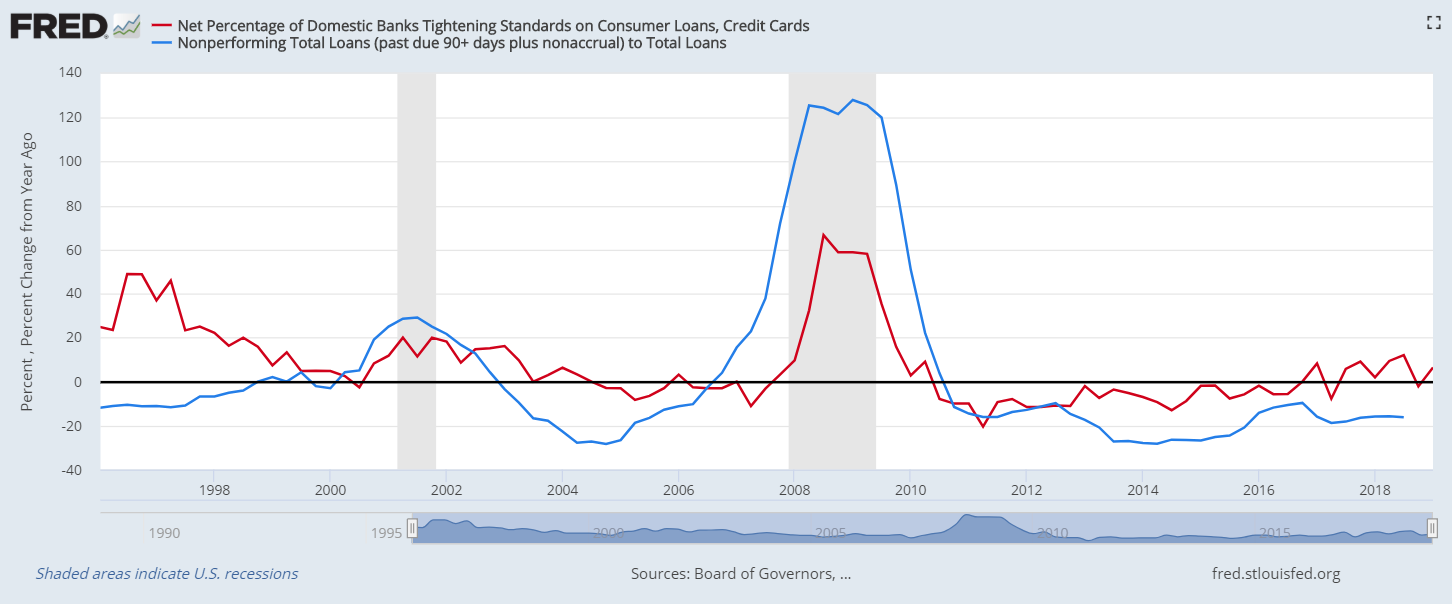
As the recovery enters its tenth year, there are signs of strain. As debtors struggle to pay their loans in a weakening economy, the percentage of non-performing loans increases.  The current rate of one percent indicates a healthy economy (Note #1). When the annual change in the rate of delinquency increases, that has been a reliable indicator that the economy is growing stagnant. Here’s a chart of the percent change in non-performing loans. A change above zero has preceded the last three recessions.

Non-PerfLoansChange

Let’s add one more series to the graph to help us understand the cycle of consumer credit. In the graph below, the red series is the percentage of banks tightening lending standards. Notice how the banks respond to a rise in delinquencies by being more selective in their credit criteria. Eventually, this tightening of credit leads to a recession. The cycle is as natural as the ocean currents that distribute heat around the planet.

NonPerfBankTighten

The financial news agency Bloomberg reports that delinquent auto loans are the highest since 2012 (Note #2). Bankrate reports that credit card debt has risen since last year. Less than half of people surveyed have emergency funds (Note #3).

December’s retail sales report, released only this week because of the government shutdown, showed a surprising decline of 1% from November. Have some consumers reached their limit? Retail sales, adjusted for inflation and population growth, does not show the strain so far. Look at the period from late 2015 through late 2016 when sales growth consistently slowed below 1%. That was a key factor that cost Hillary Clinton the election. Trump turned voter dissatisfaction into an electoral victory in the Midwest.

RetailRealAdjPop

Politicians ride to power on the anger of voters. In 1994, Republicans overcame forty years of Democratic rule in the House by promising less regulation and lower taxes in a “Contract with America.” When the Supreme Court decided the 2000 election in favor of a Republican president, they enacted tax cuts to reverse the tax increases passed by Democrats in 1993. In 2006, voters were angry with the incompetent Bush administration and reinstalled Democrats in the House.

In the depths of the Financial Crisis in 2008, Democrats rode a wave of anger, despair and hope to take the White House and command a filibuster proof majority in the Senate for the first time since the post-Watergate Congress thirty years earlier. Such a rare majority indicated that voters strongly wanted a solution to the crisis (Note #3). The Obama administration and Democratic Congress protected the financial and insurance industries while ordinary people lost their homes and their savings. The one piece of legislation that emerged from that majority was Obamacare, the bastard child of back alley compromises between mainstream Democrats and the health care industry. Few who voted for it knew what was in the bill.

In 2010, Republicans rode the anger wave of the Tea Party caucus to retake the House. With an equal number of Senate seats up for re-election, Republicans took six seats from Democrats and ended their filibuster proof majority (Note #4). In 2014, voters handed the Senate back to Republicans, then gave the reins entirely to the Republicans with the election of Donald Trump to the presidency in 2016.

In 2018, Democrats rode a wave of anger to take back control of the House. Social media campaigns whip up indignation to fan the flames of voter anger in the hopes that Democrats can at least take back the presidency in 2020. Voters may not be in enough economic distress to give Democrats control of the Senate in 2020, but it is the Republicans who have the most seats up for re-election this coming Senate cycle (Note #4).

Credit expands and contracts in a seasonal multi-year cycle. Banks are tightening in response to higher delinquencies. Will the timing of the credit cycle coincide with the 2020 election?

///////////////////////////

Notes:
1. In 2016, China, Japan and Germany had rates below 2%; the U.K. and Canada had less than 1%. On the high side, Greece had 36%; Italy had 17%, and Spain had 7%.
2. Why are so many people delinquent on auto loans? Bloomberg
3. In 1964, the Supreme Court forced the states to redistrict their state legislatures based on population changes. For fifty years, Democrats were sometimes able to forge filibuster proof Senate majorities because racist Southern states were effectively one party Democratic states. Reynolds v. Sims . Since the ratification of the 17th Amendment in 1914, Republicans have never had a filibuster proof majority
4. A third of Senators are up for election every two years so party advantage shifts with every election cycle.

GDP and Elections

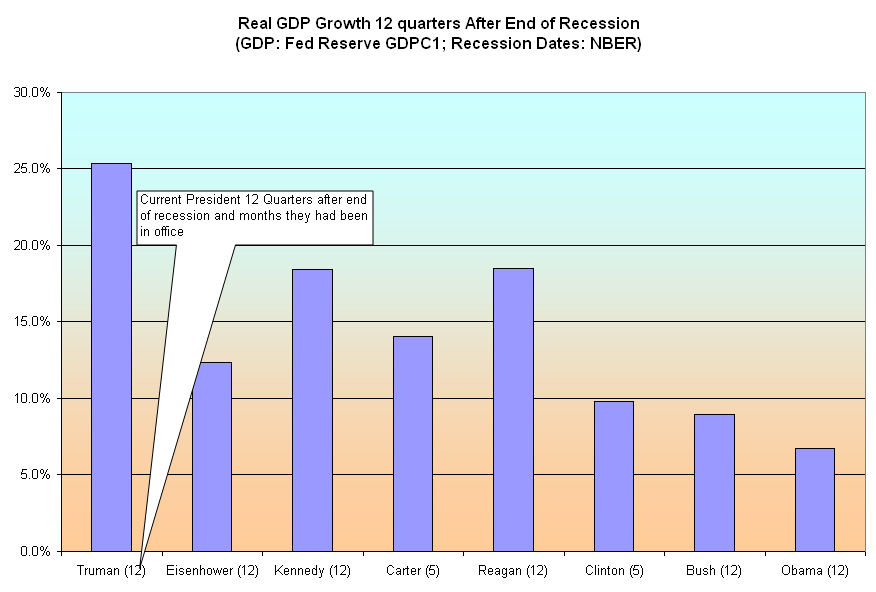
“Bummer, dude!” may be what President Obama’s election campaign manager thought when the quarterly GDP figures were released this past Friday.  Second quarter growth clocked an anemic 1.5% annualized growth rate – a tepid pace – but one which was slightly above the market consensus of 1.2%.   This first estimate of quarterly GDP growth is often revised up or down 1/2% as more data comes in (BEA Source).  Second and third revisions to the GDP growth rate will follow in August and September, but pose a challenge for any re-election campaign.  What is the pace of this recovery?  It has been three years, or 12 quarters, since the official end of the recession in the 2nd quarter of 2009.  In that time, real or inflation adjusted GDP has grown 6.7%.  What has the been the real GDP growth rate of past recoveries?  Below is a comparison of the total GDP growth of past recoveries and the Administrations in office at the 3 year mark after a recession (Click to enlarge in separate tab)

At the 3 year milestone after the 1960-61 recession, President Johnson had been in office for just two months after the assassination of Kennedy in November 1963.    At mid recovery after the long recession of 1973 – 75, Carter took over the reins from President Ford, who had taken office after Nixon resigned over the Watergate scandal.  Likewise, President Clinton took office from the first President Bush near the middle of an ongoing recovery from the recession of 1990 – 91.  In addition to the disgrace of resignation, President Nixon never enjoyed three years without a recession and so does not make it on this chart.  President Johnson has the distinction of never having a recession during his tenure in office.

Although the media and the public like to pin the economic tail on the President, the House and Senate have much more to do with the economy than the President.  Bills originate in the House (primarily) and Senate. Presidents do not initiate legislation.  Below is that same chart showing the mix of House and Senate during each recovery since WW2.

We can’t say that the strongest recoveries are when the House and Senate are the same party as the President.  We might be able to say that recoveries are strongest when Democrats are in the House, but Democrats ruled the house, except for four years in the late forties and early fifties, from 1933 through 1994 – a period of almost sixty years! (Metric Mash)  This doesn’t leave much for comparison.  We can’t say that a mixed Congress of Democrats and Republicans produces a weak recovery.  What makes this recovery unique is that, for the first time since at least 1900, the House switched parties during an economic recovery (Congressional Research Service, NBER and Metric Mash).  In the 2010 elections, anger over the health care act helped fuel a newly established Tea Party which worked within, not outside, the Republican Party and helped that party gain a large number of seats to take the majority in the house.  If history is any guide, the American public can change direction in the House during a recession, after a recovery, but not during a recovery.  The recovery plans set in place by either party need a chance to work themselves out.  To interrupt those plans in midstream produces a stalling effect.

Do the weak economic figures doom Obama’s re-election?  Not so, according to 538.  Whoa!  What’s 538?  The answer is who’s 538. And the answer to that who? is Nate Silver, a statistician who developed a system for predicting the performance of baseball players.  His methods for analyzing baseball proved to be suprisingly accurate in predicting the 2008 and 2010 elections.  After his almost perfect predictions for the 2008 electoral races and the recipient of a few awards, the NY Times licensed Mr. Silver’s blog in 2010. 

You can find Mr. Silver’s take on what the latest GDP figures mean for the election here.  Mr. Silver also has an interesting article on the primary economic indicators he thinks have the most influence on voter’s choices.  You can bookmark his blog here.