The Gravy Train

October 1, 2017

In the newly published “The High Cost of Good Intentions” author John Cogan relates a 230-year history of Federal entitlements, beginning with veterans’ pensions after the Revolutionary War. For 150 years the expansion of veterans’ benefits was prompted by budget surpluses brought on by high import tariffs. Each was targeted to a small number of soldiers who had died or become wounded during a war. Each program expanded into giant giveaways to any soldier or state militiaman and their wives.

Republicans expanded Civil War pensions to secure control of federal and state legislatures at the turn of the 20th century. Twenty years later, FDR and the Democratic Party used the same strategy of benefits to wrest control from Republicans.  First, the old system of service for benefits had to be curtailed. Like previous pension programs, benefits for WW1 veterans had been extended to those with non-service disabilities. Immediately after assuming office in 1933, FDR persuaded Congress to give him emergency authorization to alleviate the financial crisis. FDR eliminated almost a half-million veterans with non-service disabilities from the pension rolls and reduced pensions across the board. For the rest of the decade Congress tried to reinstate veteran’s benefits over the Presidential veto.

In 1934, the administration launched the New Deal, a series of programs to alleviate Depression-era hunger and unemployment. For 150 years, military service had been the prerequisite for federal benefits. Under FDR need, not service, became the primary requirement. An act of compassion quickly became a political tool that secured Democratic control at both the federal and state levels. Under the newly introduced Social Security program, a small amount of tax paid during the working years now entitled an older voter to federal pension benefits. No military service required.

For eighty years, benefit programs have become a political football. Two-thirds of the ten legislative increases to the Social Security program have occurred in election years. Today the total cost of entitlements is 60% of the $4.2 trillion in Federal spending.

If asked to list the federal entitlement programs, how many could we name? In addition to veteran’s benefits for service to the country, there are:
Income replacement programs like Social Security retirement and disability;
Income supplemental programs for poor families, such as the earned income tax credit (EITC), unemployment insurance, SSI and TANF;
Health insurance programs like Medicare and Medicaid, and the ACA’s health insurance subsidies;
Food assistance and price support programs like food stamps (SNAP) and child nutrition (WIC);
Business and individual loan guarantees and subsidized insurance programs including Sallie Mae education loans, FHA mortgage programs, and flood insurance subsidies.
This list does not include the many tax subsidies handed out by Congress.

I found that I could open this book at random and be both informed and entertained. Mr. Cogan combines an engaging narrative style and extensive research to construct an epic story of human need and greed, and the politics of pork.

I’ll turn to another book, “The Framer’s Coup” by Michael J. Klarman for some related backstory. At the Constitutional Convention in 1787, anti-Federalists objected to the “general welfare” clause of the proposed Constitution. What was to stop the Federal government from becoming a charity funded by taxes, they asked?

Nonsense, Constitutional delegates James Madison and Edmund Randolph countered, pointing to the enumerated powers in the Constitution as a restraint on the Federal government. Just as the anti-Federalists feared, the Court has long adopted a liberal interpretation of the Federal government’s enumerated powers. In the 1819 case of McCullough v. Maryland, Chief Justice Marshall set a precedent that the Congress could enact legislation that was “convenient or useful” to the exercise of its enumerated powers.  After that decision, then ex-President Madison admitted that if the Constitution had clearly stated the signers’ intention to firmly restrict the power of the Federal government, the Constitution would not have been ratified.

Turn the dial forward to the present. In the expansion of the welfare state during the 20th and 21st centuries, the Supreme Court has never found that the Federal government has exceeded its enumerated Constitutional powers. The most recent example was the Court’s finding that, under the enumerated power of taxation, the federal government could force people to buy health insurance under the ACA program.

The liberal interpretation of those two clauses – “convenient or useful” and “general welfare” – has unleashed the Federal government, whose agencies have become an omnipresent force in every American’s life. Each month, politicians in Washington take tax money from one set of voters and give benefits to another cohort of voters. Everyone  who receives benefits convinces themselves that they have paid into the system in some way. When it comes to tax money, it has always been better to receive than to give.

As the benefits to the receivers slowly exceed the taxes from the givers, there will be a crisis, and then some urgent half-baked legislative fix will be passed. I wish there was a better way.  Oh wait, I forgot.  There is a better way.  Paul Ryan, Speaker of the House, introduced the plan last year. Now that Republicans control the Presidency, Senate and House, they will fix the problem and avert a looming crisis of entitlements.  Silly me.  I can focus on the baseball finals now and stop worrying.

GDP, Profits, Inflation

December 22nd, 2013

Merry Christmas!

Last week I reviewed several decades of trends in corporate profits, as well as the 1990 change in measuring inflation that has helped increase corporate profits as a share of GDP.   (For those of you interested in the inflation controversy, here is an article that provides some additional insight.)  This week I’ll look at patterns in the economic growth of this country that sheds some light on recent events and provides some context to understand ongoing trends.

During the 30 years following World War 2, the economy grew at an annual rate of 3.7% after inflation.  Population growth was about 1% per year.  Productivity growth was about 1 – 1.5%.  Government spending, including debt, grew a bit more than 1%.  The chart below shows the compounded annual growth rate.

But I think the story is more clearly told by a different chart constructed from the same data.  The growth rate trend is more easily visible and it is the change in this trend that I will be focusing on.

During the 1970s, an economic trend known as staflation increasingly took hold. This period of high inflation, coupled with slowing growth and growing unemployment, was not thought possible by economists using theories proposed by John Maynard Keynes in the 1930s, during the Great Depression.  In 1974, economist Arthur Laffer first sketched out a theory that tax cuts would stimulate the economy.  As the Federal debt began to rise in the mid to late 1970s, few wanted to take a chance that lower tax rates would produce more revenue for the Federal Government.

The 1980s began with back to back recessions and the highest unemployment since the 1930s Depression. Big spending and tax cuts during the 1980s dramatically increased the federal debt but did little  to spur growth.

During this 13 year period, profit growth slowed to 2.4%.  The myth that the 1980s was a high growth era continues to live in the minds of political pundits.  In a WSJ op-ed on Dec. 18th, Daniel Henninger referred to “the high-growth years of the Reagan presidency.”  Myths live on because they serve a purpose to those who cherish them.  The cardinal rule of politics is “Disregard the Data.”

In 1990, economists at the BLS adopted what is called a hedonic methodology to computing the CPI.  Used by other OECD countries, this supposedly more accurate assessment of the growth of inflation shows a lower growth rate of inflation.  This naturally increases the growth rate of inflation adjusted GDP. (GDP dollars each year are divided by the inflation rate to get the real growth rate.)

The conventional narrative is that the 1990s was an explosive growth period of new technology and growing globalization.  From the beginning of 1990 to the start of 2000, stock market values grew four times.  After the bursting of the internet bubble, 9-11, and the recession of 2001, the economy recovered.  By the mid-2000s, the unemployment rate was less than 5%.  While that may be the conventional narrative, the growth of the economy from 1990 to 2007 was just as slow as the period 1978 – 1989.

Remember that this slow growth would have been even slower if the BLS had not changed their methodology for measuring inflation.  To recap, the 30 year real growth rate of GDP after WW2 was 3.7%.  The following 30 year growth rate was 2.3%.  But that later 30 period is marked by a sharp rise in consumer borrowing.   Without that escalation in borrowing, growth would have been meager.

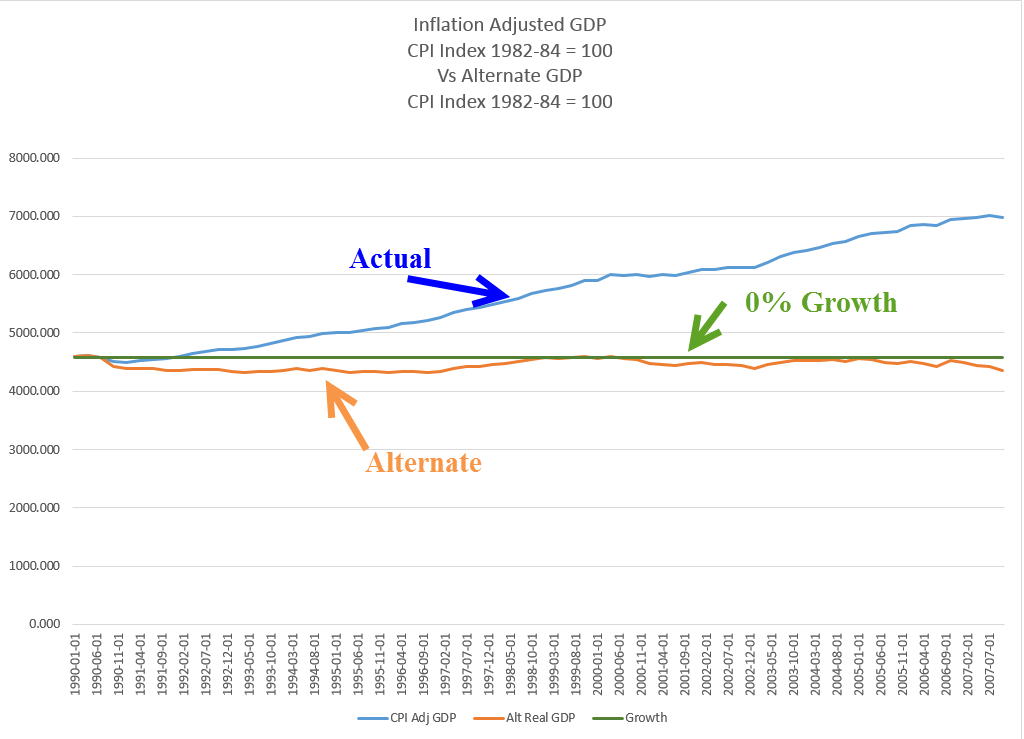
Families with two incomes borrowed against their homes, drove up the balances on their credit cards and still GDP growth was slow.  Let’s construct a fairy tale, what economists call a counterfactual.  What if the BLS had not changed to this new methodology in 1990?  What would be the growth rate of GDP using an alternate measure of inflation?

The resulting growth pattern is 0% for the 18 year period and is more consistent with the experiences of many workers and families in this economy.  The change in the measurement of inflation has greatly helped mid-size and large size companies.  An understated inflation rate reduces labor costs by reducing cost of living adjustments to salaries and wages.  In addition, companies can borrow at lower rates since many corporate bonds are tied to the inflation rate.  American companies did not engineer this revised methodology of measuring inflation but they have been the largest beneficiaries of the new policy.

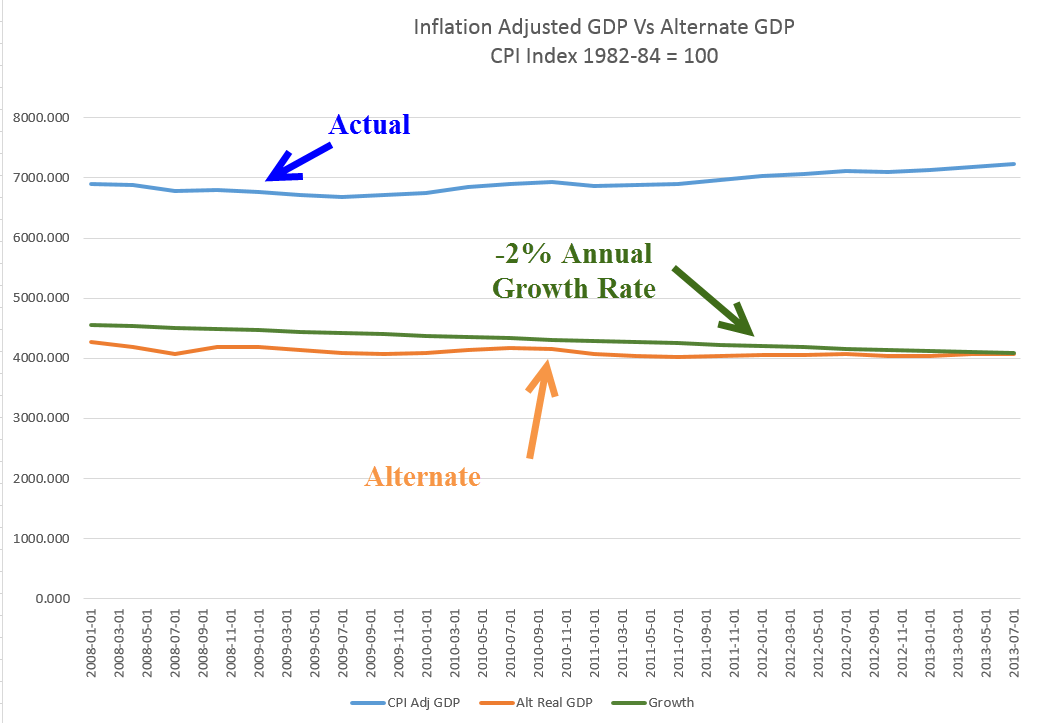
In 2008, the financial poop in the popcorn popper began to pop.  In the past 5+ years, we have experienced less than 1% real growth, not enough to keep up with population growth.  Of course, most people are wondering “what growth? It sure doesn’t feel like growth!”

The story may be told more accurately by looking once again at a comparison of inflation adjusted GDP with an alternate version of GDP, one that more realistically reflects inflationary pressures.  This chart shows a decrease of 2% per year.

Did the BLS adopt this methodology under political pressure?  Perhaps.  More likely, it was an alignment of econometric theory with political and corporate interests.  The reduction in published inflation rates did slow the growth of payments to Social Security recipients and reduced Medicare payouts to physicians and hospitals, thus shrinking budget deficits.  The government saves money, corporations make extra money, but – quietly and slowly – families lose money.

Annual cost of living adjustments to Social Security checks have been reduced but the decreased income has forced more seniors to seek assistance through the food stamp program, now called SNAP.  A politically neutral change in the measurement of inflation thus becomes a way for politicians to introduce a means testing component to Social Security income.  Instead of reducing payments based on income, payments are reduced to all recipients and poor seniors are targeted for additional benefits.  Congress has increased eligibility for the food stamp program so that seniors who are dependent on that extra income can receive it in the form of food stamps.  If the BLS had not changed their methodology, seniors would receive appoximately 60% more each month and many wouldn’t need the food stamps in the first place.

With this history in mind, let’s turn to this week’s revisions of GDP and corporate profits for the third quarter ending in September.  The real, or inflation-adjusted, growth of 3rd quarter GDP was raised to a 4.1% annualized growth rate in the third quarter, largely on upward revisions of consumer spending.  Contributing to stronger GDP growth has been a worrisome increase in company inventories, which probably influenced the Federal Reserve’s decision this week to keep any tapering of their QE bond purchases to a minimum.

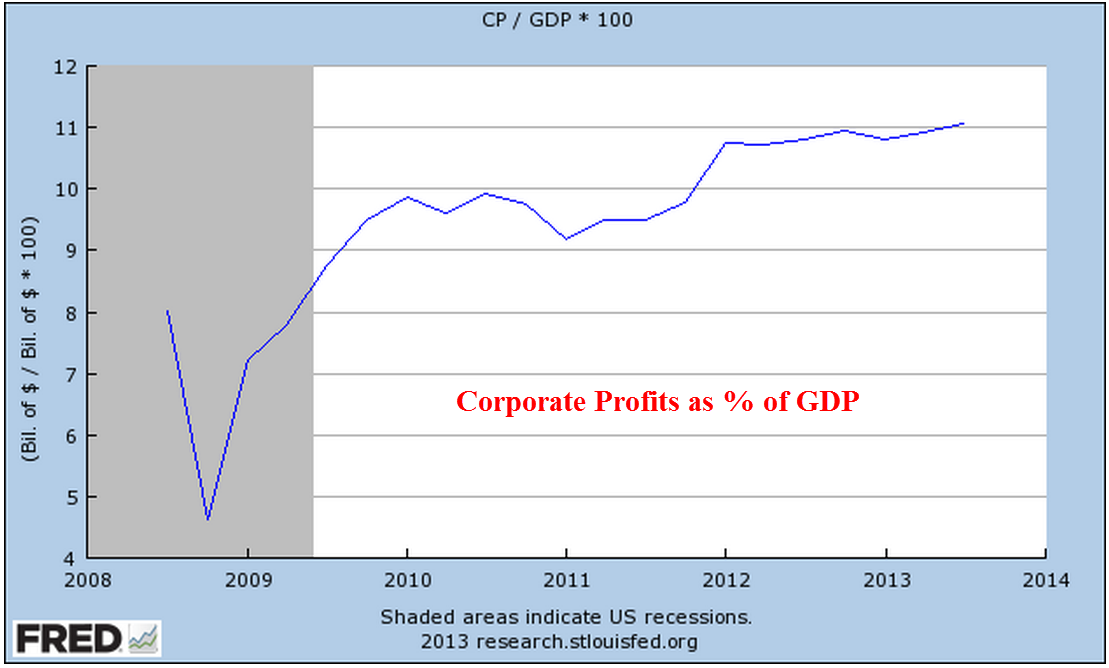
Corporate profits for the third quarter were revised higher as well.  As a share of GDP, corporate profits continue to reach all time highs.

How likely is it that economists at the BLS will change their methodology to reflect inflationary pressures before we make choices in response to rising prices?  The subject is not easily encapsulated in a sound bite or a short slogan on a placard.  In the 1992 presidential race, independent candidate Ross Pierot was able to use charts to make a point with many voters but few politicians are very good at the easel and unlikely to bring up the subject in the public forum.  Families and workers will continue to suffer and politicians will create more social benefit programs to help those hurt by problems that politicians themselves have either created or failed to address.  Large and mid sized businesses will continue to enjoy the additional slice of pie.