Immigration and Employers

Previously, I reviewed some of the provisions relating to illegal immigrants in Arizona’s recently signed immigration law 1070.  Today, I’ll review several items in the law relating to employers.

In the past few years, employers have been subject to a number of recent state initiatives to ensure that they are not hiring illegal workers.  Morgan, Lewis and Bockius, an international law firm, recently released a report detailing state immigration laws as they apply to employers. In recent years,  Congress has failed to enact clear immigration standards. Many states have enacted laws which specify employer responsibilities under federal immigration guidelines and give state officials and agencies clear authority to ensure employer adherence to Federal law.

The recently passed Arizona immigration law 1070 codifies into state law some specific details that would be in accord with Federal law and state penalties for anyone violating the law.  Many laws have two key features: the granting of authority, and the specification of penalties.  In short, power and money.

Section 5, paragraph A of the new Arizona immigration law 1070 makes it illegal for anyone to stop and hire people on the street but only if the motor vehicle “blocks or impedes the normal movement of traffic.”  Most cities have several locations where people of all types, both legal and illegal, can gather for day labor.  A contractor or homeowner pulls up, picks out as many people as they need who typically hop in the contractor’s or homeowner’s pickup or van and drive off to the job site.   As long as the contractor or homeowner pulls over to the curb and gets out of the flow of traffic, it is still legal in Arizona to hire people off the street, as long as they are legally allowed to work in the U.S.  More importantly, it gives a police officer authority to do more than simply give someone a traffic ticket for obstructing traffic when the police officer is well aware that there is a good chance that immigration laws are being violated. 

Section C make it specifically illegal for any illegal immigrant to “solicit work in a public place”.  Included in the  conventional legal definition of a public place is that it can be either public or private property.  This section of the law specifically prohibits illegal immigrants from soliciting work at a home improvement center.  More importantly, it gives police officers a clear legal authority on publicly accessible private property.  However, this section of the law does not explicitly prohibit a homeowner from hiring an illegal immigrant at a home improvement center.  That is contained in Section 6.

Most homeowners do not consider themselves to be an employer when they hire someone for a few hours.  A  definition of an employer is “A person or business who pays a wage or fixed payment to other person(s) in exchange for the services of such persons.” (http://www.lectlaw.com/def/e010.htm)

Section 6 prohibits an employer from “knowingly” employing an unauthorized alien.  That one word may protect a homeowner but it provides little protection for employers who are often held to a higher standard. Unlike other state laws, Arizona has at least specified in Section 6, paragraph I, what is clear evidence that an employer has not “knowingly” hired an unauthorized worker:  that the employer has used the Federal e-verify program to check the employee’s lawful status. Paragraph J provides the more usual non-specific protections found in law that an employer can “[establish] that it has complied in good faith” with the requirement of law.

Paragraph A of Section 6 also makes employers responsible for the legal status of any subcontractor’s workers.  Again, there is that legal keyword “knowingly”.  From my reading of the text, the general prohibitions largely follow existing federal guidelines but with specific penalties and forfeitures that convey the message loud and clear to employers, especially construction contractors, that Arizona means business when it comes to enforcement of immigration law.

Paragraph K and L of Section 6 details an employer’s affirmative defense of entrapment by law enforcement but the details are contradictory.  To establish entrapment, it is the burden of the employer to prove that law enforcement officers “urged and induced” (K3) the employer to commit a violation and that the employer was not already “predisposed” (L) to violate the law. Without a mind reading device, how does an employer prove that they were not “predisposed” to violate the law?  The employer must convince the court that the “idea of committing the violation” (K1) must have started with law enforcement.  Like other provisions of this law, the intent is to empower law enforcement, not protection of anyone’s rights, including employers.

Section 7 contains some rather severe penalties for Arizona employers who violate Arizona immigration law. Some are quite appropriate: an offending employer is ordered to terminate all other unauthorized aliens in its employ.   The more severe ones are found in paragraph F:  On the first violation, an employer has all its business licenses suspended for at least 10 days.  A second violation results in permanent revocation of all licenses (F2), essentially putting many offending employers out of business.

Arizona’s message to employers: WE MEAN BUSINESS.

Immigration Law

You can find lots of opinion about Arizona’s new immigration law, SB1070.  If you would like to form your own opinion, here is the text of the law.

Section 2 of the new law is getting a lot of attention and I’ll look at that today.  Subsequently, I’ll look at the impact on employers,as well as the general public, detailed in Sections 5 through 8 of the new bill.
  
Arizona Statutes, Title 11 is amended with Article 8. Section A of this article states (original text is all caps): “NO OFFICIAL OR AGENCY OF THIS STATE OR A COUNTY, CITY, TOWN OR OTHER POLITICAL SUBDIVISION OF THIS STATE MAY ADOPT A POLICY THAT LIMITS OR  RESTRICTS THE ENFORCEMENT OF FEDERAL IMMIGRATION LAWS TO LESS THAN THE FULL  EXTENT PERMITTED BY FEDERAL LAW.”  This section is aimed to prevent any city in Arizona from adopting a “sanctuary city” immigration policy.  Phoenix, AZ has adopted such a policy.  You can read a short history of sanctuary cities at Wikipedia.

Section B reads (highlights are mine): FOR ANY LAWFUL CONTACT MADE BY A LAW ENFORCEMENT OFFICIAL OR AGENCY OF THIS STATE OR A COUNTY, CITY, TOWN OR OTHER POLITICAL SUBDIVISION OF THIS STATE WHERE REASONABLE SUSPICION EXISTS THAT THE PERSON IS AN ALIEN WHO IS UNLAWFULLY PRESENT IN THE UNITED STATES, A REASONABLE ATTEMPT SHALL BE MADE, WHEN PRACTICABLE, TO DETERMINE THE IMMIGRATION STATUS OF THE PERSON. THE PERSON’S IMMIGRATION STATUS SHALL BE VERIFIED WITH THE FEDERAL GOVERNMENT PURSUANT TO 8 UNITED STATES CODE SECTION 1373(c).”  What is a lawful contact?  It is undefined by  Arizona state law but it could reasonably be construed to include people suspected of any minor infraction as well as witnesses to a crime or misdemeansor, or any person asking for help from a police officer.  What is “reasonable suspicion”?  In a 1968 case, Terry v. Ohio, the U.S. Supreme Court ruled that suspicion must be based on “specific and articulable facts” and not just a hunch.  In New York City at that time, the police had reasonable suspicion to stop and frisk a male  with long hair. I was one of many who endured these friskings while walking down the street or about to get on the subway.

Sections C, D, E concern the transfer and transport to federal custody of those who can not prove their immigration or citizenship status.  Paragraph F authorizes local and state communications with Federal agencies.

Section G reads in part (highlights are mine):  A PERSON MAY BRING AN ACTION IN SUPERIOR COURT TO CHALLENGE ANY OFFICIAL OR AGENCY OF THIS STATE OR A COUNTY, CITY, TOWN OR OTHER POLITICAL SUBDIVISION OF THIS STATE THAT ADOPTS OR IMPLEMENTS A POLICY THAT LIMITS OR RESTRICTS THE ENFORCEMENT OF FEDERAL IMMIGRATION LAWS TO LESS THAN THE FULL EXTENT PERMITTED BY FEDERAL LAW. The initial words of this section, “A person”, does not limit challenges to Arizona residents.  Anyone anywhere can file a challenge against the state of Arizona, a city or town in the state, and, if successful, the law requires that the state, city or town pay the court and attorney fees of the person bringing the action. (Paragraph G, Subsection 1)

Section I indemnifies police officers from any costs resulting from a judgment.

Tomorrow, I’ll look at how Sections 5 – 8 of this law affect homeowners and small employers in Arizona

Playing House

 NPR radio recently featured a show on Magnetar, a hedge fund that bought CDOs on mortgage backed securities (MBS).  For an in depth look at the MBS and CDO creation process and a clear, simple explanation of what a tranche is, you can can read the several part article at Pro Publica’s web site.

March Unemployment

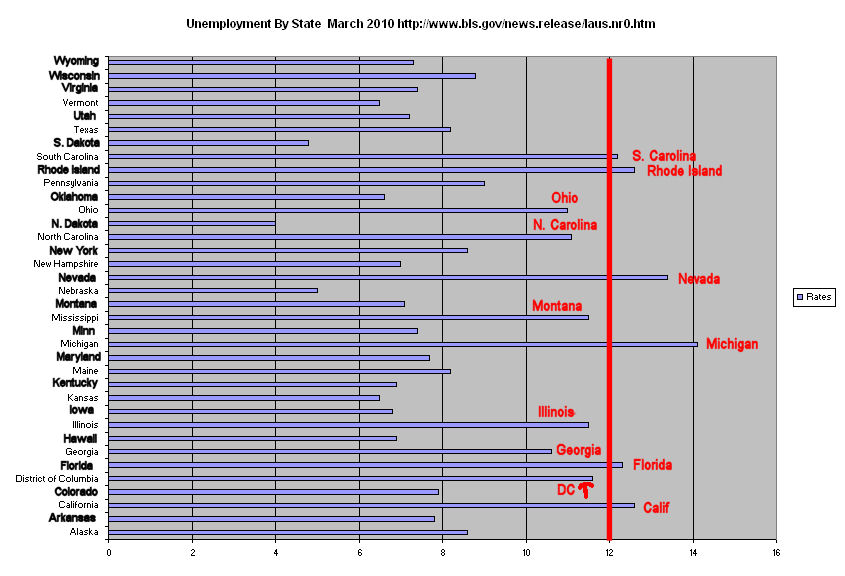
A few days ago, the Bureau of Labor Statistics (BLS) released their state by state unemployment report for March and it is uglier than the proverbial junkyard dog.  The stock market is only 8% below its level of 3 years ago, before the loss of over 8 million jobs.  If you live in one of the worst hit states – California, Nevada, Michigan, Florida, Rhode Island and S. Carolina – the real unemployment, or U6 rate, is probably over 20%.  That rate includes people working part time because they can’t find a full time job and those who have given up looking.  Here’s the ugly picture based on data from the BLS.  Click to enlarge.

Consumer Price Index

The Consumer Price Index is a yardstick of changes in everyday expenses. It is used to recalculate Social Security payments each year and governs a wide range of employment and union contracts, affecting the paychecks of millions of Americans. 

How it is measured is a source of disagreement among economists.  The task of trying to replicate the buying habits of a country is difficult, almost as difficult as picking a winning bracket in the NCAA basketball tournament.  There are a number of CPI measures but the CPI-W is the one most widely quoted.  This index aims to replicate the cost of living for urban wage earners and clerical workers.  Even though many seniors are not working, the cost of living adjustment (COLA) for their Social Security check is based on this index.  Since the 1980s there has been a separate index, the CPI-E, that more accurately reflects costs for seniors, but it has not been adopted for one simple reason – cost.  Rising health care and housing costs for seniors make this index about 1% higher than the commonly used CPI-W.  

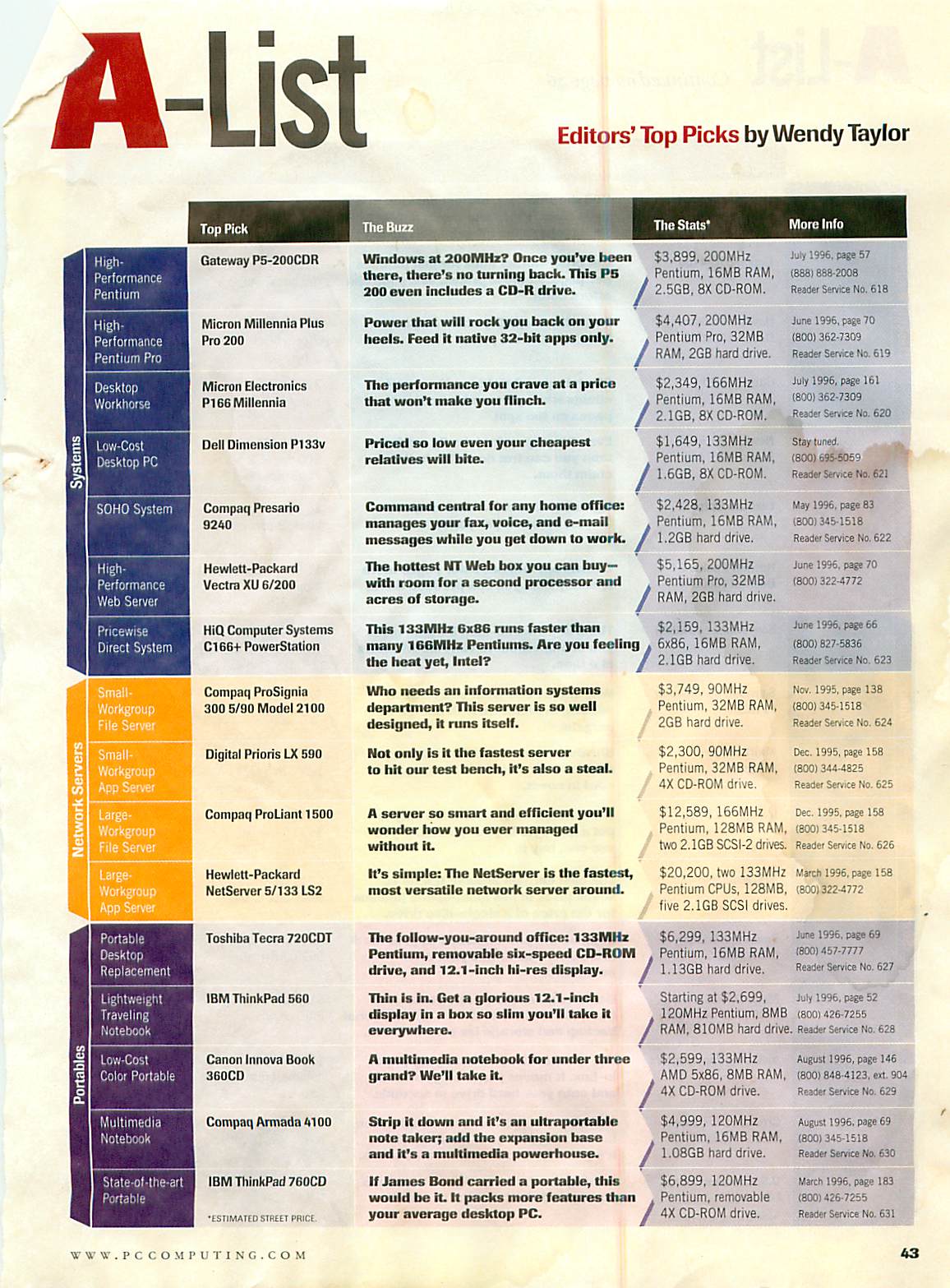
Although the index includes computer software and accessories, the cost of computers themselves do not seem to be covered.  That cost has dropped dramatically.  As I was cleaning out some files, I came across this nugget of nostalgia from a computer magazine in 1996.  Below you will see a “Desktop Workhorse” probably designed for a small businessperson and priced at over $2300 for a computer that is 1/10th as powerful as a cheap $500 computer today. (Click to enlarge)

Federal Deficit Solution

This year’s federal deficit will be about 10% of GDP.  Let’s put that figure in perspective.  Since World War 2, there have only been three or four years that the deficit has exceeded 5% of GDP.  Former Vice-President Dick Cheney famously said that “deficits don’t matter” but they do – for governments, for companies, for individuals. 

States have employed lotteries to fund a number of programs, including education and state parks.  The federal government should have a lottery to help pay off the deficit.  The prize?  A 10 year holiday from federal income taxes for 50,000 winners.  High income earners would buy a lot of lottery tickets, paying back the $2 trillion in tax cuts that they were awarded in 2003.  If 146 million U.S. taxpayers bought just one $99 ticket, that would raise $14 billion less expenses. How many tickets would you buy to get a 10 year reprieve from federal income taxes?  The federal government could “kick the can down the road”, forsaking some future tax revenues for some instant revenue. 

Although high income earners would benefit the most by winning, the lottery would generate sales among those of all income classes.  Lottery tickets would have to be tied to an individual’s social security number to prevent a secondary market of buying and selling of tickets.

The federal government could sell broadcast rights to the prime time night of the lottery drawing , thus earning additional revenue.  The number of viewers would probably exceed that of any Super Bowl, presenting a bonanza opportunity for networks to sell premium advertising time. 

If we are going to have big government, let’s have smart government.  Let’s have fun government.

Rocky Mountain Low

As expected, Colorado announced this past week that the unemployment fund is broke and the state will borrow money from the Feds to continue paying claims. Colorado joins 25 other states who have had to borrow money from the Federal government. The loans are interest free for this year.

The national picture is grim. In the past two years, the construction industry has shed 1.6 million jobs, more than 20% of the total jobs lost in all industries. The finance sector has lost 548,000 jobs since December 2007, about 7% of it’s workforce. Office and administrative workers have thinned by 10.1%.

After going broke in the 1980s, Colorado instituted some actuarial changes to strengthen its unemployment fund and started the recession with a seemingly fat cushion of almost $700 million. In the middle of this decade, I was one of many employers who grumbled at paying a “solvency tax surcharge” to meet these more stringent guidelines for the unemployment fund’s reserves. In a 2008 report, the National Employment Law Project rated Colorado as one of 20 states with adequate reserves capable of paying at least 24 months of unemployment benefits. Colorado had actually improved since a 2007 assessment that included Colorado as one of eight states that would have financial difficulty in case of moderate or severe recession.

After several extensions of benefits mandated by the Congress, unemployment benefits now exceed a year in many states, more than double the normal 26 week limit. Designed to provide a temporary safety cushion for unemployed workers, they have become a welfare program under a different name.

Knowing that unemployment tax rates will likely double or even triple in the hard hit construction industries, employers are reluctant to take on new employees unless they are very sure of an upturn in business. Already saddled with high workmen’s compensation rates, an increase in unemployment taxes just piles on more of a cost burden on employers in this sector of the economy. Expect a slow job recovery.

Forecast: Clearing

In forecasting future company profits, there are two Ouija boards and each board comes up with different results.

On the first Ouija board, equity analysts put their hands on the triangular platen and divine the future profits of each company they cover. All the results are then added up for a total “bottom up” forecast for earnings of the S&P 500. For 2010, the analyst Ouija board spelled out $77.54 in profits, a 30% increase over 2009.

On the other Ouija board, a bunch of economists put their fingers on the platen and foretell future profits. This is termed a “top-down” forecast. The economist board says $72.52. This small $5 difference in the two forecasts – a year ago the difference was $40 – is a good indicator of greater clarity looking forward, and a more stable market.

Total Place

Here’s an idea from Britain that American taxpayers might want to adopt. In a 9/2/09 Financial Times article, Nicholas Timmins, the public policy editor, summarizes a concept called Total Place, a comprehensive analysis that adds up all the public money spent in a region. In Britain, the results of two pilot studies has raised some eyebrows and led to the call for several more studies.

In the U.S., the Census Bureau maintains statistics on the amount of funds that state sends to and gets from the Federal Government. But there is no comprehensive analysis of total Federal, State and local public spending. Would we find the same disparities in per capita spending in regions of similar population density and how would we react if there were striking differences?

Lower Taxes

Want lower income taxes and national health insurance? Move to Britain. As this chart shows, income tax and health insurance takes about 30% of a paycheck in Britain. But wait.. Don’t book your flight to Britain yet. There is also a 17.5% VAT tax (Ouch!), a sales tax on many goods and services, but food and children’s clothing is exempt from the tax.

Here in the good ole U.S.A, about 9.9% goes to state and local taxes, as reported by the Tax Foundation. Keep that in mind the next time you read or hear someone say “half of the population pays no tax”. What they mean is that approximately half of the population pays little or no Federal income tax. Social Security and Medicare tax take a 15% bite (as an employer, I can assure you that the employee pays the company half of the Social Security tax in reduced wages). Add in 10% for state and local taxes and a quarter is gone out of every dollar earned, before the Feds take their share. If you are a breathing adult, you’re probably a taxpayer.

A state by state comparison of median income from the Kaiser Family Foundation shows some surprising data. There are a number of other comparisons at this site.