
June 15, 2025
By Stephen Stofka
Happy Father’s Day to the Dads out there. Even though it is Father’s Day, Cain and Abel have their usual Sunday breakfast together.
This is part of a series on persistent problems. The conversations are voiced by Abel, a Wilsonian with a faith that government can ameliorate social and economic injustices to improve society’s welfare, and Cain, who believes that individual autonomy, the free market and the price system promote the greatest good.
Abel settled down in his seat opposite Cain. “There is so much that is happening every week, it’s hard to keep up with it. LA demonstrations, the troops being called out in addition to the guard.”
Cain adjusted the window blinds to reduce the sunlight. “Yeah, there were ICE agents running after migrants in the field in the Central Valley. Imagine having all that gear on and running around in 90 degree heat. But, the farmers were complaining. About 40% of their workers are illegal (Source). Imagine if the crops rot in the ground and voters find empty vegetable displays at the grocery store. On Friday, Trump announced that ICE would no longer target farm workers (Source).”
Abel shook his head. “A 12-year old was left alone when his parents were grabbed and taken away (Source). Talk about a rotten Father’s Day. Then Trump made up some B.S. that criminals who were let in by Biden were applying for the jobs left vacant by the farm workers.”
Cain nodded. “The real battle in this country is between the moderates on either side of the political aisle and the nutjobs on the left and right wings. When I heard that the radical lefties had called Waymo taxis, then lit them on fire, I wondered if I was in a Twilight Zone episode (Source).”
Abel smirked. “Playing right into the hands of the MAGA crowd and the nutjob in the White House.”
Cain chuckled. “I don’t know if Trump is a nutjob. Remember, he outcompeted sixteen rivals in the 2016 race.”
Abel sighed. “It’s the primary voters in either party who are the extremists.”
Cain raised his eyebrows. “Another change ushered in by the Democratic reformists in 1972 (Source). A primary system would let the voters speak. Yeah, right. Often, it’s less than a quarter of eligible voters that turn out for a primary.”
Abel argued, “Wait, so it’s only wackos that vote in primaries? I vote in them.”
Cain made an equivocating hand gesture. “I didn’t say only wackos voted in primaries. But, they are a greater percentage of the small primary turnout. They influence primaries and each party caters to their interests and perspectives. The parties have drifted to the extremes in the past decades.”
Abel sighed. “Ok, let’s call them motivated voters spurred on by interest groups.”
Cain laughed. “You can call them that. I’ll call them wackos. Anyway, back to Trump. He reminds me of the Mule in Asimov’s Foundation series. A person who can control the emotions of others.”
Abel smiled. “Asimov was one of my favorite authors. I loved the Foundation series, the robot books. What, you think Trump is a mutant? I mean, that was science fiction.”
Cain looked into the distance for a moment. “He has a singular personality that draws some people. Do I think he has some emotional telepathic power like the Mule? No. But remember that the Mule assumed the guise of a clown to infiltrate the Foundation, then take it over. A lot of mainstream Republicans looked at Trump as a political buffoon in the 2016 race. He’s taken over the Republican Party just like the Mule did the Foundation.”
Abel raised an eyebrow. “Magnifico was the name the Mule assumed? Some hyperbole there. That’s Trump’s favorite tool.”
Cain nodded. “Magnifico Giganticus. I had to look it up a while ago when the similarity struck me. Physically, there’s little resemblance between Trump and the Mule.”
Abel replied, “In Asimov’s story, he was the anomaly that psycho-historians could not foresee. God, that was great stuff to read when I was a teen.”
Cain smiled. “I remember hearing that Paul Krugman loved the series as well. He said that the whole idea of psychohistory made him interested in studying economics (Source).”
Abel laughed. “If only economists had as much accuracy as the predictions of the psycho-historians. A hologram of Hari Seldon would appear at crisis moments. With his mathematics of history, he had been able to predict when a galactic crisis would occur, so he pre-recorded them before his death.”
Cain mused, “He couldn’t predict the Mule, though. That shook everyone’s faith in Seldon’s wisdom. The Democrats must be feeling like that about now.”
Abel frowned. “The second President in history to be elected in two non-consecutive elections. Cleveland was the first (Source). Until the 2024 election season, I didn’t think anyone had done that before. It’s funny. We had to memorize a succession of Presidents in grade school, but they were just names to me.”
Cain nodded. “Yeah, we often don’t appreciate the story of history until we’re older. I hated all that memorization when I was a kid, but it was good training for our brains.”
Abel sighed. “I get down on some of the kids working in stores because it seems like they can’t remember stuff. They gotta look up everything on their phone or the information gadget that the store gives them. Then, this week, I’m at Home Depot and ask this guy in his mid-twenties for something and he tells me the aisle and the location on the shelf.”
Cain chuckled. “Why do we stereotype people? Saves us time and effort, I suppose. It’s like we have a little theater, a Punch and Judy show playing in our brains. ‘Here’s how the world works,’ we say. People become characters in our internal play.”
Abel set his fork down. “Hey, talk about stereotypes. I meant to tell you about the American Communities Project. They classify the thousands of counties in this country into 15 groups. They have a color-coded interactive map so people can locate their local community (Source). This guy, Michael Bahareen, at The Liberal Patriot on Substack wrote three posts about the characteristics of each group (Source).”
Cain asked, “How do they distinguish the different groups?”
Abel replied, “Voting patterns, that’s one. Their ages, ethnicity, population, dominant industry and values. A lot of data that the Census Bureau gathers every year. Some of the data surprised me. Some didn’t. Like Native American Lands. I knew that the Indians struggled with poverty. I was surprised that counties classed as ‘Working Class Country’ had incomes that were just a few thousand dollars higher than people in Indian country.”
Cain asked, “Where are those counties?”
Abel shrugged. “Funny. All of them except one are in the eastern half of the country. Rural counties in Arkansas, West Virgina, eastern Oklahoma. In the past twenty years, those counties have become solid Republican.”
Cain argued, “So you were surprised at their low incomes? Their cost of living is a lot lower too (Source). I wish these government agencies would quote household incomes in terms of living costs.”
Abel interrupted, “Yeah, but there are a lot of things that don’t have local prices. Like life insurance, computers, cars.”
Cain agreed, “Ok, good point, but local pricing plays a huge part in a family’s finances. Let’s say a family makes $120,000 a year in Los Angeles. They might be paying $60,000 a year in housing costs. That’s $5,000 a month. Heck, it’s 50% of their income. Their income tax bite is higher than the family living in rural Arkansas or Missouri. Let’s say that family makes only $52,000 a year, but their housing costs are $12,000. Which family is more stressed out? The LA family. One of them loses their job and they can’t sleep at night.”
Abel nodded. “Ok, I get your point. But families in urban areas classified as Big Cities are generally healthier than those in Working Class Country. So why is that?”
Cain said, “Probably a lot to do with access to health care. I don’t know. I just wish we had data that allows us to do a better job at comparing incomes and living costs. Your point about computers and cars prices. An F-150 pickup starts at like $40,000 (Source). That’s like nine months of income for someone working in rural Oklahoma, but only five months for someone in L.A.”
Abel interrupted, “So housing costs might be a lot lower in rural areas, but not autos. Do you think that accounts for the political silos in this country? We talked about that last week, I think. Rural people and urban people live in different worlds in a lot of ways.”
Cain nodded. “Sure. Why is that pickup so expensive? Because of environmental and safety rules that the people in big cities voted for. The guy in Podunk, Oklahoma doesn’t want to pay for all that stuff but has no choice. Ford can’t build pickups without all those controls. Naturally, the guy in Oklahoma resents the voters in the big cities. Their priorities dominate and limit his choices and how he spends his money. Is that fair? No, of course not.”
Abel argued, “Well, you claim that the price system can allocate resources. Let’s say we got rid of mandates for environmental and safety controls. Would Ford build a new pickup for $25,000? Is there enough profit for the car manufacturer and dealer at that price? Probably not. What if we undid all the safety regulations? No more air bags or cars designed to absorb the impact of collision. Get rid of all those environmental controls while we are at it. What if you are wrong? Highway deaths skyrocket. Pollution in American cities starts to look like China cities. No one can see through the fog.”
Cain looked over his glasses at Abel. “You done? I’m not proposing anything that radical. I’m saying that we have enough car mandates. If people want air bags, they can pay for them. Let people decide. Let the car makers decide. We don’t need fat cats in Washington forcing their ideologies and priorities on us.”
Abel smirked. “We need some uniformity. Sure, this a diverse country. Geographically, culturally. That’s always been a challenge in this country. But the whole point of the Constitution was a bedrock of uniform laws that would apply to everyone.”
Cain replied, “Yeah, a bedrock, a foundation. The Constitution is only a few pages long. Why? Because the states were supposed to do the bulk of the lawmaking. What do we have now? Lawmakers in Washington, particularly the Democrats, want to keep imposing uniform regulations on all the states. Circumstances are not uniform. Incomes and cost-of-living standards are not uniform. Democratic politicians just don’t get that anymore. They look down on rural counties as they fly from the coast-to-coast. In the 2016 campaign, Clinton called them a ‘basket of deplorables‘ (Source).”
Abel shrugged. “That was just plain stupid politicking. Romney made the same mistake in the 2012 election campaign with his remark that 47% of people voted Democrat because they were dependent on government (Source). I mean, politics is mostly performance, not policy. Stupid remarks are bad performance, but not policy.”
Cain argued, “I agree with you about performance. A bunch of peacocks puffing up their tails.” Abel snorted with laughter and Cain paused. “You all right?”
Abel took a moment. “I started laughing while swallowing. I got this picture of the aristocracy in the French court dressed up in their frills and powdered wigs.”
Cain smiled. “That’s how it seems to working class people and farmers in rural counties. All those mandates. It’s disrespectful, disdainful.”
Abel argued, “A lot of regs are meant to address serious concerns that affect a lot of people. I mean, automobile fatalities averaged 36,000 per year in the 2010s (Source). That was the same as in the 1950s, even though the population doubled. Yeah, those safety features cost money but they save a lot of lives. I mean, I get your point that mandates have a disparate impact on some folks in lower income counties, but this doesn’t help your argument.”
Cain asked, “What about environmental controls? Those mandates addressed the concerns of people in urban areas. People living in a county with fewer than 10,000 people are going to be more concerned with the cost of emission controls, not the effect of those controls.”
Abel sighed. “Look, everyone has a right to breathe fresh air. Lawmakers couldn’t let automakers build two different sets of cars. Those with controls. Those without. I mean, people would just go to a rural county, buy a car without controls and drive it back to the city where they lived. How are the cops going to tell the difference? Cars need uniform laws set in Washington.”
Cain shook his head. “There could be different license plates. Boom. Someone driving a car without controls in a county that requires them gets pulled over by the cops and their vehicle impounded.”
Abel sighed. “People with low incomes are going to get hit the worst by that policy. What if some farmer in a rural county wants to visit his family in the city? Let’s say his car doesn’t have controls. What is he supposed to do? Rent a car? I know you’re into local autonomy, but this just isn’t suited to it.”
Cain settled back in his seat. “We got by for decades without all these mandates and controls. Then the Democrats started to rewrite all the rules in the 1960s. The Big Daddy economy. Johnson’s Great Society, Medicare, Medicaid and a bunch of rules dictating production decisions.”
Abel argued, “Remember, for the first half of the century, there were a lot more car manufacturers. Wait, hold on a minute. I took a screenshot of a chart about a week ago. Here it is.
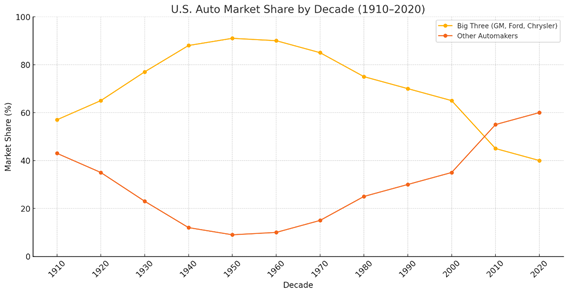
Abel continued, “The dominance of the Big Three was already starting to decline in the 1960s and 1970s. It wasn’t the new mandates but foreign competition coming into the U.S. market.”
Cain whistled softly as he looked at the chart. “I didn’t realize that the majority of cars on the road are now foreign brands.”
Abel interrupted, “Some might be Teslas.”
Cain nodded. “Right. But this shows why a lot of people want to bring manufacturing back to the U.S. What got you into this?”
Abel replied, “I was sitting in traffic and noticed that there were no American brand cars around me. I wondered if that was a trend.”
Cain shook is head. “Our economy is too open to foreign competition, if you ask me.”
Abel argued, “America’s dominance in manufacturing was just the post-war period. The war crippled the industries of Europe and Japan. As they recovered, they began to compete with American autos. My daughter drove a used Honda Civic for like ten years when she was younger. Hardly any repairs. What American car in the 1990s could make a claim like that?”
Cain replied, “Dodge Dart. Slant-6 engine. I drove that thing for over 200,000 miles without putting much money into it. Well, we got to do something. There’s too much difference in incomes between the urban areas and rural counties.”
Abel argued, “A revival in manufacturing won’t help these rural areas. Manufacturing needs supply chains, good roads that are built for truck traffic and well maintained. Infrastructure like cable and fiber. That’s the stuff Biden wanted to build, and Trump wants to cancel.”
Cain looked through the steam rising from his coffee cup. “Well, government is not too efficient at building stuff. They are good at shuffling ones and zeroes, taking money from one person and giving it to someone else. There should have been better incentives for private companies to build infrastructure. More fiber optic in rural areas, for example.”
Abel frowned. “Rural counties with older populations, what ACP categorizes as ‘Graying America,’ make up a small percentage of voters, about 5%, according to the analysis at ACP (Source). Political advertising may pay them lip service and feature them in videos, but they don’t have much power. You talked about counties with less than 10,000 people. That’s like less than a quarter of the counties and less than 2% of the population (Source).”
Cain argued, “I want to look at the research this American Communities Project is doing. It seems to me that there’s like a $25,000 to $30,000 difference in incomes between rural and urban areas. Rural counties are becoming like second or third-world countries. They don’t like it.”
Abel nodded. “I know. Their kids are leaving for better opportunities in more populous areas. I don’t know what the solution is. Democrats have come up with needs based programs to help lower income families in urban areas, but they have ignored rural areas. Of course, Social Security is progressive and that helps older people in rural counties. They earn lower incomes and get proportionately higher benefits. Their Social Security income goes a long way in a rural area.”
Cain interrupted, “It’s not that progressive. Besides, they don’t have easy access to doctors or dentists.”
Abel shrugged. “Right. There’s not enough to attract young talent the way urban areas do. Local autonomy may have suited an 18th century economy based on farming and primitive means of travel. Urban areas permit more connections between goods and services, between people and institutions. Rural communities just don’t.”
Cain argued, “Come on. Rural communities are all about connections.”
Abel replied, “Yeah, among themselves, but not so much with other communities. Look, our society, our economy, it gets more multi-layered. Urban areas have the depth and scope to accommodate that complexity.”
Cain asked, “Well, for all that complexity, we still have to eat. Who is going to grow and harvest our food?”
Abel shrugged. “Robots. Tractors and harvesters become more automated every year. There’s a show called “Clarkson’s Farm” on Amazon Prime, I think. Jeremy Clarkson is big into cars. He did some worldwide tour. He writes. He’s a presenter. Anyway, he decided to take up farming. Great show if you haven’t seen it. Fourth season just finished, I think. Boy, the sophistication of these tractors and harvesters is amazing. That trend will continue.”
Cain asked, “You think AI agents will be driving tractors?”
Abel nodded. “Sure, they’ve already got GPS in these machines.”
Cain argued, “Yeah, but you still need people to repair the machines, to muck out the stalls, whatever else they do on a farm.”
Abel replied, “Robots are picking orders at Amazon (Source). Humans are still doing the packing. It’s happening everywhere.”
Cain laid his napkin on the table next to his plate. “It’s sad. There are already a lot of small farming towns that have too many closed up stores. It’s not just the destruction of capital in a big tech company. I mean, that’s part of progress. It’s the demise of those communities, their social relationships, their religious and cultural institutions.”
Abel sighed. “Ghost towns. Gold and silver mining towns are tourist attractions, a page in history. One day, people may visit main streets in small town, America, and gawk at mom and pop grocery and hardware stores.”
Cain slid out of his seat. “That’s an uncomfortable thought. Well, I gotta go. Something to think about.”
Abel smiled. “Ok, see you next week.”
////////////////
Image by ChatGPT




 Innocent Investor