A Debate on Tariffs

by Stephen Stofka

This is 12th in a series of debates on various issues. The debates are voiced by Abel, a Wilsonian with a faith that government can ameliorate social and economic injustices to improve society’s welfare, and Cain, who believes that individual autonomy, the free market and the price system promote the greatest good.

This week, Abel began the conversation. “Toward the end of our conversation last week, you mentioned the shift of voter sentiment toward the right.”

Cain nodded, “Yes, the New York Times analyzed the change in election results from the 2020 election and it showed a shift toward the Republican Party in most counties (Source – NY Times).”

Abel interrupted, “Voters shifted left in the 2020 election. For the past twenty years, sentiment seesaws left and right with each election. Voters are so evenly divided that a slight shift can have a dramatic effect on party control of government.”

Cain argued, “This time is different. The voters want change. The neoliberal wing of the Republican Party has been discredited and driven out after two failed wars and a permissive trade policy that boosted China’s economy at the expense of American jobs. Gary Gerstle (2022, pg. 2) writes that it was the financial crisis that triggered the fall of the neoliberal order. President Trump is trying to undo the mistakes of that neoliberal ideology.”

Abel frowned. “I’ve read that book. Gerstle also noted that neoliberal policies were responsible for a lowering of the barriers to free trade (pg. 5). Tariffs and borders, for example. Trump is on a mission to rebuild those barriers. That will only hurt trade and weaken American business and consumers.”

Cain shook his head. “Open borders allowed for the smuggling of drugs and people across our southern and northern borders. The costs of open borders outweigh the benefits.”

Abel sighed. “25% tariffs on imports from Mexico and Canada are going to fuel inflation and hurt consumers. Both countries have said they will retaliate. We export a lot of grains to Canada. That will hurt our farmers.”

Cain argued, “In 2002, President Bush raised tariffs on steel and aluminum imports to as much as 30%. A year later, after complaints to the WTO, Bush ended the tariffs. Trump is made of stronger stuff. These countries are not doing enough to curb drug and people smuggling. It may not be an explicit violation of trade rules, but it violates the spirit of those rules.”

Abel replied, “Bush did that to save jobs in the steel industry. Instead of stemming the flow of jobs to other countries, the tariffs caused the loss of 200,000 manufacturing jobs (Source). Trump’s tariffs are going to raise unemployment and cost consumers.”

Cain rolled his eyes. “We’re not going to agree on this. We have got to restore our nation’s manufacturing capacity and the supply chains that support production that is vital to our security. China controls a lot of essential minerals used in the production of electronics. They are actively pursuing alliances with African countries to lock up essential mineral resources. This is economic warfare, and we have to take measures to defend ourselves.”

Abel frowned. “Tariffs lead to trade wars. Trump is acting like he has a mandate. He won with the lowest margin of the popular vote in the past four decades – just 1.5%. He didn’t even get a majority of the votes (Source). In 2016, he got fewer votes than Hillary Clinton. Contrast that with Obama, who had a 7.2% margin of victory in 2008, and Biden who won by 4.5% in 2020. Voters for Trump are going to wake up and find that they have been screwed.”

Cain argued, “Democrats always use the popular vote as a measure of voter approval. States with a less concentrated population provide the resources that are vital to the economy and security of this country. Those states supply the food, the beef, the fuel that people in urban areas rely on. It’s an economic symbiosis. The producers and workers in rural areas should not be put at a disadvantage simply because their production requires more land. The Electoral College balances the inequities that result from a popular vote.”

Abel scratched his chin. “Tariffs are going to hurt the rural producers and workers that voted for Trump. Those red rural states already depend on the coastal blue states for federal benefits like farm and oil subsidies, Medicaid and welfare and they resent it. They imagine that Trump will revitalize rural economies so that they are more like it was in the 1950s when relative wages were higher. It was the unions who bargained for those higher wages and benefits. Without unions in the private sector, wages in rural counties will remain low.”

Cain raised an eyebrow. “Unions abused their power and companies became less competitive. Unions sometimes enforced rules among their members with violence or intimidation in the workplace (Source). They invite free riding. ‘Shirkers’ are paid at the same rate as productive employees. It’s bad for morale and makes workers less productive as a whole. An employee in a union has two bosses – the shop steward and the employer. The employer wants the employee to work at their best. The shop steward might want an employee to slow down so as not to raise the employer’s expectations.”

Abel cocked his head slightly. “Free riding is a collective action problem that is not unique to labor unions. They empowered workers in negotiations with large companies who wielded extraordinary power in the labor market. In some counties, a company was a monopsony, the main source of employment for everyone in that region.”

Cain argued, “The government is the largest employer in the country employing over 23 million at various levels (Source). Walmart, the largest private employer, has just over 2 million workers (Source). Unions have taken over the public sector.”

Abel interrupted. “Let me stop you there. The BLS just released their annual survey of union membership. It’s less than a third in the public sector (Source).”

Cain nodded. “OK, perhaps I overstated the percentage. Still, public sector membership is five times what it is in the private sector. Unions may give workers more bargaining power, higher wages and more benefits. Who pays for all that? Taxpayers. Our public schools are not teaching essential reading and math skills. Fewer police officers on the street. Potholes go unfilled. What are taxpayers getting for their money? Screwed.”

Abel scoffed. “Elementary school teachers generally make less than the average wage in their local economy. In Denver, an elementary school teacher averages almost $54,000 (Source). The average in private industry is more than $80,000 (Source).”

Cain argued, “Ok, so maybe elementary school teachers in Denver are underpaid. Their main funding source is local property taxes. In the whole metro area though, federal government employees make $2128 a week (Source). That’s far above the average weekly wage of $1721 in the private sector (Source).”

Abel shrugged a shoulder. “Look, Denver is a regional hub. There is a higher proportion of tech employees in the federal workforce in Denver than the private sector. State government employees make just $2 more than the average (Source).”

Cain frowned. “If the mix of jobs and talent was similar to the private sector, then their union is not very effective at negotiating pay.”

Abel showed some impatience. “Your group doesn’t like unions. I get that. Incorporation is a collaboration of capital for investor profits. A union is a collaboration of workers for better pay and working conditions. Capitalism has been so successful because it turns the free riding problem into an advantage.”

Cain laughed. “You’re saying something good about capitalism? Go on.”

Abel smiled. “Small investors, holders of common stock in a company, enjoy the same return on their capital as the giant hedge fund who may own a substantial stake in the company. Because they have so much at stake, large investors take an active role in monitoring or directing management decisions. The small investors freeride on those efforts.”

Cain nodded. “That’s an interesting perspective. I still don’t think that unions are needed to negotiate for workers. Worker productivity and demand will support higher wages.”

Abel sighed. “In theory. This is the real world, not a freshman class in economics. If capital can collaborate to gain bargaining power, workers must collaborate to match that power.”

Cain motioned his impatience. “We started out talking about tariffs and now we’re talking about unions.”

Abel laughed. “We are exploring different perspectives. We will never come to an agreement unless we try to understand each other’s positions on these issues.”

Cain nodded. “See you next week then.”   

///////////////////

Image by ChatGPT

Gerstle, G. (2022). The rise and fall of the neoliberal order America and the world in the free market era. Oxford University Press.

The American Federation of Government Employees represents 800,000 of two million federal employees (Source). The American Federation of State, County and Municipal Employees represents more than 1.3 million workers (Source).
Could Trump Be Right On Trade?

May 6, 2018

by Steve Stofka

On Tuesday morning I had an epiphany. Some background first. I disagree with Donald Trump about many things. One of them is his fundamental tenet of international trade: it creates winners and losers. This violates an established principle of economics: comparative advantage. Trade between countries benefits the people of both countries, or a win-win. That is Principle #5 in Greg Mankiw’s Principles of Economics taught in many colleges and universities. From the textbook (6th Ed): “Trade allows countries to specialize in what they do best and to enjoy a greater variety of goods and services.”

Here’s Professor Trump on trade with the Japanese during their boom years in the late 1980s: “First [the Japanese] take all our money with their consumer goods, then they put it back in buying all of Manhattan. So either way, we lose.” (1990 Playboy interview quoted in National Review).

As I put my dishes in the dishwasher, a memory from a 1989 Christmas party in Los Angeles flashed through my mind. I was visiting from Colorado, doing more listening than talking. At the party were several people in real estate, construction and software development.

One guy complained that the Japanese were buying up chunks of California and there should be a law limiting their ownership. The comment began a spirited discussion and I sensed the resentment in the group. I asked if the Japanese owned that much California real estate. They were able to name landmark office buildings and vineyards.

As was my habit, I made a note to find out how much California real estate the Japanese did own. The Japanese had bought a few headline grabbing commercial properties, but they owned less than 1/10th of 1% of California real estate. The number of Japanese investors who bought homes did affect ordinary Californians, however. The percentage of homes bought was small but helped drive up prices, and fueled resentment of the Japanese.

The principle of comparative advantage is modeled on trade in goods. Real estate is different. That’s the point that I missed at the Christmas Party almost thirty years ago. Real estate is an investment whose present value is based on an estimate of future cash flows. A common refrain is “location, location, location.” Unlike an investment in a plant or machinery, real estate often consists of two types of asset: 1) a building, which has a limited, depreciable life; and 2) la location that has an unlimited, and appreciable, life. The first part is like a bond. The second part is like a stock. Real estate is a hybrid product of both asset types.

Let’s go to the first part of Trump’s statement: “First [the Japanese] take all our money with their consumer goods.” Let’s follow the money with an example. A company called Taro has a factory in Japan (not financed with U.S. dollars) that makes computers which it sells to U.S. consumers. Because Taro is making so many of these computers, people and peripheral businesses move near the factory.  This drives up the value of the factory’s real estate in Japan.

Taro’s capital is better deployed at making computers, so it sells the factory and land to a private equity firm, from which it leases back the factory. Taro then invests the U.S. dollars it has accumulated from computer sales, plus part of the proceeds from the sale of its real estate in Japan, to buy an office building on 5th Ave in Manhattan, that I’ll call Fifth.

To buy Fifth, Taro must outbid another buyer for the property, a U.S. investor I’ll call Bulldog. The higher price that Taro pays implies that the future cash flows from Fifth will be more than Bulldog’s estimate. If those future cash flows are mis-estimated by Taro, then Taro has introduced a form of bad money into the economic system of New York real estate. Gresham’s law states that bad money tends to drive good money out of circulation. We’ll see that the principle applies here.

There are two parts to Taro’s equity in Fifth. The first is the profits in U.S. dollars from selling computers to U.S. customers, a re-bundling of U.S. dollars. The second part is the profits from the real estate frenzy in Japan. What fueled the lofty sales price in Japan? Rosy estimates of future economic activity, robust cash flows, and a limited supply of property in desirable areas of Japan. Taro has transferred that frenzy, and risk, from a property in Japan to a property in the U.S.

Banks and other credit institutions, both U.S. and foreign, fund the rest of the sale. Because Taro has more equity to put into the property than Bulldog, the ratio of financed principle to Taro’s equity may be nearly the same as Bulldog’s proposal (the numbers are at the end below).  The rosy estimates that drove the Japanese valuation now influence, or infect, the wider international finance community as well.

Because the U.S. is not in a boom, Bulldog may not have access to the same funds and credit that Taro does.  This puts Bulldog at a disadvantage. Bulldog does not buy the building. No big deal, right? He’ll just buy another property with a more reasonable evaluation. But, wait. At any one time, only a fixed amount of credit money is available at a particular interest rate. The money that a bank lent to Taro for its acquisition is no longer available to Bulldog at the same interest rate for his buy of another property. Taro’s purchase, fueled by speculation in Japan and agressive estimates of cash flow in New York, will cost Bulldog money.

Economic models of comparative advantage tend to ignore the financing aspect for two reasons. Money is regarded as neutral in economic models, and the machinations of international finance are difficult to model.  The competition for credit is global and fierce, fought by vast private and public pools of capital and policy.  Those who buy and sell premium real estate in markets like New York City are regularly reminded of the fact.  They put their textbooks down and come out fighting.

//////////////////////

The numbers:  For every $100 in price that Bulldog offers, Taro offers $110. To finance Bulldog’s offer, he can put up $20 for every $100, or 20%. Taro can put in $27.50 for every $110 of its offer. In Bulldog’s case, $80 is financed. In Taro’s offer, $82.50 is financed. Taro has a leverage of 4-1 ($110 / $27.50), compared to Bulldog’s leverage of 5–1 ($100 / $20). Taro’s leverage looks safer. Its future cash flow estimates are 10% higher, but the finance ratio on the deal is only 3.1% higher ($82.50 / $80). If Taro’s cash flow projections are 5% too high, a lender calculates that Taro can still make payments.

Trade Wind Turbulence

April 8, 2018

Remember the clip of Jack Nicholson In the 1980 movie The Shining? Jack hacks his way through a door with an axe, then presses his face to the jagged hole and announces, “It’s Johnny!” Substitute “Trade Wars” and we get a dramatic portrayal of the stock market this past week. On several days, the Dow swung 700+ points, or more than 2%, in response to fears of a tariff feud between the U.S. and China.

The share of global commodities that China consumes far exceeds its share of the world’s population (1/5) or the global economy (1/6). Here’s a chart from Visual Capitalist.

On Thursday, the market opened almost 2% down in response to comments from the chief Tweety Bird in the White House. Later that morning, Larry Kudlow, Trump’s new NEC Director, did a quite effective job of easing market jitters. Kudlow has been a host of CNBC and his own radio program for many years and is savvy to shifting sentiments. No, he said, Trump is a free trader in disguise. This is just a bargaining tactic. The market started the day 500 points down and finished up 240 points.

This is a trader’s market. Much of the price action is taking place in the last hour of the trading day. Each price recovery since mid-March has failed, so the overall sentiment is negative and Friday’s trading was near the 200-day average. For an investor who has not yet made their 2017 IRA contribution, buying now is somewhat equivalent to dollar cost averaging over the past nine months. For those with shorter time horizons, cash looks good till the market finds its head.

The Labor Report for March showed job gains of just 103,000. This was below the 175,000 anticipated gains and far below ADP’s 240,000 estimate of job gains. Mid-March weather on the east coast may have had a negative effect on this month’s survey. The average of the BLS and ADP surveys is 172K, and I find that average to be a more accurate long-term estimate.

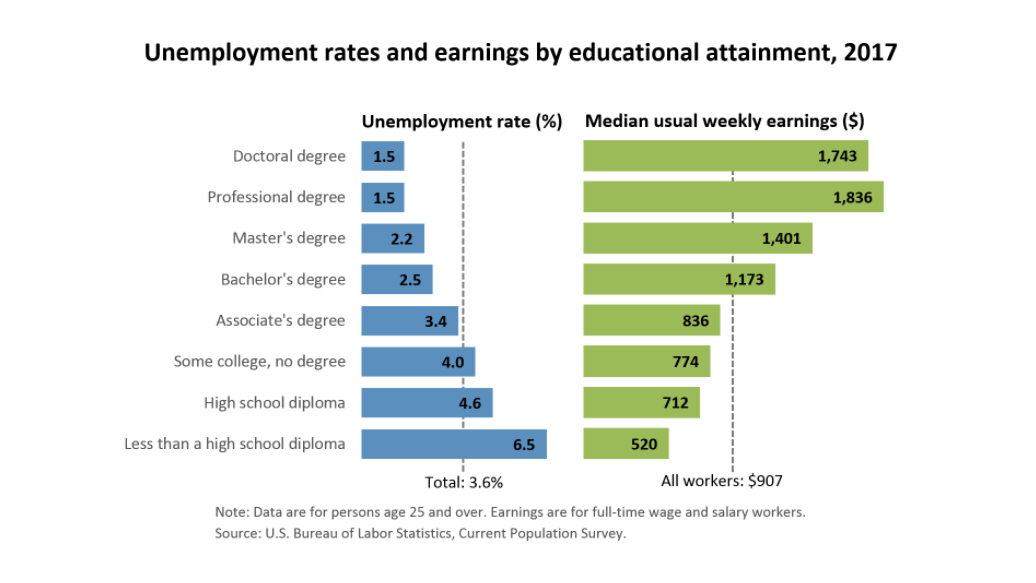
The BLS recently released a report on unemployment rates and weekly earnings classified by degree. This chart is a dramatic picture of the advantages of higher education.

UnemplEarnByDegreeBLS
VividMaps released a map showing the income needed to buy an average home in each state. Because the data uses average house prices, the map overstates the affordability problem for many families but does reveal the underlying trend. Why do I say overstates? The average home price is far above the median price because extremely expensive homes raise the average.

First quarter earnings to be released in the next two weeks are expected to show strong annual growth. Will the confirmation of rosy expectations overcome the darker fears of a global trade war? Stay tuned.

World Trade Rising

Each month the Bureau of Economic Policy Analysis, based in the Netherlands, releases a report on world trade.  The latest report for April, released June 24th, showed a month over month drop of 1.7% after a particularly strong increase of 4% in March.  The 3 month moving average is up about 5% with Japan, Asia and other emerging markets showing steady improvements in exports.