The Presidential Baton

January 29, 2017

Welcome to the new site, Innocent Investor.  You can easily reach this blog by entering innocentinvestor.com into your browser. Loyal readers can resubscribe by clicking the RSS Feed button at the bottom of this blog.  For a few weeks, I will post up a short entry at LucreTalk.blogspot.com in order to activate existing RSS feed subscriptions.

I think readers will love the presentation of both text and graphics in this WordPress format. I plan to integrate comment balloons so that a reader who is unfamiliar with a term like “GDP” can hover over the word and a quick explanation of the term will appear.

On the menu at the top of each page is an item labeled “Tools.” That page is under construction but will include many of the resources I have mentioned over the course of the past eight years.

/////////////////////////

The Presidential Baton

After the Trump inauguration, President Obama and his family boarded a helicopter bound for Andrews Air Force Base. The headline U-3 unemployment rate was less than 5%, half the level when he had taken office eight years earlier. In that time, the SP500 stock index had almost tripled. Consumer Confidence has risen from 61 in January 2009 to almost 100 as he left. GDP has been growing for 30 quarters.

Good job, Mr. Obama. Thanks for your leadership during a very bad economic crisis, and have a good life. Wouldn’t it be nice? History is a messy business. Presidents endure a lot of stress, their families make major compromises and yet half of us focus on their faults.

Let’s revisit another President who took office during very bad economic times, Ronald Reagan. When he assumed the leadership role, we were on the tail end of a recession, and still deep in an energy crisis. Interest rates and inflation were more than 10%, small business loans were about 20%, and the unemployment rate was 7.5%.

Reagan made the difficult decision to let Fed Reserve chief Paul Volker take some monetary measures to bring down interest rates, knowing that those actions would probably send the economy back into recession.  Unemployment rose 3% to 10.8%, GDP fell 2-1/2% and stayed negative for four quarters.  Inflation came down from 10% to less than 5% in that year long recession, providing an environment for businesses to grow and consumers to borrow.  Real GDP started growing at rates greater than 5%, and in 1984, Reagan was re-elected by a landslide over Walter Mondale.

A historic tax reform bill capped Reagan’s second term in office.  Like health care, tax reform is notoriously difficult because there are so many powerful interests involved. Although the Soviet Union did not officially collapse until 1991, the democratization process began in 1987 and conservatives have built a narrative that credits Reagan for the collapse. Like the executive of any large corporation, a President takes the credit and the blame.

A President’s administration rarely escapes scandal, and Reagan’s second term was so riddled with scandal that his own Vice-President, H.W. Bush, had to distance himself from Reagan’s policies in Bush’s 1988 Presidential bid. Iran-Contra and the S&L crisis were the most conspicuous of the scandals, but the Keating 5, and the HUD and EPA Grant Rigging to influence elections indicated an administration with lax ethics.

Let’s turn back to the first few months in former President Obama’s first term.  Almost daily came the announcement of another major American company near bankruptcy. In February 2009, a few weeks after Obama’s inauguration, the credit rating firm Moody’s estimated that 15 large companies were close to bankruptcy in the coming year.

The list included Rite-Aid drugstores with 100,000 employees, Chrysler with 55,000 workers, Blockbuster with 60,000 employees, and Six Flags Amusement Parks with 30,000 workers. One of the companies, Trump Resorts with 9500 workers, went into bankruptcy within a month of Obama’s inauguration.

During Obama’s first two years he was able to get some fiscal stimulus enacted and, like Reagan, took on a historic task – health care reform. The tax bill of 1986 was passed by voice vote (Govtrack) so we don’t know the vote by party.  However, the Democrats held the house at that time so nothing could be done without bipartisan bargaining. On the other hand, the health care reform was passed without a single Republican vote. A hostile voter reaction to Obamacare swept the Republicans into control of the House in 2010. The Republican House stymied attempts at further stimulus or much of any fiscal policy to alleviate the economic suffering.

The policy burden of economic recovery rested on the shoulders of the Federal Reserve, who were forced to be extremely accommodative to avoid another recession. Throughout this long and slow recovery, the Fed’s monetary tools have been stretched thin to the point of ineffectiveness.  For several years, they have wanted to raise interest rates to a more normal range of at least 2%. This past year, Chair Janet Yellen felt confident enough to bump up rates by a mere 1/4% in December.  This left the key interest rate in a range of just .5% – .75%.

With one party government Donald Trump has promised to get a languidly growing economy into high gear. GDP growth in the 4th quarter slowed to 1.9%, bringing annual growth in 2016 to a disapointing 1.6%. The post-WW2 growth rate is more than 1% higher.

The bond market is estimating that the Fed will raise interest rates three more times this year. This attempt to normalize interest rates may frustrate the Trump administration, since rising interest rates tend to curb economic growth.  President Trump will likely voice his antagonism but Chair Janet Yellen has pledged to serve out her full term, which expires in February 2018.

//////////////////////

Best President for Stock Market

So you were having a friendly conversation with a co-worker about Obama’s legacy and you mentioned that Obama had been the best President ever for the stock market. The conversation turned not so friendly and the issue was left unresolved because neither of you could find the information at the time. Well, here’s the chart

returnsbypres

Coolidge, the President that many of us forgot in history class, ranks top with annual gains of 25%.

The chart ranks the Presidents by Total Return during their term(s) in office.  Because term lengths vary, a truer rank is by annualized return (many times the rankings are the same). Coolidge tops the list in both categories. #2 is Clinton, #3 Obama, #4 Reagan. The worst on the list were #19 Hoover, and #18 G. W. Bush.

Inauguration 2017

January 22, 2017

Mr. Trump’s inauguration marks the first time in almost a hundred years that a business person assumes the highest political position in the country.  His cabinet choices share that same characteristic. There will be an inevitable clash of cultures.  Many civil servants are lifers, drawn to the generous benefits of government service, and the stability of employment.  Some may be drawn to the work because it gives them a sense of self-worth.

Many have little experience in private industry and distrust the motives of business owners.  Former President Obama was one of these.  An inspirational figure to some, his antipathy to business interests of all sizes antagonized political foes who challenged him for most of his two terms.

Mr. Trump has a similar weakness – his antipathy to and unfamiliarity with the insular culture of civil servants who work in a massive bureaucracy characterized by a thicket of rules and a lack of transparency.

Work in the private sector is characterized by competition, a striving for efficiency, the changing winds of people’s preferences, and the quality of the services and products we provide.  Employment in the public sector requires patience with burdensome procedure, a tolerance of a heirarchy of both the competent and the undeserving, and a willingness to work in a system that relies less on merit and more on seniority.

What will happen when these two diametrically opposed cultures mix?  Stay tuned.

/////////////////////////////////

Obamacare Kaput?

Since FDR began the custom, Presidents have signed executive orders on their first day in office to signify that they are on the job for that portion of the American electorate that put them in office.  One of the highlights of Mr. Trump’s campaign was the repeal of Obamacare.  Shortly after his inauguration President Trump signed an order stating his intention to repeal the ACA.  The order freezes any further promulgation of rules and regulations pertaining to the act.   I thought it would be appropriate to republish a blog I wrote in April 2011, a year before the Supreme Court ruled that most of the ACA was constitutional.  Like Social Security, ACA premiums and penalties were a tax.

The problems of providing health care and the insuring of that care have not gone away: rising costs, more sophisticated and expensive therapies, more demand for care from an aging population.  The problem is a knotty one:  how to distribute health care costs.  We all benefit from the availability of medical resources, yet these resources are very expensive.  The 24 hour care and equipment that stays idle in an urban hospital must be paid for with funds from other parts of the health care system.

It might surprise readers that more than 50% of the $3.5 trillion in Federal outlays is for Social Security benefits ($930B), Medicare ($600B) and Medicaid and Community health programs ($500B).  Eighty years ago, FDR initiated a new role for the Federal Government: an economic support system. To do that, FDR had to threaten and cajole a Supreme Court reluctant to stretch the meanings of several clauses in the Constitution.

Even FDR would be appalled to learn that the Federal Government has become an insurance company whose chief function is the collection of insurance premiums through taxes in order to pay insurance claims in the form of Social Security, Medicare and Medicaid Benefits.

Readers who would like to read more on a pie chart breakdown of government spending can visit the Kaiser Family Foundation’s fact sheet. Dollar amounts are from the latest White House budget.

//////////////////////////

MM Bash

I’m about to bash criticize some of the reporting in mainstream media (MM) publications, whose budgets rely on viewership.  When that audience was more predictable, flagship publications like the NY Times, Washington Post and Wall St. Journal could wait to verify facts before running a story.  In the current 24 hours news cycle and the rush to print, fact checking sometimes comes after the story is published online – if at all.

MM channels rested on their decades old reputations for thorough journalism and were willing to cut off at the knees any reporter compromising that reputation.  More than a decade ago, Dan Rather lost his anchor job with CBS for running with a story about George Bush that had not been properly vetted. News (fact-checked) and opinion (not checked) were clearly defined when they were in separate sections of the newspaper. In this new age when most information is delivered digitally, we are quoting blogs or other opinions that are not fact checked as reputable news sources without verifying the information.

A lie travels around the world by the time the truth gets its boots on. Something like  that.  In today’s lightning fast world of information flow, an apocalyptic news item that can move markets can be tweeted, webbed, facebooked, and retweeted.  “China fires on U.S. destroyer in South China sea!”  “N. Korean missle hits Alaska!” Sell, sell, sell, buy, buy, buy signals can flash instantly to world markets.

Later, it’s no, China didn’t fire on a U.S. destroyer.  China said it would fire if fired on by a U.S. vessel in the S. China Sea.  No, the North Koreans didn’t actually fire a missle.  Instead they said that they had a missle that could fire a nuclear payload on Alaska.  They’ve been saying that for several years.  Most defense analysts remain skeptical.  Oops, nevermind stock and bond markets.

We can not prevent this, nor can we hide our savings under a mattress.  We can prepare by making sure that we have some emergency funds in place.  Most financial advisors recommend six months replacement income.  Only after those funds are in place should we consider that boat we want on Craigslist or the down payment on that house we want to flip.  Don’t just plan to have a plan.  Have a plan.

//////////////////////////

Household Net Worth Ratio

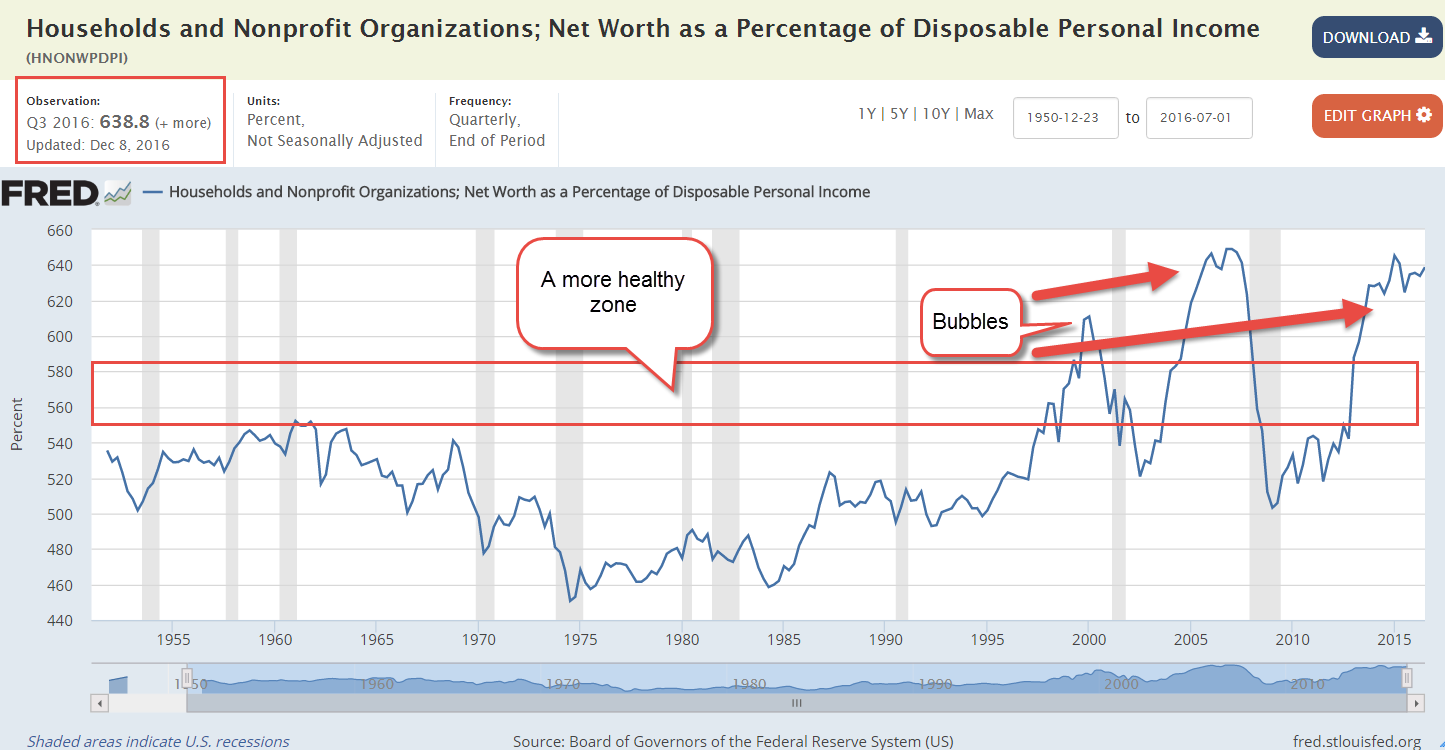
The zero interest rates for the past eight years are not natural and have created distortions in business and residential investment as well as stock market valuations. Let’s look at the residential side of the picture.  Below is a sixty year chart of the percentage of household net worth to disposable income.

The majority of the net worth of households is in their home.  The value of stocks and bonds comes second.  One or both of the two factors in that ratio is mispriced.  Perhaps disposable income has not grown to match the growth in asset valuations.  When reality doesn’t match predictions for a time, assets reprice.

What affects the pricing of these assets? The stock market rises on the prospect of sales and profit growth.   Salaries and wages rise as businesses compete for workers in a faster growing marketplace.  Disposable income rises.  Home prices rise on the prospect that more workers can afford to buy a home.

Now, what happens when disposable incomes, the divisor or bottom number in this ratio, don’t rise as much as predicted?  Yep, the ratio goes up, just as it did in 1999-2000 and 2006-2008, the peaks in the graph.

Ten Year Review

January 15, 2016

10 Year Review

Before I begin a performance review, I’ll refer to an article  on the errors of comparing our real world portfolio returns to the optimized returns of a benchmark index.  An index stays fully invested, has no trading costs, taxes or fees.  An index has survivor bias; companies that go out of business or don’t meet the capitalization benchmark of the index are effortlessly replaced, so there is no risk.  Share buybacks benefit an index but not our portfolio.

The article contains some prudent and realistic recommendations: the importance of preserving our savings, a balance of risk and return that will meet our goals, AND our time frame.  As we review the performance of the following portfolio allocations, keep those caveats in mind.  If a model portfolio earned 8% per year, use that as a rough guideline only.

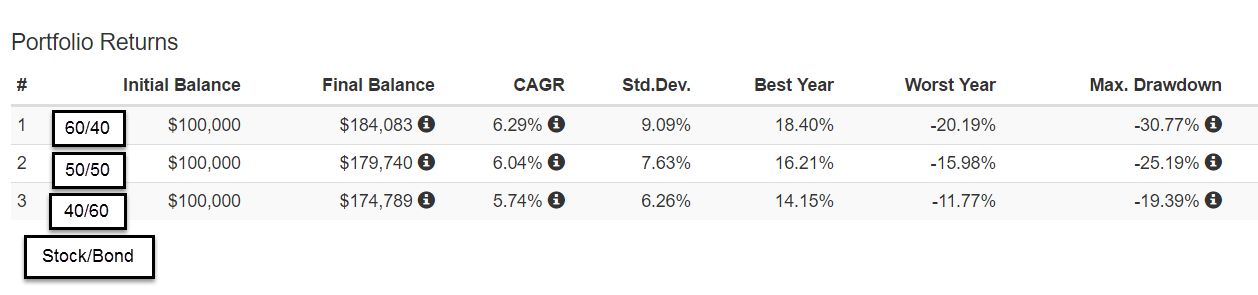
A 60/40 stock/bond portfolio returned an annual 6.3% over the past ten years with a maximum drawdown (MDD) of 30%.
A  50/50 mix returned 6% with an MDD of 25%.
A 40/60 mix returned 5.75% with a MDD of 20%.

A difference of 10% in allocation equalled a .3% in annual return, and a 5% change in MDD.  Let’s put that .3% difference in dollars and cents.  Over a ten year period, a $100,000 portfolio earning .3% extra return per year equalled about $43 extra per month, or about $1.40 per day.  Why is this important?  For whatever reason, some people worry more than others and may be willing to accept a lower return in order to sleep better at night.

Not all ten year periods will have the same response to various allocations.  The majority of ten year periods will include a recession, but this past ten years included the Great Recession. Let’s look at the historical effect of portfolio allocation during the past ten years.  In the chart below you can see the annual returns of various balanced allocation mixes shown in the left column.  At the end of 2009, the 10 year results show the results of two downturns: the 2001 – 2003 swoon and the 2007 – 2009 crash.

Note that the more aggressive 60/40 allocation has a lower return than the cautious 40/60 allocation during the years 2009-2011.  As we move forward in time, the effects of the 2001-2003 swoon diminish and, starting in 2012, the more aggressive allocation earns a better return.

Not shown in the chart are the results of a 100% allocation to stocks during the ten year period 2000-2009, the first column in the chart above.  A 40/60 allocation had a return of 3.8%.  A 100% allocation to large cap stocks had a LOSS OF 1% per year.

During the 10 year period 2007-2016, a 100% allocation to stocks returned 6.8% annually, a 1/2% higher return than the 60/40 mix, but the drawdown was 51%, far more than the 30% drawdown of the 60/40 portfolio.

High Winds or Hurricane?

A person who spends twenty years in retirement can count on at least two market downturns during that time.  Here’s how MDD, or drawdown, can affect a person’s portfolio.  I’ll present a more extreme example to illustrate the point.  Imagine an 80 year old retiree with a portfolio devoted 100% to stocks.  For several years, she had been withdrawing $40,000 from a portfolio that had a balance of $600,000 in the fall of 2007.  Projecting that her portfolio could earn a reasonable return of at least 7% per year, or $42,000, the balance looked secure.

But by March 2009, a period of only 18 months, the high winds had turned to a hurricane.  Her portfolio, her shelter in the storm, had lost 50% of its value, an MDD or drawdown of approximately $300,000.  During those 18 months, she had also withdrawn $60,000 for living expenses, leaving her with a balance of about $240,000 in the spring of 2009, the low point of the stock market.

Only 18 months earlier she had projected that she could maintain a minimum portfolio balance of $600,000. She had gnawed her nails raw as the market lost 20% by the summer of 2008, then sank in September when Lehman Bros. went bankrupt, then continued to lose value during the winter of 2008-09.  When would it end?

In March 2009, she had only 6 years of income left before her savings were gone.  Unable to stand the loss of any more value, she sold her stocks for $240,000 – at exactly the wrong time, as it turned out.  Her $240,000 earned little in a money market, forcing her to: 1) cut back the amount of money she withdrew from her portfolio to about $24,000 per year, and 2) hope she died before she ran out of money.

Of course, most advisors would NOT recommend that an 80 year old devote 100% of their savings to stocks.  BUT, some retirees might – and have – adopted a risky strategy to “whip” a portfolio to get more income or capital appreciation the way a jockey might do with a tired horse.  On the other hand, some 80 year olds with a very low tolerance for any kind of risk might have all of their savings in cash and CDs, a 0/100 allocation.

Now let’s imagine that our retiree had a cautious 40/60 balanced mix.  She would have had a drawdown of 20%, or $120,000, during the Great Recession.  After withdrawals for living expenses, she still had a balance of about $420,000 in March 2009. At a conservative estimate of a 5.5% annual return, she could have prudently drawn down her portfolio $25,000 – $30,000 for a year and waited. This is important for seniors: an allocation that allows some temporary flexibility in the withdrawal amount from a portfolio.

By the end of 2009, her portfolio had gained about 24%.  After living expenses of about $22,000 taken from the portfolio during the last 9 months of 2009, she had a balance of more than $500,000.  Her balanced allocation allowed her to wait longer for the market to recover.

In 2010, she could once again take her $40,000 living expense withdrawal and still have a $530,000 portfolio balance by the end of that year.  She has weathered the worst of the storm. At the end of 2016, she continued to take out $40,000 (adjusted upward for inflation) and still has a portfolio balance of $486,000.

Finally, her 40/60 allocation mix kept to a rule I have mentioned from time to time: the five year rule. If she wanted to take approximately $40,000 from the portfolio each year, she should have a minimum of 5 years, or $200,000 in bonds and cash – the “60” in the 40/60 allocation mix.  In the fall of 2007, she had $360,000 (60% of $600,000) in less erratic value investments.  This rule helped her withstand the storm winds of the Great Recession.

//////////////////////////

Seniors at Risk

Although the number of loans to those 65+ are less than 7% of the total of student loans, a shocking 40% of these loans are in default.  Most of these loans were cosigned by seniors for their children or grandchildren. The law allows the Federal Government to garnish or lien Social Security and other federal payments to cure the loan defaults.  Readers with a WSJ subscription can read the article here or Google the topic.

//////////////////////////

Hot Housing Markets

In a recent analysis, western cities rule Zillow’s top 10 housing markets for valuation increases.

///////////////////////////

Take this job and shove it!

The latest JOLTS report from the Labor Dept. shows the highest quits rate in private industry since the housing boom in 2006. Employees confident of finding another job are more willing to voluntarily leave their job, and have driven the rate up to 2.4% from a low of 1.4% in the 2nd half of 2009.

Statista compiles data from around the world, including this revealing tidbit: 26% of jobs in the U.S. are unfilled after 60 days, the highest percentage in the developed world. Germany ranks 2nd at 20%, and our neighbor to the north, Canada, comes in at nearly 19%.

What lies behind this data is a mismatch.  Employers may be requiring skills that job applicants don’t have.  Job applicants may want more money or other benefits than employers are willing to pay.

//////////////////////////

Obamacare Repeal

The Committe for a Responsible Federal Budget (CRFB) – yep, it’s a mouthful – has projected costs to repeal Obamacare in whole and in part.  Using both conventional, or static, budget scoring and dynamic scoring (google it if you’re interested), they guesstimate a 10 year cost of $150 to $350 billion for full repeal of the ACA.

Repeal of ACA’s insurance coverage would actually save a lot of money, more than $1.5 trillion. The net effect is a cost, not a savings, because of the $2 trillion in tax revenue on higher incomes that is built into the ACA law.

CRFB analysts have put a lot of work into these projections, including a breakdown of repealing just parts of Obamacare or delaying repeal of certain ACA provisions.  Since the Republican Congress is likely to keep some provisions, readers who are interested might want to come back to this link in the coming weeks as the discussion of this issue unfolds.

Sales Tax Collections

January 8, 2017

The New Year begins, the 9th year of this blog that began during the financial crisis.  For two decades I had studied financial markets but the financial crisis surprised most people.  This was my attempt to organize and share my thoughts.

Sales Tax Collections

Let’s look at a data point that has been a consistent indicator of economic health – sales tax collections. This is not survey data or economic estimates but actual tax collections based on consumer purchases. For the first 3 quarters of 2016, sales tax collections are up 1.6% above the same period in 2015. (Census Bureau)    As we will see, this tepid growth rate does not compare well with the historical data of the past 25 years.  Below is a quarterly graph of sales tax collected in the 50 states.

As we can see in the graph above, the 2nd quarter (orange bar) is the highest each year, and is a good indicator of consumer activity and confidence. Since population growth is about 1%, the annual growth of sales tax collected should be above that mark to be effectively positive.

In the graph below, we can see negligible or negative growth in 2001, 2008 and 2016. In 2001 and 2008, we were already in recession, although it took the recession marking committee at the NBER almost a year to declare the beginning of those recessions.  By selecting the 2nd quarter growth rate in the historical data, we can more easily see the weakness at the start of an economic downturn.

In retrospect, 25 years of data is rather sparse.  We can only hope that this year’s lack of sales tax growth may turn out to be a warning sign only, a fluke.  Third quarter tax collections were effectively positive, but only 2% growth, and that annual growth has consistently declined in the past three years in a pattern exactly like the weakening of 2006 – 2008.

Of particular note in the graph above is the steep 10% drop in sales tax collections in the second quarter of 2009. Fom a vantage point eight years in the future, we may have forgotten the degree of fear during the winter of 2008-2009.  The American people were holding onto their money.  State budgets were crippled by the lack of sales tax collections, an important and ongoing source of revenue for state and local governments.

See end for a side note.

////////////////////////

Population Growth

Business Insider published a chart of 2015-2016 population data from the Census Bureau.  We can see a clear shift from the northern states to the mountain and southern states.  Retiring boomers, who want to maximize their fixed incomes, will shift from states with high state income and property taxes like New Jersey and New York, and move to states with lower taxes.

///////////////////////

Tax Reform

In a few weeks Republicans will control the legislative machinery, and have promised  tax reform that, after thirty years, is overdue.  One of the proposals on the bargaining table is the end of the home interest deduction, which prompted this blog post at Slate.  The author contends that the elimination of this deduction will hurt middle class homeowners, who will see the value of their homes decline by 7%.

I’ll add in some contextual data from the IRS.  In 2011, 22% of the 145 million (M) returns claimed mortgage interest totalling $321 billion. ( IRS tax stats Table 3) People making a middle class income of less than $100K claimed half of that interest – 14% of all returns.  The average interest deduction for these middle class households was $8100.

Two million returns with incomes of $500K and above claimed $46B in mortgage interest, about 15% of the total interest claimed.  For these high earners, the average deduction was $20,000.

The tax reform of 1986 eliminated the interest deduction on credit cards and cars, but lawmakers could not go the final distance and squelch the home mortgage interest deduction.  At the time, auto dealerships complained that, without the interest deduction on new car loans, their business would suffer.  Tax subsidies affect both consumers and the businesses who are indirect recipients of the subsidy. Should 78% of taxpayers subsidize the housing costs for 22% of taxpayers?   Certainly, the 22% appreciate the subsidy! The real estate industry continues to resist any tax changes that might have a negative impact on their business.  Each industry deserves a subsidy of some kind because that industry is important to the overall economy – or so the argument goes.

///////////////////////

The End of Capitalism – Almost

Let’s get in the wayback machine and dial in 1997.  The dot-com boom is not yet a bubble but is growing.  Cell phones are growing in acceptance but the majority of people do not have one.  A one year CD is paying more than 5%.  The unemployment rate is about the same level as today (2016).  What is very different between then and now is the number of publicly traded companies.  In 1997, there were over 9000 listed companies.  Today, there are about 6000 companies.  The 2002 Sarbanes-Oxley (SB) law has such stringent and plentiful financial reporting regulations that many companies decide not to go public, or to sell themselves to a larger company that already has the internal infrastructure in place to comply with SB regulations.  Both parties want to repeal or amend the law but cannot agree on the details.  Readers can click for more info.

//////////////////////////

Next week I will compare the 10 year performance and risks of various portfolios.  There are some surprises there.

//////////////////////////

Side note on Sales Tax.  The Federal Reserve charts retail sales but these are based on data samples and will not be as accurate as the actual tax collected.  When retail sales are adjusted for inflation, the year over year growth can give a number of false positives.  In the graph below, I have marked up periods that went negative without the economy going into recession.  I think that the actual tax collected may be a much more accurate predictor of economic weakness.

Post-Election Bounce

January 1, 2017

Happy New Year!  How many days will it take before we remember to write the year correctly as 2017, not 2016? It is going to be an interesting year, I bet.  But let’s do a year end review.

Homeownership

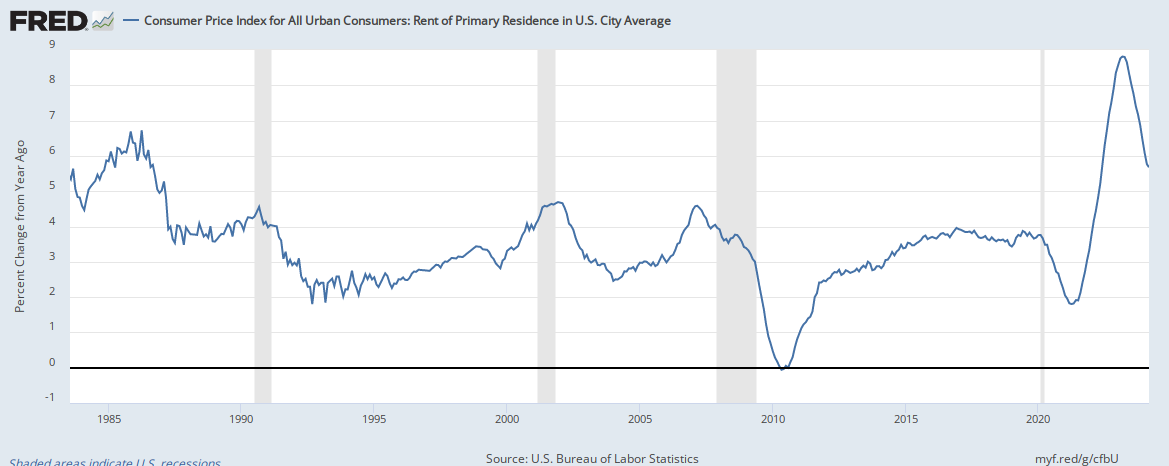
The home ownership rate has fallen near the lows set in 1985 and the mid-1960s at about less than 64%. (Graph)  In 2004, the rate hit a high of 69%.  For the U.S., the sweet spot is probably around 2/3 or 66%.  Most other countries have higher rates of home ownership, including Cuba with a rate of 90%. (Wikipedia article)  Rents in some cities have been growing rapidly.  In the country as a whole, rents have increased almost 4%, about twice the growth in the CPI, the general rate of inflation for all goods and services. (Graph)

Earnings

Real, or inflation-adjusted, weekly earnings of full time workers spiked up during the recession as employers laid off lower paid and less productive workers.  By late 2013, weekly earnings had fallen to 2006 levels and have risen since, finally surpassing that 2009 peak this year.

Core Work Force

Almost every month I look at the changes in the core work force of those aged 25-54 who are in their prime working years, who buy homes for the first time and have families.  These are the formative years when people build their careers, and form product preferences, making them a prime target for advertisers.  The economy depends on this age group.  They fund the benefit systems of Social Security and Medicare by paying taxes without collecting a benefit.  In short, an economy dependent on intergenerational transfers of money needs this core work force to be employed.

For two decades, from 1988 to 2008, the labor participation rate of this age group remained steady at 82% – 83%. (BLS graph) By the summer of 2015, it had fallen to 80%.  A few percent might not seem like much but each percent is about a million workers.  For the past year it has climbed up from that trough, regaining about half of what was lost since the Great Recession.

Consumer Confidence

A post-election bounce in consumer confidence has put it near the levels of 2001, near the end of the dot-com boom and just before 9-11. (Conference Board)  In 2012, the confidence index was almost half what it is today.

Business Sentiment

Small business sentiment has improved significantly since the November election (NFIB Survey).  Almost a quarter of businesses surveyed expect to add more employees, a jump of 2-1/2 times the 9% of businesses who responded positively in the October survey.  In October, 4% of companies expected sales growth in the coming year.  After the election, 20% responded positively.  This jump in sentiment indicates the degree of hope – and expectation – that business owners have built on the election of Donald Trump.

Hope leads to investment and business investment growth has turned negative (Graph). Recession often, but not always, accompanies negative growth. Since 1960, investment growth has turned negative eleven times.  Eight downturns preceded or accompanied recessions.  Let’s hope this renewed hope and some policy changes reverses sentiment.

On the other hand, those expectations may present a challenge to the incoming administration, which has promised some tax reform and regulatory relief. Small business owners will lobby for different reforms than the executives of large businesses.  Regulations of all types hamper small business but large businesses may welcome some regulation which acts as a barrier to entry into a particular market by smaller firms.

Publicly held firms will continue to lobby for repeal or reform of Sarbane Oxley reporting provisions.  For six years, the Obama administration has wanted to roll back these regulations but has been unable to come up with a compromise between the SEC, which regulates publicly traded companies, and Congress.  A Trump administration may finally reform a law that was rushed into place by George Bush and a Republican Congress in response to the Enron scandal.  That scandal grew in part from the Bush administration’s push to deregulate the energy market.

Voters Veer From Side To Side

We have stumbled from an all Republican government in 2002 to an all Democratic government in 2008 and now come full circle again to an all Republican government. Once in power, neither party can resist using economic policy to pick winners and losers.  Every few years the voters throw out the guys in charge and bring the other guys in, hoping that the party that has been out of power will be chastened somewhat.  Within a few months of taking power, each party digs up their old bones and begins to gnaw on them again.  Tax reform, prison reform, justice and fairness for all, climate change, more regulation, less regulation – these bones are well chewed.

Still we keep trying.  The priests and prophets of long ago kingdoms could not govern.  Neither could the kings and queens of empires.  So we have tried government of the people, by the people and for the people and it has been the bloodiest two centuries in human history.  Still we keep hoping.

The Presidential Test

Most presidents are tested in their first year in office.  Kennedy had to grapple with the Soviet threat and Cuba almost as soon as he took office.   Johnson struggled with urban violence, social upheaval and the war in Vietnam.

Nixon confronted a newly resurgent Viet Cong army when he first took office.  His second term began with the Arab oil embargo.  Ford dealt with the aftermath of Watergate and Nixon’s resignation under the threat of impeachment.

Jimmy Carter began his term with the challenges of high inflation and unemployment, and an energy crisis to boot.  Ronald Reagan wrestled with sky-high interest rates and a back to back recession in his early years.  His successor, H.W. Bush, met a Soviet Union near the end of its 70 year history as Gorbachev loosened the reins of Soviet control of eastern European countries and the Berlin Wall collapsed.

After an unsuccessful attempt to reform health care in his first year of office, Clinton suffered in the off year election of 1994.  G. W. Bush had perhaps the worst first year of any modern President – the tragedy of 9-11.  Obama entered office under a full blown global financial crisis.

Despite Putin’s bargaining rhetoric regarding President-elect Donald Trump, every President has to learn the lesson anew – Russia is not our friend.  Trump will have to learn  the same lesson.  China’s territorial claims in the South China sea may prompt an international incident.  N. Korea could launch a missle at S. Korea and start a small war.  Iran, Afghanistan, Iraq and Syria, Israel’s settlements, Palestinian independence – the crises may come from any of these tinderboxes.  We wish the new President well as he hops into the fire.

Historical Portfolio Returns

December 25, 2016

Merry Christmas Everyone!

This week I will look at the historical performance of different portfolio allocations.  Also, a comparison of this year’s performance to long term averages.  There are a few surprises.

In the weeks since the election, there has been a strong demand for risk, lifting the broad SP500 index by 8%. So how goes it over on the safety side of the ledger? Holders of an index of the total bond market, VBMFX or BND, have seen a price drop of a bit more than 3% since the election, but a net gain of 2-1/4% in the past twelve months.  Almost all of that gain is the yield, or interest earned on the bonds.  Inflation eats up most of that net gain, leaving the bond investor with little net gain for the year, but no loss.

 Morningstar provides a comparison table of various investments.  The AGG broad bond index in their table has an average total return of 2.18% over the past five years.  Yes, this year’s rather low return of 2.25% is better than the five year average.

Vanguard provides a 90 year comparison of various portfolio allocations and it is the first one on the page that I’ll turn to.  Over 90 years, the average total return of interest and price appreciation on a 100% fixed income, i.e. bond, portfolio is 5-1/4%, or 3% more than this year’s total return.

In today’s low yield universe, there is little difference, or spread between today’s yield on a broad bond index and that on a broad stock index.  Over that 90 year period, stocks have averaged 10% per year total return.  The difference between the average total return on bonds and stocks is almost 5% and is called the risk premia.  It means that, on average, a bond investor sacrifices 5% annual return for the income and the relative price stability of bonds. That’s the 90 year average.  The 5 year average tells quite a different story: a 15% per year total return for the SP500 vs 2.18% for a broad bond index.  That risk premia is 2-1/2 times the 90 average.   Seniors and others needing safety have paid a high price.

OR…let’s look at this from a different perspective.  In the long run, the law of averages is like gravity. What price would the SP500 be if its total return were more in line with the 90 year average of 10%?  The answer is a price that we last saw during February of this year – about $1840.  That is an 18% drop from today’s current price of $2264.

As the generation of boomers continues to draw down savings to supplement their income, we can expect that price stability will become more valued.  That should balance some of the downside price risk of owning bonds in an environment of rising interest rates.  There are some countervailing forces.  Oil states may derive more than half of their revenue from profits based on the price of oil.  When oil prices were high, the sovereign funds of these states bought U.S. Treasuries and other assets with the excess profits.  As prices declined since mid-2014, the lower revenues have produced budget deficits in those countries dependent on oil.  They have already sold some assets and will continue to do so if prices remain below $60 a barrel.

Comfortability Ratio

The Vanguard table of returns for various allocations (see above) shows that a 60% stocks/ 40% bond portfolio allocation (60/40) produces the best total returns of the choices for a balanced portfolio.  Let’s look at a comfortability ratio – the average return divided by the percent of years with a loss, or %AR / %YL.  This can be an important psychological ratio for those approaching and in retirement.

As many studies have shown, we give more weight to losses than gains.  We are naturally risk averse, and especially so as we near the end of our working years.  Higher comfort ratios are safer.  A 40/60 and 50/50 allocation have comfort ratios of .44.  Their average return is 44% of the percent of years that an investor suffers a loss.

Ranked by this comfort ratio, the surprise is that a 60/40 allocation acts more like a growth, not a balanced, allocation.  70/30 and 80/20 growth allocations have the same .37 comfort ratios as the 60/40.  On a more surprising note, a strongly agressive 90/10 allocation with a .38 ratio  has a better comfort ratio than any of these growth allocations.  Here’s a table:

Allocation Avg % Years Comfort Ratio
                   Return    With Loss
40/60 7.8 17.7 .44
50/50 8.3 18.8 .44
60/40 8.7 23.3 .373
70/30 9.1 24.4 .373
80/20 9.5 25.5 .373
90/10 9.8 25.5 .384
100/0 10.1 27.8 .364

Allocation based on income needs

As an alternative to conventional allocation models using percentages, an investor might keep five years of income needs in bonds and cash and devote the rest to equities. An important caveat: income needs do not include emergency cash. Using this model, an investor who needed $20K from their portfolio each year, would keep $100K in bonds and cash, and put the rest in stocks.  A 35 year old with no income needs would have 100% in equities.  This model naturally becomes more conservative as the portfolio is drawn down.

For two years the stock and bond market have seen little net change.  Investors might have become complacent.  Since the election, the shift in sentiment has been strong and investors should check their year end statements and make adjustments based on their needs and targets.

////////////////////////////

In a country far, far away….

Cue the Star Wars theme. Dah, dummm, dah, dah, dah, dummmmm.  In 2008, China overtook Japan to become the country that holds the largest amount of U.S. Treasuries. Since this summer, China has been selling Treasury bonds to support its currency, the yuan, and is now again in 2nd place.  As long as the dollar continues to rise, China is likely to continue this practice which will maintain a slight downward pressure on bond prices.

The Role of Government

December 18, 2016

What role should government at many levels – Federal, state and local – play in our lives?  Some want a large role, some small.  Does the Constitution give the Federal government a diminished role in our lives? That is the viewpoint of those on the right side of the political divide in this country.  As Donald Trump gets ready to lead a Republican dominated Federal government, the debate burns white hot, as it did at the founding of this country.

Let’s turn the time dial back to 1936, the middle of the Great Depression, to appreciate just how much we depend on government today.  At that time, the unemployment rate had declined from a soul crushing 24%, but was still high at 17%.  The Roosevelt administration had ushered in many programs to alleviate joblessness.  In 1936, total government spending at all levels was $257 billion. (Dollar amounts don’t include what is called transfer payments like Social Security. and are in 2016 dollars.)

Eighty years later, it is $6 trillion, about 24 times the 1936 level.  Some might counter that the population has grown so, of course, government spending has grown.  The population has indeed increased, but only 2.7 times, far below the 24 times that government spending has multiplied.  In 1936, per person spending was $2,000.  Today it is $19,000.

During World War 2, government spending climbed six times to $1.6 trillion, about 25% of today’s level.  We are not currently engaged in a global war which occupies most of our economy as it did in the 1940s.  We do not have millions of young men in combat.  And remember, these figures don’t include Social Security, welfare and business subsidies.

Now let’s look at this from another viewpoint, one that might lead to a different conclusion.  Let’s look at government spending as it relates to family income.  According to the IRS and BLS, average family income was about $26,000 in 1936. (IRS and BLS See note below).  Remember, this was during the most severe Depression in our nation’s history.  So, per capita government spending was about 6% of this rather low family income.  Today, it is 33% of the $56,000 median family income.  So, we squint at these figures from two viewpoints and we are still left with the same conclusion.  As a percent of income and on a per capita basis, government spending has become a significant part of our lives.

When Republicans talk about smaller government, the “small” in that catch phrase should be kept in perspective.  At best, Republicans might want to lower spending growth to eight times, not ten times, the spending of 1936.  Those on the left might want to accelerate that growth to 12 times.  In either case, neither party advocates the frugal spending levels of 1936.  I should note that President Roosevelt himself was concerned that this low (to us) level of government spending – most of them his New Deal programs – was becoming too high.

The current fad is speaking in hyperbole.  Many daily experiences in our lives are awesome.  Our kids, our vacation, the latte we had yesterday – all awesome. It is no surprise, then, that we would  use hyperbole to describe those who don’t agree with our political views.  They are communists, or socialists, or capitalist anarchists, or [insert epithet here].  The voices of moderation are growing smaller by the year.

Half of the voters in this country want less government, half want more.  If each of us wants “our” views to prevail, we need to get up off our asses and pull on the rope in this political tug of war.  When “our” side gets into power, the other half has to suffer through it, and vice-versa.  This battle of ideas will continue throughout our lifetimes and – God Forbid! – we might even change sides.

/////////////////////////////

Endnotes

According to the IRS, only 4.3% of tax returns reported positive taxable income in 1936.  One out of 20 families footed the entire bill for Federal government spending. 95% of families had no federal taxable income. 

Real wage growth in the U.K. has turned negative for the first time since the 1860s.
(Bloomberg)

The most common job in a lot of states:  truck driver.  (NPR)

Optimism Reigns

Dec. 11, 2016

For the second week since the election the SP500 index rose more than 3%, reversing a slight loss the previous week.  The SP500 has added 160 points, or 7.6%, in total since the election.  Barring some surprise, the market looks like it will end the year with a 10+% annual gain, all of it in the 6 – 7 weeks after the election. Small cap stocks have risen 17% in the past five weeks.  Buoyed by hopes of looser domestic regulations, and that international capital requirements will be relaxed, financial stocks are up a whopping 20% in the same time.

Having held their Senate majority, Republicans now control both branches of Congress and the Presidency but lack a filibuster proof dominance in the Senate.  They are expected to pass many measures in the Senate using a budget reconciliation process that requires only a simple majority. The promise of tax cuts and fewer regulations has led investment giants Goldman Sachs and Morgan Stanley to increase their estimate of next year’s earnings by $8 – $10.  Multiply that increase in profits by 16x and voila!  – the 160 points that the SP500 has risen since the election.  The forward Price Earnings ratio is now 16-17x.

Speculation is about what will happen.   History is about what has happened. The Shiller CAPE10 PE ratio is calculated by pricing the past ten years of earnings in current year’s dollars, then dividing the average of those inflation adjusted earnings into today’s SP500 index.  The current ratio is 26x, a historically optimistic value.  The Federal Reserve is expected to raise interest rates at their December meeting this coming week.

As buyers have rotated from defensive stocks and bonds to growth equities, prices have declined.  A broad bond index ETF, BND, has lost 3% of its value since the election.  A composite of long term Treasury bonds, TLT, has lost 10% in 5 weeks.  For several years advisors have recommended that investors lighten up on longer dated bonds in anticipation of rising interest rates which cause the price of bond funds to decline.  For 6 years fiscal policy remedies have been thwarted by a lack of cooperation between a Democratic President and a Republican House that must answer to a Tea Party coalition that makes up about a third of Republican House members.  The Federal Reserve has had to carry the load with monetary policy alone.  Both former Chairman Bernanke and curent Chairwoman Yellen have expressed their frustration to Congress.  If Congress can enact some policy changes that stimulate the economy, the Federal Reserve will have room to raise interest rates to a more normal range.

//////////////////////////////

Purchasing Manager’s Index

The latest Purchasing Manager’s Index (PMI) was very upbeat, particularly the service sectors, where employment expanded by 5 points, or 10%, in November.  There hasn’t been a large jump like this since July and February of 2015.  For several months, the combined index of the manufacturing and service sector surveys has languished, still growing but at a lackluster level.  For the first time this year, the Constant Weighted Purchasing Index of both surveys has broken above 60, indicating strong expansion.

The surge upward is welcome, especially after October’s survey of small businesses showed a historically high level of uncertainty among business owners.  This coming Tuesday the National Federation of Independent Businesses (NFIB) will release the results of November’s survey.  How much uncertainty was attributable to the coming (at the time of the October survey) election?  Small businesses account for the majority of new hiring in the U.S. so analysts will be watching the November survey for clues to small business owner sentiment.  Unless there is some improvement in small business sentiment in the coming months, employment gains will be under pressure.

////////////////////////////

Productivity

Occasionally productivity growth, or the output per worker, falters and falls negative for a quarter.  Once every ten or twenty years, growth turns negative for two consecutive quarters as it has this year. Let’s look at the causes.  Productivity may fall briefly if businesses hire additional workers in anticipation of future growth.   Or employers may think that weak sales growth is a temporary situtation and keep employees on the payroll.  In either case, there is a mismatch between output and the number of workers.

During the Great Recession productivity growth did NOT turn negative for two quarters because employers quickly shed workers in response to falling sales.  The last time this double negative occurred was in 1994, when employment struggled to recover from a rather weak recession a few years earlier.  For most of 1994, the market remained flat.  In Congressional elections in November of that year, Republicans took control of the House after 40 years of Democratic majorities.  The market began to rise on the hopes of a Congress more friendly to business.  Previous occurrences were in the midst of the two severe recessions of 1974 and 1982.   As I said, these double negatives are infrequent.


////////////////////////////

The Next Crisis?

The economies of the United States and China are so large that each country naturally exports its problems to the rest of the world.  The causes of the 2008 Financial Crisis were many but one cause was the extremely high capital leverage used by U.S. Banks.  A prudent ratio of reserves to loans is 1-8 or about 12% reserves for the amount of outstanding loans.  Large banks that ran into trouble in 2008 had reserve ratios of 1-30, or about 3%.

Now it is China’s turn.  Many Chinese banks have reported far less loans outstanding to avoid capital reserve requirements.  How did they do this?  By calling loans “investment receivables.”  It sounds absurd, doesn’t it?  Like something that kids would do, as though calling something by another name changes the substance of the thing.  70 years ago George Orwell warned us of this “doublespeak,” as he called it.  Reluctant to toughen up banking standards for fear of creating an economic crisis, the Chinese central bank is planning a gradual move to more prudent standards that will take several years.  However, it is a crisis waiting for a spark.  Here’s a Wall St. Journal article on the topic for those who have access.

/////////////////////////

The Un-Recovery Machine

December 4, 2016

I’ve titled this week’s blog “The Un-Recovery Machine” for a reason I’ll explain toward the end of the blog as I look at the lack of growth in household income for the past 16 years.  Lastly, I will show how easy peasy it is to do a year end portfolio review. First, I’ll look at the latest job figures and a quick five year summary of a few key stats of stewardship under the Obama administration.

The economy added 180,000 jobs in November, close to estimates.  Obama will leave office with an average monthly gain of 206,000 jobs over the past five years, a strong track record. The president has a minor influence on the number of jobs created each month but each president is judged by job growth regardless.  We need to have a donkey to pin the tail on when something goes wrong.

The real surprise this month was the drop of .3% in the unemployment rate to 4.6%.  Some not so smart analysts attributed the drop to discouraged workers who dropped out of the labor force.  However, the number of dropouts in November was the same as October when the unemployment rate declined only .1%.  Seasonal factors, Christmas jobs and variations in survey data may have contributed to the discrepancy.  What is clear is that the greatest number of those who are dropping out of the labor force are the increasing numbers of boomers who are retiring every month. I’ll look further at this in a moment.

The number of involuntary part-timers has dropped from 2.5 million five years ago to 1.9 million, about 1.3% of workers. This is a lower percentage than the 1970s, the 1980s, and the first half of the 1990s.  It is only when the tech boom and housing bubble grew in the late 90s and 2000s that this percentage was lower.

Growth in the core work force is a strong 1.5%, a good sign.  These are the workers aged 25-54 who are building families, careers and businesses.  The change in the Labor Market Conditions Index (LMCI) turned positive again in October.  This is a composite labor index of twenty indicators that the Federal Reserve uses to judge the overall health of the labor market.  They have not released November’s LMCI yet.  This index showed negative growth for the first part of the year and was the chief reason why the Fed did not raise interest rates earlier this year.

The quit rate is back to pre-recession levels at a strong 2.1%.  This is the number of employees who have voluntarily quit their jobs in the past month and is used to gauge the confidence of workers in finding another job quickly. The highest this reading has ever been was 2.6% just as the dot com boom was ending in 2001.  Too much confidence. When the housing boom was frothing in the mid-2000s, the quit rate was typically 2.3%, a level of over-confidence. 2.1% seems strong without being too much.

Another unwelcome surprise this month was a .03 decline in the average hourly wage of private workers.  On the heels of a welcome .11 increase in October, this decline was disappointing. One month’s increase or decrease of a few cents is statistical noise.  The year-over-year increase gives the longer term trend.  For the past five years, the yearly increase in wages has been unable to get above 2.5%, which was the annual growth in November.

The greatest challenge that the incoming president will face is the ever growing ranks of Boomers who are retiring.  In 2007, the number of those Not in the Labor Force was 78 million.  These are adults who can legally work but are not looking for work, and includes retirees, discouraged job applicants, women staying home with the kids, and those going to college.  That number has now grown to 95 million, an increase of 2 million workers per year, and will only keep growing as the 80 million strong boomer generation continues to retire each month.   The millenials, those aged 16 to 34, are a larger generation than the boomers but will not fully offset the number of retirees till the first half of the 2020s.  If any president can explain this in very simple terms, it is Donald Trump, who has mastered the art of communicating a message in short bursts.

//////////////////////////

Construction and Local Employment

Construction employment matters.  When growth in this one relatively small sector drops below the growth of all employment, that signals a weakness in the overall economy that indicates a good probability of recession within the year.  It’s not an ironclad law like the 2nd law of thermodynamics but has proven to be a reliable rule of thumb for the past forty years.  Fortunately, the economy is still showing healthy growth in construction employment that has outpaced broader job gains for the past four years.

The puzzle is why construction spending is an economic weathervane.  It has fallen from 11% of GDP in the 1960s to slightly over 6% of GDP today. (Graph )   Yet when this  relatively small part of the economy stops singing, there’s something amiss.

Real construction spending (in 2016 dollars) is currently at a healthy level of $175K per employee, 16% above the low of $151K in the spring of 2011.  Although we have declined slightly in the past year, the average is about the same level as late 2006 – 2007 and is above the spending of the 1990s.  As a rule of thumb in the construction industry, an employee is going to average 33% in wages and salaries. That doesn’t include the cost of employee benefits, insurance and taxes which will bring the total cost of the employee above 40% of the total cost.   So, if spending is $175K, we can guesstimate that the average worker is making about $58K.  When I check with the BLS, the average weekly earnings in construction is $1120, or almost $58K.  As a side note: that 40% employee cost is used by some contractors as a rule of thumb for a bid total when estimating a job.

During the recession many workers dropped out of the trades.  Older workers with beat up bodies cut back on hours, went on disability or took early retirement.  Younger workers who saw the layoffs and lack of construction employment during the recession turned their sights to other fields.  Workers who do come into the trades find that the physical transition takes some getting used to.  Even workers in their twenties discover that muscles and joints working 8 – 10 hours a day need some time to adapt.

The average workweek hours for construction workers hit at a 70 year high in December 2015 and is still near those highs at 39.8 hrs a week.  In some areas the lack of applicants for construction jobs is constraining growth.  In Denver, construction jobs grew by almost 20% in the past year and that surge is helping to attract  workers from other states.  The unemployment rate in Denver is 2.9%, below the 3.5% in the entire state.  (BLS Denver  Colorado)  This pattern is not confined to Colorado. Very often economic growth may be strong in the cities but weak and faltering in rural communities throughout the state.  For decades this has caused some resentment in rural communities who feel that politicians in the cities dominate policy making in each state.

Local employment

The Civilian Labor Force, those working and actively wanting work, is growing in all states except Alaska, Louisiana, Minnesota, New Jersey, New York, Nebraska, Nevada, Oklahoma and Wyoming (BLS here if you want to look up your city or state stats).  Some of the changes may be demographic.  I suspect that is the case in New York and New Jersey. The decline in some states are those related to resource extraction.  Employment in states with coal mining and oil production has taken a hit in the past two years.  In Colorado, the 11% gain in construction jobs has offset a 12% decrease in mining jobs.

/////////////////////////////

Household Income

On a more sobering note…In 1999 real median household income touched a high $58,000 annually.  Sixteen years later that median was $56,500, a decline of about 3%.  There’s a lot of pain out there.

For readers unfamiliar with the terminology, “real” means inflation adjusted.  “Median” is the halfway point.  Half of all incomes are above the median, half below.  Economists and market analysts prefer to use the median as a measure of both incomes and house prices to avoid having a small number of large incomes or expensive houses give an inaccurate picture of the data.

Both parties can take responsibility for this – two Republican administrations (Bush) and two Democratic (Obama) terms. There have been a number of different party configurations in the Presidency, House and Senate, so neither party can reasonably lay the blame at the other party’s feet.  The “new” more idealogically pure Republicans  in the House regard the “old” Republicans of the two Bush terms as traitors to conservative ideals.  Never mind that a lot of those “old” silly Republicans are still taking up room in the House.

Both parties have borrowed and spent a lot of money but little has flowed down to the American worker.  So much for the imaginativeness of trickle down economic theory.  When George Bush assumed office in January 2001, the Federal Public debt totalled $5.6 trillion.  When he left office in January 2009, the debt had almost doubled to $10.7 trillion.  Under Obama’s two terms, the debt nearly doubled again, crossing the $19.4 trillion mark in June 2016.  $14 trillion dollars of Federal borrowing and spending since early 2001 has not helped lift the incomes of American families.  It is a damning indictment of both major parties who have lost touch with the everyday concerns of many American families.

Can Donald Trump be the catalyst that miraculously turns the Washington whirlpool of money into an effective machine?  Doubtful, but let’s stay hopeful. 535 Congressmen and Senators, each with an outlook, a constituency, and an agenda funded by a coalition of lobbyists, are going to fight against giving up control.  Spend the money on my constituents. they will say.  Republicans throw out the phrase “limited government” to their base voters who whuff, whuff and chow down.  Once elected, many Republican politicians are as controlling as their Democratic counterparts, only in different areas of our lives. A Republican controlled government will push for more regulations on women’s health, regulations on people’s moral and social behaviors, a proposal to reinstitute the draft, and threats to private companies who move jobs out of the U.S.   Donald Trump recently enacted Bernie Sanders’ prescription for keeping jobs in America.  He no doubt threatened Carrier’s parent corporation, United Technologies, that they would lose defense contracts if Carrier moved all those 1000 jobs to Mexico.

So Donald Trump, the leader of the Republican Party, is following a socialist play book.  We are going to see more of this because Trump is the leader of the Trump party, not wedded to any particular ideology.  He is a transactional leader who plays any card in the deck to win, regardless of suit. Chaining oneself to ideals is a good way to drown in the political soup.

Republicans in Washington have consistently betrayed conservative ideals of financial responsibility and a smaller government imprint on the daily lives of the American people.  Democratic politicians cluck, cluck about progressive principles but Democratic voters find that their leaders have left them a pile of chicken poop. Unlike Republican voters, Democrats haven’t developed the organizational skills to make personnel changes in party primaries. Both parties are infected with old ideas, loyalties and prejudices.

Because of this, retail investors – plain old folks saving for their retirement – can expect increased volatility in the next two years.  We may look back with fondness at these last two years, a peaceful time of few accomplishments in Washington, and a sideways market in stocks and bonds.  A balanced portfolio will help weather the volatility.

Mutual fund companies and investment brokers track this information for us and we can access it fairly easily online at the company’s website.  Even if we have several places where we keep our funds, it is a relatively simple paper and pencil process to calculate our total allotment to various investments. We don’t need to be precise.  We are not launching a rocket to Mars.

If I have $198,192.15 at Merry Mutual and they say I have 70% stocks and 30% bonds, I can write down $140 in stocks, $60 in bonds.   Then over to my 401K at the Ready Retirement Company to find out that I have $201,323.39 balance, with 80% stocks and real estate funds and 20% bonds.  I write down $160 for stocks and $40 for bonds.  Then over to my savings account at Safety Savings where I have $39,178.64, which I include with my bonds.  I write down $40.  Finally, over to my CDs at the First Best Bank in my neighborhood where I have $32,378.14 in CDs of various maturities.  I include those with my bonds and write down $32. Maybe I have an insurance policy with some paid up value that I want to include in my bonds.

So, adding it all up, my stocks (more risk) are $140 + $160 = $300.  My bonds/cash (less risk) are $60 + $40 + $40 + $32 = $172.  $300 + $172 = $472 total portfolio value.  $300 stocks / $472 total = .635 which is about 64%.  So I have a 64% / 36% stock / bond split and I have figured this out without expensive software, or an investment advisor.

Depending on my comfort level, knowledge and expertise I may want some software or some advice from a professional but I know where my allocation lies.  I am on the risky side of a perfectly balanced (50% / 50%) portfolio and how do I feel about that?  If I do talk to an advisor or a friend I can tell them up front what my allocation is and we will have a much more informed conversation.

The Coming Boom or Not

November 27, 2016

For most of Obama’s time in the White House, the Republican led House has fought more borrowing to repair the nation’s decaying infrastructure.  The incoming Trump administration has promised to fulfill a campaign pledge to spend $500 billion or more on these repairs. Funding this spending while reducing taxes may prove to be improbable.  A lack of available labor in parts of the country may stress the economies of some states.

In 2010, economists Robert Frank and Paul Krugman recommended additional infrastructure spending to take care of much needed repairs at low interest rates and an idle construction workforce.  In February 2010, the unemployment rate among construction workers was 27% (FRED).

Since early 2010 construction spending has increased by 42% (FRED).  As older workers in the field retire, the severe downturn in the housing industry dissuaded many young workers from entering the profession in the past decade.  Following the housing bust and the 2008 crisis, many workers native to Mexico left the U.S. to find lower paying work in their home country. Continuing high unemployment did not attact new migrant workers who would contribute to the productivity of the U.S. economy. A mood of hostility towards foreigners has furthered dampened the appeal of work in the U.S.  Only the desperate now risk the dangers of crossing the border.

While roofing companies struggle to find workers at $20 an hour, farmers are simply leaving crops to rot for lack of available workers to pick the vegetables and fruits.  Automated picking machines still can not tell ripe from unripe produce. As job openings go unfilled, employers cut back on plans for expansion.  After six years of paralysis and debate, fiscal stimulus may be achievable under a Trump regime.  Irony may have the final curtain if the extra spending is too much too late. Readers with a WSJ subscription can read more here.

//////////////////////////////

Existing Home Sales

Sales of existing homes in October notched a recovery high at 5.6 million.  Home prices are rising fastest in the western states at a 7.8% clip.  Prices are now 50% higher than the country’s median. (NAR)  Volume increases of 10% are far outpacing the national yearly increase of 5.9%. Expect continuing price increases in the western states.

Mortgage interest rates have risen 1/2% but are still low by comparison with past decades.  The increase has prompted an uptick in refinances.  Higher rates will put homes in some neighborhoods out of reach for first time buyers as well as current owners who were hoping to trade up.

In the early part of 2008, the delinquency rate on single family mortgages rose above 5%.  During the 90s and 00s, the rate averaged a little over 2%.  Despite seven years of recovery, escalating home prices and extremely low mortgage rates, the delinquency rate just fell below 5% earlier this year.  In short, there is still a lot of pain out there.

On the other hand, credit card delinquency is at an all time low.  So are consumer loan delinquency. Consumer credit continues to grow but at a slower pace since the financial crisis.

////////////////////////////

Commercial Loans

Tightening lending standards for large and mid-size companies has proven to be a reliable recession indicator.   When the percentage of cautious banks grows above 25%, recession has followed within the year.

We can also see periods of doubt in this chart.  In late 2011 to early 2012 a short rising spike indicates a growing caution following the budget standoff in the summer of 2011.  In response to an economic dip in the beginning of this year, banks again grew more cautious.

//////////////////////////////////

Stocks make new highs

Stocks continue to rise modestly on hopes of greater economic growth, future profits, lower taxes and tax policy changes.  After more than a year of declining profits, price levels are a bit rich but may be justified if…  After spiking up on election night, volatility has fallen near year to date lows.   Traders have priced in the likelihood that the Fed will raise rates in mid-December.