New Directions

December 28th, 2014

Emergency Plan

Let’s say you have $60 invested in the stock market.  You have $30 invested in bonds and $10 sitting in your savings account, for a total of $100.  This is essentially a 60/40 stock/bond mix. You do not rely on your investments for current income.

Some crisis unfolds, sending shock waves through global markets.  Within a month, the stock market loses 30%.  Bonds have gone up 10% as investors flee to safety.  Financial soothsayers are predicting further stock losses, perhaps as much as 50%.  Others are saying that the market has bottomed.

Your stock portfolio has lost $18 (30% of the $60).  Your bond portfolio has gained 10% or $3.  Your portfolio is now valued at $42 stocks, $33 bonds, $10 savings, a 50/50 mix of stocks/bonds.

Now, let’s add some historical context. From 1968 to 1982, a period of fourteen years, there was no change in the SP500.  From 1982 to 2000, the SP500 rose 1400%.  Then from 2000 to early 2013, almost thirteen years, there was no change in the SP500.  Yes, it’s only been a year and a half since the market regained those levels of 2000.

So, what would you do?  Do you:

A)  Invest the $10 in savings to bring you back closer to your original allocation mix of 60/40 stocks/bonds.

B) Stick to allocation goals.  Keep the $10 tucked away in savings for emergencies, sell some bonds and buy stocks to get closer to your allocation goals.

C) Change your allocation mix.  Cut your losses by selling the stocks you own and buying the better performing bonds.

D) Shrug and make no changes.  Turn on the game and order a pizza. The stock market will rebound in due time and automatically rebalance your portfolio on its own.

E)  Freeze, not knowing what to do.  Yes, not knowing what you would do is a game plan, a choice.  Perhaps its not the best plan but it is often one chosen as the default.

Now, run that same scenario, changing only one thing. You rely on your investments and savings for half of your current income.  Now what do you do?

Was the past year and a half the beginning of an eighteen year run up in prices similar to the 1982 – 2000 period?  Could the SP500 index, currently trading near 2100, be valued at 21000 (1500 * 1400%) in 2032?  Maybe.  Could 2014 be the last year in the previous flat cycle so that the market drops 25% to the 1500 level of 2000 and 2007?  Maybe.

*******************************
GDP
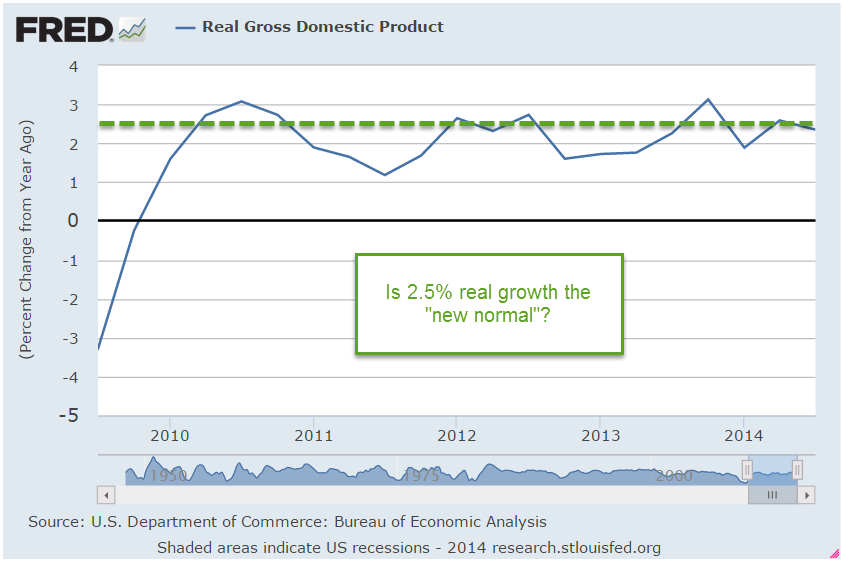
The third estimate of 3rd quarter GDP growth was a strong 5% on an annualized basis, more than offsetting the weak 1st quarter of this year. On a more sobering note, it is only in the past six months that per person GDP has firmly surpassed 2007 levels.
GDP is a measure of tradeable goods and services in an economy.  There is much important human activity that is not measured in GDP so it is far from perfect.  If you want perfect, go to the universe next door. Per person GDP growth below 1% causes concern among traders, money managers, economists and policy makers.  This year per capita growth is a healthy 2% – not robust but respectable.  
Contributing to GDP growth in the third quarter was a 4% yearly increase in federal government spending, more than double the rate of inflation.
*******************************
Oil 
Monday’s meeting of the OPEC members left little doubt that Saudi Arabia is content to let the price of oil fall as low as natural supply and demand might take it.  They said they would not consider production cuts until oil went as low as $20 a barrel, about a third of what oil is currently trading at, and a fifth of its price in 2013.  This rhetoric was aimed directly at two non-OPEC members, the U.S. and Russia, warning both countries that the Saudis intend to keep their leadership position in the international oil market.
Missouri was the first state to report an average price per gallon of gas that was lower than $3.  Others are sure to follow.  A few weeks ago an EIA administrator testified before Congress, revealing a number of dramatic shifts in U.S. oil production, consumption and import.  Once the largest importer of petroleum products, the U.S. is now the world’s largest exporter.  Despite falling oil prices, the EIA expects production to increase 10% in 2015.  

Merry Christmas

December 21, 2014

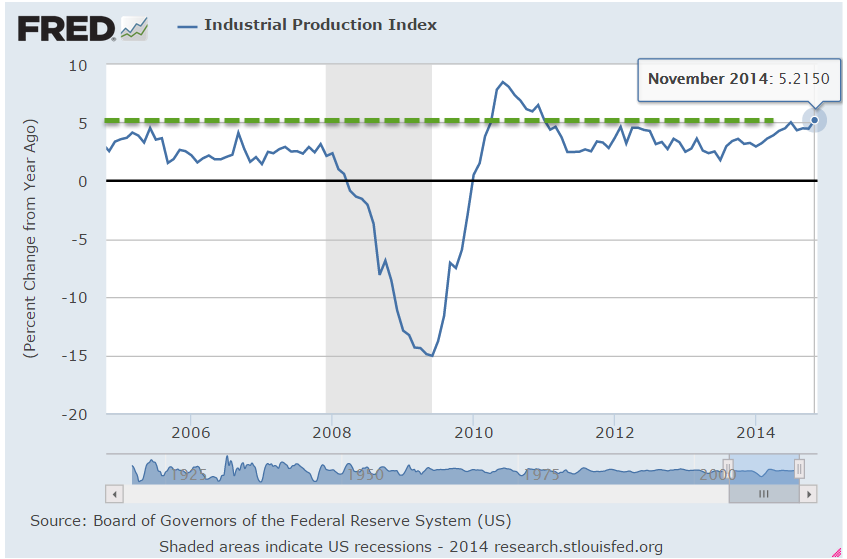
In preparation for today’s solstice, the market partied on in a week long saturnalia.  The week started off on a positive note.  Industrial production increased 1.3% in November, gaining more than 5% over November of 2013.

Capacity utilization of factories broke above 80%, a sign of strong production.  Production takes energy.  I’ll come to the energy part in a bit.

The Housing Market Index remained strong at 57, indicating that builders remain confident.  Tuesday’s report of Housing Starts was a bit of a head scratcher.  After a strong October, single family starts fell almost 6%.  Multi-family starts fell almost 10% in October, then rebounded almost 7% in November.  Combined housing starts fell 7% from November 2013.

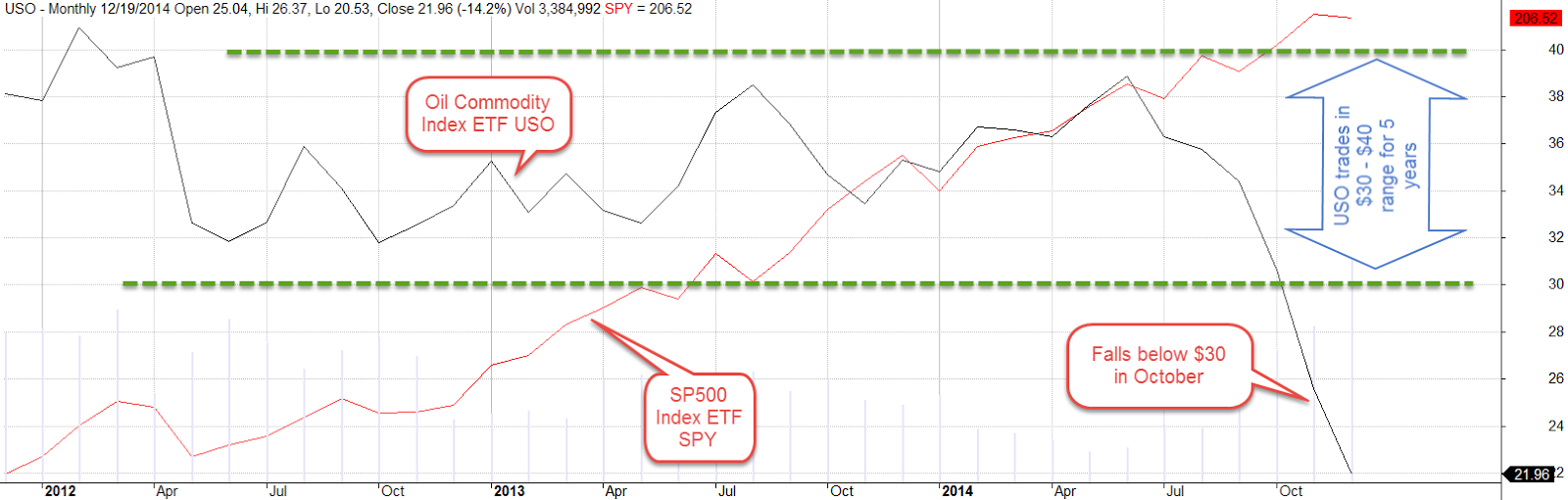
The market continued to react to the change in oil prices.  For the big picture, let’s go back a few years and compare the SP500 (SPY) to an oil commodity index (USO).  For the past five years, USO has traded in a range of $30 to $40, a cyclical pattern typical of a commodity.  In October, the oil index broke below the lower point of that trading range.

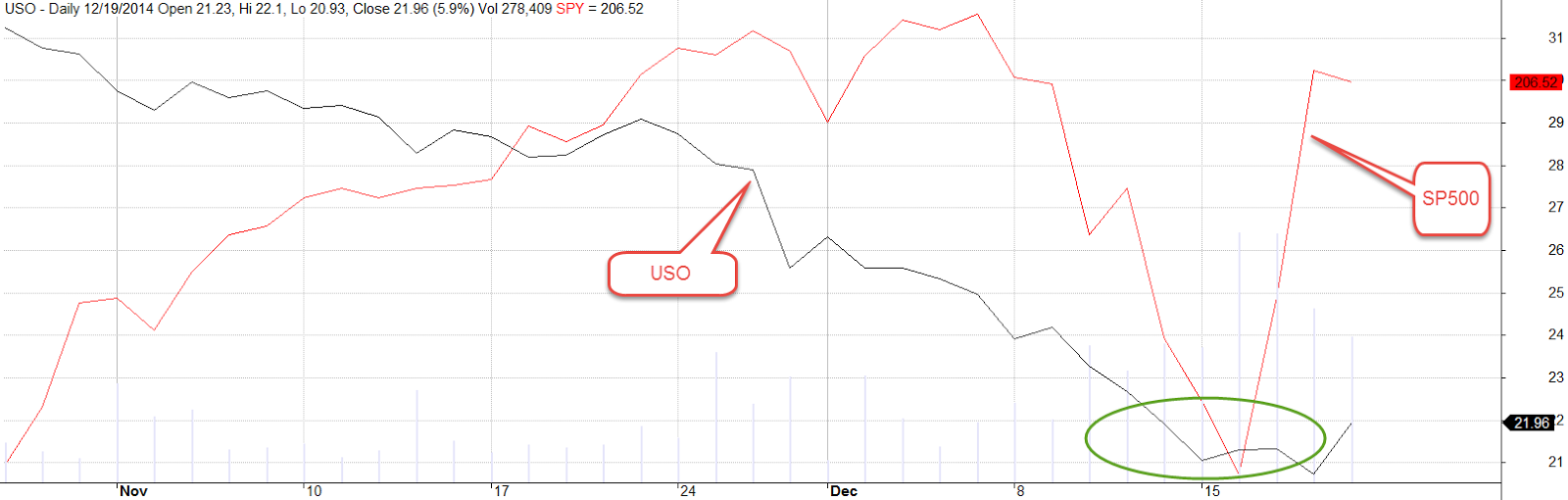
On Tuesday, oil seemed to have found a bottom in the high $50 range.  USO found a floor at $21, about a third below its five year trading range.  Beaten down for the past three weeks, energy stocks began to show some life (see note below).

Encouraging economic news helped lift investor sentiment on Tuesday morning. Some bearish investors who had shorted the market went long to close out their short positions. Growth in China was slowing down, Japan was in recession, much of Europe was at stall speed if not recession and the continued strength of the U.S. dollar was making emerging markets more frail.  While the rest of the world was going to hell in a hand basket, the U.S. economy was getting stronger.  Thee Open Market Committee at the Federal Reserve, FOMC, began its two day meeting and traders began to worry that the committee might react to the strengthening U.S. economy with the hint at an interest rate increase in the spring of 2015.  This helped sent the market down about 2% by Tuesday’s close.

Wednesday’s report on the Consumer Price Index (CPI) was heartening.  Falling gas prices were responsible for a .3% fall in the index in November, lowering inflation pressures on the Fed’s decision making about the timing of interest rate hikes.  The core CPI, which excludes the more volatile energy and food prices, had risen 1.7% over the past year, slightly below the Fed’s 2% target inflation rate.  Traders piled back into the market on Wednesday ahead of the Fed announcement Wednesday afternoon.  Back and forth, up and down, is the typical behavior when investors are uncertain about the short term direction of both interest rates and economic growth.

The Fed’s announcement that they would almost certainly leave interest rates alone till mid-2015 gave a further 1% boost upwards on Wednesday afternoon.  Twelve hours later, the German market opened  up at 3 A.M. New York time.  Early Thursday morning, the price of SP500 futures began to climb, indicating that European investors were reacting to the Fed’s decision by putting their money in the U.S. stock market.  Those of you living in the mountain and pacific time zones of the U.S. might have caught the news on Bloomberg TV before going to bed.  Maybe you got your buy orders in before brushing your teeth and putting your nightgown on. Very difficult for an individual to compete in a global market on a 24 hour time frame.  On Thursday, the market rose up as high as 5% above Wednesday’s close, before falling back to a 2.5% gain.

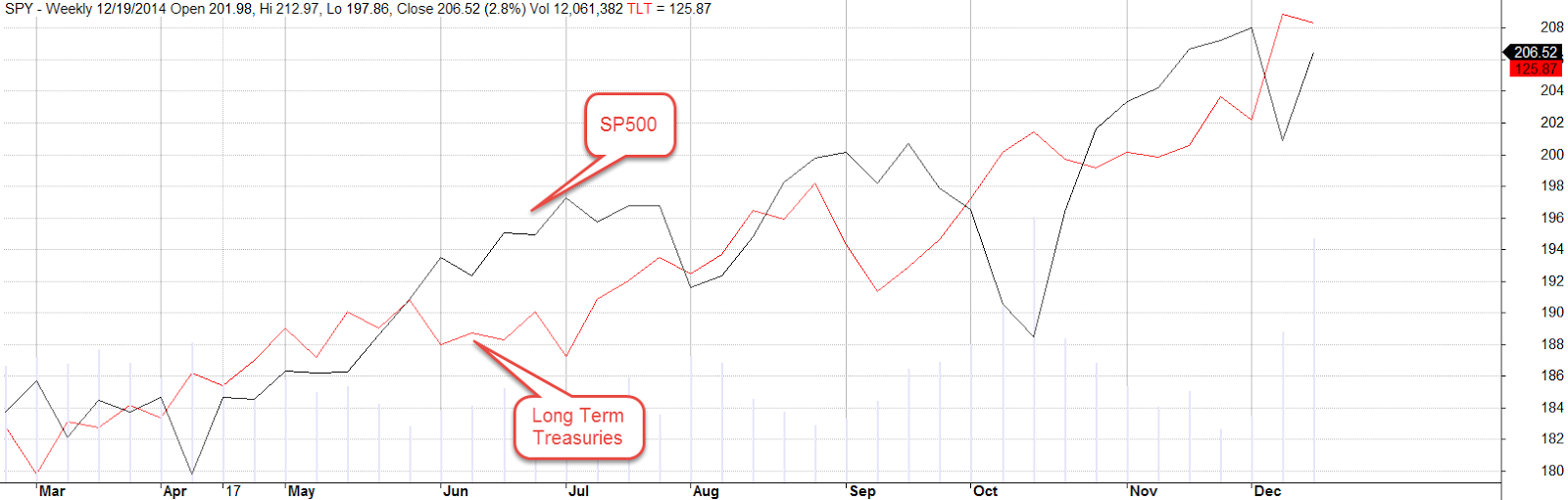
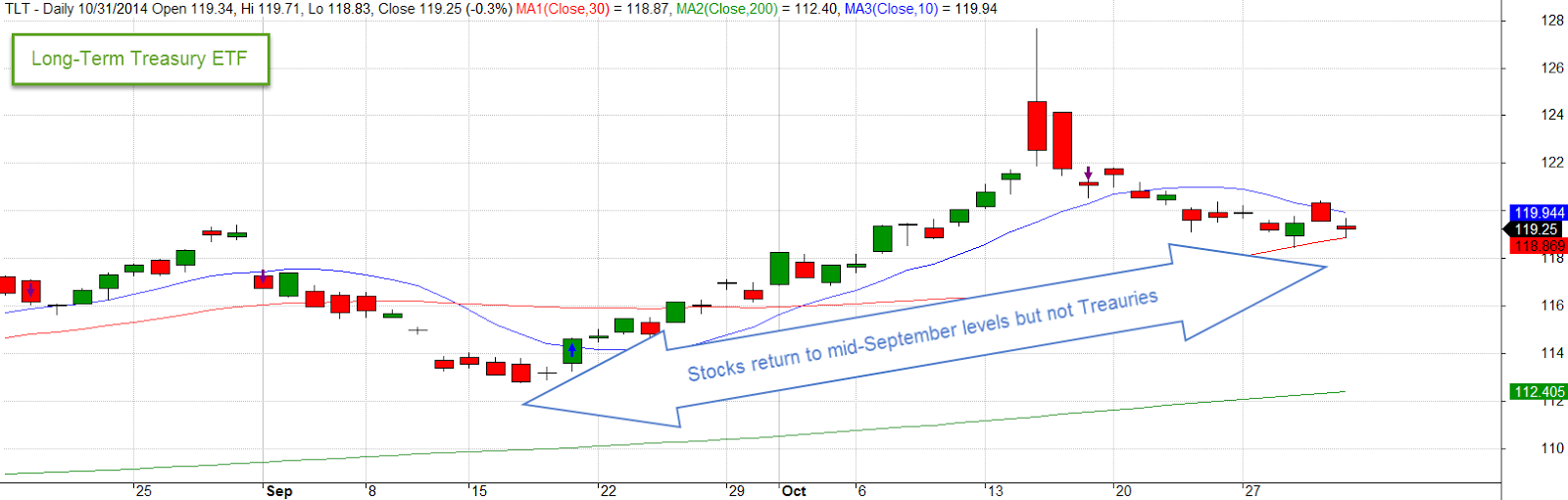
Still, a word of caution.  Both long term Treasuries, TLT, and the SP500, SPY, have been rising since October 2013.

As long as inflation remains low and the Fed continues its zero interest rate policy (ZIRP), long term Treasuries and stocks will remain attractive.   Something has to break eventually.  ZIRP  helps recovery from the aftermath of the last crisis but helps create the next crisis.  Abnormally low interest rates over an extended period are bad for the long term stability of both the markets and the economy.

**********************
Sale – Energy Stocks – Limited Time Only

(Note: this was sent out to a reader this past Tuesday.  Energy stocks popped up 4 – 5% the following day, a bit more of rebound than I expected. The week’s gain was almost 9% and the ETF closed above its 200 week average.)

As oil continues its downward slide, the prices of energy stocks sink.  XLE, a widely traded ETF that tracks energy stocks,  has dropped below the 200 week (four years!) average.  (A Vanguard ETF equivalent is VDE).  Historically, this has been a good buying opportunity. In the market meltdown of October 2008, this ETF crashed through the 200 week average.  A year later, the stock was up 38% and paid an additional 2% dividend to boot.  Let’s go further back in time to highlight the uncertainty in any strategy. The 2000 – 2003 downturn in the market was particularly notable because it took almost three years for the market to hit bottom before rising up again.  The 2007 – 2009 decline was more severe but took only 18 months. In June 2002, XLE sank below its 200 week average.  A year later, the stock had neither gained nor lost value. While this is not a sure fire strategy – nothing is – an investor  is more likely to enjoy some gains by buying at these lows.

****************************

Emerging Markets Stocks

Also selling below the 200 week average are emerging market (EM) stocks.  These include the BRICs (Brazil, Russia, India, China) as well as other countries like Mexico, Vietnam, Turkey, Indonesia and the Philipines. When a basket of stocks is trading below its four year average, there are usually a number of good reasons. Several money managers note the negatives  for EM.   Also included are a few voices of cautious optimism.  Sometimes the best time to buy is when everyone is pretty sure that this is not the right time to buy.  Another blog author recounts two strategies for emerging markets: a long term ten year horizon and a short term watchful stance.  The long term investor would take advantage of the low price and the prospect for higher growth rates in emerging economies.  The short term investor should be cognizant of the fickleness of capital flows into and out of these countries and be ready to pull the sell trigger if those flows reverse in the coming months.

******************************

Welfare

What are the characteristics of TANF families?  When the traditional welfare program was revised in the 1990s, lawmakers coined a new name, Temporary Assistance to Needy Families, to more accurately describe the program.  The old term carried a lot of negative connotations as well. Two years ago Health and Human Services (HHS) published their analysis of a sample of 300,000 recipients of TANF income in 2010.  Although the recession had officially ended in 2009, the unemployment rate in 2010 was still very high, above 9%.  It is less than 6% today.

There were 4.3 million recipients, three-quarters of them children, about 1.4% of the population. By household, the percentage was also the same 1.4% (1.8 million families out of 132 million households).  In 2013, the number of recipients had dropped to 4.0 million, the number of families to 1.7 million (Congressional Research Service)

In 2010, average non-TANF income was $720 per month, or about $170 a week.  To put this in perspective, this was about the average daily wage at that time The average monthly income from TANF averaged $392. Recipients were split evenly across race or ethnic background: 32% were white, 32% black, and 30% Hispanic. For adult recipients only, 37% were white, 33% black, and 24% Hispanic.

Rather surprising was how concentrated the recipients were. 31% of all TANF recipients in 2010 lived in California.  43.3% of all recipients lived in either New York, California or Ohio.  The three states have 22% of the U.S. population and almost 44% of TANF cases.

HHS data refutes the notion that welfare families are big.  50% of TANF families had only one child.  Less than 8% of TANF families had more than 3 children.  82% of TANF families also receive SNAP benefits averaging $378 per month.

In 2014, Federal and State spending on the TANF program was less than $30 billion, about 1/2% of the $6 trillion dollars in total government spending.  The Federal government spends a greater percentage on foreign aid (1%) than the TANF program. Yet people consistently overestimate the percentage of spending on both programs (Washington Post article).  The average estimate for foreign aid? A whopping 28%.  Cynical politicians take advantage of these public misperceptions.

**********************

Omnibus

Aiming to overhaul the health care insurance programs throughout the country, the Affordable Care Act (ACA) was a big bill.  No, it wasn’t 2700 pages as often quoted by those who didn’t like it.  The final, or Reconciled, version of the bill was “only” 900 pages.  The House and Senate versions were also about 900 pages each; hence, the 2700 pages.

At 1600 pages in its final form, the recently passed Omnibus Spending bill makes the ACA look like a pamphlet.  As  specified in the Constitution, all spending bills originate in the House.  Past procedure has been to pass a series of 12 spending bills.  Majority leader John Boehner has found it difficult to get his fractious members to agree on anything in this Congress so all 12 bills were crammed into this behemoth bill just in time to avoid a government shutdown.  Just as with the ACA, most members of the House and Senate did not have adequate time to digest the details of the bill.  The bill is sure to hold many surprises for those who signed it and we, the people, who must live under the farcical law-making of this Congress.  Here is a primer on the budget and spending process.

**********************

Home Appraisals

They’re back!  A review of 200,000 mortgages between 2011 and 2014 showed that 14% of homes had “generous” appraisals, inflating the value of the home by 20% or more.  Loan officers and real estate agents are putting increasing pressure on appraisers to adjust values upwards.

**********************

Personal Income

You may have read that household income has been rather stagnant for the past ten years or more.  In the past fifty years household formation has increased 78%, far more than the 50% increase in population.  The nation’s total income is thus divided by more households, skewing the per household figure lower.  During the past thirty years, per person income has actually grown 1.7% above inflation each year.  Inflation adjusted income is now 66% higher than what it was in 1985.

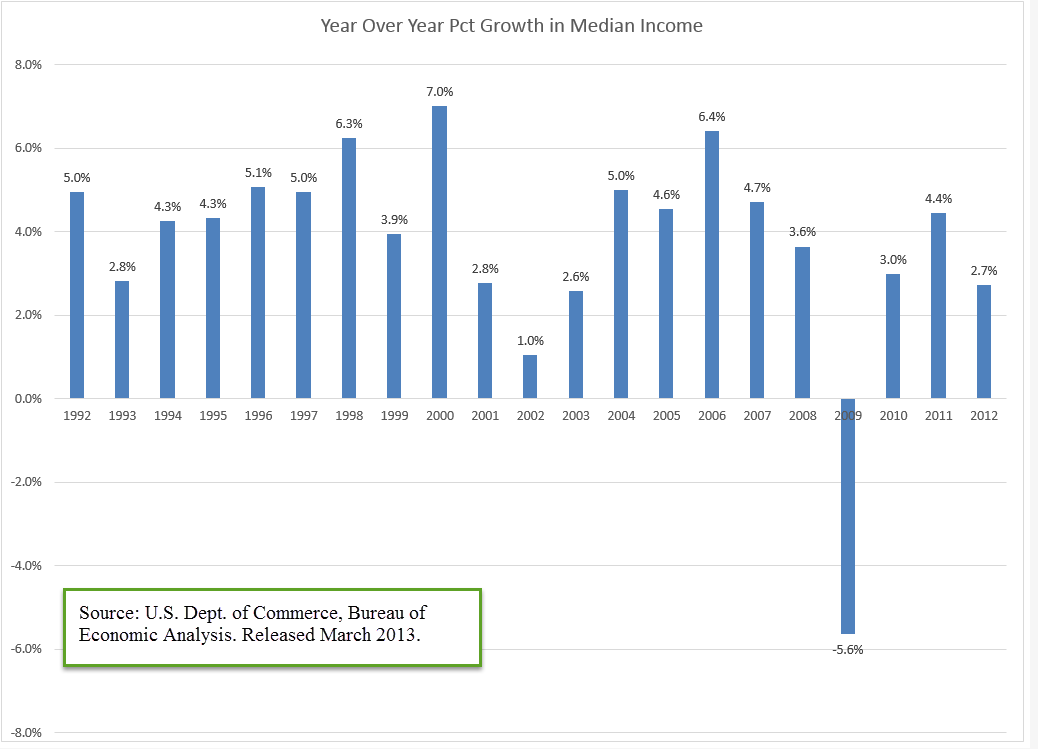
In 2013, the Bureau of Economic Analysis released median income data for the past two decades. Median is the middle; half were higher; half were lower.  This is the actual dollars not adjusted for inflation.  Except for the recession around the time of 9-11 and the great recession of 2008 – 2009, incomes have risen steadily.

The 3.7% yearly growth in median incomes has outpaced inflation by almost 25%.

Why then does household income get more attention?  A superficial review of household data paints a negative picture of the American economy. Negative news in general tugs at our eyeballs, gets our attention.  The majority of the evening news is devoted to negative news for a reason. News providers sell advertising in some form or another.  They are in the business of capturing our attention, not providing a balanced summary of the news.  In addition, a story of stagnating incomes helps promote the agenda of some political groups.

***********************

Merry Christmas and Happy Chanukah!

Oil, oil, retail, and oil

December 14, 2014

The market seemed to wake up Monday morning on the wrong side of the bed.  The Federal Reserve updated their Labor Market Conditions Index, scoring the month of November with a tepid 2.9, a sobering counter punch to the previous Friday’s report of 321,000 job gains in November.  Too many part time workers, too many long term unemployed, a rate of unemployment that was too high among minorities, those in their twenties and those without a college education.

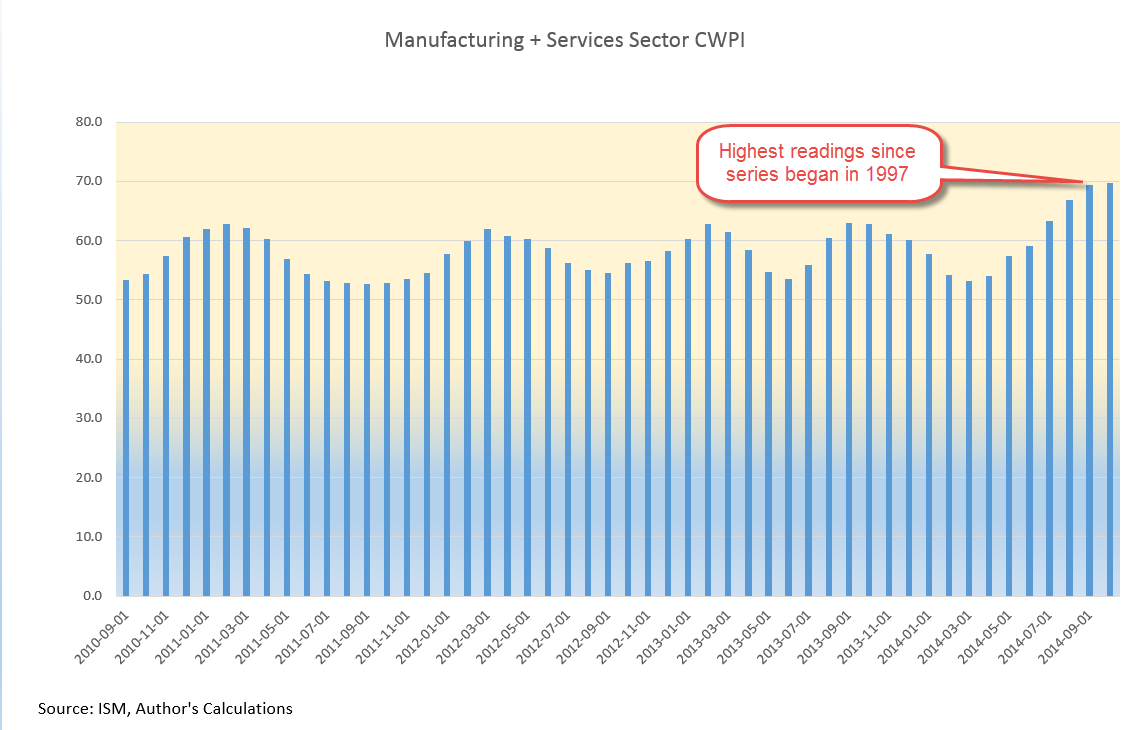
ISM’s monthly reports showed continued strength in both manufacturing and the services sector. The composite CWPI eased just a bit from the historic highs of the past two months.

The key components of the manufacturing index, new orders and employment, remained strong or robust.  The prices component showed a steep dive from expansion to contraction, 53.5 to 44.5.  George wondered if the falling price of oil had anything to do with this change.  New orders in the services sector grew even stronger while employment eased just a bit and was also continuing a strong expansion.

On his way to Home Depot on Tuesday morning, George filled up his SUV for just under $50.  When had that happened last he wondered.  2009, maybe?  George remembered the lead up to the 2012 elections. “Gas was $1.50 when Obama came into office,” he would hear on a conservative talk show, “and now it’s more than double that. Obama is hurting working families.”  As though Obama, or any President for that matter, had much to do with the price of gas.  Most talk show hosts counted on the fact that their audience was, well not stupid, as Jonathan Gruber had quipped when talking about Obamacare at a conference, but poorly informed.

The market had opened up that morning in a particularly foul mood after China tightened lending criteria so that Chinese investors could no longer use low-grade corporate debt as collateral for loans.  Overnight the Shanghai market lost more than 5% (WSJ ).

The EIA projected that U.S. oil production would rise in 2015 even as oil prices went lower.  Lower prices might curb new drilling but once the wells were drilled, the cost of production was fairly low.  The drop in gas prices put some extra money in most people’s pockets.  The EIA estimated that a gallon of gas would average about $2.60 in 2015, almost a $1 lower than the $3.51 average in 2013.

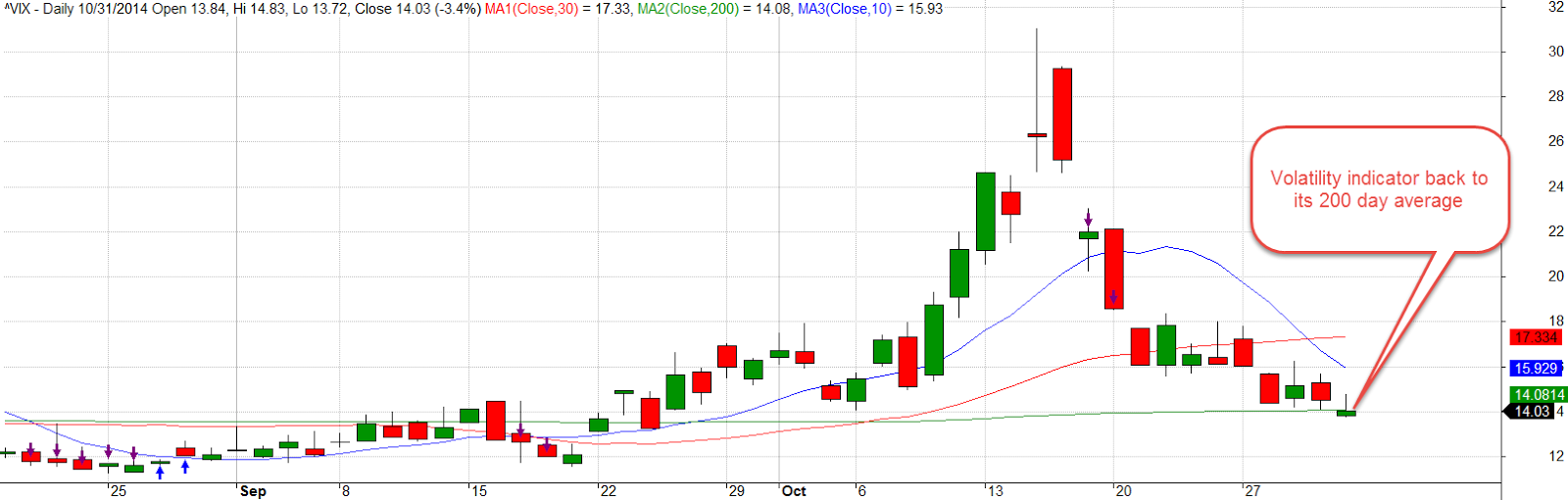
The continuing fall in oil prices contributed to another drop in the market on Wednesday, erasing the gains of the past month.  To sell or not to sell, that is the question, George thought as the volatility in the market continued to climb, rising more than 50% in the past week.  But he hemmed and hawed, then decided to replace the fence post in the back yard as the antidote to his indecision.

In an economy dominated by consumer spending, the monthly retail sales report and the employment report are probably the two most influential gauges of the strength of the economy.  Thursday’s report on retail sales was a huge positive, showing a rise of .7%.  On an annualized basis, that was an increase of more than 8%.  People were evidently spending the money they were saving at the pump.  The market opened higher and climbed up above Wednesday’s opening price.  Great stuff, George thought, then watched as the positive mood vanished and the market started sinking.  He must have made some sound because Mabel called out asking him if he was OK.  George realized that the early morning run up in prices was traders covering their short bets.  The underlying sentiment was still negative.  A strong employment report last Friday and now a strong retail sales report was having little effect on the mood of the market.  George decided to get out of the way of the darkening mood and sold the equity index he’d bought in mid-October.

The market continued to follow oil prices down on Friday.  George was pleased to find that the long term Treasuries that he had bought last week were up a few percent.  Glancing back at the beginning of the year, he saw that long term Treasuries (TLT) were up an unbelievable 20% so far this year.  Back in January many had projected higher interest rates toward the end of 2014, making long term Treasuries less attractive.  The equity market was up 10% for the year despite the recent change in mood.  Two types of investment that often moved opposite each other had moved in the same direction.  George smiled as he remembered something his  childhood baseball coach would say, “If it ain’t one thing, it’s the other, and sometimes it’s both.”  Which was just another way of saying not to put all your eggs in one basket.

Gangbusters!

December 7, 2014

On Monday, George intended to put the $50K from the CD into the bond market. He couldn’t decide between a long term bond index like Vanguard’s BLV or TLT, the ETF that tracked 10 year Treasury bonds. Both the bond and stock markets opened lower in the morning which confused him and he did nothing. Gallup released their monthly survey of consumer spending for November, showing a respectable gain of more than 4% over last November.

Tuesday’s report of auto sales in November was strong.  Total vehicle sales topped 17 million on an annualized basis. Auto manufacturers reported particularly strong sales over the Thanksgiving holiday.  SUVs were big sellers and that was a double plus for auto companies because those vehicles had larger profit margins.  The American car buyer has long had a short memory.  Six months of falling gas prices prompted many to abandon their economical cars and wrap themselves in a big bubba vehicle.

Construction spending was up 1.1% from the previous month and 3.3% above last October.  The economies of Europe may have slipped into neutral or recession but the U.S. economy was chugging along.  The upbeat reports gave the stock market a minor boost but there was little selling of Treasuries, indicating a growing split in sentiment among investors.  George decided to put his and Mabel’s CD money into TLT.

On Wednesday, the Centers for Medicare and Medicaid Services released their annual report on health care costs.  Spending had increased only 3.6% in 2013, the lowest increase since 1960, and the fifth year in a row that spending had grown less than 4%.  Out of pocket expenses had risen from $293 billion in 2007 to $339 billion in 2013, a 16% increase over six years.  Before the recession, George could remember years when spending rose almost that much in a single year.  CMS reported that consumers’ out-of-pocket spending was only 3.2% of charges, less than the 5.9% of charges in 2007.

CMS published a historical table that caused George to raise both eyebrows.  In 1960, Americans spent $125 ($967 in 2012 dollars) per person on health care. In 2012, that figure had grown eight-fold to $7533 per person.  Administrative and public health programs added another 15% to those costs.  In 2013, the total cost per person was over $9500 for a whopping national total of $2.9 trillion spent on health care, almost 18% of GDP.

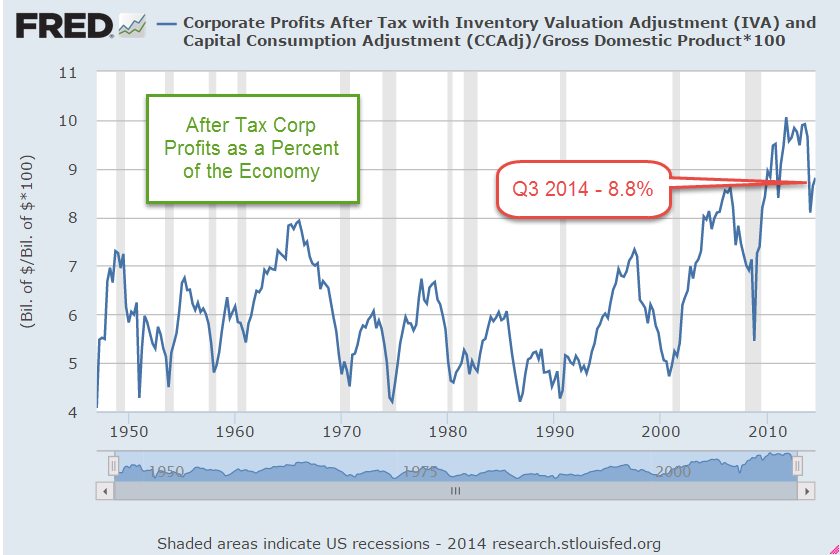
While families were shelling out more for health care, companies were grabbing a larger share of the economic pie.  As a percent of GDP corporate profits had been trending upward since 1990.

The private payroll processor ADP reported private job gains of 208,000, slightly below expectations but still above the 200,000 mark considered a healthy job market. Later that day came the announcement that a Staten Island grand jury decided that there would be no indictment in the death of Eric Garner.  Caught on video, five or six officers had surrounded the man to arrest him for selling bootleg loose cigarettes.  One of the officers put a choke hold on the unarmed Garner, restricting his breathing till he died of asphyxiation.

Later that day, four Denver bicycle cops were escorting a parade of students protesting the grand jury decision in Ferguson.  Acting as a buffer between the students and traffic on the busy street east of the Capitol, the officers were struck by a Mercedes as it ran through an intersection.  The Mercedes dragged one of the officers about thirty yards and that officer was taken to the hospital in critical condition.  On the evening news, George and Mabel learned that the driver of the Mercedes might have been having a seizure when he hit the officers.

Late Thursday morning, George was focused on several economic reports.  Since 2010, the polling firm Gallup had conducted a simple employment survey, called P2P, that counted the number of people who had worked for money in the past week or had looked for work in the past week.  Gallup reported the lowest unemployment rate, 6.2%, since the poll began.  New jobless claims were one again just under 300,000, indicating that the previous week’s 314,000 might have been an anomaly.  The 4 week average of new claims was still below 300,000.

Friday morning the reporters dusted off their sports dictionaries as they searched for words to describe the monthly labor report from the BLS.  Blockbuster.  Gangbusters. Blowout numbers. Spectacular.  Amazing.  George poured another cup of coffee. Yes, 321,000 new jobs sounded great!!! Too great. George got out his magnifying glass, put on his Sherlock cap and went hunting.  First of all, ADP had reported 208,000 private job gains.  The BLS report included new government jobs which the ADP did not include.  So back out the 7000 new government jobs to get private job gains of 314,000 according to the BLS.  Paging Dr. George, number surgeon.  He took out his skeptical scalpel. Take the average of the two estimates, which was 314 +  208 = 522, divided by 2 = 261.  Add back in the 7000 government jobs and probably the more accurate figure was close to 270,000 – 280,000.  September’s job gains had been revised up 20,000 by both ADP and the BLS. The BLS also revised the job gains of October,  getting closer to the averaging method that George used. Sacre bleu!  Averaging really works!  George was a big believer in averages.

Anyway, the employment report was strong, just not as fantastic as it first appeared. Average monthly job gains for the past year had been about 230 – 240,000.  George picked up his magnifying glass.  Hmmm, he said.  Retail job gains were 50,000, far above the 22,000 average of the past year.  At least 20,000 of those job gains were temporary seasonal gains.  Let’s be generous and start with 280,000 jobs. 280 – 20 = 260.  Now job gains were approaching the average of the past year.

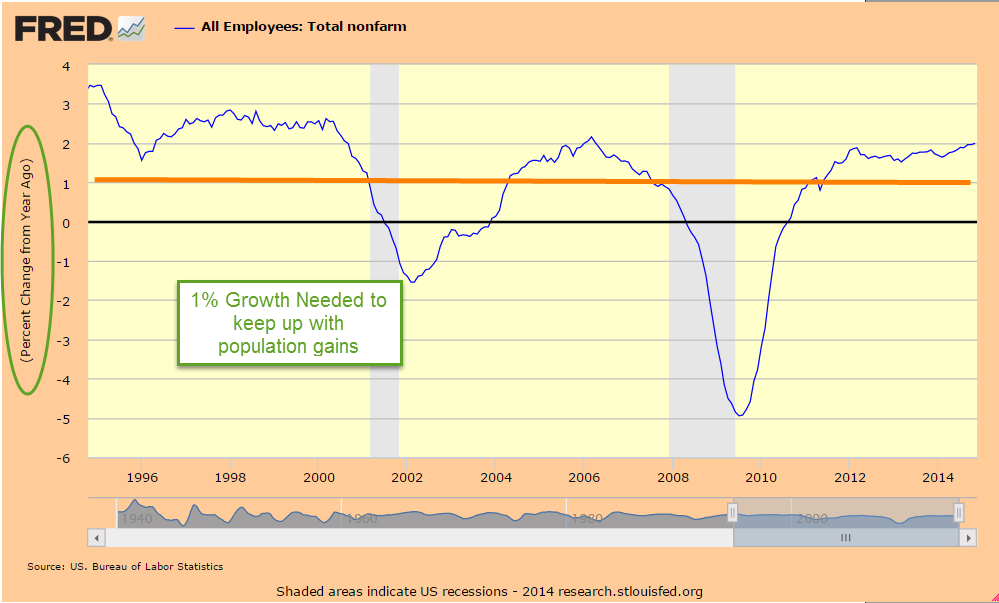
Still, the yearly growth in employment was climbing toward 2%, slowly but surely getting stronger.

Professional and business service jobs had been a leading sector for the past few years and were especially strong this month at 86,000, way above the average gains of 50 – 55,000.  George raised a skeptical eyebrow.  A closer look showed that the strong gains were particularly strong in bookkeeping and accounting.  Take out 20,000 temporary tax jobs, George thought, and now his count was down to 240,000.  Boy, this was quickly becoming an average employment report.

Yearly gains in hourly earnings for the average worker were just under 2.2%, just barely ahead of inflation. For all workers, the gains were 2.1%.

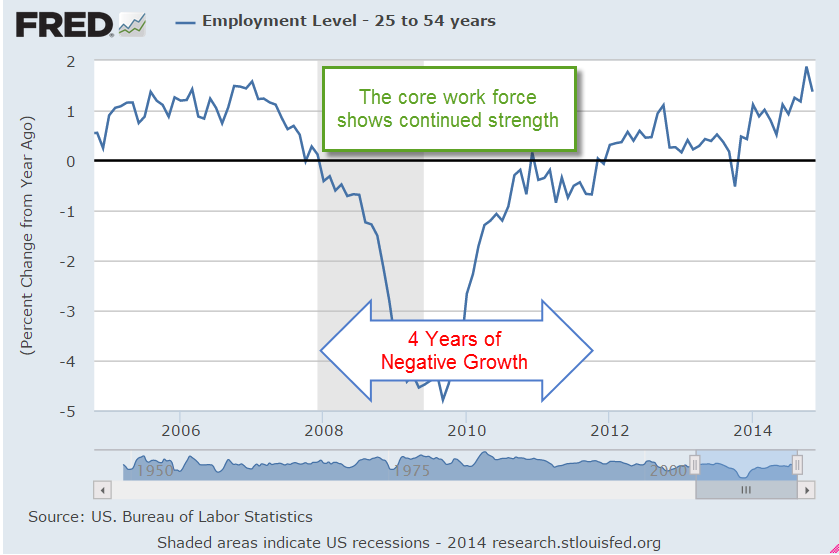
George put away his magnifying glass and put on his rosy glasses.  The average hourly work week had increased .1 hour over the past month, a good sign.  However, that was also the yearly gain.  Not so good.  George cleaned his rosy glasses.  The gains had been fairly broad and the core work force aged 25 – 54 had increased to nearly 96 million.

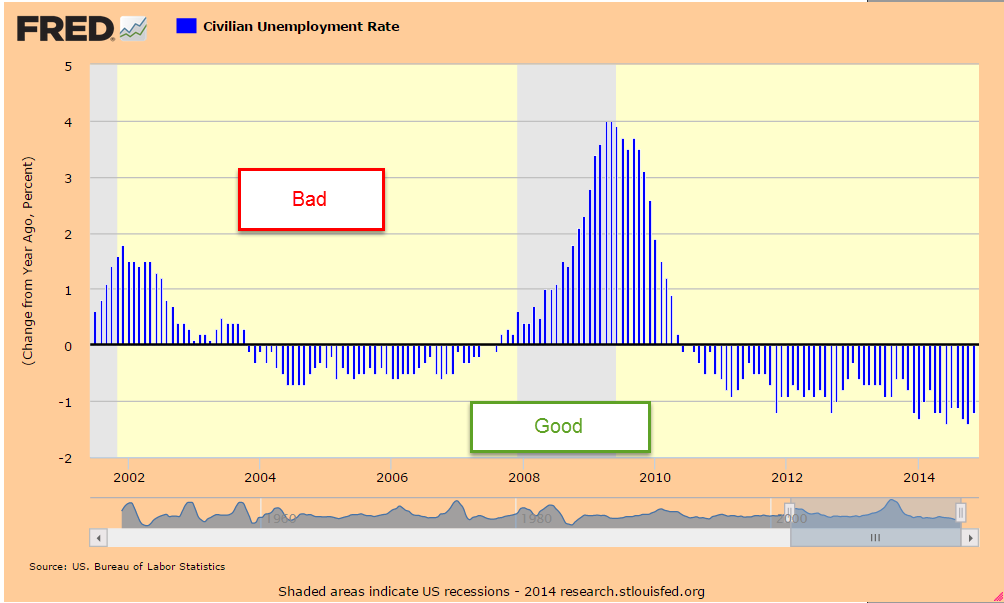
The construction and manufacturing sectors reported strong gains.  Although the headline unemployment rate remained the same at 5.8%, this rate was more than 1% below last year’s rate, a sign of a relatively healthy labor market.

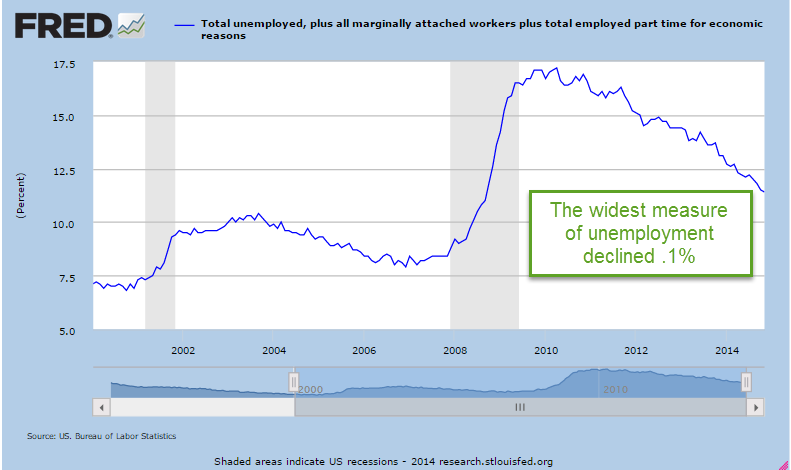
A wider measure of unemployment, the U-6 rate, had declined .1% but was still above the rates in the mid-2000s.  George needed a better pair of rosy glasses.

George checked to see if the Federal Reserve had updated their Labor Market Conditions Index but that would probably come next week.  The market had risen a few tenths of a percent since the high of two weeks ago.  According to a Fact Set report, earnings growth for the fourth quarter had been revised down from 8.3% to only 3.4%.  After rising up almost 14% since the mid-October trough, the SP500 had stalled despite a number of positive reports.  Treasury bonds had lost a few percent in price since mid-October but had stayed relatively strong, indicating some skepticism toward any further stock gains.  The stock market seemed to be treading water ahead of the December 11th deadline for Congress to pass a spending bill.  Despite promises that there would be no government shutdown this time, investors might be a bit less confident in the dependability of promises from the Republican leadership.

An Unwelcome Guest

Nov. 30, 2014

The short week of Thanksgiving should have been rather uneventful.  The week before, officials in Ferguson, Missouri had announced an imminent decision in the grand jury hearing of the fatal shooting of Michael Brown, an African American, by Darren Wilson, a Ferguson police officer who was European American.

Slavery, the denial of civil rights to African Americans, and persistent housing and job discrimination against African Americans are an integral part of American history.  Bankruptcy is a formal discharge of debt.  There is no formal procedure for discharging past wrongs.  Some Southerners are still distrustful of the Federal bureaucracy in Washington that committed so many wrongs in the period after the Civil War.  The wounds inflicted by white skinned Americans on dark skinned Americans is fresher than those suffered by Southerners during the Reconstruction period almost 150 years ago.  Fresh wounds bleed easily when scratched.

The grand jury took several days longer than “imminent” to reach its decision, announced Monday night.  Several weeks of protests during the course of the hearing erupted into violent rioting at the grand jury’s decision that Officer Wilson should not be indicted for any charges, ranging from first degree murder to manslaughter.  The decision, right or wrong on the facts, picked at the scab of the soul of some African Americans, provoking senseless violence.  Americans of every skin color riot when their team wins the World Series (San Francisco 2014) or Super Bowl (Denver 1998).  Dark skinned Americans riot when they perceive that some injustice has been committed against them.

The costliest riots, over $1 billion in damages, had occurred in Los Angeles in 1992 after the Rodney King beating.  Whether in response to victory or injustice, rioting provoked confusion and condemnation in any society.  It was both uncomfortable and strangely seductive to watch the emergence of a super two-year old, having a temper tantrum, from a group of civilized human beings.

Property damage from civil unrest was covered by many business insurance plans, George knew, but he wondered how many businesses damaged in the Ferguson riots were covered for interruption of business operations, replacing some or all of the owner’s lost income.  Sometimes these were sold as riders to a commercial policy.

People with jobs were less likely to get angry.  Unemployment among African Americans was at the same level as the early seventies, when the economy was in a severe recession, and the oil embargo and inflation had prompted Nixon to enact wage price controls.  Those had not been good times for many Americans. Five years after the official end of this last recession, the unemployment rate among African Americans was twice the rate of the general labor force.

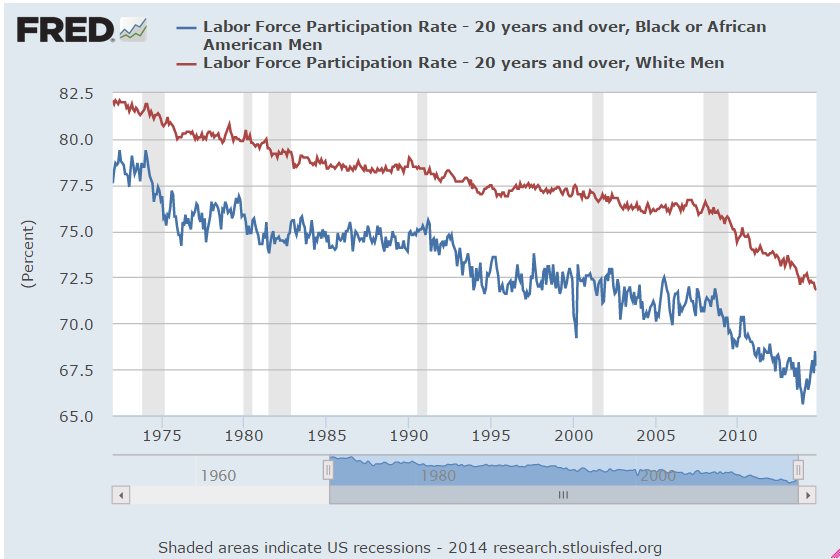
The participation rate among African Americans was about 1% less than that for the entire labor force but the rate difference for men was about 4 to 5%.

George was a bit concerned that Monday night’s riots in Ferguson might have a secondary effect on Tuesday’s trading if the 2nd estimate of GDP growth for the 3rd quarter was below 3%.  Yes, he should have been more focused on making turkeys out of construction paper for the Thanksgiving dinner.  He and Mabel – well, mostly Mabel – had started the tradition when the kids, Robbie and Emily, were younger.  Somehow they had continued the tradition after the kids had gone.  George told Mabel that he would do it while they watched the season finale of Dancing With the Stars on Tuesday night.  Somehow he felt like a kid saying he would do his homework later.  Long marriages result from both partners doing stuff they don’t particularly like doing, George thought.

Tuesday morning’s report of GDP growth allayed George’s concerns.  October’s initial estimate of growth had been 3.5%.  This second estimate was higher, at 3.9%.  The Case Shiller 20 city home price index showed a slight month-to-month increase, but the yearly increase in price was just about 5%, more in line with historical averages.  
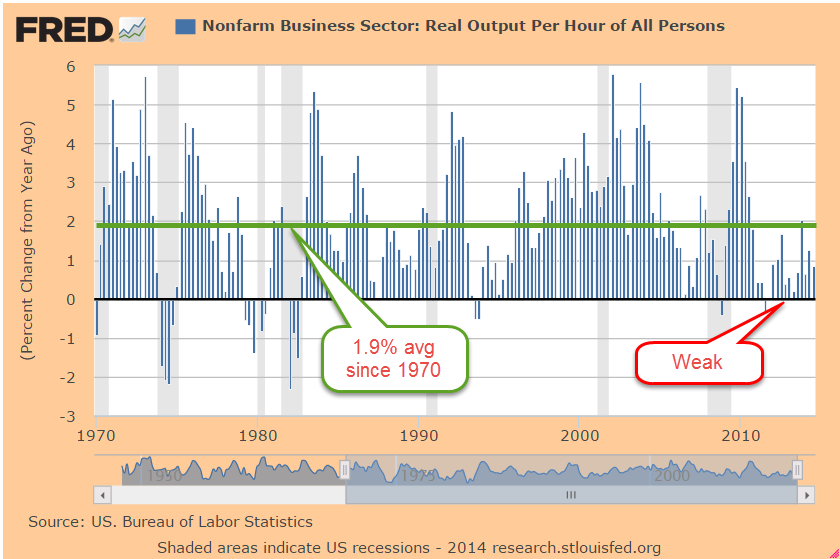
 Corporate Profits for the 3rd quarter gained 3.8% year-over-year, slowing down from the 4.6% year-over-year growth in the 2nd quarter.  Profit growth was ultimately driven by growth in productivity.  Capital investments in technology had reaped the greater share of overall growth in the past decade or more.  Labor’s share of growth had been particularly weak the past few years, far below the average of the past forty years. 
A closer look at labor productivity gains in the past decade showed just how meager they were.  
A work force unable to capture productivity growth could not command strong pay growth.  Economists at the BLS anticipated increasing overall output growth in this next decade but those projections were sullied by the lack of clarity regarding the causes for the slow growth in labor productivity of the past decade. Did the shift further away from manufacturing make gains harder to come by?  Was there a limit to growth that could be achieved by better management, process design and innovation? Some blamed the exponential growth of the regulatory state, forcing businesses to devote an increasing number of hours on compliance and reporting.  Others blamed the increase in social benefit programs for softening the competitive edge of American workers.  Got a reason?  Throw it in the hat, George thought. The market traded in a flat range for the day.
On Wednesday, George went to the bank to cash in the joint CD that he and Mabel had discussed the previous week.  He was surprised to learn that the bank did not require the both of them to cash in a joint CD.  Mabel was busy with Thanksgiving fixings so it was convenient that George could go alone to handle the matter.  He picked up a certified bank check from one bank and drove over to the bank where they kept their checking account to deposit the money.  He was also surprised to find that the bank did not credit the money to their account for a few days. “The other bank is just like 10 to 15 blocks away,” George told the teller.  “Well, we have to guard against fraud,” the teller responded.  “So it would have been better to have gotten cash?” George asked. “Well, yeh, but then I think you would have to fill out a form because it’s a large cash transaction,” the teller informed him.  “You know, to say you got the money by legal means, that you’re not a drug dealer,” he went on, “but I’d have to ask my supervisor about that.”
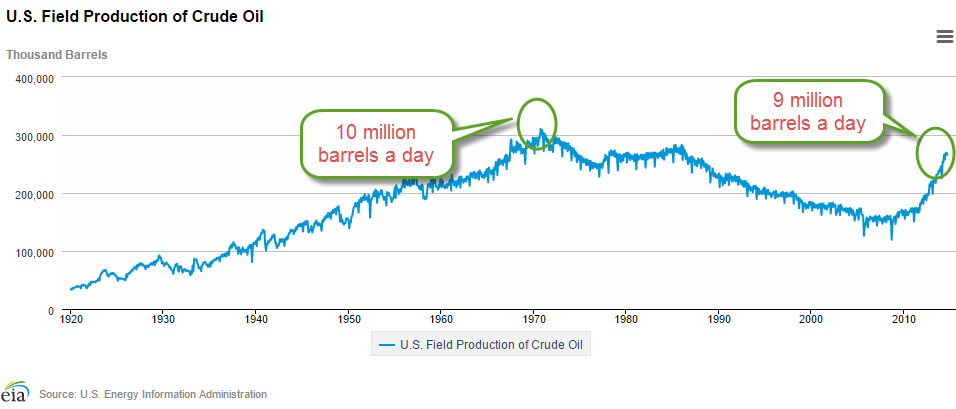
George was going to transfer the money that day to their brokerage but thought he should wait till Monday.  George was tempted to buy maybe a 1000 shares of USO, the commodity ETF that tracked West Texas Intermediate Oil.  OPEC was scheduled to meet Thanksgiving day to discuss the near term future of oil prices.  They had dropped by about a third in the past year as increasing barrels of U.S. shale oil were added to the supply for a weakening global demand.  U.S. oil production was now at 9 million barrels a day, the same level  as the mid-1980s, and rising toward the record production of 10 million barrels in the early 1970s.
Poorer countries in OPEC who funded their government with the sale of oil, wanted to set production cuts to halt any further declines in oil prices.  With their huge supply of oil and relatively inexpensive production costs, the Saudis were content to let the slide continue.  On Tuesday, oil prices had dropped a few percent.  But if the other members of OPEC prevailed and production cuts were announced, George reasoned, he could make a bundle of money in a short time by buying oil the day before.  That was the speculative angel, or devil, on his shoulder whispering in his ear.  His other angel simply asked, “Are we investing or gambling?”  George gave in to his cautious angel.  He could also lose a bunch of money really quickly if the Saudis prevailed.  
Thanksgiving dinner was a relatively muted affair, unlike those of past years.  Bob, George’s older brother, and his wife, Flo, had flown down to Cabo to work on an archaeological dig.  The digging part of that “vacation” didn’t sound appealing to George but this archaeological club, or group, would put them up for 10 days in exchange for their labor and they would still have time for sun and surf.  Bob had become fascinated with archaeology when he was about 60 years old and had pursued it with a passion since then.
Mabel, the oldest of five siblings, had taken on the Thanksgiving festivities.  Two of her sisters lived in Colorado but only Susan, the youngest, came to dinner this week.  Most unusual, George thought, that Charlie was the only child at the dinner this year.  The talk at the dinner table turned to Ferguson.  Robbie had read quite a lot of the testimony at the grand jury hearing and was full of facts.  Charlie got bored as the adults chattered on during the meal. He saw a squirrel coming down the trunk of the tree in the front yard and asked George if he could have some peanuts to feed them.  George had showed Charlie how to sit still on the back deck after putting peanuts out for the squirrels in the middle of the backyard.  He was quite surprised that a child of that age could be motionless and silent for that long as they waited for the squirrels to scurry out from the bushes to snatch up a peanut in their wiry paws.
As the talk and opinions swirled around the table, Mabel was quiet, chewing methodically while listening attentively to the others.  George had already had a few testy words with her earlier in the week so he knew how strong her opinions were.  Robbie’s wife Gail all but accused her husband of being a racist because he did not understand that the facts of the case had been carefully cultivated in favor of the police officer.  Robbie asked his mom for some affirmation.  Mabel finished a bite of sweet potato. 
“About fifteen years ago, I stayed a bit late after school, finishing up some paperwork,” she said to Robbie, then turned to the others around the table.  “It was late October,  maybe early November.  The sun had already set.  There were only a few cars left in the parking lot.  There was one of those parking lot lights, the high ones like street lights, near my car but it would go on for a few seconds, then go off for about a minute.  As I walked to my car in the semi-darkness, I noticed a figure walking to me from my right as though to intersect me as I got to my car.  A second glance up and I saw he was wearing one of those,” she paused, “hoodies, I think they’re called.  As he got closer, maybe twenty feet away, I realized that I couldn’t see his face, that it was a black man in a hoodie. My heart instantly started flippity flopping as I realized that I was going to be attacked.”  
Mabel had everyone’s attention, a difficult thing to do in an family that was not reluctant to share their opinions. “There was no one else in the parking lot that I could call out to for help,” she continued in a purposeful voice. “I hurried my step, reached into my bag, fumbling for the car keys as I approached the car.  I didn’t want to look panicked, fearing I don’t know what.  Maybe that my panic would provoke the attacker.  As I reached out my arm to unlock the car, the man’s voice broke the darkness.  All I heard was ‘Hey’ and I turned and I yelled back ‘Aaaaahhhhh,’ grunting it out like some Kung-Fu movie.  “Mabel?  Is that you? I didn’t mean to startle you,” the voice from the hoodie said.  He brushed back the hood of his parka and I could see that it was James, the biology teacher. 
He was so apologetic and I pretended that I had not noticed him until just that minute. ‘My battery’s dead and I was wondering if you have some cables, could give me a jump,’ he explained to me.  ‘I was going to call AAA and then I saw someone come out of the school entrance and I thought it might be you but I wasn’t sure,’ he went on.  I had cables in the trunk, but I was so upset that I lied and told him no, I didn’t have any.  He thanked me and went back across the parking lot to his car.”  Mabel took a quick sip of water from her glass.  George had never heard this story.  After 35 years of marriage, that rarely occurred.
“I started up the car, then sat there crying,” she continued, her lips tense.  “It’s as though my ideals, my view of myself, was a cloak that I had worn and then, that night, I looked in the mirror without my cloak on.  I wasn’t racist in spirit,” she paused, searching for the words to complete the thought, “or intention, but I realized that I was a racist in perception. Racism is embedded in our culture, in me, whether I like it or not.”  
She stopped and there was silence around the dinner table, a rare event at a Liscomb family gathering.  Robbie, sitting close by his mother, reached across the table to grasp his mother’s hand. From the far end of the table, George was struck by her – what would he call it? Her forthrightness. She had an ability he lacked, and perhaps that’s why the seeing of it in her gave him a sense of admiration.  The moment snapped like a crisp carrot as the front door swung open and Charlie burst through the doorway.  “The squirrel was eating a peanut this far from me!” he yelled excitedly and spread wide his arms.

On Friday, George learned that the Saudis had prevailed at the OPEC meeting.  By the end of the day, USO had dropped more than 8%.  We bear the fruits of what we do and don’t do, George reminded himself, then wondered if that was a line from Shakespeare or maybe Leonard Cohen?

While the stock market stayed relatively quiet during the week, ten year bond prices continued to gather strength.  Stocks and bonds tended to move opposite each other in a dance of risk and return. When they both gained in strength, something had to give.  The last time they met at this strong level was at the end of August, when bonds faltered first, falling  about 5% over two weeks while the SP500 remained fairly stable.  In mid-September they flipped.  Bonds rallied up 8-9% as stocks fell the same amount.  Then stocks rallied to all time highs in the past four or five weeks but bond prices had not fallen more than a few percent.  George resolved to watch this dance during the following week.  It was the first week of the month, filled with a number of reports including the employment report that could renew or drain confidence in the stock market. 

The Talk

November 23, 2014

A strong wind from the southwest blew into town, chasing the cold weather out onto the great plains east of Denver.  Most of the trees had given up their leaves as the days grew shorter but the elm trees had stubbornly held onto their leaves, still green far into November.  The turning of color began during the cold snap of the previous week and now the great gnarly giants began to release their leaves to the winds.  Busy at work for many years, George had hired out the autumn cleanup.  Now that he was retired, he was becoming more attuned to the daily and seasonal rhythms of the plants and animals in the neighborhood.

“Leave me a small bag of leaves, dear,” Mabel asked.  She would dry them out, then arrange them into an autumn harvest theme.  George knew he needed to bring up the renewal of the CD with Mabel before her attention became entirely focused on the holidays.  She would set up the card table in the dining room and the season’s decorating would begin.

George had spent a lifetime assessing risk for the insurance of commercial buildings, which are dependent on the municipal services available to them – the fire, police, utilities, transportation, communications, and medical facilities that reduce either the risk or cost of damage.  George had given too many presentations at city council meetings or at the city planning board, outlining the cost benefits of municipal improvements.  Unlike the federal government with its seemingly limitless ability to borrow money, state and local governments had to live with real budget constraints.

George categorized himself as a prudent judge of risk.  However, he knew that most people he had met in his line of work thought they were prudent.  If asked, “Do you think you are more or less prudent than average?” most would answer that they are above average.  It was the Lake Wobegon effect, where everyone’s child was above average.  We couldn’t all be above average.

Mabel’s experience as a school principal had given her a firm grounding in budgets and accounting, but she was reluctant to take much risk with their personal savings, preferring CDs and savings accounts. She was not alone. In a recent Wall St. Journal blog was a study showing that 1/3 of IRA accounts had no stock exposure.

Fifty-six percent of IRA owners had either all their IRA money in stocks or absolutely none of that money in stocks in both 2010 and 2012, according to a study by the Employee Benefit Research Institute of data on 25.3 million accounts. (It was 33.2% at the no-equity end of the spectrum and 22.5% at the all-equity end.)

 In today’s low interest environment these accounts paid little interest but their value was secure.  If the 2008 financial crisis had happened when he and Mabel were in their thirties and had little in savings and several decades of paychecks to come,  the emotional effect probably would have lessened with time.  Coming as it did right before their retirement, the crisis had shaken their faith in anything whose principal was not guaranteed.  Their losses during the crisis had been lessened simply because Mabel had been so insistent on selling what stocks and bonds they had in September of 2008.

She had blamed the crisis on Bush, whom she thought to be one of the worst presidents in U.S. history.  George, who followed the markets and financial news more closely, made several attempts to give Mabel a more balanced assessment but she was adamant.  “No rules!  No regulations!  This dummy for a president is finding out what happens when there are no rules or regulations!  It’s like high school with no one in charge!”  As stock prices continued to sink over that winter, George was thankful that they had avoided any additional losses.  On the other hand, they had avoided most of the subsequent gains in the past seven years.

He mentally rehearsed his presentation.  The $50,000 CD was coming up next week.  It had paid a paltry 1.1%.  He checked one year CD rates.  Chase was offering 1/100th of 1%, Wells Fargo 5/100ths.  Had George read that right?  He checked the decimal points.  Sure enough, .01% and .05%.  In short, “We don’t want your money!”  A savings deposit or CD was essentially a loan to the bank, so why would any bank want money from Ma and Pa Liscomb when they could get it for almost free from the U.S. government?  So, he would start off telling  Mabel about the low interest rates.

The next part of his presentation would be a cautionary tone of risk and reward.  He would tell Mabel that the stock market was like a wagon train.  Well, maybe that was too poetic.  She might give him her “gimme a break” look.  He would hold up his hand and ask for some patience.  Different wagon trains take different paths across the country. The bond wagon train takes the southern route.  The terrain is flatter but the distance is longer.  The stock wagon train takes the more direct route across the mountains and valleys.  He’d show her the chart of the SP500 as it went up and down the hills and valleys.

“Yeh,” she would say, “what I don’t like are the steep valleys.”  That’s when he would show her his zig-zag chart.  Do you see how bonds zig when stocks zag? he would say.  This way, bonds counterbalance some of the risks in the stock market.

“So what happened in 2008?” she would say with a healthy dose of skepticism in her voice.  “Well, that was unusual,” he would say.  “Everything fell.  Even it did happen again, it is unlikely to stay that way for more than a few months or at most a few years.  If a crisis like that happened again and stayed that way for several years, we’d be more worried about getting food and gas, not about paying for it,” he’d say.  Ok, maybe that would be an overstatement, but maybe not.

“But stocks have already gone up for the past few years,” she might say.  “Some people are saying that it’s a bubble.”  Then he’d mention all the good economic signs.  Manufacturing and services were both strong.  Industrial Production continued to rise and has been above 2007 levels for more than a year.

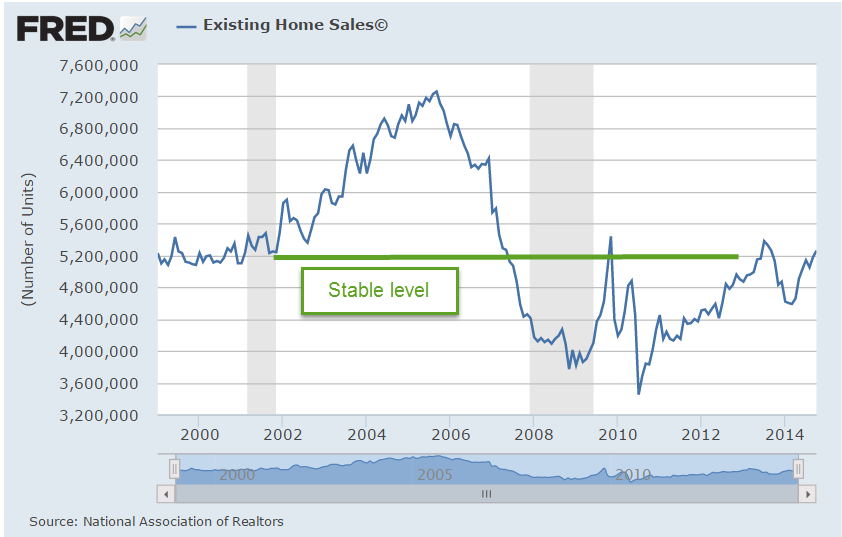
Sure, there were signs of weak consumer demand. The Consumer Price Index had risen only 1.7% over the past year.  Falling gas prices had helped keep a lid on raises in the CPI and was putting extra money in consumers’ pockets.  It was not only lifting airline profits but contributing to lower costs for a lot of companies.  The Homebuilders association was reporting strong confidence among their members and existing home sales were at a stable level.

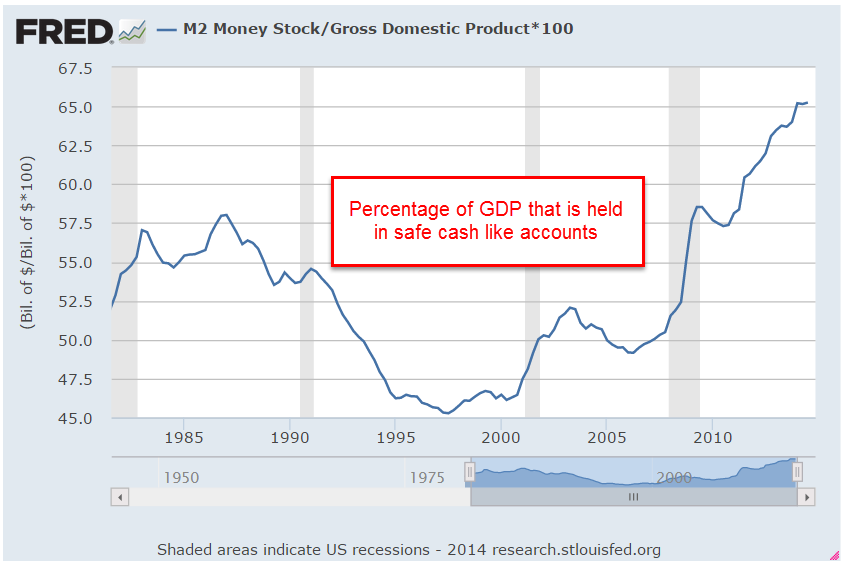
George wouldn’t tell her one thing that concerned him.  It was a long term phenomenon, a growing caution that George attributed to the aging of the population.  People put money in safe money accounts like savings, CDs, money markets, and checking when they were less confident about the future or anticipated a short term need for  cash.  On the second point, it was true that as people got older, they prudently put more money in safe accounts.  Retired people in particular were encouraged to keep five years of anticipated withdrawals in a safe place, not the stock market.  The Federal Reserve tracked the amount of these safe money accounts, known as the M2 money supply.  Occasionally, George would look at this amount as a percent of GDP.  Over the past decade the percentage of M2 to GDP had been growing.

This could be a natural trend of an aging population but there was another metric that concerned George.  Over the past thirty years, people were keeping twice the amount of money in safe accounts.  In the early 1980s, it had been about $8000.  After accounting for inflation over the past thirty years, the per capita average was $15000.

George guessed that this cautious move to safety would contribute to slowing economic growth for years to come.  But he wouldn’t tell Mabel that.  He was also keeping a wary eye on small cap stocks.

If the index continued to break down below the neckline, George expected further weakness, perhaps another 10% drop as investors lost confidence in small cap stocks.  Falling oil prices and low gas prices helped small caps but the strong dollar and continued weakness in the European countries and Japan would curtail export growth.

Armed with a mental outline of his presentation, George sat down next to Mabel in the living room.  “Whatcha reading?” he asked.  If she was in the middle of a whodunit, this wouldn’t be a good time.  “It’s a series of papers, mostly statistical studies on student scores,” she said.  “Teaching models, and correlations with their socioeconomic backgrounds, their race.  Lorraine lent me her copy.  It’s very interesting but reminds me that I need to brush up on some terms.”

This was good, George thought.  Her brain was in analytical mode already.  “Hey, hon, I wanted to talk to you about that CD coming up next week,” he started.  “Oh, yeh,” Mabel responded.  “I was at the bank the other day and couldn’t believe how low the rates are now.  Why do they insult their customers by posting the rates?” she mused.

“I was thinking about that,” George stepped in.  God, she was making this easy, he thought.  “What do you think,” she continued, “maybe move that money into one of those bond index funds?” she asked.  “Uh, yeh,” George said, a bit befuddled. She was making it too easy after all the time he’d spent planning his presentation, her objections, and his persuasive responses.  “You had said you wanted to keep everything totally safe, so I thought…,” George’s voice trailed off.  “Well, I do, but this is ridiculous,” Mabel said.  “Obviously, we are going to have to take some risk.”  “And I’ve got the time to watch it,” George reassured her.  “I’ve noticed that,” she said. “I don’t have the interest to watch it.  I guess I always thought that investing was a ‘set it and forget it’ proposition.  Maybe it was never that way.  But, after 2008, I’m…” and she gave a rock-the-boat gesture with her hand.  “Ok,” George said and stood up. “I’ll have the bank close out the CD, then transfer the money.”

A Long Term Plan

November 16, 2014

“Yaaaaay!” Charlie erupted as he kicked the pile of leaves in the backyard. Rusted orange, dried blood crimson and mustard yellow flew up into the air.  Rake in hand, George smiled at his grandson’s exuberance. “Hey, champ, let’s get these leaves in the bag.”  The little arms gathered up the colored leaves and swung to the trash can which was about the same height as the four year old boy.  Charlie threw the leaves up over the lip of the trash can.  Very few leaves made it into the can. Charlie tilted the black plastic can toward him so that he could look in the can. “Look, Ganpa!” he exclaimed, proudly showing the inside and the few leaves that had made it into the can.  “The kid’s a politician,” George remarked to his son Robbie sitting on the back deck. “Get’s very little accomplished with a lot of fanfare.”

Robbie held up his phone. “Let me get a shot of the two of you.”  George picked up Charlie and held him over the trash barrel.  Charlie clasped him around the neck and Robbie snapped the picture.  George set the child down and the boy once again gathered up a clump of leaves and threw them up into the air.  Robbie took another picture of his son.  George walked over to the deck.  “Let me see.”  Robbie showed him the two pictures then looked at the picture of his son tossing up the leaves.  He handed the phone to his dad.  “Looks like a scatterplot, doesn’t it?” Robbie asked. George looked.  “Wow, what have you been working on?  Most people don’t see a scatterplot in a cloud of leaves.” A scatterplot is a number of data observations plotted on a graph.

“Still working on pattern recognition for drones,” Robbie said, a bit of tiredness in his voice.  “A lot of tough problems to crack.”  George nodded toward Charlie. “I can remember when you were this age,” George said, a fondness in his voice. Robbie went on, “Charlie – any four year old – has better visual processing that the most sophisticated algorithms we write. The brain scientists plot the paths in our brains but we still sit around the lab wondering what is it that our brains are doing when we interpret the world.  Well, we just keep kicking at this mule…” His voice drifted as Charlie came over to them, leaves clenched in his little fists.  He slumped on Robbie’s knees.  “You need to rake more leaves, Ganpa,” he whined.  George looked up and saw that Charlie had leveled the pile of leaves.  “Ok, champ, let’s rake more leaves.”

Mabel opened the rear screen door.  “I need a potato peeling person!” she called out.  Robbie stood up.  “I’ll get it,” Robbie said, “you rake.”

As he raked, George thought back to that time when Robbie was the same age Charlie was.  At that time, thirty years had seemed like a lifetime because it was.  He and Mabel had been in their thirties.  George remembered some  meetings with their accountant at the time. She had given them the talk, one that she probably gave to other young families. “You need to keep some things in mind for your kids, and for your retirement.  I know it seems like a long time away now but your little boy will be in college before you know it.”  The accountant was only a few years older than they were but talked like a Solon.  George had supposed that the profession encouraged that kind of long term thinking.  Heck, his time horizon was about five years and this woman was stretching their imagination out twenty, thirty and forty years. “The choices you make now will limit or expand your choices in the future.”

Almost thirty years later, George and Mabel had done well by following her advice over the years.  George wanted to thank her but she had moved her business to Oregon or Washington and they had lost touch.  They had not bought the really big house although they had sometimes wished they had more room, especially when the kids were teenagers.  They had treated the two houses they had owned as a place to live, not as an investment vehicle or a store of wealth to borrow from.  The mild downturn in the residential market in the early 1990s had not worried them.  When the prices of homes crashed in 2007 and 2008, they lost little sleep because the mortgage was paid off.  George did take a hit on his 401K though.  He was close to retirement as the market tanked and both of them worried a lot through that 2008 – 2009 winter.

In the late 1980s, George had opted in for what was then a fairly new idea, a 401K plan, at work.  These were termed “defined contribution” plans.  The employee, not the employer, took the risk and the responsibilities for the investment allocations in the plan.  The employer made its contribution to the plan and had no long term liabilities for the results that the investments did or didn’t make.

When Mabel returned to teaching in the mid 1990s, she had taken a conventional defined benefit pension plan, the only one that the school offered.  In early 1999, as the Nasdaq climbed to nosebleed valuations, George had eased up on the stock allocation in his 401K.  He didn’t know a whole lot about investing, only that stocks were riskier than bonds.  As the market continued to climb, he sometimes regretted his decision but stuck with it as a matter of common sense. By the end of 2000, as stock prices continued to fall, he was glad he had been more conservative.  In late October 2014, the Nasdaq 100 had finally climbed above the level it reached in 1999, 15 years earlier.

They enjoyed a wonderful Sunday dinner with Robbie, his wife Gail, and their grandson Charlie.  Robbie asked about Emily, his sister, but no they hadn’t heard from her in almost a year.  Two kids grow up in the same house.  One of them is stable, has a good career, and a wonderful family.  The other leads a troubled life, and is consumed by some inner demon.  Emily was not a fit conversation for a dinner table so the talk moved onto other topics.  Robbie, Gail and Charlie drove back to Colorado Springs that evening.  There was a front moving down from Canada or Alaska so they declined the offer to stay in the guest room for the night.

There wasn’t a lot of economic news scheduled for the week so George was not expecting any strong moves in the market.  Much of the earnings season had come and gone.  According to FactSet  almost 80% of companies had reported above consensus estimate of earnings.  A more disturbing sign: three times as many companies had issued negative guidance for fourth quarter earnings as those that had indicated a more positive outlook.

The big news for the week was the Rosetta spacecraft.  Launched ten years earlier, it had rendezvoused with a comet 300 million away on its journey from the far reaches of the solar system to the sun.  As if that wasn’t spectacular enough, the spacecraft then launched a washing machine sized landing vehicle to sit down on the comet as it sped through space.  Talk about long term planning.

On Thursday, the spot price of a barrel of crude oil dropped below $75.  The Energy Information Agency (EIA) announced that the average price of a gallon of gasoline had fallen further to $2.94, the second week below $3.   Several analysts pegged the price range of $65 – $70 as a “make or break” benchmark for many fracking operations.  If oil were to stay down at that level for any length of time, many new drilling plans would be put on hold.  Operations at existing wells might be cut back.  The strong dollar meant that countries who were net exporters of oil would be paid in dollars, which could be traded for more of their own currency.  For these countries, the strong dollar was helping offset the impact of lowered prices.

On Thursday, the BLS released the September report of job openings and turnover, or JOLTS.  The number of employees quitting their jobs had risen to a recovery high of 2%.  Workers who were not confident of finding another job did not quit their current job.  Job quitters acted as a canary in a coal mine, where a relatively small part of an ecosystem or economy indicated the health of the entire system.  A rate of 2% or higher indicated a healthy confidence in the employment grapevine.

On Friday, George had lunch with a few former colleagues.  Four old guys sitting at a booth, drinking too much coffee. As usual, the discussion was lively.  Each of them had a take on the elections just past but the conversation got a bit heated when Stan said that there were just too many people who didn’t want to work.  Who was going to pay for all these people?  Who was going to pay for all the government programs?  He had just read a report from Pew Research that summarized the changing trends in the labor force participation rate and the sometimes contentious debates about those changes.  The participation rate was the number of people working or looking for work as a percentage of the adult population, the civilian non-institutional population, as it was called.  A 90 year old person could still work and was counted as part of that population of potential workers.

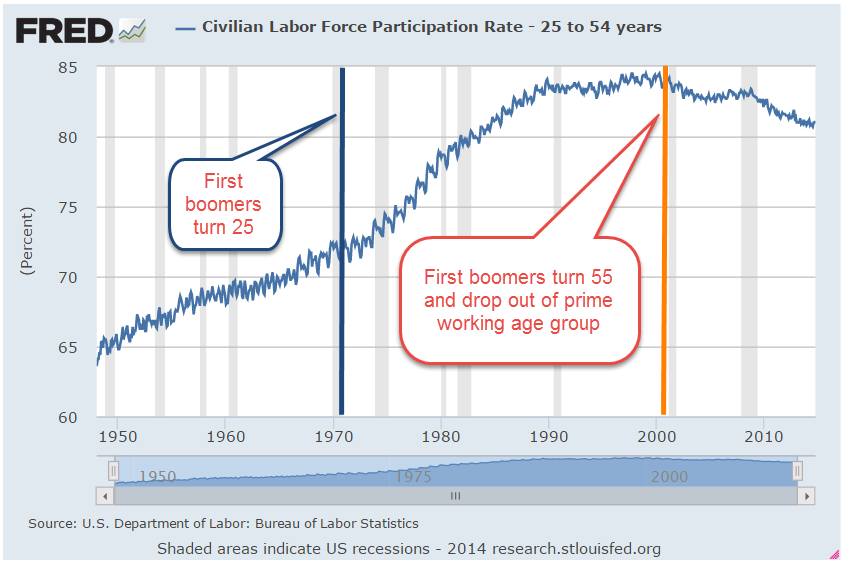
The core work force, those aged 25-54, showed a slightly declining participation.  The first boomers had grown out of this age group at the turn of the century.

George’s opinion, one echoed by the Congressional Budget Office, was that much of the reduction in the participation rate was due to changing demographics.  Since the mid-1990s, women, particularly white women, had had a historically high participation rate.

Some workers of earlier generations who had not needed a college education to earn a middle class wage found themselves less desirable in this more technological work environment.  During the recession, employers shed many workers with long term health problems.  As the economy improved employers were reluctant to hire these job seekers who may have had a good work ethic but possessed no above average skills or education.   Some applied for disability, or retired early if they could, or simply gave up trying.

Those with college level education and higher were more likely to be working.  The downtrend in the participation rate for both groups had started during the Clinton years, long before the Bush presidency, the 2008 recession or Obama’s presidency.

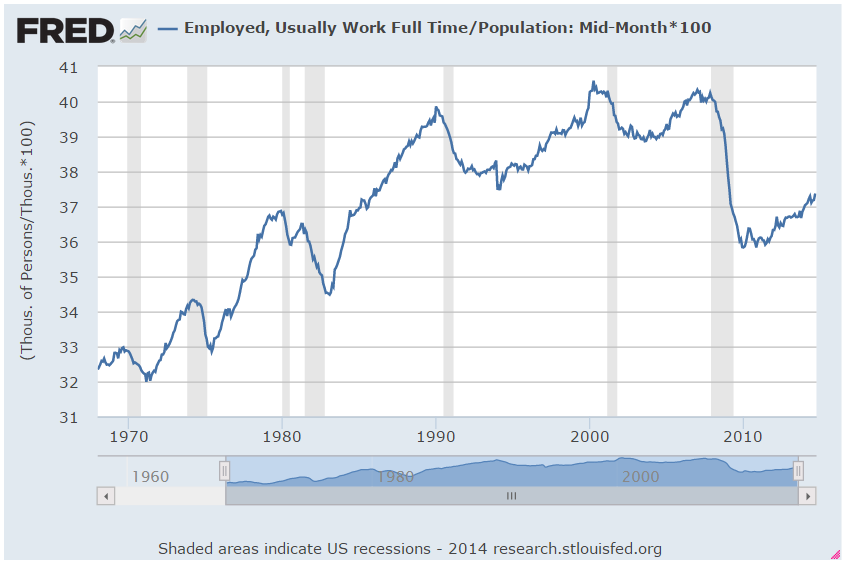
Full time workers as a percent of the total population were about the same level as the mid-1980s, when the economy was in a growth phase.  The 1990s and 2000s had been marked by unsustainable bubbles – the dot com boom and the housing debacle.

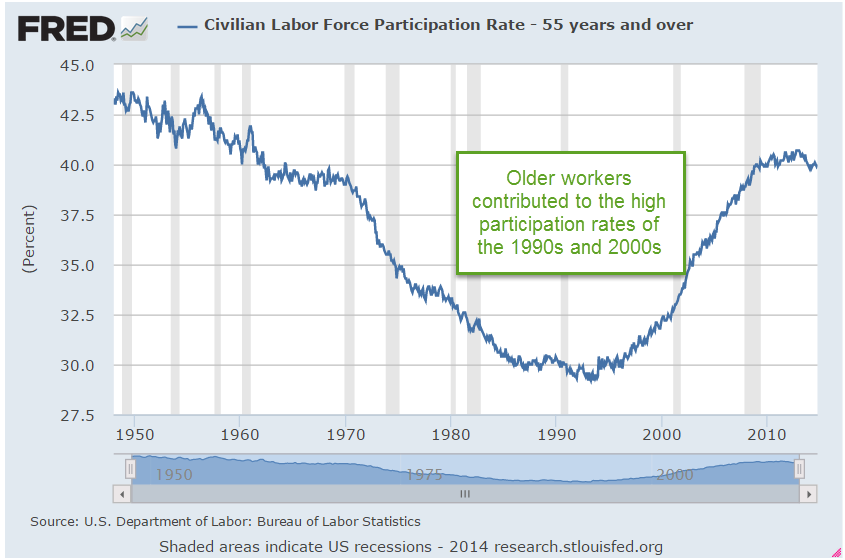
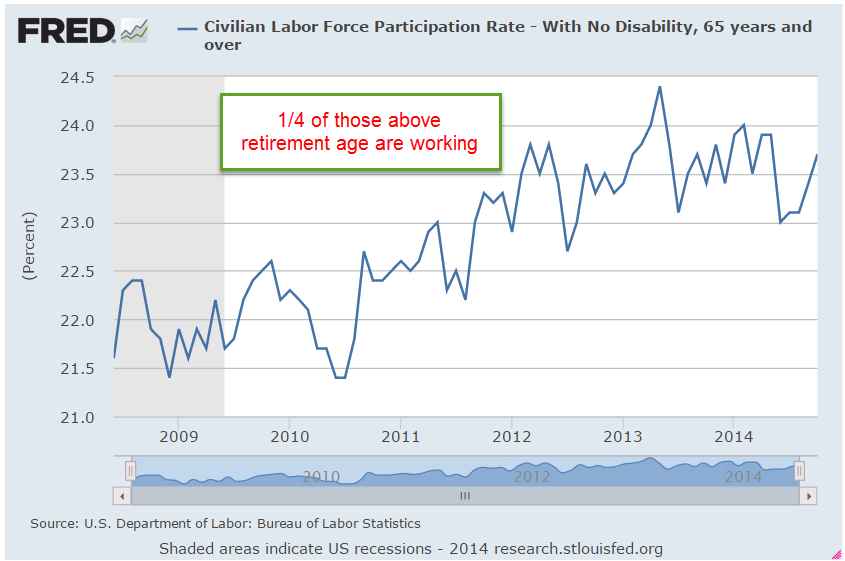
Older workers contributed to the high participation rates of the 1990s and 2000s.  A lot of people came to regard these abnormally high participation rates as normal.  They weren’t, George argued.

Sure, people are living longer, George argued, but the number of older workers can’t keep rising indefinitely.  Since the early 1990s, older workers had risen by 20 million, from 12% of the work force to 24% of the work force.  They were competing with younger workers for jobs.

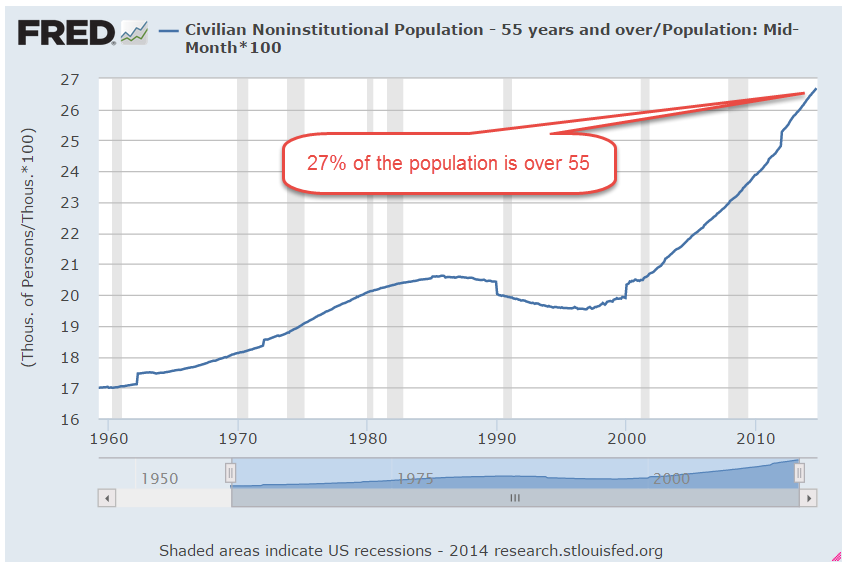
27% of the entire population was older than 55.  Most of that population was past working age yet older workers made up 24% of the work force.

Workers who might have retired in decades past were continuing to work, clogging up the labor pipeline.

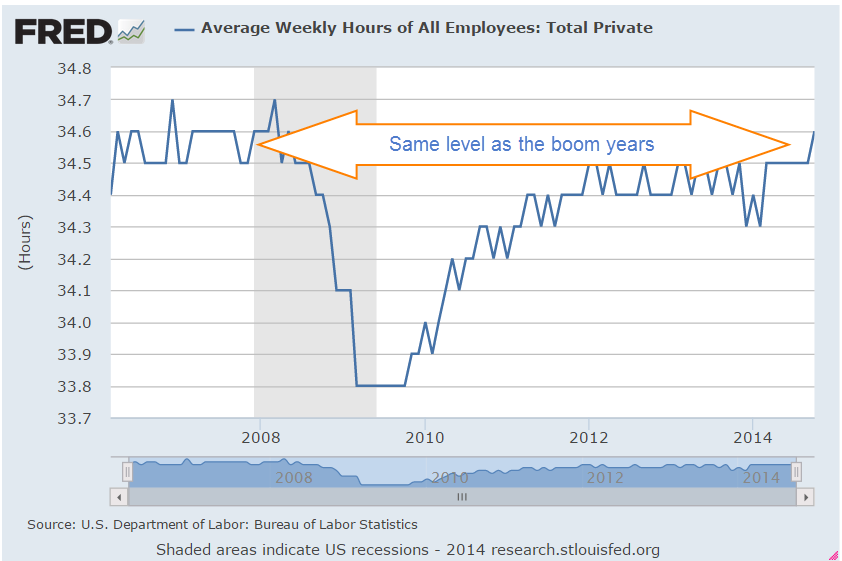
Stan thought the economy had still not recovered and was worried about the next recession.  Who’s gonna pay for all these people, he wondered again.  George reminded him that average weekly hours of all private workers – most of the work force – was now at the same level as before the recession.

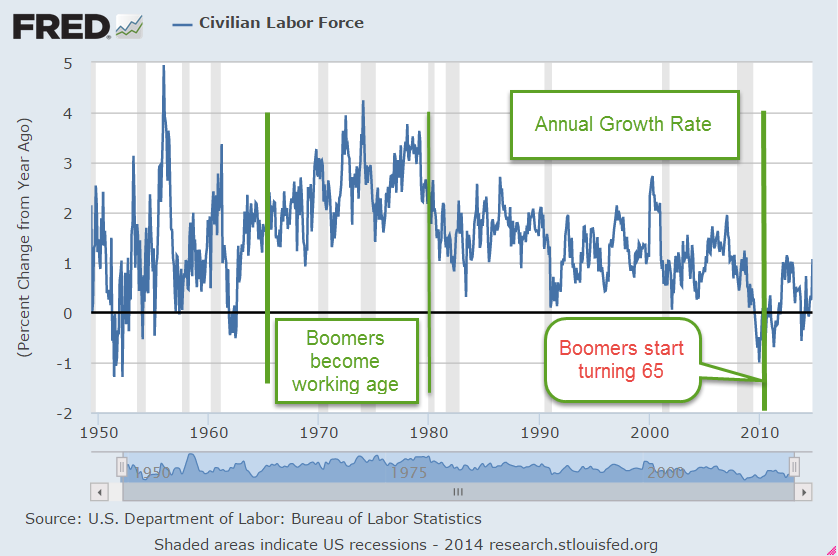
The Civilian Labor Force was higher now than before the recession started.  The growth rate was lower but still growing.

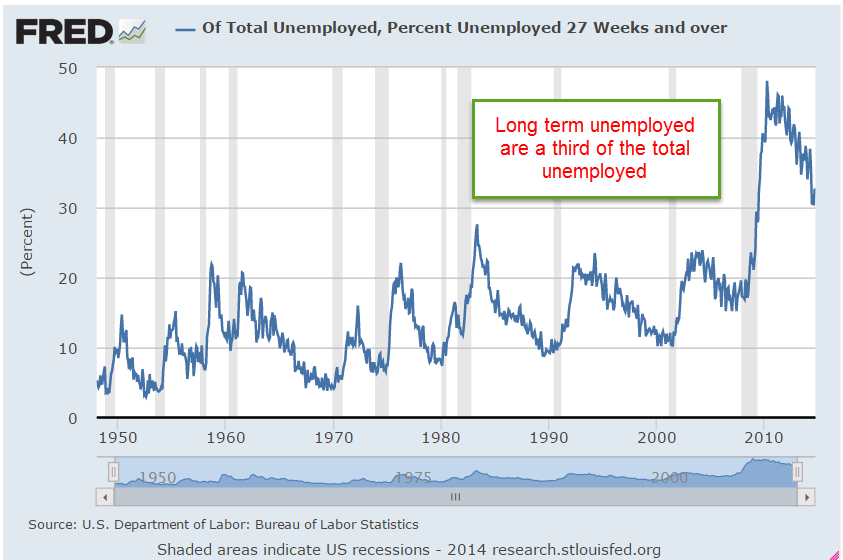
But George agreed that there were persistent problems.  A third of those unemployed had been out of work for more than a half year.

Real weekly earnings were stagnant, neither growing or declining.

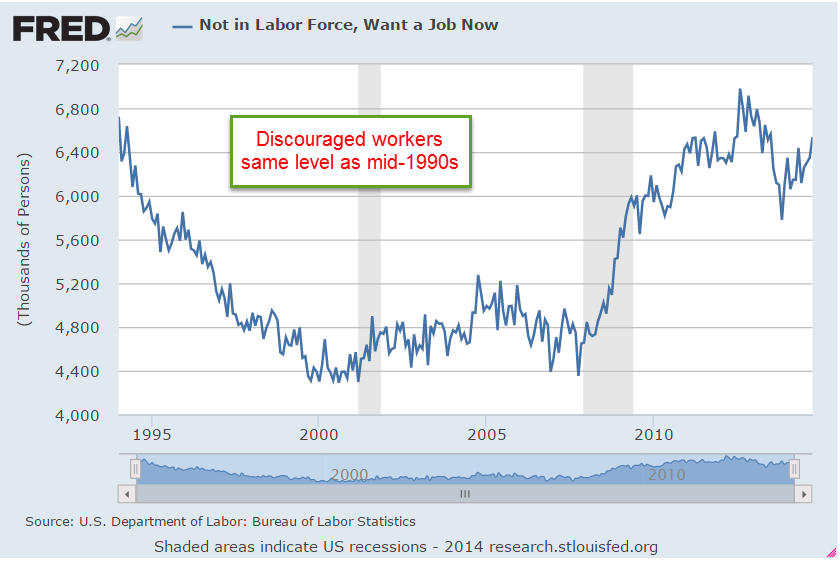
There were still a lot of people who were not counted in the labor force because they were not actively looking for work.  They wanted jobs but had given up.  As bad as it is now, George reminded Stan, discouraged job seekers are at the same level as they were in the mid-1990s.  Did you even notice back then?  George asked.  Stan admitted he hadn’t.

“A lot of us weren’t paying attention,” George told the group seated at the booth.  “Sure, it got bad sometimes, but we figured we would get through it.  This last recession was bad, bad, bad and there is a lot more information available now.  We can see how bad it was five years ago and there’s plenty more information to worry over as we look to the future.”

“So, you’re optimistic?” Stan challenged.  “Yeh, I am,” George replied. “Thirty years ago my accountant told me that by the time we retired, politicians would have to do one of three things:  increase taxes, cut benefits, or increase the retirement age.  She told Mabel and I that politicians would probably do a little of all three to spread the pain out and avoid getting thrown out of office.  I was doubtful.  How could she know what was going to happen so far in the future?  ‘It’s just math,’ she told us. ‘The largest generation of people is going to start turning 65 in twenty-five years and the system is not designed for it.  They’re gonna get sick and who’s gonna pay for it?  You think the little that you pay into Medicare is going to cover that?’  I look back now at her predictions.  They’ve raised the retirement age.  Check. The low inflation rate is helping to reduce the growth in Social Security benefits.  A half-check.  Medicare costs are growing at two to three times the rate of inflation.  They haven’t raised taxes yet but it’s coming.”

Stan said sardonically, “And you call yourself an optimist.”  George laughed.  “I guess I’m an optimist because she got Mabel and I planning for all of this a long time ago.  When they raised the retirement age, we weren’t surprised.  When they cut Social Security benefits in the future, we won’t be surprised.  When they raise taxes, we won’t be surprised.”

“Is this lady still your accountant?  She sounds pretty smart.” Stan asked.  “No,” George replied. “I think she and her husband moved to Oregon or Washington.  They wrote business and investment software but they gave up trying to defend their software from copying.  This was in the late 1980s and early 1990s.  Even their own clients were copying their software and giving it to their friends. ‘Smaller companies like ours just don’t have the time or resources to protect against theft,’ she told us.  ‘Eventually we’ll go to work as consultants for the larger companies.’  And several years later, that’s what they did.”

The waitress brought the check.  Normally they would split it four ways but Stan picked it up and handed it to George.  “Shouldn’t the optimist pay?”  George laughed.  “This one time,” he said, “but on one condition.  You all have to agree with me.  Isn’t that how they do it in politics?”  They all laughed, grunting as they straightened up after sitting so long.

Adjusting the Carburetor

November 9, 2014

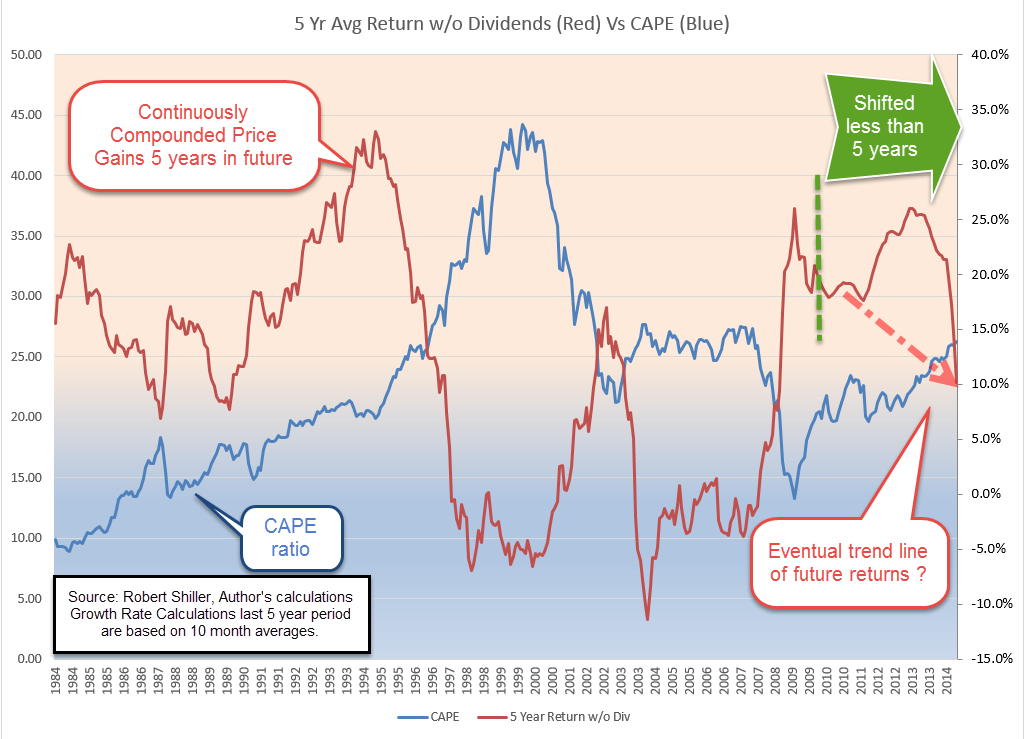
About two thirds of companies in the SP500 had reported earnings for the third quarter. George guessed that positive earnings surprises were somewhat above the normal 70% but as former Presidential contender Herman Cain said, “I don’t have facts to back that up.”  Checking his guess, George went to Fact Set which provides a weekly update summary of earnings reports.  Positive earnings surprises were the highest percentage in over four years. On the other hand, Fact Set was reporting that the forward price earnings ratio of the SP500 was above the 5 and 10 year average.  Einstein famously quipped that the most powerful force in the universe was compound interest.  He might have mentioned an equally powerful force – reversion to the mean.

George updated his spreadsheet with data from Robert Shiller, the Yale economist who had devised the CAPE ratio, an inflation adjusted Price Earnings ratio for the SP500.  When the CAPE was higher than average, as it had been the past two years, price gains over the following five years were likely to be low or negative.  George had added a spreadsheet column to measure the annual percent gain in stock prices five years in the future, then plotted these five year gains against the CAPE ratio.  In the long run of several years, the above average gains in stock prices of the past few years were likely to drift lower or turn negative, bringing their 5 year return to the post-WW2 historical mean of 7%.

But in the post-WW2 period, the stock market had almost always gained in the year after a mid-term election.   It’s like a junction on a hiking trail with many signs and no mileage, George thought.

Monday’s report on auto and truck sales was almost exactly in the middle of the range of expectations.  Promotional sales in August before the introduction of 2015 models had propelled sales upwards in August. Sales in September and October had stayed on trend, a sales curve that was flattening.

Manufacturing data from ISM was strong and continuing to rise, but the market seemed to be in pause mode a day before the elections.  “One more day!” Mabel exclaimed. “We’re being bombarded with political ads.” George reflected on that for a second. “I don’t think I’ve actually seen one ad,” he said.  “We buzz through them when we’re watching a program.”  “Well, sometimes I like to watch the local news live or the weather channel,” Mabel responded.  “It’s become impossible to watch anything live on TV.”  George wondered how many millions would be spent on this election.  How many voters were like he and Mabel, paying little if any attention?  Mabel was a straight ticket voter.  It took her less than ten minutes to vote.  Amendments to the Colorado Constitution – no. “Don’t you even read them?” George had once asked her.  “Nope, they’re all sponsored by special interests,” she had replied.  “What about the marijuana amendment two years ago?” George had asked. “Well, I did vote yes on that one,” Mabel had conceded.  George spent hours researching candidate bios and their positions on the issues.  He would sometimes bring up a name of an independent candidate or a Libertarian candidate to Mabel.  “Why waste your time?” Mabel had asked.  “Whether we like it or not, we’ve got a two party system in this country.  Pick one and vote.  No Independent or Libertarian candidate is going to win.” “Yeh, what about Ross Perot in ’92?” George had asked.  “Cost Bush the election,” Mabel had responded. “No, it didn’t.  Perot took about as many votes from Clinton as he did from Bush,” George had argued.  Where had he read that?  Probably Wikipedia.  “Fine,” Mabel had countered with that tone of voice meaning end of argument.

As they watched election results on Tuesday, George commented that he had been wrong.  “No!” Mabel exclaimed, her hands raised in supplication to the fates.  “Let me write this down,” she said. “Hecklers, always the hecklers,” George shook his head in a mock display of discouragement. “No, really.  I thought the Republicans would gain the Senate but just barely.  Gardner is cleaning Udall’s clock.  Look at Mia Love in Utah.  Methinks there’s a change in the wind, oh forsooth.”

Colorado was a toss-up.  As they turned in for the night, one channel had declared the Republican gubernatorial candidate, Bob Beauprez, as the winner in the race.  In the state senate and house, the Democrats held a slim majority that could be overturned but the races were too close to call.  George expected a bump up in the market the next day unless ADP, the private payroll processor, had a disappointing report of private job gains.

Wednesday morning they woke to the news that incumbent Colorado governor John Hickenlooper had squeaked out a win but his rival had still not conceded.  State senate and house races were still undecided and there might be recounts through November. “If this were a baseball or football game, this would be exciting.” George’s banter had little effect with Mabel who was in a rather sour mood. “Look,” he added, the Dems will have a chance to take back the Senate in 2016.  The Republicans will have six or seven Senate seats up for grabs by the Democrats.  It’s the math of Senate elections.”

In addition to gaining the Senate, Republicans had extended their control of the House.  George turned to the ADP report of private job gains – 230,000.  The market had popped up about 1/2% at the open, showing a curious restraint after the previous night’s Republican sweep.  One of their CDs would be due in a few weeks but George knew this was not a good time to bring up the subject of moving some of that really safe money into something else.  Their son Robbie, his wife Gail and their grandson Charlie would be coming over this weekend and that would help brighten up the mood in the house.

The price of West Texas Intermediate crude oil crossed below the $80 mark.  The game was on to control the world market for oil.  Fracking in the U.S. had increased supply, reducing net imports of oil by the U.S.  However, the cost per barrel using fracking methods is more expensive than conventional drilling.  The only way that the Saudis could strengthen their dominance of the market was to drive the price down to a point where fracking was no longer profitable, putting pressure on these suppliers.  At a price below $80, plans to start new wells might be put on hold.  At a sustained price below $80, some suppliers with higher drilling costs might shut down or reduce their output.  Russia, Venezuela and Mexico depended on a higher oil price to fund their governments and social programs.  The lower revenues from oil were exerting a lot of political pressure within these countries.

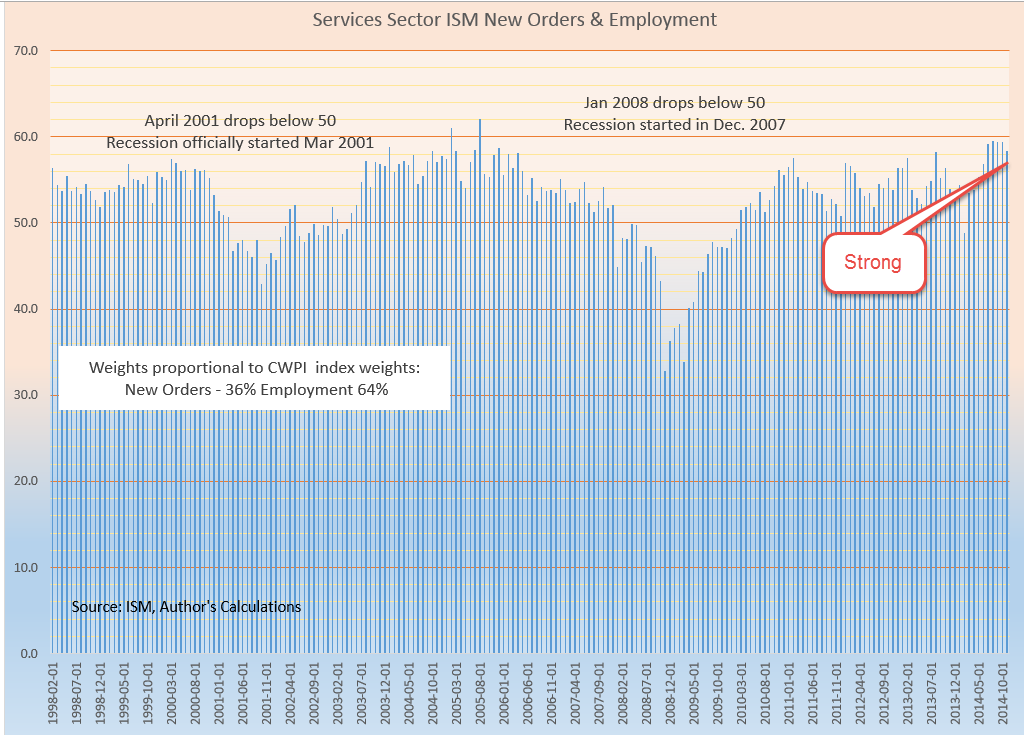
ISM released their monthly report on the service sectors.  George added the new data to his spreadsheet. He had expected a decline from September’s peak, but the composite of manufacturing and non-manufacturing was as strong as September.

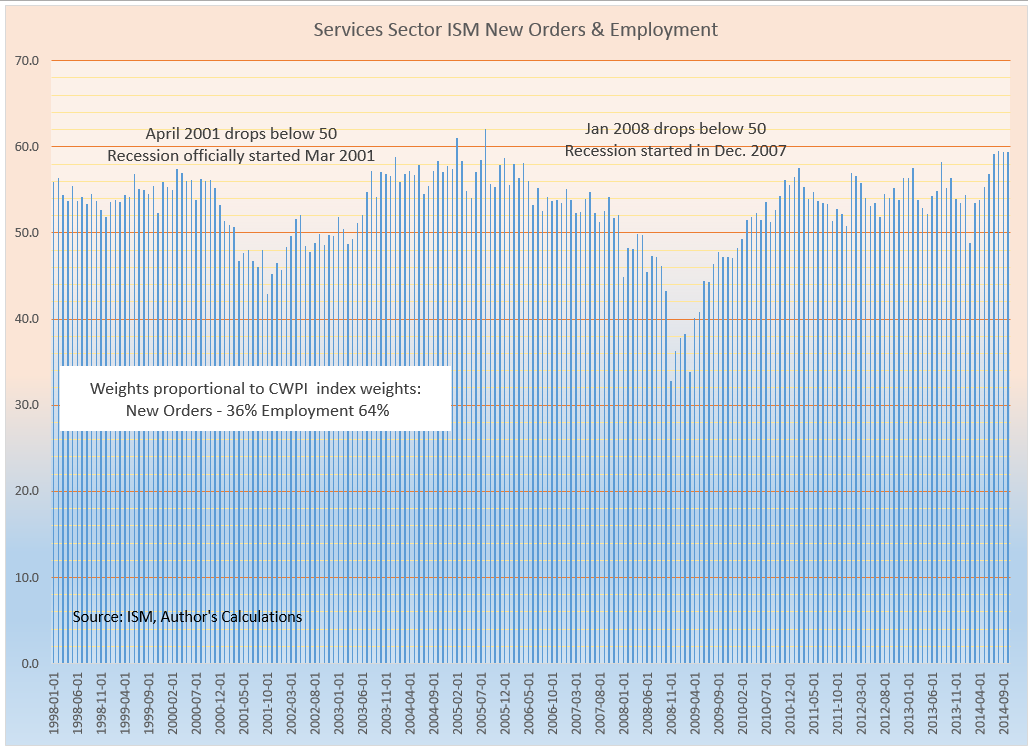
Employment and New Orders were two key factors in the services sector.  For the fourth month in a row, the readings pushed the 60 level, the boundary between strong growth and robust growth.  There had only been two times in 2005 when readings had been this strong.

 On Friday, the BLS released their monthly report of employment gains.  Although net job gains were slightly below expectations, there were gains in most industries, a healthy sign.  As usual, George averaged the BLS estimate and ADP’s estimate.  Subtract the 5000 new jobs in government from the 214,000 reported by the BLS to get private job gains of 209,000.  Average that with the 230,000 jobs estimated by ADP to get 220,000, then add back in the 5000 government jobs. A strong report in a string of strong reports.

George had heard a number of explanations for the swing toward the Republicans. The economy was growing.  Why had voters handed such a decisive hand to the Republicans?  It was a repudiation of Obama’s failed policies.  George noticed that Mabel had not eaten all her nacho chips from the night before. There are rules so he asked politely if he could finish them.  Chipotle’s chips were the best. No, they were Democrats focused on tactics rather than ideas.  No, it was a resounding affirmation of conservative principles by the Amuhrican people. No, it was a throw the bums out election.  No, it was a frustrated electorate that is sick of Washington gridlock and a do-nothing Congress.  No, it was shifting sentiments among age groups and demographic groups. Voters over 60 were a greater percentage of voters in this election while voters under 30 were a smaller percentage.  Asian and Hispanic voters had voted Democratic but with less commanding majorities.  Men swung Republican more than women swung Democratic. Post-election analysis sometimes reminded George of post-Super Bowl analysis.  There was one chart that encapsulated a big problem that Democrats had.  Part-timers couldn’t find full-time jobs.

Each of those 3 million extra involuntary part-timers were counted as one job, regardless of the hours.  A little more than 1 million jobs had been created since the peak of employment in 2007.  Job growth, in short, had been paltry.  A good indicator of job growth was Social Security tax revenue collected each year. In 2006, near the height of the housing boom, the Federal Government had collected $809 billion in Social Security taxes (Treasury data), a 27% increase over the amount collected in 2000, at the height of the dot com boom, just before George Bush took office.  In 2008, the year before Obama took office, the government collect $674 billion.  Six years into Obama’s tenure as President, the government would collect about $755 billion in 2014, a modest increase of 12%.  It was true, Obama had been handed an extremely dysfunctional financial system and a global economy in a death dive.  

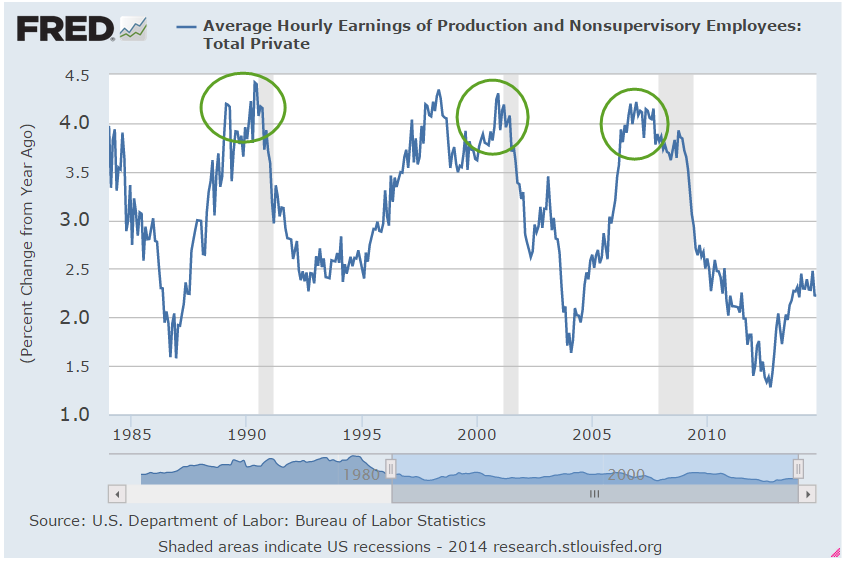
Strong wage growth had preceded the past three recessions.  Since this past recession, wage growth had fallen and stayed persistently low, causing discontent among frustrated voters.  Many workers were barely keeping up with inflation.

Voters were like the shade tree mechanics of George’s youth.  To adjust a carburetor, turn the screw this way or that way, trying to find the position where the engine idle sounded the smoothest.  It was a negotiation of sorts between air and gas.  Every two years, voters turned the political adjustment screw and waited to see if it made a difference.

The Flame of Fame

On Monday, George finished a re-read of Nassim Taleb’s Fooled By Randomness, an examination of probability without the mathematics. Taleb wrote from the point of view of a market trader but the book contained apt lessons for many kinds of decision making.  Mabel went out with a few friends to see the movie Birdman.  She asked George if he wanted to go but he was happy to sit around and read.

Taleb told the story of a emerging market bond trader in the 1990s who made a quarter billion dollars for his firm by “buying on the dips.”  When the price of the bonds declined, the trader took a highly leveraged long position, betting that the price of the bonds would rally.  Each time they did.  The man became convinced that he knew this market well.  He believed in his own astute judgment.  Then came a dip with no subsequent rally.  Instead, prices continued to fall.  The trader had no stop loss set, a floor price where a trader closes his position to prevent further losses.  Instead the trader convinced his bosses at the firm that prices would soon rally.  He increased his position as prices fell further.  Eventually, prices fell so low that the firm, near bankruptcy, fired the trader and closed the position, losing almost 600 million.  George thought about that.  There had been one correction in April and May of 2012, a near correction in October and November of that same year.  Smaller dips had occurred in June and August of 2013, then in January, April and August of this year.  Finally, this month a 7% or so dip.  Like the bond trader in the 1990s, the winning strategy of the past few years had been to buy on these dips.  The subsequent rise in prices helped convince buyers that their particular view of the market, whether fundamental or technical, was a sound one.  Note to self, George thought, don’t confuse good luck with genius.

Earnings and sales reports would drive the market for a few days until Wednesday when the Fed was expected to end its bond buying program.  On Thursday, the first estimate of 3rd quarter GDP would be released.  After the close Monday, Amgen reported earnings that were 12% better than expected.  That would help set a positive mood for Tuesday’s open.

Tuesday’s gauge of consumer confidence from the Conference Board was almost 95, the highest since 2007.  Lower gasoline prices have put extra money in consumer pockets.  A 25% decrease in the price of gas ($4 – $3) puts about $800 in a consumer’s pocket, a “raise” of almost $20 a week.  The declining price of oil caused Chevron to revise its earnings guidance downward by 15-20% for 2014 and 2015 but that was not as bad as anticipated and the shares rose.

The Case Shiller index of home prices in 20 metropolitan areas showed a 5.6% year over year gain, the lowest yearly gain in two years.  After almost a decade, the housing market seemed to be returning to more normal patterns of price appreciation.

On the whole, this earnings season seemed positive but the cautionary tone of Taleb’s book reminded George to stay watchful.  On Sunday, the European Banking Authority had released the results of their 2014 stress tests on more than 120 European banks. Approximately 20% had failed the test, most of them in Italy, Greece, Cyprus and Spain. When a football game ends, fans leave their seats and move toward the exits in a loosely organized fashion.  When a larger bank or sovereign country seems to be in danger of failing or defaulting, investors rush toward the exits as though someone called “Fire!”  Still, George was feeling – well, vindicated – that he had seemed to catch this latest dip near the bottom.
 
The mild weather of late October continued.  In shorts and tee shirt, George raked leaves in the backyard on Wednesday morning.  Taking a break, he poured himself another cup of coffee, then glanced out the window overlooking the front yard.  “Oh, wow,” he muttered.  He went to the front door, commenting to Mabel as he opened it, “Must be a bad accident down the street.  There’s a Channel 3 van parked across the street.  I’m gonna check it out.”  If Mabel had a stopwatch, she would have clocked 14 seconds before George was rushing back inside, hurriedly closing the front door. “Geez,” he exclaimed.  “What’s wrong?” Mabel asked.  “Some woman from the TV station, she starts running across the street toward the house when she saw me!  She called my name, for Chrissake!”

George walked into the kitchen, then took up a position on the side of the fridge where he could look out the window onto the street without being seen.  “There’s some guy with a video camera with her!” He said, managing to fit anger, annoyance and exasperation into the tone of his voice.  Mabel got up from her chair, stood by the living room window, partly concealed by the drapes as she looked out at the street.  “What do you think they want, George?  Should we go out and talk to them?”  “No, that’s the problem.  I think that’s exactly what they want – to talk to us.  Weird!”  Mabel noticed that the rooftop mounted dish on the TV van had been raised up.  “I think they’re broadcasting, honey,” she told George in a loud whisper.  The woman outside stood on the sidewalk, her back to the house, gesturing, turning to the house, then turning back to the camera man who wielded a shoulder mounted video camera pointed at the woman and George and Mabel’s house.  “They wouldn’t come into our front yard, would they?” George wondered aloud. “Isn’t there some kinda law against that?”

Mabel switched channels from the weather to Channel 3. “Oh, no!  This is a live feed.” She turned up the volume.  The woman reporter standing out on their sidewalk was looking at Mabel from the TV screen. There seemed to be several seconds of delay so that George and Mabel could see the woman reporter gesturing on the front sidewalk, then seeing that same gesture shortly on the TV as though time had fractured.

Reliable source, the reporter said.   In advance of the mid-terms, President visited Liscombs, who have not demonstrated active role in politics for either party.  Speculation about election strategy in the hotly contested Senate and Governor’s races.  A man presumed to be Mr. Liscomb ran back into the house to avoid answering questions.  Supposedly independent political organizations spending a lot of money in Colorado.  Are the Liscombs bundlers for one of these organizations?  Just how independent are these organizations?  Why did the President visit this house, this couple?  Were campaign rules broken?

George had joined Mabel, standing beside her, staring dumbstruck at the TV.  “Are they saying we’re like some kind of political action group like the ones the Koch Brothers fund?” George asked Mabel.  “Oh, they’re not saying anything,” Mabel said with a touch of anger.  “They’re suggesting, provoking…” she stopped as the report concluded.  “Now here comes the tease before the commercial,” she said.  “More on the upcoming elections here in Colorado when we come back,” announced the lunchtime news host.  “You watch too much TV,” George kidded her.  “You’ve gotten hip to their tricks.”

Both of them turned to look outside the living room window.  The reporter now stood with the video tech near the rear of the van.  “I think they’re leaving,” George said.  “No, wait,” Mabel told him.  “The dish on the van is still elevated for upload.  Wait till they lower it.  Then we’ll know they’re leaving.”  “Where did you learn all this stuff?” George asked her.  “Remember when we had that knife fight at the school five years ago?” Mabel asked.  George nodded.  “Two kids went to the hospital.  The local stations covered it, of course.  Got to see the vans.  It’s amazing how much equipment they cram in a regular van.  There’s probably a third person in the van working all the computers and equipment.”

Eventually, the van pulled away from the curb.  George realized that he’d missed the announcement from the Fed on their bond buying program, switched channels to confirm that they had ended the program. Although the Fed had stopped adding to its balance sheet, it continued to hold a whopping $4.5 trillion in assets, the total of the past several years of printing money to support the economy as the country struggled to recover from the Great Recession.

The market closed at the about the same level as Tuesday.  Dreamworks, the studio that produced the How to Train Your Dragon movies,  reported better than expected earnings after the close, sending the stock up 5% in after hours trading.  Kraft also reported earnings slightly higher but the overall sales picture was tepid.  Samsung reported a huge 60% decline in profit, squeezed on the high end by Apple and under pressure from mid and low end competitors.  The giant insurer MetLife had a blow out quarter.  Visa reported better than expected earnings, sending the stock over 4% higher in after market trading.

If Thursday’s first estimate of 3rd quarter GDP growth had come in at 2.5%, below the consensus of 3%, the market could have dropped 2% or more, George thought.  Instead, the estimate was 3.5%.  The market opened up lower then climbed about 1% during the day.

In each earnings season, there are several stories.  One was Gilead Sciences, a small cap biotech firm, whose “killer app”  was a new hepatitis drug called Sovaldi. Gilead reported earnings of $1.79 for the past quarter.  This was about 10% above earlier guidance but in the crazy world of Wall St., investors had been expecting $1.92, a “whisper” earnings number based on anticipated higher sales of Sovaldi.  Instead, sales of the drug were 20% less than the previous quarter.  The stock dropped about 5% on Wednesday, before climbing to new highs on Thursday.  The stock had more than quadrupled since the beginning of 2012.

On Friday the market jumped 1% at the open.  Overnight, the Bank of Japan had announced a massive stimulus program to combat risks of deflation, the bugaboo of all modern economies.  If prices might be slightly lower next year, why buy this year?  As consumers postpone some purchases, the decline in sales leads to further price declines as companies compete more fiercely to get those fewer sales.  Japan’s core CPI, excluding food and energy prices, had risen above 1% in response to earlier stimulus programs but had now fallen in the past several months back toward 1%.

On the domestic front, personal income gains in September were positive, averaging about 2.4% annually and above inflation. Wages and salaries jumped .4%, double the overall income growth. Consumer spending remained tepid, declining to a 1.4% annual pace of growth.  Amazon had warned earlier that they expected the Christmas season to be subdued this year.  Some speculated that the low rate of inflation and consumer spending would further check any rise in interest rates before the middle of 2015 at the earliest.

The market closed just slightly above the level it had reached six weeks earlier.  George had to remind himself that it was just luck.  But he sure felt smart.  Then he noticed a disturbing sign, the dragonfly doji after a gap up, on the chart of SPY, the ETF that tracks the SP500 index. The doji are one of many candelestick patterns, a type of technical analysis that tries to understand the psychology of buyers and sellers in the market from price movements over one to three days. After a number of up days, such a pattern might signal that buying pressure has become exhausted. After reading Taleb’s book, George reminded himself once again to be skeptical of signals. The last dragonfly doji after a 1% gap up that George could find in the past few years occurred on April 28, 2012.  The market had turned down after that one, losing more than 10% over the following five weeks.  Of course, George could have missed some doji simply because the market had not turned after the occurrence of one.  As Taleb noted, our view of historical data suffers from hindsight bias, from knowing what happened after a particular event.  We can not see the future very well but it’s worse than that. We don’t see the past very well either.  George had laughed when he read that.

Next week was the first week of the month when several economic reports would capture the attention of investors.   The monthly labor report at the end of the week would get the most attention.  The ISM indexes of the manufacturing and service sectors would be closely watched for any signs of a slowdown.  The sluggish growth in Europe and the strong dollar would have a negative impact on exports, which would show up in the manufacturing index.  The CWPI, a composite of both of the ISM indexes, had probably peaked the previous month, and should be lower this month as a natural part of the cyclic pattern of the past several years.  Investors could react negatively though to this cyclic decline.  The VIX, the volatility indicator, had dropped into a more calm zone and below its 10 day average.

But investors had not abandoned the safety of long-term Treasuries.

If Republicans took control of the Senate in Tuesday’s election, the market would probably get a boost, George figured.  The results might not be known for days or weeks if there were recounts in some key senatorial races and that might drag the market down a bit in advance of the upcoming labor report.  Would the market go up or down?  George could definitely say yes!  He looked out the window Saturday afternoon and could tell the direction of one thing for sure – leaves.  They were calling to him, or was it his wife with a helpful reminder?

A Surprise Guest

October 26, 2014

Shortly after Monday morning’s sunrise, George sat on the back deck, coffee in hand.  Some brilliant, utterly mad painter rushed around the neighborhood, dabbing the trees with what seemed like the entire palette of warm colors. Armies of invisible elves set up accent lights in the branches, highlighting the hues of rust-orange-yellow-gold.  As George absorbed the movie magic moment, a van from the local cable company pulled up on the grass alleyway behind the backyard fence. “Starting early,” George thought as he glanced at this watch.  7:30.

He opened the backyard gate to the alley, meaning to ask the service guy if repairs on the pole would interrupt his and Mabel’s service this morning.  A guy who looked too trim, too neat, and too fit to be a repairman opened the passenger door of the van and called out to him, “Sir, stay inside the yard.”  George took a step backward and looked up above.  Was there a loose wire or something dangerous?  Cable wire carried low voltage so what could be the problem?  He glanced back at the man and the van.

From the rear of the van, two men hopped out.  Like the guy in front, they were both dressed in black windbreakers over blue polo shirts, black slacks.  It was like a SWAT team of rugged fashion models.  One of the men came to the rear gate.  George stepped back another step.  The man scanned the yard to the left and right of George, looked past George at the rear of the house.  George noticed that the other two men scanned the alley, the nearby houses.  The man at the gate glanced at a phone in the palm of his hand, then looked at George.  “George Liscomb?” he asked in the commanding tone of one who routinely asks questions and expects answers.  George nodded.  “Is there a Mabel Liscomb living here?”  George nodded again.  “Is she here?” Another nod.  “Your wife?”  One more nod. “Any other residents inside the house?”  George shook his head.  The man turned his head sideways, keeping one eye on George.  “Bravo,” he called to the two other men.

From the side door another man emerged, dressed much like the others. George felt a numbness inside like he was on a movie set.  “Move back a few feet, please.”  Finally a slim figure emerged from the side of the van. The ears were the dead giveaway.  George forgot that he was still holding his coffee cup as he instinctively jerked his hand to his face.  The coffee cup clipped his lower jaw.  “Ouhhhhh,” George barked. The sudden grunt drew everyone’s gaze.  “You OK?” President Obama called out to him. The lukewarm coffee had spilled on George’s shirt but he was hardly mindful.  “Uh, yeh,” George replied.

Like four points of a compass, the four men surrounded the President as the group seemed to flow through the backyard gate.  The front man stood aside and the President held out his hand to George. “Great morning here in Denver, isn’t it,” the President said, an upbeat easygoing smile on his face. George paused briefly to figure out the coffee cup thing.  He put the coffee cup in his left hand then held out his right hand to shake the President’s hand.  What does one say to the President, George wondered.  “Good morning, President.”  Ok, that worked.  “George, is it?” the President asked? “Yeh,” George replied in a monotone.  “I was wondering if Mabel – that’s your wife? – is she here?  Is she available?”  “Uh, yeh,” George replied, “she’s in the living room.”  “May we go in?” the President asked politely. “Uh, sure.”  George had barely drunk his first coffee before spilling it.  Maybe that’s why his brain seemed to be stuck in monosyllabic mode.

The front man strode to the house.  “Maybe George should go with you and we’ll wait a moment on the deck,” the President called out.  George joined the man, who opened the rear door and glanced inside before allowing George to go through the doorway.  “Hey, Mabel,” George called out.   “Are you decent?  We’ve got company.”  He could hear her get up from her easy chair.  “Be right there,” she called back.  She appeared at the far end of the kitchen, saw the man next to George and asked, “What’s the matter, dear?”  “You’re not going to believe this,” George replied.  Already the man was moving toward Mabel.  George forewarned her.  “This guy needs to ask you a few questions.”

The man went through the same procedure with Mabel.  She answered curtly as though she were about to throw this impudent intruder out of her house.  “You have a holstered weapon.  Are you with the police?”  she asked after answering the first two questions.  From a few incidents at the high school, she recognized the bulge at the man’s side.   “Secret Service, ma’am,” the man answered. “Secret what?” Mabel asked and the man opened his windbreaker enough to see the ID badge hanging from his neck.  She looked past the man and spoke to George, “What the hell is going on, George?”  He could tell she was upset.  “It’s OK, just answer the questions,” George called back to her.  No, there was no one in the house.  Yes, she was Mabel Liscomb.  She leveled her gaze directly at the man when he asked her birthdate.  She responded quickly but in a slightly menacing tone.  “You have the audacity to ask me to identify myself in my own home!”  Then the man’s voice softened as though he were an actual human being.  “Sorry, ma’am.  Have to do my job.”  He stepped back to where George stood at the rear door.   The man opened the screen door and nodded, “It’s allright.”

George joined Mabel in the kitchen as the group on the deck flowed through the rear doorway, keeping the President protected.  “Mrs. Liscomb,” the President greeted her with a warm smile, “good to meet you.  You wrote me a letter a few months back, didn’t you.”  Mabel stuttered.  Had he ever hear Mabel stutter, George wondered.  “I-I-I-I-did I?  I can’t muh-member,” Mabel answered.  “You had some good ideas that I’d like to talk to you about, if you have time?”  Mabel nodded.  George could see that she was recovering quickly from her shock.  She was good at that.  The habits of a high school principal asserted themselves and Mabel told the President, “I’m flattered that you are interested, of course.  Why couldn’t your staff make an appointment?”  Geez, George thought, she’s using the command voice with the damn President of the U.S.  He noticed that each member of the security detail had moved to a window.  George glanced to his right and saw that one had gone into the living room.  The fourth guy – had he gone up the stairs to check the bedrooms?

“I was supposed to be golfing with your Senator Udall but he had to cancel,” the President explained.  “I offered to appear at a fundraiser with Diana DeGette but her staff said she’d have to get back to us.  I don’t seem to be too popular for this election.”  Mabel made a brushing gesture.  “Don’t worry about it.  Same thing happened to Eisenhower ,Reagan and Bush at the midterm of their second terms,” Mabel told him.  “With a recession still going on, Mamie Eisenhower was a lot more popular on the political circuit leading up to the ’58 mid-terms.”  “Oh, Michelle is on everyone’s dance ticket,” the President replied.  “Me, not so much.  The quarterback takes the blame when things go wrong.  When things go right, it’s the offensive line that gets the credit.  Just part of the game, I suppose.”

“Well, come on in and sit down,” Mabel turned toward the living room.  In a brief exchange, Mabel and the President had become buddies of a sort.  George still wasn’t sure how it happened but each of them had recognized something in the other that they both had in common.  Mabel sat down in her favorite chair, then motioned the President to sit on the couch nearby.  She turned to George and said, “Do you want to make some coffee? I think I took the last of the first pot.”  George nodded. “Yeh, I haven’t even had my first cup.”

The President was different in person.  When interviewed on 60 Minutes, he had showed a casual aloofness that George didn’t like. The folded legs, the studied composure didn’t ring true for George.  Now, here in this living room, he sat, legs unfolded, leaning slightly forward in an attentive pose, earnestly having a conversation with Mabel.

For the next hour Mabel discussed education policies with the President. She didn’t like the implementation of educational standards. Yes, she understood the desire for uniformity.  No federal department can understand local educational needs. Too much politics in education already.  Washington makes it worse.   “How did you come to read my letter?” she asked.  “Kind of a mistake,” the President replied. “It should have gone to Arne’s people but it got in my pile by mistake. I left it on the table and Michelle saw it.  She told me, ‘you need to hear this.  This woman’s been there her whole life.  She understands.  You’re not hearing this in Washington.’  And, to tell you the truth, it’s just been sitting in the policy pile for months.  The first thing I found out as President – probably every President faces this quickly – is that there is never enough time to get to everything on his plate.”

George stayed out of the living room for much of the time, preferring to give Mabel the opportunity to discuss her ideas with the President.  He actually served coffee to the President. The kids wouldn’t believe it when they told them. There was a woman out on the deck, talking into the air.  “Do you want some coffee,” George asked. Had she been there all along?  “No, thanks.  You’re Mr. Liscomb?” she asked.  “George,” George nodded.  “Sherry, personal assistant,” she shook his hand.  George started to invite her in but she held up her hand and started talking to the air again.

After too short a time, the assistant came in, excused herself, leaned over and whispered something in the President’s ear.  The President stood up. “I’ll have to go.  It was wonderful meeting you and talking with you, Mrs. Liscomb,” he said and bowed slightly.  Mabel rose up from her chair, “A great pleasure, Mr. President, and thank you for your insights,” Mabel responded and – you gotta be kidding me, George thought – did a slight curtsy.  The President laughed.  George shook hands with the President, then they were gone.  “Holy mackeral,” George said as he sat down on the couch. “I’m sitting in the same seat as the President of the United States.  It’s still warm.”  Mabel gave him a look.  “Oh, damn!” George remembered.  “We forgot to take a picture!”  They both laughed.  George ran out on the back deck, hoping that they had not driven away yet but the van was gone.  The story of a lifetime and no picture to prove it.

Then George remembered that he had hit the buy button the past Friday.  He sat down at the computer. The market had opened up that morning slightly lower but several earnings reports were positive.  Apple and IBM were scheduled to announce earnings after the close.  Later that day, Apple’s earnings and sales were above consensus estimates. To offset Apple’s upbeat numbers, IBM announced a chilling quarterly report. For the 10th consecutive quarter, revenue at the technology giant had declined.  The death blow: earnings for 2014 were projected to be less than 2013’s earnings, something that hadn’t happened since 2002.  This stalwart of so many institutional portfolios was continuing to stumble.  If September’s Existing Home Sales, due to be released the following morning, declined any further, Tuesday could be a seriously down day.

George woke up again before sunrise on Tuesday.  Mabel was already awake as usual.  Thankfully, sales of existing homes  showed a bounce back in September to an annual pace of close to 5.2 million homes, the benchmark for a healthy churn.

George checked earnings stats at Zacks.  Before the opening bell, the staffing giant Manpower, announced better than expected earnings.  Although sales declined in some areas, McDonald’s earnings were 10% more than expectations.  Aircraft giant Northrup Grumman reported better than expected earnings as well. Yahoo reported earnings that were more than double the consensus.  Most of the extra profits came from the sale of shares that it owned in Alibaba’s IPO.  The market opened up sharply, closing the day with a 2% gain.  Their son, Robbie, called that evening and they told him all about the visit from the President. “How many pics did you get?  You should put them up on Facebook,” he told them. “We forgot,” George informed Robbie. “Daaaad,” came the exasperated reply.  “Well, we’re old people. We’re not used to recording every event in our lives, I guess.”

On Wednesday, the Bureau of Labor Statistics announced that inflation had grown 1.7% in the past year, in line with expectations.  The Federal government closes its fiscal year at the end of each September.  Each October, the Social Security Administration sets the inflation adjustment to Social Security checks for the coming calendar year.  A 1.7% increase meant an average $20 increase in monthly benefits.  For too many seniors depending on Social Security as their primary source of income, the low annual increases in payments did not keep up with increases in drug and food costs.  Retired folks on the lower rungs of the economic ladder then had to apply for food stamps to make up for the low yearly increases in benefits.

Dow Chemical surprised to the upside as did industrial manufacturers Graco and General Dynamics.  The positive mood on Wall Street was interrupted by the news of an attack on the Canadian Parliament.  George was cleaning leaves out of the front gutter when Mabel opened the door to tell him the news.  The market reacted negatively to the news but did not give up all of Tuesday’s gains, a positive sign.

On Thursday, the BLS reported that new claims for unemployment had risen slightly the previous week but that the four week average had fallen to the lowest level in 14 years.  Positive earnings reports from 3M and Caterpillar, both of whom had a large international customer base, propelled the market higher, trading above the range of Tuesday’s rally.

On Friday, September’s new home sales of 467,000 were the best of the recovery.  August’s robust sales figures were reduced by almost 50,000 to a revised 466,000, giving George a WTF frown.  A 10% revision?  The drug manufacturer Bristol Meyers and consumer giant Colgate reported higher than expected earnings.  Ford surprised with significantly higher than expected earnings but the details in the report were not encouraging.  Revenues in both North and South America had declined and Ford expected flat earnings growth for the full year.  The market gained almost 1%.  In the past seven trading days, it had gained back all the ground lost the six days prior, closing near the level of October 8th.

For 2-1/2 years, each decline had been followed by a sharp upturn.  “Buying on the dip” had become a often used phrase.  Anticipating a bounce with each dip, investors had been coming back into the market after a short decline.  Since mid-September, investors who had bought in on the bounce had been disappointed when the market continued to decline.

Despite all the positive earnings reports, George was still concerned that stock valuations were just a bit on the high side.  Earnings gains, as well as the growth in profit margins, were becoming slower.  There had been two brief fallbacks in 2013, and already three fallbacks and a correction of more than 5% in 2014.  Frequent small fallbacks were healthy for the market, shaking out excess optimism.  The last real correction – a 10% decline in price – had last occurred in May 2012.  The market of the mid-2000s had gone for several years without a 10% correction and that did not end well.  George worried that the Feds low interest policy, kept in place for almost six years, gave investors too few choices and herded them into the riskier stock market. Gotta stay watchful, he thought.