Unemployment and Recession

As the political machine of both parties gears up for the Presidential election less than seven months away, we will hear a lot of rhetoric about the unemployment rate.  Depending on the talk show, TV program or publication we will hear many different unemployment figures and the Bureau of Labor Statistics (BLS) does publish several different figures each month.  The headline number published each month is the U3 rate – those people who are not employed but have looked for work in the past four weeks.  Other rates include discouraged unemployed (U4), marginally attached workers (U5) and those who are working part time because they could not find a full time job (U6).  Wikipedia has a pretty good overview on the rates in this country and countries around the world.  The BLS has a detailed explanation of the various categories of unemployment with concrete examples of who they put into each category.  Below is a chart of the U3 rate and the U6 rate.

Some will argue that a particular unemployment rate is the “true” rate.  On a conservative talk show a few weeks ago, I heard a caller quote a “true” employment rate of close to 11%.  Neither I, the host of the show or the caller knew where the caller had come up with that figure.  In response to questions from the host of the show, the caller showed that he did not know the various unemployment rates.  Like many voters, this caller simply heard or read about this “true” figure.

In the ongoing political debate, Democratic leaning voters will use the lower U3 rate, currently 8.2%.  Republican leaning voters may use the U6 rate, the broadest measure of  unemployment, currently 14.5%.  Here’s someone who figures the “true” unemployment rate at 36%.  We tend to believe what we want to believe and our mental squirrels are good at finding the facts that fit our beliefs. 

This past month several economic reports, including the monthly unemployment report, indicated that the economy may once again be stalling – as it did in 2010 and 2011.  The recent rise in Spanish government bond yields shows yet another sign of an underlying lack of confidence in the ability of the European market to avoid slipping into a deeper recession.  In the past six months, China’s growth has slowed as they try to transition from an export economy to a consumer economy.  The Bush tax cuts and the debt ceiling are due to expire at the end of the year.  We can expect more political turmoil as that deadline and the election approach.  Weakening economic data in the coming months could exacerbate fears that the U.S. will fall back into recession, escalating the Republican rhetoric that their party needs to be given the presidential reins to turn the economy around.

Readers of this blog know that I have been especially skeptical of seasonal adjustments to labor figures in the past few years, preferring to use the non seasonally adjusted figures from the monthly Household Survey that the BLS uses to collect employment data.  But for the chart I’m about to show you, there is not much difference between the seasonally adjusted figures and the non seasonally adjusted figures.  The chart compares the percent change in the data and the seasonally adjusted figures are easy for you to get in the future.

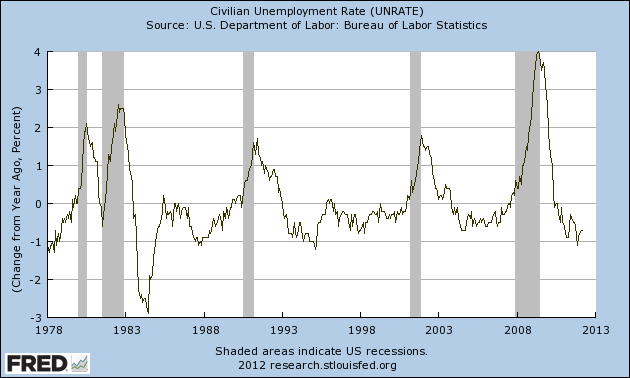
If we begin to hear the economic and political pundits raise worries of recession in the coming months, the data in the chart below is a really reliable predictor of recessions.  There was a slight delay in a minor recession in the 1950s and two false signals in 1986 and 1995 when the economy faltered. Here’s the key:  when the percentage change in the unemployment rate from a year ago goes above zero, it is highly likely that we have either just started a recession or will start one shortly.

In the coming months you can pull up this same chart by going here at the Federal Reserve  or entering “Fred Unemployment” in Google search bar and selecting the top pick.  The Federal Reserve does all the work for you.  Click “Edit Graph” just below the graph.  On the next screen, change the “Observation Date Range” below the graph to start with a more recent year to make the chart easier to read.  Go down to the “(a)” section and select “Change from Year Ago, Percent”.  Below that, click “Redraw Graph”.  Now you too can know the future.

March Labor Repot

This past Friday the Bureau of Labor Statistics (BLS) released the monthly labor report, showing job gains of 120K, far below the 200K expected.  The unemployment rate dropped 1/10th percent to 8.2% as over 100K people quit looking for work.  Contrary to a popular myth, when someone runs out of unemployment benefits they do not drop out of the workforce as long as they are continuing to look for work.

Although this report was a disappointment, the economy has added 247K jobs per month over the past quarter.  As I have done the past few months, I will look beyond the seasonally adjusted headline numbers to the unseasonally adjusted year-on-year job gains of the core work force.  These core figures tempered my enthusiasm in January and February and, as you will see, temper my disappointment in March’s headline numbers.

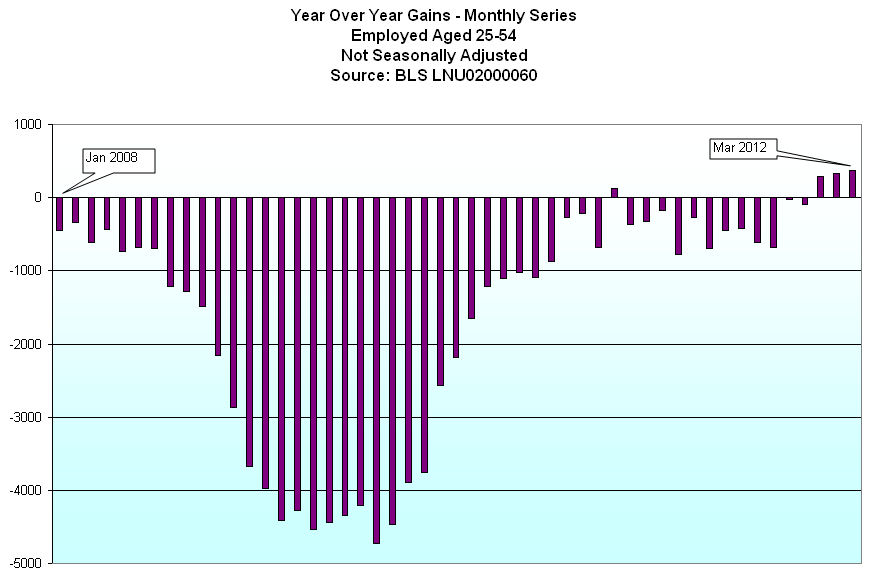
The core work force, men and women aged 25 – 54 years old, continues to show accelerating job gains.  In February, the year over year (y-o-y) gain was 350K.  In March, the gain was 374K, a modest gain but still gaining. A decline in that gain would be cause for worry.

This core work force metric is a powerful leading indicator of the health of the economy, as I will show below in this monthly chart of y-o-y job gains or losses.  January 2008 was the first month that year over year gains slipped below 0 and proved to be the canary in the coal mine that the economy was weakening.

Let’s expand the picture as I have done the past few months, looking at the larger pool of workers aged 25+. The March y-o-y gain did decline somewhat from 2079K to 2048K.  While job gains are strong, the acceleration has reversed.  Did the record breaking warm winter weather push spring hiring forward into January and February?  Could be. Does the March 34K loss in retail jobs largely account for this slight dip in job gains?  Could be.

There are several long term trends that are cautionary, revealing some structural weaknesses in the economy and the recovery.  The number of people who want work but have not looked in the past four weeks, referred to as discouraged workers, was  essentially unchanged. The number of long term unemployed was unchanged.  The average work week fell .1 hours and the income gains of workers shows an annual increase of only 2.1%.  However, the number of people working part time because they could not find a full time job fell almost 10%, an encouraging sign.

In short, this is a mixed report but one that I see, on balance, as more encouraging than discouraging.

Health Care Puzzle

Here is a WSJ guest opinion piece (article was accessible without an online subscription) by a finance professor with the Cato Institute who summarizes the many failings of the health care industry.  They include what amounts to racketeering by the AMA and Congress, an insurance system geared to raise costs in the health care industry, the lack of consistency in the tax treatment of insurance policies, and the lack of individual choice or portability – to name but a few.

Health care is one area where libertarians meet liberals in some agreement.  

Here is a 2007 thought piece by Brad DeLong on some rather simple solutions to the problem of catastrophic health care costs.  Can you imagine a world in which a person who makes $50K a year can rest secure that no matter what illness or accident happens to them, their out of pocket expense will be no more than $10K for that year?

Many years ago, I got a piece of metal in my eye and scored up my eyeball trying to get it out.  It was evening and my doctor’s office was closed so I went to the emergency room at a nearby hospital.  I had catastrophic health insurance with one of the largest insurance carriers in the country, but I had a deductible on the policy that wasn’t meant to cover the rather small cost of an ER visit for an eye injury. 

With my hand covering my painful eye, I presented my ID and insurance card to the ER admitting clerk.  “We don’t accept that insurance,” she said. 
“I’m not expecting this insurance policy to cover the cost of the ER visit,” I replied, “because of the deductible.” 
“No, we don’t have an agreement with this insurance company,” she replied. 
“What do you accept?” I asked.  She mentioned Blue Cross and one other. 
“Well, how do I get care?” I asked. 
“You pay [$560 in today’s dollars] and we will have a doctor see you as soon as possible,” she said.
“Do I get a discount for paying cash?” I asked.
“No, there are no discounts,” she said.
Having nowhere else to go for after hours care, I said “Ok, where do I sign?” 
“You have to pay first,” she said.
“What if it doesn’t cost this much?” I asked.
“The hospital will mail you a refund,” she said.
“What if it costs more?” I asked.
“The hospital will send you a bill,” she said.
“Just out of curiosity,” I asked, “what if I had a Blue Cross policy with a deductible like the one I have?”
“Then the hospital would bill you, she said.
“Would it be the same price?” I asked.
“It would be at the price set by the insurance company and the hospital,” she answered.

The care was excellent and done quickly with little waiting. I was out of there in less than an hour.  The hospital did bill me for a small amount in addition to what I had already paid. 

Over twenty years later, does a similar story still play out in emergency rooms around this country?

Piggy Banks

The Bureau of Economic Analysis (BEA) keeps track of our “piggy banks” in a metric called the Personal Savings Rate (PSR).  This is a measure of disposable income less spending on consumption items.  The rate is a percentage of savings to disposable income.  Below is a graph of the past 60 years, showing the steady decline in personal savings that began in the 1980s. (Source)

The stock market has cheered the recent rise in consumer confidence and spending but – a word of caution.  As the graph shows, the PSR was at 4.7% in December 2011.  This past Friday, the BEA reported that the PSR had declined to 4.3% in January and declined again in February to 3.7%.  In real inflation-adjusted dollars, personal incomes declined slightly at the beginning of this year, making it doubtful that the recent rise in consumer spending can be sustained.

ObamaCare and the Supremes

This past week the Supreme Court (court) listened to oral arguments on the constitutionality of the individual mandate provision of the Affordable Care Act, the health care law often referred to as ObamaCare.  There were several aspects of the law that were argued in separate sessions. These arguments are available in written form  and oral form in mp3 format.  I have included links to the audio below and a link to one of the written transcripts but you can select the transcripts for any of the arguments using the topic list number for each argument.

The first question the court heard was whether the individual mandate was a tax (11-398 Monday Argument).  If the court rules that it is a tax then the 26 states that brought suit against the federal government, which I’ll refer to as the government, have no standing to sue at this time because no one can bring suit against the government before they pay the tax.  In that case, no one could bring suit until 2015 when someone actually pays the tax.  The court would not rule on the constitutional aspects of the mandate till that time.  Wanting a resolution to the constitutionality of the health care law, neither the government or the states wanted to argue that the individual mandate was a tax.  Since neither party wanted to argue the point, the court invited Michael Carvin as separate counsel to argue the case that the mandate is a tax.  The government argued that the mandate is a penalty under the taxing authority of Congress.  Understanding that the health care law is a contentious issue before a Presidential election, the court will probably side with the case that the mandate is not a tax so that they can take up the constitutional questions that the law raises.

The second session (oral or written ) consisted of oral arguments for and against the constitutionality of the individual mandate (11-398 Tuesday Argument).  The third session argued whether the court can strike down the individual mandate and let the rest of the law stand, referred to as the “severability” of the individual mandate, i.e. can the mandate be severed from the rest of the law (11-393 Argument).  The fourth session took up the question: can the federal government withdraw existing Medicaid funds it provides to the states if the states do not want to follow the new additional Medicaid guidelines that ObamaCare imposes (11-400 Argument)

Justice Scalia summarized the concerns of the court’s conservative justices: “An equally evident constitutional principle is the principle that the Federal Government is a government of enumerated powers and that the vast majority of powers remain in the States and do not belong to the Federal Government.”

Is the individual mandate within the scope of Congress’ power?  In Article 1, Section 8 of the Constitution, the Federal government is given a list of enumerated powers.  The Tenth Amendment asserts that “The powers not delegated to the United States by the Constitution, nor prohibited by it to the States, are reserved to the States respectively, or to the people.”  Amendments to the Constitution are the  definitive way to give the federal government an additional enumerated power; the Sixteenth Amendment to collect taxes on income is an example.  Since the federal government’s power is limited to what is allowed under the Constitution, it must argue for an expanded interpretation of the authority given to it by the Constitution.   It does this under the “Basket Clause” power enumerated in Article 1 which gives Congress the power “To make all Laws which shall be necessary and proper for carrying into Execution the foregoing Powers, and all other Powers vested by this Constitution in the Government of the United States, or in any Department or Officer thereof.”

One of those “foregoing powers” is the Commerce clause in Article 1: “To regulate Commerce with foreign Nations, and among the several States, and with the Indian Tribes.”

The intent of the Constitution regarding the federal government is to put limits on the power of that government.  In any case involving the authority of the federal government, the court often wants to hear a limiting provision so that their judicial decision does not open the floodgates for unlimited government authority.  The subject of limits was raised frequently by the conservative justices on the court.  Congress has enumerated powers; the states have plenary powers.  The states can force an individual to buy car insurance; the federal government does not have that authority.  In many areas, the states have coercive powers over the individual that the federal government does not have.

In this case the government argued that the individual mandate is within its power to regulate interstate commerce.  The individual mandate to buy insurance is needed in order to require insurance companies to write policies with community rating, i.e. risk is spread throughout a large community, and guaranteed issue, i.e. no denial because of medical history or condition.  The states argued that the law’s individual mandate to buy insurance is unconstitutionally forcing people to buy a product, thus creating an insurance market.

Justice Breyer cited a lower court opinion (Sutton) that an earlier precedent setting case, Wickard v. Filburn, effectively allowed the government to force a farmer to buy wheat. Other justices disagreed with this interpretation of the Wickard case. 

The government advocate, Donald Verrilli, made what is its primary point:  health care insurance is simply a financing mechanism for health care services which all but a few will consume at some point in their lives. Since all people are or will be in the market for health care services, the government has the authority to regulate the payment for those services.

Justice Alito asked Verrilli, the government advocate, whether the government could require people to buy burial insurance since everyone will need to be buried or cremated.  Verrilli made the argument that burial expenses do not involve cost shifting the way that paying for health care insurance does.  Justice Alito countered that the government does pick up the expense of burying or cremating someone who cannot pay but Verrilli argued that this comes out of general tax revenues and these costs are miniscule when compared to the unreimbursed costs of health care.  Justice Scalia asked the rhetorical question: why couldn’t Congress just pass a tax to cover the costs of unreimbursed care?  There would be no question of constitutional authority since Congress has the express power to levy such a tax.  Although many liberals disagree with much of Justice Scalia’s opinions, they have asked this same question.

Justice Kennedy noted that the court has an implied presumption that a law is constitutional but that the government has a burden to prove its case when enacting a law that requires an individual to buy something, a requirement that fundamentally changes the relationship between the government and the individual. Kennedy noted that the health care act requires an affirmative action from an individual, i.e. buy insurance.  Under existing tort law, the government can not require an individual to take an action to prevent a blind man from stepping in front of oncoming traffic, despite the grave moral concerns this raises.  The laws of this country delineate a clear boundary around the individual that the government can not cross.  Kennedy is concerned that the court may set a precedent in this case that erodes that boundary.  Often regarded as the swing vote on the court, Kennedy’s remarks show his concerns about the constitutional questions and limits on Congressional power that the law raises.

Mr. Verrilli argued that both sides agree that the government can regulate transactions affecting interstate commerce at the point of sale.  Paul Clement, the states’ advocate, later confirmed his agreement when questioned by Justice Sotomayor:  Yes, the government can regulate commerce at the point of sale.  Verrilli argued that insurance is the way that health care services are paid for at the time of delivery or point of sale; however, no one can buy insurance at the time of delivery since no insurance company will sell someone a policy at that time.  Given this rather unique feature of health care transactions, the government has the authority to ensure that people have insurance in advance of the point of sale.  Further on, I’ll cover Clement’s argument against this contention.

Given the government’s argument, Chief Justice Roberts asked if the government could require people to buy a cell phone so that they could call for emergency services, i.e. police, fire, ambulance and roadside service, which most people will need in their lifetime.  Verrilli argued that, unlike health care, there is no market for emergency services. Justice Breyer argued that the goverment could require someone to buy a cell phone or burial insurance.  As an example, Breyer challenged Paul Clement, the states’ advocate, couldn’t the government require people to get vaccinated to prevent the spread of a disease that would kill 60% or more of the population.  Clement answered that the government could not do so.  This argument between Breyer and Clement reflects the sharply differing interpretations of the General Welfare clause of Article 1.

Justice Kennedy questioned the government’s case that the health insurance market and the health services market are the same market.  The health care act requires people to buy insurance for services that they will never need; i.e. maternity care or pediatric care.  The government advocate, Donald Verrilli, argued that the government has a right to impose minimum coverage provisions as a regulatory detail.

Justice Ginsburg noted that the government’s brief makes the case that the health care market is one where there is direct cost shifting from one market participant to another, thereby constituting an existing market.  Insurance companies and hospitals charge additional to people with insurance to pay for those who have no health insurance.  Verrilli concurred, noting that this direct cost shifting distinguishes the health care market and justifies the government’s regulation of this cost shifting.  Justice Scalia argued that there is an implied cost shifting when someone decides not to buy a car.  To make a profit, car companies have to charge more to compensate for selling fewer cars.  Verrilli argued that, unlike cars, health care will be provided regardless of one’s ability to pay.  Although Scalia failed to make his point directly, he showed a skeptical wariness of  allowing the government to control and expand the definition of what is a market.  If given a wide latitude to define a market, the government could define almost any activity as a market in the future and its authority to regulate that newly defined market.

Justice Sotomayor asked the states’ advocate, Paul Clement, whether the government could enact a “health care responsibility payment” that would be waived on proof of insurance.  Mr. Clement answered that there might be some question whether Congress could do so under its taxing authority.  Such a payment could be construed as a direct tax that would presumably not be a uniform tax and unconstitutional under Article 1.

Justice Breyer argued that Congress has historically created commerce out of nothing, noting the creation of a national bank as a regulation of commerce which did not previously exist.  Breyer cited various court decisions that ruled the growing of wheat or marijuana as activities engaging in commerce and affirming Congress’ authority to regulate such activities under the Commerce clause.  Clement countered that the creation of a national bank was not done so under the Commerce clause, nor did the government require an affirmative action from individuals – that they deposit their money only in the national bank.  Clement returned again to this question of coercion, adding that the government does not require people to buy cars to support the car industry; rather, the government offered incentives such as the Cash for Clunkers program.  The government does not support wheat farmers by requiring everyone to buy so many loaves of wheat.  In short, the government has no authority or precedence for forcing individuals into a market.

In response to challenges by Justice Roberts and Kagan, Clement argued that everyone is not in the health care market; that through this insurance mandate, the government is trying to force everyone into the market. Justice Kagan responded that insurance is a way of funding a market that everyone will participate in during their lifetime. Clement countered that not everyone will use the health care services during the year that they have bought the policy for.  Clement consistently draws the distinction between the health care services market and the health care insurance market, an appeal to the conservative justices who are wary of Congress’ future desires to make connections between markets in order to extend the reach of Congressional authority under the Commerce clause.

Justice Kagan summed up what will lie at the heart of arguments both for and against the constitutionality of this law:  “who’s in commerce and when are they in commerce?” 

January JOLTS

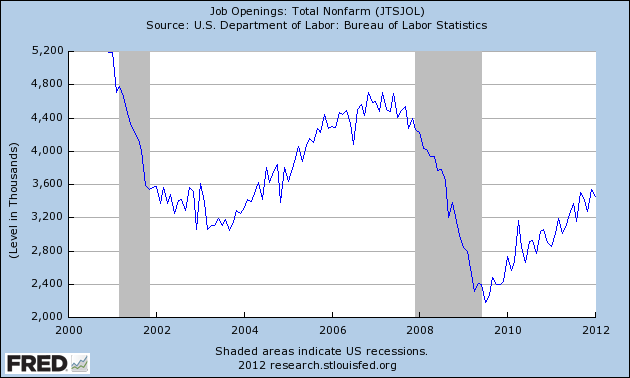
As a followup to my blog on the February jobs report and the job openings for December, here is the job openings report – JOLTS – for January from the Bureau of Labor Statistics:

The number of job openings in January was 3.5 million, unchanged from
December. Although the number of job openings remained
below the 4.3 million openings when the recession began in December
2007, the number of job openings has increased 45 percent since the
end of the recession in June 2009.

These are seasonally adjusted figures. As the graph shows there is steady but stuttering progress.

Federal Debt By President

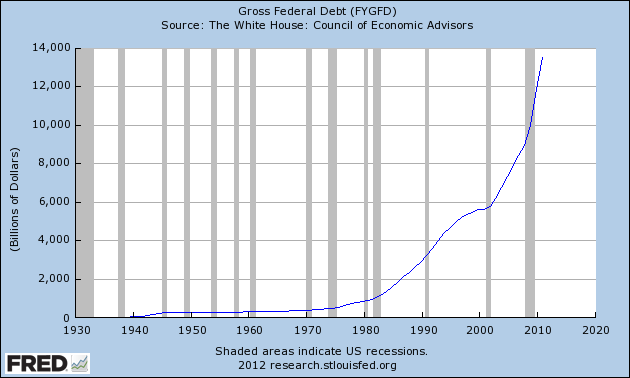
There are several “factoids” running around the internet that Obama has run up more debt than all past presidents combined.  According to the Treasury Dept that claim is not true but the run up in debt has been outstanding since Obama took office in January 2009.  When Bush left office, the total debt was 10 trillion.  It was 15.5 trillion at the end of February 2012.

As the graph below illustrates, we have been borrowing lots of money for the past thirty years.

Then I wondered:  after adjusting for inflation,what is the annual increase in federal debt for each President?  Adjusting for inflation allows us to compare apples to apples.  The Federal Reserve supplies us with both data on the debt and a deflator to adjust current dollars to real 2005 dollars.  Obama’s average is computed up to Dec 2011.

Remember, these are inflation adjusted dollars.  The big spending started with Reagan but both parties have become very practiced at developing good explanations for why we have to spend a lot of money. 

Like many, I have thought that the severe downturn has dramatically reduced federal receipts.  As a percentage of GDP, it has – receipts have been coming in at 15 – 16% of GDP, when the long term average is 18 – 19%.  But … bigger government spending has inflated GDP about 10%. What have receipts been over the past decade?  During the Bush years, the Federal government pulled in an average of 2.13 trillion dollars a year in 2005 real dollars.  During the Obama years, the average is 2.0 trillion.  The drop in receipts has been relatively slight.  80 – 85% of the responsibility for the big run up in the debt is spending.

Last week, Senator McCain acknowledged the true cost of defense spending at $1 trillion and it is defense spending that led the Bush administration to run up a $5 trillion dollar deficit in eight years despite four years of robust growth, fueled largely by a real estate bubble.  The bubble burst and the severe fallout from that debacle has prompted even more defense spending – social support programs to defend Americans against lost jobs, lost health insurance and lost home equity.

“Too much spending!” Republicans cry but do not want to cut back on defense spending or agricultural subsidies in rural areas where their support is strongest.  Income tax subsidies are another form of spending, one highlighted by the Simpson-Bowles commission.  In this broken, contentious political climate, neither side of the political aisle can agree on any meaningful reductions in tax subsidies because the voters who put them there can not agree. 

Since neither side can agree on spending cuts, there is only one other solution – higher revenues.  Yes, that’s the punch line.  Funny, isn’t it?  If neither side can agree on spending cuts, they surely can’t agree on where to get higher revenues.

Bleeding heart Democrats cry out for tax justice for the poor while Republicans stand strong for tax justice for the rich.  The Tax Policy Center can find no studies showing that taxes on the rich influence job creation, either positively or negatively.  To conservatives who believe that they do, facts are unimportant.  Conservatives are like football fans – all you gotta do is believe.

Democrats suffer from the same “fact blindness,” disregarding several studies showing that long term unemployment subsidies undercut the confidence and skills of the unemployed, making them less employable the longer they are out of work.  Car and home buying subsidies of the past few years have done little but push forward the buying of cars and homes.  When the subsidy programs expired, so too did the buying of cars and homes.  Despite the demonstrated ineffectiveness of these social subsidies, Democrats continue to propound that they are for the working person.  Another month and another proposal of yet another program for the “vulnerable.”

The moderates of either party have either been voted out of office or left in frustration.  Olympia Snowe, a Republican Senator from Maine, is the latest to quit the carnival show of Congress.  She wrote, “I do find it frustrating, however, that an atmosphere of polarization and ‘my way or the highway’ ideologies has become pervasive in campaigns and in our governing institutions.”

We can not agree on spending cuts and we have two large spending items looming in the near future which will only exacerbate the debate.  The Boomers are just beginning to collect on their deferred annuity program – we know it as Social Security.  They are one kind of bondholder expecting the government to make good on the promises it has made.  The really big bond leviathan is that world wide group of holders of U.S. debt – over $10 trillion in treasury bonds and notes.   We have benefited from the “flight to safety” over the past few years as investors around the globe have bought U.S. debt at ridiculously low rates.  Investors will want a more normal return for their money eventually and when that happens, the annual interest expense on our debt will rise.  These two groups of bondholders with demands and expectations will light the fuse.

If you think the past decade has been contentious, you ain’t seen nothin’ yet.

The Long Run

Now the really big picture.  Reflecting the severity of the market downturn that began in late 2007, the 4 year average (50 month) of the S&P500 index is getting close to crossing below the 17 year (200 month) average.  Remember, this is years.  In the normal course of affairs, inflation tends to keep the shorter average above the longer average.  The crossing or “nearing” of these two averages reveals just how sick the past decade has been.  The last time the market showed this indicator of prolonged market weakness was in the first half of 1978, after a 43% market drop in the bear market of 1973-74 and a 19% drop in 1977.

In the last 60 years, was the October 2008 market drop of 17% the deepest monthly plunge in equity prices?  No, that honor goes to the almost 22% dive in October 1987.  For a consecutive 3 month drop, 2008 does barely nudge out 1987, both falling 30%.

Although headlines will speak of the downturn in the Fall of 2008 as the worst since the depression, it is important for Boomers to remember that our parents’ generation suffered through some pretty severe market declines as well.  In 1987, most Boomers were in their thirties and probably had relatively few dollars in the stock market.  We may remember “Black Monday”, October 19, 1987, for the headlines but it was not as personal as the 2008 decline because we were decades before retirement and had less at stake.  What particularly distinguishes the two years is that the unemployment rate continued to fall during the 1987 decline.

Young people don’t remember market crashes the way that older people do.  When we are young, we have – like forever – before we are going to be old.  For the echo boomer generation born in the eighties and nineties, also known as the  “millennials”, or Generation Y, the crash of 2008 will be a faint or non-existent memory when they reach their fifties decades from now.  They will probably get to have their own crash – one that they will remember because they will have more at stake.

When we are in our twenties, someone should prepare us.  We are going to work hard and save money.  We are probably going to put some of that hard earned money in the stock market.  Then, when we are in our fifties, sixties or seventies, we are going to flip out when our stock portfolio drops by 40%.  Would we listen to or remember that sage advice?  Probably not.

Labor Report – February

This past Friday, the Bureau of Labor Statistics (BLS) released their monthly assessment of the labor market, reporting a net increase of 227,000 jobs during the month of February.  This marked the third consecutive monthly increase of more than 200,000 jobs, giving many hope that the tepid economic recovery is gaining a firmer foothold.  Consumer spending accounts for more than 2/3 of the economy.  Any improvements in the overall economy are fragile without a strengthening labor market.  Almost 1/2 million people who had previously given up looking for work became available for work again.  This influx of job seekers offset the rise in jobs, causing the unemployment rate to remain unchanged at 8.3%.

The monthly survey of businesses showed job gains in many industries:  Business services, leisure and hospitality, health care, mining and manufacturing. In 2011, government jobs disappeared at the rate of 22,000 per month.  That job attrition has slowed to zero, indicating that the cut backs in government are largely over and will no longer weigh down any growth in the private sector.

The bad news is that there are many critical elements of the jobs report that were unchanged.  The long term unemployed remained about the same at 5.4 million.  The participation rate of the 155 million civilian labor force is a bit less than what it was a year ago but the employment population ratio is slightly above Feb. 2011’s rate.  The average workweek remained unchanged at 34.5 hours.  Involuntary part time workers, those who would like a full time job but can’t find one, remained the same at 8.1 million. 

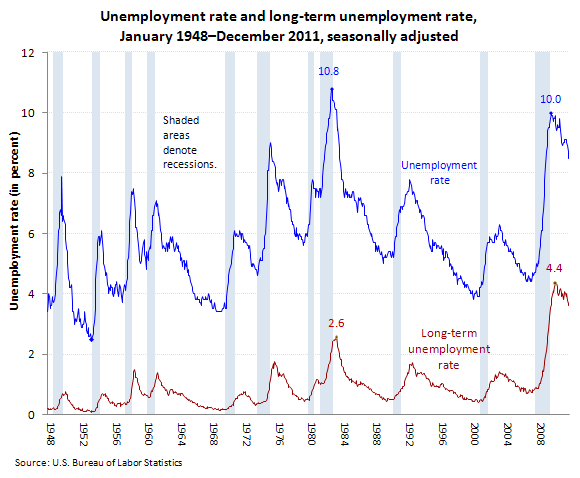
As encouraging as February’s data is, the 5.4 million who have been unemployed for 27 weeks or more is a troubling sign of the underlying weakness of the job market.  Below is a BLS historical comparison of the unemployment rate and the long term unemployment rate.  The 70 year timeline of the graph illustrates the ongoing crisis levels of long term unemployment.

On Monday, March 12th, the BLS will release the monthly JOLTS job openings report for January 2012.  In December, there were 3.4 million seasonally adjusted job openings, an increase of almost 10% from the previous month.  This is better but – always that but – the graph below shows non-seasonally adjusted (NSA) December job openings from the previous ten years to show the improving but still weak number of job openings.

As I have mentioned in past blog posts, there is some concern that the seasonal adjustments that the BLS uses may have some weaknesses due to the severe downturn in the fall of 2008 which affected the winter seasonal adjustments.  The BLS makes one set of seasonal adjustments for the six months from May through October and another set of adjustments for the November through April period.  With advances in statistical modeling that the Census Bureau has introduced over the past 50 years, the BLS has refined their methodology of making seasonal adjustments.  The concern is not with their methodology but with the data itself of late 2008 and early 2009, an “outlier” that was so extreme that it “contaminates” the data set in subsequent years. The BLS incorporates 5 years of data in their projections of seasonal adjustments, so this “hangover” will last into the spring of 2014.  You can read an overview of the adjustment methodology used by the BLS here.  Without seasonal monthly adjustments, January’s job data each year would look dismal, with job losses regularly in the 2.5 to 3 million range, as employers lay off workers who were hired for the Christmas season.

A comparison of the raw numbers for job gains in February of each year do give an indication of labor market momentum.  As the chart below shows, the gains in February have been one of the strongest of the past decade.

But we saw strong gains last year throughout the spring only to see the momentum fade, explaining why the reaction to this month’s gains have been one of “cautious optimism”.  Some attribute the loss of momentum last year to the tsunami, the unrest of the Arab spring and rising gas prices, the ongoing sovereign debt problems in Europe, and the embarrassing budget battle.  But there may be more to it than the events of last year.  I contend that there is a structural weakness in our labor market that makes us more susceptible to the “winds” of current events.

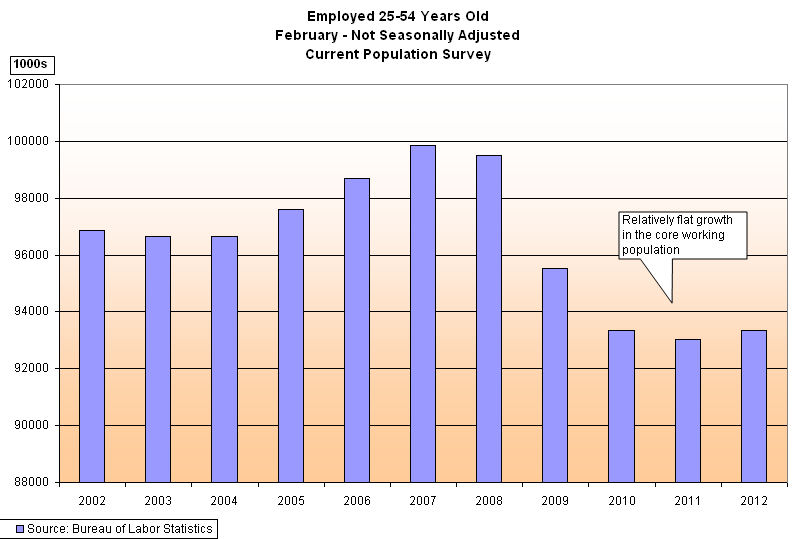
As I have done before, let’s look at the core working population, 25 – 54 years old.  These are non-seasonally adjusted figures for February in each of the past ten years.

These are the “middlers”, those of us who are buying homes for the first time, raising families, buying appliances and cars and they are the backbone of a consumer economy.  The job growth of this population backbone has been flat and remains at levels below those of the early part of the decade, as this country pulled out of the 2001 – 2003 downturn.

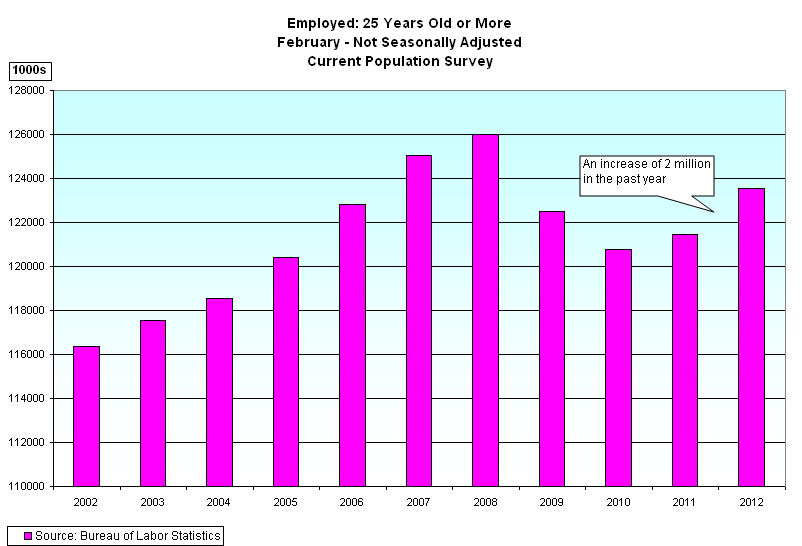
The largest part of the increase in employment have come from those who are older than 54, as shown in the chart below of the larger data set of those 25 and older who are employed. Partially this is due to an aging population – the graying of the Boomers – but it shows a structural weakness in the labor market which undercuts the resilience of the economic recovery.

The takeaway is that we are once again seeing improvement but our economy and labor force suffers from a brittleness that the labor data exposes.  Part of that brittleness is due to an aging population; part is due to the continued de-leveraging and slow recovery typical of major financial crises; part is due to political indecision in government which reflects the indecision and disagreement among the voters; part is due to a very “accommodating” (translation: low interest rates) Federal Reserve policy that attempts to distribute financial pain, reward and risk throughout the economy using the few monetary tools that it has.

The stock market is encouraged but stuck. After rising for the past two years, the 200 day moving average of the SP500 has leveled off for the past 6 months, a phenomenon not seen since April to October of 1994.  October 1971 to March 1972 and May through September 1957 saw a similar 6 month plateau.  The Indians in the market are hunched over with their ears to the ground, not certain whether the distant sounds they hear are buffalo or thunderstorms.

Golden Cross

A few weeks ago, I wrote about a long term trading strategy using the 200 day moving average of a popular index, the S&P500, which captures 75% of the corporate activity in the U.S.  As corporate profits of larger companies increasingly come from overseas, the S&P provides some foreign stock exposure as well.  Over the past decade, the strategy worked pretty well, getting out of the market before the 2008 downturn, enabling an investor to pick up shares at a cheaper price in 2009.  That is, after all, the point of adopting any type of trading strategy – sell when shares are expensive, buy them back when they are cheap.

Today, I’ll look at a variation of the 200 day strategy called the “Golden Cross”, which I have mentioned in a few past blogs.  A Golden Cross buy signal occurs when the 50 day moving average crosses above the 200 day moving average.  A sell signal occurs when the 50 day average crosses below the 200 day average. A buy signal just occurred at the end of January. You can chart the S&P index for free at StockCharts.  I will compare this Golden Cross strategy to the buy and hold strategy. 

The Golden Cross strategy investor must overcome two major problems: tax attrition and the return on cash while out of the market.  The first problem is formidable. The IRS takes their pound of flesh out of profits that the trading strategy produces.  The downturn in prices when the strategy is out of the market may not be enough to compensate for the 20% (or more?) tax bite, which reduces the investor’s capital pool when he buys back into the market.  Thus the investor may buy fewer shares on the next buy date, and those fewer shares generate less profits as market prices climb.  The second problem is almost as formidable.  Over the 50 years that I will explore, the investor would be out of the market about a third of the time.  The interest rate one earns on one’s capital while out of the market is an important factor in total returns.

Here are the assumptions of the study:

20% Effective Tax Rate – capital gains taxes are “taken out” at the time of the sale.

3% Average Dividend Yield (see here for historic dividend yields)- dividends are recorded and taxes paid for those dividends for both strategies at buy and hold dates.  While not entirely accurate, it largely accounts for the value of dividends to a portfolio.

Interest – 4% on cash while out of the market.

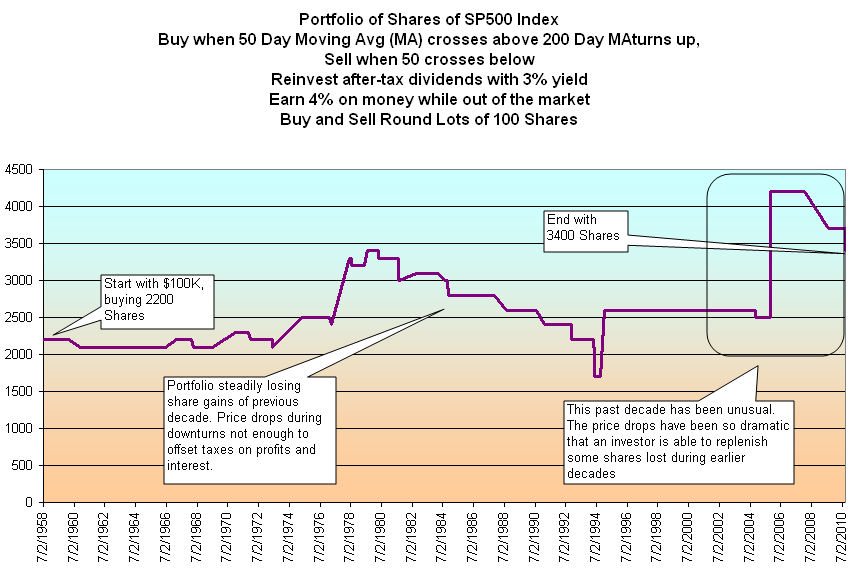
Reinvest – For the conservative buy and hold strategy, the investor pays taxes on the dividends received and puts the money in some cash equivalent fund earning the stipulated interest.  The Golden Cross strategy accumulates and reinvests the dividends at the next stock purchase date. (Click to enlarge in separate tab)

The market downturn during the 70s was severe enough that the Golden Cross investor could book profits, pay taxes and buy back more shares than he had before.  In the early 80s, the downturns were not significant enough to overcome tax attrition.  Had we ended this exploration in the year 2000, this strategy would have done poorly when compared to a buy and hold strategy, even after accounting for the deferred taxes owed by the buy and hold investor.  During the two severe bear markets of the 2000s, the Golden Cross strategy shined, exceeding the returns of the buy and hold strategy.

The lesson is that the downturn must be strong enough that the Golden Cross strategy can overcome the tax attrition by buying shares back at greatly reduced prices.  Although the Golden Cross strategy produced only 5 losses out of 27 round trip (buy/sell) trades, a winning percentage of about 80%, the tax obstacle is a formidable barrier to increased profits over buy and hold.  The buy and hold strategy is about 25% invested in cash at the end of this study, a conservative approach consistent with a buy and hold investor.  If the buy and hold investor were to periodically reinvest dividends instead of holding cash, it would probably equal the after tax returns of the Golden Cross strategy.

The Golden Cross strategy is much more dependent on finding a good return on cash when the investor is out of the market.  In these times, that is not an easy task.  As a retirement strategy, it might be wise to choose a combination of the Golden Cross and buy and hold.  A buy and hold investor in or approaching retirement would assess their income needs for the next 3 – 5 years and sell just enough shares to fill the cash account when a Golden Cross sell signal arrives.  During their working years, a buy and hold investor would add shares when a Golden Cross buy signal arrived.