Moocher Madness

President Richard Nixon famously said “I am not a crook.”  Everyday Americans say – not so famously – “I am not a moocher.”  Thom referred me to a blog at the NY Times which recounts the many ways in which most of us mooch off the government in one form or another and yet think we are not beneficiaries of a federal program.

Today President Obama released his budget for fiscal year 2012, which starts in September of this year.  Republicans pooh-poohed the President’s lack of effort to offer any serious reductions in federal government spending.  Some Democrats criticized proposed cuts or freezes in spending. Neither Republicans or Democrats want to talk about the 800 lb gorillas in the room – entitlement programs and defense spending, which take up about 70% of federal spending.  Republican politicians have vowed to cut spending but will find that most of their constituents get some kind of favor from a government program.  When Republicans begin to offer cuts to specific programs they may find themselves in a hive of angry hornets – their constituents.

Not all government programs hand out money directly to the beneficiaries of those programs.  Some programs are indirect transfers of money through tax credits and deductions.  Tax breaks for a minority of taxpayers are another form of spending by the government for that favored minority. 

A review of an IRS analysis of tax returns from 1990 – 2008 gives us a peek into the many government programs that offer tax advantages and how many of us claim these breaks.   When the bipartisan debt commission recently advocated for eliminating special tax favors like the mortgage interest deduction in exchange for lower tax rates, politicians on both sides of the aisle cowered.  In 2008, 34% of returns itemized deductions rather than take the standard deduction.  80% of itemizers take the home mortgage interest deduction so this one deduction becomes a reason for itemizing. Only a minority of taxpayers claim the deduction but it has become a sacred cow like Social Security and Medicare.

Low income seniors are treated favorably under the tax code. 17% of taxpayers received Social Security benefits in 2008 but only 60% paid any tax on that income.  Seniors vote.  What politician will touch that one?
17% of taxpayers claim the unearned tax credit, a subsidy program for low income families with children.  18% of taxpayers claim the child care tax credit.   14% of taxpayers claim a student loan interest deduction, an educational expense credit or a tuition and fees credit.

In one form or another most of us suck on the federal government’s teat.  Taxpayers claiming any farm income was only 1.3% of tax returns yet talk of abolishing farm subsidies is met by cries of anguish and anger from beleagured small farmers.  Most of these subsidies go to large multinational agricultural companies who raise the alarm when any mention is made of reducing or abolishing these programs.  Oil companies cry out if their tax allowances might be given over to solar and other renewable energy industries.

The majority of us enjoy tax breaks on any health insurance premiums – the portion paid by us and the portion paid by the employer. We don’t get a tax break for life, home or auto insurance – just health insurance. This tax benefit is another sacred cow.  No wants to give up their “gim-mes” from the federal government. 

Imagine a world where individuals and corporations pay a flat percentage tax on income; where there is no favoritism given to home buyers or oil companies.   It’s a horrible thought, isn’t it?
Tax Limbo

Back in the ancient days before the Internet, before Disco, even before the Beatles, Chubby Checker popularized a song called “Limbo Rock”. The dance craze involved bending backwards and shimmying under a limbo stick, a bar, that could be raised or lowered. An Olympic pole vaulter tries to get over the bar. A limbo dancer tries to get under the bar.

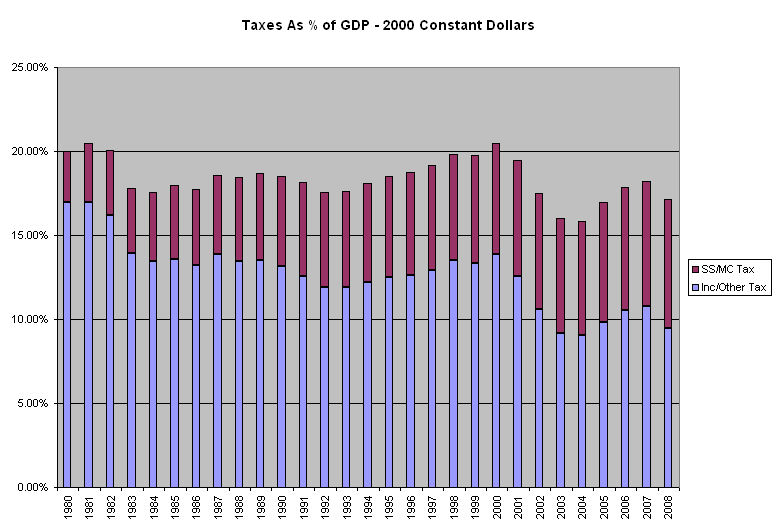
Below is a 30 year graph of Federal revenues as a percentage of GDP.

The Heritage Foundation has a 70 year chart of Federal revenues, showing the 18% historical average – the bar – of revenues to GDP and projected 2010 revenues of less than 15%.  The AP released a story today that Federal revenues for the 2011 tax year are also projected to be below 15%. 

We don’t like bending over backwards, so we party on under a different bar, one that we keep raising.  That bar is the national debt.

Those to the left of center will repeat their mantra that the government needs to spend more when times are tough.  “Raise the bar,” they chant. Those on the right will continue to press for more spending cuts (but not defense spending, their sacred cow). “Stoop lower,” they encourage.  A reasonably sane person would say we need both cuts and higher taxes if we are to avoid the long term problems of ballooning government deficits and long term debt.

Housing: Satellite View

A few weeks ago, Standard and Poors released their monthly Case-Shiller index, showing continued weakness in the housing market.   The graph on page 1 charts the year over year percent change in housing prices for 20 cities in the U.S.  After rising above 0 in the early part of 2010, the index has now taken a dive below 0, indicating increased price pressures from foreclosures and a labor market that is still far from healthy.

Let’s step back and look at another data series, an index of housing prices from the Federal Housing Finance Agency, which compiles data from Fannie Mae and Freddie Mac purchases and refinances.  The large volume of mortgages guaranteed by these two quasi-governmental agencies provides an annual data set of more than a million mortgages, 60 times larger than the Case-Shiller data set that usually makes headlines.

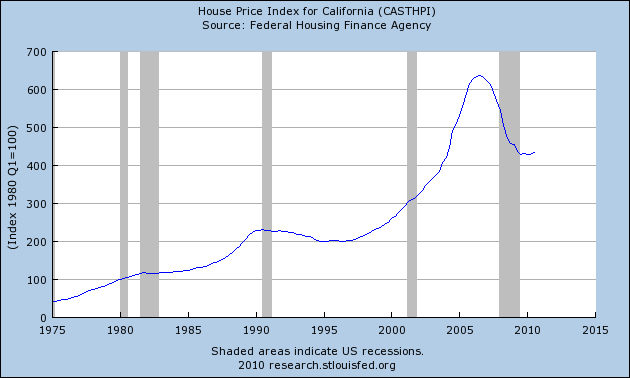
Courtesy of the FRED database at the Federal Reserve in St. Louis, we can see below a 35 year history of housing prices in California (Source)  From this multi-decade viewpoint, we can see the real estate spike that occurred during the past decade. (Click to enlarge in a separate tab)

Spotting trends in stock prices or housing prices is more art than science.  Below I’ve drawn my guesstimation of the 40 year and 20 year trend lines in the California housing index.

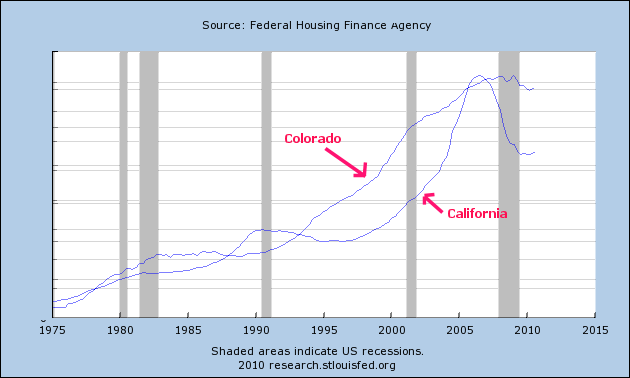
As a comparison, let’s look at a more even tempered state, Colorado.(Source)  Here we can see a more sustainable growth pattern in prices. Again, I’ve drawn a trendline in red to show a guesstimation of the long term trend.

A comparison graph of the two states reveals just how strongly the California index shot up during the past decade.  The scales are different for each state but reveal interesting historical patterns and a caution to California homeowners. 

Colorado experienced little growth in housing prices during the 80s.  For Californians, their slow growth period was from the late 80s to the late nineties. During the late nineties and early part of the 2000s, the growth pattern was similar to Colorado.  After the recession of 2002-3, California housing prices exploded upward while Colorado prices maintained the same growth pattern.  During the past two years and over the next several years, California prices will continue a painful return to the long term trend.  Colorado homeowners will see the same flatlining of prices that they experienced during the 80s but that is far better than the rollercoaster ride that California homeowners are currently on.

Tax Myths

Like many people I believed in several tax myths.  Twenty years ago, my accountant helped me better understand some of the things I took for granted as true.  I had started a contracting business a few years before.

Myth: Tax rate. I believed that, because I was in a 28% tax bracket, I paid 28% of my income in taxes. 
“Too many people confuse their marginal tax rate, which is 28% in your case, with their effective tax rate,” my accountant said.  We were reviewing my corporate and personal income tax returns.  She pointed me to the Taxable Income line on my personal tax return. 
“That’s your taxable income,” she said.  Then she pointed me to the Tax line that followed.  “That’s your tax.  What is the percentage of the tax to your taxable income?” she asked. 
“About 16%,” I replied. 
“That’s your effective tax rate,” she said.

She continued, “I have other contractor clients who want to buy a new truck.  They reason that, because they can deduct the purchase from their taxable income and they are in a similar tax bracket as you, the government is effectively paying for 30% of the cost of the truck.  It sounds like a great deal to them and justifies the cost of a new truck.  I ask them whether the first dollar they make or the last dollar they make will go to the new truck payment.  This sounds puzzling at first. If the first dollar they make goes to the truck payment and that first dollar is taxed at only 10%, then the government is only picking up 10% of the cost for the new truck.  Is the extra cost of a new truck justified if the government only picks up 10%?  Do you see what my point is?  You can’t say that you buy groceries and other necessities with the first dollar you make and then say you’ll  buy the truck with the last dollar you make.”  I nodded.

“The decision whether to buy a new truck,” she said, “should be based on a number of factors: additional work capability, reliability, less down time, savings from truck repairs, to name a few.  Any tax savings is just one of those factors.  It shouldn’t be the prime factor.  Unless you pay cash for the truck, you’ll have interest charges that will add about 15% to the purchase price.  At your effective tax rate, the government is simply picking up the interest you would pay on a truck loan.”

Myth:  Capital Gains Tax. In the middle nineties, I wanted to sell some part of a mutual fund and put the money in a different mutual fund to diversify a little bit. I was a reasonably new and unsophisticated investor who had read that diversification was good.  I had held off selling any shares in the fund for about a year because I didn’t want to pay the capital gains tax on the sale.  Once again, my accountant gave me another tax lesson. 
“Many people don’t realize that when they sell a mutual fund, they often pay little in capital gains tax or they may report a loss.  For many funds, you have been paying the tax each year on any capital gains the fund has realized.” 
That surprised me. She pointed me to a form in my tax return (Schedule D).
“Here’s the capital gains your fund had this year,” she said.  That increased your taxable income and you paid tax on it.  For many people, tax considerations should not be the prime reason they buy or sell a mutual fund, especially a stock fund.  There are some bond funds and other less common investments which are not taxable and that’s a different story.”

Myth:  Tax deferred accounts. In the mid nineties, I considered whether my company should set up a 401K retirement plan but the administrative costs and restrictions were impractical for a company my size.
“For employees  the tax deferral feature and any matching employer contribution to a 401K plan are a big plus.  For small companies with just a few employees, you lose the benefit of the employer contribution because you are the employer.” 
“But what about the tax advantages?” I asked. 
“Unlike many employees whose work hours are more or less fixed,” she replied, “you can offset the tax advantage of a 401K by working a few extra hours a week.  In effect you are paying the taxes now so that you won’t have to pay them in the future.  30 years from now you won’t remember the extra hours you worked.  You will have more control of your retirement funds.  Who knows what Congress will decide to do with IRAs and 401Ks 30 years from now?” 
“But,” I asked, “I’ll be in a lower tax bracket when I’m retired and I’ll pay less taxes on the money I take out of my IRA or 401K.”
“That’s true.  But there is the matter of how a tax rate feels.  When you are 75 years old and are on a fixed income, believe me, a 10% income tax rate feels like 20% or 30%.  At a 10% tax rate, you have to take over $1100 out of your IRA or 401K to net $1000 to meet your expenses.  At that age, you are very conscious of your dwindling savings.  In your 30s, 40s and 50s, you can command more money for your labor than you can in your 60s, 70s and 80s.   You can work a little extra now in order to buy peace of mind later and hopefully avoid having to get a part time job in your 70s to make ends meet.”

Pensions

The Adam Smith Institute Blog at the Christian Science Monitor carried a financial story about pensions in Hungary that had several misconceptions.  The Christian Science Monitor, while noted for its reporting in other areas, is not a financial publication.  The Washington Examiner then linked to this blog and it went around the internet as a case of “European countries taking private pensions”.  If this were the case, I knew I would find the story as a prominent feature in the Financial Times, the leading source of financial news in Europe, or in the Wall St. Journal, the leading source of financial news on this side of the Atlantic.  If this were true, then this is pretty big news to the bond market. 

At a Wall St. Journal blog, a reporter gave a more complete description of the transition which Hungary is planning.  Here is an excerpt. Emphasis added by me.

Hungarians will have until Jan. 31, 2011, to decide whether they opt to return fully to the state’s pay-as-you-go pension regime. Only the private pension fund members who wish to remain in their respective pension funds will need to express their wish. Those who don’t do that will automatically return to the state scheme.

“They have two options: they either stay or decide to return, [and] both decisions have their consequences,” [Economy Minister Gyorgy] Matolcsy said at a press conference in parliament after a government meeting.

The assets of those who decide to return to the state scheme will be kept in individual accounts and will remain inheritable by the spouse, Mr. Matolcsy said.

Hungary has a hybrid social security scheme similar to what George Bush proposed about 6 years ago.  Designed to encourage people to save for retirement, some of each person’s social security taxes could be invested in private pension funds.  The private pension fund is supposed to generate a return that will provide 30% of a retirees pension payment (Social Security check, in the U.S.) and Hungary supplies 70% of the pension payment.  Here’s the kernel of this story:  Hungary had promised to make up or “top off” a retiree’s pension, i.e. pay more than 70%, if the retirees private plan had not made the returns necessary to supply 30% of the full scheduled monthly pension payment the retiree was due.  Hungary can no longer promise to “top up” pension payments above the 70%.  What happened? 

Hungary has a large debt load.  It can borrow private pension money that a retiree chooses to turn over to the state at a net effective rate that is less than the bond market charges for Hungary’s debt.  The U.S. government borrows Social Security money at about 3 – 4%, a rate less than what the bond market usually (except for the past few years) charges the U.S. for its medium to long term debt.

Secondly, people close to or in retirement in Hungary took on more risk than they should have.  Many private pension funds lost value during the past two years and could not meet the 30% portion of the scheduled pension payment.  In a difficult economic environment, Hungary found itself “topping up” more and more private pensions. 

According to the Financial Times, France and Ireland are shifting state pension assets away from stocks and into government debt and cash.  Estonia, a prudently managed nation with no debt, has even considered reducing state contributions to private pension plans.

The question for developed countries with hybrid pension, or Social Security, schemes is how to design a system that encourages people to save for retirement but encourages prudent financial management.  If I were a Hungarian citizen and my government said they would make up any shortfall in the returns of my private pension funds, I would have rolled the dice and invested in riskier stocks that would hopefully generate big returns for me.  How could I lose when the government has promised they would make up the difference?  Then, whoops, the financial crisis hit and Hungary found that their hybrid pension system had inadvertently rewarded risky behavior. 

If I were a Hungarian citizen nearing or in retirement, I would be angry, of course.  The government had promised me that I could have my cake and eat it too and I like fairy tales and vote for the politicians who tell those tall tales.

More Sunlight

Every December it seems as though the sun will continue drifting south, never to return to the northern hemisphere.  Then in early January, the sun that used to come up over the neighbor’s chimney for the past week or so is now coming up just a tiny bit north of that chimney.  An economy can act like the winter’s sun, moping about in the doldrums until a few signs appear that things are going to get better.

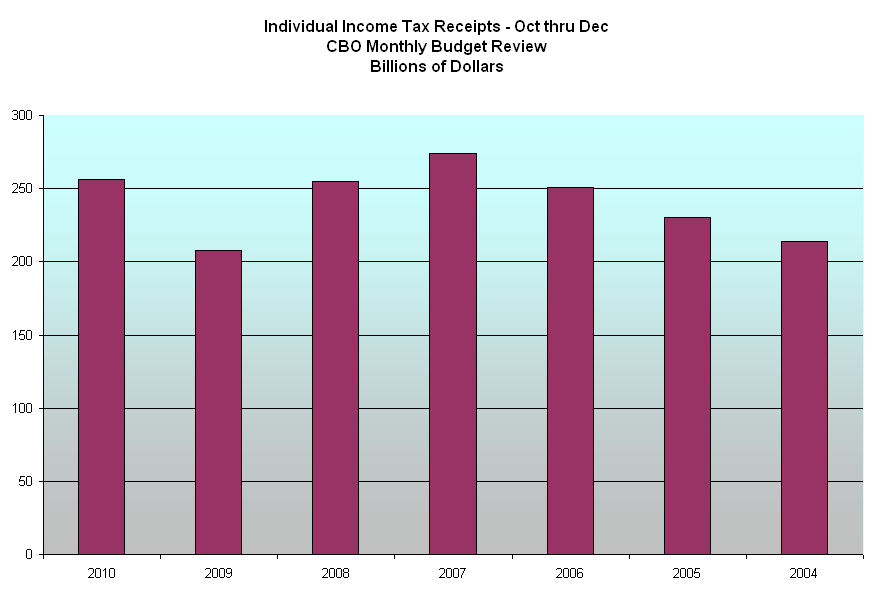
In the past few months, initial claims for unemployment have fallen slowly but steadily, approaching that magic mark of 400,000, which economists regard as a milepost on the way to a healthy economy.  Another gauge of recovery are tax receipts.

Every month the Congressional Budget Office (CBO) publishes a review of the country’s finances.  In January’s review  the CBO notes that withholding taxes and other income taxes have increased over 20% in the last calendar quarter of 2010 (1st quarter of the U.S. Treasury’s fiscal year 2011 which started in October 2010).  Withholding and social security taxes make up about 80% of overall receipts to the treasury.  Below is a comparison of this past October – December with the same quarter of earlier years.

We can judge the health of local and state economies by the amount of sales tax collected.  The increased amount of witholding taxes in the past quarter is a barometer of a recovering economy.

Lending Latitudes

The horse latitudes often refer to a section of the Atlantic ocean where there was little wind for a period of time, causing sailing ships to get “stuck” in the middle of the ocean.  There are two winds that drive a developed economy like that in the U.S – the demand for loans and the willingness of banks to make those loans.

Every 3 months the Federal Reserve Board (FRB) interviews a number of bank loan officers on their lending practices, risk management of and demand for commercial, industrial, mortgage and consumer loans.  The latest October 2010 survey  shows small increases in demand for commercial and industrial loans.

In questions 11 and 12 of the survey, loan officers were asked about residential mortgages. Demand for prime mortgages remains relatively unchanged.  34 loan officers responded that they do not originate non-traditional mortgages like interest-only or no income verification.  There were so few responses to questions about sub-prime mortgages that the FRB did not list the results.  If you anticipate being in the market for a mortgage in the coming years, you can conclude that it will be difficult to find a non-traditional or sub-prime mortgage.

Loan officers surveyed saw little overall change in demand for home equity lines of credit but a quarter of them said that they had tightened slightly their lending standards for these types of loans and 12% said that they had lowered existing lines of credit.

Consumer credit was largely unchanged but there was a hopeful sign for businesses.  Over 25% of smaller banks reported that they had increased business credit card limits.  The signs were not so hopeful for those in commercial construction as 20% of officers reported that they had decreased lines of credit for their existing customers and half of respondents anticipate that their lending standards for commercial construction will remain tighter for the foreseeable future. 

For consumers and homeowners the future does not look rosy.  The survey includes a category called the “foreseeable future”, not just the next two years, when asking loan officers about their anticipated lending standards.  40% of loan officers anticipate tighter standards for residential construction and 34% foresee tighter standards for prime mortgage homeowners (62% for sub-prime holders) wanting to borrow money against the equity in their house. Over half of loan officers see the same tightening for credit card and other consumer loans. 

Big box stores like Home Depot and Lowe’s that depend on remodeling and construction dollars have seen a 10%+ increase in their stock prices the past month.  Given the current lending environment, it may be difficult for these companies to maintain the sales growth that justifies the expectations implied by such a dramatic stock price increase.  The reluctance to lend will continue to suppress growth in the consumer market which accounts for over 2/3 of this country’s GDP. 

Nasty Neighbors

In a Wall St. Journal article Dec. 31st, reporter Dan Fitzpatrick writes about an aspect of the housing crisis that hasn’t gotten a lot of attention – condos.  Residents, mostly retirees, at a 1970s built condo village in Florida are at each other’s throats because of delinquencies in homeowner (HOA) fees. 

Some residents have lost jobs and have stopped making both mortgage payments and the HOA fees as well, making it difficult for the HOA to provide adequate security and common area maintenance of the grounds, pool and clubhouse.  Some residents who have the ability to pay the mortgage and fees have simply stopped doing so.  Some non-paying owners continue to get rental income from their tenants, pocketing the money while they wait for the bank to foreclose, a process that has been delayed in some cases for two years.

Stepping out in front of the banks, the HOA has sometimes started their own bankruptcy proceeding for late fees, an agressive tactic that has prompted accusations that HOA board members were pressing bankruptcy so they could buy the condos as a bargain rental property.

A neighbor selling a house at a loss a year ago told me, “You’re not supposed to lose money in real estate” as though there was a law protecting all real estate investments.  If only it were so.

Yield Curve

If you casually listen to financial news, you may hear about a “steepening” or “flattening” yield curve and wondered what the heck that is.  It graphs the difference in yield or interest rate for U.S. Treasury bonds of various maturities.  At the left side of the graph is the yield for Treasury bonds that mature in 3 months.  At the right side of the graph is the yield for 30 year bonds.  In a normal environment with anticipated moderate growth in the years ahead, there will be a difference of about 3% between the short 3 month rate and the long 30 year rate. (Click to enlarge graph in separate tab)

The mutual fund giant, Fidelity, has a brief summary of the different types of curves and what each says about investors’ expectations of future economic conditions.  On the page is an interactive movie of the yield curve for the past 30+ years.

For those of you who have devoted a lot of money to bond funds, you may have noticed the recent 10% drop in the value of any longer term bond funds you have.  From October 2009 to April 2010, long term bonds stayed fairly stable in price.  This summer, as doubts about the recovery emerged, prices for these long term bonds increased rather dramatically – about 16% – as investors became more risk averse and were willing to pay more for long term maturities. Investors were willing to accept lower yields or interest rates on their money.  As interest rates on Treasuries dropped, so too did rates on 30 year fixed mortgages which neared 4% during the summer.  The current downward slope in long term bond prices signals a returning confidence in the economy’s recovery.  We have also seen an increase in 30 year mortage rates to near 5%.

From the Fidelity page cited above, I compared the yield curve now with the curve in mid 2003.  In October 2002, the stock market fell to its low point after the bursting of the internet bubble and the 2001 – 2002 recession.  It see-sawed for several months until the spring of 2003 when it began a steady rise for a year.  The orange line in the graph is today’s yield curve, almost exactly what it was 7-1/2 years ago, suggesting that investors have the same expectations for continuing growth in the economy now as what they did in 2003.

Economic Theories

We grow comfortable with our theories, our hypotheses of the way the world works.  They have an internal logic which appeals to us.  We are reluctant to give up a theory when events challenge the validity of that theory.  Eventually, events force us to abandon a theory even though there is no acceptable alternative which makes sense to us.  So we adopt a mechanical model, a paradigm with no underlying rationale, which describes a progression of events but can not explain why it works the way it does. 

A classical example of this descriptive mechanical model is the relationship of electricity and magnetism first noted in the early 19th century.  Thought to be two different forces, a model was developed which defined a working and predictive relationship between the two but no one could fully understand why the relationship existed.  It was not until later in the century that James Maxwell formulated a complete theory of electromagnetism, building on the work of Faraday, Hertz and Ampere.

Yesterday I examined the Starve the Beast theory, one which should work but fails to describe the relationship between tax rates and government spending at the Federal level.  The theory works as long as the government entity does not have massive borrowing power, as the U.S. government does.  At the state level, we do see a closer correlation between reducing revenues and lowered government spending.

Another theory which should work is supply side economics, a model that predicts that lower marginal tax rates and less regulation will spur greater investment by businesses, the producers or suppliers of economic goods.  Again, the internal logic of this model makes sense.  Make it easier for people to produce and lower the tax on income from that production and people will invest more in production which will create more jobs and overall economic activity which will produce greater tax revenues to the government..  So, why haven’t income tax revenues (excluding dedicated social security taxes) over the past 30 years supported this model? 

Keynesian macroeconomic theory focuses on management of the demand side of an economy through transfer payments, greater government consumption expenditures like building roads and other infrastructure projects.  In the seventies, repeated economic crises, recessions and ultimately stagflation made it apparent that a focus on the demand side could not fully explain the dynamics of a country’s economy.  Those who clung to Keynesian theory insisted, and continue to insist, that the theory is sound but that the implementation, i.e. management of demand, was poor.

In response to the perceived weaknesses in Keynesian theory, Arthur Laffer, Victor Canto and others developed a macroeconomic theory which focused on the supply side of the economy.  Rather than manage demand, a government should manage incentives to produce, i.e. less regulation, and disincentives for those who made good income from that production, i.e. lower tax rates.  As in physics, the “holy grail” of economics is to develop a unified theory that can incorporate both the supply and demand components of an economy with a predictive relationship between the two.  I am not aware that anyone has developed such a theory.  Unfortunately, this economic debate has become politicized, with Democrats taking the demand side of the argument and Republicans taking the supply side.

Recent history has deflated both theories yet proponents of each theory blames policy implementation or some other factor which invalidates the “experiment”, i.e. events, which cast doubt on their theory.  On the demand side, economist Paul Krugman maintains that there was not enough stimulus, i.e. demand, pumped in by the government to fully test the Keynesian model.  On the supply side, economist Art Laffer has blamed  policies of taxation and income redistribution over the past 7 years which have reduced productivity.  In a 2006 lecture, when the economy was riding high atop a housing boom, Laffer had not blame but glowing praise for both monetary and fiscal policy.

We cling to our familiar theories as though they were family and regard any criticism of a cherished theory as a personal attack.  They form the foundation of our policies of government.  As a nation we alter tax policy, we adjust interest rates, we bail out, we buy more Treasury bonds and get frustrated as neither the demand or supply sides of the economy responds forcefully to our efforts.  We blame those who don’t agree with our chosen theory, we criticize those who did not implement it properly or adulterated it with compromise.

The lesson we find hard to learn:  don’t fall in love with a theory.