A Global Wave

October 16, 2022

by Stephen Stofka

On Thursday, September’s CPI came out, showing an annual price increase of 8.2%. A quarter of that increase was housing costs – rent and owner equivalent rent. Price increases have decelerated this quarter. Remember that inflation is the change in prices. Acceleration (+) or deceleration (-) is the change of that change. Inflation is like the speed in a car. Acceleration is the change in speed. The graph below shows the acceleration for the past five years.

Notice the regular up and down in small increments before the pandemic. When we drive down the highway without cruise control, we experience the same minor variations in speed. After the pandemic, price acceleration became more erratic. Why?

Usually, we do not synchronize our spending and saving. During the pandemic in 2020, we began to coordinate our buying habits. The first round of stimulus checks went out in April 2020, shortly after the economy was locked down. We bought workout equipment, computers and peripherals, appliances for the home. The second round of stimulus went out in December 2020 and January 2021. President Biden was sworn into office in January 2021 and immediately began discussions of a third stimulus payment, part of the American Rescue Plan.

Critics say the third stimulus payment was too much, that it was the impetus to the recent inflationary surge. That is an ex-post or hindsight criticism. On December 18, 2020, Moderna was granted emergency approval by the FDA (2020) for its MRNA vaccine, a relatively new vaccine manufacturing technology. The Pfizer vaccine was the first to get such approval but its vaccine required a temperature of -94F. Moderna’s vaccine required a temperature of only -4F, about the same level as the freezer temperature in a home refrigerator. The vaccine was deemed safe but the drug makers did not know how long the vaccines would last. Secondly, they needed a booster shot as well. Moderna promised 100 million doses by March of 2021. What if the vaccines lasted only a few months and development of a better formulation was delayed another year? The third stimulus would have been entirely appropriate. Policymakers must make ex-ante decisions – before all the evidence is known or evaluated.

In 2021, some economists predicted higher inflation in 2022. They turned out to be right. Ten years ago, those same economists predicted higher inflation after the 2009 ARRA stimulus. They were wrong. Economists, like traders, are right sometimes and wrong sometimes. Like traders, the winning prediction rate is closer to 50-50 or pure chance. Others are likening this to the inflation of the 1970s. However, there is a big difference. In the 1970s, price acceleration kept rising like a car which is speeding up. Currently it is falling, like a car slowing down. Here’s a look price acceleration in the 1970s.

As I mentioned last week the Social Security Administration announces the yearly COLA for Social Security recipients after the September CPI figure is reported. The 2023 COLA adjustment will be 8.7%, adding $146 to the average $1673 monthly payment for retirees. As I discussed last week, worker’s wages have not kept up with inflation. They are more on a fixed income than retirees at this point.

The inflation is global – a first in economic history. Global market research company Ipsos (2022) survey people in 29 countries. Inflation has become the top concern for 40% of respondents. Here’s the chart I downloaded from their page. Look at the surge in inflation as a concern over the past year. Unemployment and Covid-19 were the top concerns in 2020. Stimulus assistance and monetary policy in the Eurozone countries helped relieve job concerns. Covid-19 became less worrying as more people got vaccinated and hospital admissions decreased. After Russia’s invasion of Ukraine, rising oil prices lifted inflation worries in many countries.
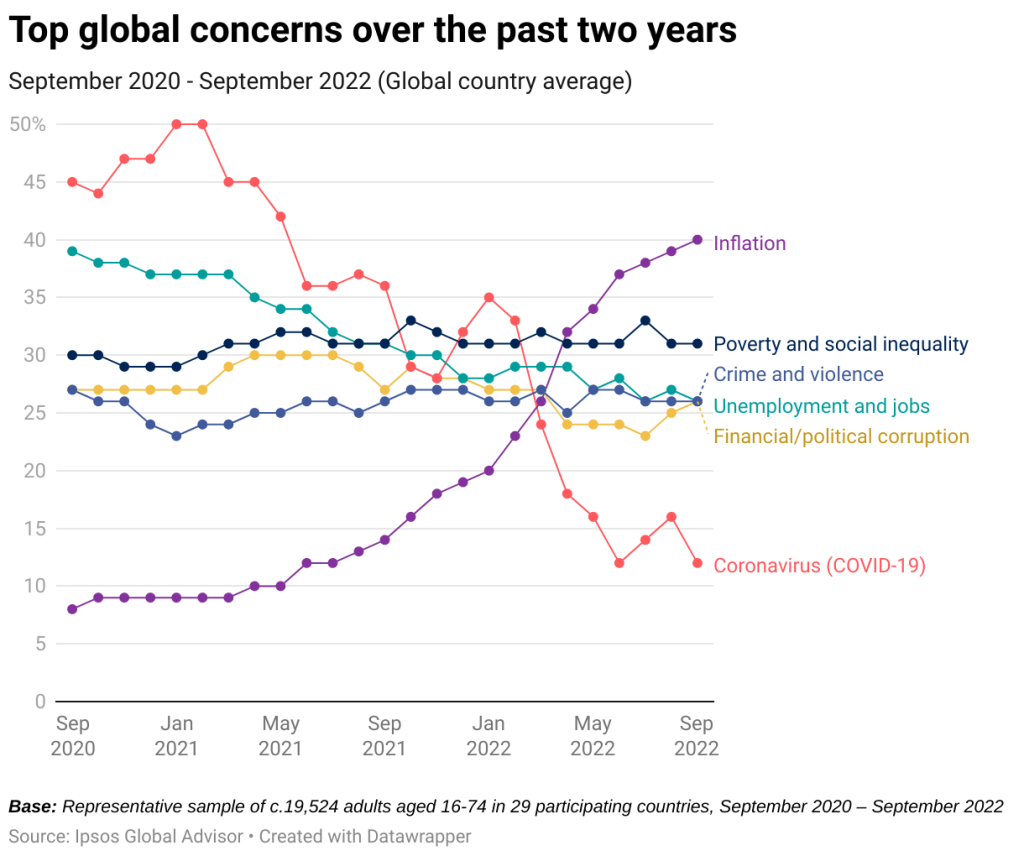
As the world becomes more integrated financially and economically, will we reach a self-destructive resonance? Our economic systems could become less stable as they synchronize. I hope not.

////////////////

Photo by Providence Doucet on Unsplash

FDA. (2020, December 18). FDA takes additional action in fight against COVID-19 by issuing emergency use authorization for second COVID-19 vaccine. U.S. Food and Drug Administration. Retrieved October 15, 2022, from https://www.fda.gov/news-events/press-announcements/fda-takes-additional-action-fight-against-covid-19-issuing-emergency-use-authorization-second-covid

Ipsos. (2022, September 22). What worries the world – September 2022 . Ipsos. Retrieved October 14, 2022, from https://www.ipsos.com/en-uk/what-worries-world-september-2022

The Politics of Compassion

July 14, 2019

by Steve Stofka

It was a busy week in Washington. Jerome Powell, the chair of the Federal Reserve, testified before a House subcommittee. His dovish remarks signaled Wall Street traders that the Fed would almost certainly lower interest rates at their next meeting on July 30-31 (Note #1). The market rallied to new highs even as investors continued to transfer funds from stocks to bonds during the past month (Note #2).

Not so dovish was the atmosphere at a House subcommittee hearing this week on immigration proceedings at the southern border. Very emotional testimony from several freshman House members who had visited immigrant detention facilities in Texas. The former head of ICE under Presidents Obama and Trump testified about the challenges that border patrol officers face under the surge of immigrants. Human and drug trafficking along the southern border has been at crisis levels for many months. Patrol officers are not trained to be social workers or medical attendants but find that most of their time is spent caring for people who lack the physical stamina necessary to navigate the harsh conditions of the deserts of northern Mexico.

Many immigrants are sick or injured after a long treacherous journey from Central America. The crowded facilities pose a challenge even for healthy immigrants. They are certainly no place for mothers with young children, but neither was Ellis Island (Note #3). However, most of the immigrants at Ellis left the building after several hours (Note #4).

I was reminded of my grandmother and aunt who were turned away twice for whooping cough and pink eye. It was easy to pick up contagious diseases on the 7-10 day journey in third-class quarters on a crowded transatlantic steamer a century ago. Processing hundreds of immigrants a day, doctors at Ellis Island were quick to reject those with even the hint of TB or trachoma (Note #5). In the years before World War I the northern states needed workers and government officials were largely forgiving of many disabilities and illnesses. Less than 2% of immigrants were deported. My family was one of the unlucky ones – twice. My grandfather waiting on the Manhattan shore a few miles away must have been confused and angry.

Some Americans are insistent that immigrants should follow our Constitution, but our founding document has little to say about immigration. Article 1, Section 8 states that the Congress shall “establish a uniform rule of naturalization.” End of story. For the first hundred years of our nation’s existence, each state processed immigrants. Many immigrants did not present any paperwork or pass a medical examination. State and Federal governments simply took an immigrant’s word as to their name and personal information. Those who insist most loudly that immigrants follow our laws may be descended from people who followed no laws when they immigrated into our country.

In 1891, Republican President William Henry Harrison signed into law the Immigration Act of 1891 passed by a Congress dominated by Republicans (Note #6). Republicans represented the interests of northern businesses who needed able bodied workers who were unlikely to become dependent on government for their care. The flood of immigrants into the northern states gave Republicans additional congressional seats and an edge over Democratic majorities in the southern states.

The founding documents of this country were forged in the fires of heated debate and hard bargaining (Note #7). In 230 years, the debate has not cooled. Today, Democratic majority states like California and New York stand to gain Congressional seats as they welcome and champion the rights of immigrants. While the Senate has a filibuster rule, only the Democratic Party can fix our broken immigration laws because they are the only ones capable of securing a filibuster-proof majority in the Senate. The Republican Party has not enjoyed such a majority since Senators were first popularly elected in 1914. If Republicans are ever going to take the lead on contentious issues, they will have to abandon the Parliamentary filibuster that chokes most legislation to death in the Senate.

Why didn’t the Democratic Party address the issue of immigration while they had a filibuster-proof majority in the Senate and controlled the Presidency and House? Was it not important then? Nancy Pelosi was House Speaker then and now. She is known for her political ability to “count votes.” Perhaps she would be more effective if she looked further than votes. In a deeply divided nation with a constitutional architecture that resists change, a resolution of our most intractable problems is a formidable challenge for any leader.

After the Financial Crisis in 2008, Pelosi helped patch together two large pieces of legislation under Obama’s first term. ARRA was an $800B stimulus package passed in February 2009 that did help keep unemployment from getting even worse but was ineffective in many areas because the stimulus was diluted over several years (Note #8). That and the passage of the controversial ACA, dubbed “Obamacare,” cost the Democrats dearly in the 2010 midterm elections. Obamacare has withstood both legislative and judicial assault but may fall sometime this year to yet another judicial challenge that was just heard by the 5th Circuit Court of Appeals. That’s a topic for next week’s blog.

///////////////////

Notes:

  1. Schedule of Fed meetings
  2. ICI flow of funds
  3. Crowded main hall at Ellis Island
  4. Relatively short processing time at Ellis Island
  5. Medical examinations of immigrants at Ellis Island
  6. Immigration Act of 1891
  7. Michael J. Klarman’s “The Framer’s Coup” is a thorough account of the construction of our nation’s Constitution. The audio book
  8. ARRA – the American Recovery and Reinvestment Act of 2009

Strong Reactions

December 30, 2018

by Steve Stofka

Happy New Year!

Dramatic trading days signal a down market. In the week prior, the SP500 index lost over 7%. On Monday, Christmas Eve, the stock market fell to a level that would traditionally signal the beginning of a bear market, which is 20% below a recent high closing price. After a huge rally on Wednesday and a lot of volatile trading this week, the index gained 3%.

A disruptive stock market underscores the importance of asset allocation. The SP500 has lost 10% in December. A conservatively balanced fund like Vanguard’s Wellesley Income (VWINX) lost 1.8%. The fund is actively managed and has 40% stocks, 60% bonds/cash. A fund of index funds, VTHRX, lost 7.8%. It has a more aggressive mix of 65% stocks and 35% bonds/cash.

As I noted a few weeks ago (Hat Trick), there have been repeated signs of a struggle between hope and fear, between competing estimates of future earnings. 7% weekly price falls occur at crises or turning points. In the past sixty years, there have been only fifteen such weeks. Let’s take a look at the most recent.

In August 2011, then President Obama walked away from an informal budget deal with House Speaker John Boehner. The market lost almost 20% but fell short from hitting that mark. Once a budget deal was negotiated, the market recovered but it took five months to make up the losses.

SPY4YR2011-2018

Three years earlier, in October 2008, the market lost more than 7% in a week when negotiations for a bank bailout fell apart. This was a month after the bankruptcy of investment firm Lehman Brothers ignited the financial crisis. The market would take 39 months to recover that October price level. On February 17, 2009, President Obama signed the American Recovery and Reinvestment Act (Note #1). Senate Democrats made many concessions to win a few Republican votes for the bill to gain passage. Once it became clear that the stimulus funds would be trickled into the economy over several years, the market tanked, losing 11% during the month of February. In a final week of capitulation, the market lost 7% in the first week of March. This was the turning point.

A 10% weekly price drop in April 2000 heralded the end of the dot-com boom. The market would not recover for 83 months, almost seven years. An even worse fall came after the market opened following the 9-11 attack. The indictment of the international accounting firm Arthur Anderson sparked doubts about the financial statements of other companies and helped fuel an 8% drop in July 2002.

With six weeks of 7% price drops, the 2000s was the most tumultuous decade since the Great Depression. Strong reactions in the market deserve our attention and caution.

//////////////////////
Notes:
1. The American Recovery and Reinvestment Act