Less Bang For The Buck

June 17, 20918

by Steve Stofka

There are two types of inputs into production, human and non-human. Over a hundred years ago, Henry Ford realized that he had to invest in his human inputs as well as his equipment, land and factories. Once he started paying his employees a decent wage, they were able to buy the very cars they were producing on Ford’s assembly line.

The total return on our stock investments depends on two inputs: dividends and capital gains, which is the increase in the stock price. Both are dependent on profits. Dividends are a share of the profits that a company returns to its shareholders. Capital gains arise from the profits/savings of other investors who are willing to buy the shares we own (see end for explanation of mutual funds).

In the past three decades, a growing share of total return has come from capital gains. Because of that shift from dividend income to capital gains, market corrections are harsh and swift.

In the 1970s, stocks paid twice the dividend rate that they do today. It took an oil embargo and escalating oil prices, a continuing war in Vietnam, the impeachment of President Nixon, a long recession and growing inflation to sink the market by 50% beginning in early 1973 to the middle of 1974.

In 2000, the dividend rate or yield was a third of what it was in 1973. Total return was much more dependent on the willingness of other investors to buy stocks. In 2-1/2 years, the market lost 45% because of a lack of investor confidence in the new internet industry, a mild recession and 9-11. Dividends act as a safety net for falling stock prices and dividends were weak.

In 2008, the dividend yield was about the same as in 2000. In 1-1/2 years, the market again lost 45% of its value because of a lack of confidence brought on by a financial crisis and a long and deep recession.

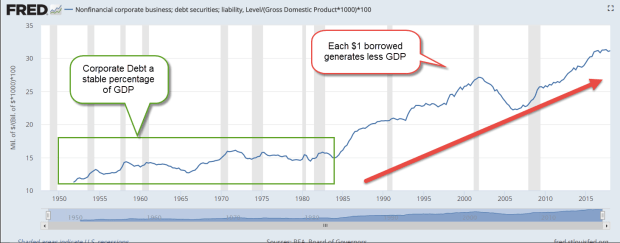
Other bedrock shifts have occurred in the past three decades. Corporate debt is an input to production. In the post-WW2 period until 1980, corporate debt as a percent of GDP was a stable 10-15%. $1 of debt generated $7 to $10 of GDP. Following the back-to-back recessions of the early 1980s until the height of the dot-com boom in 2000, that percentage almost doubled to 27%. Each $1 of corporate debt generated less than $4 of GDP.
CorpDebtPctGDP

Today $1 of corporate debt generates just $3 of GDP. Debt is a liability pool. GDP is a flow. That pool of debt is generating less flow. It is less efficient. In 1973, $1 of corporate debt generated 46 cents in profit. Now it generates just 30 cents.

To hide that inefficiency and make their stocks appealing to investors, companies have used some of that debt to buy back their own stock. This reduces the P/E ratio many investors use to gauge value, and it increases the leverage of profit flows.

Here’s a simple example to show how a stock buyback influences the P/E ratio. If a company makes a $10 profit and has 10 shares of stock outstanding, the profit per share is $1. If the company’s stock is priced at $20, then Price-Earnings (P/E) ratio is $20/$1 or 20. If that company borrows money and buys back a share of stock, then a $10 profit is divided among 9 shares for a per-share profit of $1.11. The P/E ratio has declined to 18. When the company buys stock back from existing shareholders, that often drives up the price, and thus lowers the P/E ratio further.

The P/E ratio values a company based on the flow of annual profits. A company’s Price to Book (P/B) ratio values the company based on a pool of value, the equity or liquidation value of the firm. If we divide one by the other, we get an estimate of how much profit is generated by each $1 of a company’s equity, or Return On Equity (ROE).

1982 was the worst recession since the Great Depression. Stocks were out of favor with investors and were at a 13 year low. In 1983, $8.70 of equity generated $1 of profit for companies in the SP500. Seventeen years later, at the height of the dot-com boom in 2000, companies had become more efficient at generating profits. $6 of equity generated $1 in profit. In the last quarter of 2017, companies have become less efficient. $7.30 of equity generated $1 of profit.

Let’s look at another flow ratio, one based on the flow of dividends. It’s called the dividend yield, and the current yield is 1.80, about the same as a money market account. I can put my $100 in a money market account or savings account and earn $1.80. If I need that $100 a year from now, it will still be there. I could use that same $100 and buy a fraction of a share of SPY, an ETF that represents the SP500. I could earn the same $1.80. However, if I wanted my $100 back in a year, it might be worth $120 or $50. A stock’s value can be very volatile over a short time like a year, and the current dividend rate does not compensate me for that extra risk.

Why don’t investors demand more dividends? After the early 1980s, economists at the Minneapolis Federal Reserve noted (PDF) that, on a global scale, companies’ profits grew at a faster rate than the dividends they paid to shareholders. The dividend yield of the SP500 companies fell from 6% in the early 1980s to 1% in 2000 (chart).

Those extra profits are counted as corporate savings. The same paper showed that global corporate savings as a percent of global GDP increased from 10% in the early 1980s to 15% this decade. Each year companies were adding on debt at a faster pace than during the post-war decades, but undistributed profits were growing even faster. The net result was an increase of 5% in the rate of corporate saving. Companies around the world were able to shift dividends from the savings accounts of shareholders to the savings of the companies themselves.

From the early 1980s to the height of the dot-com boom, stock prices increased more than ten-fold. Investors that had depended on company dividends for income in previous decades now depended on other investors to keep buying stocks and driving up the price. The source of an investor’s income shifted slightly from the pocketbooks of corporations to the pocketbooks of other investors. Investors adopted a shorter time horizon and now look to other investors to read the mood of the market.

The bottom line? If investors rely on each other for a greater part of their total return, price corrections will be dramatic.

///////////////

Notes: Price to Book (P/B) ratio was 1.5 in 1983 (article).
P/B graph since 2000
When mutual funds sell some of their holdings, they assign any capital gains earned to their fund holders. This amount appears on the mutual fund statements and the yearly 1099-DIV tax form.

A November 2017 article on share buybacks at the accounting firm DeLoitte


A Choice of Money

July 30, 2017

Gresham’s law states that an overvalued form of money will drive out an undervalued form of money. Let’s say that both gold and silver are accepted as money and the government fixes a ratio of 1:20 between the two metals. One ounce of gold thus equals twenty ounces of silver. Let’s say that people and businesses hold ten times as much silver as gold. The exchange ratio that the government has set is higher than the ratio of the stores of the two metals. Gold is overvalued. Gresham’s law states that people will start using gold as an exchange medium to the extent that eventually silver will be driven out of circulation.

I wanted to explore this concept and substitute two things that are not currencies or commodities: liquidity and debt.  Liquidity is today’s money.  Debt is tomorrow’s money. Today’s money is stable and available.  Tomorrow’s money is not. As soon as money is loaned, it can’t be readily converted to cash.  It’s future money.

Gresham’s law is about people’s preferences and the value of money.  When millions of individual circumstances are added up,  a preference for liquidity or debt emerges. When tomorrow’s money is overvalued, people use it, and drive down the use of present money. “Don’t save up to buy what you want.  Buy it now with future money.  Here I’ve got some,” say businesses and banks.

Let’s look at two representations of present and future money.  M2 is a broad measure of the money supply that includes cash, checking and savings accounts, as well as money market accounts and CDs that can be quickly converted to cash. Future money is the amount of business and household debt.

During recessions (gray areas in the chart below), M2, the numerator in the ratio, goes up and debt goes down. Economists call this a greater preference for liquidity. Banks are more reluctant to lend money, which tightens credit and restrains the growth of debt.  People charge less and stick more money in checking and savings. Businesses don’t borrow to expand their operations and keep more cash on hand to pay present obligations.

In the chart below, I chart the ratio of the yearly change in today’s money, or what the Federal Reserve calls M2 money, and tomorrow’s money, the amount of business and consumer debt.

M2DebtCLIRatio1960-2007

In the recessions of the 1970s and 1980s, the graph shows what I would expect. There was a greater preference for liquidity and the ratio of present to future money rose above 1, a clear sign that people and businesses were worried about the future.  As the recessions ended, the ratio declined as debt, the denominator in the fraction, grew at a faster rate than M2 money, the numerator. The recessions of the early 1990s and early 2000s were fairly mild in comparison and the uptick in a preference for liquidity was mild.

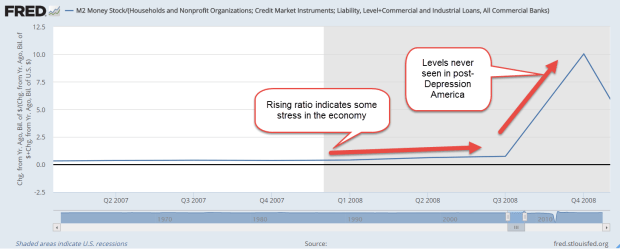
The chart ends in 2007, just before the recession and financial crisis. Let’s now turn to that period. During the early part of 2008, the ratio began to climb to 1, indicating that people and businesses were preferring liquidity over debt. During the first six months of 2008, 700,000 jobs had been lost but this was only 1/2% of the workforce. Almost 300,000 of those lost jobs were in construction, which had become overheated by the building of so many homes. Retail sales growth had gone flat but was probably just a pause in the normal course of the business and credit cycle. Not to worry.

Then a funny thing happened to the economic engine of the country, something that had never happened before in post-WW2 America. The ratio spiked upward, registering nosebleed readings.

M2DebtCLIRatio2006-2008

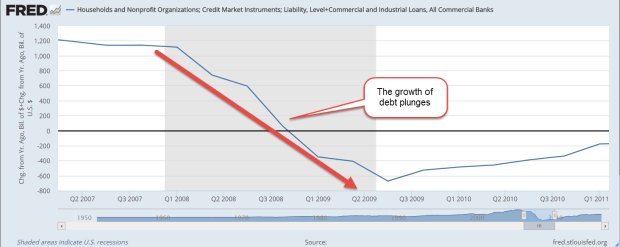
The preference for present money continued upward but the change in debt, the bottom number in the ratio, plunged downward and this drove the ratio higher. The Federal Reserve began buying some of this debt until it held about $2 trillion.

Debt2008-2010

As the change in debt turned negative, the ratio turned negative, a post Depression first. Month after month, old debts soured.  People and businesses shunned new debt. People who were saving more of today’s money were being offset by those who had to tap their savings accounts to make up for lost income. Toward the end of 2008, the economy lost as many jobs each month as it lost in total for the first six months of 2008. Retail sales dropped a few percent each month.

M2DebtCLIRatio2008-2011

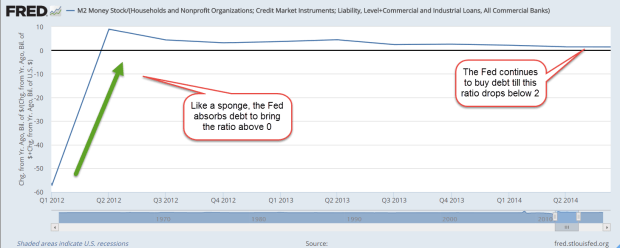
Like a car whose brakes have failed, the ratio continued its downward slide. In a program called Quantitative Easing (QE_, the Federal Reserve began buying more debt in an effort to get this ratio into the positive zone.

By the middle of 2012, the ratio broke into the positive zone as debt stopped contracting. The preference for liquidity was strikingly high, going up above 8, more than three times higher than the 2.5 level of the 1980s recession.

M2DebtCLIRatio2012-2014

The Federal Reserve continued to buy debt as the economy staggered to its feet.  In 2013, the stock market finally surpassed its inflation adjusted value at the start of the recession.  In the early part of 2014, the ratio of liquidity to debt, of present money to future money, finally fell below 2. At mid-2014, the Fed had accumulated $4.5 trillion in debt, $3.7 trillion of which had been added during the financial crisis. After 6-1/2 years, the number of people employed finally rose above its pre-recession level.  The Fed ended its debt buying program.

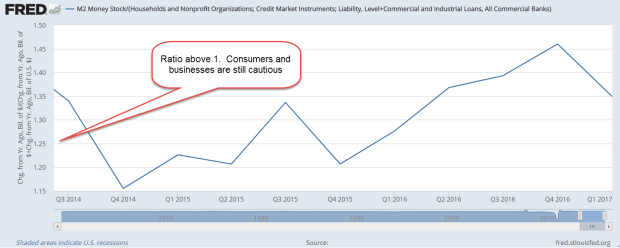
So where do we stand today? The stock market and house prices continue to make new highs but the current reading of this ratio show that people continue to prefer today’s money over tomorrow’s money.

M2DebtCLIRatio2014-2017

In short, the economy is still healing. During the expanding economy of the 1960s, the ratio was a bit over 1 for half the decade.  People who had grown up during the Depression were understandably a bit cautious. However, both present and future money grew at a steady rate during the 1960s. Today’s households and businesses have been scarred by the financial crisis and are cautious.  Into this cautious confidence, the Fed has a lot of debt to unload.  It must maintain a balance between money preferences as it feeds the debt it bought during the crisis back into the economy.

Dance of Debt

April 9th, 2017

Last week I wrote about the dance of household, corporate and government debt. When the growth of one member of this trinity is flat, the other two increase. Since the financial crisis the federal debt has increased by $10 trillion. Let’s look at the annual interest rate that the Federal government has paid on its marketable debt of Treasuries. This doesn’t include what is called interagency debt where one part of the government borrows from another. Social Security funds is the major example.

In 2016, the Federal government paid $240 billion in interest, an average rate of 1.7% on $14 trillion in publicly held debt. Only during WW2 has the Federal government paid an effective interest rate that is as low as it today. World War 2 was an extraordinary circumstance that justified an enormous debt. Following the war, politicians increased taxes on households and businesses to reduce the debt. Here is a graph of the net interest rate paid by the Federal government since 1940.

InterestRate

In 2008, before the run up in debt, the interest rate on the debt was 4.8%. If we were to pay that rate in 2017, the interest would total $672 billion, more than the defense budget. Even at a measly 3%, the interest would be $420 billion.  That is $180 billion greater than the interest paid in 2016.  That money can’t be spent on households, or highways, or education or scientific research.

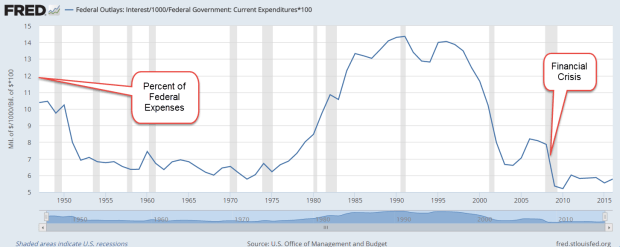
The early 1990s were filled with political arguments about the debt because the interest paid each year was crippling so many other programs. Presidential candidate Ross Perot made the debt his central platform and took 20% of the vote, more than any independent candidate since Teddy Roosevelt eighty years earlier. Debt matters. In 1994, Republicans took over Congress after 40 years of Democratic rule on the promise that Republicans would be more fiscally responsible. In the chart below, we can see the interest expense each year as a percent of federal expenses.

PctFedExp

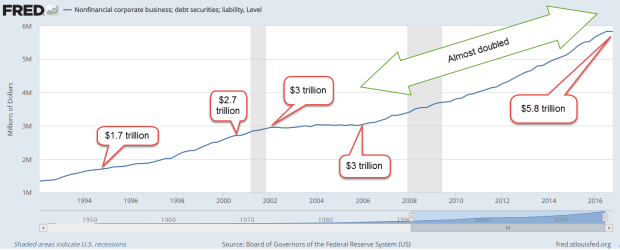
Let’s turn again to corporate debt. As I showed last week, corporate debt has doubled in the past ten years.

CorpDebt2016

In December, the analytics company FactSet reported (PDF) that the net debt to earnings ratio of the SP500 (ex-financials) had set another all time high of 1.88. Debt is almost twice the amount of earnings before interest, taxes, debt and amortization (EBITDA). Some financial reporters (here, for example ) use the debt-to-earnings ratio for the entire SP500, including financial companies. Financial companies were highly leveraged with debt before the crisis. In the aftermath and bailout, deleveraging in the financial industry effectively hides the growth of debt by non-financial companies.

What does that tell us? Unable to grow profits at a rate that will satisfy stockholders, corporations have borrowed money to buy back shares. Profits are divided among fewer shares so that the earnings per share increases and the price to earnings (profit), or P/E ratio, looks lower. Corporations have traded stockholder equity for debt, one of the many incidental results of the Fed’s zero interest rate policy for the past eight years.

Encouraged by low interest rates, corporations have gorged on debt. In 2010, the pharmaceutical giant Johnson and Johnson was able to borrow money at a cheaper rate than the Federal government, a sign of the greater trust that investors had in Johnson and Johnson at that time.

Other financial leverage ratios are flashing caution signals, prompting a subdued comment in the latest Federal Reserve minutes ( PDF ) “some standard measures of valuations [are] above historical norms.” Doesn’t sound too concerning, does it?

Each period of optimistic valuation is marked by a belief in some idea. When the bedrock of that idea cracks, doubts grow then form a chasm which swallows trillions of dollars of marketable value.

The belief could be this: passively managed index funds inevitably outperform actively managed funds. What is the difference? Here’s  a one-page comparison table. In 1991, William Sharpe, creator of the Sharpe ratio used to evaluate stocks, made a simple, short case for the assertion that passive will outperform active.

During the post-crisis recovery, passive funds have clearly outperformed active funds. Investors continue to transfer money from active funds and ETFs into index funds and ETFs. What happens when a smaller pool of active managers make buy and sell decisions on stocks, and an ever larger pool of index funds simply copy those decisions? The decisions of those active managers are leveraged by the index funds. Will this be the bedrock belief that implodes? I have no idea.

Market tensions are a normal state of affairs. What is a market tension? A conflict in pricing and risk that makes investors hesitate as though the market had posed a riddle. Perhaps the easiest way to explain these tensions is to give a few examples.

1. Stocks are overvalued but bond prices are likely to go down as interest rates rise. The latest minutes from the Fed indicated that they will start winding down their portfolio of bonds. What this means is that when a Treasury bond matures, they will no longer buy another bond to replace the maturing bond. That lack of bond purchasing will dampen bond prices. Stocks, bonds or cash? Tension.

2. Are there other alternatives? Gold (GLD) is down 50% from its highs several years ago. Inflation in most of the developing world looks rather tame so there is unlikely to be an upsurge in demand for gold. However, a lot of political unrest in the Eurozone could drive investors into gold as a protection against a decline in the euro. Tension.

3. What about real estate? After a run up in 2014, prices in a broad basket (VNQ) of real estate companies has been flat for two years. A consolidation before another surge? However, there is a lot of debt which will put pressure on profits as interest rates go up. Tension.

In the aftermath of the financial crisis, we discovered that financial companies, banks, mortgage brokers and ordinary people resolved market tensions through fraud, a lack of caution, and magical thinking. Investors can only hope that there is enough oversight now, that the memories of the crisis are still fresh enough that plain old good sense will prevail.

During the present seven year recovery there have been four price corrections in the Sp500 (Yardeni PDF). A correction is a drop in price of 10 – 20%. The last one was in the beginning of 2016. Contrast this current bull market with the one in the 2000s, when there was only one correction. That one occurred almost immediately after the bear market ended in the fall of 2002. It was really just a part of the bear market. From early 2003 till the fall of 2007, a period of 4-1/2 years, there was no correction, no relief valve for market tensions.

Despite the four corrections and six mini-corrections (5 – 10%) during this recovery, the inflation adjusted price of the SP500 is 50% higher than the index in the beginning of 2007, near the height of the market.  Inflation adjusted sales per share have stayed rather stable and that can be a key metric in the late stages of a bull market. The current price to sales (P/S) ratio is almost as high as at the peak of the dot com boom in 2000 and that ratio may prove to be the better guide. In a December 2007 report, Hussman Funds sounded a warning based on P/S ratios.  Nine years later, this report will help a reader wanting to understand the valuation cycles of the past sixty years.

Confidence Up

April 2nd, 2017

The Conference Board’s survey of Consumer Confidence shot up to 125, a 16 year high. Unfortunately, that previous high was set as the dot-com frenzy was nearing its end and just before the start of the 2001 recession. History could not possibly repeat itself, could it?

Confidence201703

There have been other frenzies in the past decades: the dot-com boom of the late ’90s, the housing and consumer debt boom of the ’00s, the run up in gold prices in the ’10s, the spike in interest rates in the late ’70s – eary ’80s. In the rear view mirror, the correction seems predictable.

From 1995 – 2000, the SP500 index tripled on the giddy expectations of a new global internet economy. Here was the plan: global supply chains spread among developing countries would assemble products which would be shipped to markets around the world. The U.S. and other developed countries could steer the global economy to new heights, and rid themselves of the nasty pollution that comes from manufacturing stuff.

Then, the new global digital economy went oops…

After falling back about 40%, the index then doubled from early 2003 through 2007. During that five year period, the house price index grew 40%, more than double its annual growth rate for the past century. In the old mortgage model, a lender would take a risk on the fortunes and reliability of a single family to repay a mortgage. Now, through the power of computerized algorithms, that risk could be sliced and diced so thin and spread among so many synthetic mortgages that the risk virtually disappeared. The smart people in the financial industry had finally figured out the secret to securitized debt. Every family could now build wealth by owning a home. Oh, happy days!

Then, housing went oops….

As the financial crisis gripped most of the developed world, central banks took on vast quantities of debt and expanded the money supply to counteract a slide into a global depression. Expanding the money supply usually brings an increase in inflation, and to protect against that coming inflation, investors around the world turned to gold. From the depths of the financial crisis in early 2009 toward the latter part of 2011, a period of less than 3 years, the price of gold doubled. But inflation did not rise as expected. The central banks had simply been fighting a strong undercurrent of deflation, stronger than even they had realized.

As inflation remained low, gold went oops….

The trick is to figure out beforehand what will go oops next. The pattern is this: an increasing number of people become convinced of “X” idea and begin to take it for granted. Then some series of events undermines a belief in “X” and the stampede begins. The massive increase in sovereign debt looks like a prime candidate for default and debacle but the central banks of developed countries have many legal and financial tools at their disposal to stem any panics.

For a dominant economic power like the U.S., the “X” has traditionally been based on private debt whose value can not be easily controlled by government dictate. In the late 90s, it was technology. Most of us associate that period with wildly inflated stock prices and IPOs that jumped in price on opening day. What may have escaped our attention is that corporate debt increased by almost 60% from the beginning of 1995 to the end of 2000. When the towers came down on 9-11, corporate debt had grown 75%. From early 2002 through 2005, there was no growth in corporate debt.

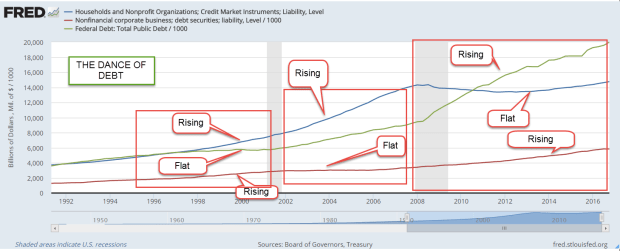
As corporate debt grew in the late 90s, government debt decreased. As corporate debt growth stopped in the early ’00s, household debt and government debt surged upwards. So let’s keep our eyes on this dance of corporate, household and government debt.

DanceOfDebt2016

Since the financial and housing crisis that began in 2008, federal govt debt has doubled, while household debt declined. It has taken eight years for household debt to finally surpass its 2008 high water mark, and is now approaching $15 trillion.

Since 2006, corporate debt has almost doubled. It is my guess that this is where the next crisis lies.

CorpDebt2016

After the next crisis, we will look back and see that there was such an obvious over-confidence in that “X.”  Analysts will help us understand the details and unfolding of the crisis till we think that we can avoid it next time.  Like whack-a-mole, the next crisis will pop up from another hidey hole.  The trick is to have several smaller hammers instead of one big hammer.