Ain’t It Great?!

April 19, 2020

By Steve Stofka

Has this pandemic prompted people to have a greater respect for science? Or has the science of the internet fostered more conspiracy theories and information hoaxes typical of countries with low literacy rates? This week – the rise and fall of science in American politics.

Let’s turn the dial back to World War 2. In the space of thirty years at mid-century, scientific understanding and accomplishment leapt forward. People expected that rate of achievement to continue into this century. Flying cars. Supersonic planes. A cure for cancer and the common cold. Lifetimes of 200 hundred years.

In the health sciences, the development of vaccines and antibiotics allayed the fears of millions of parents. Many who had survived the Depression and World War 2 remembered  when Calvin Coolidge Jr., the President’s son, had died from a simple blister he got while playing lawn tennis (Rhoads, 2014). Thousands of World War 1 soldiers died from simple bacterial infections on their skin. In the course of two decades, antibiotics were developed and saved thousands in the next war.

The polio vaccine, developed in the 1950s, removed the threat of death or lifelong disability from the disease. In 1916, a quarter of the people in New York City who contracted the disease died (Smithsonian, 2005). Cities imposed quarantines on individual homes and public transportation during summer months when the disease was most prevalent.

The development of plastics, vitamins, TVs, personal radios, semi-conductors and many more inventions changed our daily lives. Men (mostly) of learning and business leaders schooled in efficient business practices were recruited to government to help run a world that was increasingly complicated.

During the 1960s President Kennedy hired Robert McNamara, the head of the Ford Motor Company, to run the Defense Department. Yes, that happened. McNamara was one of the Whiz Kids, experts in management and the efficient deployment of technology that would refashion the U.S. military during the Cold War against Communism. McNamara made many mistakes in the first five years of the Vietnam War, but hid them until his autobiography  in 1995 (Biography, 2019).

Whiz kids headed by economist Paul Samuelson transformed monetary and economic policy with a precise mathematical approach that modeled human economic behavior as well as the movement of money, goods and services. Inspired by the work of John Maynard Keynes, who advocated strong government intervention, the new economic thinking promised to transform fiscal policy into an efficient tool that would benefit all ranks of society.

Big government spending during the 1960s spurred higher inflation. The economic Whiz Kids could not head off a recession at the end of the decade. When the Arab oil embargo caused gasoline prices to jump, inflation bit hard, and President Nixon instituted wage and price controls to curb inflation. After he left office in ignominy, his successor President Ford, fought inflation by wearing a button on his lapel that said “WIN.” Yes, that happened. The acronym stood for Whip Inflation Now (Smithsonian, n.d.). The experts were not as knowledgeable as they thought. They had tried, they had failed and their ascendancy was at an end.

Enter Ronald Reagan. He had developed a folksy manner as a host for a TV western series. He led California during its oil boom heyday in the late 1960s and early 1970s. His tenure ended just as California’s economy hit the skids. Exit the experts. Enter charisma and myth. Mr. Reagan touted Star Wars defense ideas that were products of an illustrator’s imagination. He believed in a form of wishful thinking called supply side economics. He dismissed the evidence from his own scientists when a mysterious disease began to ravage young men in the gay community. He flaunted a simplistic campaign of “Just Say No” to drug use while he backed insurgents in Central America who used American communities to build a drug empire based on crack cocaine. Mr. Reagan was a pragmatic politician who believed that facts should bend to the will of political leaders. He led the country through the most severe recession since the 1930s Depression. His two terms in office were marked by tax reform, strong economic gains, a resurgence of conservative political ideas and repeated scandals. When the Soviet Union collapsed in 1991, the conservative myth machine concocted a narrative that Reagan was responsible for the downfall of the empire. Like the iconic sheriff in a western movie, Reagan had strode out onto the dusty street of the global town and faced down the bad guy, the USSR.

Charisma left the stage when Reagan’s Vice-President, George H.W. Bush, won the election in 1988. Bush was the compromise between charisma and expertise. He had vast experience in many corners of civilian and military government. In the 1991 Gulf War, he and his Secretary of Defense, Colin Powell, demonstrated a technical prowess and efficiency that lifted the reputation of experts once again. Mr. Bush made a bargain with Congressional Democrats to raise taxes to help balance the budget. Conservatives were angry and disaffected and an expert businessman waited in the wings.

Ross Perot was the billionaire founder of a tech company. As a hard-nosed third-party candidate, he promised to bring honesty and efficiency to government finances. He took a whopping 19% of votes from Bush and gave Clinton the election by default. A contentious three-way race had given another Democrat, President Wilson, a default victory in 1912. Clinton’s vote percentage was 43% (Wikipedia, n.d.). Wilson’s was 42%. President Lincoln holds the record with the lowest vote percentage for a winning Presidential race – less than 40%.

President Clinton was the folksy governor of a backwater state called Arkansas, home to the Walton family, the owners of Wal-Mart. He was also a Rhodes scholar. Clinton promised to join expertise and charm. As with Lincoln and Wilson, those on the other side of the political aisle regarded Clinton as an illegitimate President and were determined to remove him from office. After five years of investigation, Republicans successfully impeached him on a charge of lying to Congress about an affair – a dalliance might be a more accurate description – with a White House intern. The leader of the Republican effort, House Speaker Newt Gingrich, was himself having a long affair with a young Congressional aide. Yes, that happened.

It was the 1990s. Mr. Clinton presided over an explosion in computer technology. From its early development in research labs, government and universities, the internet became public in 1993. A different group of Whiz Kids were in charge. Dot com this. Dot com that. Too much money chasing too few opportunities in the burgeoning field of online commerce led to a bust.

After 9-11, the invasion of Iraq demonstrated the power of science. The subsequent campaign demonstrated the even greater power of human hubris and folly. In 2007-2009, technological folly and greed produced the greatest recession since the 1930s Depression. Americans split into two factions: those who believed in expertise and  those who mistrusted it.

President Obama was elected by those who were confident in experts. Policy experts would soon get the country out of the financial mess that the bankers and fast fingers on Wall Street had made of the lives of ordinary Americans on Main Street.

Mr. Obama’s two terms in office proved the inefficacy and arrogance of policy experts. The experts joined forces with vain politicians and created havoc in the lives of many Americans. A stimulus program was mismanaged, ill-timed and weighed down by burdensome regulation. An embarrassed President Obama admitted that there weren’t as many “shovel-ready” projects as he had hoped. Each agency protected its kingdom of regulatory power. Programs to help people stay in their homes floundered. A Cash for Clunkers auto buying program gave a temporary boost but its effect vanished within a few months. The promise of an efficient health care system that allowed Americans their choice of doctor was a fiasco. When the health care exchange web site debuted in 2013, it looked like the weekend effort of incompetent programmers. More embarrassment. Washington experts couldn’t be trusted to change the oil on someone’s car.

In 2016, almost half of voters rejected so-called experience, expertise and a posture of stately reserve in their President. After eight years of President Obama, they had had enough. They wanted the bluster of a pro wrestler and the charisma of a reality show star. Send in the clown!

America is home to the world’s best universities and most innovative companies and attract the best minds and the most capital from around the world. Blah, blah, blah. Americans were tired of best. They wanted great. They wanted insanely crazy great. They got crazy instead. Welcome to America.

////////////////////

Notes:

Photo by humberto chavez on Unsplash

Biography. (2019, October 3). Robert S. McNamara. Retrieved from https://www.biography.com/political-figure/robert-s-mcnamara

Rhoads, J. N. (2014, July 7). The Medical Context of Calvin Jr.’s Untimely Death. Retrieved from https://www.coolidgefoundation.org/blog/the-medical-context-of-calvin-jr-s-untimely-death/

Smithsonian Institution. (2005, February 1). Individual Rights versus the Public’s Health. Retrieved from https://amhistory.si.edu/polio/americanepi/communities.htm

Smithsonian Institution. (n.d.). Knowing the Presidents: Gerald R. Ford. Retrieved from https://www.si.edu/spotlight/knowing-the-presidents-gerald-r-ford

Wikipedia. (n.d.) 1992 United States Presidential Election. Retrieved from https://en.wikipedia.org/wiki/1992_United_States_presidential_election
Fault Lines

January 20, 2019

by Steve Stofka

If your twin brother went away on a spaceship a month ago and looked at the current price level of the SP500, he wouldn’t see much change. What a month it has been! A 7% drop in stock price the week of December 17th, followed by a Christmas Eve when Santa left a lump of coal in investor’s stockings, followed by a government shutdown.

Let’s say your twin brother went off to the Romulan Galaxy on a spaceship flying near the speed of light on October 1, 2007. He has just come back and has aged a few weeks. You have aged a great deal. The financial crisis, the housing crisis, the job crisis, the crisis crisis. No wonder you look older. There are too many crises.

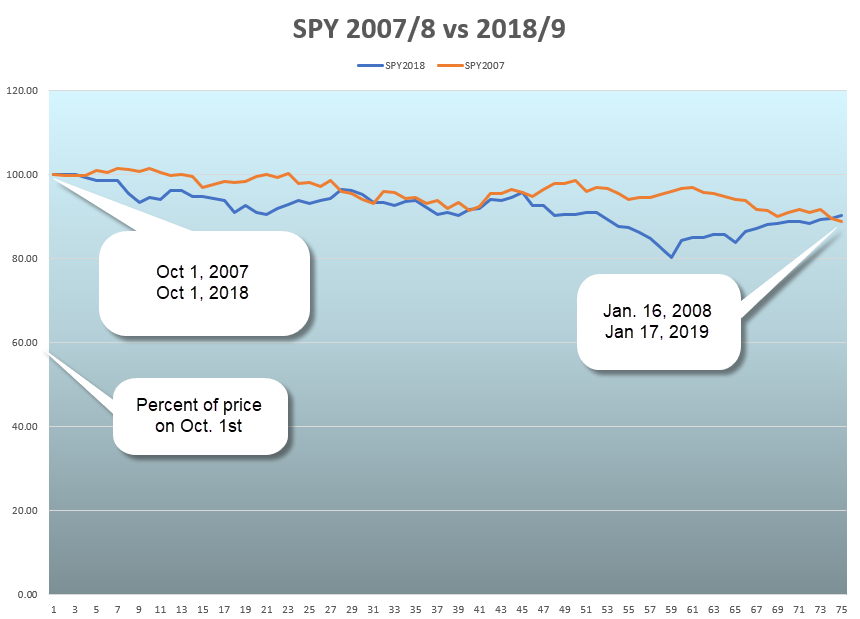
Your twin brother notes a similarity in the behavior of the stock market the past few months and the fall of 2007 when he took his starflight cruise. What similarity you ask? He hauls out his Romulan graphing tool and shows you a plot comparison of SP500 prices (SPY) in the fall of 2007 and the fall of 2018. Not only does your twin brother look younger but he also got a Romulan grapher on his journey. It is not fair.

spycomp20072018

“In both periods, prices fell about 15% in 15 weeks,” your brother says.

“They happened to fall the same percentage in the same amount of time,” you answer.  “That probably happens all the time and we just don’t notice.”

“15-20% drops in as many weeks doesn’t happen all the time,” your brother says. “It happens when there are fault lines forming. It happened in December 2000, January 2008, again in August 2011 during another government shutdown, and now.”

“Sure, there are some trade problems and the government shutdown,” you protest, “but the economy is good. Employment is at all- time highs, wage gains were over 3% last month, and inflation is relatively tame.”

“Everything was still pretty good in December 2000 and January 2008,” your brother responds. “‘A healthy correction after a price boom,’ some said. ‘The market is blowing off the excess froth before going higher,’ others said. At both times, there was something far more serious going on. We just didn’t know it.”

“You got pretty smart in the time you were gone,” you tell your brother. “Can I get one of those Romulan graphers?”

“Yes, I bought one for your Christmas present 11 years ago,” your brother says and hands you a grapher from his spacesack. “Tell me, what are these picture phones that people are carrying around now? I don’t remember them from when I left. And what’s Facebook?”

Strong Reactions

December 30, 2018

by Steve Stofka

Happy New Year!

Dramatic trading days signal a down market. In the week prior, the SP500 index lost over 7%. On Monday, Christmas Eve, the stock market fell to a level that would traditionally signal the beginning of a bear market, which is 20% below a recent high closing price. After a huge rally on Wednesday and a lot of volatile trading this week, the index gained 3%.

A disruptive stock market underscores the importance of asset allocation. The SP500 has lost 10% in December. A conservatively balanced fund like Vanguard’s Wellesley Income (VWINX) lost 1.8%. The fund is actively managed and has 40% stocks, 60% bonds/cash. A fund of index funds, VTHRX, lost 7.8%. It has a more aggressive mix of 65% stocks and 35% bonds/cash.

As I noted a few weeks ago (Hat Trick), there have been repeated signs of a struggle between hope and fear, between competing estimates of future earnings. 7% weekly price falls occur at crises or turning points. In the past sixty years, there have been only fifteen such weeks. Let’s take a look at the most recent.

In August 2011, then President Obama walked away from an informal budget deal with House Speaker John Boehner. The market lost almost 20% but fell short from hitting that mark. Once a budget deal was negotiated, the market recovered but it took five months to make up the losses.

SPY4YR2011-2018

Three years earlier, in October 2008, the market lost more than 7% in a week when negotiations for a bank bailout fell apart. This was a month after the bankruptcy of investment firm Lehman Brothers ignited the financial crisis. The market would take 39 months to recover that October price level. On February 17, 2009, President Obama signed the American Recovery and Reinvestment Act (Note #1). Senate Democrats made many concessions to win a few Republican votes for the bill to gain passage. Once it became clear that the stimulus funds would be trickled into the economy over several years, the market tanked, losing 11% during the month of February. In a final week of capitulation, the market lost 7% in the first week of March. This was the turning point.

A 10% weekly price drop in April 2000 heralded the end of the dot-com boom. The market would not recover for 83 months, almost seven years. An even worse fall came after the market opened following the 9-11 attack. The indictment of the international accounting firm Arthur Anderson sparked doubts about the financial statements of other companies and helped fuel an 8% drop in July 2002.

With six weeks of 7% price drops, the 2000s was the most tumultuous decade since the Great Depression. Strong reactions in the market deserve our attention and caution.

//////////////////////
Notes:
1. The American Recovery and Reinvestment Act 

Price Plateau

October 30, 2016

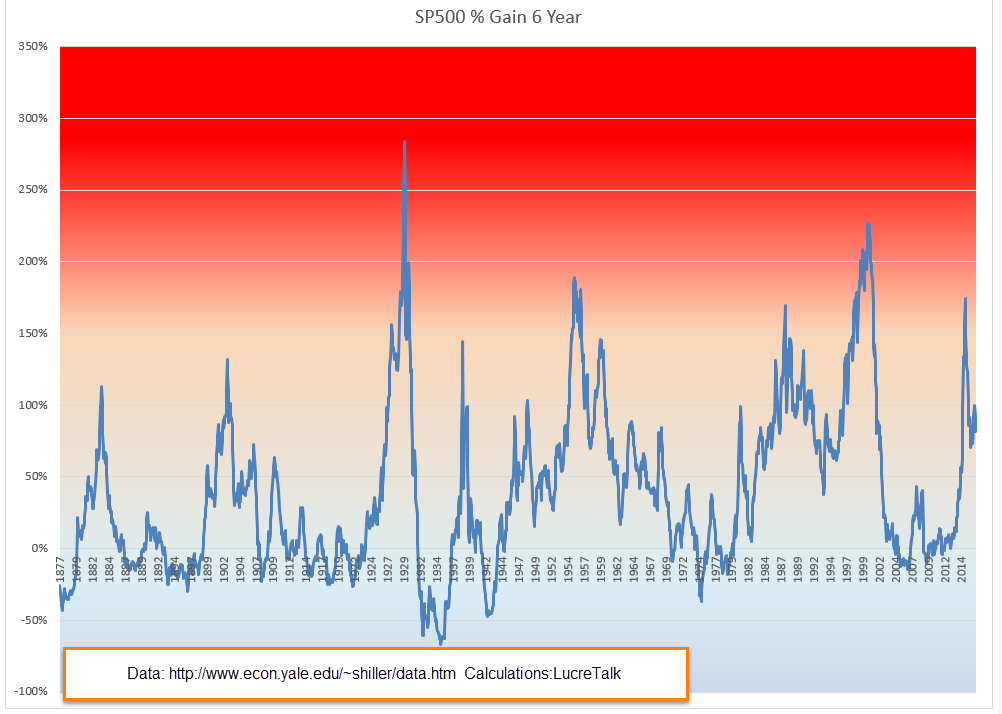
Market watchers use several indicators to gauge the valuation of the broader stock market.  The P/E ratio (Price/Earnings), P/D ratio (Price/Dividend) and Shiller CAPE ratio (Cyclically Adusted Price/Earnings) are quite common and I will look at a fourth indicator, the percentage gain in the SP500 index over a six year period.  As we will see, when gains reach a certain height, there are two alternatives that follow:  1) a crash or other steep decline in price, and 2) a flattening of price for approximately 18 months.

Use of any of these indicators – PE, PD, CAPE or this one – would not have helped an investor avoid the 2008 crisis.  Why?  Because they gauge valuation.  The 2008 crisis was a financial crisis based on bad judgment and fraud.  At the time of the crisis, the index had  gained 40% in the past six year period, about the average six year gain over the past 140 years.

Average annual gain – 6%

The average annual gain is a bit under 6%.  The median gain is 29% over a six year period, or a 4.2% annual rate.  Add in the current 2% dividend rate and the median expectation is 6.2% annual gains in the stock market based on the past 140 years. Some public pension funds are still using 7.5% expected annual gains and that will probably be the next crisis in the coming decade.

Five Year Rule

Methodology. Why did I choose a six year period?  Did I run a bunch of simulations to get the most dramatic period?  No.  It’s the first number I picked and the reason I picked it is simple:  it is one year more than the five year rule.  Financial advisors will usually recommend that their clients do NOT keep money in the stock market that they will need in the next five years.  Why? The volatility in the market could cause an investor to sell at precisely the wrong time in order to access funds.  Even at the worst depths of the 2008 crisis, after more than 50% losses, the SP500 index was only 11% less than it had been six years earlier.  This is why advisors use the five year rule.

SP500 Data

Below is a chart of the percent gains in the SP500 index after a 6 year period.  I’ll call the six year gains “6Gain” to save some typing.  The data is courtesy of Robert Shiller who wrote the book “Irrational Exuberance” which first introduced the concept of the Shiller CAPE ratio, an inflation adjusted P/E ratio.

1929 Peak

Let’s look at examples of steep price declines when the percent gains have just gotten too high. The 1929 crash was truly historic.  That’s the highest spike in the chart above.  In November 1928, the 6Gain first crossed above the 150% mark that signals an strong overvaluation.  The market should have started to flounder but lax lending rules probably helped fuel further price gains.  Many people with acceptable credit could borrow money against stocks and many did, chasing the strong upward trend in the market.  Over the next ten months the market climbed another 20%.  The decline began in mid-September 1929 (Dow chart) but was seen as a well deserved correction to the summer exuberance. At the end of September 1929, the market had gained 284% in six years, the highest 6Gain on record and a percentage gain that may go unbroken.

…and Crash

In October 1929 the market continued to lose ground, forcing the sale of borrowed securities to meet margin calls.  Margin selling contributed to the downward momentum but the sustained selling woke investors up to the fact that the market had climbed too far and too fast.  The selling culminated in a gut wrenching 23% loss on Black Tuesday, October 29th (Account of crash – I disagree with the author on valuation).

Seeking Average

It took 18 months for the market to correct to a 6Gain that was average (39% over 140 years). By that time in May 1931, the market had lost 55% of its value.  From 1931 to 1936 any money invested in the stock market six years earlier had shrunk. In 1934, six year LOSSES, not gains, approached 60%. My parents grew up during the Depression and were taught that the stock market was a reckless gamble made only by rich people who could afford to lose some of their savings.

Black Monday

These overvaluation crashes are rare, thank God.  The next one came more than 50 years later, on “Black Monday” in  October 1987, when the index lost 20% in ONE DAY, almost as much as Black Tuesday in 1929.  At that time, the 6Gain was 169%.  I can still remember where I was when that one went down. Traders could not get some of their orders filled and that began a panic in the market. Some radio pundits warned of another depression.  I had no savings in the market but I was worried that my relatively new business would go belly-up. Most of the 24% lost in two months was done in that one day.  It took a whopping six years for the 6Gain to fall to average.

The Plateau

Those are the only two examples of severe price crashes because of overvaluation.  The more common result of overvaulation is a plateau, a flattening of prices for about 18 months, followed by by a fork – up or down.  The price plateau simply tells us that a fork in the road is coming.  The over-valuation tells us to expect a price plateau.

The dot-com boom

Let’s look at the dot-com boom in the late ’90s. At the end of 1994, the SP500 index closed at 460.  Less than six years later, in the fall of 2000, the index crossed above 1500, more than triple the price in that short six year period. The 6Gain peaked at 227%. At mid-1999 the SP500 started to stall out above 1350.  Promises of huge profits to be made by internet companies were beginning to evaporate as those companies burned through cash at an alarming rate in their effort to capture a segment of the market. It would take another year before the market peaked near 1500.  By the end of 2000, eighteen months on this rounded plateau, prices were about 1350 again.  For almost two years they declined till the index had lost more than 40% of its value.  Coincidentally, this low was reached when the 6Gain finally dropped to the 140 year median of 29%.

The Fabulous Fifties

Let’s look at some older and milder examples to develop some context. In mid-1955, the index had gained almost 190% in six years. It continued to climb for another 6 – 8 months before falling back.  In the spring of 1957, the index stood at the same level as it had eighteen months earlier.

In mid-1959 the index had gained almost 150% in six years.  The index lost 10% over the next 6 months but by early 1961, about 18 months later, the index had gained back its lost ground.

In mid-1938, we see the same price plateau after a six year gain of 150%.

Recent

As we can see on the chart, these 6Gain spikes are infrequent.  Now let’s look at the most recent spike in the 6Gain – March 2015.  The SP500 index was near where it is today.  In fact, this may be the flattest price plateau in history.  The stock market was overvalued but with bond yields so low, where was an investor to go?  Real estate, commodities, gold and other alternative investments have gone up and down the past 18 months as traders tried to take advantage of mis-matches between expectations and reality.  The trend for the average investor?  No trend.

During this 18 month plateau, the 6Gain has fallen to 82% – a good sign – but still twice the average 6Gain.   Wouldn’t it be nice if there was a law that the 6Gain must fall to the average before the stock market takes on a definite trend in either direction?  No such law.  What we do see with ironclad regularity is a price plateau when the 6Gain crosses above 150% and that the plateau lasts about 18 months.  It has been 18 months and we should be nearing the edge of that plateau.

Closing Thoughts

As October draws to a close, we may have three months in a row where the month ending price (Close) is less than the price at the beginning of the month (Open).  Normally, 3 down months in a row would be a sign of more pain to come but the differences each month have been negligible and could be pre-election hesitation.  There is enough to be hesitant about.  The Shiller CAPE ratio is about 26, 10 points above the median of 16.  Due to declining oil prices, profits in the SP500 aggregate of companies have fallen for five quarters in a row and…

The Election

Trump has been losing ground in recent polls, enough so that the Senate seems more likely to turn Democratic.  This Senate cycle favors Democrats who have fewer seats up for re-election than Republicans.  In 2018, the cycle will favor Republicans.  As the gap in the polls widens, some begin to fear that a rout in the Presidential race could cascade into the House where Republicans hold what seemed to be an impregnable lead of 60 seats (Wikipedia article).  If the Democrats should take the House, they will control the Presidency, Senate and House.  Tax increases on those with upper incomes would be a certainty for 2017, as Hillary has promised.  This could cause a rush of selling in 2016 to avoid higher capital gains tax rates.  An unlikely but not impossible scenario may be contributing to the hesitation.