The Errors of Our Ways

August 2, 2026

By Stephen Stofka

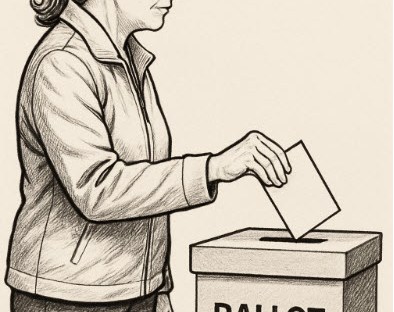
Last week I asked how we cope with the errors of our voting predictions. Do voters, in fact, make such errors? In 2024, 97% of House incumbents were reelected (Source). Voters overwhelmingly confirmed their choice of House member to represent their interests. On the other hand, a Gallup poll this past April showed that 86% of those polled disapproved of the House, a record high.

If voters are so loyal to their House members, then why the thumbs down on the institution? Is it the House’s institutional rules that disgusts everyone? The Constitution specifically states that each house of Congress will determine its own rules, and the rules reward tenure. The House is a majoritarian institution, meaning that the number of elected party members determines which party’s priorities will dominate the agenda for the next two years. In an evenly divided House like we have had for several terms, half of the country’s voters are marginalized. Constituents vote yeah, whatever and reelect incumbents.

How we engage

We come in contact with the world through our senses but we engage with the world through our errors. Before electronic bookkeeping, accountants used pencils, making it easier to correct errors. We learn to walk by propelling our body forward in a series of interrupted falls. To catch a ball, a child learns how to predict the flight of the ball through trial and error. We drive a car by predicting how it will respond to our steering, and the pressure of our foot on the brake and gas pedals. We learn to predict the actions of other drivers, although sometimes we make critical errors.

Don’t Blame the Gods

At the beginning of the Odyssey, Zeus, the “father of gods and men,” says “Look you now, how ready mortals are to blame the gods. It is from us, they say, that evils come, but they even of themselves, through their own blind folly, have sorrows beyond that which is ordained” (Source).

When we vote, we predict the character and behavior of a candidate. In a 30 minute video, author Yuval Harari notes that we often mistake confidence for competence in our leaders (Source). We may be drawn to a candidate who promises a simple solution to a complex problem. Who doesn’t like simple? We may turn away from a candidate who has a deeper knowledge of the problem because they cannot express the problem in a short sound bite.

“Drill, baby, drill!” and “Lock ‘em up” are political slogans that fit on a postcard. Even politicians who understand the complexities of a problem know that they will lose the attention of many voters, so they choose the overly simplistic slogan. Modern political campaigns use the association of beliefs and identity to brand political opponents with short negative epithets. Campaigns throw labels like communist, socialist, authoritarian, tax and spend, big government, oligarchs, and see what sticks with voters. Coupled with that negativity is an appeal to the nobel side of voters on our side.  A vote for our candidate, or our side of an issue is a defense of goodness, virtue, and American principles against the barbarians from the other party.

The Mote in Your Eye

We are attentive to the errors in other people’s opinions, yet we dislike other people offering to correct our opinions. Substack author Kati Rae points out that a belief or opinion may support a person’s identity. Offering to correct that belief or opinion is perceived as an attack on the person (Source). Our reluctance to perceive or admit the errors in our predictions contributes to the inaccuracy of those predictions.

In his book Fooled by Randomness, Nassim Taleb tells the story of George Soros, one of the most successful investors of all time. His accuracy rate? About 53%, just a bit better than random chance. What’s the secret? A prediction is an outcome, but every outcome has a story. When the narrative does not unfold as Soros predicted, he admits his error, unwinds his position and minimizes his losses. The secret to winning is acknowledging error. Why then is that so hard for many of us?

Divided by Interest

At the founding of the country, two groups emerged to represent different regional economies and interests. The Democrat-Republicans, led by Thomas Jefferson, served the priorities of farmers and others who worked the land. The Federalists, led by Hamilton and Adams, were the party of choice for those who lived in the urban areas. The economies of North and South were very different. The north relied on value added manufacturing and trade businesses. The economy of the southern states was based on agriculture.

The Constitutional structure was built on hard fought compromise. In the decades following the ratification of the Constitution, the non-compromisers in the northern and southern states took over the political machine. Most states adopted the practice of awarding all of their Presidential electors as a state block. This “winner-take-all” policy hardened the divisions among voters in each state. Why don’t moderates of both parties separate themselves from the extremists? Because extremists in each of the two dominant parties have structured state and national politics to lessen the influence of moderate voters. When will moderates take back the country?

Memory

There is no identity without memory, a vital tool in shaping our predictions. We remember economic shocks and misbegotten wars when the other side was in power. High inflation, a housing crisis, a recession, high gas prices, and major tax increases. We may excuse such incidents when our side was in charge. It couldn’t be helped. Circumstances beyond control. Or we blame the “establishment” of the party. Factions form within the two dominant parties, trying to wrest control of the party’s direction from the party’s leaders. The media, mainstream or not, plays to our selective memory.

In many areas of our lives, we learn to correct our predictions through trial and error. However, some choices like voting are infrequent and are more difficult to correct. People may misremember a past voting choice so that their remembered choice aligns more closely with their current sentiments (Source). In panel studies, survey participants are asked shortly before an election which candidate they intend to vote for. Just after the election, they are asked which candidate they voted for. A year later, they are asked again who they voted for and sometimes their answer conflicts with the answer they gave shortly after the election.

Putting It All Together

Our predictions depend on the data we sample, our memory and identity. We look away from the mistakes in our predictions. We blame it on the candidate we voted for. He or she tricked us. We blame it on the party. They tricked us. We rarely look at the real trickster, the one in the mirror. Next week I want to look at why we are so good at self-deceit. And with that, I hope to see you next week.

/////////////////////

Photo by LATIKA SARKER on Unsplash

A crystal ball outside on the ground. Inside the ball is the reflection of a lake and trees

Different Predictions

July 19, 2026

By Stephen Stofka

In last week’s post, I ended with a promise to explore our political polarization. We are divided not only by values and ideologies, but by population density. Some of us prefer less density and less regulation. Those who live in a small town may have a limited choice of dining, shopping, health care and entertainment. There may be only one movie theater with one screen. In rural areas, the land doesn’t sit there as a space for human homes, businesses and institutions. The land works. It provides food for human or animal consumption. It provides trees, minerals and other resources. Its mountain peaks reach into the skies to collect water from the clouds, channeling water down the slopes to the valleys below. In these areas, the human community is a part of the land. People live with the land.

The U.S. Census Bureau has long distinguished rural and urban areas by population density. Recently, they have included outlying areas with low population density whose economies are tied to a nearby metro area. The distinguishing characteristic is that 25% of residents commute to a metro area for work (Source).

In dense urban areas, people live on the land. The human community dominates the land. Grass and trees serve as a spiritual refuge for humans, and a habitat for birds and small mammals. Land is space for human designs of concrete, asphalt and lumber. People who live there appreciate the availability of choices in most areas of their lives. They tolerate the regulatory environment needed to manage the frictions between neighbors. They are accustomed to a diversity of cultures and religious traditions.

In the small east Texas town where my mother grew up, there were churches of a variety of Protestant sects. In less than a mile on the main street of the town, there was a Methodist, Baptist, Christ the King and Presbyterian Church. That’s all the variety that people needed in that community. Those who attended an Anglican or Catholic church could drive almost an hour to Dallas on Sunday morning. My mother could not remember meeting a Jewish or Muslim person until she moved to New York City after World War 2.

Different Outlooks

The residents of rural and urban areas have different sensibilities and outlooks on life. They may share values and ideologies, but they place a different emphasis on those values when they vote. In rural towns, change is slow and the residents are suspicious of new developments. In many rural towns, there aren’t enough job or educational opportunities for young people. Many move to urban areas, where they must become accustomed to a faster pace of life. They try on new ideas, music, and other diversions. They become part of social groups that may seem alien to their parents. They question the choices and morals of the political leaders their parents voted for. A recent study by Pew Research shows that younger voters under 30 vote more heavily for Democratic Presidential candidates. Those over 60 favor Republican candidates (Source).

Density Signpost

Several studies in the past twenty years have found that population density is a significant factor predicting party affiliation. It’s not a direct cause of course, but it represents important differences in economic and social circumstances between urban and rural environments. After reading several papers on this topic, I’ll rely on a paper by Trevor Brown and Suzanne Mettler (2024) (Source). The paper is openly available and the authors reference a lot of other papers on the topic. Brown and Mettler note that, until 2000, there was not such a clear partisan divide between rural and urban voters. Here’s a chart from their paper to show the wide divergence in voting patterns in the past two decades.

The chart shows the percentage of voters, urban and rural, who voted for the Republican Presidential candidate. In the year 1996, there was only a 3% difference between urban and rural voters. In the 2020 Presidential election, that difference had grown to 21%. What happened?

Multiple Causes

There are several causes that account for the behavior of an airplane in flight, and human beings are a lot more complicated than airplanes. Different authors have highlighted a number of causes. Those in areas of higher population density are more educated. Not smarter. Just more educated. They work at jobs that require more education, or a degree becomes a filtering mechanism in a competitive job market. Job growth in rural areas has been stagnant. Those in urban areas have higher incomes but have higher housing and living costs. As already discussed, there is a greater variety of religious institutions, and less social pressure to embrace any religion.

Brown and Mettler pointed to some studies that stressed rural “consciousness, identity, or values,” but that didn’t explain the urban-rural divergence in political sentiment of the past three decades. Some authors cited the resentment that rural voters might have for urban voters who impose their priorities on everyone. However, this is not a recent development. In the 1960s, voters in rural upstate New York voted Republican. Voters in the urban area that included New York City voted Democratic. For decades, Colorado voters in the Front Range east of the Continental Divide have voted Democrat, while those in the western part of the state and on the eastern plains voted Republican. Perhaps readers will have similar experiences of longstanding urban-rural divides in other states.

A Shift in Outlook

Many election analysts have struggled to explain the change in voter sentiments before and after an election. Just prior to the 2016 election, Gallup asked voters for their assessment of the economy. 81% of Republican voters thought the economy was getting worse. Soon after Trump won the election, only 44% of Republican voters felt the same way. Among Democrats there was a similar shift, although not as extreme (Source, McCarthy & Jones, 2016). In the weekly Gallup surveys over the following weeks, Republican confidence improved while Democrat’s outlook declined. A similar shift happened before and after the 2024 election. Some analysts have termed the phenomenon partisan perceptual bias. A better term might be partisan prediction bias.

We Predict

We are creatures who must survive on our ability to predict. Unlike a cat, we do not have fast reflexes. To navigate our world, we must predict the motion of others. We get more comfortable driving a car as we learn to make many predictions in a short period of time. Secondly, we are social animals. To survive, we must learn to read the feelings and intentions of others to anticipate how they will act.

Vote Forecasting

Writing in the Public Opinion Quarterly, Andreas Graefe (2014) noted that asking people to predict an election winner was very accurate. She analyzed vote forecasting surveys from 1932 to 2012 and found that the majority of respondents correctly predicted the outcome 89% of the time (Source).

Notice that these forecasting surveys are different from voter intention surveys that ask people who they intend to vote for. These kinds of polls are probably the most reported on. For these kinds of polls, analysts must apply several statistical techniques to align the characteristics of their polling samples more closely with the characteristics of all voters in an electoral region. Sometimes they simply do not make the correct adjustments. Surveys prior to the 2016 election accurately predicted that Hillary Clinton would win the national popular vote. However, the national popular vote does not determine the winner of the Electoral College vote. Analysts misweighted the survey samples in several swing states, which delivered the winning electoral votes to Donald Trump (Source).

Gut Prediction

Asking voters how each of them will vote takes a lot of statistical tweaks to achieve an adequate level of accuracy. Asking voters for their gut predictions of the winner turns out to be quite accurate without those tweaks. When researchers ask people for their opinion on the economy, I think what many people respond with a prediction. Those predictions are based on our perception of our personal circumstances, local and national conditions. We filter those perceptions by ideology, values, and our previous experience. What pops out is a binary prediction of a likely winner from each of the two dominant political parties, not an assessment of the broad economy.

Why do people make such different predictions? Next week I want to look more closely at the components of our prediction process. And with that, I hope to see you next week.

///////////////////

Photo by Brad Switzer on Unsplash

Notes:

Brown, T. E., & Mettler, S. (2024). Sequential Polarization: The Development of the Rural-Urban Political Divide, 1976–2020. Perspectives on Politics, 22(3), 630–658. https://doi:10.1017/S1537592723002918  

Graefe, A. (2014). Accuracy of vote expectation surveys in forecasting elections. Public Opinion Quarterly, 78(S1), 204–232. https://doi.org/10.1093/poq/nfu008  

McCarthy, J., & Jones, J. M. (2016, November 15). U.S. economic confidence surges after election. Gallup. https://news.gallup.com/poll/197474/economic-confidence-surges-election.aspx

Being Careful

February 8, 2026

By Stephen Stofka

In the AFC championship game between the Denver Broncos and the New England Patriots, the Broncos scored in the first quarter (Source). On a subsequent possession, the Broncos were deep in Patriots territory and chose to run a 4th and short yardage rather than take an easy field goal. They were unsuccessful and turned the ball over to the Patriots at that point. To many fans, the decision seemed reckless. Why turn down an easy field goal in the early part of the game? As the weather turned ugly in the 2nd half of the game, that field goal represented the difference in the final score, Patriots 10 – Broncos 7. This week I want to explore the theme of careful. In sports as in life, we must take calculated risks. When are we too careful or not careful enough?

A high school graduate may decide to take a job offer rather than continue their education. In the short term, this can be a prudent decision. Presumably, that person gains some financial and emotional stability as they begin to build a career. But data from the Bureau of Labor Statistics indicates that the time, effort and cost to earn a college degree has a better long-term outcome. Which is the more careful decision? It depends on the time frame.

The 2008 financial crisis exposed a Ponzi scheme with an estimated market value of $65 billion. The mastermind of the scheme was Bernie Madoff, whose securities firm helped develop the digital quotation market that became NASDAQ. Madoff also ran an investment advisory firm that employed the Ponzi scheme. For about thirty years, Madoff issued statements to his clients showing consistent returns of 10 – 12%. He achieved these abnormally consistent returns using a proprietary risk and timing strategy based on his long experience in the stock market. At least that’s what his clients believed. His scheme lasted so long because he was careful. Despite that carefulness, the scheme unwound in late 2008 and Madoff went to jail.

Joe McCarthy was a Republican Senator in the post-war period who rode a wave of Communist fear. Like Donald Trump, he drew attention by making unsubstantiated claims against prominent people. In a 1950 address, McCarthy claimed to have a list of Communists who were working in the State Department. A Senate subcommittee determined that McCarthy’s claims were a hoax but his claims gained credibility when a former State Department employee, Alger Hiss, was convicted of lying about his Communist associations during the 1930s (Source, Source). For three years, McCarthy led a Senate committee that investigated hundreds of people. The committee found not one Communist but ruined the careers of many in government and the media (Source). Casting about for a likely target, McCarthy turned his sights on the Army in 1954. This showdown was carried on the TV networks where the public witnessed his bullying tactics, his reckless accusations and his fondness for drink. McCarthy was politically marginalized and died three years later from cirrhosis of the liver. He was only 48.

Donald Trump has not made careful investing decisions with the money that his father gave all his children while they were growing up. He has branded himself as a builder but often leaves the building and management to other companies. Before becoming President, Trump’s role as the star of a reality show was his chief accomplishment. That, and a showy, gilt-edged product known as the Trump brand. His poor financial decisions led to six bankruptcies. Nearing 70 in 2015, his losses and reckless spending had made him a pariah to banks (Source). His 2016 run for the Presidency was a long shot with little chance of success but guaranteed to keep his name in the news.

Trump’s cruel comments and behavior drew media attention in a crowded field of Presidential candidates. The Bush administration had spent eight years “spinning” the Iraq war. Spin was a euphemism for the carefully constructed blather from Washington that was designed to cover up policy failures and judgment errors. The Obama administration had spun the government’s response to the financial crisis and the passage of Obamacare. The public was skeptical of carefully chosen words and chose a candidate that shunned political convention.

Some of us make careful choices in our diets and living habits yet we still get cancer, arthritis and other diseases. On average, careful choices should protect us from harm. A feeling of betrayal descends on us when we are diagnosed with a debilitating or life threatening disease despite our carefulness. McCarthy drank too much and died of cirrhosis. That makes sense. Cause and effect. Random events frighten us. Getting heart disease despite prudent lifestyle choices makes no sense. Being diagnosed with arthritis at the age of 30 seems like a cruel prank.

Where is the dividing line between careful and timid? We may have a caution that is inappropriate to the risk involved. A teenage boy may not ask someone out for fear that they will be rejected. Most of our parents and grandparents who grew up during the Great Depression have died. Many never bought a stock or mutual fund during their lives. The 1929 stock market crash and subsequent Depression had taught them that stocks were dangerous. Careful investors put their money in guaranteed savings accounts. They bought a house, CDs or government bonds.

The other avenue I want to explore are institutions. I have been talking about the degree of carefulness that individuals have, but we create institutions that feature carefulness, or the lack of it. A pass receiver who throws himself through the air to catch a football, then gets slammed by a defender, is not being careful. From the safety of our couch, we enjoy that practiced lack of carefulness. Two boxers face each other, each being careful to avoid a punch from their opponent. However, to throw an effective punch, a boxer must let his guard down for a moment, effectively reducing his level of carefulness. It is a dance of alternating defense and offense with split second timing.

Nations build a military to protect their sovereignty. Smaller nations seek alliances with larger powers, being careful not to threaten a nation dominant in their region. The political scientist John Mearsheimer has argued that an eastward expansion of NATO, the U.S.-European defense alliance, was a threat to Russia. In the late 1990s, Putin stated that position clearly to President Clinton. Despite those warnings, U.S. and European nations have continued that expansion (Source). Is the war in Ukraine the result of a lack of carefulness? A cause of many wars can be attributed to a miscalculation of risks and response.

There are many industries where careful precision is critical. The computer industry is probably the ultimate in precision manufacturing. The foundation of the legal profession is a precision with words. Lawyers draft contracts with a string of verbs that are near synonyms. An example of a verb string in a contract is sell, assign, transfer, convey, or dispose of. Lawyers do this to close loopholes in the interpretation of two words with similar but not exact meanings. Often lawmakers use wiggle room words like reasonable in order to secure some legislative consensus. Lawyers and judges must then apply these broad terms to specific cases. When there is conflict in interpretation, the Supreme Court becomes the final arbiter of how the term should be applied.

The Supreme Court has three levels of scrutiny. This describes how carefully they read a government statute which has an impact on individual freedom or rights. The most careful approach is strict scrutiny. The government has to show a compelling interest and that the law is narrowly tailored to achieve that interest. Most arguments do not survive strict scrutiny. One of the few was Grutter v Bollinger (2003), in which the court held that race-conscious admissions at a university had educational benefits. The court stipulated that each admission must be based on an individualized review of the candidate’s circumstances and strengths. Secondly, the law could not stipulate any quotas like 25% of a particular race.

The second level of judicial carefulness is intermediate scrutiny and is the most used standard. Under this type of scrutiny, a law only has to further a legitimate government interest. Regulations of speech that are content-neutral are a justified restriction of individual freedom. There is a clear connection between the means and the ends that those means serve. Noise ordinances are an example. The least restrictive interpretation is rational basis. The court basically defers to the government body claiming a health, safety or moral public interest.

That brings me full circle to today’s Super Bowl. In 2018’s decision Murphy v NCAA, the Supreme Court ruled that Congress could ban online sports betting, but could not force states to keep it illegal. At the heart of the decision was the concept of federalism, the separation of federal and state authority. The decision states “Congress may not simply ‘commandeer the legislative process of the States by directly compelling them to enact and enforce a federal regulatory program’” (Source). Today, the majority of states do not ban sports betting because it is a source of state revenue (Source). Illinois and Delaware charge a 50% tax on the winnings from sports betting (Source). Although many fans are careful with the amount of money they bet, approximately 25% of those surveyed by the National Council on Problem Gambling report some problems (Source).

So be careful this Super Bowl Sunday and I hope to see you next week.

/////////////////

Photo by Vivek Doshi on Unsplash

A Way Forward

August 10, 2025

By Stephen Stofka

Sunday morning and another breakfast with the boys. This week Abel and Cain try to separate facts from evidence and restore trust among the American people. The conversations are voiced by Abel, a Wilsonian with a faith that government can ameliorate social and economic injustices to improve society’s welfare, and Cain, who believes that individual autonomy, the free market and the price system promote the greatest good.

Abel laid his napkin on his lap. “A recent survey by Pew Research found that 80% of people thought that voters in both political parties can’t agree on basic facts (Source). No wonder there is so much distrust in this country. It got me to wondering what is the distinction between facts and evidence?”

Cain stirred his coffee. “Good question. We often treat the two words as synonyms. Evidence supports facts. I think of a fact as something that is verified by evidence.”

Abel interrupted, “Yeah, but eyewitness testimony is evidence and that is often unreliable (Source).”

Cain smiled. “The witness, though, regards their testimony as fact. Raises the question, if evidence is not reliable, how truthful are facts? If I am inclined to accept something as fact, I don’t need much evidence. If I am skeptical, then no amount of evidence is enough to convince me of a fact.”

Abel looked at his phone. “On that point, here’s Dirk Nies, a director of a research institute in Virginia who wrote into the British Medical Journal a few years back. He made an interesting distinction between facts and evidence. He said, ‘Facts have no purpose or agenda associated with them. Evidence always does.’ And further on he says that we select evidence as a subset of available facts (Source).”

Cain raised his eyebrows. “But politics is all about agenda. If you use that distinction, then there are few facts. Everything is just evidence.”

Abel argued, “Well, not really. ‘Donald Trump is president right now.’ That’s a fact with no agenda. It’s just a statement. ‘It’s hotter than average this summer.’ Another fact.”

Cain nodded. “Right, but if I use the fact that it’s hotter than normal to support a claim that climate change is real, then that fact is evidence to support my claim. The distinction between facts and evidence is not so clear. No wonder we use those two words interchangeably.”

Abel sighed. “The worst fear I have is another civil war.”

Cain raised his eyebrows. “You’re that worried? I guess it wouldn’t be unusual. Then whoever wins the war writes the history (Source).”

Abel said, “If I present a piece of evidence to support my claim, you might disregard it. Let’s say I claim that Trump is making inflation worse, the exact opposite of what he campaigned on. For instance, the average price of eggs was $2.60 in the first half of last year. I picked up a dozen brown eggs this week and it was $5.29. Those are facts.”

Cain shook his head. “Is last year’s average price a fact or evidence? How were those prices gathered? Lawyers try to discredit evidence or witnesses that hurts their client’s case. A Trump supporter might question the data.”

Abel interrupted, “Like tobacco companies who tried every trick in the book to discredit research showing smoking was dangerous.”

Cain nodded. “Good point. A tobacco company is trying to protect its profits. What is a political partisan trying to protect? Their beliefs, preference and opinions. That can lead people to question anything that challenges those beliefs. So, who figured up last year’s average price of eggs? Was their methodology valid? Was there some political agenda?”

Abel sighed. “It was the BLS, the same agency that produced the employment figures that Trump didn’t like so he fired the head of the agency. An agency, I might add, that Republicans have praised for its objectivity and methodology until a week ago when Trump didn’t like their figures.”

Cain shrugged. “Look, I agree with you. I’m just saying that we all become lawyers when we get into political discussions with people who don’t agree with us. We try to filter out or discredit evidence that attacks our beliefs and opinions. They are like our clients or children. We are protecting them from attack.”

Abel laughed. “So how do we manage to have these discussions? We keep it reasonable, I think.”

Cain smiled. “We’ve known each other a long time. We agree to disagree. I was listening to the Hasan Minhaj podcast a few weeks ago and he was having a conversation with Neil DeGrasse Tyson (Source).  He asked Neil, ‘Is the glass half empty or half full?’ Neil answered that if you are filling up the glass, then it is half full. If you are emptying the glass, it’s half empty.”

Abel asked, “Yeah, but what if an observer comes along on a glass that has water up to the halfway mark? There is no one else around. Half empty or half full?”

Cain smiled. “Good point. Neil assumed that we know the process, but we don’t. If Democrats are in power, Democrats see the glass as half full because they think they are filling the glass. Republicans, however, see the Democrats as making things less so they see the glass as half empty. It’s the same phenomenon when Republicans are in power.”

Abel nodded. “So the process is the context. Nies, that guy we discussed earlier, said that relevance is a characteristic of evidence, not facts.”

Cain looked hesitant. “Yeah, but we can only understand things in context. Einstein’s thought experiment of the man in a closed elevator who doesn’t know whether the elevator is resting on earth or accelerating out in the depths of space (Source).”

Abel shook his head. “But imagine we’re all in the elevator together and arguing over which is true. If we all decide we’re on earth, there’s a hope that someone may come and open the elevator door. If we’re in space, we’re doomed. We may begin tearing each other apart.”

Cain frowned. “Reminds me of William Golding’s novel Lord of the Flies. I hope they still assign that book in high school.”

Abel laughed. “I don’t know. There’s a cool interview with Golding and how the novel got rescued from the reject pile (Source). Anyway, last week, I was proposing that the Democratic Party choose a presidential candidate from each of four regions in the country. The winning candidate for each party would be chosen at a national convention. I thought it might attract more moderate candidates and a consensus within the party.”

Cain replied, “I thought it was a good idea. Grouping people by regions has its problems but its as good a way to divide up various interests as any. Better than the identity politics that has taken over the Democratic Party. How did those four regions vote in the last election? Last week, you said the southern states were all red and the western states voted blue. What about the other regions?”

Abel replied, “Southern states voted all red except for Virginia. Northeastern states were mostly blue except for Pennsylvania. The midwestern states were mostly red except for Illinois and Minnesota (Source). The four states with the most electoral votes are fairly predictable. California and New York are 82 electoral votes for Democrats. That’s almost a third of the votes needed to win the presidency. Texas and Florida are 70 votes for the Republicans, more than a quarter of the votes needed. It’s the states like Arizona, Pennsylvania and Nevada that decide these elections. They went for Biden in 2020, then Trump in 2024. Arizona and Pennsylvania went for Trump in 2016.”

Cain grunted with displeasure. “That’s what I don’t like. A relatively small number of people in a few key states decide a presidential election. The results depend on people who usually only vote in presidential elections. We’ve got to figure out a better system.”

Abel was puzzled. “You just said that you liked that regional system.”

Cain replied, “I liked that but your suggestion was within a political party. You know, a way that the party would choose a national candidate. I’m thinking of a change in the way that we elect presidents. I don’t like the way that each party has essentially captured the electoral votes in each state. They override the will of the people, the whole purpose of voting. Each House district should be able to have their vote counted for president. One vote per house district and senate seat.”

Abel argued, “But we would still need an Electoral College or else we would need to amend the Constitution. I was surprised to learn that the Electoral College has been consistently unpopular over the past 200 years. The public doesn’t like it and Congress has submitted over 700 proposals to amend or abolish the Electoral College (Source). I don’t think we can devise a representative system without an amendment.”

Cain shook his head. “Maybe there’s a way. Currently, the legislature in each state decides how the electoral votes for the state will be awarded (Source). In most states, electoral votes are awarded on a ‘winner-take-all’ basis. Whichever candidate gets the most votes, gets all the electoral votes. I think Maine and Nebraska are the exceptions.”

Abel frowned. “So you are proposing that if the voters of District 1 in Iowa choose a presidential candidate, then the elector for that district would cast their vote for that candidate. The problem is that the Constitution gives each state control of their electoral process.”

Cain interrupted, “Right but with exceptions for practices that discriminate against voters.”

Abel sighed. “Your system would involve all 50 states changing their election laws. Forget about that. The only alternative is a Constitutional amendment.”

Cain squinted. “Maybe not. If the Supreme Court ruled that the current practice of choosing electors was discriminatory in some way, then there would be no amendment needed.”

Abel rolled his eyes. “Congress might just pass an amendment to overrule that decision to preserve party power under the current system.”

Cain shook his head. “I don’t think so. I think voters would prefer that their district has a direct say in choosing the president. As it is now, voters in a rural district in a blue state like Colorado have no voice. The electoral vote that represents their district goes to a party and a candidate that they don’t like. Likewise, big city voters who vote blue in a red state suffer the same abuse. It’s perverse. It’s discriminatory.”

Abel nodded. “Ok, let’s say that electoral votes are cast according to the votes for House and Senate. There’s even more incentive for state legislatures to gerrymander house districts and that further marginalizes the minority.”

Cain winced. “Yeah, you might be right. The party system is so corrupt. I hate the idea of party elites having a voice in choosing a party’s presidential candidate. In 2016, ‘superdelegates’ represented 15% of the Democratic Party’s delegates at their nominating convention (Source). Republicans have about half that percentage and they have less discretion in how they vote but it’s still a problem (Source). Gives me a bad taste in my mouth.”

Abel argued, “Any alternative has to appear neutral to the two dominant parties. It’s hard to do. There would have to be an amendment that restricts gerrymandering. A computer could do the redistricting every decade that the Constitution requires. A simple rule like each district should have the smallest perimeter that encloses the representative population.”

Cain sighed. “Ok, let’s say that were to happen. Each party would propose a candidate chosen from each of the four regions in the country. A nominating convention for each party would choose a candidate. Electoral votes are cast by the House and Senate members who are elected.”

Abel asked, “So no more popular vote for President?”

Cain nodded. “Not directly. What’s the point? Yale University analyzed 2020 election data and found that less than 2% of voters split their ticket (Source).”

Abel asked, “So most Republican voters rarely vote for a Democratic president?”

Cain nodded. “And vice-versa. And this system I’m thinking of is not a radical change. A Republican candidate would have been elected in 2024 anyway because Republicans won more House and Senate seats. Democrats would have won in 2020 and Republicans in 2016 (Source). Nothing would have changed.”

Abel asked, “What’s the point?”

Cain replied, “More moderate candidates under the regional system you proposed. Then, using the new system for electing the president, voters in each district would have their vote counted. It’s transparent. No more guessing voters’ choices like what happened in Florida in the 2000 election.”

Abel smirked. “Yeah, one person on the Supreme Court cast the deciding vote for George Bush.”

Cain looked into the distance over Abel’s shoulder. “Whether you favored Bush or Gore, the Supreme Court should not get to decide the President. That decision was like a blot on this country’s soul, like a skin necrosis that grows until it eventually destroys a person.”

Abel’s eyes widened. “That’s a bit Shakespearian, don’t you think?”

Cain nodded. “Maybe a bit dramatic but what is happening to the people of this country is dramatic. Since that election, people don’t trust each other. Then the lies that got us into the Iraq war. Then the financial crisis and the elites in Washington bailed out the banks while hardworking homeowners lost their houses. Social media came along and amplified that distrust. Then the pandemic. The distrust is gnawing at our public spirit. We’ve got to have more transparency. I’m not saying that will fix things but it’s a step in that direction.”

Abel frowned as he pushed his chair back and laid his napkin on the table.. “One more thought. In every election, there are always several undecided House seats. The results of a presidential election could hinge on those.”

Cain shrugged. “Throw the undecided races out. In 2024, the deadline was December 11th (Source). If a House or Senate race is undecided by then, it doesn’t count for either party.”

Abel stood up. “Let me think about that. I agree with you. We’ve got to do something to restore the public trust. Look, I’ll see you next week.”

Cain smiled. “See you then.”

//////////////////

Image by ChatGPT5

Note: here is the text of the 12th Amendment (Source) and the history and interpretation of the 12th at the Constitution Center (Source).

Electoral Strategies

October 30, 2022

by Stephen Stofka

This week’s letter is a detour into political branding and public opinion. In interviews with voters, I often hear “I am a [‘Democrat’ or ‘Republican’ or ‘Independent’ here].” It is not unusual to hear the same association with a religion as in “I am a Lutheran” or “I am a Catholic.” These identifications begin when we are young, extending the reach of our sense of self outside the family (Miller & Shanks, 1996, 120). These party affiliations are not mental straitjackets by any means. As we come of age, we form a unique set of values and group identifications and may adopt a party affiliation different from our parents. This can make for some uncomfortable conversation at the Thanksgiving dinner table.

We may self-identify with a party because we are not like those people in that other party. Political and cultural scientists have a term for this process of stereotyping people – othering. We might identify as an Independent voter because we are not a crowd follower like those Democrats and Republicans. We are discerning voters who study the issues and candidates before we vote. That is also a form of othering.

Magleby et al. (2011, 247) found that many self-identified Independents are leaners, leaning toward one party or the other, and are more engaged in political issues. In Presidential elections from 1952 to 2008, Republican leaning Independents voted almost 78% of the time, about the same as Weakly Partisan Republicans. Democrat leaning Independents showed the same behavior. Truly Independent voters who are not leaners have less interest in politics and voted only 63% of the time. In recent years, that percentage has dropped to 53%.

Our party system treats people as though they were computer switches – on or off, left or right. Many of us have graduated value systems that cannot be simplified like a logic gate on a circuit board. Citizen initiated ballot measures reveal that complexity. Many states have citizen initiatives, allowing interest groups to put legislative proposals on the ballot after collecting a number of verified signatures. A voter might be for a proposal to provide free lunches for all students but does not like the way the program is funded and votes NO. The ballots contain only the two choices – YES or NO. Consider a ballot that allowed a voter to represent their actual opinion. A neutral position would be 0. A voter could vote for the proposal on a scale from 1 to 5, or against the proposal on a scale of -1 to -5. We have the technology. Why don’t we have the ballots?

Despite evidence to the contrary, some Republicans voice distrust with voting machines and want to return to the days when paper ballots were counted by hand. They ignore the extensive testing procedures that their own Republican state legislatures conduct (NCSL, 2021). Republican voters who say they doubt the integrity of the vote are, in effect, doubting the honesty of their own party’s legislators whom Republican voters elected. The story is so illogical that Democrats have been unable to tell a narrative that would replace the Republican fairy tale. That is the genius of the Republican political narrative.

In Colorado, a Republican candidate for governor is one of more than a dozen Republican candidates around the country who have been telling outlandish stories that the schools are teaching children to identify as cats and use litter boxes (Klamann, 2022). If the illogical story with the voting machines caught fire with some voters, particularly Q-Anon believers, why not adopt the same strategy and try other bizarre stories? The stories are political hornets, designed to keep Democrats occupied by reminding people of actual facts. In the early 1950s, Republican Senator Joe McCarthy kept Democrats preoccupied with tall tales of Communists lurking behind every bush in Washington and Hollywood. Alex Jones emulates that McCarthyite cruelty and craziness.  

Some Republican candidates celebrate othering and continue to build the Republican party on bias and exclusiveness. Southern Democrats successfully employed that strategy for 100 years after the Civil War. Former First Lady Michele Obama encouraged people to take the “high road” and not give into hate rhetoric. Lies, wild accusations of socialism and staged Tea Party rallies contributed to a historic loss of Democratic House seats in the 2010 midterms. In our winner-take-all electoral system, there is only one road to victory and political power. It is neither high nor low.

Democracy thrives on open distrust, on bold lies and the histrionics of political candidates and their supporters. Few Chinese dare to voice distrust with their leader, Xi Jinping. At the gathering of the CCP Congress this month, there was no wild gesticulating or shouting like there is at American political conventions and sometimes at State of the Union addresses. Americans treat politics like a rodeo, swooping and hollering. Chinese leaders look profoundly serious. In both countries, people are getting hurt, jailed and isolated but the American system is entertaining.

//////////////////////

Photo by Nelson Ndongala on Unsplash

Klamann, Seth. 2022. “‘Incredibly Frustrating’: Colorado Schools Reject Ganahl’s Claims That Students Identify as Cats.” The Denver Post. https://www.denverpost.com/2022/10/04/colorado-schools-heidi-ganahl-students-cat-claims/ (October 28, 2022).

Magleby, David B, Candice J. Nelson, and Mark C. Westlye. 2011. “The Myth of the Independent Voter Revisited.” In Facing the Challenge of Democracy: Explorations in the Analysis of Public Opinion and Political Participation, eds. Benjamin Highton and Paul M. Sniderman. Princeton, NJ: Princeton University Press. essay, 238–64.

Miller, Warren Edward, and J. Merrill Shanks. 1996. The New American Voter. Cambridge (Mass.): Harvard University Press.

NCSL: National Conference of State Legislatures. 2021. “Voting System Standards, Testing and Certification.” National Conference of State Legislatures. https://www.ncsl.org/research/elections-and-campaigns/voting-system-standards-testing-and-certification.aspx (October 28, 2022).

Inflation and Profit Flow

September 18, 2022

by Stephen Stofka

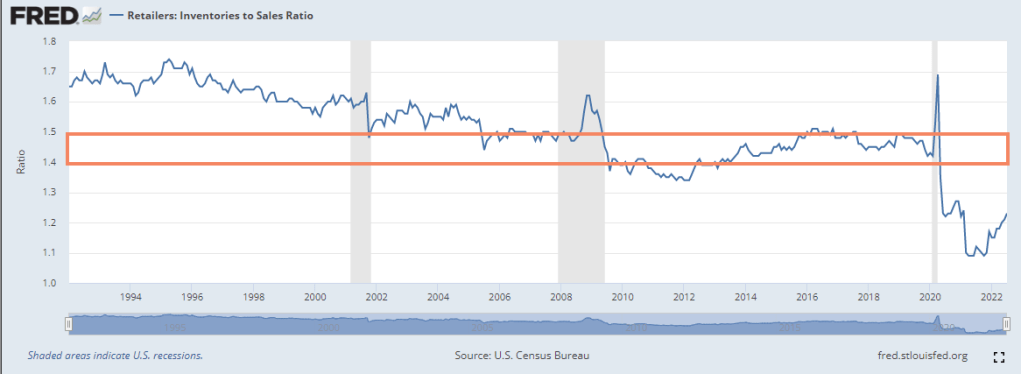
Price records circumstances, not value or utility. Our buying power is like a bar of soap. As water shrinks soap, high inflation shrinks our buying power. Economists offer several explanations for the persistent inflation but the one that I buy is that constrained supply and fairly steady demand are driving prices higher. Rising prices are a symptom of a shortage of goods – a quantity issue. Retailers inventory to sales ratio has increased slightly from the historic low in May 2021 but the ratio is still far below the range of 1.4 – 1.5 that was the benchmark before the pandemic.

This past Thursday, I picked up three jars of my favorite crunchy peanut butter. Some stores have been out of stock on the crunchy variety so I bought extra to be sure. I was not concerned about rising prices. I was responding to a quantity shortage, or the fear of a shortage. The difference is important. In Econ 101, students are shown the standard supply and demand diagram.

Left out of this stylized relationship is that supply is on a slower time scale than demand. It takes time, planning, investment and risk to produce all that supply. To cope with that reality, businesses must keep an inventory on hand to meet changes in demand which happen on a shorter time scale. Shift the red supply line to the left and the intersection of supply and demand occurs at a higher price. The Fed and the market thought that the supply constraints would fully resolve by this year but they have not. As stores and restaurants reopened, customers put away the electric panini sandwich makers, bread machines and gym equipment they had bought during the pandemic. They began purchasing consumables and were willing to pay higher prices for clothes, airline and movie tickets, and restaurant meals. In the face of ongoing supply constraints, the Fed has had to keep raising interest rates to try to curb demand, shifting the blue demand line to the left as well.

The higher prices helped businesses recover profits lost during the pandemic. Businesses have taken advantage of the supply disruptions to juice their profits by 33% (BEA, 2022).

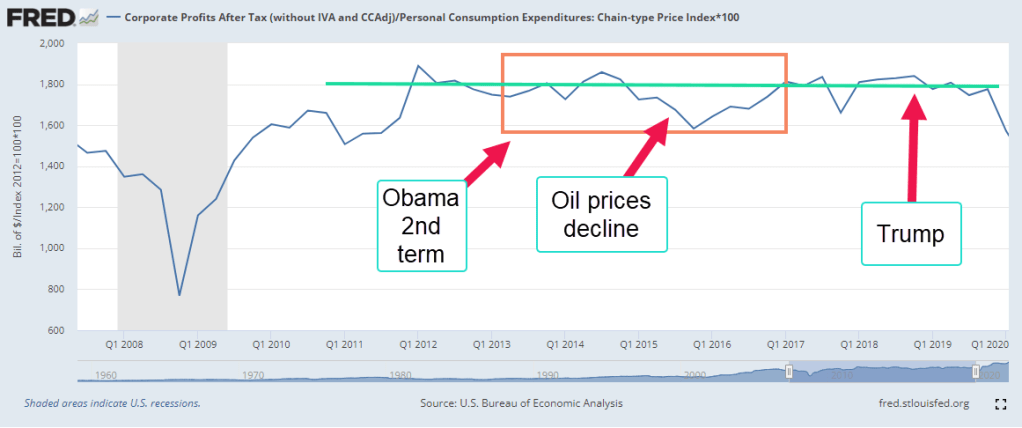
When the Republicans took control of both chambers of Congress and the Presidency, they lowered corporate taxes. Those on the left often blame the economic elite for society’s problems and wasted no opportunity in criticizing Republicans for gifting the corporate elite. Mr. Trump boasted on his business prowess, promising to get the economy revving up again. Despite his rhetoric, corporate profits remained at the same level as during Mr. Obama’s second term.

A Presidential veto can block legislation but it is Congress that passes the laws that affect the economy. As I wrote last week Congress sometimes buys voter approval, creating bubbles that finally implode. The State Historical Society of Iowa (2019) has an image of a 1928 campaign ad for Herbert Hoover. It is a resume of economic progress under total Republican control during the 1920s. The Congress had won the public’s approval with easy credit and lax regulation. The following year the onset of the Great Depression brought down the house of cards. 25% of workers lost their jobs. Many lost their homes and farms.

Corporations exist to turn money flows into profits. Whatever money Congress spends winds up in corporate coffers. After 9-11, the federal public debt rose by $3 trillion (U.S. Treasury Dept, 2019) while corporate profits more than doubled, all thanks to Congress. Democrats and Republicans supported higher military spending and a building boom supported by easy credit policies.

In response to the pandemic, a bipartisan effort in Congress passed relief packages of more than $3 trillion. Today the public debt is $7 trillion above the pre-pandemic level. Much of that money became corporate profit because that’s what good companies do – turn cash flows into profits. Some of those profits were then used to buy the Treasury bills generated when the government increased their debt. This completed the cycle of debt and profits.

On average voters re-elect 90% of House members and 80% of Senate members. Midterm elections are less than two months away. Both parties take advantage of the public’s tendency to pin responsibility – good or bad – on the President, both the current and the past President, Mr. Trump. “Inflation is Biden’s fault,” Republicans will say and hope it sticks with some voters. Democrats hope that Trump will announce a 2024 run for President before the coming midterm election. They hope that independent voters, particularly suburban women, will vote for Democrats to voice their disaffection with Mr. Trump.

The election spending will juice the profits of media companies who depend on the craziness of our democratic politics. People in western European countries look in dismay at our frenzied politics that makes us vulnerable to a populist like Trump. Some Americans long for authoritarian measures that might curb the craziness of our politics and promote more cooperation. They are tired of the demolition derby of American democracy and wish they could go to sleep for a few months until it is over.

////////////////////

Photo by Anvesh Uppunuthula on Unsplash

State Historical Society of Iowa. (2019, January 14). “A chicken for every pot” political ad, October 30, 1928. IDCA. Retrieved September 16, 2022, from https://iowaculture.gov/history/education/educator-resources/primary-source-sets/great-depression-and-herbert-hoover/chicken If you have a moment, do check this out!

BEA: U.S. Bureau of Economic Analysis, Corporate Profits After Tax (without IVA and CCAdj) [CP], retrieved from FRED, Federal Reserve Bank of St. Louis; https://fred.stlouisfed.org/series/CP, September 16, 2022.

U.S. Department of the Treasury. Fiscal Service, Federal Debt: Total Public Debt [GFDEBTN], retrieved from FRED, Federal Reserve Bank of St. Louis; https://fred.stlouisfed.org/series/GFDEBTN, September 16, 2022.

Presidential Predictabilities

March 27, 2022

by Stephen Stofka

The 2024 presidential election is still far away but a 75 year political trend is surprisingly predictive of election results. Add in one economic indicator and the results are even more predictable. An incumbent president won re-election 8 out of 12 times, or 67%. Those who lost failed to jump the hurdle of unemployment. When there is not an incumbent president, voters have changed parties in 6 out of 7 elections. America spends billions of dollars on election campaigning but voters have busy lives full of many choices. As with many decisions, we follow a few simple guidelines. Here’s a guide to winning the next election.  

American voters like change but they usually play fair. When the annual (year-over-year) change in unemployment is falling (UNRATE note below), incumbent presidents are assured of a second term. I’ll refer to that change as ΔU. If that change is falling, then employment is improving and voters don’t kick someone out of office. Let’s look at some recent history to understand the trend and those few times when political issues overshadowed economic trends. At the end of this article is an earlier history for Boomers and political history buffs.

In 1992, the ΔU did not favor incumbent Republican President H.W. Bush in the long stuttering recovery after the 1990 recession. In the 18 months after the end of the first Gulf War ended in early 1991, his approval numbers sank from very high levels. A third party candidate Independent Ross Perot focused on economic issues and diverted a lot of moderate and conservative votes away from Bush, helping to put Democratic candidate Bill Clinton in the White House with only 43% of the popular vote. Unemployment numbers favored Clinton in his 1996 re-election bid and voters awarded him a second term.

By 2000, the great internet bull market was wheezing. Unemployment was rising and did not favor Democratic VP Al Gore as he sought to succeed Clinton. A few hundred votes in Florida separated Gore and his opponent, former Texas Governor George Bush. A partisan Supreme Court made a radical decision to overrule the Florida Supreme Court and award the election to Bush, switching party choice yet again. If the employment numbers had been more favorable to Gore, voters might have been inclined to keep him at the tiller.

Bush’s approval soared after the 9-11 attack but controversy erupted when he decided to attack Iraqi leader Saddam Hussein on the pretext that the country had weapons of mass destruction. When no weapons were found, his ratings sank. The economy had stumbled after the short recession of 2001 but tax cuts in 2003 helped employment numbers recover. Bush avoided the fate of his father and won re-election.

As the housing crisis grew in the spring of 2008, the unemployment numbers turned ugly. Again voters changed parties and elected the Democratic candidate Barack Obama. Despite Obama’s unpopularity over health care reform, the unemployment numbers helped Obama to a second term over challenger Mitt Romney. After two terms of a Democratic president and knowing voters like change, a gambler would put their money on a Republican candidate in the 2016 election. The employment numbers favored the Democratic candidate Hillary Clinton, who won the popular vote. A few thousand votes in key states turned the tide in Donald Trump’s favor. Again, we learned the lesson that employment numbers assure victory for an incumbent president but not the incumbent political party.

In 2020, the pandemic drove the change in unemployment to stratospheric levels, rising 9.3% from 2019 levels. Both parties responded with legislation to stem the shock and economic pain to American households. Despite those historically unfavorable unemployment numbers, Trump increased the Republican vote count but could not overcome a larger surge in Democratic votes. The unemployment numbers in the quarters before the pandemic favored Trump. Had the pandemic not struck, it is likely that he would have won re-election.

Memo to incumbent presidents: If unemployment is rising you won’t win re-election.

Given that history, an incumbent Party should enact fiscal policy that keeps or lowers unemployment in an election year. An opposition party should try to block any such legislation. After the 2008 election, the country was suffering the worst recession since the Great Depression and Senate Minority Leader Mitch McConnell said that his goal was to make newly elected Democratic candidate Barack Obama a one-term president. McConnell was vilified for his partisan remark during a time of crisis but he stated the political reality that elections are a zero sum game. At the time of the August 2011 budget crisis between Republicans and the White House, the ΔU was a solid ½% negative. Falling unemployment hurts the election chances of the opposition party. The realities of democratic elections are uglier than many voters can stomach but we are carried along on those currents.

If unemployment is rising toward the end of 2023, look for Democrats to enact fiscal spending that will put people to work. To improve their own chances, watch for Republican strategies that will block any such measures.

////////////

Photo by Gene Devine on Unsplash

UNRATE Note: Unemployment is the headline number, averaged over each quarter. The year-over-year change is taken in the 2nd quarter of an election year (April – June) before each political party conducts its convention to choose their candidate.

/////////////

For interested Boomers and history buffs:

Near the end of WW2, 4-term Democratic President Roosevelt died and his VP Harry Truman assumed the Presidency. In 1948, the unemployment numbers looked grim as the economy tried to absorb millions of soldiers returning from war. Pre-election polls had favored Truman’s opponent, Thomas Dewey, and one newspaper printed out a headline on election night that Dewey had won but that announcement was premature. Truman’s victory is the only time an incumbent has won re-election when unemployment numbers were unfavorable. When the final results were announced, Truman famously pointed to the newspaper’s false headline. Perhaps that is the first time when a politician called out “fake news.”

In the spring of 1952, incumbent Democrat President Truman’s ratings were falling. The ΔU was neutral but the trend was against Truman. When he lost the New Hampshire primary to another Democratic candidate, he retired to his home in Missouri. Republican Dwight Eisenhower won the election. In 1956, the unemployment numbers favored “Ike” and voters gave him another term. In 1960, the ΔU had turned against Ike’s aspiring successor, VP Richard Nixon. Voters switched parties, choosing JFK, a Democrat, in a close and contentious election.

After Kennedy’s assassination in 1963, the unemployment numbers were strongly in favor of President and former VP Lyndon Johnson, who rode the wave of favorable sentiment to the White House. In the spring of 1968, the ΔU still favored Johnson but voter sentiment was more focused on the Vietnam War and Johnson decided not to run for re-election just as Truman had chosen 16 years earlier. Richard Nixon’s political fortunes resurrected on his promise to end the war with dignity and voters changed parties.

In 1972, unemployment favored Nixon who regained the White House, only to leave a few years later to avoid impeachment and ejection from office. In 1976, unemployment numbers looked good for Gerald Ford, who had assumed the presidency. However, he could not overcome voter hostility after he pardoned Nixon for the crimes revealed during the Watergate hearings. Incumbency and favorable employment numbers are powerful persuaders but there are a few times when voters concentrate on political matters more than economic considerations.  

Jimmy Carter, a Democrat, took the White House but couldn’t keep it as both unemployment and inflation were rising in 1980. Republican winner Ronald Reagan had often asked “Are you better off today than you were four years ago?” In 1984, unemployment was still high but falling by 2.7% and Reagan won in a landslide. 1988 is the only election in which the voters did not change parties after two terms. Unemployment was falling and voters turned to VP H.W. Bush for his turn in the top job. Unemployment is a decisive factor in re-electing an incumbent but not enough to overcome the American inclination to political change every decade.

The history continues in the main part of the article.

A Test of Democracy

December 27, 2020

by Steve Stofka

In 2008, Barack Obama won almost 25% of counties, a high percentage for a Democratic candidate. In 2016 and 2020, a sixth of counties voted for a Democratic President. Though a small percentage, those counties represented more than 2/3rds of the nation’s GDP. The most productive part of our economy votes Democratic, but a county electoral map looks mostly red. How can that be?

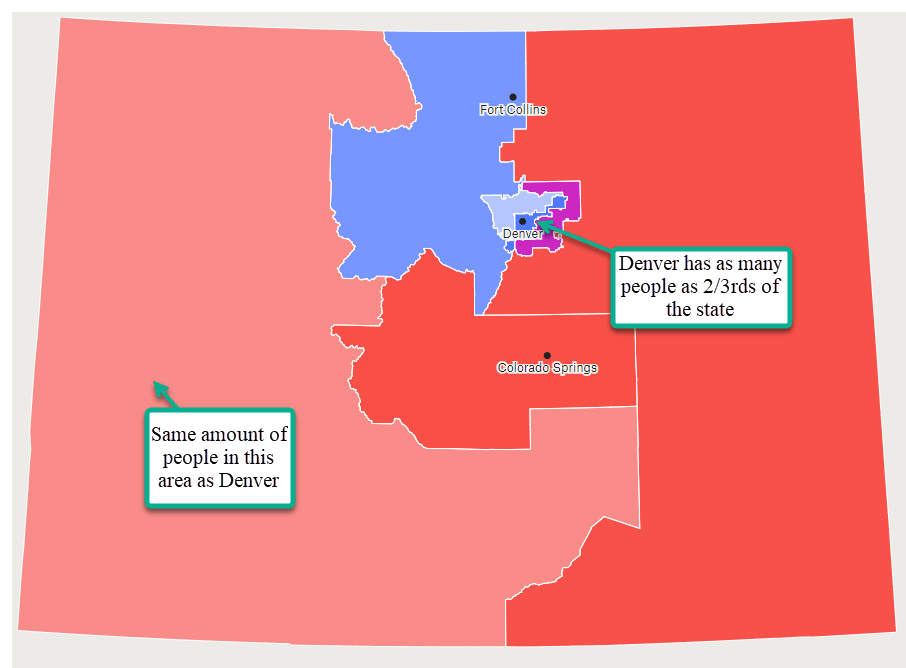
More than half of the U.S. population lives in less than 5% of counties (Census Bureau, 2019). A county electoral map gives the same weight to a county in Colorado with a few hundred people as it does to L.A. county which has 10,000,000 inhabitants. A person looking at that map gets the impression that “most of the country” votes Republican but land doesn’t vote – people do.

A more accurate electoral map is by congressional district like this one at FiveThirtyEight (2018). Voting districts are assigned by population, not land area. I’ll copy their Colorado map to illustrate the point. There are as many people living in a few square miles in Denver as there are in more than half the state.

As the population concentrates close to urban areas, a county-by-county analysis reveals some long-term trends. Historian David Kennedy recently noted a shift in sentiment over the past four decades (2020). In 1980, 13% of counties were dubbed “landslide” counties in which the Presidential candidate won by 20% or more of the vote. By 2000, 19% of counties voted that way. In the 2020 election, more than 50% of counties were landslide.

Kennedy referred to Bill Bishop’s 2009 book The Big Sort which described how Americans were moving to places where they lived with others whose political sentiments were like their own (2009). For more than a century, we have been moving from the country to the city. After World War 2, the automobile gave us the freedom to move further away from where we work. We like living with people who resemble us.

A trend that has been going on for a century is likely to continue. Those hoping that election tensions will ease in the future will be disappointed. Although social media helps spread election conspiracy theories, Americans are fond of such theories. Those on the left side of the aisle were convinced that the governor of Ohio stole the 2004 election for George Bush (Weiss, 2020). That was on the heels of the 2000 election which Florida governor Jeb Bush stole for his brother George.

Each election begins in earnest on inauguration day. Immediately after President Obama’s inauguration in 2009, Mitch McConnell succinctly summed up his job as the Senate’s Minority Leader – his job was to make sure Obama was a one-term President. With the nation deep in a financial crisis and millions of people out of work, Democrats condemned McConnell’s remark.

From the first day of President Bush’s presidency in 2001, Democrats rallied and protested the boy made king by an activist Supreme Court. In a 5-4 decision, five supposedly conservative justices tossed aside conservative jurisprudence and voted to overthrow the decision of Florida’s Supreme Court. Henry Monaghan argued against the hundreds of legal scholars who condemned the court’s jurisprudence. The first few pages summarize the circumstances of that election and the many criticisms of the court’s decision (2003).

Eighty years ago, FDR wielded his executive pen like a sword to cut through any Congressional opposition from those on either side of the Congressional aisle. In his 3-1/2 terms, he signed more than 3000 orders, a record that will likely never be broken. Today, our Presidents rule by executive order. Each President spends his first year undoing the executive orders of the last President if that President was from the other party. Without the consistency of law, the American people lose respect for the law, regarding it as little more than personal whim.

The Constitution gives the President the power to grant pardons for Federal crimes. Each President’s use of the pardon power demonstrates that personal sentiment and political alliances matter more than justice. After President H.W. Bush pardoned all the co-conspirators in the Iran-Contra scandal, the American people began to lose faith in the law.

The Supreme Court’s 2000 Bush v. Gore decision reinforced the notion that America was like the old European nations, a country of patronage and favor, not one of law. Mr. Bush disregarded good judgment, the law, and his own intelligence services to justify an attack on Iraq in response to the 9-11 tragedy. Business scandals punctuated the first four years of his administration. His re-election in 2004 convinced many Americans that corruption, not competence, was the American way. Mr. Bush’s second term reinforced that impression.

President Obama’s political rhetoric was strong and even-tempered, but his policy response to the financial crisis was weak and un-tempered. Within two years the American people chose political paralysis, wresting control of state governments from Democrats and handing the House to the Republicans. Like Mr. Bush before him, Mr. Obama found fault with others, not himself.

After electing an unseasoned backbench Senator Obama to office, the American people elected a TV star to the Presidency. Why not? America, the competent, has become a country of fools. Why would we not elect New York City’s leading buffoon?

Each day more people die of Covid than lost their lives in 9-11. The country now turns from the Jester to a seasoned former Senator, Mr. Biden, to lead the country. Unlike Mr. Obama and Mr. Trump, Mr. Biden is not in love with his own rhetoric or his judgment. Can he restore competence to the White House? Perhaps.

What he can’t do is restore the competence of the voters, who love their opinions more than their interests. Regardless of his success or his policies, half the country will condemn him because we have sorted ourselves into them and us. James Madison, the chief architect of the Constitution, worried most about the rise of factions because that is what brought down the Roman empire. We fought a Civil War and have not been a United States since then. We are transforming ourselves into a type of European confederation, divided into regional, rural, and urban interests, clutching our contempt for our fellow Americans to our hearts. Is this the century when we finally abandon the experiment of the United States?

/////////////////

Photo by Den on Unsplash

Bishop, B. (2009). The big sort: Why the clustering of like-minded America is tearing us apart. Boston: Mariner Books. [Kindle price $1.81 from https://www.amazon.com/Big-Sort-Clustering-Like-Minded-America/dp/0547237723/ref=sr_1_1

FiveThirtyEight. (2018, January 25). The Atlas Of Redistricting. Retrieved December 25, 2020, from https://projects.fivethirtyeight.com/redistricting-maps/

Kennedy, D. (2020, December 9). David Kennedy: The Future of Democracy in America. Retrieved December 25, 2020, from https://www.commonwealthclub.org/events/archive/podcast/david-kennedy-future-democracy-america

Henry P. Monaghan, Supreme Court Review of State-Court Determinations of State Law in Constitutional Cases, 103 COLUM. L. REV. 1919 (2003). Available at: https://scholarship.law.columbia.edu/faculty_scholarship/164

US Census Bureau. (2019, May 23). Big and Small America. Retrieved December 25, 2020, from https://www.census.gov/library/stories/2017/10/big-and-small-counties.html

Weiss, J. (2020, December 21). What Happened to the Democrats Who Never Accepted Bush’s Election. Retrieved December 25, 2020, from https://www.politico.com/news/magazine/2020/12/19/2004-kerry-election-fraud-2020-448604

A Man and his Kingdom

November 22, 2020

by Steve Stofka

In Shakespeare’s tragedy, King Richard III offers his kingdom for a horse after his is struck down in battle. Mr. Trump echoes the reverse sentiment, bargaining and plotting to retain his kingdom.  

The White House has archived a Heritage Foundation sampling of election fraud (Heritage Foundation, n.d.) Most of them are for local and state elections because fraud has some degree of potency in smaller elections. In a Presidential race, an attempt at fraud is like pouring a cup of water in a lake. Some of the cases are sad. A son is convicted for submitting a ballot for his mother who has just died. Some vote twice in an election even after being warned not to by election officials. Some cheat to get their friend or their boss elected to city council.

Conspiracy theorists claim that this is just the tip of the iceberg. “Absence of evidence is not evidence of absence,” they claim. Christians explained that objects fell to the ground because angels pushed them. They used the same reasoning, evidence of absence, to counter Newton’s claim that it was a force called gravity. Newton’s theory was more predictive, but I dare anyone to show me that angels are not making things fall to the ground.

Why won’t President Trump concede the election? Trump’s efforts have been dismissed by courts, including one state Supreme Court. Some on the right point to the 2000 election and the lawsuits brought by Democrats in the Florida count as a justification for Trump. The 2000 Presidential election was decided by 537 votes out of 6 million in the state. That is a small probability multiplied by the small probability that such a result would matter in the Electoral College. Perhaps 2 in a 1,000,000; it had never happened before in U.S. history. The probabilities indicate that it has never happened before in human history. Are Mr. Trump’s election numbers as close as the 2000 election? Hardly.

Katherine Harris, Florida’s Secretary of State, may have committed fraud in the 2000 election; it makes sense to risk fraud when the vote difference is that narrow. A difference of 10,000 votes – the smallest difference in any of the states that Trump is contesting – is not narrow.

Mr. Trump claims fraud before every contest. When he picked one wrestler in the 1988 WBF wrestling championship that he sponsored, he claimed that the other side was cheating. His guy won despite the cheating. Huzzah! He is a promoter. If accusations of cheating arouse the crowd, let’s do it.

After the 2008 election, Mr. Trump led the “birther” movement, claiming that Mr. Obama had cheated because he was not born in the U.S. Before – not after – the 2016 face off with Ms. Clinton in 2016, he claimed that Democrats were stealing the election (Zeitz, 2016). What works in wrestling works in elections, doesn’t it? Get the crowd’s attention. Play to the 5-year old in each of us.

Supporters of Mr. Trump point to the 1960 Presidential election as evidence for fraud. JFK (this is the anniversary of his assassination) won Illinois’ electoral votes by a slim margin of almost 9,000 votes in Cook County, where the mayor was a supporter of JFK and a family friend (Zeitz, 2016). Absence of Evidence is not Evidence of Absence.

Did Nixon throw the 1968 election? Just before the election, President Johnson called a halt to bombing in South Vietnam to give Vice-President and candidate Humphrey a boost in the polls. The Nixon campaign countered by promising a better deal to the other side if Nixon was elected. Aiding and abetting a foreign enemy? (Kilgore, 2018).

To distinguish this from election fraud, let’s call it election rigging; a campaign conducts a strategy which will help win them the election without altering votes per se. The Watergate scandal in advance of the 1972 election was an attempt by the Nixon campaign to get intel on the other side’s campaign. If Nixon had admitted to it early on, the press might have made a big brouhaha for a few months and it would have blown over. The public might have regarded it as corporate espionage – an attempt to discover the competition’s secrets. Nixon kept it within the American family.

That was not the case in the 1980 election; like the 1968 Nixon campaign, the Reagan campaign sought help from a foreign power, Iran. The Carter Administration had negotiated through Algiers a release of American hostages who had been in captivity for a year. The Reagan camp promised better terms to Iran if they would delay the release of American hostages until after the 1980 election and the swearing in of Ronald Reagan. The drawn-out hostage crisis was one of several key events that cost President Carter re-election, and Reagan handily defeated Carter. Iran released the hostages the day that Reagan took the Presidential oath (U.S. Dept. of State, n.d.). Americans spent an additional 90 days in prison so that Reagan could win an election. Election strategy, not election fraud.

Voting is essential to a democracy. So is free speech. Unless one can control speech as they do in Russia and China, the best offense is to add more speech to dilute authentic opinion. When Mr. Trump claims that more “illegal” votes were added to dilute the votes of true American opinion, he is taking a page out of the playbook that the KGB and Communist Party use.

He has cozied up to Vladimir Putin, to Kim Jong-un, and Xi Jinping, all Communist dictatorships. That is the America that Mr. Trump wants – a private kingdom of his own just like those guys have. He is jealous of their power and their control of the media. He wants his own kingdom for just four more years. How many Republicans will help him achieve his dream?

//////////////////

Photo by Annie Spratt on Unsplash

Heritage Foundation. (n.d.). A Sampling of Election Fraud Cases from Across the Country. Retrieved from https://www.whitehouse.gov/sites/whitehouse.gov/files/docs/pacei-voterfraudcases.pdf. (Notice that this report by a private foundation has been archived at the White House).

Kilgore, E. (2018, October 16). The Ghosts of the ’68 Election Still Haunt Our Politics. Retrieved November 21, 2020, from https://nymag.com/intelligencer/2018/10/1968-election-won-by-nixon-still-haunts-our-politics.html

U.S. Dept. of State. (n.d.). An End to the Crisis. Retrieved November 21, 2020, from https://history.state.gov/departmenthistory/short-history/hostageend

Zeitz, J. (2016, October 27). Worried About a Rigged Election? Here’s One Way to Handle It. Retrieved November 21, 2020, from https://www.politico.com/magazine/story/2016/10/donald-trump-2016-rigged-nixon-kennedy-1960-214395

Jobs Affect Elections

September 15, 2019

By Steve Stofka

“It’s the economy, stupid,” James Carville posted in the headquarters of Bill Clinton’s 1992 Presidential campaign. The campaign stayed focused on the concerns of middle and working- class people who were still recovering from the 1990 recession. Jobs can make or break a Presidential campaign.

Each month the BLS reports the net gain or loss in jobs and the unemployment rate for the previous month. These numbers are widely reported. Weeks later the BLS releases the JOLTS report for that same month – a survey of job openings available and the number of employees voluntarily quitting their jobs. When there are a lot of openings, employees have more confidence in finding another job and are more likely to quit one job for another. When job openings are down, employees stick with their jobs and quits go down as well.

President Bush began and ended his eight-year tenure with a loss in job openings. Throughout his two terms, he never achieved the levels during the Clinton years. Here’s a chart of the annual percent gains and losses in job openings.

As job losses mounted in 2007, voter affections turned away from the Republican hands-off style of government. They elected Democrats to the House in the 2006 election, then gave the party all the reins of power after the financial crisis.

As the 2012 election approached, the year-over-year increase in job openings slowed to almost zero and the Obama administration was concerned that a downturn would hurt his chances for re-election. As a former head of the investment firm Bain Capital, Republican candidate Mitt Romney promised to bring his experience, business sense and structure to help a fumbling economic recovery. The Obama team did not diminish Romney’s experience; they used it against him, claiming that Romney’s success had come at the expense of workers. The story line went like this: Bain Capital destroyed other people’s lives by buying companies, laying off a lot of hard-working people and turning all the profits over to Bain’s fat cat clients. The implication was that a Romney presidency would follow the same pattern. Perception matters.

In the nine months before the 2016 election, the number of job openings began to decline. That put additional economic pressure on families whose finances had still not recovered following the financial crisis and eight years of an Obama presidency. Surely that led some working-class voters in Michigan, Wisconsin and Pennsylvania to question whether another eight years of a Democratic presidency was good for them. What about this wealthy, inexperienced loudmouth Trump? He didn’t sound like a Republican or Democrat. Yeah, why not? Maybe it will shake things up a bit.  Enough voters pulled the lever in the voting booth and that swung the victory to Trump.

In the past months the growth in job openings has declined. Having gained a victory based partially on economic dissatisfaction, Trump is alert to changes that will affect his support among this disaffected group. As a long-time commentator on CNBC, Trump’s economic advisor, Larry Kudlow, is aware that the JOLTS data reveals the underlying mood of the job market. Job openings matter.

Unable to get action from a divided Congress, Trump wants Fed chairman to lower interest rates. There have been few recessions that began in an election year because they are political dynamite. The recession that began in 1948 almost cost Truman the election. The 1960 recession certainly hurt Vice-President Nixon’s bid for the White House in a close race with the back-bench senator from Massachusetts, John F. Kennedy.

In his bid to unseat President Carter in 1980, Ronald Reagan famously asked whether voters were better off than they were four years earlier. The recession that began that year helped voters decide in favor of Reagan.

Although the 2001 recession started a few months after the election, the implosion of the dot-com boom during 2000 certainly did not help Vice-President Al Gore’s run for the White House. It took a Supreme Court decision and a few hundred votes in Florida to put Bush in the White House.

As I noted earlier, George Bush began and ended his eight years in the White House with significant job losses. Those in 2008 were so large that it convinced voters that Democrats needed a clear mandate to fix the country’s economic problems. After the dust settled, the Dems had retained the house, won a filibuster-proof majority in the Senate and captured the Presidency. Jobs matter.

The 2020 race will mark the 19th Presidential election after World War 2. Recessions have marked only four elections – call it five, if we include the 2000 election.  An election occurs every four years, so it is not surprising that recessions occurred in only 25% of the past twenty elections, right? It’s not just the occurrence of a recession; it’s the start of one that matters.

Presidents and their parties act to fend off economic downturns with fiscal policy or pressure the Fed to enact favorable monetary policy that will delay downturns during an election. Trump’s method of persuasion is not to cajole, but to criticize and denigrate anyone who doesn’t give him what he wants, including the Fed chairman. To Trump, life is a tag-team wrestling match. Chairman Powell can expect more vitriolic tweets in the months to come. Trump will issue more executive orders to give an impression that his administration is doing something. The stock market will probably go up. It usually does in a Presidential election year.