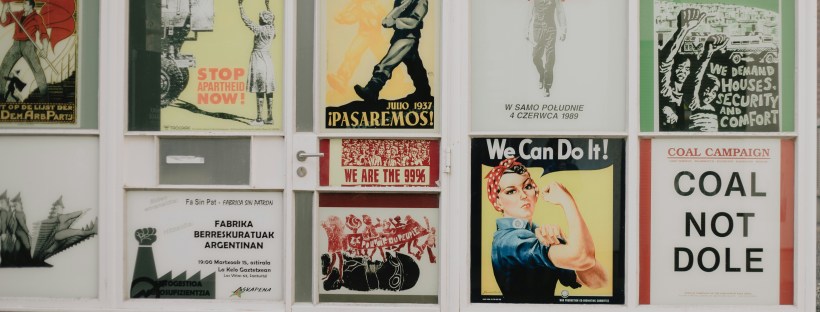
A wall with propaganda posters from several countries

Power and Propaganda

May 17, 2026

By Stephen Stofka

This week I want to explore the nature of propaganda. Is it a form of speech? Is it in the eye of the beholder, like beauty? Did the framers intend to protect propaganda as a form of speech?

Let’s look at a dictionary meaning of propaganda: “information, ideas, or rumors deliberately spread widely to help or harm a person, group, movement, institution, nation, etc.” (Source). The Bible would satisfy that definition. Most of the political spin that comes out of the White House would also satisfy that definition. CYA, or “Cover Your Ass” comments and redirection is a form of propaganda.

I prefer the definition in the Oxford English Dictionary (OED), which describes the meaning as “the systematic dissemination of information, esp. in a biased or misleading way, in order to promote a particular cause or point of view, often a political agenda” (Source). Propaganda is prop-agenda,  a propping up or boosting of an agenda or regime. Propaganda is systematic, not casual. Harm to a group or person is incidental to promoting a particular cause. This helps distinguish retribution  from propaganda.

President Trump often attacks people he doesn’t like in a systematic way, a characteristic of propaganda, but he does not promote a particularly coherent cause. Trump uses repetition as a strategy of branding or labeling. His attacks on Jerome Powell, Chairman of the Federal Reserve, for being “incompetent” and “crooked” is a branding strategy in a campaign of retribution (Source). It is not propaganda.

The former talk show host Rush Limbaugh used repetition and ridicule to brand political figures that he didn’t like. Trump borrows some of those techniques but doesn’t have Limbaugh’s imagination. Limbaugh invented colorful names and phrases to belittle political opponents, and the reach of his radio program helped them become common usage. Examples include tree huggers for environmental activists, feminazis for abortion activists, and drive-by media for mainstream media. Both Limbaugh and Trump emphasized the entertainment aspect of political discourse.

In 1922, journalist Walter Lippmann published Public Opinion, about the shaping of public opinion in a democracy. World War I had birthed a massive propaganda machine in America, led by George Creel, who headed the Creel Committee, appointed by President Wilson to promote America’s involvement in the war (Source). Wilson had won re-election in 1916 on the promise that America would stay out of the war in Europe, and he needed to combat the isolationist sentiments of the majority of Americans. Creel fought “for the minds of men, for the conquest of their convictions” to spread “the gospel of Americanism” to “every corner of the globe,” Lippman quoted Creel (p. 19). So began the evangelical crusade to convince the world that American institutions were superior to those of other nations.

Lippmann wrote “Without some form of censorship, propaganda in the strict sense of the word is impossible” (p. 18). Censorship is a key aspect because it is a police power, a function of government. Lippmann wrote “a group of men, who can prevent independent access to the event, arrange the news of it to suit their purpose” (p. 17). All governments claim that war justifies an additional degree of censorship, but that is an ugly term in the minds of Americans. We have the First Amendment and a free press. Censorship is a term we associate with Communist Russia, China and North Korea.

In 1918, Congress passed the Sedition Act of 1918 to outlaw any “disloyal, profane, scurrilous, or abusive language” about the government, the military or the flag that interfered with the war effort. It was meant as an expansion of the Espionage Act of 1917, and more than a thousand people were prosecuted under both acts. In Debs v United States, the Supreme Court upheld the conviction of Eugene V Debs for an antiwar speech he gave (Source). The decision was unanimous, indicating how little importance the Court paid to individual rights during wartime. Although the Sedition Act was repealed in 1920, the Espionage Act remains in effect to this day (Source).

The first thing American politicians must do is sell censorship to Americans as something other than censorship. An administration may be “combating misinformation” for the “public safety.” Censorship is necessary to “protect national security.” Another ploy is the use of a national emergency. The administration often claims that bold and unconventional action is needed because of a national emergency, but can’t give a coherent explanation of the emergency because of national security. George Carlin (1937 – 2008) was a comedian who famously poked fun at many of the euphemisms we use. He would have found the Trump administration a rich source of material for his stage act.

To justify censorship, American politicians have been in state of war since World War 1. If they are not fighting communism, terrorism, or totalitarianism, they are at war with drugs, poverty, and injustice. War for a noble cause can be used to justify secrecy and censorship. During the Vietnam War, reporters and TV crews had fairly free battlefield access. Both the Johnson and Nixon administrations felt that an honest and open coverage of the war contributed to public skepticism and a lack of support for the war.

During the Gulf War twenty years later, reporters were herded into press pools or embedded with military units. Reporting was subject to military security reviews to prevent the leak of any operational details and for the protection of the troops. Imagery of casualties was kept to a minimum and the emphasis was on the technological prowess of the American military. Those censorship policies continued during the Iraq and Afghanistan Wars. Both Israel and America have tried to hide the costs of the current war against Iran. The Trump administration has suppressed reports of damage to American military bases in the Gulf Coast states. Defense Secretary Hegseth has purposely understated the monetary costs of the war. Israel has effectively imposed a total black out of damage within its country. Both countries have discarded the trappings of democracy, and adopted the tactics of totalitarian regimes.

Did the framers intend propaganda to be included in First Amendment protections? That is not so clear. The first use of the word in its current political meaning did not occur until 1790, according to the historical examples shown in the OED entry. The chaos of the French Revolution and the prospect of war with France led Federalists in Congress to pass the Alien and Sedition Acts in 1798 (Source). They did not refer to propaganda, as such, but used similar terms, like “seditious writings,” “foreign influence,” and referred to the “licentiousness of the press.” The Sedition Act criminalized publishing “false, scandalous, and malicious writing” against the federal government, Congress, or the president. Federalists argued that coordinated attacks by partisan newspapers could undermine public confidence and destabilize republican government.

Before the Acts expired in 1801, several defendants challenged the constitutionality of the Sedition Act. Matthew Lyon, a Republican congressman, was prosecuted and jailed for criticizing President John Adams. Lyon argued the law violated freedom of speech and press protections. Thomas Cooper challenged the constitutionality of the Sedition Act in court, arguing that criticism of government officials was protected political speech. At that time, people disagreed whether federal courts had the authority to strike down acts of Congress. A few years later, Chief Justice Marshall set a precedent in Marbury v Madison that it was the responsibility of the Supreme Court to interpret the Constitution.

Is “false, scandalous, and malicious writing” a form of propaganda? The Federalists were worried about coordinated acts by newspapers, a systemic campaign that would indicate propaganda. Remember that Walter Lippmann introduced a distinguishing characteristic of censorship, which implies a police power. I might think that Fox News broadcasts propaganda, but does Fox News have the power to impose censorship? Viewers can choose to watch or not. The coverage might be biased, but it is not propaganda. That element of censorship can only exist when government institutions produce a biased set of information and opinion in a systematic manner.

The use of propaganda is an existential tool for any political regime. That’s especially so when the media is privately owned. An administration must carefully prune information which undermines its effectiveness. The Trump administration has been particularly aggressive in reducing data gathering at federal agencies that Trump does not like (Source). He has cut staff at NOAA because he doesn’t like climate change. NOAA is responsible for climate modeling and weather forecasting. Farmers in Iowa who no doubt voted for Trump depend on that information to manage their business. He has reduced staff at the CDC and eliminated surveys that gauge reproductive health and infectious disease (Source). Like many conservatives, Trump does not like the Department of Education and would eliminate it if he could (Source video). Most of the staff at the National Center for Education Statistics has been terminated (Source). The department administers student loans and special education funding. It enforces civil rights protections and helps equalize funding across states. How well is the Trump administration managing those areas? Without a national database of information, Trump can avoid scrutiny.

Under the Freedom of Information Act (FOIA), media organizations file hundreds of thousands of requests to gain access to information. If the administration denies the request, the requester can file a lawsuit. There is no central database that compiles FOIA requests by administration or agency, but the number of FOIA lawsuits (not requests) during the first Trump administration far surpassed that of previous administrations (Source).

In casual conversation, we may label something as propaganda, but it is limited to a government with the police power to limit information and prosecute offenders. Detecting propaganda is made more difficult if it aligns with our biases. We may tolerate censorship by an administration that we favor, reasoning that they must have a good reason. However, we are alert to any censorship from an administration that we don’t like. We are suspicious and more apt to believe in conspiracy theories about that administration. In an electorate that is evenly divided, as we have now, half of voters are tolerant of propaganda and half are not. We need to be less tolerant of propaganda and censorship from either party. Yes, it takes time and resources. Yes, we have other concerns in our daily lives. The health and viability of a democratic republic depends on an informed people who are not duped by politicians from either party.

///////////////////

Photo by Sinitta Leunen on Unsplash

Speech Control

January 18, 2026

By Stephen Stofka

This week, as I was waiting in a checkout line at the store, a couple a few lines away pushed a grocery cart with a toddler sitting inside. The toddler screamed uncontrollably, and the sound killed several of my brain cells, I was sure. I glanced their way, wanting to see if the child was hurt. She wanted her mother’s keys. When the mother relented and gave her toddler the keys, the child immediately grew quiet. What I thought was the uncontrollable anguish and rage of a toddler was a controlled performance designed to achieve a specific goal.

This week I want to take a look at the topic of control. Human beings are engineers by nature. We domesticate animals to serve our needs. We cultivate crops to produce a more pleasing taste and higher yields. We control the actions of other people to serve our wants. In his book The Indispensable Right: Free Speech in an Age of Rage, Jonathan Turley examines the history of speech control from ancient Greece to the present. America was the first country to stipulate a right to free speech in the First Amendment to its Constitution. In 1798, several years after the Constitution’s ratification, the passage of the Sedition Act tossed aside the First Amendment. The act prohibited newspapers from publishing anything critical of the administration of President John Adams, the successor to George Washington (Source).

The Constitution had recognized the danger of regional factions but not the formation of political parties. Alexander Hamilton and John Adams were the leaders of the Federalists, advocating a strong central government. Thomas Jefferson and James Madison represented the Democratic-Republicans, an opposition party that supported state and local control. For Adams, it was especially inconvenient that his Vice-President, Thomas Jefferson, actively opposed many of his policies. The Sedition Act was an attempt to quell criticism from media outlets owned by people who were sympathetic to the ideas of the Democratic-Republicans.

Three decades earlier, when the American colonies were under British rule, John Adams had been an outspoken rebel against the British monarch, the Parliament and the colonial governors. Now that Adams was the leader of the new nation, he regarded any criticism of his policies as outright sedition. When we are in control, challenges to our rule come from those who are out of control. When we are not in control, we may regard the actions of those who are in control as  uncontrollable. This duality of control makes the formation of at least two political parties inevitable. That is the second topic I want to look at this week, inevitability.

Whenever there is a disaster, an investigation often uncovers a chain of events that gives us the impression that the disaster was inevitable. No one can predict the likelihood of a severe hurricane like Katrina, but the consequences of Katrina seem inevitable in retrospect. In 1968, the Army Corp of Engineers built the Mississippi River Gulf Outlet through residential neighborhoods, particularly the lower ninth ward where 15,000 African Americans lived (Source). The outlet made it easier for ships to transition from the Mississippi River to the Gulf of Mexico but put many people at risk. In those decades following WW2, urban planners often constructed highways and other thoroughfares through poorer neighborhoods with little political power.

It is inevitable that rulers want only consensus from those they rule. A political leader fancies himself as the captain of a large ship. Any criticism of the captain’s direction is a threat of mutiny and must be suppressed for the safety of all, the captain reasons. Any crew members who are not willing to take orders from the captain are dismissed or thrown overboard. Disagreements are not tolerated. That is the policy of the current administration.

For several decades, the governors of the Federal Reserve have demonstrated an independence that is unique among federal agencies. The governors are appointed by the President and confirmed by the Senate but often express views that are contrary to those of the President and the Chairman of the Federal Reserve. During the 1960s and 1970s, the Federal Reserve conducted monetary policy that was compliant with the President’s wishes. The result was soaring inflation. Lesson learned. Congress has given the Fed a dual mandate to promote two policies that are at odds with each other, full employment and moderate inflation. Helping the President’s reelection chances or popularity is not one of those goals. To accomplish those goals, the Fed must conduct unpopular policies like higher interest rates. More demand for labor tends to create inflation. Higher inflation creates less demand for labor. Balancing these two objectives is a difficult task. Some governors give a priority to employment and favor what is called a dovish monetary policy. Others prefer a hawkish monetary policy that chokes off any signs of inflation even if that lowers employment. Again we see a conflict of two perspectives.

Multiple perspectives are inevitable. Suppressing speech aims to suppress the voices of those who are not in control of policy at a particular moment. We are aware that China, Russia and N. Korea control their media and actively prosecute dissidents. That’s bad. When college campuses block controversial speakers, that is also a form of speech suppression on a reduced scale. Advocates for such policies claim that suppressing harmful speech is itself a form of free speech.

Turley reminds us of John Stuart Mill, the 19th century author of On Liberty who argued against this very practice in his time (p. 260). Mill advocated a harm principle that limited government action to protecting us from harm by others while allowing us to exercise our rights (p. 256). In a complex society, we are connected to and affected by the actions of others. A controversial speaker appearing on campus may cause me some anxiety. That level of harm does not meet Mill’s threshold to justify me organizing a campaign to pressure the administration to ban the speaker from appearing on campus.

Governments invoke their own expansive definition of harm to prohibit free speech. They are acting in the cause of public safety, promoting social harmony, and reducing conflict and controversy that might upset some people. China has a centuries long history of civil war. They justify one party rule and media control as a way to avoid another civil war. Just the possibility of harm becomes a basis for speech suppression. That reminds me of the 2002 film Minority Report where police act on the advice of psychics to interrupt and prosecute crimes before they are committed.

Given our nature as engineers who want to control our environment, it is inevitable that leaders want to control unwanted speech while allowing and promoting favorable speech. Few of us, however, want to live in a leashed society where information is fed to us like dog food. We cherish our autonomy and do not want to be treated like pets. We do not want to be caged by government police because we expressed an unfavorable opinion. The desire to control and the resistance to control will continue to create conflict in human societies for centuries to come. That much is inevitable.

//////////////////

Photo by Patrick Tomasso on Unsplash

Keywords: free speech

Blurb: Few of us want to live in a leashed society where information is fed to us like dog food.

Freedom and Tolerance

November 2, 2025

By Stephen Stofka

In 1776, the 13 American colonies declared independence from Britain. The entire first half of that Declaration was very much a proclamation of freedom. The second half was a declaration of grievances against the King of England. Many colonists had grown intolerant of the king’s ‘usurpations,’ an unlawful taking under the cloak of authority (Source). The word is unfamiliar to modern readers, but the protection against the taking of private property is enshrined in the Fifth’s Amendment’s final clause, “nor shall private property be taken for public use, without just compensation” (Source). The 56 signers to the Declaration of Independence argued most over this second half of the declaration, for it was their justification for rebellion. They hoped to win the sympathies of European countries, particularly the French in the long feud between England and France.

This week I want to focus on two ideas as axes of analysis, freedom and tolerance. The two seem to have an inverse relationship. As the colonists felt more empowered to claim their freedom, they became less tolerant of the crown’s impositions. It’s not clear to me which is the more powerful force, the intolerance or the thirst for more freedom. The colonists had to pay taxes to support the soldiers and administration that kept them in line. Only in Connecticut and Rhode Island did the colonists elect their governors (Source). Colonial governors appointed by the king often overruled the wishes of popularly elected assemblies. The colonists wanted more autonomy.

In his book Leviathan, the 17th century philosopher Thomas Hobbes (1588 – 1679) wrote that we exchange some freedom for security in what would otherwise be a raw state of nature, an “every man for himself” kind of world. The book, published in 1651, justified a monarchy to preserve the peace between members of a civil society. More than a century later, the colonists asked themselves how much freedom they had to give up for that security. They had reached the end of their tolerance.

We speak of the colonists as they shared a single sentiment but that was not the case. Americans have always been divided about important issues. Writing almost 40 years after the Declaration, John Adams (1856), our second President after George Washington, recalled that a third of the people favored independence, a third were more favorable to England and a third were neutral. Robert Calhoon (2000), a scholar of American Loyalists, estimated a smaller percentage, perhaps 15 – 20%, favored the crown.

We are less tolerant of encroachments on our own freedoms than on the freedoms of others. The generation that wrote and ratified the Constitution exemplified that principle. In 1787, thirty-nine delegates to the Constitutional Convention signed the Constitution. As many as half of them had owned slaves during their lifetime, including Washington and Madison. Jefferson praised the sanctity of “life, liberty and the pursuit of happiness” in the Declaration but owned almost 200 slaves which he listed in his Farm Book (Source). A case of ‘liberty for me, not for thee’?

People are less free when they are poor or in a minority with less opportunity. They may sometimes act with an air of intolerance, but their income constrains their freedom. They must navigate many social and economic obstacles that stretch their tolerance capacity. Joanna Burke (2014) recalls the thinking among 18th and 19th century physicians that laborers and colonized people felt less pain than those of more refined socio-economic status. Their bodies were hardened by deprivation and needed less care so that they were able to withstand the harsh working conditions of 19th century industrialization.

People with lots of money can afford to be less tolerant of inconveniences. They enjoy a lot of freedom; some test the tolerance of those around them. Leona Helmsley (1920 – 2007) was a rich real estate and hotel owner who was known as the “Queen of Mean” for her harsh treatment of employees. In 1987, she was convicted of tax fraud but served only 18 months of a four-year sentence (Source). In testimony, she was quoted as saying, “Only the little people pay taxes.” Others with enormous wealth and freedom cannot tolerate the misery that afflicts the less fortunate. Through his foundation, Bill Gates has donated many billions to improve the health of those living in poor countries.

In its 2008 decision District of Columbia v Heller, a divided Supreme Court held that the Second Amendment was an individual right to bear arms. The decision overruled more than a century of jurisprudence that the right to bear arms was circumscribed by an individual’s service in a state militia (Source). In extending a wider range of freedom to some individuals, the court ruled that the burden of tolerance is on the majority of individuals that do not own guns (Source).

Why do we tolerate some actions from one person but not from another person? We tolerate lies from a political candidate we favor but not from a candidate of the other party. Trump is a practiced liar, a smooth operator with little loyalty to any facts. Supporters are accustomed to his exaggerations and fabrications. They tolerate his lies. He has an army of lawyers who protect him from legal responsibility for his actions. His lawyers include the conservatives on the Supreme Court who gave him immunity for “official acts” in the 2024 opinion in Trump v United States (Source).

Donald Trump acknowledges few boundaries to his behavior. His entire goal may be to test the tolerance of the American people and the world. He is truly free. His supporters, many of them bent by the burden of uncomfortable socio-economic truths, cheer Donald Trump on because he has escaped. In Ken Kesey’s novel and movie One Flew Over the Cuckoo’s Nest, we cheer on Chief Bromden, who tosses a piece of equipment through the window of a mental institution and escapes. To some, Trump is the hero who has escaped the bounds of convention. Unlike Icarus of Greek mythology, he has flown close to the sun and not fallen.

In the past sixty years, we have grown to tolerate a 70-fold increase in presidential campaign funding (Badarasan, 2024, p. 114). Why? Over several decades the Supreme Court has curtailed the freedom of the people and the state legislatures to institute guard rails around corporate spending on elections. The court’s 2010 decision in Citizens United v Federal Elections Commission ended the last restraints on campaign spending (Source). The Supreme Court has ruled that artificial persons like corporations enjoy the same freedom of speech as natural persons like ordinary people. Now, corporations and wealthy donors enjoy a greater degree of freedom while the broad public must tolerate the power and influence that comes with those freedoms.

The Boston Tea Party was a demonstration against the powerful East India Tea Company that was granted a monopoly on tea imports by the British crown (Source). 250 years later, we have come to tolerate what the Boston colonists could not abide. We have given up some of our freedoms to a new Leviathan, the few unelected elite on the Supreme Court.

//////////////////

Photo by alexandre alex on Unsplash

Adams, J. (1856). Letter to James Lloyd, January 1815. In C. F. Adams (Ed.), The works of John Adams, second president of the United States (Vol. 10, pp. 172–173). Little, Brown and Company.

Baradaran, M. (2024). The quiet coup: Neoliberalism and the looting of America. W. W. Norton & Company.

Bourke, J. (2014). The Story of Pain: From Prayer to Painkillers. Oxford University Press.

Calhoon, R. (2000). “Loyalism and Neutrality,” in A Companion to the American Revolution, ed. Jack P. Greene & J.R. Pole. Blackwell, p. 235.

The Green Divide

March 24, 2019

by Steve Stofka

Half of the country’s voters live on 80% of the land, which the political analysts color red. Half of voters live on the remaining 20% of land, which is colored blue. The needs, values and outlooks of those in the red are not the same as those in the blue. As the country’s population continues to migrate from rural to metropolitan areas, the country becomes ever more divided. As economist Paul Krugman wrote this week, no one knows how to fix the continuing economic decline in rural areas (Note #1).

A person’s views on an issue may depend on the state they live in. In the past several decades, immigration has had much more impact on California and the southern states. In 1980, 15% of California’s population was foreign born, almost four times the national average of 4.3%. In 2015, that share had doubled for both California and the nation as a whole. However, the national average is only a third of California’s numbers (Note #2). How does the nation adopt a single policy toward immigration when there are such differences in circumstances?

Regardless of our different experiences and outlooks, we are dependent on each other. 20% of Americans are on the Social Security and Medicare programs (Note #3). 24% are on CHIP and Medicaid (Note #4). 40% of the two million farms in America receive subsidies (Note #5). The transfers of money between Americans has reached 14% of GDP.

TransfersPctGDP

In 1962, Ronald Reagan took a stridently conservative tone when he warned that the Medicare program being developed in the Democratic Congress would lead to socialism and the destruction of American democracy (Note #6). Having married into wealth, he could afford a dramatic interpretation of social policy. Few Americans hold such extreme views today (Note #7).

The reasonable arguments of today might look oppressive to future generations, and progressive ideas seem natural to our descendants. Our ancestors had different views toward slavery, racism, voting rights and social programs than we have today. What has not changed is our distrust of those we regard as “other,” and our desire to make our principles universal for our fellow Americans. We want everyone to play by our rules, or our interpretation of the rules.

In the debates on the ratification of the US Constitution, some asked what the terms “provide for the …general welfare” meant (Note #8). Was the new government to become a national charity? The Federalists argued for the inclusion of the term to give the government a degree of latitude in changing circumstances. The anti-Federalists argued that this new government would eventually become the home of beggars and lobbyists wanting to promote their own welfare as the “general welfare.” In the past century, the phrase has become a constitutional bedrock of Supreme Court precedent underlying social programs. A person could argue that the size of social welfare spending and the extraordinary power of lobbyists in Washington has proven the anti-Federalist’s case.

America is the land of debate because the Constitution was structured to promote debate. While Americans had a platform to argue with each other, it was hoped that there would be less bloodshed, rebellion, and dictatorship (Note #9). Some days we might be less sure of that premise. As the circumstances of urban and rural America diverge further, we will struggle ever more to reach consensus. Each side will feel the need to impose its will on the other.  As we debate these issues, we should be just as careful of our own instincts as we are about the instincts of those on the other side of the debate.

////////////////////////

Notes:

1. Krugman op-ed on lack of solutions for the economic decline in rural America
2. Four decades of immigration numbers – pdf page 6
3. 62 million Americans on Social Security and Medicare – numbers here
4. 74 million Americans on CHIP and Medicaid – numbers here
5. 39% of 2.1 million farms receive agricultural subsidies
6. Reagan warns against Medicare
7. During the debate before the passage of Obamacare, some Tea Party members advocated a return to the days when we just let old people die.
8. U.S. Constitution, Section 8.1 “provide for the common Defence [sic] and general Welfare of the United States” http://constitutionus.com/
9. Former colonies of Great Britain have struggled with free speech issues. South Africans has only had freedom of expression for twenty years . Canada still does not have complete freedom of speech