Bank Money and Hard Money

June 11, 2023

by Stephen Stofka

This week’s post is about money and Adam Smith (2009), the author of the Wealth of Nations, a book that authors sometimes refer to by its acronym – WON. In 2026, it will be the 250 year anniversary of the publication of that work and Smith remains the most cited author in economics literature, according to Avner Offer and Gabriel Söderberg (2019), authors of The Nobel Factor. Smith lived in an age of a metallic or hard currency standard, but one with an active trade in paper or “bank” money. In Part 1, Chapter 4 of WON he attributed the debasement of hard currencies to the “avarice and injustice of princes and sovereign states.” We will see why he thought so.

Smith noted the chief flaw of hard currencies, particularly in an era of increasing industry. The supply of those metals depends on the success of mining operations and the fortunes of ships carrying the metals across the seas. There is either not enough hard currency to support the number of transactions in a country of increasing industry, or there is too much of the metal currency during economic downturns. Paper or bank money acted as a substitute for hard currency. In Part 2, Chapter 2, Smith notes that the exchange of bank money was mostly between wholesalers, not between dealers and consumers. In an age when the revenue of a country depended largely on excise taxes on particular goods and property taxes on landowners, the flow of taxes was mostly between the wealthy and the state.

Like most substitute goods the value of bank money rose when there was a shortage of hard currency, falling again when there was an adequate supply of gold or silver coin. A prince or state stabilized the value of paper money by allowing or stipulating the payment of taxes in paper money. Smith admired the resilience of the working class, a sentiment not shared by others in the higher social classes. When the American colonies drafted their Constitution, only those of means were allowed to vote because they were the primary source of direct government funding. The founders paid little recognition to those on the lower rungs of the socioeconomic ladder who paid few taxes directly to a government.

The working class paid taxes in three indirect forms: 1) higher prices on goods, 2) lower compensation for their labor, and 3) inflation. In an open letter written about 1780, American founder Benjamin Franklin remarked (https://founders.archives.gov/documents/Franklin/01-34-02-0156) that the printing of vast quantities of paper money to fund the American war against Great Britain had caused an explosive hyperinflation. In less than five years, 60 dollars of American paper currency had become equivalent to one dollar in gold. As Smith noted, a country abandons a hard currency standard as soon as it goes to war so that it can fund the war without increasing taxes.   

The developed countries of the world have realized Smith’s vision. Diverse economies with a lot of specialization promote growth. Less developed countries share a common characteristic – the economy is very reliant on agriculture. The growth of the retail trade in developed countries necessitates the increasing use of bank money. Hard currency is neither reliable nor convenient. Smith might attribute the persistent inflation of bank money not to an oversupply of paper money but to a shortage of hard currency. In growing economies, that shortage promotes deflation, benefitting those who have at the expense of those who have not. That is the injustice of hard money.

////////////////

Photo by Zlaťáky.cz on Unsplash

Keywords: Adam Smith ,gold coin, silver coin, hard currency, bank money

Malthus, T. R. (1989). An essay on the principle of population. Cambridge: Cambridge Univ. Pr.

Offer, A., & Söderberg, G. (2019). The nobel factor: The prize in economics, social democracy, and the market turn. Princeton University Press.

Smith, A. (2009). Wealth of Nations. New York: Classic House Books.

A Money Evolution

December 11, 2022

by Stephen Stofka

This week’s letter is about biological and monetary evolution. Darwin proposed that biological evolution is a process of adaptation to one’s environment. Herbert Spencer, a contemporary, coined the phrase “survival of the fittest” and Darwin adopted it but came to regret it. His theory argued that species survived not because they were the strongest or most able but because they fit the environment. Sean Carrol (2006) titled his book The Making of the Fittest but his book could have been more appropriately titled The Making of What Fits. The genetic process does not produce a series of super species because such a species would overwhelm or consume its environment. A species develops attributes that help it cope with its genetic defects and this adaptation helps it find a niche within its environment. 

As an example, the skin of dogs and cats cannot synthesize Vitamin D from sunlight. They must get it from their diet, from other creatures who can store Vitamin D (Zafalon et al., 2020). Dogs and cats partnered with a species who provides a steady diet of meat directly or indirectly. People store grain which attracts rodents and small mammals, a source of Vitamin D for cats and dogs. Cats and dogs have a far greater range and sensitivity of hearing and seeing, making them excellent sentries and hunters of small animals. Money is not a species, but a direct mechanism of exchange and an indirect property relationship. Still it has and continues to evolve.

Gold and other “hard” currencies have survived for centuries. Gold is durable yet malleable but so is iron which people have made into tools since the first cities and towns formed many millennia ago. Iron is a common element but in metal form, it oxidizes. Gold does not, but it is found in few places on earth, a characteristic defect that humans adopted as a money. However, the inflexible supply of gold produces deflation, a rise in its exchange value and a fall in the price of goods. Because of this, gold does not adapt well to growing economies. Investors are hesitant to support new ventures if the price of their produced goods are likely to fall. In Part 2, Chapter 2 of the Wealth of Nations Adam Smith noted the critical shortage of hard currency in the growing economies of the American colonies. In 1764 Parliament had passed a law making the issue of paper money illegal and this rightly angered the colonists. Because they were unrepresented in Britain’s Parliament, they had no say in policymaking.

Paper or fiat money solves the supply problem of hard currency. However, it’s characteristic defect is the opposite of hard currency – inflation brought on by the supply of too much money. That apparent ease of supply is deceptive. Fiat money requires a framework of financial institutions, a number of supervisory institutions to monitor the system and an enforcement force to punish counterfeiters. These institutional costs offset the relatively inexpensive cost of fiat money. To respond to inflation a central bank can increase the price of future money or credit. A sixty year regression of a key interest rate, the Federal Funds rate, and inflation shows that they respond to each other.

The model for Bitcoin (specifically, not just any digital currency) is more organic, exhibiting an S-curve growth path like rabbit populations and anything that is bounded by the resources of its environment. Bitcoin enthusiasts tout its strength as an exchange mechanism without the enabling framework of central bank and a network of financial institutions. It is democratic and trustless. Critics point out that the broader digital currency market is riddled with manipulators like Sam Bankman-Fried, the CEO of FTX and co-owner of Alameda Research, both of which owe billions to depositors. SBF has agreed to testify this coming Wednesday at both House and Senate committee hearings. Bitcoin advocates counterargue that crises unfold regularly in the current fractional reserve banking system because it is subject to fraud and poor risk management.

 Unlike fiat money, Bitcoin and gold share the characteristic defect of deflation. A rising exchange value of gold or Bitcoin attracts investors who support mining ventures for more gold or Bitcoin. When supply meets or exceeds demand, the exchange value falls and the miners may not be able to repay their loans.  Robert Stevens (2022) at Yahoo! Finance details the debt crisis of several Bitcoin miners who borrowed heavily to finance the purchase of mining machines during the crypto bull market but held onto what they mined. Clean Spark is a miner that sold more than two-thirds of what they mined. While the more aggressive firms may default on their loans, those like Clean Spark with cash can buy a mining machine for 10 cents on the dollar.

Like fiat money, Bitcoin exchange requires a global electronic and communications network. The mining of Bitcoin requires a vast network of suppliers of mining machines and a less expensive supply of electricity like hydropower or nuclear, both of which are in far greater supply than gold. Although Bitcoin is not physical, its shared location means that it is impervious to fire and easily portable. Like the U.S. Constitution, the rigidity of Bitcoin’s supply model gives it stability but makes it an inflexible instrument to address economic or social change.

Fiat money and gold have evolved together because they have opposite defects that complement each other. Fiat money depends on a trust in a government authority, is easily portable and tends toward inflation. Gold is physical and durable, does not rely on trust and tends toward deflation. Bitcoin is a mule, sharing characteristic defects with both fiat money and gold. Bitcoin shares gold’s tendency toward deflation, but is not physical. Bitcoin cannot replace gold until it can be made durable like gold. Bitcoin is more easily transported than fiat money but does not rely on trust in an authority. Bitcoin cannot replace fiat money unless it can be made to tend toward inflation. In the next century, fiat money, Bitcoin and gold may evolve together without replacing each other.

///////////////

Photo by Krista Mangulsone on Unsplash

Stevens, R. (2022, December 9). Bitcoin miners took on billions in debt to “pump their stock,” leading to a crypto catastrophe. Yahoo! Finance. Retrieved December 9, 2022, from https://finance.yahoo.com/news/bitcoin-miners-took-billions-debt-113000061.html

Zafalon, R. V., Ruberti, B., Rentas, M. F., Amaral, A. R., Vendramini, T. H., Chacar, F. C., Kogika, M. M., & Brunetto, M. A. (2020). The role of vitamin D in small animal bone metabolism. Metabolites, 10(12), 496. https://doi.org/10.3390/metabo10120496

The Fed’s Toll Booth

October 2, 2022

by Stephen Stofka

The dollar is the world’s reserve currency and its strength – its price relative to other currencies – is straining both the economies and the financial expectations of other countries. Businesses in developing countries with an unreliable currency regime often have to borrow in dollars – what is called “dollar denominated debt.” Businesses must make their loan payments in dollars so they must trade in ever more of their local currency to get the dollars to make the payment. European nations stocking up on liquified natural gas (LNG) from the U.S. are feeling the pinch as well. Why is the dollar strengthening?

In international finance there are two equations that model the relationship between expected inflation, exchange rates and interest rates. Currency traders are expecting inflation to moderate more quickly in the U.S. than in other countries. Because the U.S. has a better supply of natural gas, its energy prices will be less affected by the war in Ukraine. Secondly, the Fed has been increasing interest rates, enticing investors in other countries to invest their money in U.S. debt. The dollar-euro exchange rate has not been this low since 1999 when the Eurozone countries began using a common currency, the euro.

When the dollar gets stronger, exports decrease because American goods are more expensive to buyers in foreign countries. Imports become cheaper so Americans buy more stuff from other countries. However, if the U.S. is sliding into a recession, Americans are less likely to buy enough European imports to offset the LNG that European countries will buy from the U.S.  This will increase the demand for dollars relative to the euro, further driving up the price of dollars in other currencies.

The dollar has been strengthening against other forms of currency like gold and digital exchange mechanisms like Bitcoin. Priced in dollars, gold has lost about 16% of its value in the past six months. Bitcoin has lost 60% since March. Gold is both a commodity and a currency. Gold holds a store of work that it can do in the future. It has cosmetic and industrial uses.

Bitcoin is the product of past work only – a “proof of work” done in the past. It stores no capability of future work. It takes a lot of electricity and computing power to mine Bitcoin but it cannot store electricity for future use. If it could do so, the price of Bitcoin would go up when electricity prices went up.

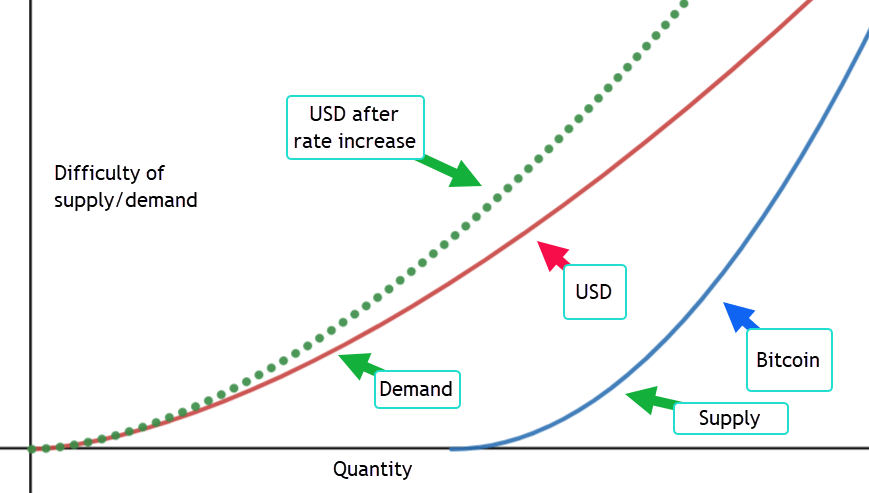
In the graph below I’ve illustrated a key difference between the dollar and Bitcoin. On the right is Bitcoin. Its algorithm incorporates a “diseconomies of scale.” As more Bitcoin is mined, it takes more effort to mine Bitcoin. Bitcoin focuses on the difficulty of supply.

On the left is the fiat dollar. There is no difficulty in supplying it. The Fed focuses on the demand for the dollar by adjusting the interest rate, the bend in the curve. It is currently tightening that bend – the dotted green curve – and increasing the difficulty of getting more dollars. The dollar can respond to changing demand more easily than gold or Bitcoin because it targets demand.

Like Bitcoin, the dollar stores no future work. In an article earlier this year (2022), I wrote that America’s store of wealth was both a proof-of-work, proof-of-stability and proof-of-trust. The dollar itself is only a sign of trust in American institutions. The checks and balances of our system of government ensures that most policymaking is incremental. While that frustrates Americans, the relative predictability of U.S. policy is reassuring to foreign investors. Americans often run around like crazy monkeys on the deck of a cruise boat but the ship is unlikely to make a large course correction.  

Think of the bend in the curve as a toll for using the highway to the future. Bitcoin’s curve is rigid. The toll remains the same. Bitcoin enthusiasts would maintain that this rigidity should shift the curve to the right over time, increasing the buying power supplied by Bitcoin.

Let’s look at three approaches.
1) Bitcoin limits the length of highway that will be built. Enthusiasts claim that this will make each “mile” of the bitcoin highway more valuable.

2) MMT advocates offer a different solution. As long as there are resources – both labor and material – available, build more highway. By targeting the supply available, congestion will ease.

3) The Fed offers an approach that targets demand, not supply. The Fed raises and lowers the interest rate – the toll – to get onto the highway to the future. Raising interest rates is a form of congestion pricing. High inflation means that there are too many people using the available length of highway. The Fed has promised that it will keep raising the toll until fewer people are using the highway. As demand declines, some of those working on the highway may lose their jobs. Unemployment will increase but historically it is very low.

The strength of the dollar against other currencies, including Bitcoin and gold, indicates increasing demand for the Fed’s approach. What is the morality of an international floating rate regime where businesses in a developing country have to work even harder to pay their dollar-denominated loans? Bitcoin advocates claim that global adoption of Bitcoin will make a more even playing field, reducing the advantage that developed countries have over developing countries. That can be the subject of another article.

////////////

Photo by kyler trautner on Unsplash

Stofka, S. (2022, April 16). Fortress of Trust. Innocent Investor. Retrieved October 1, 2022, from https://innocentinvestor.com/2022/04/17/fortress-of-trust/

Fortress of Trust

April 17, 2022

by Stephen Stofka

Adherents of the Bitcoin digital technology tout it as both a payment system and a store of value, two of the three functions of a form of money. In September 2021 El Salvador adopted Bitcoin as an official currency as a measure to reduce dependence on the dollar. After six months, customers and vendors, even those devoted hawkers of wares on Bitcoin Beach, have been disappointed in the results (Brigida & Schwartz, 2022). Gadi Schwartz, a reporter for NBC News (Video, 2022) related that few vendors take bitcoin anymore because it was not reliable. He and his film crew found a restaurant that did accept Bitcoin. They paid with Bitcoin but the transaction did not go through and, after ten minutes, they paid cash. Later they learned that the Bitcoin account had been deducted on their end but not at the restaurant’s end.

Bitcoin advocates point to recent inflation numbers as they make their case for a digital currency and against a fiat currency. Like gold, bitcoin does not grow enough to meet the growing needs of population and production technology. In the 18th century Adam Smith first noted the lack of gold available for the amount of economic activity in the American colonies. The use of gold as the dominant currency led to a number of crises and panics during America’s Gilded Age in the late 19th century.

Under a fiat currency regime, money can grow as needed. Price stability and prudent management of money and interest rates becomes the prime duty of a government and its central bank. To that end, the Fed sets a target of 2% annual inflation, which is the error term in calculating the change in prices and the comparison of utility we get from goods and services over time. We have all noticed the dramatic rise in prices at the grocery store and gas station but the 10 year average of annual inflation is right at the Fed’s target of 2% (FRED Series PCEPI). For years following the financial crisis in 2008, we became comfortable with disinflation, the slowing down of any price appreciation. Getting back to average inflation should not be so abrupt but the extraordinary slump in global production during the pandemic was abrupt.

Bitcoin boosters argue that a digital currency regime would curtail the government borrowing that fuels inflation, the borrowing that funds continual wars. That borrowing also funded the stimulus relief during the pandemic and kept millions safe in their homes and not hungry on the streets. The flexibility of fiat currencies can be good and bad. Currencies can be classified by time – the past and the future – and their flexibility in time. Gold and bitcoin are based on past effort and are proof of the work required to mine the currency, but both are inconvenient to use as such. The inhabitants on the island of Yap in the South Pacific mined limestone into round discs taller than a person. That proof-of-work, a highly immobile stone, became the island’s money. At the end of this post, check out the photo at the end of this Planet Money article (Goldstein & Kestenbaum, 2010).

From the earliest use of gold, people deposited their gold with a goldsmith who gave them a receipt for the gold. People then traded the receipts, not the gold (Cecchetti & Schoenholtz, 2021, 272). The gold was based on past effort but the receipts were based on the future – a promise by the goldsmith to redeem the receipt for gold. A fiat currency like the U.S. dollar is a receipt based on a promise as well. Few of us realize that the dollar in our pockets is a loan to the Federal Reserve as it appears on the Fed’s balance sheet. Want your loan paid back? Go to any bank, give them your dollar and they will give you a replacement dollar. The words on the back of a dollar bill may say In God We Trust but the dollar bill itself is a token of trust in the stability of the U.S. as a country.

As the NBC News crew learned in El Salvador, bitcoin may be proof-of-work in concept but it is not proof-of-trust in practice. The U.S. Fed stores the largest hoard of gold in the world. Like the large stones on the island of Yap, that accumulation of wealth is proof-of-work, proof-of-stability, and proof-of-trust. The proof-of-work is of the past. The proof-of-stability is the bridge from past to future. The proof-of-trust is a faith in the future.

/////////////

Photo by Donald Giannatti on Unsplash

Brigida, A.-C., & Schwartz, L. (2022, March 15). Six months in, El Salvador’s Bitcoin Gamble is crumbling. Rest of World. Retrieved April 16, 2022, from https://restofworld.org/2022/el-salvador-bitcoin/

Cecchetti, S. G., & Schoenholtz, K. L. (2021). Money, banking, and Financial Markets. McGraw-Hill.

Goldstein, J., & Kestenbaum, D. (2010, December 10). The island of Stone Money. NPR. Retrieved April 16, 2022, from https://www.npr.org/sections/money/2011/02/15/131934618/the-island-of-stone-money

NBC News. (2022, April 13). El Salvador adopted Bitcoin as a national currency. here’s how it’s going. NBCNews.com. Retrieved April 16, 2022, from https://www.nbcnews.com/nightly-news/video/el-salvador-adopted-bitcoin-as-a-national-currency-here-s-how-it-s-going-137673285897

The Billionaire Ballot

February 16, 2020

by Steve Stofka

“Dad, can I get a new bike?”

“What do you think money grows on trees?”

“No. If it grew on trees, I wouldn’t ask you for a new bike. I’d ask for a ladder so I could pick my own money.” A great comeback that I never said. No new bike. I could still dream of being President someday.

My dad was born before the Great Depression, a time when money lived in the ground. In 1849, people went crazy when they learned that there was gold in the dirt of California (PBS, n.d.). It’s God’s will, some said. In 1876, eight years after the Federal government signed a treaty with the Sioux Indians, gold was discovered in the Black Hills of North Dakota. Sorry, Sioux Indians, but you’ll have to move (NPS, n.d.). 

It took labor and money to dig up money when it lived in the ground. Now it lives in the digital “cloud.” Are we inherently distrustful of money that can be created with the push of a finger on a computer terminal? Seems too easy. We are 50 years into a system that is untethered from any practical restraint. The Federal Reserve guides their monetary policy according to goals set by a law passed at the height of inflation in the 1970s. They do not have to dig up dirt to get more money. They don’t have to keep gold or silver reserves. It seems like the same magical thinking of a kid who dreams about becoming President.

Presidential candidates must work hard to generate enthusiasm and donations of time and money to fuel their campaigns. A successful candidate for the Presidency usually finds a phrase that resonates with supporters.  In 2008, former President Obama used “Yes, we can” and various combinations of “Change” (List of U.S. presidential campaign slogans, 2020). President Trump used “Make America Great Again” during his 2016 campaign. His current slogan is “Keep America Great.” I heard Presidential candidate Sen. Elizabeth Warren sound out “Fighting Back” at a Virginia rally this past Thursday (C-Span, 2020). Mike Bloomberg has blanketed media with the phrase “Mike will get it done” (Mike Bloomberg, 2020).

In 2016, Marco Rubio and other Republican candidates complained that the inexperienced Donald Trump could buy the party’s nomination with his vast resources. Mr. Trump had promised to spend $100 million of his own money and spent $65 million in the final accounting (Peters & Storey, 2016). This was only half of the $121 million in inflation adjusted dollars that Ross Perot spent on his Presidential campaign in 1992 (Boaz, 2019).

Enter Mike Bloomberg. In the few months since he announced his candidacy, his campaign has spent $400 million (Burns & Kulish, 2020). His political spending is dwarfed by his charitable giving. In 2019, Mr. Bloomberg’s foundation donated more than $3 billion to charity. Unlike President Trump, Mr. Bloomberg has demonstrated his business acumen and has past political experience in the mud pit of New York City politics. He is used to the tough bargaining and political alliances that consume Washington. Mr. Trump knows only intimidation, not bargaining. He is the Twitter version of Venezuela’s former President, Hugo Chavez, who used radio to attack his political enemies.

What entices these billionaires to want a high stress job in Washington? What lies in the ground in Washington is not gold, but great power and reputation. Under FDR in 1932, the Democrats first began to consolidate political power in Washington. World War 2 and the Cold War helped grow that power base. So did the Federal programs of social support – Social Security, Medicare, Medicaid and countless others. Beginning in the 1960s, Congress began to grant the President more executive power to conduct war and administer the growing array of Federal agencies.

As the power of the Presidency grew, each Presidential campaign attracted more money. Through a series of campaign reform bills, Congress attempted to regulate the flow of money into politics. In the past decade, two recent Supreme Court decisions have undone many campaign regulations (Ballotpedia, n.d).

The discovery of gold in California and South Dakota attracted many prospectors who worked hard to grab the prize. Like today’s Presidential candidates, many miners did not have the resources necessary to capitalize on the opportunity. Well-funded companies like Homestake Mining proved successful. This is the era we are in now. Little Johnny or Mary can put away their dreams of being President. Is that good for the country?

////////////////

Notes:

Ballotpedia. (n.d.). Bipartisan Campaign Reform Act. Retrieved from https://ballotpedia.org/Bipartisan_Campaign_Reform_Act

Boaz, D. (2019, July 9). RIP Ross Perot, the Billionaire Who Ran for President. Retrieved from https://www.cato.org/blog/rip-ross-perot-billionaire-who-ran-president. Mr. Perot spent $65 million, or about $121 million in current dollars.

Burns, A., & Kulish, N. (2020, February 15). Bloomberg’s Billions: How the Candidate Built an Empire of Influence. Retrieved from https://www.nytimes.com/interactive/2020/02/15/us/politics/michael-bloomberg-spending.html

C-Span. (2020, February 14). Senator Elizabeth Warren Campaigns in Arlington, Virginia. Retrieved from https://www.c-span.org/video/?469313-1/senator-elizabeth-warren-campaigns-arlington-virginia (43:08).

List of U.S. presidential campaign slogans. (2020, February 14). Retrieved from https://en.wikipedia.org/wiki/List_of_U.S._presidential_campaign_slogans

Mike Bloomberg 2020. (2020). Mike Bloomberg for President: Official 2020 Campaign Website. Retrieved February 14, 2020, from https://www.mikebloomberg.com/

Peters, J. W., & Shorey, R. (2016, December 9). Trump Spent Far Less Than Clinton, but Paid His Companies Well. Retrieved from https://www.nytimes.com/2016/12/09/us/politics/campaign-spending-donald-trump-hillary-clinton.html

Photo by annie bolin on Unsplash

Dance of Debt

April 9th, 2017

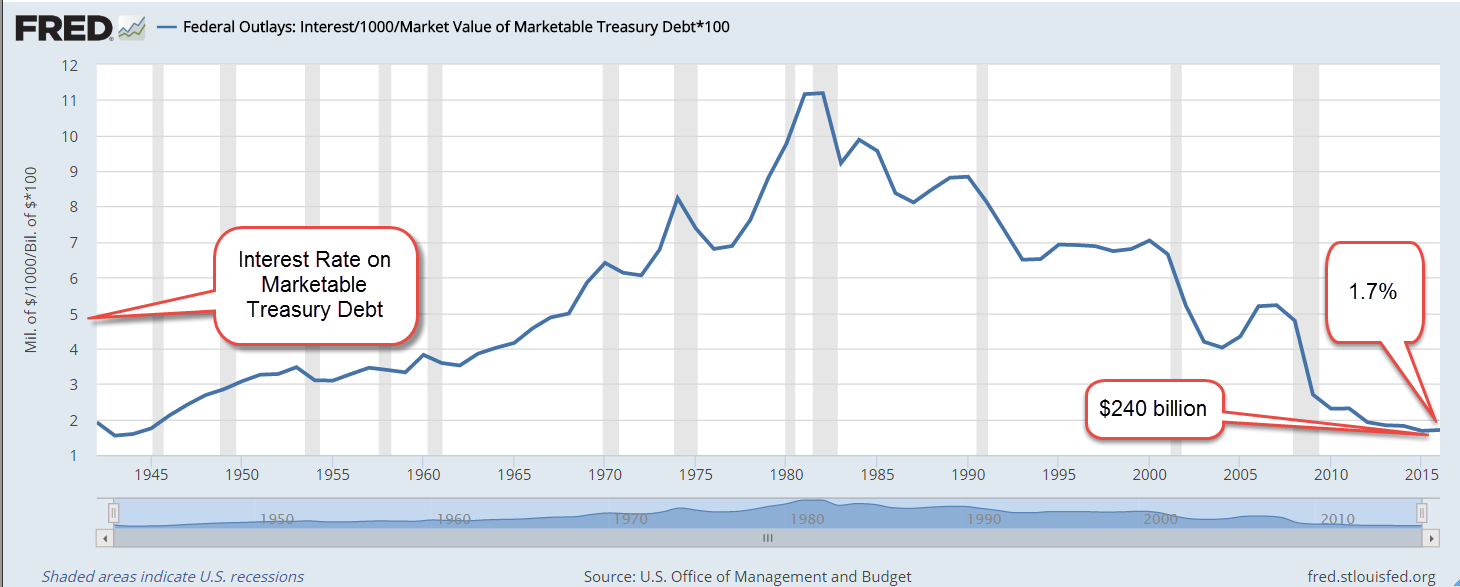
Last week I wrote about the dance of household, corporate and government debt. When the growth of one member of this trinity is flat, the other two increase. Since the financial crisis the federal debt has increased by $10 trillion. Let’s look at the annual interest rate that the Federal government has paid on its marketable debt of Treasuries. This doesn’t include what is called interagency debt where one part of the government borrows from another. Social Security funds is the major example.

In 2016, the Federal government paid $240 billion in interest, an average rate of 1.7% on $14 trillion in publicly held debt. Only during WW2 has the Federal government paid an effective interest rate that is as low as it today. World War 2 was an extraordinary circumstance that justified an enormous debt. Following the war, politicians increased taxes on households and businesses to reduce the debt. Here is a graph of the net interest rate paid by the Federal government since 1940.

InterestRate

In 2008, before the run up in debt, the interest rate on the debt was 4.8%. If we were to pay that rate in 2017, the interest would total $672 billion, more than the defense budget. Even at a measly 3%, the interest would be $420 billion.  That is $180 billion greater than the interest paid in 2016.  That money can’t be spent on households, or highways, or education or scientific research.

The early 1990s were filled with political arguments about the debt because the interest paid each year was crippling so many other programs. Presidential candidate Ross Perot made the debt his central platform and took 20% of the vote, more than any independent candidate since Teddy Roosevelt eighty years earlier. Debt matters. In 1994, Republicans took over Congress after 40 years of Democratic rule on the promise that Republicans would be more fiscally responsible. In the chart below, we can see the interest expense each year as a percent of federal expenses.

PctFedExp

Let’s turn again to corporate debt. As I showed last week, corporate debt has doubled in the past ten years.

CorpDebt2016

In December, the analytics company FactSet reported (PDF) that the net debt to earnings ratio of the SP500 (ex-financials) had set another all time high of 1.88. Debt is almost twice the amount of earnings before interest, taxes, debt and amortization (EBITDA). Some financial reporters (here, for example ) use the debt-to-earnings ratio for the entire SP500, including financial companies. Financial companies were highly leveraged with debt before the crisis. In the aftermath and bailout, deleveraging in the financial industry effectively hides the growth of debt by non-financial companies.

What does that tell us? Unable to grow profits at a rate that will satisfy stockholders, corporations have borrowed money to buy back shares. Profits are divided among fewer shares so that the earnings per share increases and the price to earnings (profit), or P/E ratio, looks lower. Corporations have traded stockholder equity for debt, one of the many incidental results of the Fed’s zero interest rate policy for the past eight years.

Encouraged by low interest rates, corporations have gorged on debt. In 2010, the pharmaceutical giant Johnson and Johnson was able to borrow money at a cheaper rate than the Federal government, a sign of the greater trust that investors had in Johnson and Johnson at that time.

Other financial leverage ratios are flashing caution signals, prompting a subdued comment in the latest Federal Reserve minutes ( PDF ) “some standard measures of valuations [are] above historical norms.” Doesn’t sound too concerning, does it?

Each period of optimistic valuation is marked by a belief in some idea. When the bedrock of that idea cracks, doubts grow then form a chasm which swallows trillions of dollars of marketable value.

The belief could be this: passively managed index funds inevitably outperform actively managed funds. What is the difference? Here’s  a one-page comparison table. In 1991, William Sharpe, creator of the Sharpe ratio used to evaluate stocks, made a simple, short case for the assertion that passive will outperform active.

During the post-crisis recovery, passive funds have clearly outperformed active funds. Investors continue to transfer money from active funds and ETFs into index funds and ETFs. What happens when a smaller pool of active managers make buy and sell decisions on stocks, and an ever larger pool of index funds simply copy those decisions? The decisions of those active managers are leveraged by the index funds. Will this be the bedrock belief that implodes? I have no idea.

Market tensions are a normal state of affairs. What is a market tension? A conflict in pricing and risk that makes investors hesitate as though the market had posed a riddle. Perhaps the easiest way to explain these tensions is to give a few examples.

1. Stocks are overvalued but bond prices are likely to go down as interest rates rise. The latest minutes from the Fed indicated that they will start winding down their portfolio of bonds. What this means is that when a Treasury bond matures, they will no longer buy another bond to replace the maturing bond. That lack of bond purchasing will dampen bond prices. Stocks, bonds or cash? Tension.

2. Are there other alternatives? Gold (GLD) is down 50% from its highs several years ago. Inflation in most of the developing world looks rather tame so there is unlikely to be an upsurge in demand for gold. However, a lot of political unrest in the Eurozone could drive investors into gold as a protection against a decline in the euro. Tension.

3. What about real estate? After a run up in 2014, prices in a broad basket (VNQ) of real estate companies has been flat for two years. A consolidation before another surge? However, there is a lot of debt which will put pressure on profits as interest rates go up. Tension.

In the aftermath of the financial crisis, we discovered that financial companies, banks, mortgage brokers and ordinary people resolved market tensions through fraud, a lack of caution, and magical thinking. Investors can only hope that there is enough oversight now, that the memories of the crisis are still fresh enough that plain old good sense will prevail.

During the present seven year recovery there have been four price corrections in the Sp500 (Yardeni PDF). A correction is a drop in price of 10 – 20%. The last one was in the beginning of 2016. Contrast this current bull market with the one in the 2000s, when there was only one correction. That one occurred almost immediately after the bear market ended in the fall of 2002. It was really just a part of the bear market. From early 2003 till the fall of 2007, a period of 4-1/2 years, there was no correction, no relief valve for market tensions.

Despite the four corrections and six mini-corrections (5 – 10%) during this recovery, the inflation adjusted price of the SP500 is 50% higher than the index in the beginning of 2007, near the height of the market.  Inflation adjusted sales per share have stayed rather stable and that can be a key metric in the late stages of a bull market. The current price to sales (P/S) ratio is almost as high as at the peak of the dot com boom in 2000 and that ratio may prove to be the better guide. In a December 2007 report, Hussman Funds sounded a warning based on P/S ratios.  Nine years later, this report will help a reader wanting to understand the valuation cycles of the past sixty years.

U.S.S. Obamacare Sails On

In March 2000, I cursed myself as I watched the SP500 cross the 1500 mark for the first time. Almost a year earlier, I had given in to my conservative instincts and paid off the mortgage with some savings. In 1999, my choice had been partially driven by a suspicion that the stock market was a bit overvalued. In 2000, I could see I was wrong; that I just didn’t understand the new economy. Had I invested the money in the stock market, I would have made 15% in less than a year.

When I set the time machine to election day 2016, I see that the index stood at about 2130, 40% higher than the 2000 benchmark. But wait. An asset is only worth what I can trade it for. Year by year, inflation erodes the real value of that asset. When I compare real values (BLS inflation calculator), the SP500 index on election day was almost exactly what it was in March 2000.

As the year 2000 passed into 2001 and the stock market fell from its heights, my decision to invest in real estate exemplified a golden word in investing: diversify.

Since the election, the SP500 has risen about 10%, as investors speculated that Republicans will usher in a new era of de-regulation and lower taxes. By mid-March, banking stocks had shot up over 25%. This past Monday, the 20th, the Freedom Caucus confirmed that they had the “no” votes necessary to block Thursday’s scheduled House vote on the Republican health care bill, AHCA. Banking and financial stocks, thought to be the biggest beneficiaries of less regulation, higher interest rates, and infrastructure spending, lost 5% over several days.

The Freedom Caucus is a group of 30-40 Republican House members who came to office in 2010 on the Tea Party wave. Led by North Carolina Representative Mark Meadows, the Caucus adheres strongly to conservative principles as they define them. They are chiefly responsible for driving out the former House Speaker, John Boehner. While strict adherence to principle – “my way or no way” – worked well as an opposition movement when Obama was President, the Caucus’ unwillingness to compromise is problematic under the current one-party rule. Can Republicans govern?

Paul Ryan, the current Speaker of the House, delayed the vote until Friday. House leadership and the White House tried to come to some compromise that would bring the Freedom Caucus on board without alienating the more moderate Republican members. With no support from Democrats, the additional no votes from the Freedom Caucus meant that Ryan could not muster the majority needed to pass the bill. Shortly before the scheduled vote at 4 PM on Friday, Ryan called off the vote.

The stock market is a herd attempt to predict and price what the world will be like in six months. As events catch up with forecasts, stock prices correct. Passage of the bill was supposed to be a key step toward tax reform if the Republicans want to pass a tax bill using Reconciliation rules, which require only a majority in the Senate.

With more than a half hour left in the trading day, the market had time to sell off 2 – 3%. And? Nothing. Did the bulls and bears cancel each other out in a flurry of trading? Nope. There was no unusual surge of volume in stocks. Either the market had already priced in the defeat of the AHCA, or buyers and sellers were left undecided.

Investors take a “risk off” approach during periods of uncertainty, moving toward gold (GLD) and long dated treasuries (TLT). Both have risen a few percent in the past two weeks but each is short of their January and February highs. Since mid-March, the SP500 (SPY) has lost a few percent. This tells me that investors had already adopted a more cautious stance.

President Trump has indicated that he wants to move on to tax reform and an infrastructure bill as well as the building of some type of defense perimeter on the border with Mexico. Perhaps investors hope that the lack of cohesion among Republicans on the health care bill will not sidetrack them from passage of these other bills.
The defeat of this bill is sure to empower the Freedom Caucus on further legislation. They were a thorn in John Boehner’s side and will no doubt frustrate Paul Ryan as well.

/////////////////////////////////

Existing Home Sales

We had a warm February in most of the country. Realtors reported good foot traffic but, but, but…a lack of affordable housing has turned away many first time home buyers. Home prices have been rising at double the growth in wages. While Feb’s numbers declined from a strong January, YTD existing home sales are more than 5% ahead of last year’s pace.

Regional declines varied: the northeast at -14% and the midwest at -7% led the list. The decline in the west was almost -4% but cities in California and Colorado report the fastest turnaround times from listing to sale. The San Jose region reported an average of 23 days.

Here’s February’s report from the National Assn of Realtors

Oh My Gawd!

November 8, 2015

There is the famous Tarzan yell by Carol Burnett and the iconic “Oh my Gawd” exclamation of Janice Lipman in the long running TV series “Friends.”  That’s what Janice would have said when October’s employment report was released this past Friday.

Highlights:

271,000 jobs gained – maybe. That was almost twice the number of job gains in September (137,000).  Really??!! ADP reported private job gains of 182,000.  Huge difference.  Job gains in government were only 3,000 so let’s use my favorite methodology, average the two and we get 228,000 jobs gained, awfully close to the average of the past twelve months.  Better than average gains in professional business services and construction.  Both of these categories pay well.  Good stuff.

At 34.5 hours, average hours worked per week has declined by 1/10th of an hour in the past year.  The average hourly rate rose 2.5%, faster than headline inflation and giving some hope that workers are finally gaining some pricing power in this recovery.

For some historical perspective, here is a chart of monthly hours worked from 1921 to 1942.  Most of those workers – our parents and grandparents – have passed away.  At the lows of the Great Depression people still worked more hours than we do today.  They were used to hard work.  There were few community resources and social insurance programs to rely on.

The headline unemployment rate fell slightly to 5%.  The widest unemployment rate, or U-6 rate, finally fell below 10% to 9.8%, a rate last seen in May 2008, more than seven years ago.  This rate includes people who are working part time because they can’t find a full time job (involuntary part-timers), and those people who have not actively looked for a job in the past month but do want a job (discouraged job seekers).  Macrotrends has an interactive chart showing the three common unemployment rates on the same chart.

The lack of wage growth during this recovery, coupled with rising home prices, may have made owning a home much less likely for first time buyers.  The historical average of new home buyers is 40%.  The National Assn of Realtors reported that the percentage is now 32%, almost at a 30 year low.

2.5% wage growth looks a bit more promising but the composite LMCI (Labor Market Conditions Index) compiled by the Federal Reserve stood at a perfect neutral reading of 0.0 in September.  The Fed will probably update the LMCI sometime next week.  This index uses more than twenty indicators to give the Fed an in-depth reading of the labor market.

**********************************

Bonds and Gold

The strong employment report increased the likelihood that the Fed will raise interest rates at their December meeting and this sent bond prices lower.  A key metric for a bond fund is its duration, which is the ratio of price change in response to a change in interest rates.  Shorter term bond funds have a smaller duration than longer term funds. A short term corporate bond index like Vanguard’s ETF BSV has a duration of 2.7, meaning that the price of the fund will decrease approximately 2.7% in response to a 1% increase in interest rates.  Vanguard’s long term bond ETF BLV has a duration of 14.8, meaning that it will lose about 15% in response to a 1% increase in rates.  In short, BLV is more sensitive than BSV to changes in interest rates. How much more sensitive?  The ratio of the durations – 14.7 / 2.7 = 5.4 meaning that the long term ETF is more than 5 times as sensitive as the short term ETF.

What do we get for this sensitivity, this higher risk exposure?  A higher reward in the form of higher interest rates, or yield.  After a 2.5% drop in the price of long term bond funds this week, BLV pays a yield close to 4% while BSV pays 1.1%.  The reward ratio of 4 / 1.1 = 3.6, less than the risk ratio.   On September 3rd, the reward ratio was much lower, approximately 3.27 / 1.3 = 2.5, or half the risk ratio.

Professional bond fund managers monitor these changing risk-reward ratios on a daily basis.  Retail investors who simply pull the ring for higher interest payments should be aware that not even lollipops at the dentist’s office are free.  Higher interest carries higher risk and duration is that measure of risk.

The prospect of higher interest rates has put gold on a downward trajectory with no parachute since mid-October.  A popular etf  GLD has lost 9% and this week broke below July’s weekly close to reach a yearly low.  Investors in gold last saw this price level in October 2009.  Back then  gold was continuing a multi-year climb that would take its price to nosebleed levels in August 2011, 70% above its current price level.

**********************************

CWPI (Constant Weighted Purchasing Index)

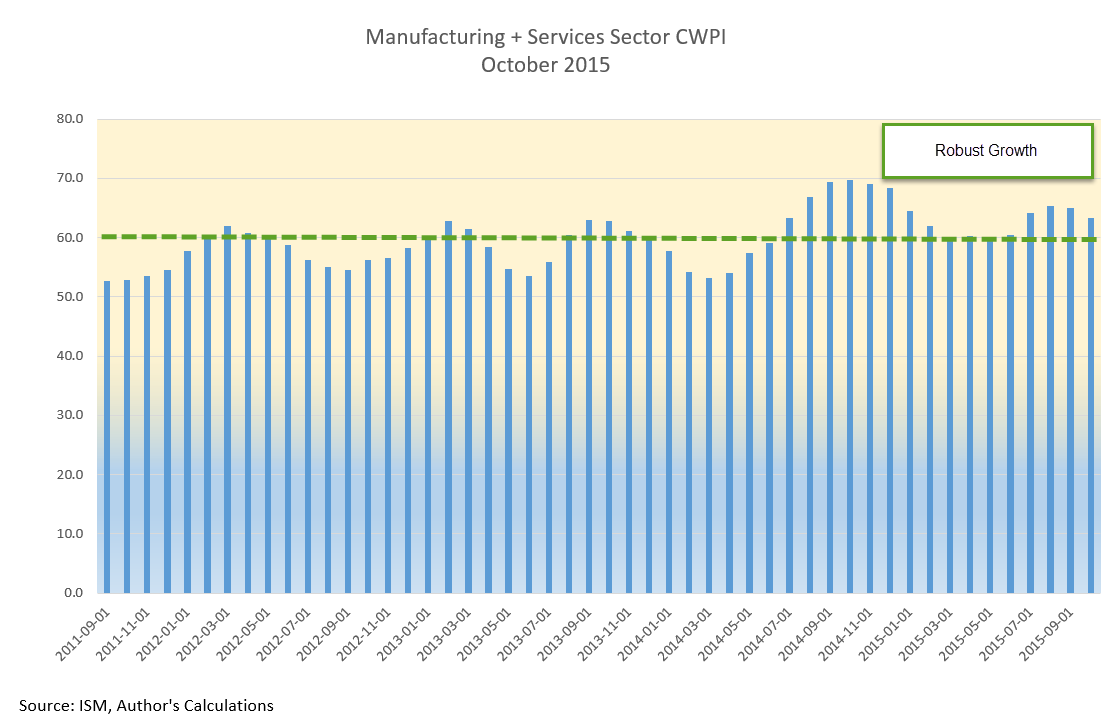
Manufacturing is hovering at the neutral 50 mark in the ISM Purchasing Manager’s Index but the rest of the economy is experiencing even greater growth after a two month lull.  No doubt some of this growth is the normal pre-Christmas hiring and stocking of inventories in anticipation of the season.

The CWPI composite of manufacturing and service sector activity has drifted downward but is within a range indicating robust growth.

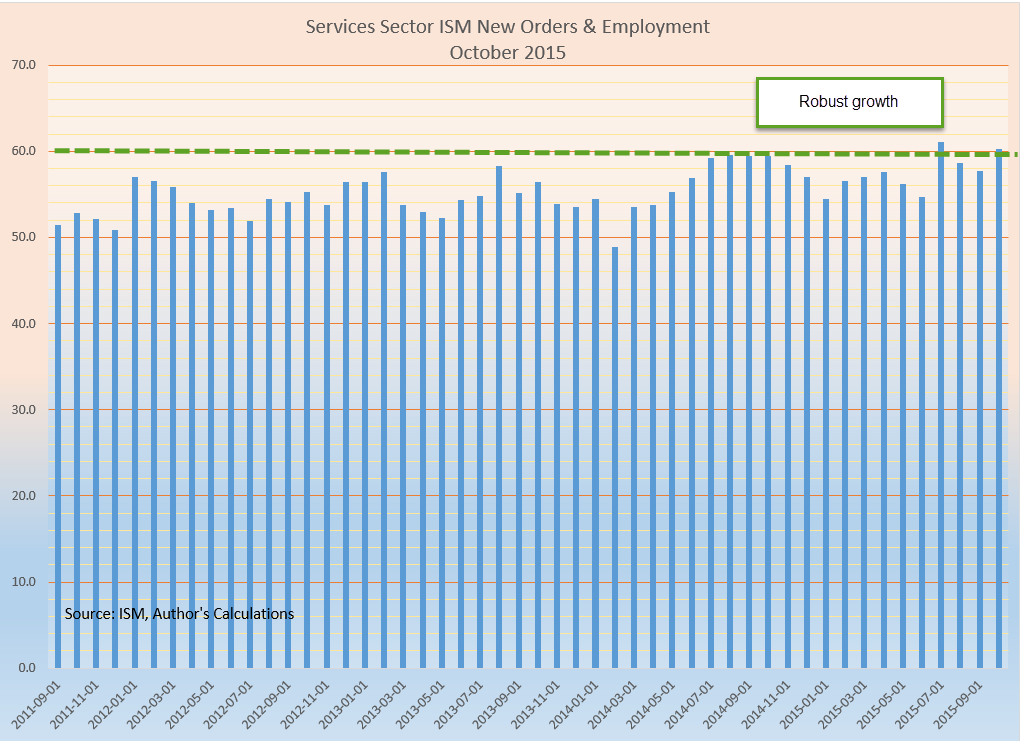
Employment and New Orders in the non-manufacturing sectors – most of the economy – rose up again to the second best of the recovery.

Economists have struggled to build a mathematical model that portrays and predicts the rather lackluster wage growth of this recovery in a labor market that has been growing pretty strongly for the past few years.

*************************************

Social Security

The Bipartisan Budget Act of 2015, passed and signed into law this past week, curtails or eliminates a Social Security claiming strategy that has become popular.  (Yahoo Finance – can pause the video and read the text below the video).  These were used by married couples who were both at full retirement age.  One partner collected spousal benefits while the “file and suspend” partner allowed their Social Security benefits to grow until the maximum at age 70.  On the right hand side of this blog is a link to a $40 per year “calculator” that helps people maximize their SS benefit.

************************************

Tax Cuts Anyone?

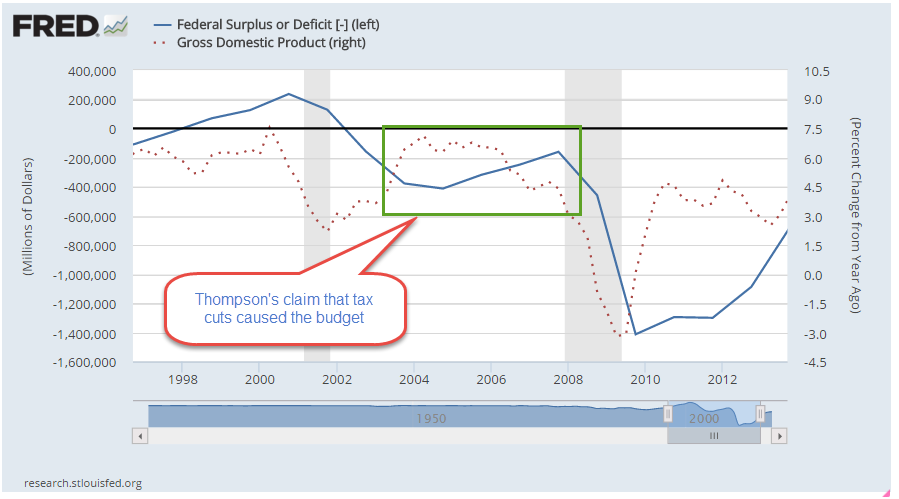
Former Senator, Presidential contender and actor Fred Thompson died this past week.  The WSJ ran a 2007 editorial by Thompson arguing that the “Bush tax cuts” that the Republican Congress passed in 2001 and 2003, when he was a Senator, had spurred the economy, causing tax revenues to increase, not decrease, as opponents of the tax cuts claimed.  Like others in the tax cut camp, Thompson looked at a rather small slice of time to support his claim: 2003 -2007.

Had tax cut advocates looked at an earlier slice of time – also small – in the late 1990s they would have seen the opposite effect.  Higher tax rates in the 1990s caused greater economic growth and higher tax revenues to the government, thereby shrinking the deficit entirely and producing a surplus.

Tax cuts decrease revenues.  Tax increases increase revenues.  That tax cuts or increases as enacted have a material effect on the economy has been debated by leading economists around the world for forty years.  At the extremes – a 100% tax rate or a 0% tax rate – these will certainly have an effect on people’s behavior.  What is not so clear is that relatively small changes in tax rates have a discernible impact on revenues.  A hallmark of belief systems is that believers cling to their conclusions and find data to support those conclusions in the hopes that they can use that to help spread their beliefs to others.

The evidence shows that economic growth usually precedes tax revenue changes; that tax policy advocates in either camp have the cart before the horse.  A downturn in GDP growth is followed shortly by a decline in tax revenues.

Thompson’s editorial notes a favorite theme of tax cut advocates – that the “Kennedy” tax cuts, initiated into law in memory of President Kennedy several months after his assassination in November 1963, spurred the economy and increased tax revenues. Revenues did increase in 1964 but the passage of the tax act occurred during that year so there is little likelihood that the tax cuts had that immediate an effect.  Revenues in 1965 did increase but fell in subsequent years.  A small one year data point is all the support needed for the claims of a believer.

The question we might ask ourselves is why do tax policy and religion share some of the same characteristics?

The Big Picture

Or maybe the title of this post should be “The Big Pitcher”.  No, it’s not about a tall baseball pitcher, but the glass pitchers that central banks around the world hold.  What comes out of the pitcher when the central banks start pouring?  Money.  How do they do that?  It’s magic.  Don’t you wish you had a money pitcher?

Jerry forwarded me an article by someone at Matterhorn Asset Management, a Swiss asset management company that invests primarily in metals as a wealth preservation model so they will have a predisposition to a gloomy outlook because investors’ fears will bring more business to the company.  That said, the article presents a 200 year review and outlook on the mechanics of inflation and rather dire long term predictions for the world economy.

Featuring a 150 year chart on the Consumer Price Index and another one of US Debt to GDP ratio, this 6 page article definitely takes a long view of events in the past in making prognostications of the future. 

A comparison of the 19th and early 20th century with the latter part of the 20th century has to be put in a bit more perspective than this article does.  Electricity is something we take for granted but its effect on our lives has been as profound as the discovery of fire and the invention of cooking.  It is an energy that is readily available to most people in developed countries.  This ready source of energy has radically transformed our society, our productive capacity and our demand for products that use this energy.

In the 1920s, the new industry of radio telecommunications kicked off a bubble in the stock market.  Some predicted that we would walk around with communication devices that we wore on our wrists.  Information would be readily available to all with these cheap and portable two way radios.  It would be another 70 years before this dream would become a reality with the internet and the dawning of the cell phone age.  That in turn prompted another stock bubble in the late nineties.

When countries around the world abandoned the gold standard in the past century, they did so because the supply of gold could not keep up with the rapid expansion of production and demand that accompanied the energy and communication age.  How profound has this expansion been?  Several historians have noted that a person living in Boston in 1780 would have felt familiar with most of what surrounded him in that same city in 1900.  Jump ahead another 50 years to 1950 and that same person would be totally disoriented in a city with electricity, flashing lights, automobiles, subways, TVs, radios and the sheer growth in the population of the city.

The gold standard simply could not accommodate this rapid expansion of economic activity.  However, the gold standard put brakes on the centuries old tendency of sovereign countries to print money or debase the currency.  After abandoning the automatic regulatory mechanism of the gold standard, we have found nothing comparable to provide some restraint on central bankers other than a trust in the wisdom and foresight of those like Ben Bernanke, Chairman of the Federal Reserve.  An entire world of billions of people depends on the wisdom of several hundred individuals making decisions at central banks around the world.  It is a daunting and vulnerable position we find ourselves in.

Gold ETFs

The rise in gold prices has prompted a growing popularity in the SPDR Gold Trust ETF (GLD), which buys and holds gold bullion. The IRS regards ownership in this trust as an ownership in a collectible and taxes profits in the trust accordingly.

An investor who holds GLD for a year or more and sells for a profit might expect to pay the 15% long terms capital gains rate. However, the profit is taxed at the 28% collectibles rate. For this reason, an investment in gold bullion is more appropriate in an IRA or other tax advantaged plan.

Another way to play the gold market is to buy Market Vectors Gold Miners (GDX), an ETF that owns shares in gold mining companies. The average cost to produce an ounce of gold is about $850 – $900, so that a gold price above that amount is profit to the mining companies. Because of this leverage, mining company stocks are more volatile than the bullion itself. Long term profits in an ETF like this one would be taxed at the usual 15% long term capital gains rate.