The Haves and Have-Nots

June 29, 2025

By Stephen Stofka

Sunday morning and another breakfast with the boys as they discuss world events and persistent problems. The conversations are voiced by Abel, a Wilsonian with a faith that government can ameliorate social and economic injustices to improve society’s welfare, and Cain, who believes that individual autonomy, the free market and the price system promote the greatest good.

Cain smiled as he asked Abel, “You used to live in New York. So, are they getting ready to elect their first socialist mayor?”

Abel chuckled as he spread the linen napkin across his lap. “Mamdani is the Trump of the left. Knows how to work social media and promises he’ll make food and housing affordable again. Just like Trump. Neither one of them has a workable plan. Maybe that’s the age we live in. The age of blowhards on social media. Anyway, I wanted to ask you what you thought about the court’s decision this week. Can lower level courts issue nationwide injunctions? What’s the verdict, Mr. Court Watcher?”

Cain stared into his coffee cup then looked at Abel. “Well, I liked that part. Last year, Reuters did a study (Source). There have been almost 130 injunctions issued in the past sixty years. So, during the 1960s and 1970s, there were two injunctions. Two! Then it got political. Sixty injunctions during Trump’s first term. California judges were a go-to for Democrats.  Maybe twenty injunctions during Biden’s term. Republicans running to Texas judges. Now the Democrats have started again in Trump’s second term. It’s abusive tit-for-tat.”

Abel asked, “So you like the decision? How did it stand up to the famous Cain consequentialist rule?”

Cain held up his right hand, thumb down. “Failed. It confuses more issues than it clarifies. The court stayed Trump’s executive order for thirty days. Not a whole lot of time to get a class certification and a whole bunch of procedures (Source). A district judge can issue an injunction on the likelihood of class certification, but it only applies to the parties named in the suit (Source). Meanwhile there will be confusion everywhere. Confusion equals bad court decision in my book.”

Abel lifted his eyebrows. “A ‘Keep It Simple, Stupid’ approach. But this decision permits the White House to keep drafting unconstitutional orders then enforce them wherever there is no applicable injunction. I mean, this is a case where you can’t separate legal rules and procedures from the merits of the case, the Constitutional right to citizenship at birth.”

Cain frowned, then settled back as their food arrived. “Justice Sotomayor basically made that point in her dissent. The consequence of the court’s ruling is that the burden of protecting our constitutional rights falls on ‘we, the people.’”

Abel pursed his lips. “That’s expensive.”

Cain sighed. “It’s also depressing. Anyway, change of subject. We were talking last week about the One Big Beautiful Bill, the cuts to Medicaid.”

Able interrupted, “Oh yeah, why people vote against their best interests. What was that book?  What’s the Matter With Kansas? Thomas Frank.”

Cain nodded. “So you said you didn’t understand how Republican representatives could propose cuts to Medicaid that would hurt their constituents. I said that it was the principle of the thing and the huge costs to the states even after the cost-sharing with the federal government.. So, I was reading this week that some of the Republican members are concerned about the blowback from voters in the midterms (Source). “

Abel glanced at his phone. “Boy, I love this thing. My personal librarian. Last week, you made me aware of how much the states were spending on Medicaid. I did some digging this past week and I was surprised at how dependent we all are on Medicaid. It’s red states, blue states. Did you know that Medicaid finances 42% of all births (Source)?”

Cain shook his head. “Wow, I didn’t know it was that much. Now I’m remembering Romney’s remark about the 47% dependent on federal programs. He might have lost the 2012 election over that but maybe that’s what he was talking about.”

Abel frowned. “You know, when I think of poor rural states, Louisiana, Mississippi and Alabama come to mind. They have high percentages of  children who are covered by Medicaid. Like more than 60% in some cases. North Dakota is up there at 63%. Kansas and Iowa are above 50%. But there’s also blue states in that category. In Minnesota, it’s more than 60% and in Colorado it’s more than 50% (Source).”

Cain asked, “Colorado is a blue state? I thought it was purple.”

Abel shook his head. “Nah, they have a trifecta now. Governor, state House and Senate. All Democrat. In fact, most of the states have trifectas now, like almost 40 states (Source). Shows how polarized we are in this country. Forget about what happened to Kansas. What happened to divided government?”

Cain smiled. “For many years, that’s how I voted. I was against the Democrat, Republican duopoly. If Republicans held a lot of seats, I voted Democrat just to keep a balance of power. Groups get crazy when they have all the power. What did you call it? The monster in us. We start to uncage the monster. We want to enact revenge. We want what we want just to enjoy the power of getting what we want.”

Abel raised his eyebrows. “Wow, talk about dark. Well, you weren’t alone. I was reading that, in the 1970s, voters split their ticket like 30% of the time. That started to decline in the 1980s. Now, it’s less than 5% (Source).

Cain nodded. “Like I said last week, we’re in our silos. We got our political clubhouses with big signs that say, ‘Keep Out!’ That’s why I believe in the price system, supply and demand. Keeps people from getting their own way.”

Abel frowned. “You’ve talked about that before. I mean, how does a price system work in a democracy?”

Cain smiled. “I’ll talk about it another time. It’s simple. Most of us have social security numbers. Everybody living in a state votes, whether they cast a vote or not.”

Abel looked puzzled. “How would that work?”

Cain gave a Cheshire grin. “Not this week. Anyhow, back to Medicaid. So, I said last week that a lot of Republicans don’t respect dependency. It’s a bad word. That’s why they are against these big federal programs.”

Abel interrupted, “That’s  you.”

Cain nodded. “Yeah, but I’m not against dependency as such. We’re all dependent on each other in a lot of ways that we take for granted. That was Adam Smith’s point. My eggs here. Someone had to grow them, spread feed, and muck out the chicken coops. I appreciate that when I eat eggs. I’m connected to those farmers.”

Abel interrupted, “An illegal immigrant probably mucked out those chicken coops.”

Cain nodded. “Yeah, or the farmer’s kids before they went to school that morning. People who work hard. Eggs are under $3 a dozen now after the industry has recovered from the mass killing of chickens to stop the virus (Source). So, it’s like 25 cents an egg. That’s less than a minute of someone’s hourly wage, let’s say. So the farmer, the kids, or the illegal immigrant, as you point out, work their butts off and I get to buy an egg for less than a minute of work. A great deal.”

Abel set his water glass down on the table. “You put it like that, and I can understand the two different worlds perspective.”

Cain mopped up some egg yoke with his toast. “What were the two groups in the Time Machine story? The Eloi and I forget the name of the other group. In Wells’ book, they represented the working class of England (Source).”

Abel smiled. “The Morlocks. So, you’re saying that the Eloi are urban dwellers and rural people are Morlocks? That’s kind of stretching an analogy.”

Cain laughed. “No, not exactly. The Eloi are the ‘haves’ and the Morlocks are the ‘have-nots.’ That’s what I’m thinking. In any society, there are those two groups. That was Machiavelli’s point in the Republic. He thought the haves were the more dangerous group because they fought harder to keep what they had.”

Abel whistled softly. “Whoa. From Medicaid to political philosophy. Let me buckle my seat belt. Although, now that I think about it, that was a big cause of the Civil War. The plantation owners in the South wanted to keep on expanding. I was reading Alan Taylor’s book American Civil Wars and I was shocked to learn that Lincoln agreed to let the southern states keep slavery legal. This was even before the war started. His red line was no more expansion into federal territories or any new states. If the slave owners had agreed to that, would we have avoided a civil war? Anyway, the slave owners needed to expand to keep up the value of their slaves. New markets, new demand.”

Cain smirked. “A rich man’s war, for sure. Can you imagine paying a substitute to fight instead of your own son? (Source)”

Abel shrugged. “Reading that book, I could understand why we don’t learn a lot of that stuff in grade school. Too dark for grade school kids.”

Cain interrupted, “It’s the monster inside. So, you think the Republicans who vote for Trump’s big, beautiful bill are heartless?”

Abel replied, “No, I think that Trump is gambling that he won’t lose that much support from blue-collar workers even if those voters lose some or all of their Medicaid. These rural states showed strong support for Trump in the 2024 election (Source). They elect far more Republicans than Democrats to Congress (Source). It’s a political gamble. He’ll blame Democrats if he’s wrong.”

Cain frowned. “Yeah, but if that gives Democrats enough support to flip the House, they will try and block his agenda in the last two years.”

Abel shook his head. “He’s a gambler. He ran for President in 2016 to boost his brand. His businesses were failing, and he had trouble getting financing (Source). He didn’t think he had a chance to win the Presidency (Source). He admitted he didn’t know what he was doing his first term in office. He’s rolling the dice this term.”

Cain sighed. “Talk about the Time Machine. I wish I could get in a time machine and go to four years from now. Trump, Trump, Trump all the time. I kind of miss the days when we talked about who shot J.R. on the TV show Dallas, or something like that.”

Abel laughed. “I think there will be someone like Trump after Trump. Someone who knows how to maximize social media. Kyla Scanlon on Substack used the word ‘virality’ (Source). Someone who knows how to go viral. We talked about Mamdani earlier. He’s the same. Maybe that’s the new vanguard in the political arena. We will only elect people who get and keep our attention.”

Cain shook his head. “God, I hope not. So, we were talking about two groups, the haves and have-nots. I accept the fact that there will always be inequality in society. Life is multi-dimensional so it’s impossible to have equality. Each of us is like a soap bubble on an ocean wave. We’re all at different locations and elevations, different times in our lives.”

Abel raised his eyebrows. “That’s a good point, but I think a lot of us would like to reduce the growing economic inequality in this country. You think that these big government programs just aren’t very effective. That’s what you said last week.”

Cain nodded. “I think the data backs me up. The best way to reduce inequality is more economic growth. More jobs, more opportunities, more income. Democrats just focus on redistributing the profits. It’s like someone who spends all their time adjusting the heat vents in a home so that everyone feels comfortable. The problem is that Democrats don’t do maintenance on the furnace itself. Then the furnace breaks and no one has any heat.”

Abel chuckled. “Yet, economic growth is stronger under Democratic administrations. More job growth, lower unemployment, higher GDP growth (Source). Using your analogy, it’s the Republicans who don’t maintain the furnace. They make sure the gas valve is wide open. Low taxes, big investment. Republicans expect that the furnace will just keep running. Adam Smith’s Invisible Hand. The will of God, or something.”

Cain laughed. “Ok, you ran away with my analogy. You are watching too much Democratic propaganda. Under eight years of Obama, real per capita economic growth increased 11%. In Trump’s four years, it increased almost 7%. On an annualized basis, that’s better than Obama. Under Biden’s four years, it increased 8%. The big winners were Reagan and Clinton with 20% growth during their two terms (Source).”

Abel tapped notes in his phone. “You’re using per capita growth?”

Cain nodded. “Sure, that’s what people care about. If there is a bigger population, there will be higher overall growth. You have to divide by the population to get a sense of what people are experiencing in their daily lives.”

Abel nodded. “Ok, makes sense. The thing is, there was a lot illegal immigration during the Reagan administration. That’s why he agreed to grant amnesty in 1986 (Source). There was still high growth.”

Cain smirked. “And high deficits, don’t forget. Reagan had to work with a big spending Democratic Congress. And he needed to rebuild the military after the Carter administration.”

Abel laughed. “Sure, it was all the Democrats fault. For the first six years Reagan had a Republican Senate, don’t forget. Clinton raised taxes and there were actual budget surpluses and big growth. So Republicans are against illegal immigration and taxes but neither of those interfered with economic growth during the Reagan and Clinton administrations. So, what’s the secret sauce, professor?”

Cain grunted. “I’m just saying that Democrats need to focus on economic growth more than income inequality.”

Abel sighed. “You’re using per capita economic growth but that doesn’t capture the real effect of inequality on households since the start of Reagan’s first term.”

Cain shook his head. “No, remember we talked a little bit about this. The official measure of inequality doesn’t capture a lot of the income and benefits that lower households receive. In 2016, a Congressional Budget Office found a much lower GINI coefficient than the Census Bureau reported (Source). That lower figure was after taxes and government transfers were accounted for. The World Bank also computes a GINI coefficient that is closer to the CBO estimate (Source).”

Abel asked, “Does that include Medicaid or food stamps?”

Cain shook his head. “No. There is a lot of what’s called ‘in-kind’ support for lower income households that is not included in these inequality measures. Section 8 housing vouchers. The Census Bureau lists all the different types of income streams and which are counted (Source). Yet Democrats just throw these inequality figures around without acknowledging the subtleties.”

Abel interrupted, “Ok, I’ll admit that housing support can be sizeable. I had customers who paid maybe $300 for an apartment that normally rented for like $1500. Ok, go on.”

Glancing at this phone, Cain continued,  “Yeah, so that’s like almost $15,000 in after-tax income and it’s not counted. Food stamps or SNAP, they call it now, are not included and neither are school lunches. Medicaid, Medicare and employer health insurance are not counted (Source).”

Abel said, “So, I’ve been reading about all the horrible things Americans did to each other during the Civil War, and you’ve been digging up data. Ok, so how much was it before and after all these in-kind transfers?”

Cain replied, “Well, the GINI coefficient before those was .42. Lower numbers mean more equality of incomes.”

Abel interrupted, “What’s Mexico and Canada?”

Cain looked up at the ceiling, searching his memory. “Mexico is about the same as the U.S. Canada is low. Like 30 or so.”

Abel nodded. “Ok, so what was the GINI coefficient after including in-kind transfers?”

Cain shook his head. “I couldn’t find a GINI number for that. I mean, there are so many income measures. Before tax, after tax, with transfers, without, with capital gains and without. Survey data like the Census Bureau or figures from IRS tax records.”

Abel smiled. “Like you said, it’s complicated.”

Cain sighed. “Yeah. Some researchers have developed an ‘augmented’ income measure that adjusts a conventional measure called the ’90/10 ratio.’  You know, they compare the top 10% to the bottom 10%. One paper estimated a 30% reduction in that ratio in 2012 (Source).”

Abel smiled. “That sounds like a Bernie Sanders measure, comparing the very top and very bottom. What was the top compared to the middle? I’ve read that top incomes have been growing a lot faster than median household incomes.”

Cain squinted at his phone. “Geez, I need new glasses, I think. Hold on. Ok, that 90/10 ratio grew by a third between 1980 and 2018 (Source).”

Abel interrupted, “No taxes figured in?”

Cain shook his head. “No, just cash income. They do subtract capital gains. You know, they are trying to measure current year income (Source).”

Abel asked, “Ok, so do they compare the top and the middle?”

Cain expanded his screen with a flick of two fingers. “Yeah, it’s called a 90/50 ratio. So the top 10% has grown a lot. From 1979 to 2012, their incomes grew like 30%. The middle only grew by 7% (Source).

Abel nodded. “So that shows what I was talking about. The top has grown four times as fast as the middle in the past few decades. They are doing way better than the middle and yet the Republicans want to keep cutting taxes on the top. You’re saying that these inequality measures don’t include food stamps and housing vouchers and stuff like that. Well, the middle is mostly not getting those, so there’s no confusion. I mean, you can see the inequality in the data.”

Cain argued, “It’s a lot more complicated than that because the top 1% skew the comparison so much. If you dig into the income data for 2012, you find that the top 1% had 40% of the income in the top 10%. An income measure used by the Congressional Budget Office shows that the top 1% now have almost 14% of total income. That’s almost tripled (Note).”

Abel argued, “Ok, so what’s the 99/50 ratio, I guess it would be called. What’s that?”

Cain sighed. “The BEA didn’t have that.”

Abel sighed. “You seem skeptical about the accuracy of the measures themselves.”

Cain replied, “I am. The GINI coefficient jumped up like 6% in two years during a slight recession in 1990 and 1991. That tells me there was some change in the categorization of incomes, some anomaly in those years. During the Great Recession, that coefficient only dropped 2%. Like I said, there’s something doesn’t make sense about that jump in 1990.”

Abel said, “I want to do some research on poverty, but I suspect I’m going to run into the same problem. A lot of different income streams and measures of poverty?”

Cain nodded. “Exactly. The Census Bureau uses self-reported income, and several studies have found that lower income households underreport their income. One study compared self-reported income to actual Social Security checks sent to the people in the study and found that their reported income was lower than what they actually received (Source).”

Abel asked, “How much lower?”

Cain shrugged. “Well, it wasn’t a lot, like 7-8%.”

Abel replied, “So, slight underreporting of lower incomes. That’s not going to change the picture all that much. Income inequality is still a problem. Maybe a little bit less, but not a whole lot.”

Cain smiled. “I can see that I haven’t convinced you to focus on economic growth.”

Abel argued, “I think you are taking some slight imperfections in measurement and using that to cast doubt on the whole idea that inequality is a big problem in this country. During the Clinton years, taxes were raised on higher income families and that basically stopped the growth of inequality under Reagan and H.W. Bush (Source). Republicans just keep fighting any Democratic effort to reduce inequality through higher taxation.”

Cain shook his head. “Clinton was an anomaly. A lot of investment poured into the tech sector and stock prices tripled during Clinton’s eight years (Source). The result of that was a lot of capital gains taxes. It was an anomaly. Normally, higher taxes hurt economic growth. End of story.”

Abel let his head fall. “If we can’t resolve the disagreements in this country with the available data, what hope is there? I think of the story of the blind men touching different parts of an elephant and trying to identify it. If one person is convinced it’s a snake they will just keep searching the animal for a trunk then reason that the snake ate a big meal and is lying on a table with four stout legs.”

Cain laughed. “It’s like our brains are tuned to specific types of information. You know, the way our eyes see the world differently than birds or dogs.”

Abel said, “Well, nice data hunt this week. I just wish you would look at things the correct way. You bought last week. I’ll pick it up this week.”

Cain smiled. “Well, if you are buying, then I totally agree with you. See you next week.”

///////////////

Image by ChatGPT

Note: Clarke, C., & Kopczuk, W. (2025). Measuring Income and Income Inequality. https://doi.org/10.3386/w33678

Socioeconomic Engineering

April 30, 2023

by Stephen Stofka

Last week’s letter was about marginal loss and marginal value. This week I’ll continue exploring another topic in marginal thinking – the marginal disutility of labor. I will touch on the influence of John Stuart Mill, Karl Marx and Thorstein Veblen and revisit John Bates Clark from last week. I will finish up with Keynes, a seminal figure who voiced disapproval of some earlier economic ideas but incorporated portions of that thought into his General Theory.

What is the marginal disutility of labor? Disutility is a synonym for harm. There are two choices in each period of time: work and leisure. Leisure should be understood as non-work, not an activity like resting in a lounge chair on the beach. If the next period of work causes harm we will choose leisure, a rest from work. This idea became popular in the late 19th century as neoclassical economists adopted utilitarian ideas contained in John Stuart Mill’s Principles of Political Economics. Mill claimed that values were subjective, based on scarcity and the costs of production (Heilbroner, 1997). Mill rejected the claim by classical economists like Ricardo and Smith that there was some natural law of distribution of the gains from production. Mill wrote that distribution of gains was based on customs and morals peculiar to each society.

That was a bit too arbitrary and subjective for some neoclassical economists like Jevons and Menger. The neoclassical economists wanted to divorce politics from economics, to cut out the “Political” in the title of Mills book. They developed the concept of a marginal productivity of labor idea to accompany the marginal disutility of labor. Under this schema, every worker was paid their marginal product, their contribution to production. Neoclassical economists became preoccupied with equilibrium in a static world.

I wrote about John Bates Clark last week and I will mention him again. A neoclassical economist himself, his book The Distribution of Wealth reminded readers that most neoclassical ideas only made sense in a fictional world where labor and capital were free to go wherever they would earn the most return. It is a world without friction or gravity like Newton’s mechanical world of motion. The simplification helped Newton identify the interplay of forces on an object in motion.

Clark went down the rabbit hole himself and he defined and reconciled two sets of laws, the static and dynamic. In his theory, there were static laws of equilibrium between scarcity and wants. This was a system seeking rest like the swing of a pendulum as it gradually comes to rest at the lowest point of an arc. He identified five forces that disrupted the static laws. These were population, capital, technological improvements, the types of businesses and the wants of consumers. Each of these were increasing, a dynamism that interfered with any resolution.

At this point in the story, I will return to The Worldly Philosophers by Robert Heilbroner (1997).  One of Clark’s pupils was Thorstein Veblen, a Norwegian who would become one of the leading voices of what is called American Institutionalism. That school of economists proposed a class of socio-economic engineers who would optimize the institutions that dictated the distribution of property to make production more efficient. Marx had also insisted that production and distribution could not be separated. Veblen’s ideas were a rational system implemented by a trained intellectual elite. Marx envisioned a reactionary movement like the upheavals that swept Europe in the 1840s. Despite the stark differences between Veblen and Marx, the neoclassicals depicted Veblen as another Marxist philosopher and marginalized that school of thought.

John Maynard Keynes rejected the notion of the marginal disutility of labor because it failed to explain how millions of workers were idle regardless of their asking wage. Employers were not hiring because the expectation of sales was so low. Sales remained low because workers were not employed, a problem that Henry Ford had solved two decades earlier. Ford needed more people to buy his cars but even his own workers could not afford the cars. So he paid them more money. That solution was more difficult to deploy throughout an entire economy, however. Only a government had enough fiscal power to put a large number of people back to work, to increase what Keynes called effective demand.

In his General Theory Keynes introduced the same idea of the economist engineer but did not mention Veblen. Heilbroner thought it was because the neoclassicals had successfully stereotyped Veblen as a Marxist, a socialist without respect for private property. Keynes was essentially a conservative in the camp of Edmund Burke, someone who wanted to preserve the capitalist system based on private property. Despite the difference in intentions, Keynes introduced top down economic engineering at a time when people were desperate for solutions that would preserve existing institutions.

Our society today is based on these ideas and the institutional norms those ideas spawned. As the debate over raising the debt nears a critical standoff sometime this June, we will be able to see the clash of ideas tangled with the posturing and struggle for political dominance.     

/////////////////

Photo by Mykola Makhlai on Unsplash

Heilbroner, R. L. (1997). Teachings from the worldly philosophy. New York, NY: Norton & Company.

///////////////

Equity and Equality

This week the debate over the minimum wage continued in the Senate, on C-Span, other news outlets and social media. The Wall St. Journal presented the minimum wage in Big Mac terms. In 1968, it took 18 minutes of minimum wage to buy that iconic hamburger. Today, it takes 30 minutes of minimum wage. Using that as a guideline, the minimum wage should be at least $12.

Why don’t Democrat politicians propose a minimum wage that varies according to each region’s cost of living (COL)? According to survey data, Colorado’s COL is 73% of California’s COL (MERIC, 2021). Using that as a guideline, Colorado’s minimum wage would be about $11, the same as the current minimum. Missouri’s minimum would be $8.35, which is LESS than the state’s current minimum of $8.60. Many states have implemented a $15 COL-adjusted minimum wage.  

Advocates for a uniform minimum wage argue that they want to erase some of the disparity between urban areas and low paid rural regions, many of which are black or Hispanic. Those in rural areas worry that small businesses will lay off workers, driving the unemployment rate higher than it already is. Others worry that businesses will raise their prices, making it more difficult for those on fixed incomes. In that case, the minimum wage would benefit some at the expense of others.

Twenty years ago, an analysis of minimum wage increases and employment data found only one statistically significant correlation: increases had a minimal effect on teenage employment (Burkhauser, Couch, & Wittenburg, 2000). Other studies have found no effect on employment in the fast-food industry. A recent study examined minimum wage increases in the states and found that increases greater than a $1 had a negative impact of 1% on low-skill employment (Clemens & Strain, 2018). Smaller increases had either no effect or a positive impact. How can we have an informed debate if history does not provide a clear lesson?

Since Plato’s time 2500 years ago, we have wrestled with equality, equity, and justice. Equity measures by outcome, varying the inputs until the outcomes are about the same. Equality measures by inputs; if everyone gets the same chance, the same inputs, then equality is satisfied. Plato argued that justice was an individual functioning well within community. Some of his companions in The Republic argued for alternate versions of justice: that it was the interests of the stronger, that it was helping friends and harming enemies, or telling the truth and paying your debts.

John Maeda posted a Tony Ruth graphic that depicts these concepts of inequality, equality, equity, and justice (2019). Two kids stand on opposite sides under a leaning apple tree so that one kid below the overhang gets most of the apples that fall. That is inequality. They are both given a ladder of equal height; since they each have the equal tools, that is equality. The kid below the overhang is given a shorter ladder to compensate for his better opportunity at picking apples; that is equity. Justice is the equalization of opportunity and tools; using braces and ropes, the tree is straightened, and each kid is given the same size ladder. Justice is both equity and equality.

As a society we often can’t straighten the tree; if we could, who pays for the labor, braces, and ropes? Who owns the ladders? Writing 500 years ago, Machiavelli said that a republic is the best form of government because the two main political classes of society constantly wrestle with these issues. The two groups may be labeled nobles and common people, or Republicans and Democrats, but they are essentially a tug of war between these notions of equity and equality. One group champions equity over equality; the other fights for equality as a priority above equity.

As we listen to debates in Congress, the workplace, and our households, we can identify those two elements. The argument then evolves into the particulars of process, and this is used to justify either side of the equity / equality debate. Machiavelli wrote that people make fewer mistakes when they focus on the particulars. In working out the details we uncover the broad issues that we tussle over. The road of history is curved; to keep from running off the road, we adjust the steering wheel left and right, repeatedly correcting our previous course corrections. This is a time for correction.

//////////////

Photo by Splint on Unsplash

Burkhauser, R. V., Couch, K. A., & Wittenburg, D. C. (2000). A reassessment of the New economics of the minimum Wage literature with monthly data from the current population survey. Journal of Labor Economics, 18(4), 653-680. doi:10.1086/209972

Clemens, J., & Strain, M. R. (2018). The short-run employment effects of recent minimum wage changes: Evidence from the American community survey. Contemporary Economic Policy, 36(4), 711-722. doi:10.1111/coep.12279

Maeda, J. (2019, March 11). Design in Tech Report 2019 | Section 6 | Addressing Imbalance. Retrieved March 06, 2021, from https://designintech.report/2019/03/11/%F0%9F%93%B1design-in-tech-report-2019-section-6-addressing-imbalance/

MERIC. (2021). Cost of living data series. Retrieved March 06, 2021, from https://meric.mo.gov/data/cost-living-data-series

Finding the Right Wires

February 14, 2021

by Steve Stofka

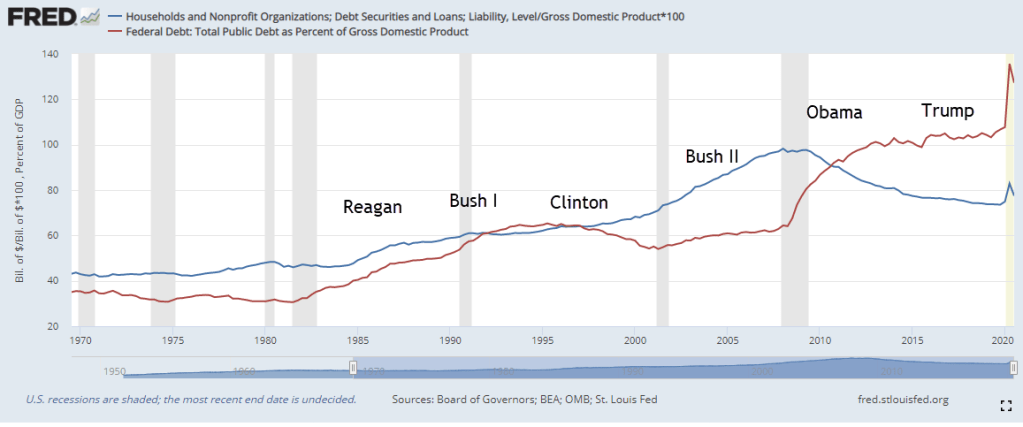
Since WW2, households have traditionally held more debt than the federal government as a percent of GDP. I’ll call it %Debt. The biggest component of household debt is mortgages, and includes car loans, student loans, credit card debt, etc. A decade ago, Federal %Debt surpassed households, effectively allowing households to reduce their debt level and put it on the federal balance sheet.

Federal debt spiked during the pandemic while household debt levels have risen only 1.5%. For decades, deficit hawks have long warned that rising federal debt levels could cause an economic implosion that would make the Great Depression look tame by comparison. They may be right – finally.

There are two ways that the federal %Debt can go down. The first is to grow the economy; that’s the GDP in the denominator of Debt / GDP. The second way is to reduce the level of Debt, the numerator. It is unlikely that Congress is going to raise taxes enough to reduce the debt, so that leaves only one way to reduce %Debt – grow the economy faster than the growth in federal debt.

To do that, consumers need to spend money because their spending makes up 70% of GDP. There are three ways to increase spending. The first is to increase incomes faster than economic growth but that has not been happening for several decades. The real growth in middle class incomes over the past 30 years is only 15%, or 1/2% per year average.

The non-partisan Congressional Budget Office projects that total incomes will increase by an average of $33B per year over the next decade if the minimum wage is raised to $15 over the next five years (CBO, 2021). That increase of 1.5% in GDP will not change the federal %Debt by much.

The second way to increase GDP is for consumers to take on more debt. A rise in housing prices has lifted the net worth of many households, who can tap into that equity to increase their spending. However, households are already choked with debt. The two largest generations, the Millennials and the Boomers are offsetting each other’s spending. Older Boomers are reducing spending as Millennials increase their purchases. The Millennials have been crushed by the financial crisis a decade ago and again with the Covid crisis. Many feel like they came along at the wrong time in history and are cautious. When consumers pay down debt, they spend less and that lowers GDP growth.

The third way is probably the trend of the future. The federal government will continue to pile debt on its balance sheet and shift income onto households in the hopes that consumers will spend money and grow the economy faster than the rise in federal debt. There is a concept called the multiplier and economists argue over its value. It is the total effect of spending in an economy when the government spends $1. That depends on consumer and business confidence, which depends on the amount of debt each sector holds. The IMF estimates that the multiplier is about 1.5, so that $1 of spending equals $1.50. If so, deficit spending might grow the economy faster than the federal debt grows.

I’ll return to a proposal I discarded earlier – increasing taxes, particularly on the top 10% who don’t spend as much of their incomes on consumer goods as the bottom 90%. Under the Budget Reconciliation rule in the Senate, the Democrats could pass tax legislation that undoes the 2017 tax cuts that the Republicans passed using that reconciliation process. In his campaign proposals, President Biden limited any tax increases to those making $400,000 or more, a small sliver of the population.

Income distribution is skewed toward the upper 5%, who will fight vigorously to keep what they have. They will complain – and they have a point – that they are already paying higher taxes in the form of lost income because interest rates are so low. Those with savings are being paid a paltry amount in interest but the low rates reduce the interest on the debt that the federal government pays each year. Boomers on fixed incomes are having to reduce their savings faster  to meet monthly expenses.

The structure of income distribution is weak. No, it’s not a problem with capitalism, as some like to claim. This is a problem with political policy which pre-dates capitalism. A small group of people in a nation take command of the distribution levers and direct more of the nation’s income to themselves. In the 1700s, the problem was thought to originate with monarchy and aristocracy. Democracy was going to cure the problem, but it didn’t. Communism was going to cure the problem and it didn’t. Socialism – the middle way between capitalism and communism – was going to solve the problem, but the EU demonstrates that socialism simply slows growth, increases structural unemployment, and does little to solve the persistent problem of distributional inequalities.

Governments worry about exogenous factors like Covid, war, or a dramatic shift in commodity prices. While those do produce crises, they do so because of endogenous factors – weaknesses in a nation’s political and economic system that award property rights in such a way as to exacerbate social tensions. The Great Depression and Financial Crisis were examples.

Since the Financial Crisis a decade ago, people in nations around the world have been raising their fists and their voices. The productivity gains that capitalism promoted had ameliorated the centuries old problem of political oligarchies, but no economic system can solve what is fundamentally a political problem.

Those who voted for former President Trump in 2016 did so thinking that he was a political outsider who could “drain the swamp,” i.e., bust up the political oligarchy that controls Washington. He became part of that oligarchy, feeding the monster, because it relied on his lack of political expertise.

Those who voted for President Biden hope that his decency and moderation will help craft legislation that unlooses the grip that the oligarchy has on our political process. Which wires do we pull to disconnect the oligarchy?

///////////////

Photo by Victor Barrios on Unsplash

Congressional Budget Office (CBO). (2021, February 08). The budgetary effects of the raise the Wage act of 2021. Retrieved February 13, 2021, from https://www.cbo.gov/publication/56975

Tax Policy Center. (2020, May). What is reconciliation? Retrieved February 13, 2021, from https://www.taxpolicycenter.org/briefing-book/what-reconciliation

Income Tax and the Constitution

The Constitution of the United States was designed to protect the individual states who feared the power of a large central government.  In keeping with that design, the Constitution enumerates the various powers of the Federal Government. This past week a majority of the Supreme Court decided that the health care law known as Obamacare was constitutional, basing its decision on the taxing power granted by the Constitution and the 16th Amendment.

A fundamental presumption of writing the Constitution is the self-preservation of the new nation as such.  Various powers of defense, the ability to make war and treaties with foreign countries are some of the enumerated powers granted to the Federal Government to ensure the country’s continued existence.  What is not enumerated but assumed is the right, the duty of the Federal Government to protect the country as a whole.  At a time of armed conflict within a fractured nation, President Lincoln understood this point more clearly than most – that the utmost responsibility of a President is not spelled out in the Constitution that he had sworn to uphold.

There are two common faults that have caused the downfall of all nations, particularly nation empires: 1) the internal struggle for power by factions; and 2) the inexorable concentration of wealth and property.  The second leads to the first.

In the Federalist Paper No. 9, Alexander Hamilton wrote “It is impossible to read the history of the petty Republics of Greece and Italy, without feeling sensations of horror and disgust at the distractions with which they were continually agitated, and at the rapid succession of revolutions, by which they were kept in a state of perpetual vibration, between the extremes of tyranny and anarchy.”  Periods of calm within those empires were short-lived, “soon to be overwhelmed by the tempestuous waves of sedition and party-rage.”  As we look at and listen to the debates regarding health care, what do we see?  Party-rage.  Day after day, proponents on both sides of the issue make claims that are either blatantly untrue or a tortured stretching of fact.  There are so many dubious claims that reporters at Politifact.org  can only examine the more widely spread claims.

In Federalist Paper No. 10, James Madison, the chief constructor of the Constitution, wrote: “Among the numerous advantages promised by a well constructed Union, none deserves to be more accurately developed than its tendency to break and control the violence of faction.”  Further, he writes “Complaints are every where heard … that the public good is disregarded in the conflicts of rival parties.”  He explained what he meant by the word faction: “By a faction, I understand a number of citizens, whether amounting to a majority or minority of the whole, who are united and actuated by some common impulse of passion, or of interest, adverse to the rights of other citizens, or to the permanent and aggregate interests of the community.” 

What is to be done?  Madison wrote “There are two methods of curing the mischiefs of faction: the one, by removing its causes; the other, by controling [sic] its effects.  There are again two methods of removing the causes of faction:  the one by destroying the liberty which is essential to its existence; the other, by giving to every citizen the same opinions, the same passions, and the same interests.”  The first of these methods is undesireable; the second is impractical. Madison concluded “The latent causes of faction are thus sown in the nature of man.”  He does not condemn people for this tendency to form factions; a well constructed government must deal with this part of man’s nature.

Madison saw “A zeal for different opinions concerning religion, concerning Government, …an attachment to different leaders ambitiously contending for pre-eminence and power [who] have in turn divided mankind into parties, inflamed them with mutual animosity, and rendered them much more disposed to vex and oppress each other, than to co-operate for their common good.  So strong is this propensity of mankind to fall into mutual animosities, that where no substantial occasion presents itself, the most frivolous and fanciful distinctions have been sufficient to kindle their unfriendly passions, and excite their most violent conflicts.  But the most common and durable source of factions, has been the various and unequal distribution of property.  Those who hold and those who are without property, have ever formed distinct interests in society. [Many different interests] grow up of necessity in civilized nations, and divide them into different classes, actuated by different sentiments and views.  The regulation of these various and interfering interests forms the principal task of modern Legislation, and involves the spirit of party and faction in the necessary and ordinary operations of Government.” [emphasis added]  These astute observations by Madison are true today just as they were two hundred years ago.

In its own self-preservation, a government must ameliorate the “unequal distribution of property” which Madison considers to be the chief cause of factions.  How is a government to do that and preserve the respect for property rights that Madison and the framers deemed essential to a free people?  Madison wrote “From the protection of different and unequal faculties of acquiring property, the possession of different degrees and kinds of property immediately results: and from the influence of these on the sentiments and views of the respective proprietors, ensues a division of the society into different interests and parties.”  As with factions, this contradiction is an essential process of being a free people.  To use the same sentence construction as Madison: there are two methods for removing the causes of the concentration of wealth and property:  the one, by abolishing individual property rights which are essential to a nation of free people; the other, by giving every citizen the same amount of property.  The first is undesireable; the second invalidates the first principle and impractical, as Communist societies discovered.

A well constructed government uses its taxing authority to fund its operation and control the inevitable concentration of wealth and property. Many conservatives of today argue on principle that government’s role is not to transfer wealth from one person to the next.  They ignore the history of the decline of many nations whose wealth concentration reached a critical mass that ignited revolution.  They forget that the first principle of a nation is its own preservation; that a nation MUST transfer enough wealth to slow its concentration among a small portion of its citizens.  By its very nature, a property or income tax takes, by threat of force, the property of a person.  The principle of respect for individual private property rights can not be sustained in the ideal if a nation is to survive.

The income tax, or 16th, amendment was “sold” to the state legislatures as a way to tax corporations and very wealthy individuals.  For corporations, the income tax was to be an excise tax or a fee for the exemption from liability that a corporate structure afforded its stockholders.  Today many conservatives advocate a flat tax or a less progressive tax rate structure, citing the uneven distribution of the tax burden on the rich.  When the legislatures voted on this amendment, they did so on the premise that almost all people would not be subject to the income tax.   Corporations and those with extremely large incomes were to shoulder the entire burden of the income tax.  Those state house members who voted for ratification would be shocked that the top 1% of income earners paid only 38% of the personal income tax collected in 2008 (National Taxpayers Union).  They would be indignant that corporations paid only 22.1% of the combined total of personal and corporate income taxes collected in 2008 (IRS Statistics  Table 1).  When the 16th Amendment was sold to the American people in 1910 through 1913, these two groups combined were to shoulder most, if not the entire, burden of the income tax.  In 2008, they paid a little less than 52%.

In the coming months billions of dollars will be spent to sway or negate our vote.  The people and corporations who spend these vast amounts of money will try to convince us that we should vote a certain way on principle, out of loyalty to a particular ideal, party or policy.  Those who spend this money are not evil – they are simply promoting their own interests, hoping that they will convince each of us that we share an interest with theirs.  Given a choice of two competing parties, some voters will be undecided, feeling lukewarm or conflicted about the interests of either faction.  We may wish for some alternative to these dominant factions, or a menu where we could pick and choose the narrow interests that most closely align with ours.  It is the nature of mankind that we can not either live or vote in the ideal; that we must make compromises and choose the faction which most closely aligns with our interests.

From the beginnings of this nation, parties have arisen, trying to wrest control of the government, hoping to grab control of its power for their own self-interest.  For its own self-preservation, a well constructed government MUST constantly strive to distribute competing interests and power; since money and property form the core of power, a government must spread just enough money from the richest of its citizens and corporations to the rest of its citizens.   How well a government can do so determines whether the nation survives.

Personal Income

On Friday, the Bureau of Economic Analysis (BEA) released their monthly report of personal income, the total of income from wages, salaries, government benefits, interest and dividend payments and rental income. 

Total personal income rose just .1% for the month of September but wages and salaries showed a more healthy .3% monthly increase after declining .1% in August.  Interest income and government benefits remained flat.  Year over year, income increased 4.4% – more than the seasonally adjusted 3.6% increase in inflation.

In this country there is a feeling that something fundamental is wrong. Many are waking up to the fact that the national myth of Equal Opportunity may be just that – a myth. For decades, people have started small businesses using the equity in their homes to survive the cash flow crunch of the first years of a small business. The decline in housing prices has left many without that traditional capital cushion.

A few weeks ago I wrote about the decline in the median income over the past decade.  Today, let’s look at the big picture of personal income.  Below is a Federal Reserve chart of inflation adjusted personal income for the past fifty years. (Click to enlarge in separate tab)

After a big dip in the past recession (shaded on the chart above), total personal income has returned to about the level it was at the start of the recession in December 2007.  Below is that same chart zoomed on the past five years of inflation adjusted income.

To see the underlying strength or weakness of income, we need to take out transfer payments, which are government checks for benefits of all types.  After all, this is just tax money taken from Paul to pay Peter. The Federal Reserve conveniently gives us that data.

A zoom in on the last five years of inflation adjusted personal income shows the economic sickness that many people vaguely know in their hearts.  After rising from a trough in the 3rd quarter of 2009, real personal income has stagnated the past year.

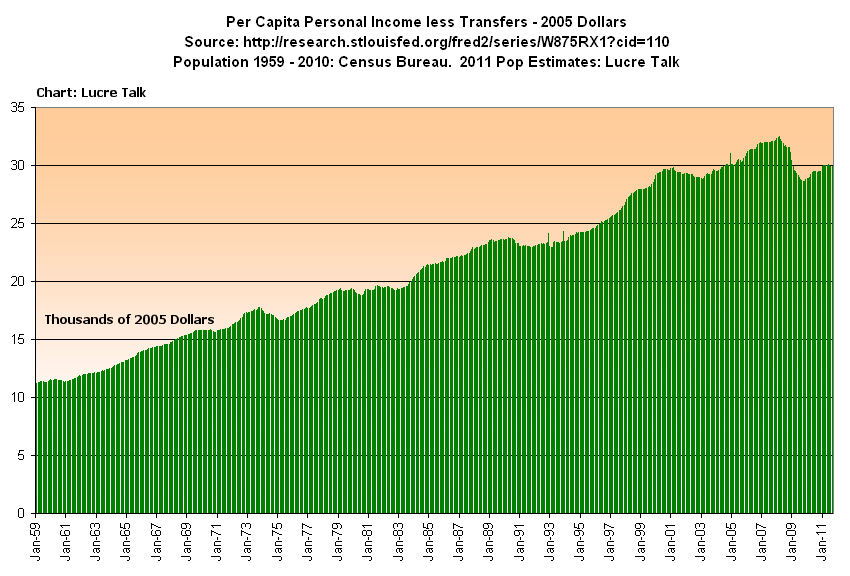
What this data doesn’t do is adjust for the increase in population.  Although the Federal Reserve charts per capita disposable personal income, they do not chart real personal income less transfer payments on a per capita basis.  Using population figures from the Census Bureau, I was able get a picture of the income data, one that has serious implications for the future.

In 2011, we have finally reached the 2001 level of income.  Despite all the productivity gains of the past decade, we are back to where we started.  As I have pointed out before, the productivity gains are going to the very top incomes.  Below is that same chart, but focused on the past ten years.

As the boomers retire in ever increasing numbers they will be receiving Social Security checks, a transfer payment, which will put downward pressure on personal income less transfer payments.  The long term chart of personal income less transfer payments reveals a familiar and disturbing pattern familiar to stock chart watchers – the head and shoulders pattern – which indicates a dramatic drop in the future.  Confirming this ominous sign are the uncompromising unemployment figures – over 16% of the working age population is either un- or under-employed.  How are these fewer workers with relatively stagnant real incomes in the production of goods and services going to generate enough tax revenues to pay for the increasing transfer payments?

Income Disparity

Beth referred me to a Slate article by

This article has a decided “liberal” slant.  The graph showing disparities in income leaves out “transfers of income”.  In July 2010, the BEA reported that transfer payments were 1/6 of total personal income, or about 30% of what people got paid in wages and salaries.  Transfer payments include Social Security, unemployment insurance, back to work welfare programs, pell grants, etc, etc.  There is disparity of income but Paul Krugman and others who have a strong political agenda pick out the data that most strongly shows their case.  Income is income.  In the early part of the 20th century there were no social safety net programs and few transfer payments.  Now, they comprise a significant part of income for a growing part of the population and should be included for comparison.

A final note:  There will always be disparities in income, disparities in circumstance, disparities in ability.  James Madison, the primary architect of the Constitution, was well aware of this and wrote in Federalist #10:
 

The diversity in the faculties of men, from which the rights of property originate, is not less an insuperable obstacle to a uniformity of interests. The protection of these faculties is the first object of government. From the protection of different and unequal faculties of acquiring property, the possession of different degrees and kinds of property immediately results; and from the influence of these on the sentiments and views of the respective proprietors, ensues a division of the society into different interests and parties.

Those who hold and those who are without property have ever formed distinct interests in society. Those who are creditors, and those who are debtors, fall under a like discrimination. A landed interest, a manufacturing interest, a mercantile interest, a moneyed interest, with many lesser interests, grow up of necessity in civilized nations, and divide them into different classes, actuated by different sentiments and views. The regulation of these various and interfering interests forms the principal task of modern legislation, and involves the spirit of party and faction in the necessary and ordinary operations of the government.

The violence of factions had brought down previous republics like Greece and Rome.  What can remedy this natural tendency of people to form factions?

There are two methods of curing the mischiefs of faction: the one, by removing its causes; the other, by controlling its effects.
There are again two methods of removing the causes of faction: the one, by destroying the liberty which is essential to its existence; the other, by giving to every citizen the same opinions, the same passions, and the same interests.

Realizing that the cures for faction are worse than the disease of faction, Madison constructed a Constitution by which the different factions in this country would push and pull for power.  Unlike utopians who dream of a better world if only people weren’t so self-interested, Madison understood that self-interest was natural to people and developed a legislative structure that could hopefully balance those competing interests.
Today we have become a country of factions fighting for federal largesse:  farmers who want price supports, the unemployed who want benefit extensions, students wanting more generous student loan programs and grants, industrial towns wanting government support to bring businesses to their area, banks and car companies wanting bailouts, consumers wanting ever more protections, seniors wanting generous cost of living adjustments to their pensions, people wanting more regulations, people wanting less regulations, etc, etc.  We are turning into a country of supplicants raising our voices in a cacophony of “Gimme” and “It’s mine.” 
And we call ourselves a great nation.

The Tax Divide

Continuing my review of 20 years of tax data from the IRS, I’ll look at incomes vs income taxes paid.  As the chart below shows, the top half of households in this country pay all the personal income taxes collected. (Click graph to enlarge)

In 2000, net tax rates for the top half of households topped out at about the same level of the mid 80s – just under 20%.  The Bush tax cuts of 2001 and 2003 lowered net tax rates for the top half of household to under 15%.

The top half of households are making 90% of the personal income in this country and paying almost 100% of the personal income tax.  The top 25% of households are making 70% of the income and paying about 83% of personal income taxes.

Half of households pay the bills both for themselves and for the other half. In a democratic society, those on the lower half of the economic ladder will vote for politicians who promise more programs to help them out.  Those on the upper half will vote for politicians that promise to reduce their tax burden.

The core of the problem, however, is not tax rates or taxes paid but the rising gaps between economic groups, particularly those households at the very top of the economic ladder and the rest of the population.  Until that inequity in income is reduced, the top 25% of households will pay an ever increasing share of the tax burden.  Policymakers in Washington have been and continue to create a two tiered society.

What are some solutions to reduce the income gaps?   We have found that we can not have a healthy economy which is based almost entirely on the service sector.

1) Encourage businesses to relocate manufacturing facilities back to the U.S.  This can be done with tax incentives for those businesses that hire American workers.  Where will we get the money to afford these tax incentives?  The only place possible – those in the top 10% of households.  Increase the tax rates on those in the upper income brackets but target the additional money specifically for tax breaks for small manufacturing businesses – those with 100 employees or less – that hire American workers.  In Obama’s 2010 budget, he proposes to let the Bush era tax cuts expire for upper income taxpayers and use the additional tax money to reduce the country’s deficit.  It is a noble goal but it does not address the long term structural defects in this economy.  Right now, deficit reduction is a temporary bandaid on a much larger problem that will make large budget deficits a structural component of our economy in the coming decades.

2)  Relax some of the stringent environmental codes enacted over the past several decades which drove up costs for U.S. based manufacturers and hastened their departure for other countries with cheaper labor costs and less onerous environmental requirements.  This may upset some people who want a perfect world.  We can’t have a perfect world.  We never could. 

3)  Manufacturing requires capital and will absorb some of the excess money reserves that are looking for a return.  Too much U.S. savings is being used to invest in the manufacturing output of other countries.  Too much U.S. savings is being used to buy federal, state and local debt, all of which will continue to increase as the tax base decreases.  Let’s get our savings to work producing.

4)  Have a minimum tax that all but the poorest households pay each year – even if it is only $100 a year.  25% of households in this country have no “skin in the game.”  Target that tax money for those in the helping professions who are generally paid less for the work they do and the education they work hard to achieve.  That includes social workers, LPNs, nurses aides and counselors.

Any other ideas?