January Employment and Economic Production

February 9th, 2014

The ISM manufacturing report for January reported a severe decline from the robust readings of past months.  New orders suffered the most, dropping from a strong reading of almost 65 in December to just a bit above the neutral reading of 50.  Prices jumped significantly.  Manufacturing’s drop off in new orders comes on the heels of a similar decline in the service sector in December.  This is the third report in the past thirty days that came in below even low estimates, the other two being pending home sales and December’s employment gains.  At mid week, ISM released their January estimate of the health of the service sector which is the bulk of the economy.  Happily, this showed continued growth, helping to offset concerns about a broad slowdown in the economy.

The CWI that I have been tracking continues to show an overall strength, declining slightly to 58 from the rather vigorous reading of 60 last month.  As I noted a few weeks, this index anticipated a winter lull before picking up energy again in early spring.
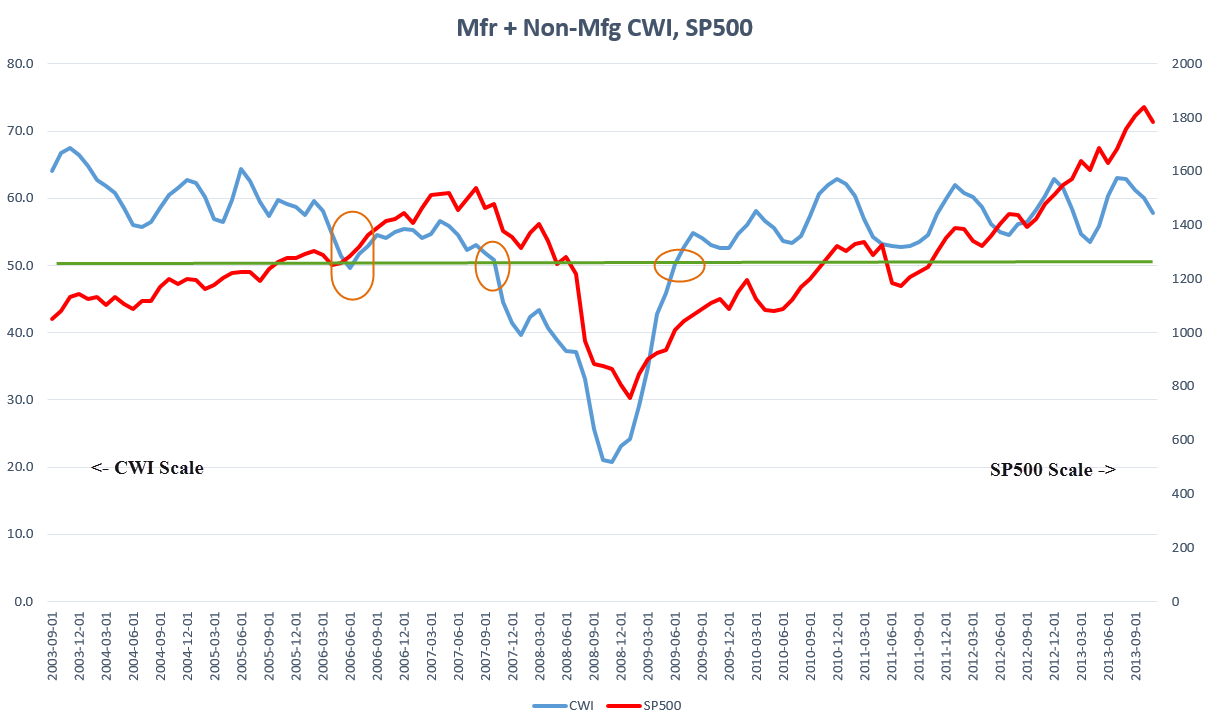
A reader had difficulty understanding the wave like graph of the CWI.  I indexed it to a starting base then indexed that to the SP500 average in 1997.  Perhaps this will help visualizing the long term response of the SP500 to underlying economic activity.

*******************************

ADP reported a gain of 175,000 private jobs in January, below the strong 227,000 job gains of December.  There was only a slight revision to ADP’s previous report, confirming the suspicion of some that the greater flaw lies in the BLS figures for December.

On Friday, the Bureau of Labor Statistics (BLS) released their estimate of 113,000 job gains in January, far below the consensus of about 180,000.  Here’s a story from the Atlantic that captures some of the highlights.  Forgive some of the misspellings, if they are still there by the time you read it.

As I did last month, I’ll show the average of monthly job gains estimated by the BLS and ADP.  ADP does not report government jobs so I’ve just added those in from the BLS report.
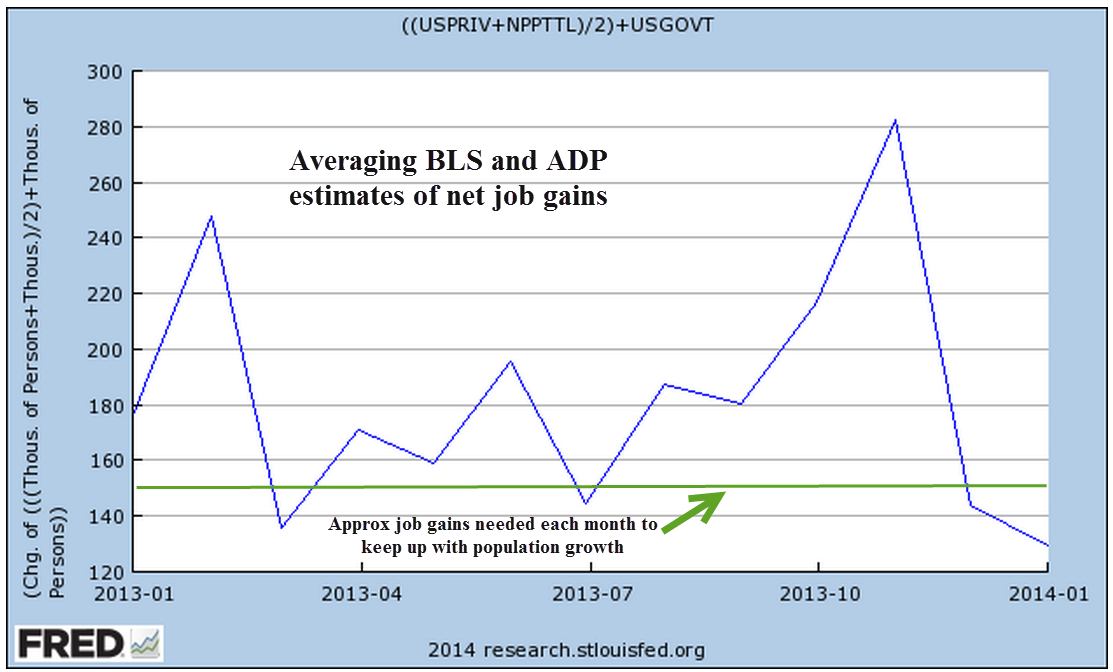
The decline below the replacement level of 150,000 may be a temporary response to severe weather conditions in the populous east coast and Chicago region.

The market responded quite favorably to this labor report. A slackening labor market prompted hopes that the Federal Reserve will not accelerate their easing of bond buying.  A large revision of job gains in November was a big positive in the report.  Another positive was the half a million increase in the core work force, those aged 25 – 54.  Men accounted for most of this increase.
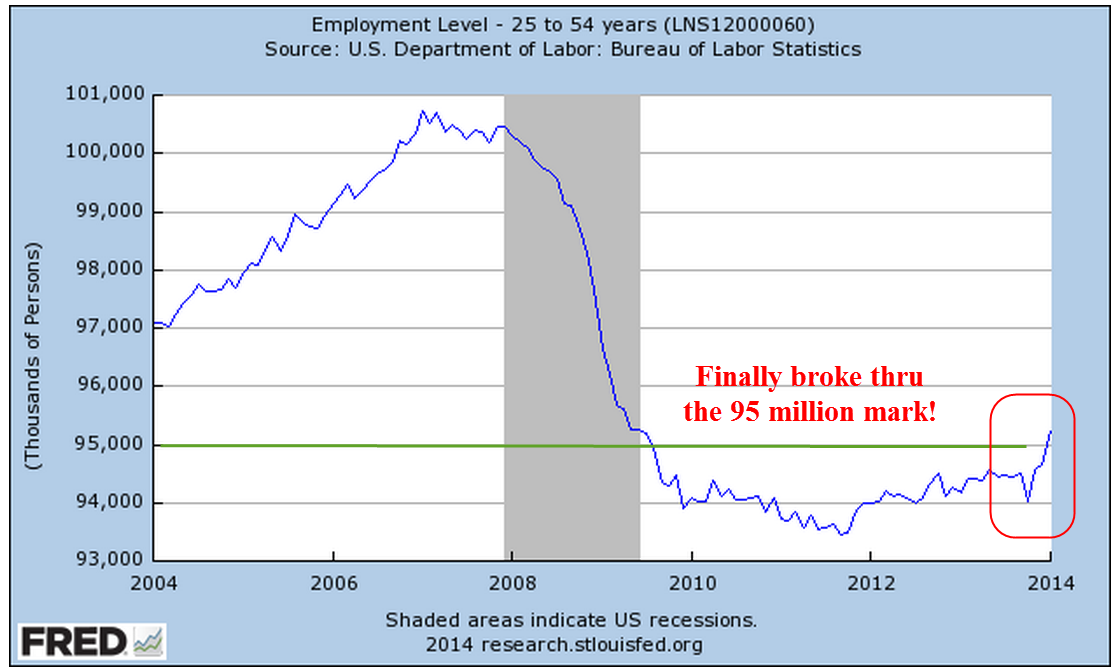
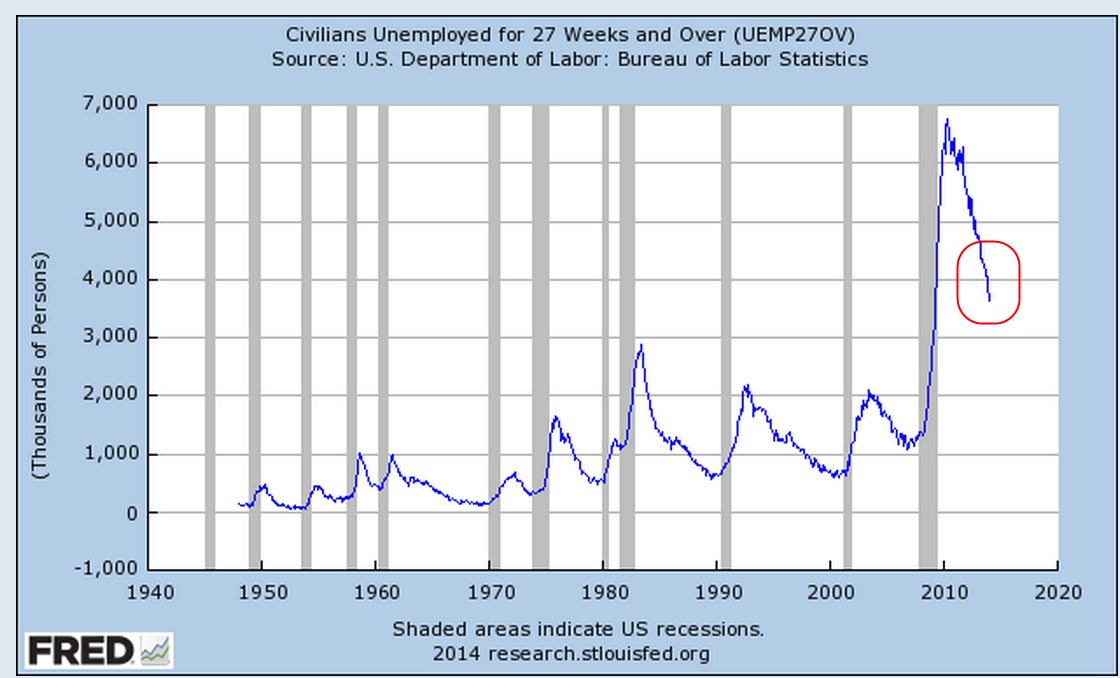
The number of people working part time because they can’t find a full time job dropped by a half million but there are still more than 7 million people in this situation.  A 232,000 decrease in the number of long term unemployed was heartening although many lost their unemployment benefits at the end of the year and may have had little choice but to take whatever job they could find.
*****************************

Doug Elmendorf is the head of the Congressional Budget Office (CBO) that advises the Congress in constructing the budget, making appropriations, and the anticipated or actual economic effects of policy.  In advance of his testimony before the House Budget Committee this past week, the CBO released the highlights of their report. Some talk show hosts and conservative media were trumpeting a loss of 2.3 million jobs due to Obamacare.  In his testimony, Mr. Elmendorf explained that the 2.3 million jobs mentioned in the CBO report are not lost jobs because the CBO does not estimate any reduction in the demand for employees because of Obamacare. The CBO estimated the number of hours that employees would voluntarily reduce their hours in order to meet qualifications for subsidies under Obamacare and divided those total hours by what a full time employee would work in a year.  Since there is a surplus of labor in this country, this voluntary reduction would help those who are either looking for a job or want to work more hours.  The CBO sees no impact on part time jobs that can be attributed to Obamacare.

*******************************
Republicans and some Independents have repeated the claim that the rich are paying most of the personal income taxes in this country. IRS 2010 data (Table 2 ) doesn’t seem to support that contention.  The top 5% of taxable returns with taxable incomes greater than $200K had taxable income of $1.9 trillion, or 36% of the total $5.3 trillion in taxable income.  On that income, the top 5% paid $513 billion in Federal income tax, 49% of the total.  In a flat tax system, the top 5% would have paid a bit more than $360 billion.

When Republicans use the code words “broaden the tax base” what they mean is that they want a flat tax so that rich people pay the same percentage of tax as poor people.  Several states have such a flat tax system.  To Democrats, a broadening of the tax base means making more of the income of rich taxpayers subject to progressive tax rates.

When Democrats use the code words “paying their fair share” they mean that the rich should pay proportionately more than the additional load of about 32% that they are currently paying.  To Republicans “fair share” means a flat tax.

What the IRS data shows is that the rich are not paying most of the income taxes in this country.  Often tax policy and social benefit programs are lumped together, confusing the issue in the minds of many.  The Tax Foundation did an analysis of the net benefit and expense of taxation and benefit programs.  They report that:

As a group, the bottom 60 percent of American families receive more back in total government spending than they pay in total taxes.

Government tax and spending policies combine to redistribute more than $2 trillion from the top 40 percent of families to the bottom 60 percent.

The methodology that the Tax Foundation uses presumes that everyone benefits equally from public spending like defense, police and the courts.  An alternative assumption that people benefit according to their income results in a $1.2 trillion redistribution, about 40% lower, according to the Tax Foundation.  (Kudos to the Tax Foundation for making both computations.)

What the report does not do – because it is just so hard to do – is calculate age and circumstance related movements of taxpayers from the top 40% to the bottom 60%.  Consider a taxpayer – I’ll call her Linda – making $100,000 who is in the top 40%.  She loses her job and starts collecting unemployment for several months.  Her income now puts her in the bottom 60%.  “Past Linda” was supporting the bottom 60% but “present Linda” is now part of the bottom 60%, according to the methodology used by the Tax Foundation.  Yet if we isolate this one taxpayer, we can say that “past Linda” was actually supporting “present Linda.”  When Linda was making $100K, she presumably paid a lot in income and other taxes, including unemployment taxes paid by her employer.  The Federal Government does not keep records that would allow this kind of inter-temporal analysis.  As a result, we get a distorted view of what is actually happening.

Let’s look at an older taxpayer – I’ll call him Sam – who retires.  Sam was making $80K before he retired and was in the top 40%.  With social Security income and income from savings, Sam now makes $36K in retirement, which puts him in the bottom 60%.  Is Sam being supported by the top 40%?  Statistically he is.  However, most of us would say that Sam is simply living off the benefits that he paid into during his working life.

I appreciate the exhaustive work that the Tax Foundation does but the problem is more complex than they present.  Furthermore, many people are not aware of the difficulties and complications of calculating who supports whom.  Some use this analysis to present the case that the majority of Americans are sucking on the teats of the few well off.  Presidential contender Mitt Romney’s unguarded comment about “the 47%” who are living off the efforts of others did not serve him well in the past election yet a sizeable percentage of voters believe this.

The 16th Amendment passed a century ago allowed the Federal government to tax the income of individuals directly and it was intended to be progressive.  Relatively few paid any income taxes in the first decades after the enactment of the income tax.  Whether one likes the progressivity of the tax code, one has to recognize that the law was intended to be that way when it was passed.

I would like to see the repeal of the 16th Amendment for two reasons: 1) protect individuals from the power of the Federal government; 2) slow the consolidation of money in Washington.  Money brings power and power begets patronage, if not downright graft.  We can never get rid of patronage, only retard the concentration of patronage. Studying 5000 years of history, we have learned that the concentration of power in any political institution ultimately leads to the downfall of that institution.  Only corporations can exist with such a concentration of power and even they sometimes fall when top leadership in a company becomes resistant to change.

Perhaps we could adopt a taxing system where the Federal government taxes the states based on the population in each state.  If a state has 10% of the country’s population, then they would owe 10% of any tax used to replace the current income tax.  Let the states determine how they will collect the money.  Racism has been a constant nemesis of this country and legal protections could be enacted which would prevent states from taxing citizens based on race or sex.  Head taxes have a tawdry reputation because they were often used to disenfranchise poorer voters.  If the population count of a state was simply used as an allotment mechanism and not applied directly to each citizen, I think that this could be a fairer and safer system of taxation.  Certainly, legislation could be passed preventing the denial of rights to a citizen based on a tax.

Could Doug Elmendorf and his cohorts at the CBO build a model based on such a system?

*******************************

Tidbit:

And we’re talking about nine million individuals who are eligible for both Medicare and Medicaid. They are responsible for a significant amount of spending in both programs — approximately 46% of Medicaid and close to a quarter of Medicare spending annually.  Estimates range that that is anywhere from 300 to $350 billion a year total that we’re [CMS] spending. 
Melanie Bella, Director of the Federal Healthcare Office at the Centers for Medicare and Medicaid Services, Federal Coordinated Healthcare Office Conference 11/1/2010

Gimme More Government Limits

Many companies do not want limited government.  A smart company dumps as many costs as it can into the public sector, thereby increasing its profits.  WalMart is one such smart company, going so far as to provide their many low paid employees with literature on government social programs that will help the employee cope with the low wages WalMart pays.  Smart companies crusade local governments to upgrade their fire departments and the delivery pressures of their water systems in order to save the company money on its business insurance.  The cost is shifted and spread out to the public and the owners of companies in the upgraded area put the profits in their pocket. Smart established companies like regulations which establish a barrier to entry for their competition, particularly in businesses that have low capital requirements to start up.  Smart companies lobby local and state governments for more licensing laws which present one more cost and regulatory hurdle for small businesses trying to gain a competitive foothold in an industry.  Smart companies argue that licensing is needed for public safety.  Would you want an unlicensed fishing guide?  Of course not!  Here is a partial list of occupations requiring a state license in my state.

The IRS is now requiring most tax preparers to be licensed as a Registered Tax Return Preparer, which includes “competency tests for all paid tax return preparers except attorneys, certified public accountants (CPAs) and enrolled agents who are active and in good standing with their respective licensing agencies.” (IRS Source)  How many independent tax preparers who do tax returns for a few months a year will bother with the cost and time to establish and maintain their credentials?  Many low income workers, especially those with marginal reading skills, feel more comfortable having a tax preparer fill out the amount of their W-2s and do the relatively simple calculations required to file the short form 1040A.  The IRS could have exempted those preparing 1040As, but it didn’t.  Did the IRS enact these regulations in response to a law passed by Congress?  No.  Surely the IRS must have studied this problem for several years before issuing these new regulations?  The IRS spent all of six months before issuing these rules.  One can only wonder who and what prompted such a swift review and enactment of these regulations.  The logic is the oldest one in business:  reduce the supply of preparers and those that remain can charge higher fees.

I am not a tax preparer so I don’t have a dog in this fight.  I’m sure there are instances of tax preparers filing more complex tax returns which the preparer does not have the knowledge to prepare.  But why use an axe when a paring knife will do?  The only solution may be tax reform, the holy grail of simplicity and practicality that continually eludes our elected representatives.

Income Tax and the Constitution

The Constitution of the United States was designed to protect the individual states who feared the power of a large central government.  In keeping with that design, the Constitution enumerates the various powers of the Federal Government. This past week a majority of the Supreme Court decided that the health care law known as Obamacare was constitutional, basing its decision on the taxing power granted by the Constitution and the 16th Amendment.

A fundamental presumption of writing the Constitution is the self-preservation of the new nation as such.  Various powers of defense, the ability to make war and treaties with foreign countries are some of the enumerated powers granted to the Federal Government to ensure the country’s continued existence.  What is not enumerated but assumed is the right, the duty of the Federal Government to protect the country as a whole.  At a time of armed conflict within a fractured nation, President Lincoln understood this point more clearly than most – that the utmost responsibility of a President is not spelled out in the Constitution that he had sworn to uphold.

There are two common faults that have caused the downfall of all nations, particularly nation empires: 1) the internal struggle for power by factions; and 2) the inexorable concentration of wealth and property.  The second leads to the first.

In the Federalist Paper No. 9, Alexander Hamilton wrote “It is impossible to read the history of the petty Republics of Greece and Italy, without feeling sensations of horror and disgust at the distractions with which they were continually agitated, and at the rapid succession of revolutions, by which they were kept in a state of perpetual vibration, between the extremes of tyranny and anarchy.”  Periods of calm within those empires were short-lived, “soon to be overwhelmed by the tempestuous waves of sedition and party-rage.”  As we look at and listen to the debates regarding health care, what do we see?  Party-rage.  Day after day, proponents on both sides of the issue make claims that are either blatantly untrue or a tortured stretching of fact.  There are so many dubious claims that reporters at Politifact.org  can only examine the more widely spread claims.

In Federalist Paper No. 10, James Madison, the chief constructor of the Constitution, wrote: “Among the numerous advantages promised by a well constructed Union, none deserves to be more accurately developed than its tendency to break and control the violence of faction.”  Further, he writes “Complaints are every where heard … that the public good is disregarded in the conflicts of rival parties.”  He explained what he meant by the word faction: “By a faction, I understand a number of citizens, whether amounting to a majority or minority of the whole, who are united and actuated by some common impulse of passion, or of interest, adverse to the rights of other citizens, or to the permanent and aggregate interests of the community.” 

What is to be done?  Madison wrote “There are two methods of curing the mischiefs of faction: the one, by removing its causes; the other, by controling [sic] its effects.  There are again two methods of removing the causes of faction:  the one by destroying the liberty which is essential to its existence; the other, by giving to every citizen the same opinions, the same passions, and the same interests.”  The first of these methods is undesireable; the second is impractical. Madison concluded “The latent causes of faction are thus sown in the nature of man.”  He does not condemn people for this tendency to form factions; a well constructed government must deal with this part of man’s nature.

Madison saw “A zeal for different opinions concerning religion, concerning Government, …an attachment to different leaders ambitiously contending for pre-eminence and power [who] have in turn divided mankind into parties, inflamed them with mutual animosity, and rendered them much more disposed to vex and oppress each other, than to co-operate for their common good.  So strong is this propensity of mankind to fall into mutual animosities, that where no substantial occasion presents itself, the most frivolous and fanciful distinctions have been sufficient to kindle their unfriendly passions, and excite their most violent conflicts.  But the most common and durable source of factions, has been the various and unequal distribution of property.  Those who hold and those who are without property, have ever formed distinct interests in society. [Many different interests] grow up of necessity in civilized nations, and divide them into different classes, actuated by different sentiments and views.  The regulation of these various and interfering interests forms the principal task of modern Legislation, and involves the spirit of party and faction in the necessary and ordinary operations of Government.” [emphasis added]  These astute observations by Madison are true today just as they were two hundred years ago.

In its own self-preservation, a government must ameliorate the “unequal distribution of property” which Madison considers to be the chief cause of factions.  How is a government to do that and preserve the respect for property rights that Madison and the framers deemed essential to a free people?  Madison wrote “From the protection of different and unequal faculties of acquiring property, the possession of different degrees and kinds of property immediately results: and from the influence of these on the sentiments and views of the respective proprietors, ensues a division of the society into different interests and parties.”  As with factions, this contradiction is an essential process of being a free people.  To use the same sentence construction as Madison: there are two methods for removing the causes of the concentration of wealth and property:  the one, by abolishing individual property rights which are essential to a nation of free people; the other, by giving every citizen the same amount of property.  The first is undesireable; the second invalidates the first principle and impractical, as Communist societies discovered.

A well constructed government uses its taxing authority to fund its operation and control the inevitable concentration of wealth and property. Many conservatives of today argue on principle that government’s role is not to transfer wealth from one person to the next.  They ignore the history of the decline of many nations whose wealth concentration reached a critical mass that ignited revolution.  They forget that the first principle of a nation is its own preservation; that a nation MUST transfer enough wealth to slow its concentration among a small portion of its citizens.  By its very nature, a property or income tax takes, by threat of force, the property of a person.  The principle of respect for individual private property rights can not be sustained in the ideal if a nation is to survive.

The income tax, or 16th, amendment was “sold” to the state legislatures as a way to tax corporations and very wealthy individuals.  For corporations, the income tax was to be an excise tax or a fee for the exemption from liability that a corporate structure afforded its stockholders.  Today many conservatives advocate a flat tax or a less progressive tax rate structure, citing the uneven distribution of the tax burden on the rich.  When the legislatures voted on this amendment, they did so on the premise that almost all people would not be subject to the income tax.   Corporations and those with extremely large incomes were to shoulder the entire burden of the income tax.  Those state house members who voted for ratification would be shocked that the top 1% of income earners paid only 38% of the personal income tax collected in 2008 (National Taxpayers Union).  They would be indignant that corporations paid only 22.1% of the combined total of personal and corporate income taxes collected in 2008 (IRS Statistics  Table 1).  When the 16th Amendment was sold to the American people in 1910 through 1913, these two groups combined were to shoulder most, if not the entire, burden of the income tax.  In 2008, they paid a little less than 52%.

In the coming months billions of dollars will be spent to sway or negate our vote.  The people and corporations who spend these vast amounts of money will try to convince us that we should vote a certain way on principle, out of loyalty to a particular ideal, party or policy.  Those who spend this money are not evil – they are simply promoting their own interests, hoping that they will convince each of us that we share an interest with theirs.  Given a choice of two competing parties, some voters will be undecided, feeling lukewarm or conflicted about the interests of either faction.  We may wish for some alternative to these dominant factions, or a menu where we could pick and choose the narrow interests that most closely align with ours.  It is the nature of mankind that we can not either live or vote in the ideal; that we must make compromises and choose the faction which most closely aligns with our interests.

From the beginnings of this nation, parties have arisen, trying to wrest control of the government, hoping to grab control of its power for their own self-interest.  For its own self-preservation, a well constructed government MUST constantly strive to distribute competing interests and power; since money and property form the core of power, a government must spread just enough money from the richest of its citizens and corporations to the rest of its citizens.   How well a government can do so determines whether the nation survives.

Corporate Taxes

Both conservative and “mainstream” media pundits, as well as candidates In the Republican primary debates, assert that U.S. corporations pay a 35% federal income tax rate, “one of the highest in the world.”  After the corporation pays this tax, it distributes dividends to its shareholders, who then pay tax on the dividend.  Capital gains and dividends are taxed at a lower 15% rate, resulting in a net tax of 50% federal tax on corporate profits.  In arguing for lower corporate tax rates and rationalizing the lower rate on dividends, conservatives ask should the federal government get half of corporate profits?

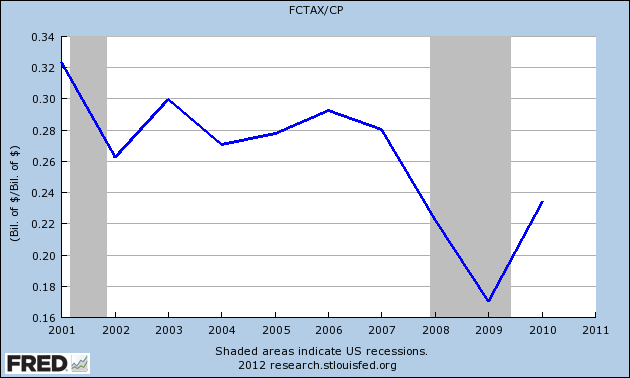
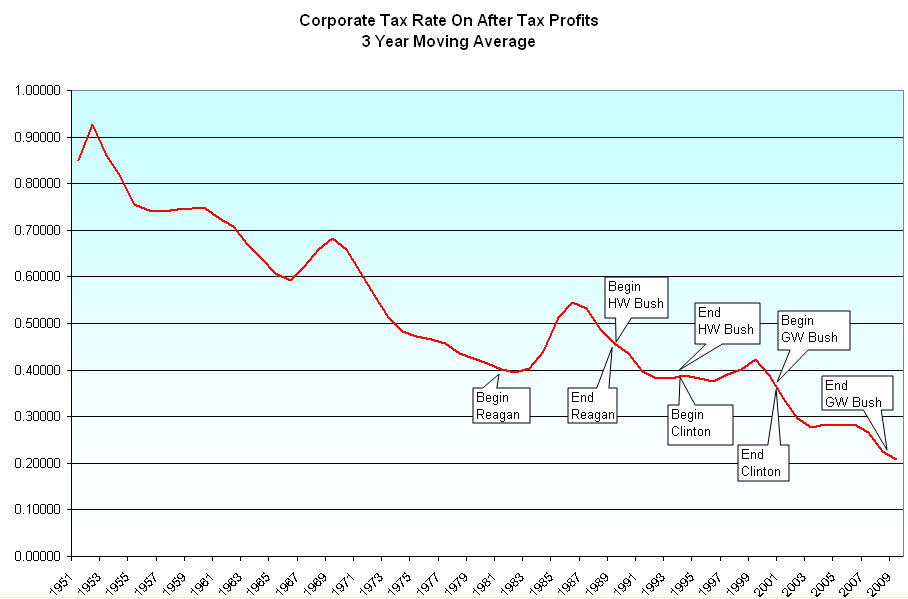
The federal government may get too much of profits but it is not 50%.  The international accounting firm PricewaterhouseCoopers calculated an effective tax rate of 27% in the years 2006 – 2009.  Sixty years of data from the Bureau of Economic Analysis show that the corporate tax rate has declined markedly since World War 2. (Click to enlarge in separate tab)

Using a three moving average highlights the downward trend.  For those in the Ronald Reagan cult, it may come as some surprise to see the “hump” in rates during the Reagan years.

Zooming in on the past ten years, we see an effective tax rate of 30% or less.  Some might explain that the lower average rate is due to smaller corporations who pay less than the 35% tax but IRS data shows that smaller companies who qualify for these lower rates make up less than 10% of corporate profits.

If companies had paid a 35% rate on their profits this past decade, what would they have paid?  Almost a trillion dollars extra in taxes.

When someone mentions the “35% corporate tax rate”, that is the statuatory rate, not the actual rate companies pay.   In 2009, the three year moving average rate had dropped to 21%.  That is a far cry from 35%.  We can have a discussion – or disagreement – about what a fair tax rate is for U.S. companies.  We should at least start that discussion from some realistic data.

One Percent Club

Recently I received links to a few articles on the top income earners – the “one percenters” in this country.  One is a recent Vanity Fair article, written by the economist Joseph Stiglitz, that provides a thoughtful analysis of the economic and political consequences of income disparity. A few days ago the movie critic, Roger Ebert, penned a more emotional article about the one percenters.

As I noted in a previous blog, an adjusted gross income over $410K gets a person in the one percent club.  This club includes the New York Yankees Alex Rodriguez at $33M, his fellow team mate CC Sabathia at $24M, David Letterman at $24M, country star Tim McGraw at $23M and poker stud Daniel Negreanu at $14M.

Roger Ebert’s sentiments probably reflect a more common gut response to the one percenters.  Ebert chose to note the $21M pay package of Jamie Dimon, CEO of JPMorgan Chase, one of the largest banks in the world.   Chase withstood the financial crisis with no bailout funds other than temporary liquidity funds that were quickly repaid.  Quite the opposite. The government and Federal Reserve actually came to Chase asking for a bailout of another troubled banking giant, Washington Mutual. Had Ebert done a bit more homework in his hunt for a villainous financial robber baron, he would have picked John Thain, the CEO who earned over $80M in the year he steered Merrill Lynch into a collapse that threatened the financial system.

So, we can make life simple and reason that there are two kinds of one percenters: the good and the bad. On the good side are people who do stuff: Alex bangs out baseballs, CC throws baseballs, David throw jokes and Tim belts out tunes.

On the bad side then are the one percenters who don’t do anything that involves banging, belting or throwing.  Since most of us can’t grasp what the CEO of a bank does to earn that much money, it must be nefarious back room wheeling and dealing, not hitting and throwing and singing.

In the recent and ongoing debates about whether to continue tax cuts for the wealthy, we should make it clear to our congressional representatives and tell them that we want only the bad one percenters to pay more taxes.

The one percent club also includes anesthesiologists and all we know about what they do is that they put us to sleep before surgery.  Let’s put them in the good one percenter group.  I want to wake up after surgery.

Income Tax Revenues

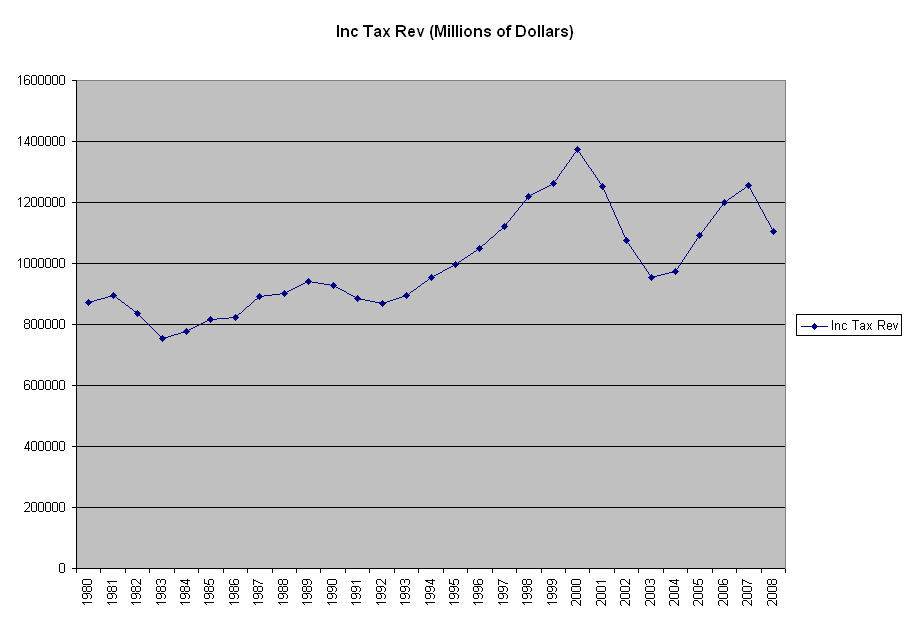
Conservatives have repeatedly argued that even though tax rates were cut during the Reagan administration, federal tax revenues have increased in almost every year.  Is this true?  YES.  The Tax Policy Center presents a history of federal tax revenues from the Office Of Management and Budget (OMB).

BUT, what conservatives don’t acknowledge is the effect that Social Security revenues have had on total tax revenues. Combining a history of Social Security revenues with the history of total Federal tax revenues, I created a chart to show the effect that increasing Social Security revenues have had on total federal tax revenues.

As you can see, it has been dramatic.  When we subtract Social Security revenues from total federal tax revenues, we see that, contrary to what conservatives maintain, income tax revenues in constant 2000 dollars have not increased almost every year since the Reagan era tax cuts.

The larger income tax revenues of the 1990s was due not to a decrease in tax rates but to an increase in tax rates on the upper income brackets.  As the stock market experienced the “irrational exuberance” of the 1990s, capital gains taxes increased dramatically. 

Have the Bush tax cuts of 2003 contributed to more tax revenues?  Yes, BUT most of the revenue gains were again from capital gains taxes.  As the stock market dramatically declined in the latter part of 2008, capital gains and the taxes on those gains evaporated.

The decrease of income tax revenues accelerated in 2009 and although the chart does not show it, the constant dollar income tax revenue in 2009 was about the same level as 1980.

Tired Taxpayers

On 4/10/09, I blogged about recommendations for tax reform from Nina Olson, an IRS advocate. On 4/20/09, a CPA wrote a letter to the editor in which he suggested that “each senator and representative [should] prepare his or her federal income tax return personally and .. the IRS [should] audit 100% of those returns each year.”

We must have some reform. Alternatives include 1) a tax on spending, or VAT; 2) a flat tax on income; 3) a tax on savings through fees charged on all stock and bond trades.

Here is a review of flat tax proposals. Here is a proposal for an optional flat tax by Kansas senator Sam Brownback.

A fair tax is a modified VAT tax (value added tax as it is called in Europe) with no tax for those below a certain income level. The home page is here, and a page explaining the rates are here.

We all agree that the current system is broken. Where we disagree is the solution. Perhaps the best thing would be to put a version of the three alternatives and the current system on a ballot for this November and have all of us vote on it. Lawmakers have been disagreeing on reform since the last tax reform of 1986 and it is doubtful that they could ever agree on a radical change to the code.

The disadvantage of the current system is that it invites Congress to “tweak” the code to reach certain admirable goals, but this constant tweaking is confusing and treats taxpayers like we are donkeys responding to carrots dangled in front of our eyes.

Tell your Congressperson that you don’t want to treated like an ass anymore.

The Tax Man Cometh

In a 4/10/09 WSJ op-ed, Nina Olson, the national taxpayer advocate at the IRS, presents her case for a simpler tax code.

Her office estimates that taxpayers and businesses spend 7.6 billion hours complying with IRS tax code. This does not include state and city tax codes. That amount of hours would make tax compliance one of the largest in the U.S., requiring 3.8 million full-time workers.

Her office calculates that taxpayers spend the dollar equivalent of 14% of the income tax collected to meet tax code requirements.

Her recommendations as guiding principles for tax reform:
Don’t create traps for the unwary.
Simple enough that a single form can be used to report tax liability.
Anticipate areas of non-compliance and make it less inviting.
Some choices, but too many are confusing.
Refundable credits should be simpler to understand, apply for and administer.
Incorporate a periodic review of the tax code.

I have a better idea. No Federal income taxes. Politicians are wanna be car mechanics. As long as they breathe, they will want to amend the tax laws in order to “fix” something.

If there are no income taxes, how to replace the $1.4T – $1.5T in personal and corporate income taxes? Tax stock and bond trades.

In the five day period ending 2/18/09, daily average total notational volume was $229B on 10 million shares traded per BATS. This volume included the Chicago Options Exchange, NYSE, Nasdaq, Boston Exchange, International Stock Exchange. That is $229B traded in one day. 1/2 of 1% (.005) of that trading volume would be $1.145B. There were 250 trading days in 2008 = $1.145B per day * 250 days = $286B. For an individual making a $10,000 stock purchase, that would be a $50 fee.

The volume of bonds sold dwarfs that of the stock market. Construct a smaller percentage fee structure for the bond market. Financial institutions who buy and sell securities with the savings deposits of their customers would pass the cost on to their customers in the form of lower interest returns. Those institutions who traded less would incur less cost and theoretically be able to offer their customers a slightly higher return.

While there will always be the issue of non-compliance, the problem will be greatly reduced, thereby enhancing revenues. Inevitably, there will be investment banks who will construct legal dodges but the IRS should be able to deal with these much more straightforwardly than they currently do with the complexity of the tax code.

Under this simple system, we would implicitly be taxing those who have more than others. That is essentially what this country does with all the complexity of its tax code. Let’s admit it and at least make it simple.