Tax Cuts and Us

Until the end of the year, we will hear and read a lot about the expiration of the Bush tax cuts.  For those who want to extend all the Bush tax cuts, you will hear stuff like this: “The non-partisan Congressional Budget Office (CBO) has predicted a recession in 2013 if the Bush tax cuts are allowed to expire.”  As with most political claims, this is slightly true.  Remember that politicians are little more than magicians practicing a logical sleight of hand in order to convince you of some claim.  What the CBO actually said in a May 2012 report was “if the fiscal policies currently in place are continued in coming years, the revenues collected by the federal government will fall far short of federal spending, putting the budget on an unsustainable path.” (Source)  In the next sentence, the CBO cautions “On the other hand, immediate spending cuts or tax increases would represent an added drag on the weak economic expansion.”  Is there room for compromise in this dysfunctional Congress?

While many politicians are aware of the difficult trade-offs, they dare not mention that to voters, who, they presume, are stupid.  On Fox News, MSNBC and other media, we will continue to hear simplified versions of a complex debate because – well, we’re just too dumb to pay attention to complex arguments that involve math.  If you are like most voters, many politicians reason, you have already stopped reading this because it has too many adjectives, verbs and commas.

The CBO does its best to estimate the long term impact on the federal budget and economic activity as a result of a paticular policy. To illustrate just how difficult this task is, let’s look at a July 2007 letter from the CBO to the Congressional Budget Committee projecting “For 2008 through 2011, CBO’s baseline budget projections show deficits of $113 billion, $134 billion, $157 billion, and $35 billion, respectively.”  Deficits were actually $458 billion, $1,413 billion, $1,293 billion and $1,300 billion.  Actual deficits were almost ten times what the CBO projected!  Knowing that ten year projections are almost pure fantasy, Congress continues this practice.  Each party uses the CBO estimates to support or attack a particular policy. 

The CBO projects a recession in 2013 if ALL tax policies were allowed to expire, including the Bush tax cuts.  “These include the Bush tax cuts, the alternative minimum tax (AMT) patch, the temporary payroll tax cut, and other temporary expiring provisions, many of which are commonly referred to as “tax extenders.” (Source)   The Congressional Joint Committee On Taxation (JCT) has a complete seven page (!!!) list of “temporary” tax cuts that are due to expire at the end of this year. 

What is the bottom line for the individual taxpayer if ALL the fiscal policies, including the Bush tax cuts, were allowed to expire?  In a 2012 report by the Congressional Research Service, they cite estimates by the Tax Policy Center that, in 2010, “the Bush tax cuts resulted in the lowest 20% of taxpayers seeing their income rise by 0.5%, while the top 20% saw their after-tax incomes rise by 4.9% and the top 1% saw their income rise by 6.6%”. (Source).  What will be the impact on most taxpayers if the Bush tax cuts expire?  Some but certainly not as dire as some politicans predict.  But that is not how politicians get votes.  To get us to the polls, politicians and their pundit lackeys who appear on TV and radio talk shows try to breed fear in voters.  The media is happy to oblige; fear makes for better ratings.

Based on estimates from the Tax Policy Center and the IRS, below is a comparison of what 2012 tax rates would be with and without the effect of what are commonly called the Bush tax cuts. (Source) This is just a “what if” scenario since the Bush tax cuts are still in effect for the 2012 tax year, but it does give us a good guesstimate of the effect of letting the tax cuts expire.

Using that data, I have projected what the effective tax rate on adjusted gross income would be for 2013 if the tax cuts are allowed to lapse.  It includes the tax brackets that includes the majority of tax payers.

The couple making $40K in adjusted gross income would pay $645 more in Federal income taxes.  The couple making $80K would pay $2225 more; the couple making $120K would pay $6669 more.  Those in the top 20% would see tax increases of $16K and more.  It is understandable that taxpayers with income in the millions would want to keep their gravy train going.  They need government mostly to protect their property rights; everything else, all the regulations and social support programs, is just wasted tax money.  Most of the rest of us don’t like paying taxes either.  We could step up to the plate and pay down some of the debt that we have run up; or maybe we should just let our kids figure it out.

Spending and Revenue

This Labor Day weekend is the eye in the storm of the Republican and Democratic conventions.  As we listen to all the rhetoric and half-truths (at best) coming out of both conventions, it might be best to take a long term view of government spending.  The two biggest components of federal spending are defense and what is called human resource spending, which includes federal Education and Training Programs, Medicare, Medicaid, Social Security, various social safety net programs and veterans’s benefits (functions 500 – 700 described here ).  Data is from the Office of Management and Budget (Source), Table 3.1, Outlays by Function and Super-function.

The 70 year average (1940 – 2011) of total government spending is 20.6% of GDP.  The 30 year average from 1981 to 2011 is 21.2%.  During the Obama administration, spending has increased to 24.1% of GDP.  Each 1% of GDP is about $150 billion at current levels of GDP. (Click to enlarge in separate tab)

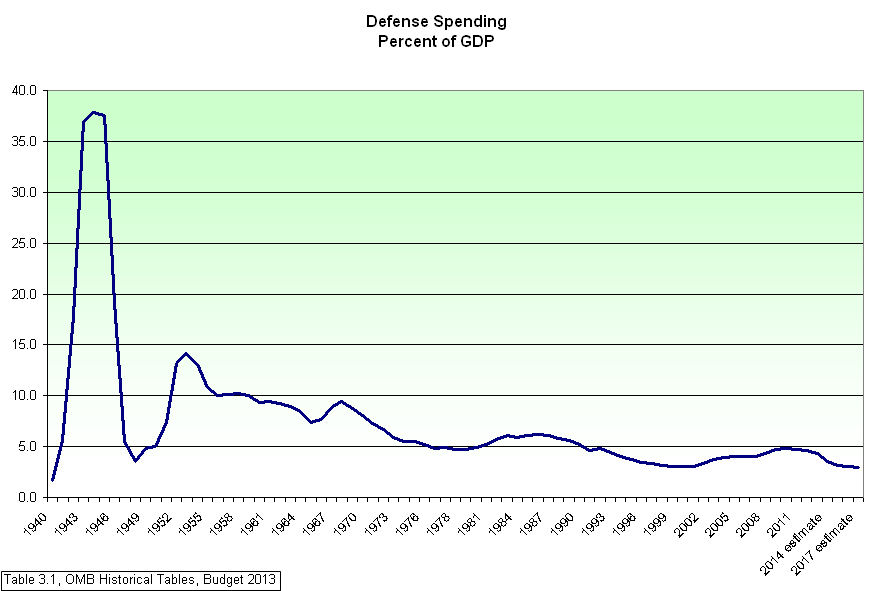
Defense spending has doubled in the past decade.

This spending figure includes only active defense spending.  Outlays for Veterans benefits, education and job training for vets are included under the Human Resources superfunction.  Housing benefits for veterans are included under another superfunction, Physical Resources.  The total outlay is estimated at over a trillion dollars and that figure has been acknowledged by Senator John McCain, a long time supporter of strong defense spending.

As a percent of GDP, however, active defense spending has remained below 5%. Putting this increase in spending in historical perspective puts the lie to the contention by some liberals that our budget problems are mostly due to defense spending.

Human Resource spending includes Social Security payments, which comes out of current taxes and a trust fund surplus of $2.7 trillion (Source).  Since most Social Security payments come out of a tax that has been dedicated to those payments, I have deducted them from total Human Resource spending to get a more accurate picture of the trend in spending on the social safety net. 

When financial conservatives on both sides of the aisle warn of this upward trend, this is what they are talking about.

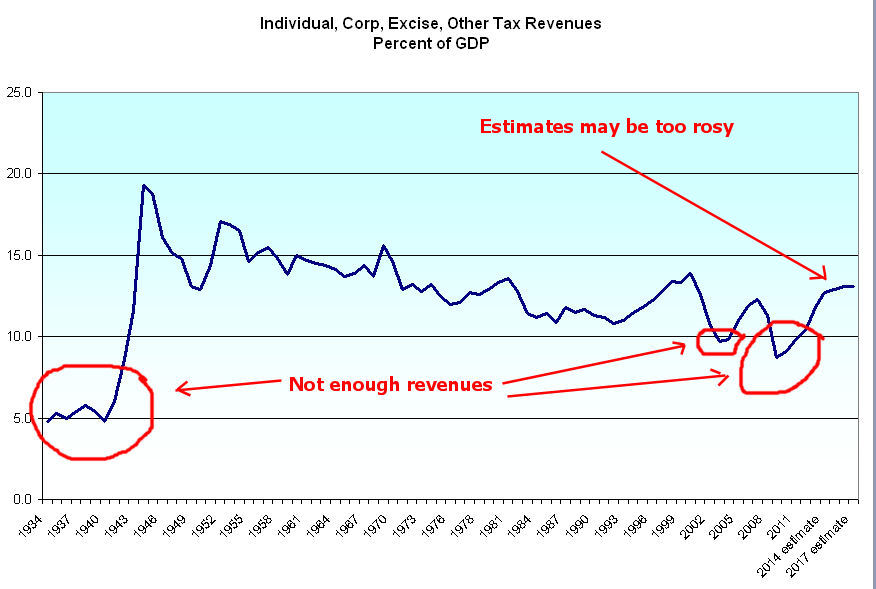
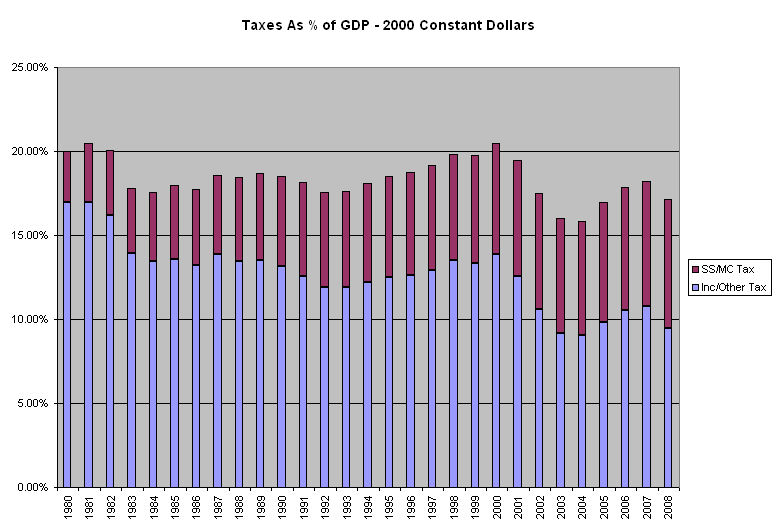
What too many Republicans won’t acknowledge is that we have had and continue to have a severe revenue problem.

Since I listen to and read a lot of “conservative” media each day, I repeatedly hear the mantra that Reagan lowered tax rates and revenues increased.  This is the justification for pushing for continued tax cuts. Reagan and a Democratic Congress lowered tax rates.  The president signs bills that are passed by the Congress.  This is not a one man show.  Total revenues, including Social Security and Medicare taxes, did increase because Social Security taxes were increased 12% during the Reagan years (Source).  When we look at tax revenues without Social Security taxes, revenues as a percent of GDP fell, just as anyone would expect when tax rates are reduced.  Since WW2, tax rates have been gradually reduced, and, as expected, tax revenues as a percentage of the economy have fallen.  There is no magic formula here.  Lower tax rates = lower revenue.

In this ongoing battle of ideologies, there are three real issues.  Should we spend more than 5% of GDP on active defense spending?  Should we spend more than 10% of GDP on social safety programs (excluding Social Security)?  Can we expect to ever live within our means if we collect only 10% of GDP in income and excise taxes?  We can not do all three.

Taxes – Not In My Backyard!

There is a lot of discussion about the renewal of the Bush tax cuts enacted in 2003.  This past week the Senate passed a bill to renew the tax rates for all those with less than $250K taxable (not gross) income – $200K if filing single.  The measure is unlikely to pass the Republican dominated House which wants the cuts extended for all taxpayers, including the wealthiest.

For many of us, the tax rate cuts started in 1987, not 2003, after the Tax Reform Act of 1986.  Below is a 100 year chart of historical tax rates for a married couple with two children with a gross income of $66,000 in inflation adjusted dollars (thanks to the Tax Foundation)  After the standard deduction and exemption allowances, this is approximately $40,000 in taxable income.  This is middle class income, slightly below the median for married couples.

As you can see, we have enjoyed comparatively low income tax rates for the past twenty-five years.  For the past ten years, we have been conducting two wars without paying for them.  The rich are not paying.  The middle are not paying.  When our parents and grandparents ran up huge debts fighting WW2 and recovering from the 1930s Depression, they increased taxes on the middle class and the rich to pay down the debt.  This generation, the children and grandchildren of that WW2 generation, decided they had a better idea – charge it!  After all, we have expenses that previous generations didn’t have – like our cable TV bill and internet bill and cell phone bill.  The WW2 generation also had bills that previous generations didn’t have – car, electrical and phone bills for services and products that their parents and grandparents didn’t have.  Did they use that as an excuse to reduce their taxes?  No.

We continue to argue over how much government services and programs we want.  We argue over how much to spend on defense.  We argue whether we want somebody (but not us, God forbid) to pay more in taxes.  While we argue, the Federal debt continues to climb.

Government Spending

The dastardly demons of demagoguery are at it again.  You know who I mean – the Republicans and Tea Partiers who swaggered through Washington in the past two weeks, brandishing cutlasses and slashing funds to needy women and children.

Republicans would gain more credibility if they could find even a few dollars to cut in a military budget that exceeds $1T – that’s trillion, as in 12 zeroes. But, they have kick started the debate.

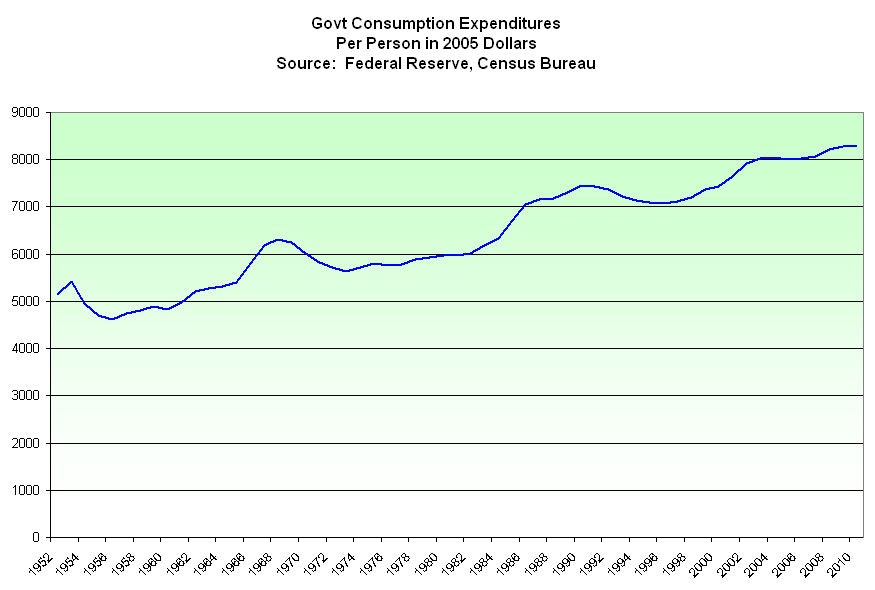
Below is a chart of per person federal, state and local spending in real, inflation-adjusted dollars.  This does not include what are called transfer payments, like social security and unemployment checks the government sends out.  More military spending, more social welfare programs, more health care programs, more regulatory agencies and it all adds up to a 60% per person increase over the past 60 years.

When do we start having the conversation about reducing government spending?  When the increase is 100%?  That has been a question that few politicians wanted to tackle.  In 2010, President Obama appointed a debt and deficit commission which made recommendations in December 2010, after the elections.  Some Democrats in tightly contested 2010 election races did not want to have any budget debates before the election, leaving then speaker Nancy Pelosi without a convincing majority in the House.  The Republicans in the Senate had one word in response to most Democratic House bills – “No”.  Unable to break Republican filibusters in the Senate, any budget resolution passed by the House would probably have gone into the Senate trash bin.  In February, the Obama administration ducked the deficit commission recommendations when it presented the FY 2012 (Starts Sept 2011) budget.

In this game of political chicken, someone finally went first!  On April 5th, Paul Ryan, the Republican House Budget Committee chairman, revealed his committee’s 2012 Budget proposal.  This past week, President Obama presented his long term budget “plan” as a rebuttal to Ryan’s plan.  The NY times has a short comparison of the two plans.  An innocent bystander might ask why the President could not present his administration’s plan when he presented the 2012 budget proposal two months ago.

Military spending has to be the first subject of any reasonable discussion.  Including pension, health care and training programs for ex-military, the $1T in current military spending is $3333 per person, or almost a third of the $9400 (in current dollars) per person government cost.

Structural changes to Medicaid and Medicare have to be the second topic of discussion. In January 2010, the Congressional Budget Office estimated 2010 Medicare and Medicaid costs at $800B and projected yearly increases of 7%, more than double the average 3% inflation rate of the past thirty years.

Some Democratic politicians accuse the Republicans of throwing women, children and the poor under the train and advocate higher taxes on the rich.  But there simply aren’t enough rich people.  In July 2010, the IRS released an analysis of 2008 tax returns.  If the Federal government were to confiscate ALL the adjusted gross income of those making $200K or more, that would total about $2.46 trillion in 2008 dollars, or about $2.6 trillion in 2011 dollars.  That amount is about 2/3 of estimated Federal spending in 2011.

The 2011 budget has a projected deficit of $1.65 trillion (Wikipedia article) How much would we have to tax every rich person to make up this year’s deficit?  In 2008, the IRS reported that there were almost 4.4 million taxpayers making more than $200K.  We would need to charge $375,000 to every one of those taxpayers to make up this year’s deficit.  Obviously, we couldn’t get people making $200K to pay $375K in taxes. 

So let’s pass a law to soak the 319,000 millionaires by taking away all of their deductions and take 90% of their income.  That will give the Federal government $900B in additional revenue but we are still short $750B.  Let’s take away all the deductions for those 574,000 people making more than $500K and tax them at 90%.  That will raise another $351B but we are still short about $400B.  Finally, we take away all the deductions for people making more than $250K and tax them at 50% and we have balanced the budget for this year!

Taxing the rich won’t solve our budget problems. Reducing spending alone will not solve our budget problems.  We need a combination of higher taxes on everyone and reduced spending.  Unless we can come to this two part solution of higher taxes and lower expenses, we will continue to run deficits and ever higher long term debt.  In the next decade, bondholders will demand ever higher interest rates to buy this country’s debt.  Increasing interest payments will only make this country’s spending problems worse.  The time to act is now.

Effective Tax Rates

The effective or net tax rate is the amount of income tax we pay on our adjusted gross income.  For many of us under 65, our adjusted gross income is our total income.

The Tax Reform Act of 1986 eliminated many tax breaks and lowered marginal tax rates, which lowered the effective tax rate (ETR).  As a result of the act, the ETR for the top 1% of income earners dropped from 33% in 1986 to 26.5% in 1987. 

The IRS regularly publishes studies on various aspects of the tax system.  One of their studies, updated in July 2010, reviewed income and taxes paid for the period 1986 to 2007.

Over the thirty years since 1987, the majority of taxpayers have made a beggars bargain by voting for politicians who promised lower tax rates. During that time, many taxpayers have received a tiny decrease in their ETR while top income earners have seen a 15% decrease.

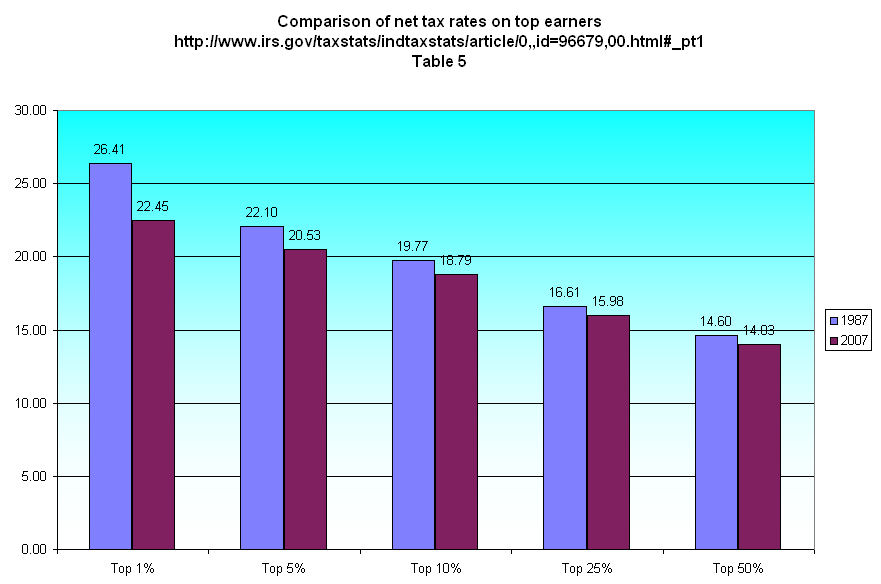
Below is a chart comparing the ETR for various income brackets in 1987, the year after the reform act, and 2007.

In 2007, what income bracket did you fall into?  The chart below shows the top half of all adjusted gross incomes.  If you made $33K or more in 2007, you were in the top half of income earners in this country.

The highest earners have enjoyed the biggest reductions in their ETR over the past thirty years.

During the past election cycle, there was much debate about increasing the marginal tax rate on the top incomes in this country.  Republicans made significant electoral gains and quashed any attempts to increase taxes, resulting in a compromise this past December that left tax rates unchanged.

Some voters objected in principle to ANY increase in taxes.  Some voters objected in principle to an increase on only a small minority of taxpayers, maintaining that the tax pain should be shared so some degree by all taxpayers.  The minority of voters who wanted the tax burden to fall heaviest on the upper income taxpayers might have been able to win the argument, particularly among moderates, if they had proposed an across the board 5 or 10% increase in income tax rates.  An increase of 10% in a 35% income tax bracket is far more than a 10% increase in a 15% tax bracket.  Instead, Democrats proposing a “soak the rich” tax policy change watched in horror as the electorate shifted Republican in many states.  “Soak the rich” tax proposals seem to violate some sense of fairness in the American voter, even those who are not rich.

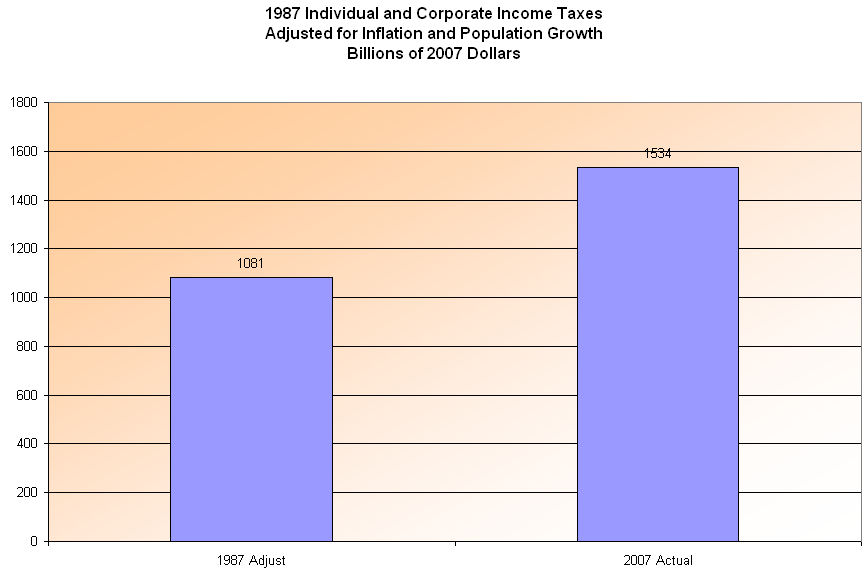
In 1987, the Federal Government collected $392.5B in individual income taxes.  Adjusting for inflation (about 83%) and population growth (about 24%) from 1987 – 2007, that amount is $889B.  What did the Feds actually collect in 2007?  $1,163.5B, an increase of 30% over adjusted 1987 levels.  In 2009 and 2010, income tax collections were about $200B less than 2007 levels, yet still about the same level as 1987.  This country is running huge deficits each year simply because Federal spending has increased far more than inflation and population growth combined. 

Below is a comparison of 1987 individual and corporate income taxes adjusted for inflation and population growth with the actual taxes collected in 2007.

Tax collections in 2007 were far stronger than the 1987 pace BUT the federal government is spending money at a faster rate than 1987. Below is a comparison of adjusted 1987 on-budget Federal spending – which excludes most of Social Security – with the actual amount spent in 2007.

As Republican presidential candidates prepare to announce their candidacy, we can be certain that the debate over higher taxes vs. reduced spending will only heat up further.  Proponents of higher taxes can point to the charts above and make a good case that the top 5% of incomes have enjoyed greater tax reductions than the rest of us over the past thirty years.  Proponents of reduced spending can make a valid case that the federal government has just gotten too big. There is no resolution to the debate.  Some people want the federal government to take a greater role in our lives – some don’t.  The only “solution” is a compromise – cut some Federal spending, including defense, and bump up taxes an equal percentage on most American taxpayers.

Taxes – The Old and The New

The Federal government has a revenue problem.  Both personal and corporate income tax collections are down.  The charts below show individual income taxes for the past 60 years and a smoothed average of those amounts. (Click to enlarge in separate tab)

Below is the same data smoothed with a 4 year moving average to show the overall trend.

Those with high incomes are paying less in taxes than they did.  But the problem is more widespread.  ALL of us are paying less in Federal income tax than we used to. 

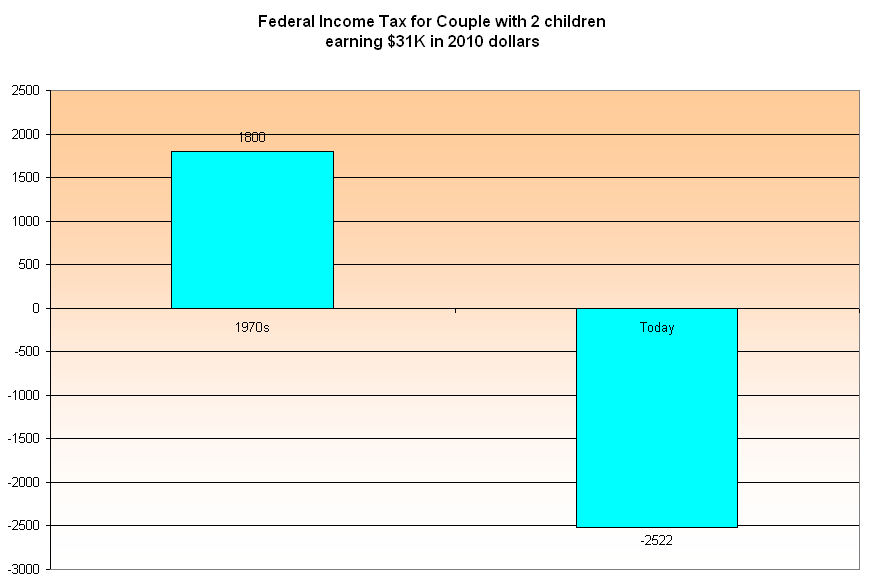
In 1974, a low income couple with two children making $7000 paid $400  in income taxes.  In inflation adjusted dollars, that is $31,000 dollars of income and a tax bill of $1800.  Under current tax law, a couple with two children making $31,000 would get a net credit of $2522 in income taxes.  They would get this credit through the earned income credit program.  For this couple, the difference – the tax savings – between the tax policy of the 1970s and today is $4300.

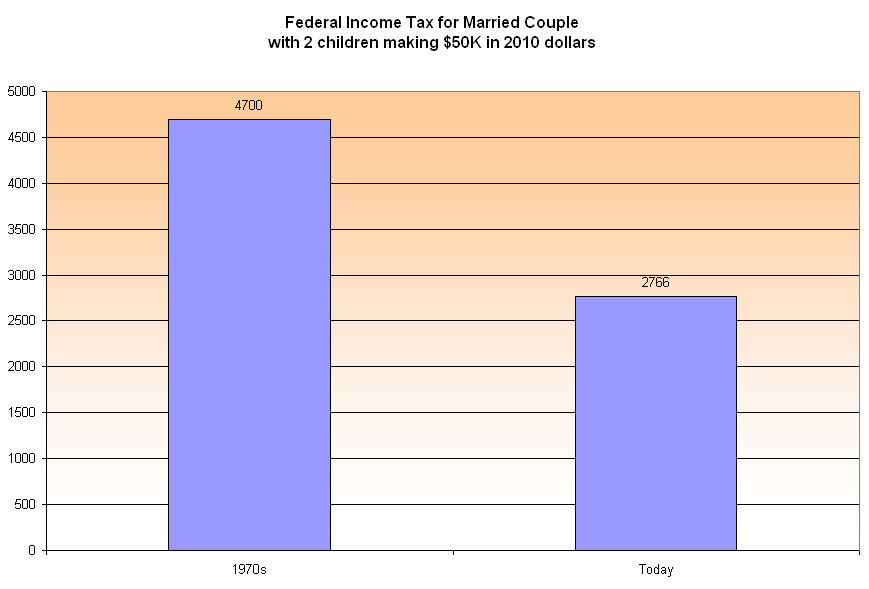
In 1978, a couple with two children making the equivalent of $50,000 in 2010 dollars paid the equivalent of $4700 in income taxes.  Under existing tax policy, they pay $2766, a savings of almost $2000.

In 1978, a single person making $12,000 paid almost $1700 in income tax.  In inflation adjusted dollars, those amounts translate to $40,000 income and a tax bill of $5500.  What would a single person making that same money pay today?  $4600, a savings of $900 when compared to the tax policies of the 1970s.

In the past 30 years, the taxpayers of America wanted lower taxes and they voted in the politicians who would give them lower taxes.  Many of us wanted more environmental and labor regulations, social support programs and we got those too.  Many of us voted for more defense and we got that.  Military bases mean jobs for a lot of voters and voters like jobs.  So who is going to pay for all of this?  “Not me,” we all said.  “Get it from the other guy,” we moaned. 

Reducing the debt of this nation will require changes in both tax revenues and spending.  Impose more taxes on those in ALL income brackets, not just the rich.  There aren’t enough rich people to make up the yearly deficits. For all but the very poorest in our country, there should be a minimum income tax, even if it is only $100, so that everyone has some “skin in the game.”

Eliminate the corporate income tax and raise the tax rate on the profits that they pay out in dividends to shareholders and stock awards to company officers. The accountants and lawyers at the IRS will never be able to compete with the tax accountants and lawyers at large companies.

Consolidate duplicate regulatory government departments which overlap in their oversight responsibilities.  Well meaning and egotistical congresspeople want their own agencies supervised by their committee and the result is a hodge-podge of agencies.

Reduce spending, beginning with Congresspeople themselves.  If tax revenues decrease, then the budget allowance of each Congressperson’s office should be reduced by the same amount.  While the millions of dollars involved are negligible within the scope of the entire Federal budget, it enshrines a principle that if taxpayers are tightening their belts, so should their elected representatives.

Make a dedicated effort to detect fraud and overcharges in defense and entitlement programs and prosecute the perpetrators.

If we continue to put off these decisions, it will only get worse.  Each year, as we have to pay more in interest on the nation’s debt, programs will continue to experience budget cuts, provoking an economic and class warfare that may permanently scar the spirit of the people of this country. We owe it not only to our kids but to ourselves to make some difficult but prudent choices soon.

Big Daddy

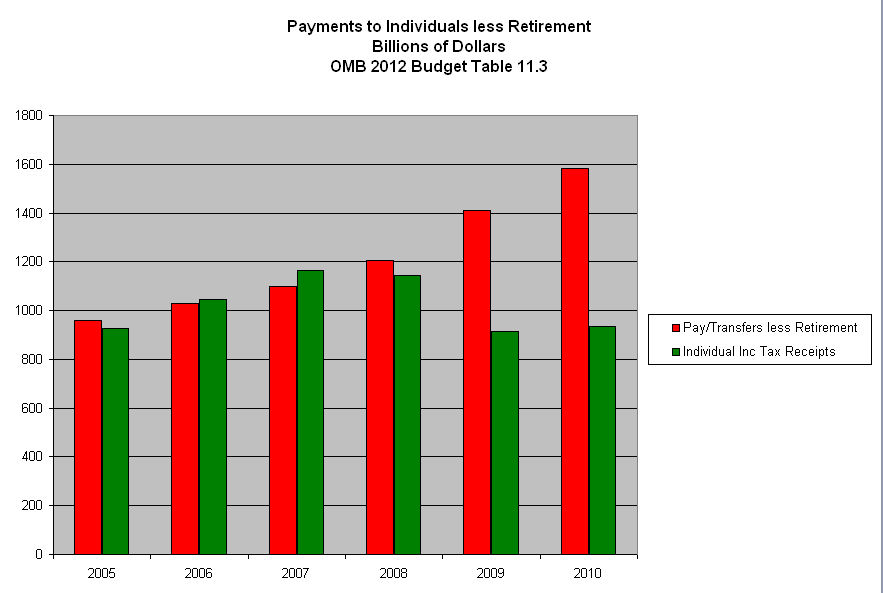
Big Daddy in Washington got big pockets.  He gets money and gives money.  Big Daddy collects income taxes and then pays all that money out to people who need it for something – school, food, housing assistance, disability, training and many other programs.  Big Daddy got a big hole in his pocket and here’s why.  The way it’s supposed to work is that Big Daddy pays out what he collects in individual income taxes – money in, money out.  If you look at the mid decade years in the chart below, you will see the way it’s supposed to work – approximately the same amount of money went out to the needy as what came in from those who weren’t needy. Those that got give to those who don’t – and all that charity goes through Big Daddy’s pockets.

The green bars are individual income tax receipts.  The red bars are the payments of all the Federal social assistance programs not including Social Security, railroad and military retirement.

Instead of sending our income tax to Big Daddy in Washington, each of us could just walk over to our neighbor down the street who is having a hard time for one reason or another and give them our income tax.  But we wouldn’t get to fill out income tax forms which is an exciting way to spend a weekend or two.  The person who needs the money wouldn’t get to fill out long applications for student grants or housing assistance or food stamps.  Long applications and supporting documentation are fun things to do so we wouldn’t want to deprive people of that joy.

The past two years show clearly what the problem is.  Lots of money out and not enough money in.  So what’s Big Daddy gonna do?  The Green People tug at Big Daddy’s pants and say “Hey, Big Daddy, raise taxes on the rich people!”  The Red People kick Big Daddy in the ankle and say “Big Daddy, you got to reduce payments to all these needy folks!”  Big Daddy sure has got a heap of problems.

Moocher Madness

President Richard Nixon famously said “I am not a crook.”  Everyday Americans say – not so famously – “I am not a moocher.”  Thom referred me to a blog at the NY Times which recounts the many ways in which most of us mooch off the government in one form or another and yet think we are not beneficiaries of a federal program.

Today President Obama released his budget for fiscal year 2012, which starts in September of this year.  Republicans pooh-poohed the President’s lack of effort to offer any serious reductions in federal government spending.  Some Democrats criticized proposed cuts or freezes in spending. Neither Republicans or Democrats want to talk about the 800 lb gorillas in the room – entitlement programs and defense spending, which take up about 70% of federal spending.  Republican politicians have vowed to cut spending but will find that most of their constituents get some kind of favor from a government program.  When Republicans begin to offer cuts to specific programs they may find themselves in a hive of angry hornets – their constituents.

Not all government programs hand out money directly to the beneficiaries of those programs.  Some programs are indirect transfers of money through tax credits and deductions.  Tax breaks for a minority of taxpayers are another form of spending by the government for that favored minority. 

A review of an IRS analysis of tax returns from 1990 – 2008 gives us a peek into the many government programs that offer tax advantages and how many of us claim these breaks.   When the bipartisan debt commission recently advocated for eliminating special tax favors like the mortgage interest deduction in exchange for lower tax rates, politicians on both sides of the aisle cowered.  In 2008, 34% of returns itemized deductions rather than take the standard deduction.  80% of itemizers take the home mortgage interest deduction so this one deduction becomes a reason for itemizing. Only a minority of taxpayers claim the deduction but it has become a sacred cow like Social Security and Medicare.

Low income seniors are treated favorably under the tax code. 17% of taxpayers received Social Security benefits in 2008 but only 60% paid any tax on that income.  Seniors vote.  What politician will touch that one?
17% of taxpayers claim the unearned tax credit, a subsidy program for low income families with children.  18% of taxpayers claim the child care tax credit.   14% of taxpayers claim a student loan interest deduction, an educational expense credit or a tuition and fees credit.

In one form or another most of us suck on the federal government’s teat.  Taxpayers claiming any farm income was only 1.3% of tax returns yet talk of abolishing farm subsidies is met by cries of anguish and anger from beleagured small farmers.  Most of these subsidies go to large multinational agricultural companies who raise the alarm when any mention is made of reducing or abolishing these programs.  Oil companies cry out if their tax allowances might be given over to solar and other renewable energy industries.

The majority of us enjoy tax breaks on any health insurance premiums – the portion paid by us and the portion paid by the employer. We don’t get a tax break for life, home or auto insurance – just health insurance. This tax benefit is another sacred cow.  No wants to give up their “gim-mes” from the federal government. 

Imagine a world where individuals and corporations pay a flat percentage tax on income; where there is no favoritism given to home buyers or oil companies.   It’s a horrible thought, isn’t it?

Tax Limbo

Back in the ancient days before the Internet, before Disco, even before the Beatles, Chubby Checker popularized a song called “Limbo Rock”. The dance craze involved bending backwards and shimmying under a limbo stick, a bar, that could be raised or lowered. An Olympic pole vaulter tries to get over the bar. A limbo dancer tries to get under the bar.

Below is a 30 year graph of Federal revenues as a percentage of GDP.

The Heritage Foundation has a 70 year chart of Federal revenues, showing the 18% historical average – the bar – of revenues to GDP and projected 2010 revenues of less than 15%.  The AP released a story today that Federal revenues for the 2011 tax year are also projected to be below 15%. 

We don’t like bending over backwards, so we party on under a different bar, one that we keep raising.  That bar is the national debt.

Those to the left of center will repeat their mantra that the government needs to spend more when times are tough.  “Raise the bar,” they chant. Those on the right will continue to press for more spending cuts (but not defense spending, their sacred cow). “Stoop lower,” they encourage.  A reasonably sane person would say we need both cuts and higher taxes if we are to avoid the long term problems of ballooning government deficits and long term debt.

Tax Myths

Like many people I believed in several tax myths.  Twenty years ago, my accountant helped me better understand some of the things I took for granted as true.  I had started a contracting business a few years before.

Myth: Tax rate. I believed that, because I was in a 28% tax bracket, I paid 28% of my income in taxes. 
“Too many people confuse their marginal tax rate, which is 28% in your case, with their effective tax rate,” my accountant said.  We were reviewing my corporate and personal income tax returns.  She pointed me to the Taxable Income line on my personal tax return. 
“That’s your taxable income,” she said.  Then she pointed me to the Tax line that followed.  “That’s your tax.  What is the percentage of the tax to your taxable income?” she asked. 
“About 16%,” I replied. 
“That’s your effective tax rate,” she said.

She continued, “I have other contractor clients who want to buy a new truck.  They reason that, because they can deduct the purchase from their taxable income and they are in a similar tax bracket as you, the government is effectively paying for 30% of the cost of the truck.  It sounds like a great deal to them and justifies the cost of a new truck.  I ask them whether the first dollar they make or the last dollar they make will go to the new truck payment.  This sounds puzzling at first. If the first dollar they make goes to the truck payment and that first dollar is taxed at only 10%, then the government is only picking up 10% of the cost for the new truck.  Is the extra cost of a new truck justified if the government only picks up 10%?  Do you see what my point is?  You can’t say that you buy groceries and other necessities with the first dollar you make and then say you’ll  buy the truck with the last dollar you make.”  I nodded.

“The decision whether to buy a new truck,” she said, “should be based on a number of factors: additional work capability, reliability, less down time, savings from truck repairs, to name a few.  Any tax savings is just one of those factors.  It shouldn’t be the prime factor.  Unless you pay cash for the truck, you’ll have interest charges that will add about 15% to the purchase price.  At your effective tax rate, the government is simply picking up the interest you would pay on a truck loan.”

Myth:  Capital Gains Tax. In the middle nineties, I wanted to sell some part of a mutual fund and put the money in a different mutual fund to diversify a little bit. I was a reasonably new and unsophisticated investor who had read that diversification was good.  I had held off selling any shares in the fund for about a year because I didn’t want to pay the capital gains tax on the sale.  Once again, my accountant gave me another tax lesson. 
“Many people don’t realize that when they sell a mutual fund, they often pay little in capital gains tax or they may report a loss.  For many funds, you have been paying the tax each year on any capital gains the fund has realized.” 
That surprised me. She pointed me to a form in my tax return (Schedule D).
“Here’s the capital gains your fund had this year,” she said.  That increased your taxable income and you paid tax on it.  For many people, tax considerations should not be the prime reason they buy or sell a mutual fund, especially a stock fund.  There are some bond funds and other less common investments which are not taxable and that’s a different story.”

Myth:  Tax deferred accounts. In the mid nineties, I considered whether my company should set up a 401K retirement plan but the administrative costs and restrictions were impractical for a company my size.
“For employees  the tax deferral feature and any matching employer contribution to a 401K plan are a big plus.  For small companies with just a few employees, you lose the benefit of the employer contribution because you are the employer.” 
“But what about the tax advantages?” I asked. 
“Unlike many employees whose work hours are more or less fixed,” she replied, “you can offset the tax advantage of a 401K by working a few extra hours a week.  In effect you are paying the taxes now so that you won’t have to pay them in the future.  30 years from now you won’t remember the extra hours you worked.  You will have more control of your retirement funds.  Who knows what Congress will decide to do with IRAs and 401Ks 30 years from now?” 
“But,” I asked, “I’ll be in a lower tax bracket when I’m retired and I’ll pay less taxes on the money I take out of my IRA or 401K.”
“That’s true.  But there is the matter of how a tax rate feels.  When you are 75 years old and are on a fixed income, believe me, a 10% income tax rate feels like 20% or 30%.  At a 10% tax rate, you have to take over $1100 out of your IRA or 401K to net $1000 to meet your expenses.  At that age, you are very conscious of your dwindling savings.  In your 30s, 40s and 50s, you can command more money for your labor than you can in your 60s, 70s and 80s.   You can work a little extra now in order to buy peace of mind later and hopefully avoid having to get a part time job in your 70s to make ends meet.”