Inflation Measures

“Everyone is entitled to his own opinion but not to his own facts.” – Sen. Daniel Patrick Moynihan

September 30, 2018

by Steve Stofka

The above quote has been attributed to the former Senate Majority Leader. People repeat the quote when discussing a contentious subject. We are often convinced that we have the facts when our facts may indeed be arbitrary. Let’s take the case of real or inflation-adjusted income. Has the average real wage declined or risen in the past decades? The calculation depends on which measure of inflation we choose.

There are two measures of inflation, the Consumer Price Index (CPI) and the Personal Consumption Expenditure Price Index (PCE). The CPI relies on surveys of what consumers buy. The PCE is based on surveys of what businesses sell (Note #1). The CPI uses a fixed basket of goods, regardless of changes in the prices of items in a basket. If the weekly basket of goods includes two pounds of ground beef, that two pounds never changes in response to lower prices. It is static. The PCE does adjust for price changes. If the price of a pound of ground beef went down thirty cents, the PCE calculates that a family bought a bit more ground beef and a little bit less chicken, for example. It is a dynamic measure.

People drive fewer miles and buy more fuel-efficient cars as the price of gas increases BUT only after a certain dollar amount. Our purchasing patterns are both static and dynamic. Because we are creatures of habit, our buying patterns are resistant to change. Within a certain price range, we will continue to buy the same items. Outside of that range, we do make changes because we want to optimize our choices.

In the past forty years the CPI has calculated an annual rate of inflation that is over ½% higher than the PCE rate. That small difference compounded over forty years amounts to 23%. That large difference tells two very different stories. Using the CPI, the average worker has lost a few percent in inflation adjusted hourly wages. Using the PCE, on the other hand, the average worker has enjoyed real gains of 20% in the past forty years (Note #2).

Our most volatile disagreements are in areas where facts are difficult to observe. The household survey data that underlies the CPI is unreliable because people living busy lives are not accurate journal keepers of their daily purchases. On the other hand, surveys based on business sales are inaccurate because people stock up on items whose prices decline.

Even when facts are readily verifiable, the interpretation of those facts varies with context. In arriving at our version of the meaning of those facts and their context, we subtract a lot of observable data.  We must filter reality because we cannot manage such a large amount of information. Because we filter our perceptions, eyewitness testimony is unreliable. Although our perceptions are inaccurate, we must act on those perceptions and hope that they are accurate enough. That same reasoning guides economists, politicians, and those in the social and physical sciences. We would all have more constructive discussions if we understood the imperfection of our perceptions.

//////////////

Notes:

1. The Difference between CPI and PCE {Federal Reserve}

2. Using the average hourly wage for production and non-supervisory employees.

Optical Illusions

May 12, 2018

by Steve Stofka

I have long enjoyed optical illusions. Is that a picture of a rabbit or a duck? Which way is the cube facing, right or left? (Some examples) Is that two people facing each other, or a vase? (Image page) These can be even more fun when shared with a friend or sibling. Can’t you see the rabbit? No, it’s a duck!!!

Moving images present a selective attention deception. When asked to count the number of basketball passes, we may not see the gorilla that walks across our field of view. (Video)

These examples excite our curiosity and fascination as children and carry important lessons for us as adults. We sometimes misinterpret the data our senses receive. Those with a strong ideological bent may focus narrowly on only that data that supports their view of the world, or that makes them feel comfortable.

Let’s look at an example. Real (inflation-adjusted) median (middle of the pack) household income peaked in 1999 at $58,665. In 2016, income climbed to $59,039. However, personal income did not peak till 2007, at $30,821. Like household income, personal income finally rose above that peak in 2016.

PersVsHouseholdIncome

In the household series, the past twenty years have been especially tough. In the personal series, only the past ten years have been that difficult. What accounts for the difference in the two series? Households have grown faster than the population. Population Income / Households will be lower when households increase.

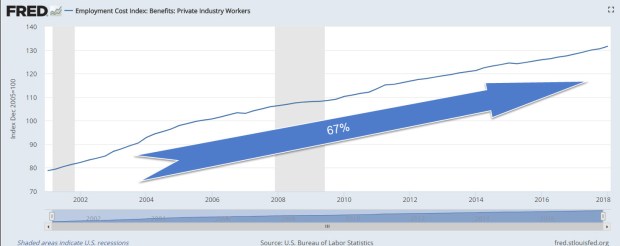
But what is income? Household income is money income received and does not include employer-provided benefits and retirement contributions (Census Bureau Defs). The BLS does track total compensation costs which do include these benefits, and those costs are 67% higher today than they were in 2001.

Benefits

If an employer gave an employee $500 a month for health care expenses and the employee sent the money to the health insurance company, that would be counted as income in the data. But because the employer sends the money directly to the insurance company, that income is not counted. Because of World War 2 wage and price controls, and to avoid being taxed under the income tax system, most employee benefits never touch the employee’s pocket, and are not counted as income. This becomes important when something not counted, benefits, grows much quicker than the income that is counted, or money received.

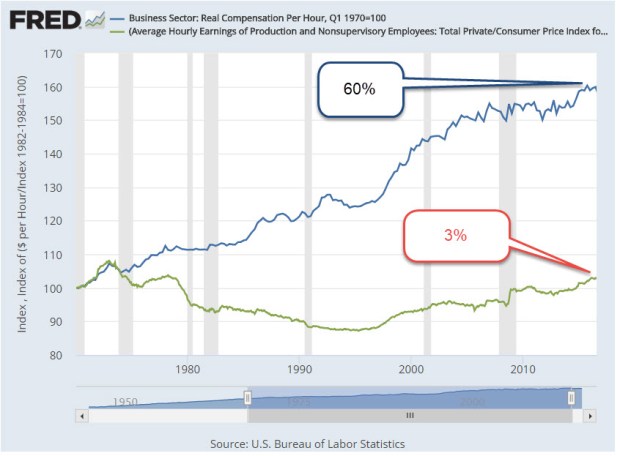
Since 1970, real hourly wages have grown only 3%. Bernie Sanders and other Democrats use a similar figure to press for more social welfare programs. Total hourly compensation has grown 60% (Fed Reserve blog) and most of that is not included in household income.

HourlyWagesVsTotalComp

Is it a rabbit or a duck?

////////////////////////

Do Millennials have it worse than Boomers did at this age?

I’ll call them the Mills and the Booms, so I don’t wear out my fingers. The Mills were born about 1982-2001 so they are 17 – 36 years old today.  A decade after the worst recession since the Great Depression, home and apartment prices are rising fast in many urban areas.  Mills are now the largest generation alive and are at an age when a majority of  them are independent and increasing the demand for housing.

Some Mills are trying to provide shelter for their families when the competition for housing puts constant upward pressure on prices. Some Mills are paying off student loans, while paying $800 to $1000, or more in California, to share a 3 bedroom house with  two other people. It is stressful.

The Booms were born approximately 1946 – 1964. The youngest are 54; the oldest are 72. When the Booms were 17-36, the year was 1982, and oh, what a year it was. The Booms had just endured a decade of double-digit inflation rates (it is now less than 2%), four recessions, mortgage rates that were considered a “bargain” at 9% (4% today), and high housing and apartment prices because there was so much demand for living space from this post war baby boom.

Oh, and tax increases. Tax rates were not indexed for inflation till 1985, so higher wages each year to keep up with that double-digit inflation meant that many workers were kicked up into a higher tax bracket each year. One of Ronald Reagan’s campaign promises was to stop the sneaky practice of dipping deeper into worker’s pockets every year. He got elected President, beating President Jimmy Carter who had told workers to turn the heat down and put a sweater on.

How do today’s monthly debt payments compare? Household Debt Service Payments as a percent of disposable personal income are 5.8% today compared to 5.6% in 1982. The 37-year average is 5.7% (Federal Reserve).

What are those average debt service payments buying? Better cars, more education, more square footage of housing space per person, and computers and electronics that didn’t exist in the 1980s. People are paying more for housing but are enjoying 30% more square footage per person (Bloomberg). In 1982, 17% of the population 25 years and older had a college degree. Today, it is double that percentage (Census Bureau table A-1), an achievement that the Mills can be proud of.

The Mills do have it better than the Booms, who had it better than the generations before them. That “good old days” talk that we heard from Bernie Sanders on the campaign trail are based on some foggy memories. The reality was way tougher than Sanders remembers or talks about because his perception is clouded by his ideology. He only sees the data that tells him it’s a rabbit. He doesn’t see the duck.

Years Past

December 31, 2017

by Steve Stofka

This past week, I found a July 2008 Wall St. Journal used as shelf liner. On the eve of 2018, a look back has some useful reminders for a casual investor.

Journal20080703

Most of us remember the financial crisis that erupted in September 2008. What we may not remember is that the first half of that year was very volatile. In reporting about the first half, there were “warnings of the collapse of the global financial system.”

In the first six months of 2008, 703,000 jobs had been lost. The job losses continued until March of 2010 and totaled a staggering 8 million. In early July 2008, the stock market had lost 16% from its high mark in October 2007 but a balanced portfolio of 60% stocks and 40% bonds had lost only 8%. To prepare for a difficult second half of 2008, investors were cautioned to:
1) Balance
2) Diversity
3) Spend less and invest more
4) Don’t pay high investment fees
5) Don’t get greedy and chase get rich investments

The advice is timeless.

/////////////////////////

Tax Reform

In a holiday week, thousands of residents in coastal states lined up at their local tax assessor in order to pre-pay 2018 property taxes in 2017.  Most of these residents have annual property taxes that exceed the $10,000 cap on all state and local taxes that can be deducted on 2018 Federal taxes.

The IRS said that they would not allow deductions for prepaid taxes unless the local district had assessed the tax by December 31, 2017.  We may see lawsuits over the definition of the word “assess.” When is a homeowner assessed a property tax?  When they receive a bill?  When the district announces the rate for the following year?

In their battle against the IRS, Republicans have cut the agency’s funding so much that the IRS does not have the resources to perform audits on several hundred thousand to determine the status of assessment.  The courts will likely weigh in on the question.  Come next November, voters will register their opinions.

The New York Times featured a several question calculator  to estimate the effect of the tax bill on your 2018 taxes.

///////////////////////

Income

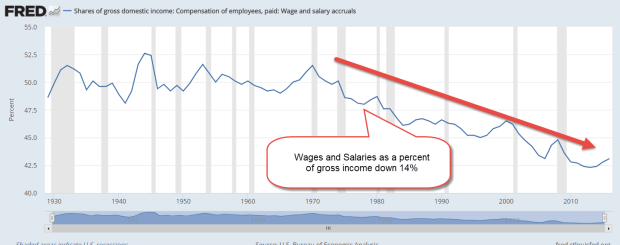
Economists have noted the decades long decline in inflation-adjusted wages.  Since 1973, the share of national income going to wages and salaries has declined by 14%.

WagesSalariesPctGDI

Employee benefits as a percent of gross domestic income have grown by a third since the 1970s. Of course, a person cannot spend benefits.

BenefitsPctGDI

Even after the increase in benefits, total income is down. In 1973, 50% of Gross Domestic Income (GDI) went to wages and salaries + 7.5% to benefits for a total of 57.5%. In 2016, 42% went to wages + 10% to benefits = 52%.  Total compensation is down 10%.

As the wealth of the affluent continues to grow, the ratio of net wealth to disposable income has reached an all-time high.

WealthPctInc
It is inevitable that extreme imbalances must revert to mean.  The last two peaks preceded severe asset repricings.

The Poor and the Not Poor

October 15, 2017

No worries. Among the 25 OECD countries, Americans have historically had the lowest percentage of their financial assets in cash and savings deposits. After the financial crisis, we became the second lowest, just ahead of Chile. The percentage for the most recent available year (2015) was 13.5%.

In the heady optimism of the dot-com boom in 1999-2000, Americans had less than 10% of their assets in cash and savings. In the long downturn from 2000 – 2003, Americans bumped up their percentage in safe assets to almost 13%. As the economy recovered, that need for safety declined slightly but not to the levels of the 1990s. The financial crisis in 2008 caused Americans to reach for safety. Safe assets rose to 14.3% of total financial assets and we have still not recovered the level of confidence we once had.

You can click on this OECD link to see a comparison of current percentages. On the bottom right below the chart you can drag the year slider and look at some historical data.

Below the chart on the left is a category labeled “Perspectives.” Select “Total” to see total financial assets, which does not include home equity. Americans have the second highest total, just below Switzerland.

On the other hand, the U.S. has a comparatively high poverty rate of 17.5% using the OECD standard,  a simple measure that an economist would use.The poverty threshold is half the median income.

The U.S. publishes a poverty rate that is several percent lower because it uses a complex definition first set in 1963 when families spent an estimated 1/3 of their income on food. The complexity of the definition hints that politicians had a hand in crafting the definition but it is attributed to one person in the Social Security Administration, who based her standard on a combination of foods that the Department of Agriculture thought would meet minimum nutritional needs. The history of this standard and its many revisions is an interesting read.

The threshold is set at three times the cost of this 1960s era minimum food diet. Efficiencies in food production over the past 50 years have dramatically lowered food costs for U.S. families. In 1978, the BLS estimated that the average family spent only 18% of their income on food. In 2014, it was a bit more than 14% (BLS).

Using food costs as the basis for measuring poverty has enabled politicians in this country to claim success in lowering poverty over the past half century. In 1978, the calculation of the U.S. poverty threshold produced one that was slightly more than the OECD standard. Today, the U.S. threshold is 16% less than the OECD standard.

Let’s look at a family of four making $28K in 2016. They were above the official U.S. poverty threshold of $24,300 for a family of four. By the OECD definition, that American family was below half of the median $59K in income and would be counted as poor.

Housing costs are higher in urban areas, where half of the U.S. population lives. That family of four living in Chicago might pay $15000 per year for a 2 BR apartment in Chicago. Further south in the same state, Springfield, IL, they might pay $11,000. That $4000 difference in housing cost is not calculated into the poverty rate that the U.S. publishes. In effect, poverty is undercounted in urban areas and overcounted in rural areas.

The simplicity of the OECD standard better captures poverty among both urban and rural low-income families because it is based on median income. So why doesn’t the U.S. adopt this much clearer standard? We can turn to the last sentence of the previous paragraph for a clue. Politicians in rural areas want a standard that overcounts poverty in their districts. A higher headcount of poverty equals more subsidies for their constituents. When this standard was set, rural areas in the southern states were primarily Democratic and Democrats dominated the Congress under a Democratic President, Lyndon Johnson. Those politicians wanted the adoption of a food based standard that overcounted those voters.

Today, most rural areas are predominantly Republican and the standard works to the advantage of Republicans and the disadvantage of Democrats. As a rule of thumb, whenever we see excessive complexity in rule-making, there’s usually a very sound political reason for that obfuscation. Former President John Adams lamented this unfortunate characteristic of lawmaking in the crafting of the Constitution itself.

The intentional lack of clarity in lawmaking ensures that any nation’s population will be at odds with each other. A small and smart part of the population makes money from conflict and confusion. People argue on Facebook; Facebook makes money. Trump did what? There’s a video. Got to see that, right? Click bam boom, Google makes money by placing some ads next to the video.  Controversy is profitable. Politics as carnival show.

Crown Publishing, a division of Random House, publishes both the fringe right author Ann Coulter, and the way out on the left author and MSNBC host, Rachel Maddow. Worried that the liberals are taking over the country? Frightened that the conservatives will destroy the very institutions that have made America the greatest nation on earth?  Crown has something for you.

On the other hand, the record low volatility of the stock and bond markets in the past year have made it difficult for financial firms who depend on controversy to make a good profit.  Active fund managers have struggled to outperform their benchmark indexes.  The volume of derivatives and other products that insure against volatility have fallen.  People are not worried enough.  That’s the problem.  We need to worry about not being worried.

And those poor families?  If we lower the poverty threshold even more, we won’t have to worry about those poor people as much.

The Long Game

April 16, 2017

Happy Easter!

Successful investing requires a far sighted vision. At the end of each year Vanguard sends its customers their long term outlook. This last one contained a few caveats: “the investment environment for the next five years may prove more challenging than the previous five, underscoring the need for discipline, reasonable expectations, and low-cost strategies.”

Vanguard’s ten year estimate of annualized returns is about 8% for non-US equities, 6.5 – 7% for the US stock market, 5% for REITs (real estate) and commodities, and 2% for bonds.

Vanguard’s team projects that a diversified portfolio of 60% stocks/ 40% bonds will return 5.6% annually over the next ten years. An agressive 80/20 mix they estimate at a 6.6% return, and a very conservative 20/80 mix at about 3.3%. Insurance companies typically adopt this safe approach. (Source)

/////////////////////////

ANNUITIES vs. MANAGED PAYOUT?

Investors near or in retirement must often turn to their investments for supplemental income. Annuities are sold as a safe “set it and forget it” solution, but they come with upfront fees and currently pay low interest.

In early 2008, before the fianncial crisis, a 65 year old man could get an average annuity (the average of a 10 year and life) for 5.5% a year. That provided a guaranteed income that was more than the classic 4% “safe” withdrawal rate for retirees. That 4% withdrawal rule would normally ensure that a retiree did not run out of money before they died.

The average annuity rate for that same age is now half that interest rate (Source). For an investment of $100K, a 67 year old male living in Colorado can get a lifetime annuity of $7212 per year (CNN Annuity Calculator) For 14 years, the insurance company providing the annuity is essentially returning the investor’s money to them. If that male investor lived for 20 years till age 87, they would receive a total of $144K, an annual return of only 1.84%. If the retiree lived to 97, their annualized return would increase to 2.5% over the thirty year period. Clearly, an investor is paying for safety.

Wade Pfau is a CFP whom I have cited in previous blogs. Here he compares the advantages and disadvantages of investments vs. insurance. He makes an argument that an annuity that covers one’s essential needs allows a person to take more risk with the rest of their portfolio. The potentially higher return from the investment side of the portfolio can thus make up for the lower returns of the annuity, an insurance product. He does caution, however, that most annuities do not protect against inflatiion. A investor who needed $1000 extra dollars in monthly income in 2017, would need more than $2000 in 30 years at a 2.5% inflation rate.

Managed Payout?

One alternative is a managed payout fund. The Vanguard Managed Payout Fund VPGDX lists the fund’s holdings as 60% stocks with an almost 20% allocation to alternative strategies. Alternatives vary in volatility depending on the intent of the investment but let’s treat them as though they were mostly a stock, giving the fund a simple effective allocation of 75% stock, 25% bonds. This fund lost 43% from April 2008 through March 2009, less than the 50% loss of the SP500 index but not by much. A broad composite of bonds (BND) actually gained 3% in price during that time. Here is some info from the investing giant Black Rock on alternative investments.

The return of the fund since its inception in April 2008 is 4.28%. Vanguard’s broad bond composite fund VBMFX, with far less risk, had a ten year return of 4.12% and gained value during the financial crisis. Although some mutual funds have trade restrictions, the prospectus on this fund lists no such restrictions, so that one could set up a monthly withdrawal from the fund.

A Vanguard target date 2030 fund (VTHRX), which has an allocation of 70% stocks, 30% bonds, had a ten year return of 5.31%. That fund lost 45% during the eleven month downturn in 2008-2009, slightly more than the Managed Payout Fund.  The additional 1% annual return is the reward for that slightly greater drawdown. A 1/4 of that additional 1% return can be attributed to lower fees.

The advantage of a Managed Payout Fund – simplicity and regularity of income flows – does not outweigh the disadvantages of volatility and some tax inefficiency. An investor could conveniently set up a monthly withdrawal from a broad based bond fund and enjoy the same return with much greater safety of principal, lower fees, and control over the withdrawal amount, if needed.

When it comes to retirement income, most investors would prefer the simple arithmetic of our grade school years.  Both Social Security and traditional defined benefit pension programs use that kind of math.  Each year, a retiree gets ‘X’ amount that is adjusted for inflation.  No choices needed.  However, most employees today have defined contribution, not benefit, plans. A retiree owns their savings, the capital base used to generate that monthly income, and it is up to the retiree to  navigate the winding channel between risk and return.

Midpoints

July 3, 2016

A week after crash-go-boom in the stock market following Brexit, the British vote to leave the European Union, the market recovered most of the 5 – 6% lost in the two days following the vote.  The reaction was a bit too intense, inappropriate to an exogenous shock, the vote, whose consequences would take several years to develop. In last week’s blog I had suggested that the market drop was a good time to put some IRA money to work for 2016.  This was not some kind of magic insight.  Each year’s IRA contribution amount is a small percentage of our accumulated  retirement portfolio.

Buying on market dips can be an alternative strategy to regular dollar cost averaging since the market recovers within a few months after most dips, although the recovery is at a slower pace than the fall.  Fear can cause stampedes out of equities; confidence grows slowly.  As an example of an abrupt price decline, the SP500 index fell almost 7% in five days last August, then took more than two months to regain the price level before the fall.  The 12% price drop at the beginning of this year was more gradual, occurring over six weeks.  The recovery to regain that lost ground also took two months, from mid-February to mid-April. In the latter quarter of 2012, the market also took two months to erase a 7% price decline from mid-October to mid-November.

The price level of the SP500 is near the high mark set in May 2015, more than a year earlier.  Only in the past year has the inflation-adjusted price of the SP500 surpassed its summer 2000 level (Chart and table).  Nope, I’m not making that up. The stock market has just barely kept up with inflation for the past 15 years. The inability of the stock market to move higher indicates that buyers are not attracted to the market at current price levels.  The absurdly low interest yields on bonds makes this caution especially puzzling.  As stock prices recovered this past week, prices on long term Treasury bonds should have fallen as traders moved into more risky assets.  Instead, bond prices have risen.  As the price of long term Treasuries (ETF: TLT) broke through its January 2015 high  on Friday, the last day of June, traders began betting against treasuries (ETF: TBF).

Those who are concerned about the return OF their money, the safety searchers buying bonds, are competing against those seeking a return ON their money.  VIG is a Vanguard ETF that focuses on company stocks with dividend appreciation, and is favored by those seeking some safety while investing in stocks. TLT is an ETF of Treasury bonds for those seeking safety and, as expected, pays more in dividends than VIG.  Rarely do we see a broad stock ETF like VIG have a yield, or interest rate, that is close to what a long term Treasury bond ETF like TLT has.  At the end of this week, VIG had a dividend yield of 2.15%, just slightly below TLT.  Why are investors/traders bidding up the price of Treasury bonds?  Some 10 year government bonds in the Eurozone have recently crossed a dividing line and now have negative interest rates.  The low, but positive, interest rates of U.S. Treasury bonds look like big open flowers to the busy bees of institutional investors around the world.

In a large group of investors, buy and sell decisions tend to counterbalance each other.  Occasionally there are periods when such decisions reinforce each other and create a precarious imbalance that all too often rights itself in an abrupt fashion.  Bubbles and – what’s the opposite of a bubble? – are iconic examples of this kind of self-reinforcing behavior.

In another week we will mark the middle of the summer season.  The All-Star game on July 12th occurs near the halfway mark in the baseball season and advises parents in many states that there are still five to six weeks before the kids head back to school.  Our mid-40s is about the midpoint of our working years, a reminder that we need to start saving for retirement if we have not done so already.  It has been seven years since the market trough in March 2009.  Let’s hope that this is the midpoint of a 14 year bull market but I don’t think so.

Next week will be chock full of data before the start of earnings season for the second quarter. We will get the June employment report as well as the Purchasing Managers Index.  In this time of short, sharp reactions to news events, we can expect continued volatility.

/////////////////////////


Earnings


Pew Research just released a comparison of earnings by racial group and sex that is based on Census Bureau surveys, the same data that the BLS compiles into their monthly employment reports.  My initial criticism of the Pew Research comparison was that they used the earnings of full and part time workers.  Women tend to work more part time jobs so that would skew the earnings comparison, I thought. Thinking that a comparison of full time workers only would show different results, I pulled up the BLS report which groups the data by sex, only to find out that the differences between the earnings of men and women was about the same.  At the median, women earn 82% of men.


An even more depressing feature of the BLS report is that median weekly earnings have barely kept ahead of inflation during the past decade.  This wage stagnation provides a base of support for the criticisms voiced by former Presidential contender Bernie Sanders in a recent NY Times editorial.
Like a truck stuck in the mud, households are spinning their wheels without making much progress.  In the coming months, Donald Trump and Hillary Clinton will try to sell themselves as the tow truck that can pull average American families out of the mud. Well, it would be nice if they would conduct their campaigns in such a positive light.  The truth is that each candidate will try to convince voters that voting for the other candidate will get American families stuck deeper in the mud.  The conventions of both parties are later this month.  Expect the mud to start flying soon after they are over.  By election day in November, we will all be buried in mud.

Housing Heats Up

June 5, 2016

In parts of the country, particularly in the west, demand for housing is strong, causing higher housing prices and lower rental vacancy rates.  For the first quarter of 2016, the Census Bureau reports that vacancy rates in the western U.S. are 20% below the national average of 7.1%.  At $1100 per month, the median asking rent in the west is about 25% above the national average of $870 (spreadsheet link).

With a younger and more mobile population, home ownership rates in the west are below the national average (Census Bureau graph). Housing prices in San Francisco have surprassed their 2006 peaks while those in L.A.are near their peak.  Heavy population migration to Denver has spurred 10% annual home price gains and an apartment vacancy rate of 6% (metro area stats).

From 1982 through 2008, the Census Bureau estimates that the number of homeowners under age 35 was about 10 million. These were the “baby bust” Generation X’ers who numbered only 70% of the so-called Boomer generation that preceded them.

Shortly before the financial crisis in 2008, a new generation came of age, the Millenials, born between 1982 and 2000, and now the largest age group alive in the U.S. (Census Bureau). Based on demographics, homeownership should have increased to about 13 million in this younger age group, but the financial crisis was particularly hard on them.  Starting in 2008, homeownership in this younger demographic began to decline, reaching a historic low of 8.8 million in 2015, a 15% decline over seven years, and a gap of almost 33% from expected homeownership based on demographics.

In response to lower homeownership rates, builders cut back and built fewer homes.  I’ll repost a graph I put up last week showing the number of new homes sold each year for the past few decades.

Look at the period of overbuilding during the 2000s, what economists would euphemistically call an overinvestment in residential construction.  Then, financial crisis, Great Recession and kerplooey!, another technical term for the precipitous decline in new homes built and sold. As the economy has improved for the past two years, the demand for housing by the millennial generation, supressed for several years by the recession, has shifted upwards.  More demand, less supply = higher prices.  This younger generation prefers living closer to city amenities, culture and transportation, causing a revitalization of older neighborhoods.  In Denver, developers are buying older homes, scrapping them off, and building two housing units where there was one. Gentrification influences the rental market as well as affordable single family homes and pushes out families of more modest means in some parts of town.

The housing market really overheats when rentals and home prices escalate at the same time. During the housing boom of the 2000s, many tenants left their apartments to buy homes and cash in on the housing bonanza.  Rising vacancies put downward pressure on monthly rents.  Move-in specials abounded, announcing “No Deposit!”, “First Month Free!” or “Free cable!” to attract renters. This time it’s different.

Rising rents and home prices put extraordinary pressure on working families who find they can barely afford to live in central city neighborhoods which offered low rents and affordable transportation.  They consider moving to a satellite city with lower costs but face longer commute times and additonal transportation costs to get to work.  Demographic trends shift more slowly than building trends but neither moves quickly so we can expect that housing pressures will not abate soon until the supply of multi-family rental units and single family homes increases to meet demand.

////////////////////////

Incomes

For the past four decades, household income has declined, as Presidential contender Bernie Sanders is quick to point out.  Some economists also note that household size has declined greatly during that time as well so that comparisons should take into account the smaller household size.  A recent analysis  by Pew Research has made that adjustment and found that middle class incomes had shrunk from 62% of total income in 1970 to 43% in 2015.

But, again, comparisons are made more difficult because some categories of income, which have risen sharply in the past few decades, are not included.  Among the many items not included are “the value of income ‘in kind’ from food stamps, public housing subsidies, medical care, employer contributions for individuals (ACS data sheet).  Generally, any form of non-cash or lump sum income like inheritances or insurance payments are excluded.  There is little dispute with the exclusion of lump sum income but the exclusion of non-cash benefits is suspect.  An employer who spends $1000 a month on an employee health benefit is paying for labor services, whether it is cash to the employee or not.

The lack of valid comparison provokes debate among economists, confusion and contenton among voters.  The political class and the media that live off them thrive on confusion. Those who want the data to show a decline in middle class income cling to the current methodology regardless of its shortcomings.

//////////////////////////

Employment

The BLS reported job gains of only 38,000 in May, far below the gain of 173,000 private jobs reported by the payroll processor ADP and below all – yes, all – the estimates of 82 labor economists. The weak report caused traders to reverse bets on a small rate increase from the Fed later this month.

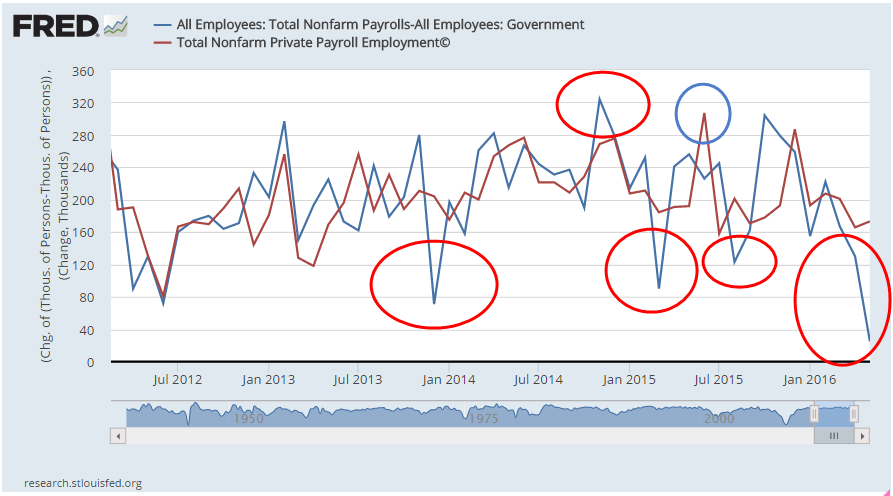
Almost 40,000 Verizon employees have been on strike since mid-April and just returned to work this past week. On the presumption that a company will hire temporary workers to replace striking workers, the BLS does not adjust their employment numbers for striking workers.  However, most employers of striking employees hire only as many employees as they need to, relying on salaried employees to fill in.  Do strikes contribute to the spikes in the BLS numbers?  A difficult answer to tease out of the data. In the graph below we notice the erratic data set of the BLS private job gains (blue line; spikes circled in red) compared to the ADP numbers (red line; spike circled in blue).

Each month I average the BLS and ADP estimates of job gains to get a less erratic data swing.  The 112,000 average for May follows an average of 140,000 job gains in April – two months of gains below the 150,000 new jobs needed to keep up with population growth.  Let’s put this one in the wait and see column.  If June is weak, then I will start to worry.

Keynes, Income, Spending

July 12, 2015

In the past few weeks, I have looked at savings and investment as forms of spending shifted in time.  Now let’s examine the idea of income.  We earn money, spend most of it, and hopefully save a little of it.

In the 1930s John Maynard Keynes proposed an income expenditure model to explain business cycles. (More here) Although Keynes’ model was mathematically simple by today’s standards, it showed an interlocking relationship between employment, interest rates and money.  Keynes popularized his ideas in lectures, debates and magazine articles.  Although he died shortly after World War 2, financial institutions and economic policies still bear his mark.  It was he who first proposed and then co-developed the framework for the International Monetary Fund (IMF) and World Bank.

One of Keynes many seminal insights was that one person’s income is another person’s spending.  If I decide to save $5 by not buying a latte at the neighborhood coffee shop, I am in effect putting my $5 in a savings account at my local bank.  But the coffee shop owner has $5 less in income.  $5 less in income is $5 less profit, keeping all else the same.  The owner of the coffee shop must go to the local bank and take $5 out of their savings account to make up for the lost income.  There is no net savings when a person decides to not spend money and we see the relationship between savings and profit; namely, savings = profit.

We are now ready to develop that insight of Keynes, that income = spending.  As we discussed in previous weeks, the amount that we don’t spend on current consumption is savings.  Savings = spending, either yesterday’s spending, i.e. an investment in someone’s debt, or tomorrow’s spending, i.e. an investment in someone’s future profits, or savings.  When we spend for tomorrow, we are effectively moving our savings into the future.  Likewise, when we spend for yesterday, we move our savings into the past to replace the savings that someone else did not have at the time they borrowed the money.

All of these categories – income, spending, saving, investment – are all forms of spending shifted in time.  Next week we’ll look at the GDP accounting identity and the government component of that equation.

*****************************

CWPI

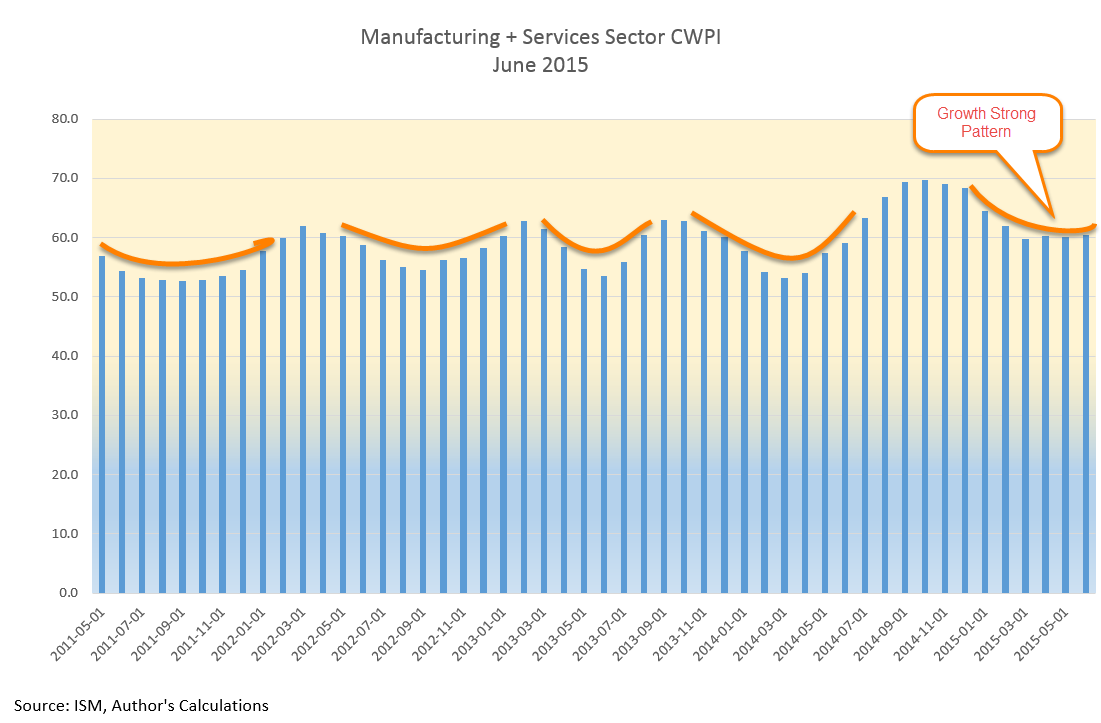
The manufacturing sector stumbled during the harsh winter and strengthening dollar.  The service sectors fell somewhat but remained strong.  In June, the manufacturing sector regained strength, helping offset a slight slackening in the service economy.  The composite index remains strong in a several month growth trough.

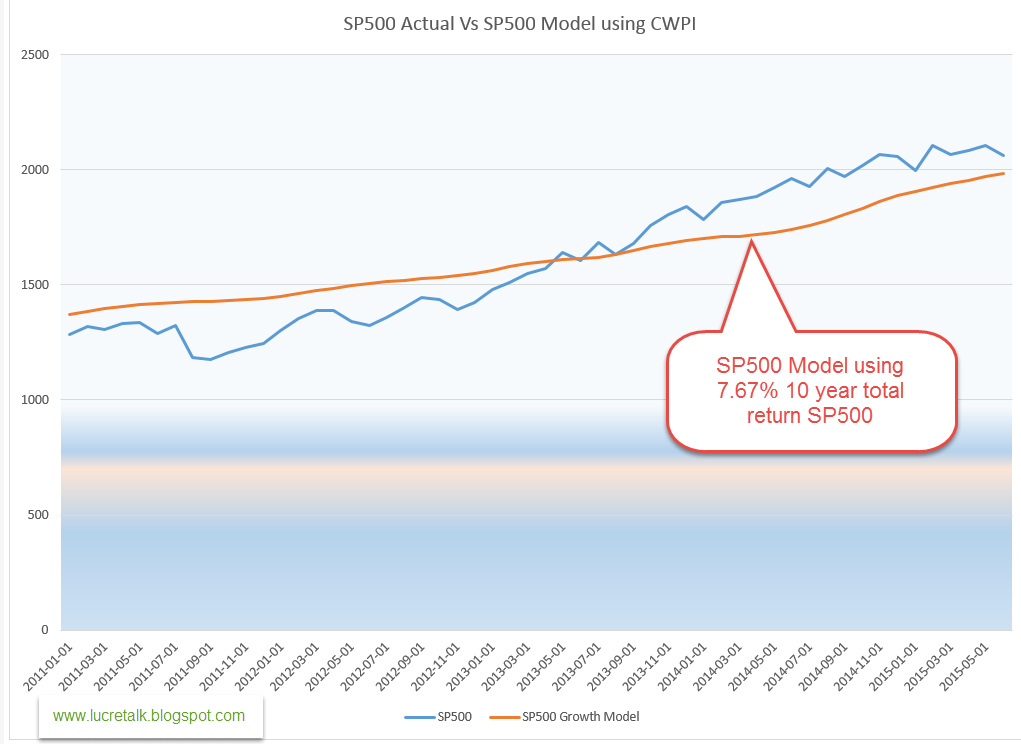
Some are of the opinion that the stock market can be overvalued or undervalued.  In my opinion, liquid markets are usually fairly valued.  Expectations of buyers and sellers change, causing a recalculation of future growth and a change in valuations.  Comparing an index like the SP500 to a valuation model can help identify periods of investor optimism and pessimism.

I built a model based on a 930 average price of the SP500 in the 3rd quarter of 1997.  At the end of 2014, the 10 year total return of the SP500 was 7.67% (Source) which I used as a base growth rate modified by the change in growth shown by the CWPI index.  The CWPI measures a number of factors of economic growth but measures profits indirectly as a function of that economic growth.  Profit growth may outpace or lag behind economic growth and investors try to anticipate those varying growth rates when they value a company’s stock.

Until mid-2013, the SP500 lagged behind the model, indicating a degree of pessimism.  In 2013, the SP500 gained 30% and it is in that year that we see the crossover of investor sentiment from pessimism to optimism.  In the first six months of this year, the SP500 has changed little and we see the index drifting back toward the model, which was only 4% less than the closing price of the SP500 index at the end of June.

In hindsight, we can identify periods when investors were too exuberant and miscalculated future growth.  But we can only do so because in that future, profits and growth were not as hoped for.  That is the problem with futures.  We never know which one we are going to get.

Income, Housing and Durable Goods

In this week’s downturn, prices of the SP500 almost touched the 26 week, or half year, average of $203.90.  Since August 2012, when the 50 day average crossed above the 200 day average, these price dips have been good buying opportunities as the market has resumed its upwards climb after each downturn.

***********************

Manufacturing and Durable Goods

Preliminary readings of March’s Purchasing Managers’ Index (PMI) showed an uptick back into strong growth.  Survey respondents were concerned about weak export sales as the dollar’s strength makes American products more expensive overseas.  The full report will be released this coming Wednesday.

This past Wednesday’s report that Durable Goods had dropped 1.4% in February caused an already negative market to fall another 1.5% for the day and this marked the close of the week’s activity as well.  New orders for non-transportation durable goods have steadily declined since the fall.  Although the year-over-year comparisons are consistent with GDP growth, about 2.3%, the downward trend is concerning.

***********************
Housing

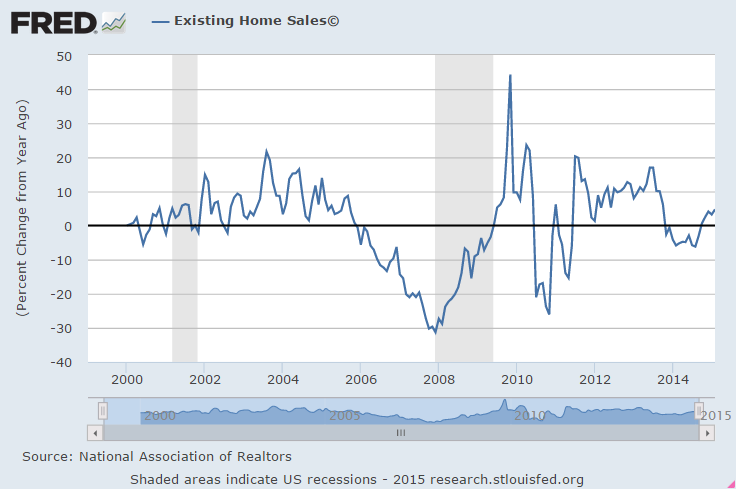
Existing home sales in February rose almost 5% in a year over year comparison, the best in a year and a half but still below the 5 million annual mark. The positive y-o-y gains during the past six months has prompted some optimism that sales may climb back above the 5 million mark in the spring and summer season.

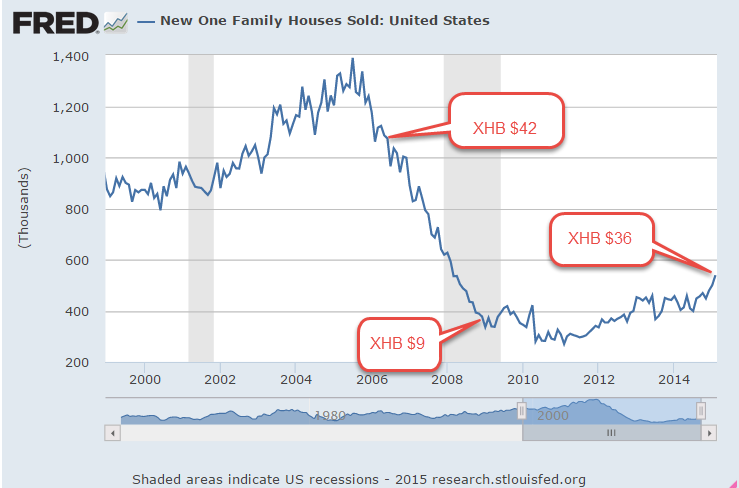
New home sales in February surged back above a half million.  In a more healthy market, sales of new homes are 6% – 7% of existing homes.  In 2006, that ratio started climbing above the normal range, getting increasingly sicker until it reached almost 18% in May 2010.  February’s ratio was 9%. If the ratio were in the normal range, existing home sales would be over 8 million, far above the current 4.9 million units actually sold.

In a 2014 report the National Assn of Realtors noted that boomers tend to buy new or newer homes to avoid maintenance headaches while younger buyers buy older homes because they are less expensive (page 3).  38% of all home buyers are first timers but the percentage is double for those younger than 33 (Exhibit 1-9 in the report).  As the supply of existing homes is inadequate to meet the demand, prices climb and suppress the demand, forcing first timers to either buy a smaller new home or continue renting.

Sales of new homes and the fortunes of home builders are based on the churn of existing homes.  Since October, the stocks of home builders (XHB) have climbed 20% in anticipation of growing sales, but weak existing home sales may prove to be a choke point for growth.

The larger publicly traded homebuilders also build multi-family units.  Real investment in this sector has tripled from the lows of early 2010 but are still below pre-crisis levels.

The housing market in this country is still wounded.  63% of the population are white Europeans (Census Bureau) but are 86% of home buyers (Exhibit 1-6).  While few will admit to racial prejudice in the current housing market, the numbers are the footprints of this nation’s long history of racial discrimination and socio-economic disparity.  Mortgage companies that made – let’s call them imprudent – credit decisions that helped precipitate the housing crisis are especially cautious, making it more difficult for younger buyers to purchase their first home, despite the historically low mortgage rates.  This market will not heal until mortgage companies relax their lending criteria just a bit and that won’t happen while rates are so low.

**************************
Income

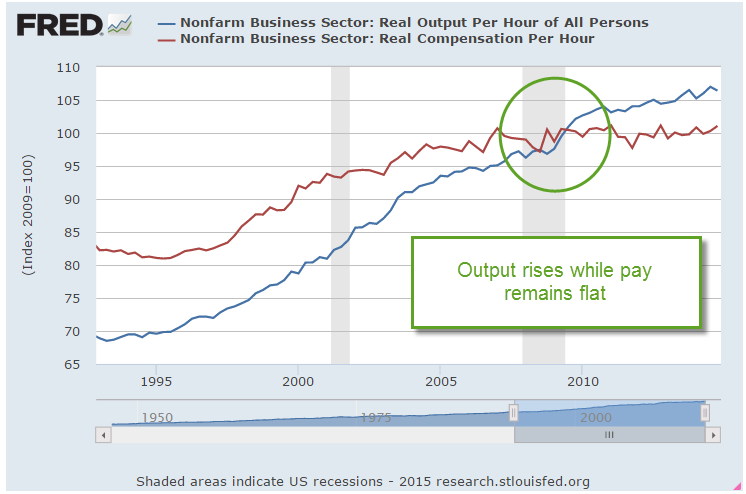
The Bee Gees might have sung “Words are all I have to take your heart away” because they were singing about love, not economics and finance.  Graphs often tell the story much better than words.  A milestone was passed a few years back.  For the first time since World War 2, the growth in income crossed below the growth in output.

This past week, the Bureau of Labor Statistics released a revision to their initial estimate of multi-factorial productivity in 2013.  There is a lot of data to gather for this series.  An often quoted productivity growth rate calculates the GDP of the nation divided by an estimate of the number of hours worked, a statistic that is accessible through payroll reports submitted monthly and quarterly.  The contribution of capital to GDP is much more difficult to assess and is largely disregarded by those like Robert Reich, former Secretary of Labor under President Clinton, who have a political axe to grind.  Truth is on a path too meandering for politics.

Total output in the years 2007 – 2013 was just plain bad, growing at an annual rate of only 1%, a third of the 2.9% growth rate from the longer period 1987 – 2013.  In the BLS assessment, the growth rates of both labor and capital inputs were poor by historical norms but capital input accounted for all of the meager gains in non-farm business productivity.  People’s work is simply not contributing as much to growth as before.  That reality means that income growth will be meager, which will prompt louder political rhetoric to make some kind of change, any kind of change, because voters like to believe that politicians have magic wands.

GDP and Education

June 29, 2014

This week I’ll review some of this week’s headlines in GDP, personal income, spending and debt, housing and unemployment.  Then I’ll take a look at some trends in education, including state and local spending.

**************************
Gross Domestic Product First Quarter 2014

The headline this week was the third and final estimate of GDP growth in the first quarter, revised downward from -1% to -2.9%.  This headline number is the quarterly growth rate, or the growth rate over the preceding quarter.  A year over year comparison, matching 2014 first quarter GDP with 2013 first quarter GDP, shows an annual real growth rate of 1.5%, below the 2.5 to 3.0% growth of the past fifty years.  The largest contributor to the sluggish GDP growth was an almost 5% drop in defense spending.  Simon Kuznets, the economist who developed the GDP concept, did not include defense spending in the GDP calculation.

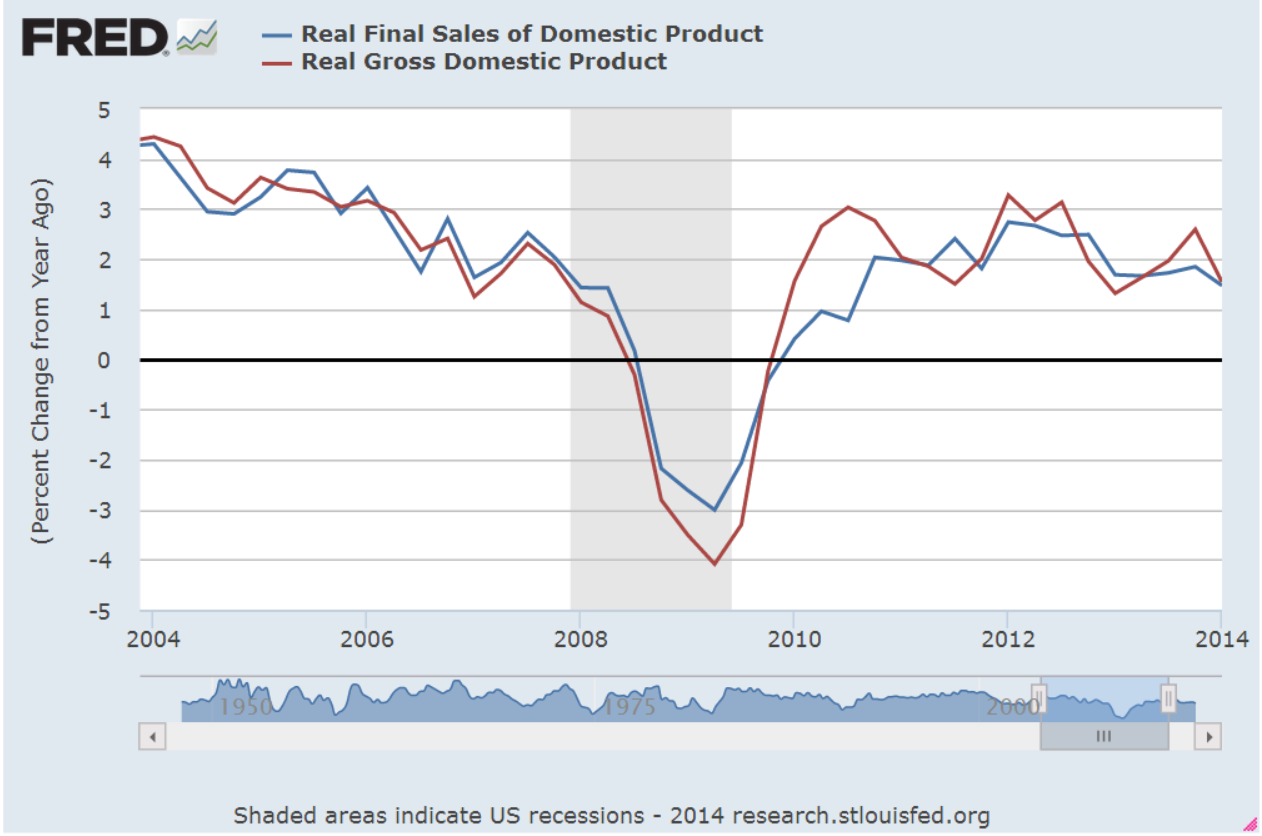
Contributing to the quarterly drop was the 1.7% decline in inventories.  Businesses had built up inventories a bit much in the latter half of 2013 in anticipation of sales growth only to see those expectations dashed by the severe winter weather.  Final Sales of Domestic Product is a way of calculating current GDP growth and does not include changes in inventory.  Let’s look at a graph of the annual growth in Real (Inflation-Adjusted) GDP and Real Final Sales of Domestic Product to see the differences in the two series.

Note that Real GDP growth (dark red line) leads Final Sales (blue line) as businesses build and reduce their inventory levels in anticipation of future demand and in reaction to current and past demand.
  
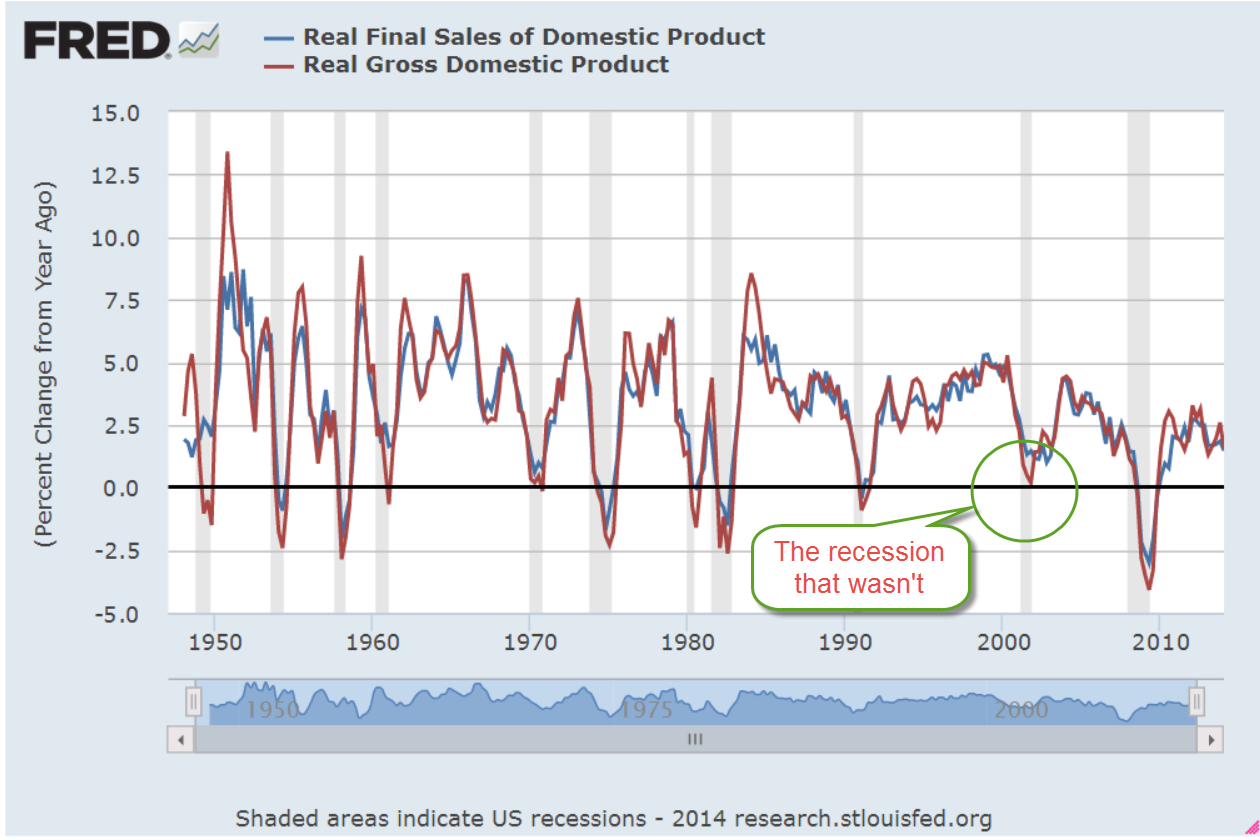
The Big Pic: if we look at these two series since WW2, we see that ALL recessions, except one, are marked by a year over year percent decline in real GDP.  The 2001 recession was the exception.
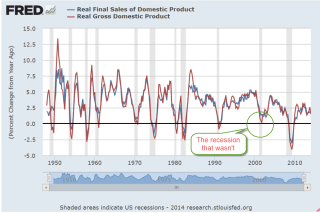
Secondly, note that in half of the recessions, y-o-y growth in Final Sales, the blue line in the graph, does not dip below zero.  We can identify two trends to recession: 1) businesses are too optimistic and overbuild inventories in anticipation of demand, then correct to the downside, causing a reduction in employment and a lagging reduction in consumer spending; 2) consumers are too optimistic and take on too much debt – selling an inventory of future earnings to creditors, so to speak – then correct to the downside and reduce their consumption, causing businesses to cut back their growth plans.  In case #1, a decrease in consumer spending follows the cutbacks by businesses.  In case #2, businesses cut back following a downturn in consumer spending.

In this past quarter, employment was rising as businesses cut back inventory growth, indicating more of a rebalancing of resources by businesses rather than a correction.  Consumer spending may have weakened during the first quarter but, importantly, did not decline.  We have two hunting dogs and neither is pointing at a downturn.

For a succinct description of the various components of GDP, check out this article written for about.com by Kimberly Amadeo.  Probably written in the first quarter of 2014, her concerns about the inventory buildup in 2013 were proved accurate.

**************************

Income and Spending

Personal Income rose almost 5% on an annualized basis in May but consumer spending rose at only half that pace,  2.4%.  The spending growth is only slightly more than the 1.8% inflation rate calculated by the Bureau of Economic Analysis, revealing that consumers are still cautious.

I heard recently a good example of how data can be presented out of context, leading a listener or reader to come to a wrong conclusion.  Data point: the dollar value of consumer loans outstanding has risen 45% since the start of the recession in late 2007. Consumer loans do not include mortgages or most student loan debt. If I were selling a book, physical gold, or a variable annuity with a minimum return guarantee, I could say:

My friends, this shows that many consumers have not learned any lessons from the recession.  They are living beyond their means, running up debts that they will not be able to pay. Soon, very soon, people will start defaulting on their debts and the economy will collapse.  This country will suffer a depression that will make the 1930s depression look tame.  Now is the time to protect yourself and your loved ones before the coming crash.

Data is little more than an opportunity to spread one’s political message.  Data should never lead us to reconsider our message, our point of view.  If I were penning a politically liberal message, I could write:

The families in our country are desperate.  Without enough income to satisfy their basic needs, they are forced to borrow, falling ever deeper into debt while the 1% get richer.  We need policies that will help families, not the financial fat cats on Wall Street.  We need a tax structure that will ensure that the 1% pay their fair share and not have the burden fall on the shoulders of most of the working Americans in this country.


Selling a political persuasion and selling a car brand often employ similar techniques.  Data should never lead us to question our loyalty to the brand.  If I were crafting a conservative message, I could write:


The misuse of credit indicates an immaturity fostered by cradle to grave social programs, which are eroding the very character of the American people, who come to rely less on their own resources and more on some agency in Washington to help them out.  People steadily lose their sense of personal responsibility, becoming more like children than self-reliant adults.

However, the facts behind the data point lead us to a different story. In the spring of 2010, consumer loans spiked, rising $382 billion in just two months.

That surge represents more than a $1000 in additional debt per person. Consumers did not suddenly go crazy.  Banks did not open their bank vaults in a spirit of generosity. Instead, banks implemented accounting rules FAS 166 and 167 that required them to show certain assets and liabilities on their books. $322 billion of the $382 billion increase in consumer loans during those two months in 2010 was the accounting change. If we subtract that accounting change from the current total, we find that real consumer loan debt increased only 5.5% in 6-1/2 years.  And that is the real story.  Never in the history of this series since WW2 have consumers restrained their borrowing habits as much as we have since December 2007.  We had to.  In the eight years before the financial crisis in 2008, real consumer debt rose 33%, an unsustainable pace.
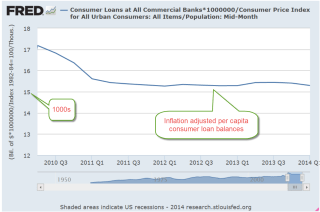
About two years ago, loan balances stopped declining and since then consumers have added $80 billion, much of it to finance car purchases. $25 billion of that $80 billion increase has come only since the beginning of this year.  On a per capita, inflation adjusted basis, consumer loan balances are still rather flat.

**************************

Housing

New home sales in May were up almost 20% over April’s total, and over 6% on an annual basis.  Existing homes rose 5% above April’s pace but are down 5% on an annual basis.  Each year we hope that housing will finally contribute something to economic growth.  Like Cubs fans, we can hope that maybe this year….

**************************

Unemployment Claims

New unemployment claims continue to drift downward and the 4 week moving average is just below 315,000.  Our attention spans are rather short so it is important to keep in mind that the current level of claims is the same as what is was last September.

It has taken this economy six months to recover from the upward spike in claims last October.  The patient is recovering but still not healthy.

**************************

Minimum Wage

The number of workers directly affected by changes in the minimum wage are small.  We sympathize with those minimum wage workers who try to support a family.  The Good Samaritan impulse in many of us prompts us to say hey, come on, give these people a break and raise the minimum wage.  What we may forget are the implications of any minimum wage increase.  Older readers, stretch your imagination and remember those years gone by when you were younger. Workers in their early working years often see the minimum as a benchmark for comparison.  The much larger pool of younger workers who make above minimum wage may push for higher wages in response to increases in the minimum wage.

Fifty years ago, Congress could have made the minimum wage rise with inflation, ensuring that workers in low paid jobs would get at least a subsistence wage and that increases would be incremental.  Of course, there are some good arguments against any nationally set minimum wage.  $10 in Los Angeles buys far less than $10 in Grand Junction, Colorado.  Ikea recently announced that they will begin paying a minimum wage that is based on the livable wage in each area using the MIT living wage calculator .  Several cities have enacted minimum wage increases that will be phased in over several years but none that I know of are indexed to inflation as the MIT model does.

Congress could enact legislation that respects the differences in living costs across the nation.  For too long, Congress has chosen to use the minimum wage as a political football.  Social Security payments are indexed to inflation because older people put pressure on politicians to stop the nonsense.  There are not enough minimum wage workers to exert a similar amount of coordinated pressure on the folks in Washington so workers must rely on the fairness instinct of the larger pool of voters if any national legislation will be passed.

**********************

Education

Demos, a liberal think tank, recently published a report recounting the impact of rising tuition costs on students and families.  Student debt has almost quadrupled from 2004 – 2012.  Wow, I thought.  State spending per student has declined 27%.  More wows.  How much has enrollment increased, I wondered?  Hmmm, not mentioned in the report.  Why not?

The National Center for Education Statistics, a division of the Dept. of Education, reports that full time college enrollment increased a whopping 38% in the decade from 2001-2011.  Part-time enrollment increased 23% during that time.  Together, they average a 32% increase in enrollment. Again, wow!  Ok, I thought, the states have been overwhelmed with the increase in enrollment, declining revenues because of the recession, etc.  Well, that’s part of the story.  Spending on education, including K-12, is at the same levels as it was a decade ago.
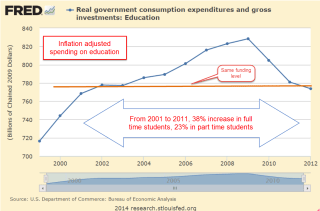
From 2002-2012, states have increased their spending on higher ed by 42%.  Some argue that the Federal government should step up and contribute more.  In 2010, total Federal spending on education at all levels was less than 1% ($8.5B out of $879B).  Others argue that the heavily subsidized educational system is bloated and inefficient.  As much cultural as they are educational institutions, colleges and universities have never been examples of efficiency.  Old buildings on college campuses that are expensive to heat and cool are largely empty at 4 P.M.  Legacy pension agreements, generously agreed to in earlier decades, further strain state budgets.  We may need to rethink how we can deliver a quality education but these are particularly thorny issues which ignite passions in state and local budget negotations.

Although state and local governments have increased spending on higher ed by 42% in the decade from 2002-2012, the base year used to calculate that percentage increase was particularly low, coming after 9-11 and the implosion of the dot-com boom.  Nor does it reflect the economic realities that students must get more education to compete for many jobs at the median level and above.

Let’s then go back to what was presumably a good year, 2000, the height of the dot-com boom.  State coffers were full.  In 2000, state and local governments spent 5.14% of GDP (Source).  By 2010, that share had grown to 5.82% of GDP (Source). That represents a 13% gain in resources devoted to education.  But that is barely above population growth, without accounting for the rush of enrollment in higher education during the decade.

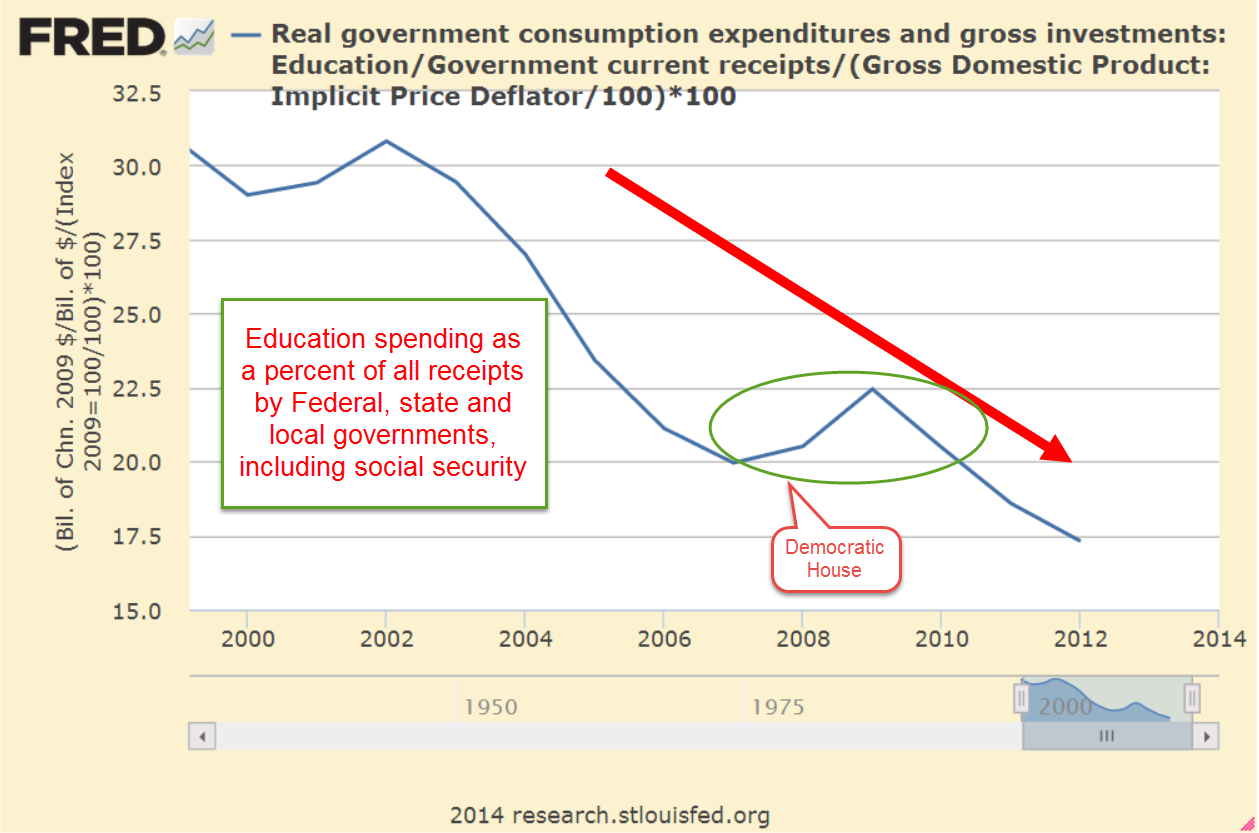
Let’s take a broader view of educational spending, comparing the total of all spending on education, including K-12, to all the revenue that Federal, state and local governments bring in.  This includes social security taxes, property taxes, sales taxes, etc.  As a percent of all receipts, spending on education has declined from 30% to under 18%.

Many on the political left paint conservatives as being either against education or not supportive of education.  Census data shows that Republican dominated state legislatures, in general, devote more of their budget to education than Democratic legislatures.  W. Virginia, Mississippi, Michigan, S. Carolina, Alabama and Arkansas devote more than 7% of GDP to education, according to U.S. Census data compiled by U.S.GovernmentSpending.com.  Only two states with predominantly Democrat legislatures, Vermont and New Mexico, join the plus-7% club (Wikipedia Party Strength for party control of state legislatures).

In the early part of the twentieth century, a high school education was higher education.  In the early part of this century, college may be the new high school, a minimum requirement for a job applicant seeking a mid level career.  What are our priorities?  In any discussion of priorities, the subject of taxes arises like Godzilla out of the watery depths.  People scramble in terror as Taxzilla devours the city. Older people on fixed incomes and wealthy house owners resist property tax increases.  Just about everyone resists sales tax increases.  Proposals to raise income taxes are difficult to incorporate in a campaign strategy for state and local politicians running for election.

Let’s disregard for a moment the ideological argument over Federal funding or control of education.  Let’s ask ourselves one question:  does this declining level of total revenues reflect our priorities or acknowledge the geopolitical realities of today’s economy?

***********************

Takeaways

Reductions in defense spending, inventory reductions and a severe winter that curtailed consumer spending accounts for much of the sluggishness in first quarter GDP growth.

A surge in new home sales is a sign of both rising incomes and greater confidence in the future.

Consumer spending growth is about half of healthy income gains.

Spending on education has grown a bit more than population growth and is not keeping up with surging enrollment in higher education.