Employment Trends

September 10, 2017

I’ll review a few notes from last week’s employment report and highlight some long-term trends. There’s good news and bad news.  Figuring out the future is tough because it hasn’t happened yet.  Heck, scholars still haven’t figured out what went on in the past.

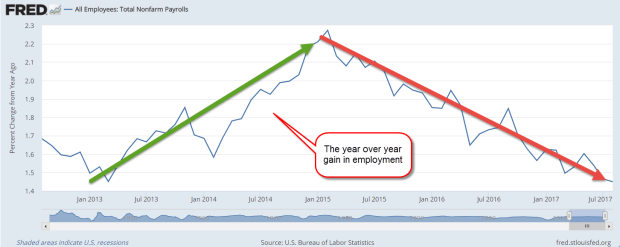
The unemployment rates are computed from a Household Survey and is a self-reporting statistic. The answers of survey respondents are not verified. The monthly job gains come from a separate survey of businesses and the data is more reliable. One of the recession indicators I use is the change in employment from the business survey. I regard a 1% year-over-year gain as a minimum threshold for a stable or growing economy. 1% is about the rate of population growth. If our economy cannot keep up with population growth, that is a pretty sure indicator of a coming recession. Here is a chart of the past five years. Growth is still above 1% but there is a definite downward trend.

Employ201608

Here’s a graph of the past two recessions showing that crucial decline below the 1% threshold.

Employ99-09

Due to higher manufacturing employment and higher population growth during the 1960s – 1980s, the recession threshold was closer to 2%. Here’s a graph of the 1970s to 1990s. The exception that broke the rule was the economic shock of the 1973 Arab-Israeli war. The oil embargo that followed straightjacketed the U.S. economy.

Employ1973-1993

The NAFTA agreement signed in the early 1990s began an erosion of the manufacturing base and employment in this country. Still, the decline was rather mild until China was admitted into the WTO in 2001. The streamlining of ocean shipping and land transport of goods by cargo container reduced costs and catalyzed a mass migration of manufacturers and supply chains to China and southeast Asia.

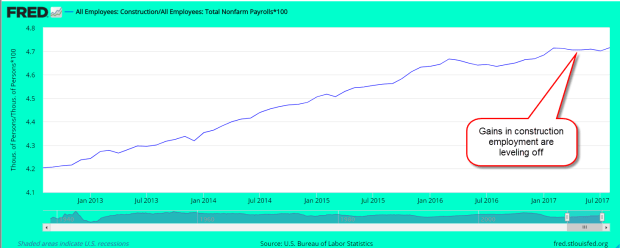
Gains in construction employment are waning. A sustained plateau followed by a decline precedes every recession.  Notice that the growth is not in the actual number of construction employees but in the percentage of construction employment to total employment.

ConstructEmploy

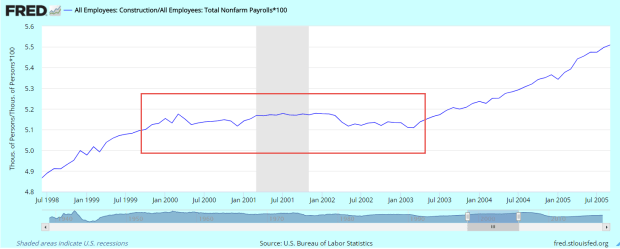
A plateau in construction employment began in April 2000 and persisted through one recession till the spring of 2003. In late 2002, there was talk of another recession. Fed chair Alan Greenspan continued to push rates down to 1% to ward off the boogie man of recession.

ConstructEmploy1998-2005

With unemployment as low as it is, wage growth should be stronger.  In the latter part of 2016 and earlier this year the hourly earnings of private employees sometimes pushed toward 3% annual growth. Since April, growth has stayed rock steady at a mild 2.5%.  It’s like some joker is laughing at the dominant economic models.

Speaking of predictive models, the Fed has discontinued the Labor Market Conditions Index (LMCI), a broad composite of 19 employment indicators. As a general picture of the employment market, it was satisfactory. As a predictive tool of developing trends, the Fed thought it was too sensitive. For those readers who would like a deeper dive, Doug Short of Advisor Perspectives examines the Feds remarks on this index.

/////////////////////

Lloyd Blankfein, the CEO of Goldman Sachs, commented recently (CNBC) that the length of this bull market has worried the traders at Goldman.   Next week, I’ll compare this bull run with those of the past.

The Supply Chain Sags

September 11, 2016

Fifteen years ago almost three thousand people lost their lives when the twin towers crumpled from the kamikaze attack of two hijacked airplanes.  Over the fields of rural Pennsylvania that morning, the passengers of a another hijacked plane sacrificed their own lives to rush the hijackers and prevent an attack on Washington.  We honor them and the families who endured the loss of their loved ones.

/////////////////////////

Purchasing Managers Index

Each month a private company ISM surveys the purchasing managers at companies around the country to assess the supply chain of the economy. Are new orders growing or shrinking since last month?  Is the company hiring or firing?  Are inventories growing or shrinking?  How timely are the company’s suppliers?  Are prices rising or falling? ISM publishes their results each month as a  Purchasing Managers Index (PMI), and it is probably the most influential private survey.

ISM’s August survey was disappointing, especially the manufacturing data.  Two key components of the survey, new orders and employment, contracted in August. Both manufacturing and service industries indicated a slight contraction.

For readers unfamiliar with this survey, I’ll review some of the details The PMI is a type of index called a diffusion index. A value of 50 is like a zero line.  Values above 50 indicate expansion from the previous reading; below 50 shows contraction. ISM compiles an index for the two types of suppliers, goods and services, manufacturing and non-manufacturing.

The CWPI variation

Each month I construct an index I call the Constant Weighted Purchasing Index (CWPI) that blends the manufacturing and non-manufacturing surveys into a composite. The CWPI gives extra weight to two components, new orders and employment, based on a methodology presented in a 2003 paper by economist Rolando Pelaez.  Over the past two decades, this index has been less volatile than the PMI and a more reliable warning system of recession and recovery, signaling a few months earlier than the PMI.

Weakness in manufacturing is a concern but it is only about 15% of the overall economy.  In the calculation of the CWPI, however, manufacturing is given a 30% weight.  Manufacturing involves a supply chain that produces a ripple effect in so many service industries that benefit from healthy employment in manufacturing. Because there may be some seasonal or other type of volatility in the survey, I smooth the index with a three month moving average.  Sometimes there is a brief dip in both the manufacturing and non-manufacturing sides of the data. If the downturn continues, the smoothed data will confirm the contraction in the next month.  This is the key to the start of a recession – a continuing contraction.

History of the CWPI

The contraction in the survey results was slight but the effect is more pronounced in the CWPI calculation. One month’s data does not make a trend but does wave a flag of caution. Let’s take a look at some past data.  In 2006 there was a brief one month downturn. In January 2008, the smoothed and unsmoothed CWPI data showed a contraction in the supply chain, and more important continued to contract. The beginning of the recession was later set by the NBER at December 2007. ( Remember that these recession dates are determined long after the actual date when enough data has been gathered that the NBER feels confident in its determination.)  The PMI index did not indicate contraction on both sides of the economy until October 2008, seven months after the signal from the CWPI.  During that time, from January to October 2008, the SP500 index lost 30% of its value.

The CWPI unsmoothed index showed expansion in June 2009 and the smoothed index confirmed that the following month. The PMI did not show a consistent expansion till August 2009.  The NBER later called the end of the recession in June 2009.

The Current Trend

Despite the weak numbers, the smoothed CWPI continues to show expansion but we can see that there is a definite shift from the wave like pattern that has persisted since the recovery began.

With a longer view we can see that an up and down wave is more typical during recoveries.  A flattening or slow steady decline (red arrows) usually precedes an economic downturn.  The red arrows in the graph below occurred a year before a recession.  The left arrow is the first half of 2000, a year before the start of the 2001 recession.  The two arrows in the middle of the graph point to a flattening in 2006, followed by a near contraction.  A rise in the first part of 2007 faltered and fell before the recession started in December 2007.  The current flattening (right arrow) is about six months long.

New Orders and Employment

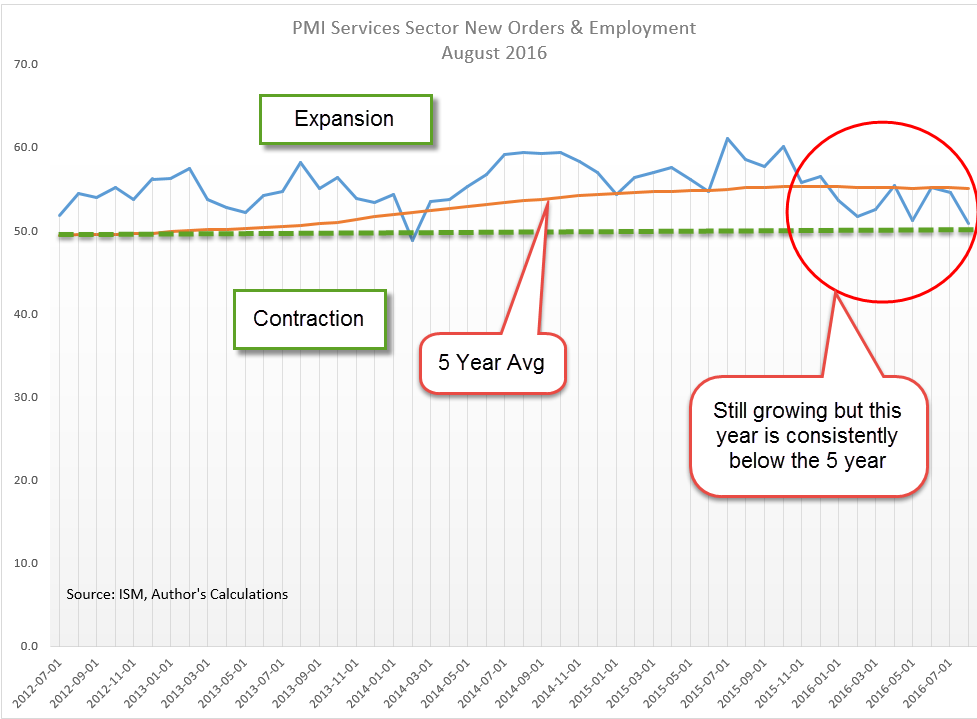
Focusing on service sector employment and new orders, we can see the weakness in this year’s data.

With a long view, a smoothed version of this-sub indicator signals weakness before a recession starts and doesn’t shut off till late after a recession’s end.  The smoothed version has been below the 5 year average for seven months in a row.  If history is any guide, a recession in the next year is pretty certain.

The 2007-2009 Recession

 In August 2006 this indicator began consistently signaling key weakness in the service sectors of the economy (big middle rectangle in the graph below). Stock market highs were reached in June 2007 and the recession did not officially begin till December 2007, a full sixteen months after the signal started.  That signal didn’t shut off till the spring of 2010, about eight months after the official end of the recession.

The 2001 Recession, Dot-Com Bust and Iraq War

The recession in 2001 lasted only six months but the downturn in the market lasted three years as equities repriced after the over-investment of the dot-com boom.  The smoothed version of this indicator first turned on in January 2001, two months before the start of the recession in March of that year.   Although, the recession officially ended in November 2001, the signal did not shut off till June 2003 (left rectangle in the graph above).  Note that the market (SP500) hit bottom in September 2002, then nosedived again in the winter.  Weak 4th quarter GDP growth that year fueled doubts about the recovery.  Concerns about the Iraq war added uncertainty to the mix and drove equity prices near that September 2002 bottom.  In April 2003, two months before the signal shut off, the market began an upward trajectory that would last over four years.

No one indicator can serve as a crystal ball into the future, but this is a reliable cautionary tool to add to an investor’s tool box.

//////////////////////////////

Stocks, Interest Rates and Employment

There are 24 branches of the Federal Reserve. This week, presidents of two of those banches indicated that they favored an interest rate hike when the Fed meets later this month (Investor’s Business Daily article).  On Friday, the stock market dropped more than 2% in response.  One of those presidents, Rosengren, is a voting member on the committee (FOMC) that sets interest rates.  I have been in favor of higher interest rates for quite some time so I agree with Rosengren that gradual rate increases are needed. However, Chairwoman Janet Yellen relies on the Labor Market Conditions Index (LMCI) to gauge the health of the labor market.

Despite an unemployment rate below 5%, this index of about 20 indicators has been lackluster or negative this year.  There are a record number of job openings but employees are not switching jobs as the rate they do in a healthy labor market.  This is the way that the majority of employees increase their earnings so why are employees not pursuing these opportunities?

The Federal Reserve has a twin mandate from Congress: “maximum employment, stable prices, and moderate long-term interest rates.” (Source) There is a good case to be made that there are too many weaknesses in the employment data, and that caution is the more prudent stance.  The FOMC meets again in early November, just six weeks after the upcoming September meeting. Although the Labor Report will not be released till three days after the FOMC meeting, the members will have preliminary access to the data, giving them two more months of employment data. Yellen can make a good case that a short six week pause is well worth the wait.

Stuck in the Mud

In 18 months, the SP500 is little changed.  A broad index of bonds (BND) is about the same price it was in January 2015.  The lack of price movement is a bit worrying.  There are several alternative investments which investors may include in their portfolio allocation.  Since January 2015, commodities (DBC)  have lost 15%, gold (GLD) has gained a meager 1%, emerging markets (VWO) are down 5%, and real estate (VNQ) is literally unchanged.  A bright note: international bonds (BNDX) have gained almost 6% in that time and pay about 1.5%.  1994 was the last time several non-correlated assets hit the pause button.  The following six years were good for both stocks and bonds.  What will happen this time?  Stay tuned.

Caution: Under Construction

June 12, 2016

As we travel the highways this summer we are likely to encounter many construction zones as crews repair wear and tear, and the damage that results from the temperature cycle of freeze and thaw. There are a few hitches on the economic road as well.

CWPI

I look to the Purchasing Manager’s (PM) Survey each month for some advance clues about the direction of the economy.  Like the employment report, this month’s survey contains some troubling signs.  I had my doubts about the low numbers in the employment report until I saw the results from this survey.  PMs in the services sectors reported a 3.3% contraction in employment growth so that it is now neutral, matching the lack of growth in manufacturing employment.

New orders in both manufacturing and services are still growing but slowed considerably in the services sectors.  The slowdown in both employment and new orders in the services sectors is apparent from the graph below.  While this composite is still growing (above 50), it has been below the five year average for four out of five months.

This recovery has been marked by, and hampered by, a familiar peak and trough pattern of growth. Last month I wrote:

 “A break in this pattern would indicate some concern about a recession in the following six months. What is a break in the pattern? An extended trough or a continued decline toward the contraction zone below 50.”

The CWPI, a custom blend of the various parts of the ISM surveys, shows a continued weakening that is more than just the periodic trough.  If there are further indications of weakness this summer, get concerned.

///////////////////////

LMCI

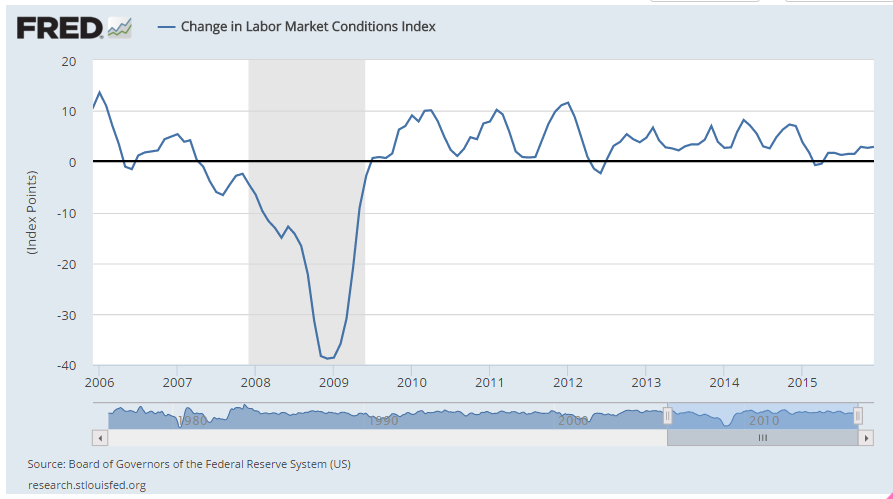
A few years ago the Federal Reserve introduced the Labor Market Conditions Index, or LMCI, a composite analysis of the labor market based on about twenty indicators published each month by several agencies. Because the report is released a week after the headline employment report, this composite does not receive much attention from policy makers, which is a bit of puzzle.  Janet Yellen, chair of the Fed, has indicated that she and others on the rate setting committee of the Fed, the FOMC, rely on this index when determining interest rate policy.

One business day after the release of this month’s unexpectedly weak employment report, the LMCI showed an almost 5% decrease and is the 5th consecutive monthly decrease in the index.

Although this composite is fairly new, many of the underlying indicators have long histories and enable the Fed to provide several decades of this index.  As a recession indicator, the monthly changes in this index tend to produce a number of false positives.  However, if we shift the graph upwards by adding 7 points to the changes, we see a familiar 0 line boundary.  When the monthly change in the index drops below 0 on this adjusted basis (actually -7), a recession has followed shortly.

We are not at the zero boundary yet, but we are getting close and the pattern looks ominously familiar.  Don’t play the Jaws music yet, though.

Income Distributions

February 7th, 2016

Updates on January’s employment report and CWPI are at the end of this post.  Get out your snowboards ’cause we’re going to carve the political half-pipe! (*v*)
(X-Game enthusiasts can click here)

////////////////////////////////

To Be Rich or Not To Be Rich

Every year the IRS takes a statistical snapshot of the almost 150,000,000 (150M) personal tax returns it receives.  There are some interesting tidbits contained in these tables that will put the lie to many a politician’s claim in this election season.  The IRS lists the number of returns for each of some twenty income brackets.  They also list the exemptions claimed for each of these income brackets and let’s turn to that for some interesting insights.

From Table 1.4 we learn that there were 290M exemptions claimed in the 147M tax returns filed in 2013, or almost two exemptions per return.  In 1995 (Table 1, same link as above) the number of exemptions claimed was 237M for 118M returns, exactly two exemptions per return. Exemptions are people that need to be fed, clothed, and housed.

Census Bureau surveys (CPS) over the past few decades show that households are shrinking.  Conservatives assert that median household income has stagnated simply because there are fewer people and workers in households today compared to the past.  If this were true, IRS data would show a greater decrease in exemptions over an 18 year period. We can’t say that one or the other data source is “true,” but that averaging data from the two sources probably gives a more accurate composite of income trends in the data.  Census data probably overcounts households while the IRS undercounts them.  Conservatives who advocate less government support will ignore IRS data that conflicts with their beliefs.

30% of the exemptions were claimed by tax returns with adjusted gross incomes (AGI) of less than $25,000, or less than half the median household income. (AGI is earned income and does not include much of the income received from government social programs.)  Only 2M exemptions, or 2/3 of 1%, were claimed by tax returns with an AGI of $1M or more.  Out of 315 million people in the U.S., there are only two million “fat cats” with incomes above $1,000,000.

Presidential contender Bernie Sanders tells his supporters that he is going to tax the rich to help pay for his programs.  IRS data shows just how few there are to tax to generate money for ambitious social programs. Mr. Sanders says he will get money from the big corporations.  Corporations with lots of well paid lawyers are not going to give up their money peacefully.

Instead, Mr. Sanders’ plans will rely on taxing individuals who can not erect the legal or accounting barricades employed by big corporations.  11% of exemptions were claimed by those making more than $200,000, a larger pool of potential tax money. Doctors, lawyers and other professionals will “Feel the Bern.”  It is not unusual for a middle class married couple in a high cost of living city like New York or Los Angeles to make $200K.  Mr. Sanders has his sights on you.  You are now reclassified as rich.

Here is a well-sourced analysis of the net cost to families.  Most will save money.  Unfortunately, Mr. Sanders made the political mistake of admitting that he would raise taxes, but…  No one paid attention to the “but.”  Should he win the Democratic nomination, Mr. Sanders will “feel the Bern” as Republicans use the phrase against him.  He might have used a phrase like “my plan will lower mandatory payments” to describe the combined effect of higher income taxes and no healthcare insurance payments.

The author calculates that the top 4% will spend a net $21K in extra taxes less savings on health care premiums.  The author probably overstates the effect on those at the top because he uses an average instead of a median, but we could conservatively estimate an additional $10K for those with AGIs in the $200K-$300K range.

****************

Earned Income Tax Credit

The Earned Income Tax Credit (EITC) is  a reverse income tax for low income workers, who get a check from the federal goverment.  For the 2014 tax year, over 27 million returns received about $67 billion from the government for an average of $2400 per receipient (IRS).  In inflation adjusted dollars, this is up 50% from the 2000 average of $1600.  The number of receipients has expanded 50% as well, growing from 18 million to 27 million.  Although Democrats often tout their support for the poor, it is Republican congresses that are largely responsible for expanding this support for low income families.  Republicans may talk tough but are more than willing to reach out a helping hand to those who are giving it their best effort.  There is a practical political consideration as well.  An analysis of IRS data by the Brookings Institute found that, in the past fourteen years, the poor have shifted from urban areas largely controlled by Democrats to the outlying suburbs of metropolitan areas, where Republicans have more support. In short, Republicans are taking care of their voter base.

****************

Constant Weighted Purchasing Index (CWPI)

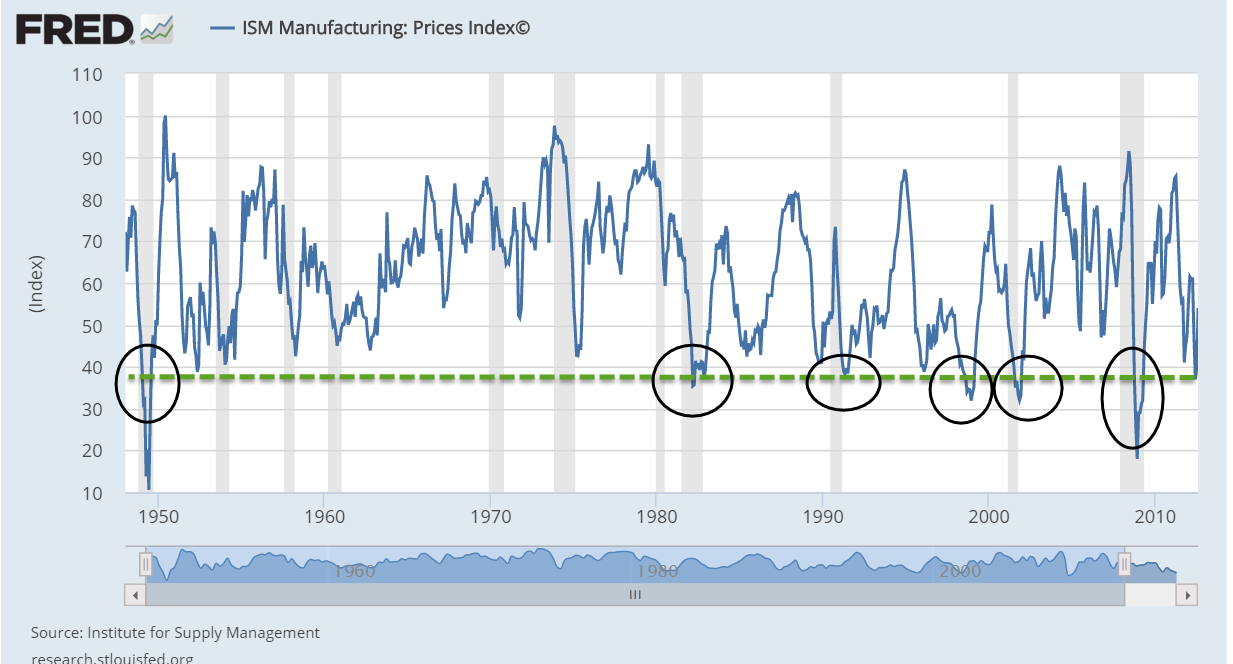
The manufacturing sector, about 15% of the economy, continues to contract slightly, according to the latest Purchasing Manager’s Survey from ISM.  The strong dollar and a slowdown in China have dragged exports down.   Extremely low oil prices have impacted the pricing component of the manufacturing survey, which has reached levels normally seen during a recession.


For some industries, like chemical products, the low oil prices have boosted their profit margins.  Most industries are reporting strong growth or at least staying busy.  Wood, food, beverage and tobacco manufacturers and producers report a sluggish start to the year, as reported to ISM.

The services sectors have weakened somewhat in the latest survey of Purchasing Managers, but are still growing, with a PMI index reading of 53.5.  Above 50 is growing; below 50 is contracting.  The weighted composite of the entire economy, the CWPI, is still growing strongly but the familiar up and down cycle of the recovery is changing.  Both exports and imports are contracting

The composite of employment and new orders in the non-manufacturing sectors has broken  below the 5 year trend.  It may turn back up again as it did in the winter of 2014, but it bears watching.

*************************

Employment

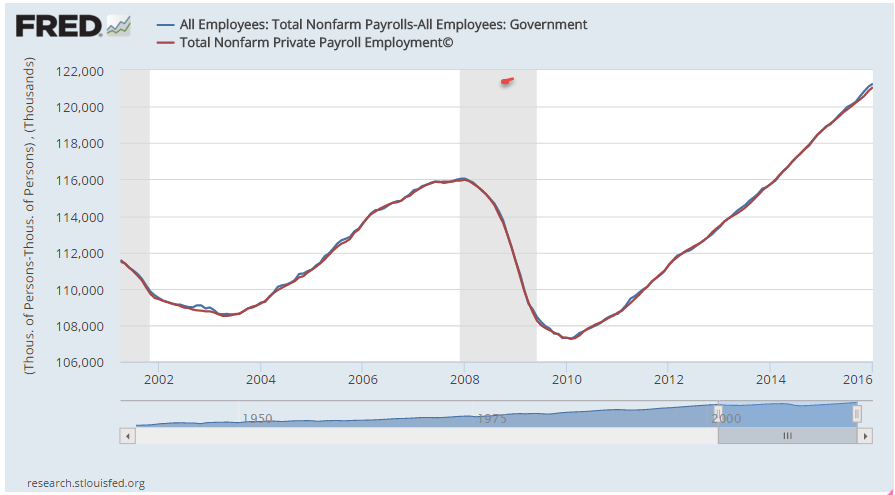
Each month theBureau of Labor Statistics  (BLS) surveys thousands of businesses and government agencies to compute the number of private and public jobs gained or lost during the month.  The payroll processing firm ADP also tallies a change in private jobs based on paychecks generated from thousands of its client businesses.  If we subtract government jobs from the BLS total, we should get a total number of jobs that is close to what ADP tallies.  As we see in the graph below, that is the case.

Economists, policy makers and the media look at the monthly change in that total number of jobs.  This change is miniscule compared to the 121 million private jobs in the U.S.  A historical chart of that monthly change shows that BLS survey numbers are more volatile than ADP.

I find an averaging method reduces the monthly volatility.  I take the change in jobs as reported by the BLS, subtract the  change in government employment, average that result with the ADP report of jobs gained or lost, then add back in the BLS estimate of the change in government employment.  This method produces a resulting monthly change that proves more accurate in time, after the data is subsequently revised by the BLS.  Based on that methodology, jobs gains were close to 175K in January, not the 151K reported by the BLS or the 205K reported by ADP.

There was a lot to like in January’s survey.  The unemployment rate fell below 5%.  Average hourly earnings increased by 1/2%.  Manufacturing jobs added 29,000 jobs, the most since the summer of 2013.  This helped offset the far below average job gains in professional and business services.  Year-over-year growth in the core work force aged 25-54 increased further above 1%.

The bad, or not so good, news: job gains in the retail trade sector accounted for 1/3 of total job gains and were more than twice the past year’s average of retail jobs gained.  Considering that job growth in retail was near zero in December, this may turn out to be a survey glootch.  Food services were another big gainer this past month.  Neither of these sectors pays particularly well.  The jump in manufacturing jobs probably contributed the most to lift the average hourly wage.

The Labor Market Conditions Index (LMCI) is a cluster of twenty or so employment indicators compiled by the Federal Reserve.  December’s change in the monthly index was almost 3%.  In the forty year history of this index, there has NEVER been a recession when this index was positive.

We are innately poor at judging risk.  We derive indicators and other statistical tools to help us balance that innate human weakness with the strength of mathematical logic.  Still, people do not make money by NOT talking about recession.  NOT talking does not pay commissions, does not generate the buying of put options, expensive annuities, and other financial products designed to make money on the natural gut fears of investors.  Next week I’ll look at the price stability of our portfolios.
New Year Review

January 3, 2016

As we begin 2016, let’s take a look at some trends.  It is often repeated that the recovery has been rather muted.  As former Presidential contender Herman Cain once said, “Blame Yourself!”  You and I are the problem.  We are not charging enough stuff or we are making too much money. Debt payments as a percent of after tax income are at an all time low.

At its 2007 peak, households spent 13% of their after tax income to service their debt.  Currently, it is about 10%. In early 2012, this ratio crossed below the recession levels of the early 1990s.  By the end of 2012, this debt service payment ratio had fallen even below the levels of the early 1980s.  Almost six years after the official end of the Great Recession the American people are behaving as though we are still in a recession.  An aging population is understandably more cautious with debt.  In addition to that demographic shift, middle aged and younger consumers are cautious after the financial crisis. We gorged on debt in the 1990s and 2000s and paid the price with two prolonged downturns.  Having learned our lessons, our overactive caution is now probably dragging down the economy.

In this election year, we can anticipate hearing that the sluggish economy can be blamed on: A) the Democratic President, or B) the Republican Congress.  It is Big Government’s fault.  It is the fault of greedy Big Companies.  Someone is to blame.  Pin the tail on the donkey.  Blah, blah, blah till we are sick of it.

************************

Auto Sales

The latest figures on auto sales show that we are near record levels of more than 18 million cars and light trucks sold, surpassed only by the auto sales of February 2000, just before the dot com boom fizzled out.  On a per capita basis, however, car sales are barely above average.  The thirty year average is .054 of a vehicle sold per person.  The current sales level is .056 of a car per person.  Automobile dealers would have to sell an addiitonal 900,000 cars and light trucks per year to have a historically strong sales year.

************************

Construction Spending

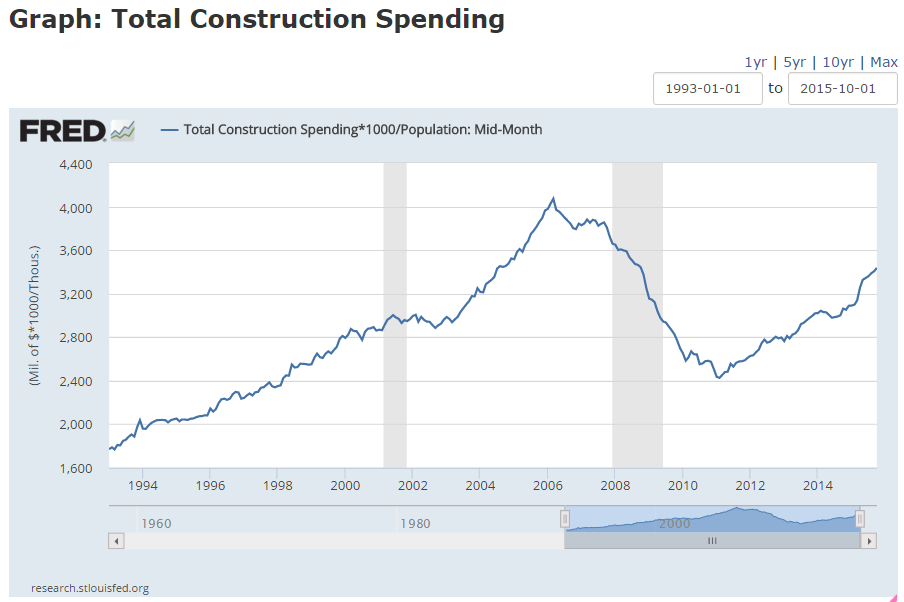
In some cities, housing prices and rents are rising, and vacancies are low.  We might assume that construction is booming throughout the country.  Six years into the recovery per capital construction spending is at 2004 levels and that does not account for inflation.  Levels like this are OK, not good, and certainly not booming.

*************************

Employment

The unemployment rate and average hourly wage may get most of the public’s attention but the Federal Reserve compiles an index of many indicators to judge the health of the labor market.  Positive changes in this index indicate an improving employment picture.  Negative changes may be temporary but can prompt the Fed to take what action it can to support the labor market.  Recent readings are mildly positive but certainly not strong.

*************************

Stock Market

Many of the companies in the SP500 generate half of their revenue overseas.  Because of the continuing strength of the dollar, the profits from those foreign sales are reduced when exchanged for dollars.  According to Fact Set, earnings for the SP500 are projected to be about $127 per share, the same level as mid-2014.  In the third quarter of 2015, the majority of companies reported revenue below estimates.  As 4th quarter revenue and earnings are released in the coming weeks, investors will be especially vigilant for any downturns in sales as well as revisions to sales estimates for the coming year.  It could get bloody.