The Media is the Mirror

August 16, 2026

By Stephen Stofka

Last week I discussed how we deceive ourselves. This week I want to explore how we define ourselves through our affiliation with and membership in groups. Growing up we are part of a family, a group of students in school, congregants at church, players on a team, members of our local community. Many of these group affiliations are endowed to us by our parents, by our circumstances and the institutions within our local community. Later we associate with others of the same profession or job, who have similar political sympathies, or similar interests and hobbies. Are we passive victims of group psychology or do we actively, perhaps unconsciously, seek out groups that will confirm our opinions, values and perspectives? How does the development of different media change the composition of our social groups?

In 1956, the sociologist C. Wright Mills (1956, p. 304) argued that the country was developing from a community of publics into a mass society. What’s the difference? In her book These Truths, historian Jill Lepore explained what Mills meant by the two terms. “A community of publics is a population of people who talk to one another; a mass society receives information from the mass media. In a mass society, elites, not the people, make most decisions, long before the people even know there is a decision to be made” (2018, p. 566). In a community of publics, communication is a two way street. People communicate with their governing institutions and with each other. In a mass society, communication is a one-way street. Centralized organizations communicate to large populations who have little opportunity to respond.

Mass Media

Until the last decades of the 19th century, newspapers, magazines and books did not have a circulation wide enough to be considered mass media. Shortly after the Constitution was drafted, Alexander Hamilton, John Jay and James Madison published a series of 85 essays arguing for the ratification of the new Constitution. The essays were first published in two New York City newspapers. They were reprinted by a few newspapers in other cities but many Americans would not have read those arguments (Source).They might have heard about them from neighbors or at local meetings where a state legislator revealed those arguments. America was a jigsaw puzzle of communities without any unifying identity.

It wasn’t until the late 19th century that newspapers had a role in shaping public opinion and identity. William Randolph Hearst and Joseph Pulitzer built media empires that competed with each other for readership in several prominent cities (Source). Through their influence on public opinion, they had some indirect influence on public policy. In 1898, the U.S. sent the battleship Maine to Havana to show support for Cuba’s fight for independence from Spain. When the battleship blew up, the Navy initially determined that the cause was a mine, an act of aggression by Spain (Source).

Newspapers published by Hearst and Pulitzer featured hyperbolic headlines designed to stoke animosity against Spain. Did those alarmist headlines, known as yellow journalism, light a fire of public anger so hot that politicians in Washington declared war on Spain? In grade school I was taught that, but the truth is that there were several issues that accelerated tensions between the U.S. and Spain. It is unlikely that the newspaper coverage prompted the war (Source). However, it became clear that large media organizations were willing to shape their reporting of events to amplify public sentiment and attract more readers.

Thousands of newspaper readers riding a New York City subway car to work might be reading the same newspaper. Without being conscious of it, they were part of a group, bundled together and sold to advertisers as part of the newspapers’ circulation numbers. The small amount that readers paid for the newspaper had never been enough to offset the printing and distributing costs.

Broadcasting

On November 2, 1920, a station in Pittsburgh broadcast the election returns. Within two years, there were over 500 licensed radio stations (Source). In 1931, a CBS station in New York City became the first broadcast TV station (Source). By the end of World War 2, the three networks, ABC, CBS and NBC dominated the medium and competed with each other for listeners and viewers. In the 1920s, the Nielsen company began to sample the audience for radio stations. In 1950, they began measuring the viewership for TV programming (Source).

In the 1960s, a popular Top-40 radio station like WABC in New York might broadcast a variety of music that appealed to a wide range of people and musical tastes. Higher audience numbers led to higher advertising revenue.

There were songs from popular musicals, as well as American song book classics performed by artists like Frank Sinatra. There was a mix of rock and roll from bands like the Beatles, some R&B by Ray Charles and the soul music of James Brown. Mom and Dad tolerated the sound of the Beatles, the Rolling Stones and Who. The kids tolerated old fogey artists like Sinatra and Bing Crosby. People were exposed to a diverse collection of musical tastes played over and over again in rotation. Maybe a 12-year-old mentally tuned out Eydie Gorme’s song Blame It on the Bossa Nova, but if someone mentioned the song or sang a couple of bars, they would be somewhat familiar with the song. The exposure and repetition of this variety led songwriters to incorporate elements from a diverse collection of musical styles. That was AM broadcasting.

Narrowcasting

The rise of FM radio stations tailored a selection of music to a smaller audience. Until 1965, FM radio stations in larger cities simply simulcast what their affiliated AM Radio station played. In 1965, the FCC instituted a rule change that required the owners of AM and FM stations in large markets to broadcast distinct programming on their FM stations. Some FM stations became independent and adopted innovative programming to appeal to a narrower audience. WNEW in New York City played jazz, poetry readings and progressive rock (Source). A person no longer had to tolerate the music that they didn’t like. In fact, a popular artist or song from another genre might be unfamiliar.

Getting Choosy

In the late 1960s, 8-track players for cars became available. Music lovers took one step further to crafting a unique listening experience in their car (Source). People could be less tolerant of what they didn’t like and more in control of listening to what they did like. In the 1980s, people could create an intimate and unique listening experience with the newly introduced Sony Walkman, headphones and compact cassette.

The Internet

In the 1990s, the development of the internet allowed users to explore and share common interests, opinions and perspectives with strangers. By 2000, AOL Online had 20 million users and hundreds of forums, chat rooms and message boards (Source). Users were known to AOL by their real names and addresses but users could hide behind screen names and creative profiles with other users. As consumers of print, radio and TV media, we were anonymous. Through social media we could interact directly with other human beings and preserve our anonymity. Without anonymity, we might be reluctant to express our frank opinion. Behind the curtain of digital anonymity, we became like the wizard of Oz.

Shared Errors

Two weeks ago I wrote that “we come in contact with the world through our senses but we engage with the world through our errors.” As wizards in the digital realm, our anonymity meant that our errors might have little cost. In direct contact with others, we had to learn some restraint. Now we could try out controversial religious, political and social claims without worrying about social ostracization or physical harm.

We could hang out in groups of people who made similar claims. Vaccines were a government conspiracy. The Trilateral Commission controlled the leaders of powerful countries through extortion or mind control. Most of the extraordinary technological and scientific discoveries in the second half of the 20th Century had come from aliens who had landed near Roswell, New Mexico after World War 2. Democratic politicians were sponsored by Communist sleeper cells intent on imposing socialism on America. They were part of a secret cabal of pedophiles. Republican politicians were puppets of big business and the military industrial complex. They would rather spend your taxes on war than health care and social programs.

We found groups and media channels that believed the same facts and came to the same conclusions we did. We could stand firmly on the principle that people should not be forced to buy healthcare insurance. But what about a 25-year-old without health insurance who got injured somehow? Should the emergency room refuse to treat her? We could believe that churches and civic organizations would voluntarily contribute to charitable funds that would pay for that expense. We could believe that and no one would challenge us with facts because we all had libertarian sensibilities and resisted most government programs.

Social media has helped us untie the restraints on our opinions, impulses and emotions. Next week I want to look at how we form and share common rules of morality in groups. I hope to see you next week.

/////////////

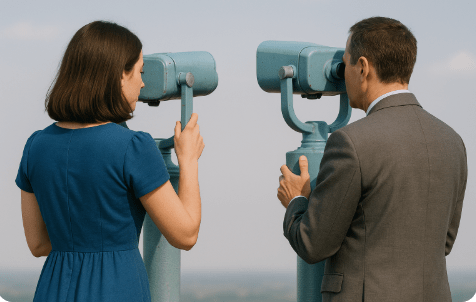
Photo by Ramon Kagie on Unsplash

Lepore, J. (2018). These truths: A history of the United States. W. W. Norton & Company.

Mills, C. W. (1956). The power elite. Oxford University Press.

Me and Not Me

January 11, 2026

By Stephen Stofka

An infant rests in the crook of his mother’s arm and gazes at her face. The infant may have been separated physically at birth from his mother, but the infant knows no boundaries of self. Fast forward a number of decades. When a parent dies, a child learns that the property of the dead parent forms a new self, a legal entity, that can be party to a contract. This new agent, called an estate, is even given an identification number (Source). This week I want to explore the space between self and non-self. What do we mean by self? I will leave a discussion of Atman, and other mystical variations, for another day.

At first glance, the idea of self seems rather binary. There’s Me and everything else which is not Me, the rest of the universe. But our lives are lived by degrees. We may not feel like the same person we were ten years ago, but our identity remains the same. A person may excuse their behavior by saying they weren’t themselves when they did such and such. Is Me the identity that began on the day of my birth? Does that Me end on the day of my death? That identity is objective. It was recognized by others even when I was lying in my crib and unaware of my identity. I could be lying in a coma in a hospital oblivious of my identity but that identity would persist.

Or is Me the person that experiences change, that acquires and loses abilities and characteristics? That is the subjective perspective. Perhaps Me includes both of these aspects, the objective identity and the subjective experience. As we reach our teenage years we experience an awareness of our presentation to those around us. Integrating this subjective awareness of the objective aspect of ourselves can be emotionally painful.

The Greek philosopher Aristotle built a metaphysics of a unified self experiencing change. He was a nature guy, a philosopher who speculated that things and people in the world behaved the way they did because they wanted to realize their nature. This sense of purpose, called teleology, was the central foundation of Aristotle’s thinking. He thought there was a universal form, an essence that directed a person toward a purpose. Plato, Aristotle’s teacher, had thought the essence lived somewhere in the heavens. Aristotle taught that it was within us. Of course, I wouldn’t trust Aristotle to diagnose a problem with my car but they didn’t have cars back in ancient Greece when Aristotle lived.

If I fast forward in my time machine to the late 19th century, I would get a more mechanistic view from the psychologist Sigmund Freud. He thought that if there was any unity of self, it was a fragile union, a lull in an internal battle between the id and superego. The id was our primitive drive for pleasure. The superego was a collection of societal and parental norms that we had internalized. Negotiating the conflict was the ego, who was like a person walking an ill behaved dog (the id) that constantly yanks on the leash (the superego). Aristotle thought that we expanded our sense of self outward to family, friends and our local community. Freud imagined that we internalized our family and society, that we struggled to incorporate their ideals, commands and prohibitions. Somewhere in the space between these very different views of the self we can develop our own sense of what the self is.

The other axis I want to explore is care. Adam Smith was an 18th century philosopher and economist who noted that we care the most about those who are closest to us. We would be more upset by the loss of our own fingertip than we would if a million people in China died in an earthquake. It’s as though caring behaved like gravity, a caring force that grows weaker as the distance between two people increases. Smith wrote a century before Charles Darwin but we can understand how this mechanics of caring helps guarantee our survival. Charities recognize this force in their outreach to the public, and try to bring us closer to the plight of those in far off countries.

We care about ourselves a great deal and this helps our survival. People who are at risk for suicide may have a diminished sense of self-care. Some of us have a grandiose sense of our importance to others, lack empathy for others and seek admiration to reinforce our sense of our own importance (Source). This condition is called narcissistic personality disorder, and yes, it has its own billing code (Source).

Let’s return to that pastoral scene of mother and child. A woman experiences many hormonal changes after childbirth that can make it difficult to take care of herself while coping with the demands of a newborn (Source). Increases in the hormone chemical oxytocin help increase a sense of bonding with the infant (Source). A woman’s sense of self expands to integrate and accommodate the infant’s needs as well as her own, similar to the expansionist model of self Aristotle taught. In his philosophy, the self is directed outwards. His emphasis was on unity of self seeking to fulfill a purpose. He understood that a woman’s nature was to act as care giver and keeper of the household (Source).

Freud, on the other hand, focused on the conflict within the self. The self is not a given as in Aristotle’s metaphysics. It is built from the surrounding society, our family, friends and community. It is built through managing our instinctual urges. Given all that, it is no wonder that a parent, particularly a mother, would have a prominent role in a Freudian diagnosis. In his book Determined: A Science of Life without Free Will, neuroscientist Robert Sapolsky notes that the dominant explanation for schizophrenia until the 1970s was schizophrenogenic mothering. Yes, ladies, if your kid is a schizophrenic, it’s because you were a terrible mother. A history of such pseudoscientific quackery fosters public distrust in science, yet our modern society is ever more dependent on scientific expertise.

Does caring diminish with distance, as Adam Smith noted? Maybe so. People around the world responded when Minneapolis police officer Derek Chauvin knelt on George Floyd’s neck for none minutes. Chauvin didn’t care when Floyd protested that he couldn’t breathe. The video and accounts of that incident shrunk the emotional distance between George Floyd and the public. Viewers cared. Around the world, they protested the brutal disregard of life shown in the video. Many believed that Chauvin was an example of a systemic prejudice against minorities. He was the mushroom that pokes its head out of the ground, an indication of a widespread fungal network below ground.

The spread of broadcast, cable, internet and social media has accelerated the expansion of each individual self. We become outraged at the sight of a flagrant violation of basic human rights. Internet networks have evolved to promote rage bait, content that is designed to elicit anger and outrage (Source). We see elements of both visions of the self, those of Aristotle and Freud. We are a bridge between an ancient idea that humans have a natural purpose and a more modern notion that we are a disjointed assemblage of impulses and influences. There is both unification and fragmentation. We are drawn to new experiences yet shrink from the conflict of so many different points of view. To simplify our lives, we contract and consolidate our media feed so that we consume only certain points of view. This Balkanization resists any unified vision, any common agreement of principle, of ethics, of acceptable behavior. And we ain’t seen nothing yet. Hope to see you next week.

///////////////////

Photo by Олег Мороз on Unsplash

The Rusting of Trust

December 7, 2025

By Stephen Stofka

In Genesis 22 of the Old Testament, God commands Abraham to sacrifice his son Isaac. As Abraham is about to make the sacrifice, an angel interrupts. Many commentators, among them the 19th century Danish philosopher Søren Kierkegaard, have discussed the ethics of Abraham’s actions (Source). This week I want to explore several aspects of asymmetrical relationships like that between God and Abraham, or between leaders and the people they govern. The first avenue is the question of honesty. God lied to Abraham as a test of his fealty. In making a sincere effort to comply with God’s request, Abraham was honest. In an asymmetric relationship, what are the ethics of those who hold more power in the relationship? Do public leaders owe any obligation of honesty to those they govern?

Related to the issue of honesty is the distinction between public and private. I want to explore the intersection of honesty and privacy. In our public relationships, when do we have an obligation to tell the truth? Is that obligation grounded in any ethics or does it simply reflect an imbalance in a power relationship? For instance, a witness in a criminal trial is subject to imprisonment and fines for lying under oath. It is the government who imposes that punishment because the government has more power in a relationship with each individual it governs. However, in such a case where a witness might implicate themselves in a crime, the Fifth Amendment to the Constitution provides an escape clause. An individual can remain silent instead of lying.

The founders recognized that each of us has a private space, a private interest that must be balanced with the public interest. In a tribal society with strict rules of hierarchy and fealty, the Biblical tradition placed a higher value on obedience than to an individual’s self-interest. The Constitution was the product of Enlightenment thinking which placed greater emphasis on the individual.

Do we judge the actions of others by their intent or by the outcome of their action? Our system of justice considers the motivations of people in the commission of a crime and at sentencing for those who have been found guilty of a crime. Most of us do not hold the executioner responsible for the death of a prisoner legally condemned to death. They are simply acting in their official capacity as an agent of the government.

At the inauguration ceremony, a newly elected President takes an oath to “protect and defend the Constitution” (Source). Unlike a witness, a President’s oath does not include telling the truth. Believing that he was keeping the American people safe from further terrorist attack, former President George Bush ordered an invasion into Iraq that led to the death of many hundreds of thousands (Source). He acted on authorization from Congress (Source) but without the sanction of the U.N. Security Council (Source). Many leaders honestly believe they are protecting their community, or furthering the interests of the community when they act.

In 2006, a Gallup poll found that Americans were almost evenly split on whether the war was morally justified. A majority of 60% thought the war was not worth the cost. A slight majority held the Bush administration responsible for misleading the public about the presence of WMDs, the primary pretext for the war (Source). Are leaders responsible for the consequences of their actions if those decisions were based on an honest belief that they were necessary? In January 2003, Gallup polls found that a large majority of Americans thought that Iraq might be hiding nuclear weapons (Source).

Does an honest belief in something excuse any action, no matter how heinous the consequences? Early 19th century Americans believed that God ordained the dominion of the continent by white Christian settlers, a policy called Manifest Destiny (Source). Did that belief justify the taking of many Indian tribal lands and the killing of many unarmed civilian Indians?

In a democracy, a duly elected leader is believed to be the voice of the people, which gives him legitimacy to act for the people as a whole. Many European monarchs based the legitimacy of their office on primogeniture, the belief that a ruler was divinely ordained by birth. Does either belief system convey more legitimacy? In the 18th century, the 13 colonies declared their separation in the Declaration of Independence. The document challenged the legitimacy of the English monarch’s rule because of his actions, which were listed in the declaration (Source). As Jay Winik notes in his book The Great Upheaval the founders were at the forefront of an Enlightenment movement that overturned the belief in divinely ordained rulers (Source).

Do honestly held beliefs justify the actions of our leaders? The Cold War between the U.S. and the U.S.S.R. was an apocalyptic battle between two political ideologies, democracy and communism. In 1954, President Eisenhower introduced an idea labeled the Domino Theory (Source). This was a belief that, if one country fell to communist rule, its neighbors would soon follow, as though a political ideology were contagious. Based on that belief, President Johnson ordered an escalation of the war in Vietnam, a small country with no geopolitical effect on the United States. That escalation led to the deaths of more than 58,000 American soldiers and many hundreds of thousands of civilians (Source).

While newspapers champion the truth, they feed on controversy, on opposing beliefs and opinions. If we all have the same opinion on an issue, its not newsworthy. In pursuit of controversy, they may give attention to those with marginal opinions or colorful characters. In 2015, many newspapers treated Donald Trump as a rich eccentric who attracted an audience. When he declared his candidacy, the press gave him a lot of airtime because his interviews boosted their ratings. Trump espoused marginal conspiracy theories but did he really believe that Barack Obama had not been born in the U.S. or that all immigrants were criminals? Rather than delegitimizing the beliefs underlying the conspiracy theories, the media helped promote them. Beliefs are contagious, after all.

Mass media companies are part of private industry but many Americans regard them as public utilities. They think the network and cable channels have a public responsibility to expose corruption, state the facts without political spin and act as a watchdog on public institutions and other private companies. That is a tall order for a private company whose first responsibility is to its shareholders. Given such high expectations, it is understandable that a recent Gallup poll found that only 28% of Americans express any trust in mass media. In 1976, after the Watergate scandal, 72% of the public had a “great deal or fair amount” of trust in mass media (Source). Have public expectations exceeded the capacity of the private media industry? Is the media less objective today than it was fifty years ago?

Americans have even less trust in Congress with only 15% approving the job they are doing (Source). A lack of belief in an institution often leads to the demise of that institution. For the past decade, the influence and profits of mass media has declined. The industry has shrunk and consolidated. Private industry may respond to the changing beliefs of the public, but public institutions like Congress are resistant to public sentiment. The members of Congress may change, but only a civil war can abolish the institution itself.

Because government institutions are resistant to change, libertarians prefer a minimum of such institutions. At their founding, the legitimacy of political institutions is grounded in the public will or welfare. Their capacity to have an influence on individual lives, however, is based on the police power of the government. They no longer express the will of the people, but enforce the will of a small minority within the people. While professing to serve the public interest, they  often serve the interests of its leaders. Members of Congress have little accountability outside of Congress until election time. Of the many who have served in the past few decades, only have a few have been convicted and served time (Source).

Company leaders, on the other hand, are held responsible by tax, accounting and fraud laws. That sense of accountability leads to greater public trust in private industry. An annual poll by Bentley University and Gallup finds that 65% of Americans believe that businesses have a positive impact on people’s lives (Source). When Americans have so little trust in our political institutions, their expectations diminish. They become callous to the ineffectiveness of Congress to enact any meaningful change in their lives.

Instead, they came to rely on a Presidential candidate who was a private businessman like Donald Trump, an outsider to the political arena. When he promised to lower grocery and oil prices, a majority of voters believed him. Now that voters see out false those claims were, they have become disillusioned. They have realized that Trump is almost as ineffective as Congress. Lots of hot air, no results.

Like belief, trust is private to each individual. Like belief, trust is contagious. The public trust is the sum of private trust. As trust decreases, everyone looks only to their advantage. Strategy, not ethics or convention, rules. The public will is subordinated to private ambition. How do we reinvigorate that trust?

///////////////

Photo by NADER AYMAN on Unsplash

Different Views

July 20, 2025

by Stephen Stofka

Sunday morning and another breakfast with the boys as they discuss world events and persistent problems. The conversations are voiced by Abel, a Wilsonian with a faith that government can ameliorate social and economic injustices to improve society’s welfare, and Cain, who believes that individual autonomy, the free market and the price system promote the greatest good.

Abel stirred an ice chip into his coffee. “Last week you were criticizing the childish behavior of this administration. This week we saw another example of petty vindictiveness when Trump pushed Congress to claw back $8 billion from foreign aid and $1 billion from PBS and NPR. I mean, that’s a drop in the bucket compared to the spending and deficits in the Big Bogus bill passed two weeks ago.”

Cain nodded. “I was reading that there hasn’t been a rescission bill passed since 2000 (Source). Anyway, conservatives have complained about public funding of liberal media for decades. In the 1980s, the Reagan Administration ended the fairness doctrine so that radio and TV stations did not have to present both sides of a political issue. Rush Limbaugh started a nationally syndicated AM radio talk show and used to complain that public radio and TV stations were funded by taxpayer money.”

Abel argued, “I always thought public radio tried to be objective in its presentation.”

Cain laughed. “Objective is a matter of political perspective, I suppose. Rush was the angry white guy protesting the liberal policies passed during the sixties and seventies. He got a lot of mileage out of anger and protest. In a sense, he’s the spiritual father of Donald Trump.”

Abel looked surprised. “You keep using the word ‘was.’ Did he die or is he off the air?”

Cain replied, “He died a month after the January 6th protests. His audience hated Democratic policies and liked conspiracies, so he promoted them. He questioned Obama’s birth as an American citizen. He promoted Trump’s election conspiracies. He made a lot of money and won a lot of converts to the Republican Party (Source).

Abel waited as their server laid the plates of food on the table. “So that was Rush. Kind of a shock jock for the conservative media. I take it he wasn’t alone.”

Cain asked, “You ever listen to AM talk radio?”

Abel shook his head. “Not in a long time. Sometimes when I’m on the road, that’s the only thing on the radio. Bible preachers and such. Too many commercials.”

Cain shrugged. “Well, there  you go. Lefties like NPR get funded by taxpayer dollars. Righties have to sell advertising. Is that fair?”

Abel smirked. “Like I said, NPR seems fairly neutral to me, like the news is supposed to be.”

Cain asked, “You think so? The attack on the U.S. Embassy in Benghazi just before the 2012 election. How much coverage did NPR and the mainstream media give that? Conservative media gave it a lot of air time (Source). A House Intelligence Report found that there were a number of administrative failures to recognize the risks and provide resources to protect embassy personnel (Source).”

Abel argued, “But there was no intentional coverup by Clinton, Obama or Susan Rice. I mean this was mostly a partisan political attack on a Democratic administration. It wasn’t objective news reporting. It was a smear job by Fox News and other conservative media.”

Cain argued, “Look, everyone’s trying to direct the narrative. That includes the political parties, the media, think tanks, you name it. When a media channel like NPR says they are objective, they are helping to direct the narrative. When NPR claims to be objective or neutral, they want to raise doubts about the reputation of another outlet. Of course, the other outlet does the same.”

Abel argued, “Oh, come on. This all started with alternative media outlets like Fox News disparaging mainstream news channels like NBC, ABC, CBS and PBS. They were the new guy in town who criticized the established players.”

Cain shook his head, “The major players were an oligopoly created by lawmakers. It wasn’t until the early 1960s that Congress mandated that manufacturers of TV sets include a receiver capable of receiving UHF signals (Source). Until then, people could only get the ‘Big Three’ on their TV sets in most markets. It was a public private partnership in which the government controlled access to news. Sure, Fox News had to distinguish themselves to compete with that oligopoly.”

Abel asked, “Ok, so when did Fox News start?”

Cain replied, “About the same time as Rush Limbaugh. Mid to late 1980s or so.”

Abel said, “So that’s the birth of conservative media. When Reagan ended the fairness doctrine.”

Cain shrugged. “Well, the networks were glad to see it end. They had trouble following the policy. Broadcasters were supposed to present a balanced view on controversial subject. Advocacy groups claimed that they were not given enough time, blah, blah, blah.”

Abel asked, “How did the fairness doctrine ever survive a First Amendment challenge?”

Cain smiled. “In 1969, the Supreme Court decided that the broadcast spectrum was a limited resource and the free speech rights of listeners were more important than the rights of broadcasters (Source). It was a unanimous decision too. It’s kind of ironic that the decision came down in the same year that Nixon hid a lot of information from the press and public as he prepared to invade Cambodia (Source).

Abel put his coffee cup down. “I just see this rescission bill as part of a broader attempt to undo all the compassionate reforms of the past decades.”

Cain smiled. “You mean liberal reforms, right?”

Abel argued, “They were liberal and compassionate. Why take away funding for global health initiatives?”

Cain replied, “Trump wanted to loosen pandemic restrictions a few weeks after his own administration initiated them in March 2020. He claimed that the pandemic was over and he didn’t like some of the criticisms from international health organizations, including the CDC. He halted funding the WHO (Source).”

Abel sighed, “And Trump is like the elephant that never forgets. I just think he’s coming after every other program that he thinks are Democratic policies. Medicare, Medicaid, food stamps, whatever. He has little if any compassion for people.”

Cain nodded. “In this second term, he’s surrounded himself with people who believe that Democrats have controlled the narrative for too long. They believe they are taking back the country, so to speak.”

Abel smirked. “When Republicans enact legislation, they claim it is a public mandate. When Democrats pass legislation, Republicans claim that these are party priorities rather than the will of the people. You can’t have it both ways.”  

Cain argued, “You’re missing the point. We talked about this last week. Yes, the Democrats had public support when they passed all that legislation. But the entitlement programs they passed were designed to enact Democratic priorities even when the party no longer had public support. This is not how a democracy works. The Democrats constructed a legislative monarchy, and a core group of Republicans have wanted to overthrow that monarchy for decades.”

Abel shook his head. “Come on, gimme a break. Republicans were the driving force of some of the Great Society legislation. Less than 10% of Democratic Congressional members in the southern states voted for the Civil Rights Act in 1964 (Source). An equal number of Democrats and Republican House members voted for the Fair Housing Act in 1968 (Source).”

Cain replied, “Ok, I’ll give you that. Most of the southern Democrats were a bunch of racists.”

Abel nodded. “Yeah, that’s the legacy of the civil war we’ve talked about. Anyway, Democrats had a big majority when they passed Medicare and Medicaid in 1965. But the Democrats had overwhelming support for these programs. In sixty years, the elderly population had grown from three million to almost eighteen million and many were unable to get proper health care (Source). The yes votes on that legislation represented three-quarters of the country’s population (Source). In the House, half of Republicans voted for the bill (Source). That’s a convincing mandate. Compare that mandate with the recent passage of the Big Bogus Bill.”

Cain argued, “Let me go back to the southern states. The no votes on civil rights legislation came from the deep south, the former confederate states. My point is that the Civil War was not over in the 1960s and it is not over now. After the 1960s, the Republicans adopted a Southern Strategy to appeal to that opposition and today they control both chambers in most of those states (Source). Since the founding, this has been a divided country. The Jeffersonian view of decentralized power versus the Hamiltonian view of a strong central government. The Civil War unified the country’s political and legal structure, but not its sentiments or allegiances.”

Abel asked, “So this version of the Republican Party headed by Donald Trump is going to try and undo all the social programs of the past sixty years? Is that the goal? To eradicate compassion?”

Cain replied, “Does that legislation really care about people? No. In the case of Medicare, it takes from the young and gives to the old. In the case of Medicaid, it takes from families with private insurance in the form of higher premiums and gives to families who don’t have private insurance. That’s not caring. It’s a political strategy. You want caring? Set up a charity to fund Medicaid. Maybe offer a tax break. Help out your neighbor kind of thing.”

Abel smirked. “That’s not practical. Medicaid’s budget is a trillion dollars. I don’t think that a charity would attract enough funding.”

Cain agreed. “You may be right. But it will demonstrate whether people do care about their less fortunate neighbors.”

Abel argued, “If people did care enough, we wouldn’t need these programs in the first place. After the tax cut legislation in 2017, charitable giving declined by a third, according to the Tax Policy Center (Source). The truth is that people are more inclined to buy something for their own family than some family they don’t know.”

Cain shrugged. “See, that’s the heart of the debate. It’s Democrats who have a cynical attitude toward the human spirit. They believe that people are selfish, mean and nasty at heart so government needs to force people to be charitable.”

Abel rolled his eyes. “It’s not a cynical attitude toward the human spirit, as you called it. Geez, when we live in densely populated areas, most people that we encounter in a day are strangers. Yes, it’s harder to feel the same compassion for a stranger as it is a family member or strong acquaintance. Your favorite author, Adam Smith, made that point. Democrats recognize that government is a coordinating mechanism. It facilitates the general welfare by shifting resources within a dense group of people who are strangers.”

Cain sighed. “Now we are coming back to this eternal disagreement on the distinction between the common welfare and the general welfare. Look, I have no problems with New York City acting as a government charity. I object to the federal government doing that.”

Abel argued, “I know we’ve talked about this general welfare thing before but I noticed that the first lines of the Constitution mention the ‘common defense’ and ‘general welfare.’ You always argue that the founders meant the common welfare, matters that were common to all the states. But the founders didn’t use the word ‘common’ next to welfare. They wrote ‘general.’ Clearly, they meant a welfare that was more expansive than what you and other libertarians think it should be.”

Cain nodded. “Maybe. They might have regarded the two words as synonyms.”

Abel shook his head. “No, we know that they argued about it. Madison thought that the general welfare clause was antithetical to the clearly defined responsibilities specified in Article 1, Section 8.”

Cain argued, “That’s my point. Governments can do no more than take from some and give to others. The states were adamant that they be treated equally when the Constitution was written. That’s why they compromised on the two different forms of representation in the House and Senate. Under these Democratic social programs, the states are not treated equally. The federal government takes a lot from the wealthier states and gives it to the poor states. That is contrary to the spirit of the Constitution.”

Abel replied, “Look, programs of compassion need a central administration. Otherwise people will more likely move to states with better social programs. Let’s say that New York offered universal health care and New Jersey didn’t. A lot of people might move to New York when they had serious health problems and it would overwhelm the system. Health care needs to be a federal program.”

Cain shook his head. “All these big social programs give too much power to the federal government. For that reason alone, they have to be dismantled no matter how much good they do.”

Abel sighed as he laid his napkin on the table. “I don’t understand this obsession you have with central power. In a dynamic society like ours with a growing population there needs to be a large coordinating agency like the federal government.”

Cain argued, “The reason why we have a dynamic economy is because there is no central coordinating agency. The collapse of the Soviet Union and the slow growth of European countries demonstrates that central planning does not work.”

Abel slid out of his seat. “We keep getting stuck on this point, I think. I’ve got to get going.”

Cain looked up at Abel. “Like I said before, the argument between centralized and distributed power and responsibility has been going on since the founding.”

Abel nodded. “Maybe something to discuss next week. I’ll see you then.”

/////////////////

Image by ChatGPT