HealthCare.gum

November 3rd, 2013

In this week’s title is the new government top level domain name: gum for gummint or gummed up.  But before I get into that, a few side notes on the economy.

On Friday, the Institute for Supply Mgmt released October’s ISM manufacturing report, which again showed that the manufacturing sector of the economy is humming along.  The monthly report on Factory Orders will be released this coming Monday, followed by the non-manufacturing ISM report on Tuesday.  The non-manufacturing sector has slowed from robust growth readings during the summer but are expected to still be a strong 54 to 56.  I’ll update the CWI that I have been charting since the spring.

On Wednesday, the payroll firm ADP released their estimate of job growth in the private sector during October.  The 130,000 net job gains came in under expectations and ADP noted a downward revision of about 12% for the previous months employment gains.  Normally, the BLS releases their monthly employment report on the first Friday of each month but because of the government shutdown that report will not be released till this coming Friday. The disappointing growth in the private sector shown in ADP’s report and fallout from the government shutdown in October has diminished expectations of job growth in the coming BLS report.  Previous estimates of 160-180,000 job gains have shrunk to 120-140,000.  The economy has been expanding yet employment gains have been moderate, a puzzlement to a lot of economic models.  The stagflation of the 1970s contradicted several prominent economic models at that time and the current persistent weakness in employment growth has got to be causing some head scratching by labor economists.

The continuing computer dysfunctions at healthcare.gov have commanded the spotlight these past two weeks.  There are about 15 million people, or 5% of the population, who purchase individual health insurance plans. About 50% of individual plans are not renewed each year, either by choice of the insurance company or the insured.  In the industry, this is referred to as the “churn rate.”

The Affordable Health Care Act, a/k/a Obamacare, enacted minimum standards for health insurance plans.  Existing plans were grandfathered in with a few caveats, one of them being that there was no change in rates since the act was signed into law in 2010.  Of course, most plans have annual rate revisions, voiding any grandfathering provisions.  Some estimate that as many as half of all individual policy holders have received cancellation notices from their insurance carriers.

Only 18 states have set up their own health care exchanges and these have functioned fairly well over the past month.  The “hub” portion of healthcare.gov acts in the background to connect these state exchanges to data from various government agencies.  A majority of states, including all states dominated by Republican legislatures, opted not to set up their own exchanges but to use the federal health care exchange at healthcare.gov.  This much more visible portion of the health care IT infrastructure has been a disaster since it opened on October 1st. Many individual plan policy holders in states without an exchange must access this web site to shop for insurance policies and apply for federal insurance subsidies.  For many the web site has been inaccessible or there were long delays in creating accounts on the site or they were constantly dropped off the site.

There was little to no support for Obamacare among Republicans and this dysfunctional web marketplace underscores a lack of faith in the big government that Democrats extol.  Note to Democrats:  a crippled web site is not the way to win friends and influence people.

In control of the House, Republicans control the agendas of the various committees and subcommittees.  Note to Democrats:  don’t screw up when the other party has control.  In congressional hearings, Republican reps presented numerous examples of constituents angry over the largely non-functioning federal health care site.  Democrats were angry as well – less so at agency officials appointed by a Democratic President and more so at Republicans, arguing for everyone to come together to solve these problems.

After failing to make their point by shutting down the government for a few weeks, House Republicans have taken a more moderate stance of letting the Democratic health care insurance apparatus implode.  Had the Republicans – and Democrats – not been posturing at their podiums during the shutdown, Republicans might have paid more attention to the healthcare.gov site problems during the first week of the government shutdown and adopted this more moderate stance sooner.   Note to Republicans: get out of the way when your opponent is falling on his sword.

In the political wrangling over the passage of the Affordable Care Act, President Obama famously repeated, “If you like your insurance, you can keep it.”  What he should have said was “Nothing in the new health care act will force you to change plans,” but that indicates some nuance.  Nuance is the first soldier to fall in political campaigns.  Words are daggers; as kids we learn that lesson well.  To pass the Politician Exam, candidates learn three things about the use of words:  how to conceal, cajole and cut with them.  In Politician School they learn “Keep It Simple, Stupid” and think that the Stupid are the voters.  In sales, the quip is aimed at the salesperson, a “memo to self” reminder that the more one becomes practiced in the art of selling a particular good or service, the more complicated and less effective one’s presentation can become.

Politicians tend to talk to voters at the level of the least intelligent among them, so it comes as no surprise that President Obama kept it beguilingly simple, to the point of an almost falsehood.  Yes, if an insurance company kept a policy exactly as it was three years ago, then it was grandfathered in.  An insurance carrier has little incentive to keep a person or family in the same risk pool when the carrier can cancel the policy, issue them a new policy at higher rates justified by the fact that the person or family is now in an unrated risk pool.  President Obama might have thought that the subject of risk pools was just too complicated for simple minded voters.  Several years ago, politicians in Colorado found that voters were very interested in and could comprehend risk pools when it involved changes to auto insurance.  In response to legislative changes, I have had at least two policy cancellations and reissues by my auto insurance carrier.  Because the market for auto insurance is very competitive, rate changes were small.  Not so in the market for individual health insurance.

My state, Colorado, has set up its own exchange.  In Estes Park, a husband and wife with a family of four kids will save almost $600 a month with a health insurance plan they purchased on the exchange.  Their deductible will drop from $12,500 a year to zero.

For each anecdote illustrating the benefits of Obamacare, there will be at least one example of financial hurt.  For 14 years as a self-employed person I carried an individual health policy, so I am well aware of the benefits and problems of these policies.  To get an initial policy, I answered a lot of questions about myself, my habits, my family’s medical history, and my family’s parent’s medical history.  I peed in a cup and had blood taken to get a policy renewal.  Applications are an average of 23 pages according to testimony in recent hearings.  Contrast that length with the typical two page application for an employer-sponsored health care plan. In short, there were and are a lot of very big and persistent problems in the individual health insurance market.

Many individual plans are sold to small business owners or self-employed professionals, an independent lot who do like being able to pick and choose an affordable plan that meets their needs. Despite the negatives, individual plans did not suffer the onerous burden of government regulation.  Media attention to the problems in individual plans has been scant because almost 90% of people with health insurance get their insurance through an employer or through Medicare or Medicaid.

A week ago, a Congressional oversight committee questioned CGI, the general contractor for the healthcare.gov web site, and OSSI, a contractor for the backbone of the system.  This past week, another Congressional committee questioned Marilyn Tavenner, the head administrator for CMS, the government agency that administers Medicare and Medicaid, and Katherine Sebelius, the Secretary of HHS.  Both have apologized for the fiasco and have promised a tireless effort to get it right, bringing in teams of experts from private industry, including Google and Facebook, to work on the problems.

Ms. Tavenner worked for 25 years in the big hospital chain HCA, then a four year stint in Virginia’s HHS, before becoming a Deputy Administrator, then the head Administrator at CMS.  Congresspeople on both sides of the aisle gave her a lot of respect.  During the hearing with Ms. Tavenner, there were several points raised.  While I took notes, I did not fact  check the claims.

CMS projects an enrollment of 7 million by March 2014.  Of these 7 million, approximately 2.3 million need to be younger to make the policies actuarially sound.
Before the web site launch on October 1st, the CMS conducted small scale tests of the site for two weeks in September that showed no major problems.  In testimony the week before, both CGI and OSSI said that a project this size requires several months of testing before launch.
CMS made the decision not to release initial application or enrollment numbers on healthcare.gov till mid-November, claiming that the numbers were unreliable.  Republican members of the committee claimed that this was a delaying tactic to hide the fact that the numbers of enrollees so far is very low.
Ms. Tavenner insisted that their goal was to have the site running smoothly by the end of November, giving those who have had policies cancelled effective on Jan. 1st ample time to sign up for new plans.
If a person is not concerned about the availability of subsidies, they do not have to sign up, i.e. create an account on the web site, simply to find out what plans are available and at what rates.
Health care costs and coverage over the next twenty-five years are the primary concerns of small businesses.  (Side note: for most of the 2000s, premiums in the Colorado small business market were increasing by 9 – 15% each year.)
In August, CMS decided to delay the “Shop and Browse” rollout of insurance plans for small businesses on healhcare.gov till later in the year.  They also decided to delay the Spanish version of the web site as well as the capability of Medicare and Medicaid transfers.  Even with the delayed implementation of some of these components of the web site, the site has been dysfunctional.
On October 24th, Mother Jones reported that it was possible that social security numbers could be hacked on the healthcare.gov web site.
Charley Rangel, a Democratic Congressman from New York, stressed the need for health care access for children, reminding Republicans that they need a stock of healthy children to fight their wars.  An example of the verbal tennis match that ensues at some Congressional hearings.
Under the medical loss ratio clause of Obamacare, $3.4 billion has been returned to policyholders by insurance carriers.
17 million children with pre-existing conditions can no longer be denied coverage.
Medicare patients have saved $8.3 billion by the closing of the “donut hole” in Part D prescription drug coverage.
Lloyd Doggett, a Democratic rep from Texas (Texas has everything, including Democrats), continues to ask for Navigator progress reports.  Navigators are licensed by CMS to help people sign up for Obamacare and it was not clear how much supervision CMS has over these Navigators.
Ms. Tavenner denied reports that Navigators are not required to undergo criminal background checks.
Current Medicare claims are 18% below CBO projections from a few years ago.  There has been a slowing of medical costs for the past few years.  If someone leans to the left, they attribute that to the enactment of the ACA.  If someone leans to the right, they attribute the reduction to the recession.

I noticed a pattern during the hearings and the distinction has been confirmed in some polling.  Democratic voters and their representatives focus on health care access, while Republicans focus on health care costs.  This difference in focus helps explain why each side often talked past the other during the hearings.

The longer that the web site is not functioning properly, the more that voters will punish Democratic reps in the 2014 elections.  Many districts are rigged – er, engineered – to be no contest for one party or the other.  Democratic reps in contested districts are hoping that the current problems are fixed asap and praying that no more problems emerge before the election.

And finally, a side note on food stamps.  The House reduced food stamp benefits by 5% this week.  Lest you think that Republicans are all about smaller government, think again.  Yahoo reported  that Republicans want to impose restrictions on what foods and drinks a person can buy with food stamps.  Whatever became of the Party of Personal Responsibility?  Although President Obama has said he would veto the plan, it indicates that Republicans as well as Democrats are parties of Big Gummint.  Put your money in the gumball machine and hope your flavor comes out.
March of Generations

2010 marked the demographic closing of the “Greatest” generation of the Great Depression and WW2 and the start of the Boomer generation, when the Boomers born in 1946 reach 65.  During the past twenty years, the Greaters, I will call them, and their children, the Boomers, have contributed the most to shaping public policy.  Those over 45 vote the most frequently and in greater concentrations than younger generations.  The overwhelming majority of politicians at the national level are over 45.  Earning power tends to peak in the 45 – 64 age range so it is that generation that contributes the most in taxes as a percentage of the total.  As a demographic, those in the 65+ age consume more federal tax dollars.  Politically and economically these two generations have a dominant influence on the nation.  So how has it been going?

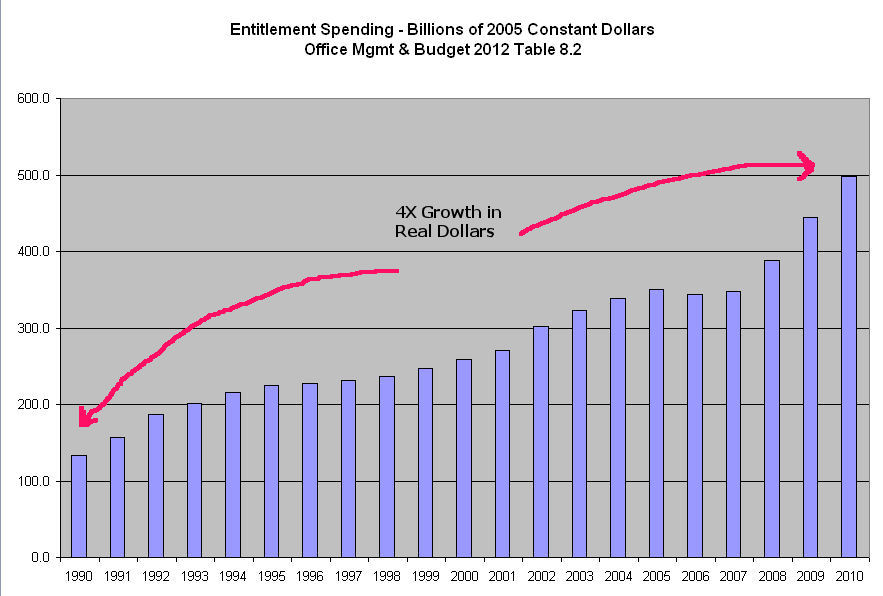
These two generations have been especially kind to the less fortunate.  Below is a chart of federal spending on entitlements that includes Medicaid, food stamps (SNAP), family support assistance (AFDC), temporary assistance to needy families (TANF), welfare contingency fund, child care entitlement to States, child nutrition programs, foster care and adoption assistance, Children’s health insurance, supplemental security income (SSI) and other programs.  These are inflation-adjusted dollars. (Click to enlarge in separate tab)

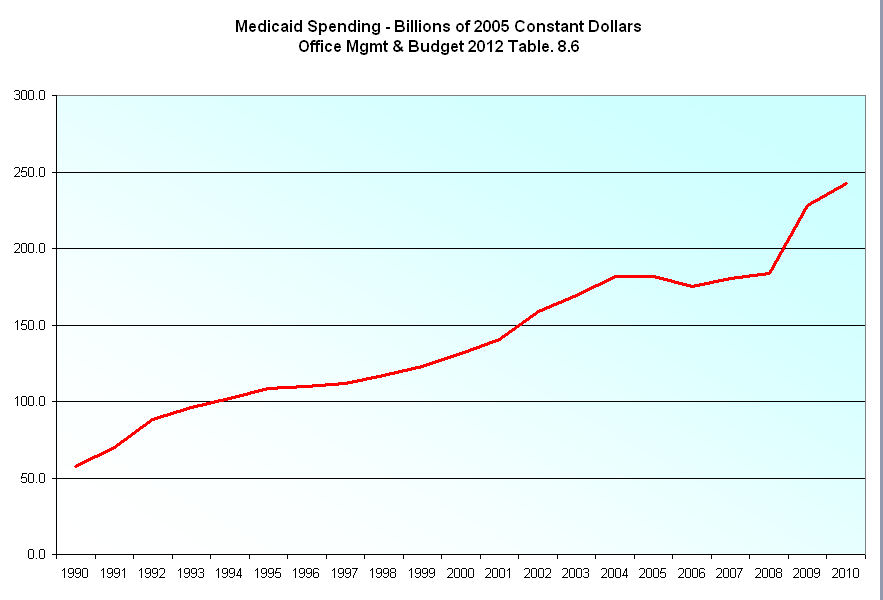
Chiefly responsible for the rise of assistance spending has been Medicaid.  Below is just the federal component of Medicaid spending, in real inflation adjusted dollars, over the past 20 years. 

For most of the past twenty years, states and local communities contributed about 70 cents for each dollar that the Federal government spent. (Source – (CMS) Centers for Medicare and Medicaid Services)  As part of the stimulus program, the states only kicked in 50 cents for each Fed dollar. As these stimulus funds run out this year, many states will be hard pressed to meet accelerating Medicaid costs.

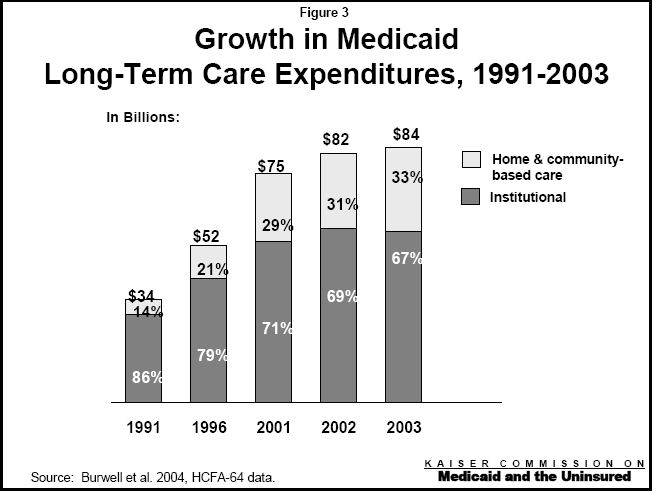
Joblessness has led to increased enrollment in the program. Colorado had a 13% increase in enrollment last year. But an ever increasing cost is long term care for seniors who spend down what resources they have, then enter the Medicaid program to meet either long term home care expenses or nursing home costs. A 2005 Kaiser Family Foundation analysis of long term care spending in 2003 revealed that Medicaid paid $34 billion or 40% of total long term care expenses.  $34 billion was an eighth of total Medicaid spending of $270 billion that year but as the population ages, the long term care component of Medicaid costs will inevitably rise.

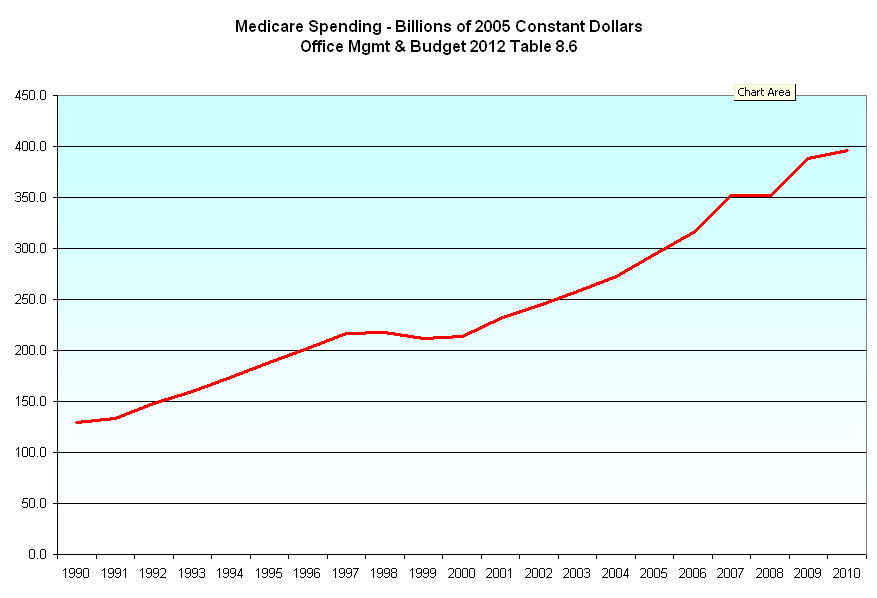
The growing sophistication of medical technology has enabled the Greaters to live longer and better than their parents did.  Body parts wear out but can be replaced or repaired.  A dying moment can be postponed for several days or weeks or months with the use of critical care and life support systems.  Much of that care gets charged to Medicare.  Below is a chart of Medicare spending in inflation-adjusted dollars.

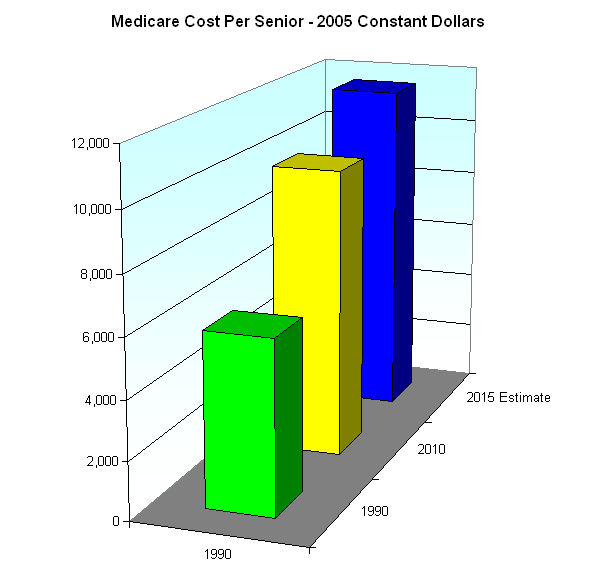
Medicare covers some disabled and others but it is primarily a program for seniors aged 65+.  Let’s look at the total Medicare cost divided by the number of seniors so that we get a per senior cost.  This is not the actual per person cost but the process enables us to make some projections. Over the past 20 years, the per senior cost of Medicare has grown, in inflation adjusted dollars, by 67%, a rise of 2.6% per year over inflation.  Using that growth rate, I estimate a per senior Medicare cost of over $11,000 in 2015.

How are these rising costs being paid?  A Kaiser Family Foundation analysis of 2009 Medicare revenues found that the premiums that seniors pay each month for Medicare B (doctor’s bills) accounted for only 13% of Medicare costs (Page 12).  Payroll taxes made up 38%.  Income taxes pay 44% of the cost.  If Medicare is truly an insurance program and we want to subsidize health care for our seniors, why do we take almost half the cost of this “insurance” program from our income taxes? 

During the past twenty years, the Census Bureau reports that the population of those aged 65+ has increased from 22 million in 1990 to 40 million in 2010, an average growth rate of 3%. In 2015, the US Census Bureau estimates that the senior population will total almost 47 million.  Now that the Boomers are hitting 65, that population growth rate is accelerating to 3.3%. 

Math time:  47 million seniors x $11,583 (my projected average cost per senior in 2005 constant dollars) = $544 billion, over half a trillion dollars.  My methodology gives a 2015 estimated total cost of $70 billion more than the Obama 2012 budget estimate of $473 billion in 2005 constant dollars and hey, I could be wrong.  Perhaps the ratio of disabled and other recipients of Medicare won’t increase as fast as the senior population growth.  Perhaps there will be savings under the new health plan.  Perhaps the government will crack down on the fraud and abuse in the Medicare system. 

So what to do?  
1) Cut down on fraud and abuse.  Make changes to the timeliness of the Medicare payment system so that more claims can be reviewed before being paid.  Spend more money on field agents who can inspect newer medical facilities to ensure that they are legitimate.  Use database technologies to scan for doctors who are billing Medicare for far above what the average physician in their specialty in that geographic area bills Medicare. 
2)  Reward efficiency.  There is much talk of payments based on outcomes, not procedures.  Such a program will be difficult to implement and follow but it promises savings.  
3) Pay up for our values.  If we are going to support the health of our senior and disabled population, then we need to pay for it directly.  Lower the Medicare tax rate and tax all income regardless of its source.  We reach into the general tax revenue kitty to subsidize seniors so that they can have affordable monthly Medicare premiums.  If that reflects our values,  let’s take that cost and add it to the payroll tax rate. 

We can do this.

Prescription Drug Managers

A 1/15/10 Wall St. Journal article detailed a Dept of Justice case against Johnson and Johnson (J&J), accusing the company of paying kickbacks to Omnicare, a publicly held company (OCR) and a Medicare and Medicaid Prescription Benefits Manager (PBM). Omnicare is the country’s largest PBM servicing nursing homes. Prosecutors allege that Omnicare’s annual purchases of J&J products almost tripled to more than $280M.

In addition to the kickbacks, J&J paid bonuses to Omnicare for switching patient’s prescriptions from competitor’s drugs to J&J’s medicines.

PBMs typically negotiate prices with drug manufacturers and then add on a markup to their client, whether it be the U.S. government or a large Fortune 500 company. In an earlier blog, I related Caterpillar’s recent negotiations with Wal-Mart and Walgreen’s to lower their drug costs. How much could Medicare/Medicaid save by following a similar path?

Health Care & Medicaid

Dr. Miller, dean and CEO of Johns Hopkins, wrote an op-ed piece in the WSJ 12/4/09 citing a CMS actuary that the House bill will increase Medicaid rolls by 18 million. The Senate version will increase eligibility for Medicaid to 133% of Federal poverty level. Miller cites the Kaiser Family Foundation that an additional 308,000 people will meet that eligibility in Maryland alone so the Senate version appears to have a similar impact as the House bill.

Dr. Miller is concerned about the costs. JH has already struggled handling the Medicaid patients it has and has lost a good deal of money in unreimbursed costs from the state.

From 1990 to 2004, Federal and state Medicaid spending increased yearly by about 10%, more than triple the average 3% CPI rate of inflation. For the three year period 2004-7, annual increases slowed considerably to 3.6%. States are reporting 2009 Medicaid spending increases averaging 7.9% because of the recession.

United States of Insurance

The United States government has become the largest insurance company in the world.
Its citizens are among the most heavily insured people in the world. We are insured for many aspects of our lives, from our life itself to other people’s mistakes.

Some insurance fees we pay directly. These include insurance against getting old, Social Security and Disability Insurance, insurance on our health, home, car and mortgage. Some insurance fees are indirect in that the cost of that insurance is passed on to us in the price of a product we buy or income to us is reduced by these fees.

Examples of the first type of indirect insurance are “mistake” insurance, malpractice and liability. A business pays a fee to protect themselves in case they make a mistake. Those fees are passed on to us in higher prices.

Unemployment and FDIC insurance are examples of the second type of indirect insurance.
Unemployment insurance is a based on a percentage of the wages paid by an employer to an employee. An employer typically reduces the wages that it can pay an employee by that amount. FDIC insurance is a fee charged to banks to protect savings against bank failure. The bank reduces the interest it can pay on a savings account to offset the fee. Like individuals, businesses pay for many types of insurance, passing the cost on to their customers in the form of higher prices.

There is another indirect form of insurance in the form of taxes paid into a general fund.
We are insured against poverty in the form of SSI and food stamp programs, whose payments come out of general Federal and State tax revenues.

How have Federal and State governments become so heavily involved in the insurance business? With the passage of the Social Security Act during the 1930s Depression, the Federal government entered the annuity insurance business – sort of. Annuities are a type of insurance where a person pays premiums over a period of time and, at the end of that period, begins collecting payments from the insurance company. Insurance companies invest the premiums paid in order to make the payments at a later time. The Federal government, on the other hand, spends the premiums received each year, relying on future premiums to make payments. If our Federal government did not spend the premiums each year, Social Security would be more like an annuity program. Since the premiums are spent, it is a Ponzi scheme.

With the introduction of the Medicare and Medicaid programs in the 1960s, the Federal government stepped into the health insurance business. Unlike private health insurers who charge higher premiums for those with higher risks, the government charges higher premiums based on a person’s ability to pay higher premiums. This premium pricing system is most often used by those in the protection racket.

Ponzi schemes and protection rackets eventually collapse. What can we do? Elect representatives who are willing to make a transition to a valid business model. Elect representatives who will support a new law giving them a legal fiduciary duty to the voters and taxpayers. Without that duty, our elected reps have no responsibility to the public or liability for their actions other than the prospect of losing their jobs. They can enact laws and make promises with impunity. We, the voters and taxpayers, pay the price.

Medicare Reimbursement

In anticipation of the annual announcement of reimbursement rates for Medicare patients, pundits have been warning of a tsunami of hospital bankruptcies once the new rules were implemented. Last year marked a transition to a new cost coding system, one that some feared would significantly reduce reimbursements to hospitals.

On May 1st, CMS published the proposed reimbursement rules (NPRM) to take effect Oct. 1st of this year. Analysts at the independent Congressional agency, the Medicare Payment Assessment Commission, or MedPac, dug into the 1228 pages of data and found only minor changes, and a slight reduction in per patient case rates. Colorado hospitals will see a slight increase.

As Edward Berger reports at MassDevice.com, MedPac found that Medicare reimburses hospital 6 – 8% less than the cost of care. Higher private insurance reimbursements offset this negative impact. In the ongoing debate about public vs private insurance, this would seem to reinforce the opinions of those who say that a greater presence of public insurance and below cost reimbursement rates will close hospitals, force doctors out of business, and reduce the availability of medical care.

However, Berger writes “MedPAC research shows that the hospitals with the highest private insurance margins have the highest Medicare per-case costs; those that can’t achieve high private-payer margins have lower costs across all classes of payer – with no discernable impact on quality.” If this assessment is true, public insurance is achieving an efficiency normally associated with a competitive marketplace, causing hospitals to examine their operations and find cost efficiencies while maintaining the same level of care.

75% of nursing homes’ revenue comes from Medicare and Medicaid. When Medicare reduced their payments in the late nineties, a number of nursing homes went bankrupt. Due to the weak economy, many nursing homes were worried that there would be no annual reimbursement increase.

On May 12th, CMS published their 110 page set of proposed rules, specifying a 2.1% increase in Medicare reimbursement rates effective October 1st. While not as large as the 3+% increase of last year, it is an increase in an economy with a negative year over year CPI cost index.

Tight state budgets may impact Medicaid reimbursement to nursing homes. A more complete analysis of the Medicaid fiscal environment can be found here from a CPA at healthlawyers.org.

Health of Health Care

In a 4/23/09 WSJ article, Vanessa Fuhrmans reports on the health of the country’s health plans.

Wellpoint, the largest insurer, lost 2% of its subscribers since December. It ascribed the larger than expected 1/2 million subscriber loss both to layoffs and workers who are declining coverage under their employer’s plan. United Health Group, the second largest insurer, reported a subscriber loss of 900,000 in the first 3 months of 2009.

The Kaiser Family Foundation estimates that the U.S. Census Bureau figure of 45.7 million uninsured in 2007 has grown to about 50 million uninsured. In a nation of 300 million, that is a 1 in 6 ratio. Of the estimated 9M people who have lost coverage since December 2007, Kaiser calculates that 3.6M have enrolled in Medicaid and other public health programs.

A Kaiser Family Foundation study of Medicaid fees from 2003 – 2008 shows that Medicaid pays physicians only 72% of what Medicare pays. In 2008, the average Medicaid reimbursement for the most commonly billed procedure, a 15 minute office visit with an existing patient, was $38. If you have a stopped up toilet, it costs $75 – $100 for a plumber to run a snake through the toilet bowl.

As the boomer generation nears retirement, swelling the ranks of both Medicare and Medicaid patients, should we be encouraging young people to become plumbers instead of doctors?
The Association of American Medical Colleges reported that the average educational debt of indebted graduates of the class of 2007 was $139,517. The site link is a student doctor network with a message board that you can read, but not post or comment.

State Taxes

According to a Census Bureau report (follow link to Excel spreadsheet), the states collected $782B in taxes in 2008. That is about 70% of what the federal government collected in federal income taxes. This doesn’t include local taxes.

The Census Bureau breaks them down into major categories: Property, Sales and Gross Receipts, Licenses, Income and Other.

Alaska, Florida, South Dakota, Texas, Washington and Wyoming do not have a personal income tax. Texas, Washington and Wyoming do not have a corporate income tax.

13 states do not charge a property tax. Alaska, Delaware, Montana, New Hampshire, and Oregon do not charge a general sales tax. Alabama, Alaska and Arkansas do not charge an estate and gift tax. 16 states do not charge a severance tax, a tax on extracted resources like coal, oil and gas.

While Texas and Alaska do not charge on income tax, they don’t need to. Texas collects $4B in severance taxes, Alaska $7B. Together the two states collect almost 2/3 of all the severance tax collected by the states.

What did they spend all this money on? In 2008, Medicaid spending was estimated at $164B, a whopping 20% of state revenues. As unemployment continues to rise, Medicaid spending will also rise.

What steps are states taking to control these costs? As this Kaiser Family Foundation table shows, there is a lot of room for improvement.

Almost 2/3 of states have some pharmacy cost controls including approved manufacturers, use of generics where possible – routine controls that patients with health insurance encounter. Only 3 states have co-pays. The Federally mandated maximum copay for a Medicaid patient is $3, less than a Big Mac. As long as Health and Human Services designates such a low copay, most states probably will not bother to try and collect.

Only 8 states have any cost containment programs for long term care, which is 44% of Medicaid spending. As the population ages, this cost will increase dramatically. Only 3 states have any restrictions or reductions on benefits.

All of the states complain about the growing Medicaid expense and its impact on their budget. But what are they doing about it? Maybe we should ask our state representatives.