The Start of the Beginning

April 7, 2019

by Steve Stofka

In 1971 former President Nixon announced that the U.S. was abandoning the gold standard of fixed exchange that had existed for almost thirty years. Within a short time, other leading nations followed suit. Each nation’s currency simply traded against each other on a global currency, or FX, market.

Since oil was priced in dollars and the world ran on oil, the U.S. dollar became the world’s reserve currency. Each second of every day, millions of US dollars are traded on the international FX markets. The demand for US dollars is strong because we are a productive economy. The euro, yen and British pound are secondary currency benchmarks.

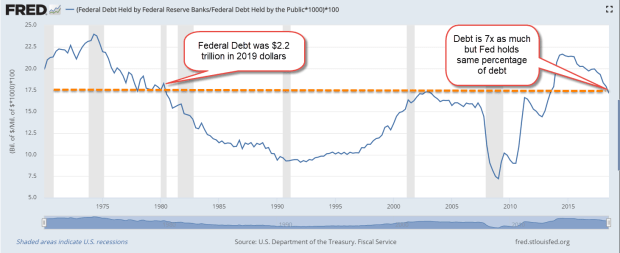
When the U.S. wants to borrow money from the rest of the world, the U.S. Treasury sells notes and bills collectively called “Treasuries” to large domestic and foreign banks who “park” them in their savings accounts at the Federal Reserve (Fed), the U.S. central bank (Note #1). The phrase “printing money” refers to a process where the Federal Reserve, an independent branch of the Federal Government, buys Treasury debt on the secondary market. It may surprise many to learn that the Fed owns the same percentage of U.S. debt as it did in 1980. The debt in real dollars has grown seven times, but the percentage held by the Fed is the same. That is a powerful testament to the global hunger for U.S. debt. Here’s the chart from the Fed’s FRED database.
FedResHoldTreasPctDebt

In 1835, President Andrew Jackson paid off the Federal debt, the one and only time the debt has been erased. It left the country’s banking system in such a weak state that subsequent events caused a panic and recession that lasted for almost a decade (Note #2). Government debt is the private economy’s asset. Paying down that debt reduces those assets.

About a third of the debt of the U.S. is traded around the world like gold. It is better than gold because it pays interest and there are no storage costs. Foreign businesses who borrow in dollars must be careful, however. They suffer when their local currency depreciates against the dollar. They must earn even greater profits to convert their local currency to dollars to make payments on those dollar-denominated loans.

Each auction of Treasury debt is oversubscribed. There isn’t enough debt to meet demand. In a world of uncertainty, the U.S. government has a long history of respect for its monetary obligations. As the reserve currency of the world, the U.S. government can spend at will. Even if there were no longer a line of domestic and foreign buyers for Treasuries, the Federal Reserve could “purchase” the Treasuries, i.e. print money. Let’s look at the difference between borrowing from the private sector and printing money.

When the private sector buys Treasuries, it is effectively trading in old capital that cannot be put to more productive use. That old capital represents the exchange of real goods at some time in the past. In contrast, when the government spends by buying its own debt, i.e. printing money, it is using up the current production of the private sector. This puts upward pressure on prices. Let’s look at a recent example.

Quantitative Easing (QE) was a Fed euphemism for printing money. During the three phases of QE that began in 2009, the Fed bought Treasury debt. That was an inflationary policy that countered price deflation as a result of the Financial Crisis. In August 2009, inflation sank as low as -.8% (Note #3). It was even worse, but inflation measures do not include the dividend yield on money. To many households, inflation felt like -2% (Note #4). The Fed’s first round of QE did provide a jolt that helped drive prices up by 3% and out of the deflationary zone.

During the five years of QE programs, the Fed continued to fight itself. The QE programs pushed prices upwards. Near zero interest rates produced a deflationary counterbalance to the inflationary pressures of printing money. Because inflation measures do not include the yield on money, the Fed could not read the true change in the prices of real goods in the private sector. The economy continues to fall below the Fed’s goal of 2% inflation. There are still too many idle resources.

Leading proponents of Modern Monetary Theory (MMT) remind people that yes, the U.S. can spend at will, but that it must base its borrowing on policy rules to avoid inflation. A key component of MMT is a Job Guarantee (JG) program ensuring employment to anyone who wants a job. A JG program may remind some of the WPA work programs during the Great Depression. Visitors to popular tourist attractions, from Yellowstone Park in Wyoming to Carlsbad Caverns in New Mexico, use facilities built by WPA work crews. Today’s JG program would be quite different. It would be locally administered and targeted toward smaller public works so that the program was flexible.

The U.S. government has borrowed freely to go to war and has never paid that debt back. Proponents of MMT recommend that the U.S. do the same during those times when the private economy cannot support full employment. That policy goal was given to the Fed in the 1970s, but it has never been able to meet the task of full employment through crude monetary tools. With an active program of full employment, the Fed would be left with only one goal – guarding against inflation.

There are two approaches to inflation control: monetary and fiscal. Monetary policy is controlled by the Fed and includes the setting of interest rates. If the Fed’s mandate was reduced to fighting inflation, it could more readily adopt the Taylor rule to set interest rates (Note #4).

Fiscal policy is controlled by Congress. Because taxation drains spending power from the economy, it has a powerful control on inflation. However, changes in tax policy are difficult to implement because taxes arouse passions. We are familiar with the arguments because they are repeated so often. Everyone should pay their “fair share,” whatever that is. Some want a flat tax like a head tax that cities like Denver have enacted. Others want a flat tax rate like some states tax incomes. Others want even more progressive income taxes so that the rich pay more and the middle class pay less. Some claim that income taxes are a government invasion of private property rights.

Because tax changes are difficult to enact, Congress would be slow to respond to changes in inflation. The Fed’s control of interest rates is the more responsive instrument. The JG program would provide stability to the economy and reduce the need for corrective monetary action by the Fed. The program would help uplift those in marginal communities and provide much needed assistance to cities and towns which had to delay public works projects and infrastructure repair because of the Financial Crisis. As sidewalks and streets get fixed and graffiti cleaned, those who live in those areas will take more pride in their town, in their communities, in their families and themselves. This makes not just good economic sense but good spiritual sense. We can start small, but we must start.

////////////////////////
Notes:

1. Twenty to twenty-five times each month, the Treasury auctions U.S. government debt. Many refer to the various forms of bills and notes as “treasuries.” A page on the debt
2. The Panic of 1837
3. The Federal Reserve’s preferred measure of inflation is the Personal Consumption Expenditure Index, PCEPI series.
4. The annual change in the 10-Year Constant Maturity Treasury fell below -1% at the start of the recession in December 2007 and remained below -1% until July 2009. FRED series DGS10. John Maynard Keynes had recommended the inclusion of money’s yield in any index of consumer demand. In his seminal work Foundations of Economic Analysis (1947), economist Paul Samuelson discussed the issue but discarded it (p. 164-5). Later economists did the same.
5. The Taylor rule utility at the Atlanta Federal Reserve.

 

Taxes – A Nation’s Tiller

Printing money is merely taxation in another form. – Peter Schiff


August 12, 2018

by Steve Stofka

The Federal government does not need taxes to fund its spending, so why does it impose them? Taxes act as a natural curb on the price pressures induced by Federal spending. Taxes can promote steady growth and allow the government to introduce more entropy into the economic system.

During World War 2, the Federal government ran deficits that were 25% of the entire economy (Note #1) and five times current deficit levels as a percent of the economy. Despite its monetary superpowers, the government imposes a wide range of taxes. Why?

Using the engine model I first introduced a few weeks ago (Note #2), taxes drain pressure from the economic system and act as a natural check on price inflation. During WW2, the government spent so much more than it taxed that it needed to impose wage and price controls to curb inflationary pressures. Does it matter how inflation is checked? Yes.

When price pressures are curbed by law, people turn to other currencies or barter. During WW2, the alternative was barter and do-it-yourself. Because neither of these is a recorded exchange of money, the government collected fewer taxes which further increased price pressure in the economic engine. After the war was over and price controls lifted, tax collections relieved the accumulated price pressures. As a percent of GDP, taxes collected were 50% more than current levels.

For the past fifty years, Federal tax collections have ranged from 10-12% of GDP, but they are not an isolated statistic. What matters is the difference between Federal spending and tax collections, or net Federal input. During the past two decades Federal input has become a growing share of GDP.

FedSpendLessTaxPctGDP

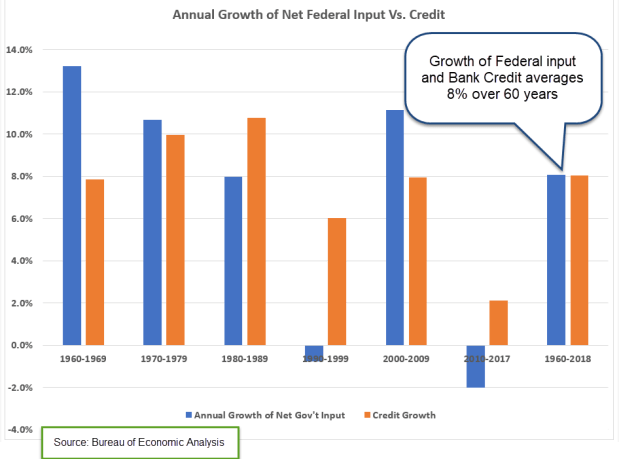
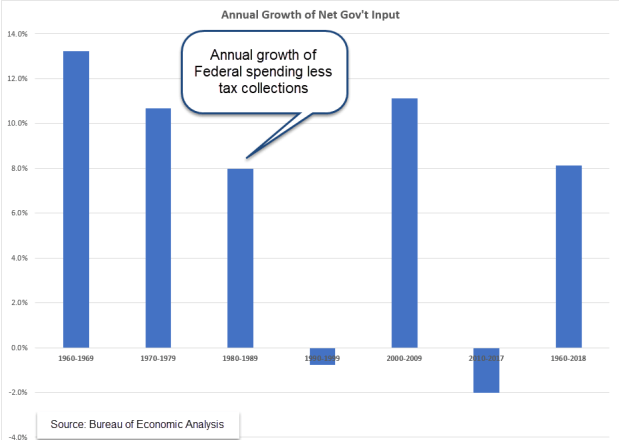
During the past sixty years, that net input has grown 8% per year. The growth rates have varied by decade but the strongest rates of input growth rates have occurred when the same party has held the Presidency and House. Neither party knows restraint. The lowest input growth has occurred when a Republican House restrains a Democratic President (Note #3).

FedNetInputGrowth

Let’s compare net Federal input to the growth of credit. As I wrote last week, the Federal government took a more dominant role in the economy in the late 1960s. By the year 2000, net Federal input grew at an annual rate of 10.3%, over one percent higher than credit growth. During all but six of those years, Democrats controlled the House and the purse. During those forty years, inequality grew.

FedNetInputCreditGrowth

During the 1990s and 2010s, government should have increased its net input to offset the lack of credit growth. To increase input, the government can increase spending, reduce taxes or a combination of both. When GDP growth is added to the chart, we can see why this decade’s GDP growth rate has been the lowest of the past six decades. It’s not rocket science; the inputs have been low.

FedNetInputCreditGrowthGDPGrowth

A universe with maximum entropy is a still universe because all the energy is uniformly distributed. At a minimum entropy, the universe exploded in the Big Bang. Too much clumping of money energy provokes rebellion. Too little clumping hampers investment and interest and condemns a nation to poverty. As an act of self-preservation, a government adopts redistributive tax policies. Among the developed nations, the U.S. is second only to France in the percent of disposable income it redistributes to its people (Note #4).

A nation can either tax its citizens directly, or add so much net input that it provokes higher inflation, which taxes people indirectly through the loss of purchasing power. Of the two alternatives, the former is the more desirable. In a democracy we can vote for those who spend our tax dollars. Inflation is both a tax and an unmanaged redistribution of money from the poor to the rich. How so? Credit is money. Higher inflation rates lead to higher interest rates which reduce access to credit for lower income households, and give households with greater assets a higher return on their savings.

////////////////////////////////

Notes:
1. Federal Income and Outlays at the Office Management and Budget, Historical Tables

2. The “engine” was first introduced in Hunt For Inflation, and continued in Hunt, Part 2 , Engine Flow , and Washington’s Role.

3. Federal spending less tax collections grew at a negative annual rate during the Clinton and Obama administrations. Both had to negotiate with a hostile Republican House in the last six years of their administrations.

4. “U.S. transfer payments constitute 28.5% of Americans’ disposable income—almost double the 15% reported by the Census Bureau. That’s a bigger share than in all large developed countries other than France, which redistributes 33.1% of its disposable income.” (WSJ – Paywall) The OECD’s computation of the GINI coefficient is based on disposable personal income, which is calculated differently in the U.S.

Miscellaneous:

Average GDP growth for the past sixty years has been 3.0%. The average inflation rate has been 3.3%. The 60-year median is 2.6%. The average inflation rate of the past two decades have been only 2.1%.

A good recap of the after effects of the financial crisis.


Washington’s Role

“The rich are much better placed to feed at the public trough. The poor get crumbs.” – Steve Hanke, American Economist, 1942 –

August 5, 2018

by Steve Stofka

In the past fifty years, the increasing role of the Federal government in the economy has been the chief contributor to inequality. In the last years of the Bush administration, America became a socialist economy. Credit growth under the Trump administration has not changed from the levels during the Obama administration. On this score, Trump is Obama II.

Since the Great Recession, the federal government has far surpassed the role of banks in net input into the economic engine. In the post WW2 period, the annual growth in credit outstanding (see Notes #1) to households, corporations, state and local government surpassed the net input of the federal government, its spending less the taxes it drained out of the engine. The blue line in the graph below is the growth in bank credit.

CreditGrowthvsFedInput1953-1970

The Great Society and the escalation of the Vietnam War in the 1960s marked a changing role for the Federal government. Bernie Sanders marked the early 1970s as the beginning of the increase in inequality. Bernie suggested that the Federal government should have a greater role in the economy to correct the problem. Bernie has it backwards, as I will show. It is the greater role of the Federal government in the economy that has contributed to inequality. The hand that feeds the poor becomes the hand that feeds the rich.

Under subsequent presidents after 1968, both Republican and Democratic, the Federal input into the economy dominated the net – loans minus payments – input of bank credit. When the Federal government spends more than it taxes, it becomes a proxy debtor for individuals, state and local governments who cannot borrow enough to meet their needs. As the net credit input into the economy sank in the last two years of the Bush administration, 2007-2008, the role of the Federal government approached the levels of western European socialist governments.

CreditGrowthVsFedInput

The Obama Administration and super-majority Democratic Congress of 2009-2010 simply held that input level established earlier by the Bush Administration and a Democratic House. When Republicans took control of the House in 2011, they fought with the Obama Administration to reduce the input level. From 2012 through 2015, the growth in credit eclipsed the net input of the Federal government. Since early 2016, the growth in Federal input has once again dominated the role of the banks in the private economy. After the tax cuts passed last year, the Federal government will drain less taxes out of the economy and further cement its dominant role as an input into the engine.

For the past 65 years, quarterly credit growth has averaged 1.9%. In the last ten years, it has averaged .4%. From April 2017, two months after Trump took office, through March 2018, quarterly net credit growth averaged the same .4% as it did during the Obama years. Banks may express confidence in the Trump presidency, but their credit policies indicate that they have as little confidence in Trump’s Washington as they had in Obama’s Washington. Unless Trump can turn that sentiment, his administration will suffer the same lackluster growth as the Obama administration. If the Federal government continues to dominate economic input, Trump’s pledge to drain the swamp will be broken. Federal economic power only feeds the K-Street crocodiles lurking in the swamp waters.

/////////////////////

Notes

  1. The growth of credit outstanding (net input) is a function of new credit issued (input), debtors’ payments on existing loans (drain) and the write-off of non-performing loans (drain).

K-Street in Washington is the location of many of the nation’s most powerful lobbying firms.


Engine Flow

July 29, 2018

by Steve Stofka

“Banking was conceived in inequity and born in sin” – Josiah Stamp

In the past two weeks, I’ve looked at the inputs and drains to the economic engine. This week I’ll look at the flow between bank credit, the largest input, and loan payments, the largest drain. Because bankers want to make a profit on the money they pump into the economy, they do a better job of managing the economy than government officials.  Banks manage access to the credit system better than governments and achieve less economic inequality. Whenever governments wrest control of credit creation away from the banks to promote greater equality, the country’s economy suffers.

Let’s begin with the first point; banks must protect their loan portfolios. To do that, they monitor the health of the economy. The Conference Board uses ten data series to construct its index of leading economic indicators to estimate the probability of recession. ECRI uses 50 data series to chart its weekly leading index. These indicators are sensitive and may give a false signal, indicating a coming recession which doesn’t occur. Watching these data series are the banks who form an emergent Artificial Intelligence machine that varies the amount of credit they input into the economic engine.

Let’s piggy back on the efforts and watchfulness of the banks. We can look for a change in the ratio of household credit, an input to the engine, to the unemployment rate, or the ability to drain the input. One quarter’s decline of 2% or greater in this ratio, or two quarters of a smaller decline has been a reliable indicator that a recession is approaching. Below is a graph of the Household Debt-Unemployment ratio during the past thirty years but this signal has been reliable since World War 2.

HouseholdDebtUnemploymentRate

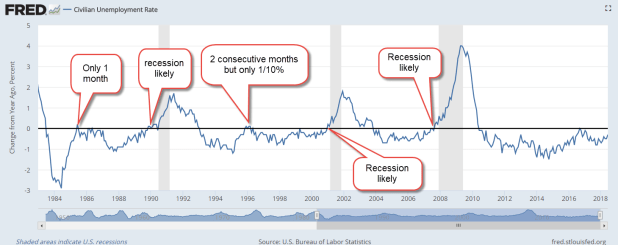
Bank behavior has accurately predicted the start of every recession since WW2. Is this the holy grail for mid to long-term trading decisions? Not quite. The Federal Reserve does not release the total amount of household debt for each quarter until the end of the following quarter (see #1 at end). However, every month, the BLS releases the unemployment rate, the divisor in the Debt-Unemployment ratio. If the rate is lower than a year ago, no worries. If the year-over-year change in the rate is higher in two consecutive months, worry.

Unemploy

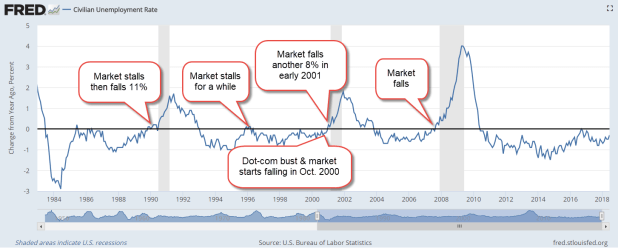
Here’s the same chart with the stock market’s reaction when the year-over-year change has been above zero for two months in a row. Insiders and market movers have lightened their exposure to equities.

UnemployStkMkt

Loans add money to the engine. Loan payments drain money from the engine. As unemployment rises, people reduce their loan payments. In managing their risk, the banks react to signs of economic weakness by reducing the amount of credit they issue. Because they are more responsive to evolving conditions than central banks and elected officials, banks manage the economy better than the government.

Access to credit is the key to understanding the disparity in fortunes among Americans. Let’s look at the flow of credit creation in a system where a bank can loan out ten times its deposits. Let’s say I borrow $10,000 from Bank A for a bath remodel. The contractor might have a gross profit of $2500 which he deposits in Bank B, who leverages that into a $25,000 loan to another customer, who remodels her basement. Her contractor’s gross profit of $5000 is deposited in Bank C, which leverages that into a $50,000 loan to another customer for a complete kitchen remodel. Only those people with good credit – the haves – can access this money machine. The machine is closed to the have-nots.

Governments have attempted to fix this inequality. The government borrows from the banks, acting as a substitute for the people who cannot borrow. The government then inputs the money into the economy, but this does not make the engine run because there is not enough being drained out in loan payments and taxes. The engine runs on flow – inputs and drains. One without the other damages the engine and makes the country vulnerable to a triggering event which causes collapse and the economic engine blows up. Yugoslavia (1994), Argentina (2000), Zimbabwe (2008) and Venezuela (2017) are the most recent examples.

Quoting an unnamed source, Winston Churchill said, “Democracy is the worst form of Government except for all those other forms that have been tried from time to time.”  Private bank management of credit creation is a terrible system, but far better than the other systems that have been tried.

///////////////////

Notes:
1. With a month delay, the Fed releases a monthly estimate of household debt that excludes mortgages and HELOCs.

Ten years after the recession, the amount of household debt per employee is still above trend. A ratio of debt to disposable income is below trend.

According to the credit reporting agency Experian “Transactors” are 29% of card holders and pay off their balance each month. 43% carry a balance. The rest are dormant accounts. Experian ranks states by the average credit rating of its residents.

Fannie Mae reports that, as of the end of 2017, 37% of the mortgages modified during the housing crisis had defaulted again.

Bank of America clients with High Net Worth reported that their allocations were 55% stocks, 21% bonds, 15% cash, 10% other.

In May, consumer credit increased at a seasonally adjusted annual rate of 7-1/2 percent. Revolving credit increased at an annual rate of 11-1/2 percent, while nonrevolving credit increased at an annual rate of 6-1/4 percent (Federal Reserve)


The Hunt, Part 2

July 22, 2018

by Steve Stofka

Last week, I showed the inputs to the credit constrained economy as a percent of GDP. I’ll put that up again here.

CreditGrowthFedSpendPctGDP

This week I’ll add in the drains but first let me review one of the inputs, bank loans. Focus your attention on that period just after 9/11, the left gray recession bar,  and the end of 2006, just to the left of the red box outlining the Great Recession on the right.  For those five years after 9/11, the banks doubled their loans to state and local governments, a surge of $1.4 trillion. The banks increased their household and mortgage lending by $5.3 trillion, or 67%. Why did banks act so foolishly? Former Fed chairman Alan Greenspan couldn’t answer that. We have a partial clue.

For 4-1/2 years after 9/11 and the dot-com bust, there was no growth in credit to businesses, a phenomenon unseen before in the data history since WW2. The banks reached out to households, as well as state and local governments because they needed the $1 trillion in loan business missing on the corporate side (#1 below).

There are four drains in the economic engine – Federal taxes, payments on loans, bad debts and the change in bank capital. State and local government taxes are not a drain because those government entities can not create credit. The change in bank capital reflects the changes in the banks’ loan leverage and their confidence in the economy. During the 1990s and 2010s the sum of the inputs and the drains remained within a tight range of about 1/7th of GDP.

InputLessDrains

The results of bad policy during the 2000s are shown clearly in the graph. In addition to the surge in bank loans, the Federal government went on a spending spree after 9/11. There was too much input and not enough drain. The reduction in taxes in 2001 and 2003 exacerbated the problem. There was less being drained out. Asset prices absorb policy mistakes until they don’t – a life lesson for all investors.

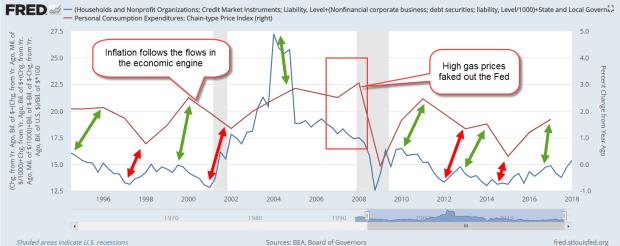
Let’s add in a second line to the graph – inflation. The rise and fall of inflation approximates the flows of this economic engine model with a lag time of several months. I’ve shown the peaks and troughs in each series.

InputLessDrainsVsPCE

Look at that critical period from 2006 through 2007. The Fed kept raising rates in response to rising inflation (the red line), driven primarily by increases in the price of oil.  The Fed Funds rate peaked out at 5-1/4% in the summer of 2006 and stayed at that level for a year. The Fed misread the longer term inflation trend and contributed to the onset of the recession in late 2007. The net flows in the engine model (blue line) indicated that the long term trend of inflation was down, not up.

Where will inflation go next? Using last week’s theme, follow the hounds! Who are the hounds? The banks. The inflow of credit from the banks is the primary driver of inflation. Why has inflation in the past decade been low? Because credit growth has been low. Where will inflation go next? A gentle increase – see the slight incline of the blue line at the right of the graph. Contributing to that increase were last year’s tax cuts. Less money is being drained out of the engine.

Too much flow into the economic engine or an improper setting of interest rates – these mistakes are absorbed by assets, which are the reservoirs of the engine. Stocks, bonds and homes are the most commonly held assets and most likely to be mispriced. During the early to mid 2000s, the mistakes in input were so drastic that the financial crisis seems inevitable when we look in the rear view mirror. During the past eight years, the inputs and drains have remained steady, but interest rates have been set at an inappropriate level. Again, we can anticipate that asset prices have been absorbing the mistakes in policy.


//////////////////////////

1. In the last quarter of 2001, loans to non-financial corporate business totaled $2.9 trillion and had averaged 6%+ growth for the past decade. Anticipating that same growth would have implied a credit balance of $3.9 trillion by the end of 2006. The actual balance was $3.1 trillion.

Hunt For Inflation

July 15, 2018

by Steve Stofka

Saddle up your horses, readers, because we are going on the Hunt for Inflation. I promise you’ll be home for afternoon tea. During this recovery, Inflation has been a wily fox, a real dodger. It has not behaved according to a model of fox behavior. Has Inflation evolved a consciousness?

Inflation often behaves quite predictably. The central bank lowers interest rates and pumps money into the economy. Too much money and credit chasing too few goods and Inflation begins running amuck. Tally-ho! Unleash the bloodhounds! The central bank raises interest rates which curbs the lending enthusiasm of its member banks through monetary policy. Inflation is caught, or tamed; the bloodhounds get bored and take a nap.

Not this time. Every time we think we see the tail of Inflation wagging, it turns out to be an illusion. Knowing that Inflation must be out there, the central bank has cautiously bumped up interest rates in the past two years. Every few months another bump, as though unleashing one more bloodhound ready to pounce as soon as Inflation shows itself.

Yes, Inflation has evolved a consciousness – the composite actions of the players in the Hunt. These players come in three varieties. One variety is the private sector – you and me and the business down the street. The second variety is the federal government and its authorized money agent, the Federal Reserve, the country’s central bank. Finally, there is a player who is a hybrid of the two – banks. They are private but have super powers conferred on them by the federal government. The private sector is the economic engine. The federal government and banks have inputs, drains and reservoirs that control the running of the economy.

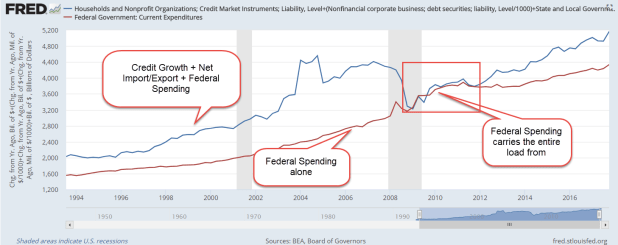
The three money inputs into the constrained (see end) economy are 1) Federal spending, 2) Credit growth, and 3) net exports. In the graph below, the blue line includes 1, 2, and 3. The red line includes only 1. The graph shows the dramatic collapse of credit growth in this country. Federal spending accounted for all the new money flows into the economy.

CreditNXFedSpendvsFedSpend

Before the financial crisis, money flows into the economy were just over 30% of GDP. In less than a year, those inputs collapsed by almost 25%.

CreditGrowthFedSpendPctGDP

When inflation is lower than target, as it has been for the past decade, too much money flow is being drained out for the amount that is flowing in. In the case of too high or out of control inflation, as in the case of Venezuela, the opposite is true. Too much is being pumped in and not enough is being drained out. That’s the short story that gets you back to the lodge in time for a cup-pa or a pint. Next week – the inputs, drains and reservoirs of the economy.

////////////////////////////

  1. Constrained – the private economy, state and local governments who cannot create new credit.
  2. Net exports are the sum of imports (minus) and exports (plus).