A Debate on Subsidies

January 12, 2025

by Stephen Stofka

This is ninth in a series of debates on various issues. The debates are voiced by Abel, a Wilsonian with a faith that government can ameliorate social and economic injustices to improve society’s welfare, and Cain, who believes that individual autonomy, the free market and the price system promote the greatest good.

After a few pleasantries, Abel began, “Last week, we finished talking about the government’s role in the social contract. The scope of that role is the key difference between your group and mine.”

Cain nodded. “Your group thinks of the federal government as an insurance company. Our group tries to keep your group in check. It’s not easy.”

Abel replied, “Your group may believe in a more limited role for government as a general principle, but you advocate policies that contradict that principle. Take housing as an example. It is a private good that is heavily subsidized by the federal government.”

Cain tilted his head in an equivocating manner. “Let me stop you there. Are you asking whether our group supports federal underwriting of thirty-year mortgages? In principle, we shouldn’t. The federal government should have a minimal role in the exchange of private goods. As a practical matter, the entire housing market would collapse if the federal government did not underwrite most mortgages in the U.S.”

Abel interrupted, “But your group doesn’t support the federal government’s student loan program.”

Cain nodded, “That’s right. An education is a different type of good than a house. An education can’t be separated or alienated from a person. A house can. I would prefer that the federal government not be involved in the mortgage market, but few states have the resources to underwrite mortgages. Private banks prefer not to underwrite 30-year mortgages at low interest rates. Only the U.S. and tiny Denmark have 30-year mortgages at fixed interest rates (source).”

Abel said, “But the higher education market would collapse without federal student loans, grants and subsidies. That same practical reasoning supports the federal involvement in underwriting higher education loans.”

Cain shook his head. “Housing has a concrete public aspect to it. Education doesn’t. The Constitution specifies a role for the federal government. It is to provide for the ‘general welfare,’ not private welfare. An education is inseparable from a person’s private welfare.”

Abel objected, “But private welfare contributes to the general welfare. This is a sticking point between our two groups. Your group regards the general welfare as only those goods or services that are available to all. The sum of individual welfare is the general welfare.”

Cain replied, “Look, everyone who wants a subsidy claims that their private welfare will contribute to the public good. Car manufacturers want protective tariffs and subsidized loans, claiming that it will help preserve jobs. Ranchers want below market rates on grazing land for their catttle, claiming that they will be motivated to act as good stewards of that land and help preserve it. College students want subsidized loans and grants on the premise that their improved skills will contribute to a better society, a more productive work force.”

Abel argued, “But your group is more likely to support subsidies for ranchers and farmers.”

Cain shrugged. “The subsidy for grazing fees is about $100 million, according to one estimate. Americans have $7.5 trillion in federally backed mortgages at an interest rate that is at least 5% below market. That’s an indirect annual subsidy to homeowners of $350 billion, with a ‘b.’ Subsidies to farmers and ranchers are like drops in the bucket compared to the subsidies to homeowners. Divide that $350 billion by approximately 50 million federally backed mortgages and each mortgage holder gets an average annual subsidy of $7000. The federal government looks like it has deep pockets. Everyone wants to stick their hand in those pockets. It’s the road to ruin.”

Abel argued, “But the federal government has a long history of handing out subsidies. In the 19th century, they gave out vast tracts of western lands to the railroads for pennies an acre. After the tracks were built the railroads sold the land to developers for many times what the railroads paid. Then the developers sold the land for many times that to homesteaders. Subsidies are a tool of government.”

Cain interrupted, “Tools to achieve what? Policy goals. Who sets those policy goals? The politicians in Washington. What is their policy goal? To get re-elected. How do they get re-elected? By gettting subsidies of some sort for their constituents. What is the sum of those individual efforts by elected officials? A government whose main purpose is giving out subsidies. There has to be some principle in place to limit that kind of largesse.”

Abel asked, “So what? End all subsidies? That is not going to happen. America binds all these regional interests together by handing out subsidies to homeowners, students, farmers, ranchers, people of every business type. In an earlier era, Senate leaders inserted earmarks for those senators who held crucial votes. Former OMB director George Shultz quipped, ‘the budget process was a fight of the parts against the whole and the parts always won.’ (Behn 1977, 109).”

Cain interrupted, “That practice promoted increased spending and deficits. When the government borrows money, that increases the money supply and inflation. Then the Federal Reserve has to fight inflation by adjusting interest rates. Higher interest rates causes a drop in investment which can raise unemployment. There’s just a whole cascade of economic effects.”

Abel argued, “In 2006, John Boehner, the former Speaker of the House, ended all earmarks in the House. Have deficits decreased? No, they have gotten worse. So has the polarization in the Congress and in the country. The public is like a pack of hungry dogs. Give each of them a little bit of meat and they won’t tear each other apart.”

Cain shook his head. “Tell the voters on the campaign trail that they are a bunch of dogs. The problem with your group is a lack of respect for the public and way too much respect for politicians and experts.”

Abel conceded, “Ok, maybe the hungry dogs imagery wasn’t the best, but look at the defense industry. It wields a lot of influence on Capitol Hill and your group is a big supporter of defense contractors. Defense is one of the few legitimate constitutional duties of the federal government, you say. Each individual representative in Congress votes for more defense spending if it will mean more federal tax dollars coming into their state. Each representative competes for defense dollars even if it is wasteful. It’s pork barrel politics.”

Cain said, “The saying goes, ‘something that can’t last forever won’t.’ The country can’t keep running deficits and borrowing money from the private sector. The interest on that debt keeps getting larger every year. It’s unsustainable. Deficit spending is a security issue. If and when a large war breaks out, the country will not be able to muster a strong response.”

Abel nodded. “Our group agrees that deficit spending is a problem. Your group thinks that earmarks are a big part of the problem. We don’t. Pork barrel politics joins people together. All the different constituencies in the country gather together to pull one of two ends of the rope. What we need is higher taxes on upper income households to afford those earmarks.”

Cain shook his head. “Higher taxes reduces investment.”

Abel interrupted, “So your group says. During the 1990s, both taxes and investment increased. In fact, investment increased at the highest pace since World War 2, and we had budget surpluses by the time Clinton left office at the end of the decade. Higher taxes do not reduce investment.”

Cain argued, “Look, the birth of the internet and the computer age was a special case. That exception does not support your case.”

Abel smiled. “Taxes and the effect of taxes is a whole other discussion. See you next time.”

Cain nodded and turned to leave. “Until then.”

///////////////////

Photo by Anna Samoylova on Unsplash

A 2010 analysis by the Congressional Research Service found that few developed countries offer 30-year mortgages at fixed interest rates. https://crsreports.congress.gov/product/pdf/R/R41432/3

An analysis by the Center on Biological Diversity estimated an annual subsidy of $100 million to ranchers in below market rates for grazing fees. https://www.biologicaldiversity.org/programs/public_lands/grazing/pdfs/CostsAndConsequences_01-2015.pdf

Federally backed mortgages rose from $707 billion in 2009 to $5 trillion in 2010 and have risen steadily since then. https://fred.stlouisfed.org/series/BOGZ1FL403065005Q

Behn, Richard. 1977. “The False Dawn of the Sunset Laws.” The Public Interest (Fall): 103-118. doi: https://www.nationalaffairs.com/public_interest/detail/the-false-dawn-of-the-sunset-laws.

The Federal deficit as a percent of GDP https://fred.stlouisfed.org/series/FYFSDFYGDP

Tevlin, S., & Whelan, K. (2000). Explaining the investment boom of the 1990s. SSRN Electronic Journal. https://doi.org/10.2139/ssrn.221415 In the seven-year period 1992-1998, investment growth averaged a record-breaking 11.2%. A copy of the paper can be found at https://www.federalreserve.gov/pubs/feds/2000/200011/200011pap.pdf

Targets of Taxation

April 28, 2024

by Stephen Stofka

The subjects of this week’s letter are home prices, household income and property taxes. The policy of using property tax revenue to fund public education has provoked controversy since the 19th century. Like other social species we are watchful of threats like freeloading to our group’s cohesion, however we determine “our” group. Newcomers to an area are often regarded with suspicion as being freeloaders who get from the group before they have contributed to the common welfare. This suspicion often underlies the heated debates that erupt at local council meetings. I will begin with property valuations, the basis of property taxation.

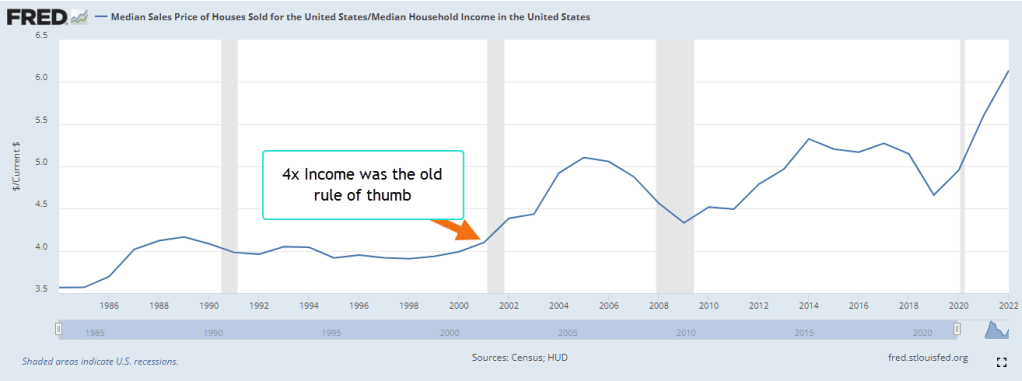
As a young man I was taught not to buy a home that was priced more than four times my income. In 2022, families paid more than six times the median household income, as shown in the chart below. Despite the high prices, mortgage debt service is a tame 10% of the household disposable personal income. Almost 40% of homeowners have a fully paid mortgage, according to Axios. Many homeowners hold mortgages at the historically low rates of the last decade. If higher mortgage rates persist for several years, we may see greater delinquency rates as recent buyers cope with payments that stretch their budget.

Graph shows an increasing ratio of home prices to median household income since 2000.

The Center for Microeconomic Data at the NY Federal Reserve has tracked household finances for more than twenty years. The highest percent of total household debt continues to be mortgage debt at 68% to 70%. Mortgage debt has grown at an annual rate of 3.9%, slightly more than the 3.7% annual increase in owner equivalent rent that I discussed last week. A low 3% of mortgages are more than 30 days delinquent, down from 11% to 12% during the 2008-2009 financial crisis. Only 40,000 people are in foreclosure, less than half the number in 2019. The numbers today are the lowest on record except for the pandemic years of 2020 and 2021 when many foreclosures were halted.

As I discussed last week, property prices reflect the anticipated cash flows from the house during a 30-year mortgage, a process called capitalization. The home buyer replaces the seller in the stream of cash flows from the house. Because property taxes are based on the appraisal values, the taxing authority implicitly bases property taxes on cash flows that a homeowner has not received yet. Each state sets an assessment rate that is a percent of the appraised value of the home. Each taxing authority within the state then charges a dollar amount – the mill value – per thousand of that assessed value. A home with an appraised value of $500,000 and an assessment rate of 8% would have an assessed valuation of $40,000. If the mill levy were $100 per $1000 of assessed value, then the homeowner’s property tax bill would be $4000. The effective property tax rate would be $4000 divided by $500,000, or 0.8%. Investopedia has a longer explanation for interested readers.

Each state taxes property at different rates. Colorado charges ½% of the appraised property value, one of the lowest in the nation. California averages ¾%. Texas averages a whopping 1.74% of home property values but has no income tax. Families earning the median household income and owning a house valued at the median house price in Texas and Colorado pay the same combined property and income tax of $5883 and $5669, respectively. Colorado has a cheaper tax burden despite having an income tax and far higher median house values. The same family living in California would pay $8256, largely because their property tax bill would be about the same as in Texas because the home values are more than double those in Texas. I will leave data sources in the notes.

Many districts give seniors a discount on their property taxes, effectively throwing a higher burden on working homeowners. Some argue that these exemptions should be means tested, effectively lessening or eliminating the discount for seniors with higher incomes. A wave of seniors may move to an inter-urban area that features lower home prices yet is within an hour of vital medical services like a hospital. The higher demand drives up home prices for others who have lived in the area for decades. Secondly, seniors consume more medical services and public accommodations. That requires more public spending, which is shared by the entire community and leads to resentments and contentious public meetings at the local town hall.

The majority of property taxes are used to fund public schools, and it is the largest line item on an individual homeowner’s property tax statement. This system of funding raises principled objections from childless couples and those who privately school their children, but are expected to share the burden of funding public schools. Homeowners have often resented having to fund the schooling of recently arrived immigrants. In the 19th century a wave of immigrants from Catholic Ireland, then Catholic Italy prompted many states with Protestant majorities to pass laws that excluded public funding for schools run by Catholics. Since the 16th century, the two main branches of Christianity had fought bloody civil wars in Europe and Britain. Those who colonized America brought those antagonisms with them.

During the 1970s, the number of encounters at the southern border increased almost ten times, according to the CBP. High inflation and migration of Amerians to western states caused a surge in property valuations and higher property taxes. In 1978, a taxpayer revolt in California led to the passage of Proposition 13 limiting property tax increases. In some school districts, undocumented parents had to pay a fee to enroll their children in public school.

In a 1982 case Plyler v. Doe, a slim 5-4 majority on the Supreme Court ruled that undocumented immigrant children did not have to pay a fee to go to school. The court reasoned that the equal protection clause of the 14th Amendment extended protection to “persons,” not “citizens.” Therefore, a state could not provide public benefits to one child in a school district and not another child because their parents were undocumented. The court interpreted “protection” to include public benefits, a construction that the Connecticut Constitution made explicit in 1818 with the phrase “exclusive public emoluments or privileges from the community.” The conservative majority on the Supreme Court overruled an interpretation of the due process clause in the 14th Amendment that justified the 1972 Roe v. Wade decision. This court might revisit this interpretation of the equal protection clause of the 14th Amendment as well.

Districts with lower property valuations struggle to raise adequate taxes to meet minimum educational standards. They may have to tax homeowners at a higher rate than a neighboring district, raising legal questions about uniformity and proportionality. The disparity in valuation was the subject of the 1997 Claremont decision by the New Hampshire Supreme Court. At the time, local districts provided 75% to 89% of funding for elementary and secondary education. The state’s general fund provided only 8% of school needs. The decision forced the state to distribute tax revenues among districts to meet adequate education standards for all children in the state. A 2017 analysis found that states now provide almost half of public education funding, relying on income tax revenue to smooth disparities in income among districts within each state.

People do not like paying taxes but grudgingly accept them. People elect local officials to decide on spending priorities yet some homeowners object to the way their taxes are spent. On my property tax bill are eleven items which include funding for schools, the city’s bonds, police, fire, libraries and flood control. Homeowners might prefer a questionnaire of thirty categories of spending which allowed them to allocate their tax dollars by percentage when they paid their property tax each year. In my district, a half-percent goes to affordable housing, three percent to social services. Some might prefer 5% or more. A homeowner paying online could elect to answer the questionnaire online. Would homeowners respond? Next week I will begin an exploration of various aspects of consumption, the chief component of our economy.

///////////////////////////

Photo by Museums Victoria on Unsplash

Keywords: housing, home prices, mortgage, property tax

Property taxes by zip code and state can be found at Smart Asset
Median home prices by state are at Bank Rate
Median Sales Price of Homes Sold in the U.S. is FRED Series MSPUS at https://fred.stlouisfed.org/ Median Household Income in the U.S. is series MEHOINUSA646N. The ratio of mortgage payments to disposable personal income can be found here. The home price to property tax ratio can be found here

A Home Is a Magic Wallet

April 7, 2024

by Stephen Stofka

In this week’s letter I will explore the various roles that housing plays in our lives. Last week I showed the divergence of household formation and housing supply during the financial crisis. Home builders responded to the downturn in household formation by building fewer homes. Because the recovery after the crisis was slow, the demand for housing did not pick up until 2014. It is then that a mismatch between housing demand and supply started to appear in the national and some local home price indices. This week I will examine the demographics of homebuyers and sellers in recent history and the secret life of every homeowner as a landlord. A home is a magic wallet where money flows come and go.

Data from the National Association of Realtors (NAR) indicates that the median age of home sellers has increased from 46 to 60 since 2009. I will leave NAR data sources in the notes. In the four decades between 1981 and 2019, the median age of home buyers rose by twenty years, from 36 in 1981 to 55 in 2019. The median age of first-time buyers, however, increased by only four years, from 29 to 33. In 1981, the difference in age and accumulated wealth between first-time buyers and all buyers was only seven years. Now that difference has grown to 22 years. First-timers typically buy a home that is 80% of the median selling price of all homes.

In the past four decades, there has been a divergence in wealth between older and younger households. The real wealth of younger households has declined by a third since 1983 while households headed by someone over 65 have enjoyed a near doubling of their real wealth in thirty years. Accompanying that imbalance in growth has been a shift in capital devoted to housing.

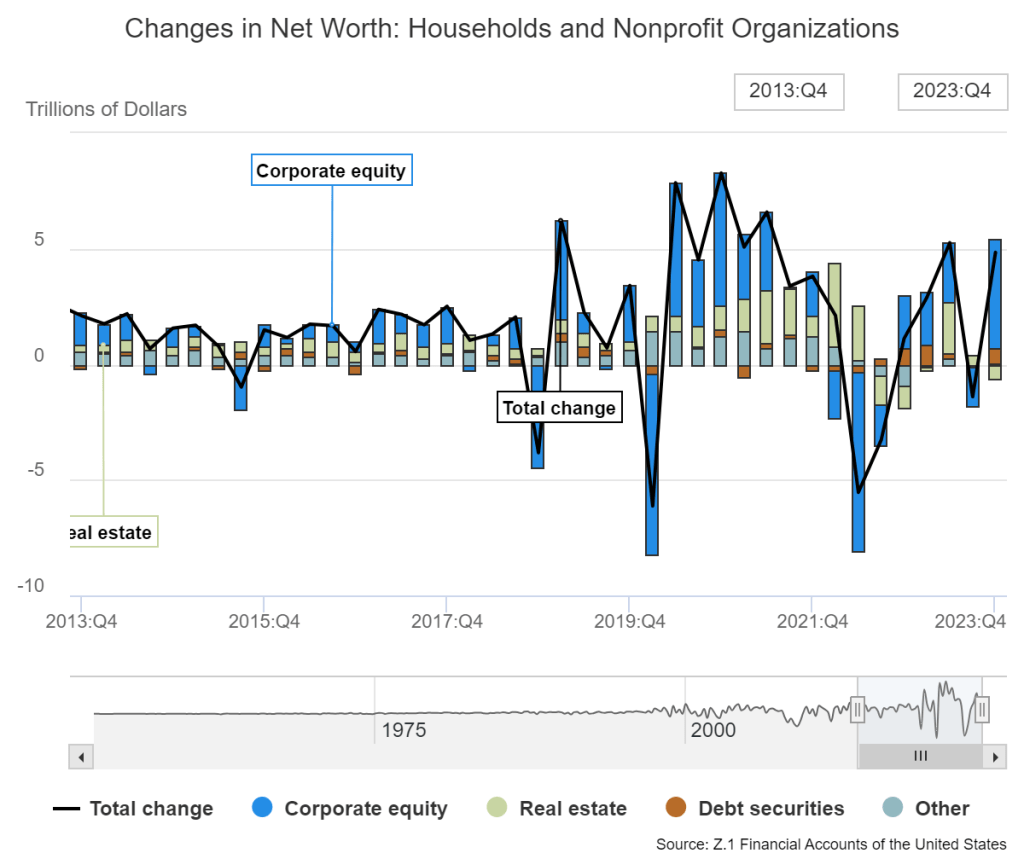
The Federal Reserve regularly updates their estimates of the changes in household net wealth. The link is an interactive tool that allows a user to modify the time period of the data portal. The chart below shows the most recent decade of changes in wealth. The lighter green bars are the changes in real estate wealth for households and non-profits and show the large gains in real estate valuations during the pandemic. The blue bars represent equity valuations and demonstrate the volatility of the stock market in response to any crisis, large or small.

The Fed’s data includes various types of debt as a percent of GDP. Twenty years ago, household mortgages were 11-12% of GDP. Today they are 19% of GDP, a huge shift in financial commitment to our homes and neighborhoods. A city average of owner equivalent rent (FRED Series CUSR0000SEHC) averaged an annual gain of 2% during Obama’s eight- year term, 2.8% during Trump’s term, and 6% during the first three years of Biden’s term. Biden has little influence on trends in housing costs, but the art of politics is to use correlation as a weapon against your opponent. People feel the change in trajectory as a burden on their households.

The Bureau of Labor Statistics calculates owner equivalent rent by treating a homeowner as both a landlord and renter. Property taxes, mortgage payments, interest, maintenance and improvements to a home are treated as investments just as though the owner were a landlord. The BLS uses housing surveys to determine the change in rental amounts for different types of units. A sample of homeowners are asked how much they would rent out their home but this guess is used only to establish a proportion of income dedicated to rent, not the actual changes in the rental amounts for that area, as the BLS explains in this FAQ sheet.

Let us suppose that a homeowner has a home that is fully paid for. If the house might rent for $2000 a month and monthly expenses are $500 a month, that would represent $1500 per month in implied net operating income for that homeowner, an annual return of $18,000. A cap rate is the amount of net operating income divided by the property’s net asset value. If similar homes are selling for $450,000 in that area, the homeowner is making 4% on their house’s asset value, slightly less than a 10-year Treasury bond (FRED Series DGS10, for example).

Long-term assets compete with each other for yield, relative to their risk. A property is a riskier investment than a Treasury bond, so investors expect to earn a higher yield from a property. Before the pandemic, 10-year bonds were yielding between 2-3%. Landlords could charge lower rents and still earn more than Treasury bonds. As yields rose for Treasury bonds, property investors must charge higher rents to earn a yield appropriate to the risk or sell the property and invest the money elsewhere.

When we own an asset that provides an income, it is as though the asset owes us. When a home declines in value, we feel a sense of loss. When the housing market turned down in 2007-2008, homeowners expected to get a similar price as the house their neighbor sold in 2006. They used that sale price to determine what their house owed them. In order to get the listing, a real estate agent would agree to list the home for that higher amount, but the property would get few offers. After a period of time, the seller would cancel the listing and wait for the “market to turn around.”

Earlier I noted the dramatic rise in mortgage debt as a percent of GDP. At one-fifth of the economy, that debt represents capital that is not being put to its most efficient use because most homeowners do not regularly evaluate the yield on their homes as professional investors. A higher percent of capital devoted to housing will help sustain higher housing costs and pressure household budgets. I worry that an inefficient use of capital will contribute to a pattern of lower economic growth in the future, stifling income growth. The combination of these two pressures will make it difficult for younger households to thrive. The generational gap will widen, adding more social and political discord to our national conversation.

/////////////////

Photo by Towfiqu barbhuiya on Unsplash

Keywords: mortgage, housing, owner equivalent rent

Notes on median age of sellers: 2009 data is from the NAR and cited in a WSJ article (paywall). Current data is from the NAR FAQs sheet. Jessica Lautz, an economist with NAR, reported the four-decade trend in home buyers. Median home prices of first-time buyers is from a 2017 analysis by the NAR. The comparison of older and younger households comes from a 2016 NAR analysis.

Notes on Federal Reserve data:  The change in mortgage debt as a percent of GDP is in the zip file component z1-nonfin-debt.xls, in the column marked “Noncorporate Mortgages; Percent of GDP.”

A Home Is More Than a Home

March 31, 2024

by Stephen Stofka

This week’s letter is about housing, the single largest investment many people make. The deed to a home conveys a certain type of ownership of physical property, but the price reflects a share of the surrounding community, its economy, infrastructure, educational and cultural institutions. We purchase a chunk of a neighborhood when we buy a home.

These are network effects that influence demand for housing in an area. They are improvements paid for by tax dollars or business investment that are capitalized into the price of a home. Take two identical homes, put them in different neighborhoods and they will sell for different amounts. When elements of this network change, it affects the price of a home. Examples of negative changes include the closing of businesses or an industry, a decline in the quality of schools, the presence of graffiti or increased truck traffic. Positive changes might include improved parks and green zones, better schools and alternative transportation like bike lanes and convenient public transportation.

Zoning is a critical tool of a city’s strategic vision. Zoning controls the population density of an area, the available parking and the disturbance from commercial activities. Many cities have some kind of long-term plan for that vision. Los Angeles calls it a General Plan. In Denver it is called Blueprint Denver (pdf). Homes built in the post-war period in the middle of the twentieth century were often smaller. They feature a variety of building styles whose distinctive character and lower prices invite gentrification. As properties are improved, their higher appraisal values bring in more property tax revenue from that city district and the process of building an improved neighborhood network begins.

A representative for that district can argue for more spending on public amenities to enhance the neighborhood. This further lifts property values and increases tax revenues. Developers get parcels rezoned so that they can convert a single-family property into a two-family unit. This may involve “scraping” the old structure down to its foundation, then expanding the footprint of the structure to accommodate two families. As this gentrification continues, there is increased demand for rezoning an area to allow the building of accessory dwelling units, or ADUs, on a property with a single-family home. Here is a brief account of a rezoning effort in Denver in 2022.

In the past decade, the 20-city Case-Shiller Home Price Index (FRED Series SPCS20RSA) has almost doubled. The New York Fed has assembled a map with video showing the annual change in the index for the past twenty years. Readers can click on their county and see the most recent annual price change. Millennials in their late twenties and thirties feel as though some cruel prankster has removed the chair just as they started to sit down. Analysts attribute the meteoric rise in prices to lack of housing built during and after the financial crisis fifteen years ago.

Each generation faces a set of crises that stifle their ambitions. In the 1970s, just as the first Boomers were entering their late twenties, mass migration from the eastern U.S. to the western states and high inflation doubled home prices in some areas within just a few years. The decade is a comparison tool as in “How bad is it? Well, it’s not as bad as the ’70s.” The 1980s began with high interest rates, the worst recession since the Great Depression and high unemployment. Boomers had to buy houses with mortgage rates over 10%. Following that recovery was another housing scandal and the savings and loan crisis that restricted any home price growth. A homeowner who bought a home in 1980 might have seen no price appreciation by 1990. Gen-Xers who bought a home during the 2000s had a similar experience, leaving some families underwater or with little equity for a decade. Equity growth from homeownership helps support new business start-ups.

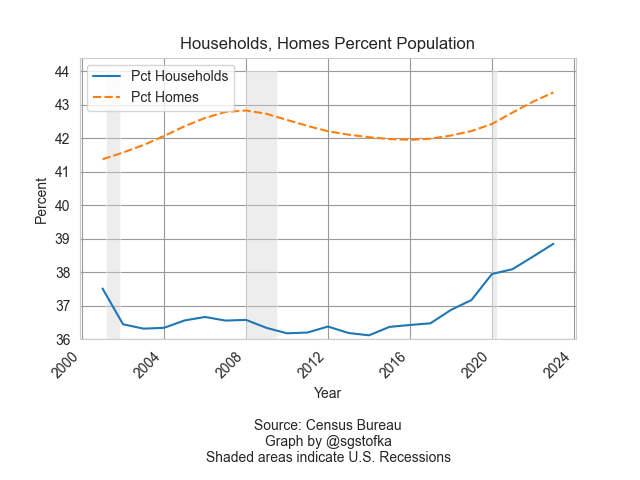
Despite the insufficient supply of affordable housing, there are more homes than households. In the graph below are the number of homes (orange line) and households (blue line) as a percent of the population. The difference is only a few percent and contains some estimate error, but represents many more homes than the number of households.

Graph showing homes and households as a percent of the population.

Household formation, the blue line in the graph above, is a key feature of the housing market. In 1960, 3.4 people lived in each household, according to the Census Bureau (see notes). By 1990, that number had steadily declined to 2.6 persons and is slightly under that today. The supply of homes naturally takes longer to adjust to changes in household formation. That mismatch in demand and supply is reflected in home prices.

During the financial crisis household formation declined as unemployment rose. Home prices fell in response to that change in demand for housing and a come down from the “sugar high” of easy credit and sloppy underwriting. The percent change in the Home Price Index, the red line in the graph below, fell below zero, indicating a decline in home prices, an event many homeowners had never experienced. The fall in home values crippled the finances of local governments who depended on a steady growth in the property taxes based on rising home values.

Graph containing two lines: 1) the percent difference between homes and households as a percent of the population, 2) the home price index. There is a large gap where the two series diverge during the financial crisis.

The thirty-year average of  the annual growth in home prices (FRED Series USSTHPI) is 4.5% and includes all refinancing. We can see in the chart above that the growth in home prices (red line) is near that long-term mark. However, rising wages and low unemployment have encouraged more household formation, the rising blue line in the first chart. Those trends could continue to keep the growth in home prices above their long-term average. Millennials with mortgages at 6-7% are anxiously waiting for lower interest rates, a chance to refinance their mortgages and reduce their monthly payments. Strong economic growth and rising incomes will continue to put upward pressure on consumer prices, slowing any decisions by the Fed to lower interest rates. These trends are self-reinforcing so that they take a decade or more to correct naturally. Too often, the correction comes via a shock of some sort that affects asset prices and incomes. Millennials have endured 9-11, the financial crisis and the pandemic. “Go ahead, slap me one more time,” this generation can say with some sarcasm. The challenge for those in each generation is to try harder and endure.

Next week I will look at the cash flows that a property owner receives from their home investment.

////////////////////

Photo by Scott Webb on Unsplash

Keyword: interest rates, mortgages, mortgage rates, housing, households

Notes on series used in the graphs. The total housing inventory is FRED Series ETOTALUSQ176N divided by Total Population Series POPTHM. Total Households is TTLHHM156N divided by the same population series. These are survey estimates so some of the difference between the two series can be attributed to a normally distributed error. The all-transactions Home Price Index is FRED Series USSTHPI. The FRED website is at https://fred.stlouisfed.org/

Fiscal Cliffs

June 4, 2023

by Stephen Stofka

This week’s letter is about household debt and income. First I’ll touch on the latest news in the debt ceiling debacle. In a late Thursday session, the Senate passed a debt ceiling bill 63-36 and the President is expected to sign it before Monday, the day when Treasury Secretary Janet Yellen said the country would start delaying or defaulting on payments. There were few significant cuts to social and military spending, the biggest contributors to the nation’s rising debt. The CBO’s recent outlook estimates that the debt will rise by almost 50% in the next decade.

Although the issue is laid to rest until 2025, neither side is willing to pass a law that voids the 105 year old debt ceiling law. Since the passage of the 17th Amendment in 1913, only the Democratic Party has ever held a filibuster proof 60 vote majority in the Senate. For Republicans, the debt ceiling is a critical bargaining chip to undo Democratic spending priorities. When Democrats had a filibuster proof majority in 2009-2010, they could have undone the debt ceiling law but chose other priorities like Obamacare and banking reform. In 2021, ten Republicans joined Senate Democrats to bypass the 60 vote filibuster threshold and permit a vote to raise the debt ceiling, the Hill reported. Last year, Janet Yellen asked Democrats to lift the debt ceiling while they held majorities in both chambers of Congress but Chuck Schumer probably didn’t have the votes in a narrowly divided Senate.

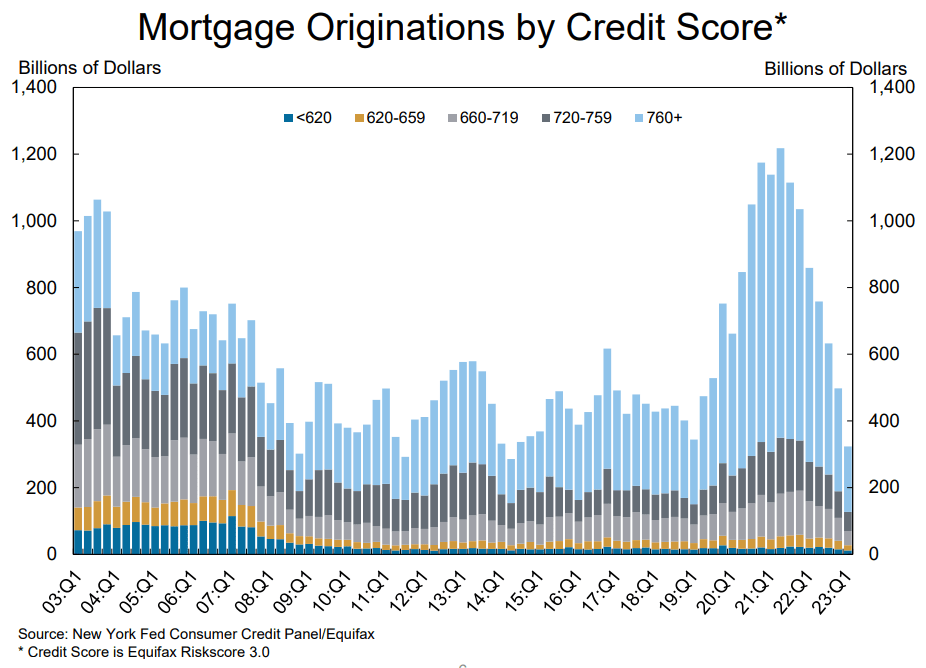
The latest report on household debt from the New York Federal Reserve (2023) reveals some interesting trends in mortgage debt. During the pandemic, the surge in mortgage originations was particularly strong among those with the best credit scores of 760 and above.

Those with the greatest house buying power are now “locked” into historically low interest mortgages below 4%. How low is 4%? The 50 year average of the 30-year fixed mortgage rate is 7.74%, according to Trading Economics. An entire generation was accustomed to very low rates after the financial crisis. Those low mortgages will create a resistance to sell that will likely dampen the housing market for a decade to come. A $400,000 mortgage at 4% costs $1900 per month. At a 6.5% rate that same monthly payment covers only a $300,000 mortgage. How many people will be willing to downsize into a more affordable mortgage?

In the past 15 years, Americans have reduced their debt load to a level less than their disposable income but how long can that continue? For the past 20 years, real disposable personal income per household has grown at only 1% annually, half of the rate of growth from 1982-2002. (Disposable income is what remains after taxes). In the graph below, that is the blue line. That same income series per job, not household, has grown at 1.25% annually (red line), down from 1.5% annual growth in the previous 20 year period. I’ve charted the two series on a log scale to demonstrate the different growth rates. The difference indicates that those with higher paying jobs have enjoyed higher growth of after tax income for the past two decades. The two series show the cumulative effect of favorable tax policies for those with higher incomes.   

Because the growth of household income is tepid, families are more likely to increase their debt burden. In a decade this could provoke a credit crisis similar to the great recession 15 years ago. Republicans are fiercely resistant to higher taxes on the top income earners and equally resistant to any reductions in military spending or agricultural supports. Democrats continue to promote social programs without the additional tax revenues to support that spending. A higher federal debt level will reduce the federal government’s capacity to support families when the next crisis arrives.   

//////////////////

Photo by Leio McLaren on Unsplash

Keywords: fiscal cliff, public debt, household debt, mortgage, disposable income

Federal Reserve Bank of New York. (2023, May). Quarterly report on household debt and credit. https://www.newyorkfed.org/medialibrary/interactives/householdcredit/data/pdf/HHDC_2023Q1

U.S. Bureau of Economic Analysis, Real Disposable Personal Income [DSPIC96], retrieved from FRED, Federal Reserve Bank of St. Louis; https://fred.stlouisfed.org/series/DSPIC96, June 2, 2023. Other series shown are Total Nonfarm Payroll (PAYEMS), the Census Bureau’s estimate of  households (TTLHHM156N)

The Crack in Our Windshield

May 28, 2023

by Stephen Stofka

This week’s letter is about debt, both public and household. Since 9-11, the public federal debt  has grown five times. The causes include costly wars in Iraq and Afghanistan, a global financial crisis followed by a slow recovery, tax cuts passed under the Trump administration and a once-in-a-century pandemic. Ten percent of the $32 trillion debt was added during the first three months of the pandemic. As the deadline approaches when the government will not be able to make timely payments to vendors and bondholders, we ask why do we have this thing called a debt limit?

Denmark is the only other country in the world to require an approval of a debt limit after the spending has been approved. Their legislators raised the limit so high that it might be a century before the issue comes up again. That leaves only the U.S. in the world where a debt limit debate is a threat. Neither party wants to repeal this century old law because it has the potential to be a powerful negotiating tool. It allows one party to negate or modify the funding priorities that the other party passed in the last legislative session. This is a game of chicken played for high stakes.

Some have criticized the Biden administration for not starting negotiations sooner. However, the House did not put anything on the negotiating table until they passed a bill on April 26th, just a month ago. Given the fractured Republican caucus, it was not clear that Speaker McCarthy could get a bill passed in the House. French Hill, R-Ark., told Roll Call “The whole purpose of this is to compel the president to negotiate — and to demonstrate to Washington, D.C., that Kevin McCarthy has the votes to raise the debt ceiling.” Four House members defected and the vote barely squeaked by at 217-215. Although George Santos, R-NY, is facing prosecution for fraud, money laundering and theft of public funds, McCarthy has allowed him to keep his seat at a time when every vote is crucial.

In 2011, the Republican House balked at raising the limit but the only legislation they could pass was an affirmation that they would not raise the limit without some unspecified spending cuts. Republicans were unable to agree on terms that they could pass in the House. Despite that, President Obama made the mistake of negotiating with Speaker John Boehner, and the two struck a so called Grand Bargain. Lacking anything in written legislation from the House, a bipartisan committee in the Senate came up with a different proposal and Obama tried to negotiate a compromise between the two versions with Boehner. Boehner could not get any changes past the most conservative members in his caucus. According to Politico reporter Tim Alberta (2017), the staff of Jim Jordan, R-OH, had been working secretly with outside groups to sway enough House members to vote against Boehner’s bargain. Jordan apologized but the incident exacerbated tensions between the warring factions within the Republican House. As Vice-President at the time, Biden would have learned a valuable lesson. Get something in writing before starting negotiations.

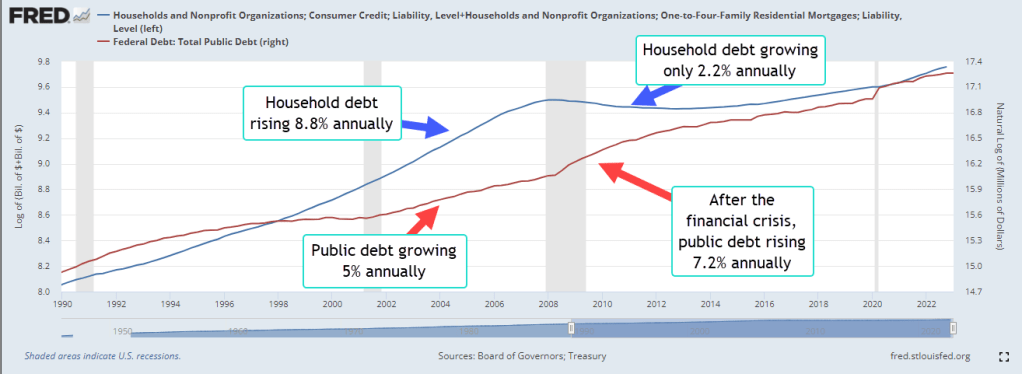
In contrast to the growth of the public debt, the growth in household debt has decreased since the financial crisis and the housing bust. The chart below compares the two types of debt, public and household, in two 13 year periods before and after the financial crisis.  

From 1994-2007, the public debt (GFDEBTN) grew 5% per year while household debt rose 8.7% annually. As a percent of disposable income, household debt jumped from 78% at the end of 1994 to 124% at the end of 2007. Chiefly responsible was the doubling of mortgage debt (HHMSDODNS) during the first seven years of the 2000s. Lax underwriting standards allowed families with poor credit scores of less than 620 to secure mortgages. Millions lost their homes during the housing bust, banks tightened lending standards and Americans were forced to go on a credit diet.

Since the financial crisis, American household balance sheets have improved. Household debt has grown by only 2.2% per year, about half the growth rate of personal income (DSPI). As a result, debt as a percent of disposable income had fallen to 91% at the end of 2022. The public finances have not fared as well. Although federal tax receipts, including FICA taxes, have increased 8% annually, expenditures and social benefit payments have outpaced tax receipts, resulting in a 7.2% annual increase in the public debt since the end of 2009.  

This week David Leonhardt (2023) with the New York Times presented a graph of voter policy preferences derived from recent polls. The fiscal liberals in both parties outweigh the fiscal conservatives, a trend sure to promote the growth of the public debt. In the 2011 debt limit duel, Republican leaders like Paul Ryan championed privatization of Social Security and cutting back on benefit programs. In the decade since, neither of those proposals are popular with the party’s base. Instead McCarthy will appeal to the social conservatives in the party and insist on work requirements for benefit programs. As Leonhardt notes, the fight for Democrat and Republican swing voters is taking place in the quadrant of voters who are socially conservative but fiscally liberal, nicknamed the “Scaffles.”

The government’s spending becomes household income in some form or another, an accounting identity that joins the growth in public and household debt. Our economy, laws and regulatory framework promote financial crises and exacerbate social problems. Policymakers, economists and social scientists can debate the causes, extent and severity of the problems but acknowledge the reality.  We may discover that our experiment in governance does not scale as our population grows and congregates in cities, as our technology advances and we become accustomed to greater energy use. The spread of mass communication and social media since World War 2 has exacerbated rather than resolved our ideological and cultural differences. The growth of our public debt indicates that we expect more from our government than our economy or political framework is able and willing to pay for. Like a crack in our windshield, it will continue to grow.

////////////////////

Photo by Ivan Vranić on Unsplash

Keywords: public debt, household debt, mortgage debt, debt limit

Alberta, Tim. 2017. “John Boehner Unchained.” POLITICO Magazine. https://www.politico.com/magazine/story/2017/10/29/john-boehner-trump-house-republican-party-retirement-profile-feature-215741/ (September 27, 2022).

Federal Reserve Bank of New York. (2023, May). Quarterly report on household debt and credit. https://www.newyorkfed.org/medialibrary/interactives/householdcredit/data/pdf/HHDC_2023Q1

The various FRED data series used in this post were HHMSDODNS Mortgage Debt, HCCSDODNS Consumer Credit Debt, GFDEBTN Public Debt, DSPI Disposable Personal Income.

Leonhardt, D. (2023, May 25). Ron DeSantis and the “scaffle” vote. The New York Times. https://www.nytimes.com/2023/05/25/briefing/ron-desantis.html

Commercial Mortgages

April 25, 2021

by Steve Stofka

They’re at it again. Thirteen years ago, the financial crisis originated in RMBS, residential mortgage-backed securities. Now banks and investment companies have been packaging CMBS, mortgage-backed loans on office and retail space, not residential, properties. Most of these loans are backed by or facilitated by the Small Business Administration and other government agencies. Who will pick up the tab when some of these loans default because of the pandemic? The same people who picked up the tab for the financial crisis – taxpayers. Even if the direct cost of bailouts is repaid, the loss of economic output and incomes is a crushing blow to many Americans.

Next month, the Federal Reserve will release its semiannual Financial Stability Report a comprehensive examination of the assets and lending of America’s financial institutions. Their last report in November 2020 was based on nine months of data, six months after Covid restrictions began. Concerning the Fed were several trends that were far above their long-term averages.

High yield bonds and investment grade quality bonds were almost double long-term trend averages (Fed, 2020, p. 17). High-yield bonds are issued by companies with low credit quality. Well established companies with good credit issue bonds rated investment grade. These are attractive to pension funds and life insurance companies who need stability to meet their future obligations to policy holders. Many companies took advantage of low interest rates during the Covid crisis. 60% of bank officers reported relaxing their lending standards; that same practice preceded the financial crisis in 2008. Will we eventually learn that commercial property evaluations were overvalued, just as house prices were generously valued before the financial crisis?

Many commercial mortgages are backed by commercial real estate (CRE) and packaged into CMBS, commercial mortgage-backed securities. The Fed noted that “highly rated securities can be produced from a pool of lower-rated underlying assets” (p. 51). This was the same problem with residential mortgages. CMBS are riskier than residential mortgages and delinquencies on these loans have spiked (p. 27). The Fed devoted most of their TALF (below) program in 2020 to CMBS (p. 16). 

Before the election last year, more than 70% of those surveyed by the Fed listed “political uncertainty” as their #1 concern (p. 68). 67% listed corporate defaults, particularly small to medium sized businesses. Respondents were from a wide range of America, from banking to academia. Only 18% of respondents were concerned about CMBS default. Simon Property Group (Ticker: SPG), the largest commercial real estate trust in the U.S. fell by almost 50% last spring. Although it has recovered since then, its stock price is still 20% below pre-pandemic levels.

Who thinks that the market for commercial space, retail and office, will return to pre-pandemic levels? Vacancy rates have improved, but even hot markets like Denver have a 17% direct vacancy rate (Ryan, 2021), near the 18% vacancy rate during the financial crisis, and far above the 14% during a healthy economy. 25% of space in Houston, Dallas and parts of the NY Metro area is vacant.

The stock market is convinced that the economy will come roaring back. In total, investors may be right but I think there will be some painful adjustments in the next year or two. The Covid crisis has diverted the habits of people and companies into new channels, and the market has not priced in that semi-permanent diversion. I would rather not wake up to another morning like that one in September 2008 when we learned that the global financial world was on the brink of disaster. I hope that the Fed report released in a few weeks will show a decrease in some of these troubled areas.

/////////////

Photo by John Macdonald on Unsplash

TALF – Term Asset Backed Securities Loan Facility

Federal Reserve System (Fed). (2020 November). Financial Stability Report. Retrieved from https://www.federalreserve.gov/publications/files/financial-stability-report-20201109.pdf. (Page numbers cited in the text are the PDF page numbering, six pages greater than the page numbers in the report).

Ryan, P. (2021, April 20). United States Office Outlook – Q1 2021, JLL Research. Retrieved April 24, 2021, from https://www.us.jll.com/en/trends-and-insights/research/office-market-statistics-trends

Personal Debt

April 15, 2018

by Steve Stofka

Until the financial crisis, I thought that other people’s debt was their problem. In 2008, debt became a nation’s problem and a national conversation with two aspects – the moral and the practical. Moral conversations are not confined to church; they drive our politics and policy. Many laws contain some language to contain moral hazard, which is the danger that language loopholes in a law or policy promote the opposite of the intended effect of the law. This is particularly true of many entitlement policies. Let’s leave the moral conversation for another day and turn to the practical aspects of current policy.

Bankers learned their lesson during the financial crisis, didn’t they? Maybe not. A decade of absurdly low interest rates has starved those who depend on the income earned by owning debt. Even a savings account is money loaned to a bank, a debt that the bank must pay to the account holder. In their hunger for income, investors have turned to less prudent debt products. So long as the economy remains strong, no worries.

A fifth of conventional mortgages are going to people whose total debt load, including the mortgage, is more than 45% of their pre-tax income. By comparison, at the market’s exuberant peak in late 2007, 35% of conventional mortgages were going to such households, who were especially vulnerable when monthly job gains turned negative in early 2008.

The real estate analytics firm Core Logic also reports that Fannie Mae has started backing mortgages to those with total debt loads up to 50%. FICA, federal, state and local income taxes can amount to 25% of a paycheck (Princeton Study). Add in 45% of that gross pay for mortgage and debt payments, and there is only 30% left for food, gas, home repairs and utilities, child care, etc.

I’ll convert these percentages to dollars to illustrate the point. A couple grossing $80,000 might have a take home pay of $60,000. The couple has $36,000 in mortgage and other debt payments (45% of $80,000). They have $24,000, or $2000 a month for everything else. This couple is vulnerable to a change in their circumstances: a layoff or a cut back in hours, some unexpected expense or injury.

For those who get a conventional loan despite their heavy debt load, where is the money coming from? Banks suffered huge losses during the financial crisis. The Federal Reserve tightened capital requirements for banks’ loan portfolios, forcing them to improve the overall quality of their debt. As a result, banks turned away from their most lucrative customers – subprime borrowers and those with heavy debt loads who must pay higher interest on their loans. Profits in the financial industry fell dramatically. A broad composite of financial stocks (XLF) has still not regained the price levels of 2007.

The banking industry employs some very smart people. What solution did they create? The big banks now loan money to non-financial companies who loan the money to subprime borrowers. After bundling the consumer loans into securities, the non-financial companies use the proceeds to pay the big banks back. In seven years this kind of borrowing has expanded seven times to $350 billion. Doesn’t this look like the kind of behavior that almost took down the financial system in 2008? The banks say that this system isolates them from exposure to subprime borrowers. If large scale job losses cause a lot of loan defaults, it is the investors who will bear the pain, not the banks. Same song, different lyrics.

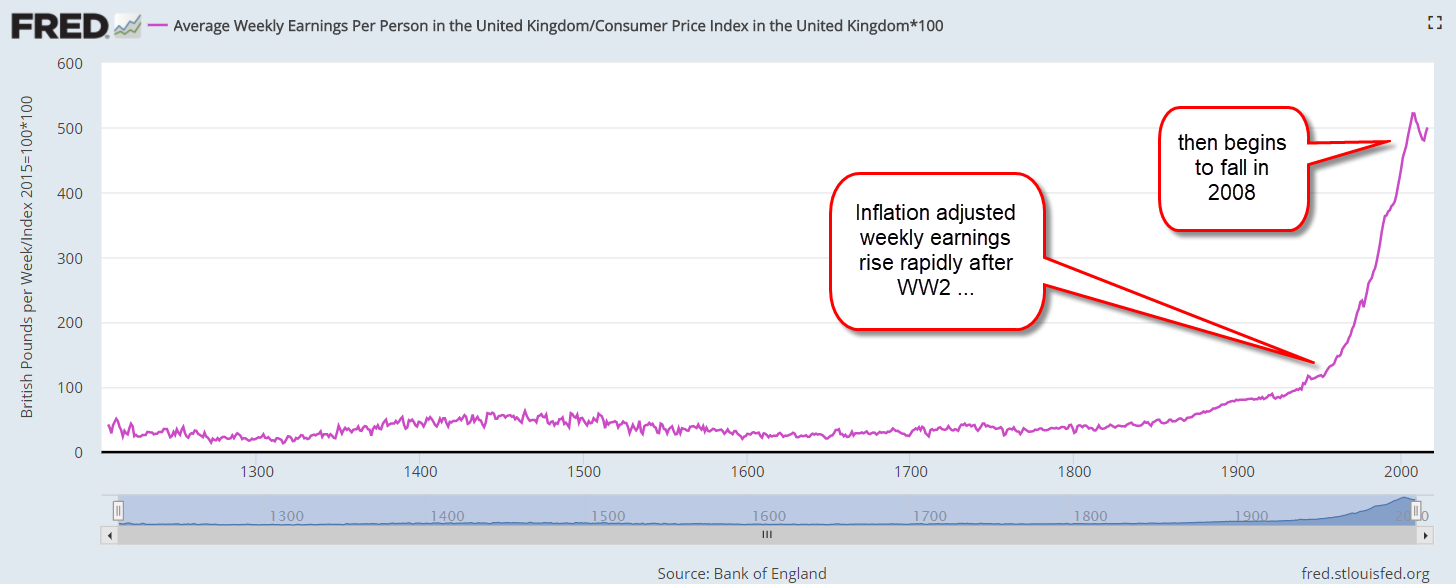
The 2008 financial crisis is best summed up with a chart from the Federal Reserve. In the post WW2 economy, the weekly earnings of British workers rose steadily. The growth is especially strong when compared to the earlier decades of the 19th and 20th centuries. In 2008, earnings peaked.
WeeklyEarnUK

Developed countries depend on the steady growth of tax receipts generated by weekly earnings. An assumption of 3% real GDP growth underlies the health and continuation of post-war social welfare policies. For more than a decade, the U.S. and U.K. have had less than 2% GDP growth.  Both governments have had to borrow heavily to fund their social support programs.  How long can they increase their debt at such a rapid pace?

I am reminded of a time more than 40 years ago when New York City held a regularly scheduled auction to sell  bonds to fund their already swollen debt load.  None of the banks showed up to bid for the bonds.  The city is the financial center of the world.  The lack of interest stunned city officials.  To avoid a messy bankruptcy, the city turned to the Federal government for a loan (NY Times).

The Federal government is not a city or state, of course. It has extraordinary legal and monetary power, and its bonds are a safe haven around the world.  But there could come a time when investors demand higher interest for those bonds and the rising annual interest on the debt squeezes spending on other domestic programs.

Debt causes stress.  Stress causes anxiety.  Anxiety weakens confidence in the future and causes investment to shrink. Falling investment leads to slower job growth. That causes profits and weekly earnings to fall which reduces tax receipts to the government.  That increases debt further, and the cycle continues.  Other people’s debt is everyone’s problem after all.

Sacred Cow

October 22, 2017

Moo. One of the sacred cows of tax law has been the mortgage interest deduction. There is talk that the proposed Tax Reform law will erase this deduction. Who benefits from the deduction? Before I look at that, here’s some groundwork.

Two months ago the IRS released aggregated income tax data for 2015. Pew Research analyzed the data and produced this  chart of who pays how much in individual income taxes.   I took the liberty of marking up  their chart.

TaxAnalysis2015Pew

The Tax Reform bill that is being tortured to death in the back rooms of Congress proposes to double the standard deduction, making the first $50K that a couple earns tax-free. About 50% of tax returns will pay little or no federal income tax. That leaves the other half to pick up the tab for the 5% of taxes paid by the lower half of incomes. 1% of tax returns paid 40% of taxes in 2015 and they will argue that they are already paying their fair share.

As the Congress tries to craft a Tax Reform bill, one of the hot button topics is the mortgage interest deduction. According to IRS analysis of 2015 tax data, 33 million returns, about 20% of total returns, took the mortgage interest deduction totaling $304 billion, averaging over $9000, or $770 a month. The annual cost to the Treasury is about $70 billion in taxes not paid.

The bulk of this tax giveaway goes to wealthy families, but the program is popular among middle class families in expensive housing markets, particularly on the east and west coasts. The Tax Reform package proposes to double the standard deduction.  For many married couples, this would exclude another $25K of their income. This $25K is far more than the $9K average mortgage interest deduction.  However, there will be about 8 million returns, mostly wealthier Americans, who will pay more.  Those 8 million will certainly raise a campaign of alarm and outrage as they try to convince the vast majority of Americans that this reform is so un-American. Those in the real estate sector will claim that this will cripple a recovering homebuilding sector and prevent many American families from owning a home.  It won’t.  Each sector of the economy wants to preserve their tax carve outs because their business model has come to depend on it.

Notice that the analysis included effective, not marginal, tax rates. What is the difference? The effective rate is the net tax divided by adjusted gross income. It is the average tax paid for all the income received. For those who use tax preparation software, the program calculates the effective rate and prints it out on the summary page.

The marginal rate is the highest tax rate paid on the last dollar. When we hear someone complain that they are in the 33% tax bracket, for example, we think that the person pays 33% on all their income. They don’t. A two-earner family making $130K, filing jointly, two deductions, would be in the 25% bracket in 2017, but their effective tax rate is 12.89%, almost half of the marginal rate. (Dinky Town calculator)

Why is this important? Let’s return to the difference between effective and marginal tax rates. Let’s say our hypothetical couple making $130K wants to buy a new house for $300K. After $60K down, they will pay about $7800 per year in interest for the first 20 years of a 30-year mortgage (Zillow mortgage calculator). What they tell themselves is that they are “saving” over $160 per month, almost $2000 per year, because they are in the 25% tax bracket.

What is the fallacy? The couple assumes that the first dollars they earn buy the groceries, buy clothes for the kids, or make the car payment. It’s the last money earned, the money that is taxed at a 25% rate, that they will use to pay the mortgage. It’s sounds silly, but it’s effectively what we do when we use the marginal rate to analyze costs. Real estate salespeople sometimes use this technique to upsell a couple into a more expensive house, one that earns the salesperson a higher commission. If our couple uses the effective tax rate of less than 13%, the savings on that monthly mortgage payment is only $83. Many financial decisions are made “at the margin” but this is not one of them.

Also on the cutting board is a reduction in the amount of pre-tax contributions a person can make to a 401K retirement program.  Higher income earners would be trading in that tax break for lower tax rates, but the finance industry is sure to balk.  They make billions of dollars in administrative and trading fees for these retirement programs. In addition to the taxpayers who receive the benefits directly, tax breaks have protectors who benefit indirectly from the break. Together, this minority fights for their interests.

Soon after the last tax reform was passed in 1986, members of Congress began adding tax exclusions. Republicans may be able to pass a reform bill under a Budget Reconciliation rule in the Senate, which requires only a 50-vote threshold. Their slim majority in the Senate and a lack of cooperation from Democrats means that passage of a reform bill is vulnerable to just a few Republican defections. This is how health care repeal or reform was defeated earlier.  It can happen again.

Vulnerable

September 3, 2017

Hurricane Harvey invaded the lives, homes and businesses of so many people in Houston and the surrounding area of southeast Texas. People around the world watched the plight of so many who were caught in the rising waters. I was cheered by the dedication of first responders, by those who came from near and far to help with their boats, with food and clothing. I have never been in a flood. Some of those interviewed had been in several. Why do they stay there, I wondered? The answer is some or all of these: their family, their church, their job, their school, their culture.

Watching so many vulnerable people reminded me of my own. If given a few minutes to leave my house, what would I put in a garbage bag? In the urgency and stress of the moment so many people in Houston forgot their medications.  My list: Pets, papers, clothes, medications. Food? Will the shelter have food? Pet food, as well? Where are we going? Oops, what about a phone charger? And the laptop. What about the list with all the passwords? That too. What about the photos in the closet? I was going to get those scanned in and uploaded. No time now. Take a few of the smaller framed photos on the shelf in the living room. Out of time. Gotta go. All the questions that must have been bouncing around inside the heads of those forced to evacuate as the brown water took possession of their house.

If I don’t call it Climate Change, I could call it Flood Frequency, or Flood Freak for short. Here is a chart showing the increased frequency of flooding during the past century. This was from an article in the WSJ (paywall).

FloodFrequency
This week’s theme – vulnerability. The signs of it and what we can do to lessen it. Debt is a vulnerability. For the past three years, households have been increasing their debt load in mortgages, auto and student loans. Here’s a breakdown of household debt from the NY Fed. (As a side note, this report gives a breakdown of the different types of debt by credit score. For example, the median credit score for an auto loan is about 700).

DebtBalance2016.png
Mortgage debt is more than 2/3rds of total debt. Despite the rise in home prices, more than 5 million homes, or 7%, are still badly “under water.” (Consumer Affairs)

Credit card debt has stayed stable for the past thirteen years. Households are only using 10% of their after-tax income to service their debt.

DebtService2016

Despite low interest rates, households are continuing to deleverage, to decrease their vulnerability. The ratio of household debt – the total of that debt, not the payments – to income climbed above 2.5 in late 2007. It has fallen below 2.2 but is still high. We are still up to our eyeballs in debt.

HouseholdDebtIncomeRatio

Debt reduction will curb economic growth for the near future. According to several cabinet members, Trump is focused on GDP growth in discussions about trade policy, defense policy, infrastructure spending, and the regulatory environment. How does this or that policy get us to 3% growth? he asks.

2/3rds of the nation’s economy is based on the public willingness to spend money. Jobs helps. Higher wage growth helps. Low interest rates help. But without the willingness to take on more debt relative to income, policymakers may feel like they are trying to goad a stubborn mule to go faster. Tough to do.

//////////////////////////////////

Unemployment

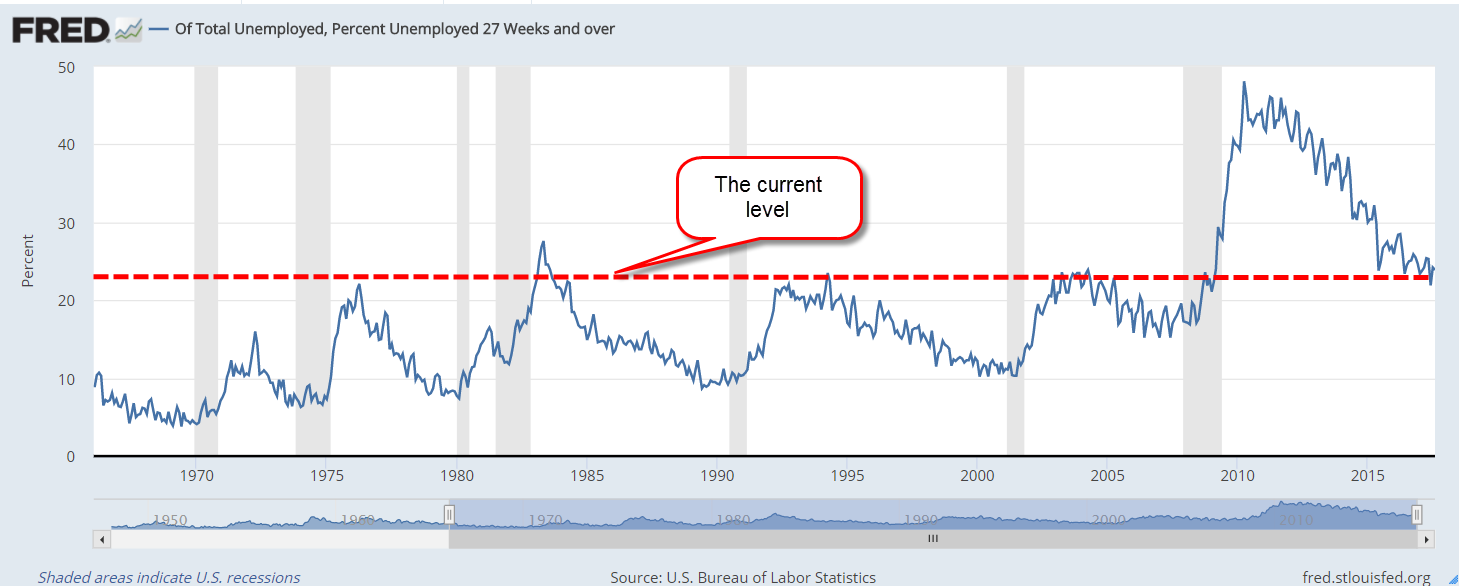
Continuing the theme of vulnerability.  As a percentage of the unemployed, the number of long-term unemployed remains stubbornly high at close to 25%.  I call them the 27ers because 27 weeks of unemployment is the cutoff that the BLS uses to determine whether someone is categorized as long term unemployed. 27 weeks or six months is a long time to be actively looking for work and not finding a job.  Eight years after the end of the recession, today’s percentage of 27ers is at the same level as the worst of most past recessions.

LTUnemploy

During any recession the number of long term unemployed climbs higher. When these past few recessions have ended, the number of 27ers doesn’t start to decline.  Instead, they continue to increase and reach a peak several months after the recession is officially over. In the last three recessions, the peaks came later than previous recessions.

UnemployLTPctCLF
This more vulnerable cohort in the labor force struggles to recover after a recession.  Manufacturing is the more volatile element in the business cycle.  As manufacturing has declined, recessions are less frequent. However, manufacturing used to put a lot of people back to work at the end of recessions.  In a recovery, the service sectors are not as quick to add jobs.

The structural shift in the labor force will continue to leave more workers and families vulnerable and needing help just as many older workers are claiming retirement benefits. More than half of voters, both Republican and Democrat, have received benefits from at least one of the six entitlement programs (Pew Research). Elected officials offer promises of future benefits in exchange for taxes, and votes, today. When circumstances force a clash of priorities and promises, Congress seems incapable of resolving the conflict. President Trump’s approval ratings are in the low thirties, but his popularity far exceeds the public’s dismal ratings of Congress.

In a crisis, Americans come together to help each other but why do we wait till there is a crisis? Have we always been a nation of drama queens?  Maybe that’s the American charm.