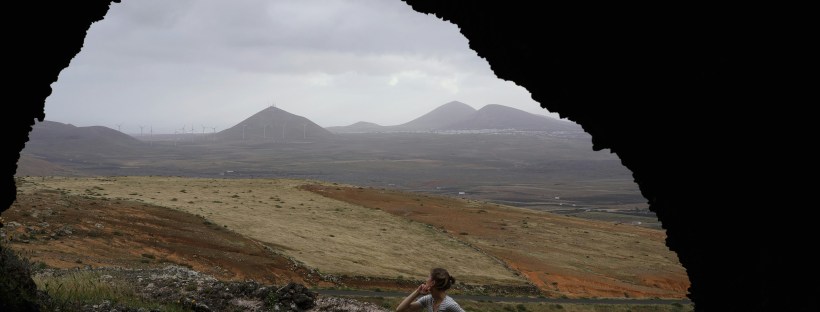
A landscape of brown hills and far off mountains framed by the entry of a cave

Beyond Our Cave

July 26, 2026

By Stephen Stofka

For the past few weeks I have been writing about the political polarization of voters based on where they live. Last week I wrote that voting behavior depends on our prediction of how a particular candidate or party will affect our own well being or that of  our family, our community. A choice is the result of a prediction. A vote is a choice. Those who vote for a Republican candidate are making different predictions than those who choose a Democratic candidate. To understand the polarization in this country, I want to understand the prediction process itself. How much information do we need to feel like we have enough knowledge to make a prediction? That depends on many things – the circumstances and the consequences of making a prediction.

The Pool of Possibilities

The future is an infinity of possibilities. We cannot gather enough information in the present to flawlessly predict the future. What do we do? Take a small sample of the present and trust that that small sample will reliably represent the future. But how do we decide the size of that sample? Some voters meticulously research candidates and issues before voting. Some people vote by the dominant political party that represents their interests and values. However, in states that allow citizen ballot issues, there may be no clear party line. Some voters rely on a media source to do the research and make recommendations.

Some cities were large enough to support two daily newspapers. The editorial board of one newspaper would present a conservative position on candidates and citizen initiatives. The other newspaper would  present a liberal perspective on candidates and issues. Some people grew up learning only one perspective because their parents subscribed to that newspaper. People who moved to a city soon learned which of the two perspectives aligned with their personal values. The newspapers did the work of filtering all the information.

The Media Jungle

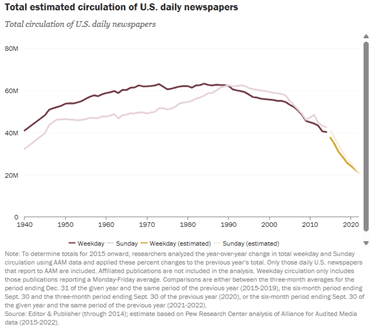
From 1970 to 1990, the circulation of daily newspapers peaked at over 60 million, almost the same number as the number of households in the country. By 2020, estimated circulation was about 25 million. Here’s a chart from Pew Research (Source).
In addition to local and national news, the newspaper had that day’s TV listings, the daily weather forecast, and the results of yesterday’s sports games. Readers checked their horoscope, read cartoons and played the games in the back pages of the newspaper.

Today, digital algorithms serve up news sources and content that engages a reader. We are like donkeys endlessly walking in circles, powering a flour mill as social media dangles a carrot to keep our attention. Like cute cats? Here’s more. Like hearing about Trump’s latest outrage? Here’s more. Before we show you that, here’s a commercial.

The General and the Particular

A President has a relatively small impact on the personal circumstances of most voters. People often vote based on their prediction of whether a particular candidate will be good or bad for the country as a whole, or an industry. Gallup conducts two separate polls for opinions on the general economy, the Economic Confidence Index, and people’s individual financial circumstances, the Personal Finance Survey.

The Economic Confidence Index plunged into negative numbers at the onset of the pandemic and was still negative on the eve of the 2020 election. Sentiments recovered somewhat shortly after Biden took office, then plunged again as inflation climbed to 9% in the summer of 2022. As inflation declined, those polled grew more optimistic. On the eve of the 2024 election, that index was still negative and voters elected Donald Trump, who promised to restore economic confidence. However, a few months after he took office, Trump initiated his “liberation day” tariffs. Public sentiment and the stock market both fell in response. While the stock market recovered, people’s confidence has not. Confidence in the economy is now lower than when Trump left office in January 2021 (Source).

What about people’s personal financial circumstances? In a poll conducted during the first quarter of this year, a third of those polled were “very worried” that they would not have enough money for retirement. Another third were “moderately worried.” Sixty percent of respondents were worried that they could not cover medical bills in case of a serious illness (Source).

Party Loyalty

Some people make voting easy. They vote for each candidate from one of the two dominant political parties. Researching the electoral platform and record of each candidate can be time consuming. Also, many voters do not pay a lot of attention to politics until a few months before an election, so this strategy is practical. Mike Rosen was a conservative radio talk show host in Denver until 2016. His experience working in Washington helped him understand that party politics drove the legislative machinery. Party cohesion, power and connections gets legislation passed. Party affiliation is more important that the merits of individual candidates. Because of that, he endorsed a voting strategy of “party over person.” Having to choose between two dominant parties makes prediction much easier. Each party constructs a brand from a platform of policies meant to strengthen attachment with current members and to attract newcomers.

Attachment

As social creatures, we instinctively seek attachment. Branding is a marketing strategy that promotes attachment between consumers and products or voters and political parties. The Republican Party brands itself as the party of low taxes and low regulations. It promotes larger military spending, which helps support local communities in the southern states where Republican support is strong. The Democratic Party stresses equality and fairness for all. They promote programs which assist lower income families in urban areas where housing and other monthly costs are relatively high. Both branding strategies rely on predictions of the future. Elect our candidates and the future will be better, each party says.

Religion

Religious conviction relies heavily on predictions of the future. The Christian religion evolved from its Jewish roots but stressed individual salvation in contrast to the Messianic culture of the Jewish people that predicted a group salvation. Religious and political affiliation manifests the human desire for attachment. It is understandable that one or both dominant parties would incorporate religious sentiments into their brand.

In the mid-19th century, the Democratic Party promoted expansion of the country into the western lands occupied by Indians and held by Mexico. Expansion of land was necessary for the expansion of slavery, a cornerstone concept championed by the party. The party justified expansion under the banner of Manifest Destiny, an idea that the U.S. had a divinely ordained mission to spread Christian and republican government throughout the continent (Source).

In the past several decades, the Republican Party has absorbed a diverse group of Christian conservatives and evangelicals into the fold. The party has endorsed policies that outlaw abortion and same sex marriages, supported exemption from laws that conflict with one’s religious beliefs, and the rights of religious schools.

Postdiction

The past, particularly the ancient past, is almost as hidden from us as the future. We sample our present circumstances and often invent origin stories to explain the present. We speculate on the creation and composition of the cosmos, the formation of our world, the Earth, and how what is came to be. These speculations are like predictions but they come after the fact. Perhaps we should call them postdictions.

Organized religions promote an attachment to certain origin stories, claiming a divine authority and imprimatur on the opinions, values and interests of that religion’s congregation of believers. There are many religions and religious sects but only two political parties to absorb those congregations.

History

We are a politically divided country because the framers of the Constitution glued two different countries and cultures, north and south, together. Historians note the many dichotomies and contradictions of those founding documents. Thomas Jefferson penned the words “all men are created equal” in the Declaration of Independence, but owned 200 slaves. Article IV, Section 2, Clause 3 of the Constitution itself contained a fugitive slave clause, recognizing and treating human beings as property like domesticated animals (Source). That same declaration grounded government in “the consent of the governed,” but excluded women, blacks, Indians and poor white men.

Although the founders valued liberty and private property, many states allowed the imprisonment of debtors. Governments protected creditor rights above the property rights of farmers. Creditors were usually from urban areas. Debtors, mostly farmers, were from rural areas. From the beginnings of our country, there was a propensity for voters to sort themselves into two interest groups, rural and urban. Because we have a “winner-take-all” election system, this naturally leads to the formation of two political parties. A proportional representation system of elections gives formal recognition to marginalized communities. In our country, minority interests must work within either the Republican or Democratic parties.

Errors

Our actions today represent our predictions of the future, but our predictions aren’t always accurate. How do we cope with the errors of our conclusions? That’s something I want to take a look at next week, and I hope to see you then.

//////////////////

Photo by Maria Lupan on Unsplash

A crystal ball outside on the ground. Inside the ball is the reflection of a lake and trees

Different Predictions

July 19, 2026

By Stephen Stofka

In last week’s post, I ended with a promise to explore our political polarization. We are divided not only by values and ideologies, but by population density. Some of us prefer less density and less regulation. Those who live in a small town may have a limited choice of dining, shopping, health care and entertainment. There may be only one movie theater with one screen. In rural areas, the land doesn’t sit there as a space for human homes, businesses and institutions. The land works. It provides food for human or animal consumption. It provides trees, minerals and other resources. Its mountain peaks reach into the skies to collect water from the clouds, channeling water down the slopes to the valleys below. In these areas, the human community is a part of the land. People live with the land.

The U.S. Census Bureau has long distinguished rural and urban areas by population density. Recently, they have included outlying areas with low population density whose economies are tied to a nearby metro area. The distinguishing characteristic is that 25% of residents commute to a metro area for work (Source).

In dense urban areas, people live on the land. The human community dominates the land. Grass and trees serve as a spiritual refuge for humans, and a habitat for birds and small mammals. Land is space for human designs of concrete, asphalt and lumber. People who live there appreciate the availability of choices in most areas of their lives. They tolerate the regulatory environment needed to manage the frictions between neighbors. They are accustomed to a diversity of cultures and religious traditions.

In the small east Texas town where my mother grew up, there were churches of a variety of Protestant sects. In less than a mile on the main street of the town, there was a Methodist, Baptist, Christ the King and Presbyterian Church. That’s all the variety that people needed in that community. Those who attended an Anglican or Catholic church could drive almost an hour to Dallas on Sunday morning. My mother could not remember meeting a Jewish or Muslim person until she moved to New York City after World War 2.

Different Outlooks

The residents of rural and urban areas have different sensibilities and outlooks on life. They may share values and ideologies, but they place a different emphasis on those values when they vote. In rural towns, change is slow and the residents are suspicious of new developments. In many rural towns, there aren’t enough job or educational opportunities for young people. Many move to urban areas, where they must become accustomed to a faster pace of life. They try on new ideas, music, and other diversions. They become part of social groups that may seem alien to their parents. They question the choices and morals of the political leaders their parents voted for. A recent study by Pew Research shows that younger voters under 30 vote more heavily for Democratic Presidential candidates. Those over 60 favor Republican candidates (Source).

Density Signpost

Several studies in the past twenty years have found that population density is a significant factor predicting party affiliation. It’s not a direct cause of course, but it represents important differences in economic and social circumstances between urban and rural environments. After reading several papers on this topic, I’ll rely on a paper by Trevor Brown and Suzanne Mettler (2024) (Source). The paper is openly available and the authors reference a lot of other papers on the topic. Brown and Mettler note that, until 2000, there was not such a clear partisan divide between rural and urban voters. Here’s a chart from their paper to show the wide divergence in voting patterns in the past two decades.

The chart shows the percentage of voters, urban and rural, who voted for the Republican Presidential candidate. In the year 1996, there was only a 3% difference between urban and rural voters. In the 2020 Presidential election, that difference had grown to 21%. What happened?

Multiple Causes

There are several causes that account for the behavior of an airplane in flight, and human beings are a lot more complicated than airplanes. Different authors have highlighted a number of causes. Those in areas of higher population density are more educated. Not smarter. Just more educated. They work at jobs that require more education, or a degree becomes a filtering mechanism in a competitive job market. Job growth in rural areas has been stagnant. Those in urban areas have higher incomes but have higher housing and living costs. As already discussed, there is a greater variety of religious institutions, and less social pressure to embrace any religion.

Brown and Mettler pointed to some studies that stressed rural “consciousness, identity, or values,” but that didn’t explain the urban-rural divergence in political sentiment of the past three decades. Some authors cited the resentment that rural voters might have for urban voters who impose their priorities on everyone. However, this is not a recent development. In the 1960s, voters in rural upstate New York voted Republican. Voters in the urban area that included New York City voted Democratic. For decades, Colorado voters in the Front Range east of the Continental Divide have voted Democrat, while those in the western part of the state and on the eastern plains voted Republican. Perhaps readers will have similar experiences of longstanding urban-rural divides in other states.

A Shift in Outlook

Many election analysts have struggled to explain the change in voter sentiments before and after an election. Just prior to the 2016 election, Gallup asked voters for their assessment of the economy. 81% of Republican voters thought the economy was getting worse. Soon after Trump won the election, only 44% of Republican voters felt the same way. Among Democrats there was a similar shift, although not as extreme (Source, McCarthy & Jones, 2016). In the weekly Gallup surveys over the following weeks, Republican confidence improved while Democrat’s outlook declined. A similar shift happened before and after the 2024 election. Some analysts have termed the phenomenon partisan perceptual bias. A better term might be partisan prediction bias.

We Predict

We are creatures who must survive on our ability to predict. Unlike a cat, we do not have fast reflexes. To navigate our world, we must predict the motion of others. We get more comfortable driving a car as we learn to make many predictions in a short period of time. Secondly, we are social animals. To survive, we must learn to read the feelings and intentions of others to anticipate how they will act.

Vote Forecasting

Writing in the Public Opinion Quarterly, Andreas Graefe (2014) noted that asking people to predict an election winner was very accurate. She analyzed vote forecasting surveys from 1932 to 2012 and found that the majority of respondents correctly predicted the outcome 89% of the time (Source).

Notice that these forecasting surveys are different from voter intention surveys that ask people who they intend to vote for. These kinds of polls are probably the most reported on. For these kinds of polls, analysts must apply several statistical techniques to align the characteristics of their polling samples more closely with the characteristics of all voters in an electoral region. Sometimes they simply do not make the correct adjustments. Surveys prior to the 2016 election accurately predicted that Hillary Clinton would win the national popular vote. However, the national popular vote does not determine the winner of the Electoral College vote. Analysts misweighted the survey samples in several swing states, which delivered the winning electoral votes to Donald Trump (Source).

Gut Prediction

Asking voters how each of them will vote takes a lot of statistical tweaks to achieve an adequate level of accuracy. Asking voters for their gut predictions of the winner turns out to be quite accurate without those tweaks. When researchers ask people for their opinion on the economy, I think what many people respond with a prediction. Those predictions are based on our perception of our personal circumstances, local and national conditions. We filter those perceptions by ideology, values, and our previous experience. What pops out is a binary prediction of a likely winner from each of the two dominant political parties, not an assessment of the broad economy.

Why do people make such different predictions? Next week I want to look more closely at the components of our prediction process. And with that, I hope to see you next week.

///////////////////

Photo by Brad Switzer on Unsplash

Notes:

Brown, T. E., & Mettler, S. (2024). Sequential Polarization: The Development of the Rural-Urban Political Divide, 1976–2020. Perspectives on Politics, 22(3), 630–658. https://doi:10.1017/S1537592723002918  

Graefe, A. (2014). Accuracy of vote expectation surveys in forecasting elections. Public Opinion Quarterly, 78(S1), 204–232. https://doi.org/10.1093/poq/nfu008  

McCarthy, J., & Jones, J. M. (2016, November 15). U.S. economic confidence surges after election. Gallup. https://news.gallup.com/poll/197474/economic-confidence-surges-election.aspx

A group of people show alarm as they slide down a slope

A Slippery Slope?

March 16, 2025

by Stephen Stofka

This is part of a series on centralized power. The debates are voiced by Abel, a Wilsonian with a faith that government can ameliorate social and economic injustices to improve society’s welfare, and Cain, who believes that individual autonomy, the free market and the price system promote the greatest good.

In the park, Abel paused beneath an elm tree to study the new leaf buds emerging on the branches. He turned at the sound of Cain’s voice from the picnic table. Cain raised a seat cushion and motioned Abel over. Abel set the tray of two coffees on the concrete table inlaid with a chessboard. Abel said, “I didn’t know they had chess here.”

Cain frowned. “They used to provide sets, but the park office is closed. What do you have?”

Abel unslung his backpack, set it down and withdrew a white paper bag. “Burritos. This is a good idea, meeting outside on a nice spring day.”

Cain lifted a coffee from the cardboard tray. “Sugar?”

Abel nodded as he sat down. “In the bag. You know, we were talking about executive orders last week. You were comparing Trump and FDR. I was reading an article in Foreign Affairs this week called “The Path to American Authoritarianism” (Source – Levitsky and Way). They compare Trump’s strategies to autocrats around the world and they are similar.”

Cain pointed to his burrito. “Mild chili?” Abel nodded. Cain said, “I’m skeptical but go on.”

Abel continued, “Autocrats want to silence their critics, so they bring the media under control by hitting them with lawsuits. Trump has done that. Bezos and Zuckerberg have both settled lawsuits or the threat of lawsuits against the Washington Post and Facebook.”

Cain swallowed. “Trump sued both the Washington Post and the New York Times for defamation in March 2020 when he was running for re-election (Source – NPR). He sued ABC News in March 2024 when he was running for President again (Source – BBC). In office or out of office, the guy sues. It’s an election tactic.”

Abel replied, “Yeah, Trump has always kept lawyers busy, whether for him or against him. It’s just that between Election Day and Inauguration Day, when Trump took power, prominent media figures gave in.”

Cain shook his head. “I don’t think the White House has any more control of the media than it did when JFK was President. Here’s one example. To protect their access to the White House, the press kept JFK’s physical condition secret. Today, that would be a scandal. In that time, it was business as usual.”

Abel set his coffee cup down. “The authors of that article also talked about weaponizing the justice system to go after the political opposition.”

Cain shook his head. “FDR, JFK and Johnson weaponized the FBI. Is it OK when Democrats do it but not when Republicans do it?”

Abel shrugged. “You keep comparing the present to a time like sixty years or more in the past. The 60s and 70s introduced a lot of reforms to curb those abuses of earlier decades. Trump is undoing those reforms.”

Cain put his cup down on the concrete table. “Look, there are plenty of checks and balances in the system.”

Abel nodded. “Yeah, Levitsky and Way listed several. Let me think. There’s a small number of political appointees in the civil service. That’s one I can remember. The Senate has to confirm the heads of agencies. That’s another.”

Cain offered, “Lifetime tenure for judges?”

Abel replied, “Yeah, and staggered terms for independent agencies. Also, the military. Lots of laws to isolate the military chain of command from the political chain of command.”

Cain traced the rim of his cup with his forefinger. “So, a variety of boundaries that restrain a president.”

Abel shook his head. “But an autocrat systematically tries to break free of those restraints. He uses the tax system against his enemies. He rewards friendly businessmen and punishes unfriendly businesses.”

Cain interrupted, “You mean like Obama did favoring Solyndra? That was the solar panel company that got a lot of federal loans before it went bankrupt. Meanwhile, the Obama administration was imposing new regulatory burdens on the oil and gas industry (Source).

Abel frowned. “Solyndra’s business model did not account for the falling cost of making solar panels or the state support that panel manufacturers were being given in China. The Obama administration paid more attention to its own ideology rather than the economic and political facts. But that’s a common mistake. The financial crisis developed because policymakers like former Fed Chair Alan Greenspan was ‘blinded’ by his faith in the free market” (Source – video). People act based on their convictions.”

Cain shrugged. “Hmmm, good point. In fact, that’s a great argument for a minimum of regulation. Policymakers pay more attention to their ideologies when they make decisions. Or they favor their political friends. The Sackler family, the owners of Purdue Pharma, the makers of Oxycontin – they escaped responsibility for their actions for years (Source). They were generous contributors to both civic and political organizations. Policymakers on both sides of the aisle overlooked their role in the growing opioid crisis. Is that evidence of an authoritarian state or just plain old ‘machine’ politics?”

Abel replied, “I think the authors would say it’s a matter of degree. One or two examples of favoritism, or judicial prosecution does not indicate a slide into authoritarianism. It’s an accumulation of evidence. I guess its like in civil court cases. It’s a preponderance of the evidence.”

Cain argued, “But by then, when the evidence has accumulated, it’s too late. The autocrat has taken over the systems of government. Right? So many things in life are a matter of degree. ”

Abel nodded. “I guess you’re right. That’s why I often hear some version of the ‘slippery slope’ argument. Is the banning of the sale of bump stocks an abrogation of second amendment rights and a step on the road to tyranny or is it a reasonable response to the invention of digital printers?”

Cain crumpled his napkin. “It depends on my political bias or passion for a particular issue. People on the opposite side of an issue or the political aisle are more likely to see a single incident like bump stocks as a threat to individual freedom.”

Abel gave a short laugh. “It sounds like we are agreeing on something.”

Cain smiled. “I think I speak for a group that is naturally skeptical of the power of group thinking. A person might have what sounds like a good idea. Then it gets distorted. Take Darwin’s idea of evolution by natural selection. Policymakers here in America used that idea to justify eugenics. An earlier theory was Lamarckism, the idea that use or disuse of a part of the body was passed on to succeeding generations (Source). Policymakers justified taking American Indian children from their families and training them to be ‘civilized.’ They would then pass those traits on to their offspring.”

Abel looked up as a crow flew into the tree near them. “Yeah, Levitsky and Way stress how powerful a government is. There has to be checks on that power to protect people and businesses. The richest nations are capitalist because it’s an economic system that minimizes the role of government.”

Cain nodded. “I like that. Government needs to be smaller than it is.”

Abel replied, “That’s easy to say, but imagine you are trying to apply for Social Security or resolve some problem related to that. Some things have to be handled in person. Musk and DOGE are planning to close fifty Social Security offices (Source). So, you’ve worked a lifetime. You’ve paid taxes into the system, and you just want someone to handle the problem. How fair is that?”

Cain shrugged. “The way you put it, no, it’s not fair. Most people use computers or smartphones. A person with a problem could just start a chat with a Social Security representative. We need to design apps that make such interactions easy. Facial recognition, maybe some other biometric identification tools for security. Private institutions like banks have been closing branches as many people migrate to online banking. Government needs to do the same.”

Abel set his coffee cup down. “Last week you said that Americans accept the reality that politicians lie. As we said goodbye, you said I didn’t have enough faith in the American people. Those two sentiments contradict each other, if you ask me.”

Cain shook his head. “I didn’t mean that Americans are cynical. We guard our freedom. We’re more suspicious of power than European democracies, I think. We’re more feisty and non-conformist compared to European sensibilities. I think the Democratic Party has become more conformist in the past decade or so.”

Abel frowned. “Trump has taken over the Republican Party because they fall in line. They champion the ‘party over person’ idea. Even if you don’t like a politician personally, vote along party lines because a unified party is how policy gets enacted in this country. Trump could never take over the Democratic Party because it’s like herding cats. Like Trump, Obama was a charismatic leader, and he struggled to corral the diverse sentiments in the party.”

Cain nodded. “OK, good point. But no one is requiring people to vote Republican. The woke movement is all about conformity to certain language like the use of pronouns. Then they make policies that require students and employees to take the DEI classes. It’s indoctrination. That’s what Huxley warned about in Brave New World (Source).”

Abel scoffed. “In 1945, Sinatra made a short film denouncing racism that was called The House I Live In (Source – video). Was that DEI training or some mind control? No. It was in response to the prejudices when soldiers from different faiths and backgrounds came together to fight World War 2. This country is big. A lot of different people, races, religions. It’s about not putting up with bigotry and sexism when we encounter it on college campuses or some corporate headquarters in Manhattan.”

Cain argued, “As to diversity, there are a lot of factions in the Republican Party. Trump averaged about 40% approval ratings in his first term (Source). Why? Because the party is not conformist. There’s MAGA and traditional conservatives like Mitt Romney and the libertarian Rand Paul faction and the Freedom Caucus. Under Trump’s leadership, the party is now attracting more voters from the Democratic side. Republicans are against DEI because it’s forced indoctrination.”

Abel sighed as he closed the paper bag that had held their breakfast. “I look forward to these weekly talks because they challenge my viewpoint. I just don’t think we are going to get anywhere on this. DEI is about acting with some civility and responsibility, not some futuristic mind control.”

Cain smiled as he stood up. “It’s the slippery slope, isn’t it? Some see DEI as a step to an authoritarian government. Others see it as benign.”

Abel slid to the side on his bench seat. “Some see Trump’s actions as a path to autocracy. Some see it as a remedy for a bloated bureaucracy. Hey, at least we found some agreement this week. That’s a step forward.”

Cain laughed. “Is that one step on the road to total agreement? Hey, I’m glad we got together here in the park. I’ll see you next week.”

Abel waved. “Take care.”

///////////////////

Image by Chat GPT in response to the prompt “draw an image of a group of people sliding down a slippery slope with alarm on their faces.”

Survey Signals

February 11, 2024

by Stephen Stofka

This week’s letter takes a detour toward political polling. NBC News recently posted a story summarizing its latest opinion poll on the overall state of the country and the favorability of presidential candidates. Hart Research Associates regularly conducts this poll for NBC News and asks the question “All in all, do you think things in the nation are generally headed in the right direction, or do you feel that things are off on the wrong track?” One of the reporters at NBC News was kind enough to post the survey data on a central repository, and included in Hart’s survey data were the results of past surveys. A visual depiction of those survey trends contradicted some of my beliefs.

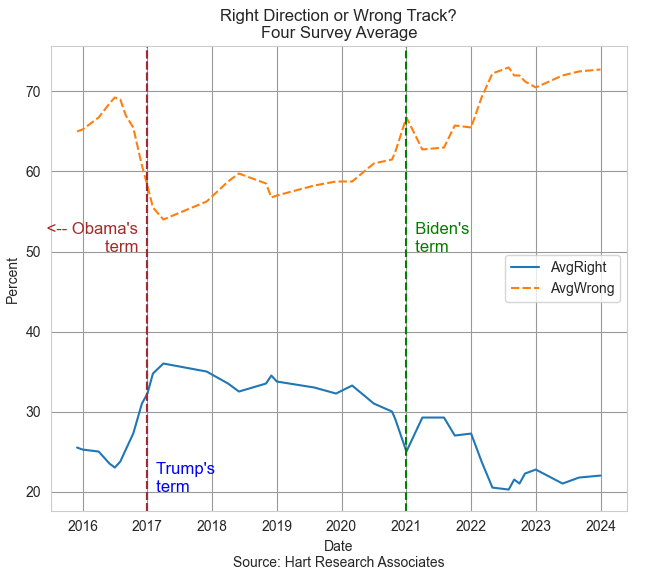
For a decade, the majority of survey respondents regularly answered that they don’t like the direction the country is going. More than half of these surveys were conducted among registered voters only and it doesn’t matter who the President is. The wrong track responses outnumber those who think the country is on the right track. In the graph below I’ve charted a four survey average to smooth the trends in the results. The orange dotted line is the percentage of those who answered wrong track. The blue line indicates those who answered right direction. Less than 10% of respondents have a mixed opinion or are not sure and I did not include those responses in the graph.

Toward the end of Obama’s second term, the percentage of wrong direction responses declined to about 55% before Trump took office in January 2017. From there, the survey responses became increasingly pessimistic. In the final year of Trump’s term negative sentiment shot up in reaction to the pandemic and it kept rising during Biden’s term. The percentage of those with a negative outlook this past month is over 70%, but just a few percent higher than a peak toward the end of Obama’s second term.

Favorability

Given such pessimism about the direction of the country, it is no surprise that a President’s favorability ratings rarely exceed 50%. Survey respondents were routinely asked to rate their feelings toward several public figures. Although both Biden and Trump are subjects of this question for more than a decade, I focused on the responses while both men were in office. The survey has five categories of feelings, from very positive to very negative. I chose just the two favorable categories, very positive and somewhat positive. A chart of the response numbers indicates stark differences in the trend of feelings toward each person. I’ll begin with Joe Biden.

In the first few months of Biden’s term, the sum of positive responses increased from 44% to 50%. Although the Democrats had a political trifecta, their majorities in the House and Senate were slim and prevented passage of controversial legislation like comprehensive immigration reform. The realities of the political process dampened the ardor of progressives who hoped for reforms in immigration, as well as education and child care. The level of moderate feelings, those who answered they were somewhat positive toward Biden, remained anchored at about 20%.

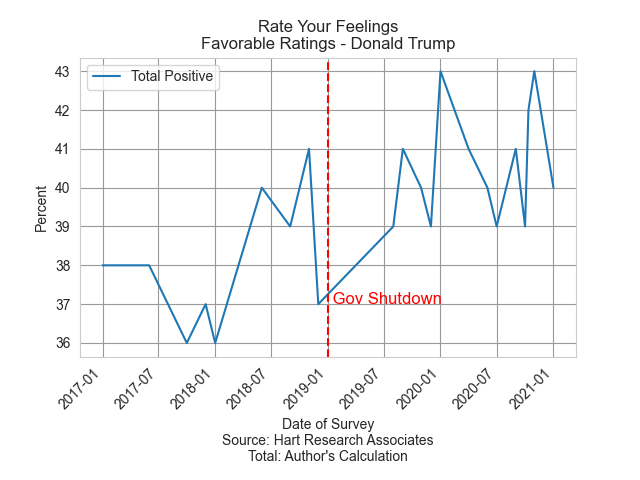
Unlike Biden, the percent of respondents with very positive feelings toward Trump continued to grow during Trump’s term. His disruptive style won him more appeal from ardent supporters than he lost among moderates. Trump’s overall favorability increased slightly during his term from 38% to 40%. Unlike Biden, Trump has a zealous voter base which affords him room to make reckless political postures.

In contrast, Biden’s support is more tempered and results oriented. After an initial positive rating among half of respondents in the early months his very positive ratings in this survey dropped by almost half. The passage of the Inflation Reduction Act in August 2022 helped revive his favorability ratings but the bloom faded after the Republicans won a slim majority in the House a few months later. For Democratic voters, policy choices trump party and person loyalty. With little prospect of further legislative gains in a divided Congress, voter enthusiasm waned.

Party loyalty has long been a central characteristic of Republican voters. Like an operator switching a train track, Trump has steered that loyalty to himself as a person. As such his favorability has been more resilient. In November 2018, midway through Trump’s term in office, the Democrats won the House Majority. Just before Christmas, the Republican-led Congress and Trump were unable to pass an Appropriations bill or a Continuing Resolution. The federal government shut down all non-essential services for a month, the longest government shutdown on record. Trump’s favorability ratings should have taken a hit.

Unlike Biden, Trump’s favorability increased in reaction to the shutdown and the swing of power in the House to Democrats. A wing of the Republican Party, fervent and defiant, continue to fight for control of the party and its agenda. Trump is their champion. The party has evolved from a party holding the political center – think of Mitt Romney – to a reactionary movement of None of the Above. No taxes, no immigration, no Obamacare, and no restrictions on guns to name some prominent issues. Nikki Haley, a Republican challenger to Trump, lost the Nevada primary to a candidate on the ballot named None of these candidates.

After the January 6th riot at the Capitol, fervent support for Trump waned. By June of 2023, survey responses of  very positive had dropped by half to a low of 17 and his total positive sentiment was less than Biden’s numbers. His success in the upcoming election will depend on whether he can re-engage strong sentiment among Republican voters.

These polls demonstrate the strength of Trump’s support in the party. Those in the Republican caucus are afraid of a primary challenge that will cost them their seat. In 2014, the Republican House Majority Leader, Eric Cantor, lost a primary to a Tea Party challenger who received a boost from conservative media. Trump wields a big trumpet and blows it daily. As any parent of a two-year old knows, saying no is easier than making choices that involve compromise. With only a slim majority in the House, loyalty to Trump has made it difficult for Republicans to pass any legislation in the House. Republican congressman Chip Roy from Texas worries that his party will have few accomplishments to attract voters in the upcoming election. However, voters in the coming election will likely cast a rejection vote as in Not Trump or Not Biden. The media will be bombarded with even more negative advertising than usual. Grab a big box of popcorn and settle in.

//////////////

Photo by Emily Morter on Unsplash

Keywords: election, survey, opinion poll, ratings, favorability