
Camouflage

September 27, 2026

By Stephen Stofka

As I have written before, we experience the world through our senses but we engage with the world through our errors. We begin our lives as babies learning from repeated mistakes. We hit ourselves in the face by mistake because our sense of proprioception is not fully developed. We stumble and fall repeatedly while learning to walk. This week I want to explore any advantages we gain by causing others to make errors.

Camouflage

Camouflage is a common strategy to fool others. Most mammals with fur have arrector pili, tiny muscles attached to hair follicles, that cause the hair to lift from the skin when the animal is cold or alarmed. As a function of the autonomic nervous system, the animal has little control over the process so it is not something that animals do deliberately. As a camouflage device, it makes an animal look bigger and may cause an aggressor to misjudge the size of their target and pause before attacking.

Another camouflage technique is hiding. The fur of an Arctic hare or fox changes color in winter and summer, allowing it to blend in to a snowy environment. Cephalopods like octopi and cuttlefish can change color quickly to blend in with their environment, causing other animals, whether predator or prey, to lower their state of precaution.

Every year, the health care industry sells $700 billion of  products, some of which are designed to camouflage some features, others designed to enhance the attractiveness of certain features. A pair of high heels on a woman serve both functions.

Political campaigns are designed to both camouflage and enhance a candidate’s qualities and appeal to voters. A candidate may adopt stronger positions on some issues when running for a House seat, a narrow constituency, than when running for a state wide Senate seat with a varied constituency. Most candidates hide some characteristic of their personal biography. Those with a legislative record may have to shape the story of that record.

Voters select a person on the ballot, but that choice is the result of an elaborate package, like a Trojan horse, assembled by the campaign. Hidden within that package is the candidate and a campaign team of staffers and donors who want access to the legislative castle. It takes a lot of voters to pull that package up the ramp and through the castle doors.

What’s True?

Imagine a poker game where the players have blurred vision. They can’t clearly distinguish a 9 from an 8 from a 3. A player lays down his hand, claiming that he has four 3s and begins to gather the pot toward him. Another player grabs one of his arms and says, “Not so fast. You’ve got two pair, 3s and 8s. I have three 4s. I win the pot.” Some players agree, some don’t. One person pushes another and a fight breaks out.

Political strategists and media messaging make it hard for voters to evaluate their perceptions. “I don’t know what to believe anymore,” is a repeated complaint by voters in focus groups that Sarah Longwell leads. Longwell has been a political consultant for twenty years and has been leading hundreds of focus groups each year since 2019 (Source). A former Republican and a Never Trumper, her recently published book How to eat an elephant: One voter at a time explores the beliefs and sentiments of voters in both parties who must navigate a varied media information stream.

Many voters filter the volume of channels and information by selecting just one or two news sources. Others are passive recipients of whatever news the algorithm feeds them on social media. Over the past four decades, Longwell writes, Republicans have built a well coordinated media echo chamber that carefully shapes news events. They have built an information bubble in response to what Republicans perceive as a liberal bias in the dominant mainstream media. Democratic messaging, on the other hand, is haphazard, as fractured as the media environment. In

Longwell (2026, p. 59) presents several key components of a successful communications strategy. Storytelling, humor and repetition are important. Normalizing ideas and beliefs helps promote them as common sense. “Attaching new arguments to things people already believe is key,” she writes.

Longwell’s advice is constructive. Steve Bannon, Trump’s former campaign strategist, offered a more combative approach. He regarded the mainstream media as the real enemy, not the Democratic Party. He advised a “flood the zone with shit” tactic to keep the media overwhelmed (Source).

Living a Lie

Czechoslovakia was one of the eastern European nations ruled by the Soviet Union. In his 1978 essay The Power of the Powerless, the dissident and later President, Václav Havel described the lack of free speech under Soviet rule. To stay out of trouble with officials, people publicly supported beliefs and claims that they privately disbelieved.

Today, many elected officials in the Republican Party must express a belief that the 2020 election was stolen or risk being primaried and losing their seats, or being sidelined in the party. Liz Cheney, a Republican Representative from Wyoming, was a notable example of losing her house seat to a primary challenger backed by Trump in the 2022 election. Cheney and three other House members who voted to impeach Trump after the January 6th insurrection lost their seats to primary challengers. Two other House members defeated their primary challengers and four members decided to retire rather than fight the MAGA mania that has infected the party.

Bartels and Carnes (2023) found that politicians who echoed Trump’s conspiratorial “stop the steal” claims suffered little damage in the 2022 midterm election (Source). Like citizens of nations under Communist rule, many Republican politicians have played it safe, spouting the MAGA propaganda to avoid a confrontation with Trump.

The Campaign Legal Center has documented over 60 court cases brought by Trump’s legal team. Some were withdrawn before a decision was reached, but none have been successful. Despite the lack of success in the courts, Trump has introduced false and distorted disinformation into the media space. This is the same technique used by Stalin, Khrushchev and other Soviet leaders during the cold war. It is no wonder than the MAGA movement has adopted the same red color featured on Communist flags.

False Certainty

Politicians of all stripes offer simple solutions because people prefer simplicity. We have evolved to make quick judgments on a small amount of information. Todorov et al (2025) found that voters in the 2000, 2002 and 2004 Senate elections picked candidates who appeared competent based solely on their facial appearance. On page 60 of her book, Longwell describes our primary motivations with an acronym – FLAGS – fear, love, anger, greed and sympathy. These instincts are ever in conflict with our rational decision making process.

Daniel Kahneman (2011) describes this conflict as two ways of thinking, fast and slow. We rely on intuition rather than calculation. Repetition makes things appear familiar when they are not. We associate news exposure with frequency of occurrence. If we often hear local media coverage of children kidnapped, we assume that it happens more frequently than it does. People who sell us stuff, whether it is soap or a politician, use our tendency to make these kinds of errors. A manufacturer of a new brand of soap will use a “flood the airwaves” campaign, hoping that the repetition will give us a sense of familiarity about the product. A political campaign uses the same strategy with a candidate, hoping that repeated exposure to an ad for the candidate will impart a sense of familiarity with that candidate.

Bearing the Burden

Most of these strategies have been deliberate attempts to cause confusion or misjudgment in others. Next week I want to explore the unintentional harm that our errors cause others both in the present and future. I hope to see you next week.

/////////////////////

Photo by Hans Veth on Unsplash

Bartels, L. M., & Carnes, N. (2023). House Republicans were rewarded for supporting Donald Trump’s ‘stop the steal’ efforts. Proceedings of the National Academy of Sciences of the United States of America, 120(34), e2309072120. https://doi.org/10.1073/pnas.2309072120

Kahneman, D. (2011). Thinking, fast and slow. Farrar, Straus and Giroux.

Longwell, S. (2026). How to eat an elephant: One voter at a time. St. Martin’s Press.

Todorov, A., Mandisodza, A. N., Goren, A., & Hall, C. C. (2005). Inferences of competence from faces predict election outcomes. Science (New York, N.Y.), 308(5728), 1623–1626. https://doi.org/10.1126/science.1110589
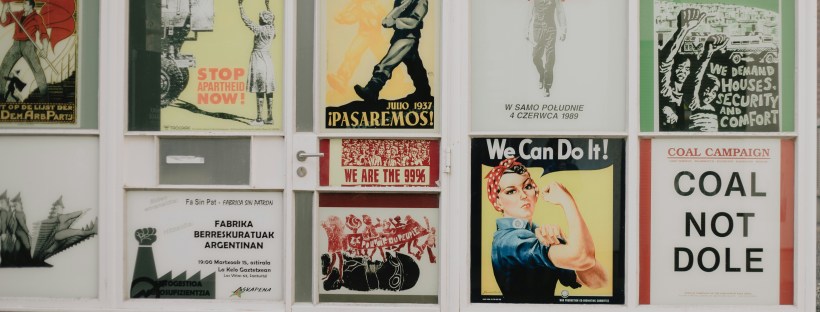
A wall with propaganda posters from several countries

Power and Propaganda

May 17, 2026

By Stephen Stofka

This week I want to explore the nature of propaganda. Is it a form of speech? Is it in the eye of the beholder, like beauty? Did the framers intend to protect propaganda as a form of speech?

Let’s look at a dictionary meaning of propaganda: “information, ideas, or rumors deliberately spread widely to help or harm a person, group, movement, institution, nation, etc.” (Source). The Bible would satisfy that definition. Most of the political spin that comes out of the White House would also satisfy that definition. CYA, or “Cover Your Ass” comments and redirection is a form of propaganda.

I prefer the definition in the Oxford English Dictionary (OED), which describes the meaning as “the systematic dissemination of information, esp. in a biased or misleading way, in order to promote a particular cause or point of view, often a political agenda” (Source). Propaganda is prop-agenda,  a propping up or boosting of an agenda or regime. Propaganda is systematic, not casual. Harm to a group or person is incidental to promoting a particular cause. This helps distinguish retribution  from propaganda.

President Trump often attacks people he doesn’t like in a systematic way, a characteristic of propaganda, but he does not promote a particularly coherent cause. Trump uses repetition as a strategy of branding or labeling. His attacks on Jerome Powell, Chairman of the Federal Reserve, for being “incompetent” and “crooked” is a branding strategy in a campaign of retribution (Source). It is not propaganda.

The former talk show host Rush Limbaugh used repetition and ridicule to brand political figures that he didn’t like. Trump borrows some of those techniques but doesn’t have Limbaugh’s imagination. Limbaugh invented colorful names and phrases to belittle political opponents, and the reach of his radio program helped them become common usage. Examples include tree huggers for environmental activists, feminazis for abortion activists, and drive-by media for mainstream media. Both Limbaugh and Trump emphasized the entertainment aspect of political discourse.

In 1922, journalist Walter Lippmann published Public Opinion, about the shaping of public opinion in a democracy. World War I had birthed a massive propaganda machine in America, led by George Creel, who headed the Creel Committee, appointed by President Wilson to promote America’s involvement in the war (Source). Wilson had won re-election in 1916 on the promise that America would stay out of the war in Europe, and he needed to combat the isolationist sentiments of the majority of Americans. Creel fought “for the minds of men, for the conquest of their convictions” to spread “the gospel of Americanism” to “every corner of the globe,” Lippman quoted Creel (p. 19). So began the evangelical crusade to convince the world that American institutions were superior to those of other nations.

Lippmann wrote “Without some form of censorship, propaganda in the strict sense of the word is impossible” (p. 18). Censorship is a key aspect because it is a police power, a function of government. Lippmann wrote “a group of men, who can prevent independent access to the event, arrange the news of it to suit their purpose” (p. 17). All governments claim that war justifies an additional degree of censorship, but that is an ugly term in the minds of Americans. We have the First Amendment and a free press. Censorship is a term we associate with Communist Russia, China and North Korea.

In 1918, Congress passed the Sedition Act of 1918 to outlaw any “disloyal, profane, scurrilous, or abusive language” about the government, the military or the flag that interfered with the war effort. It was meant as an expansion of the Espionage Act of 1917, and more than a thousand people were prosecuted under both acts. In Debs v United States, the Supreme Court upheld the conviction of Eugene V Debs for an antiwar speech he gave (Source). The decision was unanimous, indicating how little importance the Court paid to individual rights during wartime. Although the Sedition Act was repealed in 1920, the Espionage Act remains in effect to this day (Source).

The first thing American politicians must do is sell censorship to Americans as something other than censorship. An administration may be “combating misinformation” for the “public safety.” Censorship is necessary to “protect national security.” Another ploy is the use of a national emergency. The administration often claims that bold and unconventional action is needed because of a national emergency, but can’t give a coherent explanation of the emergency because of national security. George Carlin (1937 – 2008) was a comedian who famously poked fun at many of the euphemisms we use. He would have found the Trump administration a rich source of material for his stage act.

To justify censorship, American politicians have been in state of war since World War 1. If they are not fighting communism, terrorism, or totalitarianism, they are at war with drugs, poverty, and injustice. War for a noble cause can be used to justify secrecy and censorship. During the Vietnam War, reporters and TV crews had fairly free battlefield access. Both the Johnson and Nixon administrations felt that an honest and open coverage of the war contributed to public skepticism and a lack of support for the war.

During the Gulf War twenty years later, reporters were herded into press pools or embedded with military units. Reporting was subject to military security reviews to prevent the leak of any operational details and for the protection of the troops. Imagery of casualties was kept to a minimum and the emphasis was on the technological prowess of the American military. Those censorship policies continued during the Iraq and Afghanistan Wars. Both Israel and America have tried to hide the costs of the current war against Iran. The Trump administration has suppressed reports of damage to American military bases in the Gulf Coast states. Defense Secretary Hegseth has purposely understated the monetary costs of the war. Israel has effectively imposed a total black out of damage within its country. Both countries have discarded the trappings of democracy, and adopted the tactics of totalitarian regimes.

Did the framers intend propaganda to be included in First Amendment protections? That is not so clear. The first use of the word in its current political meaning did not occur until 1790, according to the historical examples shown in the OED entry. The chaos of the French Revolution and the prospect of war with France led Federalists in Congress to pass the Alien and Sedition Acts in 1798 (Source). They did not refer to propaganda, as such, but used similar terms, like “seditious writings,” “foreign influence,” and referred to the “licentiousness of the press.” The Sedition Act criminalized publishing “false, scandalous, and malicious writing” against the federal government, Congress, or the president. Federalists argued that coordinated attacks by partisan newspapers could undermine public confidence and destabilize republican government.

Before the Acts expired in 1801, several defendants challenged the constitutionality of the Sedition Act. Matthew Lyon, a Republican congressman, was prosecuted and jailed for criticizing President John Adams. Lyon argued the law violated freedom of speech and press protections. Thomas Cooper challenged the constitutionality of the Sedition Act in court, arguing that criticism of government officials was protected political speech. At that time, people disagreed whether federal courts had the authority to strike down acts of Congress. A few years later, Chief Justice Marshall set a precedent in Marbury v Madison that it was the responsibility of the Supreme Court to interpret the Constitution.

Is “false, scandalous, and malicious writing” a form of propaganda? The Federalists were worried about coordinated acts by newspapers, a systemic campaign that would indicate propaganda. Remember that Walter Lippmann introduced a distinguishing characteristic of censorship, which implies a police power. I might think that Fox News broadcasts propaganda, but does Fox News have the power to impose censorship? Viewers can choose to watch or not. The coverage might be biased, but it is not propaganda. That element of censorship can only exist when government institutions produce a biased set of information and opinion in a systematic manner.

The use of propaganda is an existential tool for any political regime. That’s especially so when the media is privately owned. An administration must carefully prune information which undermines its effectiveness. The Trump administration has been particularly aggressive in reducing data gathering at federal agencies that Trump does not like (Source). He has cut staff at NOAA because he doesn’t like climate change. NOAA is responsible for climate modeling and weather forecasting. Farmers in Iowa who no doubt voted for Trump depend on that information to manage their business. He has reduced staff at the CDC and eliminated surveys that gauge reproductive health and infectious disease (Source). Like many conservatives, Trump does not like the Department of Education and would eliminate it if he could (Source video). Most of the staff at the National Center for Education Statistics has been terminated (Source). The department administers student loans and special education funding. It enforces civil rights protections and helps equalize funding across states. How well is the Trump administration managing those areas? Without a national database of information, Trump can avoid scrutiny.

Under the Freedom of Information Act (FOIA), media organizations file hundreds of thousands of requests to gain access to information. If the administration denies the request, the requester can file a lawsuit. There is no central database that compiles FOIA requests by administration or agency, but the number of FOIA lawsuits (not requests) during the first Trump administration far surpassed that of previous administrations (Source).

In casual conversation, we may label something as propaganda, but it is limited to a government with the police power to limit information and prosecute offenders. Detecting propaganda is made more difficult if it aligns with our biases. We may tolerate censorship by an administration that we favor, reasoning that they must have a good reason. However, we are alert to any censorship from an administration that we don’t like. We are suspicious and more apt to believe in conspiracy theories about that administration. In an electorate that is evenly divided, as we have now, half of voters are tolerant of propaganda and half are not. We need to be less tolerant of propaganda and censorship from either party. Yes, it takes time and resources. Yes, we have other concerns in our daily lives. The health and viability of a democratic republic depends on an informed people who are not duped by politicians from either party.

///////////////////

Photo by Sinitta Leunen on Unsplash