The Water That Connects Us

August 28, 2022

by Stephen Stofka

Several events this week share a common theme. President Biden announced a partial student loan forgiveness program.  Fed chair Jerome Powell announced the central bank’s firm commitment to tame inflation. The justice department is pursuing tens of thousands of fraudulent claims related to the pandemic federal relief programs. California Governor Gavin Newsome announced that the state will completely phase out gas fueled cars by 2035. What do these four events have in common? Government officials taking action to shield or relieve individuals from some oppressive force – a debt burden, rising prices, a pandemic, and a contributing cause to climate change. Government is a raft, an anchor of safety that we must share if we are to keep our heads above the water that connects us.

The physical world does not care whether human beings acknowledge or deny climate change. In 2013 the IPCC released their fifth assessment of the global climate. They were careful to note that they could not project individual small weather events like thunderstorms but that there would be more extreme weather events. Tree ring data indicates that this two decade drought in the west last occurred 1200 years ago. Agriculture uses 80% of the total amount of water humans use and have been severely impacted by water rationing. The federal government and states have spent billions fighting fires throughout the west. In recent days several southern states have experienced “1000 year” floods. They have declared emergencies to trigger federal assistance for cleanup and rebuilding.

The sun pours a flow of energy on the earth. Greenhouse gases like carbon dixoide retard the escape of the heat from that energy. California’s initiative is a key declaration of an aspirational agenda to lessen the release of greenhouse gases.  Building an infrastructure for thousands of electric vehicles is a Herculean task. So was the journey from Independence Missouri on the Oregon Trail in the 19th century. More of us are realizing that things have gotten to a point that we have to make some changes whether we like it or not. California has declared its intention to start the journey. Let’s hope more states will follow.

Inflation is oppressive. In a Jackson Hole summit speech this Friday Fed Chairman Jerome Powell stressed the Fed’s  commitment to taming inflation. “Inflation feeds on itself,” he said. As people come to expect higher inflation they may buy more now, making choices that actually accelerate inflation. When inflation is low, businesses and people no longer need to factor in rising prices as they make future plans. Former Fed Chairman Allan Greenspan called it “rational inattention.” The Fed has a twin policy mandate from Congress – full employment and stable prices. Because unemployment is so low the Fed feels that they can focus their policy tools on curbing inflation. Powell warned that rising interest rates would have a negative impact on both economic growth and employment. The stock market fell more than 3% in response to the Fed’s determination to keep raising rates until inflation has returned closer to their target.

David Farenthold (2022) reports that the Justice Department is pursuing tens of thousands of fraudulent claims under the CARES act. Three relief programs totaled $5 trillion, $3.1 trillion in the spring of 2020 and $1.9 trillion under the new Biden administration in the spring of 2021. Because there are so many cases, those who stole $10,000 will probably escape prosecution as investigators tackle claims with larger amounts. The Labor Department has 39,000 cases of fraudulent unemployment claims pending. The Small Business Administration has over two million fraudulent claims to investigate and verify. So far, the Justice Department has charged 1500 and secured 500 convictions. During the pandemic, Congress reached out. Many took advantage.

President Biden announced a student loan forgiveness program of $10,000 for each student with outstanding student debt and an income below $125K. The debt relief does not apply to those pursuing advanced medical and law degrees. A surge of college enrollment before and after the Great Recession drove student loan debt much higher. For-profit colleges overpromised well-paying careers to attract lower income students who qualified for federal grants and loans. Those low-income students who qualified for Pell grants will be eligible for up to $20,000 of student loan forgiveness. This will help minority students and women who typically earn less even after earning a BA degree. Most of those who graduate from 4-year schools come from the top 50% of incomes, and are endowed with more financial and educational resources prior to entering college. Whether a president has the power to forgive student loan debt is a matter for the courts. Mr. Biden’s executive action will surely be challenged.

Former President Ronald Reagan once quipped “The nine most terrifying words in the English language are: I’m from the Government, and I’m here to help.” Despite his rhetoric, Reagan headed a big spending government that helped certain groups of people. Communities near military bases appreciated his military buildup in the fight against the Soviet Union. Investment and savings banks appreciated the 1984 and 1986 bailouts from his administration. High interest rates during the early 1980s drove the economy into a deep recession and curbed inflation but crippled debt-burdened farmers. Many family farms were sold to large agricultural holding companies. Military contractors and finance companies got relief. Farmers did not.

The founders of our country thought that the business of government was to protect people from oppressive burdens. Then as now we argue about whose burdens, who pays and how they should be relieved. We are all interconnected, swimming in the same pool. Government is a big raft, a temporary rest from a lifetime of staying afloat. At times we appreciate the hand up when someone says, “I’m from the government and I’m here to help.”

////////////////

Photo by Jong Marshes on Unsplash

Fahrenthold, D. A. (2022, August 16). Prosecutors struggle to catch up to a tidal wave of pandemic fraud. The New York Times. Retrieved August 25, 2022, from https://www.nytimes.com/2022/08/16/business/economy/covid-pandemic-fraud.html

United Nations. (n.d.). United Nations Charter. United Nations. Retrieved August 26, 2022, from https://www.un.org/en/about-us/un-charter/full-text

Forgiveness

January 24, 2021

by Steve Stofka

Some members of the Democratic Party have called for a forgiveness of all student debt, which the Federal Reserve estimates at more than $1.7 trillion, which has doubled since the onset of the financial crisis and recession in 2007-8. On the campaign trail, President Biden seemed receptive to a forgiveness of $10,000 as a uniform application of policy (Urban, 2020).

Many of us react instinctually to debt forgiveness, ready to condemn the idea outright because we were taught as children to pay our debts. The ancient Greeks committed individuals and families to slavery for failure to pay their debts (ABI, n.d.). The Romans allowed creditors to dismember debtors. American colonists had debtors flogged, ears cut off and imprisoned.

Our laws have become more forgiving in the past three centuries, but the attitudes of many Americans have not improved as much. In the depths of the 2009 recession, CNBC reporter Rick Santelli criticized a mortgage debt relief program and ignited a storm of passion that contributed to the formation of the Tea Party movement. Will a student debt forgiveness program arouse similar sentiments?

A week before Congress passed the CARES act on March 27, 2020, Education Secretary Betsy DeVos suspended payments on federal student loans payments (DOE, 2021). The CARES act formalized that suspension but only for six months. President Trump then directed her to continue the suspension of payments and waiver of interest. President Biden has continued that policy until September 2021.

Who got the loan money? Some of it went to for-profit institutions. Students at for-profit institutions total two million, less than 5% of the 42 million students enrolled in higher education (Bennett et al., 2010). During the financial crisis, for-profits received a lot of criticism for abusive recruitment practices, low graduation rates, high default rates and poor student outcomes. Under tightened regulations during the Obama administration, several lost eligibility for federal student loans and subsequently shut down.

Ok, goes the argument, some students got a bad deal. Shouldn’t they still have to honor their contracts? What if the government forgave all debts involving a product or service which did not perform as promised? The buyer would no longer have to be diligent about quality. Eventually the quality of goods and services would decrease. Those who use this argument see debt forgiveness of any kind as a slippery slope to the downfall of the entire economy and the impoverishment of society.

The bulk of the $1.7 trillion of outstanding debt was paid to public educational institutions, who have raised tuition far above the general rate of inflation. Since 1985, inflation adjusted tuition has doubled (NCES, 2021). Over the past two decades, states have cut back their funding for higher education, throwing the extra burden onto students. In analyzing the shift, Douglas Webber found that the student burden had tripled since 2000 (2017).

Where did the money go? To state institutions. Imagine each student wearing a backpack loaded with 10 pounds of debt. State governments took 20 pounds of weight off their books and put it in the backpacks of the students, those least able to bear that burden. A forgiveness of debt, total or partial, would take some or all that weight out of the backpacks of each student and put it on the Federal balance sheet.

At its core, debt is about justice, a subject that we struggle to discuss rationally because we are social animals who process the subject of fairness with our monkey brains. In 18th century England, the punishment for crimes, including debt, was in proportion to the outrage of society at the criminal. In a more rational approach, the philosopher and legislator Jeremy Bentham introduced a “felicity calculus” that would guide legislators and judges to enact punishments that were proportional to the consequences of a crime and the profit of the crime to the criminal.

Our laws no longer treat debtors as criminals, but in the case of a student’s debt, how is society to judge the profit that a student will earn over a lifetime from their education? On average they will make a higher income and pay higher taxes. If all student debt is forgiven, one student will receive a benefit of $100,000 while another will receive a $30,000 benefit. Is that just? I personally think a $10,000 uniform forgiveness is more just. A debt forgiven cannot be unforgiven; moderation is the key.

We can never agree on issues of distribution of benefits. Small children argue whether they got the same amount of chocolate milk if the glasses are shaped differently. In the parable of the workers in the vineyard, workers who only worked one hour received the same amount of money as those who had worked all day. Is that fair? The landowner insisted that it was his money to do whatever he wanted.

In a democracy, we have an instinctual sense that the Federal government’s money does not belong to the government. Some of us claim an equal say in how that money is spent, whether we pay a small amount or a large amount of federal tax. Some of us decide the justice of debt forgiveness as though the debt was owed to us personally. Some of us don’t see this as a personal issue; the federal debt is as remote as the Andromeda galaxy. Those two groups cannot agree.

In a democracy, we argue about the rules. We compete to elect the people who make the rules. Half of us like the rules; half don’t. A democracy survives only as long as each half can forgive the other half for their tyranny while they were in the majority. As long as each half feels that they are getting a turn at making the rules, there is a grudging tolerance, if not forgiveness, and a democracy survives. When one half of the people feel as though they are shut out of the rule making process, the fighting starts. If we can’t practice some forgiveness we don’t deserve a democracy. Tyranny and aristocracy are the political choices of those who don’t forgive. I’ll take democracy.

///////////////////

Notes:

Photo by Pang Yuhao on Unsplash

American Bankruptcy Institute (ABI). (n.d.). A (Very) Brief History of Bankruptcy and Debt in the West. Retrieved January 23, 2021, from https://www.abi.org/feed-item/a-very-brief-history-of-bankruptcy-and-debt-in-the-west

Bennett, D., Lucchesi, A., & Vedder, R. (2010, June 30). For-Profit Higher Education: Growth, Innovation and Regulation. Retrieved January 23, 2021, from https://eric.ed.gov/?id=ED536282

NCES. (2021). The NCES Fast Facts Tool provides quick answers to many education questions (National Center for Education Statistics). Retrieved January 23, 2021, from https://nces.ed.gov/fastfacts/display.asp?id=76

Urban Institute & Brookings Institute, Tax Policy Center (Urban). (2020, October 15). An Updated Analysis of Former Vic President Biden’s Tax Proposals. [PDF]. Retrieved from https://www.urban.org/sites/default/files/publication/103075/an_updated_analysis_of_former_vice_president_bidens_tax_proposals_1.pdf

U.S. Dept. of Education (DOE). (2021). Coronavirus and Forbearance Info for Students, Borrowers, and Parents. Retrieved January 23, 2021, from https://studentaid.gov/announcements-events/coronavirus

Webber, D. A. (2017). State divestment and tuition at public institutions. Economics of Education Review, 60, 1-4. doi:10.1016/j.econedurev.2017.07.007

The Sense and Cents of a College Education

October 21, 2018

by Steve Stofka

Should a young person invest money in a college education? Let’s look at the question from a financial perspective. Building a higher educational degree is as much an asset as building a house. Let me begin with the hard numbers.

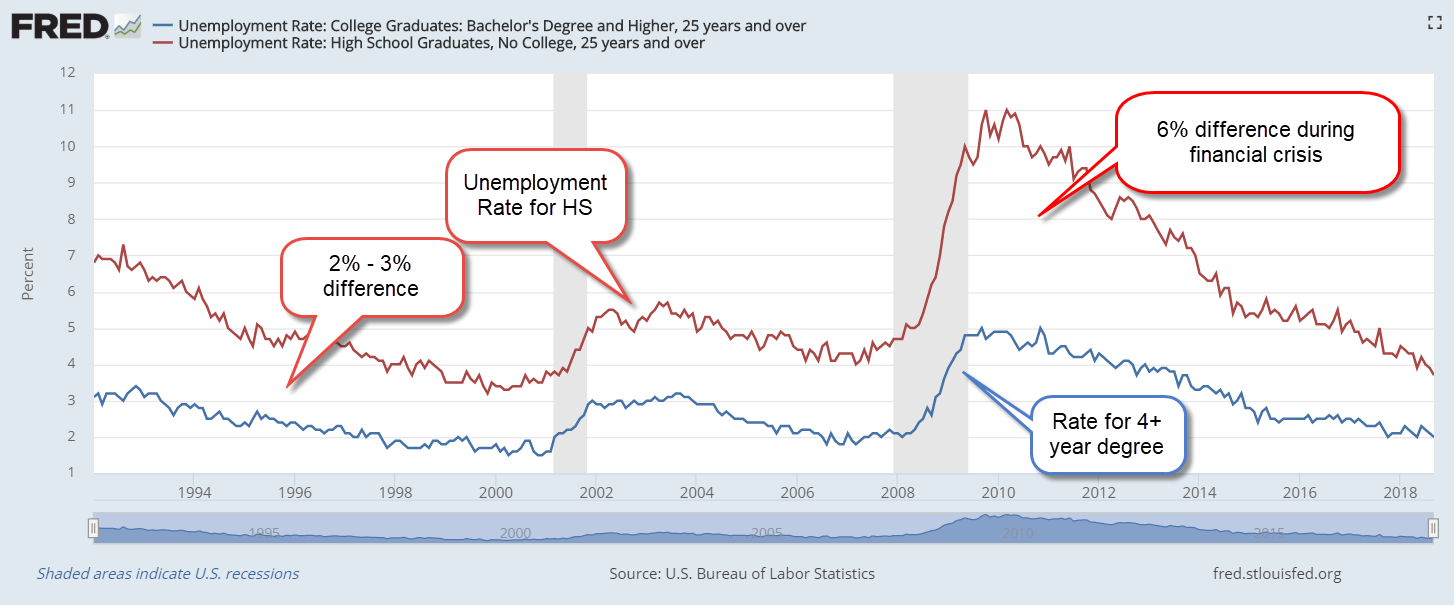
Employment: A person is more likely to be employed. Here is a comparison of those with a four-year degree or higher and those with a high school diploma. The difference in rates is 2% – 3% during good times and as much as 6% during bad times.

UnemployRateCollVsHS

Is the unemployment rate enough to justify an investment of $50K or more in a four-year degree? Maybe not. During the worst part of the financial crisis, ninety percent of HS graduates were working. Why should a diligent person with good work skills spend time in college? Most college students take six years to complete a four-year degree. They must spend four to six years of study in addition to the loss of work experience and earnings in those years. The unemployment rate is not a decision closer.

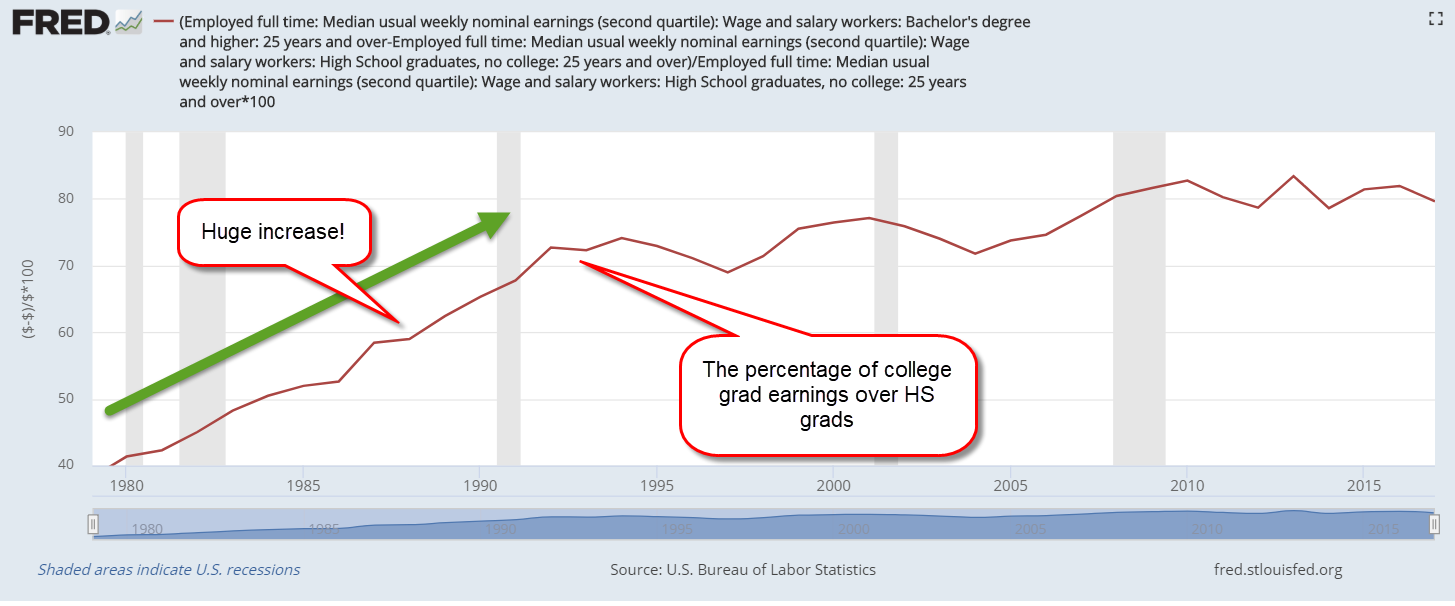
Earnings: In 1980, when those of the Boomer generation were taking their place in the workforce, college grads earned 41% more than HS grads. Today, college grads earn 80% more. That gap of $567 per week totals almost $30,000 in a year and is less than the monthly payment on a $50,000 loan (Note #1). Can a person expect to earn that much additional when they first graduate? No, and that’s why many students struggle with their loan payments in the decade after they graduate.

MedWklyEarnCollVsHS

Maybe that earnings difference is a temporary trend. The debt is permanent. Should a young person take on a lot of debt only to find out the earnings difference between college and high school graduates was temporary? Unfortunately, that’s not the case. The big shift came in the 1980s when the gap in earnings grew from 41% to 72% in twelve years.

EarnDiffPctCollVsHS

There were several reasons for the explosive growth in that earnuings gap. Many Boomers had gone to college to avoid the Vietnam War draft. As they crowded into the workforce in the late 1970s and 1980s, they wanted more money for that education.

During the 1980s, the composition of jobs changed. Steel manufacturing went overseas to smaller and more nimble plants which could adjust their outputs more economically than the behemoth steel plants that dominated the U.S.

Automobile companies in Michigan closed their old plants. Chrysler needed a government bailout. The manufacturing capacity of Asia and Europe that had been crippled by World War 2 took several decades to recover. The U.S. began to import these cheaper products from overseas. As high-paying blue-collar jobs diminished, the advantage of white-collar workers grew.

As more companies turned to computers and the processing of information, they wanted a more educated workforce that could understand and execute the growing complexity of information. Manufacturing today relies on computer programs that require a set of skills that are more technical than the manufacturing jobs of the past.

A oft-repeated story is that the signing of NAFTA in 1993 and the admittance of China into the World Trade Organization were chiefly responsible for the growing gap between white collar and blue collar workers. I have told that story as well, but it is incorrect and incomplete. As the graph above shows, that gap has grown modestly in the past twenty-five years. The big shift happened in the 1980s when the first of today’s Millennials were in diapers and grade school.

When we adjust weekly earnings for inflation, we can better understand the evolution of this earnings gap. In the past forty years, high school graduates have seen no change in median weekly earnings. From 1980 to 2000, their earnings declined. The 25% growth in the earnings of college graduates came in two spurts: in the mid to late 1980s, and during the dot-com boom of the late 1990s.

EarnInflAdjCollVsHS

Since this trend has been in place for decades, college students can assume that it will likely stay in place for the following few decades. Like the mortgage on a home, the balance on a student loan doesn’t increase every year with inflation, but the earnings from that education do and they have increased more than inflation. The payoff to a four-year degree is the difference in earnings. That is the decision closer.

Notes:

  1. Using $50,000 loan for ten years at 6% interest rate at Bank Rate.

Consumer Credit

It is very iniquitous to make me pay my debts; you have no idea of the pain it gives one. – Lord Byron

October 7, 2018

by Steve Stofka

The total of all consumer loans, excluding mortgages, is almost $4 trillion. The Federal government owns $1.5 trillion of that total, most of which is student loans, which have tripled in the past decade. According to the Dept. of Education, 11% of student loans are in default, three times the credit card default rate and more than ten times the auto loan default rate (Note #1).

Over a five-decade period, the stock market has risen when consumer credit rose. Below is a chart of consumer debt outstanding as a percent of GDP (Note #2).

ConsCreditPctGDP

This a decade long indicator, not a timing tool. Notice that the ratio of credit to GDP (blue line) rises during recessions (shaded gray) when GDP, the bottom number in the fraction, falls. When the recession is over, credit falls as people fall behind in their payments, loans are written off, etc. Now GDP starts rising again while the top number, credit, is falling.

Auto loans make up 28% of outstanding consumer credit and currently have less than a 1% default rate. If we adjust the total of consumer credit by the extraordinary growth in student loans, auto loans make up 39% of total consumer credit (Note #3). We saw a similar percentage in the mid to late 1980s when savings and loans aggressively extended auto loans and mortgages. In the late 1980s and early 1990s, a third of all S&Ls failed.

Typically, people do not count vehicle depreciation in their budget, but they should, just as businesses do. Example: the average yearly take-home pay is $52K. Let’s say the average car, new and used, is $24K and depreciates $2400 a year (Note #4). Let’s say that the average person saves about $2400 a year to make the math easy. The $2400 that goes in the savings bank is simply offsetting the $2400 in depreciation. There is no savings.

In addition to depreciation, many of us don’t include the cost of inflation in our budget. Six years from now, a replacement car, new or old, could cost an additional 15%. Without adjusting for these “hidden” costs, we may think we are getting by. Over time, however, we add these hidden costs to our credit balances. We put less down on the next car and get longer auto loans. The average loan length is now 5-1/2 years. As soon as we are done paying off one car, it is time to get another (Note #5).

The economy is strong, and it needs to stay strong so that households can pay back their loans. The ultra-low interest rates of the past decade have reduced the monthly debt payments for many. For the past two years they have leveled at 5.6% of disposable personal income, the mid-point of the past forty years. For every $20 that a person takes home, they are paying $1 to service their consumer debt. The average yearly debt service payment would be about $3000 on a $52K take-home pay.

In response to the strong economy, the Federal Reserve has been raising interest rates to a more normal range. The 30-year mortgage rate just hit 5% this past week. Rising interest rates raise the monthly payments and reduce the loan amounts that borrowers can qualify for.  Many younger workers are unfamiliar with a world of normal interest rates.  They will have to learn a new math.

////////////////////////////

Notes:

1. Student default rates . Default rates reported by the credit agency Experian .
2. More detail on consumer credit here at the Federal Reserve ()
3. I made the adjustment by subtracting $1 trillion in Federal student loans from the current total of credit. This pretends that Federal loans grew 15% in the past decade, not 300%.
4. The average amount financed on a used car is $17,500 (FRED series DTCTLVEUANQ). New car loans average $29,800 (FRED series DTCTLVENANM).
5. A buyer of a new car holds it for 71 months according to Auto Trader.

////////////////////////////

Misc

Amy Finkelstein is a MacArthur genius award recipient who studies trends in health care. Proponents of Medicaid expansion projected that lower income families would better control and plan their medical care under Medicaid. Instead they have used the ER even more.  She found that people visit the ER more, not less. Although families report better health and more confidence in their financial security because of Medicaid expansion, measureable health outcomes have shown no change. WSJ article (paywall) is here. Her citations on Google Scholar.


The Hunt, Part 2

July 22, 2018

by Steve Stofka

Last week, I showed the inputs to the credit constrained economy as a percent of GDP. I’ll put that up again here.

CreditGrowthFedSpendPctGDP

This week I’ll add in the drains but first let me review one of the inputs, bank loans. Focus your attention on that period just after 9/11, the left gray recession bar,  and the end of 2006, just to the left of the red box outlining the Great Recession on the right.  For those five years after 9/11, the banks doubled their loans to state and local governments, a surge of $1.4 trillion. The banks increased their household and mortgage lending by $5.3 trillion, or 67%. Why did banks act so foolishly? Former Fed chairman Alan Greenspan couldn’t answer that. We have a partial clue.

For 4-1/2 years after 9/11 and the dot-com bust, there was no growth in credit to businesses, a phenomenon unseen before in the data history since WW2. The banks reached out to households, as well as state and local governments because they needed the $1 trillion in loan business missing on the corporate side (#1 below).

There are four drains in the economic engine – Federal taxes, payments on loans, bad debts and the change in bank capital. State and local government taxes are not a drain because those government entities can not create credit. The change in bank capital reflects the changes in the banks’ loan leverage and their confidence in the economy. During the 1990s and 2010s the sum of the inputs and the drains remained within a tight range of about 1/7th of GDP.

InputLessDrains

The results of bad policy during the 2000s are shown clearly in the graph. In addition to the surge in bank loans, the Federal government went on a spending spree after 9/11. There was too much input and not enough drain. The reduction in taxes in 2001 and 2003 exacerbated the problem. There was less being drained out. Asset prices absorb policy mistakes until they don’t – a life lesson for all investors.

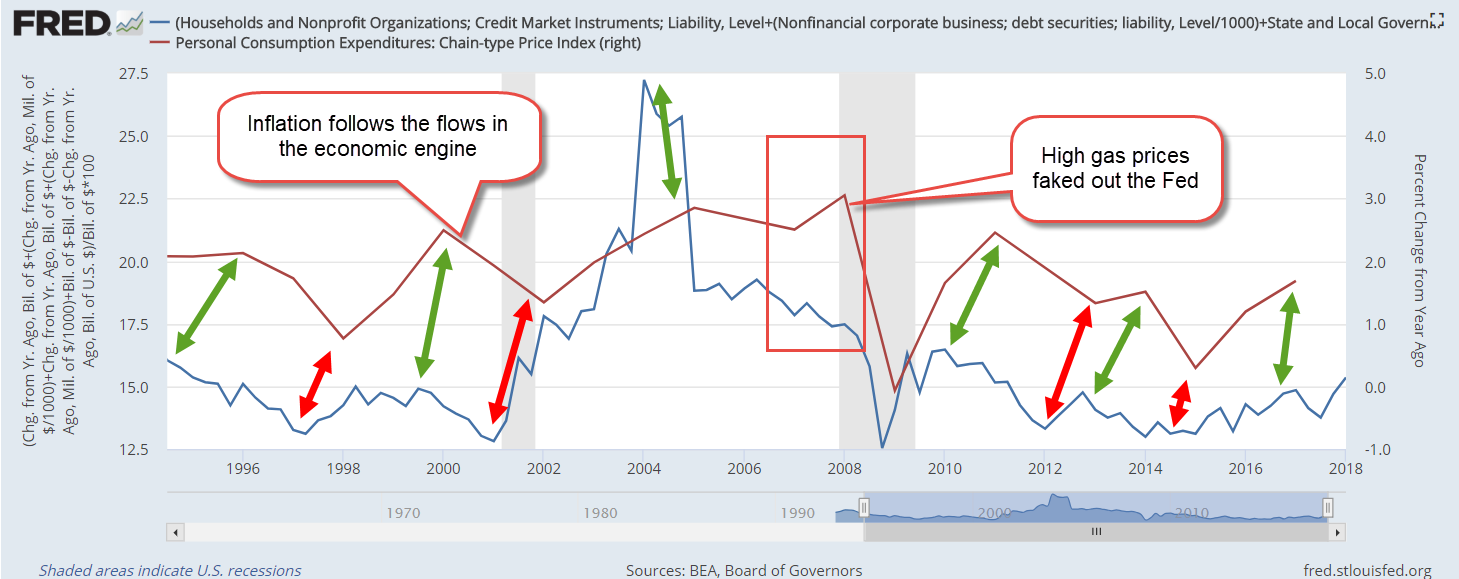
Let’s add in a second line to the graph – inflation. The rise and fall of inflation approximates the flows of this economic engine model with a lag time of several months. I’ve shown the peaks and troughs in each series.

InputLessDrainsVsPCE

Look at that critical period from 2006 through 2007. The Fed kept raising rates in response to rising inflation (the red line), driven primarily by increases in the price of oil.  The Fed Funds rate peaked out at 5-1/4% in the summer of 2006 and stayed at that level for a year. The Fed misread the longer term inflation trend and contributed to the onset of the recession in late 2007. The net flows in the engine model (blue line) indicated that the long term trend of inflation was down, not up.

Where will inflation go next? Using last week’s theme, follow the hounds! Who are the hounds? The banks. The inflow of credit from the banks is the primary driver of inflation. Why has inflation in the past decade been low? Because credit growth has been low. Where will inflation go next? A gentle increase – see the slight incline of the blue line at the right of the graph. Contributing to that increase were last year’s tax cuts. Less money is being drained out of the engine.

Too much flow into the economic engine or an improper setting of interest rates – these mistakes are absorbed by assets, which are the reservoirs of the engine. Stocks, bonds and homes are the most commonly held assets and most likely to be mispriced. During the early to mid 2000s, the mistakes in input were so drastic that the financial crisis seems inevitable when we look in the rear view mirror. During the past eight years, the inputs and drains have remained steady, but interest rates have been set at an inappropriate level. Again, we can anticipate that asset prices have been absorbing the mistakes in policy.


//////////////////////////

1. In the last quarter of 2001, loans to non-financial corporate business totaled $2.9 trillion and had averaged 6%+ growth for the past decade. Anticipating that same growth would have implied a credit balance of $3.9 trillion by the end of 2006. The actual balance was $3.1 trillion.

Ten Year Review

January 15, 2016

10 Year Review

Before I begin a performance review, I’ll refer to an article  on the errors of comparing our real world portfolio returns to the optimized returns of a benchmark index.  An index stays fully invested, has no trading costs, taxes or fees.  An index has survivor bias; companies that go out of business or don’t meet the capitalization benchmark of the index are effortlessly replaced, so there is no risk.  Share buybacks benefit an index but not our portfolio.

The article contains some prudent and realistic recommendations: the importance of preserving our savings, a balance of risk and return that will meet our goals, AND our time frame.  As we review the performance of the following portfolio allocations, keep those caveats in mind.  If a model portfolio earned 8% per year, use that as a rough guideline only.

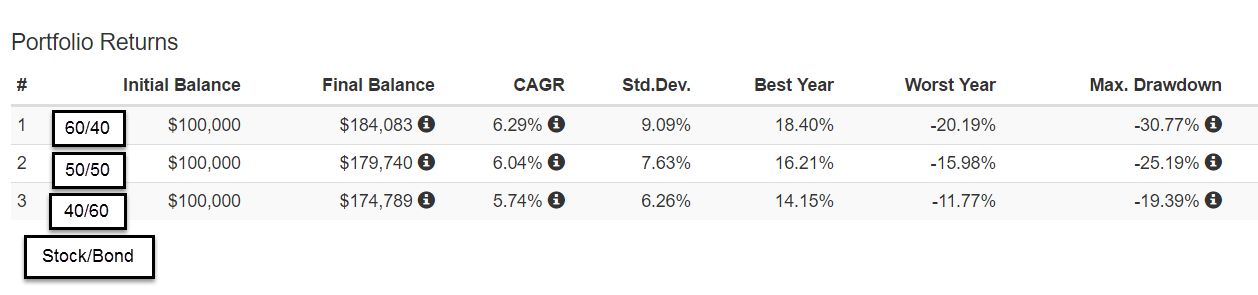
A 60/40 stock/bond portfolio returned an annual 6.3% over the past ten years with a maximum drawdown (MDD) of 30%.
A  50/50 mix returned 6% with an MDD of 25%.
A 40/60 mix returned 5.75% with a MDD of 20%.

A difference of 10% in allocation equalled a .3% in annual return, and a 5% change in MDD.  Let’s put that .3% difference in dollars and cents.  Over a ten year period, a $100,000 portfolio earning .3% extra return per year equalled about $43 extra per month, or about $1.40 per day.  Why is this important?  For whatever reason, some people worry more than others and may be willing to accept a lower return in order to sleep better at night.

Not all ten year periods will have the same response to various allocations.  The majority of ten year periods will include a recession, but this past ten years included the Great Recession. Let’s look at the historical effect of portfolio allocation during the past ten years.  In the chart below you can see the annual returns of various balanced allocation mixes shown in the left column.  At the end of 2009, the 10 year results show the results of two downturns: the 2001 – 2003 swoon and the 2007 – 2009 crash.

Note that the more aggressive 60/40 allocation has a lower return than the cautious 40/60 allocation during the years 2009-2011.  As we move forward in time, the effects of the 2001-2003 swoon diminish and, starting in 2012, the more aggressive allocation earns a better return.

Not shown in the chart are the results of a 100% allocation to stocks during the ten year period 2000-2009, the first column in the chart above.  A 40/60 allocation had a return of 3.8%.  A 100% allocation to large cap stocks had a LOSS OF 1% per year.

During the 10 year period 2007-2016, a 100% allocation to stocks returned 6.8% annually, a 1/2% higher return than the 60/40 mix, but the drawdown was 51%, far more than the 30% drawdown of the 60/40 portfolio.

High Winds or Hurricane?

A person who spends twenty years in retirement can count on at least two market downturns during that time.  Here’s how MDD, or drawdown, can affect a person’s portfolio.  I’ll present a more extreme example to illustrate the point.  Imagine an 80 year old retiree with a portfolio devoted 100% to stocks.  For several years, she had been withdrawing $40,000 from a portfolio that had a balance of $600,000 in the fall of 2007.  Projecting that her portfolio could earn a reasonable return of at least 7% per year, or $42,000, the balance looked secure.

But by March 2009, a period of only 18 months, the high winds had turned to a hurricane.  Her portfolio, her shelter in the storm, had lost 50% of its value, an MDD or drawdown of approximately $300,000.  During those 18 months, she had also withdrawn $60,000 for living expenses, leaving her with a balance of about $240,000 in the spring of 2009, the low point of the stock market.

Only 18 months earlier she had projected that she could maintain a minimum portfolio balance of $600,000. She had gnawed her nails raw as the market lost 20% by the summer of 2008, then sank in September when Lehman Bros. went bankrupt, then continued to lose value during the winter of 2008-09.  When would it end?

In March 2009, she had only 6 years of income left before her savings were gone.  Unable to stand the loss of any more value, she sold her stocks for $240,000 – at exactly the wrong time, as it turned out.  Her $240,000 earned little in a money market, forcing her to: 1) cut back the amount of money she withdrew from her portfolio to about $24,000 per year, and 2) hope she died before she ran out of money.

Of course, most advisors would NOT recommend that an 80 year old devote 100% of their savings to stocks.  BUT, some retirees might – and have – adopted a risky strategy to “whip” a portfolio to get more income or capital appreciation the way a jockey might do with a tired horse.  On the other hand, some 80 year olds with a very low tolerance for any kind of risk might have all of their savings in cash and CDs, a 0/100 allocation.

Now let’s imagine that our retiree had a cautious 40/60 balanced mix.  She would have had a drawdown of 20%, or $120,000, during the Great Recession.  After withdrawals for living expenses, she still had a balance of about $420,000 in March 2009. At a conservative estimate of a 5.5% annual return, she could have prudently drawn down her portfolio $25,000 – $30,000 for a year and waited. This is important for seniors: an allocation that allows some temporary flexibility in the withdrawal amount from a portfolio.

By the end of 2009, her portfolio had gained about 24%.  After living expenses of about $22,000 taken from the portfolio during the last 9 months of 2009, she had a balance of more than $500,000.  Her balanced allocation allowed her to wait longer for the market to recover.

In 2010, she could once again take her $40,000 living expense withdrawal and still have a $530,000 portfolio balance by the end of that year.  She has weathered the worst of the storm. At the end of 2016, she continued to take out $40,000 (adjusted upward for inflation) and still has a portfolio balance of $486,000.

Finally, her 40/60 allocation mix kept to a rule I have mentioned from time to time: the five year rule. If she wanted to take approximately $40,000 from the portfolio each year, she should have a minimum of 5 years, or $200,000 in bonds and cash – the “60” in the 40/60 allocation mix.  In the fall of 2007, she had $360,000 (60% of $600,000) in less erratic value investments.  This rule helped her withstand the storm winds of the Great Recession.

//////////////////////////

Seniors at Risk

Although the number of loans to those 65+ are less than 7% of the total of student loans, a shocking 40% of these loans are in default.  Most of these loans were cosigned by seniors for their children or grandchildren. The law allows the Federal Government to garnish or lien Social Security and other federal payments to cure the loan defaults.  Readers with a WSJ subscription can read the article here or Google the topic.

//////////////////////////

Hot Housing Markets

In a recent analysis, western cities rule Zillow’s top 10 housing markets for valuation increases.

///////////////////////////

Take this job and shove it!

The latest JOLTS report from the Labor Dept. shows the highest quits rate in private industry since the housing boom in 2006. Employees confident of finding another job are more willing to voluntarily leave their job, and have driven the rate up to 2.4% from a low of 1.4% in the 2nd half of 2009.

Statista compiles data from around the world, including this revealing tidbit: 26% of jobs in the U.S. are unfilled after 60 days, the highest percentage in the developed world. Germany ranks 2nd at 20%, and our neighbor to the north, Canada, comes in at nearly 19%.

What lies behind this data is a mismatch.  Employers may be requiring skills that job applicants don’t have.  Job applicants may want more money or other benefits than employers are willing to pay.

//////////////////////////

Obamacare Repeal

The Committe for a Responsible Federal Budget (CRFB) – yep, it’s a mouthful – has projected costs to repeal Obamacare in whole and in part.  Using both conventional, or static, budget scoring and dynamic scoring (google it if you’re interested), they guesstimate a 10 year cost of $150 to $350 billion for full repeal of the ACA.

Repeal of ACA’s insurance coverage would actually save a lot of money, more than $1.5 trillion. The net effect is a cost, not a savings, because of the $2 trillion in tax revenue on higher incomes that is built into the ACA law.

CRFB analysts have put a lot of work into these projections, including a breakdown of repealing just parts of Obamacare or delaying repeal of certain ACA provisions.  Since the Republican Congress is likely to keep some provisions, readers who are interested might want to come back to this link in the coming weeks as the discussion of this issue unfolds.