Tidbits

This week is a “tidbit dump” of information that I thought was interesting.

– Local governments, municipal and county, employ 14.2M people, about 10% of the workforce.  Local government employs more people than the entire manufacturing sector does.  Less than half of the population of the U.S. works.

– The National Ass’n of Realtors offers assessments of local real estate markets, including employment, occupation mix, mortgage defaults.  Current reports are available by subscription but recent reports are free.

Federal and state governments have large pension and employee costs that are tied to the CPI or inflation rate.  Social Security payments rise with the CPI.  Federal, State and local government employees receive annual cost of living adjustments (COLA) to their pay that is based on the CPI.  The amounts of money involved are staggering.  Retirement benefits will total about $500B this year.  A 1% increase in the CPI is an additional $5B paid under this program alone.

– Doug Short is a retired IT consultant whose web site contains various commentaries on markets and personal economics.  Here is a historical overview and explanation of the Consumer Price Index.  It includes a decade long chart of the percentage rise of the various components of the CPI.  The rather steady rise of the food component over the past 10 years contradicts the Federal Reserve’s assertion that food is a volatile component.  The Fed leaves this supposedly volatile component out of it’s calculation of “core CPI” to get what the Fed considers a more accurate assessment of inflation pressures.  This methodology understates inflation, in my opinion, and contributes to the poor monetary policy that the Fed has adopted in the past 15 years.

– In an interview with former President Bill Clinton after the shooting of Congressperson Gabrielle Giffords :
These words[political invective] fall on the serious and delirious alike, they fall on both those who are connected and unhinged.

– Each year U.S. national parks receive as many visitors as the population of the U.S.

– Should a person nearing retirement take an early Social Security payout or wait? Steve Vernon with CBS Money Watch examines the pros and cons in this article.  The reader comments are as interesting as the article.

Money Machine

Investors who consider themselves to be conservative will sometimes keep a relatively small amount of money aside for riskier assets to “juice” overall returns.  This riskier pool may be 5% or less of a total portfolio and can be targeted toward smaller companies with higher growth rates and potentially higher returns.

What could be more enticing than investing in a Chinese natural resources company that is listed on the Nasdaq global exchange?  China is a fast growing economy, a growing middle class and a major manufacturing center which uses natural resources.

A Yahoo Finance article and video reviews one particular pitfall of investing in a company whose “home” is in a country that has less stringent financial oversight of publicly listed firms.  As on a “wet vac”, money machines that entice investors with the promise of higher returns have two ports, one for suction and one for blowing.

Ka-Ching to the Future

“Sell in May and go away” is an old maxim for stock traders and is based on the sentiment that in most years the summer stock market either goes down or sideways.  For the long term investor, would the summer “doldrums” be a good time to make one’s annual IRA contribution? 

The S&P500 index is a familiar benchmark for the U.S. stock market as a whole.  I ran three scenarios: 1) investing $3000 on July 1st of each tax year; 2) investing $3000 on Jan. 31st of the following year for the previous tax year (year end bonus?); and 3) waiting till the last minute, April 15th, to make one’s contribution.

I expected a big KA-CHING! for those investing on July 1st of each year.  Not only would an investor capture a supposed lull in the market  in July but would have the additional benefit of having one’s money invested several months longer each year.  I was surprised at the relatively small advantage that a July 1st contribution gives the investor.  Below is the number of shares an investor would have accumulated during the 17 tax years 1993 – 2009. (Click to open in separate tab)

At the end of 2010, the value of the shares bought during those 17 tax years is shown below.  The investor contributing each July has 2.5% more value than the person waiting till the deadline the following April.  But no Ka-Ching!

For nine tax years, an investor contributing on July 1st, got a good deal.  There were six years in which the investor got a better deal by waiting till January or April of the following year to make their contribution.  In two years, it didn’t matter which of the three dates an investor made the contribution.

Then I examined the frumpy, boring method of IRA investing – a monthly contribution to a mutual index fund that mimics the performance of the S&P500 index. Below is a chart of the shares accumulated by investing $250 each month.

KA-CHING!  While the July investor accumulated 2.4% more shares than the April investor, the monthly investor has 7% more shares than the wait-till-the-last-minute investor.  At the end of 2010, those extra shares totaled $3400 more than the July investor, and almost $9000 more than the April investor, an extra return of  three years of contributions!

It may be possible for an investor to gain additional return by “timing” one’s contributions to a retirement account.  One could backtest any number of longer term trading systems, keep a vigilant watch on the market and possibly achieve higher returns.  That would be the exciting way to build an IRA nest egg.  Waiting till April 15th each year to fund an IRA is another dramatic approach.  These solutions make for good stories to tell family and friends.  The third approach – I’ll call it the Third Way to make it sound more exciting – may be the (yawn) monthly system.

Whatever system one chooses, the charts above illustrate the returns provided by regular investment.  An investment of $51K during the 17 years of this example returned an additional $30K to $35K if valued at the end of 2010.   Even at the market low of July 2010, the monthly investor would still have “made” $18K, or six years worth of contributions, on their savings. A good scout helps old people across the street, don’t they?  Regular, disciplined contributions to a retirement account is like being a good scout to our future selves, a helping hand across the street of retirement. No, there is no badge, just some ease of mind.

Oil Suck

After rising to almost $115 a barrel (42 gallons per barrel), oil slid to $98 a barrel in this past week.  Across the country prices at the pump approach and in some states exceed $4 per gallon.  When gas prices rise, presidents call for an investigation into speculative trading and market manipulators and this president is no different.  This past week President Obama called on his Attorney General, Eric Holder, to lead a “Fraud Squad” which will root out those nefarious speculators and bring them to justice. 

There’s only one problem – the speculators are state, local and private pension funds buying “paper oil”, Joe and Mary hoping to grow their college fund by buying a few hundred shares of an oil related ETF.  Frank hopes to pay off his student loans with a proven timing system on the Proshares Ultra Oil and Gas ETF (DIG).  Hedge fund managers include oil as part of a commodity exposure mathematically designed to mitigate inflation risks to their clients’ portfolios.  None of these speculators either produce or want delivery of any oil.  The companies – airlines, for example – that do use lots of oil and trade oil futures to lock in operating costs probably daydream that some administration or some Congress or the feeble Securities Exchange Commission or the Chicago Mercantile Exchange would keep those who buy and sell “paper oil” out of  the market.

For the past half century this country has sucked on oil.  Below is the daily U.S. crude oil consumption during the past 30 years as reported by the U.S. Energy Informaton Administration (EIA) (Source) Consumption has declined slightly in the past two years, thanks to the recession.  Recent quarterly figures from the EIA, however, show that 2010 consumption was already up to 2008 levels.

Since 1980, we have introduced more fuel efficient cars and “cut” our gasoline with ethanol.  Our population has concentrated more in urban areas, and we have spent billions of taxpayer dollars on new and improving public transportation.  I combined data from the EIA and the Census Bureau to get a per person per day consumption rate.  All this hard work and we still suck up gas.

Each day all the people on the planet use about 85 million barrels of oil.  The U.S. uses almost 20 million barrels a day, a bit less than a quarter of the world total.  Ten years ago, we consumed a bit more than a quarter.  Growing prosperity in developing countries is increasing the demand for oil.

In the 1970s, President Nixon spoke about developing a comprehensive energy policy and every president since then has repeated the pledge.  Do we have such a policy?  Not a chance.  This country sits on top of vast reservoirs of natural gas yet there is no comprehensive plan to increase the use of this clean burning fuel.  In other countries, Ford and GM make cars that use Compressed Natural Gas (CNG) but the lack of any cohesive U.S. policy to promote this technology and delivery system has forced carmakers to abandon this country, the largest oil market in the world.  For more info on CNG vehicles.

Federal and state politicians will likely continue to twiddle their thumbs as they have done for the past 40 years. Exxon Mobil is the largest oil company in the world and will likely benefit from increasing global demand for its products.  When  President Nixon spoke about a comprehensive energy policy, Exxon’s stock traded at an adjusted closing price of less than $1.  Today the stock trades at $83 and they pay a dividend, currently about 2.3%. 

As shown above, our consumption has changed only slightly despite reduction measures.  Older people generally drive less and as the population ages, miles driven will likely decrease during the next 20 years.  But will our overall consumption decrease?  We like big in our cars.  We like trucks and SUVs.  We like to drive.

Health Care Costs Rise

April 30, 2011

Opponents of the Affordable Care Act (ACA), derisively referred to as Obamacare, often cite the individual mandate to buy insurance as the chief objection to the act.  Most Americans do not like to be told what to do, whether it is paying taxes or buying insurance.  Proponents of the Act defend the individual mandate by likening it to the requirement to buy auto insurance.  Opponents say that a person can choose not to drive a car, thus making auto insurance an inherently optional choice.   ACA leaves no option.  If you breathe, ACA says you need to have insurance.  So, how did we get to a point where the government tells us we have to buy health insurance?

In 1986, the COBRA act mandated that any emergency room that took Federal money must take care of anyone coming into the emergency room.  The bill originated in a Democratic House, but was passed in the Republican Senate and signed by a Republican president.  Since almost all emergency rooms received either Medicare or Medicaid dollars, it meant that the Federal government would now start telling private hospitals which patients they should treat.

New York City is at the forefront of most reforms.  One of the world capitals of trade and finance, NYC has a large and diverse population crammed into a relatively small space.  Problems in this urban pressure cooker surface earlier than in other areas of the country.  In the 60s, NYC passed a law mandating that any hospital emergency room that received any kind of city money had to treat people whether or not they could pay.  In the late sixties and early seventies I worked in a large privately owned hospital in NYC.  Working part of that time in the emergency room, I saw that not only did hospitals not have a choice in who they could treat but that the patients no longer had a choice either.  Whether in response to possible litigation or by law, an injured person who refused to be taken by ambulance to a hospital was assumed to be under stress and not in their right mind from the injury.  The ambulance drivers were instructed to bring in the patients whether they wanted treatment or not. The emergency room would routinely get injured homeless and drunk patients who had to be coerced into receiving treatment.  Gunshot victims, sometimes anesthetized by alcohol, heroin or other drugs, fought against care, complaining that it was only a flesh wound.  As you can imagine, some of these protesting patients were not a lot of fun to treat.  Patients used the emergency room for runny noses, gassy stomachs and acne flare-ups.  Parents brought their young daughters in upon their first menstruation.  It was particularly challenging to keep the more gruesome gunshot wound, knife stabbing and car accident victims separated from those with less violent complaints and illnesses. 

Today, that emergency room scene plays out daily in hospitals around this country.  The COBRA act provided no federal funding for this mandate of mercy, forcing hospitals to invent creative accounting and pricing policies to offset the cost of charity care.  In a recent publication, an  American Hospital Association survey reported that charity care has increased 20% since 1980.

The real charity care though is not the relatively small 6.1% of total hospital costs that uncompensated care accounts for.  Rather it is the increasing share of patient visits that are covered by Medicare and Medicaid.  As the chart above shows, M & M care accounted for 44% of hospital costs in 1980.  In 2009, it had grown to 55%, with much of that increase coming from Medicaid, the low income insurance program.  Neither Medicare or Medicaid pay the full cost of care.  The chart below shows the growing shortfall in just the last 12 years.

From almost zero in 1997, underpaid hospital costs have grown to over $35B in 2009.  Where do the hospitals get the difference that they lose in treating Medicare and Medicaid patients?  By jacking up reimbursements from those with private insurance.  The chart below shows a 20 year history of the extra that hospitals charge private insurance companies to make up the shortfall in Medicare and Medicaid payments.

This past week, I received the renewal rates for my company’s health insurance program – a 17% increase.  Double digit rate increases have been normal for the past eight years but this year’s increase is the highest yet, surpassing the 13.4% increase a few years ago.  In the face of rapidly rising health insurance premiums, small companies who want to get and keep quality employees face a formidable challenge in providing health insurance to their employees.  Whether one agrees with all the elements of the ACA, small business owners have known for the past decade that something had to be done.

As the chart above shows private insurance companies pay an additional 34% to hospitals to make up for payment shortfalls from Medicare and Medicaid insured patients.  The insurance company passes on that increase to its customers and the resulting cost shifting means ever rising insurance rates.  As the number of Medicare and Medicaid patients continues to grow, the cost shifting will increase in proportion.  Each states sets the Medicaid reimbursement rate for that state.  With many of them experiencing severe budget shortfalls, reimbursement rates will fall, accelerating the cost shift to private insurance patients.

During the upcoming 2012 election campaigns, we are unlikely to hear about the complexities of cost shifting. Politicians have to convey their summary of the problem in two sentences or less.  Is that the fault of politicians or the voters? Republicans will say rising insurance rates are because of Obamacare.  Was it Obamacare that caused the double digit increases during the Bush years?  Democrats will say that the ACA is the cure for the double digit increases of the Bush years.  That’s what I like about election campaign rhetoric – everything is so simple and easy to understand.

Government Spending

The dastardly demons of demagoguery are at it again.  You know who I mean – the Republicans and Tea Partiers who swaggered through Washington in the past two weeks, brandishing cutlasses and slashing funds to needy women and children.

Republicans would gain more credibility if they could find even a few dollars to cut in a military budget that exceeds $1T – that’s trillion, as in 12 zeroes. But, they have kick started the debate.

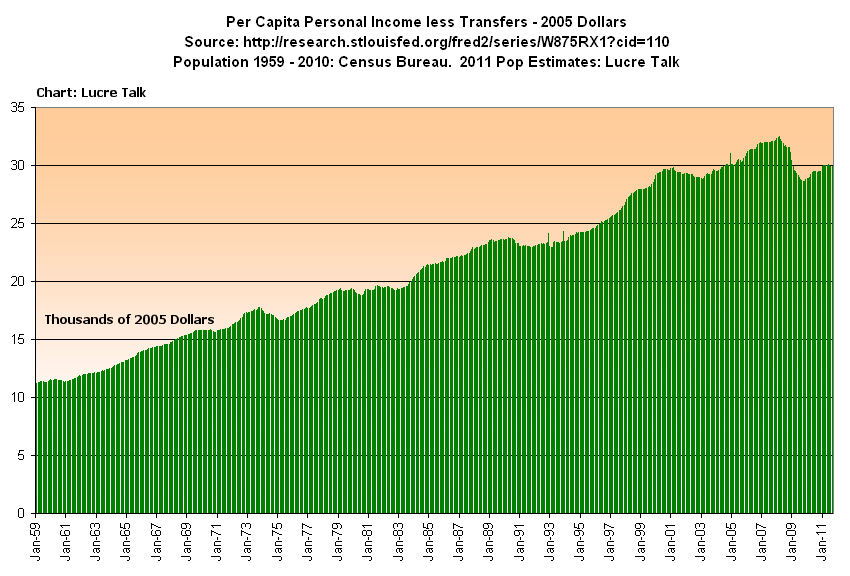
Below is a chart of per person federal, state and local spending in real, inflation-adjusted dollars.  This does not include what are called transfer payments, like social security and unemployment checks the government sends out.  More military spending, more social welfare programs, more health care programs, more regulatory agencies and it all adds up to a 60% per person increase over the past 60 years.

When do we start having the conversation about reducing government spending?  When the increase is 100%?  That has been a question that few politicians wanted to tackle.  In 2010, President Obama appointed a debt and deficit commission which made recommendations in December 2010, after the elections.  Some Democrats in tightly contested 2010 election races did not want to have any budget debates before the election, leaving then speaker Nancy Pelosi without a convincing majority in the House.  The Republicans in the Senate had one word in response to most Democratic House bills – “No”.  Unable to break Republican filibusters in the Senate, any budget resolution passed by the House would probably have gone into the Senate trash bin.  In February, the Obama administration ducked the deficit commission recommendations when it presented the FY 2012 (Starts Sept 2011) budget.

In this game of political chicken, someone finally went first!  On April 5th, Paul Ryan, the Republican House Budget Committee chairman, revealed his committee’s 2012 Budget proposal.  This past week, President Obama presented his long term budget “plan” as a rebuttal to Ryan’s plan.  The NY times has a short comparison of the two plans.  An innocent bystander might ask why the President could not present his administration’s plan when he presented the 2012 budget proposal two months ago.

Military spending has to be the first subject of any reasonable discussion.  Including pension, health care and training programs for ex-military, the $1T in current military spending is $3333 per person, or almost a third of the $9400 (in current dollars) per person government cost.

Structural changes to Medicaid and Medicare have to be the second topic of discussion. In January 2010, the Congressional Budget Office estimated 2010 Medicare and Medicaid costs at $800B and projected yearly increases of 7%, more than double the average 3% inflation rate of the past thirty years.

Some Democratic politicians accuse the Republicans of throwing women, children and the poor under the train and advocate higher taxes on the rich.  But there simply aren’t enough rich people.  In July 2010, the IRS released an analysis of 2008 tax returns.  If the Federal government were to confiscate ALL the adjusted gross income of those making $200K or more, that would total about $2.46 trillion in 2008 dollars, or about $2.6 trillion in 2011 dollars.  That amount is about 2/3 of estimated Federal spending in 2011.

The 2011 budget has a projected deficit of $1.65 trillion (Wikipedia article) How much would we have to tax every rich person to make up this year’s deficit?  In 2008, the IRS reported that there were almost 4.4 million taxpayers making more than $200K.  We would need to charge $375,000 to every one of those taxpayers to make up this year’s deficit.  Obviously, we couldn’t get people making $200K to pay $375K in taxes. 

So let’s pass a law to soak the 319,000 millionaires by taking away all of their deductions and take 90% of their income.  That will give the Federal government $900B in additional revenue but we are still short $750B.  Let’s take away all the deductions for those 574,000 people making more than $500K and tax them at 90%.  That will raise another $351B but we are still short about $400B.  Finally, we take away all the deductions for people making more than $250K and tax them at 50% and we have balanced the budget for this year!

Taxing the rich won’t solve our budget problems. Reducing spending alone will not solve our budget problems.  We need a combination of higher taxes on everyone and reduced spending.  Unless we can come to this two part solution of higher taxes and lower expenses, we will continue to run deficits and ever higher long term debt.  In the next decade, bondholders will demand ever higher interest rates to buy this country’s debt.  Increasing interest payments will only make this country’s spending problems worse.  The time to act is now.

One Percent Club

Recently I received links to a few articles on the top income earners – the “one percenters” in this country.  One is a recent Vanity Fair article, written by the economist Joseph Stiglitz, that provides a thoughtful analysis of the economic and political consequences of income disparity. A few days ago the movie critic, Roger Ebert, penned a more emotional article about the one percenters.

As I noted in a previous blog, an adjusted gross income over $410K gets a person in the one percent club.  This club includes the New York Yankees Alex Rodriguez at $33M, his fellow team mate CC Sabathia at $24M, David Letterman at $24M, country star Tim McGraw at $23M and poker stud Daniel Negreanu at $14M.

Roger Ebert’s sentiments probably reflect a more common gut response to the one percenters.  Ebert chose to note the $21M pay package of Jamie Dimon, CEO of JPMorgan Chase, one of the largest banks in the world.   Chase withstood the financial crisis with no bailout funds other than temporary liquidity funds that were quickly repaid.  Quite the opposite. The government and Federal Reserve actually came to Chase asking for a bailout of another troubled banking giant, Washington Mutual. Had Ebert done a bit more homework in his hunt for a villainous financial robber baron, he would have picked John Thain, the CEO who earned over $80M in the year he steered Merrill Lynch into a collapse that threatened the financial system.

So, we can make life simple and reason that there are two kinds of one percenters: the good and the bad. On the good side are people who do stuff: Alex bangs out baseballs, CC throws baseballs, David throw jokes and Tim belts out tunes.

On the bad side then are the one percenters who don’t do anything that involves banging, belting or throwing.  Since most of us can’t grasp what the CEO of a bank does to earn that much money, it must be nefarious back room wheeling and dealing, not hitting and throwing and singing.

In the recent and ongoing debates about whether to continue tax cuts for the wealthy, we should make it clear to our congressional representatives and tell them that we want only the bad one percenters to pay more taxes.

The one percent club also includes anesthesiologists and all we know about what they do is that they put us to sleep before surgery.  Let’s put them in the good one percenter group.  I want to wake up after surgery.

Effective Tax Rates

The effective or net tax rate is the amount of income tax we pay on our adjusted gross income.  For many of us under 65, our adjusted gross income is our total income.

The Tax Reform Act of 1986 eliminated many tax breaks and lowered marginal tax rates, which lowered the effective tax rate (ETR).  As a result of the act, the ETR for the top 1% of income earners dropped from 33% in 1986 to 26.5% in 1987. 

The IRS regularly publishes studies on various aspects of the tax system.  One of their studies, updated in July 2010, reviewed income and taxes paid for the period 1986 to 2007.

Over the thirty years since 1987, the majority of taxpayers have made a beggars bargain by voting for politicians who promised lower tax rates. During that time, many taxpayers have received a tiny decrease in their ETR while top income earners have seen a 15% decrease.

Below is a chart comparing the ETR for various income brackets in 1987, the year after the reform act, and 2007.

In 2007, what income bracket did you fall into?  The chart below shows the top half of all adjusted gross incomes.  If you made $33K or more in 2007, you were in the top half of income earners in this country.

The highest earners have enjoyed the biggest reductions in their ETR over the past thirty years.

During the past election cycle, there was much debate about increasing the marginal tax rate on the top incomes in this country.  Republicans made significant electoral gains and quashed any attempts to increase taxes, resulting in a compromise this past December that left tax rates unchanged.

Some voters objected in principle to ANY increase in taxes.  Some voters objected in principle to an increase on only a small minority of taxpayers, maintaining that the tax pain should be shared so some degree by all taxpayers.  The minority of voters who wanted the tax burden to fall heaviest on the upper income taxpayers might have been able to win the argument, particularly among moderates, if they had proposed an across the board 5 or 10% increase in income tax rates.  An increase of 10% in a 35% income tax bracket is far more than a 10% increase in a 15% tax bracket.  Instead, Democrats proposing a “soak the rich” tax policy change watched in horror as the electorate shifted Republican in many states.  “Soak the rich” tax proposals seem to violate some sense of fairness in the American voter, even those who are not rich.

In 1987, the Federal Government collected $392.5B in individual income taxes.  Adjusting for inflation (about 83%) and population growth (about 24%) from 1987 – 2007, that amount is $889B.  What did the Feds actually collect in 2007?  $1,163.5B, an increase of 30% over adjusted 1987 levels.  In 2009 and 2010, income tax collections were about $200B less than 2007 levels, yet still about the same level as 1987.  This country is running huge deficits each year simply because Federal spending has increased far more than inflation and population growth combined. 

Below is a comparison of 1987 individual and corporate income taxes adjusted for inflation and population growth with the actual taxes collected in 2007.

Tax collections in 2007 were far stronger than the 1987 pace BUT the federal government is spending money at a faster rate than 1987. Below is a comparison of adjusted 1987 on-budget Federal spending – which excludes most of Social Security – with the actual amount spent in 2007.

As Republican presidential candidates prepare to announce their candidacy, we can be certain that the debate over higher taxes vs. reduced spending will only heat up further.  Proponents of higher taxes can point to the charts above and make a good case that the top 5% of incomes have enjoyed greater tax reductions than the rest of us over the past thirty years.  Proponents of reduced spending can make a valid case that the federal government has just gotten too big. There is no resolution to the debate.  Some people want the federal government to take a greater role in our lives – some don’t.  The only “solution” is a compromise – cut some Federal spending, including defense, and bump up taxes an equal percentage on most American taxpayers.

Taxes – The Old and The New

The Federal government has a revenue problem.  Both personal and corporate income tax collections are down.  The charts below show individual income taxes for the past 60 years and a smoothed average of those amounts. (Click to enlarge in separate tab)

Below is the same data smoothed with a 4 year moving average to show the overall trend.

Those with high incomes are paying less in taxes than they did.  But the problem is more widespread.  ALL of us are paying less in Federal income tax than we used to. 

In 1974, a low income couple with two children making $7000 paid $400  in income taxes.  In inflation adjusted dollars, that is $31,000 dollars of income and a tax bill of $1800.  Under current tax law, a couple with two children making $31,000 would get a net credit of $2522 in income taxes.  They would get this credit through the earned income credit program.  For this couple, the difference – the tax savings – between the tax policy of the 1970s and today is $4300.

In 1978, a couple with two children making the equivalent of $50,000 in 2010 dollars paid the equivalent of $4700 in income taxes.  Under existing tax policy, they pay $2766, a savings of almost $2000.

In 1978, a single person making $12,000 paid almost $1700 in income tax.  In inflation adjusted dollars, those amounts translate to $40,000 income and a tax bill of $5500.  What would a single person making that same money pay today?  $4600, a savings of $900 when compared to the tax policies of the 1970s.

In the past 30 years, the taxpayers of America wanted lower taxes and they voted in the politicians who would give them lower taxes.  Many of us wanted more environmental and labor regulations, social support programs and we got those too.  Many of us voted for more defense and we got that.  Military bases mean jobs for a lot of voters and voters like jobs.  So who is going to pay for all of this?  “Not me,” we all said.  “Get it from the other guy,” we moaned. 

Reducing the debt of this nation will require changes in both tax revenues and spending.  Impose more taxes on those in ALL income brackets, not just the rich.  There aren’t enough rich people to make up the yearly deficits. For all but the very poorest in our country, there should be a minimum income tax, even if it is only $100, so that everyone has some “skin in the game.”

Eliminate the corporate income tax and raise the tax rate on the profits that they pay out in dividends to shareholders and stock awards to company officers. The accountants and lawyers at the IRS will never be able to compete with the tax accountants and lawyers at large companies.

Consolidate duplicate regulatory government departments which overlap in their oversight responsibilities.  Well meaning and egotistical congresspeople want their own agencies supervised by their committee and the result is a hodge-podge of agencies.

Reduce spending, beginning with Congresspeople themselves.  If tax revenues decrease, then the budget allowance of each Congressperson’s office should be reduced by the same amount.  While the millions of dollars involved are negligible within the scope of the entire Federal budget, it enshrines a principle that if taxpayers are tightening their belts, so should their elected representatives.

Make a dedicated effort to detect fraud and overcharges in defense and entitlement programs and prosecute the perpetrators.

If we continue to put off these decisions, it will only get worse.  Each year, as we have to pay more in interest on the nation’s debt, programs will continue to experience budget cuts, provoking an economic and class warfare that may permanently scar the spirit of the people of this country. We owe it not only to our kids but to ourselves to make some difficult but prudent choices soon.

Big Daddy

Big Daddy in Washington got big pockets.  He gets money and gives money.  Big Daddy collects income taxes and then pays all that money out to people who need it for something – school, food, housing assistance, disability, training and many other programs.  Big Daddy got a big hole in his pocket and here’s why.  The way it’s supposed to work is that Big Daddy pays out what he collects in individual income taxes – money in, money out.  If you look at the mid decade years in the chart below, you will see the way it’s supposed to work – approximately the same amount of money went out to the needy as what came in from those who weren’t needy. Those that got give to those who don’t – and all that charity goes through Big Daddy’s pockets.

The green bars are individual income tax receipts.  The red bars are the payments of all the Federal social assistance programs not including Social Security, railroad and military retirement.

Instead of sending our income tax to Big Daddy in Washington, each of us could just walk over to our neighbor down the street who is having a hard time for one reason or another and give them our income tax.  But we wouldn’t get to fill out income tax forms which is an exciting way to spend a weekend or two.  The person who needs the money wouldn’t get to fill out long applications for student grants or housing assistance or food stamps.  Long applications and supporting documentation are fun things to do so we wouldn’t want to deprive people of that joy.

The past two years show clearly what the problem is.  Lots of money out and not enough money in.  So what’s Big Daddy gonna do?  The Green People tug at Big Daddy’s pants and say “Hey, Big Daddy, raise taxes on the rich people!”  The Red People kick Big Daddy in the ankle and say “Big Daddy, you got to reduce payments to all these needy folks!”  Big Daddy sure has got a heap of problems.