The Role of a Rule

December 31, 2023

by Stephen Stofka

This week’s letter is about the role of a monetary rule and the guiding points that help the Fed steer its policymaking. Since the 2008-9 financial crisis, the Fed has purchased a lot of assets, increasing its balance sheet from less than one trillion dollars at the end of 2007 to almost $8 trillion this month. It has kept the federal funds rate that anchors all other interest rates near zero for ten of the last 15 years. The members on its board of governors serve 14 year terms, affording them an autonomy resistant to political influence. From those board members the President and Senate choose and confirm the Chair and Vice-Chair of the board. The governance structure allows them to set and follow a plan of steady guidance but their actions have resembled those of sailors steering against unpredictable winds. What are the guiding lights?

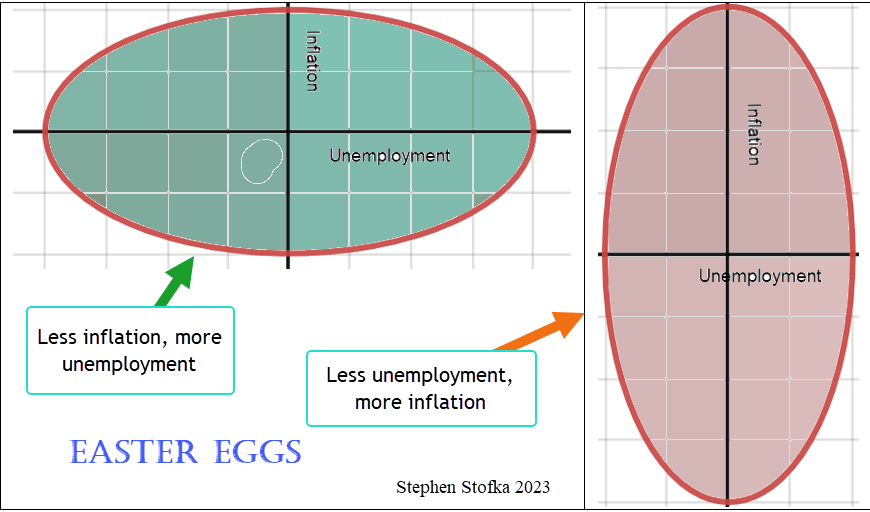
In the late 1950s, economists and policymakers enthusiastically endorsed the concept of the Phillips Curve. Picture an ellipse, a circle that has been stretched along one axis so that it appears like an egg.

Think of unemployment along the x-axis and inflation along the y-axis. More unemployment stretched the circle, shrinking inflation. More inflation stretched the circle in the y-direction, lessening unemployment. Policymakers could tweak monetary policy to keep these two opposing forces in check. In the 1970s, both inflation and unemployment grew, shattering economic models. Nevertheless, Congress passed legislation in 1978 that essentially handed the economic egg to the Fed. While the central banks of other countries can choose a single policy goal or priority – usually inflation – Congress gave the Fed a twin mandate. It was to conduct monetary policy that kept inflation steady and unemployment low – to squeeze the egg but not break it.

Mindful of its twin mission, the Fed later recognized – rather than adopted – a monetary policy rule, often called a Taylor rule after John B. Taylor (1993), an economist who proposed the interest setting rule as an alternative to discretion. The Fed would use several economic indicators as anchors in policymaking. The Atlanta Fed provides a utility that charts the actual federal funds rate against several alternate versions of a Taylor rule. I’ve included a simple alternative below and the actual funds rate set by the Fed. When the rule calls for a negative interest rate, the Fed is limited by the zero lower bound. Since the onset of the pandemic in March 2020, the Fed’s monetary policy has varied greatly from the rule. Only in the past few months has the actual rate approached the rule.

In a recent Jackson Hole speech, Chairman Powell said, “as is often the case, we are navigating by the stars under cloudy skies.” What are these guiding points that should anchor the Fed’s monetary policy? I’ll start with r-star, represented symbolically as r*, which serves as the foundation, or intercept, of the rule. Tim Sablick at the Richmond Fed defined it as “the natural rate of interest, or the real interest rate that would prevail when the economy is operating at its potential and is in some form of an equilibrium.” Note that this is the real interest rate after subtracting the inflation rate. The market, including the biggest banks, consider it approximately 2% (see note at end). This is also the Fed’s target rate of inflation, or pi-star, represented as π*. The market knows that the Fed is going to conduct monetary policy to meet its target inflation rate of 2%.

Why does the Fed set a target inflation rate of 2% instead of 0%? The Fed officially set that target rate in 1996. The 2% is a margin of error that was supposed to give the Fed some maneuvering room in setting policy. There was also some evidence that inflation measures did not capture the utility enhancements of product innovation. Thirdly, if the public expects a small amount of inflation, it adjusts its behavior so that the cost is so small that the benefit is greater than the cost (Walsh 2010, 276). Today, most central banks set their target rate at 2%.

The definition of r-star above is anchored on an economy “in some form of equilibrium.” How does the Fed gauge that? One measure is the unemployment rate and here we have another star, U-star, often represented as un, meaning the natural rate of employment. In 1986 Ellen Rissman at the Chicago Fed described it (links to PDF) as “the rate of unemployment that is compatible with a steady inflation rate.” So now we have both unemployment and the interest rate anchored by the inflation rate.

Another part of that r-star definition is an economy “operating at potential.” Included in the Fed’s interest rate decisions is an estimate of the output gap that is produced by economists at the Congressional Budget Office (CBO). The estimate includes many factors: “the natural rate of unemployment …, various measures of the labor supply, capital services, and productivity.” The CBO builds a baseline projection (links to PDF) of the economy in order to forecast the federal budget outlook and the long term financial health of programs like Social Security. Each of these factors does contribute to price movement but the analysis is complex. A more transparent gauge of an output gap could help steer public expectations of the Fed’s policy responses.

In a paper presented at the Fed’s annual Jackson Hole conference in Wyoming, Ed Leamer (2007, 3) suggested that the Fed substitute “housing starts and the change in housing starts” for the output gap in constructing a monetary policy rule. At that time in August 2007, housing starts had declined 40% from their high in January 2006. Being interest rate sensitive, homebuilders had responded strongly to a 4% increase in the Fed’s key federal funds rate. Despite that reaction, the Fed kept interest rates at a 5% plateau until September 2007. By the time, the Fed “got the message” and began lowering rates, the damage had been done. Six months after Leamer delivered this paper, the investment firm Bear Sterns went bankrupt. The Fed engineered a rescue by absorbing the firm’s toxic mortgage assets and selling the rest to JP Morgan Chase. Six months later, Lehman Brothers collapsed and the domino effect of their derivative positions sparked the global financial crisis.

I have suggested using the All-Transactions House Price Index as a substitute for the output gap. A long-term average of annual changes in this index is about 4.5%. The index is a summation of economic expectations by mortgage companies who base their loan amounts on home appraisals, banks who underwrite HELOC loans to homeowners and loans to homebuilders. The index indirectly captures employment trends among homeowners and their expectations of their own finances. Any change that is more than a chosen long-term average would indicate the need for a tightening monetary policy. Anything less would call for a more accommodative policy. Either of these housing indicators would be a transparent gauge that would help guide the public’s expectations of monetary policy.

Although the Fed considers the Taylor rule in setting its key interest rate, the rate setting committee uses discretion. Why have a rule only to abandon it in times of political or economic stress? The rule may not operate well under severe conditions like the pandemic. A rule may be impractical to implement. A Taylor rule variation called for a federal funds rate of 8% in 2021. This would have required a severe tightening that forced the interest rate up 7% in less than a year. The Fed did that in 1979-80 and again in 1980-81. Both times it caused a recession. The second recession was the worst since the 1930s Depression. An economy as large as the U.S. cannot adjust to such a rapid rate increase.

How strictly should a rule be followed? Some of us want rule making to be as rigid as lawmaking. A rule should apply in all circumstances regardless of consequences. Many Republican lawmakers felt that way when they voted against a bailout package in September 2008. Some of us regard a rule as an advisory, not a straitjacket constraint of policy options. Each of us has a slightly different preference for adherence to rules.

See you all in the New Year!

/////////////

Photo by Mark Duffel on Unsplash

Keywords: housing starts, house price index, stars, output gap, unemployment, interest rate, inflation

All-Transactions House Price Index is FRED Series USSTHPI. The annual change is near the long-term average of 4.5%, down from a high of 20% in 2022.

Housing starts are FRED Series HOUST. The output gap is a combination of two series, real GDP GDPC1, and real potential GDP, GDPPOT.

A gauge of long-term inflation expectations is the 10-year breakeven rate, FRED Series T10YIE. The 20-year average is 2.08%. The series code is T=Treasury, 10Y = 10 year, IE = Inflation Expectations. The T5YIE is a 5-year breakeven rate.

Leamer, E. (2007). Housing Is the Business Cycle. https://doi.org/10.3386/w13428

Taylor, J. B. (1993). Discretion versus policy rules in practice. Carnegie-Rochester Conference Series on Public Policy, 39, 195–214. https://doi.org/10.1016/0167-2231(93)90009-l

Walsh, C. E. (2010). Monetary theory and policy. MIT press.

Solow’s Growth Machine

December 24, 2023

by Stephen Stofka

I will start off this week’s letter with a look at the assumptions of neoclassical economics. I will finish up with some thoughts on the contributions of Robert Solow, a Nobel laureate who died this week at the age of 99. His growth model was built on neoclassical foundations and is still a workhorse of intermediate level macroeconomics.

In the late 19th century, several economists blended mathematics and utility theory to separate the study of economics from political economy. They thought that they could study human behavior with the same quantitative analysis that physicists and engineers used to make predictions about the mechanical world. To make their analysis consistent with established mathematical principles they made several assumptions regarding both consumer choice and the production process. I’ll begin with consumer choices.

The first assumption was that individual choice making was rational. This meant that people had preferences for some goods over others and could construct bundles of goods that would maximize their utility, or satisfaction. These preferences were consistent and independent of circumstances like income. For instance, a person might not be able to afford a steak but they preferred steak to ground beef. The ordering of preferences was complete. A person either preferred this bundle of goods to that bundle of goods, or preferred that over this, or considered them equal.

In order to predict human behavior, the neoclassicals assumed that humans behaved predictably. Behavioral economists challenged those assumptions as unrealistic. We may try to optimize our satisfaction but our lives are a series of circumstances partly determined by our prior choices and circumstances. Because of this our preferences change. Our “priors” introduce biases into our decision making that sabotage our attempts to maximize our utility. We want to put a decision behind us so we may shorten a lengthy examination of options and choose something just to have it done. This is known as decision fatigue. The choice of a hotel room while on vacation might be an example. Ratings systems address this fatigue.

A second assumption was that the market clears, balancing supply and demand so that there is no surplus or shortage. At this equilibrium is the market clearing price. A surplus or shortage would introduce some serial correlation into the price analysis and raise the likelihood that errors in the data were not random. A third assumption was that people form expectations by reducing the errors in prior expectations. This was later formalized as a concept called rational expectations but it was based on the idea that people optimized their satisfaction. These assumptions interpret human behavior so that our behavior is amenable to mathematical modeling and statistical validity. How realistic are they? The law of inertia models motion under the assumptions that there is no gravity or friction.  Although unrealistic, it is the basis for accurate prediction. In 1966, economist Milton Friedman wrote “The Methodology of Positive Economics,” a seminal paper asserting that a valid test of an assumption was not how likely or reasonable it seemed but its ability to enable accurate prediction.

In analyzing the production process, the neoclassicals assumed that the proportions of the factors of production were consistent. If the production costs for an industry were half labor and half capital, they were always in those proportions. In order to make production amenable to differential analysis, the neoclassicals pretended that production was continuous and incremental, even when it was seasonal or halting. They assumed that the output from production was constant, or constant returns to scale. X number of inputs went into the production function in certain proportions and the same Y output came out. The neoclassicals assumed that savings were automatically turned into investment. When the Great Depression of the 1930s showed that the process was not automatic, the neoclassical analysis could not explain it.

The neoclassicals failed to predict the extraordinary growth in productivity during the twentieth century. In the thinking of some economists, growth was inherently uneven and would introduce market instability that made it more difficult to reach equilibrium. In 1956 Robert Solow and Trevor Swan independently published papers that introduced a model where technological innovation enhanced labor productivity. The higher productivity led to higher savings rates which led to a higher rate of investment. Policies that encourage investment would lead to more efficient use of that investment and a steady rate of economic growth.

Like the neoclassical economists, the Solow-Swan models assumed that savings were turned into investment. With that increased investment, companies adjusted the mix of capital and labor used in production. The ratio of capital (K) to labor (L) inputs, the K/L ratio, kept increasing. In a medium term of like ten years, higher savings and investment led to higher economic growth. But greater investment increased depreciation costs so that savings and depreciation rates competed with each other. In the long-term of two or more decades, their models described a steady state of balanced growth. Capital, effective labor and economic output would approach the same rate of growth.

In their steady state model, technological innovation was an exogenous factor, meaning that it was not generated or explained by the model. In studying developing countries, other economists realized the importance of property rights protection. Policies and institutions must encourage investment and afford some assurance that the fruits of R&D research will be protected. Without this sense of security, investors must account for the risk that their research will be copied and the resulting loss of profits will impact projections of long term cash flows. This dampens investment in those countries with low property rights protection. Consequently there is a low amount of R&D investment and the people within those countries become stuck in a trap.

Nobel laureates are recognized for their contribution to a field of study. Their ideas and their analytical approach became an incubator for more research, more questions, discussion and controversy. As growth theory and development economics have evolved, they have incorporated the ideas of Robert Solow. He was born in the early 1920s when electricity was ushering in large gains in mechanical productivity. He died when those same electrical currents are powering a revolution in information processing. His birth and death are the bookends of a century of transformation.

///////////////

Photo by Mike Hindle on Unsplash

Keywords: neoclassical economics, consumer, production, steady state, growth theory, Solow

AI, Ideas and Perspectives

December 17, 2023

by Stephen Stofka

This week’s blog is about perspective as a launching point for understanding current and historical events and our own transformation in this digital age. There is plenty of controversy over the wars in Israel/Palestine and Ukraine, immigration and abortion policy. In 1991 Rodney King was beaten with batons by several L. A. police. In an age before cell phone cameras, a bystander on his apartment balcony recorded the incident with a video camera. When the video was shown by a local TV station, the city brought charges against four officers. When a jury acquitted the officers a year after the incident, L.A. erupted in riots that lasted almost a week. Rodney King famously asked, “Can we get along?,” which became a Why can’t we get along? meme. We don’t get along because we have individual perspectives.

Perspective is a point of view that encompasses beliefs, identity, values and assumptions. Although each person has a unique perspective formed by individual experience, we form groups with those who share a similar perspective. We convince ourselves that our values and assumptions are the correct ones. From the jury box of our values and assumptions we judge the actions of others.

The elements of perspective are the foundation of an analytical framework, a toolset of principles and theories that help us build a community of shared perspectives. A framework prioritizes some values and assumptions to achieve the goals of the analysis. An academic researcher and an advocacy group have different goals and methodologies. The advocacy group uses a framework like that of a lawyer, sifting through facts and opinions to find those that support the group’s policy goals. Substance above process. A researcher will adopt a framework with a sound and accepted methodology that will most likely earn favorable peer review and publication. That researcher may filter out facts that don’t fit the methodology. Process above substance.

Our conclusions are shaped by our attention. Our attention is directed by our intention. We discredit facts that threaten our intention and undermine our self-interest, values or identity. On the other hand, we do not challenge those facts that confirm our perspective. Why should we? We interpret facts to support the assumptions so foundational to consensus within a group. Social media has increased the scope of our conflict and consensus. We can agree or disagree with strangers around the world about the ethical issues of current events. We can hone our skills of ridicule and outrage. We can join a group to exploit trading platforms in the hopes of financial gain, buy almost anything online, and find romantic partners and people with similar hobbies and interests.

The chain of communication breakthroughs began with Gutenberg’s printing press 500 years ago. Broadsheets and newspapers followed in the following centuries but their ideas and sentiments were constrained by geography. The circulation of the Federalist papers supporting the adoption of the U.S. Constitution was limited. The ideas penned by Madison and Hamilton found a wider audience when a publisher bound those op-eds into a single volume. In the 20th century, radio and TV spread ideas, new and entertainment to a wider audience. The development of the internet in the 1990s led to a revolution in time – information and entertainment became both a good and a service.

Last week I wrote about the four types of goods/services. Many goods are asynchronous. The consumption of the good occurs at a different time than the production of the good. Many services are synchronous. A haircut is consumed and produced at the same time. Social and news media captures both aspects. The content may be asynchronous, produced and stored on a server in the cloud. It may be synchronous – either a broadcast of an event or a Twitter exchange in real time between two people separated by multiple time zones. Social and news media has changed our daily experience. We may cling to the belief that our perspective has remain unchanged, our values and principles intact, but have they? Experience shapes perspective and an evolving set of experiences must surely have some effect on our values, assumptions and the way we interpret events.

Will the internet change history? The printing press changed individual perspectives. Within a few decades it made possible the wide dissemination of Luther’s 95 theses in 1517 that sparked the Protestant Reformation. Luther’s principles challenged the long dominant authority of the Catholic Church in the interpretation of the Christian faith. In 1543 Copernicus’ book on the revolution of the planets and other celestial bodies ignited the Scientific Revolution. His ideas challenged the centuries old thinking of Ptolemy, the second century Greek astronomer and mathematician.

In the political sphere, the works of John Locke led to an uprising in England that challenged the extent of monarchical authority. Those ideas would become the foundation of America’s Constitution. Not only was it the first written Constitution but it had to be printed and circulated to state assemblies as well as the general public in order to win ratification. Almost 400 years after Gutenberg invented the printing press, the United States emerged from the printing press.

It was a country built on confrontation, cooperation and conflict between regional interest groups that threatened to tear apart the new republic. The economies of the southern states were based on agriculture while those in the north were founded on industry. There was so much fractiousness at the Constitutional Convention in Philadelphia that the delegates fought over the text of the Constitution behind closed doors. America has stayed intact despite a civil war because its Constitution encourages public arguing as an alternative to civil war.

Social media companies have developed algorithmic platforms that support arguing as a way to keep viewers engaged. Arguing fosters new combinations of identities and values and these shifting combinations promote new group formation much like the variety of Protestant sects that emerged during the Protestant Reformation. To a historian in the twenty-fifth century, the historical significance of the internet age may be the development of artificial intelligence, or AI, to efficiently mimic many human capabilities. A set of algorithms cannot replicate the intricacies of individual perspective but it will alter our perspectives. We are becoming not the hardware cyborgs of science fiction movies but the software cyborgs of ideas and perspectives.   

////////////////

[20231217Letters.png]

Photo by Amador Loureiro on Unsplash

Keywords: Constitution, analysis, values, assumptions, perspective

Money – the Shape Shifter

December 10, 2023

by Stephen Stofka

This week’s letter is about public goods and the characteristics of public goods. I’ll discuss whether money or a digital currency is a public good. I’ll explore the four types of goods as economists classify them. These properties can enrich our understanding of some contentious debates. Hop on board as we tour the safari park of economic ideas.

Economists use two criteria to classify goods: whether they are rival and whether they are excludable. Rival means that one person’s consumption of a good lessens another person’s consumption of the good. An excludable good means that there is a feasible mechanism to prevent someone from consuming a good. A private good is both rival and excludable. A public good is both non-rival and non-excludable. It helps to look at public goods from a cost perspective. The marginal cost of providing the good to one more person is practically zero. The marginal cost to prevent someone from consuming a public good is very high.

An example of a public good is the national defense. One person’s protection from attack has little if any effect on another person’s protection. A country cannot practically prevent someone from being protected. Another example is firework displays. Although we call the street out in front of our house a “public street,” it is a toll good or club good according to these characteristics. Once built and maintained, the cost for one more driver to use the road is zero so it is non-rival just like the national defense. But it can be made exclusive at a reasonable cost by restricting access. A toll road is an example. A city makes a street public by decree, not by any characteristic of the road. A decree can be undone as when a city converts a city street to a pedestrian mall.

Another type of good is rival but non-exclusive. These are called pooled goods. A classic example is fishing in the ocean. The fish that someone catches are no longer available to someone else so they are a rival good. However, it is difficult and costly to prevent someone from fishing in the ocean. Pooled goods typically include natural resources or game animals. A government manages the depletion of the resource by issuing licenses and imposing fines. Overfishing of the world’s oceans has been a contentious issue for decades.

Governments have managed the problem of pooled resources by selling a property or use right to a private owner. The manager restricts access to the resource and charges a fee to users of the resource, effectively turning a pooled good into a toll good. A use right might be in the form of a 99 year renewable lease or a public-private partnership where a private company manages a park or other natural resource. 

These characteristics can provoke some lively discussion. For instance, is money a public good? It might seem so. It costs almost nothing to make another $1 of currency. But providing the next $1 of currency requires billions of dollars of legislative and judicial debate because public spending is rival. If that $1 is spent on one cause, it cannot be spent for another project. If transferred to one person, that same $1 cannot be given to another person. Is it excludable? Social spending programs are based on criteria that exclude some while entitling others to the benefits of the program. We argue so much about “public” spending because the spending itself has characteristics of a private good. It is rival and excludable. Once built an air defense system might act as a public good, providing non-excludable protection. The spending itself is not a public good.

Let’s follow the path of a tax dollar. It went from a private party through a banking system that restricts access to money resources, then into a government pool where it became an indistinguishable unit of tax revenue, a pooled good, then became private again when the tax dollar was spent or transferred to someone. If spent, the use of the good or service became public in some sense. An air defense system or the building of a public library, for example. If transferred to a person, the money was spent in the private economy for goods and services like food and rent. The  transformation of private dollars to public pot and back to private dollars is accompanied by a lot of heated debate.

The money supply has characteristics of a pooled good although it is not a natural resource. In circulation it acquires the characteristics of a natural resource, a good that has many access points. A government manages the money supply like a pooled resource. It licenses out the ability to create money to member banks, imposing some regulations and trusting that the discipline of gain and loss will cause banks to act prudently when making loans that increase the money supply. However, banks don’t just loan money to individuals and businesses. They loan money to financial institutions who loan money, thus magnifying the power of the money-creation process.

Money in the economy acts like a magnetic field in a giant turbine. The turbine turns as long as the magnetic field keeps changing. Money has the characteristics of a private good in exchange, then a pooled good in taxation and a toll good in the banking system, and then a private good again. Money can buy public goods and services but can’t assume the characteristics of a public good. Like money, a digital currency like Bitcoin has an exchange power between private parties that relies on the seller’s willingness to accept payment in Bitcoin. But it cannot act as another type of good because the government refuses to accept Bitcoin as a payment for taxes. Doing so would interrupt its control of the money licensing process. Money then becomes an intermediary in a Bitcoin exchange, like the Universal Translator on the original Star Trek TV series. Money is adaptable to each type of good for which it is exchanged. That adaptability gives money power, a power that governments have abused in centuries past, giving people a cause for concern.

///////////////

Photo by Richard Horvath on Unsplash

Keywords: private goods, public goods, toll goods, club goods, private goods. Bitcoin, digital currency.

The “As If” Pandemic War

December 1, 2023

by Stephen Stofka

Last week I mentioned that the pandemic simulated conditions similar to a large scale war. This week’s letter explores those war-like aspects, the personal behavior and public policy choices that promoted inflation. Economists measure indicators of supply and demand to gauge the human emotion and calculation that guides decision making. Supply and demand are discernible but inseparable, a synergy of planning, emotion and reaction. Wars and global pandemics transform the routine of our daily lives into a natural experiment to help us better understand the dynamics of our daily choices.

As inflation increased in 2022, economists fell into several camps. There were those who thought the inflation was due to supply bottlenecks and that it would resolve itself. Some thought that the government had provided too much stimulus and the excess demand fueled inflation. Others thought that it was a combination of the two – both supply and demand. Some thought the Fed had waited too long before recognizing and responding to the problem of rising prices. The public sometimes gets frustrated with the arguments of prominent economists who help shape public policy.

Economists gather a lot of data and develop causal models to construct scenarios of future events. People do not respond to events like automatons. People try to anticipate what’s coming and change our behavior before anything has happened. From several blocks away I can see that the light is green but it is unlikely to be green when I get to the intersection at the speed I am going. I can either accelerate quickly or ease up in anticipation of making a full stop at the light. I am not responding to the state of the world as it is but as I predict it will be. The philosopher Ludwig Wittgenstein (1889 – 1951) wrote that the future could not be inferred from the present. What if I speed up to beat the light and a driver swerves onto the road? At the same time I am making my decision to speed up, a pedestrian might think it is safe to cross the road. It is a minor tragedy in the making. What doesn’t happen is as much the reality of the moment as what does happen, Wittgenstein claimed. As economists try to predict human behavior, the subjects being studied are also trying to predict the behavior of the people and events around them.

During the pandemic, the global supply chain exhibited bottlenecks that would be more likely during a large scale war. A critical strategy during war is to disable or destroy the enemy’s supply lines. Factories, roads, railways and airports are bombed. The initial response to the pandemic was to shut down much of the global manufacturing capacity. The transportation networks were not destroyed but disrupted. For months shipping containers sat on ocean ships outside the port of Los Angeles in California. The ships could not return empty to factories in Asia and load up with more shipping containers. The conveyer belt of the global supply chain had stopped. To get critical supplies, U.S. companies hired planes to fly goods from Asian ports.

In January 2022, several economists at the New York branch of the Federal Reserve published a GSCPI composite index that estimates the price pressures in the global supply chain. You can read about their methodology here. In December 2021, the index measured a stress level that was so rare – less than four out of a million chance of occurring. In March the NY Fed estimated that global supply pressures had eased a bit but May’s report indicated worsening pressures. A month earlier the Fed had started a series of interest rate increases to curb inflation.

During a war, civilians alter their buying habits. Governments impose travel restrictions and curfews on the civilian population. Some goods are diverted to armaments. The armed forces requisitions certain foods for the soldiers fighting the war. During the pandemic, house-bound people bought household appliances and furniture, computers and entertainment devices. These are “core” goods that people buy infrequently so suppliers were likely to have a supply in stock. Stores could not restock and shelves were often bare. Where were the goods? Sitting in a container on a ship in the Pacific. By early 2021, Covid-19 vaccines were made available to seniors and others deemed vulnerable. By late 2021, restrictions on personal services like hair salons and restaurants were eased. By early 2022, a world that had gone stir crazy for two years visited restaurants, booked vacations, joined gyms and had their hair done. The household goods and appliances that stores had ordered now arrived but the public had switched their buying habits.

Many Americans had never experienced wartime restrictions and resented the heavy hand of government in their daily lives. Many states closed schools and day care facilities, leaving parents with round the clock care of their children. Some of us are content to be alone while others thrive on the company of others. As people re-emerged into normal public life, some rebelled against institutional rules of any sort. A request from a flight attendant on an airplane might incite a violent reaction from a passenger who regarded the flight attendant as representative of all institutional authority. Some passengers responded as if they were escaping from prison. They verbally attacked employees working in airlines, in restaurants and grocery stores, in hair salons and other public facing businesses. Here is a compilation of confrontations between passengers and airline employees. In the public square and on social media, we were acting as though we were at war with each other.

There are often social frictions following a war. The passage of the Prohibition amendment following World War I disrupted social relations in America. Some states and cities imposed restrictions to curtail the spread of the so-called Spanish flu (see note below). The drop in crop prices following the war put many farmers and regional banks out of business during the severe recession of 1920-21. Americans turned against other Americans, particularly minorities who enjoyed any good fortune. A prosperous Black community in Oklahoma was burned to the ground. Americans of British and northern European heritage pressed lawmakers for new immigration rules that would restrict anyone but northern Europeans from legal entry into the U.S. In 1924 Congress passed the Johnson-Reed Act that imposed country quotas favoring those from northern European countries at the expense of southern Europeans and Asians.

During World War 2, Americans were at war with Japanese, Italian and German Americans in the barracks and in the public square. A 1942 musical featured a song The House I Live In to promote a camaraderie among the public. In 1945 the popular singer Frank Sinatra starred in a short movie of the same name to combat prejudicial attitudes toward minorities. In the year after the war ended, the marriage rate hit an all-time high but the divorce rate also spiked.

During the 1960s and 1970s the Vietnam War provoked social and political hostilities among Americans. The conflict erupted on public streets, on college campuses and in households where children and parents debated the ethics of the war. To a growing coalition of Americans returning vets represented the barbarous atrocities that the country’s leadership had ordered. They were treated with scorn or disregard by a public that wanted to forget the war. Many were betrayed by the bureaucratic red tape that kept many waiting for benefits that the government had promised in return for their service. See 2: 45 on this 5 minute clip from the History Channel. How does rude and antagonistic behavior affect inflation?

The rudeness, the lack of kindness in social relations stirs a deep sense of dissatisfaction within us. The circumstances of the pandemic aroused feelings of vulnerability and anger. The antidote to dissatisfaction is satisfaction. The antidote to powerlessness is the exercise of power. Spending money on ourselves and our family promotes a sense of satisfaction and power – just what the doctor ordered. Newly escaped from pandemic prison consumers increased their credit card balances by an average of 15% annualized in 2022 and 17% in the first half of this year. Over a ten-year period, consumers increased their credit card balances by 4% each year, slightly more than the 3.65% average of all consumer debt. As they did after WW2, Americans put the pandemic crisis behind them by us by spending.

/////////////

Photo by Shalom de León on Unsplash

Keywords: World War 1, World War 2, Vietnam War, curfews, consumer spending, credit card debt

Note on Spanish flu:  The U.S., Britain and other allies suppressed news of the flu spreading among their troops. Spain did not impose wartime restrictions on publication of the news so the public first became aware of it from Spanish newspapers. Later genetic testing and historical records indicated that the origin of the world wide pandemic was an Army base in Leavenworth, Kansas.

The Interest Payment Load

November 26, 2023

by Stephen Stofka

This week’s letter is about the federal interest paid on the country’s debt. Why does the U.S. pay more on its debt than other advanced economies? In the second quarter of this year, federal government paid 20% of its revenue in interest, almost three times the average 7.34% percentage of similar countries. High interest payments crowd out spending in other areas. They spark even more debates about the debt itself which is now 120% of GDP. This added interest expense exacerbates animosities in a country that is already fractured by divided perspectives and priorities.

In the second quarter of 2022, before the Fed began to raise rates, the federal government paid 13.6% of its revenues in interest (I/R) to service the debt. That was 6% less than the percentage in 2023 and represented $280 billion, more than twice the $128 billion spent in 2022 for the SNAP (food stamp) program. The higher interest payments, however, were about the same as the 50-year average I/R of 19% (median = 17.8%). In 2021, the 27 countries of the Euro area reported to the World Bank that they paid 3.11% of their revenues in interest (see note below).

Over the past fifty years, the federal government has collected about 20% of GDP in taxes. In the chart below, I have added both averages to the chart of federal interest payments as a percentage of revenue. The average revenue is almost identical to the median so this average is representative of a variety of economic conditions and policy responses over the long term.

As an approximation, the interest expense is 20% of revenue and revenue is 20% of GDP so interest expense has averaged 4% of GDP. However, neither the public nor policymakers are accustomed to average. For two decades, the Fed has kept interest rates low to accommodate economic recovery after the dot-com bust, 9-11, the financial crisis, the slow recovery from that crisis and the Covid-19 pandemic.

The pandemic simulated several critical conditions of a large scale war and the inflation that followed was typical of those inflationary periods following wars. I will cover that in next week’s letter. To curb an accelerating inflation, the Fed began to systematically raise rates from zero in the spring of 2022. In six months it raised rates by 2%, a rapid change that was six times faster than the period from late 2015 to early 2019 when the Fed gradually raised rates by the same 2%. By early 2023, the Fed raised rates an additional 2% within six months.

As a consequence of the higher rates, the government has paid higher interest rates on its debt. (The reasons for that are complex). We have become so accustomed to “easy money” and lower interest rates that the sudden increase in interest payments has caught the attention of both the public and policymakers. Will this further fracture political sentiment ahead of the 2024 elections?

At the beginning of this letter I mentioned divided perspectives and priorities. What are they?  Some give priority to the social programs that promote individual citizen welfare as essential to a general welfare. Their opposition may deride them as socialists but they are more properly called institutionalists because they champion a lot of control and planning by a central government to achieve that welfare. Those who oppose institutionalist policies also care about individual welfare but think that well-intentioned bureaucrats in government can cause more damage to the general welfare than they repair. These might properly be called marketists who believe that the price system distributes resources in an efficient and sustainable manner.  They respond that a centrally planned economy creates moral hazard, rewarding individual needs instead of personal hard work, planning and integrity.

Institutionalists label marketists as capitalists or plutocrats and accuse them of being mean-spirited and driven only by profit and self-interest. Vulnerable communities do not have the resources to help themselves, the institutionalists argue. Marginalized communities need to draw from a central funding pool. They must overcome decades of legal policies that disenfranchised them to benefit other groups. Marketists respond that profits reward people for taking risks. The willingness to accept risk is a key component of technological innovation that benefits all of society.

Interest payments have nudged aside defense spending to become the third largest percentage of federal receipts. The top category is health insurance like Medicare, Medicaid, CHIP and payments under the ACA which take up 30% of federal receipts (see note below). Social Security comes in second. Cuts to either of these programs have been a “hot rail” for conservative politicians. Everyone in Congress talks about cuts to defense spending but not in their district because it supports the local economy. The issue of rising interest payments and the federal debt is a safe one for politicians of both parties to run on in the upcoming election. According to Open Secrets, $14.4 billion was spent on the 2020 election, double the spending of the 2016 election. As candidates complain about excess spending, voters might consider why the major parties will spend about $100 for each of the votes in this coming election (notes below). I would call that excess spending.

//////////////

Photo by Joshua Woroniecki on Unsplash

Keywords: health care, ACA, Social Security, Medicare, defense spending, interest payments

Health Care Note: The health care programs are 24% of the federal budget including deficits, according to an analysis by the Center on Budget and Policy Priorities.

Election Spending: $14,400 million / 160 million voters ≈ $86 per voter in the 2020 election.

World Bank data: https://data.worldbank.org/indicator/GC.XPN.INTP.RV.ZS?end=2021&start=1972&view=chart. You can download an Excel file at https://api.worldbank.org/v2/en/indicator/GC.XPN.INTP.RV.ZS?downloadformat=excel to view interest payments for countries and regions dating back several decades.

The Free Market Myth

November 19, 2023

by Stephen Stofka

In this week’s letter I will continue to look at subsidies. Subsidies are created by legislation or agency interpretation that dispenses benefits to people, businesses and institutions. There are two forms of subsidy: a monetary credit of some sort, and an ownership credit, i.e., the granting of a property right. The monetary form includes tax credits and tax expenditures that can be calculated or estimated in dollar amounts. Last week, I noted that some of the biggest tax expenditures were the non-taxability of employer paid health insurance premiums and pension plans. The ownership form includes water rights and land use rights. Unlike the right to vote, these are rights related to the ownership of a physical property or the benefits of a property.

An ownership subsidy can be indirect. A century ago, the western states divvied up water rights to the Colorado River according to the doctrine of prior appropriation which mandates that if one party does not use their share, it is available to the other parties. Water is a scarce resource in this arid region of the country so this principle makes sense. In the wetter eastern states, water rights are based on a common law riparian system where ownership of the right is not coupled with use. Federal water rights are based on this common law system so there is an inevitable conflict whenever the western states cannot resolve their allocation treaties. Today, Colorado does not use all of its allotment while California uses more than its allotment. California does not send the state of Colorado a check every year for the water they use and is a form of indirect subsidy.

Monetary subsidies include agricultural subsidies that I discussed last week. Others include tax credits for buyers of electric cars and homeowners who install solar panels. The oil and gas industry as well as renewable energy producers receive many tax credits. Spending on public transportation includes subways, buses and light rail as well as the roads and highways that motorists use to get to work. Subsidies that support social welfare include public and private schools as well as the school vouchers doled out to parents of schoolchildren. Support programs include subsidies for housing, food and health expenses that involve many tangled cross subsidies. A large retail company can offer discounted merchandise by paying their employees lower wages and the reduced income makes those employees eligible for social assistance programs.

In this jungle of subsidies, it is difficult to compute a net subsidy benefit or deficit. Two-thirds of a homeowner’s property tax might support public schools in their district but they have no kids. Is that fair? They shop at a discount retailer and save hundreds of dollars annually because the retailer can pay its employees lower wages. When this homeowner buys gas, they provide a small subsidy to fossil fuel producers and the farmers who grow corn for ethanol. They buy milk at a lower price because of a government milk support program that is paid for by all taxpayers, even those who do not drink milk. If they eat hamburger, they benefit from grazing subsidies on federal land. The homeowner does not use bus or light rail but they live in a district that includes a sales tax for those systems. Why can’t we just have a free market with no government interference?

The concept of the free market is a useful abstraction but a dangerous idea when politicians and economists advocate for that reality. A “free market” and a “fair market” are oxymorons. A market cannot be free of government influence because all three branches of government are adjudicators, instrumental in awarding and enforcing property claims and the rules of exchange. Whatever the form of money used in a market, governments regulate it. To be fair, a rule giver would treat everyone equally but the world is composed of discrete goods and services that are not infinitesimally divisible. We live in a “clumpy” world and there is no universal standard of fairness to divide the clumps. Some people advocate for equality of opportunity. Others argue for equality of outcome. These abstractions help us analyze the world but we cannot build a society with either and retain a dynamic flow of both opportunity and outcome.

Governments award monopolies for the public good. Companies secure monopolies and market restrictions from government to reduce competition. The government is part of the market as a buyer of goods and services. Some authority must regulate the exchange of ownership that accompanies the exchange of goods and services. The protection of person and property in a market requires either a police presence or an impromptu coalition of people who enforce rules with force if necessary. Some authority must certify weights and measures or a “free market” becomes a “market of force,” a melee of arguments and fights.

We live our lives in a storm of electromagnetic waves, unaware of most of them but dependent on many of them. We rarely make a transaction without the involvement of some subsidy yet many of us live with the illusion of independence. Some pay more in income tax or property tax. Some help coach the school soccer team. As nodes in a social web we cannot calculate the cost of our contribution to the strength of that web. At any point in time some of us contribute more, some less. Over a lifetime our contribution varies from less to more and less again. Our society flourishes when we spend less energy keeping score.

///////////

[20231119Market.png]

Photo by Jezael Melgoza on Unsplash

Keywords: monopoly, public goods, property rights, water rights

Subsidies and Deficits

November 12, 2023

by Stephen Stofka

Note: at the end is a correction to last week’s letter.

This week’s letter continues to investigate the subsidies, both direct and indirect, that secure re-election for politicians but make deficits inevitable. This week there was weak market demand for $24 billion of newly issued 30-year Treasury bonds, forcing primary dealers like J.P. Morgan to absorb 24% of the debt, more than twice their usual participation rate. Treasury bonds carry little if any credit risk because the U.S. can always pay its debts by issuing more debt. However, long term debt exposes traders to market risk that they must offset by demanding a higher rate of interest for purchasing the debt. Higher interest payments narrow the budget space for subsidies and benefit programs that politicians dole out to gain constituent support. The long term outlook is that our arguments over fairness will cause greater fractures in our society.

As social animals we begin at an early age to form a sense of fairness that can test parents’ patience. An older sibling gets to stay up later at night and that is unfair. The level of chocolate milk is lower in one glass than in a sibling’s glass and that is unfair. We sympathize with animals who suffer the loss of their parents, their herd, or their environment. While we may have an instinctive ability to recognize unfairness, we must be taught how to construct rules that are based on fairness. These involve conflicts over sharing toys, a playroom, or a TV game console. Through experience and temperament, we build a framework of fairness that is unique. As we grow older we glue these values together with justifications and associate with others who share similar values. We form interest groups that compete for federal, state and local benefits, reasoning that our welfare is the general welfare.

We have been taught since childhood that public laws and public monies should be spent on the public good. We may not recognize property arrangements that advantage one group by disadvantaging another group, or at the expense of the general public. The exchange of goods and services take place in a web of property rights whose density obscures the dependencies between parties. Those rights are instituted and enforced by a network of government institutions – a legislature or council, an executive agency, the courts and a police force. Those rights favor a majority according to some characteristic, or an effective interest group that directs public money and property to their cause.

At the heart of most contentious Supreme Court decisions is the reality that one group of people in this country are going to indirectly subsidize others. One group of people will have to give up something – call it rights, power or a sense of safety – for other people to enjoy rights, power or greater security. More than 200 years ago, Adam Smith wrote that a well governed society with a respect for private property could produce a greater prosperity for everyone in the society. His was a long term vision. In the short term empowerment is a zero sum game and that is why so many issues in our society are contentious.

When a subsidy benefits a relatively small group of people, they fight hard to protect that subsidy. When the costs for the subsidy are spread over a large group, there is little opposition to the subsidy. An interest group becomes part of an Iron Triangle to protect the subsidy. This triangle consists of the interest group, a legislative subcommittee and an executive agency. An example is the ethanol subsidy. Department of Energy data shows that, in 2022, 35% of the corn crop in America was devoted to the manufacture of ethanol. Over its life cycle, ethanol added to gasoline reduces greenhouse gas emissions (GHG) by 40%, according to several studies. Farmers receive a maximum subsidy of $20 per dry ton of corn or other feedstock that they sell to biofuel plants. Biofuel producers receive a tax credit of 46 cents per gallon of ethanol. The consumer’s cost for the 10% addition of ethanol is small. The benefits to the ethanol blenders and farmers is large. A senator or representative in a farm state like Iowa is expected to protect that subsidy.

As I noted last week, just six tax expenditures reduced tax revenue to Treasury by almost $700 billion last year, more than half the total deficit. The largest expenditures were the exclusion of employer paid pension contributions and health insurance premiums. How many of us will agree to give up their tax exclusion in the interest of making tax rules uniform? Homeowners can enjoy 30-year mortgages at low rates because the federal government effectively underwrites those mortgages. In Britain, homeowners do not enjoy the protection of decades-long mortgages. According to a recent article in Forbes, 800,000 fixed rate mortgages in Britain were due in 2023, and 1.6 million will be due in 2024. Homeowners will have to remortgage at higher rates.

The slim Republican majority in the House cannot agree within their own caucus to bring a bill before the House for a vote. Lawmakers prefer to complain about spending because that is a popular stance with their constituents. A lawmaker’s abiding concern is getting re-elected by their constituents. Few will complain about raising tax revenues if the revenues are to come from a broad group of taxpayers. Democratic politicians argue for higher taxes on a small group of the rich for fear of antagonizing the majority of their voters. Reducing revenue by subsidies and tax exclusions is as much a policy choice as spending appropriations. Without a continuing resolution in the next week, the federal government will begin to shut down non-essential facilities. The House has not been able to produce a budget on time in thirty years because lawmakers have limited choices. Taxpayers, favored industries and social welfare interest groups will oppose a lawmaker who advocates the elimination of a tax exclusion, a subsidy reduction for producers or households.

We are a nation competing for space at the public trough. For at least a generation, our federal government will be unwilling to collect enough revenue to meet spending commitments. Buyers of U.S. debt will realize the inevitability of deficits rising faster than economic growth and reduce their holdings of long term bonds.

//////////////////

[Photo by Anna Samoylova on Unsplash

Keywords: ethanol, subsidy, tax expenditures, deficit

Correction: In last week’s letter I wrote twice last year’s deficit of $118 billion.” The link was to the average monthly deficit. That should have read “twice last year’s average monthly deficit of $118 billion,” not the deficit for the entire year. The total deficit for last year was $1.375 trillion.

Subsidies and Fairness

November 5, 2023

by Stephen Stofka

This week’s letter is about subsidies and fairness. The culture of Western civilization emphasizes individual effort and achievement while downplaying our reliance on others. In the past two weeks, I have questioned an economic assumption that workers are paid the value of their marginal product. This week I will extend that analysis toward other commodities in our lives. Our society is a network of cross-subsidies; we often don’t pay the marginal cost of what we buy or pay our fair share of taxes into the public pot because of tax subsidies we receive. We judge the fairness of a subsidy by the recipient of the subsidy and we tend to favor ourselves as deserving of the subsidies we receive.

This month oil refiners are selling unleaded gasoline near a breakeven cost to wholesalers at $2.20 per gallon, reported the Wall St. Journal. A week ago, the spot price of WTI crude was about $83.00, making the per gallon cost almost $2 per gallon (see oil notes at end). The public uses less gasoline during the winter months so the slack demand reduces pricing power at the wholesale and retail level. A 20 cent profit on a gallon of gasoline does not allow oil refiners to meet their “hurdle rate,” the expected return on investment. The users of diesel and jet fuel, business customer whose demand is less seasonal, make up the difference in profits. The heaviest users of these products are trucking companies, power plants and the airlines. The users of diesel and jet fuel are effectively subsidizing the lower gasoline prices for consumers.

Is it fair that women should spent double the amount of time caring for children that men do, according to the American Time Use Survey. Is it fair that tax revenues from some states are used to subsidize the incomes of people in other states? Vermont, W. Virginia and Alaska rely on federal grants for more than a third of their budget, according to a recent report from the Office of Management and Budget and the Census Bureau. Less than a sixth of Colorado’s budget relies on federal aid.

Many subsidies are indirectly awarded through the tax system. Three of the biggest items are employer contributions to pension plans, employer-paid health insurance premiums and imputed rental income, or owner’s equivalent rent. Employers write off their contribution to an employee’s pension plan but the employee does not report the income. The U.S. Treasury estimated the tax subsidy of the various types of pension plans and IRAs was $228 billion in 2022, a sixth of last year’s deficit of $1,378 billion. Employers write off health insurance premiums they pay for their employees but that expense is not included in personal income. In 2022, the tax loss was estimated at $221 billion. Homeowners make a capital investment in their homes but do not report the annual rental income – termed an imputed rental income – they receive from that investment. In 2022, the Treasury estimated that tax subsidy at $131 billion. We may complain about the deficit but no one lobbies to reduce these subsidies.

Long-term capital gains from investments are taxed at lower rates than ordinary income. That tax exclusion favors the top half of taxpayers and had an estimated cost of $108 billion in foregone tax revenue in 2022. Tax law allows beneficiaries to inherit stocks and other investments at current valuations so that heirs are not responsible for the capital gains accrued during the lifetime of the deceased. That method of valuation is called a step-up and cost the government an estimated $44 billion in 2022. Certain service providers like lawyers and accountants enjoy a 20% deduction on their business income. This pass-through income exclusion had an estimated cost of $56 billion in 2022, about the same amount as the deduction for charitable contributions. In contrast, federal agricultural subsidies were only $15 billion, about ¼% of total federal spending. Like foreign aid, people often overestimate how much the U.S. government subsidizes farmers.

Libertarians devoted to methodological individualism or an 18th century ideal of the yeoman farmer reject the notion of an income tax subsidy. The income belongs to the individual, not the government, and the government cannot rightfully extract a tax without the consent of the individual. A person can avoid or reduce the burden of a sales or excise tax by not buying something or buying a lower cost item. An income tax is levied on someone’s effort. Religious conservatives might reject the legitimacy of an income tax for that very reason. They argue that it was God who commanded that we work after ejecting Adam and Eve from the Garden of Eden. A tax on our effort then is an affront to God’s own commandment.

Some discredit the legitimacy of any tax if they don’t like how the tax money is spent. In 1964, the singer Joan Baez refused to pay 60% of her income tax because the government was using the money for the war in Vietnam. In 1967, writers and editors protested the “Vietnam war tax,” a 10% surcharge on telephone service each month. In response to Bush’s War on Terror, the Code Pink campaign and other tax protesters refused to pay a portion of their taxes. Some were jailed and others had their bank accounts and wages seized by the IRS.

We can’t always stipulate why we think something is fair or unfair but we know it when we see it. Each of us builds a personal framework of justifications for our beliefs and opinions, then finds others with similar frameworks. Our opinions of fairness don’t matter unless we can join with others who have the same criteria we do. Finding others who share our fairness preference validates our sense of justice and raises our personal preference closer to that of a universal law. The more people who share our outrage at an injustice confirms our convictions. However, our assessments of fairness are not universal or eternal. They can change with our circumstances – our age or income, our access to resources. This idea – that justice is a communal agreement about what is fair – disturbs those who prefer to believe that there are universal truths. There may be universal facts like gravity but there is only one universal truth – on average, people give greater consideration to whatever is closer to them.

////////////////////

Photo by Andrew Moca on Unsplash

Keywords: oil, subsidy, sales tax, income tax, tax protest, tax expenditures

Oil notes: A barrel of oil is 42 gallons is different than a drum, which typically has a 55 gallon capacity. The price of a barrel of oil divided by 42 is the spot price of a gallon of oil. WTI crude closed slightly lower at the end of this week at $80.51.

The Choices We Steer By

October 29, 2023

by Stephen Stofka

Last week’s letter explored income and wealth distribution within a framework that involves choice as well  as chance. The emphasis on choice was first presented in a 1953 paper by the Nobel economist Milton Friedman. This week’s letter develops the implications of Friedman’s speculation.

Friedman suggested that a wage implicitly contained an insurance premium charged by employers for reducing an employee’s income risk. Debt instruments involve an ongoing relationship between debtor and creditor and carry a risk premium that is a component of the interest rate on the debt. The employer-employee relationship is an ongoing financial relationship as well. An employee’s desire for a consistent income leads them to accept a lower income, a tradeoff of some income for some certainty about future income. This implies that a worker’s wage is not just the marginal product of their labor, a bedrock assumption of neoclassical economics. A worker who has a tolerance for more risk will demand higher pay from an employer, reducing the insurance premium embedded in a wage.

During economic crises when there is higher unemployment, employers should be able to charge a higher risk premium, i.e. a lower wage, to workers who would have a greater desire for certainty. But wages are slow to decline during these times. In Chapter 17 of the General Theory, Keynes claimed that wages were “sticky.” Economists attributed it to union wage contracts that do not respond to changing circumstances. Today union membership in the U.S. is less than 10% of the workforce, reducing that as a causal factor in this country. So why don’t workers accept much lower wages to obtain work?

Employers and employees bargain over the price of certainty, each of them aware that certainty at any price is in short supply. In times of stress, employees may be concerned that a smaller employer, the implicit insurer of a worker’s wage, cannot provide the degree of income safety that the lower wage would purchase. Because the employer-employee relationship is a persistent one, employees are concerned that working for a much lower wage might set a precedent that is not easily undone. When economic conditions improve, how likely is an employer to restore wages to their former levels? This was a point of contention in ongoing wage negotiations between the UAW – the auto workers’ union – and car manufacturers. During the financial crisis, the union made wage concessions to help the automobile companies stay in business. When business improved, wage increases were based on the reduced wages. Recent hires were paid less than a delivery driver for Amazon.

In the closing decades of the 19th century, neo-classical economists like Stanley Jevons, Francis Edgeworth, Leon Walras and Alfred Marshall cleaved Economics away from Political Economy in an effort to treat economics as a mechanistic science of exchange. They argued that an employee’s wage was just a factor of production like machines and land. They excluded from their analysis the political and legal constructs that protected private property and the social institutions that were a part of the community that surrounded firms and their employees. The wage was a component of the marginal cost to produce one more unit of whatever the company sold. Economists called it the marginal product of labor, or MPL.

There was a moral implication that employees were being paid their “fair share” of the cost to bring the next unit into production. This model suggested that employees who demanded higher wages wanted to be paid more than their marginal product, or more than they deserved. This provided moral justification and political appeal when employers clashed with employees over wages and working conditions. In 1877, railroad owners convinced West Virginia Governor Henry Mathews to provide state militia to end a workers’ strike (White, 2019, 347).

In the late 19th century there were few legal protections and no social insurance programs for workers. Today an employer acts as an insurance broker for a host of mandated government insurance programs. These include Social Security, unemployment insurance and workers’ compensation. An employer does not provide mandated benefits for free. They are included in an employer’s labor costs and deducted from an employee’s wage. Neither employer nor employee have any choice in these government mandated insurances. The choice an employee does have is how much they must pay their employer for income stability. The employer may charge that fee in many ways. These include a lower wage or the expectation that employees will work varying shifts or staggered hours. The employer may include other working conditions in the employment bargain that require compromise from the employee. This is all part of the insurance premium that an employer charges for providing future income certainty.

An employee’s choice whether to pay that insurance premium is bounded by their expectations, personal circumstances and the broader economy. An employee who asks for a higher wage, refuses to work a varying schedule or declines working overtime risks negative consequences. If the job market looks poor, the employee is more likely to comply with employer demands. An employer calculates the degree of difficulty to replace that employee and the “domino effect” of a higher wage on other employees in the company. Employers may stress confidentiality but employees often spread news of a wage increase, or the lack of one, to their coworkers. This is a series of opportunity cost calculations made by both employers and employees.

In the late 19th century, economists devised a mechanistic interpretation of human interaction that is still a component of economic studies today. Bargaining between parties is illustrated by supply-demand diagrams, Edgeworth boxes and other graphical teaching tools. Keynes’ 1936 General Theory is entirely founded on the principle that investors bargain with uncertainty but it wasn’t until the following decade that economists incorporated game theory into their analysis. Friedman’s 1953 paper was an exploration of the choices that underlay the dynamics of economic relationships. Like Keynes, Friedman was fascinated with the interaction between choice and chance in our lives. Chance is like being in a raft on a river. Our choices are like oars that help us navigate the perils of the moving water and the hidden rocks in our way. Throughout his life, Friedman pointed out the hidden aspects of our lives.

/////////////

Photo by Bluewater Sweden on Unsplash

Keywords: marginal product of labor, neoclassical economists, wages, insurance, uncertainty

White, R. (2019). The Republic for which it stands: The United States during reconstruction and the gilded age, 1865-1896. Oxford University Press.