Productivity & GDP

March 23rd, 2014

Industrial Production

The week opened with a positive report on industrial production.  The .8% rise offset Janary’s decline and was the 4th month in which this index has been above the level of late 2007, the onset of the last recession.  To give the reader a sense of historical perspective, this index of industrial production has been produced for almost hundred years.  The average recovery period of civilian production is 2-1/2 years.  This recovery period of this past recession, 6 years, is second only to the  7-1/2 year recovery of the 1930s Depression.  I have excluded the 6-1/2 year post WW2 recovery period from war time production, which doubled production to produce goods and armaments for the war.  If that period is included, the average is 3 years.
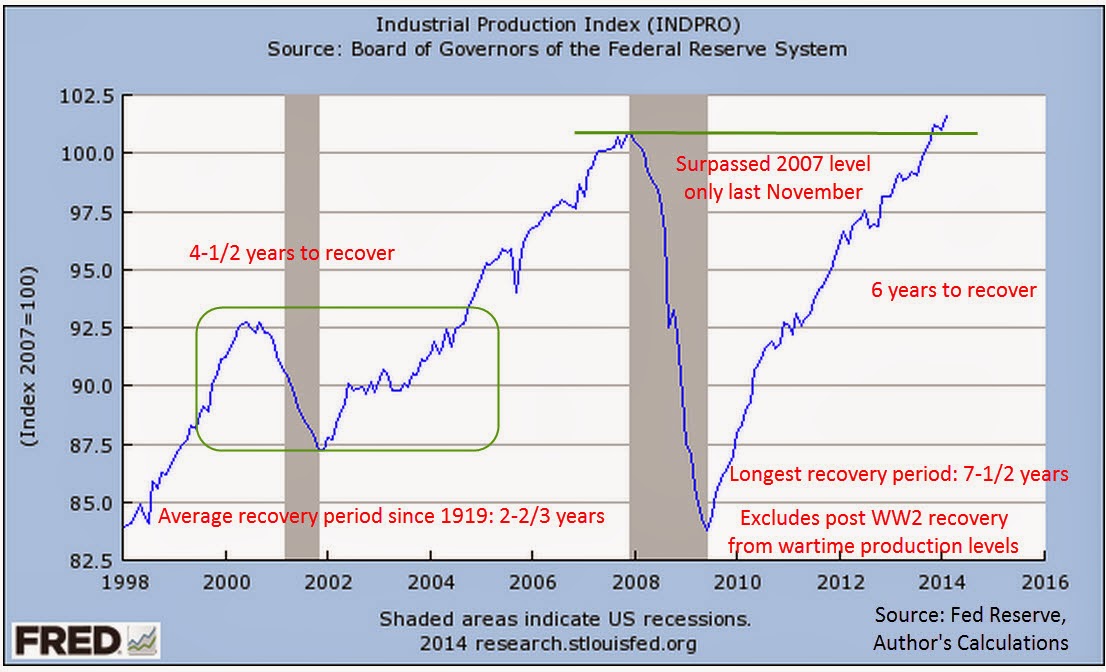
Here is a comparison of the recovery periods since 1919.  The back to back dips of 1979 and 1980-83 were, in effect, one long dip lasting 4 years, making it the third worst recovery period of the past one hundred years.
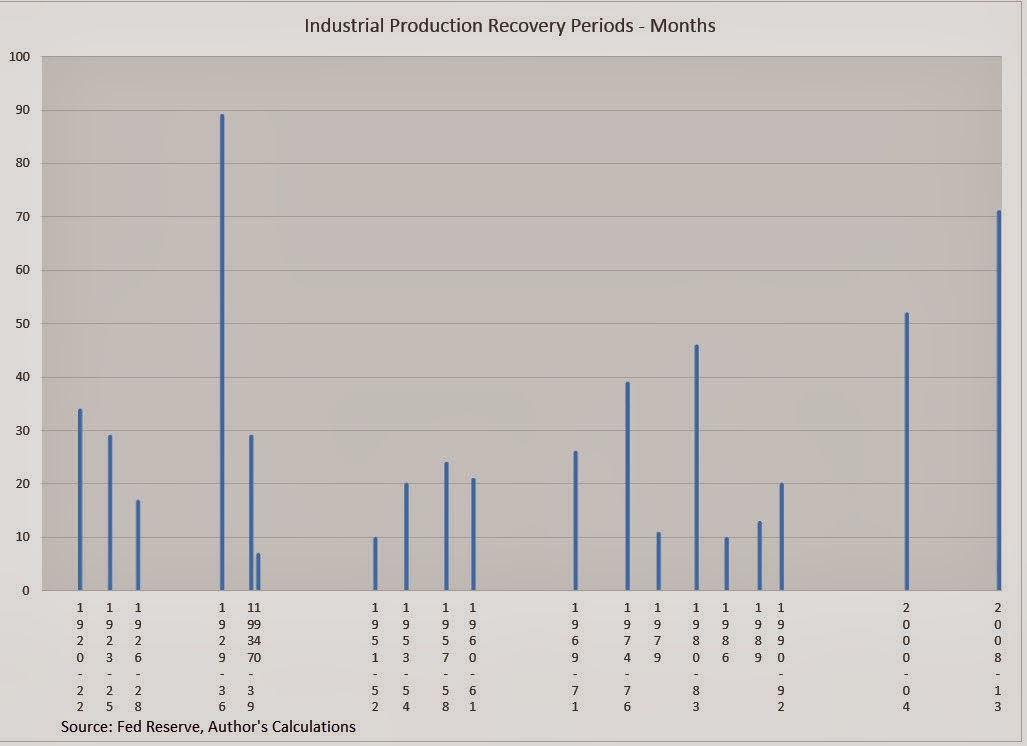
When industrial production takes several years to regain the ground lost during a recession, it is vulnerable to even minor economic weaknesses.  As production recovered from a 7-1/2 year dip during the 1930s Depression, the Federal Reserve tightened money and production slid once again before reviving to produce arms to ship to British and European forces in the early years of World War 2.  Outgoing Federal Reserve chairman Ben Bernanke, a noted scholar of the 1930s Depression, understands the inherent weakness of an economy when production takes several years to recover.  For this reason, he was reluctant to ease up on monetary support until production was clearly and securely recovered.

The new Federal Reserve chairwoman, Janet Yellen, has decades of experience and is well aware of the fragility that is inherent in an economy that experiences a long period of industrial recovery.  This will be one of several factors that the Federal Reserve watches closely for any signs of faltering.  Those who think that the Fed will make any abrupt changes in monetary policy have not been reading the footprints left by the past.

****************************

Productivity

Last August I wrote about the rather slow growth of multi-factorial productivity (MFP) since 2000.  The Bureau of Labor Statistics (BLS) calculates a meager 1% annual rate of growth in that time.  Far down in their historical tables is a revealing trend: Labor’s contribution to production has declined dramatically in the past ten years while capital’s share of inputs has increased.  Capital inputs include equipment, inventories, land and buildings.  In 2011, the most recent year available, labor’s share of input had decreased to 63.9%, far below the 60 year average of 68.1%.

Capital’s share of input had increased to 36.1%, far above the average 31.9%

As I mentioned last August, the headline productivity figures are misleading because they simply divide output by number of hours worked and ignore the contributions of capital to the final output.  As capital’s share of input increases, the contributors of that capital want more return, i.e. profit, on their increased contribution.

In the twelve years from 2000 – 2011, capital’s share of input has increased 20%, from 30% to 36%.  In that same period, after tax profits have grown by 130%, a whopping return on the additional 20% capital invested.  While overall MFP growth has slowed, the mix has changed.
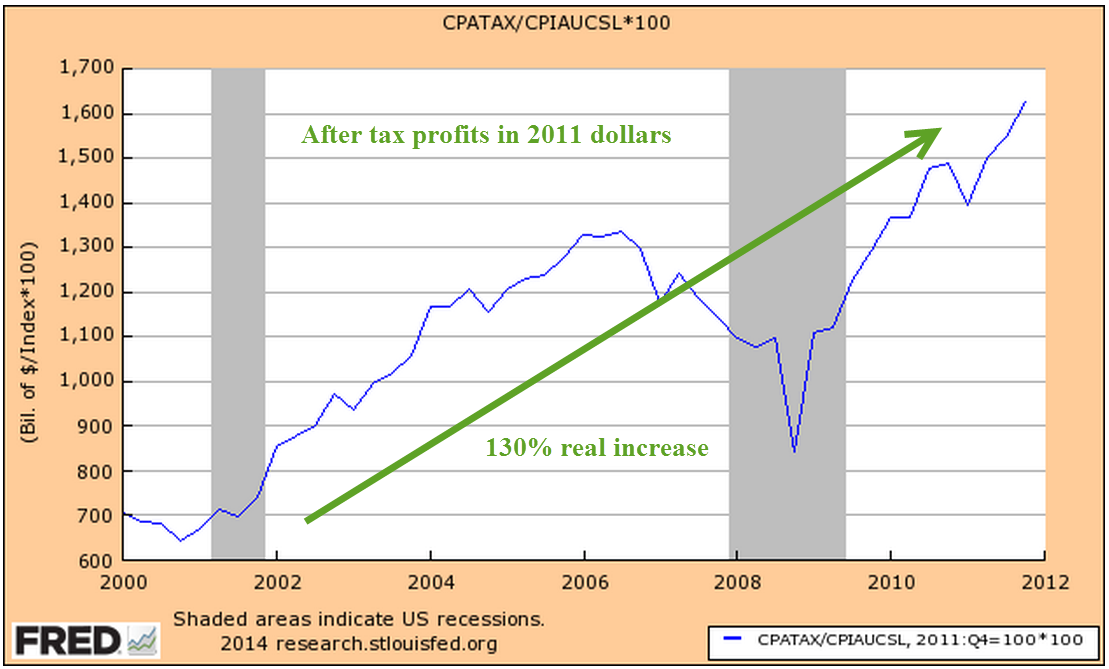
Given such a rich return, we can expect this trend to continue until the growth of profits on ever larger capital investments reaches a plateau and slows.  Until then, labor’s share of productivity gains will be slight, acting as a continuing restraint on family incomes.

*******************************

Existing Home Sales

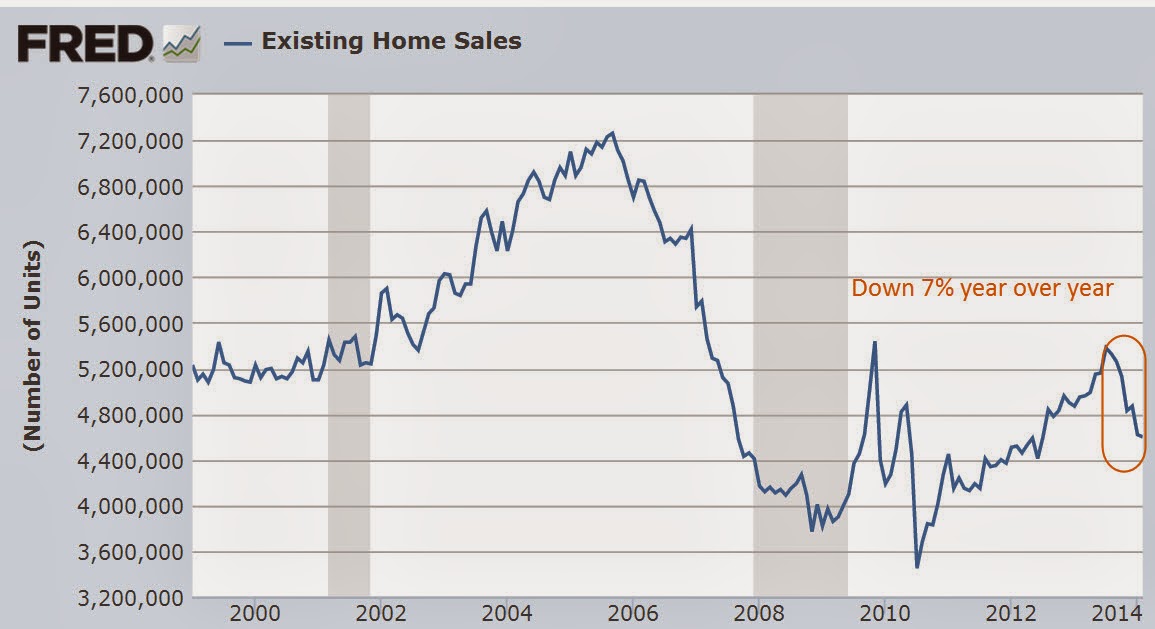
The 5 million sales of existing homes in 2013 was 9% above 2012 levels but the percentage of cash buyers has increased as well, now making up almost 1/3 of existing homes sales. (National Assn of Realtors).  The percentage of first time buyers declined from 30% in December 2012 to 27% in December 2013. For the past half year sales of existing homes have declined and the latest figures for February show a 7% decline from 2013 levels.
In May 2013, the price of Home Depot’s stock hit $80, a 400% rise from the doldrums of the spring of 2009.  Since then, it has traded in a close range around that price.  In May 2013, the price of the stock was 200% of the 4 year average, an indication that all of the optimism had been baked into the stock price.  It now trades at 160% of the 4 year average, rich but more reasonable if expectations for a continued housing recovery materialize.

In January 2000, the stock broke above $50 and was also trading at almost 250% of it’s 4 year average.  After trading in a range in the high $40s for several months, the stock began to fall.  By mid-June of 2000, the stock traded for 150% of its 4 year average.
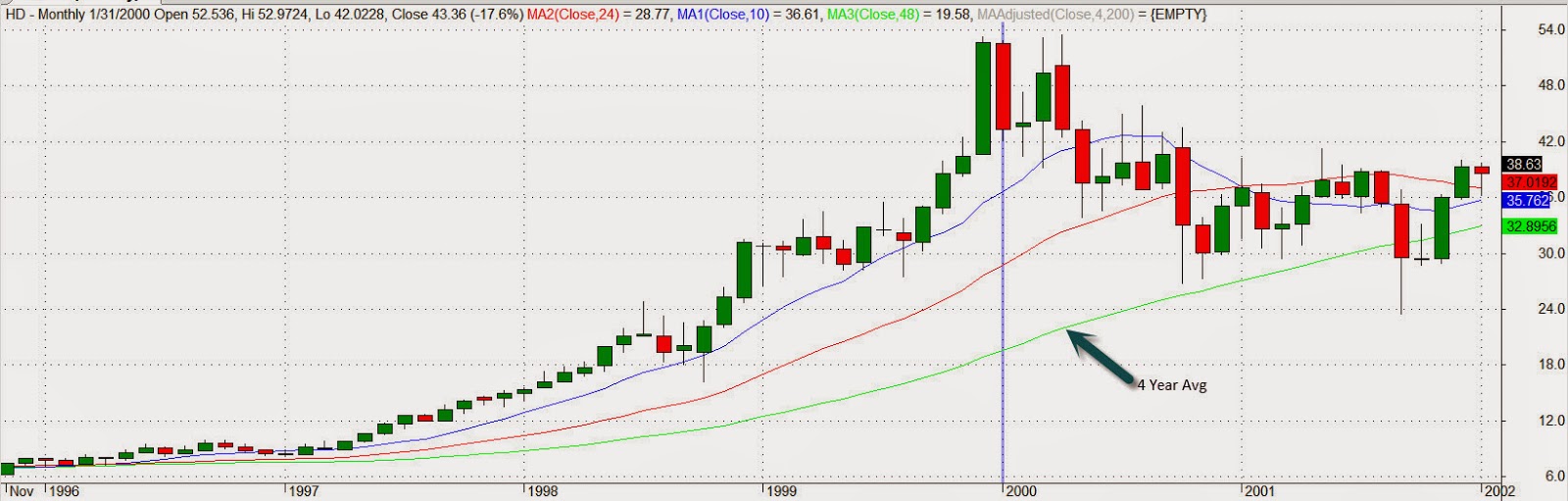
The range bound price of Home Depot’s stock price for 8 months now is a good indication that investors have become watchful of the real estate sector, particularly the existing home market.  The percentage of cash buyers has risen 10%, replacing the similar decline in the number of first time home buyers.  Remember that this stalling is taking place at a time when interest rates are near historic lows.

*******************************

Reader questions

A reader posed a few questions about last weeks blog.

When annualized sales rates are down, but annualized inventory rates are up, is that usually because of prior contracts that businesses must accept?  Or is it usually hope for their future?  In other words, is a higher inventory rate a positive sign or a negative one?

When sales are going down and inventories are going up, it means that businesses were not prepared for the change in sales. This ratio measures the amount of surprise.  Businesses will then reduce their orders to factories, wholesalers, etc.  They may decide to reduce any hiring plans.  On the other hand, they might increase their marketing expense.  Look closely at the Inventory to Sales Ratio (ISRATIO) graph from the Fed.  In the early part of the recession in the first quarter of 2008, the ISRATIO moved up a bit, then down in the 2nd quarter but it was still in the subdued normal range of 1.25 to 1.30 established since 2006.  During the summer of 2008, the ISRATIO rose again but it was not until September 2008 that this ratio began it’s several month upward spike as sales crashed.

Re:  Decline in real personal consumption below 2.5% has ALWAYS led to a recession within a year.  Are there any substantive changes in how the economy is run now than in the past?  For example, has the Fed always been involved with quantitative easing like it is now?  Could that easing create a better economic climate despite personal consumption decline?  When we look at the past, are we generally comparing apples to apples?

The fact that a recession has always happened when inflation adjusted personal consumption falls below 2.5% does NOT mean that it will happen this time.  These are indicators, not predictors and we must remember that indicators of past trends are with revised data.  Investors and policy makers must make decisions with the currently available data, before it is fully complete. Personal consumption for 2013 could be revised higher in the coming quarters.  Some revisions happen as much as three years later.  What it does mean is that the Fed will be watching this sign of weakness in the consumer economy and is unlikely to make any dramatic policy changes.

So how do you think our leaders should lead in regards to SS?  Do you think the age should be raised to say 70?  Do you think we will not be able to depend on SS being there throughout our lifetimes?  It must be of great concern to your kids that it may not be there for them, esp. after having contributed over the years.

I think politicians will have to spread the pain on Social Security.  These suggestions are not new.

1) Raise the salary level that is subject to the tax so that more tax is captured from higher salaries.  This years maximum is $117K. (SSA) This is a tough sell.  The ratio of the maximum taxed earnings to the median household income (Census Bureau Table H.6) has gone up from 150% in 1980 to almost 220% in 2012.
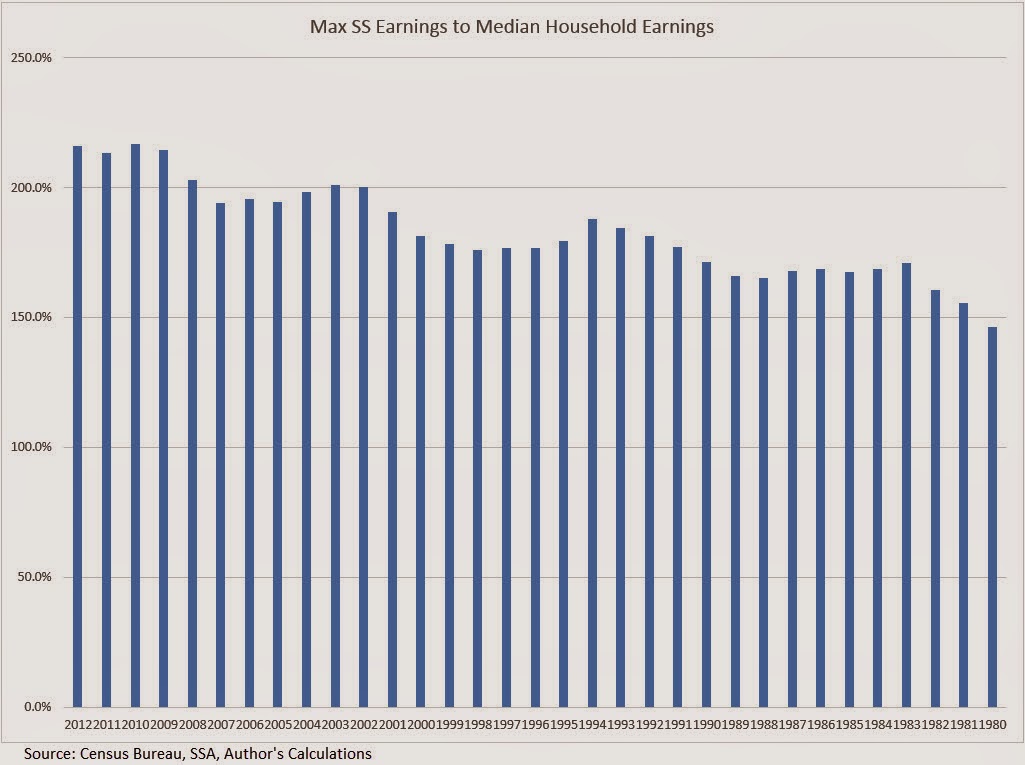
Well to do people feel like they are already paying their “fair share.”  Senator Bernie Sanders and other Democrats use the ratio of the maximum taxed earnings to the top 10% of incomes to make the case that the maximum should be as high as $175K.  Computers and the availability of so much data enable policy makers and think tanks to produce whatever data set they want in order to support their conviction.

2)  Raise the employee and employer share of the tax .1% each year for the next five years.  Democrats will not like this one because it raises the burden on lower income families.

3)  Initially raise the social security age by two months each year over the next five years and index it to the growth in the life expectancy of a 65 year old so that the official retirement age is 15 years less than the life expectancy.  In 2025, if the life expectancy is 85 years, then the official retirement age would be 70.  Early retirement should be set at 3 years less than full retirement age.  In this case, early retirement would be 67.

All of these are tough choices and most politicians don’t want to touch them.   Voters are not noted for their prudence and are unlikely to pressure pressure policy makers for more taxes and less benefits. In order to sell these difficult proposals, I would add one more proposal.

4) Guarantee the payout of benefits for ten years, regardless of death.  Each retiree would name beneficiaries for their social security and payments would go to those beneficiaries until the 10 year anniversary that retirement benefits began.  This would incentivize retirees who could afford it to delay the start of their retirement benefits until 70, knowing that their heirs would get at least ten years of benefits. This delay would ease some of the fiscal shock as the boomer generation is now retiring.

Currently, the highest social security benefit is paid to a surviving spouse.  If a man dies with a higher monthly benefit than his wife, then the wife gets the husband’s higher benefit amount each month but loses her benefit.  Under this proposal, the wife would get her benefit and the husband’s benefit plus her benefit if her husband dies within ten years of retirement.  Often, a couple’s income is cut in half or by a third when a spouse dies.  Older women are particularly impacted, finding that they can no longer afford the mortgage or rent in their current housing situation. This feature would enhance the popular understanding that Social Security is like an insurance annuity.  It would help particularly vulnerable older surviving female spouses, an emotionally appealing feature that politicians could sell to voters, thus making it more likely that voters would accept the higher taxes and raised retirement age.  Whether the idea is fiscally sound is something that the Board of Trustees at the SSA could calculate.
Sales, Employment, Social Security

March 15th, 2014

Small business

The monthly survey of small businesses showed an abrupt decline in sentiment, below even the lowest of expectations,  and the sixth report since the beginning of the year to come in below the consensus range.  Two factors led the downward change: lowered sales expectations and hiring plans. The majority of business owners surveyed are reducing, not adding to inventory.  The steady but slowly improving sentiment during 2013 has now weakened.

This reading of optimism among small business owners is indexed to 100 in 1986.  The current survey reading of 91.5 is far above the pessimistic level of 80 that the index sank to in the early part of 2009.  In 2006, sentiment broke below the 95 level and has not risen above that since – eight years of below par sentiment among small business owners.

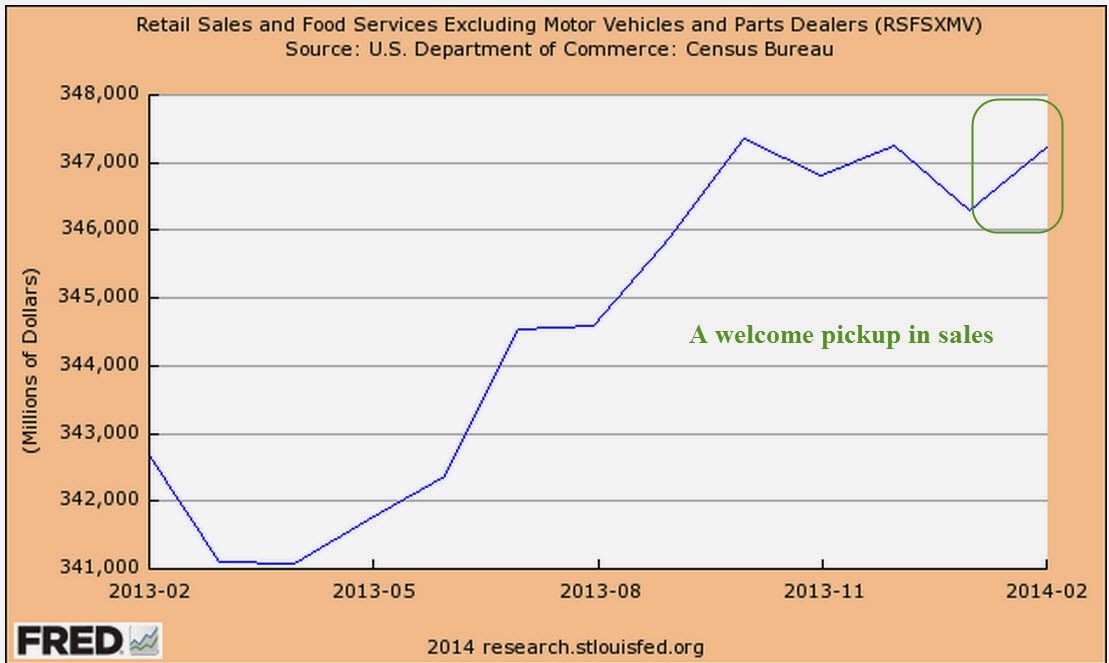
The lackluster small business report early in the week dampened market activity until the release of February’s retail sales report on Thursday.  The retail sales and employment reports that are released each month probably elicit the most response from the market.  A fall in February’s retail sales might have driven the market down at least 1%.  Instead, the report showed an annualized growth rate of 3.6%, offsetting the weakness in January and December.  Excluding auto sales, which accounts for about 20% of retail sales, total sales have formed a plateau.  Even auto sales were up this past month in spite of the extreme bad weather in parts of the country.  Some see this resilience in the face of the extraordinary weather this winter as an indication of an ever strengthening consumer base, a harbinger of solid economic growth.

The reason for the reduction in inventories indicated by the small business survey was revealed by Thursday’s report of the inventory-sales ratio for January.  Inventories rose at a 4.8% annualized rate versus a 7.2% annualized decline in sales.  January’s ratio of inventory to sales is at the same level as the beginning of the recovery in 2009.  Businesses will be cautious buyers this spring until excess inventories are reduced.

****************************
Employment

The number of unemployment claims declined again this week, bringing the four week average down to approximately 330,000, considered by many to be in the healthy range.  As a percent of the workforce, new unemployment claims are near all time lows.  Enacted in 1993, NAFTA had some small effect on employment but the more consequential impact was the admittance of China into the WTO.  As the relatively more volatile manufacturing employment decreased, so too did the surge in unemployment claims.  Note the reduced volatility of the work force today compared to the 1980s.

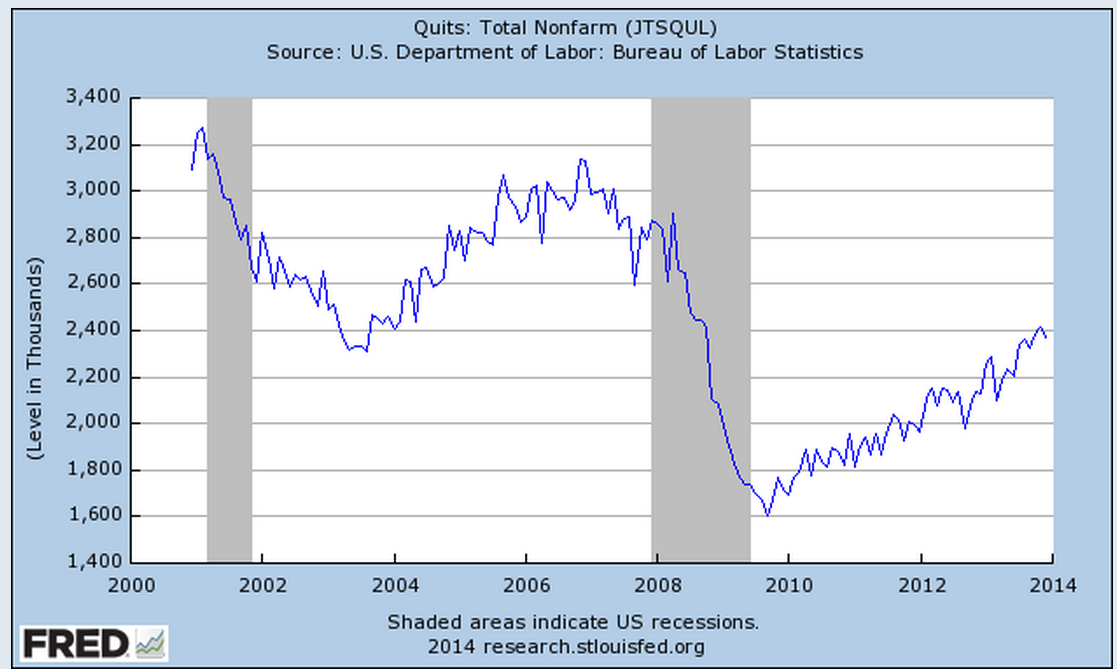
As a rule, employees quit jobs when they feel confident that another job is readily available.  The Quits rate has been rising since the official end of the recession in the summer of 2009 but is still relatively weak and declined in January.  The current level is at the lows of the recovery from the recession of the early 2000s.

As a percent of the workforce, however, the level of quits has not even reached the lows of that previous recession.

***************************
Income

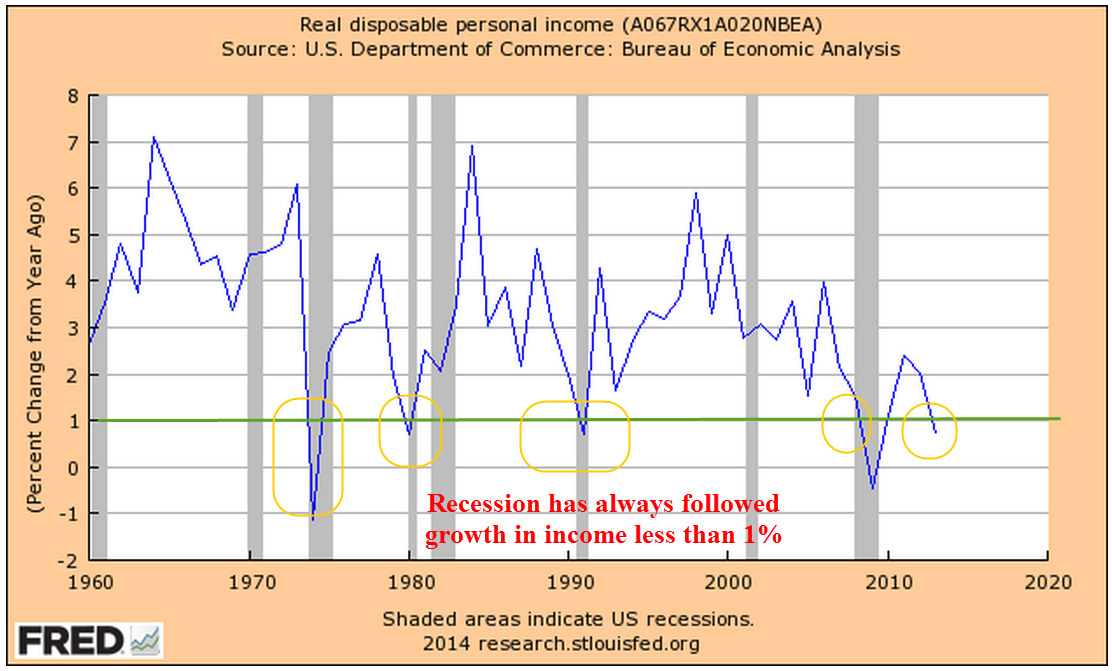
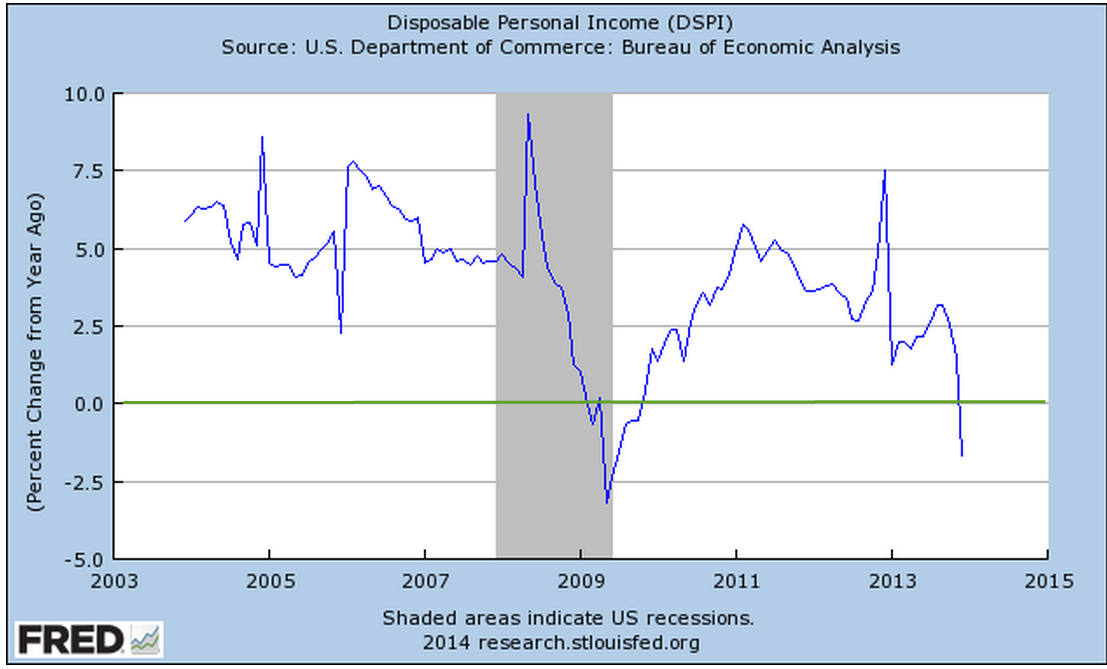
Now for a disturbing trend: the decline in disposable income below 1% has always marked the start of a recession.  This annual report from the Bureau of Economic Analysis (BEA) covers the period till the end of 2013 and was not affected by the recent cold weather.

Recent price increases in basic food commodities like milk and cereal nibble away at consumers’ pocketbooks.  An ETF that tracks agricultural commodities is up almost 20% in the last six weeks.

Whenever the growth in real, or inflation-adjusted, personal consumption has declined below 2.5%, the economy has always  gone into recession within the year.  In 2013, consumption growth fell to 2.0%.

Well, maybe this time is different.  Eternal hope, persistent denial. Those of us living in the present too often believe that we belong to an elite club with special rules that those in the past did not enjoy.

**************************

Social Security

Several years ago, the Social Security administration (SSA) estimated that 10,000 people would qualify for benefits each day.  Republican Congressman Eric Cantor and Democratic Senator Ron Wyden are two politicians on opposite sides of the political aisle who mention the 10,000 a day factoid.  The actual number of new retirees per day is actually higher.  Using recent data from the SSA, PolitiFact reported that 11,000 new retirees each day qualify for Social Security.  No one mentions the 4,300 who die and drop off the Social Security rolls (2008 data from the Census Bureau).  This number is likely to increase another 15% as the Boomer population swells into old age; the 1.6 million a year who die is likely to grow to 1.8 million who leave the Social Security system while 4 million become eligible for retirement benefits.  The result is an approximate net increase of 2.2 million beneficiaries each year of the next decade.

For now, let’s leave out the growth in the disability and Medicare programs and focus only on retirement and survivor’s benefits, or OASI.

At an average yearly benefit of $14K the benefits paid by the Social Security Administration rise by $31 billion this year, a 4.6% increase on the approximately $670 billion in Social Security and Survivor’s benefits paid out in 2013 (CBO report).  The relatively small deficit of $60 billion last year will grow into hundreds of billions within the decade.  Congress argues at length over $3 billion; efforts at tackling the really big deficits of Social Security are too often met with blowhard rhetoric, not serious negotiation.

The SSA estimates that “By 2033, the number of older Americans will increase from 45.1 million today to 77.4 million.” (SSA Basic Facts) At an inflation rate of 2.5%, less than the 3% average of the past 50 years, the average $14K annual benefit will grow to $23K by 2033.  Multiply that by 77 million people and the total of benefits that will be paid to seniors in 2033 is close to $1.8 trillion, almost triple the benefits paid in 2013.  

The current elderly count of 45 million people is 14% of today’s population of approximately 313 million.  In 2033, 77 million elderly will be 20% of an estimated population of 382 million.  More people getting paid while fewer people will be paying.  The SSA estimates that a little over 40% of the population who are working will be supporting the 20% of the population that is collecting SS benefits.
Independent Senator Bernie Sanders is fond of reassuring us that the Social Security Trust Funds have plenty of money to pay benefits over the next two decades.  What the trust funds have are I.O.U.s from the U.S. Government’s pool of tax revenues.  Where will the money come from?  Increased taxes. 
Politicians rarely lead.  The art of politics is to look like one is a leader, to position oneself at the front of the herd as it flees the pursuing lions.  In this case, the lions are demographics, and decades of promises, unrealistic assumptions and political cowardice.  The question is whether voters will force the leaders to lead before the lions attack.

Employment, New Orders, CWPI

CWPI (Formerly CWI)

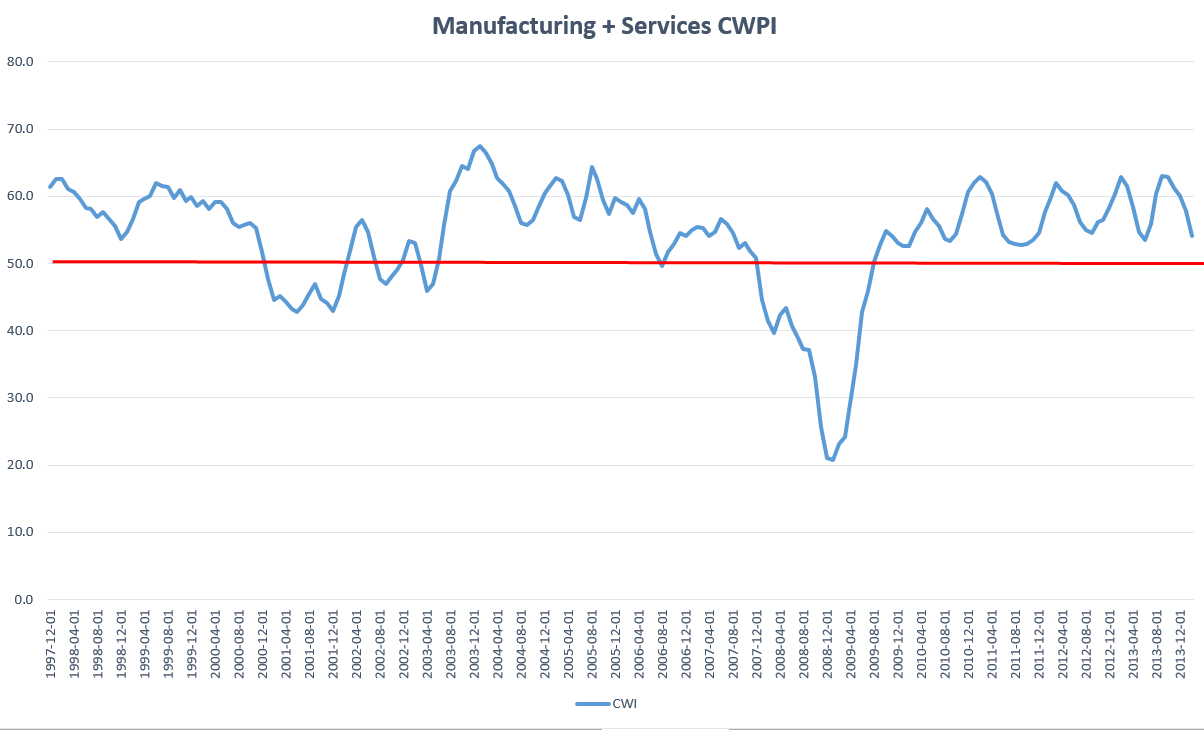
The Constant Weighted Purchasing Index (CWPI) that I introduced last summer was designed to be an early or timely warning system of weakening elements of the economy.  It is based on a 2003 study by economist Rolando Pelaez on the monthly Manufacturing Purchasing Managers Index (PMI) published by the Institute for Supply Management (ISM).  ISM also produces a Non-Manufacturing index for service industries each month but this was not included in the 2003 study.

The CWPI focuses on five factors published by ISM:  employment, new orders, pricing, inventory levels and the timeliness of supplier deliveries.

The CWPI assigns constant weights to the components of both indexes, then combines both of these indexes into a composite, giving more weight to the services sector since it is a larger part of the economy.  Both the CWPI and PMI are indexed so that 50 is neutral; readings above 50 indicate growth; readings below 50 indicate contraction.  In previous months (here and here), I anticipated that the combined manufacturing and services sector index would move into a trough at this time before rising again in March and April of this year.

A longer term chart shows the wave like formation in this expansionary phase that began in the late summer of 2009.

February’s ISM manufacturing index climbed slightly but the non-manufacturing, or services, index slid precipitously, more than offsetting the rise in manufacturing.  Particularly notable was the huge 9% decline in services employment, from strong growth to contraction.  The service sector portion of the CWPI shows a contraction which some blame on the weather.  A slight contraction – a reading just below 50 – can be just noise in the survey data.  The past two times when the employment component of the services sector has dropped below 48, as it did in this latest report, the economy was already in recession; we just didn’t know it till months later.

A close comparison of the current data with the previous two episodes may sound a cautionary tone.   At this month’s reading of 48.6, the CWPI services portion is not showing as severe a contraction as in April 2001 (43.5) and January 2008 (33.1), when the employment component also dropped below 48.

New orders and employment in both portions of the CWPI are given extra weight. In January 2008, new orders and employment both fell dramatically.  The current decline is similar to the onset of the recession beginning in early 2001, when employment declined severely in April but new orders remained about the same.  Let’s isolate just these two factors and weight them proportionate to their respective weights in the services portion of the CWPI.

Notice that the decline below 50 signaled the beginning of the past two recessions.  Here’s the data in a different graph with a bit more detail.

Some cite the historically severe weather in the populous eastern half of the country as the primary cause for the decline in the services sector employment indicator and it well may be.  If so, we should expect to see a rebound in this component in March.  Basing a prediction on one month’s reading of one or two components of an indicator is a bit rash.  However, we often mistakenly attribute weakness in some parts of the economy to temporary factors and discount their importance because they are temporary – or so we think.

In the early part of 2008, many thought that a healthy correction in an overheated housing market was responsible for the slowdown in economic growth.  In the spring of that year, the bailout of bankrupt Bear Stearns, an undercapitalized investment firm which had made some bad bets in the housing market, confirmed the hypothesis that the corrective phase was nearing its end. As weakness continued into the late spring of that year, some blamed temporarily high gasoline and commodity prices for exacerbating the housing correction.  In the fall of 2008, the financial crisis exploded and only then did many realize that the problems with the economy were more than temporary.

In the early part of 2001, a healthy correction to the internet boom was responsible for the slowdown – a temporary state of affairs.  When the horrific events of 9-11 scarred the country’s psyche, the recession was almost over.  Many were not listening to the sucking sound of manufacturing jobs leaving for China or giving enough importance to the increasing competitiveness of the global market.  Employment would not reach the levels of early 2001 till the beginning of 2005.

This time the slowdown in employment and new orders in the services sector may be a temporary response to the severe winter weather.  Let’s hope so.

********************************

Private Sector employment and new unemployment claims

ADP released their February employment report this week and eyes rolled.  January’s benign reading of 175,000 private job gains was so at odds with the BLS’ reported gains of 113,000.  “Oh, wait,” ADP said this week, “we’ve revised  January’s gains down to 127,000.”  In a work force of some 150 million, 50,000 jobs is rather miniscule.  As the chief payroll processor in this country, ADP has touted its robust data collection from a large pool of employers.  A revision of this magnitude leads one to question the robustness and reliability of their methodology, and the timeliness of their data collection.  For its part, the BLS admits that its current data is based on surveys and that each month’s estimate of job gains is largely educated guesswork.  ADP is actually processing the payrolls, which should reduce the amount of guesswork.

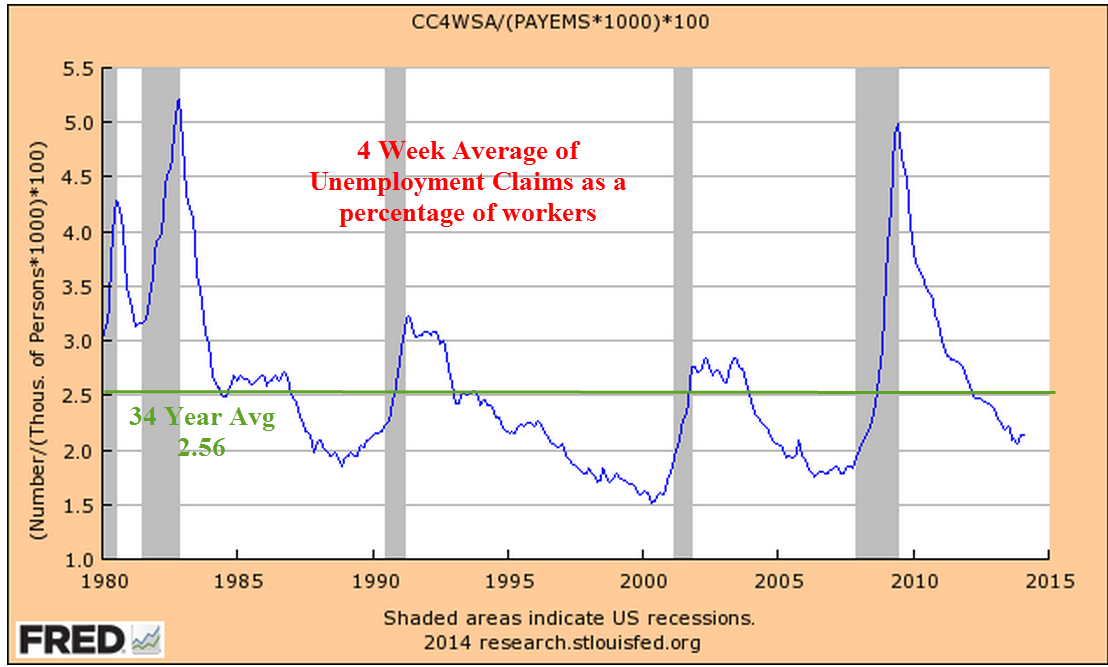
Private job gains in February were 10,000 below the consensus 150,000 but this week’s report of new unemployment claims dropped 27,000, bringing the 4 week average down a few thousand.  As a percent of workers, the 4 week average of continuing claims is below the 33 year average and has been since March 2012.  In this case, below average is good.

********************************

Employment – Monthly Labor Report

This week’s labor report from the BLS carried a banner caveat that the cold weather in February may have affected employment data.  With that in mind, the headline job gains of 175K were above expectations for 150K job gains.  The unemployment rate ticked up a bit.  If we average the ADP job gains with the private sector job gains reported by the BLS, we get 150K plus 13K in government jobs added for a total of 163K total jobs.  The year over year growth in the number of workers is above 1%, indicating a labor market healthy enough to preclude recession.

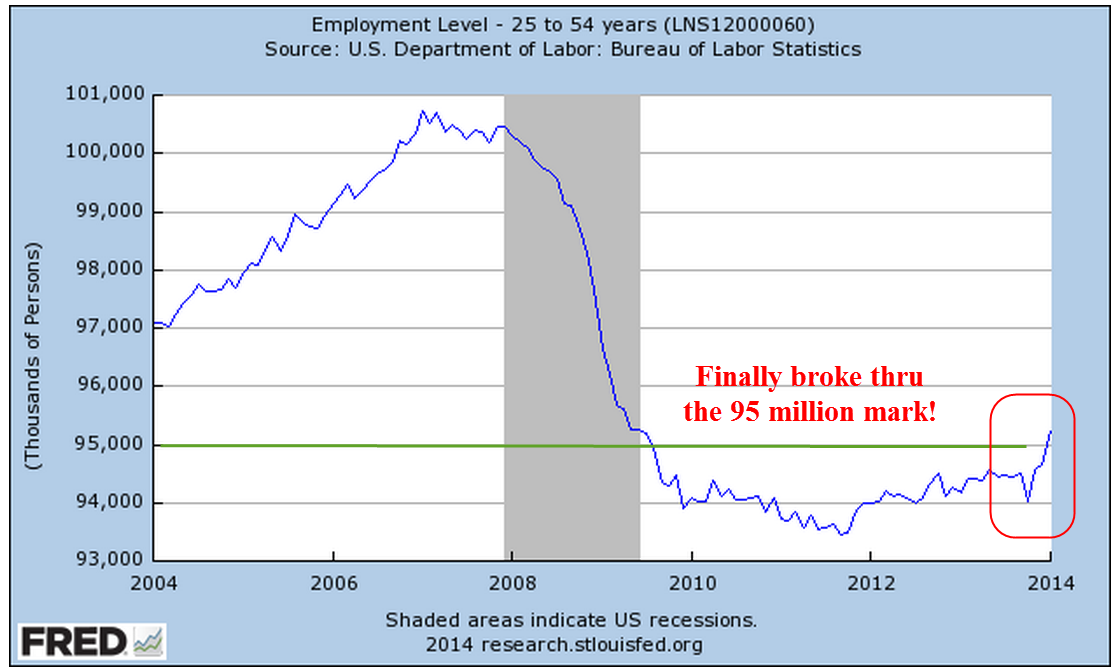
A big plus this year is the growth in the core work force, those aged 25 – 54, which finally surpassed the level at the end of the recession in the summer of 2009. 

However, there are some persistent trends independent of the weather that underscore the challenges that the current labor market is struggling to overcome.

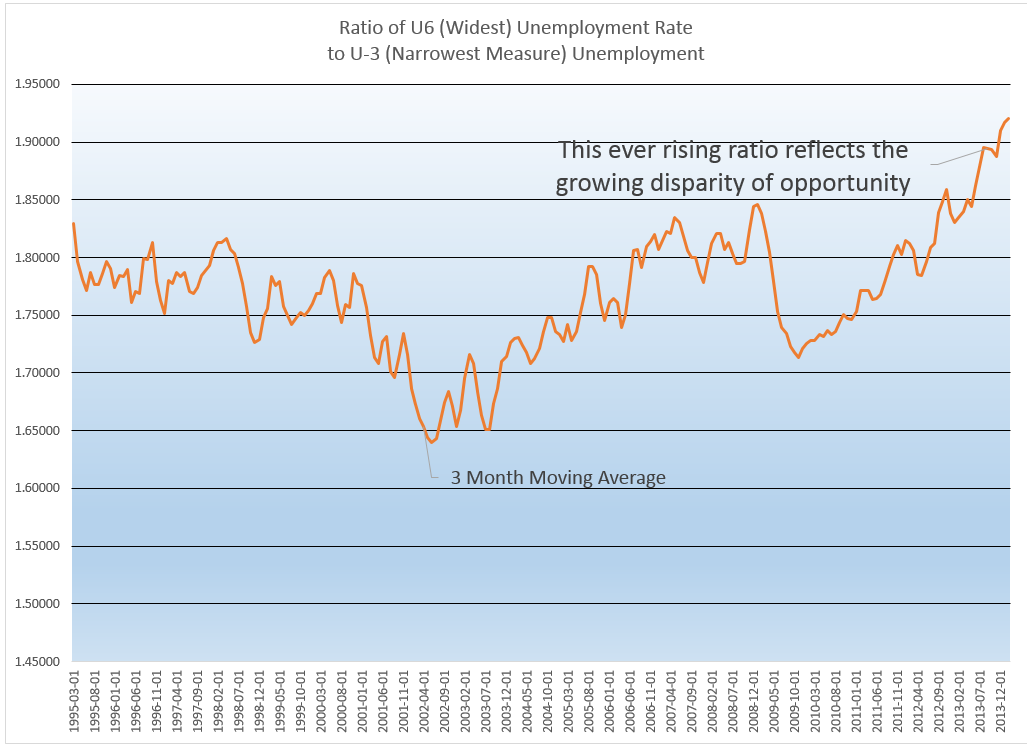
As I pointed out last week, there are several unemployment measures, from the narrowest measure – the headline unemployment rate – to wider measures which include people who are partially employed.  The U-6 rate includes discouraged workers and those who are working part time jobs because they can’t find full time jobs.  For a different perspective, let’s look at the ratio of the widest measure to the narrowest measure. The increase in this ratio reflects a growing disparity in the economic well being of the work force.

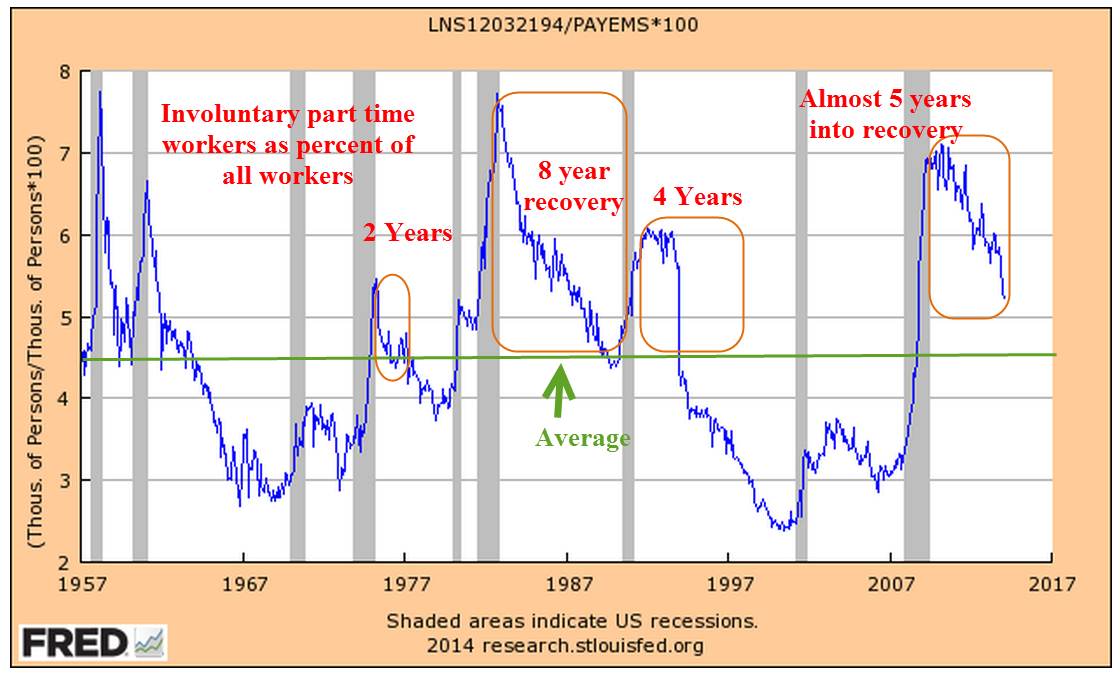
Contributing to the rise in this ratio is the persistently high percentage of workers who are involuntary part timers.  Looking back over several decades, we can see that the unwelcome spike in this component of the work force can take a number of years to decline to average levels.  Following the back to back recessions in the early 1980s, levels of involuntary part timers took 8 years to recover to average, then quickly climbed again as the economy sputtered into another recession.  We are almost five years in recovery from this recession and have still not approached average.

There are more discouraged workers today than there were at the end of the recession in the summer of 2009.  Discouraged workers are included in the wider measure of unemployment but not in the narrow headline unemployment figure.

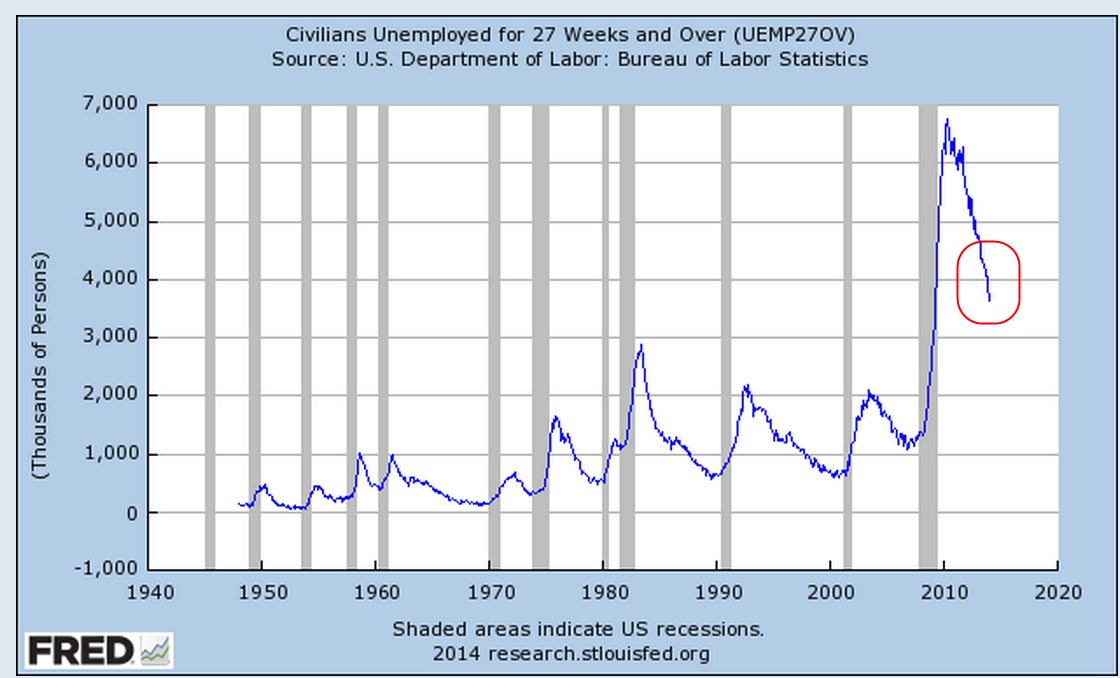
The median duration of unemployment remains at levels not seen since the 1930s Depression.  Someone who becomes unemployed today has a 50-50 chance of still being unemployed four months from now.  That would make a good survey question:  “In your lifetime, have you ever been involuntarily unemployed for four months?”

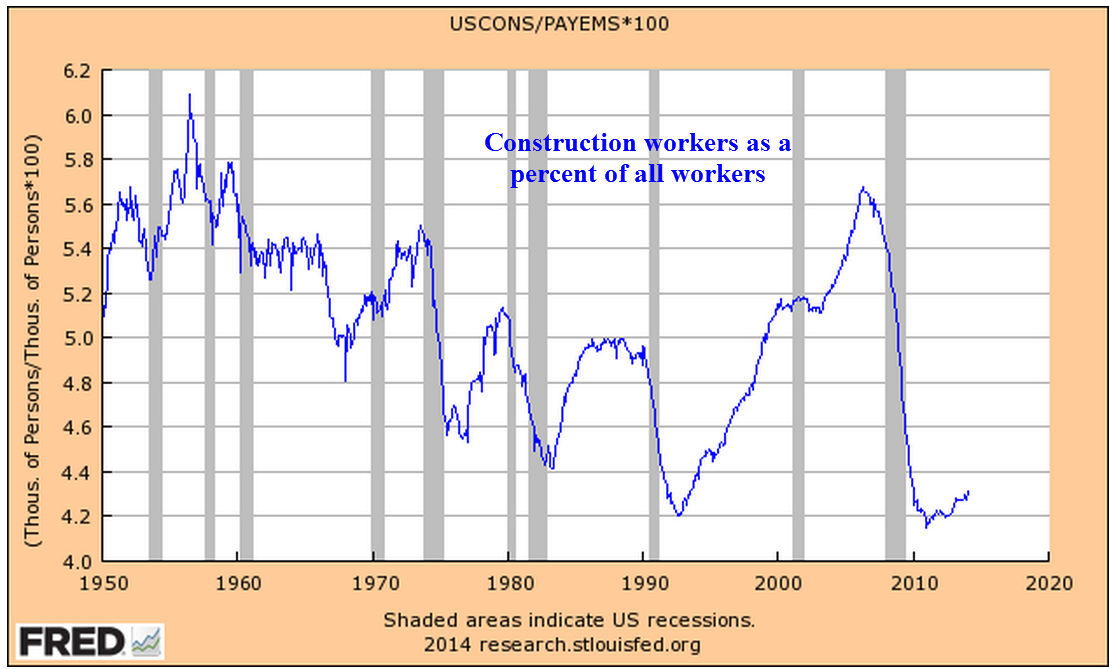
Despite all the headlines that the housing market is rebounding, the percent of the work force working in construction is barely above historic lows.

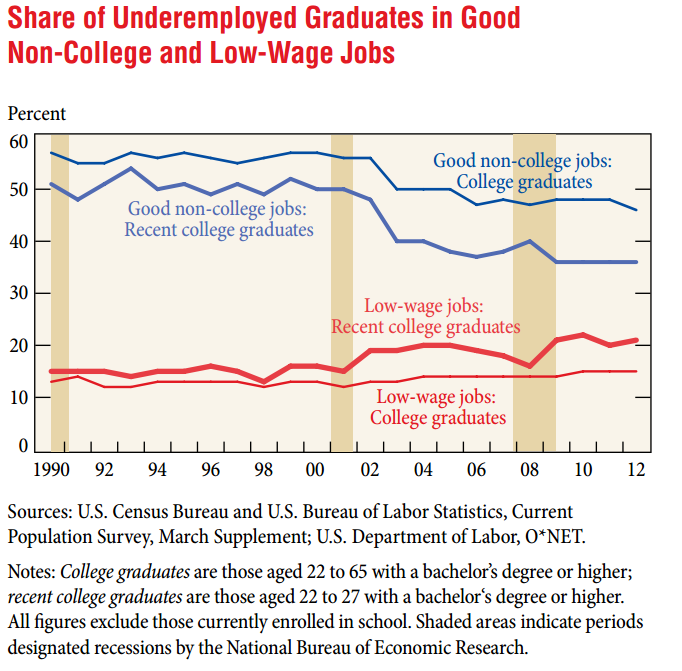
A recent report by two economists at the New York branch of the Federal Reserve paints a disappointing job picture for recent college graduates.  On page 5 of their report is this telling graph of a higher percentage of recent college graduates accepting low wage jobs.

Low wage and part time jobs do not enable a graduate to pay back education loans.  Almost two years ago, the total of student loans surpassed the trillion dollar mark.  According to the Dept. of Education, the default rate in 2011 was 10%.  I’ll bet that the current default rate is higher.

******************************

Takeaways

As is often the case, data from one source partially contradicts data from a different source.  The employment decline reported by ISM bears close watching for further signs of weakness.  The yearly growth in jobs reported by the BLS indicates a relatively healthy job market.

The Market and Growth

March 2nd, 2014

SP500
Some pundits have made the case that the stock market is due to fall this year because of the almost 30% rise in prices in 2013.  On the face of it, it seems logical.  If the average rise in the SP500 over the past fifty years is about 8-1/2% and there is a 30% rise in one year, then the market has essentially “used up” more than three years of the average – all in one year.  But the stock market is the net result of billions of buy and sell decisions by human beings.  My experience has taught me that the connection between sense and the behavior of human beings is tenuous, at best.  The Red Carpet walk at the Oscars Award Ceremony is a demonstration of the nonsensical choices that human beings make.  I mean, can you believe the dress that actress is wearing?  And who told that actor he could grow a beard?  PUH-LEEZ!

So I looked at past history and wondered: what is the average yearly return of the SP500 index over the three years following a 20% rise in the market?  As an example, if the market rises 20% in Year #1, what is the 3 year average of yearly returns in Year #4?  The results surprised me – 9.5%.

But wait! you say.  The late nineties were an aberration of irrational exuberance that skews the average.  Removing those two outliers from the data set gives a yearly average of 6.2%.  Add in 2% dividends and the total comes to 8.2%, a respectable return.

But wait!, you say again.  What about the year after the 20% rise?  Surely, the index must compensate for the above average rise the previous year.  In the year after a 20% rise in the market, the average gain was 13.5%.  Again, there were those crazy years of the late nineties so I’ll take them out, leaving an average gain of 3.7%.  Add in the 2% dividend and it easily outpaces the current return on long term bonds.

This year the pundits could be right and the stock market falls.  However, a successful long term investor must learn to play the averages.

*********************************

GDP and Savings

GDP is a measure of the economic output of a nation but what the heck is it?  A recent presentation by Gary Evans, an economics professor at Harvey Mudd College in California, has a number of wonderfully illustrated graphs that may help the casual reader understand the components of GDP and recent trends in the economy.

On January 30th, the Bureau of Economic Analysis (BEA) released their advance estimate of real GDP growth of 3.1% in the 4th quarter.  As more information of December’s slowdown became available in late January and early February, the market began anticipating that the BEA would revise their advance estimate down.  Slower growth might mean further declines in stock prices, right? Instead, the market anticipated that a slowing of growth in the fourth quarter would calm the hand of the Fed in tapering their bond purchases. As a result, the market  rebounded in February, more than making up for January’s decline.  On Friday, the BEA revised their second estimate of fourth quarter growth downward to 2.4%, almost exactly what the market consensus had anticipated and the market finished out a strong month with a small gain.  The BEA attributed the slower growth in the fourth quarter to reductions in federal, state and local government spending and a slowdown in residential housing.

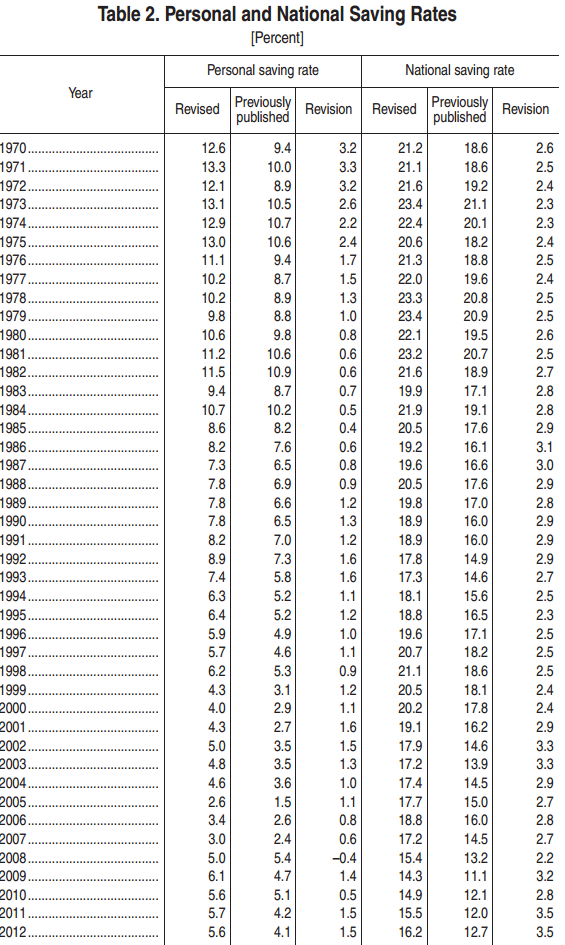
As the BEA revises their methodology, they also revise previously published GDP data.  In the 2013 revision the BEA adjusted their data going back to 1929.  In the past few years, revisions have added about 1/2 trillion dollars to GDP.  Adjustments to the personal savings rate were substantially higher but savings in the past decade have been at historically low levels.  Personal savings are the amount of disposable income, or income after taxes, that families save.  The rate or PSR is the the percentage of their disposable income that they don’t spend.

When people charge purchases that decreases the savings rate.  Conversely, when families pay down their credit purchases that increases the savings rate.  Despite the explosive growth of household debt in the past thirty years,
the savings rate has remained positive, meaning that the people who do save are more than offsetting those who don’t or can’t save.

Let’s take an example of three families:  the Jones family makes $60K in disposable, or after tax income, saves nothing, but increases their debt $8,000 by buying a new car.  Their personal savings rate is $-8K/$60K, or -13.3%.  The Smith Family also has $60K in disposable income, but is frugal and pays down a few loans and saves some money for a total savings of $2K, or 3.3%.   The Williams family has a disposable income of $120K and has net savings of $20K, or 16.7%. Families with higher incomes tend to save proportionately more of that income.  Total disposable income for the three families is $240K.  Total savings is $14K, or 5.8% of disposable income, but that hides the fact that it is the Williams family that is making most of the contribution to that savings rate.
There is another subtle element contributing to this disparity in savings: inflation.  The Consumer Price Index charts the increasing prices of goods and services – spending.  A higher income family that spends less of its income is less affected by changes in the CPI than a lower income family and this helps a higher income family save proportionately more than the lower income family.  The difference is slight but the compounded effect over thirty years is significant.

During the past thirty years, the personal savings rate has steadily declined.

This doesn’t mean that families are saving less as a percentage of their income but that the number of families with net savings are becoming fewer while the number of families with little net savings or negative net savings are becoming more numerous.  The period from 1930 to 1980 was one of relatively more income equality than the period 1980 to the present.  Let’s look again at the chart above.  In the late 1970s, as income equality begins a decades long decline, so too does the personal savings rate.  The ratio of high income families with a relatively high savings rate to lower income families with a low savings rate also declines.

Savings drives investment in the future.  The low savings rate means that future U.S. economic growth must rely ever more on the savings from those in other countries.  Typically savings rates increase as a recession progresses and then the economy recovers.

Notice that the savings rate has stayed relatively steady in the past three years, indicating neither an increasing confidence or caution.  As shown in the table, only the three year period from 1988 – 1990 period showed the same lack of direction.  GDP growth in that period was stronger than it is today but the savings and loan crisis and the stock market crash of October 1987 had diluted the confidence of many.

****************************

New Home Sales
Here’s a head scratcher.  New home sales rebounded almost 10% in January, after falling 13% in December.  Even the figures for December were revised a bit higher.  As I noted last week, the rather flat growth in incomes has become an obstacle to the affordability of homes. December’s Case Shiller 20 city home price index reported a 13.4% annual increase in home prices. January’s rise in home sales was partially aided by sellers willing to make price concessions, resulting in a 2.2% decrease in the median sales price.

****************************

Durable Goods
Orders for durable goods, excluding transportation, were up about 1% this past month. A durable good is something which has a life of 3 years or more.  Cars and furniture are common examples. The year over year gain, a bit over 1% as well, indicates rather slow growth over the past year after adjusting for inflation.  However, several current regional reports of industrial activity indicate a quickening growth at the start of this year.  Reports from Chicago, Philadelphia and Kansas City hold promise that next week’s ISM assessment of manufacturing activity nationally will show a rebound.

As I have noted in blogs of the past few months, the pattern of the CWI index that I have been compiling since last summer indicated a rebound in overall activity in the early spring of this year.  This gauge of manufacturing and non-manufacturing activity is based on the Purchasing Managers Index released each month by ISM.  I suppose a better name for the CWI index would be “Composite PMI.”  Readers are welcome to make some suggestions.

****************************

Unemployment
New unemployment claims rose, approaching the 350K mark, but the 4 week average of new claims is holding steady at 338K.  In past winters the 4 week average has been around 360K.  If new claims remain relatively low during this particularly harsh winter in half of the country, it will indicate an underlying resiliency in the labor market.

Janet Yellen, the new chairwoman of the Federal Reserve, appeared before the Senate Finance Committee this week.  In her response to questions about the dual mandate of the Fed – inflation and employment – she noted that the Fed looks at much more than just the unemployment rate in gauging the health of the labor market.  One of the employment indicators they use is new unemployment claims.

When asked what unemployment rate the Fed considers “full employment,” Ms. Yellen stated that it was in the 5 – 6% range.  One of the Republican Senators asked about the “real” unemployment rate, without specifying what he meant by the word “real.”  Without hesitation and in a neutral tone, Ms. Yellen responded that if the Senator meant the “widest” measure of unemployment, the U-6 rate, that it was about 13%.  The U-6 rate includes discouraged workers and part time workers who want but can not find full time work.

When George Bush was President, “real” meant the narrowest measure of unemployment to a Republican because it was the smallest number.  With a Democrat in the White House, the word “real” now means the widest measure of unemployment to a Republican because it is the largest number.  Democrats employed the same strategy when George Bush was President, preferring the higher U-6 unemployment rate as the “real” rate because it was higher.  I thought that it would be a good response for anyone when confronted by a colleague at work about the “real unemployment rate” that we steer the conversation to more precise and politically neutral words like “widest” and “narrowest.”

****************************
Pensions
A reader sent me a link to a Washington Post article on the pension and budget woes of San Jose, a large city in California.  I am afraid that we will see more of these in the coming decade.  Beginning in the 1990s politicians in state and local governments found an easy solution to wage demands from public workers: make promises.  Wages come out of this year’s budget; pension promises and retiree health care benefits come out of some budget in the distant future.  For an increasing number of governments, the distant future has arrived.

In Colorado, a reporter at the Denver Post noted that the Democratic Governor and the Republican Treasurer are hoping that the state’s Supreme Court will force the public employee’s pension fund, PERA, to open its books. It might surprise some that a public institution like PERA is less transparent than a publicly traded company.  Actuarial analysis estimates are that PERA’s asset base is underfunded by $23 billion, or about $46,000 for each retiree. It was only last year that the trustees of the fund reluctantly lowered its expected returns to 7.5% from 8%.  Assumptions on expected returns, what is called the discount rate, is a major component in analyzing the health of any retirement fund and the money that must be set aside today to pay for tomorrow’s promised benefits.  Many analysts contend that even 7.5% is a rather lofty assumption in this low interest rate environment.

Readers who Google their own state or city and the subject of pensions will likely find similar tales of past political promises and lofty assumptions running headlong against the realities of these past several years.

Housing and Stocks

February 23rd, 2014

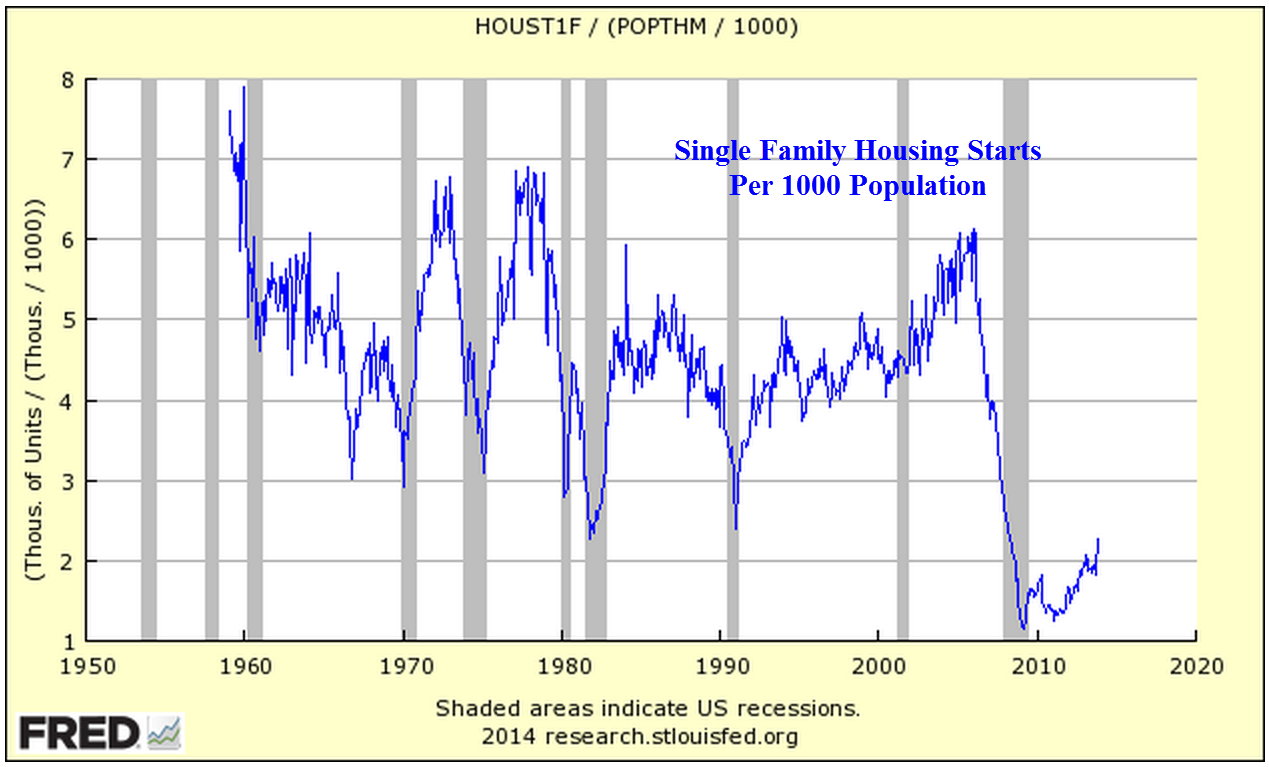
The extreme cold in half of the country had a profound effect on housing starts which fell 16% in January.  Less affected by the weather are permits for new housing which slid 5%.

The Bible prescribes that every 50th year should be a Jubilee year, in which all debts are forgiven.  While this policy of redistribution of property might be a practical solution in a smaller tribal society, it is much less practical, even dangerous, in a complex economy.  By targeting a 2% inflation rate, central banks in the developed world engage in a type of gradual debt forgiveness.  Inflation incrementally shifts the real value of a debt from the debtor to the creditor.  At a 2% inflation rate, a debt is worth half as much in 35 years.

Let’s say Sam borrows $1000 from Jane at 0% interest and doesn’t pay her anything for 35 years, then pays off the debt.  The $1000 that Sam pays back in 35 years is only worth $500 in purchasing power.  Half of Sam’s debt has effectively been forgiven.  So why would Jane loan Sam any money?  She wouldn’t – not at 0% interest.  At that interest rate the loan is actually a gift.  Jane would need Sam to pay her an interest rate that 1) offsets the erosion of the purchasing power of the loan amount, the principal, and 2) compensates Jane for the use of her money over the 35 years.

Janes all over the world loan Sam the money and don’t want much interest.  The Sam in this case is Uncle Sam, the U.S. Government.  The loan is called a 30 year Treasury bond.  (Treasury FAQs )

If your name is just plain old Sam though, few people want to loan you money for thirty years, even if it is to buy a hard physical asset like a house.  That is why U.S. government agencies back most of the mortgages in the U.S., essentially funneling the money from around the world to ordinary Sams and Janes to buy housing.  Heck of a system, isn’t it?

The affordability of housing… 

In the metro Denver area, median household income was $59,230 in 2011, compared to the national median income of $50,054. (Source)  According to Zillow, the median home value in Denver is $253,700, or 4.3 times income.   Although Denver is a large city, it is not a megalopolis like New York City or Los Angeles. In Los Angeles, median home values are $491,000.  Median incomes in 2011 were $46,148, so that home values are more than ten times incomes.  Like other megaregions, Los Angeles has a huge disparity in housing and incomes, resulting in a median income that is skewed downward because of the large number of poor people that inhabit any large metropolitan area.  The L.A. Times ranks incomes by neighborhoods.  This ranking shows a median income in middle class areas at about $85K.  Using this metric, housing is still more than six times income.  Using a conventional bank ratio of .28 of mortgage payment to income, a household income of $85K will qualify for a monthly mortgage payment of almost $2K, which will get a 30 year, 4.5% fixed interest mortgage payment, including property taxes, of about $320K.  A 20% down payment of $80K brings the price of an affordable house to $400K, below the median value of $461K, meaning that many middle class Los Angelenos can not afford to live in a middle class neighborhood.

… acts as a constraint on home sales.
 

This week the National Assoc of Realtors reported a year over year 5% drop in existing home sales.  After rising more than 10% over the past year, prices have outrun increases in income.  While we don’t have median household income figures for 2013, disposable personal income actually declined in 2013 so we can guesstimate that household income was relatively flat as well.

As this year progresses, we may see other effects from the drop in disposable income.  Economists and market watchers will be focusing on auto and retail sales in the coming months.  January’s Consumer Price Index showed a yearly percent gain of 1.6%, indicating little inflationary headwinds.  An obstacle to growth is the difference between inflation and the weak growth in household income.

*********************************

Minimum Wage

On Tuesday, the Congressional Budget Office released their estimate of the net effect of raising the minimum wage to either $9 or $10.10 from the current Federal level of $7.25 an hour.  Their analysis ranged from a minimal loss of jobs to almost a million jobs lost.  The average of this range, 500,000 jobs lost, became the headline number.  The CBO also noted that over 16 million low income workers would see an increase in income, enabling some to rely less on government aid programs.  Their projection was a slight increase in revenues to government.  A half million jobs is relatively small in a workforce of 150 million.  Some economists would concur that there is no clear evidence that raising the minimum wage has any effect on the number of jobs.  The science of economics is the study of complex human behavior in response to changes in our environment and resources.  Many times the data is not as conclusive as one might like, leading researchers to statistically filter or interpret the data according to their professional biases.

A 2013 analysis of minimum wage workers by the Economic Policy Institute indicated that the average age of minimum wage workers was about 35 years old.  Yet, 2012 data from the Bureau of Labor Statistics, the primary aggregator of labor force characteristics, does not support EPI’s conclusions – unless one includes workers who are exempt from minimum wage laws – like waiters – who are paid below the minimum wage law.  The BLS data shows that 55% of minimum wage workers are below 25 years old.

Too frequently, financial reporters who could summarize the caveats of a particular study either don’t bother or their work is left on the editor’s floor.  Many readers digest the headline summary without question and a difficult guesstimate by a government agency like the CBO is re-quoted as though it were gospel truth.

**********************************

Manufacturing Rebound?
On the bright side, an early indicator of manufacturing activity in February showed a rebound from January’s decline.

********************************

Stock Market Dividends
As the market continues to rise, the voices of caution, if not doom, get louder.  Some analysts are permanent prophets of catastrophe.  Eventually they are right, the market sinks, they proclaim their skills of prognostication and sell more subscriptions to their newsletters.  Subscribers to these newsletters don’t seem to mind that the authors are wrong most of the time.

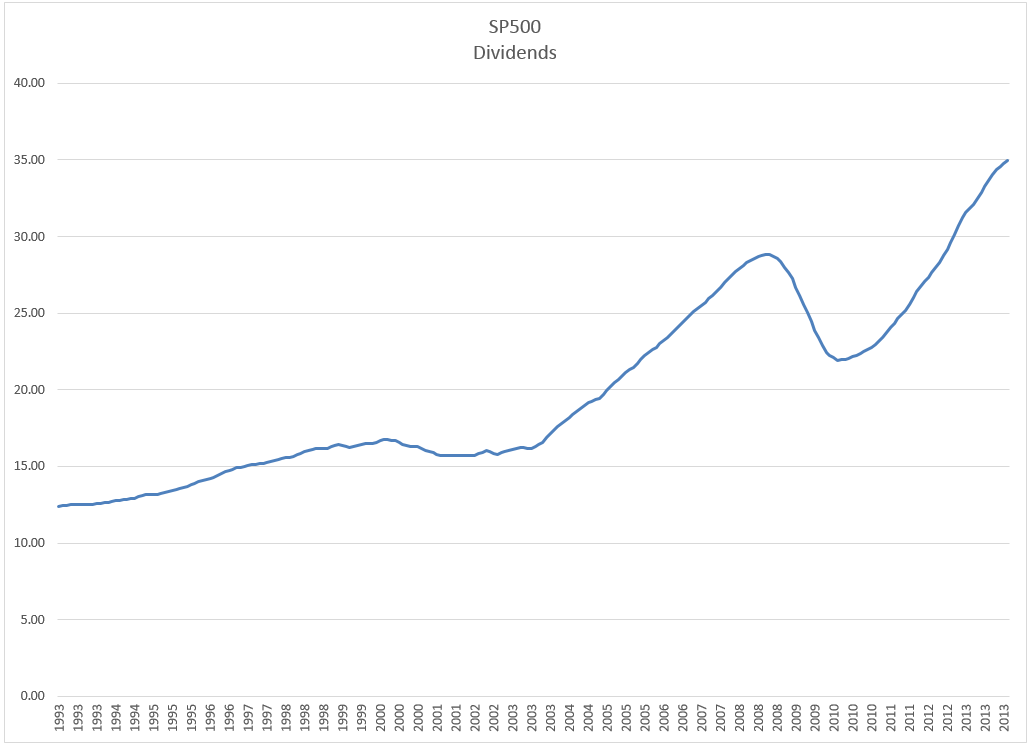
Last August, I wrote about the dividend yield – or it’s inverse ratio, the price dividend ratio – of the SP500 index using data that economist Robert Shiller compiles from a variety of sources.  The dividend yield of the SP500 index is currently 1.9%, meaning that for every $100 a person invested in the SP500 index, they could expect $1.90 in dividends.  The price dividend ratio is just the inverse of that, or $100 / $1.90 = 52.6. The current dividend yield is at the 20 year average.  I will focus on the dividend yield, or the interest rate that the SP500 index pays an investor.

It might surprise some investors that dividend information is available on a more timely basis than earnings.  In the aggregate,  dividends are more reliable and predictable.  Most companies have several versions of earnings and they massage their earnings to present the company in the best light.  On the other hand, most companies announce their dividend payouts near the end of each quarter so that the aggregate information is available to an investor more quickly than aggregate earnings.

Most portfolios contain a mixture of stocks and bonds so it is instructive to compare the dividend yield of the relatively risky SP500 with the yield on what is considered a perfectly safe bond – the 10 year Treasury.  Many investors think of these two asset classes as complementary – they are – but they are also in competition with each other. If the real dividend yield on stocks is the same as ten year Treasuries, it means investors in stocks want to be compensated for risking their principle on stocks.  If the interest rate on 10 year Treasuries is 4% and the  dividend yield of the SP500 is 2%, then the dividend ratio of stocks to Treasuries is 2% / 4%, or .5.  As investors perceive less risk in the stock market, this “demand for yield” from stocks will fall and the ratio will decline.   In the past, this ratio has reached a low of .19 in July 2000 as the stock market reached its apex of exuberance and investors became convinced that the rise of the internet and just in time inventory control had ushered in a new era in business.  Bill Gates, then CEO, Chairman  and founder of Microsoft, scoffed at dividends as a waste of money that could be better put to use by a company in growing the business. At the other extreme, this demand for yield ratio rose as high as 1.28 in March 2009 as stocks reached their lows of the recession.

More importantly is the movement of this ratio from peaks and troughs, indicating a change in sentiment among investors.  Note that the early 2003 market lows after the tech bubble burst were about the 50 year average of this ratio.  Compare that relative calm to the spikes of fear in this ratio since late 2007 to early 2008.  For the past 18 months, this demand for yield has declined but is still above the 50 year average.  There is still enough skepticism toward the stock market that it continues to curb exuberance.

Transfer Payments

February 16th, 2014

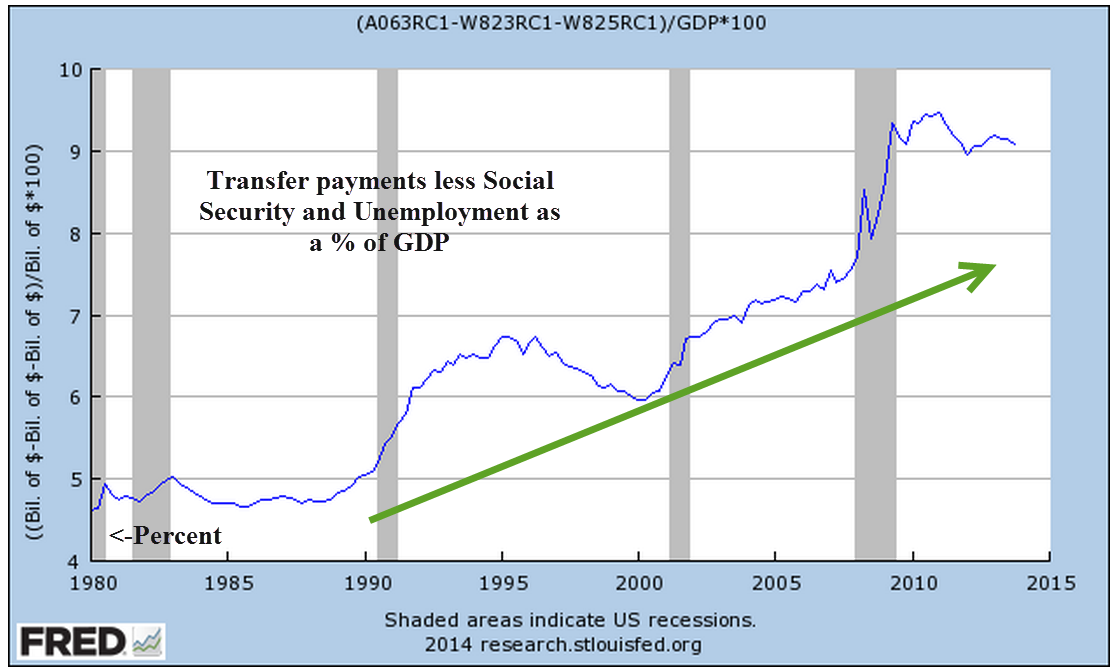
In this election year, as in 2012, the subject of transfer payments will rear its ugly head with greater frequency.  In the mouths and minds of some politicians, “transfer payments” is synonymous with “welfare.”  Don’t be confused – it is not.  As this aspect of the economy grows, politicians in Washington and the states get an increasing say in who wins and who loses.  Below is a graph of transfer payments as a percent of the economy.  I have excluded Social Security and Unemployment because both of those programs have specific taxes that are supposed to fund the programs.

Transfer payments, as treated in the National Income and Product Accounts (see here for a succinct 2 page overview), are an accounting device that the Bureau of Economic Analysis (BEA) uses to separate transfers of money this year for which no goods or services were purchased this year.  The BEA does this because they want to aggregate the income and production of the current year. Because that category includes unemployment compensation, housing and food subsidies, some people mistakenly believe that the category includes only welfare programs.   Here’s a list of payments that the BEA includes:

Current transfer receipts from government, which are called government social benefits in the NIPAs, primarily consist of payments that are received by households from social insurance funds and government programs. These funds and programs include social security, hospital insurance, unemployment insurance, railroad retirement, work­ers’ compensation, food stamps, medical care, family assistance, and education assistance. Current transfer receipts from business consist of liability payments for personal injury that are received by households, net in­surance settlements that are received by households, and charitable contributions that are received by NPISHs.

That settlement you received from your neighbor’s insurance company when his tree fell on your house is a transfer payment.  Didn’t know you were on welfare, did you?  Some politicians then cite data produced by the BEA to make an argument the government needs to curtail welfare programs.  Receiving a Social Security check after paying Social Security taxes for forty plus years?  You’re on welfare.  A payment to a farmer to not grow a bushel of wheat – an agricultural subsidy – is not a transfer payment.  A payment to a worker to not produce an hour of labor – unemployment insurance – is a transfer payment.  Got that?  While there are valid accounting reasons to treat a farmer’s subsidy check and a worker’s unemployment check differently, some politicians prey on the ignorance of that accounting difference to push an ideological agenda.

That agenda is based on a valid question: should a government be in the business of providing selective welfare; that is, to only a small subset of the population?  Some say yes, some say no.  If the answer is no, does that include relief for the victims of Hurricane Katrina, for example?  Even those who do say no would agree that emergencies of that nature warrant an exception to a policy of no directed subsidies or welfare payments.  It was in the middle of a national emergency, the Great Depression, that Social Security and unemployment compensation were enacted.  Government subsidies for banks began at this time as well.  Agricultural subsidies began in response to an earlier emergency – a sharp depression a few years after the end of World War 1.  Health care subsidies were enacted during the emergency of World War 2.  The pattern repeats; a subsidy starts as a response to an immediate and ongoing emergency but soon becomes a permanent fixture of government policy.

Tea Party purists think that the Constitutional role of the federal government is to tax and distribute taxes equally among the citizens.  Before the 16th Amendment was passed a hundred years ago, the taxing authority of the Federal Government was narrowly restricted.  However, the Federal Government has always been selective in distributing  the resources at its disposal.  Land, forests, mining and water rights were either given or sold for pennies on the dollar to a select few businesses or individuals. (American Canopy is an entertaining and informative read of the distribution and use of resources in the U.S.) By 1913, the Federal Government had dispensed with so much land, trees and water that it had little to parlay with – except money, which it didn’t have enough of.  Solution: the income tax.

In principle, I agree with the Tea Party, that the government at the Federal and state level should not play God.  How likely is it that the voters of this country will overturn two centuries of precedent and end transfers?  When I was in eighth grade, I imagined that adults would have more rational and informed discussions.  Sadly, our political conversation is stuck at an eighth grade level on too many issues.

****************************

While most of us pay attention to the unemployment rate, there is another statistic – the separation rate – that measures how many people are unemployed at any one time.  The unemployment can be voluntary or involuntary, and last for a week, a month or a year.  Not surprisingly, younger workers change jobs more frequently and thus have a higher separation rate than older workers.  In the past decade, almost 4% of younger male workers 16 – 24 become unemployed in any one month.  Put another way, in a two year period, all workers in this age group will change jobs.  For prime age workers 25 – 54, the percentage was 1.5%.  In a 2012 publication, Shigeru Fujita, Senior Economist at the Philadelphia Federal Reserve Bank, examined historical demographic trends in the separation rate.

On page five of this paper, Mr. Fujita presents what is called a “labor-matching” model that attempts to explain changes in unemployment and wages, primarily from the employer’s point of view. Central elements of this model, familiar to many business owners, include uncertainty of future demand and the costs of finding and training a new worker.  Mr. Fujita examines an aspect that is not included in this model – the degree of uncertainty that the worker, not the employer, faces.  In the JOLTS report, the BLS attempts to measure the number of employees who voluntarily leave their jobs.  These Quits indicate the confidence among workers in finding another job.  The JOLTS report released this week shows an increasing level of confidence but one which has only recently surpassed the lows of the recession in the early 2000s.

**************************

Labor Participation
In a more recent paper, Mr. Fujita examines the causes of the decline in the labor participation rate, or the number of people working or looking for work as a percentage of the people who are old enough to work.  As people get older, fewer of them work; the aging of the labor force has long been thought to be the main cause of the decline.  That’s the easy part.  The question is how much does demographics contribute to the decline? What Mr. Fujita has done is the hard work – mining the micro data in the Census Bureau’s Current Population Survey.  He found that 65% of the decline of the past twelve years was due to retirement and disability.  More importantly, he discovered that in the past two years, all of the decline is due to retirement.  The first members of the Boomer generation turned 65 in 2011 so this might come as no surprise.  The surprise is the degree of the effect;  this largest  generational segment of the population dominates the labor force characteristics. During the past two years, discouraged workers and disability claims contributed little or nothing to the decline in the participation rate.  Another significant finding is that relatively few people who retire return to the work force.

In this election year, we will be bombarded with political BS: Obamacare or Obama’s policies are to blame for the weak labor market; the anti-worker attitude of Republicans in Congress are responsible.  Politicians play a shell game with facts, using the same techniques that cons employ to pluck a few dollars from the pockets of tourists in New York City’s Times Square.  Few politicians will state the facts because there is no credit to be taken, no opposing party to blame.  Workers are simply getting older.

In 2011, MIT economist David Autor published a study on the growth of disabiliity claims during the past two decades and the accelerating growth of these claims during this Great Recession.  Mr. Fujita’s analysis reveals an ironic twist – at the same time that Mr. Autor published this study, the growth in disability claims flattened.  The ghost of Rod Serling, the creator and host of the Twilight Zone TV series, may be ready to come on camera and deliver his ironic prologue.

*******************************

Lower automobile sales accounted for January’s .4% decline in retail sales. Given the continuing severity of the weather in the eastern half of the U.S., it is remarkable that retail sales excluding autos did not decline.  In the fifth report to come in below even the lowest of estimates, industrial production posted negative growth in January.  By the time the Federal Reserve meets in mid-March, the clarity of the economy’s strength will be less obscured by the severe winter weather.

*******************************

A reader sent me a link to short article on the national debt.  For those of you who need a refresher, the author includes a number of links to common topics and maintains a fairly neutral stance.  I still hear Congresspeople misusing the words “debt,” the accumulation of the deficits of past years, and “deficit,” the current year’s shortfall or the difference between revenues collected and money spent.  Could we have a competency test for all people who wish to serve in Congress?

*******************************

The House and Senate both passed legislation to raise the debt ceiling this week.  The stock market continued to climb from the valley it fell into two weeks ago and has regained all of the ground it lost since the third week of January.

January Employment and Economic Production

February 9th, 2014

The ISM manufacturing report for January reported a severe decline from the robust readings of past months.  New orders suffered the most, dropping from a strong reading of almost 65 in December to just a bit above the neutral reading of 50.  Prices jumped significantly.  Manufacturing’s drop off in new orders comes on the heels of a similar decline in the service sector in December.  This is the third report in the past thirty days that came in below even low estimates, the other two being pending home sales and December’s employment gains.  At mid week, ISM released their January estimate of the health of the service sector which is the bulk of the economy.  Happily, this showed continued growth, helping to offset concerns about a broad slowdown in the economy.

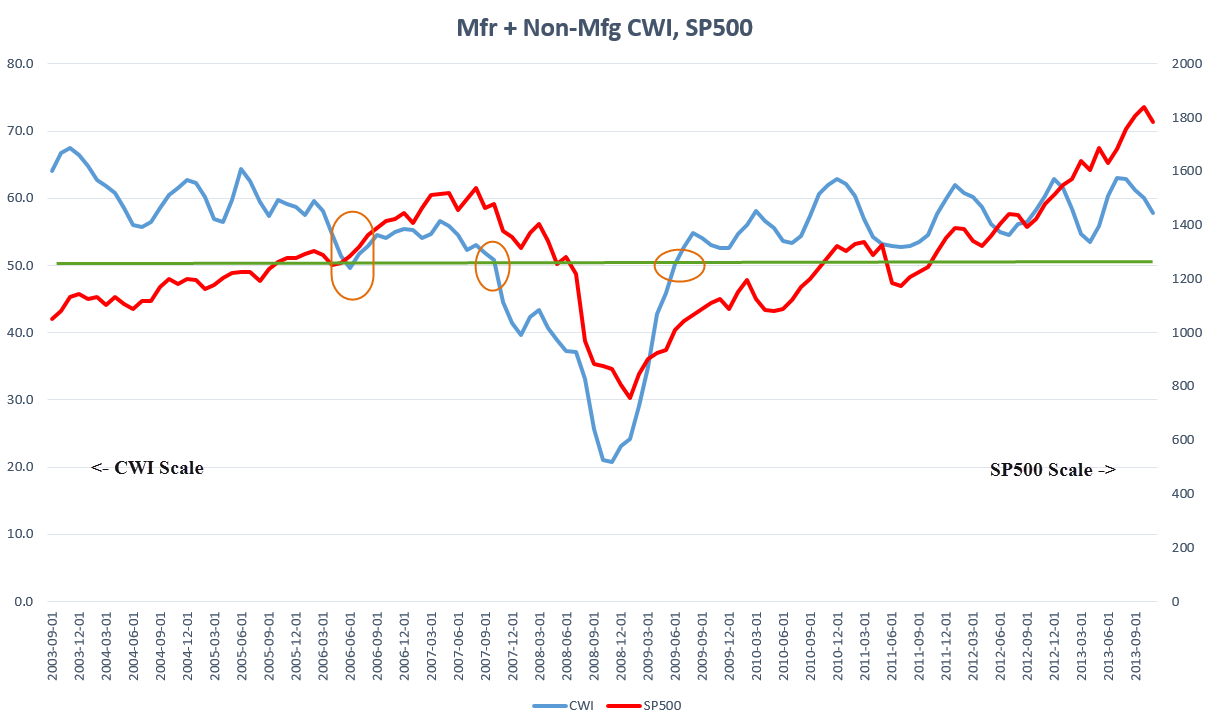
The CWI that I have been tracking continues to show an overall strength, declining slightly to 58 from the rather vigorous reading of 60 last month.  As I noted a few weeks, this index anticipated a winter lull before picking up energy again in early spring.

A reader had difficulty understanding the wave like graph of the CWI.  I indexed it to a starting base then indexed that to the SP500 average in 1997.  Perhaps this will help visualizing the long term response of the SP500 to underlying economic activity.

*******************************

ADP reported a gain of 175,000 private jobs in January, below the strong 227,000 job gains of December.  There was only a slight revision to ADP’s previous report, confirming the suspicion of some that the greater flaw lies in the BLS figures for December.

On Friday, the Bureau of Labor Statistics (BLS) released their estimate of 113,000 job gains in January, far below the consensus of about 180,000.  Here’s a story from the Atlantic that captures some of the highlights.  Forgive some of the misspellings, if they are still there by the time you read it.

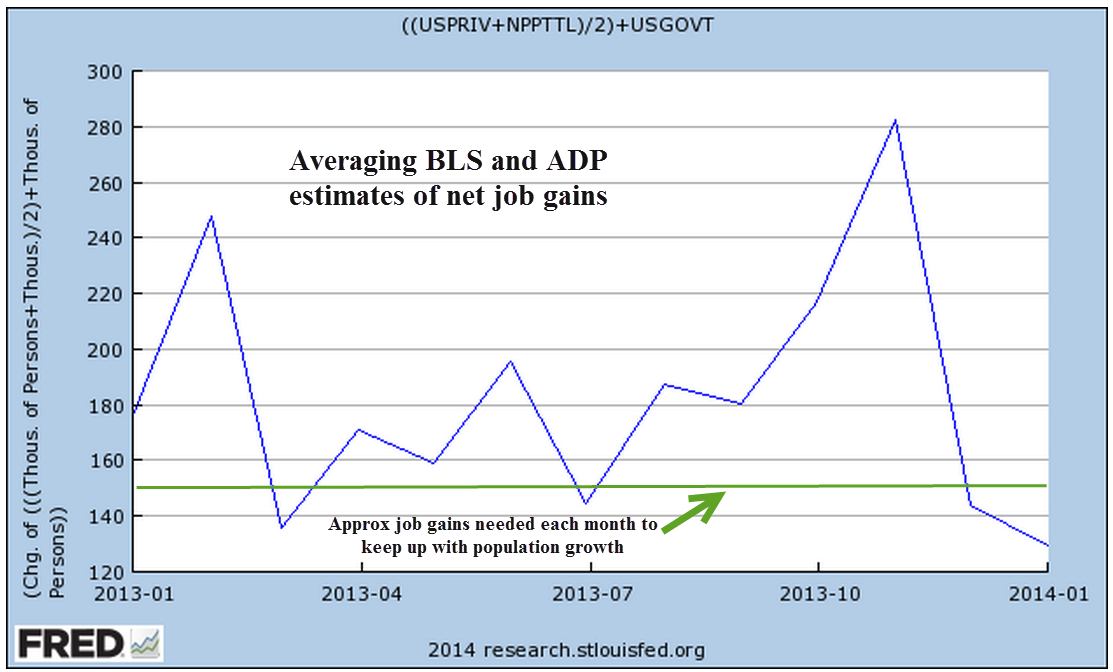
As I did last month, I’ll show the average of monthly job gains estimated by the BLS and ADP.  ADP does not report government jobs so I’ve just added those in from the BLS report.

The decline below the replacement level of 150,000 may be a temporary response to severe weather conditions in the populous east coast and Chicago region.

The market responded quite favorably to this labor report. A slackening labor market prompted hopes that the Federal Reserve will not accelerate their easing of bond buying.  A large revision of job gains in November was a big positive in the report.  Another positive was the half a million increase in the core work force, those aged 25 – 54.  Men accounted for most of this increase.

The number of people working part time because they can’t find a full time job dropped by a half million but there are still more than 7 million people in this situation.  A 232,000 decrease in the number of long term unemployed was heartening although many lost their unemployment benefits at the end of the year and may have had little choice but to take whatever job they could find.

*****************************

Doug Elmendorf is the head of the Congressional Budget Office (CBO) that advises the Congress in constructing the budget, making appropriations, and the anticipated or actual economic effects of policy.  In advance of his testimony before the House Budget Committee this past week, the CBO released the highlights of their report. Some talk show hosts and conservative media were trumpeting a loss of 2.3 million jobs due to Obamacare.  In his testimony, Mr. Elmendorf explained that the 2.3 million jobs mentioned in the CBO report are not lost jobs because the CBO does not estimate any reduction in the demand for employees because of Obamacare. The CBO estimated the number of hours that employees would voluntarily reduce their hours in order to meet qualifications for subsidies under Obamacare and divided those total hours by what a full time employee would work in a year.  Since there is a surplus of labor in this country, this voluntary reduction would help those who are either looking for a job or want to work more hours.  The CBO sees no impact on part time jobs that can be attributed to Obamacare.

*******************************
Republicans and some Independents have repeated the claim that the rich are paying most of the personal income taxes in this country. IRS 2010 data (Table 2 ) doesn’t seem to support that contention.  The top 5% of taxable returns with taxable incomes greater than $200K had taxable income of $1.9 trillion, or 36% of the total $5.3 trillion in taxable income.  On that income, the top 5% paid $513 billion in Federal income tax, 49% of the total.  In a flat tax system, the top 5% would have paid a bit more than $360 billion.

When Republicans use the code words “broaden the tax base” what they mean is that they want a flat tax so that rich people pay the same percentage of tax as poor people.  Several states have such a flat tax system.  To Democrats, a broadening of the tax base means making more of the income of rich taxpayers subject to progressive tax rates.

When Democrats use the code words “paying their fair share” they mean that the rich should pay proportionately more than the additional load of about 32% that they are currently paying.  To Republicans “fair share” means a flat tax.

What the IRS data shows is that the rich are not paying most of the income taxes in this country.  Often tax policy and social benefit programs are lumped together, confusing the issue in the minds of many.  The Tax Foundation did an analysis of the net benefit and expense of taxation and benefit programs.  They report that:

As a group, the bottom 60 percent of American families receive more back in total government spending than they pay in total taxes.

Government tax and spending policies combine to redistribute more than $2 trillion from the top 40 percent of families to the bottom 60 percent.

The methodology that the Tax Foundation uses presumes that everyone benefits equally from public spending like defense, police and the courts.  An alternative assumption that people benefit according to their income results in a $1.2 trillion redistribution, about 40% lower, according to the Tax Foundation.  (Kudos to the Tax Foundation for making both computations.)

What the report does not do – because it is just so hard to do – is calculate age and circumstance related movements of taxpayers from the top 40% to the bottom 60%.  Consider a taxpayer – I’ll call her Linda – making $100,000 who is in the top 40%.  She loses her job and starts collecting unemployment for several months.  Her income now puts her in the bottom 60%.  “Past Linda” was supporting the bottom 60% but “present Linda” is now part of the bottom 60%, according to the methodology used by the Tax Foundation.  Yet if we isolate this one taxpayer, we can say that “past Linda” was actually supporting “present Linda.”  When Linda was making $100K, she presumably paid a lot in income and other taxes, including unemployment taxes paid by her employer.  The Federal Government does not keep records that would allow this kind of inter-temporal analysis.  As a result, we get a distorted view of what is actually happening.

Let’s look at an older taxpayer – I’ll call him Sam – who retires.  Sam was making $80K before he retired and was in the top 40%.  With social Security income and income from savings, Sam now makes $36K in retirement, which puts him in the bottom 60%.  Is Sam being supported by the top 40%?  Statistically he is.  However, most of us would say that Sam is simply living off the benefits that he paid into during his working life.

I appreciate the exhaustive work that the Tax Foundation does but the problem is more complex than they present.  Furthermore, many people are not aware of the difficulties and complications of calculating who supports whom.  Some use this analysis to present the case that the majority of Americans are sucking on the teats of the few well off.  Presidential contender Mitt Romney’s unguarded comment about “the 47%” who are living off the efforts of others did not serve him well in the past election yet a sizeable percentage of voters believe this.

The 16th Amendment passed a century ago allowed the Federal government to tax the income of individuals directly and it was intended to be progressive.  Relatively few paid any income taxes in the first decades after the enactment of the income tax.  Whether one likes the progressivity of the tax code, one has to recognize that the law was intended to be that way when it was passed.

I would like to see the repeal of the 16th Amendment for two reasons: 1) protect individuals from the power of the Federal government; 2) slow the consolidation of money in Washington.  Money brings power and power begets patronage, if not downright graft.  We can never get rid of patronage, only retard the concentration of patronage. Studying 5000 years of history, we have learned that the concentration of power in any political institution ultimately leads to the downfall of that institution.  Only corporations can exist with such a concentration of power and even they sometimes fall when top leadership in a company becomes resistant to change.

Perhaps we could adopt a taxing system where the Federal government taxes the states based on the population in each state.  If a state has 10% of the country’s population, then they would owe 10% of any tax used to replace the current income tax.  Let the states determine how they will collect the money.  Racism has been a constant nemesis of this country and legal protections could be enacted which would prevent states from taxing citizens based on race or sex.  Head taxes have a tawdry reputation because they were often used to disenfranchise poorer voters.  If the population count of a state was simply used as an allotment mechanism and not applied directly to each citizen, I think that this could be a fairer and safer system of taxation.  Certainly, legislation could be passed preventing the denial of rights to a citizen based on a tax.

Could Doug Elmendorf and his cohorts at the CBO build a model based on such a system?

*******************************

Tidbit:

And we’re talking about nine million individuals who are eligible for both Medicare and Medicaid. They are responsible for a significant amount of spending in both programs — approximately 46% of Medicaid and close to a quarter of Medicare spending annually.  Estimates range that that is anywhere from 300 to $350 billion a year total that we’re [CMS] spending. 
Melanie Bella, Director of the Federal Healthcare Office at the Centers for Medicare and Medicaid Services, Federal Coordinated Healthcare Office Conference 11/1/2010

Diminished Expectations

February 3rd, 2014

The SP500 has been hovering over a support trendline in the 1760-1775 range, with buyers coming in at 1775.  At 1750, the market would have corrected 5%, a fairly normal occurrence.  Market watchers have been concerned that the market has not experienced one of these small “shaking of the tree” corrections since May/June of 2012.  Disappointing earnings and revenue reports from bellweather companies, together with selling pressure on some emerging market currencies, have made traders nervous.

The market is composed of buyers and sellers responding within varying time frames.  In a short to mid term time horizon, one person might pay more attention to turbulence in emerging markets or the latest corporate reports.  A mid to long term investor might pay more attention to rising industrial production, healthy GDP numbers, consumer spending and income, and declining unemployment.

*****************************************

Apple forecast lower than expected revenues for the coming quarter in the China market.  The announcement prompted an 8% decline in the company’s stock.  Facebook reported blow out revenue growth of 63% in the past quarter, causing the stock to rise about 16%.  FB’s active user base has more than doubled in two years.  Despite the robust growth, the sky high valuation of the company reminds me of some internet stocks in the late 1990s.  The stock has a Price to Sales – not Price to Earnings – ratio of about 15 to 1.  Google has a track record of strong revenue and earnings growth and sports a richly valued price to sales ratio of 6.4.  Does Facebook’s short track record deserve a valuation that is more than twice Google’s?  In 2000, Microsoft had a price-sales ratio of 23 to 1. Fourteen years later, Microsoft’s stock sells for 30% less than it did in 2000.  In 2000, Cisco had a price to sales ratio of 30 to 1.  Cisco’s revenues were growing 50% a year.  “The stock is cheap,” some said.  Fourteen years later, Cisco sells for less than a third of what it did in the heady days of rapid growth.  A word of caution to long term investors.

Amazon reported “only” a 20% increase in quarterly revenue during the busy 4th quarter Christmas season. This is five times the sales growth of the overall retail industry so a casual observer might think that the stock enjoyed a healthy bump up in price, right?  Wrong. After rising 50% over the past year, the company’s stock was priced to perfection. The disappointing growth particularly in overseas markets prompted a lot of selling and an 8% decline in price on Friday.

As I noted last week, many retailers will report quarterly earnings in February.  Many companies get a sense of the bottom line that they will report before the official release of quarterly data.  If there are material differences between consensus expectations and forecast results, a company will issue a revised forward guidance.  Wal-Mart did so this past week, revising its revenue and earnings forecast down for the fourth quarter and lowering earnings projections for the coming year.  The company cited a much greater than forecast impact from November’s reduction of the food stamp program.  The severe storms in December also had a material impact on sales.

In the past two months, Wal-Mart’ stock has declined 8%.  Let’s think about that for a moment.  The market value of Apple and Amazon declined 8% in one day.  It takes two months for Wal-Mart’s stock to decline by the same percentage.  Individuals who invest in companies like Apple and Amazon have to be able to take abrupt market gyrations in stride.  Companies are essentially stories.  Some like Apple and Amazon are stories of growth.  There comes a time when the story changes, as it did for Microsoft and Cisco more than a decade ago.  Apple’s story has been “under construction” in the past 18 months. Since the beginning of 2008, Wal-Mart’s stock has risen 56%, Apple’s is up 150%, and Amazon’s market price has soared more than 6 times.  Growth companies offer rich rewards for the investor who has the time to  follow the story, but it can be difficult to know when the story is changing.

During the past 3 weeks, Home Depot has lost about 6% after gaining 35% since the beginning of 2013.  This giant has one foot in the home construction and remodeling sectors, one foot in the retail sector.  The decline reflects lowered near term expectations for both construction and retail.  Consumer spending has risen steadily but incomes are flat.

*****************************************

December’s report of new homes sold was disappointing.  After rising above an annual level of 450,000 in the fall, sales have fallen closer to the 400,000 mark.

 Some blame the particularly harsh December in the east, some blame the weak labor report released in early January, others blame the low supply, still others blame rising mortgage rates. The Case Shiller home price index shows a year over year gain of almost 14% in metro area homes, indicating relatively healthy demand.  However, the latest Consumer Confidence survey reports a decline in the number of people planning to buy a home.  On an ominous note, pending home sales in December declined more than 8%, the worst monthly decline in almost four years.  Without a doubt, the severe winter weather in the eastern U.S. was a big factor but it is difficult to assess how much of a change.  This is the second report – employment was the first – that was far below even the lowest of estimates.

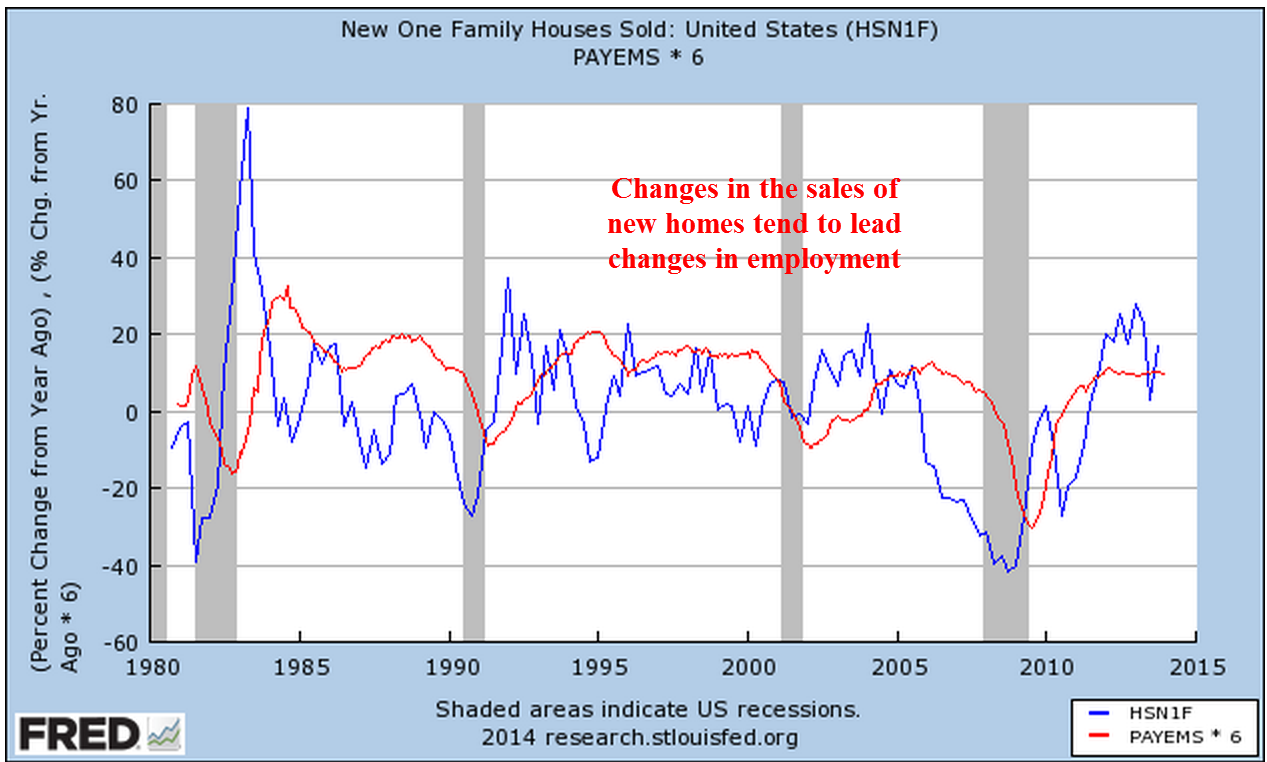
The link between employment and new home sales is counterintuitive; changes in new home sales anticipate changes in employment.

In a 2007 paper presented at a Federal Reserve conference, economist Ed Leamer demonstrated that changes in residential investment, a relatively small component of the economy, indicate coming recessions and recoveries.  The National Assn of Homebuilders estimates that each new home generates a bit more than three full time jobs.

Residential investment includes new homes, remodels, furniture and appliances.  Eventually residential investment reaches a point where it is contributing too much to the economy. As that percentage begins to correct to more normal levels, the contraction tugs on the total of economic growth.

As you can see in the chart above, a sustainable “sweet spot” is in the 4 to 4-1/2% of GDP range but residential investment is still less than 3% of GDP.  In past recessions, residential investment has helped recovery.  This time is different.  Housing’s less than normal contribution to the nation’s GDP has dampened overall growth.

*****************************************

The first estimate of GDP growth for the fourth quarter was a rather remarkable 3.1%.  Although this was in line with estimates, I was concerned that the severe winter weather in the east might have more of a negative impact.  A version of GDP that reflects domestic consumption, Final Sales of Domestic Product, showed a modest 2.1% growth in the 4th quarter, reflecting the impact of the weather, I think. The third quarter growth rate was revised to 4.1%, up substantially from the initial estimate of 2.8%.  The hope is that this is now a 4% growth economy and the first quarter of this year may hold some welcome surprises as delayed economic activity in the 4th quarter is rolled into this year’s first quarter.  As I noted a few weeks ago, the wave like trend of the CWI composite index of manufacturing and non-manufacturing indicated a slight lull in these winter months before another peak in early to mid-spring.

****************************************

Consumer Confidence rose to 80, the lower bound of what I consider healthy.  This index fell below 80 in the early part of 2008 and did not get above that mark till this past summer, then fell back in the fall.  A separate Consumer Sentiment survey from the U. of Michigan showed a similar reading at slightly above 81.

*****************************************

January’s monthly employment numbers will be released next Friday.  I ran a chart of those not in the labor force as a percent of those working.  Thirty years ago, the economy was coming out of the most severe employment recession since the Depression.  It is rather disturbing that this ratio continues to climb to the nose bleed levels of that recession thirty years ago.

******************************************

The harsh winter weather may be affecting consumers more than businesses.  Chicago and the upper Midwest region got creamed with cold snap after cold snap in December yet industrial production figures for the month are still robust, declining somewhat from the incredibly strong readings of the past few months.

Market Bumps

January 26th, 2014

In a holiday shortened week, the market opened higher than the previous Friday but fell a bit more than 3% by week’s end.  On this same week in 2012, the market lost 2.5% in 3 trading days.  As I mentioned last week, there were few economic reports this past week to detract from the focus on corporate earnings.

IBM opened up the week by beating profit estimates but missed revenue estimates by $1 billion, or about 3%, and were about $1.5 billion less than the final quarter of 2012.  The 4th quarter is usually IBM’s strongest quarter each year; lower revenues from this giant indicate a cautious business investment outlook.  IBM is selling for the same price now that it did in mid 2011, a price earnings ratio of 12.

The following day, China announced that the country’s industrial production has fallen just below the neutral mark.   The reaction to the news was exaggerated by sharp declines in some emerging market currencies, which started a cascade of selling. See SoberLook blog for some charts. Similar weakness out of China last summer prompted a much more subdued reaction.

On Thursday, McDonald’s reported weak sales growth, which added to concerns.  After a run up of 30% last year, many traders were on high alert for any negative news.  The U.S. stock market has enjoyed a tail wind from Federal Reserve stimulus policy, but a global economy is largely outside of the Fed’s influence.

A 14 month support trend line that has been in place since November 2012 sets a mark at about 1760.  Dropping below that would signal a short to mid term shift in market sentiment.  The SP500 index closed at 1790 on Friday, 1.7% above that support trend line.  The 10 month average of the index is 1700.  A drop below that mark would signify a change in mid to long term sentiment. A few weeks ago, I noted that the market was close to 10% over its 10 month average.  This week’s decline puts that percentage at a bit over 5%.

******************************

Existing home sales notched up a bit in December but the yearly percent gains were relatively flat.  The 4 week average of new claims for unemployment declined to 331,000.  Several weeks ago it was close to the psychological 350,000 mark.  Mitigating the decline in new claims, continuing claims have been rising lately and are approaching the 3 million mark.

To put that 3 million people in historical perspective, take a look at the chart below.

The number of long term unemployed is ever a concern.

*************************

In early October I noted the relative sluggish performance of retail stocks vs the larger market index of the SP500 ahead of the Christmas buying season.  Below is an updated chart of a retail index ETF vs the larger market.

Shortly after that post, renewed hopes for a strong Christmas season led to higher prices for the group.  Disappointing sales gains announced as the season ended deflated that balloon.  Since the new year began, a composite of retail stocks has lost 8%.

Typically retailers report their earnings in mid to late February.  Traders have already priced in a rather disappointing earnings season for the retailers.  In the context of a longer time frame, retail stocks are still up 25% year over year.  If an investor had bought this composite on this date seven years ago when the economy was strong and retail stocks were at a high, she would still have doubled her money, easily outpacing the 38% gains in the larger market since then.  The resilience of consumer demand, despite an extremely severe downturn when unemployment and falling house prices put a brake on consumer spending, has helped make this sector a sure footed long term winner.  

Housing, Unemployment and CPI

January 19th, 2014

A strong retail report for December and an improvement in sentiment among small business owners buoyed the market at the start of the week.  Both reports continue a trend that indicates a healthy economy:  results are at at the upper bound or above expectations.

The latest report of  jobless claims at 325,000 pulled the 4 week average further down away from the psychological mark of 350,000.  This is sure to reassure short to mid term traders.  The weak BLS employment report released a week ago may have just been an anomaly.  Other employment indicators, as well as retail sales and business production simply do not confirm the headline numbers from the BLS.

The Consumer Price Index for December showed a mild 1.5% year over year increase and will reassure the Fed that its stimulus program poses little danger of igniting inflation.

The National Assn of Homebuilders reported continued strong growth in their Housing Market Index.

******************************
Featured on one of the blogs that I link to is a chart of the annual returns of the SP500.  Double digit gains in the index, like the one we had last year, are rather common, occurring about 40% of the time.  A reassuring takeaway for the longer term investor is that the market goes up in 75% of the years for the past eighty years.

******************************
The number of unfilled job openings in November was the highest since March of 2008, indicating continuing strengthening in the labor market.  Job openings have been above the ten year average for over a year now.

The number of people who voluntarily quit their jobs continues to climb over the past year.  Employees quit when they feel more confident about job prospects. While this metric has been improving, it is only at the lowest levels of the past decade.

******************************
Housing starts declined slightly in December to a million but is still growing from the lows of the bust.

Let’s get a bit of perspective. There is a decided shift downward from the post war building boom.  Below is a graph of  housing starts adjusted for population growth.

Adjusted for population growth, the multi-family component of housing starts has reached the normal levels of the past two decades.  This is the more stable component of housing starts.

Starts of single family homes have not yet reached the lows of past recessions.  The words “improvement” and “recovery” should be viewed in the context of these abysmal lows.

*******************************
The Consumer Price Index (CPI) for December showed a year over year increase of 1.5%.  I believe this understates current inflationary pressures on consumers but it is the official rate, one that the Federal Reserve will use to guide policy.  The low rate will help allay fears that continuing stimulus will spur inflation in the near term.

*******************************
Stock prices will be driven largely by earnings reports at this time.  About 10% of SP500 companies have reported this past week, too few to get a solid feel yet for the past quarter.  62% of companies have beat expectations, a bit less than the more normal 70%.  The market is largely trading sideways as it digests both the past quarter’s results and the forward guidance that companies give when they report.  IBM, Johnson and Johnson, and Verizon kick off this holiday shortened week when they report earnings on Tuesday. McDonald’s, Microsoft, Proctor and Gamble, and Netflix are due to report this week as well.  There don’t appear to be any significant market moving economic reports coming up this week.  Existing Home Sales on Thursday might have some minor impact and traders will be watching the continuing trend in new unemployment claims.