Labor Report – August Doldrums

This past Friday, the Bureau of Labor Statistics (BLS) released their monthly report for August and the employment gains of 96,000 were below the already muted expectations of 120,000 jobs gained.  Many economists estimate that it takes 150,000 jobs per month just to keep up with population growth.  On the day before the BLS report, the large payroll processing company, ADP, released their estimate of 201,000 private job gains in August, leading some to speculate that total job gains for the month would be above 150,000.  As you can see below, the BLS and ADP counts of private employment closely track each other. (Click to enlarge charts in a separate tab)

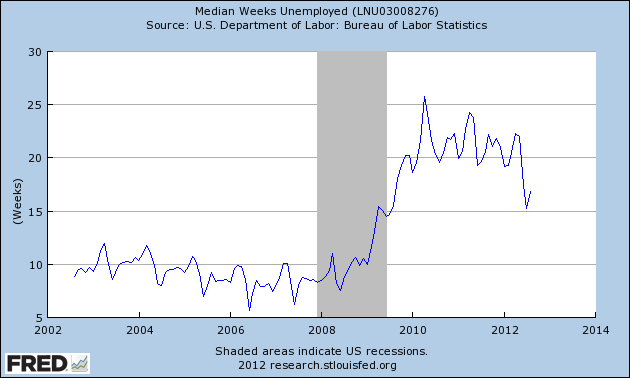
On Thursday afternoon before the Friday morning release of the BLS report, the White House is notified of the numbers.  The disappointing numbers may have led President Obama to tone down the rhetoric of his speech that evening at the Democratic National Convention.  He did not seem to have the “fire in the belly” when he delivered his acceptance speech.  The unemployment rate ticked down from 8.3% to 8.1% because 368,000 dropped out of the work force and are no longer counted as unemployed.  Some of this number retired, either voluntarily or involuntarily.  Some have simply become discouraged.  Some have gone back to school.  The average number of weeks of unemployment is still at high levels. 
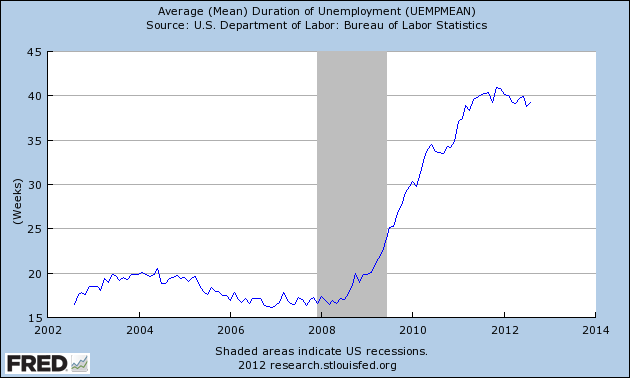
Some of this is due to changes in BLS reporting since Obama took office.  Before January 2011, the BLS allowed a maxiumum of 2 years, or 104 weeks in their survey.  Starting in 2011, the BLS allows a maximum of five years, or 260 weeks.  Since a small number of unemployed forces the average number higher, the BLS recommends using the mean for comparison. (BLS Source

Most of Europe is in recession; growth in South America, China and India have slowed.  Several strong economic reports in the winter and spring of this year led many to think that the U.S. economy might be less tethered to this global malaise.  The stock market rose over 10% in the first few months of 2012; then China reported contracting manufacturing and real estate sectors, and European leaders showed their continued inability to resolve the fiscal and monetary policy challenges that threaten to crack the European Union.  We realized that we were not immune to the global financial flu and the stock market fell 10% in May, wiping out the gains of the winter and spring. The monthly employment gains dropped during the summer.

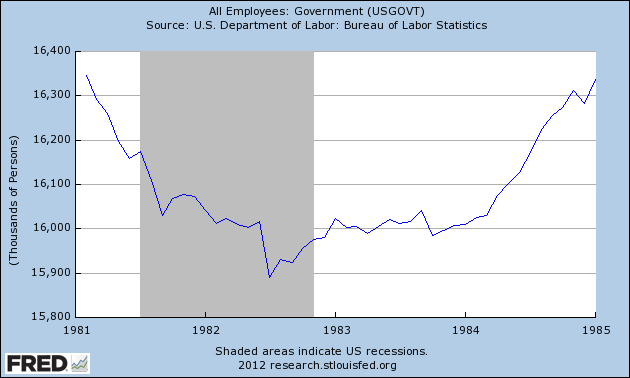
Recent employment and industrial reports have showed that our growth, while still positive, is struggling.  Private job growth has been hampered by the layoffs of government workers, as the chart below shows.
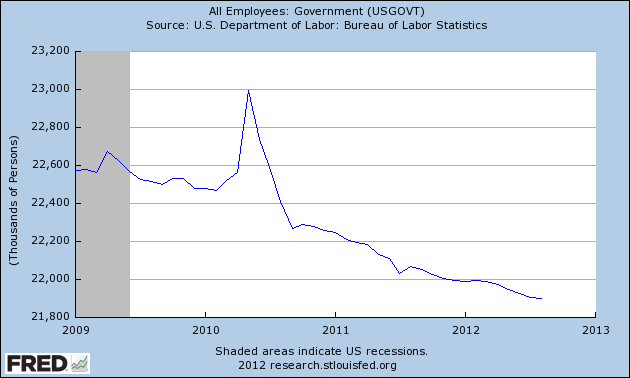
The shedding of government jobs halted this past month as Federal employees actually gained about 3,000.  Those on the left have criticized the Republican House for aggravating job losses in state and local governments by blocking any further federal aid to the states.  A comparison with the first term of the Reagan administration shows a similar decline in government employment during the 1981 – 1982 recession.  However, following the end of the recession, government employment increased in the last two years of his first term and helped Reagan get elected to a second term.  The Democratic House was kinder to Reagan than the current Republican House is to Obama.
The slow growth of the past several months has fueled speculation that the Federal Reserve will once again come to the rescue with a bond buying program.  Since the beginning of June, the stock market has “melted up” on very low volume.  Once again, it is at the peak reached earlier this year and in 2007 before the recession began.

The uninspiring lack of job growth among what I call the core labor force, those aged 25 – 54, is a predictor of a sluggish economy in the near future.  These workers buy a lot of stuff. No jobs, no stuff.
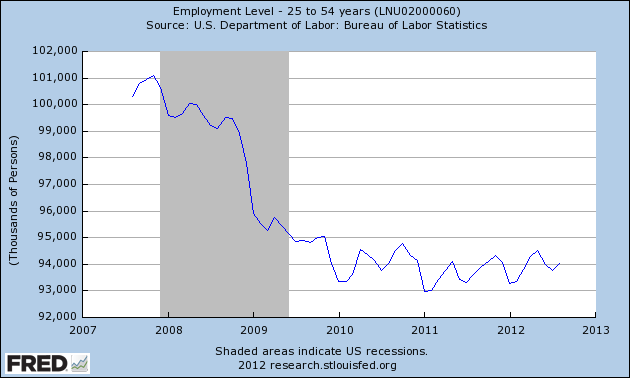
The larger group of adult workers, those aged 25 plus, continues to show gains, indicating that older workers are continuing to keep and get jobs.  The old are simply not making way for the young.  Severe declines in house values and the loss of value in their retirement funds has forced many older workers to continue working longer than they may have planned.  Older workers do no buy a lot of stuff.

During the 2010 elections, Republican candidates for the House promised that job programs would be first priority.  We have been waiting two years.  Both houses of Congress have historically low voter approval ratings yet the burden of the sluggish job growth continues to fall on the President’s shoulders.  Politicians on the Republican side of this dysfunctional Congress point to the President as the cause of the muddle through labor market; they know most voters can’t remember what they learned in civics class in grade school and don’t understand that it is Congress, not the President, that initiates legislation.  It is Congress, both Democrats and Republicans in the House and Senate, that is responsible for the lack of job growth.  Who elected these men and women to the Congress?  Look in the mirror.  That’s who’s responsible for the slow job growth. 

Tax Cuts and Us

Until the end of the year, we will hear and read a lot about the expiration of the Bush tax cuts.  For those who want to extend all the Bush tax cuts, you will hear stuff like this: “The non-partisan Congressional Budget Office (CBO) has predicted a recession in 2013 if the Bush tax cuts are allowed to expire.”  As with most political claims, this is slightly true.  Remember that politicians are little more than magicians practicing a logical sleight of hand in order to convince you of some claim.  What the CBO actually said in a May 2012 report was “if the fiscal policies currently in place are continued in coming years, the revenues collected by the federal government will fall far short of federal spending, putting the budget on an unsustainable path.” (Source)  In the next sentence, the CBO cautions “On the other hand, immediate spending cuts or tax increases would represent an added drag on the weak economic expansion.”  Is there room for compromise in this dysfunctional Congress?

While many politicians are aware of the difficult trade-offs, they dare not mention that to voters, who, they presume, are stupid.  On Fox News, MSNBC and other media, we will continue to hear simplified versions of a complex debate because – well, we’re just too dumb to pay attention to complex arguments that involve math.  If you are like most voters, many politicians reason, you have already stopped reading this because it has too many adjectives, verbs and commas.

The CBO does its best to estimate the long term impact on the federal budget and economic activity as a result of a paticular policy. To illustrate just how difficult this task is, let’s look at a July 2007 letter from the CBO to the Congressional Budget Committee projecting “For 2008 through 2011, CBO’s baseline budget projections show deficits of $113 billion, $134 billion, $157 billion, and $35 billion, respectively.”  Deficits were actually $458 billion, $1,413 billion, $1,293 billion and $1,300 billion.  Actual deficits were almost ten times what the CBO projected!  Knowing that ten year projections are almost pure fantasy, Congress continues this practice.  Each party uses the CBO estimates to support or attack a particular policy. 

The CBO projects a recession in 2013 if ALL tax policies were allowed to expire, including the Bush tax cuts.  “These include the Bush tax cuts, the alternative minimum tax (AMT) patch, the temporary payroll tax cut, and other temporary expiring provisions, many of which are commonly referred to as “tax extenders.” (Source)   The Congressional Joint Committee On Taxation (JCT) has a complete seven page (!!!) list of “temporary” tax cuts that are due to expire at the end of this year. 

What is the bottom line for the individual taxpayer if ALL the fiscal policies, including the Bush tax cuts, were allowed to expire?  In a 2012 report by the Congressional Research Service, they cite estimates by the Tax Policy Center that, in 2010, “the Bush tax cuts resulted in the lowest 20% of taxpayers seeing their income rise by 0.5%, while the top 20% saw their after-tax incomes rise by 4.9% and the top 1% saw their income rise by 6.6%”. (Source).  What will be the impact on most taxpayers if the Bush tax cuts expire?  Some but certainly not as dire as some politicans predict.  But that is not how politicians get votes.  To get us to the polls, politicians and their pundit lackeys who appear on TV and radio talk shows try to breed fear in voters.  The media is happy to oblige; fear makes for better ratings.

Based on estimates from the Tax Policy Center and the IRS, below is a comparison of what 2012 tax rates would be with and without the effect of what are commonly called the Bush tax cuts. (Source) This is just a “what if” scenario since the Bush tax cuts are still in effect for the 2012 tax year, but it does give us a good guesstimate of the effect of letting the tax cuts expire.

Using that data, I have projected what the effective tax rate on adjusted gross income would be for 2013 if the tax cuts are allowed to lapse.  It includes the tax brackets that includes the majority of tax payers.

The couple making $40K in adjusted gross income would pay $645 more in Federal income taxes.  The couple making $80K would pay $2225 more; the couple making $120K would pay $6669 more.  Those in the top 20% would see tax increases of $16K and more.  It is understandable that taxpayers with income in the millions would want to keep their gravy train going.  They need government mostly to protect their property rights; everything else, all the regulations and social support programs, is just wasted tax money.  Most of the rest of us don’t like paying taxes either.  We could step up to the plate and pay down some of the debt that we have run up; or maybe we should just let our kids figure it out.

Spending and Revenue

This Labor Day weekend is the eye in the storm of the Republican and Democratic conventions.  As we listen to all the rhetoric and half-truths (at best) coming out of both conventions, it might be best to take a long term view of government spending.  The two biggest components of federal spending are defense and what is called human resource spending, which includes federal Education and Training Programs, Medicare, Medicaid, Social Security, various social safety net programs and veterans’s benefits (functions 500 – 700 described here ).  Data is from the Office of Management and Budget (Source), Table 3.1, Outlays by Function and Super-function.

The 70 year average (1940 – 2011) of total government spending is 20.6% of GDP.  The 30 year average from 1981 to 2011 is 21.2%.  During the Obama administration, spending has increased to 24.1% of GDP.  Each 1% of GDP is about $150 billion at current levels of GDP. (Click to enlarge in separate tab)

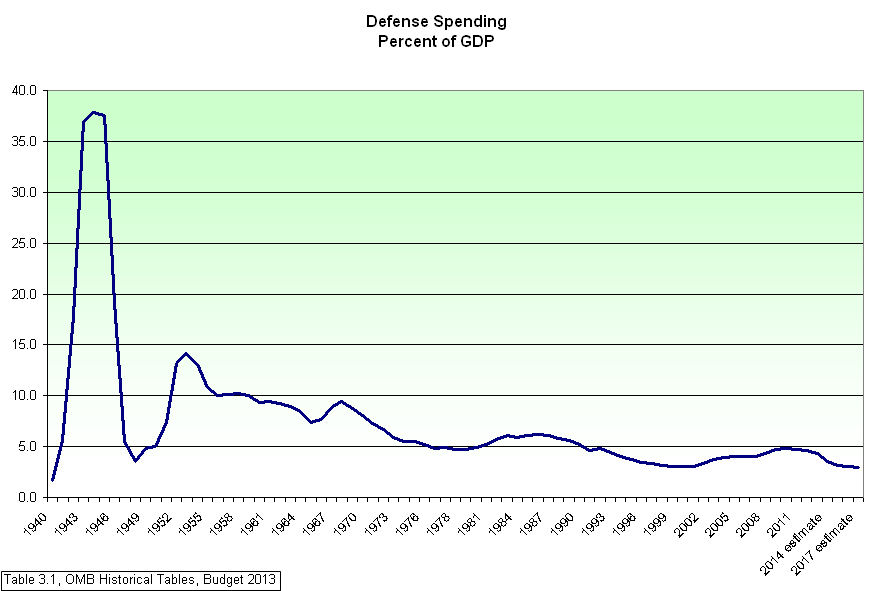
Defense spending has doubled in the past decade.

This spending figure includes only active defense spending.  Outlays for Veterans benefits, education and job training for vets are included under the Human Resources superfunction.  Housing benefits for veterans are included under another superfunction, Physical Resources.  The total outlay is estimated at over a trillion dollars and that figure has been acknowledged by Senator John McCain, a long time supporter of strong defense spending.

As a percent of GDP, however, active defense spending has remained below 5%. Putting this increase in spending in historical perspective puts the lie to the contention by some liberals that our budget problems are mostly due to defense spending.

Human Resource spending includes Social Security payments, which comes out of current taxes and a trust fund surplus of $2.7 trillion (Source).  Since most Social Security payments come out of a tax that has been dedicated to those payments, I have deducted them from total Human Resource spending to get a more accurate picture of the trend in spending on the social safety net. 

When financial conservatives on both sides of the aisle warn of this upward trend, this is what they are talking about.

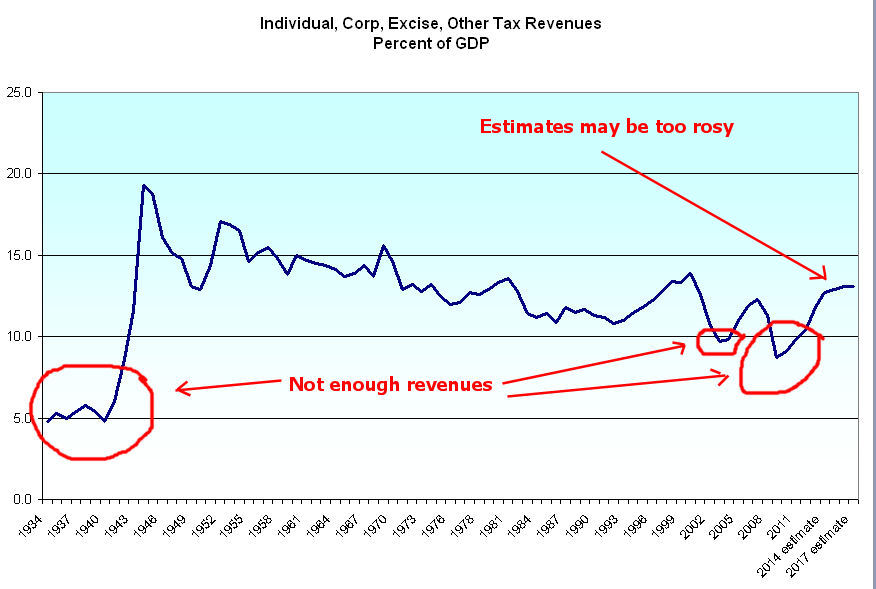
What too many Republicans won’t acknowledge is that we have had and continue to have a severe revenue problem.

Since I listen to and read a lot of “conservative” media each day, I repeatedly hear the mantra that Reagan lowered tax rates and revenues increased.  This is the justification for pushing for continued tax cuts. Reagan and a Democratic Congress lowered tax rates.  The president signs bills that are passed by the Congress.  This is not a one man show.  Total revenues, including Social Security and Medicare taxes, did increase because Social Security taxes were increased 12% during the Reagan years (Source).  When we look at tax revenues without Social Security taxes, revenues as a percent of GDP fell, just as anyone would expect when tax rates are reduced.  Since WW2, tax rates have been gradually reduced, and, as expected, tax revenues as a percentage of the economy have fallen.  There is no magic formula here.  Lower tax rates = lower revenue.

In this ongoing battle of ideologies, there are three real issues.  Should we spend more than 5% of GDP on active defense spending?  Should we spend more than 10% of GDP on social safety programs (excluding Social Security)?  Can we expect to ever live within our means if we collect only 10% of GDP in income and excise taxes?  We can not do all three.

The Job Growth President

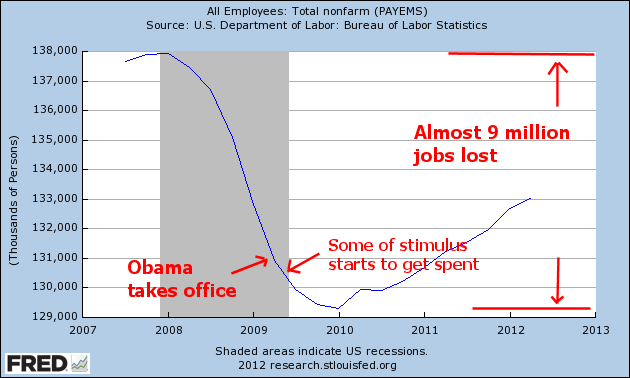
Both incumbent President Barack Obama and Republican challenger Mitt Romney are making the case to American voters that each has better policy answers for future job growth.   Obama touts total job gains of 4+ million jobs since the recession ended.  Romney points out that this is less than half of the 9 million jobs lost since the end of 2007.

An economy is a dynamic resolution of the tension between supply and demand among all the people, companies and governments that participate in that marketplace.  Obama’s approach focuses on the demand side of the economy and believes in government borrowing and spending to temporarily take up the slack in private sector demand. The stimulus of government spending is supposed to both support and kickstart demand in the private sector, particularly consumer demand.  The fault of focusing on the demand side of an economy is that “demand-siders” presume that the supply side of the economy will naturally increase production to meet the sustained or increased demand.  In 2009, the Obama administration, together with a Democratic House and Senate passed a stimulus bill that included a lot of money for sorely needed infrastructure projects.  Democrats, most of them demand-siders, simply assumed that there would be a number of “shovel-ready” projects on the drawing board, projects that would employ construction workers laid off during the severe housing decline.  Since demand-siders do not pay as much attention to the process of producing or constructing something, they were dismayed that there were so few such projects ready to go.  Decades of labor, environmental impact and traffic impact regulations had dramatically increased the planning time required for many highway improvement projects.  At a meeting with his council on stimulus planning, Obama commented wryly, “Shovel-ready was not as shovel-ready as we expected.”

Romney’s approach focuses on the supply side of the economic dynamic.  “Supply-siders” believe that the government’s role in the economy should be limited; that government should remove many regulatory barriers and hinderances to the producers of economic goods and services.  The fault of this approach is that it presumes that consumer and inter-business demand will naturally increase as producers are able to make more goods and products available at a cost that has been lowered by the removal of hurdles to production.  The producers will hire more workers, will buy goods and services from other businesses who will hire more workers;  demand will inevitably increase which will support and stimulate more production.  Many adherents of the supply-sider hypothesis believe that defense of the country is a government’s primary proper role.  They advocate a large amount of military spending but regard taxation as a barrier to production.  These two competing and antagonistic ideas – more military spending, less tax revenue per dollar of economic activity – has resulted in large budget deficits which contradict the professed fiscal frugalness of many in this ideological camp.  Libertarians advocate a more consistent supply-side philosophy, arguing for lower military spending in addition to reduced government spending on social programs. 

Demand-siders argue that workers are both producers and consumers.  Supply siders contend that workers are consumers but not producers; workers are a cost of production.  Demand-siders focus on domestic civilian consumption.  Although supply-siders do not focus on consumption, they do emphasize military consumption.

Who is right?  Both of them and neither of them.  The political discourse and election structure aims to separate people into ideological and emotional teams; over the past decade many politicians who were less polarized in this debate have lost their seats.  A hundred years ago, this country began a transition away from party leaders picking candidates for national office to a primary system whereby voters would choose candidates.  In the two decades after World War 2, our political system made a complete transformation to a primary system, which has produced two increasingly polarized political teams.  A small group of voters in each political camp now elects the candidates for national office; in the last presidential election, less than a 1/4 of registered voters voted in the primaries.  We have traded a system where party bosses in a backroom picked candidates to one in which a small contingent of passionate people pick candidates.  We need a new system.

In his “Believe in America” plan Romney asserts that his policies will foster stronger job growth. (Long version and Short version).  They include reducing the corporate income tax rate, more free trade agreements, more oil and gas leases, reducing federal retraining programs and a 5 percent reduction in non-defense discretionary spending, a relatively small reduction in federal spending of $20 billion, or 1/2 of 1% of total federal spending. (Discretionary spending is government spending which excludes those social programs like Social Security and Medicare and Medicaid whose spending is on “auto pilot”).  Romney’s proposals are consistent with a supply-sider philosophy.

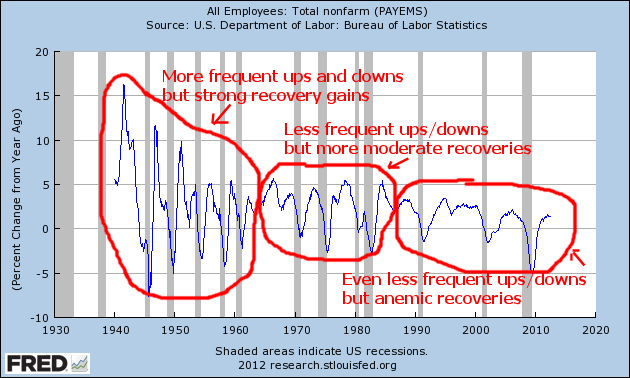
Beginning with the conventions in these next few weeks, both political campaigns are about to go into full court press during the remaining days before the election in November.  Each candidate will argue that their approach will foster job growth.  What neither candidate will tell us are some of the complexities that continue to trouble economists who study the labor market.  Why has job growth been rather anemic during the recoveries of the past thirty years?  Below is a chart of the year-over-year (yoy) percent gain in employment.

Notice two changes in the pattern:  the frequency of job losses has decreased but so have the employment gains during recoveries.  Economists at the Federal Reserve have analyzed the factors for this long term trend and concluded: “The analyses discussed here suggest that weak labor demand is the primary explanation for prolonged unemployment duration observed in the recent recession and recovery. The weak recovery of employment is similar to the jobless recoveries that followed the 1990–91 and 2001 recessions. This suggests that the labor market has changed in ways that prevent the cyclical bounceback in the labor market that followed past recessions. ” (Source)  The authors of the study analyze and isolate several factors to account for the change, including changes in how the numbers are reported, the longer duration of unemployment benefits, and the reduced manufacturing production in this country which would respond quickly during recoveries and recall laid off workers.  Weak labor demand is the chief culprit of anemic job growth and the lengthening duration of unemployment.  Why?  In the past thirty years, underdeveloped countries in Asia, India and South America are now offering a ready supply of un-educated or moderately educated workers.

The increase in the global labor supply is a particularly challenging problem because it is accompanied by an increase in productivity; i.e. less workers are needed to produce a unit of something.  Obama’s answer to this problem is more government support for educating young people and retraining those in the workforce whose skills are not suited to the changing demands of producers.  Obama has essentially given up on jobs for low and moderately educated U.S. workers other than government spending on infrastructure projects.  He hopes that American workers can command more of the global market for highly skilled workers. 

Romney wants to reduce federal retraining programs for workers and turn that task over to states.  He hopes that, somehow, someway, businesses with lower production costs will hire more workers.  More oil and gas drilling will employ more moderately educated workers but even Romney knows that these job gains are modest relative to the entire labor market.  More defense spending will employ workers in defense industries but many of those jobs require higher skills; lower skilled workers will benefit as a consequence, as part of an economy that supports defense contractors and military bases.  Increasing the number of soldiers reduces the number of available workers and reduces unemployment.

Neither candidate proposes to address an intractable problem:  too many workers around the globe.  Below is a chart of the y-o-y change in the number of people employed.  Due to a glut of workers, the structure of the labor workforce in this country is inherently weak.  The chart below shows the drastic drop in employment.

A winning economy, like a top-rated tennis player, blends strategies.  Politicians and players that strictly adhere to a school of thought or a school of play lose out to those are able to see and employ the benefits of differing strategies.


Medicare Reform

A week ago, presumed Republican presidential contender Mitt Romney announced his pick for vice-president – Congressman Paul Ryan.  Ryan has authored a budget plan which has passed the Republican house but was stopped in the Democratic Senate.  The addition of Paul Ryan, a man who focuses on policy issues, should elevate the debate between both presidential campaigns and present a clear choice to the voters.  A signature feature of Ryan’s budget is the transition of the Medicare program from a pay for service program to a voucher program; i.e. seniors would be given vouchers to purchase insurance from private insurance companies. During this decade, Medicare expenses are projected  to grow 3.5% per year, while the annual increase in private insurance costs is estimated at 5.4%.  These estimates were compiled by the Kaiser Family Foundation from a number of sources, including the Congressional Budget Office (CBO), the Center for Medicare and Medicaid Services (CMS), Medicare Trustees Report, Census Bureau and others (Source)  The Ryan plan phases in the voucher plan for Medicare so the difference in annual cost increases this decade would not impact anyone – yet.  The plan applies only to those 55 and younger.  In the decade of the 2020s, the difference in annual cost increases would be borne by newly retiring seniors on fixed incomes.

A chart from the Kaiser Family Foundation shows a breakdown of who has paid for medical care for the past fifty years.  I’ve marked it up to show the categories more clearly. (Click to enlarge in separate tab)

In the coming months, we will hear much debate on the Medicare program.  In 2010, the total program cost was $519 billion and increased to $555 billion in 2011, an annual increase of 6.9%.  This was only slightly above the 6.7% growth rate in spending since 1985  (Source).  Medicare costs are projected to rise to $902B in 2020.

Underlying Paul Ryan’s transitioning of Medicare to a private insurance program is the belief that competition in the private market place will reduce the growth in costs.  This cherished assumption has not proved to be the case in the health insurance market, particularly the small business and individual group markets, which have seen annual increases of 10% or more in the past decade.  A June 2012 survey of insurance agents showed that costs were expected to rise from 12 – 20% this year.  My company has seen only one year when the annual increase in our small group insurance plan was less than 10%.  Competitive quotes from other health insurance carriers were even higher.

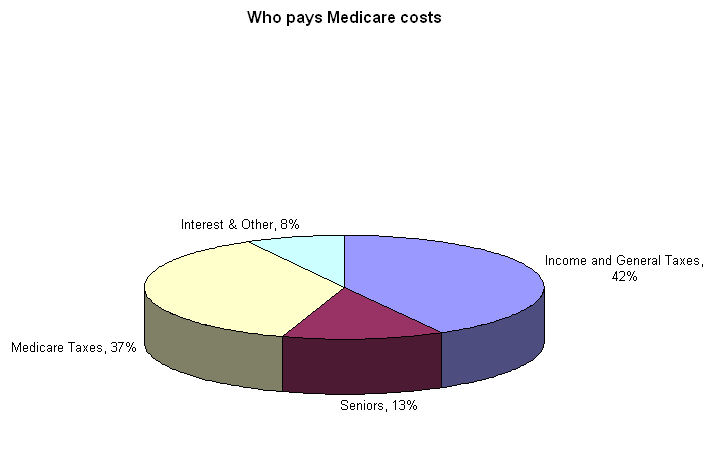
Who pays for Medicare? 

Income and general taxes pay 42%;  seniors pay 13%; Medicare taxes on salary and wages pay for the other 37%.  The total Medicare tax is 2.9%; the employee pays 1.45%; the employer pays the other 1.45%.  The CBO has estimated that the Medicare program will largely stay in the black for the next ten years but admits that its projections depend on whether existing laws or policies remain in place. 

Who benefits from this?  The answer might seem obvious – seniors, of course!  Less obvious is that the Medicare program benefits the children and family of seniors.  Without the Medicare program, many families would need to help support Mom and Dad because of the impact of sky high medical insurance premiums and medical costs on a senior’s fixed income.  

What other solutions are there to the escalating costs in the Medicare program?  We could, God forbid, share the costs of the program out among all taxpayers.  In 2010, the IRS reports that there was $8 trillion in adjusted gross income reported on individual income tax returns (Source)  A 4.6% tax on that amount would have covered the entire expense of the Medicare program, including all Parts – A, B, C and D.

The problem is that voters like government programs but don’t want to pay for them.  Politicians know this and that is why almost half of the cost of the Medicare program comes out of general tax revenues, where they can remain out of sight to most voters on election day.

Should any politician propose that taxpayers actually pay for something they value, they would be pilloried from all sides.  The rich have spent a lot of time and money lobbying to have a large part of their income exempt from Medicare taxes.  Lobbyists for the poor would argue that the poor simply can’t afford it.  AARP would loudly protest that insurance costs to seniors are already too high. The middle class would point to the rich guys and say, “Take it from them.  They can afford it!”

We get the government and the Congress we want and we want fairy tales.  The politicians know we want fairy tales so most of them tell us fairy tales. When the reality check comes, many of get up and say we have to go to the bathroom, then duck out.

I have a lot of respect for Ryan’s sincerity and chutzpah.  I think his solution passes on too many of the cost increases to seniors in the future.  Perhaps some other politicians might take a cue from Ryan and take on other controversial topics like just a teeny-tiny bit of regulation of assault weapons.  Any takers?

Gimme More Government Limits

Many companies do not want limited government.  A smart company dumps as many costs as it can into the public sector, thereby increasing its profits.  WalMart is one such smart company, going so far as to provide their many low paid employees with literature on government social programs that will help the employee cope with the low wages WalMart pays.  Smart companies crusade local governments to upgrade their fire departments and the delivery pressures of their water systems in order to save the company money on its business insurance.  The cost is shifted and spread out to the public and the owners of companies in the upgraded area put the profits in their pocket. Smart established companies like regulations which establish a barrier to entry for their competition, particularly in businesses that have low capital requirements to start up.  Smart companies lobby local and state governments for more licensing laws which present one more cost and regulatory hurdle for small businesses trying to gain a competitive foothold in an industry.  Smart companies argue that licensing is needed for public safety.  Would you want an unlicensed fishing guide?  Of course not!  Here is a partial list of occupations requiring a state license in my state.

The IRS is now requiring most tax preparers to be licensed as a Registered Tax Return Preparer, which includes “competency tests for all paid tax return preparers except attorneys, certified public accountants (CPAs) and enrolled agents who are active and in good standing with their respective licensing agencies.” (IRS Source)  How many independent tax preparers who do tax returns for a few months a year will bother with the cost and time to establish and maintain their credentials?  Many low income workers, especially those with marginal reading skills, feel more comfortable having a tax preparer fill out the amount of their W-2s and do the relatively simple calculations required to file the short form 1040A.  The IRS could have exempted those preparing 1040As, but it didn’t.  Did the IRS enact these regulations in response to a law passed by Congress?  No.  Surely the IRS must have studied this problem for several years before issuing these new regulations?  The IRS spent all of six months before issuing these rules.  One can only wonder who and what prompted such a swift review and enactment of these regulations.  The logic is the oldest one in business:  reduce the supply of preparers and those that remain can charge higher fees.

I am not a tax preparer so I don’t have a dog in this fight.  I’m sure there are instances of tax preparers filing more complex tax returns which the preparer does not have the knowledge to prepare.  But why use an axe when a paring knife will do?  The only solution may be tax reform, the holy grail of simplicity and practicality that continually eludes our elected representatives.

11 Year Labor Recession

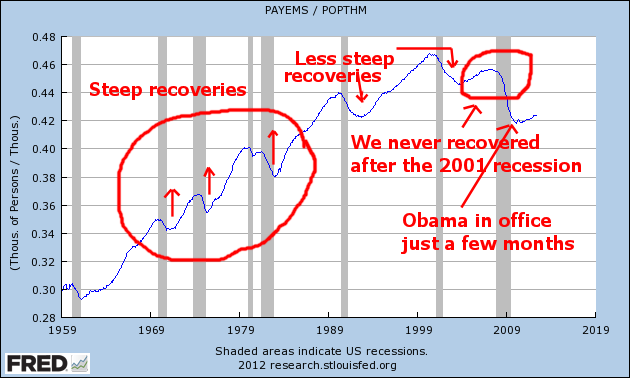
Sitting down?  Good.  Put the kids to bed?  This is not suitable for young minds.  Below is the number of employees per capita during the past fifty years.(Click to enlarge in separate tab)

Job growth after the recessions of the 1960s, 1970s and early 1980s were fairly steep.  The declines in employment were fairly mild in the 1960s and 1970s.  The back to back recessions of 1980 through 1983 led to the first sizeable drop in employment but that became the new normal for employment declines.  In the early nineties, we experienced another equally dismal decline and the employment recovery this time was not so hearty but eventually employment levels exceeded the previous peak before the recession.  In the beginning of the 2000s, we experienced yet another steep decline but this time was different.  China had joined the World Trade Organization (WTO) in 2001 and many manufacturing jobs were shipped off to newly built facilities in China.  Our labor market has never recovered.  The housing bubble during the 2000s led to some growth but we never surpassed the peak before that 2001 recession.  Per capita employment is now at the same depressed level that it was in the early nineties.

During this election season, we are hearing a lot of rhetoric about job growth and job loss but it is mostly focused on the past 4 – 5 years.  We need to step back and understand just how long this sub-standard job growth or job recession has been going on – over a decade.

The swell of the boomer generation is only just beginning to retire.  Some in their early sixties who have lost a job and can’t find another have simply given up and are retiring early, taking an involuntary 25% cut in retirement benefits for the rest of their lives simply because they need the money to pay the rent or mortgage, to buy food and pay the utility bills.  Look at the chart again and understand that job growth policies need to be dramatic to climb up above the employment peak of 2000.  What is dramatic?  Tax incentives for businesses to relocate factories in the U.S. and tariffs on imported goods to protect American manufacturing.  Over the past decades, politicians on both sides of the aisle have chopped away at tariffs until the U.S. has the lowest tariffs of all developed countries.  With each decade have come more tax and employment policy disincentives to hire workers here in the U.S.

Which candidate for President or Congress has discussed or advocated policies that would dramatically spur growth?  None that I have heard.  “More drilling for oil” or “more energy jobs” may add some jobs but the number is insignificant in relation to the problem.  “Infrastructure investments” may likewise promote some jobs in the construction industry but the job gains are tiny fractions of the large scale job growth we need.

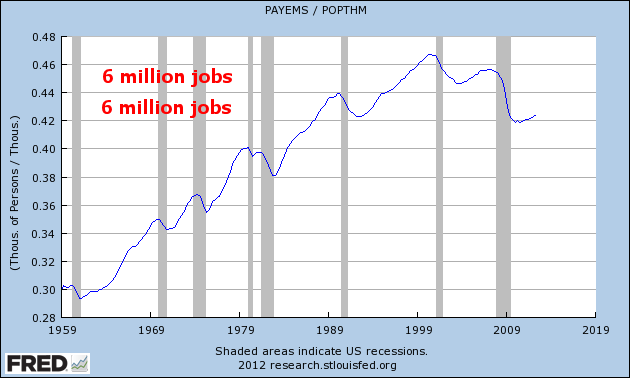
Look at the graph again – this time without my scribbling.  Every gray horizontal line is 6 million jobs.

Let’s zoom in on the past 13 years. Each gray line is 3 million jobs.

To reach just the same level of per capita employment at the peak of 2000, we need 12 million jobs!  So here’s the question I have for all members of Congress and for both candidates for President:  what policies do you advocate that will help create 12 million jobs? 

Government Unemployment

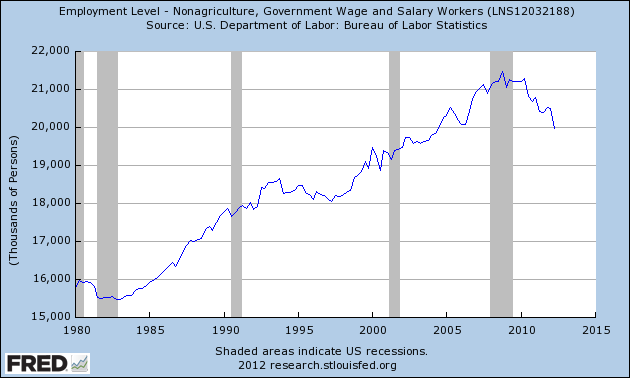
Since the beginning of 2010, approximately 1.3 million government workers have lost their jobs.  Most of these jobs are at the state and local levels and have affected women more so than men.

The initial payouts from the stimulus bill passed in the spring of 2009 went to state and local governments to help them cope with declining tax revenues.  This federal support (all of it borrowed) helped to soften the effect of the recession on women earners, leading some observers to call the recession a “mancession”.  The unemployment rate for men shot up far above that for women.


As stimulus spending declined in 2010, government workers, particularly teachers, lost their jobs as state and local governments made hard choices to balance their budgets. 

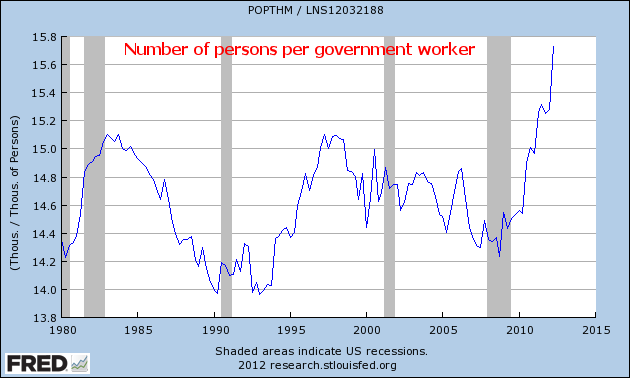
Have they gone too far?  Below is the ratio of total population served by each government worker and it is at a historic high.

Each government worker is “servicing” one extra person more than the thirty year average of just under 15 people per worker.  Second only to the law of gravity is the law of averages; we will return to average, resulting in an increase in government jobs.  Politics is a bloodsport.  In the coming years, Republican politicians in office will take credit for the inevitable addition of these government jobs as the “result of our pro-growth policies” when it is anything but.  The reality is that Republican political leaders and strategists wanted to choke off funding for government jobs while the other party was in power.  The individual carnage of unemployment serves the aims of those desiring political power.  Should Republicans take the Presidency and make gains in the Senate in the upcoming elections, they will stuff their rhetoric about limited government in their pockets, then  announce that – surprise, surprise – the job cuts at the state and local levels have been too much.  The spending spree will continue.

Unemployment Measures

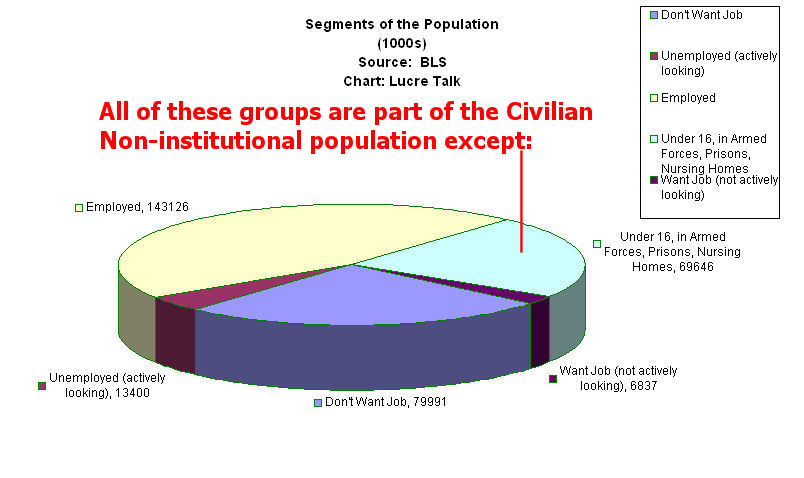
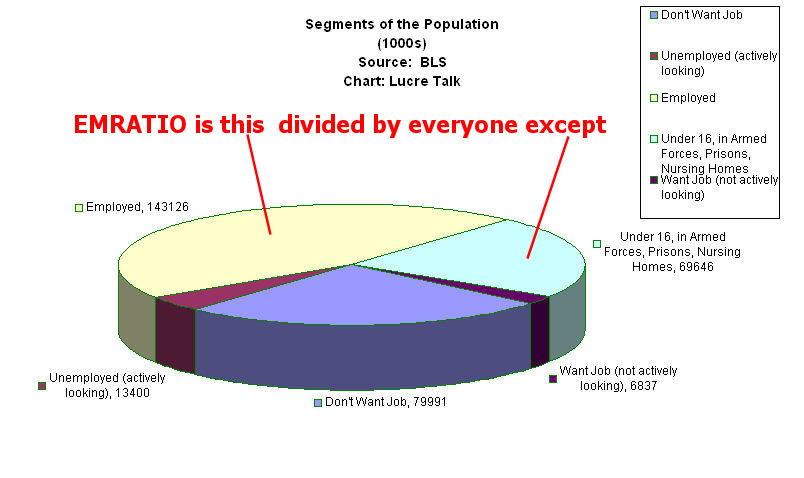
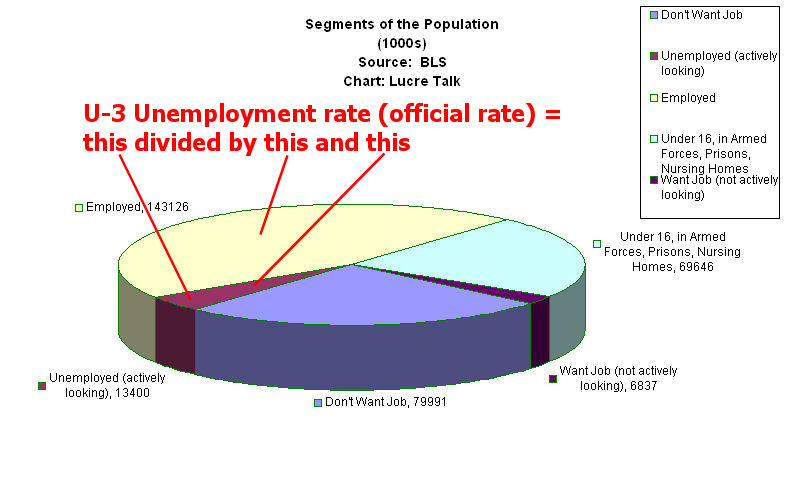
When the Bureau of Labor Statistics (BLS) issues their monthly labor report, the headlines quote an unemployment rate and the number of jobs gained in the past month.  In addition to those headline numbers, a newspaper article may cite a Civilian Participation Rate, the number of long term unemployed, discouraged workers, etc.  To the casual reader, all of these numbers swirl around, making it difficult to see a clear picture.  Below is a pie chart breaking down the approximately 313 million people of the U.S. into various segments. (Click to enlarge in separate tab)

When you read about the Civilian Non-Institutional Population, it is all the people in the country except for those who are under 16, in the Armed Forces, a nursing home or prison.   A better term might be “non-restricted”, i.e. those who are, by definition, free to choose whether they want a job or not.  “Persons not in the labor force combined with those in the civilian labor force constitute the civilian noninstitutional population 16 years and over. (There is no upper age limit.)”  (BLS Source )

This population number becomes the divisor (the bottom number of a fraction) for the Civilian Employment Population Ratio (EMRATIO), which calculates the percentage of employed people to the Non-Institutional Population.

When you read “Civilian Labor Force” that means “”The sum of the employed and the unemployed constitutes the civilian labor force” (BLS Source)

When you read about the unemployment rate, this is the U-3 employment rate.

Sometimes you will read about the “true” or “real” unemployment rate, although often the speaker or author can not define what is “true” or “real”, showing a lack of knowledge about the various employment rates.  What they are usually referring to is the U-6 unemployment rate, which includes discouraged workers and those who are working part time because they either can not find a full time job or business is slow and their hours are reduced.

A casual reader of American History will remember the WPA, a government project that put up to three million people to work during the 1930s.  Projects included the Hoover Dam, Grand Coulee Dam, the Lincoln Tunnel linking Manhattan and New Jersey, Carlsbad Caverns, the Great Smoky Mountains National Park and public buildings throughout the U.S.  But who knew that a large part of the unemployment report itself was a WPA project begun in 1940? (BLS Source)

Personal Income

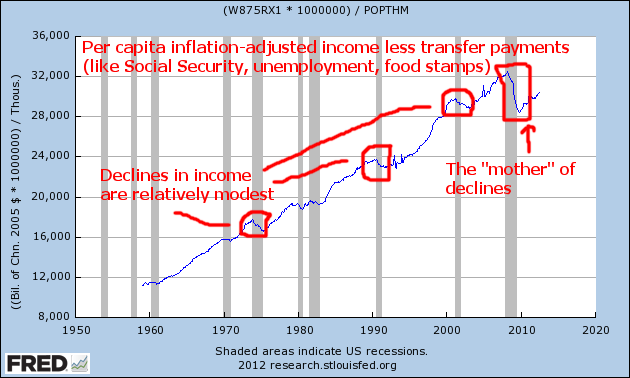
To understand why so many people are still hurting, take a look at the graph below.  This is per capita inflation adjusted income less what are called transfer receipts – government payments to people like Social Security, food stamps, Unemployment insurance, etc.  Previous recessions have seen a flattening of income and a few have seen a decline in income but nothing like what we have experienced during this past recession.  The “cliff” is a decrease of 12.5%.

Including transfer payments from the government, the decline is only 8.5%.

The difference is about $1.5 trillion dollars per year that goes to people to pay bills, to pay for housing, to buy food and medicine.  Almost all of that money gets spent.  It is true that government is borrowing to pay out that money but without that extra “juice”, we would no doubt have been in a depression.

The federal government is about to hit the $16 trillion mark in debt.  Eventually interest rates will go up and the government will have to pay several hundred billion dollars more each year in interest payments on that debt.  That is billions of dollars that won’t be available for people or guns.  The worst of the decline is over.  Now is the time for us to stop shouting at each other and talk earnestly about some really tough problems.