Employment, Income and GDP

May 4th, 2014

Employment

Private payroll processor ADP estimated job gains of 220K in April and revised March’s estimate 10% higher, indicating an economy that is picking up some steam.  Of course, we have seen this, done that, as the saying goes.  Good job gains in the early months of 2012 and 2013 sparked hopes of a strong resurgence of economic growth followed by OK growth.

New unemployment claims this week were pushing 350K, a bit surprising.  The weekly numbers are a bit volatile and the 4 week average is still rather low at 320K.  In a period of resurgent growth, that four week average should continue to drift downward, not reverse direction. Given the strong corporate profit growth expectations in the second half of the year, there is a curious wariness in the market.  Conflicting data like this keeps buyers on the sidelines, waiting for some confirmation.  CALPERS, the California Employees Pension Fund with almost $200 billion in assets, expressed some difficulty finding value in U.S. equities and is looking abroad to invest new dollars.

On Friday, the Bureau of Labor Statistics reported job gains of 288K in April, including 15K government jobs.  Most sectors of the economy reported gains but there are several surprises in this report.  The unemployment rate dropped to 6.3% from 6.7% the previous month, but the decline owes much to a huge drop in labor force participation.  After poking through the 156 million mark recently, the labor force shrank more than 800,000 in April, more than wiping out the 500,000 increase in March.

To give recent history some context notice the steady rise in the labor force since the end of World War 2, followed by a flattening of growth in the past six years.

The core work force, those aged 25 – 54 years, finally broke through the 95 million level in January and rose incrementally in February and March.  It was a bit disappointing that employment in this age group dropped slightly this month.
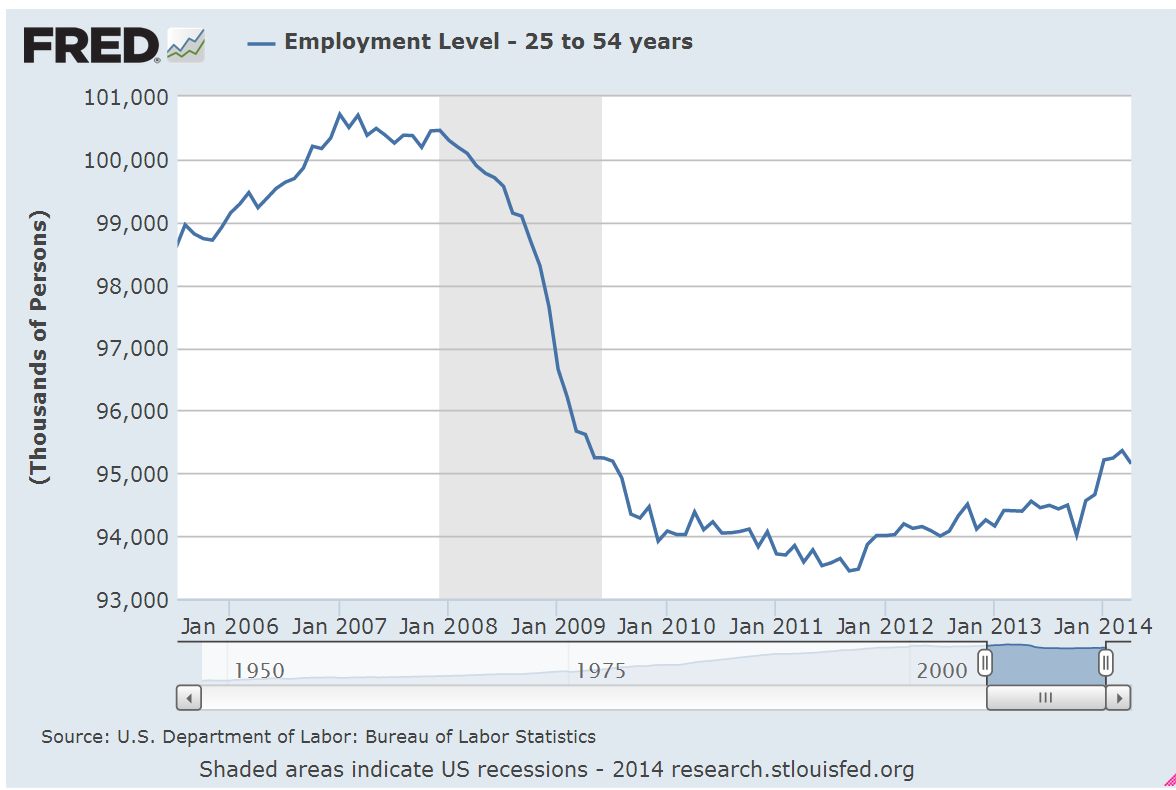
To give this some perspective, look at the employment rate for this age group. Was the strong growth of employment in the core work force largely a Boomer phenomenon unlikely to repeat?  Perhaps this is why the Fed indicated this week that we may have to lower our expectations of growth in the future.

Discouraged job seekers and involuntary part timers saw little change in this latest report.  On the positive side, there was no increase.  On the negative side, these should decline in a growing economy.  There simply isn’t enough growth.  Was the strong pickup in jobs this past month a sign of a resurgent economy?  Was it simply a make up for growth hampered by the exceptional winter?  The answers to these and other questions will become clearer in the future.  My time machine is in the shop.

************************

GDP

Go back with me now to those days of yesteryear – actually, it was last year.  Real GDP growth crossed the 4% line in mid year.  The crowd cheered.  Then the economic engine began to slow down. The initial estimate of fourth quarter growth a few months ago was 3.2%.  The second estimate for that period was revised down to 2.4%, far below a half century’s average of 3%.  This week the final estimate was nudged up a bit to 2.6%, but still below the long term average.

Earlier in the week, the Federal Reserve announced that it will continue its steady tapering of bond buying and that it may have to adjust long term policy to a slower growth model.  The harsh winter makes any analysis rather tentative so we can guess the Fed doesn’t want to get it wrong?

************************

Manufacturing – ISM

ISM reported an upswing in manufacturing activity in April, approaching the level of strong growth.  The focus will be on the service sector which has been expanding at a modest clip.  I’ll update the CWPI when the ISM Service sector report comes out next week.

************************

Income – Spending

Consumer income and spending showed respectable annual gains of 3.4% and 4.0%.  The BLS reported that earnings have increased 1.9% in the past twelve months. CPI annual growth is a bit over 1% so workers are keeping ahead of inflation, but not by much.   Auto sales remain very strong and the percentage of truck sales is rising toward 60%, a sign of growing confidence by those in the construction and service trades.  Construction spending rose in March .2% and is up over 8% year over year but the leveling off of the residential housing market has clearly had an effect on this sector in the past six months.

***********************************

Conservative and Liberals

While this blog focuses mainly on investing and economics, public policy is becoming an ever increasing part of each family’s economic heatlh, both now and particularly in the future.
Some conservatives say that they endorse policies which strengthen the family yet are against rent control, minimum wage and family leave laws, all of which do support families.  How to explain this apparent contradiction?  A feature of philosophies, be they political, social or economic, is that they have a set of rules.  Some rules may be common to competing philosophies but what distinguishes a conceptual framework or viewpoint is the difference in the ordering of those rules.  The prolific author Isaac Asimov, biologist and science fiction writer, proposed a set of three rules programmed into each robot to safeguard humans.  A robot could not obey the second law if it conflicted with the first.  Robots are rigid; humans are not.  Yet we do construct some ordering of our rules.

A conservative, then, might have a rule that policies that protect the family are good.  But conservatives also have two higher priority rules which honor the sanctity of contract and private property: 1) that government should not interfere in voluntary private contracts, and 2) that private property is not to be taken from private individuals or companies without some compensation, either money or an exchange of a good or service. Through rent control policies, governments interfere in a private contract between landlord and tenant and essentially take money from a landlord and give it to a tenant, a violation of both rules 1 and 2.  Minimum wage and mandatory family leave laws enable a government to interfere in a private contract between employer and employee and essentially transfer money from one to the other, another violation of both rules.

In my state, Colorado, there is no rent control.  Instead, landlords receive a prevailing market price and low income tenants receive housing subsidies and energy assistance.  Under rent control, money is taken from a specific subset of the population, landlords, and given to tenants.  Under housing subsidies, money is taken from general tax revenues of one sort or another and given to tenants.  Of the two systems, housing subsidies seems the fairer but many conservatives object to either policy because the government takes from individuals or companies without any exchange, a violation of rule #2.  All policies like housing subsidies which involve transfers of income from one person to another, are mandatory charity, and violate rule #2.

Liberals want to support families as well but they have a different set of rules that prioritizes the sanctity of the social contract: 1) individuals living in a society have an obligation to the well being of other members of that society, and 2) those with greater means have a greater obligation to the well being of the society.  A government which is representative of the individuals of that society has the responsibility to facilitate the movement of wealth and income among those individuals in order to achieve a more equitable balance of happiness within the society.  Flat tax policies espoused by more conservative individuals violate rule #2.  Libertarian proposals for a much smaller regulatory role for government violate rule #1.

For liberals, both of the above rules are subservient to the prime rule: humans have a greater priority than things.  When the preservation of property rights violates the prime rule, property rights are diminished in preference to the preservation of human well-being.  On the other hand, conservatives view property rights as an integral aspect of being human; to diminish property rights is to diminish an individual’s humanity.

In the centuries old dynamic tension between the individual and the group, the liberal view is more tribal, focusing on the well being of the group.  Liberals sometimes ridicule some tax policies espoused by conservatives as “trickle down economics.”  In a touch of irony, it is liberals who truly believe in a trickle down approach in social and economic policies.  The liberal philosophy seeks to protect society from the natural and sometimes reckless self-interest of the individuals within that society. The conservative viewpoint is concerned more with the protection of the individual from the group, believing that the group will achieve a greater degree of well-being if the individuals are secure in their contracts and property. Conservatives then favor what could be called a bottom up approach to organizing society.

Conservatives honor the social contract but give it a lower priority than private contracts.  Liberals honor private contracts but not if they conflict with the social contract. Most people probably fall somewhere on the scale between the two ends of these philosophies and arguments about which approach is “right” will never resolve the fundamental discord between these two philosophies.

In the coming years, we are going to have to learn to negotiate between these two philosophies or public policy will have little direction or effectiveness.  Negotiating between the two will require an understanding of the ordering of priorities of each ideological camp.

Before the 1970s political candidates were picked by the party bosses in each state, who picked those candidates they thought would appeal to the most party voters in the district.   The present system of promoting political candidates by a primary system within each state has favored candidates who are fervent advocates of a strictly conservative or liberal philosophy, chosen by a small group of equally fervent voters in each state.  The middle has mostly deserted each party, leading to a growing polarization.  Survey after survey reveals that the views of most voters are not as polarized as the candidates who are elected to represent them. A graph from the Brookings Institution shows the increasing polarity of the Congress, while repeated surveys indicate that voters are rather evenly divided.
Spring Fever

April 27th, 2014

Existing Home Sales

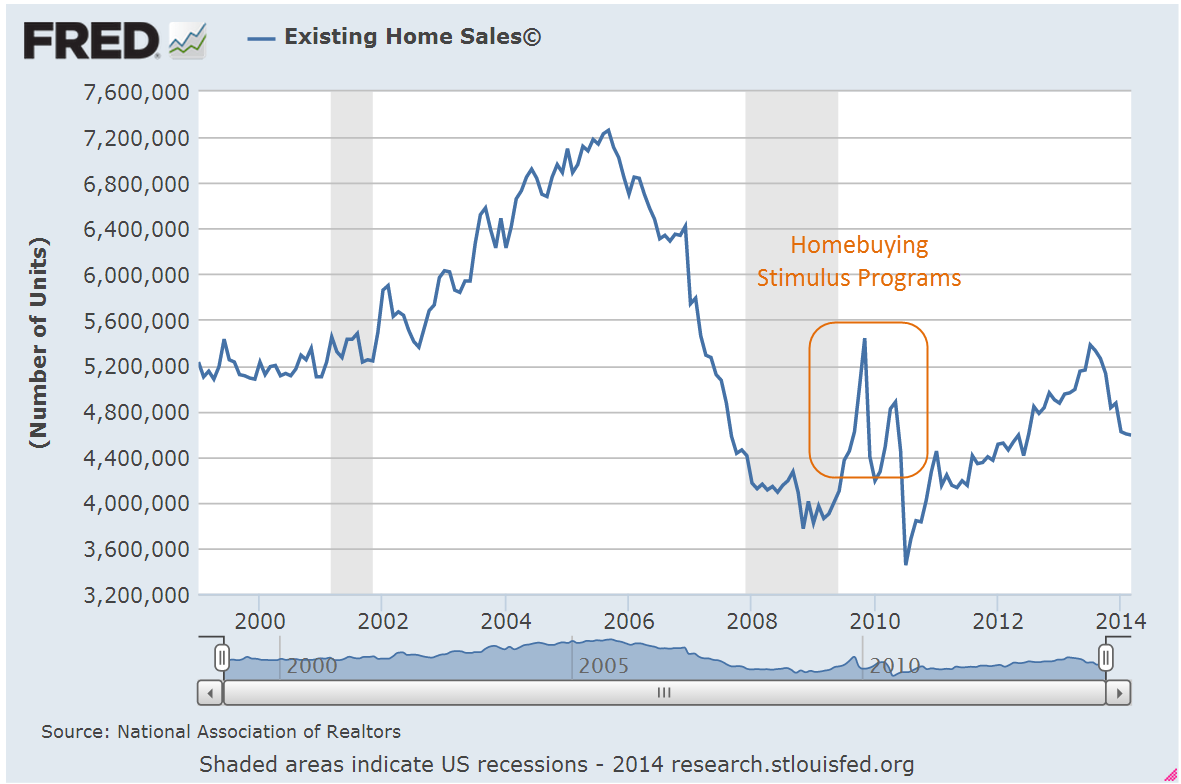
Sales of existing homes in March were disappointing, dropping 7.5% year over year.  Some analysts use the 5 million mark as an indication of a healthy housing market.

As a percent of the population, the change in existing home sales is rather small, yet the change of ownership prompts remodeling projects and home furnishing purchases after the sale, spiff ups before the sale, and commissions and fees for real estate professionals at the time of the sale.

As a percent of the total stock of homes, sales are likewise small yet determine the valuation of everyone’s home.  There are concrete consequences: a lowered evaluation of a home’s value might mean that a person cannot get a home equity loan to help start a new business.  As we discovered in this last recession, lowered valuations of a  home can mean that homeowners are upside down on their mortgages.  Low valuations “box in” a homeowner’s choices so that they may feel that they can not move to a nearby town to be closer to a new job.  These cumulative effects can promote a defeatist attitude among homeowners.  In the past several years, many of us recently found that we were worth less – $50K, $100K, $200K – because the value of our homes had dropped.  Even though many of us had no intention of moving, we felt poorer.

The methodology underlying the calculation of the Consumer Price Index (CPI) involves the concept of Owner Equivalent Rent (OER).  The CPI treats home ownership as though the family who owns the home is renting the home to themselves.  In this sense, owning a home is like a owning a U.S. Treasury bond that pays regular interest payments, or coupons.  Until the recent recession, many regarded home ownership as though it were a Treasury bond, unlikely to ever lose value.  Even better than a Treasury bond, a house was likely to gain in value.

Most of us, however, do not think in  terms of OER.  We feel poorer when the value of our home drops by 20%. Likewise, a stock market drop of 20% has a significant effect on the value of our retirement funds.  Even if we do not need that money for 10 years or more, we are poorer on paper and this affects many other buying decisions.

***********************************

Spring Fever

Other economic reports this week offset the negative news on home sales.  The flash, or preliminary, index of manufacturing activity indicates a positive report next week on the sector.  Durable goods orders were strong, reinforcing the signs that manufacturing is on a spring upswing.  New claims for unemployment were a bit above expectations but nothing significant and the 4 week moving average of claims indicates a much improved labor market.

Although UPS and 3M had disappointing earnings or forecasts, industrial giants GM and Caterpillar surprised to the upside, as did tech giants Microsoft and Apple.  Expectations for this earnings season were rather lukewarm but the aggregate earnings growth of the SP500 may come in below 1%.  Some attribute Friday’s drop in the market to accelerating tensions in Ukraine but the market was essentially flat this past week, reflecting a general lack of enthusiasm or worry.

************************************

Buffet Investing Advice

In mid March Warren Buffet got the attention of many when he made a surprising recommendation:

Put 10% of the cash in short-term government bonds and 90% in a very low-cost S&P 500 index fund. I suggest Vanguard’s. (VFINX) I believe the trust’s long-term results from this policy will be superior to those attained by most investors – whether pension funds, institutions, or individuals – who employ high-fee managers.

Doughroller presented some good observations on Buffet’s recommendation.  Also at the same site Rob Berger offers a fresh perspective on the stock – bond allocation mix.

**********************************

Consumer Price Index and College Tuition

In a recent analysis of trends in the various components of the Consumer Price Index, Doug Short presented several graphs of the annualized growth rates of the different components.  It comes as no surprise that medical care costs have risen 70% in the past 13 years.  The real surprise to me was that college tuition costs have shot up almost twice that – 130% in the same period.  Average tuition and fees for an in state student at a public four year college are currently almost $9K per year.

The growth in costs should worry parents with a son or daughter six years away from entering college.  Perhaps they may have planned on $10K – $12K a year.  However, if these growth trends remain as constant in the coming years as they have in the past, tuition and fees will be more like $15K per year when their child begins college.  By the time they graduate – if they graduate within four years – the cost could be $20K per year.  Remember, this doesn’t include any housing costs.  Higher education receives heavy subsidies from each state and the Federal government. So why the skyrocketing tuition costs?  Heavy lobbying, influence in the state capitols in the nation, inefficient and bloated administrative structures, protectionism – these are just a few of the reasons for the escalation in costs.  A spokesman for higher education won’t give those reasons, of course.  She will cite the need to attract quality teachers, investments in new technologies, aging infrastructure that is costly to maintain, and those certainly do contribute to increasing costs.  Higher education is still largely built on a framework that was suited for the sons of the landed gentry in the 18th and early 19th centuries.  As Obama and voters discovered after the 2008 elections, change comes slowly.  Like the tax system, higher education will continue to receive incremental changes, a hodgepodge of patches to fix this and that, to pad the pockets of this interest group or ameliorate a select slice of voters.

Earnings, Revenues and Retail Sales

April 20, 2014

You’re on a date with me, the pickin’s have been lush
And yet before this evenin’ is over you might give me the brush

Luck Be a Lady
from the play Guys and Dolls

Easy money

In opening remarks Tuesday at a Federal Reserve conference in Atlanta, Janet Yellen, head of the Fed, made the case that ongoing weakness in the global economy warranted support from central banks and that she did not anticipate full employment in the U.S. for another two years.  The Fed reported that the economies in all 12 Fed districts improved in March as consumers ventured out of their winter burrows. The stock market rose in each of the four trading days this week, but has still not risen to the level it opened at on Friday, April 11th, when the market dropped 2%.  Disappointing earnings reports restrained enthusiasm sparked by the prospect of continued easy monetary policy from the Fed.

**************************************

Earnings

On Tuesday, discount broker Charles Schwab reported a 58% increase in first quarter profits.  Trading volume was the highest in its history as many individual investors returned to the stock market.

In the tech sector, Intel and IBM reported declining revenues of 1% and 4% respectively.  The stock price of both companies is about the same as it was two years ago.  Intel is trying to transition from its traditional dominance in PC chips as sales of PCs continue to slow.  IBM is undergoing a similar transition from hardware – particularly mainframes – to business software.

Since early 2012, the Technology SPDR ETF,  a broad basket of tech stocks, is up almost 50%.  For an investor who does not have the time to research trends in a particular sector, particularly one as dynamic as the technology sector, buying a representative basket of the sector may be the safer choice.

American Express reported a first quarter drop in revenue of 4%, attributing most of the decline to small business and corporate spending.

Google reported an 8% drop in first quarter revenue from the fourth quarter.  Year over year, revenue rose 10% but investors have realized that the days of 20 – 40% annual revenue gains are probably over.  Since early March, the company’s stock has dropped 12%.

W.W. Grainger sells supplies, parts, equipment and tools to businesses.  Since 2009 revenues have risen almost 50% but sales growth has been meager since the middle of last year.  A few weeks ago, I noted the lack of growth in maintenance and repair employment.  Grainger’s lack of revenue growth and declining spending by businesses at American Express are disturbing indicators that there is a lack of confidence and investment in growth.

The industrial and financial megalith General Electric reported a year over year revenue increase of 2.2% but the company’s revenues have been fairly flat for four years and the stock price is almost 20% below its mid 2007 level.  GE is gradually shedding its financial businesses in order to focus on what it does best – making stuff, big stuff and small stuff.  With a dividend yield of 3.4%, this stock may be worth a more in depth look for investors who buy individual stocks and think that the company can make the transition.  As a side note:  in 2013, GE managed to defer $3.3 billion, or 85%, of its income tax liability, which will no doubt get some attention in the coming election cycle.  What won’t be mentioned is that GE paid over $8 billion in 2011 and 2012.

*************************************

Retail Sales and Household Debt

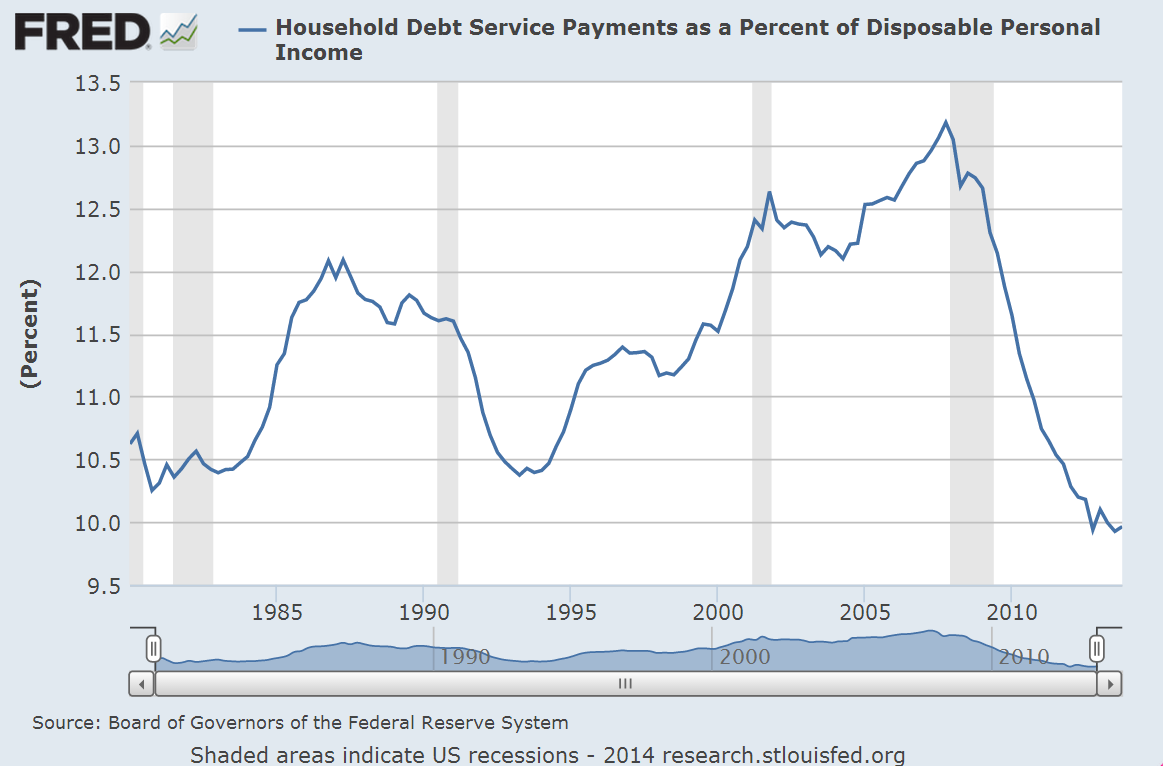
Retail sales were up a strong 1.1% in March, the most in two years.  Auto sales were particularly strong. Household debt is at the same level as it was in the 1st quarter of 2007 but has been slowly rising in the past year.  The years from the mid 1980s to the mid 2000s is often called the Great Moderation by many economists but the period is marked by an immoderate 8.6% annual growth rate in household debt.  Since the onset of the financial crisis and recession, households have jumped off that runaway train yet today’s levels still reflect a 34 year annualized growth rate of 7%.

With meager growth in personal income, it is unlikely that consumers can afford to rise to those heady and unsustainable growth rates in debt.  However, the percent of income needed to service that debt is at 34 year lows.  Growing consumer confidence and willingness to take on more debt may pull the economy out of the current lackluster growth.

*************************************

Margin Debt

A link on this blog is to the excellent work that Doug Short does.  In case you missed it, here are some graphs he presented on margin debt reported by the NY Stock Exchange, or the amount of money that investors have borrowed against their stock holdings.

I am not sure how reliable this indicator is.  Selling as margin debt starts to drop and buying as it starts rising again has mixed results.  The strategy would have kept a hypothetical investor out of the market during the market downturn in the early 2000s, back into the market in late 2003, out of the market in early 2008, and back into the market in July 2009.  So far, the timing looks great.  Since then, however, the rise and fall in margin debt has signaled some fake outs, so that an investor would have sold during a temporary market disruption, only to buy in later at a higher level.

Oddly enough, the last buy signal in February 2012 coincided with the Golden Cross in late January 2012.  The Golden Cross occurs when the 50 day moving average crosses above the 200 day moving average.

Diminished Expectations

February 3rd, 2014

The SP500 has been hovering over a support trendline in the 1760-1775 range, with buyers coming in at 1775.  At 1750, the market would have corrected 5%, a fairly normal occurrence.  Market watchers have been concerned that the market has not experienced one of these small “shaking of the tree” corrections since May/June of 2012.  Disappointing earnings and revenue reports from bellweather companies, together with selling pressure on some emerging market currencies, have made traders nervous.

The market is composed of buyers and sellers responding within varying time frames.  In a short to mid term time horizon, one person might pay more attention to turbulence in emerging markets or the latest corporate reports.  A mid to long term investor might pay more attention to rising industrial production, healthy GDP numbers, consumer spending and income, and declining unemployment.

*****************************************

Apple forecast lower than expected revenues for the coming quarter in the China market.  The announcement prompted an 8% decline in the company’s stock.  Facebook reported blow out revenue growth of 63% in the past quarter, causing the stock to rise about 16%.  FB’s active user base has more than doubled in two years.  Despite the robust growth, the sky high valuation of the company reminds me of some internet stocks in the late 1990s.  The stock has a Price to Sales – not Price to Earnings – ratio of about 15 to 1.  Google has a track record of strong revenue and earnings growth and sports a richly valued price to sales ratio of 6.4.  Does Facebook’s short track record deserve a valuation that is more than twice Google’s?  In 2000, Microsoft had a price-sales ratio of 23 to 1. Fourteen years later, Microsoft’s stock sells for 30% less than it did in 2000.  In 2000, Cisco had a price to sales ratio of 30 to 1.  Cisco’s revenues were growing 50% a year.  “The stock is cheap,” some said.  Fourteen years later, Cisco sells for less than a third of what it did in the heady days of rapid growth.  A word of caution to long term investors.

Amazon reported “only” a 20% increase in quarterly revenue during the busy 4th quarter Christmas season. This is five times the sales growth of the overall retail industry so a casual observer might think that the stock enjoyed a healthy bump up in price, right?  Wrong. After rising 50% over the past year, the company’s stock was priced to perfection. The disappointing growth particularly in overseas markets prompted a lot of selling and an 8% decline in price on Friday.

As I noted last week, many retailers will report quarterly earnings in February.  Many companies get a sense of the bottom line that they will report before the official release of quarterly data.  If there are material differences between consensus expectations and forecast results, a company will issue a revised forward guidance.  Wal-Mart did so this past week, revising its revenue and earnings forecast down for the fourth quarter and lowering earnings projections for the coming year.  The company cited a much greater than forecast impact from November’s reduction of the food stamp program.  The severe storms in December also had a material impact on sales.

In the past two months, Wal-Mart’ stock has declined 8%.  Let’s think about that for a moment.  The market value of Apple and Amazon declined 8% in one day.  It takes two months for Wal-Mart’s stock to decline by the same percentage.  Individuals who invest in companies like Apple and Amazon have to be able to take abrupt market gyrations in stride.  Companies are essentially stories.  Some like Apple and Amazon are stories of growth.  There comes a time when the story changes, as it did for Microsoft and Cisco more than a decade ago.  Apple’s story has been “under construction” in the past 18 months. Since the beginning of 2008, Wal-Mart’s stock has risen 56%, Apple’s is up 150%, and Amazon’s market price has soared more than 6 times.  Growth companies offer rich rewards for the investor who has the time to  follow the story, but it can be difficult to know when the story is changing.

During the past 3 weeks, Home Depot has lost about 6% after gaining 35% since the beginning of 2013.  This giant has one foot in the home construction and remodeling sectors, one foot in the retail sector.  The decline reflects lowered near term expectations for both construction and retail.  Consumer spending has risen steadily but incomes are flat.

*****************************************

December’s report of new homes sold was disappointing.  After rising above an annual level of 450,000 in the fall, sales have fallen closer to the 400,000 mark.

 Some blame the particularly harsh December in the east, some blame the weak labor report released in early January, others blame the low supply, still others blame rising mortgage rates. The Case Shiller home price index shows a year over year gain of almost 14% in metro area homes, indicating relatively healthy demand.  However, the latest Consumer Confidence survey reports a decline in the number of people planning to buy a home.  On an ominous note, pending home sales in December declined more than 8%, the worst monthly decline in almost four years.  Without a doubt, the severe winter weather in the eastern U.S. was a big factor but it is difficult to assess how much of a change.  This is the second report – employment was the first – that was far below even the lowest of estimates.

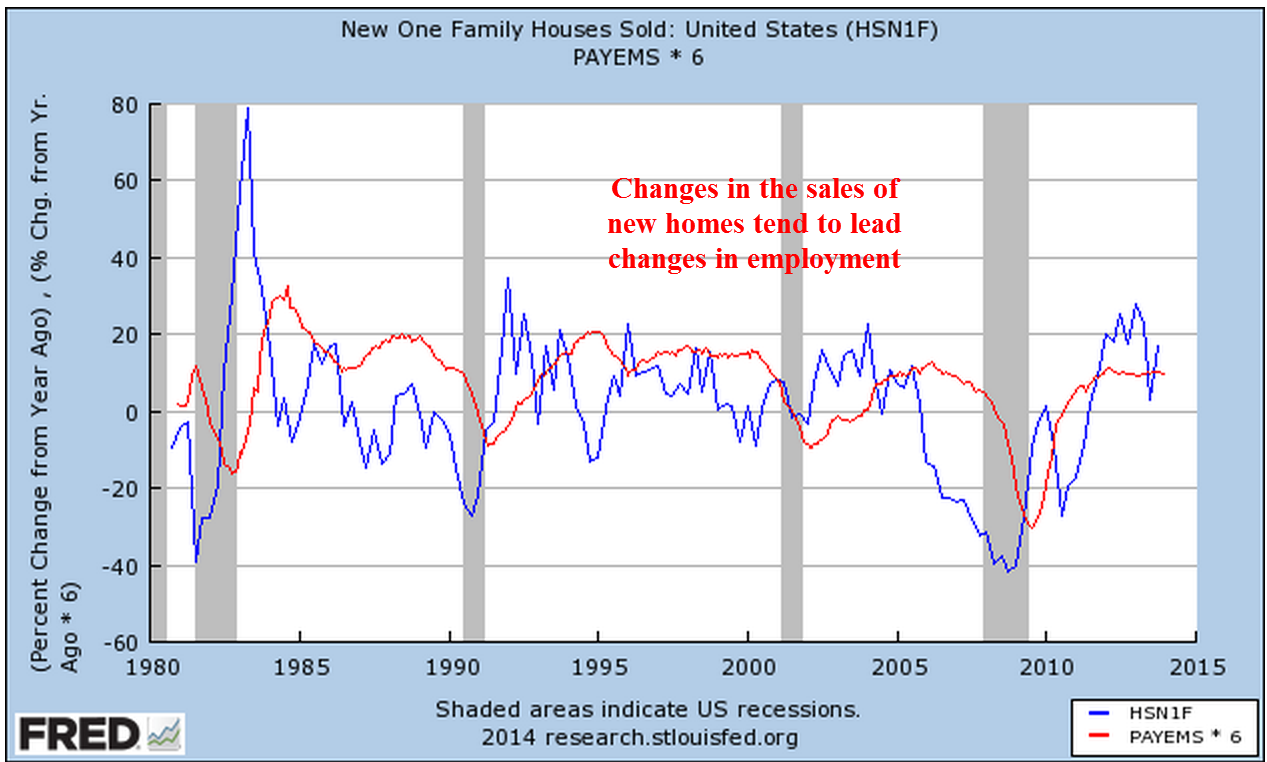
The link between employment and new home sales is counterintuitive; changes in new home sales anticipate changes in employment.

In a 2007 paper presented at a Federal Reserve conference, economist Ed Leamer demonstrated that changes in residential investment, a relatively small component of the economy, indicate coming recessions and recoveries.  The National Assn of Homebuilders estimates that each new home generates a bit more than three full time jobs.

Residential investment includes new homes, remodels, furniture and appliances.  Eventually residential investment reaches a point where it is contributing too much to the economy. As that percentage begins to correct to more normal levels, the contraction tugs on the total of economic growth.

As you can see in the chart above, a sustainable “sweet spot” is in the 4 to 4-1/2% of GDP range but residential investment is still less than 3% of GDP.  In past recessions, residential investment has helped recovery.  This time is different.  Housing’s less than normal contribution to the nation’s GDP has dampened overall growth.

*****************************************

The first estimate of GDP growth for the fourth quarter was a rather remarkable 3.1%.  Although this was in line with estimates, I was concerned that the severe winter weather in the east might have more of a negative impact.  A version of GDP that reflects domestic consumption, Final Sales of Domestic Product, showed a modest 2.1% growth in the 4th quarter, reflecting the impact of the weather, I think. The third quarter growth rate was revised to 4.1%, up substantially from the initial estimate of 2.8%.  The hope is that this is now a 4% growth economy and the first quarter of this year may hold some welcome surprises as delayed economic activity in the 4th quarter is rolled into this year’s first quarter.  As I noted a few weeks ago, the wave like trend of the CWI composite index of manufacturing and non-manufacturing indicated a slight lull in these winter months before another peak in early to mid-spring.

****************************************

Consumer Confidence rose to 80, the lower bound of what I consider healthy.  This index fell below 80 in the early part of 2008 and did not get above that mark till this past summer, then fell back in the fall.  A separate Consumer Sentiment survey from the U. of Michigan showed a similar reading at slightly above 81.

*****************************************

January’s monthly employment numbers will be released next Friday.  I ran a chart of those not in the labor force as a percent of those working.  Thirty years ago, the economy was coming out of the most severe employment recession since the Depression.  It is rather disturbing that this ratio continues to climb to the nose bleed levels of that recession thirty years ago.

******************************************

The harsh winter weather may be affecting consumers more than businesses.  Chicago and the upper Midwest region got creamed with cold snap after cold snap in December yet industrial production figures for the month are still robust, declining somewhat from the incredibly strong readings of the past few months.

The Price is Right?

August 4th, 2013

First week of the month and several good monthly reports helped propel the SP500 through the 1700 mark this week, making an all time high.  Last week I wrote that the market would be cautious and the first few trading days of the week was exactly that, drifting sideways.  On Thursday the release of a suprisingly strong ISM Manufacturing report gave an upward jolt to the market.  In several recent blogs on the ISM and an alternative composite called the CWI, we could see that manufacturing has been sliding toward the neutral mark of 50 for the past several months.  On Monday, the ISM non-manufacturing index will be released and next week I hope to update the CWI.

Ultimately, the market rides up or down on the anticipation of future earnings.  However, earnings can be “managed,” to put it politely.  Further confusing the earnings picture for a casual investor are the several different types of earnings: operating, pro-forma and GAAP to mention a few.  There are two types of “future”, or projected, earnings: bottom up and top down.

A simpler approach that some investors use is to calculate the Price Dividend ratio.  There is no fudging of cash dividends to investors.  Robert Shiller, author of  the 2005 book “Irrational Exuberance”, updates the data used in his book.   These include the SP500 index, earnings, dividends, the CPI and a Price Earnings ratio that is based on the past ten years of earnings.  The current ratio of 23.80 is lower than the 2006 ratios which were in the high twenties.

But let’s look at the Price Dividend, or PD, ratio.  For the past ten years that ratio has averaged a bit less than 52, meaning that investors have been willing to pay almost 52 times the amount of the dividend to own the stock.  As of June 30th, the PD ratio stood at a bit more than 48, which means that stocks were a bit cheaper than average at this date.  Since then the market has gone up about 6% so that the PD ratio is now about 51, or just about average.

As the market makes new highs, investors are prone to ask themselves if the price they are paying for stocks is too high.  The long term investor might take a different perspective and ask themselves, “How will I feel in ten years if I continued to put money into the stock market now?”  Ten years from now, in the year 2023, the answer will be “Well, I didn’t get a deal and I didn’t overpay based on the information available at the time.  I paid about average.”

McGraw-Hill, the publisher of the SP500 market index, also keeps an index of dividends.

Dividend growth has plateaued and is about a third of earnings, which means that companies are paying a third of their earnings back to investors in the form of dividends.  This is just slightly more than the median for the past ten years.

There was a lot of data to digest in this past week.  The GDP estimates for the 2nd quarter was a sluggish 1.7%, more than the expectation of 1.1%.  But – always that but – the 1st quarter GDP growth was revised down from 1.7% to 1.1%.

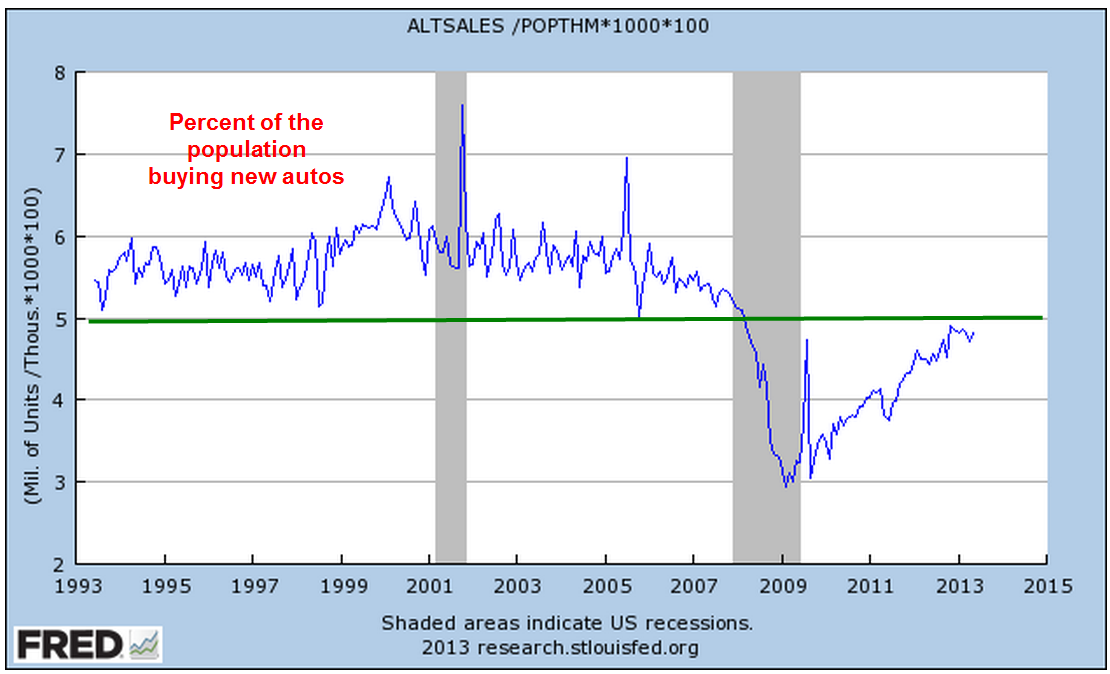
On Thursday, the same day as the ISM manufacturing report, came the monthly report on auto sales.  Total sales of light weight vehicles, which includes cars and pickups, increased about 4% this past month to an annualized amount of 16 million vehicles.

When we look at auto sales on a per capita basis, auto sales are still below 5% of the population, a level that would show me that consumer demand and the construction industry (pickup trucks) is healthy.  As we can see from the chart below, the sale of autos stayed consistently above that 5% level for more than 20 years – until the last recession began.

Employment in the production of motor vehicles and related parts is very  weak.

Although vehicle sales includes both imports and domestics, I wanted to see how many autos are sold per person employed in automotive production.  Advances in manufacturing and the mix of import and domestically made vehicles have impacted employment.

And with that, I’ll look briefly at the Employment Report for July released this past Friday.  On Wednesday, ADP reported 200,000 private jobs gained, giving a brief upward impetus to the market.  As I noted last week, caution would be the watchword of this week and that caution showed in later trading on Wednesday.  The ADP report did give some hope that the BLS employment report would show an approximate gain of that many jobs.  Instead, the employment gains from the BLS were disappointing, at 162,000.   A further disappointment were the small downward revisons in May and June’s employment gains, totalling -26,000.

The unemployment rate declined, from 7.6% to 7.4%, but for the wrong reasons.  For any number of reasons – disappointment, frustration, going back to school, retirement – 240,000 people dropped out of the work force.  This is close to the reduction of 257,000 in the ranks of the unemployed.  After declines or relative stability in the number of “drop outs” in recent months, this month’s surge was particularly disappointing.

Job gains in the core work force aged 25 -54 remains relatively flat.

While older workers continue to add jobs

Business Services and Health Care jobs continued their strong job gains but gains in the health care field have slowed from 27,000 per month in 2012 to only 16,000 in 2013.  Sit down for this one – government workers, mostly at the local level, actually gained 1,000 in July.

Despite the decline in unemployment, the tepid employment and GDP growth reports likely reassured many that the Fed is unlikely to stop or reduce their quantitative easing program in the next few months.

Widgets and Labor

March 9th, 2012

Labor costs are the major share of the expense of producing goods and services.  While the percentages vary by industry, a rule of thumb is that labor is about 70% of the final cost of a product.  The cost of labor to produce one widget should keep rising with inflation.  With the passage of time, widgets sell for more and employees demand more pay to produce those widgets.  Not surprisingly, the Bureau of Labor Statistics keeps track of the labor cost to produce widgets; they call it Unit Labor Cost.  In laymen’s terms we can think of it as the Widget Labor Cost.  The cost is indexed to a particular year year; in this case it is 2005.  If the labor cost of a widget was $2.43 in 2005, we’ll set that to 100.  Indexing makes what might seem like arbitrary numbers more uniform.  If the labor cost of a widget in 2012 is $2.67, then the index would read 110, or 10% more than 2005.

Widget labor costs typically fall or flatten out in a recession.  A graph of the past ten years shows that we still have not reached 2007 levels.

Keynesian economists say that labor costs are “sticky”, i.e. they do not decline in proportion to the downturn in the economy and the reduced demand during a recession.  Wages are the price of labor. Union contracts and employment laws do not allow these prices to fall to what is called the market clearing level.  Labor prices thus become too expensive and employers want less labor, resulting in higher unemployment.

Several decades of data allows us to see some changing growth trends in the labor costs to make widgets.

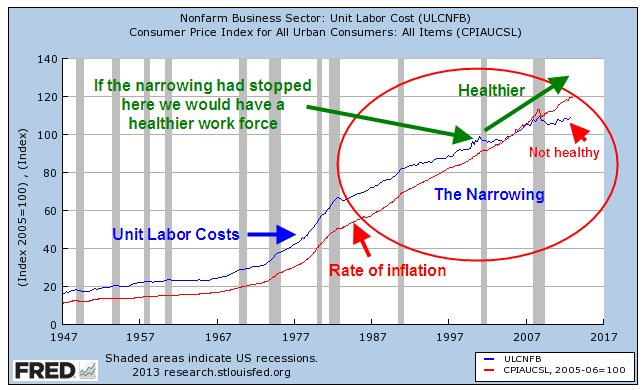
As I noted earlier, labor costs rise with inflation.  The graph below shows the relationship between the two.

After WW2, the rise in labor costs was just slightly ahead of the rise in inflation, allowing workers a greater standard of living and to put away some money for the future.  During the “stagflation” of the 1970s, this gap widened as workers demanded more pay in response to rising inflation while economic growth stagnated.  When the economy recovered in the mid-1980s, we began to see a narrowing between unit labor costs and the rate of inflation.  Had this narrowing stopped around the year 2000 and labor costs continued rising with inflation we would have a healthier work force and a healthier  economy.  But the gap narrowed further until labor costs were no longer keeping up with inflation.  Dwindling increases in labor costs have resulted in more profits for companies.  Although the labor market has a strong influence on the stock market, it is an indirect influence.  Stock prices are directly influenced by rising corporate profits and the perception that future profits will increase at a faster or slower rate.

Because wages do not rise and fall in proportion to the swings in the business cycle, companies took the only course of action left.  They reduced the labor component cost of their goods and services where they could.  Union contracts offer a company less flexibility in responding to downturns in the economy.  Companies reduced their exposure to union labor by outsourcing production to other countries, or by subbing out production to smaller companies with non-union workforces.  

Many people have been waiting several years for employment to recover.  As the chart above shows, there has been a systemic decrease in labor needed to produce each widget.  There is little indication that this trend will end as the economy continues to recover.  Since this economy is consumer driven, it is dependent on a healthy labor market.  A stumbling labor force will not produce robust gains in the economy. 

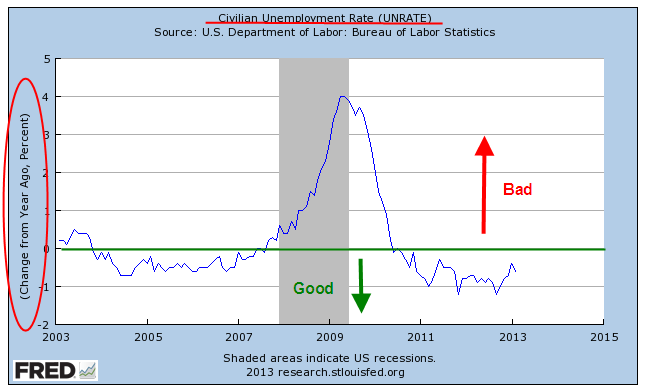
That is the background, the context for a look at February’s monthly labor report from the BLS, a better than expected report.  The headline job gain was 236,000, far above the 170,000 anticipated employment gain.  The unemployment rate dropped to 7.7% and the year over year decrease in the unemployment rate indicates little chance of recession.

There were other positive signs in this latest report.  Average hourly earnings of private-sector production and nonsupervisory employees broke above $20, increasing to $20.04.  After rising and stuttering last year, earnings have increased steadily since August 2012.  Despite these gains, hourly earnings of production employees are little changed from 1965 levels.

A slowly improving economy gave some hope that we might see the number of discouraged unemployed workers decline below 800,000 this month.  Instead the number rose from 804,000 to 885,000.

The Labor Force participation rate dropped another .1%.  Fewer and fewer workers are being asked to shoulder the benefits of the retired and unemployed.  The core work force aged 25-54 is still showing no substantial improvement.

While employment gains in the 25 – 54 age group have stagnated, the larger group aged 25+ continues to show improvement.  The unemployment rate for this larger group declined another .2% and now stands at a respectable 6.3%.  The employment picture for new entrants into the labor force, those aged 16 – 19, remains bleak.  This past month, the rate of the unemployed in this group increased and now stands at 25%.  Hispanics have seen a 10% decrease in unemployment during the past year but there are still almost 10% unemployed.  The minority group that has suffered the most through this recession has been African-Americans, whose unemployment rate has stayed subbornly high.  There have some small declines in unemployment over the past year, but almost 14% of this group is unemployed.

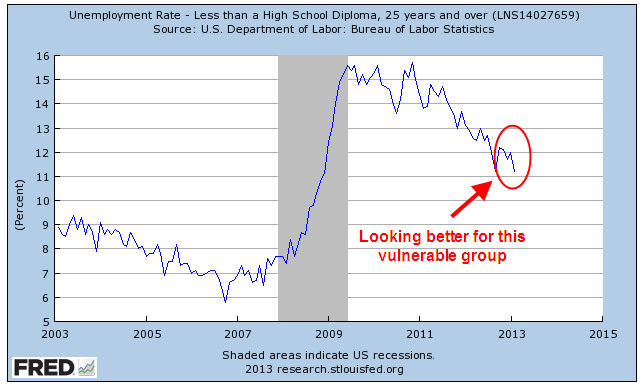
However, a group that has had persistently high unemployment, those without a high school diploma, saw a significant decline from 12% to 11.2%.

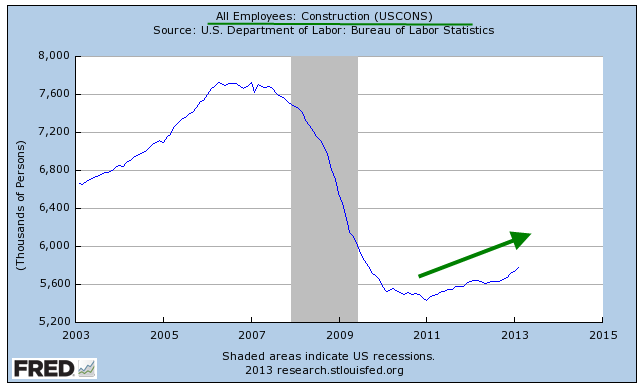
A significant contributor to that decrease is the steady rise in construction employment.

Perhaps not so widely followed is the “Craigslist indicator of construction activity.”  No, you won’t find this one charted anywhere but it does give a clue to what it going on in your area.  Search for “work van”, “work truck”, “step van” or “cube van” in your local Craigslist.  If there are a lot of listings, it means things are not good.  A few years ago, the Denver area used to have pages of work vehicles for sale by both owners and dealers.  This month there are few listings.

Other positives were the increase in the weekly hours worked to 34.5, in the pre-recession range.  Health care enjoyed strong gains as usual.  Professional and business services enjoyed strong gains, offsetting the unusually flat gains of January.  A rise in retail hiring was a nice surprise.

A bit of a head scratcher was the revision of January’s job gains, erasing 25% of the 160,000 job gains that month.  Revisions of that size leads to doubts about the winter seasonal adjustments that the BLS makes to the raw data. 

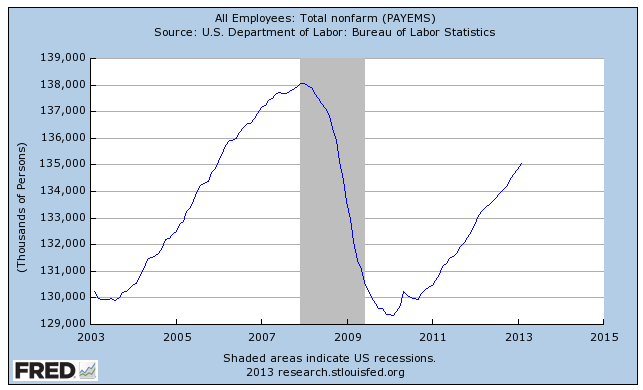
There are still 3 million fewer people working than in January 2008, when the BLS reported employment of 138 million.

In the past week the Dow Jones Industrial average crossed above the high mark of 2007.  On an inflation adjusted basis, the Dow is still well below the level it attained in 2000 and has still not passed 2007 price levels.  Some argue that the average 2.2% in stock dividends paid out each year partially compensates for the 3% loss in purchasing power.  Others argue that the dividend is compensation for the risks the investor assumes in the stock market and should not be taken into account.  If we disregard dividends, the inflation adjusted SP500 index is – well, it’s better than it was in 1990.

If a buy and hold investor has been in the market since 1990, she has gained 4% per year after inflation.  Adding in a dividend yield of about 2.5% over that time results in a total gain of 6.5%.  Had she bought a 30 year Treasury note in 1990, she would have been making about 8% per year for the past 23 years.  There are three lessons to be learned from this:  Diversify, diversify, diversify.

Earnings 2011

Over 80% of S&P500 companies have reported earnings for the 3rd quarter.  80% have beat earnings estimates that were previously lowered, an indication of how well companies are managing the estimates of the analysts who cover them.  In the third quarter of 2009, how many companies beat estimates?  79% (source) – pretty close to this year’s third quarter.

In September of this year, Standard and Poors reported that 2011 earnings estimates for the S&P500 fell below $100 after peaking at about $105 in early August.  2012 earnings estimates have been lowered from $111 to $108.  The S&P index closed about $1250 this past Friday, giving a forward P/E ratio of almost 12, a fairly conservative ratio.  These estimates, however, do not take into account any debt contagion from Europe. In a recent interview Nick Raich, Director of Research at Key Private Bank, projected an estimate of $85 in 2012 if there are no solutions found to the debt crisis in Europe.

Investors Friend has an article summarizing past S&P500 earnings and the difficulty of estimating earnings as there are several versions of earnings – GAAP and operating being two of the most frequently cited.

Yesterday Standard and Poors issued an update of third quarter earnings results.  Pay particular attention to the downward revisions for next year’s earnings in each sector.

Earnings

The headline from a recent report by the Census Bureau revealed that the men’s median (50% made more, 50% made less) inflation adjusted income is now less than it was in 1968.  Looking behind the headline at half a century of data uncovers some trends that surprised me.(Click to enlarge in separate tab)

Men’s median earnings during this mother of all recessions have actually been better than the recessions of the early nineties and early eighties.  What distinguished the recession of the early 2000s was that median earnings did not decline, probably due to the growing boom in the construction industry at the time – a boom that would blow up the economy in 2008.  What is apparent is the two decade “Camelot” period of the post war period when median male incomes steadily increased.

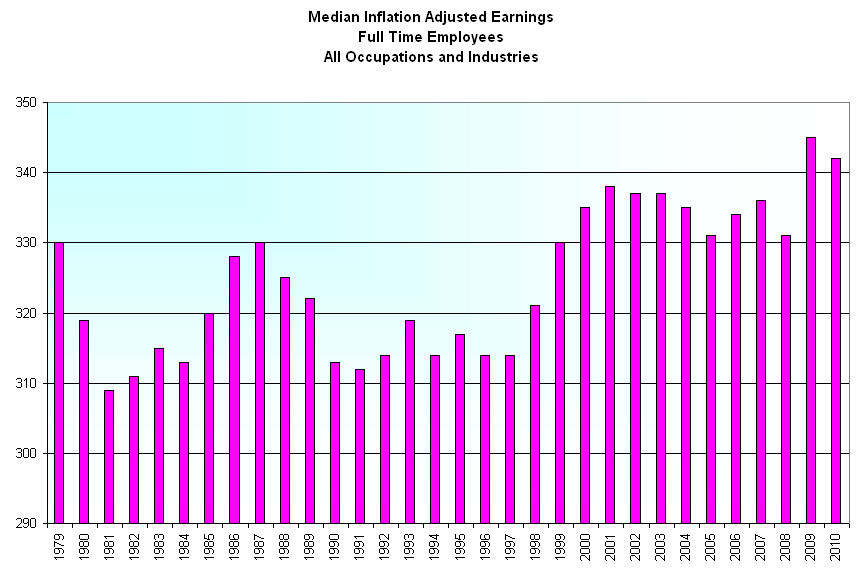
1979 was a historic year when there were more women in the workplace than men. How have full time employees of both sexes done in the past thirty years? Data from the Bureau of Labor Statistics shows a overall slight increase in median inflation adjusted earnings during the past decade.

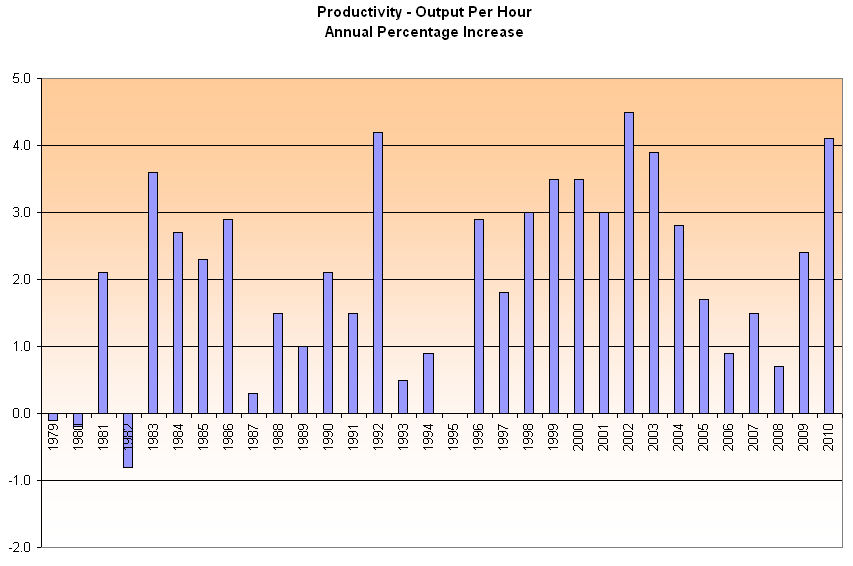
The increased production of workers during those thirty years has been strong – far more than the slight increase in earnings.

As I noted a few weeks ago top incomes have been growing far more than the median income.  Productivity gains produce greater profits. Those profits have largely gone to employers, not the employees. 

Social Security Wage Index

Every year we get a statement from the Social Security Administration (SSA) listing our wage history and an estimate of the monthly SS benefits we will receive when we retire. Our past earnings determine our future benefits. But how do they do that? Social Security Wage Indexing Factors. The SSA adjusts each person’s past wages for inflation, then takes the best 35 years as a benchmark for determining benefits.

If you have an extra half hour or so and want to look at your wage history in today’s dollars, go to the factor’s page at the SSA. Set the year to 2010. Copy the resulting table of years and index factors (two columns) into a spreadsheet. For each year, type in the reported earnings from your SSA statement into a third column. In a fourth column, set the formula to multiply each year’s actual earnings in the third column by the index factor in the second column. The result will be the inflation adjusted amount of your earnings for that year.

You may find a few surprises in the data. I did.