February 17, 2019
by Steve Stofka
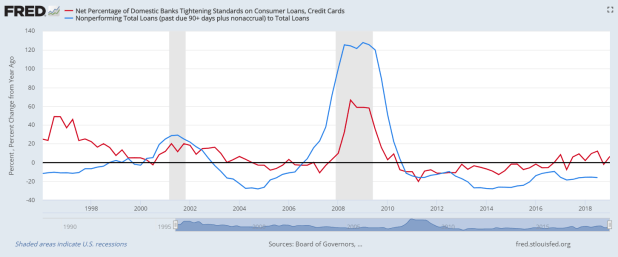
As the recovery enters its tenth year, there are signs of strain. As debtors struggle to pay their loans in a weakening economy, the percentage of non-performing loans increases. The current rate of one percent indicates a healthy economy (Note #1). When the annual change in the rate of delinquency increases, that has been a reliable indicator that the economy is growing stagnant. Here’s a chart of the percent change in non-performing loans. A change above zero has preceded the last three recessions.

Let’s add one more series to the graph to help us understand the cycle of consumer credit. In the graph below, the red series is the percentage of banks tightening lending standards. Notice how the banks respond to a rise in delinquencies by being more selective in their credit criteria. Eventually, this tightening of credit leads to a recession. The cycle is as natural as the ocean currents that distribute heat around the planet.
The financial news agency Bloomberg reports that delinquent auto loans are the highest since 2012 (Note #2). Bankrate reports that credit card debt has risen since last year. Less than half of people surveyed have emergency funds (Note #3).
December’s retail sales report, released only this week because of the government shutdown, showed a surprising decline of 1% from November. Have some consumers reached their limit? Retail sales, adjusted for inflation and population growth, does not show the strain so far. Look at the period from late 2015 through late 2016 when sales growth consistently slowed below 1%. That was a key factor that cost Hillary Clinton the election. Trump turned voter dissatisfaction into an electoral victory in the Midwest.

Politicians ride to power on the anger of voters. In 1994, Republicans overcame forty years of Democratic rule in the House by promising less regulation and lower taxes in a “Contract with America.” When the Supreme Court decided the 2000 election in favor of a Republican president, they enacted tax cuts to reverse the tax increases passed by Democrats in 1993. In 2006, voters were angry with the incompetent Bush administration and reinstalled Democrats in the House.
In the depths of the Financial Crisis in 2008, Democrats rode a wave of anger, despair and hope to take the White House and command a filibuster proof majority in the Senate for the first time since the post-Watergate Congress thirty years earlier. Such a rare majority indicated that voters strongly wanted a solution to the crisis (Note #3). The Obama administration and Democratic Congress protected the financial and insurance industries while ordinary people lost their homes and their savings. The one piece of legislation that emerged from that majority was Obamacare, the bastard child of back alley compromises between mainstream Democrats and the health care industry. Few who voted for it knew what was in the bill.
In 2010, Republicans rode the anger wave of the Tea Party caucus to retake the House. With an equal number of Senate seats up for re-election, Republicans took six seats from Democrats and ended their filibuster proof majority (Note #4). In 2014, voters handed the Senate back to Republicans, then gave the reins entirely to the Republicans with the election of Donald Trump to the presidency in 2016.
In 2018, Democrats rode a wave of anger to take back control of the House. Social media campaigns whip up indignation to fan the flames of voter anger in the hopes that Democrats can at least take back the presidency in 2020. Voters may not be in enough economic distress to give Democrats control of the Senate in 2020, but it is the Republicans who have the most seats up for re-election this coming Senate cycle (Note #4).
Credit expands and contracts in a seasonal multi-year cycle. Banks are tightening in response to higher delinquencies. Will the timing of the credit cycle coincide with the 2020 election?
///////////////////////////
Notes:
1. In 2016, China, Japan and Germany had rates below 2%; the U.K. and Canada had less than 1%. On the high side, Greece had 36%; Italy had 17%, and Spain had 7%.
2. Why are so many people delinquent on auto loans? Bloomberg
3. In 1964, the Supreme Court forced the states to redistrict their state legislatures based on population changes. For fifty years, Democrats were sometimes able to forge filibuster proof Senate majorities because racist Southern states were effectively one party Democratic states. Reynolds v. Sims . Since the ratification of the 17th Amendment in 1914, Republicans have never had a filibuster proof majority
4. A third of Senators are up for election every two years so party advantage shifts with every election cycle.
 Innocent Investor