America first, Americans last

April 5, 2026

By Stephen Stofka

I keep a thought bin of ideas for articles, then weave some of them together into a single essay. Sometimes finding that thread is difficult. This week, I am going to write on an assortment of these ideas.

The Nonchalant President

In early March, President Trump was nonchalant about rising gas prices. In an interview with the Reuters international news agency, he said “if they rise, they rise” (Source). A lot of Americans who voted for America First didn’t bargain for Americans Last. To elites like Trump, born with a golden spoon, the concerns of everyday Americans are trivial. The only thing Trump wants is their vote. Then comes the betrayal.

Energy as a Weapon

Green energy is locally produced, which can make many countries less dependent on the major producers of oil. I think that is a major reason why President Trump dislikes green energy. The U.S. is the leading producer of oil (Source) and that gives our country a geopolitical edge. The Middle Eastern countries account for a third of global oil production, which gives them a great deal of geopolitical importance despite the fact that their combined population is only 380 million, slightly more than the U.S. alone. International relations is a chess game of power played by individual nation states. The more powerful states, particularly a regional hegemon like the U.S., want to maintain or increase their economic edge over other countries to preserve their dominance.

There are several examples of dominant powers who sabotaged production in other countries to preserve their economic dominance. During the 18th and 19th centuries, Britain imposed punishing tariffs on India’s textile industry so that India could not compete against Britain’s textile industry. Britain’s Navigation Acts mandated that British colonies could only trade using British ships. Britain actively suppressed manufacturing in its colonies, using them only as a source of raw goods which were finished by Britain’s own manufacturing industries. In 2010, China imposed restrictions on the export of rare earths, giving them effective control of key components of industrial production around the world (Source).

Strategic Power

Some of the president’s many miscalculations in the Iran War arise from a lack of appreciation for strategic power. Volume, not cunning or planning, appeals to him, so he engages in “bomb, baby, bomb” and “drill, baby, drill.” More, more, more is not always better. China controls production of most of the world’s rare earths, a key component in many electronics systems, including those of our military systems. When Trump threatened high tariffs on China last year, they threatened to choke off the supply of rare earths and he capitulated. Did he learn his lesson? No. Iran controls 20% of oil production that is shipped through the Straits of Hormuz, a narrow strip of water where Iran can destroy any oil tanker that does not play by Iran’s rules. Did Trump consider that? No. Strategic control of resources can be as powerful as a fleet of bombers.

Declining Leadership

President Trump has the attention span of a tweet and so his staff has to keep his daily security briefings short. His daily updates on the war consist of two-minute compilations of targets bombed (Source). This would not be unexpected in an adolescent. We should expect more from a grown man who is the leader of the most powerful country on the planet. Why have the American people put Biden and Trump, two doddering seniors, in such a position of power?

Sacrifice

More American soldiers have died in the Iran war than Israeli soldiers. It is the young who give up their lives in war, sacrificing many more years of life than the older men who commit them to that fight. The question of reinstituting the draft has come up. The 62-year old comic Rob Schneider thinks we should have a military draft (Source). He was 12 when the draft was ended and is not eligible for the draft at his advanced age so it is easy for him to be rah-rah about the draft. It would take an act of Congress to reinstitute the draft but Trump has shown a persistent ability to bypass the subservient Republican majority in Congress. In 2018, the CDC reported that the military considered 71% of eligible youth physically unfit for military service (Source). They have had trouble filling the ranks of a volunteer military service.

A Policy of War

As I wrote last week, we are “celebrating” 25 years of continual war. John Mearsheimer is a political scientist known for developing the theory of Offensive Realism. This theory focuses on states which are great powers, a state which is dominant in its region of the world. The U.S., China and Russia are examples of great powers. India, Japan the European Union are sometimes included. The theory claims that these great powers must maximize their power relative to other countries to ensure their survival.

The international system is anarchic, meaning that there is no central authority. In such an environment, a great power cannot know the intentions of other countries, so the safest course of action is to become as powerful as possible while preventing rival countries from gaining greater power. This leads states to compete aggressively, expand influence, and exploit opportunities to weaken other countries. This view sees international cooperation as a temporary aligning of opportunities because gains by one state are often at the expense of other states. Conflict is a structural feature of international relations. To demonstrate his point, Mearsheimer reminds us that the U.S. has been at war of some type since the end of World War 2. These include the Cold war with the U.S.S.R, or hot wars like Vietnam, Iraq, the Balkans, and Iran. He referred to the U.S. as a “crusader state” (Source – video).

The Ethics of War

On February 28th, the first day of the war against Iran, U.S. planes bombed a girl’s school, killing about 170 students. The incident happened because military leaders had used out of date maps and failed to double check before setting the targets. Trump was unconcerned about the deaths, absolving the U.S. for any responsibility. At first, he suggested that the Iranians might have been at fault. What I noticed was that signature shrug of his shoulders, indicating his casual dismissal of the deaths. During the 2016 presidential campaign, the Access Hollywood tape recorded Trump saying he was entitled to grope women because he was a star (Source). Does his casual dismissal arise from that sense of entitlement? Trump dislikes rules and institutions. For him, there is only power. He has the same cold-blooded look of nihilism in his eye as the character Malcolm McDowell played in the 1971 movie Clockwork Orange.

Taking Back Power

Congress passes the laws but doesn’t deal with the consequences of their implementation. Perhaps if they did do more administration, they would write better laws or more readily modify those laws which they have written. In the 19th century, Congress took a more active role in administering the programs they enacted. The National Archives contain the records of Congressional committees that decided the pensions of soldiers, an administrative task now done by the Veterans Benefits Administration, a department of Veterans Affairs and part of the Executive branch (Source).

Searching for Truth

In grade school, we are presented with questions where there are many wrong answers but only one right answer. When was the Declaration of Independence? How much is 3 times 4? We get the answer.

In high school, we are presented with questions for which there are several “right” answers. In English class, students might be asked “Why did the character in this story make this decision?” In History class, they might be asked, “What was the primary cause of this war?” In Social Studies class, students might be asked, “Should an individual sacrifice for the greater good?” In a Science class, they might be asked, “How to best design this experiment to test this hypothesis?” We explore the answers.

In college, we study the methods of answering questions. These include the frameworks of investigation, various models and schools of interpretation, the types of evidence and which are more reliable. Lastly, we are asked to formulate our own question and design a method of answering that question, often having to explain why we chose that method. We create the questions.

In the comments to a well written essay on social media, I have noticed that the comments often neglect the reasoning we learned in high school. The writers of these comments seem to be stuck in grade school, believing that there is only one answer to complex social and political problems. Coincidentally, they have that one answer and are willing to share it in their comment! Yes, we are so grateful for your generosity and wisdom. And with that, I hope to see you next week.

Finally

P.S. check out this anime video of a solution to the immigration issue and have a chuckle.

////////////////////

Photo by Nils Söderman on Unsplash

The Chopping Block

March 23, 2025

by Stephen Stofka

This is part of a series on centralized power. The debates are voiced by Abel, a Wilsonian with a faith that government can ameliorate social and economic injustices to improve society’s welfare, and Cain, who believes that individual autonomy, the free market and the price system promote the greatest good.

Abel put his coffee cup down on the table. “I don’t know where to start. Shortly after Trump was inaugurated, I said that the EPA would get cut (Source). Now Trump has announced that his recently confirmed head of the EPA will be cutting agency staff by 65%. This week Trump is signing an executive order to end the Department of Education (Source). He’s cutting staff by 50%. He fired the two Democrats on the Federal Trade Commission, an independent agency (Source). That violates a Supreme Court decision. He shut down three watchdog agencies in the Department of Homeland Security who monitor his immigration crackdown (Source). The Federal Reserve will be next. This reminds me of the guillotine during the French Revolution. That didn’t end well.”

Cain swallowed a bite of pancake. “He’s not going to fire governors on the Fed. He can’t, I don’t think.”

Abel scoffed. “Trump shoots first and leaves the details to others. The governors are appointed by the president and confirmed by the Senate just like the commissioners at the FTC that he just fired.”

Cain frowned. “The market would implode.”

Abel replied, “In his first term, Trump sought the market’s approval of his policies. In this second term, Trump has shown that he no longer cares what the market thinks.”

Cain shrugged. “On the campaign trail, he said he would clean up the swamp in Washington. He’s keeping a campaign promise. The majority of voters wanted this.”

Abel laughed. “Cutting staff by 50%? You think half of any government agency is ‘waste, fraud and abuse?’ Nah, this is the same radical disorder that marked the French Revolution.”

Cain shook his head. “Well, only Congress can end the Department of Education. Trump’s executive order simply outlines steps toward the end of the department.”

Abel raised his eyebrows. “You’re trying to normalize this? Nothing about this is normal or gradual.”

Cain sighed. “Look, the federal government is like a ship locked in ice. Nothing gets done in Washington any longer. There needed to be some drastic action to break free. You know, the department’s functions should never have been carved out of HEW, the Department of Health, Education and Welfare. In his run for President in 1976, Jimmy Carter promised the teacher’s union that he would make education a cabinet level agency in return for their endorsement. Even after he was elected, Carter slow walked the process for three years (Source). So, Carter signed the bill in October 1979. Ronald Reagan was running for President and promised to end the department if he became President (Source). Reagan and others thought it was unconstitutional, but he was never successful in ending it because the Democrats controlled the House during his two terms in office.”

Abel put his fork down. “So, you’re saying that Republicans have always challenged the legitimacy of the department.”

Cain nodded. “Yeah. There are three departments that have long been on the Republican hit list because they are outside the constitutional scope of the federal government. Education, Energy, and the EPA, the three ‘E’s. In 1977, Carter signed into law the creation of the Department of Energy to combine and coordinate several dozen programs in various agencies (Source). These are departments, as in cabinet level positions. Unlike Education and Energy, the EPA was not created by law, but by executive order. Not Johnson. Not Carter, or some big government-loving Democratic President. Nixon created the EPA shortly after signing an update to the Clean Air Act in 1970 (Source). Like Carter, Nixon wanted to combine a lot of programs into a single agency reporting to the President.”

Abel replied, “I often think of the 1930s as the era of big government. FDR created what was called an alphabet soup of agencies. You’re saying that Trump’s first target, though, is the second wave of federal government expansion in the 1960s and 1970s.”

Cain nodded. “That’s why I don’t think he will go after the Federal Reserve, which was created before FDR and the first expansion of government.”

Abel shook his head. “He’s trying to gut the IRS and that was created before FDR as well. I think you underestimate the anarchical instinct that motivates Trump and his cohorts.”

Cain shrugged. “Anarchy? Nah. Principled objection and longstanding grievance is not anarchy. Anyway, that second expansion was made possible by some key decisions by the Supreme Court during the first wave of federal expansion. The Tenth Amendment restricts the scope of the federal government and promotes federalism, the idea that a lot of power should be decentralized and under state control.”

Abel interrupted, “State governments are more responsive to the people. That kind of idea.”

Cain nodded. “Yeah, and the founders were suspicious of concentrated power. So, the FDR administration didn’t like the variety of worker protections in the states. No consistency. In 1938, FDR signed into law the Fair Labor Standards Act to make labor policy uniform throughout the nation. The law established a standard work week, a minimum wage, and overtime pay (Source).”

Abel interjected, “It’s good to have the same rules. Otherwise, it’s a race to the bottom as states try to get a competitive advantage by lowering standards.”

Cain smiled. “That’s some teleological reasoning you’re doing there. The ends justify the means.”

Abel argued, “The Constitution gives the federal government power to fix standards of money, weights and measures. A unit of labor is affected by the rules governing labor contracts. Setting uniform rules of commerce is like setting uniform measures used in commerce. Achieving uniformity in commerce is an implicit federal power granted by the Constitution.”

Cain rolled his eyes. “That’s stretching the definition of weights and measures, if you ask me. Anyway, some states complained that the act was an unconstitutional federal intrusion on state power. The government claimed that all labor policy had some effect on interstate commerce. The Constitution grants the federal government authority to control interstate commerce. That same year, a federal district court ruled that the act was unconstitutional in a case involving Darby Lumber Company. The case made it up to the Supreme Court which overturned the lower court’s  decision. Since Darby Lumber shipped some of their lumber out of state, that meant the company was involved in interstate commerce (Source).”

Abel replied, “Seems hard to argue with that. One state could lower their standards and give their manufacturers a competitive advantage offering lower prices.”

Cain nodded. “Yeah, sounds reasonable. But, consider a situation where a company exports less than 1% of its products out of state. The federal government was claiming authority over labor policy for a company’s entire operation because of any amount of interstate commerce, no matter how small.”

Abel frowned. “Ok, I see how that could be an intrusion on the state’s domain of legal authority.”

Cain replied, “And it got worse. In a 1942 decision Wickard v. Filburn, the Supreme Court decided that a farmer growing wheat for his own use was also involved in interstate commerce (Source). Yeah, you look puzzled. The court reasoned that the farmer’s consumption of his own wheat affected the interstate market for wheat.”

Abel laughed. “So, growing tomatoes in my backyard affects interstate commerce?”

Cain scoffed. “Apparently. That was the opinion of the Supreme Court.”

Abel nodded. “Ok, so the federal government expanded its scope under the Commerce Clause of the Constitution.”

Cain replied, “Way beyond the intentions of the framers. The whole idea of the Commerce Clause was to settle disputes over issues like water and road transportation, and anti-trade policies between the states. Instead, FDR wanted to undercut the legitimacy of state governments. He wanted to control everything.”

Abel asked, “Ok, so what is the beef against the Department of Energy? Natural gas lines cross state lines. Oil gets shipped from one state to a refinery in another state, then distributed out to states within a region. Plainly, it is interstate commerce.”

Cain shook his head. “The department was created in 1977 when the whole country was concerned about the price and supply of oil. Back then, a lot of policymakers and scientists believed in peak oil theory, first proposed in 1956 by geologist M. King Hubbert (Source). This was the idea that oil production would peak in the late 1960s and begin to decline thereafter. The crises of the 1970s seemed to confirm that prediction.”

Abel interrupted with a question. “What about fracking?”

Cain replied, “It had not been invented yet. At least, not an economical way. When the price of oil was high in the 1970s, the industry experimented with extracting oil from oil sands. When the price of oil started declining in the early 1980s, these developments were no longer profitable.”

Abel nodded. “Ok, back to what’s the beef with the Department of Energy?”

Cain sighed. “The purpose of the department was to develop nuclear energy to solve the problem of declining oil supplies (Source). Instead, the oil industry developed new drilling and exploration techniques, and America is now the leading producer of oil (Source). Anyway, a few years after the creation of the DOE came the nuclear accident at Three Mile Island (Source). Public sentiment turned against nuclear.”

Abel interrupted, “France gets over 70% of their electricity from nuclear (Source).”

Cain replied, “Yeah, but they have only a small amount of oil reserves compared to the U.S. That affects public sentiment. Anyway, the DOE has completely changed its mission in the past decades. Now they focus on developing green energy sources like wind and solar (Source). If there is no longer a shortage of oil reserves, there is no justification for the Department of Energy.”

Abel said, “Look, an energy crisis might have prompted the creation of the department, but it’s mission was always to develop a coordinated national energy policy. Initially, its focus was on nuclear energy. The department’s mission is broad. The oil industry just wants to get rid of a federal agency that supports the development of competing energy sources like solar and wind. Despite all its abundances, the federal government still gives over $20 billion a year in subsidies to the oil industry (Source). No matter how much they get, the industry wants more for them and less for their competition.”

Cain replied, “The federal government needs to get out of the energy business, including subsidies for the oil and gas industry.”

Abel frowned. “Fat chance. What about pollution, oil clean ups and nuclear waste disposal? If there is no longer an EPA, who takes care of oil spills like the 2010 Horizon accident?”

Cain replied, “FEMA would be the natural choice for emergencies of that sort. There are a lot of redundancies in the federal government.”

Abel shook his head. “Shifting responsibilities to another department may gain some slight efficiencies in the long run. In the short run, there is going to be a lot of knowledge lost, leaving us vulnerable to the next disaster. Each week, we learn of another stupid mistake that DOGE has made in their efforts to remake government. They are causing more harm and saving little money.”

Cain protested, “The federal government has become so bloated that it is crippling our ability to get anything done. The federal response to Hurricane Katrina was an embarrassment. Same with the Horizon oil spill, the delays and ineffectiveness of Obama’s Build America plan, the botched rollout of the Obamacare exchanges. Let’s not forget the high-speed rail line in California. Billions spent and no rail. Biden’s infrastructure bill that spent billions to get just a few electric charging stations built. This country used to be able to get stuff done. Now, everything gets snarled in red tape. Compared to China, we look like a declining empire. Turning that around will not be easy.”

Abel set his coffee cup on his plate. “Well, firing a bunch of government employees with vital expertise, and closing a few departments is not going to solve the problem. This administration will flail around when the next crisis comes. In the 2026 midterms, a small number of voters on the fence will cast their vote with the ‘other guys,’ the Democratic Party, and power will shift again. We have become a country of short-term thinkers. That’s why China will eventually gain the upper hand.”

Cain laid his napkin on the table and stood up. “This will take time, I grant you.”

Abel interrupted, “Yeah, Rome wasn’t built in a day, and I need to have faith and blah, blah, blah.”

Cain laughed. “No, I won’t give you that lecture again.”

Abel sighed. “I’ll see you next week. Maybe there will be another department on the chopping block.”

/////////////////

Image by ChatGPT in response to the prompt “draw an image of a butcher block with a carving knife beside it”

The Formation of Expectations

May 7, 2023

by Stephen Stofka

This week’s letter is about expectations – how we form them and why they are essential to our survival. This is a broad topic that encompasses several disciplines, from psychology to neuroscience and economics. Each field of study informs those in associated fields so the debate in economics is enriched by discoveries and theories in these other fields. I can only touch on a few aspects as I introduce yet another complication that might resolve some of the contradictions between theory and data.

We gain the ability to form expectations at an early age. Infants less than one year old learn what is called object persistence. If a toy falls out of their crib, they look over the edge to the floor below to see where the toy went. But object persistence is a primitive form of expectation. True expectation is a weighting of possibilities based on some criteria.

Instinctual responses often involve a primary measure of threat or satisfaction. We see this if we walk by a squirrel near a tree. If we are across the street, the squirrel may pause, poised to flee. If we draw nearer, the squirrel runs to the safety of the trunk as we approach. How far up the tree the squirrel goes depends on the distance we are from the squirrel. It would like to keep us in sight but if we get uncomfortably close, the squirrel must choose. It can hide on the side of the trunk opposite to our approach but it loses sight of us. It can go further up the tree, keeping us in sight and staying out of reach. That is a short term expectation formed in response to an immediate threat or stimulus. It is an instinctual rather than a rational expectation, the kind that economists consider.

Rational expectations are formed about the environments that produce events, or data samples, more so than the events themselves. For more than sixty years economists have been debating whether consumers have enough data and patience to construct a rational expectation. Richard Curtin (2022) reviewed the history of this debate as he argued for a theory that embraces both reason and passion as inseparable components of human decision making. In 1959, Herbert Simon protested that inadequate data does not invalidate the idea that consumers are trying to make decisions that improve their satisfaction – that’s the rational part – within the bounds of the data available to them. Simon called this bounded rationality. A few decades later Daniel Kahneman and Amos Tversky explored the biases in our decision making and their work became the foundation of behavioral economics.

Survey data reveals that consumers’ expectations of inflation overestimate actual inflation, according to Henry et al. (2023), economists at the Richmond branch of the Federal Reserve. The basis for that assertion is the University of Michigan (2023) survey of inflation expectations. The inaccuracy is fairly consistent and persistent, meaning that consumers are slow to correct their expectations as new data is released. Richard Curtin (2022) notes that as many as 40% of consumers are not aware of recent government data releases on the inflation rate, the unemployment rate and the growth rate of GDP.

Consumers cannot survive if they consistently and persistently form inaccurate expectations. There is an alternative explanation: economists and consumers are measuring two different things. Economists form their inflation expectations by measuring changes in the prices of goods and services. Consumers form their expectations in part by estimating their loss of purchasing power, their ability to satisfy their wants and needs. If consumers feel that their income gains are not keeping up with the change in prices, they may raise their estimate of future inflation.   

The prices of frequently purchased items like food and energy guide our expectations of changes to our purchasing power. Our purchases of food and energy don’t respond quickly to changes in our income. In economist speak, these items are price inelastic. We still need to drive to work and eat. Secondly, we buy food and gas frequently so our expectations of future prices depends on an averaging of the most recent prices and the last purchase we made. It is unlikely that we will form an expectation of next year’s gas prices based on a ten year average of gas prices. Thirdly, energy prices are quite volatile. I might buy gas as frequently as I go to the movies if I like movies but the price of a movie ticket does not vary as much as the price of gas. To summarize, our expectations of inflation are guided by frequency, recency and volatility.

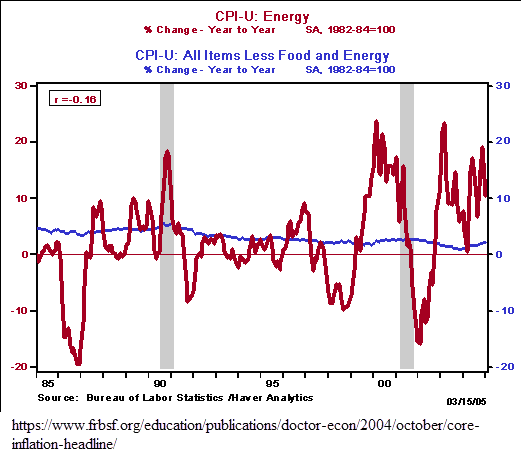
Energy prices are particularly volatile. In this 2004 article the Federal Reserve graphed the annual changes in energy prices (red) and the broad CPI price index (blue). The difference is startling.

The wild swings in energy prices are noise. Because of that volatility, the Bureau of Labor Statistics excludes food and energy items when it computes an index of core inflation.  Core inflation is the inflation signal that economists use to predict next year’s prices.  

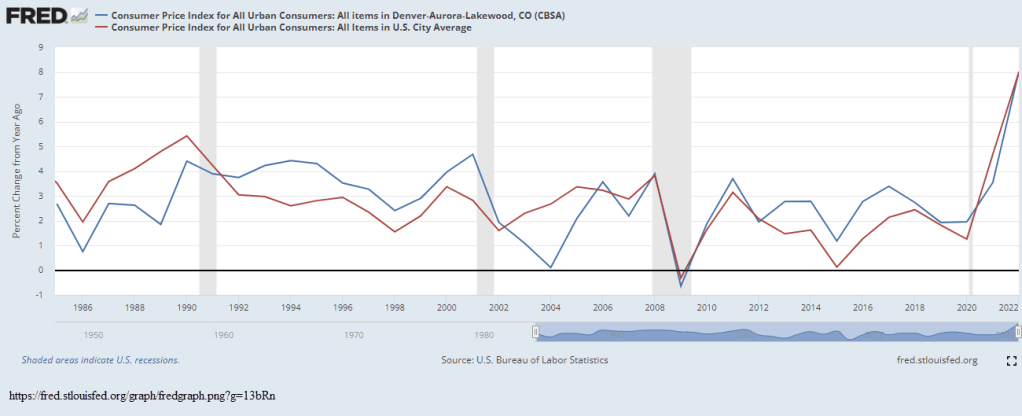
Consumer expectations of inflation include estimates of changes to their personal utility. As Richard Curtin (2022) has noted, it is not practical or possible to measure inflation at such a personalized level so economists average consumer expectations across the entire country. They collect price data at a broad metro area, or MSA. These urban areas can vary a lot from national inflation averages. In the chart below is a comparison of inflation in the Denver metro area and the nation as a whole. Rarely do the two series move together. When economists compile such a variety of consumer expectations into one national average, that average is less likely to accurately reflect individual or sub-regional expectations.

So economists are measuring changes in prices and consumers are estimating the change in their purchasing power. In his General Theory Keynes referred to the marginal efficiency of capital and the animal spirits of investor expectations of that efficiency that could be measured by the direction of market prices. Using that as a template, consumers’ purchasing power would be the marginal efficiency of income. We can gauge the animal spirits of consumers by the direction of total consumer purchases, which are continuing to outpace inflation. That is the best indicator of purchasing power expectations.   

/////////////////////

Photo by Rodion Kutsaiev on Unsplash

Curtin, R. T. (2022, September 5). A new theory of expectations – Journal of Business Cycle Research. SpringerLink. Retrieved May 5, 2023, from https://link.springer.com/article/10.1007/s41549-022-00074-w

Henry, E., Mulloy, C., & Sarte, P.-D. G. (2023, January). What survey measures of inflation Expectations Tell us. Federal Reserve Bank of Richmond. Retrieved May 5, 2023, from https://www.richmondfed.org/publications/research/economic_brief/2023/eb_23-03#:~:text=Conclusion,inflation%20every%20month%20since%202012  

University of Michigan, University of Michigan: Inflation Expectation [MICH], retrieved from FRED, Federal Reserve Bank of St. Louis; https://fred.stlouisfed.org/series/MICH, May 4, 2023.