Different Views

July 20, 2025

by Stephen Stofka

Sunday morning and another breakfast with the boys as they discuss world events and persistent problems. The conversations are voiced by Abel, a Wilsonian with a faith that government can ameliorate social and economic injustices to improve society’s welfare, and Cain, who believes that individual autonomy, the free market and the price system promote the greatest good.

Abel stirred an ice chip into his coffee. “Last week you were criticizing the childish behavior of this administration. This week we saw another example of petty vindictiveness when Trump pushed Congress to claw back $8 billion from foreign aid and $1 billion from PBS and NPR. I mean, that’s a drop in the bucket compared to the spending and deficits in the Big Bogus bill passed two weeks ago.”

Cain nodded. “I was reading that there hasn’t been a rescission bill passed since 2000 (Source). Anyway, conservatives have complained about public funding of liberal media for decades. In the 1980s, the Reagan Administration ended the fairness doctrine so that radio and TV stations did not have to present both sides of a political issue. Rush Limbaugh started a nationally syndicated AM radio talk show and used to complain that public radio and TV stations were funded by taxpayer money.”

Abel argued, “I always thought public radio tried to be objective in its presentation.”

Cain laughed. “Objective is a matter of political perspective, I suppose. Rush was the angry white guy protesting the liberal policies passed during the sixties and seventies. He got a lot of mileage out of anger and protest. In a sense, he’s the spiritual father of Donald Trump.”

Abel looked surprised. “You keep using the word ‘was.’ Did he die or is he off the air?”

Cain replied, “He died a month after the January 6th protests. His audience hated Democratic policies and liked conspiracies, so he promoted them. He questioned Obama’s birth as an American citizen. He promoted Trump’s election conspiracies. He made a lot of money and won a lot of converts to the Republican Party (Source).

Abel waited as their server laid the plates of food on the table. “So that was Rush. Kind of a shock jock for the conservative media. I take it he wasn’t alone.”

Cain asked, “You ever listen to AM talk radio?”

Abel shook his head. “Not in a long time. Sometimes when I’m on the road, that’s the only thing on the radio. Bible preachers and such. Too many commercials.”

Cain shrugged. “Well, there  you go. Lefties like NPR get funded by taxpayer dollars. Righties have to sell advertising. Is that fair?”

Abel smirked. “Like I said, NPR seems fairly neutral to me, like the news is supposed to be.”

Cain asked, “You think so? The attack on the U.S. Embassy in Benghazi just before the 2012 election. How much coverage did NPR and the mainstream media give that? Conservative media gave it a lot of air time (Source). A House Intelligence Report found that there were a number of administrative failures to recognize the risks and provide resources to protect embassy personnel (Source).”

Abel argued, “But there was no intentional coverup by Clinton, Obama or Susan Rice. I mean this was mostly a partisan political attack on a Democratic administration. It wasn’t objective news reporting. It was a smear job by Fox News and other conservative media.”

Cain argued, “Look, everyone’s trying to direct the narrative. That includes the political parties, the media, think tanks, you name it. When a media channel like NPR says they are objective, they are helping to direct the narrative. When NPR claims to be objective or neutral, they want to raise doubts about the reputation of another outlet. Of course, the other outlet does the same.”

Abel argued, “Oh, come on. This all started with alternative media outlets like Fox News disparaging mainstream news channels like NBC, ABC, CBS and PBS. They were the new guy in town who criticized the established players.”

Cain shook his head, “The major players were an oligopoly created by lawmakers. It wasn’t until the early 1960s that Congress mandated that manufacturers of TV sets include a receiver capable of receiving UHF signals (Source). Until then, people could only get the ‘Big Three’ on their TV sets in most markets. It was a public private partnership in which the government controlled access to news. Sure, Fox News had to distinguish themselves to compete with that oligopoly.”

Abel asked, “Ok, so when did Fox News start?”

Cain replied, “About the same time as Rush Limbaugh. Mid to late 1980s or so.”

Abel said, “So that’s the birth of conservative media. When Reagan ended the fairness doctrine.”

Cain shrugged. “Well, the networks were glad to see it end. They had trouble following the policy. Broadcasters were supposed to present a balanced view on controversial subject. Advocacy groups claimed that they were not given enough time, blah, blah, blah.”

Abel asked, “How did the fairness doctrine ever survive a First Amendment challenge?”

Cain smiled. “In 1969, the Supreme Court decided that the broadcast spectrum was a limited resource and the free speech rights of listeners were more important than the rights of broadcasters (Source). It was a unanimous decision too. It’s kind of ironic that the decision came down in the same year that Nixon hid a lot of information from the press and public as he prepared to invade Cambodia (Source).

Abel put his coffee cup down. “I just see this rescission bill as part of a broader attempt to undo all the compassionate reforms of the past decades.”

Cain smiled. “You mean liberal reforms, right?”

Abel argued, “They were liberal and compassionate. Why take away funding for global health initiatives?”

Cain replied, “Trump wanted to loosen pandemic restrictions a few weeks after his own administration initiated them in March 2020. He claimed that the pandemic was over and he didn’t like some of the criticisms from international health organizations, including the CDC. He halted funding the WHO (Source).”

Abel sighed, “And Trump is like the elephant that never forgets. I just think he’s coming after every other program that he thinks are Democratic policies. Medicare, Medicaid, food stamps, whatever. He has little if any compassion for people.”

Cain nodded. “In this second term, he’s surrounded himself with people who believe that Democrats have controlled the narrative for too long. They believe they are taking back the country, so to speak.”

Abel smirked. “When Republicans enact legislation, they claim it is a public mandate. When Democrats pass legislation, Republicans claim that these are party priorities rather than the will of the people. You can’t have it both ways.”  

Cain argued, “You’re missing the point. We talked about this last week. Yes, the Democrats had public support when they passed all that legislation. But the entitlement programs they passed were designed to enact Democratic priorities even when the party no longer had public support. This is not how a democracy works. The Democrats constructed a legislative monarchy, and a core group of Republicans have wanted to overthrow that monarchy for decades.”

Abel shook his head. “Come on, gimme a break. Republicans were the driving force of some of the Great Society legislation. Less than 10% of Democratic Congressional members in the southern states voted for the Civil Rights Act in 1964 (Source). An equal number of Democrats and Republican House members voted for the Fair Housing Act in 1968 (Source).”

Cain replied, “Ok, I’ll give you that. Most of the southern Democrats were a bunch of racists.”

Abel nodded. “Yeah, that’s the legacy of the civil war we’ve talked about. Anyway, Democrats had a big majority when they passed Medicare and Medicaid in 1965. But the Democrats had overwhelming support for these programs. In sixty years, the elderly population had grown from three million to almost eighteen million and many were unable to get proper health care (Source). The yes votes on that legislation represented three-quarters of the country’s population (Source). In the House, half of Republicans voted for the bill (Source). That’s a convincing mandate. Compare that mandate with the recent passage of the Big Bogus Bill.”

Cain argued, “Let me go back to the southern states. The no votes on civil rights legislation came from the deep south, the former confederate states. My point is that the Civil War was not over in the 1960s and it is not over now. After the 1960s, the Republicans adopted a Southern Strategy to appeal to that opposition and today they control both chambers in most of those states (Source). Since the founding, this has been a divided country. The Jeffersonian view of decentralized power versus the Hamiltonian view of a strong central government. The Civil War unified the country’s political and legal structure, but not its sentiments or allegiances.”

Abel asked, “So this version of the Republican Party headed by Donald Trump is going to try and undo all the social programs of the past sixty years? Is that the goal? To eradicate compassion?”

Cain replied, “Does that legislation really care about people? No. In the case of Medicare, it takes from the young and gives to the old. In the case of Medicaid, it takes from families with private insurance in the form of higher premiums and gives to families who don’t have private insurance. That’s not caring. It’s a political strategy. You want caring? Set up a charity to fund Medicaid. Maybe offer a tax break. Help out your neighbor kind of thing.”

Abel smirked. “That’s not practical. Medicaid’s budget is a trillion dollars. I don’t think that a charity would attract enough funding.”

Cain agreed. “You may be right. But it will demonstrate whether people do care about their less fortunate neighbors.”

Abel argued, “If people did care enough, we wouldn’t need these programs in the first place. After the tax cut legislation in 2017, charitable giving declined by a third, according to the Tax Policy Center (Source). The truth is that people are more inclined to buy something for their own family than some family they don’t know.”

Cain shrugged. “See, that’s the heart of the debate. It’s Democrats who have a cynical attitude toward the human spirit. They believe that people are selfish, mean and nasty at heart so government needs to force people to be charitable.”

Abel rolled his eyes. “It’s not a cynical attitude toward the human spirit, as you called it. Geez, when we live in densely populated areas, most people that we encounter in a day are strangers. Yes, it’s harder to feel the same compassion for a stranger as it is a family member or strong acquaintance. Your favorite author, Adam Smith, made that point. Democrats recognize that government is a coordinating mechanism. It facilitates the general welfare by shifting resources within a dense group of people who are strangers.”

Cain sighed. “Now we are coming back to this eternal disagreement on the distinction between the common welfare and the general welfare. Look, I have no problems with New York City acting as a government charity. I object to the federal government doing that.”

Abel argued, “I know we’ve talked about this general welfare thing before but I noticed that the first lines of the Constitution mention the ‘common defense’ and ‘general welfare.’ You always argue that the founders meant the common welfare, matters that were common to all the states. But the founders didn’t use the word ‘common’ next to welfare. They wrote ‘general.’ Clearly, they meant a welfare that was more expansive than what you and other libertarians think it should be.”

Cain nodded. “Maybe. They might have regarded the two words as synonyms.”

Abel shook his head. “No, we know that they argued about it. Madison thought that the general welfare clause was antithetical to the clearly defined responsibilities specified in Article 1, Section 8.”

Cain argued, “That’s my point. Governments can do no more than take from some and give to others. The states were adamant that they be treated equally when the Constitution was written. That’s why they compromised on the two different forms of representation in the House and Senate. Under these Democratic social programs, the states are not treated equally. The federal government takes a lot from the wealthier states and gives it to the poor states. That is contrary to the spirit of the Constitution.”

Abel replied, “Look, programs of compassion need a central administration. Otherwise people will more likely move to states with better social programs. Let’s say that New York offered universal health care and New Jersey didn’t. A lot of people might move to New York when they had serious health problems and it would overwhelm the system. Health care needs to be a federal program.”

Cain shook his head. “All these big social programs give too much power to the federal government. For that reason alone, they have to be dismantled no matter how much good they do.”

Abel sighed as he laid his napkin on the table. “I don’t understand this obsession you have with central power. In a dynamic society like ours with a growing population there needs to be a large coordinating agency like the federal government.”

Cain argued, “The reason why we have a dynamic economy is because there is no central coordinating agency. The collapse of the Soviet Union and the slow growth of European countries demonstrates that central planning does not work.”

Abel slid out of his seat. “We keep getting stuck on this point, I think. I’ve got to get going.”

Cain looked up at Abel. “Like I said before, the argument between centralized and distributed power and responsibility has been going on since the founding.”

Abel nodded. “Maybe something to discuss next week. I’ll see you then.”

/////////////////

Image by ChatGPT

Politics and Principles

July 13, 2025

by Stephen Stofka

Sunday morning and another breakfast with the boys as they discuss world events and persistent problems. The conversations are voiced by Abel, a Wilsonian with a faith that government can ameliorate social and economic injustices to improve society’s welfare, and Cain, who believes that individual autonomy, the free market and the price system promote the greatest good.

Abel sat back in his seat as the busser poured some coffee. “I wonder how much Trump’s tariffs on Brazil will raise coffee prices.”

Cain waited a moment until the busser left. “I wish Senate Republicans would challenge him on that. I mean, we export more to Brazil than we import. Congress just cowers in the corner while Trump engages in all these petty political vendettas.”

As soon as the busser left, the waitress arrived to take their orders. Abel tucked his table napkin into his belt. “A few weeks ago, we were talking about inequality before and after taxes. Last week, Paul Krugman wrote about the growing inequality since  the 1980s. He mentioned a paper where the authors recommended a 73% top marginal income tax rate, more like the rates this country had in the period after World War 2 (Source). There was more equality, and we paid down the war debt.”

Cain tilted his head slightly. “An accountant will tell you that it’s the effective tax rate that counts more than the marginal rate. That’s the bottom line. So, in the 1950s and 1960s, there were high marginal tax rates, but the rich had so many tax write-offs available to them that it reduced their effective tax rate to about 30 – 35% (Source).”

Abel argued, “Well, that’s still higher than the current effective rate, about 25% (Source). I mean, back in 1980, the top 1% got about 10% of all the income in the country. Now, they get like 20% (Source, Slide 11).”

Cain raised his eyebrows. “And how much has their share of taxes gone up? The Tax Foundation analyzed income tax data from the IRS for 2022. The top 1% had 22% of adjusted gross income but paid 40% of income taxes. The bottom 50% had 10% of the income but paid only 3% of the tax (Source). So, the top half are paying almost all of the income tax burden but liberals like AOC and Bernie Sanders don’t think they are paying their ‘fair share.’”

Abel argued, “Well, the earned income tax is a refund of taxes to those families in the bottom 10%. That distorts the figure for the lower half of incomes. I’ll bet if the earned income tax credit were excluded the bottom half pay a lot more than 3%.”

Cain shook his head. “The credit is about 2% of income taxes collected (Source). That will make only a slight difference in the percentages. The fact remains that the top half are carrying all of the burden already. And another thing. The federal government collected 20% of GDP in 2022. That’s already more than 10% above the long-term average. The government is already taking a big chunk of taxpayer money and still running up big deficits. The problem is spending, not taxes.”

Abel rolled his eyes. “The problem is inequality. Higher taxes help tackle that problem.”

Cain shook his head. “Economic growth and higher productivity helps tackle the problem. Hey, change of subject. I wanted to ask you about the abortion decision by the Wisconsin Supreme Court a few weeks ago. Did you have a chance to dig into that?”

Abel looked into the distance as he tried to recall. “Oh, yeah. That state’s Supreme Court held that an 1849 law banning abortion had been implicitly repealed by subsequent laws. I had never heard of ‘implied repeal’ of a law. It’s when a legislature doesn’t expressly repeal a law but passes a number of laws afterward that can only be valid if the first law is assumed to be void. Therefore, an implicit repeal.”

Cain smirked. “Declaring a law void seems to me like the judiciary was overstepping its bounds.”

Abel nodded. “It was a 4-3 decision and boy, the dissent from the conservative minority made that point very passionately. The majority used a 1941 decision from that same court and, wait, I’ve got it here. Back in 1941, the court said that it had a duty to treat conflicts in separate laws as though both were operative, ‘if possible.’ Note the ‘if possible’ part. So that court stressed that implied repeals should only be recognized, another quote, ‘when the intent of the legislature clearly appears’ (Source).”

Cain sighed. “Let me guess. The conservatives didn’t think that the subsequent laws demonstrated the clear intent of the legislature.”

Abel shrugged. “Right. Those subsequent laws were passed after Roe v Wade. So, of course, the legislature treated the 1849 law as moot because the Roe decision said those abortion laws were unconstitutional. Would those laws have been passed if the Roe decision had not been handed down? Like so many things in this life, it’s not so clear.”

Cain frowned. “The Roe decision sparked a resistance movement among conservatives. A decade later, John Leo founded the Federalist Society (Source). To the conservative justices on the Wisconsin Supreme Court, the Dobbs decision to overturn Roe basically invalidated, or lessened the significance of those laws passed after Roe.”

Abel said, “The majority quoted a Pro Publica article that sepsis cases were up 50% since Texas outlawed abortion after Dobbs. Maternal deaths were up by a third (Source). So the majority was also considering the consequences of their decision. A few weeks ago, I was talking about Justice Breyer’s book Reading the Constitution. He wrote about the struggle in judicial interpretation. Rules or values. Breyer chose values. Conservatives prefer rules. Breyer would consider whether the consequences of a decision undermined the values a law protected. Conservatives preferred rules with less regard for consequences. Breyer and Scalia would often debate in public on these types of interpretation.”

Cain smirked. “In last year’s presidential immunity cases, the conservatives were all about consequences. In oral arguments, Gorsuch said he was looking past the actions of Trump because the court was writing ‘a rule for the ages’ (Source). What pomposity. Like they were handing down the Ten Commandments.”

Abel rolled his eyes. “Yes, but only conservative decisions are rules for the ages. Apparently not the Roe or Casey decisions that validated a right to have an abortion. Not guns laws or campaign finance laws. These conservative justices demonstrate such a lack of consistency and clarity in their decisions. Anyway, I wanted to get your feedback on the Big Bogus Bill, as you call it.”

 Cain replied, “Well, I hate this kind of legislation no matter which party pushes it through. Reconciliation bills are a grab bag of legislative candy. Who invented the reconciliation process? Democrats, of course. My biggest objection is that the bill increases the deficit when the economy is good.”

Abel interrupted, “The federal debt gets larger every year, the rich buy that debt, and the federal government pays those rich people interest on the money it didn’t tax them. It’s a reverse tax, like an unearned income tax credit for rich people.”

Cain smiled. “That’s one way of looking at it. But remember that, when Trump left office in 2020, the interest on the debt was 15 cents for every dollar the federal government collected. When Biden left in 2024, it was 22 cents of every dollar (Source).”

Abel argued, “Well, the interest on the debt was relatively a lot worse under Reagan, Bush and most of Clinton’s term. What’s happened since then? Twenty years ago, Republicans started giving away tax cuts to rich people.”

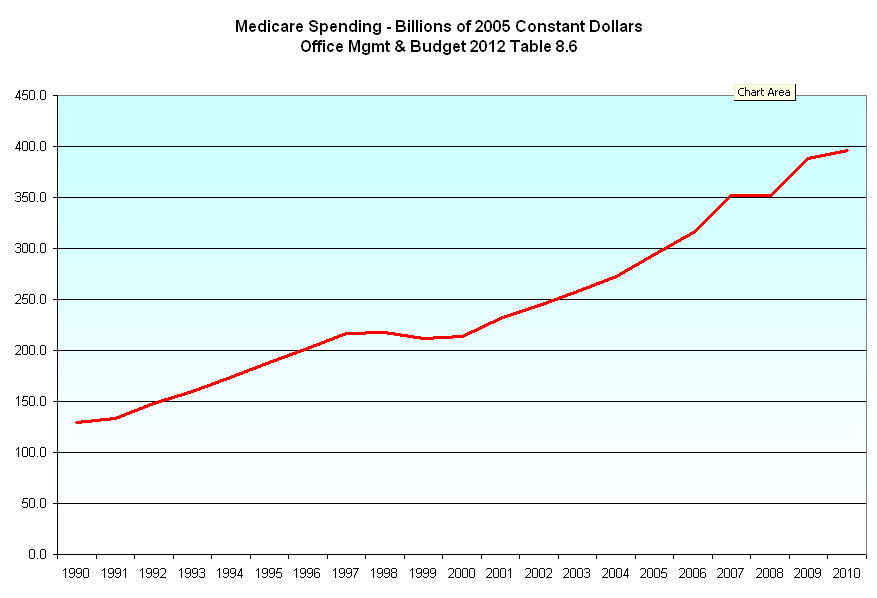
Cain replied, “Whoa, there, pardner. All the entitlement programs that liberals passed have been the main contributor to the debt, if you ask me. We talked about this last week. Medicaid spending is up to a trillion by now. That’s more than 3% of the country’s GDP. In 1990, we spent five times as much on defense as on Medicaid. Now they are almost equal (Source). This country needs to have a conversation about our priorities.”

Abel sighed. “Health care is an implied right. Life, liberty and the pursuit of happiness is not possible without health care.”

Cain argued, “Defense is an explicit right. The founders stated that in the first sentence of the Constitution (Source).”

Abel interrupted, “And the general welfare was in that same sentence. Health care is a key component of the general welfare.”

Cain shook his head. “They meant the common welfare, the welfare common to everyone.”

Abel showed exasperation. “We argued about this last week and how many times before that? What does ‘general welfare’ mean? So, didn’t you like about the bill?”

Cain replied, “I thought it was dumb that they are cutting back on incentives for wind and solar energy. I’m an ‘all of the above’ guy when it comes to energy. So is Texas, a red state.”

Abel rolled his eyes. “The White House says that they are reducing energy costs by expanding fossil fuel production (Source).”

Cain smirked. “Fine, but why hobble wind and solar production? It’s stupid. It’s just vindictive politics. I’m sick of this childish shit from people who are supposed to be the leaders of this country. This is the kind of stuff kids in middle school do.”

Abel replied, “Seniors get an extra tax break. An older couple can deduct almost $48,000 (Source). According to the Census Bureau’s Supplemental Poverty Measure, 14% of seniors were poor, so this might help reduce that. Help them pay for medical expenses (Source).”

Cain shook his head. “I liked the simpler deduction in the 2017 so I’m glad they kept that. The extra deduction for seniors won’t help poorer seniors much. This deduction basically eliminates income taxes for seniors in the bottom 50% who barely pay income taxes as it is (Source). Poor seniors won’t get a refund if their taxable income is negative. It’s seniors in the top half who will benefit most from the extra deduction. This government already gives plenty to seniors. Too much, if you ask me.”

Abel asked, “Did you see anything you liked?”

Cain replied, “I like the ability to fully expense short-term capital investment. Better allowances for depreciation which is pretty high in tech industries. The Tax Foundation has an article and video explaining some of the good, bad and ugly in the bill (Source).”

Abel asked, “What about the work requirement? Like half the people who are aged 50-64 and on Medicaid are disabled (Source). Ok, maybe some can work. Can they work 20 hours a week to stay on the program? Who knows?”

Cain nodded. “I liked the discipline of it, but they went overboard. Do the states have the resources to monitor all these requirements? No. Does the law give the states some flexibility or specific funding to carry out the law? No. This is another one of those unfunded federal mandates. It’s sad to see Republicans using the Democrats’ playbook.”

Abel said, “I wish Murkowski had not buckled to pressure and just voted no on that bill. She said she didn’t like the bill but hoped that the House would change some provisions. What kind of spineless response is that? The Tax Foundation estimated that continuing these tax cuts will add $4.5 trillion to the debt over a ten-year window (Source). A bunch of old people in Congress passing laws that benefit the rich and the old, then sticking our kids with the bill.”

Cain smiled as he glanced at his watch. “That reminds me. I can’t remember whose turn it is. I got to go help my daughter with something.”

Abel replied, “Yours. Hey, I hear people like the new Superman movie. A story about someone who acts on principle rather than political expediency.”

Cain laughed as he slid out of his seat. “Most of us try to live up to our principles. Yet we have leaders who pay more attention to political expediency than principles.”

Abel looked up at Cain. “The saying goes, ‘you can’t govern if you don’t win.’ Unfortunately, our political system and news cycle focuses on the contest, the winning, rather than the principles.”

Cain nodded as he turned to leave. “Hmmm, something to think about. I’ll see you next week.”

//////////////

Image by ChatGPT

A Divided Country

July 6, 2025

By Stephen Stofka

Happy 4th to everyone. Despite the holiday weekend, the boys squeeze in a Sunday morning breakfast. The conversations are voiced by Abel, a Wilsonian with a faith that government can ameliorate social and economic injustices to improve society’s welfare, and Cain, who believes that individual autonomy, the free market and the price system promote the greatest good.

Cain settled into his seat as the busser set two glasses of water on the table. “We need another system of government.”

Abel gave him a questioning look. “They haven’t even brought the coffee yet, and you are rewriting the Constitution? I need to fasten my seat belt for this discussion.”

Cain laughed. “I’m disgusted with the corruption that is embedded in Senate rules. This monstrosity of a bill, what I call the ‘Big Bogus Bill.’ Senate Republicans bought Senator Murkowski’s vote, the critical vote, by exempting Alaska from some of the provisions in the bill (Source).”

Abel smiled. “This is the party you voted for. There are only  a few, like Rand Paul, Murkowski and Collins in Maine that are independent. The rest are automatons playing follow the leader. They are supposed to represent the interests of the people in their state, not the interests of their party leaders.”

Cain frowned. “Democratic leaders did the same thing in 2010 as they tried to get the Obamacare bill across the finish line.”

Abel interrupted, “That’s what this whole thing is about. Trump and the Republicans tried to repeal Obamacare in Trump’s first term. The House tried like fifty times. The repeal got so close, then John McCain gave his own party the thumbs down in the Senate vote on the repeal (Source). Now  Trump and the MAGA crowd are determined to undo as much of the ACA as they can.”

Cain frowned. “It’s a long standing grievance. Republicans have never had a filibuster proof majority in the Senate since the 17th Amendment instituted popular voting for Senate seats.”

Abel interrupted, “Well, it needed reform. Having the state legislatures elect their senators invited too much corruption. Senators were basically buying their seats.”

Cain nodded. “Good point. But it also allowed the states to check a President. I think we have lost that. We saw it this week when Trump threatened to primary Senator Tillis from North Carolina if he didn’t vote for the bill.”

Abel replied, “And Tillis told him to take a hike, basically. He said he wasn’t going to run again anyway. He’s disgusted by his own party acting like the President’s obedient pets. Trump was born with a silver spoon and yet he wants to take Medicaid away from a lot of people, including those in North Carolina. Tillis works for the people of North Carolina, not the spoiled brat in the White House.”

Cain sighed. “Too many wealthy people in the halls of power if you ask me. What was I, oh yeah, the filibuster. Every time that the Democrats get a filibuster proof majority, they pass a huge intergenerational social program that is not subject to the regular appropriations process. When people vote Republicans into power, Republicans have one hand tied. That’s not fair to the people who voted them into power. It’s like playing a game and the other player gets to make all the important rules.”

Abel argued, “Republicans have fought every one of those programs all the way up to the Supreme Court and lost every time.”

Cain nodded. “Republicans are still angry that John Roberts, the Chief Justice, voted with the liberals that the ACA was constitutional. A few months later, Obama defeated Romney, one of the old guard in the Republican Party. A few years later, Donald Trump appeared as the avenging angel (Source). He took on primary candidates from every faction of the party and won.”

Abel looked skyward. “Come on, this is not a Die Hard movie.”

Cain laughed. “That’s where you’re wrong. To some voters, Trump was like the tip of the spear, the leader of a resistance movement against big government.”

Abel frowned. “An agent of chaos who will destroy the Republican Party and the conservative values it has stood for. Is helping people that bad to so many Republicans?”

Cain smirked. “Democrats design programs that are not effective at helping the poor. We talked about that last week. The data supports my claim. These programs cost far more than the projected costs and the Democrats want to raise taxes on successful people to mask Democrat incompetence.”

Abel chuckled. “Yeah, right. Republicans promised that the Iraq war would pay for itself.”

Cain interrupted, “They expected that the revenue from more efficient oil production would defray a lot of costs, but they never promised that the war would pay for itself (Source).”

Abel replied, “Ok, you want to torture this like a lawyer? A lot of the American public was led to believe that the costs would be far less. How’s that?”

Cain argued, “Goes to prove my point. Policymakers and politicians have difficulty making projections. The Iraq war cost more than anticipated. That’s the nature of war. The war lasted like eight years. Look at the schemes the Democrats cook up. The programs have an infinite time horizon, so it’s impossible to project future costs with any accuracy. Democrats passed Medicare in 1965. Their leaders in the House Ways and Means Committee projected that the program would cost $9 billion a year by 1990. The actual cost was $67 billion (Source). So, either they were incompetent or lying. I suspect it was both.”

Abel asked, “So, what would you do? Cancel Social Security, Medicare, Medicaid, and other entitlement programs? While you are at it, why don’t you cancel the income tax amendment?”

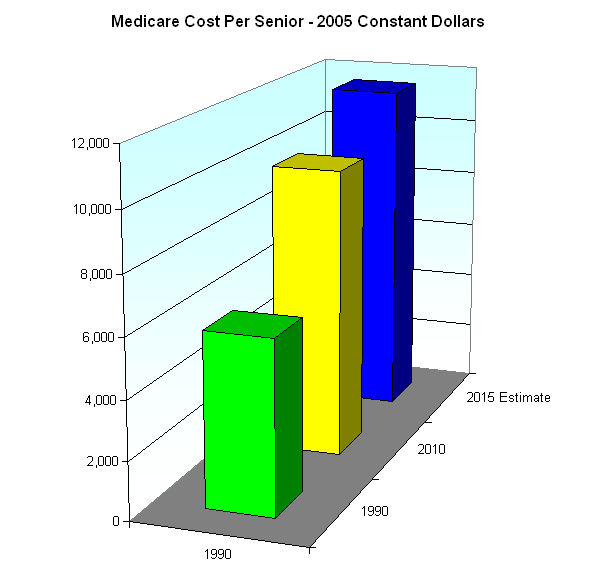
Cain sighed. “Obviously, it’s not practical, but it’s not right that one party has dominated spending priorities for so many decades. It’s been sixty years since Medicare began. A lot of seniors think that payroll taxes and Medicare premiums pay for their care, but that’s not the case. Over a third of the costs are paid for by taxpayers out of general tax revenues. In 2023, that was $360 billion.”

Abel argued, “Those costs skyrocketed after the Republicans added Medicare Advantage and Prescription benefits to the program. Those two parts, Part C and D, cost more than half of Medicare spending. And why were those added? To help Bush win re-election in 2004. So I don’t want to listen to Republican sob stories about Democratic social programs. These programs mostly help people in red states who are older and poorer.”

Cain argued, “Look, you talk about Trump destroying the Republican Party? It was Bush and the old guard Republicans like Cheney who destroyed the party. They started acting like Democrats, passing legislation to get votes.”

Abel smirked. “Did it ever occur to you that it might actually be about helping people?”

Cain nodded. “Yes, it occurred to me. This is a country of many countries, too diverse for some one-size-fits-all program designed in Washington. The Constitution gives Congress the power to provide for the general welfare, not particular benefits given out to some individuals and not others. Only those programs, like national defense, the courts and the Post Office, which benefit everyone.”

Abel replied, “There’s always been a disagreement about what the general welfare clause in the Constitution means. In 1937, the Supreme Court noted as much when they found that the Social Security Act was constitutional. The court did not think it was their place to overrule the reasonable judgment of the legislature (Source). That is a prominent feature of the current court’s conservative majority. That the court should stay within its bounds.”

Cain nodded. “Ok, I’ll grant you that last point.. However, there are many of us who disagree with that broad interpretation of the general welfare clause. The fact that ‘common Defense’ and ‘general welfare’ are linked together in the same phrase is evidence that a narrow interpretation is appropriate.”

Abel asked, “Do you think this 6-3 conservative majority will overturn precedent and find the Social Security Act unconstitutional? They already overturned centuries of gun law with the Heller decision. They overturned decades of campaign finance law with the Citizens United decision. They overturned decades of abortion law with the Dobbs decision. I mean, why not go after Social Security, Medicare and Medicaid?”

Cain replied, “I think they would be mindful of both precedent and the consequences.”

Abel argued, “They didn’t care about the consequences in the Dobbs case with abortion. They didn’t care about the consequences of giving blanket immunity to Trump in last year’s decision (Source). The conservative justices are like politicians in any majority. It’s hard to see past their own principles and prejudices. In the Dred Scott decision that provoked the Civil War, Chief Justice Taney adopted a narrow originalist interpretation of the words ‘citizen’ and ‘territory’ in the Constitution. That led him to conclude that Negroes could not be citizens and that Congress had no authority to make laws for the Missouri Territory (Source).”

Cain raised his eyebrows. “Oh, I forgot that. He declared the Missouri Compromise unconstitutional.”

Abel asked, “Grade school test. When was the Missouri Compromise?”

Cain laughed as he raised his hand. “1820.”

Abel smiled. “Very good! You get a gold star.”

Cain sighed. “So much memorization back in those days.”

Abel replied, “Before we had librarians in our pockets. Anyway, the Missouri Compromise avoided secession and civil war in 1820. So, it should have been a good guess that voiding that compromise would aggravate tensions and lead to civil war, but Taney didn’t see it. He thought the court had resolved the issue once and for all. That’s my point. The logical application of our principles can lead us to disregard the consequences of our thinking. I’m afraid this court will follow a path of reasoning that will tear this nation apart, just like Taney did with the Dred Scott decision.”

Cain stared into his coffee cup, then looked at Abel. “That’s dark. You know, I wanted to get your feedback on the abortion ruling by the Wisconsin Supreme Court this week, but I promised my daughter I would join them on a picnic at the lake.”

Abel nodded. “And the Big, Beautiful Bill that passed this week.”

Cain smiled. “I’m still working through that bloated bill, but I thought it was clever the way Republicans had structured the bill so that the tax cuts happen in 2025 and 2026. The benefit cuts happen after the midterm election next year.”

Abel shook his head. “There are about 79 million people on Medicaid (Source). The Congressional Budget Office estimates that this bill will cause 12 million to lose their coverage (Source).”

Cain argued, “Yeah, but Medicaid enrollment already dropped 12 million after the expiration of the pandemic entitlements (Source). The world didn’t come to an end. So let’s say that Medicaid enrollment falls to 67 million. That’s still 20% above the levels of 2013 just before Obamacare kicked in (Source).”

Abel sighed. “It seems like so little gain for all the political upheaval it has caused.”

Cain shrugged. “Democrats probably could have accomplished that with small tweaks to the system. But no. As always, they wanted to completely rewrite policy in this country.”

Abel frowned. “So the tax goodies happen right away? People are going to be doing their 2025 taxes next spring and will see all these goodies. Manipulating public opinion just before the primaries start (Source).”

Cain slid out of his seat. “That’s politics. By stalling the benefit cuts, they avoid any repercussions before the election.”

Abel shook his head. “Seems so corrupt.”

Cain nodded as he turned to go. “It’s a game of power. That’s a big flaw in democratic systems. I still think we should have government by small tribunals.”

Abel laughed. “That’s basically how the Constitution was written. Anyway, see you next week. I think it’s my turn to pick up the check.”

///////////////////

Image by ChatGPT
Poverty and Principles

June 22, 2025

By Stephen Stofka

Sunday morning and another breakfast with the boys as they discuss world events and persistent problems. The conversations are voiced by Abel, a Wilsonian with a faith that government can ameliorate social and economic injustices to improve society’s welfare, and Cain, who believes that individual autonomy, the free market and the price system promote the greatest good.

Cain twirled the rod on the blinds to reduce the sunlight. “Boy, it’s hot this week.”

Abel said, “I can take that side if you want. Nice and shady on this side.”

Cain replied, “Nah, it’s ok. There we go. That’s better. Anyway, did you hear about the Supreme Court’s decision this week? They said that states can pass laws that make it illegal for doctors to prescribe puberty blockers to minors (Source). I thought you would be up in arms about that.”

Abel replied, “I’m not. I thought it was a reach, especially with this conservative court. The plaintiffs in the case wanted to blur the distinction between gender and sex so that they could claim sex discrimination under the Fourteenth Amendment. The Biden administration filed an amicus brief in the case. Come on, Joe. You’re supposed to be a middle of the road guy. You were captured by the progressive wing of your party.”

Cain laughed. “Criticizing Biden? I thought it was performance politics, not legal reasoning. The Trump administration reversed their amicus argument as soon he was elected.”

Abel looked around the restaurant. “Where’s the guy with the coffee and water? Anyway, the N.Y. Times had a magazine article on the history of the case (Source). Ok, there he is.”

Cain settled back in his seat as the busser poured coffee for each of them. “It’s a tough job,” he said. “I bused for a country club when I was like 16 or so. Summer job. Everyone wants to be served as soon as they walk in the door. Anyway, have you heard of WPATH?”

Abel asked, “No. Sounds like a public transportation thing.”

Cain chuckled as he spelled out the acronym. “It’s some psychiatric association for transgender care that issued guidelines for treatment of transgender people in 1979.”

Abel frowned. “That long ago? It seems like its only in the past ten years or so that this has become an issue. Shows how long these things take to come to general attention. So what’s the deal with WPATH?”

Cain replied, “So this professional association revised its guidelines in the late 1990s to ‘permit’ not ‘recommend’ puberty blockers for minors in rare cases. So, get that. Rare cases only. And it was only for minors aged 16 or over. Then in 2012, they relaxed their guidelines to permit treatment in minors under age 16 (Source).”

Abel interrupted, “Maybe that’s why this issue has only come to the public’s attention in the past decade. Ok, so go on.”

Cain said, “In 2022, get this, they revised their guidelines again to ‘endorse,’ not just permit, puberty blockers starting at puberty.”

Abel smirked. “Ah, the step too far.”

Cain nodded. “Exactly. First the policy permitted sex-hormones in rare cases for emotionally disturbed individuals who were almost legal adults. Now it has grown into a recommended procedure for a lot of children who might be only 11 or 12 years old. Some states said no. A state often acts as a surrogate for parental responsibility like at school. It has a right to exercise reasonable prudence.”

Abel smiled when Maria appeared at their table. “Hello, boys. What will it be? The same as usual? Number one over medium, rye toast, and number four with French toast and bacon?”

Abel replied, “How many customers do you have memorized? Absolutely genius. Anyway, can I switch to sausage this week?”

After Maria left with their order, Abel said, “I think they changed their bacon supplier. It used to be thicker. Had a maple taste. Anyway, where were we? Oh, yeah. Gender dysphoria. I didn’t think the science with those treatments was very clear. You know, like effectiveness and long-term side effects.”

Cain nodded. “It’s not. In their 2022 revision, WPATH stated as much (Source). Anyway, that got me to thinking about rights in general, and Robert Nozick’s Theory of Rights.”

Abel asked, “Refresh my memory. Nozick, the libertarian guy?”

Cain replied, “Yeah. In 1974, his book Anarchy, State and Utopia was published. It basically set out the principles of the libertarian movement. His theory of rights was that people should be permitted to do anything that does not violate the rights of others.”

Abel argued, “Yeah, but who decides the bounds of those rights? I mean, women had a right to have an abortion, then the Supreme Court decided they didn’t. Gays did not have a right to marry until the Supreme Court decided they did. We recognize a right to self-defense, ok? But not if you’re resisting arrest. But maybe you do if the officer is using excessive or unlawful force (Source).

Cain smirked. “What’s excessive or unlawful? Like there’s a referee every time someone encounters a police officer.”

Abel nodded. “Right. That’s why bystanders take videos of an arrest with their cell phones. Some kind of public witness.”

Cain continued, “So Nozick argued that a state’s proper role was to enforce the sanctity of individual rights. The courts, a police force, that kind of thing. A federal government should provide for the common defense against foreign powers. You pointed out a big flaw in Nozick’s argument. What are those rights?”

Abel replied, “Yeah, the right to free speech, for instance. Countries set different boundaries on that right. In Britain, the burden of proof is on the defendant, the person accused of committing the libel. In the U.S., it’s the plaintiff, the accuser who has the burden of proof (Source). Two entirely different approaches to defining the limits of a right.”

Cain frowned. “That brings up the subject of what’s called ‘positive’ rights. You know, like FDR’s Four Freedoms. The first two were already in the Constitution. Freedom of speech and worship. But the other two were freedom from want and freedom from fear. So, is it the federal government’s responsibility to ensure those last two freedoms?”

Abel replied, “That is at the heart of the debate for the past eighty years. Is there an obligation to help the poor? If so, whose responsibility is that? In 17th century England, the local parishes administered relief for the poor (Source).”

Cain nodded. “That’s the way it should be in this country. Means tested programs like food stamps, Medicaid, and welfare should be handled by the states or local governments.”

Abel asked, “And pay for it how? In England, they charged an extra poor rate on property owners. So let’s say, a city has an above average rate of poor people and low property values. How is the city going to handle that? What about poor states in the deep south? They rely on federal funding. Mississippi gets like an additional $30 billion a year in federal funds (Source). Without those funds, people would start to migrate to states with more resources. That was a big problem in England.”

Cain argued, “I don’t think there would be a lot of migration. A richer state would be more expensive to live. It’s probably a more competitive job market. Besides, it takes resources to move. Something that a lot of poor people don’t have.”

Abel said, “I just think that policies founded on libertarian principles will have some bad consequences. The bad would overwhelm any good.”

Cain paused as he looked over his coffee cup at Abel. “All these federal programs create a sense of entitlement and dependency. People start making up rights to this, rights to that. Sometimes less is better.”

Abel sighed. “Yeah, kids can do with fewer dolls. That’s what Trump said. Not very charitable.”

Cain stared at his plate, deep in thought. “Taxes were high in the 1980s. I only took home 75% of my pay because of various taxes. I was young and I wasn’t making much. They kept raising the Social Security tax rate because the system was going bust then.”

Abel interrupted, “I agree. It sucked. High inflation, tough to pay bills as it was. Then all these small increases in taxes. It adds up.”

Cain continued, “So, older people were collecting far more than they had paid into the system during the first decades of the program. If they had paid anything, they felt entitled to collect. Social Security had become a big charity program, a transfer of money from the young to the old. That taught me a thing about rights. They had rights. I had none. That’s what it felt like.”

Abel argued, “I was young. I didn’t appreciate that Social Security is essentially an insurance program, an old age insurance program. I mean, old age was an eternity away. Hard to imagine getting wrinkles and ‘turkey neck,’ we called it. I thought old people looked that way because they didn’t get enough vitamins back in the old days.”

Cain laughed. “Ok, good point. We get older. We get a longer term perspective. Can the insurance company, the government, make good on its promises? Did it collect enough in premiums to pay out those promised benefits? No. It’s a badly managed insurance program. Why? Because the premium rates are set by politicians who don’t have the guts to charge an appropriate rate, a tax that is proportionate to the promised benefits. What’s the term? Actuarily sound. That’s why the program is going to run out of money in eight years, and the program will pay out reduced benefits (Source).”

Abel argued, “You call the politicians gutless. Because they are gutless, they will use general funds to make up the difference. They will be forced to, or the voters will throw them out of office.”

Cain asked, “How are they going to do that? This new spending bill reduces taxes even further and increases the deficit each year (Source). No, each side is going to use this issue as a weapon against the other side. Look, Social Security has not been very effective at reducing poverty among seniors. Google dug up an old Census Bureau report from 1966 that shows a poverty level of about 18% among seniors. This was before taking into account Social Security and Medicare and any other programs (Source). Today, after including the income from all those programs, it’s about 15% (Source).”

Abel argued, “Well, a 3% reduction is a lot, I think. Hey, here’s food. Thank you.”

Cain shook some pepper on his eggs. “Hold on. That’s not all. That old report estimated that about 12% of kids under 18 were poor (Source). What is it today? After all the programs, it’s gone up, not down. It’s almost 14% (Source). So, the government is essentially taking from families with young kids and giving it to seniors with no kids. Does that seem fair or effective to you?”

Abel frowned. “You know what I don’t like about your thinking? It’s uncharitable. Why don’t we have more of a sense of community? There were childless couples who had to pay property taxes to fund public schools. We benefited from that but never gave it a thought. Think of it as a game of poker. We throw money into the pot and sometimes we get back more than we put in. The winner of a hand is richer. The other players are poorer.”

Cain swallowed, then replied, “No, I think it’s your attitude that is uncharitable. “There’s all these kids whose outlook and personalities are going to be affected by that poverty for the rest of their lives. Some learn to be passive and helpless. Some rebel and turn to drugs and crime as a way to empower themselves.”

Abel interrupted, “Until they go to jail or get shot by another gang.”

Cain nodded. “Right. This is not a prudent long term strategy, let’s say. In prison, they sit around in a cage. Can’t get more helpless than that. I just think that all these big federal programs have ruined the character of this country. What happened to self-reliance? The states have become little more than departments in a big company taking orders from the bosses in Washington. They send a lot of tax money to Washington, then go crawling to Washington when they need something.”

Abel said, “We were talking about rights before, the so-called positive rights. Freedom from want. Freedom from fear. After eighty years, you are saying that ‘big daddy’ government is a failure?”

Cain nodded. “Exactly. This country doesn’t have a great record on rights. The Declaration cites all these universal rights, but those rights were not universal. Women were excluded. Blacks, American Indians, later the Chinese. Businesses could form trade associations, but labor unions could not go on strike. It wasn’t until the 1937 NLRB decision that the court recognized workers’ right to organize (Source). Women didn’t have the right to vote until 1920.”

Abel argued, “I thought you weren’t a big fan of unions.”

Cain replied, “I might not like the strategies that unions use, but I’m a big fan of consistency. If businesses can engage in quasi-collusion through trade associations, then workers should be able to do the same. I do like right-to-work laws. I don’t think employees should be forced to join a union to be employed at a company.”

Abel asked, “That’s why you don’t like Social Security? In a sense, you’re forced to join, to buy into the insurance program? I mean, that’s part of living in society. We trade some freedom for security. To me, your ideology seems too rigid.”

Cain laughed. “They’re called principles. Your approach seems too arbitrary. Where you conform to the circumstances of the moment.”

Abel smiled. “Marginal thinking. I’m practical. A few weeks ago, we talked about Stephen Breyer’s book on taking a pragmatic approach when evaluating court cases. That’s me. Mr. Practical. So you mentioned the spending bill that’s working its way through Congress.”

Cain smirked. “ The One Big Beautiful Bill Act, as it is now known. They should call it the One Big Bloated Bill.”

Abel interrupted, “They are going to cut back on Medicaid, which is going to hurt a lot of poor people, both kids and seniors. You talked about how much states are spending on Medicaid. A lot of that is on seniors. In California, seniors cost almost twice the state’s average on their Medicaid program (Source). California spends about $90,000 per year for a senior in a nursing home. What’s your plan? Put them out on the street?”

Cain asked, “Do you think that California could handle that load with its own resources?”

Abel nodded. “Sure. The problem is that California kicks in a lot of tax money to the federal government and gets far less back from them. That amounts to $90 billion in a year, a huge hole that California has to fill (Source). New York and Texas have similar holes. The feds take that tax money and give it to rural states that are usually poorer.”

Cain raised his eyebrows. “Is providing health care a state and local thing, or a national thing that the federal government should do?

Abel argued, “Well, health care insurance is a deductible expense for businesses, so that makes it a national issue. Businesses spend money on health insurance for their employees, but people don’t have to declare it as income. It’s the largest subsidy by the federal government to working people and businesses (Source). Why should some working people get a subsidy and others don’t? Is that a violation of the 14th Amendment?”

Cain shook his head. “That’s the problem. The tax deductibility of health insurance was a World War 2 policy. Because there were wage freezes in place during the war, companies wanted a way to attract employees. Health insurance was one of those. Again, we are saddled with the effects of a policy that ‘big government’ FDR started. As soon as the war was over, that program should have ended. Period.”

Abel shrugged. “Yeah, fat chance. It was tax-free money. No one wants to give that up.”

Cain replied, “Exactly my point. These big federal programs are like fishing boats coming back from a big catch. The gulls stay with the boat, wanting an easy meal.”

Abel argued, “Well, companies do the same at the state level.”

Cain smirked. “States must balance their budgets even if it does take some accounting tricks. So states have some constraint. The federal government has no such discipline other than the probability that generous federal transfers will cause inflation.”

Abel shook his head. “There’s like seven rural hospitals that close every year (Source). Remember, that’s with the Medicaid expansions under Obamacare. So, if Medicaid is severely reduced or eliminated, most rural hospitals will fail. I just don’t understand why the representatives of these rural states vote to reduce Medicaid. And for what? To keep giving big tax breaks to billionaires?!”

Cain sighed. “It’s the principle of the thing. Medicaid programs encourage people to drop private insurance in favor of a low cost government program. This ultimately has an effect on the larger market for employer sponsored health plans and drive up private insurance rates. The federal government covers a lot of the cost, but the states still have to cough up like 10% of Medicaid costs and it’s a huge program. Texas spends almost half of its state budget on Medicaid (Source).

Abel whistled softly. “Wow, I didn’t realize it was that much.”

Cain smiled. “You wouldn’t because you mostly consume left wing and mainstream media. Even the blue states struggle to pay their share of Medicaid. New York and California spend almost 40% of their budget on Medicaid. College students complain about the high cost of education but part of the reason for that is the states pick up less of the cost of higher education than they did like forty years ago. Why? Because Medicaid sucks up so much of each state’s budget. So college kids are basically paying for greater access to Medicaid. Is that fair? No, of course not.”

Abel argued, “That’s bogus. State spending on higher education has increased by $2000 per student over the past forty years (Source). That’s after adjusting for inflation. The real problem is that colleges have been raising tuition and housing prices for students at a faster rate than inflation.”

Cain sighed. “Come on. First of all, the schools have had big cost increases because of federal mandates. They have to present the material in a lot of different formats tailored to different learning styles. They have to make allowances for disabilities and special needs. That takes time and resources. The students themselves make it worse. They find a doctor who says they have some learning disability which entitles them to have more time taking tests or completing assignments. Some of those claims are legitimate. Some are simply working the system, trying to gain an advantage. The school has to deal with that.”

Abel argued, “I think a lot of those additional costs are not simply because of federal mandates. Learning has changed. Students spend a lot of time on computers or their phones. The curriculum has to be modified to accommodate that. The cost of housing has increased at a slightly higher rate than overall inflation (Source).”

Cain replied, “Ok, I’ll grant you that. But how much are schools spending on administrative costs? One organization said that those costs had increased by 61% in the twelve years before 2007 (Source). Ok, that’s not inflation adjusted but after accounting for that, administrative costs are going up an additional 2% above inflation. The Department of Education also estimates a growing share for administrative costs, like 16 cents of every dollar in 1980 has now grown to 25 cents of every dollar. These federal programs are not efficient. They rob from Peter to give to Paul. That’s my point. Social Security, Medicaid, and education mandates. Everywhere you look.”

Abel laid his napkin on the table. “I agree with you that a centralized structure has problems. But I think your approach is impractical. We have to live with the decisions that previous generations made. I believe we can patch some of the problems in these programs. Right or wrong, employer-sponsored health care is here to stay. Right or wrong, private insurance companies will not cover the medical risks that come with old age. Right or wrong, people don’t save enough for their retirement. That’s just the way it is.”

Cain settled back in his seat. “I still think that these problems would be better handled at the state or local level. My point is that they are not effective at the federal level.”

Abel stood up. “Half of the states have limited resources. We saw that during the pandemic. Rural hospitals in one state sent their patients to hospitals in other states. Idaho sent patients to Washington (Source). Wyoming sent patients to Colorado. Solutions to any problem have to deal with those hard realities. Does that involve a compromise with principles? Maybe.”

Cain looked up. “You’re ready to go. Maybe we can continue this next week. See you then.”

Abel replied, “It’s a huge problem, isn’t it? See you next week. Where’s the check?”

Cain said, “I think it’s my turn. I can’t remember. You go ahead and I’ll pick it up.”

/////////////////////

Image by ChatGPT in response to a prompt
Note: The standard poverty measure does not include any government transfers like Social Security. The Supplemental Poverty Measure (SPM) includes those transfers. The 1966 study used the conventional poverty measure. The recent poverty measure was the supplemental variety. Cain contrasted the two to show the relatively small reduction in poverty that the sum of government transfers has had over the decades. The 1966 study showed that a significant reduction in poverty before Johnson’s Great Society programs had taken effect. The strong economy of the early 1960s played a significant part (Source).

Green Debt

March 17, 2019

by Steve Stofka

Imagine a world where, each year, the U.S. government (USG) gave $1000 to each of it’s approximately 300 million citizens (Note #1). The annual cost of the program would be $300 billion, about $120 billion more than the 2017 tax cuts (Note #2). As it does every year, the USG would borrow the money and issue Treasury bills, which are traded around the world. Although there is more than $23 trillion of Treasury debt – a plentiful supply – there is not enough to meet world demand.

Let’s say that the American people spent 80% of that $300 billion each year and saved the rest (Note #3). Let’s also calculate a multiplier of 1.5 so that the extra $240 billion of spending generates $360 billion of GDP (Note #4), about 1.7% of last year’s GDP. The increase in GDP would return about $60 billion to the USG in tax revenues (Note #5). The net cost to the USG is $300 billion less $60 billion in additional tax revenue = $240 billion.

Will the slight increase in GDP each year generate higher inflation? Inflation occurs when too much money chases too few goods and resources. Efficiencies in world production of goods and services has caused a continuing deflation in developed economies. Against those headwinds, inflationary pressures will be modest.

At the end of ten years, this program would create an additional $3.5 trillion in U.S. debt, the same amount of debt that the Federal Reserve accumulated in 2008 to protect the jobs and bonuses of Wall St. bankers. The Fed still owns most of that debt (Note #6). Which is fairer? A program to distribute money equally to everyone or a program to distribute the same amount to a select few?

Implementation of such a program is unlikely but illustrates the lack of a moral rudder in our Congress. Self-branded fiscal conservatives in both parties promote the fiction that the Social Security and Medicare funds will “run out of money” at a certain date in the future. These funds are part of the Federal government and are nothing more than bookkeeping entries on the Federal government’s books. The Social Security Administration explains this: “[the funds] provide 1) an accounting mechanism for tracking all income to and disbursements from the trust funds, and (2) they hold the accumulated assets. These accumulated assets provide automatic spending authority to pay benefits” [my emphasis] (Note #7). The accumulated assets are paper IOUs from the government to itself so that Social Security benefits are beyond the reach of Congressional infighting and debate each year. When it was created, President Roosevelt called Social Security an insurance program because it was insured against Congressional tampering.

Republicans propose to privatize Social Security while Democrats propose additional taxes to “fully fund” Social Security. These schemes are built on accounting fictions and sold to the general public as prudent solutions. Will the trust funds run out of money? Congress can change this with a stroke of a pen. Just as they “borrowed” from the funds, they can “loan” to the funds (Note #8). Both parties are trying to convince voters that big changes must be made because Congress is too incompetent to make a small legislative change. Will voters buy this nonsense and let them keep their jobs?

Around the world, the value of US Treasury debt is more trusted than gold. It is more than a bond because it trades among commercial banks like currency. The U.S. enjoys a unique position. Its debt is a trusted part of the world’s savings. This country has worked hard and prudently to make the U.S. dollar the world’s money. Over the past century, the U.S. has managed its economy and debt better than other large developed countries. Let us take advantage of that position. Let’s stop the political ploys around Social Security and other federal entitlement programs. Let’s have a serious discussion about investing in building new schools and transportation solutions, as well as needed infrastructure repairs. Let’s stop posturing like buffoons and start behaving like the leader we are.

//////////////////////
Notes:

1. Census Quick Facts
2. Annual loss of tax revenue about $180 billion times 10 years = $1.8 trillion per CBO estimate 
3. Americans usually save about 5% of income.
4. More on fiscal multipliers. 1.5 is an average of various multipliers.
5. USG revenues average 17% of GDP.
6. Fed’s balance sheet over time. The Fed buys Treasury debt in the secondary market from large banks that buy the debt at Treasury auctions. The Fed continues to hold $1.6 trillion of mortgage-backed securities, the same kind of debt that led to the Financial Crisis. Current balance sheet.
7. Social Security Administration FAQ #1 on the nature of the funds . Also, see their page debunking SS myths promoted on the Internet
8. The Federal government pays below market interest rates for the money that it “borrowed” from the SSA funds. Decades ago, the interest rate was set at approx. the five-year average for funds “borrowed” for several decades. If 20 or 30 year rates had been used, the SS funds would be much larger. There would be no “crisis” to argue about.

Four Foundations

Over the next two months, there will be much debate over spending cuts as the debt limit ceiling approaches in late February.  For the past four years, the Federal Government has been running $1 trillion annual deficits.

Deficits are the annual shortfall; debt is the cumulative amount of those annual deficits.  The total debt of the Federal Government, including money owed to the Social Security trust funds, is over $16 trillion, and is now more than the annual GDP, the sum of all economic activity in the country.

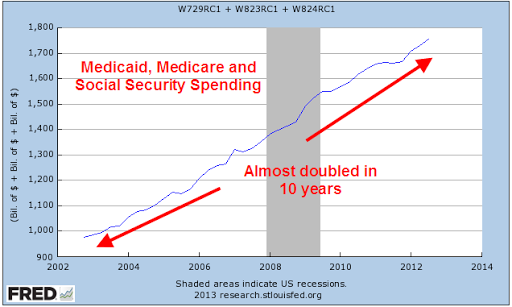
Republicans contend that the real problem with the budget is entitlement spending: Medicare, Social Security and Medicaid are the largest programs.  In the past ten years, spending on these three programs has almost doubled and now consumes 47% of the total Federal spending budget.

Spending increases on these programs will escalate now that the first wave of the Boomer generation has reached retirement age.  Too many rigid ideologues in the Democratic Party defiantly defend every penny of this spending.

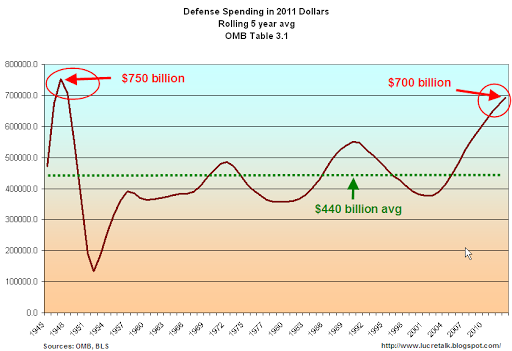
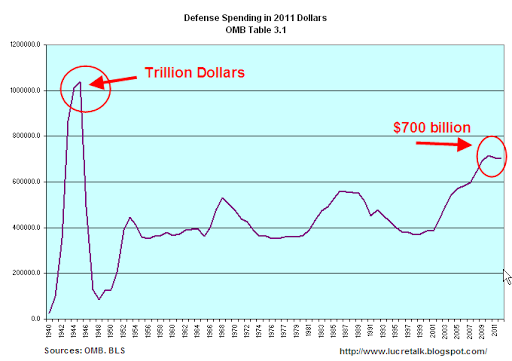
On the other hand, defense spending is near WW2 levels.  On an annual basis, the current $700 billion we spend on defense is far less than the inflation adjusted levels of $1 trillion we spent at the height of WW2.

Wars may be won or lost at their peaks but the spending occurs over several years.  When we look at a moving five year average of defense spending, we are near the average of WW2.

Judging by the amount of money we are spending, we are fighting the third World War.  Yes, it’s a dangerous world but is it as dangerous as the state of the world during WW2?  Has Al-Qaeda, a loose coalition of stateless forces, subjugated Europe as Hitler’s armies did?  Is the threat of Iran comparable to the domination of Japan over the eastern seaboard of Asia during WW2? 

In the late 50s, President and former General Eisenhower warned that the military industrial complex would invade the halls of Washington.  Preparedness is prudence, but Eisenhower knew firsthand that the industry peddles a self-serving culture of fear to those in Washington.  As high military spending becomes entrenched in the federal budget, regions of the country become dependent on the defense industry; those people send  politiicans to Washington to vote for more military spending and the spending cycle spirals upwards.

Each year, we are spending about $250 billion more than the 70 year average of military spending.  Unlike the spike of WW2 spending, the recent five year average has surged upwards like a wave – a wave that is drowning this country in debt.  As troubling as this is, we must remember that we are running $1 trillion deficits – four times the excess amount of military spending.  Those who say that we can balance the budget by cutting defense spending simply have not looked closely at the data.  We can not balance the budget by cutting only entitlement spending or only defense spending.  Even when we combine the two, we still can not balance the budget.

Which brings us to receipts, a gentle euphemism for taxes.  Economic bubbles inflate the amount of tax revenue to the government but the resulting lack of revenues after the bubble bursts outweighs the increased revenue while the bubble was building.

When we run a projection of revenues using more sustainable averages based on longer term trends, we come up with an optimized $3 trillion in revenues for the current year, still leaving us $600 billion short of current spending. 

The solution then is a mix of four factors: more revenue from 1) economic growth and 2) tax reform; less spending for both 3) defense and the 4) social safety net.  These are not easy choices, particularly when partisans vigorously defend a particular program as though it were the last stand at the Alamo.

Obligations and Entitlements

“Social Security and Medicare are the two largest federal programs, accounting for 36 percent of federal expenditures in fiscal year 2011.”  (Trustee’s annual report)

So how did we get here?

When Social Security was enacted in 1935, President Roosevelt promoted it as an insurance program for the old, widowed and orphaned. The language of the law called the employee portion of the tax an “income tax”, and the employer portion an “excise tax,” not an insurance program. Regardless of the language, Social Security has acted both as an annuity for retired workers and an insurance program for disabled workers and survivors of workers.

Several challenges to the law were brought before the Supreme Court, which issued several decisions in 1937 that confirmed that various components of the Social Security tax were valid. By law, the Social Security reserve fund could invest only in the debt of the U.S., either through marketable Treasury bonds or through special bonds which could not be sold. (A history of the financing of Social Security)  Since 1960, the Social Security funds are “invested” in these special bonds, which are little more than promises that the federal government will pay Social Security benefits. 1960 is also the last year that the federal government ran a budget surplus except for the years 1999 and 2000; in two years out of 52, the federal government has been able to balance its books. In overwhelming numbers, voters send lawyers to Washington; most of them have little if any business experience or education.  We reap what we sow.

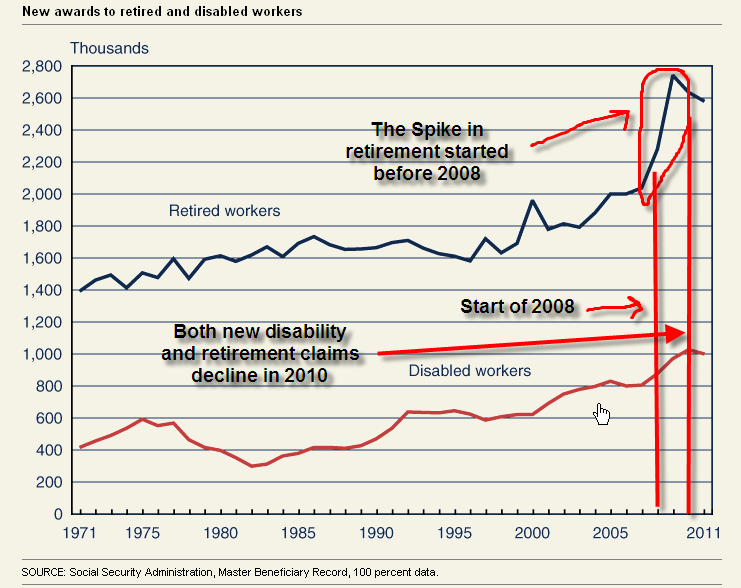
The Bureau of Labor Statistics (BLS) estimates the total number of workers at 135 million.  More than 55 million people are currently receiving some form of benefit under the Social Security program, a ratio of about 2.5 workers per beneficiary.  In 2011, 2.6 million applied for retirement benefits while one million applied for disability benefits.  In the past 40 years, the number of retirees receiving benefits has doubled, the number of disabled has more than doubled.  Both disabled and retiree claims have declined since 2010.  (Fast Facts

There is a demonstrated increase in disability applications when the unemployment rate rises.  As one guy with a bad back explained to me, “I’d rather be working scheduling service calls.  I worked in the heating and cooling business for almost 30 years.  After looking for a year, I gave up.  Who’s gonna hire a 60 year old guy with a bad back in this economy?”

(SSA Source)

The number of retirees has doubled but the population has grown only 50%.  The growth of women in the workforce has contributed to the growth in retirees and in disability claims.

Most people receiving Social Security benefits of one type or another feel as though they entered a contract with the federal government.  In return for their Social Security taxes, retirees and the disabled are owed promised benefits from the federal government, just as one would expect from an insurance company. Likewise, veterans also feel that they entered a contract with the federal government when they risked their lives in defense of the country. In exchange for their service, the federal government made promises of benefits to veterans.  Too many Republican politicians are fond of lumping Social Security beneficiaries and veterans under the umbrella term of “entitlement” programs when the more proper term is one of obligation.  When someone buys a Treasury bond, they expect to be paid the value of the bond when it matures.  Is that person part of an “entitlement” program?  No.  The bond is a contractual obligation between the bondholder and the federal government.  Why should a bondholder be treated with any more or less respect than a person who has “lent” the government money throughout their working years through their Social Security taxes?  Neither Paul Ryan or Mitt Romney understand that, to many of us, an obligation is an obligation.  Period.

So I want to distinguish between obligation programs like Social Security, and entitlement programs.

What are more properly called entitlement programs are those programs for the unfortunate and the vulnerable, whose financial circumstances qualify them for some kind of income assistance program.  Many have paid little in income taxes over the years for any number of reasons.  Some are children, some don’t or can’t work, some work but make so little that they owe no taxes.  Some may have paid a good share of income taxes in the past but found themselves in a bad way in recent times.  There are a lot of programs: SNAP(food stamps), SSI (Supplementary Security Income), and TANF (traditionally called welfare), to name but a few.

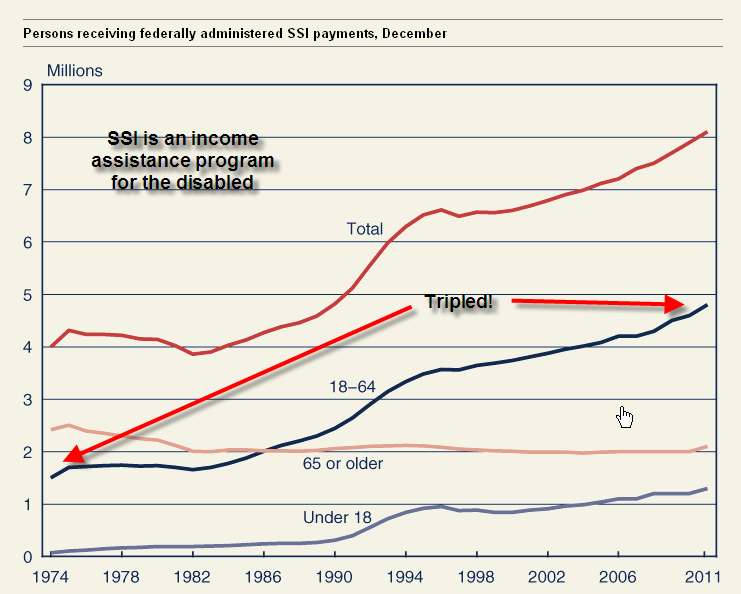
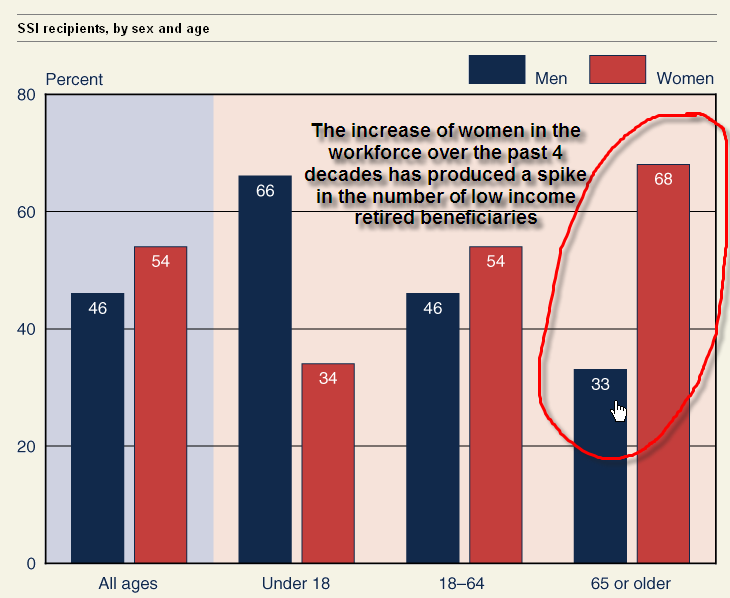
Let’s look at one program: SSI, an income assistance program for the blind, disabled and aged, whose beneficiaries comprise a mere 2.5% of the population.  The SSI program is paid out of general revenues, not Social Security taxes. In 2011, blind and disabled recipients made up 86% of the total of about 8 million. (Source)  The average monthly benefit is about $500. The cost of the program is about $50 billion, or 1.4% of total Federal expenditures. 2% of the cost of the SSI program includes vocational training and other back to work programs. When some politicians talk about reforms to “entitlement” programs, they know that some of these programs are small but they cite examples of abuse, of someone gaming the system, because they hope that you don’t know that the programs are small.  Vote them into office and what they really want to chop are the big obligation programs, Social Security and Medicare.

However, there are some legitimate concerns in these small programs; the number of SSI recipients has grown 33% in the past 17 years.

The number of disabled, aged 18 – 64, receiving income assistance under the SSI program has tripled in the past forty years, a growth rate six times that of the overall population. 

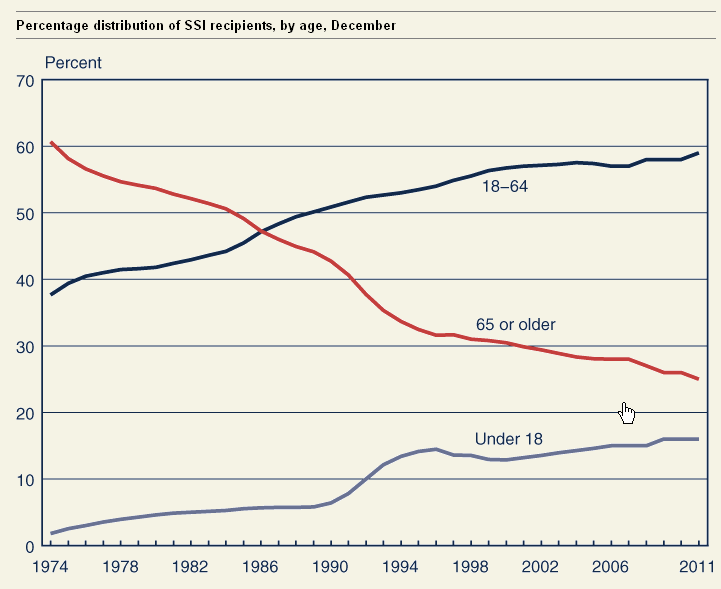
The SSI program also helps low income retirees, who have declined in real numbers by 15% in the past 16 years.

The percentage decline is explained partially by the explosive growth of the disabled who are younger than 65.  The number of women receiving SSI payments has also increased dramatically. 

Let’s look at another entitlement program that Mitt Romney and Paul Ryan have targeted in their stump speeches: SNAP or Food Stamps.  “45 million people on food stamps!” is the cry of either of these candidates to illustrate the runaway spending in entitlements and the poor economy.  What neither will tell you is that the program cost $78 billion in 2011 (CBO source).  That is 2.2% of Federal spending.  Whatever reforms these guys propose to this program will save a very small percentage of the budget.  In that same report, the CBO summarized the characteristics of those on the program: “three out of four SNAP households included a child, a person age 60 or older, or a disabled person. Most people who received SNAP benefits lived in households with very low income, about $8,800 per year on average in [2010].”  I can excuse Mitt Romney because he may not be aware of the numbers.  There is no excuse for Paul Ryan, who is the “budget-meister” and certainly knows that any savings to a program this small is chump change in a budget of $3600 billion. 

What both of them are counting on it that you don’t know that.  Their ultimate goal is to reform the big guy, Social Security, so that they can short change one type of federal obligation, Social Security recipients, to pay another obligation, the buyers of Treasury bonds.  Many of the large institutions that buy Treasury bonds are not suckers so Mr. Romney and Mr. Ryan turn to those with the least information – suckers who will vote for them.

March of Generations

2010 marked the demographic closing of the “Greatest” generation of the Great Depression and WW2 and the start of the Boomer generation, when the Boomers born in 1946 reach 65.  During the past twenty years, the Greaters, I will call them, and their children, the Boomers, have contributed the most to shaping public policy.  Those over 45 vote the most frequently and in greater concentrations than younger generations.  The overwhelming majority of politicians at the national level are over 45.  Earning power tends to peak in the 45 – 64 age range so it is that generation that contributes the most in taxes as a percentage of the total.  As a demographic, those in the 65+ age consume more federal tax dollars.  Politically and economically these two generations have a dominant influence on the nation.  So how has it been going?

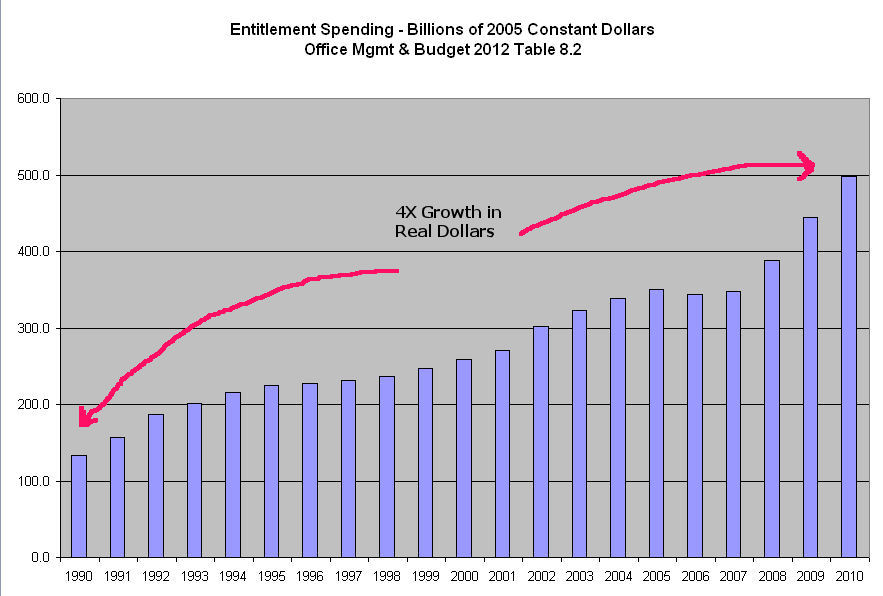
These two generations have been especially kind to the less fortunate.  Below is a chart of federal spending on entitlements that includes Medicaid, food stamps (SNAP), family support assistance (AFDC), temporary assistance to needy families (TANF), welfare contingency fund, child care entitlement to States, child nutrition programs, foster care and adoption assistance, Children’s health insurance, supplemental security income (SSI) and other programs.  These are inflation-adjusted dollars. (Click to enlarge in separate tab)

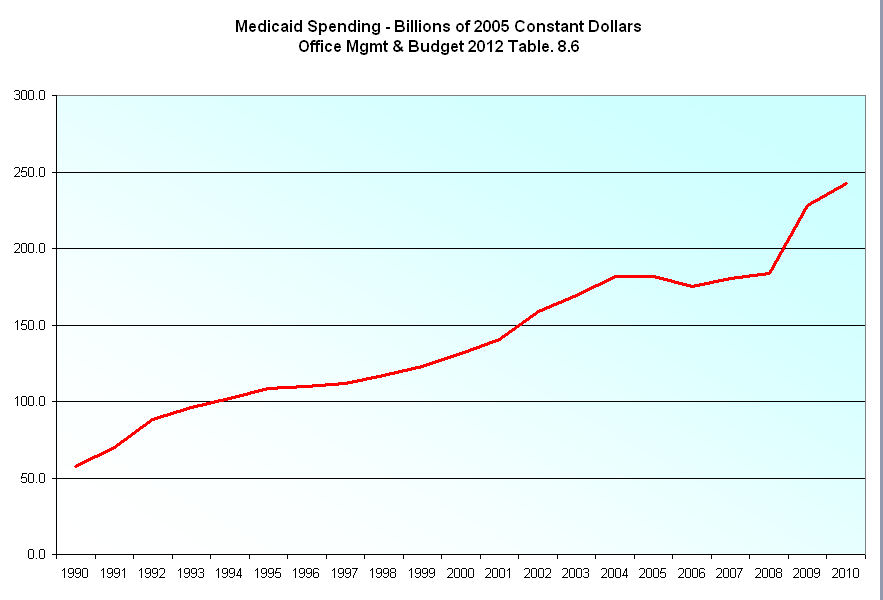
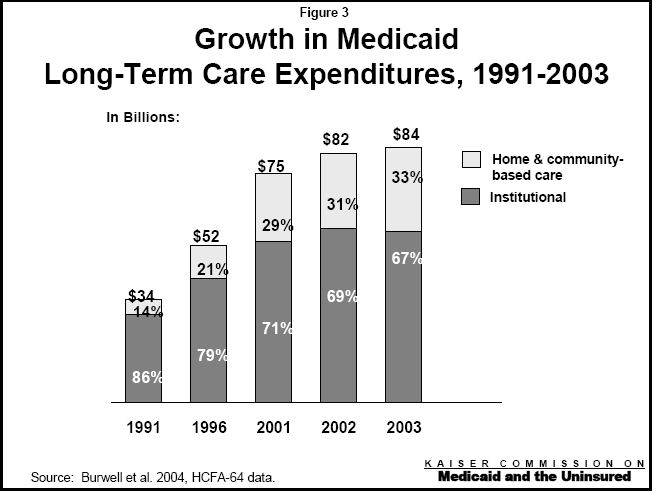
Chiefly responsible for the rise of assistance spending has been Medicaid.  Below is just the federal component of Medicaid spending, in real inflation adjusted dollars, over the past 20 years. 

For most of the past twenty years, states and local communities contributed about 70 cents for each dollar that the Federal government spent. (Source – (CMS) Centers for Medicare and Medicaid Services)  As part of the stimulus program, the states only kicked in 50 cents for each Fed dollar. As these stimulus funds run out this year, many states will be hard pressed to meet accelerating Medicaid costs.

Joblessness has led to increased enrollment in the program. Colorado had a 13% increase in enrollment last year. But an ever increasing cost is long term care for seniors who spend down what resources they have, then enter the Medicaid program to meet either long term home care expenses or nursing home costs. A 2005 Kaiser Family Foundation analysis of long term care spending in 2003 revealed that Medicaid paid $34 billion or 40% of total long term care expenses.  $34 billion was an eighth of total Medicaid spending of $270 billion that year but as the population ages, the long term care component of Medicaid costs will inevitably rise.

The growing sophistication of medical technology has enabled the Greaters to live longer and better than their parents did.  Body parts wear out but can be replaced or repaired.  A dying moment can be postponed for several days or weeks or months with the use of critical care and life support systems.  Much of that care gets charged to Medicare.  Below is a chart of Medicare spending in inflation-adjusted dollars.

Medicare covers some disabled and others but it is primarily a program for seniors aged 65+.  Let’s look at the total Medicare cost divided by the number of seniors so that we get a per senior cost.  This is not the actual per person cost but the process enables us to make some projections. Over the past 20 years, the per senior cost of Medicare has grown, in inflation adjusted dollars, by 67%, a rise of 2.6% per year over inflation.  Using that growth rate, I estimate a per senior Medicare cost of over $11,000 in 2015.

How are these rising costs being paid?  A Kaiser Family Foundation analysis of 2009 Medicare revenues found that the premiums that seniors pay each month for Medicare B (doctor’s bills) accounted for only 13% of Medicare costs (Page 12).  Payroll taxes made up 38%.  Income taxes pay 44% of the cost.  If Medicare is truly an insurance program and we want to subsidize health care for our seniors, why do we take almost half the cost of this “insurance” program from our income taxes? 

During the past twenty years, the Census Bureau reports that the population of those aged 65+ has increased from 22 million in 1990 to 40 million in 2010, an average growth rate of 3%. In 2015, the US Census Bureau estimates that the senior population will total almost 47 million.  Now that the Boomers are hitting 65, that population growth rate is accelerating to 3.3%. 

Math time:  47 million seniors x $11,583 (my projected average cost per senior in 2005 constant dollars) = $544 billion, over half a trillion dollars.  My methodology gives a 2015 estimated total cost of $70 billion more than the Obama 2012 budget estimate of $473 billion in 2005 constant dollars and hey, I could be wrong.  Perhaps the ratio of disabled and other recipients of Medicare won’t increase as fast as the senior population growth.  Perhaps there will be savings under the new health plan.  Perhaps the government will crack down on the fraud and abuse in the Medicare system. 

So what to do?  
1) Cut down on fraud and abuse.  Make changes to the timeliness of the Medicare payment system so that more claims can be reviewed before being paid.  Spend more money on field agents who can inspect newer medical facilities to ensure that they are legitimate.  Use database technologies to scan for doctors who are billing Medicare for far above what the average physician in their specialty in that geographic area bills Medicare. 
2)  Reward efficiency.  There is much talk of payments based on outcomes, not procedures.  Such a program will be difficult to implement and follow but it promises savings.  
3) Pay up for our values.  If we are going to support the health of our senior and disabled population, then we need to pay for it directly.  Lower the Medicare tax rate and tax all income regardless of its source.  We reach into the general tax revenue kitty to subsidize seniors so that they can have affordable monthly Medicare premiums.  If that reflects our values,  let’s take that cost and add it to the payroll tax rate. 

We can do this.