The Errors of Our Ways

August 2, 2026

By Stephen Stofka

Last week I asked how we cope with the errors of our voting predictions. Do voters, in fact, make such errors? In 2024, 97% of House incumbents were reelected (Source). Voters overwhelmingly confirmed their choice of House member to represent their interests. On the other hand, a Gallup poll this past April showed that 86% of those polled disapproved of the House, a record high.

If voters are so loyal to their House members, then why the thumbs down on the institution? Is it the House’s institutional rules that disgusts everyone? The Constitution specifically states that each house of Congress will determine its own rules, and the rules reward tenure. The House is a majoritarian institution, meaning that the number of elected party members determines which party’s priorities will dominate the agenda for the next two years. In an evenly divided House like we have had for several terms, half of the country’s voters are marginalized. Constituents vote yeah, whatever and reelect incumbents.

How we engage

We come in contact with the world through our senses but we engage with the world through our errors. Before electronic bookkeeping, accountants used pencils, making it easier to correct errors. We learn to walk by propelling our body forward in a series of interrupted falls. To catch a ball, a child learns how to predict the flight of the ball through trial and error. We drive a car by predicting how it will respond to our steering, and the pressure of our foot on the brake and gas pedals. We learn to predict the actions of other drivers, although sometimes we make critical errors.

Don’t Blame the Gods

At the beginning of the Odyssey, Zeus, the “father of gods and men,” says “Look you now, how ready mortals are to blame the gods. It is from us, they say, that evils come, but they even of themselves, through their own blind folly, have sorrows beyond that which is ordained” (Source).

When we vote, we predict the character and behavior of a candidate. In a 30 minute video, author Yuval Harari notes that we often mistake confidence for competence in our leaders (Source). We may be drawn to a candidate who promises a simple solution to a complex problem. Who doesn’t like simple? We may turn away from a candidate who has a deeper knowledge of the problem because they cannot express the problem in a short sound bite.

“Drill, baby, drill!” and “Lock ‘em up” are political slogans that fit on a postcard. Even politicians who understand the complexities of a problem know that they will lose the attention of many voters, so they choose the overly simplistic slogan. Modern political campaigns use the association of beliefs and identity to brand political opponents with short negative epithets. Campaigns throw labels like communist, socialist, authoritarian, tax and spend, big government, oligarchs, and see what sticks with voters. Coupled with that negativity is an appeal to the nobel side of voters on our side.  A vote for our candidate, or our side of an issue is a defense of goodness, virtue, and American principles against the barbarians from the other party.

The Mote in Your Eye

We are attentive to the errors in other people’s opinions, yet we dislike other people offering to correct our opinions. Substack author Kati Rae points out that a belief or opinion may support a person’s identity. Offering to correct that belief or opinion is perceived as an attack on the person (Source). Our reluctance to perceive or admit the errors in our predictions contributes to the inaccuracy of those predictions.

In his book Fooled by Randomness, Nassim Taleb tells the story of George Soros, one of the most successful investors of all time. His accuracy rate? About 53%, just a bit better than random chance. What’s the secret? A prediction is an outcome, but every outcome has a story. When the narrative does not unfold as Soros predicted, he admits his error, unwinds his position and minimizes his losses. The secret to winning is acknowledging error. Why then is that so hard for many of us?

Divided by Interest

At the founding of the country, two groups emerged to represent different regional economies and interests. The Democrat-Republicans, led by Thomas Jefferson, served the priorities of farmers and others who worked the land. The Federalists, led by Hamilton and Adams, were the party of choice for those who lived in the urban areas. The economies of North and South were very different. The north relied on value added manufacturing and trade businesses. The economy of the southern states was based on agriculture.

The Constitutional structure was built on hard fought compromise. In the decades following the ratification of the Constitution, the non-compromisers in the northern and southern states took over the political machine. Most states adopted the practice of awarding all of their Presidential electors as a state block. This “winner-take-all” policy hardened the divisions among voters in each state. Why don’t moderates of both parties separate themselves from the extremists? Because extremists in each of the two dominant parties have structured state and national politics to lessen the influence of moderate voters. When will moderates take back the country?

Memory

There is no identity without memory, a vital tool in shaping our predictions. We remember economic shocks and misbegotten wars when the other side was in power. High inflation, a housing crisis, a recession, high gas prices, and major tax increases. We may excuse such incidents when our side was in charge. It couldn’t be helped. Circumstances beyond control. Or we blame the “establishment” of the party. Factions form within the two dominant parties, trying to wrest control of the party’s direction from the party’s leaders. The media, mainstream or not, plays to our selective memory.

In many areas of our lives, we learn to correct our predictions through trial and error. However, some choices like voting are infrequent and are more difficult to correct. People may misremember a past voting choice so that their remembered choice aligns more closely with their current sentiments (Source). In panel studies, survey participants are asked shortly before an election which candidate they intend to vote for. Just after the election, they are asked which candidate they voted for. A year later, they are asked again who they voted for and sometimes their answer conflicts with the answer they gave shortly after the election.

Putting It All Together

Our predictions depend on the data we sample, our memory and identity. We look away from the mistakes in our predictions. We blame it on the candidate we voted for. He or she tricked us. We blame it on the party. They tricked us. We rarely look at the real trickster, the one in the mirror. Next week I want to look at why we are so good at self-deceit. And with that, I hope to see you next week.

/////////////////////

Photo by LATIKA SARKER on Unsplash
A New Set of Rules

August 24, 2025

By Stephen Stofka

Sunday morning and another breakfast with the boys. This week Abel and Cain explore new election rules for electing representatives in the House. The conversations are voiced by Abel, a Wilsonian with a faith that government can ameliorate social and economic injustices to improve society’s welfare, and Cain, who believes that individual autonomy, the free market and the price system promote the greatest good.

Cain opened the conversation. “Did you hear that the Air Canada flight attendants ended their strike?”

Abel shook his head and he unfolded his napkin. “Didn’t know they were on strike. What for?”

Cain replied, “They wanted to be paid for boarding time.”

Abel frowned. “What, they’re not paid until they step on the airplane?”

Cain laughed. “Not them boarding. The passengers.”

Abel tilted his head slightly. “They’re standing there welcoming passengers as they walk on the plane. They’re not paid for that?”

Cain shook his head. “Apparently not. It’s been an ongoing practice for decades. Airlines did not pay flight attendants until the airplane’s doors were closed. A few years back, Delta was the first to pay for boarding time, then American Airlines and Alaska Airlines started similar policies (Source).”

Abel looked incredulous. “How can it be legal to not pay employees when a company requires them to be there?”

Cain sighed. “It’s not. A company I knew got busted for requiring some employees to be at a construction site to unload deliveries but not paying them until the truck showed up and pulled up to the building ready to unload. On a busy site, a delivery truck might have to wait in line.”

Abel asked, “And the employees just stood there waiting and not getting paid?”

Cain nodded. “A state auditor told me he regularly visited companies who shaved time off an employee’s paycheck like that. It’s illegal. The Department of Labor makes two key distinctions based on a 1944 Supreme Court case (Source). There’s a category called ‘engaged to work’ where the employee is under the control of the employer. ”

Abel interrupted, “Flight attendants waiting on a plane while passengers board means they are under the control of the airline, the employer.”

Cain laughed. “Obviously. There’s also the category of ‘waiting to be engaged.’ That’s where the employee is free to do whatever they want.”

Abel smirked. “Let me guess. Airlines have insisted that the flight doesn’t start until the plane’s door is closed. The airlines have paid flight attendants as though the attendants have been waiting to be engaged.”

Cain sighed. “Probably. These past few weeks, we have been talking about changes to election rules. I thought this story was a good example of how often people and companies don’t play by the rules. In a lot of cases, it’s more cost effective to bend the rules, then have your lawyers negotiate a settlement with a regulating agency. We need a new set of rules that encourage people to follow the rules.”

Abel nodded. “Don’t ask permission. A rule we learned as kids.”

Cain continued, “So let’s say all fifty states change their laws to give voters more representation. How likely is that the major political parties will play by the rules? Not likely.”

Abel finished chewing. “Texas is redrawing their districts in mid-decade to get five more seats in the House. Now California is planning to do the same. It’s a race to the bottom that does not represent the will of the people.”

Cain said, “We were talking about that last week. Drawing congressional districts in a straightforward manner. There’s an economics professor at Harvard, Roland Fryer, who suggested making districts as compact as possible while making allowance for county borders (Source). In 2011, he developed an index that measures how much a state’s districts are gerrymandered (Source). A score of 1 is like a benchmark that means that the state has totally compact districts.”

Abel asked, “What does that mean?”

Cain glanced at this phone. “The boundaries of the district have not been tortured to create an advantage for one party. Here’s Fryer: compactness … measures how much voters’ choices can move the scoreboard.’”

Abel nodded. “Like voters actually make a difference.”

Cain replied, “Yeah, parties are spending a lot of money so they want predictable outcomes. They want to minimize competitive races so they redraw district boundaries to move voters around like they are poker chips. A score of three suggests that the districts have been extremely gerrymandered. There are some states with high scores like Tennessee, Texas, New York, Massachusetts and New Jersey. Fryer has a number of state maps so you can see the difference between an ideal and the actual districting in a state (Source).”

Abel sighed. “Trump says he wants to get rid of mail-in ballots. Claims there is massive fraud. No evidence of that, of course. A few isolated cases but not enough to matter. I love the convenience of mail-in voting.”

Cain shook his head. “Yeah, he’s blowing smoke. For Republicans, the problem is that mail-in ballots make it easier to vote in densely populated areas. In less than a decade, the number of polling places has fallen by more than 50% (Source). There are far fewer places to vote in urban areas and minority neighborhoods, where people usually vote Democratic. Georgia closed ten polling places in districts with large black populations (Source). Why? Most black voters pull the lever for Democrats. It’s a game of power.”

Abel sighed. “Reminds me of Garret Hardin’s Tragedy of the Commons. The dominant party in each state has an incentive to gerrymander and to make it more difficult for the other side to gain power. What makes sense to each individual state, though, is bad for what we have in common. It’s eroding the public trust in our political process. If the political process is just a game played by party bosses, that only creates more cynicism and alienation.”

Cain nodded. “Yeah, that’s what I want to reverse. But the fact is that voting is like war. A vote for A is a vote against B. Voters on one side are firing bullets at voters on the other side.”

Abel raised his eyebrows. “Boy, that’s a bleak analogy. Not exactly the rah-rah democracy we learned in school.”

Cain shrugged. “It’s the reality of the voting process. As General Patton said, winning a war is getting the soldiers on the other side to give up their lives for their country (Source).”

Abel smirked. “Voters are not killing each other.”

Cain laughed. “Voters aren’t, but their votes are. It’s a war of attrition. My vote cancels out your vote. That type of thing. We have a winner-take-all system in this country. Voting is about winning, not representation. Just like war. I want to change that. That guy Fryer said that we should have almost 600 House seats to keep up the growth in population over the past century.”

Abel asked, “Yeah, when were the number of House seats capped at 435? I don’t remember that in the Constitution.”

Cain shook his head. “It’s not there in the Constitution. There’s a minimum of 30,000 voters for a representative but there’s no maximum. Congress couldn’t agree on reapportionment after the 1920 census, then capped the number of House seats in 1929 (Source). Today each House seat represents like 750,000 people. There’s 174 million registered voters so that’s about 400,000 voters per House district (Source).”

Abel asked, “What about Great Britain? How many voters does a seat in the House of Commons represent?”

Cain fished in his shirt pocket and withdrew a small piece of paper. “Yeah, get this. The U.K. has less than a third of registered voters, like 48 million. There are 650 seats in the House of Commons, England’s equivalent to our House (Source). That’s about 75,000 voters per seat, less than a fifth of the constituency size in the U.S. Canada has a little over 80,000 per seat. We need a new set of rules. Voters in this country get poor representation because there are too many people per House seat. If there were 600 House seats, that would lower each constituency to about 300,000 voters. It’s better, but not great.”

Abel said, “Voters would get better representation if we had proportional representation. Make the districts bigger and have multi-member districts where several House members represent the district in proportion to the number of votes they receive. This past January, the New York Times had an article comparing what the House would look like under both a single member system like we have now and a multi-member system (Source). Under a proportional representation system, the House would look at lot more like the voters and their political preferences.”

Cain grunted. “Well, you’d have to overturn a 1970s law that made single member districts mandatory for House elections. For the past thirty years, various members have introduced bills to allow multi-member voting. They’ve gone nowhere (Source).”

Abel argued, “Hey, it’s not an amendment to the Constitution. It’s doable.”

Cain asked, “And you’d need a Constitutional Amendment to change that 30,000 minimum. I mean, what if a Libertarian candidate gets a percentage of the vote that represents only 20,000 people? The Constitution says that person cannot be seated, I think. Heck, I’m not a Constitutional scholar.”

Abel shook his head. “Those votes could be apportioned according to the votes the other candidates received. The states could implement that on their own.”

Cain frowned. “Ok, like ranked choice voting does. I like that but, again, the problem is that all the states would need to implement that strategy.”

Abel sighed. “Yeah, that’s a problem. But let’s look at a purple state like Colorado, which has eight House seats split evenly between Democrats and Republicans. The cities along the Front Range vote Democratic but that vote is split among conservative Democrats, what used to be called Blue Dog Democrats, and then there’s liberals, socialists, communists, whatever. A Liberal Party or Socialist Party candidate cannot win a seat under our current system. That stifles the growth of alternative parties that voters might identify with.”

Cain laughed. “That may be a good thing. There are die-hard Communists on the left and staunch John Birchers on the right.”

Abel pushed back his seat and stood. “Yeah, but there’s the 30,000 minimum population rule in the Constitution. A John Birch candidate that represents less than that would have their votes spread around to the other candidates. The system would encourage alternative parties but not fringe parties.”

Cain nodded. “Ok, I like that. I think both of us are aiming for a multi-party system. Even if two parties dominate, other parties have a voice in governance. Australia, Canada, France and Germany have such systems. We fought a war against the British over representation. The system we have now is disempowering voters, making them less engaged.”

Abel laughed as he turned to leave. “Hey, we agree on something. A date that will go down in history.”

Cain smiled. “See you next week.”

///////////////

Image by ChatGPT

GDP and Elections

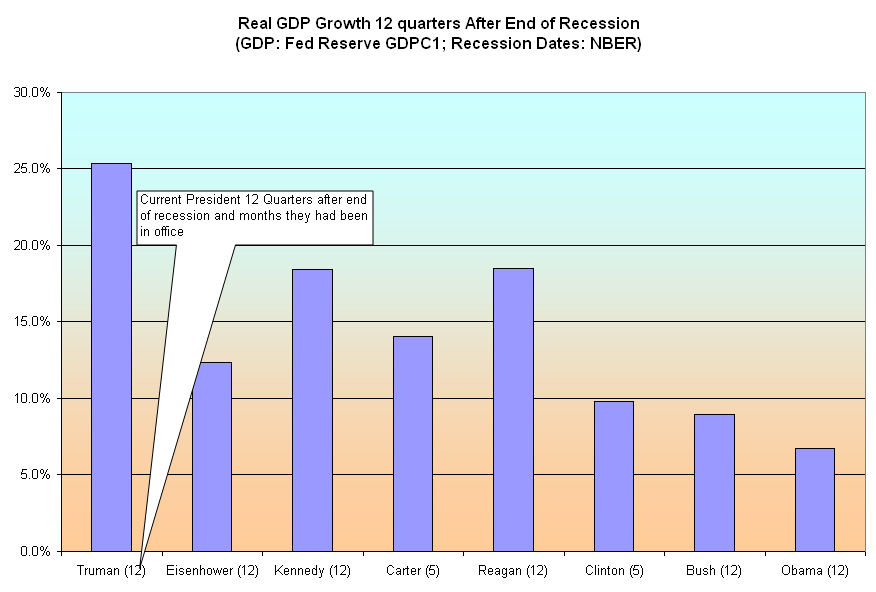
“Bummer, dude!” may be what President Obama’s election campaign manager thought when the quarterly GDP figures were released this past Friday.  Second quarter growth clocked an anemic 1.5% annualized growth rate – a tepid pace – but one which was slightly above the market consensus of 1.2%.   This first estimate of quarterly GDP growth is often revised up or down 1/2% as more data comes in (BEA Source).  Second and third revisions to the GDP growth rate will follow in August and September, but pose a challenge for any re-election campaign.  What is the pace of this recovery?  It has been three years, or 12 quarters, since the official end of the recession in the 2nd quarter of 2009.  In that time, real or inflation adjusted GDP has grown 6.7%.  What has the been the real GDP growth rate of past recoveries?  Below is a comparison of the total GDP growth of past recoveries and the Administrations in office at the 3 year mark after a recession (Click to enlarge in separate tab)

At the 3 year milestone after the 1960-61 recession, President Johnson had been in office for just two months after the assassination of Kennedy in November 1963.    At mid recovery after the long recession of 1973 – 75, Carter took over the reins from President Ford, who had taken office after Nixon resigned over the Watergate scandal.  Likewise, President Clinton took office from the first President Bush near the middle of an ongoing recovery from the recession of 1990 – 91.  In addition to the disgrace of resignation, President Nixon never enjoyed three years without a recession and so does not make it on this chart.  President Johnson has the distinction of never having a recession during his tenure in office.

Although the media and the public like to pin the economic tail on the President, the House and Senate have much more to do with the economy than the President.  Bills originate in the House (primarily) and Senate. Presidents do not initiate legislation.  Below is that same chart showing the mix of House and Senate during each recovery since WW2.

We can’t say that the strongest recoveries are when the House and Senate are the same party as the President.  We might be able to say that recoveries are strongest when Democrats are in the House, but Democrats ruled the house, except for four years in the late forties and early fifties, from 1933 through 1994 – a period of almost sixty years! (Metric Mash)  This doesn’t leave much for comparison.  We can’t say that a mixed Congress of Democrats and Republicans produces a weak recovery.  What makes this recovery unique is that, for the first time since at least 1900, the House switched parties during an economic recovery (Congressional Research Service, NBER and Metric Mash).  In the 2010 elections, anger over the health care act helped fuel a newly established Tea Party which worked within, not outside, the Republican Party and helped that party gain a large number of seats to take the majority in the house.  If history is any guide, the American public can change direction in the House during a recession, after a recovery, but not during a recovery.  The recovery plans set in place by either party need a chance to work themselves out.  To interrupt those plans in midstream produces a stalling effect.

Do the weak economic figures doom Obama’s re-election?  Not so, according to 538.  Whoa!  What’s 538?  The answer is who’s 538. And the answer to that who? is Nate Silver, a statistician who developed a system for predicting the performance of baseball players.  His methods for analyzing baseball proved to be suprisingly accurate in predicting the 2008 and 2010 elections.  After his almost perfect predictions for the 2008 electoral races and the recipient of a few awards, the NY Times licensed Mr. Silver’s blog in 2010. 

You can find Mr. Silver’s take on what the latest GDP figures mean for the election here.  Mr. Silver also has an interesting article on the primary economic indicators he thinks have the most influence on voter’s choices.  You can bookmark his blog here.