The Ethosphere

July 12, 2026

By Stephen Stofka

Last week I wrote about the ethosphere with a promise to expand on that this week. There are four interlocking areas that consistently affect our daily lives: economics, sociology, politics and the law. Each is interconnected by a system of ethics. Economics, sociology and politics concern the flow and distribution of power. The law is the rules by which those flows occur. Politics is the struggle over who gets to write the laws. Sociology is about the people who are affected by the distributions of power. Economics is the study of resources and their flows. Resources include capital, land and labor. Each of the other three areas governs the owners of resources and the flows.

A college student with an emphasis in either one of these four areas could probably design an interdisciplinary program that uses theories from one course of study to understand issues and events in other areas. For instance, a good understanding of the regulation of industrial pollution explores each of these areas.

Election Decisions

Many election issues are best understood if we look at each of these aspects. Let’s say there is an affordable housing issue on the ballot. We may not have the time or energy to do as much homework on the issue as we would like. Prompting an LLM like ChatGPT or Claude with these four aspects of the problem can help us. Here’s a prompt I put in ChatGPT: what are the economic, political, sociological and legal aspects of an election issue like rezoning for more affordable housing?

The two page response from ChatGPT began with: Each discipline asks different questions, uses different methods, and emphasizes different values. It went on to list the positives, negatives and unknowns from each of these four perspectives. Finally, it listed the central concern from each discipline. Sociologists are concerned about the effect on communities and social groups. Economists ask whether a policy will improve efficiency and affordability in the local housing market. A political scientist will ask who makes the policy decisions and ongoing administrative rules. A lawyer might be concerned with a ballot initiative’s compatibility with the state constitution. You might say that this is too much information, but it’s rare that we consider all aspects of an issue. Usually, there are one to three factors that are important enough to help us make a decision. The AI program is a reminder list.

Distributing the Gains from Productivity

If we have grown up with a set of rules, we may think that there is something natural about those rules, that there is some underlying principle. However, if there were clear and consistent principles of the distribution of profits, for example, our courts would not be busy. Let’s consider tools that increase worker productivity. The owner of a small construction company buys a tool that will help an employee become more productive. With the tool, the employee can do 25% more work in the same period of time. Who gets to keep the profit from the additional productivity? The employee, the employer, or a split of some sort?

The Constraints of the Market

If the employer paid for the tool then the employer decides, but that decision is subject to constraints. If the labor market is competitive, the employee may capture the majority of the gain in productivity. If a tool pays for itself in a month or two, it is likely that other employers will buy such a tool, then offer higher wages or benefits to an employee.

If there are a lot of companies competing for business, then a business might pass on the productivity gains to the consumer in lower prices. If a company is trying to expand, it might offer more return to investors or partners. In each of these cases, the distribution of the productivity gains responds to market conditions.

Human Capital

In the first example, the employer bought the tool. In this second example, the employee buys the productivity enhancing tool. The most common example is some educational training beyond high school. According to the Bureau of Labor Statistics, the median weekly earnings for an employee with a bachelor’s degree was $1530 in 2024, $600 more than the median for workers with only a high school degree (Source).

What is an employee’s total investment in that four year degree? Economists at the New York branch of the Federal Reserve estimated the total cost, including the opportunity cost, at $180,000 per year (Source). That total included $30,000 in direct costs per year, and governments contributed student aid of about $15,000 per year. An employee has invested a whopping $720,000 in that four year degree, more than most people invest in their home. That same study estimated a 12% annual return on investment.

Federal and state governments have contributed about $60,000 total in aid over a four year period. Where did the student aid come from?General taxes. Is this charity for college students? Not so. Over a 40 year working career, an employee with a four year degree pays back the initial public investment with higher taxes. In 2009, researchers at the RAND organization estimated a worker with a four year degree contributes about $160,000 (in 2002 dollars) more in payroll taxes over a lifetime than a worker with a high school degree (Source). In 2024 dollars, that’s $284,000, almost five times the initial investment using government taxes.

Students are Capitalists

Most students do not think of themselves as capitalists. Like the employer who bought the tool, a student makes an investment in their own human capital and this affects their future earnings on average. The principle of distribution seems to be that whoever invests the capital, whether it is money, or a combination of one’s labor and money, gets to keep the majority of any additional profits from the increased productivity.

The Economic Policy Institute compiled federal productivity data since 1948 and calculated that workers have captured 60% of labor productivity gains in higher compensation (Source). What is not visible is the relative shares of investment by employees and employers.

The Distribution of the Gains From Invention

When an employee or group of employees invents a new product or process, current law holds that the product or process belongs to the employee(s). Here’s the text of an opinion in Banks v Unisys (2000): “The general rule is that an individual owns the patent rights to the subject matter of which he is an inventor, even though he conceived it or reduced it to practice in the course of his employment. There are two exceptions to this rule: first, an employer owns an employee’s invention if the employee is a party to an express contract to that effect; second, where an employee is hired to invent something or solve a particular problem, the property of the invention related to this effort may belong to the employer” (Source). Naturally, businesses work hard to draw up ironclad employment agreements to secure those intellectual property (IP) rights. The default legal principle may be that the creator owns the patent rights but a patent is a form a long term capital. A business survives by securing that capital. Legal principle is simply an obstacle to be overcome.

AI Competes with Human Capital

If an employer buys a tool for an employee, the tool is portable. Another employee can use it. A college education is regarded as human capital, but it is capital that is non-transferable. The development of Artificial Intelligence (AI) has fundamentally altered this aspect of human capital. ChatGPT, Claude, and other AI machines have been trained on the writing of millions of people. AI agents reduce knowledge to a series of connections between words, then compute the probability of those connections. They do not always understand context, but they don’t call in sick, take holidays or want healthcare insurance. AI may not replace the human brain’s ability to synthesize knowledge into new paradigms but it can replicate a lot of the work that people depend on for their livelihood.

The Constraints of Democratic Government  

Conventional economic models treat government mandates like minimum wage, sick and overtime policies and safety regulation as outside the market. Those who favor laissez-faire economics want to minimize those kinds of policies. Why? Government policies usually do not respond to changing market conditions. Secondly, they create incentives for businesses to avoid those additional costs by hiring people “off the books,” or treating them as subcontractors even though the workers perform their duties under the direction of the employer.

In a democracy, however, politicians are very much a part of the market. They must appeal to voters. They must compete for political donations. They must align with other politicians to get anything done. To exclude them is to ignore a vital component of the marketplace. Politicians get elected by promising to fix problems. Fixes come in two varieties: repair and restore. Populist Presidents like Reagan and Trump chose the restore option. They appealed to voters by promising to undo some of the policy fixes of past decades. Other politicians like Bernie Sanders promise to implement existing solutions on a broader scale, like Medicare-for-all, or solutions that have been tried in other countries.

The Weaknesses of the Price System

The price system cannot manage large imbalances of supply and demand. During the Gilded Age in the late 1800s and in the first decades of the 20th century, eastern cities were crowded with an influx of European immigrants. There was a plentiful supply of workers willing to work for low wages to survive and gain a foothold in their new country. Jacob Riis documented the appalling housing conditions in New York City at that time (Source). The free market system encouraged landlords to offer the least living space for the most money that the new immigrants could afford. In many businesses, human labor was an indistinguishable commodity. Business owners maximized their profits by offering low wages and few worker protections. Tragedies like the Triangle Shirtwaist Factory fire in 1911 alerted the general public to the inhumane working conditions that many people endured (Source). These events aroused a public demand for reform and regulation that marked the Progressive Era from 1900-1929 (Source).

The Demand for Regulation

The more dense an urban area, the greater the desire for regulations. In a densely populated area, people make choices that have an impact on their neighbors. Freedom of choice is limited by our neighbors’ freedom of choice. Land, drinking water and proper sanitation are, by their nature, limited resources. The free marketplace and the price system cannot manage naturally limited resources. Those who want to minimize the number of regulations they have to live with should move to a less crowded area. Many people do. Over time, that migration has created two sets of voters: those with a preference for less density and less regulation, and those whose tolerance of their neighbors and greater regulation is balanced by the advantages of an urban area.

I hope to see you next week when I explore that polarization.

/////////////////////

Photo by BoliviaInteligente on Unsplash

Effective Governments

July 5, 2026

By Stephen Stofka

Last week I wrote about the system of rent control  in New York City as one of the many ways in which government interferes with a utopian model of laissez-faire economics. I had written that post earlier in the week and was surprised when the Rent Guidelines Board (RGB) voted to pass Mayor Mamdani’s proposal to freeze rents on rent stabilized units in the city for the next two years. This policy was similar to the old system of rent regulation known popularly as rent control. This week I want to look at several ways that government controls the price of essential commodities and services.

The Federal Reserve is an independent government agency that indirectly sets interest rates for all credit in the United States. This includes mortgages on homes, car loans, and credit cards. Higher interest rates increase business costs and businesses raise retail prices to their customers. Or do they? This is a debate among economists. The Fed raises interest rates to curb inflation, or the change in prices, not fan the inflationary flames. The theory is that higher interest rates will curb the use of credit, and push business costs higher. Interest is a factor of production that competes with other factors of production, namely labor. A reduction in the use of credit should lead to a lower demand for goods and services, prompting businesses to slow down their hiring and wage increases. That model fits the new car market where demand responds to price changes. That is not the case for goods and services that we buy each week.

Consumers pay higher monthly charges for rent, utilities, and food. Higher interest costs increase costs for landlords, leading to higher rents. Grocery stores pay for their food inventory with short term credit so higher interest rates put upward pressure on their costs and consumer prices. Farmers depend on credit so higher interest rates increase commodity prices, reduce farmers’ profits, or both. Electrical utilities finance all their capital improvements so higher interest rates increase utility bills each month. Unlike the market for cars, demand for these essential goods is inelastic, meaning that demand is rather insensitive to price changes.

Production costs and prices for new cars are affected, but demand for new cars does respond to price changes so this provides a counterbalancing effect, reducing the price increases. However, since people hold onto their vehicles longer, this reduces the number of used cars available for sale. Because the price of used cars is less than new cars, the demand for used cars increases. Both supply and demand factors increase the prices for used cars.

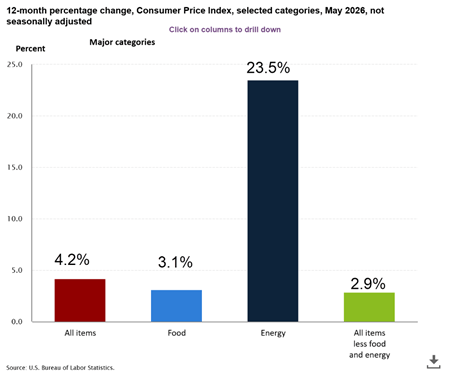
In setting interest rate policy, the Federal Reserve pays closer attention to a measure they call the Core CPI, the Consumer Price Index without volatile food and energy costs. They do this to gain a sense of underlying inflation trends. Here is a chart from the Bureau of Labor Statistics comparing different CPI measures as of May 2026 (Source).

Rising gas prices after the U.S. and Israel attacked Iran produced a spike in gasoline costs which accounted for most of the huge increase in energy costs. The Fed’s target inflation rate is 2%,  below either the All Item CPI (red), or the Core CPI measure (lime). Because of that, the members of the Fed’s interest rate setting committee, the FOMC, will lean toward a policy of rising or at least steady interest rates. This will put further pressure on consumer sentiments,  reducing the number of consumers who can qualify for home mortgages and car loans, even as higher gas prices effectively tax consumers.

Consider a small business whose employees make service calls. Plumbing, electrical, HVAC and home repair businesses typically consume a lot of gasoline. In addition, they frequently use a short term line of credit to carry their accounts receivable. Higher interest rates and higher gas prices are squeezing these kinds of companies from both directions. The same for farmers and ranchers who use a lot of gas and short term credit.

Interest rate policy affects all businesses and consumers but especially redistributes wealth among different businesses and consumers just as effectively as a policy of rent regulation does in New York City. Donald Trump’s decision to be led by the nose into Israel’s long running feud with Iran sparked a sharp rise in the price of gasoline. This effectively redistributed wealth from the working class, the blue collar trades, and rural folks to the weapons manufacturers and bankers who profit from war and a higher deficit. It’s an especially cruel blow to rural folks who voted for Trump. His comment that he doesn’t think about the effect of the war on the finances of everyday folks was an indication of the contempt he holds for working people (Source).

The government subsidizes a lot of perishable foods, influencing the pricing and availability of milk and dairy products, fruits and vegetables, meat, poultry, eggs and seafood. It does this largely through subsidies for animal feed, disaster assistance, crop insurance, and USDA purchases of food for public nutrition programs. A person who favors a policy of minimal government interference in markets may not realize that the price of their eggs is influenced by government programs which help to lower consumer prices.

The most government subsidies are channeled to commodity crops like corn, wheat and soybeans. Fruit and vegetable farmers complain that they receive far less subsidies for their crops than the growers of these crops. The subsidies for corn used to produce high fructose corn syrup have led to a sharp rise in obesity and higher healthcare costs (Source). Lower prices for fruits and vegetables would lead to greater consumption and might reduce the obesity epidemic. Subsidies for one type of food producer, the growers of commodity crops, redistributes wealth from tomato farmers in California to corn farmers in Iowa.

SNAP benefits, known as food stamps, provide food assistance to low income households (Source). Those who favor a reduced role for government may be accused of lacking compassion for others, particularly children. They argue that such programs are not the role of the federal government. Let the states create, administer and fund such charity programs. However, those states with the highest percentage of low income families don’t have the resources to fund such programs. One in five households in New Mexico, for example, qualifies for SNAP benefits  (Source). The national average is one in eight households. This is the irony of need. Those with the greatest need have the fewest resources. How a society handles these resource contradictions are central to its character.

Economists of the late 19th century forced a separation between the disciplines of economics, sociology and political science in order to understand economic principles better. Stanley Jevons, Alfred Marshall, and Francis Edgeworth were some of the leaders of this movement away from the complicated socio-political analysis of economics of Marx, David Ricardo and the Ricardian Socialists of the mid-19th century. The social, political, economical and ethical aspects of our daily lives are bound together in what I will call an ethosphere, the how of engaging with others in a society. Studying just one aspect in isolation leads to faulty conclusions.

Some economists and pundits treat the government as an actor outside the marketplace because it has taxation and police powers that other members of society lack. A corporation has unique features and powers as well. We don’t treat corporations as alien to the marketplace. The question is not whether government should take an active role in this ethosphere. It can’t help but take an active role. The question is the type of role it takes, not how active it should be. An effective government creates programs of redistribution to solidify political support among the various factions of a society. These programs increase a government’s capacity, build its legitimacy among its citizens, reduce the frictions that lead to civil war and help a government survive.

Next week I hope to explore the four components of the ethosphere. Hope to see you then.

///////////////////

Photo by Ayush Kumar on Unsplash

Wrestlers in a boxing ring

A Deadly Game

April 12, 2026

By Stephen Stofka

Imagine you and your buddy stop off at a grocery store. You wait in the driver’s seat while your buddy goes in to get a few drinks. A few minutes later, he comes running out of the store, hands stuffed in his poncho, but no drinks. As he settles into the passenger seat, you ask where are the drinks. Just go. Get out here, he urges. Both of you have had some minor scuffles with the law so you don’t ask. You go. Later, you are both arrested on suspicion of armed robbery. What neither of you know is that the security camera wasn’t working and the cops have no hard evidence.

You are taken into separate interrogation rooms. The detective and a district attorney enter the room. The detective offers you a deal. Confess to the crime and testify against your buddy and the police will let you off Scot free but your buddy will get ten years in prison. The detective cautions you that they are offering the same deal to your buddy, so you need to make a decision quickly. What if we both confess, you ask. The detective looks at the district attorney. Five years, the district attorney says. Your public defender asks, What if both of them act on their Constitutional right and remain silent? The district attorney reminds you of your record and assures you that they will get you on something that will probably keep you locked up for a year.

What do you do? Your strategy is to minimize your time in jail so the best tactic is to confess, hoping that you are the first to do so. A safe strategy would be to remain silent, take the year in jail, but that only works if your buddy cooperates and also remains silent. Otherwise, you get ten years in prison. So the default tactic is to confess, unless you trust your buddy. The game illustrates how people acting in their own best interest can achieve a worse outcome than cooperating with each other. In the 1950s, Albert Tucker first developed this scenario known as the prisoner’s dilemma as a concrete way to visualize a mathematical payoff matrix (Source). The RAND corporation later used it to illustrate the dilemmas of nuclear annihilation during the cold war between the United States and the USSR.

Under the anarchic system of international relations, there is no cop, no district attorney. Nations honor multi-lateral agreements out of necessity and advantage. Might makes right. While their leaders may give voice to moral principles, those principles are subordinate to the prime directive: survive. Survival was the primary motivation for the thirteen American colonies to join together under a new Constitution in 1787. In Federalist No. 11, Alexander Hamilton warned of the threats from the European nations who considered “the rest of mankind as created for her benefit,” referring to Europe as a unified threat. On the western and northern borders were the French, English and allied Indian nations. To the south were the Spanish and French. “Let the thirteen States, bound together in a strict and indissoluble Union, concur in erecting one great American system, superior to the control of all transatlantic force or influence, and able to dictate the terms of the connection between the old and the new world!” (Source).

In his 2024 election campaign, Donald Trump evoked those Hamiltonian sentiments. Let America stay out of far-flung foreign wars to chase the dream of American empire at the expense of our republic. In a recent interview with former UN Weapons Inspector Scott Ritter, Professor Glenn Diesen noted that America First was a promise to consolidate our national interests, to preserve our republic over the dreams of empire (Source). To join with Israel in an unprovoked attack on Iran prompts the question, what happened to that idea? In short, religious zeal and paranoia.

The Trump administration has been infected with a Crusader passion that makes America look like the gigantic octopus in Jules Verne’s Twenty-thousand Leagues under the Sea” (Source – trivia). In a March 31st New York Times op-ed, Thomas Friedman noted that Defense Secretary Pete Hegseth holds “extreme Christian nationalist beliefs” and that “In other words, it’s now our religious warriors against Iran’s” (Source).  Friedman could have included Israel in that coalition of religious warriors.

Because of Israel’s Proportional Representation election system, there are at least a dozen parties in the country. In such a system, common in some form in many European countries, people vote for a party, not a person. Each party that passes a minimum threshold percentage of the vote receives a proportional number of seats in the country’s parliamentary body, the Knesset (Source). Each of the two main parties, Likud and Labor, often forms alliances with minority groups to secure a 61 seat majority out of 120 seats. In cases where the majority advantage is slim, the loyalty of these minority groups is crucial and they are able to drive bargains that are out of proportion to their number in the general population. This means that a party with less than 10% of the vote might have non-negotiable demands that one of the major parties has to meet. When these demands are not met, those crucial votes are lost and Israel’s government collapses. New elections are called.

Benjamin Netanyahu’s party, Likud, often partners with religious extremist groups to secure a majority in Parliament. The primary group is called Shas and represents the Mizrahi/Sephardi ultra-Orthodox Haredi Jews (Source). Like Muslims who believe that Sharia law should be followed instead of secular law, many ultra-Orthodox believe that Jewish religious law should be the law of Israel. Many support the illegal settlements in the West Bank as the return of the ancient kingdom of Judea in Biblical times. They insist on being excluded from mandatory military service, but support military action to achieve a goal. Some believe in the notion of a Greater Israel, a land that stretches from the Jordan River to the Mediterranean Sea, a land governed by Jews for the benefit of the Jewish inhabitants.

If the United States had a proportional system, the Evangelical Christians would probably form at least one minority party and have seats in Congress. In the United States our winner-take-all system favors just two formal parties which incorporate minority coalitions within each party. Like Likud, the Republican Party partners with evangelicals, promising to promote their causes in exchange for their vote (Note below). There is no Evangelical Christian Party but they do influence who serves in government. Pete Hegseth, the Secretary of Defense, states strong Christian nationalist views and has two tattoos that evoke the imagery of the Crusades (Source). He believes in religious war as an existential battle between Christianity and Islam. President Donald Trump may have promised “no more foreign wars,” but chose Hegseth, a Medieval Crusader, to steer the country’s war machine.

The closure of the Strait of Hormuz threatens the supply of oil, fertilizer and helium used in electronics manufacture. As critical components of the global economy, shortages in those materials may trigger a global recession or worse. Trump wants an exit from this dilemma, but the other prisoner in the dilemma is not Iran. It’s Israel. In this version of the game, Israel and the United States are not in separate rooms but fighters on a tag team in the same boxing ring (Note below). One fighter wants to declare a tie and fight another day, while the other is determined to fight on but can’t survive alone.

And on that cheery analogy, I hope to see you next week.

/////////////////////

Photo by Claudia Raya on Unsplash

Note: The Democratic Party also partners with social justice groups like the ACLU and the NAACP. If the United States had a proportional representation system, these groups that focus on fairness, equality, and protection of human rights might form a Social Justice Party. If the Democratic majority in the House were slim, votes from the Social Justice Party would be critical to maintaining the majority. In our system, the influence is informal but it allows small groups to have a lot of policy leverage.

Note: The political scientist John Mearsheimer sometimes refers to the United States and Israel as a tag team.

Equity and Equality

This week the debate over the minimum wage continued in the Senate, on C-Span, other news outlets and social media. The Wall St. Journal presented the minimum wage in Big Mac terms. In 1968, it took 18 minutes of minimum wage to buy that iconic hamburger. Today, it takes 30 minutes of minimum wage. Using that as a guideline, the minimum wage should be at least $12.

Why don’t Democrat politicians propose a minimum wage that varies according to each region’s cost of living (COL)? According to survey data, Colorado’s COL is 73% of California’s COL (MERIC, 2021). Using that as a guideline, Colorado’s minimum wage would be about $11, the same as the current minimum. Missouri’s minimum would be $8.35, which is LESS than the state’s current minimum of $8.60. Many states have implemented a $15 COL-adjusted minimum wage.  

Advocates for a uniform minimum wage argue that they want to erase some of the disparity between urban areas and low paid rural regions, many of which are black or Hispanic. Those in rural areas worry that small businesses will lay off workers, driving the unemployment rate higher than it already is. Others worry that businesses will raise their prices, making it more difficult for those on fixed incomes. In that case, the minimum wage would benefit some at the expense of others.

Twenty years ago, an analysis of minimum wage increases and employment data found only one statistically significant correlation: increases had a minimal effect on teenage employment (Burkhauser, Couch, & Wittenburg, 2000). Other studies have found no effect on employment in the fast-food industry. A recent study examined minimum wage increases in the states and found that increases greater than a $1 had a negative impact of 1% on low-skill employment (Clemens & Strain, 2018). Smaller increases had either no effect or a positive impact. How can we have an informed debate if history does not provide a clear lesson?

Since Plato’s time 2500 years ago, we have wrestled with equality, equity, and justice. Equity measures by outcome, varying the inputs until the outcomes are about the same. Equality measures by inputs; if everyone gets the same chance, the same inputs, then equality is satisfied. Plato argued that justice was an individual functioning well within community. Some of his companions in The Republic argued for alternate versions of justice: that it was the interests of the stronger, that it was helping friends and harming enemies, or telling the truth and paying your debts.

John Maeda posted a Tony Ruth graphic that depicts these concepts of inequality, equality, equity, and justice (2019). Two kids stand on opposite sides under a leaning apple tree so that one kid below the overhang gets most of the apples that fall. That is inequality. They are both given a ladder of equal height; since they each have the equal tools, that is equality. The kid below the overhang is given a shorter ladder to compensate for his better opportunity at picking apples; that is equity. Justice is the equalization of opportunity and tools; using braces and ropes, the tree is straightened, and each kid is given the same size ladder. Justice is both equity and equality.

As a society we often can’t straighten the tree; if we could, who pays for the labor, braces, and ropes? Who owns the ladders? Writing 500 years ago, Machiavelli said that a republic is the best form of government because the two main political classes of society constantly wrestle with these issues. The two groups may be labeled nobles and common people, or Republicans and Democrats, but they are essentially a tug of war between these notions of equity and equality. One group champions equity over equality; the other fights for equality as a priority above equity.

As we listen to debates in Congress, the workplace, and our households, we can identify those two elements. The argument then evolves into the particulars of process, and this is used to justify either side of the equity / equality debate. Machiavelli wrote that people make fewer mistakes when they focus on the particulars. In working out the details we uncover the broad issues that we tussle over. The road of history is curved; to keep from running off the road, we adjust the steering wheel left and right, repeatedly correcting our previous course corrections. This is a time for correction.

//////////////

Photo by Splint on Unsplash

Burkhauser, R. V., Couch, K. A., & Wittenburg, D. C. (2000). A reassessment of the New economics of the minimum Wage literature with monthly data from the current population survey. Journal of Labor Economics, 18(4), 653-680. doi:10.1086/209972

Clemens, J., & Strain, M. R. (2018). The short-run employment effects of recent minimum wage changes: Evidence from the American community survey. Contemporary Economic Policy, 36(4), 711-722. doi:10.1111/coep.12279

Maeda, J. (2019, March 11). Design in Tech Report 2019 | Section 6 | Addressing Imbalance. Retrieved March 06, 2021, from https://designintech.report/2019/03/11/%F0%9F%93%B1design-in-tech-report-2019-section-6-addressing-imbalance/

MERIC. (2021). Cost of living data series. Retrieved March 06, 2021, from https://meric.mo.gov/data/cost-living-data-series

A Nation of Storytellers

February 28, 2021

by Steve Stofka

In our national narrative, the sheriff comes to town and the virtuous town folk walk without fear. Four years ago, President Trump promised to be that sheriff, routing out the miscreants that lived in the Washington swamp. When he was the unlikely winner of the 2016 election, religious romantics attributed his victory to God, not the arcane rules of the Electoral College. When he lost the 2020 election, God was nowhere to be found. He had been chased off by cheaters who had stolen the election from their candidate. Hollywood could only have been invented in America. We are storytellers.

On January 6th, a group of self-dubbed patriots attacked the Capitol building in Washington. In their eyes, the lawmakers in that building were illegitimate, and the vigilantes assumed their Constitutional duty to unseat those lawmakers. They were the Tea Party attacking the British in Boston Harbor more than two hundred years ago. Through social media they had amplified their role in the American myth, taking center stage in a fight for freedom.

America is a game of Prisoner’s Dilemma, the game theory scenario where two prisoners, each in a separate interrogation room, must decide whether to confess to a crime. If neither confesses (they cooperate), they get off with a light sentence. If one confesses and the other doesn’t, one goes scot free and the other is given a harsh sentence. If they both confess, they are both given a medium-term sentence. The players have a choice to cooperate (neither confesses) or defect (confess). If the game is played once, it is better for each prisoner to defect. If the game is played multiple times and there is a memory between games, the prisoners should cooperate.

American politics is not a cooperative game. Within a decade after the ratification of the Constitution, the founders realized, to their dismay, that they had created a vicious party system. In 1800, the founders themselves were engaged in an electoral battle, ready to smear each other’s reputations and the honor of their families to gain the power of the Presidency.

In the halls of Congress, the prisoners meet in committee rooms. They confess to the crime of representing their constituents. They confess to the sin of defending their principles. They handcuff themselves together with rules of order, then come out fighting. They play this game every day, each party unable to cooperate with each other, but telling themselves a story that they are cooperating with the rules. Outside the halls of Congress, their constituents are fighting without rules. The breach of the Capitol building brought the fight inside.

We are storytellers. After World War 2, many Americans lost their jobs and careers on suspicion that they were Communist sympathizers. Today a common phrase is “if you see something, say something.” The campaign began as a response to the 9-11 attack but has been extended to mean any suspicious activity. The “see something, say something” campaign means to promote predator awareness – those who would victimize children and women. Trayvon Martin and Ahmaud Arbery were two men who looked suspicious and were gunned down by white vigilantes who interpreted the Constitution to give them the right to defend their community against suspicious people.

Hong Kong is an island off mainland China that was formerly under British rule and prized its independence from Communist rule on the mainland. They are telling a different kind of story – turning on each other. As part of a campaign by the mainland Communist Party to repress street protests in Hong Kong, the government set up a hotline to report suspected violators of new security laws aimed to restrict criticism of the government in the media. 40,000 virtuous and vigilant residents have squealed on their neighbors.

Myths connect people but our stories are tearing us apart. Our media is saturated with a mixtape of opinion, lies and carefully filtered facts to present some Americans as the “other.” The Chinese government encourages Hong Kong residents to turn on each other. In our country, the media does the same job. We are proud of those freedoms even if they destroy our civility and our cohesiveness as a society.

///////////////

Photo by Patrick Tomasso on Unsplash

A Policy Pivot?

February 21, 2021

by Steve Stofka

Climate change induces more erratic weather patterns. More dry and wet; colder and hotter. California has been hit by persistent drought. Texas and other southern states got walloped this week. Several dozen Texans lost their lives when electricity generation failed for several days this week. For two decades, Texas has adopted a relaxed regulatory policy that does not incentivize or require power generators to prepare for unusual events like this week’s cold snap. Texas legislators argued that these policies reduced costs and lowered bills for Texans. Other states with more stringent regulations weathered the cold snap because power operators beef up their generation system to withstand extremes.

Natural gas supplies 46% of Texas’ electricity generation. The valves and regulators on those lines froze because of a lack of heating equipment. Wind turbines supply 23% of Texans electricity but had no heaters installed as they do in other states. Because Texas has its own electricity grid, it has no power balancing arrangements with other states. Texans pride themselves on their self-reliance to the point of arrogance. They are the Lone Star State, Texans first, Americans second.

Through district gerrymandering a minority of Republican voters in Texas control policy. The state has a constitutionally weak governor with little power. The legislature promotes someone to the post who will be agreeable. Politics is heavily influenced by the oil and gas industry whose rights are senior to property owners. If a gas company wants to run a pipeline through someone’s property, an owner has a difficult fight.

Because Texas was part of Mexico until the 1840s, its laws and culture are influenced by the hacienda system set up by Spain in Latin and South America during the 17th century. In that colonial period, the Spanish monarchy took control away from parliament, imposed a uniform religion and a rigid centralized bureaucracy. Land in the Americas was parceled out in large tracts called haciendas to those who were loyal to the crown. This promoted a system of personal relations among landowners, people over principle, and a lack of growth and technological improvement. Like cuttings on a plant, the culture of white settlers in Texas were grafted onto this system. Texans adopted the “good old boy club” that has plagued politics in Latin America for centuries and made it their own.

Northern states were initially settled by colonists from England. In the 17th century, the English Parliament took power from the monarchy, a power shift opposite that in Spain. Religious and political diversity carried over from the motherland to the colonies and became institutionalized. Property rights, and the products of property could be conveyed to others. This encouraged a system of principle over person, a more impersonal exchange that fostered technological development.

Texas culture relies on tradition more than innovation, but the state provides a fertile and friendly atmosphere for innovative businesses from other states. Business growth relies on a flourishing human capital. Texas’ K-12 schools rank in the middle of the 50 states and above California, both with large immigrant populations and low English fluency (McCann, 2020). However, a state that cannot manage its power grid is not an attractive environment for business.

Will this crisis spark a shift in policy? Texas has long been captured by special interests, who are antagonistic to change. The past few years Texas politicians have stood proud, calling to California businesses, “Come here and get away from those regulations.” That cheery welcome has been tarnished this week. Business executives might wonder if Texas has other infrastructure problems. Texans hope that the fast-moving news cycle will turn its attention elsewhere.

//////////////////////

Photo by Alexander Schimmeck on Unsplash

McCann, A. (2020, July 27). States with the best & worst school systems. Retrieved February 20, 2021, from https://wallethub.com/edu/e/states-with-the-best-schools/5335

Alt Belief

December 6, 2020

by Steve Stofka

Cognitive dissonance controls our political sensibilities. We speak in cryptic code and listen only to those whose code we understand. Our understanding is the standard by which we judge all other versions of reality. There is a dedicated band of people determined to preserve out of fashion ideas and explanations. Life would be easier if the people who disagreed with us would change their minds.

Listening to Washington Journal on C-Span this past week, I realized why my sensibilities lie with the Democratic Party. I can argue with their ideas, some of which I do not agree with. A Republican Congressman said that the government has no right to dictate the personal behavior of people, even though that behavior might kill people. On the other hand, the government does have the right to dictate the personal behavior of women on the chance that they might kill their fetus. My head exploded and I moved on to something else.

Several decades ago, Republican voices used to make more sense. Either the party has changed, or I have. Is this any way to discover my political allegiances? American politics is driven more by disaffection. The enemy of my enemy is not my friend, but more like my foxhole companion on the political battlefield. Both sides of the political aisle would benefit more if they cooperated, but it pays to compete, or to defect as it is known in Game Theory. If the other side says 2+2=4, then our side will claim the answer is 5. Rally ’round the flag, boys. In this prisoner’s game, the American public is forced to play along.

The American people and the members of Congress, but especially the Senate, live in different realities. Many families cannot pay their rent; the lines at food pantries stretch for many blocks; 20% of retail businesses have closed their doors; depression, drugs and suicide are increasing. Lounging in their Roman baths, our Republican Senators argue the ontological points of another aide package. Republican led states, dependent on energy or tourism, are begging their party for help. Senate Majority Leader McConnell wraps his white tunic about him, bids his slaves to draw his bath, and refuses to budge.

It’s always the other fella who is living in an alternate reality. When Einstein first noticed that, he built himself a theory. Some people thought he was living in an alternative reality, but after a century, most agree that his explanation was a good one. E=mc2 is as well-known as the 2600-year-old Pythagorean theorem a2 + b2 = c2.

Many alternate realities die as people come to agree on things. There are a few people who won’t let an explanation die. The earth is still flat. The moon landing was a hoax. So is Covid. Massive voter fraud gave Joe Biden a 7 million vote victory over Donald Trump. I used to think that ideas changed one death at a time. Now I’m not so sure. Some ideas are stubborn.

People and mules have much in common. We respond better to carrots in front of us instead of whips behind us. Why then do people on each side of the political aisle whip each other with words? Did we all run out of carrots?

People fix their minds on something and never change. That’s a conservative. Facts will not budge them from their ideological foxholes. The economist John Maynard Keynes said that he changed his mind when presented with new facts. That’s a liberal. They respond to the whip of facts and the carrot of something better.

We begin life with no fixed ideas. Our parents and the people around us put their ideas in our heads. Some of them grow, some fall out. People get mad at us when the ideas they planted don’t take hold in our minds. As adults, we learn that lesson at the Thanksgiving dinner table.

We are more comfortable when we are with those who share a common perspective. Perhaps we think God controls every detail of our lives, or that [insert name here] is part of a conspiracy that controls every detail of our lives.

No matter how different political and religious institutions are, they want us to believe what they believe. That is the problem: getting others to believe what we believe. We believe that what we believe is not a belief, but reality. Your belief is a belief. You see that, don’t you?  

/////////////////

Photo by K. Mitch Hodge on Unsplash

Heathens and Wizards

During negotiations over raising the debt ceiling from July 26th to August 8th, 2011 the S&P500 fell 16%.  The index fell only 1% in the first week of negotiations as it looked like President Obama and Republican Majority Leader John Boehner might strike a deal.  Then the bottom fell out.

In the week of trading since budget talks intensified on Dec. 20th, 2012 the S&P500 has lost 2%. 

Investors are worried but hopeful that Congress and the President can come to some resolution before tax increases and spending cuts automatically take effect on January 1st.  Housing and automobile sales are showing renewed strength; the yearly increase in Christmas shopping was a disappointment but the underlying fundamentals of the economy give reason for cautious optimism.

The rapid decline in last year’s stock market should serve as an example to investors in today’s market.  For the long term investor, a further decline of 5 – 15% will present some buying opportunities – time to make that IRA contribution or to put some sidelined cash to work.

The volatility index, or VIX, measures the relative uncertainty of the broader market using a formula that analyzes the bid -ask spreads of option contracts, which are promises to buy or sell stocks in the future.  When the markets are fairly calm, the VIX index is under 18 – 20.  As markets melted down in October 2008, the VIX rose to 80.  So, 16 is pretty good; 80 is real bad. In the last week of July 2011, this index jumped 20%, then skyrocketed to 48 in the first week of August.

This past week, the VIX went up from the calm range of 18 to 23, indicating the underlying worry.

Last week I wrote about the debate over which inflation measure to use, the CPI or deflator.  If you hear about “chained dollars” or “chained CPI”, it is the deflator that they are referring to.  The difference between the two yardsticks is $3 – $5 per month in a $1000 Social Security check.  This afternoon, Senate Majority Leader Harry Reid walked away from negotiations over this issue.  As I write this in the afternoon of Sunday, Dec. 30th, Senator John McCain has announced that Republican Senators have just taken this issue off of the table.  We can expect that the issue will come up again in the coming negotiations over the raising of the debt ceiling.

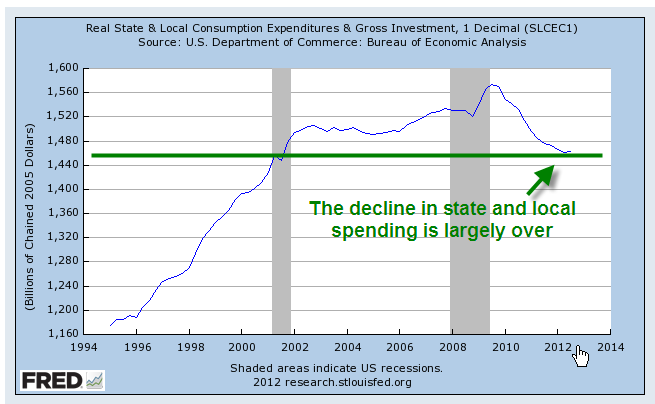
For the past several years, Republicans both in Congress and at the state level have targeted the growth in state and local spending.  This campaign of austerity, as Democrats call it, or fiscal common sense, as some Republicans call it, has won Republicans the governerships of thirty states.  Most of that spending growth has been curbed.

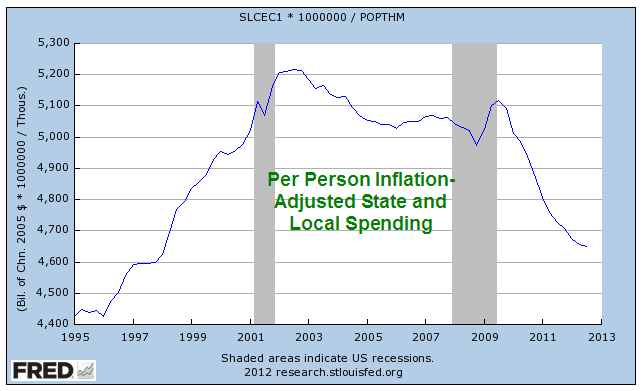
On a per person basis, inflation adjusted spending is at the same level as the mid 1990s.

For states, this return to mid 1990s spending levels has meant cuts in services to their residents.  Medicaid spending takes an increasingly larger portion of state budgets; because states can not run budget deficits, reductions have to be targeted toward education and infrastructure spending.  In 2011, Medicaid spending averaged 25% of state budgets, more than the 20% spent on education (Reuter’s source)

While Republicans dominated the Congress and Presidency in the early 2000s, they showed little concern for the growth in what they call entitlements, programs like Medicare and Social Security.  Instead, they increased entitlement programs, adding a Medicare drug benefit program.  Since they lost their Congressional dominance in 2006,  Republicans have become more cost conscious – and the next targets are entitlements.  Most seniors who have paid into Medicare and Social Security all their lives do not consider these programs as “entitlements.”  It is a dog whistle word that Republican politicians use to call out to their pack.

Democrats look and look and look but simply can not find any cuts that they can make to the social safety net.  Under the rubric of compassion, the Democratic strategy consists primarily of buying votes with ever more social welfare programs.  In the Democrat view, a government and its citizens are in a partnership.  Republicans rightly point out the dangers in any partnership where one partner, the government, holds all the power.  Despite all the rhetoric about limited government, Republicans are advocates of a different kind of partnership between government and corporations whose political contributions are essentially kickbacks for contracts with the federal government and a more relaxed regulatory environment.

Supposedly vigilant Republicans get out their spending cleavers but can not find any cuts they can make in current defense spending.   The operative word here is “current.”  The Defense Dept lives in a budget bubble that most of us would envy because it has little economic responsibility for soldiers once they leave the service.  Most rehabilitation, medical, housing, retraining and other services that the soldier is entitled to or need are no longer born by the defense department. Congress “dumps” these costs on the Human Services department, routinely targeted by Republicans for spending reductions.  In inflation adjusted dollars, we are currently spending 30% more on defense that we spent during the Vietnam War years, 25% more than during the military buildup of the Reagan years.

At the beginning of this century, we have two parties whose allegiances prevent them from coming to any meaningful compromise.  Tax policy is riddled with temporary tax cuts to promote various social causes. Special interest groups and wealthy taxpayers nibble away at tax legislators, creating a swiss cheese of fairness. Budget planning is a legerdemain practiced by a small coterie of heathens and wizards in budget committees; under current budget rules, there are few reductions in spending, only reductions in projected increases in spending.  Imagine that your family budgets for a 3% yearly increase in your utility bills.  One year, the utility company has no rate increase.  Your family claims that they have cut spending on utilities.

The Defense Dept has no long term accountability for the care of their soldiers.  The Human Resources Departments have no accountability for increases in health care spending; they are on automatic pilot.  Congress has no accountability for passing a budget; they have not done so for six years yet continue to get paid.  Bankers risk huge amounts of money that threaten the savings of millions; the company pays a relatively small fine and the individuals responsible suffer no criminal prosecution because of the difficulty and expense of such trials. The public senses that the political party system is morally bankrupt; that the leaders and representatives of this country are unable to break out of the cycle of partisan brinkmanship; that many representatives are bought and paid for; that most of the public has been left out of the deal. 

The public will either find a way to reclaim their authority over the political process of governing or be left standing helplessly on the sidelines while the two parties scrimmage at midfield, both parties having lost sight of either the goal or the audience.  Political advantage has become their goal.  Party leaders enforce a rigid heirarchy of committee assignments, rewarding those in the party who comply while shrugging off those who might compromise.  Gerrymandered districts ensure that many representatives are accountable only to the more rigid ideologies of their district;  their sole challenge comes from extremists in their own party. 

Maybe this time is different.  Maybe not.  Slowly and finally, the social, economic and political order cracks; the public votes in the most extreme elements who promise to restore order and principle or their version of fairness.  What they bring is despotism.

But that could be many years in the future.  For now, we salute the New Year!