
July 5, 2026
By Stephen Stofka
Last week I wrote about the system of rent control in New York City as one of the many ways in which government interferes with a utopian model of laissez-faire economics. I had written that post earlier in the week and was surprised when the Rent Guidelines Board (RGB) voted to pass Mayor Mamdani’s proposal to freeze rents on rent stabilized units in the city for the next two years. This policy was similar to the old system of rent regulation known popularly as rent control. This week I want to look at several ways that government controls the price of essential commodities and services.
The Federal Reserve is an independent government agency that indirectly sets interest rates for all credit in the United States. This includes mortgages on homes, car loans, and credit cards. Higher interest rates increase business costs and businesses raise retail prices to their customers. Or do they? This is a debate among economists. The Fed raises interest rates to curb inflation, or the change in prices, not fan the inflationary flames. The theory is that higher interest rates will curb the use of credit, and push business costs higher. Interest is a factor of production that competes with other factors of production, namely labor. A reduction in the use of credit should lead to a lower demand for goods and services, prompting businesses to slow down their hiring and wage increases. That model fits the new car market where demand responds to price changes. That is not the case for goods and services that we buy each week.
Consumers pay higher monthly charges for rent, utilities, and food. Higher interest costs increase costs for landlords, leading to higher rents. Grocery stores pay for their food inventory with short term credit so higher interest rates put upward pressure on their costs and consumer prices. Farmers depend on credit so higher interest rates increase commodity prices, reduce farmers’ profits, or both. Electrical utilities finance all their capital improvements so higher interest rates increase utility bills each month. Unlike the market for cars, demand for these essential goods is inelastic, meaning that demand is rather insensitive to price changes.
Production costs and prices for new cars are affected, but demand for new cars does respond to price changes so this provides a counterbalancing effect, reducing the price increases. However, since people hold onto their vehicles longer, this reduces the number of used cars available for sale. Because the price of used cars is less than new cars, the demand for used cars increases. Both supply and demand factors increase the prices for used cars.
In setting interest rate policy, the Federal Reserve pays closer attention to a measure they call the Core CPI, the Consumer Price Index without volatile food and energy costs. They do this to gain a sense of underlying inflation trends. Here is a chart from the Bureau of Labor Statistics comparing different CPI measures as of May 2026 (Source).
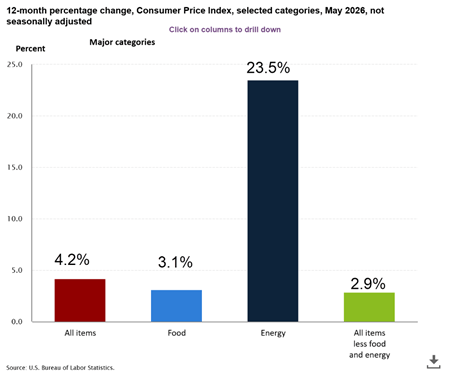
Rising gas prices after the U.S. and Israel attacked Iran produced a spike in gasoline costs which accounted for most of the huge increase in energy costs. The Fed’s target inflation rate is 2%, below either the All Item CPI (red), or the Core CPI measure (lime). Because of that, the members of the Fed’s interest rate setting committee, the FOMC, will lean toward a policy of rising or at least steady interest rates. This will put further pressure on consumer sentiments, reducing the number of consumers who can qualify for home mortgages and car loans, even as higher gas prices effectively tax consumers.
Consider a small business whose employees make service calls. Plumbing, electrical, HVAC and home repair businesses typically consume a lot of gasoline. In addition, they frequently use a short term line of credit to carry their accounts receivable. Higher interest rates and higher gas prices are squeezing these kinds of companies from both directions. The same for farmers and ranchers who use a lot of gas and short term credit.
Interest rate policy affects all businesses and consumers but especially redistributes wealth among different businesses and consumers just as effectively as a policy of rent regulation does in New York City. Donald Trump’s decision to be led by the nose into Israel’s long running feud with Iran sparked a sharp rise in the price of gasoline. This effectively redistributed wealth from the working class, the blue collar trades, and rural folks to the weapons manufacturers and bankers who profit from war and a higher deficit. It’s an especially cruel blow to rural folks who voted for Trump. His comment that he doesn’t think about the effect of the war on the finances of everyday folks was an indication of the contempt he holds for working people (Source).
The government subsidizes a lot of perishable foods, influencing the pricing and availability of milk and dairy products, fruits and vegetables, meat, poultry, eggs and seafood. It does this largely through subsidies for animal feed, disaster assistance, crop insurance, and USDA purchases of food for public nutrition programs. A person who favors a policy of minimal government interference in markets may not realize that the price of their eggs is influenced by government programs which help to lower consumer prices.
The most government subsidies are channeled to commodity crops like corn, wheat and soybeans. Fruit and vegetable farmers complain that they receive far less subsidies for their crops than the growers of these crops. The subsidies for corn used to produce high fructose corn syrup have led to a sharp rise in obesity and higher healthcare costs (Source). Lower prices for fruits and vegetables would lead to greater consumption and might reduce the obesity epidemic. Subsidies for one type of food producer, the growers of commodity crops, redistributes wealth from tomato farmers in California to corn farmers in Iowa.
SNAP benefits, known as food stamps, provide food assistance to low income households (Source). Those who favor a reduced role for government may be accused of lacking compassion for others, particularly children. They argue that such programs are not the role of the federal government. Let the states create, administer and fund such charity programs. However, those states with the highest percentage of low income families don’t have the resources to fund such programs. One in five households in New Mexico, for example, qualifies for SNAP benefits (Source). The national average is one in eight households. This is the irony of need. Those with the greatest need have the fewest resources. How a society handles these resource contradictions are central to its character.
Economists of the late 19th century forced a separation between the disciplines of economics, sociology and political science in order to understand economic principles better. Stanley Jevons, Alfred Marshall, and Francis Edgeworth were some of the leaders of this movement away from the complicated socio-political analysis of economics of Marx, David Ricardo and the Ricardian Socialists of the mid-19th century. The social, political, economical and ethical aspects of our daily lives are bound together in what I will call an ethosphere, the how of engaging with others in a society. Studying just one aspect in isolation leads to faulty conclusions.
Some economists and pundits treat the government as an actor outside the marketplace because it has taxation and police powers that other members of society lack. A corporation has unique features and powers as well. We don’t treat corporations as alien to the marketplace. The question is not whether government should take an active role in this ethosphere. It can’t help but take an active role. The question is the type of role it takes, not how active it should be. An effective government creates programs of redistribution to solidify political support among the various factions of a society. These programs increase a government’s capacity, build its legitimacy among its citizens, reduce the frictions that lead to civil war and help a government survive.
Next week I hope to explore the four components of the ethosphere. Hope to see you then.
///////////////////
Photo by Ayush Kumar on Unsplash

