Fish and Bones Investing

January 14, 2024

by Stephen Stofka

This week’s letter is about our portfolios and the return we earn for the risks we take. Flounder is tasty but be careful of the bones. January is a good time to review savings and assets and start making plans for 2024. Did I make any contributions to my IRA in 2023? After the gains in the stock market last year, how has my portfolio allocation changed? I thought I would take a wee bit of time to review the performance and key indicators of some model portfolios over the past sixteen years. We have endured a great recession, a financial panic, a slow recovery during the 2010s and a pandemic in 2020. Despite all those setbacks the SP500 index has more than tripled since December 2007. Huh?! Before I begin, I will remind readers that none of what I am about to say should be considered financial advice.

Allocation

A portfolio can be separated into three broad categories: stocks, bonds, and cash. Stocks are a purchase of equity or ownership in a company;  bonds are a purchase of public and private debt; cash is an insurance policy. Each of these can be subdivided further but I will stick with these broad categories. An allocation is a weighting of these types of assets. A benchmark allocation is 60/40, meaning 60% stocks and 40% bonds and cash. The percentage of stocks in a portfolio indicates an investor’s appetite or tolerance for risk. In this review I will discuss three allocations: 50/50, 60/40 and 70/30. A 70/30 allocation is considered more aggressive than a 50/50 allocation.

Investment Cohorts

The 50/50 portfolio was invested equally in the SP500 (SPY) and the total bond market (AGG) at the start of each 8-year period, beginning with the period that began in 2007. I will refer to these 8-year periods as cohorts, just like age cohorts. The 2007 cohort was “born” on January 1, 2007, and “died” on December 31, 2014. The second cohort was born on January 1, 2008, and died on December 31, 2015. There was no rebalancing done throughout each period to test the effect of a severe financial shock during the life of the investment.

Presidential Administrations

I picked an 8-year period because it aligns with two Presidential terms. A change in administration alters the political climate and presumably has some effect on a portfolio’s returns. The data, however, did not confirm that hypothesis. Presidential candidates try to persuade voters that their candidacy and their party will make people better off. To the millions of people trying to build a retirement nest egg, a change in administrations during the past 16 years had little effect. The market responds to forces much broader than the policies of any administration.

Specific Cohorts and their Returns

Let’s look at a few cohorts. Despite the severe downturn during 2007-2009, the slow recovery and the pandemic shock, the more aggressive 70/30 allocation delivered consistently higher returns than the two safer allocations. Obama’s two term Presidency began in 2009 at a decades low in the stock market, an opportune time to invest. However, that 8-year return had only the second highest return in this analysis. The highest return was the 2013-2020 cohort that consisted of Obama’s second term and Trump’s only term (so far).

Risk vs. Return

In 2008 a 50/50 portfolio cushioned the 37% loss in the U.S. stock market but over an 8-year period, the advantage of a safer allocation largely disappeared. In the period that began in 2008 all three portfolios delivered less than a 6% annualized return. During a severe downturn, a safer portfolio can mitigate an investor’s fears but the best tonic is a long term perspective. Generally the difference in returns is about 1% per year so the 50/50 portfolio earned 1% less than the 60/40 which earned less than the 70/30 portfolio. However the 70/30 investor absorbed more risk than the other two portfolios. In the chart below is the standard deviation (SD) of each portfolio, a measure of the risk or variation in a portfolio.

Performance Metrics

Recall that the 2013 cohort (green dotted line) had a return above 12%. The risk was almost 11%, a nearly one-to-one ratio of return to risk. Financial analysts have developed several measures of the tradeoff between risk and return. The Sharpe ratio is a measure of return that adjusts for risk by subtracting the return on a really safe investment from the return on the portfolio. The benchmark for a risk free investment is a short term Treasury bill (The interest rate on a money market account would be a close substitute).

Let’s use some rounded figures from the 2013 cohort as an example. The 70/30 portfolio earned 12% and a safe investment earned just 1%, a difference of 11%. That is the numerator in the Sharpe ratio. The denominator is the level of risk which is the standard deviation (SD) mentioned above. The SD was almost 11%, giving a ratio of 1. In the chart below is the Sharpe ratio for each cohort and shows that the actual ratio of 1.1 was close to the approximation above. Notice that the safer 50/50 portfolio often had the higher risk adjusted return.

From Peak to Valley

Investors may ask themselves “how much in return can I earn” when the more appropriate question is “how much risk can I tolerate?” The MDD, or maximum drawdown, is the greatest change in the value of a portfolio, regardless of the beginning and ending of a year. A portfolio might have gained 20% by October of 2007, then lost 60% in the next six months. The MDD would be 60%. It can be a gauge of your comfort level. Notice in the chart below that the MDD only varies under great stress like the financial crisis when the difference between the safer 50/50 allocation and the 70/30 portfolio was about 10%.
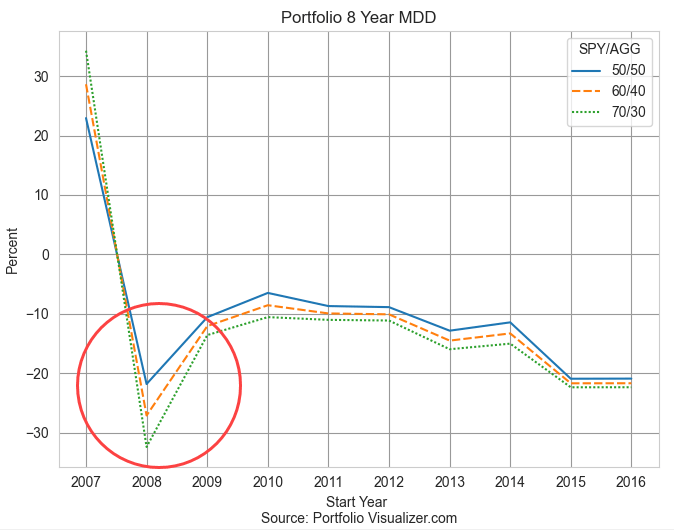
The Impact of Loss

We feel losses more than we do gains, even if the losses are only on paper. A portfolio that gains 20% only has to lose 16% to return to even. Regardless of our math abilities in a classroom, our instincts can be quite good at percentages. At higher gains, the percentages are painful. A portfolio that gains 50% then loses 50% nets a 25% net loss from our starting position (see notes at end). An MDD is a good indicator of “will this loss of value cause me to sell the investment?” In the early part of 2009 after the market had been battered, some clients could not handle the anxiety and sold some or all of their stocks, despite the advice from their advisors that this was the worst time to sell.

No Two Crises are Alike

Since December 2019, a few months before the pandemic restrictions began, the stock market gained 20% after adjusting for inflation (details at end). During and after the financial crisis, stocks lost 12% during the four years from December 2007 through December 2011 (details at end). The better response of asset prices during the pandemic era can be attributed to two phenomenon: technological advances and high government support of households and small business. During the financial crisis the majority of government support strengthened the foundations of financial institutions at the expense of households and small businesses. During the pandemic, many people could be productive from home. Students were in a virtual classroom with 15-30 other students. Had the pandemic happened in 2007, there was not enough bandwidth to support that kind of access, nor had the software been developed that could run that network capacity.

Takeaways

Households vary by income, by age, by health, circumstances and family characteristics. Each of these factors is a component of a risk exposure that a household faces. A younger couple might have time on their side but family obligations reduces their risk tolerance. Those obligations might include caring for an elderly parent or supporting a child’s educational goals. These models cannot replicate actual portfolios or individual circumstances but they do illustrate the smoothing effect of time even under the worst shocks. Risk tolerance is a matter of time tolerance.

//////////

Photo by Ch P on Unsplash

Keywords: portfolio allocation, standard deviation, risk, return, Sharpe ratio

A portfolio of $100 that gains 50% is then worth $150. If it loses 50%, the result is a value of $75, a net loss of $25 or 25%.

According to multpl.com, the inflation-adjusted value of the SP500 was 4708 in December 2023. This was a 20.6% gain above an index of 3902 in December 2019. The index stood at 2005 in December 2007, the first month of the Great Recession that would become the financial crisis in 2008. In December 2011, the index stood at 1762, an inflation-adjusted loss of 12%.

Bray and Begone

January 1, 2023

by Stephen Stofka

This week’s letter is about an unusual year and the lessons we can and can’t learn from it. As I wrote last week, we must carefully sift through the unique circumstances in a time series to learn any lessons that we can carry into the future. Sometimes we bray at the passing of an unusual year and continue on our course. Other times, like 9-11 and the 2008 financial crisis, we sort through the debris of an unusual year to understand how we can avoid a repeat occurrence.

What made this year so unusual was the bond market’s loss of almost 13% in addition to the stock market’s loss of 18%. Normally, bonds zig when stocks zag but not this year. This year’s loss in the bond market was the steepest drop ever. This year has been a good test of an investor’s allocation but a long term perspective is encouraging.

During our working years we accumulate assets. In retirement we distribute the price appreciation and income from those assets. In a down market like this past year, a younger investor must balance the opportunity to buy assets at lower prices with the probability they will need liquidity, i.e. cash for living expenses. A basic recommendation is to have six month’s income in cash for emergencies and loss of job. Someone in an executive position might store up to two years of cash or highly liquid investments in anticipation of a much longer job search to find a comparable position.

This past year has tested retired investors who have relied on the historical stability of bond prices. An aggregate bond mix lost 12.8%, surprising investors who may have used bond funds as a substitute for cash funds that paid little interest in the previous years. A bit of historical perspective – in 1994, after five years of relatively low rates, the Fed began raising rates. An intermediate term bond fund lost 4.2%, while an average treasury bond lost 8% that year. The Fed has kept rates far lower and far longer than that five year period and the market reaction has been greater as well. A 60-40 portfolio (60% stocks, 40% bonds) has moderate risk and good long term returns, making it a choice of many money managers. That typical portfolio weighting lost 16.5% this year.

An asset’s ultimate value is measured in the goods and services that they can buy. Today’ retiree might live 20 – 25 years or more, tapping their assets for their income needs. A few months ago, Gupta et al (2022), researchers at McKinsey & Company, found that the SP500 index has returned about 9% since 1994, including the dot-com frenzy of the late 1990s. To measure the purchasing power of the SP500 index over a 23 year period, I adjusted the index by the CPI index in January 2000, near the height of the dot-com bubble. In that span of time, we have endured a dot-com meltdown, the Great Financial Crisis and its slow recovery, followed by a once-in-a-century pandemic and a disruption of the global supply chain. The wide adoption of the internet in commerce has prompted a fundamental shift in jobs and revenue. Despite those disruptions, the purchasing power of stocks has increased 1.8% above annual inflation since 2000. Including an average dividend return of 2.02%, the broad stock market has grown in purchasing power almost 4% every year.

The SP500 index is a compilation of companies that have survived tough economic conditions. Companies that fail the adversity test are discarded from the index and replaced by another company. It is like a game of “King of the Hill” that we played as kids but the stakes and price volatility are far  higher. A broad index of bonds usually offsets that volatility, sacrificing a little return for a big reduction in the value of a portfolio. In the past 23 years, a 500 index fund had a standard deviation – or wag of the tail – of more than 15%. According to Portfolio Visualizer (2022), a simple 60-40 portfolio had less than 10% deviation. That lack of volatility cost .25% per year in return, about the same as the annual cost to insure a house. Investors with a 6-30-10 portfolio, setting aside 10% in cash, paid an additional .25% less return in exchange for a slight reduction in price volatility.

For the first time since records began, bonds did not offset the volatility of stock prices this past year. Depending on their age, health, location and available resources, some investors have a greater tolerance for risk than others. Investors with exactly the same circumstances may perceive their risk differently and comparisons between individuals are difficult and ill-advised. Some investors feel more fragile, giving greater weight to unique outcomes like this past year. Others give more weight to average trends, taking comfort in the probability that this year was an anomaly.

////////////////////////////

Photo by Mary Farrell on Unsplash

Backtest portfolio asset allocation. Portfolio Visualizer. (2022). Retrieved December 31, 2022, from https://www.portfoliovisualizer.com/backtest-portfolio#analysisResults. Stocks: an SP500 index fund. Bond: an intermediate term broad bond fund. Cash: money market.

Gupta , V., Kohn, D., Koller, T., & Rehm, W. (2022, August 4). Markets will be markets: An analysis of long-term returns from the S&P 500. McKinsey & Company. Retrieved December 31, 2022, from https://www.mckinsey.com/capabilities/strategy-and-corporate-finance/our-insights/prime-numbers/markets-will-be-markets-an-analysis-of-long-term-returns-from-the-s-and-p-500

Portfolio Performance & Presidents

October 6, 2019

by Steve Stofka

The employment report released Friday was a Goldilocks gain of 136,000 jobs for the month of September. Why Goldilocks? Not as weak as some feared following news this week that manufacturing was getting hit hard in the trade war with China (Note #1). Not so strong that it ruled out the possibility of another rate cut from the Fed this year. Just weak enough to speculate on another rate cut by year’s end. After several days of big losses, the market rallied on Friday.

Although manufacturing has been contracting, a report on the rest of the economy was more encouraging, although a bit lackluster (Note #2). Service businesses are continuing to hire but the pace has slowed. New export orders have accelerated but new orders in total slowed significantly from August. Something to like, something not to like.

Billions of dollars around the world are traded as soon as the employment report is released each month. During Mr. Obama’s tenure private citizen Donald Trump accused Obama of fudging the employment numbers. Larry Kudlow, now Mr. Trump’s economic advisor, took him to task for that. Mr. Kudlow worked in the Reagan administration and knew well how sacrosanct the employment numbers were. The BLS is an independent agency working in the Department of Labor and its 2400 employees try to collect and publish the most accurate data it can accomplish. The agency’s Commissioner is the only political appointee in the BLS and once confirmed by the Senate, serves four years, the same as the head of the Federal Reserve (Note #3). According to Mr. Kudlow, the White House gets the number the night before only to prepare a press release when the report is released.

Mr. Trump’s reckless behavior helped him take out 16 other Republican presidential candidates in the 2016 election. He acts quickly and aggressively. That lack of caution has led to several bankruptcies, and because of that, no bank in the world will loan him money (Note #4). What if, on an impulse, Mr. Trump tweeted out the employment number shortly before its official release time? Some traders pay a lot of money so that the news will hit their trading desk a split second faster than a conventional news release. It’s that important. An early leak of the employment numbers would cost a lot of influential people big money around the world and would prompt a national if not a global crisis. Forget about the phone calls to foreign leaders to discredit Joe Biden. That would be an act of treason for sure – against the global financial community. Can’t happen? Won’t happen?

Mr. Trump knows no rules. His father protected him when his rash behavior got him into trouble as a child. The elder Trump sheltered Donald from his own mistakes in the real estate industry and his foolish foray into the Atlantic City gambling business. Now that Mr. Trump’s father is no longer there, he depends on others to protect him. He has enlisted a long line of people in that effort. They have come in the revolving door to the White House and left. The list is longer than I imagined (Note #5). John Bolton, the third National Security Advisor under Mr. Trump’s tenure, was the last high-profile team member to leave.

Mr. Trump has said that Americans would get tired of winning so much while he was President. To use a baseball analogy, when he takes the mound, the team doesn’t win very often. People who lose a lot either give up or blame everyone and everything else for their losses. They need to have an ideal environment or get lucky to win. Mr. Trump berates the independent Fed because he wants them to protect him. He needs every crutch he can get. He couldn’t succeed in a war or in the financial crisis because he is not disciplined or organized.

What does this mean for the average investor? Take a cautious approach and keep a balanced portfolio. Betting that Mr. Trump will pitch a good game is a poor bet.

Or is it? At an event on Friday, he claimed that the stock market has gone up 50% since he was elected. Not quite but it is up 42% since the day after he was elected (Note #6). It’s been about 35 months. That’s pretty good. A 60-40 stock-bond portfolio has gone up 30% in that time. Under Obama’s tenure the market only went up 27%. A balanced portfolio went up almost 40% and he had to deal with the worst recession since the Great Depression. The budget battles with Republicans put a big dampener on investor enthusiasm during Obama’s first term.

35 months after the Supreme Court awarded the presidency to George Bush, the market was down 25% but a balanced portfolio was up 21%. Even Mr. Clinton could not best Mr. Trump, although he comes close. 35 months after the 1992 election the market was up 38%. A balanced portfolio was up 40%. The winner? A balanced portfolio.

What might an investor expect? At today’s low interest rates and inflation, a break-even return might be 5% a year, for a total gain of 22% in four years. Will Mr. Trump’s first four years be one of his few wins? Check back in a year. It’s bound to be a tumultuous year.

/////////////////////////////

Notes:

  1. Institute for Supply Management (ISM). (2019, October 3). September 2019 Manufacturing ISM Report on Business. [Web page]. Retrieved from https://www.instituteforsupplymanagement.org/ISMReport/MfgROB.cfm
  2. Institute for Supply Management (ISM). (2019, October 3). September 2019 Non-Manufacturing ISM Report on Business. [Web page]. Retrieved from https://www.instituteforsupplymanagement.org/ISMReport/NonMfgROB.cfm?navItemNumber=28857&SSO=1
  3. Bureau of Labor Statistics. (n.d.). About the U.S. Bureau of Labor Statistics. [Web page]. Retrieved from https://www.bls.gov/bls/infohome.htm
  4. Business Insider. (2019, August 28). The world is talking about Trump’s relationship with Deutsche Bank. [Web page]. Retrieved from https://markets.businessinsider.com/news/stocks/trump-tax-returns-deutsche-bank-relationship-drawing-intense-scrutiny-2019-8-1028482268#why-it-matters2
  5. Wikipedia. (n.d.). List of Trump administration dismissals and resignations. [Web page]. Retrieved from https://en.wikipedia.org/wiki/List_of_Trump_administration_dismissals_and_resignations
  6. Prices are SPY, the leading ETF that tracks the SP500. Clinton: 42 to 58 (approximately) – up 38%. Bush: 138 to 103 – down 25%. Obama: 91 to 116 – up 27%. Trump: 208 to 295 – up 42%. Balanced portfolio returns from Portfolio Visualizer calculated using a mix of 60% U.S. stock market, and 40% of an evenly balanced mix of intermediate term government and corporate bonds. Dividends were reinvested and the portfolio re-balanced annually.

Follow the Leaders

January 27, 2019

by Steve Stofka

This week the investment community mourned the death of John Bogle, the founder of Vanguard, the mutual fund giant. He had the crazy idea that mom-and-pop investors should buy a basket of stocks and not attempt to beat the market (Note #1). In 1976, he launched the first SP500 index fund, VFINX, a low-cost “no-brainer” or passive fund. Because people did not want to invest in the idea of earning just average stock returns, the initial launch raised very little money. “Bogle’s folly” now has more than fifty imitators (Note #2).

Vanguard has over $5 trillion under management. Let’s turn to them to answer the age-old question – what percent of my retirement portfolio should be invested in bonds? Bond prices are much less volatile than stocks and stabilize a portfolio’s value. Several decades ago, people retired at 65 and expected to live ten years in retirement. An old rule was that the percentage of bonds and cash should match your age. A 50-year old, for example, should have 50% of their portfolio in bonds and cash. Few advisors today would be so conservative. Many 65-year-olds can expect to live another twenty years or more.

Vanguard, Schwab, Fidelity and Blackrock offer various life cycle funds that have target dates. The most common dates are retirement; i.e. Target 2020, or 2030 or 2040. These funds are composed of shifting portions of stock and bond index funds offered by each investment company. The funds adjust their stock and bond allocations based on those dates. For example, if a 55-year old person bought the Vanguard Retirement Target Date 2020 Fund VTWNX in 2005, it might have been invested 75% stocks and 25% bonds when she bought it. As the date 2020 nears, the stock allocation has decreased to 53% and the bond portion increased to 47%. The greater portion of bonds helps stabilize the value of the portfolio.

In the chart below, I’ve compared the stock and bond allocations of various retirement funds offered by Vanguard (Note #3). Notice that the stock portion of each fund increases as the dates get further away from the present.

vantargetfundscomp

A 46-year old who intends to retire in 2040 when they are 67 might buy a Target 2040 fund which is 84% invested in stocks. The bond allocation is only 16%. Using the old rule, the bond portion would have been 46%.

What happens after that target date is met? The fund continues to adjust its stock/bond allocation towards safety. Over five years, Vanguard adjusts its mix to that of an income portfolio – 30% stocks and 70% bonds (Note #4).

These strategies can guide our own portfolio allocation. I have not checked the allocations of Schwab, Fidelity and others in the industry but I would guess that they have similar allocations for their life cycle funds.

///////////////////////
Notes:

1. History of Vanguard Group
2. More than fifty funds invest in the SP500 index according to Consumer Reports
3. Vanguard’s Target 2020 fund VTWNX , 2025 Fund VTTVX , 2030 Fund VTHRX, 2035 Fund VTTHX, and 2040 Fund VFORX
4. Vanguard’s Income Portfolio VTINX 

Place Your Bets

January 6, 2019

by Steve Stofka

This will be my tenth year writing on the financial markets. As I’ve written in earlier posts, we’ve been sailing in choppy waters this past quarter. In 2018, a portfolio composed of 60% stocks, 30% bonds and 10% cash lost 3%. In 2008, that asset allocation had a negative return of 20% (Note #1). We can expect continued rough weather.

If China’s economy continues to slow, the trade war between the U.S. and China will stall because a slowing global economy will give neither nation enough leverage. Will the Fed stop raising interest rates in response? If there is further confirmation of an economic slowdown, could the Fed start lowering interest rates by mid-2019? Ladies and gentlemen, place your bets.

Thanks to good weather and a strong shopping season, December’s employment reports from both ADP and the BLS were far above expectations (Note #2). Wages grew by more than 3%. Will stronger wage gains cut into corporate profits? Will the Fed continue to raise rates in response to the strong employment numbers and wage gains? Ladies and gentlemen, place your bets.

The global economy has been slowing for some time. After a 37% gain in 2017, a basket of emerging market stocks lost 15% last year. Although China’s service sector is still growing, it’s manufacturing production edged into the contraction zone this past month (Note #3). Home and auto sales have slowed in the U.S. What is the prospect that the U.S. could enter a recession in the next year? Ladies and gentlemen, place your bets.

The partial government showdown continues. The IRS is not processing refunds or answering phones. If it lasts one more week, it will break the record set during the Clinton administration. Trump has said it could go on for a year and he does like to be the best in everything, the best of all time. Could the House Democrats vote for impeachment, then persuade 21 Republican Senators (Note #4) to vote for a conviction and a Mike Pence Presidency? Ladies and gentlemen, place your bets.

When the winds alternate directions, the weather vane gets erratic. This week, the stock market whipsawed down 3% one day and up 3% the next as traders digested the day’s news and changed their bets. Interest rates (the yield) on a 10-year Treasury bond have fallen by a half percent since November 9th. When yields fell by a similar amount in January 2015 and January 2016, stock prices corrected 8% or so before moving higher. Since early December, the stock market has corrected by a similar percentage. Will this time be different? Ladies and gentlemen, place your bets.

Staying 100% in cash as a long-term investment (more than five years) is not betting at all. From a stock market peak in 2007 till now, an all cash “strategy” earned less than 1% annually. A balanced portfolio like the one at the beginning of this article earned a bit less than 6% annually. Older investors may remember the 1990s, when a person could safely earn 6% on a CD. Wave goodbye to those days for now and place your bets.

///////////////////////////

Notes:

  1. Portfolio Visualizer results of a portfolio of 60% VTSMX, 30% VBMFX and 10% Cash
  2. Automatic Data Processing (ADP) showed 271,000 private job gains. The Bureau of Labor Standards (BLS) tallied over 300,000 job gains.
  3. China’s manufacturing output in slight contraction
  4. The Constitution requires two-thirds majority in Senate to convict an impeached President. Currently, there are 46 Democratic Senators and Independents who caucus with Democrats. They would need to convince 21 Republican Senators to vote for conviction to get a 67 Senator super-majority. 22 Republican Senators are up for re-election in 2020 and might be sensitive to public sentiment in their states.

Stormy Seas

December 23, 2018

by Steve Stofka

For the past two months, the stock market’s volatility has doubled from late summer levels. The Fed announced its intent to continue raising interest rates in 2019 at least two times, and the market nosedived in response. It had been expecting a more dovish policy outlook from Chair Jerome Powell.

What does it mean when someone says the Fed is dovish, or hawkish? Congress has given the Fed two mandates: to manage interest rates and the availability of credit to achieve low unemployment and low inflation. That goal should be unattainable. In an economic model called the Phillips curve, unemployment and inflation ride an economic see-saw. One goes up and the other goes down. To rephrase that mandate: the Fed’s job is to keep unemployment as low as possible without causing inflation to rise above a target level, which the Fed has set at 2%.

There are periods when the relationship modeled by the Phillips curve breaks down. During the 1970s, the country experienced both high unemployment and high inflation, a phenomenon called stagflation. During the 2010s, we have experienced the opposite – low inflation and low unemployment, the unattainable goal.

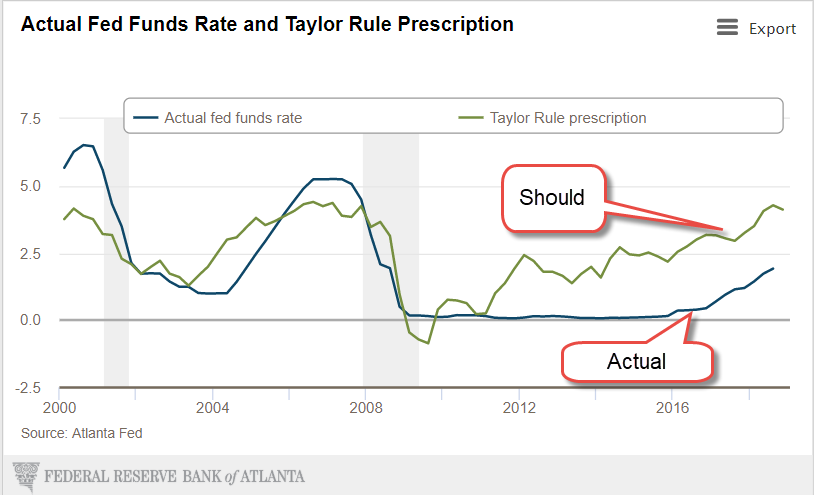
Convinced that low unemployment will inevitably spark higher inflation, the Fed has been raising interest rates for the past two years. The base rate has increased from ¼% to 2-1/2%. The thirty-year average is 3.15%. Using a model called the Taylor Rule, the interest rate should be 4.12% (Note #1).  After being bottle fed low interest rates by the Fed for the past decade, the stock market threw a temper tantrum this past week when the Fed indicated that it might raise interest rates to average over the next year. Average has become unacceptable.

FedFundVsTaylorRule

In weighing the two factors, unemployment and inflation, the Fed is dovish when they give greater importance to unemployment in setting interest rates. They are hawkish when they are more concerned with inflation. The Fed predicts that unemployment will gradually decrease to 3.5% this coming year. Unemployment directly affects a small percentage of the population. Inflation affects everyone. The Fed’s current policy stance is warily watching for rising inflation.

The stock market is a prediction machine that not only guesses future profits, but also other people’s guesses of future profits. As the market twists and turns through this tangle of predictions, should the casual investor hide their savings in their mattress?

These past five years may be the last of a bull market in stocks; 2008 – 2012 was the five-year period that marked the end of the last bull period that began in 2003 and ran through most of 2007. Here are some comparisons:

From 2014-2018, a mix of stocks returned 7.7% per year (Note #2). A mix of bonds and cash returned 1.96%. A blend of those two mixes returned 4.91% per year.

From 2008-2012, that same stock mix returned just 2.66% per year. The bond and cash mix returned 5.5%, despite very low interest rates. A blend of the stock and bond mixes returned 5.26%.

For the ten-year period 2008 thru 2017, the stock mix earned 7.7%. The bond and cash mix returned 3.54% and the blend of the two gained 6.35% annually. On a $100 invested in 2008, the stock mix returned $13.5 more than the blend of stocks and bonds. However, the maximum draw down was wrenching – more than 50%. The $100 invested in January 2008 was worth only $49 a year later. Whether they needed the money or not, some people could not sleep well with those kinds of paper losses and sold their stock holdings near the lows.

The blend of stock and bond mixes lost only a quarter of its value in that fourteen-month period from the beginning of 2008 to the market low in the beginning of March 2009. The trade-off between risk and reward is an individual decision that weighs a person’s temperament, their outlook, and the need for to tap their savings in the next few years.

A rough ride in stormy seas tests our mettle. During the market’s rise the past eight years, we might have told ourselves that our stock allocation was fine because we didn’t need the money for at least five years.  If we are not sleeping because we worry what the market will do tomorrow, then we might want to lower our stock allocation. Sleeping well is a test of our portfolio balance.

///////////////////

Notes:
1. The Atlanta Fed’s Taylor Rule calculator
2. Calculations from Portfolio Visualizer: 30% SP500, 30% small-cap, 20% mid-cap, 20% emerging markets. Bond mix: 70% intermediate term investment grade bonds, 30% cash. The blend of the two was half of each percentage: 15% SP500, 15% small-cap, 10% mid-cap, 10% emerging markets, 35% bonds, 15% cash.

Spring Cleanup

March 11, 2018

by Steve Stofka

Today time springs forward. Tufts of grass turned green, and some trees are beginning to bud. It was still light after 6 P.M. even before the time change. Great flocks of cranes fly north. In the springtime evening we can hear the siren call of the booby headed tax deadline.  2017 IRA contributions are due by April 15th.

This is a good time to check our game plans. Are we saving enough? In the accumulation, or pre-retirement, phase, 10% or more of our income is a good savings goal. 5% is an absolute minimum. Savings should be used to pay down any debt that has an interest rate more than 5%. High interest rate loans are a weight we must drag around with us. Consider working part time for a while and using that money to pay down high interest rate debt.

New car loans now average over $30K with an average maturity (length of payment period) of 67 months. The average interest rate is 4.21% but anyone with less than a FICO score of 690 is paying 5% or more. This article has breakdowns by credit score, lending institution, length of loan, and other factors.

Of the money we have saved – any annual portfolio realignments to be done? This is a good time to not only think about it but to do it.

In the distribution phase of a portfolio, we begin to withdraw funds from the portfolio that we have accumulated through a lifetime of saving.  Using Portfolio Visualizer, I’ve compared two portfolios with a 60/40 mix – 60% stocks, 40% bonds and cash.  These backtests include an annual rebalancing that may be more difficult for funds in a taxable account because buying and selling may generate taxable capital gains.

Let’s pretend a person retired in May of 1998 at the age of 68 and just died last year. During this twenty years, there were two times when the stock market fell 50%. The beginning year 1998 is near a high point in the stock market. The ending year 2017 was the 8th year of the current bull market. The test begins and ends at strong points in the market cycle, a key feature of a test like this.  Beginning a backtest with a trough in the market cycle and ending with a peak only distorts the results.

Portfolio

At the time of retirement, our retiree had a $1 million portfolio, although the amount could have been $100,000 or $10 million.

Portfolio6040

Although the stock allocation is the same for both portfolios, Portfolio 2 is totally simple. Put all the money in Vanguard’s Total Stock Market fund and forget about it. Portfolio 1 manually diversifies the 60% stock portion of the portfolio among four classes: Large capitalization, mid cap, small cap value stocks in the U.S., and European large cap stocks. Think of Goldilocks sitting down to a table with four bowls of soup – big, medium, small and European.  If that person retired today, a diverse stock portfolio would include an emerging markets index fund like Vanguard’s VEIEX.  In 1998,  emerging markets were not part of a core portfolio as they are today.  For this test, I left out emerging markets.

The bond portion of the portfolio is an index fund of the total bond market. Both portfolios hold 10% in cash for emergencies and living expenses.

Income

A portfolio is like snow in the Rocky Mountains that melts and flows toward the Pacific Ocean. Will the water make it to the ocean? Each year this retiree withdrew 4% of their portfolio balance for expenses. That percentage is considered safe during most twenty-year retirement periods. Note that some advisors are using a thirty-year retirement period to test a portfolio mix. As the years go by and the purchasing power of a $1 erodes, will 4% be enough to meet a retiree’s income needs? The more diverse portfolio allowed the retiree to withdraw a larger amount every year, and the annual withdrawal did keep up with inflation.  Secondly, the ending balance was about the same as the beginning balance after adjusting for inflation.

PortfolioWithdrawal6040

Return

The more diverse Portfolio 1 (marked complex in graphic below) has a better return over this twenty-year period. See the Internal Rate of Return (IRR) column, which adjusts for the withdrawal amounts each year.

PortfolioReturns6040
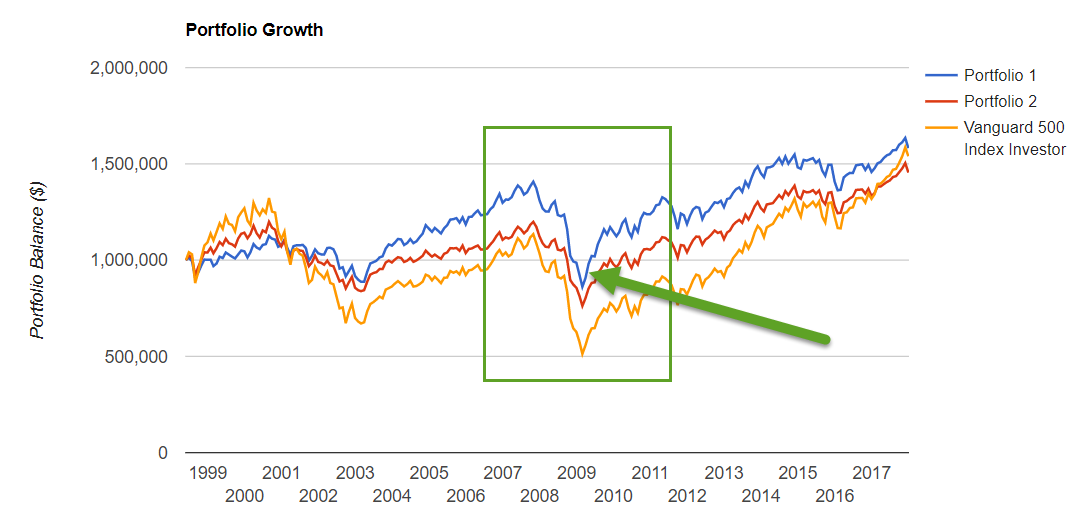
The drawdown, or greatest decline in value, in the time series is a critical test of a portfolio mix. The retiree needs that portfolio to generate a certain amount of income every year. If the portfolio falls to zero, the income stream has dried up. In the chart below, look at the dip in the portfolio value during the 2008 Financial Crisis. The more diverse Portfolio 1 (blue line) dipped below the starting $1 million figure, but not by much. The investor who was 100% invested in the stock market, the 500 Index portfolio (yellow line), fared the worst during most of the twenty-year period.  In a sign that the bull market has matured, the 500 Index has overtaken the simple 60/40 mix (red line) and is about to overtake the diversified 60/40 mix (blue line).

PortfolioGrowth6040
The diverse portfolio is not complex. There are no gold or commodity assets, no energy or natural resource funds, and no real estate REITs to manage.  If emerging markets were added to the Goldilocks mix, there would now be five equal bowls of soup, each of them taking 12% of the portfolio. This portfolio would have earned 4/10% better each year.

PortfolioEM6040

We could add a Pacific stock index like Vanguard’s VPACX to the mix, but when do we stop adding indexes? In this time period, that index had a slight negative effect on returns. As the number of indexes grow, we are less likely to adjust our allocation.

Our portfolios can get cluttered and too complicated to be effective and easily managed.  Can we simplify?  It’s worth a look see. In taxable accounts, de-cluttering and re-balancing can generate taxable capital gains, so it might not be advisable to make any changes.

Stress Test

February 11, 2018

by Steve Stofka

The recent market correction, defined as a 10% decline, has been a real time stress test for our portfolios. There hasn’t been a stock market correction since the 11% drop in December 2015 to January 2016. Because the end of January was near the height of the stock market, you can more easily find out how much your portfolio declined relative to the market. As of the close Friday, the SP500 had fallen 7.2% since the end of January. That is your benchmark. Later in this blog, I’ll review a few reasons for the decline.

You can now compare the decline in your portfolio to that of the market.  If you use a personal finance program like Quicken, this is an easy task. If you don’t, then follow these steps:
1) Write down your January ending balances at your financial institutions, including any savings accounts or CDs that you own.
2) Write down the current balances and calculate the difference in value since the end of January.
3) Divide that difference by the balance at the end of January to get a percentage decline.

For instance, let’s say your balances at the end of January added up to $100K and your current balance is $95K (Step 1). The difference is $5K (Step 2). Your portfolio has declined 5% (Step 3) compared to the market’s 7.2%, or about 70% of the market. If the market were to fall 50% as it did from 2000-2002 and 2007-2009, you could expect that your portfolio would fall about 35%. Are you emotionally and financially comfortable with that? A safety rule of investing is that any money you might need for the next five years should not be invested in the stock market.

The next step is to compare the gains of your portfolio in 2017 to the market’s gain, about 24%. The gain should be approximately the same as the loss percentage you calculated above. If the gain is slightly more than the losses, you have a good mix.

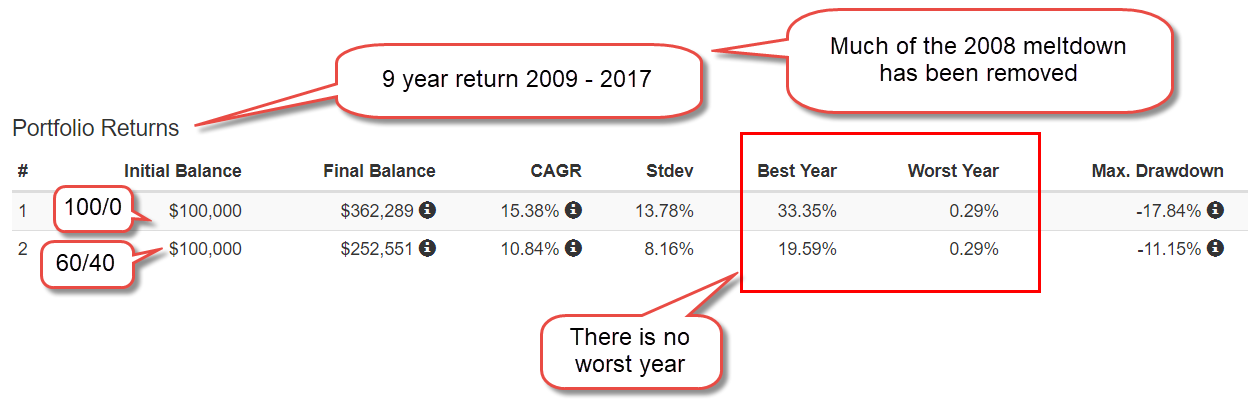
The chart below compares two portfolios over the past ten years: 1) 100% U.S. stock market and 2) 60% stocks/ 40% bonds (60/40 allocation). Notice that the best and worst years of the 60/40 portfolio are nearly the same while the best year of the 100% stocks is 10% less than the worst year.

StressTest2008-2017
The 60/40 portfolio captured 80% of the profits of the 100% stock portfolio ($101,532 / $128,105) but had only 60% of the drawdown, or decline in the portfolio. Compare that with the chart below, which spans only nine years and leaves out most of the meltdown of value during the Financial Crisis. There is no worst year! La-di-da! Investors who are relatively new to the stock market may underestimate the degree of risk.

StressTest2009-2017
The 60/40 portfolio captured 58% of the profits of the 100% stock portfolio ($152,551 / $262,289) but the drawdown was 63% (11.15% / 17.84%).  If the drawdown is more than the profits, that doesn’t look like a very good deal for the 60/40 portfolio, does it?  That is how bull markets entice investors to take more risk than might be appropriate for their circumstances.  Come on in, the water’s fine!  An investor might not see the crocodiles. Markets can be volatile. This has been a good reminder to check our portfolio allocation.

///////////////////

Why?

So, why did the market sell off? Let me count the ways. It began on Friday, February 2nd, when the monthly labor report showed an annual gain of 2.9% in hourly wages. For much of this recovery, economists have been asking why wage growth was sluggish as unemployment fell. Economists who like their idealized mathematical models don’t like it when reality disagrees with those models. Finally, wage growth showed some healthy gains and the market got spooked. Why?

As wages take more of the economic pie, profits decline. Companies respond by raising prices, i.e. higher inflation. As interest rates rise, there are several negative consequences. Companies must pay more to borrow money. Fewer consumers can afford mortgages.  Homebuilders and home improvement centers like Home Depot and Lowe’s may see a decline in sales. Car loans become more expensive which can cause a decline in auto sales. There is one caveat: even though hourly wages increased, weekly earnings remained stable because weekly hours declined slightly.  Next month’s reports may show that inflation concerns were overestimated.

This past Monday, ISM released their monthly survey of  Non-Manufacturing businesses and it was a whopper. 8% growth in new orders in one month. Over 5% growth in employment. These are two key indicators of strong economic growth, and confirmed  the fears stirred up the previous day’s labor report. Inflation was a go and traders began to sell, sell, sell.

For the past year, market volatility was near historic lows. Volatility is a measure of the predictability of the pricing of SP500 options. A profitable tactic of traders was to “short” volatility, i.e. to bet that it would go lower. There were two exchange traded funds devoted to this: XIV and SVXY. Traders who bought XIV at the beginning of 2017 had almost tripled their money by the end of the year. When volatility tripled this past week, the whole trade blew up. People who had borrowed to make these bets found that their brokers were selling assets to meet margin calls.  Within days, XIV was closed and investors were given 4 cents on the dollar. SVXY may soon follow. Investors had been warned that these products could blow up. Here’s one from 2014.

The stock market is both a prediction of future profits and a prediction of other investor’s predictions of future profits! The prospect of stronger interest rate growth caused traders to reprice risks and returns. Much of the impact of the selling this past week was in the last hour on Monday and Thursday, when machine algorithms traded furiously with each other. The last hour of trading on Monday saw an 800 point, or 3% , price swing in just a few minutes. In the closing ten minutes of that hour, Vanguard’s servers had difficulty keeping up with the flow of orders.

Contributing to the decline were worries over the government’s debt.  The new budget deal signed into law this week will likely increase the yearly deficit to more than $1  trillion.  There was soft demand for government debt at this week’s Treasury bill auction.  Even without a recession in the next ten years, the accumulation of deficits will increase the total debt level to about $33 trillion.

This correction is an opportunity for the casual investor to make some 2017 or 2018 contributions to their IRA. Profit growth is projected to be strong for the coming year. The correction in prices this week has probably brought the forward P/E ratio of the SP500 to just below 20, a more affordable level that we haven’t seen in few years.


Ten Year Review

January 14, 2018

by Steve Stofka

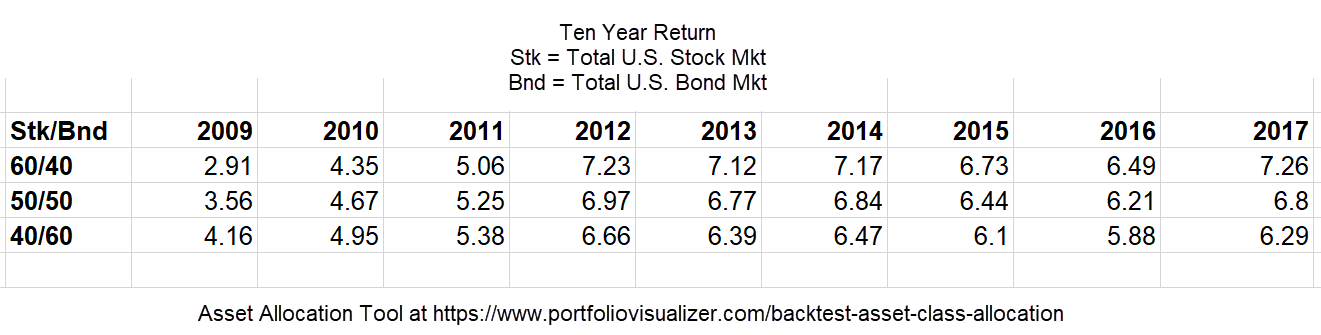
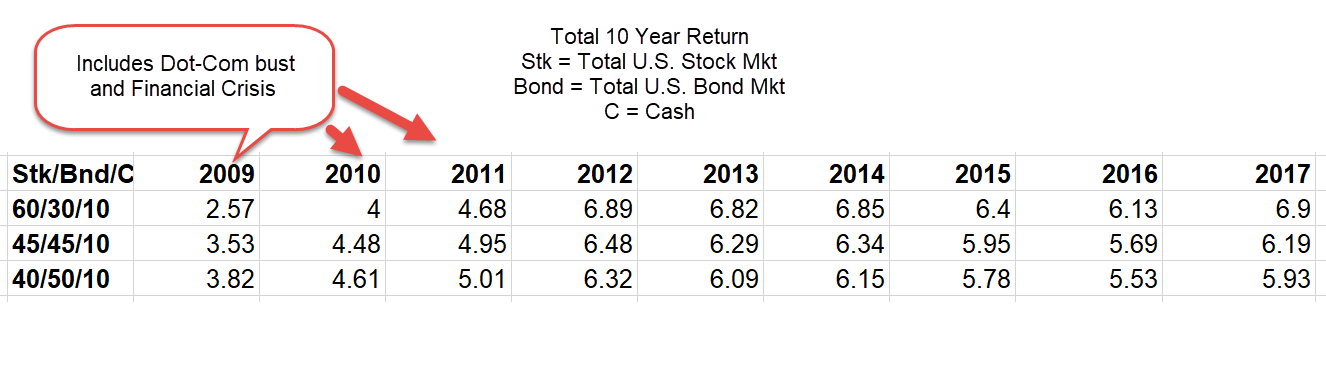
To ward off any illusions that I am an investing genius, I keep a spreadsheet summarizing the investments and cash flows of all my accounts, including savings and checking. Each year I compare my ten year returns to a simple allocation model using the free tool at Portfolio Visualizer. Below is a screen capture showing the ten-year returns for various balanced allocations during the past several years.

10YrReturn20180112
The two asset baskets are the total U.S. stock market and the total U.S. bond market. A person could closely replicate these index results with two ETFs from Vanguard: VTI and BND. Note that there is no exposure to global stocks because Portfolio Visualizer does not offer a Total World Stock Asset choice in this free tool. An investor who had invested in a world stock index (Vanguard’s VT, for example) could have increased their annual return about 1.3% using the 60/40 stock/bond mix.

I include my cash accounts to get a realistic baseline for later in life when my income needs will require that I keep a more conservative asset allocation. An asset allocation that includes 10% cash looks like this.

10YrReturnStkBondCash20180112
In the trade-off between return and risk, a balanced portfolio including cash earns a bit less. In 2017, the twenty-year return was not that different from the ten-year return. From 2009 through 2011, ten-year returns were impacted by two severe downturns in the stock market.

//////////////////////

The Hurt

Falling agricultural prices for seven years have put the hurt on many farmers. This decade may turn out to be as bad as the 1980s when many smaller farms went belly up because of declining prices. Remember the Farm Aid concerts?

The Bloomberg Agriculture Index has fallen about 40% over the past five years. While farmers get paid less for their produce, the companies who supply farmers with the tools and products to grow that produce are doing reasonably well. A comparison of two ETFs shows the divergence.

DBA is a basket of agricultural commodity contracts. It is down 33% over the past five years.
MOO is a basket of the stocks of leading agricultural suppliers. The five-year total return is 31%.

The large growers can afford to hedge falling prices. For family farmers, the decline in agricultural prices is a cut in pay. Imagine you were making $25 per hour at the beginning of 2017 and your employer started cutting your pay bit by bit as the year progressed? That’s what its like for many smaller farmers. They work just as hard and get paid less each year.

Surprises

May 14, 2017

Surprises, the good, the bad and the ugly. When we are in retirement, we are less resilient when the bad or ugly surprises happen. There are event surprises and process surprises. An event surprise might be the damage and loss from a weather related event. A process surprise can be even more deadly because it happens over time.

Misestimates and unrealistic expectations are two types of process surprises. Let’s look at the first type – misestimates. In a recent survey, Boomers were asked to estimate the percentage of income they would have to spend on healthcare. The average estimate was a bit less than 25%. The actual average is a third of retirement income. Let’s say a couple gets $4000 in monthly income from Social Security, interest and dividends. If they had budgeted $1000 (25%) of that for healthcare costs, then discover that they are spending over $1300 a month, that extra cost will slowly eat at their savings base.

A good rule of thumb is to estimate that, in the first few years of retirement, we will spend as much if not more than we spent before we retired. If we are wrong and we spend less, that’s a good surprise. In those first years we may find that we are spending more in one area of our lives and less in another.

The second type of process surprise – unrealistic expectations. Let’s say I expect to make 8% per year on my savings with a small amount of risk. People with a lifetime of experience in managing money struggle mightily to accomplish this and all but a few fail. Either they must take on more risk or lower their expectations of return.

Vanguard and other financial companies provide the expected risk and returns of several different allocations over many decades. Here‘s a chart at Vanguard that does not include a cash allocation in its calculation.  These long term calculators have another drawback: they include rather unusual times in history – the 1930s Depression era and World War 2.

We could use the last twenty years of actual returns to guide our expectations for the next twenty years. In past articles, I have linked to the free tools available at Porfolio Visualizer and there is a permanent link on the Tools page.

I select 1997 for the starting year and 2016 for the ending year. I leave the default settings at the top of the screen alone for now. If I input 40% into the U.S. Stock Market, 40% into the Total U.S. Bond Market, and 20% into Cash, I have chosen a conservative allocation – 40/40/20. I click the Analyze Portfolios button and see that the return was a bit over 6% in the CAGR (Compound Annual Growth Rate) column. How likely am I to achieve 8% over the next 20 years? Not very likely.

I’ll input a moderate allocation of 60% stocks, 30% bonds and 10% cash. The result is an almost 7% annual return so I am getting close to my 8% but there was a nasty time when I lost 1/3 of the value of my portfolio. If I am 70 years old, how comfortable would I be if I watched my portfolio sink almost 33%? I think I would have some restless nights worrying whether I would have to go back to work. How up to date are my skills? Would my prospective employer allow me to take a short nap in the afternoon? I feel so rested and ready to rock and roll after a nap. Well maybe not.

Wait a minute, I tell myself. The past 20 years included the busting of a tech bubble, 9-11 and the 2008 financial crisis. Two of those were rather extraordinary events. So I pick a different 20 year time period, 1987 – 2006. That still includes some serious shocks like the tech bubble and its pop, as well as 9-11. My conservative allocation of 40/40/20 made 8-1/2% CAGR and the moderate allocation of 60/30/10 made 9-2/3%.

But I’m not happy with the risk. I could even decrease my risk and make my 8% return by choosing a very conservative allocation of 30% stocks, 50% bonds and 20% cash. My portfolio lost less than 10% in its worst year ever – the maximum drawdown. If I go to Vanguard’s risk return chart they estimate a 7.2% average return over 90 years, which included a horrible depression that lasted a decade and a world war. It’s to be expected that my 20 year period 1987 – 2006 would do a bit better than the 90 year average because the catastrophic shocks are not included.  I think my 20 year period is more representative of the risks I will face in the next 20 years.

I could have picked the 20 years from 1981-2000 and that would have been unrealistic. The conservative allocation earned more than 10% and the annual return on the moderate allocation was almost 12%.

So I have now set what I think is a realistic 20 year time frame that gave me the historical risk and reward that met my expectations. But that’s not realistic. Not yet. I am going to be taking money from this portfolio to supplement my retirement income. So now I go back up to the top of the screen where the defaults are and under “Periodic Adjustments” I select the “Withdraw fixed percentage” option and under that I input 4.0%. This is supposed to be the safe withdrawal percentage. The next row is the “Withdrawal frequency.” I’ll select Annual.

Since I am now taking cash out this portfolio, I will turn to the IRR column of the results because the Internal Rate of Return calculation considers cash flows. My very conservative allocation of 30/50/20 has an IRR of almost 8.5% with a drawdown of less than 15%. The column that says “Final balance” shows that I have more than double the money I started out with and I have been able to withdraw 4% per year. I would have liked to get the drawdown below 10% but I think I can live with 13-1/2%. I’ll be worried but I don’t think I will lose sleep over it. So now I have made what I think is a reasonable expectation of risk and reward based on historical returns.

There’s one last thing I need to do. I know that the 20 year period from 1929 to 1948 was bad but I can’t check that in Portfolio Visualizer because the year selection only goes back to 1972. So I select a really bad ten year period, 2000 – 2009. This was from the heights of the dot.com boom to a short time after the financial crisis. After taking 4% per year, the IRR on my very conservative allocation was 4% and I still had the money I started out with at the beginning of the ten year period. I could probably withstand a 20 year period like this as long as I stay true to my allocation.  But, the maximum drawdown (see here) was 21%, something that I am not comfortable with.

I am left with some hard choices.   In the case of another bad ten year period, I can lower my withdrawal percentage a bit or I can learn to have faith in the allocation process and accept the drawdown.  I have done this with a free tool. I could pay for more sophisticated tools that gradually transition from one allocation to another allocation over a 20 year period.  That would be more realistic still since I will probably get more risk averse as I get older. At least this gets me started.

We often can’t avoid the suprise events. Some surprises are both event and process like the diagnosis of a  life-threatening illness. We can understand and be alert to the process surprises that we may inflict on ourselves. Understanding involves some frank self-assessment and difficult questions. Am I prone to wishful thinking? Do I overestimate my tolerance for risk? How well do I live with the consequences of my decisions?

/////////////////////

CAPE

A few weeks ago I mentioned that I might calculate a 20 year CAPE ratio. The CAPE that Robert Shiller uses is a ten year period. As of the end of 2016 the 20 year CAPE was 31 vs the 70 year average of 21. Whichever calculation we use, the market is priced a good deal above average. The 20 year CAPE first crossed above the average in the late summer of 2009.

//////////////////

California

Over the past 5 years California’s economy has grown faster than any other developed country except for China. Bloomberg article