
Effective Governments

July 5, 2026

By Stephen Stofka

Last week I wrote about the system of rent control  in New York City as one of the many ways in which government interferes with a utopian model of laissez-faire economics. I had written that post earlier in the week and was surprised when the Rent Guidelines Board (RGB) voted to pass Mayor Mamdani’s proposal to freeze rents on rent stabilized units in the city for the next two years. This policy was similar to the old system of rent regulation known popularly as rent control. This week I want to look at several ways that government controls the price of essential commodities and services.

The Federal Reserve is an independent government agency that indirectly sets interest rates for all credit in the United States. This includes mortgages on homes, car loans, and credit cards. Higher interest rates increase business costs and businesses raise retail prices to their customers. Or do they? This is a debate among economists. The Fed raises interest rates to curb inflation, or the change in prices, not fan the inflationary flames. The theory is that higher interest rates will curb the use of credit, and push business costs higher. Interest is a factor of production that competes with other factors of production, namely labor. A reduction in the use of credit should lead to a lower demand for goods and services, prompting businesses to slow down their hiring and wage increases. That model fits the new car market where demand responds to price changes. That is not the case for goods and services that we buy each week.

Consumers pay higher monthly charges for rent, utilities, and food. Higher interest costs increase costs for landlords, leading to higher rents. Grocery stores pay for their food inventory with short term credit so higher interest rates put upward pressure on their costs and consumer prices. Farmers depend on credit so higher interest rates increase commodity prices, reduce farmers’ profits, or both. Electrical utilities finance all their capital improvements so higher interest rates increase utility bills each month. Unlike the market for cars, demand for these essential goods is inelastic, meaning that demand is rather insensitive to price changes.

Production costs and prices for new cars are affected, but demand for new cars does respond to price changes so this provides a counterbalancing effect, reducing the price increases. However, since people hold onto their vehicles longer, this reduces the number of used cars available for sale. Because the price of used cars is less than new cars, the demand for used cars increases. Both supply and demand factors increase the prices for used cars.

In setting interest rate policy, the Federal Reserve pays closer attention to a measure they call the Core CPI, the Consumer Price Index without volatile food and energy costs. They do this to gain a sense of underlying inflation trends. Here is a chart from the Bureau of Labor Statistics comparing different CPI measures as of May 2026 (Source).
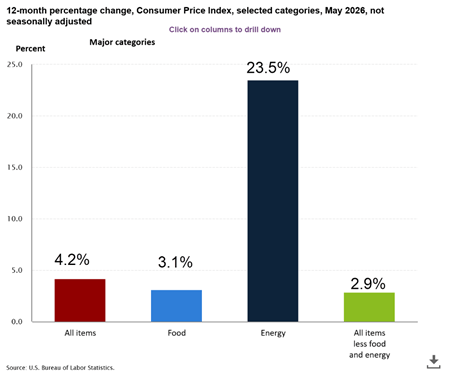
Rising gas prices after the U.S. and Israel attacked Iran produced a spike in gasoline costs which accounted for most of the huge increase in energy costs. The Fed’s target inflation rate is 2%,  below either the All Item CPI (red), or the Core CPI measure (lime). Because of that, the members of the Fed’s interest rate setting committee, the FOMC, will lean toward a policy of rising or at least steady interest rates. This will put further pressure on consumer sentiments,  reducing the number of consumers who can qualify for home mortgages and car loans, even as higher gas prices effectively tax consumers.

Consider a small business whose employees make service calls. Plumbing, electrical, HVAC and home repair businesses typically consume a lot of gasoline. In addition, they frequently use a short term line of credit to carry their accounts receivable. Higher interest rates and higher gas prices are squeezing these kinds of companies from both directions. The same for farmers and ranchers who use a lot of gas and short term credit.

Interest rate policy affects all businesses and consumers but especially redistributes wealth among different businesses and consumers just as effectively as a policy of rent regulation does in New York City. Donald Trump’s decision to be led by the nose into Israel’s long running feud with Iran sparked a sharp rise in the price of gasoline. This effectively redistributed wealth from the working class, the blue collar trades, and rural folks to the weapons manufacturers and bankers who profit from war and a higher deficit. It’s an especially cruel blow to rural folks who voted for Trump. His comment that he doesn’t think about the effect of the war on the finances of everyday folks was an indication of the contempt he holds for working people (Source).

The government subsidizes a lot of perishable foods, influencing the pricing and availability of milk and dairy products, fruits and vegetables, meat, poultry, eggs and seafood. It does this largely through subsidies for animal feed, disaster assistance, crop insurance, and USDA purchases of food for public nutrition programs. A person who favors a policy of minimal government interference in markets may not realize that the price of their eggs is influenced by government programs which help to lower consumer prices.

The most government subsidies are channeled to commodity crops like corn, wheat and soybeans. Fruit and vegetable farmers complain that they receive far less subsidies for their crops than the growers of these crops. The subsidies for corn used to produce high fructose corn syrup have led to a sharp rise in obesity and higher healthcare costs (Source). Lower prices for fruits and vegetables would lead to greater consumption and might reduce the obesity epidemic. Subsidies for one type of food producer, the growers of commodity crops, redistributes wealth from tomato farmers in California to corn farmers in Iowa.

SNAP benefits, known as food stamps, provide food assistance to low income households (Source). Those who favor a reduced role for government may be accused of lacking compassion for others, particularly children. They argue that such programs are not the role of the federal government. Let the states create, administer and fund such charity programs. However, those states with the highest percentage of low income families don’t have the resources to fund such programs. One in five households in New Mexico, for example, qualifies for SNAP benefits  (Source). The national average is one in eight households. This is the irony of need. Those with the greatest need have the fewest resources. How a society handles these resource contradictions are central to its character.

Economists of the late 19th century forced a separation between the disciplines of economics, sociology and political science in order to understand economic principles better. Stanley Jevons, Alfred Marshall, and Francis Edgeworth were some of the leaders of this movement away from the complicated socio-political analysis of economics of Marx, David Ricardo and the Ricardian Socialists of the mid-19th century. The social, political, economical and ethical aspects of our daily lives are bound together in what I will call an ethosphere, the how of engaging with others in a society. Studying just one aspect in isolation leads to faulty conclusions.

Some economists and pundits treat the government as an actor outside the marketplace because it has taxation and police powers that other members of society lack. A corporation has unique features and powers as well. We don’t treat corporations as alien to the marketplace. The question is not whether government should take an active role in this ethosphere. It can’t help but take an active role. The question is the type of role it takes, not how active it should be. An effective government creates programs of redistribution to solidify political support among the various factions of a society. These programs increase a government’s capacity, build its legitimacy among its citizens, reduce the frictions that lead to civil war and help a government survive.

Next week I hope to explore the four components of the ethosphere. Hope to see you then.

///////////////////

Photo by Ayush Kumar on Unsplash

A person blurred by obscure glass

Market Distortions

June 28, 2026

By Stephen Stofka

Last week I wrote about different types of authority, and whether authority without responsibility is legitimate. From last week: “Through its legislative authority and police power, a government controls the terms of contracts between private parties. It grants licenses to individuals and companies to conduct business. It sets rules that contracts must follow. Those contracts govern the distribution of wealth within a society. Does a government have an accompanying responsibility to ameliorate the economic outcomes from those contracts?”

A utopian economic model popular with some libertarian economists is laissez-faire economics. In this model, government has a limited role in commerce, but what are those limits? The term acts as a signaling device between pundits rather than a precise economic doctrine. Economists prefer to discuss the balance between market failures and government failures. Market failures occur when market participants don’t pay for a benefit or inadvertently cause harm. Pollution is a frequently used example. Let’s turn to government failures.

In his seminal work The Wealth of Nations, Adam Smith argued that governments provide essential institutions for commerce. These include defense, a court system to adjudicate contracts and protect property, provision of public works, a system of weights and measures, a reliable money to conduct business, and the granting of patents and copyrights. Smith supported public education, a controversial idea in the late 18th century. He thought it would improve the labor pool and civic life. He thought there should be few regulations and few, if any, programs of redistribution  to people or businesses. He was very critical of grants of monopolies, which stifled competition and retarded commercial improvement.

Governments inherit a legacy of past arrangements, property rights and commercial licenses that were doled out by a king or some other royalty after a conquest. The island of Manhattan in New York City is some of the priciest real estate in the world. During the reign of England’s King Charles II, the English navy seized the island from the Dutch in 1664. The king granted the land to his brother, the Duke of York (Source). A common practice was to subdivide the land and sell it for money, or to secure key political allies. Our economic system is built on a legacy of colonial conquest and monarchical power and privileges.

A company may owe part of its fortune to its ownership of a key parcel of land in a harbor port like New York City. That ownership is based directly or indirectly on a conquest and land grant. These past arrangements have created economic advantages for some private parties who leveraged those assets over decades, then sold them to other private parties. Those advantages may have seemed right and fair several centuries ago, but standards of fairness change with the passing of generations, and each generation must deal with the legacy of those past arrangements.

Governments protect the transfer of property rights down through the generations to maintain a stable and predictable economic and legal system, the backbone of a flourishing society. Long lived governments like the City of New York inherited an authority of several centuries. They have an accompanying responsibility to rectify the unequal outcomes that have arisen from those ancient arrangements. Denying that responsibility diminishes their authority in the eyes of those they govern.

Naturally, those that benefit from those advantages fight to keep those benefits. They believe their wealth was entirely deserved and promote ideologies that champion the virtues of accumulated wealth. Descendants inherit the authority over the assets but reject any responsibility for the circumstances under which those assets were accumulated. Our legal system accommodates the inheritors of wealth because the rules were written by the inheritors.

When governments try to correct those inequalities of income and circumstance, they often make a mess of it. Frederich Hayek (1899 – 1992), a Nobel Prize winning economist, pointed out that market prices carry a lot of information that coordinates production and distribution. Government redistribution schemes distort that information system. To achieve their goals, governments can not access enough information to make prudent decisions. Inevitably, they distort the private marketplace and investment decisions. It’s a matter of opinion whether corrective redistribution programs do more good than harm to the people they are designed to help.

Prices in a market system provide both information and benefits that we take for granted. Let’s consider a textbook example of rent regulation in New York City. 1.6 million people live on the island of Manhattan in an area of 22 square miles. That’s a density of 73,000 people per square mile (Source), more than four times the density of Greater Tokyo. Brooklyn has 38,000 residents per square mile. Naturally, there is a strong demand for housing and this puts upward pressure on prices and rents. For many working families, housing costs can consume 50% of income, far above the 30% recommended threshold. I grew up in the city and left in my 20s because living costs were too high.

For over a hundred years, there has been some form of rent regulation in the city. Under the old systems, known collectively as rent control and phased out in 1969, rents were often frozen. Landlords skimped on building maintenance and tenants were reluctant to push too hard for repairs or improvements in case the landlord used that as a reason to do upgrades which terminated the apartment’s status as a rent controlled unit.

The Rent Stabilization program was created in 1969 and replaced the older rent control systems that had been in place for fifty years. There are more than two million rental units in the city and slightly less than half are rent regulated. Almost all of those units are under the new rent stabilization program. Unlike the older rent control program, annual rent increases occur without landlords having to apply to a government agency.

In a market system model, supply and demand regulate prices. In the Rent Stabilization program, a government agency called the Rent Guidelines Board sets a cap on these rent increases (see note below). The Board must review thousands of data points on the costs of providing housing to determine a reasonable percentage cap for rent increases (Source). In a market system, thousands or millions of people make choices that influence the price of the goods and services they buy.

Several economic studies have concluded that rent regulation reduces housing supply. An investor can’t simply buy an older building, move the old tenants out, demolish the building and build something new. Rent stabilized buildings have guaranteed lease renewal so it is very difficult to move the old tenants out. Rent regulations dampen investment in new housing. Even though new buildings are exempt from rent stabilization, policies can change and investors can not be assured that a newly constructed building will remain exempt (Source).

Rent stabilization reduces the turnover rate. Tenants remain in their rent stabilized units regardless of a change in their job location, income, or family size. This encourages mixed-income neighborhoods but the benefits of the program flow to high income families who don’t need the financial assistance. Critics say that housing vouchers would better target needy families.

Under a free market system, prices respond as people make choices to balance their income and needs. Given the cost of living in New York City, why don’t more people move to Clifton, New Jersey? The city has a population of 90,000, a density of only 8,000 per square mile and it’s a 35 minute drive from Manhattan. Housing prices are modest and the city gets a good rating at Livability.com. Why isn’t the free market system inducing more people to move from NYC to Clifton? The fact that prices and quality of living are not attracting more people indicates that the housing market has characteristics and constraints that place it outside of the free market model.

People buy more than square feet when they buy or rent a home. A home is an essential part of daily life and each family’s home package is unique. They purchase a housing package of resources that include job opportunities, schools, churches and other social institutions, transportation, shopping, green space, hobbies and entertainment, and networks of other people. A family may spend $3000 a month for housing in a city with adequate public transportation so that they do not have to spend $1000 a month on a car and gas to get to work, school and play activities. Another family spends $2000 a month for similar housing but has additional transportation costs that add $1000. Both housing packages cost the same.

When some pundits criticize rent regulation as government interference, it is important to keep in mind that, in those cities with rent regulation, the physical home is a small part of the entire housing package. One time when I visited my brother who lived in Manhattan, we went deep sea fishing during the day then attended a riverboat concert that night. We took public transportation and spent about $300 (2026 dollars) combined, including meals. That seems like a bargain but we need to add in the cost of apartment rent in Manhattan. Access to all the amenities that the city has to offer comprises the entire housing package and is capitalized into the cost of housing. That’s why rents and housing prices in New York City are so high.

Secondly, the free market model is a distortion of actual free market dynamics because most markets have frictions and ancillary benefits. When economists build their models, these frictions and benefits are assigned a Greek letter and added to the equation. Present day governments must negotiate a long history of entitlements and endowments that were themselves a distortion of the free market. With authority comes responsibility. When pundits complain about government distortions of the market, ask yourself if a government program is distorting the market more than the model itself. I hope to see you next week.

//////////////////

Photo by Kaleb Nimz on Unsplash

Note: On Thursday evening, June 25, the Rent Guidelines Board voted 7-1 to freeze rents on units with 1 and 2 year leases. This is the first time in the 56 year history of the rent stabilization program (Source).