Still Worried

November 1, 2015

Today is the day that U.S. readers fall back.  Let’s hope it’s the only thing that falls back!

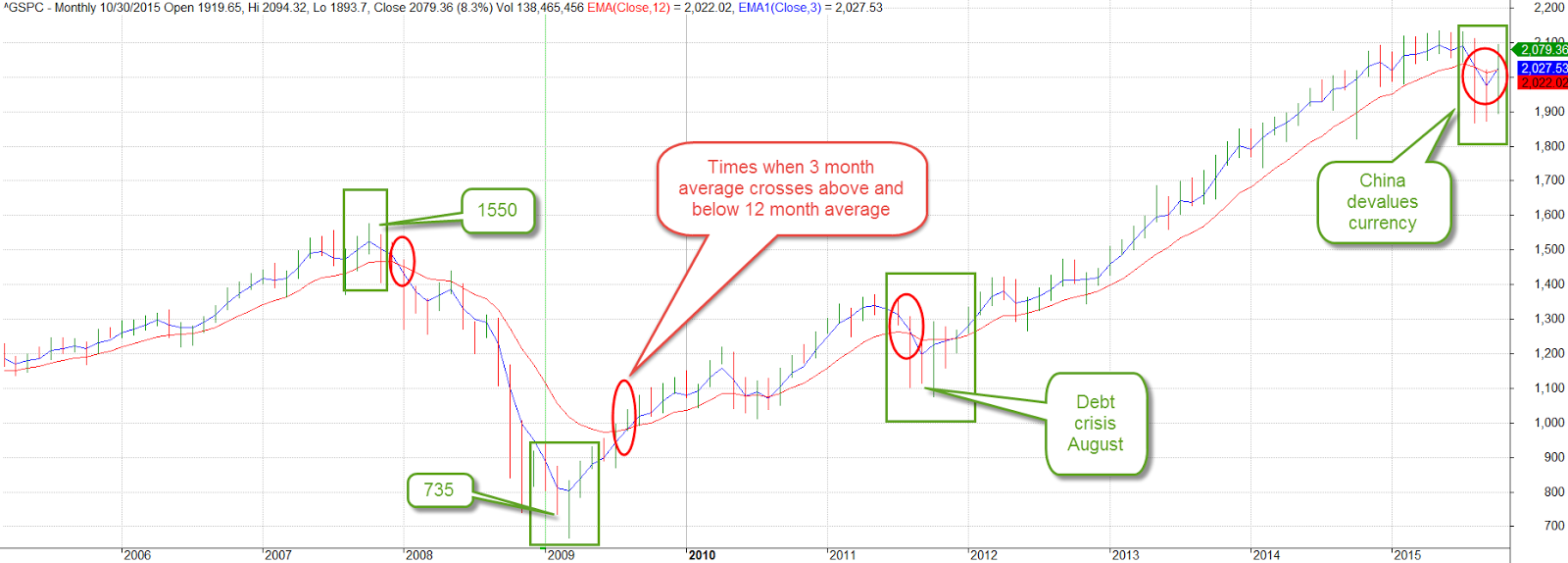
Eight years ago, in October 2007, the SP500 index reached a pre-recession high of 1550. After this month’s 8% recovery the index stands at 2079, more than a third above that long ago high.  A decade long chart of the SP500 shows the inflection points of sentiment.  We can compare two averages to understand the shifts in investor confidence.  A three month average, one quarter of a year, captures short term concerns and hesitations.  A one year average reflects doubts or optimisms that have strengthened over time.  The crossing of one average above or below the other gives us a signal that a change may be coming.  Concerns may be temporary – or not.

After falling below the 12 month average, the 3 month average strained and groaned to pull its chin above that long average, notching five consecutive weekly gains.  Both China and the EU central banks have announced plans for lower interest rates or QE to spur their economies.  Oil prices continued to bounce around under the $50 mark.  OPEC suppliers announced they could not agree on production cuts.  Fearing a continuing oversupply of crude, oil prices fell 4 – 5%.  Then came the news that the number of oil rigs in the U.S. had fallen.  Prices went back up.

Commodities and mining stocks remain under pressure.  After falling over 18% in September, mining stocks gained back most of those losses in the first two weeks of October, then fell back in the last half of this month, closing the month with a 3% gain.  15 to 20% gains and losses in a sector during a month looks like so much scurrying and confusion.

Emerging market indexes lost ground this past week, slipping more than 4%.  Worries of a global recession continue to haunt various markets.  For large and medium U.S. companies, a slowdown in European and Asian markets is sure to have a negative effect on the bottom line.

The first estimate of 3rd quarter GDP growth was a paltry 1.5%, far below the 3.9% annual rate of the 2nd quarter.  Two-thirds of the SP500 companies have reported earnings for the 3rd quarter and FactSet estimates a decline of 2.2% for the quarter, the second consecutive quarter of earnings declines.

***********************

The Causes of Depression

The economic kind, not the emotional and psychological variety.  Economics history buffs will enjoy David Stockman’s critique of the extraordinary amount of monetary easing under former Fed chairman Ben Bernanke.  As President Reagan’s budget director, Stockman was at the forefront of supply side economics, a theory which promised an answer to the stagflation of the 1970s that drove many to question the assumptions and conclusions of Keynesian economics.

At first a champion of this new approach to economic policy making, Stockman grew disillusioned and later coined the term “voodoo economics” to describe the contradictory thinking of his boss and others in the Republican Party who stuck by their beliefs in supply side economics in spite of the evidence that these policies generated large budget deficits and erratic economic cycles.

In 2010, Stockman penned an editorial  that held some in the Republican Party, his party, culpable for the 2008 fiscal crisis.  He understands that politicians and policy makers become welded to their ideological platforms, disregarding any input that might upset their model of the world.

For those who have a bit of time, an Atlantic magazine December 1981 an article acquainted readers with David Stockman in his first year as budget director.  The budget process seems as broken today as it was 35 years ago when Stockman assumed the task of constructing a Federal budget.

 These “internal mysteries” of the budget process were not dwelt upon by either side, for there was no point in confusing the clear lines of political debate with a much deeper and unanswerable question: Does anyone truly understand, much less control, the dynamics of the federal budget intertwined with the mysteries of the national economy?

Stockman understands the political gamesmanship that permeates Washington.  He criticizes Bernanke’s analysis of the 2008 Great Recession as well as the 1930s Great Depression. Faulty analysis produces faulty remedies. Stockman goes still further, finding fault with Milton Friedman’s monetary analysis of the causes of the Great Depression.  In a 1963 study titled A Monetary History of the United States Friedman and co-author Anna Schwartz found that monetary actions by the Federal Reserve deepened and lengthened the 1930s Depression.  Friedman became the leading spokesman of monetarism in the late 20th century, the thinking that governments can more effectively guide a national economy by adjusting the money supply rather than employing an ever changing regime of fiscal policies.

Students of the great debate of the past 100 years – bottom up or top down? – will enjoy Stockman’s take on the matter.

Rebound

October 25, 2015

Last week we looked at two components of GDP as simple money flows.  In an attempt to understand the severe economic under-performance during the 1930s Depression, John Maynard Keynes proposed a General Theory that studied the influences of monetary policy on the business cycle (History of macoeconomics).  In his study of money flows, Keynes had a fundamental but counterintuitive insight into an aspect of savings that is still debated by economists and policymakers.

Families curtail their spending, or current consumption, for a variety of reasons.  One group of reasons is planned future spending; today’s consumption is shifted into the future.  Saving for college, a new home, a new car, are just some examples of this kind of delayed spending.  The marketplace can not read minds.  All it knows is that a family has cut back their spending.  In “normal” times the number of families delaying spending balances out with those who have delayed spending in the past but are now spending their savings.  However, sometimes people spend far more than they save or save far more than they spend, producing an imbalance in the economy.

When too many people are saving, sales decline and inventories build till sellers and producers notice the lack of demand. To make up for the lack of sales income, businesses go to their bank and withdraw the extra money that families deposited in their savings accounts.  Note that there is no net savings under these circumstances.  Businesses withdraw their savings while families deposit their savings.  After a period of reduced sales, businesses begin laying off employees and ordering fewer goods to balance their inventories to the now reduced sales.  Now those laid off employees withdraw their savings to make up for the lost income and businesses replace their savings by selling inventory without ordering replacement goods.  As resources begin strained, families increasingly tap the several social insurance programs of state and federal governments which act as a communal savings bank,   Having reduced their employees, businesses contribute less to government coffers for social insurance programs.  Governments run deficits.  To fund its growing debt, the Federal government sells its very low risk debt to banks who can buy this AAA debt with few cash reserves, according to the rules set up by the Federal Reserve.  Money is being pumped into the economy.

As the economy continues to weaken, loans and bonds come under pressure.  The value of less credit worthy debt instruments weakens.  On the other side of the ledger are those assets which are claims to future profits – primarily stocks.  Anticipating lower profit growth, the prices of stocks fall.  Liquidity and concern for asset preservation rise as these other assets fall.  Gold and fiat currencies may rise or fall in value depending on the perception of their liquidity.

Until Keynes first proposed the idea of persistent imbalances in an economy, it was thought that imbalances were temporary.  Government intervention was not needed.  A capitalist economy would naturally generate counterbalancing motivations that would auto-correct the economic disparities and eventually reach an equilibrium.  Economists now debate how much government intervention. Few argue anymore for no intervention.  What we take for granted now was at one time a radical idea.

While some economists and policymakers continue to focus on the sovereign debt amount of the U.S. and other developed economies, the money flow from the store of debt, and investor confidence in that flow, is probably more important than the debt itself.  As long as investors trust a country’s ability to service its debt, they will continue to loan the country money at a reasonable interest rate.  While the idea of money flow was not new in the 1930s, Keynes was the first to propose that the aggregate of these flows could have an effect on real economic activity.

***********************

Stock market

A very good week for the market, up 2% for the week and over 8% for October.  A surprising earnings report from Microsoft lifted the stock -finally – above its year 2000 price.  China announced a lower interest rate to spur economic activity.  ECB chair Mario Draghi announced more QE to fight deflation in the Eurozone. Moderating home prices and low mortgage rate have boosted existing home sales.

The large cap market, the SP500, is in a re-evaluation phase.  The 10 month average, about 220 days of trading activity, peaked in July at 2067 and if it can hold onto this month’s gains, that average may climb above 2050 at month’s end.

The 10 month relative strength of the SP500 has declined to near zero.  Long term bonds (VBLTX) are slightly below zero, meaning that investors are not committing money to either asset class.  The last time there was a similar situation was in October 2000, as the market faltered after the dot-com run-up.  In the months following, investors swung toward bonds, sending stocks down a third over the next two years.  This time is different, of course, but we will be watching to see if investors indicate a commitment to one asset class or the other in the coming months.

October Surprise

October 11, 2015

A good week for stocks (SPY), up over 3%.  Emerging markets (VWO) were up over 5%, but are still down 18% from spring highs and are on sale, so to speak, at February 2014 prices.

On news that domestic crude oil production had fallen 120,000 barrels per day, about 15%, in September, an oil commodity ETF (USO) rose up 8% this week.  On fears, and confirmations of fears, of an economic slowdown in much of the world, commodities have taken a beating in the past year, falling 50% or more.  A broad basket of commodities (DBC) was up 4% this week but are still at ten year lows.  An August 2010 Market Watch commentary recounted the evils of commodity ETFs as a place where the pros take the suckers’ money.  Not for the casual investor.

The Telegraph carried a brief summary of the latest IMF assessment of credit conditions around the world.  There is an informative graphic of the four stages of the macro credit cycle and which countries are at what stage in the cycle.

**************************

Social welfare

Some people say they dislike redistribution schemes on moral grounds.  The government takes money from some people based on their ability and gives it to other people based on their need, a central tenet of Communism.

In a 2014 paper IMF researchers have found that redistribution is a hallmark of developed economies.  Why?  Because advanced economies have the most income inequality.  Why?  Developed economies have greater income opportunity and opportunity breeds inequality.  A sense of human decency prompts the voters in these developed countries to even the playing field a bit.

In countries with greater equality, living standards and median income are lower.  There is less income to redistribute.  In the real world where the choices are higher income and redistribution vs an equality of poverty, I’ll take the more advanced economies.

****************************

CWPI

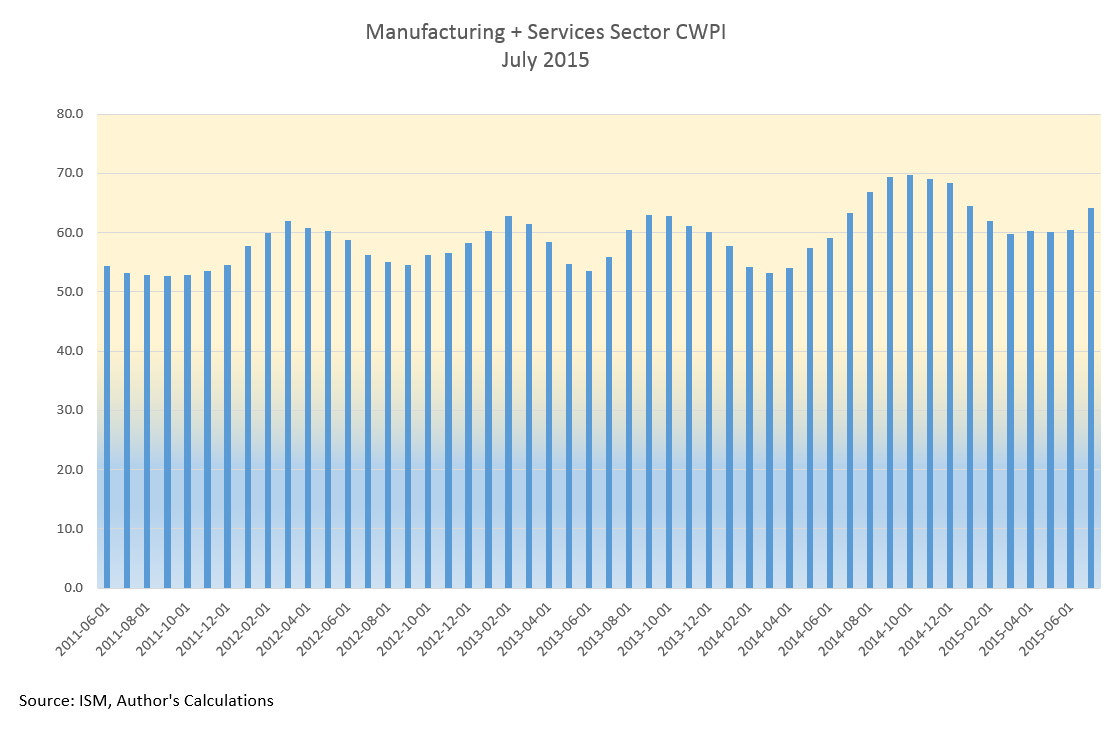
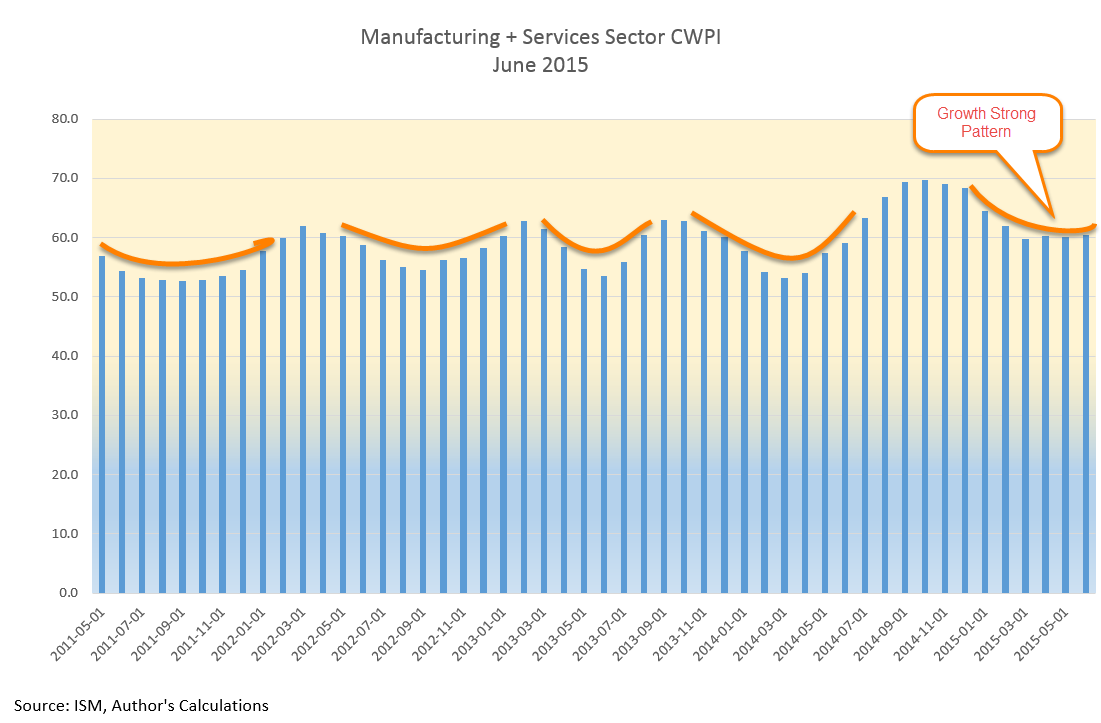
Since the beginning of this year the manufacturing component of the Purchasing Managers’ Index has continued to expand.  The strong dollar has made U.S. products more expensive around the world and this has hurt domestic manufacturers.  Growth has slowed from the strong expansion of the last half of 2013 and all of 2014.  September’s survey of manufacturers is right at the edge between expansion and contraction.  The CWPI weights the new orders and employment portions of each index more heavily.  Using this methodology, the manufacturing side of the equation looks stronger than the headline index indicates.

The services sector, most of the economy, is still enjoying robust growth and this strength elevates the combined CWPI.

How much will the substandard growth in the rest of the world affect the U.S. economy?  Industrial production in Germany declined last month.  China’s growth is slowing.  GDP growth in the Eurozone is barely positive.  Emerging markets are struggling with capital outflows.  Developed economies that are dependent on natural resources – Canada and Australia – are struggling.  The GDP growth rate of both countries is very slightly negative. The U.S. is probably the one economic ray of hope.  September’s lackluster labor report and the Fed’s decision to delay a rate increase has attracted capital back into the stock market. This past Monday, volatility in the market (VIX – 17) dropped down below its long term historical average of 20 but is a tiny bit above its 200 day average.  I’d like to see another calm week before I was convinced that the underlying nervousness in the market has abated.  Third quarter earnings season is here and estimates by Fact Set  are for a 5% decline in earnings, the second consecutive quarter of declines since 2009.

The Active and the Inactive

October 4, 2015

A disappointing September jobs report capped off a third week of losses a rescue from a third week of losses in the stock market.  The initial reaction on Friday morning was a 1.5% drop in the SP500. Over the past several weeks, the stock (SPY) and long term Treasury market (TLT) have become little more than speculative gambles on when the Fed will raise interest rates.  Until Friday’s jobs report, the choices were mainly restricted to October or December 2015. Janet Yellen voiced a commitment to raising interest rates this year in comments (see last week’s blog) at the U. of Massachusetts.  However, the lackluster jobs report ushered in another choice – March of 2016.  By the closing bell on Friday, the SP500 had gained 1.5%, a reversal of 3% on the day and a gain of 1% in the index for the week.

Emerging markets bounced up almost 5% this week, showing that there are enough buyers who are willing to invest at these low price levels.  The Vanguard ETF VWO formed a “W” pattern on a weekly chart and strong volume.

Despite the tepid job growth of 142,000, the unemployment rate remained steady because more than 300,000 left the work force.  Probably the biggest surprise was that July and August’s job gains were revised downward as well.  I had been expecting an upward revision in August’s numbers.

The Labor Force Participation Rate (CLF) declined .2% to 62.4%.  The CLF rate measures the (number of people working or looking for a job) / (number of people who can legally work).  There is another measurement that I have used before on this blog: the ratio of (people not working or looking for a job) / (the number of people working).  Let’s call it the Inactive Active ratio, or IARATIO.

Visually, the blue CLF rate doesn’t show us much; it is a relatively monotonic data series.  In contrast, the decades long fluctuations in the red IARATIO present some useful information.  We can see a simple answer for the federal budget surplus at the end of the 1990s, when the ratio of inactive to active workers was very low. Although politicians like to claim and blame for every data point, the simple truth is that there were almost as many adults working as not working in the late ’90s. Working people tend to put in more than they take out of the kitty.  For two decades there was a striking correlation between the Federal Surplus/Deficit and the IARATIO.

At about .75, the ratio of this past recovery was similar to that of the first half of the 1980s.  In the past two years, the IARATIO has dropped to .72, a good sign,  similar to the readings of 1986, a time of economic growth.

The ever greater number of Boomers retiring over the next decade will put upward pressure on this IARATIO.  The fix?  More jobs. Jobs solve a lot of problems, both for families and government budgets.

Which Way Sideways?

August 9, 2015

As we all sat around the Thanksgiving table last November, the SP500 was about the same level as it closed this week.  Investors have pulled off the road and are checking their maps to the future.  After forming a base of good growth in the past few months, July’s CWPI reading surged upwards.

Despite years of purchasing managers (PMI) surveys showing expanding economic activity, GDP growth remains lackluster.  Every summer, in response to more complete information or changes to statistical methodologies, the Bureau of Economic Analysis (BEA) revises GDP figures for the most recent years.  A week ago the BEA revised real annual GDP growth rates for the years 2011 – 2014 from 2.3% to 2.0%.  “From 2011 to 2014, real GDP increased at an average annual rate of 2.0 percent; in the  previously published estimates, real GDP had increased at an average annual rate of 2.3 percent.”

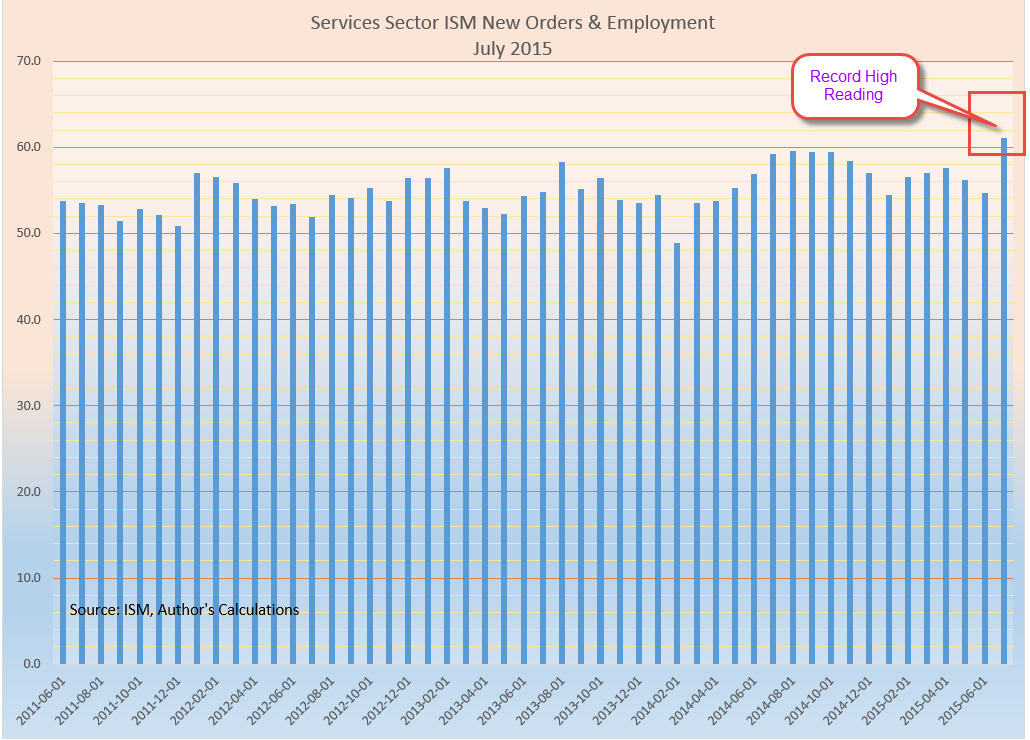
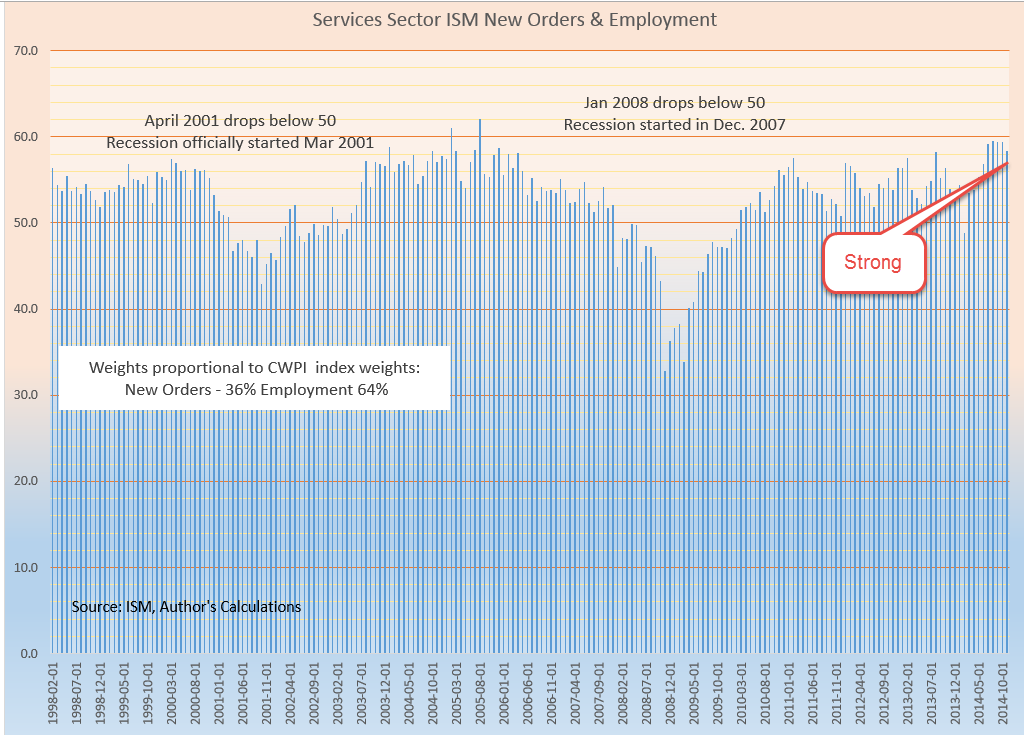
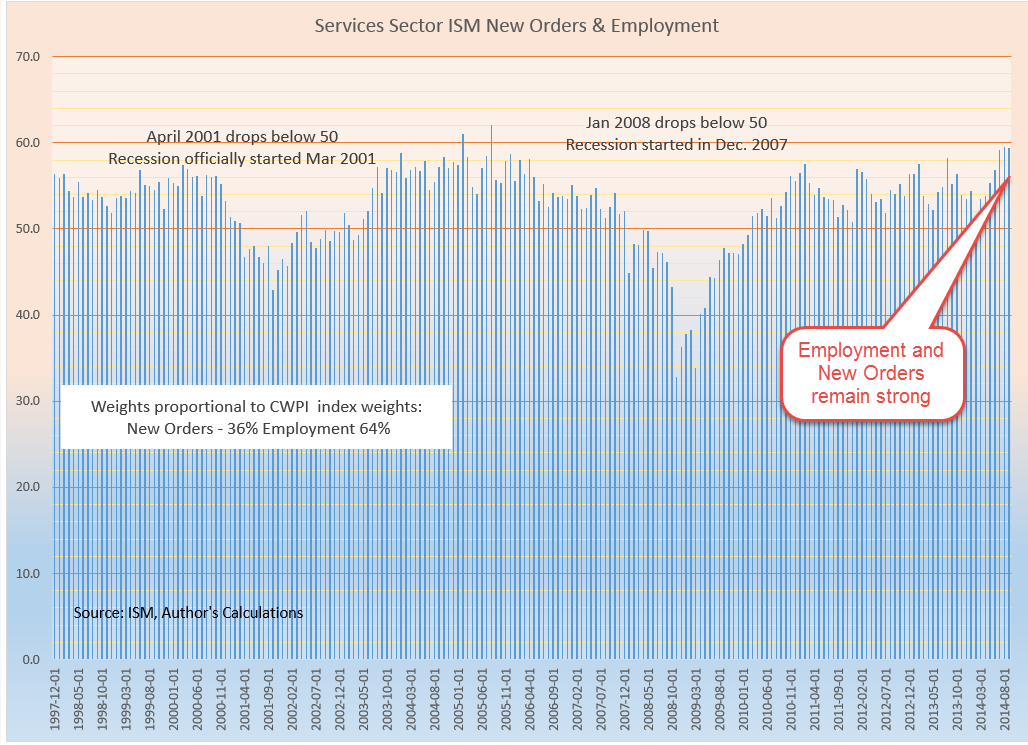
A composite of new orders and rising employment in the service sectors showed its strongest reading since the series began in 1997.  The ISM reading bested the strong survey sentiments of last summer. We can assume that the PMI survey is not capturing some of the weakness in the economy.

This level of robust growth should put upward pressure on prices but inflation is below the Federal Reserve’s benchmark of 2%.  Energy and food prices can be volatile so the Fed uses what is called the “core” rate to get a feel for the underlying inflationary pressures in the economy.

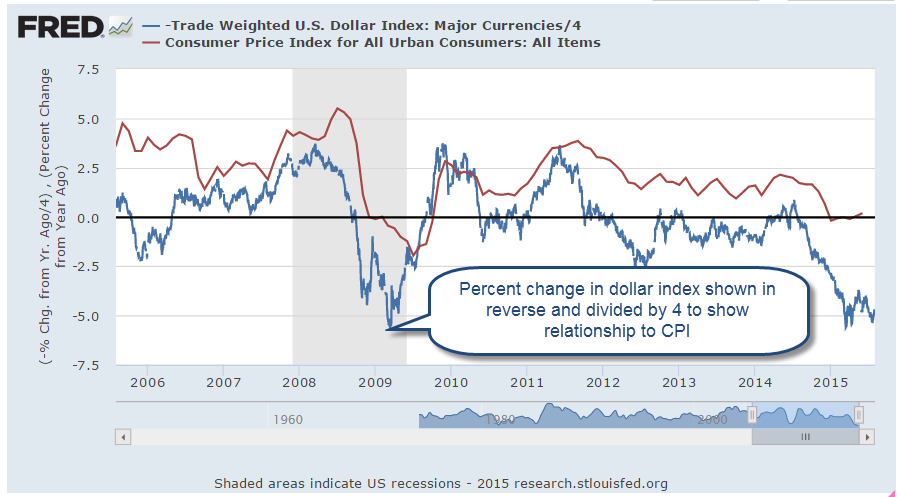
The stronger U.S. dollar helps keep inflation in check.  There is less demand from other countries for our goods and the goods that we import from other countries are less expensive to Americans. .  Because the U.S. imports so much more than it exports, the lower cost of imported goods dampens inflation.  In effect, we “export” our inflation to the rest of the world.

When the economy is really, really good or very, very bad we set certain thresholds and compare the current period to those benchmarks.  When the financial crisis exploded in late 2008, the world fled to the perceived safety of the dollar in the absence of a exchange commodity of value like gold.  Because oil is traded in U.S. dollars and the U.S. is a stable and productive economy and trading partner, the U.S. dollar has become the world’s reserve currency.  The conventional way of measuring the strength of a currency like the dollar has been to compile an index of exchange rates with the currencies of our major trading partners.  This index, known as a trade weighted index, does not show a historically strong U.S. dollar.  In fact, since 2005, the dollar has been extremely weak using this methodology and only recently has the dollar risen up from these particularly weak levels.

As I mentioned earlier, a strong dollar helps mitigate inflation pressures; i.e. they are negatively correlated. When the dollar moves up, inflation moves down.  To show the loose relationship between the dollar index and a common measure of inflation, the CPI, I have plotted the yearly percent change in the dollar (divided by 4) and the CPI, then reversed the value of the dollar index.  As we can see in the graph below, the strengthening dollar is countering inflation.

What does this mean for investors?  The relatively strong economy allows the Fed to abandon the zero interest rate policy (ZIRP) of the past seven years and move rates upward.  A zero interest rate takes away a powerful tool that the Fed can employ during economic weakness: to stimulate the economy by lowering interest rates.

The strong dollar, however, makes Fed policy makers cautious. Higher interest rates will make the dollar more appealing to foreign investors which will further strengthen the dollar and continue to put deflationary pressures on the economy.  The Fed is more likely to take a slow and measured approach.  Earlier this year, estimates of the Effective Federal Funds Rate at the end of 2015 were about 1%.  Now they are 1/2% – 3/4%.  In anticipation of higher interest rates, the price of long term Treasury bonds (TLT) had fallen about 12% in the spring.  They have regained about 7% since mid-July.

DBC is a large commodity ETF that tracks a variety of commodities but has about half of its holdings in petroleum products.  It has lost about 15% since May and 40% in a year.  It is currently trading way below its low price point during the financial crisis in early 2009.  A few commodity hedge funds have recently closed and given what money they have left back to investors.  Perhaps this is the final capitulation?  As I wrote last week, there is a change in the air.

*************************

Labor Report

Strong job gains again this month but labor participation remains low.  A key indicator of the health of the work force are the job gains in the core work force, those aged 25 – 54.

While showing some decline, there are too many people who are working part time because they can’t find a full time job.  Six years after the official end of the recession in the summer of 2009, this segment of the work force is at about the same level.

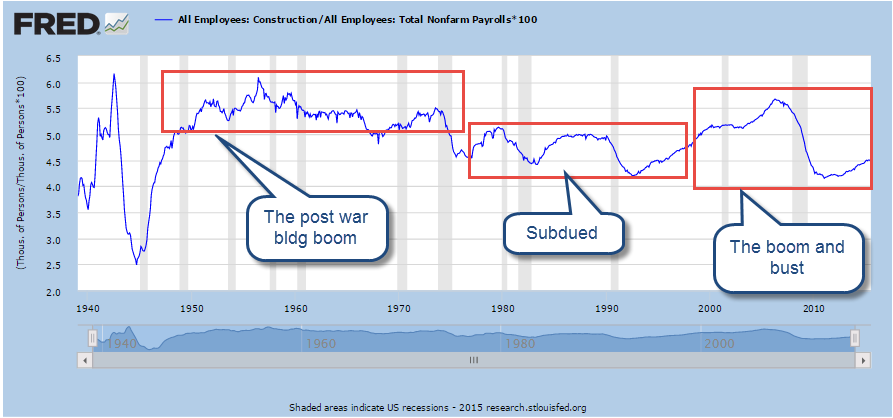
In some parts of the country job gains in Construction have been strong.  Overall, not so much.  As a percent of the work force, construction jobs are relatively low.  In the chart below I have shown three distinct phases in this sector since the end of World War 2.  Extremes are most disruptive to an economy whether they be up or down.    Note the relatively narrow bands in the post war building boom and the two decades from 1975 through 1994.  Compare that to the wider “data box” of the past two decades.

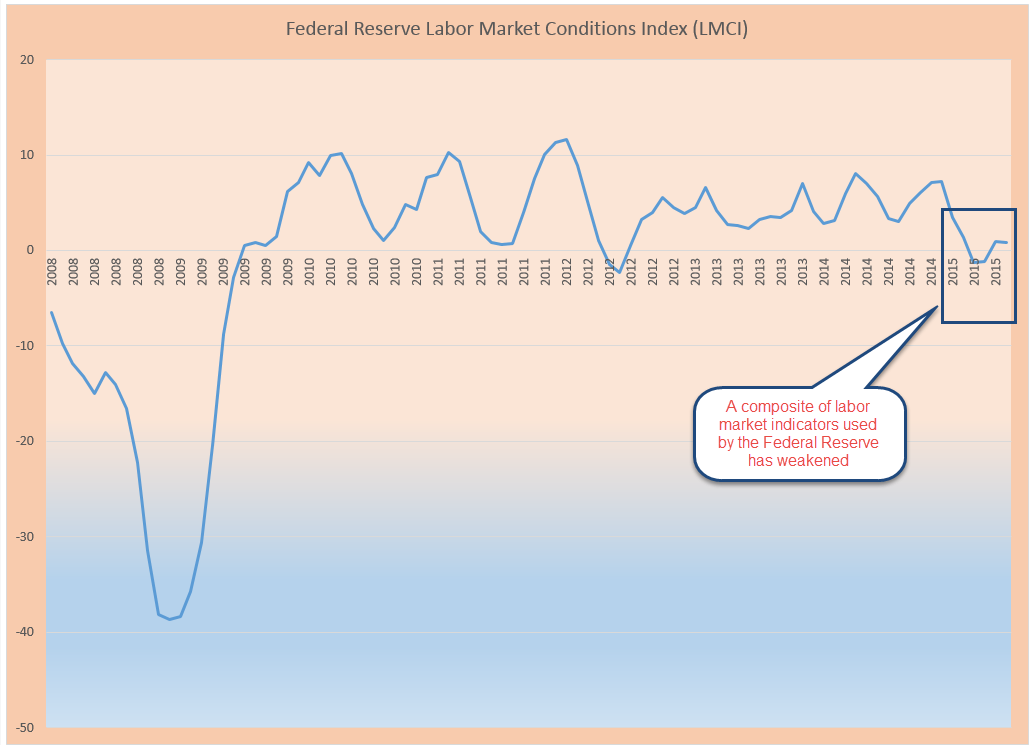
For several months the headline job gains have averaged about 225,000 each month.  The employment component in the ISM Purchasing Managers’ Index (on which the CWPI above is based) is particularly robust.  New unemployment claims are low and the number of people confident enough to quit their jobs is healthy.  The Federal Reserve compiles an index of many factors that affect the labor market called the Labor Market Conditions Index (LMCI).  They have not updated the data for July yet but it is curiously low and gives more evidence that the Fed will be cautious in raising rates.

Keynes, Income, Spending

July 12, 2015

In the past few weeks, I have looked at savings and investment as forms of spending shifted in time.  Now let’s examine the idea of income.  We earn money, spend most of it, and hopefully save a little of it.

In the 1930s John Maynard Keynes proposed an income expenditure model to explain business cycles. (More here) Although Keynes’ model was mathematically simple by today’s standards, it showed an interlocking relationship between employment, interest rates and money.  Keynes popularized his ideas in lectures, debates and magazine articles.  Although he died shortly after World War 2, financial institutions and economic policies still bear his mark.  It was he who first proposed and then co-developed the framework for the International Monetary Fund (IMF) and World Bank.

One of Keynes many seminal insights was that one person’s income is another person’s spending.  If I decide to save $5 by not buying a latte at the neighborhood coffee shop, I am in effect putting my $5 in a savings account at my local bank.  But the coffee shop owner has $5 less in income.  $5 less in income is $5 less profit, keeping all else the same.  The owner of the coffee shop must go to the local bank and take $5 out of their savings account to make up for the lost income.  There is no net savings when a person decides to not spend money and we see the relationship between savings and profit; namely, savings = profit.

We are now ready to develop that insight of Keynes, that income = spending.  As we discussed in previous weeks, the amount that we don’t spend on current consumption is savings.  Savings = spending, either yesterday’s spending, i.e. an investment in someone’s debt, or tomorrow’s spending, i.e. an investment in someone’s future profits, or savings.  When we spend for tomorrow, we are effectively moving our savings into the future.  Likewise, when we spend for yesterday, we move our savings into the past to replace the savings that someone else did not have at the time they borrowed the money.

All of these categories – income, spending, saving, investment – are all forms of spending shifted in time.  Next week we’ll look at the GDP accounting identity and the government component of that equation.

*****************************

CWPI

The manufacturing sector stumbled during the harsh winter and strengthening dollar.  The service sectors fell somewhat but remained strong.  In June, the manufacturing sector regained strength, helping offset a slight slackening in the service economy.  The composite index remains strong in a several month growth trough.

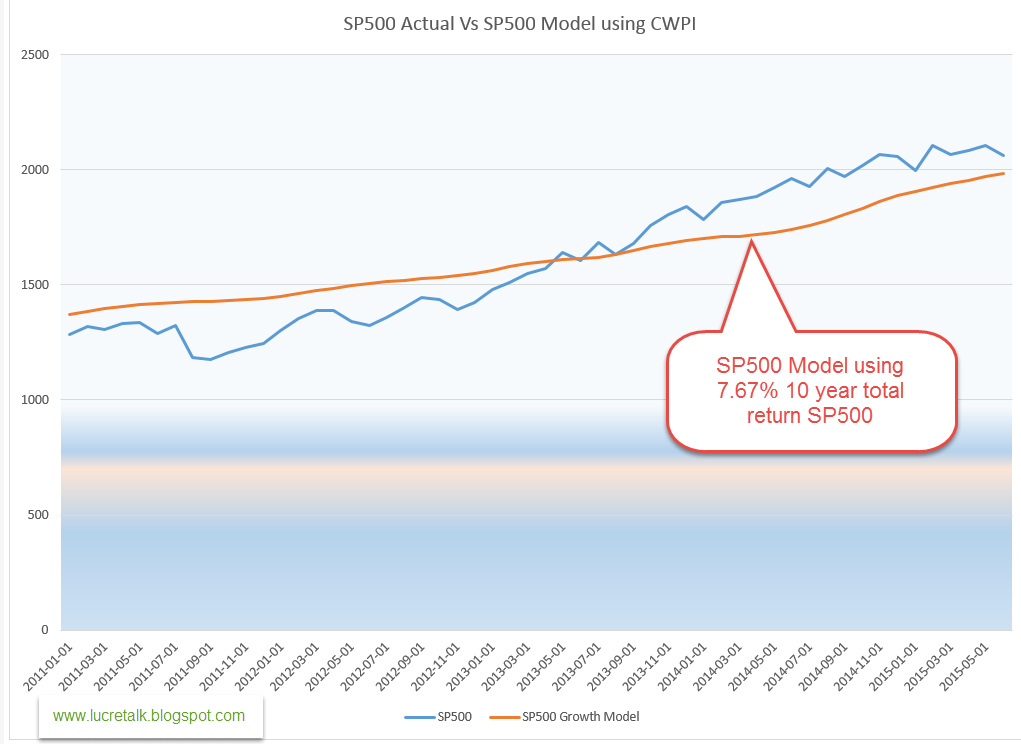
Some are of the opinion that the stock market can be overvalued or undervalued.  In my opinion, liquid markets are usually fairly valued.  Expectations of buyers and sellers change, causing a recalculation of future growth and a change in valuations.  Comparing an index like the SP500 to a valuation model can help identify periods of investor optimism and pessimism.

I built a model based on a 930 average price of the SP500 in the 3rd quarter of 1997.  At the end of 2014, the 10 year total return of the SP500 was 7.67% (Source) which I used as a base growth rate modified by the change in growth shown by the CWPI index.  The CWPI measures a number of factors of economic growth but measures profits indirectly as a function of that economic growth.  Profit growth may outpace or lag behind economic growth and investors try to anticipate those varying growth rates when they value a company’s stock.

Until mid-2013, the SP500 lagged behind the model, indicating a degree of pessimism.  In 2013, the SP500 gained 30% and it is in that year that we see the crossover of investor sentiment from pessimism to optimism.  In the first six months of this year, the SP500 has changed little and we see the index drifting back toward the model, which was only 4% less than the closing price of the SP500 index at the end of June.

In hindsight, we can identify periods when investors were too exuberant and miscalculated future growth.  But we can only do so because in that future, profits and growth were not as hoped for.  That is the problem with futures.  We never know which one we are going to get.

Oil, oil, retail, and oil

December 14, 2014

The market seemed to wake up Monday morning on the wrong side of the bed.  The Federal Reserve updated their Labor Market Conditions Index, scoring the month of November with a tepid 2.9, a sobering counter punch to the previous Friday’s report of 321,000 job gains in November.  Too many part time workers, too many long term unemployed, a rate of unemployment that was too high among minorities, those in their twenties and those without a college education.

ISM’s monthly reports showed continued strength in both manufacturing and the services sector. The composite CWPI eased just a bit from the historic highs of the past two months.

The key components of the manufacturing index, new orders and employment, remained strong or robust.  The prices component showed a steep dive from expansion to contraction, 53.5 to 44.5.  George wondered if the falling price of oil had anything to do with this change.  New orders in the services sector grew even stronger while employment eased just a bit and was also continuing a strong expansion.

On his way to Home Depot on Tuesday morning, George filled up his SUV for just under $50.  When had that happened last he wondered.  2009, maybe?  George remembered the lead up to the 2012 elections. “Gas was $1.50 when Obama came into office,” he would hear on a conservative talk show, “and now it’s more than double that. Obama is hurting working families.”  As though Obama, or any President for that matter, had much to do with the price of gas.  Most talk show hosts counted on the fact that their audience was, well not stupid, as Jonathan Gruber had quipped when talking about Obamacare at a conference, but poorly informed.

The market had opened up that morning in a particularly foul mood after China tightened lending criteria so that Chinese investors could no longer use low-grade corporate debt as collateral for loans.  Overnight the Shanghai market lost more than 5% (WSJ ).

The EIA projected that U.S. oil production would rise in 2015 even as oil prices went lower.  Lower prices might curb new drilling but once the wells were drilled, the cost of production was fairly low.  The drop in gas prices put some extra money in most people’s pockets.  The EIA estimated that a gallon of gas would average about $2.60 in 2015, almost a $1 lower than the $3.51 average in 2013.

The continuing fall in oil prices contributed to another drop in the market on Wednesday, erasing the gains of the past month.  To sell or not to sell, that is the question, George thought as the volatility in the market continued to climb, rising more than 50% in the past week.  But he hemmed and hawed, then decided to replace the fence post in the back yard as the antidote to his indecision.

In an economy dominated by consumer spending, the monthly retail sales report and the employment report are probably the two most influential gauges of the strength of the economy.  Thursday’s report on retail sales was a huge positive, showing a rise of .7%.  On an annualized basis, that was an increase of more than 8%.  People were evidently spending the money they were saving at the pump.  The market opened higher and climbed up above Wednesday’s opening price.  Great stuff, George thought, then watched as the positive mood vanished and the market started sinking.  He must have made some sound because Mabel called out asking him if he was OK.  George realized that the early morning run up in prices was traders covering their short bets.  The underlying sentiment was still negative.  A strong employment report last Friday and now a strong retail sales report was having little effect on the mood of the market.  George decided to get out of the way of the darkening mood and sold the equity index he’d bought in mid-October.

The market continued to follow oil prices down on Friday.  George was pleased to find that the long term Treasuries that he had bought last week were up a few percent.  Glancing back at the beginning of the year, he saw that long term Treasuries (TLT) were up an unbelievable 20% so far this year.  Back in January many had projected higher interest rates toward the end of 2014, making long term Treasuries less attractive.  The equity market was up 10% for the year despite the recent change in mood.  Two types of investment that often moved opposite each other had moved in the same direction.  George smiled as he remembered something his  childhood baseball coach would say, “If it ain’t one thing, it’s the other, and sometimes it’s both.”  Which was just another way of saying not to put all your eggs in one basket.

A Surprise Guest

October 26, 2014

Shortly after Monday morning’s sunrise, George sat on the back deck, coffee in hand.  Some brilliant, utterly mad painter rushed around the neighborhood, dabbing the trees with what seemed like the entire palette of warm colors. Armies of invisible elves set up accent lights in the branches, highlighting the hues of rust-orange-yellow-gold.  As George absorbed the movie magic moment, a van from the local cable company pulled up on the grass alleyway behind the backyard fence. “Starting early,” George thought as he glanced at this watch.  7:30.

He opened the backyard gate to the alley, meaning to ask the service guy if repairs on the pole would interrupt his and Mabel’s service this morning.  A guy who looked too trim, too neat, and too fit to be a repairman opened the passenger door of the van and called out to him, “Sir, stay inside the yard.”  George took a step backward and looked up above.  Was there a loose wire or something dangerous?  Cable wire carried low voltage so what could be the problem?  He glanced back at the man and the van.

From the rear of the van, two men hopped out.  Like the guy in front, they were both dressed in black windbreakers over blue polo shirts, black slacks.  It was like a SWAT team of rugged fashion models.  One of the men came to the rear gate.  George stepped back another step.  The man scanned the yard to the left and right of George, looked past George at the rear of the house.  George noticed that the other two men scanned the alley, the nearby houses.  The man at the gate glanced at a phone in the palm of his hand, then looked at George.  “George Liscomb?” he asked in the commanding tone of one who routinely asks questions and expects answers.  George nodded.  “Is there a Mabel Liscomb living here?”  George nodded again.  “Is she here?” Another nod.  “Your wife?”  One more nod. “Any other residents inside the house?”  George shook his head.  The man turned his head sideways, keeping one eye on George.  “Bravo,” he called to the two other men.

From the side door another man emerged, dressed much like the others. George felt a numbness inside like he was on a movie set.  “Move back a few feet, please.”  Finally a slim figure emerged from the side of the van. The ears were the dead giveaway.  George forgot that he was still holding his coffee cup as he instinctively jerked his hand to his face.  The coffee cup clipped his lower jaw.  “Ouhhhhh,” George barked. The sudden grunt drew everyone’s gaze.  “You OK?” President Obama called out to him. The lukewarm coffee had spilled on George’s shirt but he was hardly mindful.  “Uh, yeh,” George replied.

Like four points of a compass, the four men surrounded the President as the group seemed to flow through the backyard gate.  The front man stood aside and the President held out his hand to George. “Great morning here in Denver, isn’t it,” the President said, an upbeat easygoing smile on his face. George paused briefly to figure out the coffee cup thing.  He put the coffee cup in his left hand then held out his right hand to shake the President’s hand.  What does one say to the President, George wondered.  “Good morning, President.”  Ok, that worked.  “George, is it?” the President asked? “Yeh,” George replied in a monotone.  “I was wondering if Mabel – that’s your wife? – is she here?  Is she available?”  “Uh, yeh,” George replied, “she’s in the living room.”  “May we go in?” the President asked politely. “Uh, sure.”  George had barely drunk his first coffee before spilling it.  Maybe that’s why his brain seemed to be stuck in monosyllabic mode.

The front man strode to the house.  “Maybe George should go with you and we’ll wait a moment on the deck,” the President called out.  George joined the man, who opened the rear door and glanced inside before allowing George to go through the doorway.  “Hey, Mabel,” George called out.   “Are you decent?  We’ve got company.”  He could hear her get up from her easy chair.  “Be right there,” she called back.  She appeared at the far end of the kitchen, saw the man next to George and asked, “What’s the matter, dear?”  “You’re not going to believe this,” George replied.  Already the man was moving toward Mabel.  George forewarned her.  “This guy needs to ask you a few questions.”

The man went through the same procedure with Mabel.  She answered curtly as though she were about to throw this impudent intruder out of her house.  “You have a holstered weapon.  Are you with the police?”  she asked after answering the first two questions.  From a few incidents at the high school, she recognized the bulge at the man’s side.   “Secret Service, ma’am,” the man answered. “Secret what?” Mabel asked and the man opened his windbreaker enough to see the ID badge hanging from his neck.  She looked past the man and spoke to George, “What the hell is going on, George?”  He could tell she was upset.  “It’s OK, just answer the questions,” George called back to her.  No, there was no one in the house.  Yes, she was Mabel Liscomb.  She leveled her gaze directly at the man when he asked her birthdate.  She responded quickly but in a slightly menacing tone.  “You have the audacity to ask me to identify myself in my own home!”  Then the man’s voice softened as though he were an actual human being.  “Sorry, ma’am.  Have to do my job.”  He stepped back to where George stood at the rear door.   The man opened the screen door and nodded, “It’s allright.”

George joined Mabel in the kitchen as the group on the deck flowed through the rear doorway, keeping the President protected.  “Mrs. Liscomb,” the President greeted her with a warm smile, “good to meet you.  You wrote me a letter a few months back, didn’t you.”  Mabel stuttered.  Had he ever hear Mabel stutter, George wondered.  “I-I-I-I-did I?  I can’t muh-member,” Mabel answered.  “You had some good ideas that I’d like to talk to you about, if you have time?”  Mabel nodded.  George could see that she was recovering quickly from her shock.  She was good at that.  The habits of a high school principal asserted themselves and Mabel told the President, “I’m flattered that you are interested, of course.  Why couldn’t your staff make an appointment?”  Geez, George thought, she’s using the command voice with the damn President of the U.S.  He noticed that each member of the security detail had moved to a window.  George glanced to his right and saw that one had gone into the living room.  The fourth guy – had he gone up the stairs to check the bedrooms?

“I was supposed to be golfing with your Senator Udall but he had to cancel,” the President explained.  “I offered to appear at a fundraiser with Diana DeGette but her staff said she’d have to get back to us.  I don’t seem to be too popular for this election.”  Mabel made a brushing gesture.  “Don’t worry about it.  Same thing happened to Eisenhower ,Reagan and Bush at the midterm of their second terms,” Mabel told him.  “With a recession still going on, Mamie Eisenhower was a lot more popular on the political circuit leading up to the ’58 mid-terms.”  “Oh, Michelle is on everyone’s dance ticket,” the President replied.  “Me, not so much.  The quarterback takes the blame when things go wrong.  When things go right, it’s the offensive line that gets the credit.  Just part of the game, I suppose.”

“Well, come on in and sit down,” Mabel turned toward the living room.  In a brief exchange, Mabel and the President had become buddies of a sort.  George still wasn’t sure how it happened but each of them had recognized something in the other that they both had in common.  Mabel sat down in her favorite chair, then motioned the President to sit on the couch nearby.  She turned to George and said, “Do you want to make some coffee? I think I took the last of the first pot.”  George nodded. “Yeh, I haven’t even had my first cup.”

The President was different in person.  When interviewed on 60 Minutes, he had showed a casual aloofness that George didn’t like. The folded legs, the studied composure didn’t ring true for George.  Now, here in this living room, he sat, legs unfolded, leaning slightly forward in an attentive pose, earnestly having a conversation with Mabel.

For the next hour Mabel discussed education policies with the President. She didn’t like the implementation of educational standards. Yes, she understood the desire for uniformity.  No federal department can understand local educational needs. Too much politics in education already.  Washington makes it worse.   “How did you come to read my letter?” she asked.  “Kind of a mistake,” the President replied. “It should have gone to Arne’s people but it got in my pile by mistake. I left it on the table and Michelle saw it.  She told me, ‘you need to hear this.  This woman’s been there her whole life.  She understands.  You’re not hearing this in Washington.’  And, to tell you the truth, it’s just been sitting in the policy pile for months.  The first thing I found out as President – probably every President faces this quickly – is that there is never enough time to get to everything on his plate.”

George stayed out of the living room for much of the time, preferring to give Mabel the opportunity to discuss her ideas with the President.  He actually served coffee to the President. The kids wouldn’t believe it when they told them. There was a woman out on the deck, talking into the air.  “Do you want some coffee,” George asked. Had she been there all along?  “No, thanks.  You’re Mr. Liscomb?” she asked.  “George,” George nodded.  “Sherry, personal assistant,” she shook his hand.  George started to invite her in but she held up her hand and started talking to the air again.

After too short a time, the assistant came in, excused herself, leaned over and whispered something in the President’s ear.  The President stood up. “I’ll have to go.  It was wonderful meeting you and talking with you, Mrs. Liscomb,” he said and bowed slightly.  Mabel rose up from her chair, “A great pleasure, Mr. President, and thank you for your insights,” Mabel responded and – you gotta be kidding me, George thought – did a slight curtsy.  The President laughed.  George shook hands with the President, then they were gone.  “Holy mackeral,” George said as he sat down on the couch. “I’m sitting in the same seat as the President of the United States.  It’s still warm.”  Mabel gave him a look.  “Oh, damn!” George remembered.  “We forgot to take a picture!”  They both laughed.  George ran out on the back deck, hoping that they had not driven away yet but the van was gone.  The story of a lifetime and no picture to prove it.

Then George remembered that he had hit the buy button the past Friday.  He sat down at the computer. The market had opened up that morning slightly lower but several earnings reports were positive.  Apple and IBM were scheduled to announce earnings after the close.  Later that day, Apple’s earnings and sales were above consensus estimates. To offset Apple’s upbeat numbers, IBM announced a chilling quarterly report. For the 10th consecutive quarter, revenue at the technology giant had declined.  The death blow: earnings for 2014 were projected to be less than 2013’s earnings, something that hadn’t happened since 2002.  This stalwart of so many institutional portfolios was continuing to stumble.  If September’s Existing Home Sales, due to be released the following morning, declined any further, Tuesday could be a seriously down day.

George woke up again before sunrise on Tuesday.  Mabel was already awake as usual.  Thankfully, sales of existing homes  showed a bounce back in September to an annual pace of close to 5.2 million homes, the benchmark for a healthy churn.

George checked earnings stats at Zacks.  Before the opening bell, the staffing giant Manpower, announced better than expected earnings.  Although sales declined in some areas, McDonald’s earnings were 10% more than expectations.  Aircraft giant Northrup Grumman reported better than expected earnings as well. Yahoo reported earnings that were more than double the consensus.  Most of the extra profits came from the sale of shares that it owned in Alibaba’s IPO.  The market opened up sharply, closing the day with a 2% gain.  Their son, Robbie, called that evening and they told him all about the visit from the President. “How many pics did you get?  You should put them up on Facebook,” he told them. “We forgot,” George informed Robbie. “Daaaad,” came the exasperated reply.  “Well, we’re old people. We’re not used to recording every event in our lives, I guess.”

On Wednesday, the Bureau of Labor Statistics announced that inflation had grown 1.7% in the past year, in line with expectations.  The Federal government closes its fiscal year at the end of each September.  Each October, the Social Security Administration sets the inflation adjustment to Social Security checks for the coming calendar year.  A 1.7% increase meant an average $20 increase in monthly benefits.  For too many seniors depending on Social Security as their primary source of income, the low annual increases in payments did not keep up with increases in drug and food costs.  Retired folks on the lower rungs of the economic ladder then had to apply for food stamps to make up for the low yearly increases in benefits.

Dow Chemical surprised to the upside as did industrial manufacturers Graco and General Dynamics.  The positive mood on Wall Street was interrupted by the news of an attack on the Canadian Parliament.  George was cleaning leaves out of the front gutter when Mabel opened the door to tell him the news.  The market reacted negatively to the news but did not give up all of Tuesday’s gains, a positive sign.

On Thursday, the BLS reported that new claims for unemployment had risen slightly the previous week but that the four week average had fallen to the lowest level in 14 years.  Positive earnings reports from 3M and Caterpillar, both of whom had a large international customer base, propelled the market higher, trading above the range of Tuesday’s rally.

On Friday, September’s new home sales of 467,000 were the best of the recovery.  August’s robust sales figures were reduced by almost 50,000 to a revised 466,000, giving George a WTF frown.  A 10% revision?  The drug manufacturer Bristol Meyers and consumer giant Colgate reported higher than expected earnings.  Ford surprised with significantly higher than expected earnings but the details in the report were not encouraging.  Revenues in both North and South America had declined and Ford expected flat earnings growth for the full year.  The market gained almost 1%.  In the past seven trading days, it had gained back all the ground lost the six days prior, closing near the level of October 8th.

For 2-1/2 years, each decline had been followed by a sharp upturn.  “Buying on the dip” had become a often used phrase.  Anticipating a bounce with each dip, investors had been coming back into the market after a short decline.  Since mid-September, investors who had bought in on the bounce had been disappointed when the market continued to decline.

Despite all the positive earnings reports, George was still concerned that stock valuations were just a bit on the high side.  Earnings gains, as well as the growth in profit margins, were becoming slower.  There had been two brief fallbacks in 2013, and already three fallbacks and a correction of more than 5% in 2014.  Frequent small fallbacks were healthy for the market, shaking out excess optimism.  The last real correction – a 10% decline in price – had last occurred in May 2012.  The market of the mid-2000s had gone for several years without a 10% correction and that did not end well.  George worried that the Feds low interest policy, kept in place for almost six years, gave investors too few choices and herded them into the riskier stock market. Gotta stay watchful, he thought.
Zorro Moon

October 12, 2014

Last Sunday, George and Mabel flew back to Denver from Portland.  They took a bus shuttle from the terminal to long-term parking and discovered that neither of them could find the parking stub which indicated which section they had parked in.  Mabel dutifully looked through her purse.  “I know you kept the stub, George, but I’ll look anyway.”  Mabel remembered details like this so George knew she was probably right. “I should have put it in my wallet and it’s not there,” George replied.  They asked to be let out at the main exit booth.  The attendant told them to go inside the office where they met a nice man with a patient look.  His English was barely accented with the round vowels of Spanish.  “My name is George.  How can I help you?” the attendant announced.  “Hey, that’s my name too,” George replied, as though each of them belonged to a brotherhood.  “Well, we seem to have lost our ticket stub and we can’t remember where we parked our car,” George told him.  “What day did you come in?” the other George asked.  “Last Monday, about 7:30 in the morning.”  The attendant’s face adopted an odd stillness, his eyes looking far away. “That was a busy morning.  We were parking in GG and HH at the far end of the lot.”  Both George and Mabel were amazed at the man’s memory and said so.  The attendant smiled graciously.  He pulled a set of keys from a hook on a key board, picked up two of their bags and led them to an idle shuttle parked near the office.  At the far end of the lot, the attendant drove slowly down one row until they reached the edge of the lot, then drove down the next row.  Mabel was the first to see their car. “There it is!” she exclaimed.  George gave the attendant a $10 bill, thanking him for his help.  The attendant nodded graciously, then drove back toward the office.  “There’s someone with  a remarkable talent working at a parking lot,” Mabel remarked.  “I think our schools do a terrible job of helping students discover their own talents.   The structure of our society, our economy – it could uncover and use these talents better.”

Sitting at his desk Sunday night, George mulled over the same thought that had distracted him on the flight from Portland.  Should he sell some or all of their stock holdings?  Two indicators said yes, another said maybe, one said this was temporary.  While on vacation, he had not compiled his makeshift index based on the monthly Purchasing Managers Index.  ISM, the publishers of the index, had released the services sector figures that past Friday.  He pulled up the latest report, then input the figures into his spreadsheet.  The index seemed to have peaked in September at a very robust reading near 70, rising up a few points from an already robust reading in August.

This composite of economic activity was a “stay out of trouble” indicator, giving buy and sell signals when the index rose above and below 50.  The last signal had been a buy signal in August 2009 when the SP500 was about half its current value.  Before that, the previous cue had been a sell signal in January 2008, a month after the official start of the recession.  Because employment and new orders were the largest components of the index, a chart of just these two components of the services sector reflected the larger composite.

So, the American economy was strong and Friday’s employment report had been a positive surprise. What seemed to be worrying investors was weakness over in Europe.  But Europe had been nearing recession for a few quarters now and that had not worried investors during the past year and a half.  Yes, no, yes, no decisions swirled around in George’s head.  Should he wait till the market opened Monday morning and see what the mood was?  Well, what if it was rather flat?  What would that tell him?  As Yogi Berra said, when you come to a fork in the road, take it.  So George did.  He put in an order to sell half of their stock holdings, essentially taking both forks of the road.

On Monday the market opened up above Friday’s close, indicating that a number of investors had put their buy orders in over the weekend after the positive employment report.  Active traders took the market back down below the level of Friday’s close.  In 1970s lingo, it was “negative vibes,” or negative sentiment in normal speak.

The Federal Reserve announced that they would begin publishing a labor market index that compiled 19 different labor market indicators to give an overall report card on employment.  The index was first proposed in a working paper published in May and the Fed was cautioning that the index was not “official.”

A chart of the various components of the index showed the correlations of each component with overall economic activity in the country.

The Fed provided a permanent link to a spreadsheet that they would update each month.  It was  a zero-based index.  Readings above zero meant overall conditions were improving; below zero, conditions were deteriorating.

The market opened up Tuesday with the news that Germany’s industrial output had dropped 4% in August.  A key leader and consistent performer, Germany was the Derek Jeter of the Eurozone.  As every baseball fan knows, if Derek was not producing, the whole team was in trouble.  The whole team in this analogy was the world.  The IMF revised their global growth rate for 2014 from 3.4% to 3.3%.  Quelle horreur!  Never mind that Tuesday’s JOLTS report showed the most job openings since 2001 when China was admitted to the World Trade Organization and started sucking jobs from the U.S.

Tuesday evening, George and Mabel watched the full moon, the Hunter’s moon, when it was about 30 degrees above the eastern horizon.  Clouds had obscured the moon when it was first rising and really big.  Wisps of clouds still drifted across the pale disk.  “It’s a Zorro moon,” George remarked.  “Zorro would go out on a night like this and undo the oppressive plans of the evil comandante.”  Mabel laughed.  “We’ll rename it the Zorro moon, then.  All those calendars we get each year will have to be changed.”  “Yeh, what’s with that?” George asked.  “No one ever sends a pamphlet of favorite quotes or prominent dates in history.  Just calendars.”

Mabel set her alarm to get up at 4:15 AM so she could watch the lunar eclipse.  She woke up about 7:30 that morning, disappointed that her sleeping self had turned off the alarm without even bothering to notify her lunar eclipse watching self.

On Wednesday afternoon, the Federal Reserve released the minutes of the September meeting of the Open Market Committee, the group within the Fed that that determined interest rate policy.  The sentiment of the Committee was rather dovish, and the stock market rallied up sharply in the last two hours of trading.  Still, the close was not as high as the opening price on Monday, two days earlier.  Volume was the highest it had been since August 1st and should have been confirmation that sentiment had reversed to the positive.  George was still cautious.

The market is essentially an argument over value.  The difference between each day’s high and low price indicates how much investors are arguing. The 5-day average of that difference was now double the 200 day average and rising.  George had learned that bigger arguments usually led to lower prices.  He had enjoyed a nice run up in 20-year Treasuries during the summer but then got out in mid-September.  Now two thirds of his investing stash was sitting on the sidelines in cash.  Treasuries had rallied, proving that it was difficult, if not impossible, to time the market.  Something George didn’t like was the relatively small movement in the price of Treasuries as the stock market rallied.

On Thursday, the market dropped quickly on news that German exports had dropped almost 6% in August. By the end of the day, the SP500 index had lost about 2%.  Bears saw an opportunity to hawk their books warning of the coming collapse of the global economy.  “Is the end near?  Next we go to Doug Munchie of Funchee Crunchie Capital.  Doug, tell our audience some companies that you think will do well as the coming global meltdown approaches.” Doug is looking sharp in a $300 white shirt and a $200 blue and red tie. “Good morning, Megan.  For our cautious clients, we recommend gold Lego blocks.  Our clients can construct many creative projects with their gold while they sit out the collapse.” “Thanks, Doug.  When we come back, we’ll talk to a priest who claims that holy water can cure Ebola.”

By the time he died, George thought, he will have heard at least 1 million hustles.  “Doctor, do you know the cause of Mr. Liscomb’s death?”  “Yes, he suffered from Bullshitis, the accumulation of a lifetime of blather.  A person’s brain becomes clogged and shuts down.”

The decline continued on Friday, bringing the SP500 back to the price levels of late May.  The closing price touched the 200-day average.  For long term investors, the next week might be a good  opportunity to move some idle cash into stocks. If the downturn became a serious decline, the 50 day average would cross below the 200-day average in a few weeks or so.  That crossing was called the Death Cross, a serious shift in sentiment.

Watching the news later that evening, Mabel asked, “We’re fine?”  “We’re fine,” George replied. Then he changed the subject to their recent visit to Oregon.  “I wish could be close to the ocean and yet not have all the dampness.”  “It’s called southern California,” Mabel quipped.

Economic Porridge

August 31, 2014

As summer comes to a close and the sun drifts south for the winter, the porridge is not too hot or too cold.

********************

Coincident Index

The index of Leading Indicators came out last week, showing increased strength in the economy.  Despite its name, this  index has been notoriously poor as a predictor of economic activity.  The Philadelphia branch of the Federal Reserve compiles an index of Coincident Activity in the 50 states, then combines that data into an index for the country.

This index is in the healthy zone and rising. When the year-over-year percent change in this index drops below 2.5%, the economy has historically been on the brink of recession.  The index turns up near the end of the recession, and until the index climbs back above the 2.5% level, an investor should be watchful for any subsequent declines in the index.

As with any historical series, we are looking at revised data.  When this index was published in mid-2011, the percent change in the index was -7% at the recession’s end in mid-2009.  Notice that the percent drop in the current chart is a bit less than 5%.  This may be due to revisions in the data or the methodology used to compile the index.

**************************

Disposable Income

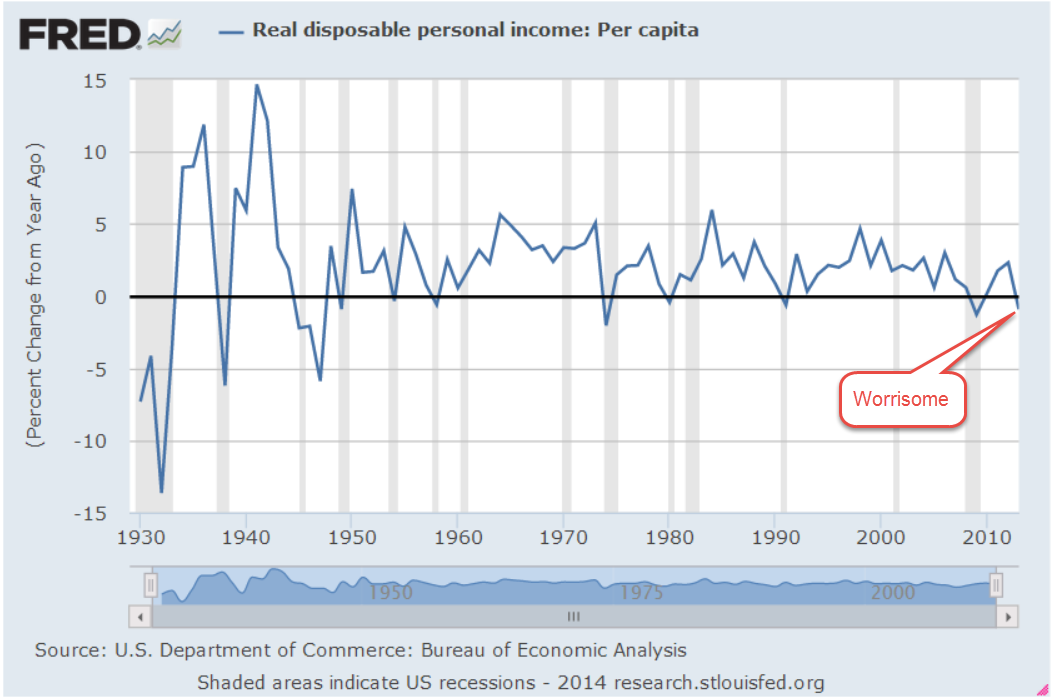
The Bureau of Economic Analysis (BEA) produces a number of annual series, which it updates through the year as more complete data from the previous year is received.  2013 per capita real disposable income, or what is left after taxes, was revised upward by .2% at the end of July but still shows a negative drop in income for 2013.  While all recessions are not accompanied by a negative change in disposable income, a negative change has coincided with ALL recessions since the series began at the start of the 1930s Depression.

Many positive economic indicators make it highly unlikely that we are either in or on the brink of recession.  Clearly something has changed.  Something that has routinely not been counted in disposable personal income is having some positive effect on the economy.  In 2004, the BEA published a paper comparing the methodology they use to count personal income and a measure of income, called money income, that the Census Bureau uses.  What both measures don’t count in their income measures are capital gains.

Unlike BEA’s measure of personal income, CPS money income excludes employer contributions to government employee retirement plans and to private health and pension funds, lumps-sum payments except those received as part of earnings, certain in-kind transfer payments—such as Medicare, Medicaid, and food stamps—and imputed income. Money income includes, but personal income excludes, personal contributions for social insurance, income from government employee retirement plans and from private pensions and annuities, and income from interpersonal transfers, such as child support. (Source)

Analysis (Excel file) of 2012 tax forms by the IRS shows $620 billion in capital gains that year, about 5% of the $12,384 billion in disposable personal income counted by the BEA.  An acknowledged flaw in the counting of disposable income is that the total reflects the taxes that individuals pay on the capital gains (deducted from income) but not the capital gains that generated that taxable income.  Although 2013 data is not yet available from the IRS, total personal income taxes collected rose 16%.  We can suppose that the 30% rise in the stock market generated substantial capital gains income.

*************************

Interest

Every year the Federal Government collects taxes and spends money.  Most years, the spending is more than the taxes collected – a deficit.  The public debt is the accumulation of those annual deficits.  It does not include money “borrowed” from the Social Security trust fund as well as other intra-governmental debt, which add another third to the public debt.  (Treasury FAQ)  This larger number is called the gross debt.  At the end of 2012, the public debt was more than GDP for the first time.

The Federal Reserve owns about 15% of the public debt.  But wait, you might say, isn’t the Federal Reserve just part of the government?  Well, yes it is.  Even the so-called public debt is not so public.  How did the Federal Reserve buy that  government debt?  By magic – digital magic.  There is a lot of deliberation, of course, but the actual buying of government debt is done with a few dozen keystrokes.  Back in ye olden days, a government with a spending problem would have to melt down some of its gold reserves, add in some cheaper metal to the mix and make new coins.  It is so much easier now for a government to go to war or to give out goodies to businesses and people.

Despite the high debt level, the percent of federal revenues to pay the interest on that debt is relatively low, slightly above the average percentage in the 1950s and 1960s but far below the nosebleed percentages of the 1980s and 1990s.

As the boomer generation continues to retire, the Federal Government is going to exchange intra-governmental debt, i.e. the money the government owes to the Social Security trust funds, for public debt.  As long as 1) the world continues to buy this debt,  and 2) interest rates stay low, the impact of the interest cost on the annual budget is reasonable.  However, the higher the debt level, the more we depend on these conditions being true.

************************

Watch the Percentages

As the SP500 touched and crossed the 2000 mark this week, some investors wondered whether the herd is about to go over the cliff.  The blue line in the chart below is the 10 month relative strength (RSI) of the SP500.  The red line is the 10 month RSI of a Vanguard fund that invests in long term corporate and government bonds.  Readings above 70 indicate a strong market for the security. A reading of 50 is neutral and 30 indicates a weak market for the security. The longer the RSI stays above 70, the greater the likelihood that the security is getting over-bought.

Long term bonds tend to move in the opposite direction of the stock market.  While they may both muddle along in the zone between 30 and 70, it is unusual for both of them to be particularly strong or weak at the same time.  We see a period in 1998 during the Asian financial crisis when they were both strong.  They were both weak in the fall of 2008 when the global financial crisis hit.  Long term bonds are again about to share the strong zone with the stock market.

Let’s zoom out even further to get a really long perspective.  Since November 2013, the SP500 index has been more than 30% above its 4 year average – a relatively rare occurrence.  It happened in 1954 – 1956 after the end of the Korean War, again in December of 1980, during the summer months of 1983, the beginning of 1986 to the October 1987 crash, and from the beginning of 1996 through September 2000.

In the summer of 2000, the fall from grace was rather severe and extended.  In most cases, including the crash of 1987, losses were minimal a year after the index dropped back below the 30% threshold.  When the market “gets ahead of itself” by this much, it indicates an optimism brought on by some distortion.  It does not mean that an investor should panic but it is likely that returns will be rather flat over the following year.

The index rarely gets 30% below its 4 year average and each time these have proven to be excellent buying opportunities.  The fall of 1974, the winter months of 2002 – 2003, and the big daddy of them all, March 2009, when the index fell almost 40% below its 4 year average.

************************

GDP

The Bureau of Economic Analysis (BEA) released the 2nd estimate of 2nd quarter GDP growth and surprised to the upside, revising the inital 4.0% annual growth rate to 4.2%.  As I noted a month ago, the first estimate of 2nd quarter growth included a 1.7% upward kick because of a build up of inventory, which seemed a bit high.  The BEA did revise inventory growth down to 1.4% but the decrease was more than offset primarily by increases in nonresidential investment. A version of GDP called Final Sales of Domestic Product does not include inventory changes.  As we can see in the graph below, the year-over-year percent gain is in the Goldilocks zone – not strong, but not weak.

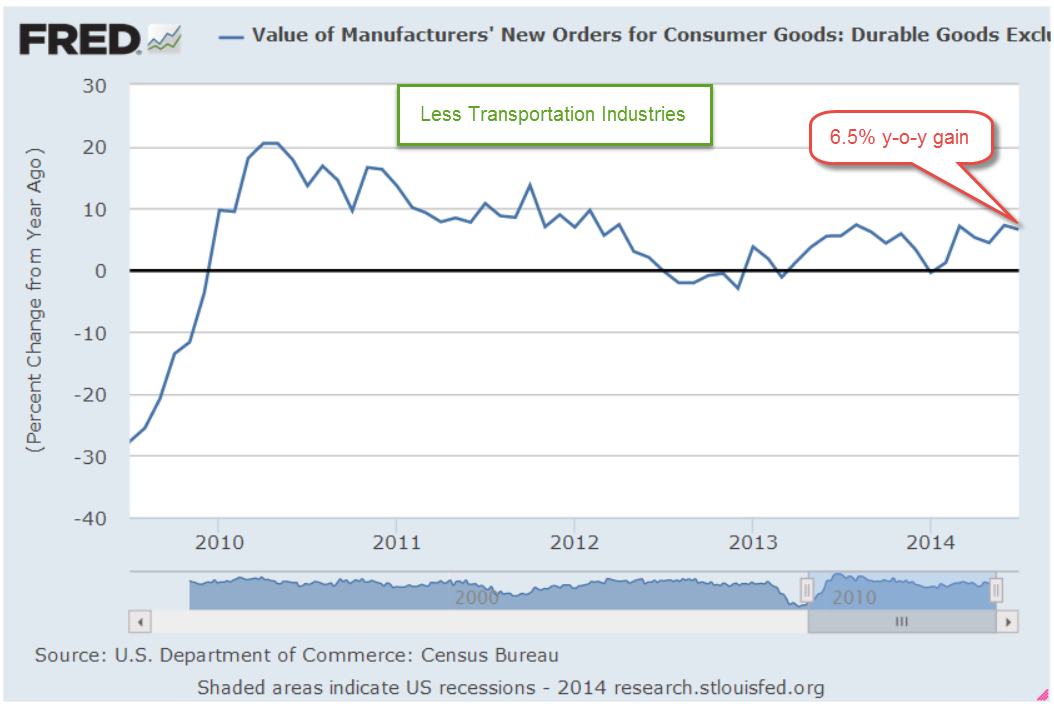
New orders for durable goods that exclude the more volatile transportation industries, airlines and automobiles, showed a healthy 6.5% y-o-y increase in July.  Like the Final Sales figures above, this is sustainable growth.

***********************

Takeaways

Economic indicators are positive but market prices may have already anticipated most of the positive, leaving investors with little to gain over the following twelve months.