Make America Fair Again

April 13, 2025

By Stephen Stofka

This is part of a series on centralized power. The debates are voiced by Abel, a Wilsonian with a faith that government can ameliorate social and economic injustices to improve society’s welfare, and Cain, who believes that individual autonomy, the free market and the price system promote the greatest good.

Abel tucked a table napkin into his belt. “Another uneventful week.”

Cain smirked as he cut a bite from his stack of pancakes. “Will the country last four years?”

Abel sighed. “Sometimes I dream that the voting public turns the House and Senate over to the Democrats so they can impeach him.”

Cain laughed. “There would be another January 6th when the new members took their oath of office.”

Abel frowned. “That’s what I worry about. Trump has too many of the same characteristics as other autocrats. Maduro in Venezuela, Erdogan in Türkiye come to mind. They freeze out the opposition party. Laura Gamboa had a piece in Foreign Affairs this month about past incidents (Source).  In 2003, Erdogan and his party began a campaign that either crippled or took over parts of the bureaucracy in Türkiye. Although the opposition stopped some legislation, in the first four years, Erdogan was able to totally seize power in 2007.

Cain gave a soft whistle. “Yeah, in any kind of governing, it’s ‘process over substance.’ I remember some Congressman saying something like, ‘I’ll let you write the substance … you let me write the procedure, and I’ll screw you every time.’” (Source)

Abel smiled. “Yeah, that was John Dingell. Served in Congress for fifty years! Anyway, a good example of that. Trump has extended his powers by declaring an emergency. What’s the emergency? Not a pandemic, or a war, an attack from China. No, it’s the trade deficit. Under the National Emergencies Act, Congress can pass a joint resolution declaring an end to the emergency (Source).”

Cain interrupted, “Yeah, but Trump could still veto the resolution.”

Abel nodded. “True. A higher hurdle to formally end an emergency. The House has a Rules Committee that decides on how legislation is brought to the floor. So, Congress can initiate a declaration ending an emergency declared by the President. It would send a word of caution to the White House.”

Cain raised his eyebrows. “You know, there’s no definition of emergency under the IEEPA, the law that Trump is using [Source].”

Abel nodded. “The IEEPA is another of those laws passed in the 1970s with no definitions. Another example is ‘waters of the United States.’ What does that mean? Courts, including the Supreme Court, have been arguing about it for 50 years (Source). Today, all serious legislation contains definitions.”

Cain replied, “So I didn’t know Congress could undo that. Go ahead.”

Abel continued, “So the Rules Committee just wrote a rule a few weeks ago that prevents any member from raising an objection that lead to a vote to declare an end to the emergency (Source). That tweak of the rules gets little attention but curtails any effective opposition in the House to Trump’s expansion of powers. Republicans in the House don’t want to go on the record opposing Trump. It was that kind of stuff that Gamboa was writing about.”

Cain said, “The slim Republican majority in the House weakens any checks and balances. Like I said last week, Trump has gone rogue.”

Abel argued, “He’s put together a team of rogues. Yes men and yes women. Sycophants who suck up to power and those who cower in the corner, hoping not to attract anger from Trump or Musk. The nominee to head the Bureau of Land Management just withdrew her nomination after it was revealed that she had written a memo criticizing Trump after the 2020 election (Source).”

Cain put down his fork. “I think there are some independent voices, but they are reluctant to come forward. Rumor is that Trump paused the reciprocal tariffs, the really high ones, because some people warned him that the bond market was starting to crack. At first, investors started moving into Treasuries as expected but then the rate on 10-year Treasuries started to rise, indicating that the nosebleed tariffs were causing investors to lose confidence in Treasuries (Source). US debt is like the Titanic was thought to be. Unsinkable.”

Abel frowned. “That’s why mortgage rates shot up half a percent, back up to 6.90% (Source). The mortgage market tends to move with the long-term Treasuries.”

Cain asked, “Just yesterday, mortgage rates broke the 7% threshold. Can the President of the United States cause a financial crisis? Maybe.”

Abel put set his coffee cup down. “Trump’s had several bankruptcies. His dad helped to bail him out of his brash bets on the casino industry in Atlantic City (Source). He was having trouble getting financing, so he ran for President to boost his name recognition.”

Cain sighed. “I think a lot of us voted for someone who could get things done, even he was a little bit crazy and impulsive.”

Abel said, “This last election, Trump attracted people outside of his core MAGA supporters. What does ‘great’ mean? Different things to different people. Some thought Trump would bring down prices. He promised to do that on ‘day one’ of his presidency. Some thought he would end the war in Ukraine because he promised to do that. Some thought he would be pro-business and curb the regulatory state.”

Cain replied, “Yeah, Trump’s a promoter. That’s what politicians do. Different people have different levels of gullibility. Even a skeptic can be convinced if the promises confirm their beliefs and desires. I think a lot of pro-business types bought into Trump’s promise to cut back on regulations. These tariffs are just a different type of big government imposing its will on the market. This is as heavy-handed as the Democrats get, only in a different way. It makes for a lot of uncertainty.”

Abel nodded. “Exactly. You know, AOC and Bernie Sanders have been going around the country to build opposition to Trump. They actually got over 30,000 people in Denver a week or so ago. I was thinking that there is a constituency in the Democratic Party that is like MAFA, Make America Fair Again.”

Cain interrupted, “I like that, but what do you mean ‘again.’ Has America ever been fair?”

Abel replied, “Well, some Democrats look back to the post-war period as an example of more fairness. Sure, there was a lot of prejudice. Jim Crow laws in the south, for example. But union membership was strong, wages grew faster than inflation and taxes were like 70% on the top 1%. Kind of a ‘Father Knows Best’ or ‘Leave It To Beaver’ moment. What’s weird about that is that the MAGA crowd on the right also looks back to that time as an ideal as well. The U.S. was the leading manufacturing country in the world and the supply chain helped support businesses in small and medium sized towns. There were good paying jobs and people could afford to buy a home. So, the MAGA crowd on the right and the MAFA crowd on the left are looking to the same post-war period as their ‘Golden Age.’”

Cain replied, “I like that idea. What’s ‘great?’ What’s ‘fair?’ It can be anything. They are promotional, not substantive words. What’s fair to me might not be fair to you. Let’s say you and I pick apples for a living. We both have the same size ladder, but I get assigned a section of trees where the apples are easier to reach than the trees in your section. I think it’s fair because we both have the same tool, the same length ladder. You don’t think it’s fair because picking apples is more of a challenge for you than it is for me. When we are done, I think I am more productive than you and I deserve the extra money I made. You feel cheated. I think you are just lazy. If you don’t know that my apples were easier to pick, you might become convinced that there is something wrong with you. Some character flaw. You might start believing that you are lazy or dumb or something.”

Abel said, “I remember seeing a cartoon about that once. It was trying to show the difference between equality and equity. Two people might have equal means, but not equal opportunity because one person’s environment is more advantageous. They are more likely to succeed.”

Cain frowned. “Fixing that problem only makes the problem worse. That’s what’s wrong with liberal politicians. They focus on outcomes and reason backwards. If outcomes are not equal, then the environment must be different, so they change some aspect of the environment. Outcomes are still unequal. Why? Because people anticipate policy changes. People are not machines or rats in a lab. There is a field of economics where researchers introduce policy changes into a community and test the effect. Some women in a rural farming community in India are given ducks. It’s random so the researchers can publish their study. The women will be able to raise the ducks so they can feed their families (Banerjee & Duflo, 2011). A neighbor, jealous because they didn’t get ducks, poisons the ducks. Social scientists can’t conduct experiments on people the way that researchers in the hard sciences can. We are sentient beings, not dumb guinea pigs.”

Abel nodded. “At least researchers are trying to develop some empirical data. It’s better than the approach that Aristotle and other philosophers used. Make up shit based on my perspective and declare it so.”

Cain laughed. “Hey, I’ll grant you it’s not easy. The beauty of the price system is that prices are the result of thousands of experiments testing the value of something. The magic of the price system is that it involves trade-offs, some opportunity cost. I need to give up ‘x’ dollars to get ‘y’ good or service. I could spend my dollars on something else or nothing else and save it. A gigantic set of experiments in opportunity costs. That needs to be a fundamental characteristic of policy design. Often, it isn’t.”

Abel argued, “Yeah, but that bottom-up approach doesn’t work for collective action problems. Spend more money on national defense or health care? Public education or more police? People can’t agree on the value of each and the opportunity costs.”

Cain interrupted, “Agreed, but a top-down approach doesn’t work either.”

 Abel stood up. “So, we are left with irresolvable problems, it seems. Maybe that is something we can talk about next week. Please, God, something other than the latest Trump fiasco.”

Cain waved. “That would be nice. See you next week.”

//////////////////////

Image by ChatGPT in response to the prompt, “draw a blue baseball cap with the words ‘Make America Fair Again’ stenciled in white letters.”

Banerjee, A. V., & Duflo, E. (2011). Poor economics: A radical rethinking of the way to fight global poverty. New York, NY: Public Affairs.

A Home Is a Magic Wallet

April 7, 2024

by Stephen Stofka

In this week’s letter I will explore the various roles that housing plays in our lives. Last week I showed the divergence of household formation and housing supply during the financial crisis. Home builders responded to the downturn in household formation by building fewer homes. Because the recovery after the crisis was slow, the demand for housing did not pick up until 2014. It is then that a mismatch between housing demand and supply started to appear in the national and some local home price indices. This week I will examine the demographics of homebuyers and sellers in recent history and the secret life of every homeowner as a landlord. A home is a magic wallet where money flows come and go.

Data from the National Association of Realtors (NAR) indicates that the median age of home sellers has increased from 46 to 60 since 2009. I will leave NAR data sources in the notes. In the four decades between 1981 and 2019, the median age of home buyers rose by twenty years, from 36 in 1981 to 55 in 2019. The median age of first-time buyers, however, increased by only four years, from 29 to 33. In 1981, the difference in age and accumulated wealth between first-time buyers and all buyers was only seven years. Now that difference has grown to 22 years. First-timers typically buy a home that is 80% of the median selling price of all homes.

In the past four decades, there has been a divergence in wealth between older and younger households. The real wealth of younger households has declined by a third since 1983 while households headed by someone over 65 have enjoyed a near doubling of their real wealth in thirty years. Accompanying that imbalance in growth has been a shift in capital devoted to housing.

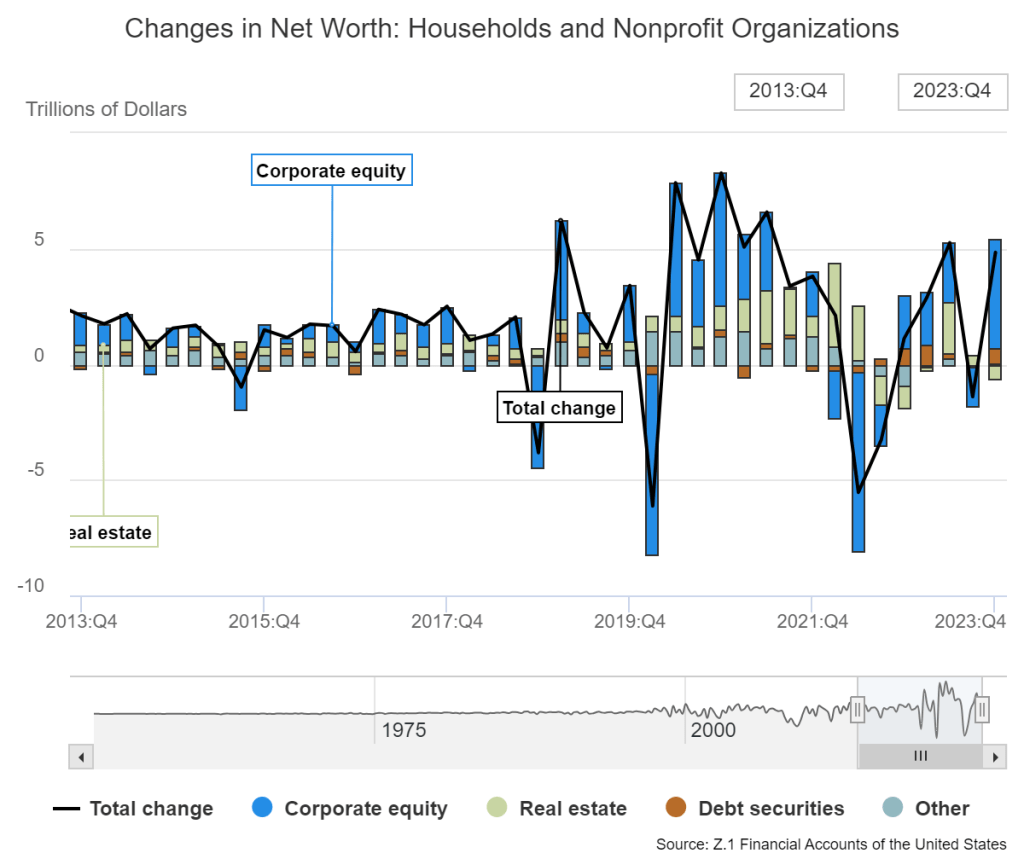
The Federal Reserve regularly updates their estimates of the changes in household net wealth. The link is an interactive tool that allows a user to modify the time period of the data portal. The chart below shows the most recent decade of changes in wealth. The lighter green bars are the changes in real estate wealth for households and non-profits and show the large gains in real estate valuations during the pandemic. The blue bars represent equity valuations and demonstrate the volatility of the stock market in response to any crisis, large or small.

The Fed’s data includes various types of debt as a percent of GDP. Twenty years ago, household mortgages were 11-12% of GDP. Today they are 19% of GDP, a huge shift in financial commitment to our homes and neighborhoods. A city average of owner equivalent rent (FRED Series CUSR0000SEHC) averaged an annual gain of 2% during Obama’s eight- year term, 2.8% during Trump’s term, and 6% during the first three years of Biden’s term. Biden has little influence on trends in housing costs, but the art of politics is to use correlation as a weapon against your opponent. People feel the change in trajectory as a burden on their households.

The Bureau of Labor Statistics calculates owner equivalent rent by treating a homeowner as both a landlord and renter. Property taxes, mortgage payments, interest, maintenance and improvements to a home are treated as investments just as though the owner were a landlord. The BLS uses housing surveys to determine the change in rental amounts for different types of units. A sample of homeowners are asked how much they would rent out their home but this guess is used only to establish a proportion of income dedicated to rent, not the actual changes in the rental amounts for that area, as the BLS explains in this FAQ sheet.

Let us suppose that a homeowner has a home that is fully paid for. If the house might rent for $2000 a month and monthly expenses are $500 a month, that would represent $1500 per month in implied net operating income for that homeowner, an annual return of $18,000. A cap rate is the amount of net operating income divided by the property’s net asset value. If similar homes are selling for $450,000 in that area, the homeowner is making 4% on their house’s asset value, slightly less than a 10-year Treasury bond (FRED Series DGS10, for example).

Long-term assets compete with each other for yield, relative to their risk. A property is a riskier investment than a Treasury bond, so investors expect to earn a higher yield from a property. Before the pandemic, 10-year bonds were yielding between 2-3%. Landlords could charge lower rents and still earn more than Treasury bonds. As yields rose for Treasury bonds, property investors must charge higher rents to earn a yield appropriate to the risk or sell the property and invest the money elsewhere.

When we own an asset that provides an income, it is as though the asset owes us. When a home declines in value, we feel a sense of loss. When the housing market turned down in 2007-2008, homeowners expected to get a similar price as the house their neighbor sold in 2006. They used that sale price to determine what their house owed them. In order to get the listing, a real estate agent would agree to list the home for that higher amount, but the property would get few offers. After a period of time, the seller would cancel the listing and wait for the “market to turn around.”

Earlier I noted the dramatic rise in mortgage debt as a percent of GDP. At one-fifth of the economy, that debt represents capital that is not being put to its most efficient use because most homeowners do not regularly evaluate the yield on their homes as professional investors. A higher percent of capital devoted to housing will help sustain higher housing costs and pressure household budgets. I worry that an inefficient use of capital will contribute to a pattern of lower economic growth in the future, stifling income growth. The combination of these two pressures will make it difficult for younger households to thrive. The generational gap will widen, adding more social and political discord to our national conversation.

/////////////////

Photo by Towfiqu barbhuiya on Unsplash

Keywords: mortgage, housing, owner equivalent rent

Notes on median age of sellers: 2009 data is from the NAR and cited in a WSJ article (paywall). Current data is from the NAR FAQs sheet. Jessica Lautz, an economist with NAR, reported the four-decade trend in home buyers. Median home prices of first-time buyers is from a 2017 analysis by the NAR. The comparison of older and younger households comes from a 2016 NAR analysis.

Notes on Federal Reserve data:  The change in mortgage debt as a percent of GDP is in the zip file component z1-nonfin-debt.xls, in the column marked “Noncorporate Mortgages; Percent of GDP.”

The Spread

May 22, 2022

by Stephen Stofka

Consumer spending during the pandemic and in the post-pandemic recovery has been strong. Inflation adjusted retail sales have averaged 5.6% annual growth since December 2019 (FRED, 2022a). However, the disruptions caused by the once-in-a-century pandemic have made the annual growth rates erratic, particularly those in the spring months when the pandemic hit. In spring 2021, retail sales numbers showed an annual increase of 48% over the previous year. Older Americans had been getting vaccines in the first months of 2021, shops were reopening and people were spending money. The economy was recovering but the size of the recovery was a “base effect.” Retail figures in 2021 were compared to retail sales in March and April 2020 when the economy was largely shut down. The American economy is so large that it is not capable of producing 50% annual growth in real sales.

Because the spring 2021 numbers were so strong, the numbers this spring look shaky. When the April retail numbers were released this week, traders began to mention the word recession and the market sank several percent. When people swarmed into stores in the spring of 2021, Target (Symbol: TGT) reported an increase of 22% in same store sales. A realistic portrayal of a customer behavior trend? No, it was an artifact of the pandemic disruption. In the first quarter of this year, the company reported a slight decline compared to those year-ago numbers. The reaction? The company’s stock fell 25%, an overreaction in a thinly traded market, and its worse loss since October 1987 when the broader stock market fell more than 20% in one day.

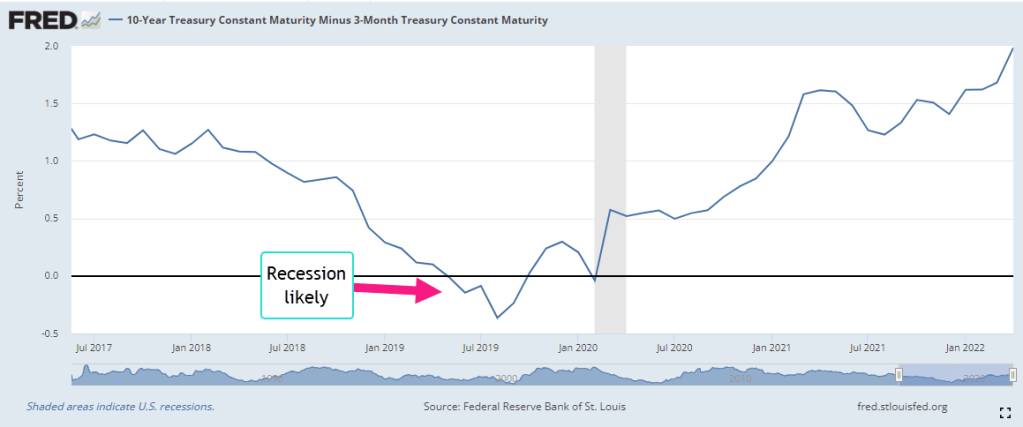
The stock market gets all the headlines each day but it is small in size relative to the bond market where the world’s lifeblood of debt and credit is traded. Over time the differences in interest rates between various debt products indicate trends in investor sentiment. These differences are called spreads. A common spread is a “term spread” between a long-term Treasury bond – say ten years – and a short-term Treasury of three months (FRED, 2022b). Short-term interest rates are usually lower than long-term rates because there is less that can go wrong in the short-term. When that relationship is turned upside down, it indicates a recession is likely in the near-term like a year or so. Why? Financial institutions are now expecting the opposite – that there is more that can go wrong in the short term than in the long term. They will be less likely to extend credit for new investments, business or residential.

For the past forty years, this spread has been a reliable predictor of recessions and it does not confirm the market’s recent concern about a recession. There are a few shortcomings with this indicator. With a wide range of several percent over five years, it has a lot of data “noise” that might obscure an understanding of the stresses building in the bond market and economy. Secondly, Treasury bonds are a small part of the bond market and carry no risk of default. We would like a risk spread between the rates on corporate bonds and those on Treasury bonds. Thirdly, the Federal Reserve has much less influence over corporate bond rates than it does on Treasury bond rates. Comparing corporates and Treasuries would give us a better sense of the broader market sentiment.

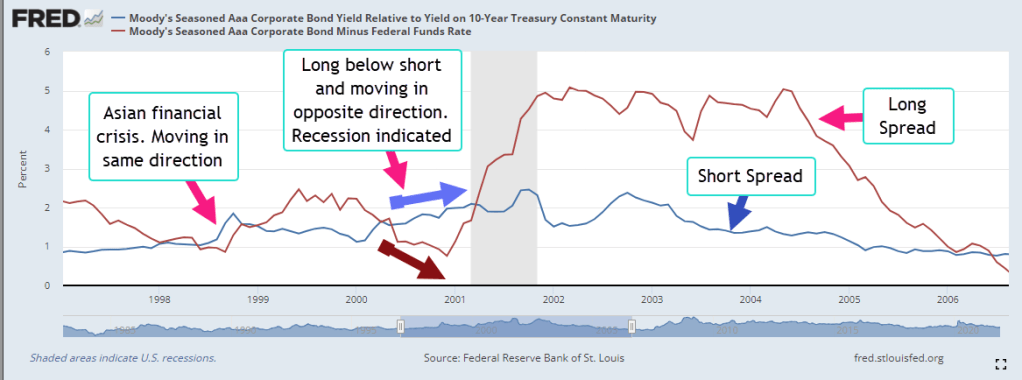
Moody’s Investors Service, a large financial rating company, computes the yield, or annualized interest rate, of an index of highly rated corporate bonds in good standing with a term longer than one year. The yield spread between corporate and long-term Treasury bonds usually lie in a range or channel of 1-1.5%. Like the lane markings on a highway, channels help us navigate data. The upper bound of 1.5% indicates a stress point. Let’s call that the long spread (FRED 2022c).

The Fed Funds rate is an average of rates that banks charge each other for overnight loans and the Federal Reserve tightly manages the range of this rate. For most of the past decade it has been below 1% and has often been close to zero. Let’s call the difference between the yield on corporate debt and the overnight rate the short spread (FRED, 2022d). Most of the time, the short spread is larger than the long spread. Just as with our first indicator of term spread, this relationship flips in the near term preceding a recession. Importantly, they continue to move in opposite directions for a while. The short spread keeps getting smaller while the long spread goes higher. In the graph below is the short recession after the dot-com bust.

In the right side of the graph the pattern will telegraph the coming recession in 2008. The graph below highlights the years after the financial crisis. The short term spread remained elevated above 1.5%, an indication of the persistent stress in the bond market. During Obama’s two terms in office, the short spread fell only once into the “everything is OK” range. Helped by the prospect of tax cuts in 2017, the spread declined to a lasting lull.

In the last half of 2019, the conjunction of these two time-risk spreads indicated a coming recession. The term spread we saw in the first graph also indicated a recession. They suggest that a 2020 recession was likely even if there was no pandemic. The Fed had been raising rates through mid-2019 to curb inflationary trends, then eased back a bit in the final months of that year. Were they seeing signs of economic stress as well?

How would the 2020 Presidential campaign have evolved if there had been no pandemic but a short recession lasting six to nine months? The Republican tax cuts enacted at the end of 2017 would have been shown to be a bust, doing little more than transferring wealth to the already wealthy. Mr. Trump would have certainly blamed the recession on Jerome Powell, the Chairman of the Fed, whom he had appointed. Powell would have been characterized as a Democratic stooge, part of an underground political plot to get Donald Trump out of the White House. The stories of what could have happened are entertainment for a summer’s campfire.

//////////////

Photo by Nadine Shaabana on Unsplash

FRED. 2022a. Federal Reserve Bank of St. Louis, Advance Real Retail and Food Services Sales [RRSFS], retrieved from FRED, Federal Reserve Bank of St. Louis; https://fred.stlouisfed.org/series/RRSFS, May 18, 2022.

FRED. 2022b. Federal Reserve Bank of St. Louis, 10-Year Treasury Constant Maturity Minus 3-Month Treasury Constant Maturity [T10Y3M], retrieved from FRED, Federal Reserve Bank of St. Louis; https://fred.stlouisfed.org/series/T10Y3M, May 19, 2022.

FRED. 2022c. Federal Reserve Bank of St. Louis, Moody’s Seasoned Aaa Corporate Bond Yield Relative to Yield on 10-Year Treasury Constant Maturity [AAA10Y], retrieved from FRED, Federal Reserve Bank of St. Louis; https://fred.stlouisfed.org/series/AAA10Y, May 19, 2022. The “long” spread.

FRED. 2022d. Federal Reserve Bank of St. Louis, Moody’s Seasoned Aaa Corporate Bond Minus Federal Funds Rate [AAAFF], retrieved from FRED, Federal Reserve Bank of St. Louis; https://fred.stlouisfed.org/series/AAAFF, May 19, 2022. The “short” spread.

Event and Response

March 15, 2020

by Steve Stofka

The response to an event is part of the event. While driving on the highway this week, I listened to an NPR report on the relatively few deaths from the COVID-19 virus. I passed under a sign telling me that almost 600 people died in my state last year in auto accidents. The number of deaths nationally was almost 39,000. In 2019, we had almost 20% fewer fatalities than 2002 even though we drove 20% more miles during the year (CDOT, 2020). Cars are safer now because the government set safety standards for car manufacturers. Our institutions are strong. We tackle thorny problems and fix them. Was the reaction to this virus a bit too strong?

On Friday, the death toll from the virus climbed to 50. During the winter flu season of 2017-18, the CDC estimated 70,000 deaths (CDC,2020). That’s over 1300 per week. 50 didn’t seem so bad. One person on Twitter thought this panic buying of toilet paper was all silly. Then he went into his grocery store and the shelves were empty of Twix, his comfort chocolate. A bit of black humor. We may need more humor in the weeks to come.

Despite the mortality from flu each season, the world community has built a collective herd immunity to the disease over the past two thousand years. What’s herd immunity? If I have antibodies against a virus, I won’t be a carrier of the virus to someone else. This reduces transmission of the disease. COVID-19 is a new type of coronavirus. No one has built an immunity, so it travels fast.

Six months ago a friend asked me what I thought about the stock market. I told him I thought it was overpriced. Should I sell some of the stocks in my 401K, he asked? I shrugged. What if stocks went down 50% like in 2001 and 2008, I asked? Would you panic? He didn’t really need the money for five years, so probably not, he said. I’d be anxious, he said. Would you be anxious if you had no money in the stock market, I asked? Yeah, he said. I hear about the stock market on the radio, get news about it on my phone. I’d worry there was another crisis like the financial crisis coming. Do you think stocks are going to go down 50%, he asked? I said I have no idea. If I knew the future, I would have to hide away in a cave somewhere because people would want to kidnap me and make me tell them what the future was going to be. The past has already happened and very often we don’t understand what happened. Even if we knew what the future was, we would have trouble understanding it.

The long bull market in stocks ended this week and the SP500 index officially entered a bear market 20% below its recent high. The bull market almost ended in 2018 when the index fell 19% from a recent high but that didn’t count. 19% is not 20%. What about 2011 when the 20% decline occurred during a trading day but recovered enough by the end of the day to be a decline of less than 20%? That didn’t count either because the “official” declaration of a bear market is based on the day’s closing price. If the 20% decline benchmark were based on the yearly closing of the SP500, we still are not in a bear market (only 16.1% down) and didn’t come close in 2018 or 2011.  But that’s not newsworthy, is it?

The financial crisis came about because of a contagion in our financial markets. That led to a contagion of distrust in our institutions in this country and around the world. The current crisis started with a contagion between people that is spreading to our financial markets. This week the Federal Reserve stepped in to stabilize the bond market (Cox, 2020).

U.S. Treasuries are the benchmark for safety around the world. Companies around the world with long term obligations – banks, insurance companies and pension funds – hold U.S. government debt. The key word in that last sentence is “hold.” As fear gripped the market in Monday’s open this week, long term Treasuries surged 10% in price. A lot of buyers wanted safety. In response, companies that would normally hold their Treasury bonds wanted to take advantage of the price increase, so they put some of their bonds on the market. The bond dealers were not equipped to handle this much previously issued long term debt coming to the market. They are accustomed to trading newly issued Treasury debt. They had trouble matching buyers and sellers. Even as the stock market fell 10% on Thursday, the price of long-term Treasury bonds fell 4% in the last few hours of that afternoon. They are supposed to move in opposite directions. Something was wrong. If there were problems in the U.S. Treasury market, it could spread another kind of contagion throughout the bond market. The stock market is like a toy boat floating on the big pond of the bond market. On Friday morning, the Fed announced that they would start buying Treasuries, starting with long-term bonds.

The financial crisis of a decade ago demonstrated that the response to a crisis becomes part of the crisis – for good or bad. A crisis creates a bottleneck which causes unexpected consequences which may need unexpected policy responses. I tell myself that our institutions are strong, that we fix problems. I’m starting to worry more about the people who stock up on a year’s supply of toilet paper. It will not save them from the zombie apocalypse. The zombies eat people, not toilet paper. I thought everyone knew that by now.

///////////////

Notes:

CDC. (2020, January 10). Disease Burden of Influenza. Retrieved from https://www.cdc.gov/flu/about/burden/index.html

Colorado Department of Transportation (CDOT). (2020, February 25). Colorado Fatalities since 2002. [PDF]. Retrieved from https://www.codot.gov/library/traffic/safety-crash-data/fatal-crash-data-city-county/Colorado_Historical_Fatalities_Graphs.pdf/view

Cox, J. (2020, March 14). The Fed to start buying Treasuries Friday across all durations, starting with 30-year bond. CNBC. Retrieved from https://www.cnbc.com/2020/03/13/the-fed-details-moves-to-buy-treasurys-across-all-durations-starting-with-30-year-bond.html

Photo by Jay Heike on Unsplash

The Start of the Beginning

April 7, 2019

by Steve Stofka

In 1971 former President Nixon announced that the U.S. was abandoning the gold standard of fixed exchange that had existed for almost thirty years. Within a short time, other leading nations followed suit. Each nation’s currency simply traded against each other on a global currency, or FX, market.

Since oil was priced in dollars and the world ran on oil, the U.S. dollar became the world’s reserve currency. Each second of every day, millions of US dollars are traded on the international FX markets. The demand for US dollars is strong because we are a productive economy. The euro, yen and British pound are secondary currency benchmarks.

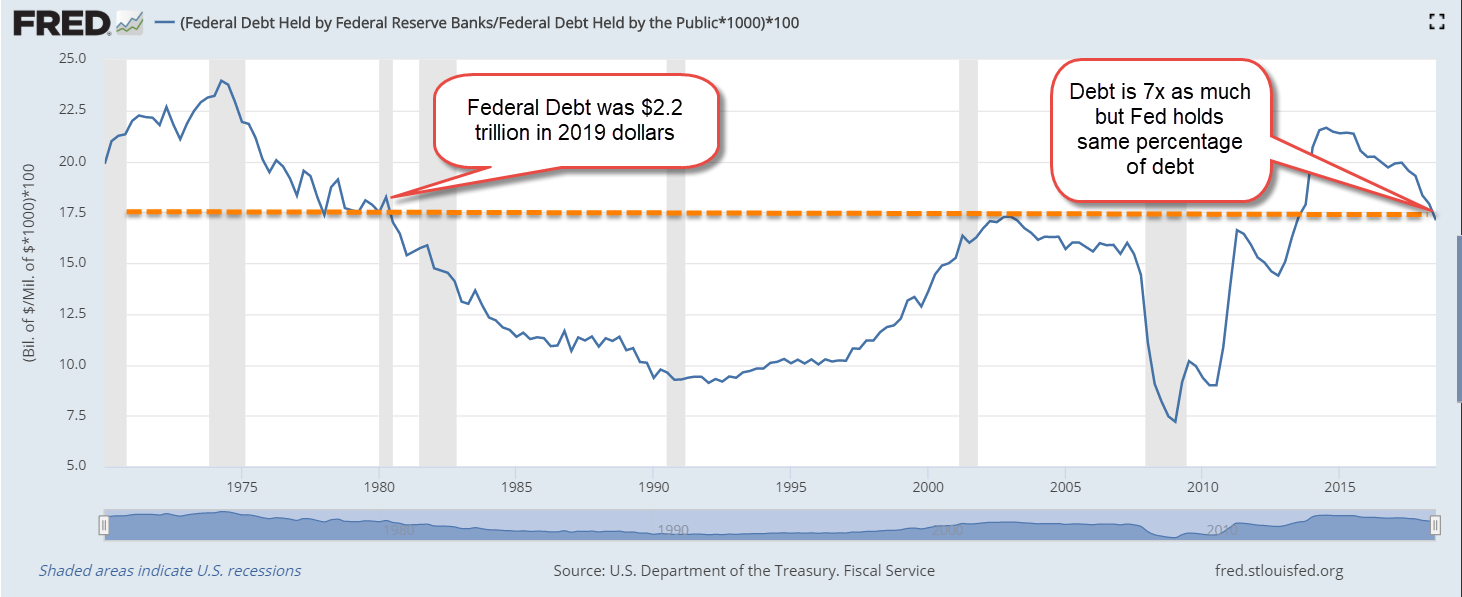
When the U.S. wants to borrow money from the rest of the world, the U.S. Treasury sells notes and bills collectively called “Treasuries” to large domestic and foreign banks who “park” them in their savings accounts at the Federal Reserve (Fed), the U.S. central bank (Note #1). The phrase “printing money” refers to a process where the Federal Reserve, an independent branch of the Federal Government, buys Treasury debt on the secondary market. It may surprise many to learn that the Fed owns the same percentage of U.S. debt as it did in 1980. The debt in real dollars has grown seven times, but the percentage held by the Fed is the same. That is a powerful testament to the global hunger for U.S. debt. Here’s the chart from the Fed’s FRED database.

FedResHoldTreasPctDebt

In 1835, President Andrew Jackson paid off the Federal debt, the one and only time the debt has been erased. It left the country’s banking system in such a weak state that subsequent events caused a panic and recession that lasted for almost a decade (Note #2). Government debt is the private economy’s asset. Paying down that debt reduces those assets.

About a third of the debt of the U.S. is traded around the world like gold. It is better than gold because it pays interest and there are no storage costs. Foreign businesses who borrow in dollars must be careful, however. They suffer when their local currency depreciates against the dollar. They must earn even greater profits to convert their local currency to dollars to make payments on those dollar-denominated loans.

Each auction of Treasury debt is oversubscribed. There isn’t enough debt to meet demand. In a world of uncertainty, the U.S. government has a long history of respect for its monetary obligations. As the reserve currency of the world, the U.S. government can spend at will. Even if there were no longer a line of domestic and foreign buyers for Treasuries, the Federal Reserve could “purchase” the Treasuries, i.e. print money. Let’s look at the difference between borrowing from the private sector and printing money.

When the private sector buys Treasuries, it is effectively trading in old capital that cannot be put to more productive use. That old capital represents the exchange of real goods at some time in the past. In contrast, when the government spends by buying its own debt, i.e. printing money, it is using up the current production of the private sector. This puts upward pressure on prices. Let’s look at a recent example.

Quantitative Easing (QE) was a Fed euphemism for printing money. During the three phases of QE that began in 2009, the Fed bought Treasury debt. That was an inflationary policy that countered price deflation as a result of the Financial Crisis. In August 2009, inflation sank as low as -.8% (Note #3). It was even worse, but inflation measures do not include the dividend yield on money. To many households, inflation felt like -2% (Note #4). The Fed’s first round of QE did provide a jolt that helped drive prices up by 3% and out of the deflationary zone.

During the five years of QE programs, the Fed continued to fight itself. The QE programs pushed prices upwards. Near zero interest rates produced a deflationary counterbalance to the inflationary pressures of printing money. Because inflation measures do not include the yield on money, the Fed could not read the true change in the prices of real goods in the private sector. The economy continues to fall below the Fed’s goal of 2% inflation. There are still too many idle resources.

Leading proponents of Modern Monetary Theory (MMT) remind people that yes, the U.S. can spend at will, but that it must base its borrowing on policy rules to avoid inflation. A key component of MMT is a Job Guarantee (JG) program ensuring employment to anyone who wants a job. A JG program may remind some of the WPA work programs during the Great Depression. Visitors to popular tourist attractions, from Yellowstone Park in Wyoming to Carlsbad Caverns in New Mexico, use facilities built by WPA work crews. Today’s JG program would be quite different. It would be locally administered and targeted toward smaller public works so that the program was flexible.

The U.S. government has borrowed freely to go to war and has never paid that debt back. Proponents of MMT recommend that the U.S. do the same during those times when the private economy cannot support full employment. That policy goal was given to the Fed in the 1970s, but it has never been able to meet the task of full employment through crude monetary tools. With an active program of full employment, the Fed would be left with only one goal – guarding against inflation.

There are two approaches to inflation control: monetary and fiscal. Monetary policy is controlled by the Fed and includes the setting of interest rates. If the Fed’s mandate was reduced to fighting inflation, it could more readily adopt the Taylor rule to set interest rates (Note #4).

Fiscal policy is controlled by Congress. Because taxation drains spending power from the economy, it has a powerful control on inflation. However, changes in tax policy are difficult to implement because taxes arouse passions. We are familiar with the arguments because they are repeated so often. Everyone should pay their “fair share,” whatever that is. Some want a flat tax like a head tax that cities like Denver have enacted. Others want a flat tax rate like some states tax incomes. Others want even more progressive income taxes so that the rich pay more and the middle class pay less. Some claim that income taxes are a government invasion of private property rights.

Because tax changes are difficult to enact, Congress would be slow to respond to changes in inflation. The Fed’s control of interest rates is the more responsive instrument. The JG program would provide stability to the economy and reduce the need for corrective monetary action by the Fed. The program would help uplift those in marginal communities and provide much needed assistance to cities and towns which had to delay public works projects and infrastructure repair because of the Financial Crisis. As sidewalks and streets get fixed and graffiti cleaned, those who live in those areas will take more pride in their town, in their communities, in their families and themselves. This makes not just good economic sense but good spiritual sense. We can start small, but we must start.

////////////////////////
Notes:

1. Twenty to twenty-five times each month, the Treasury auctions U.S. government debt. Many refer to the various forms of bills and notes as “treasuries.” A page on the debt
2. The Panic of 1837
3. The Federal Reserve’s preferred measure of inflation is the Personal Consumption Expenditure Index, PCEPI series.
4. The annual change in the 10-Year Constant Maturity Treasury fell below -1% at the start of the recession in December 2007 and remained below -1% until July 2009. FRED series DGS10. John Maynard Keynes had recommended the inclusion of money’s yield in any index of consumer demand. In his seminal work Foundations of Economic Analysis (1947), economist Paul Samuelson discussed the issue but discarded it (p. 164-5). Later economists did the same.
5. The Taylor rule utility at the Atlanta Federal Reserve.


Green Debt

March 17, 2019

by Steve Stofka

Imagine a world where, each year, the U.S. government (USG) gave $1000 to each of it’s approximately 300 million citizens (Note #1). The annual cost of the program would be $300 billion, about $120 billion more than the 2017 tax cuts (Note #2). As it does every year, the USG would borrow the money and issue Treasury bills, which are traded around the world. Although there is more than $23 trillion of Treasury debt – a plentiful supply – there is not enough to meet world demand.

Let’s say that the American people spent 80% of that $300 billion each year and saved the rest (Note #3). Let’s also calculate a multiplier of 1.5 so that the extra $240 billion of spending generates $360 billion of GDP (Note #4), about 1.7% of last year’s GDP. The increase in GDP would return about $60 billion to the USG in tax revenues (Note #5). The net cost to the USG is $300 billion less $60 billion in additional tax revenue = $240 billion.

Will the slight increase in GDP each year generate higher inflation? Inflation occurs when too much money chases too few goods and resources. Efficiencies in world production of goods and services has caused a continuing deflation in developed economies. Against those headwinds, inflationary pressures will be modest.

At the end of ten years, this program would create an additional $3.5 trillion in U.S. debt, the same amount of debt that the Federal Reserve accumulated in 2008 to protect the jobs and bonuses of Wall St. bankers. The Fed still owns most of that debt (Note #6). Which is fairer? A program to distribute money equally to everyone or a program to distribute the same amount to a select few?

Implementation of such a program is unlikely but illustrates the lack of a moral rudder in our Congress. Self-branded fiscal conservatives in both parties promote the fiction that the Social Security and Medicare funds will “run out of money” at a certain date in the future. These funds are part of the Federal government and are nothing more than bookkeeping entries on the Federal government’s books. The Social Security Administration explains this: “[the funds] provide 1) an accounting mechanism for tracking all income to and disbursements from the trust funds, and (2) they hold the accumulated assets. These accumulated assets provide automatic spending authority to pay benefits” [my emphasis] (Note #7). The accumulated assets are paper IOUs from the government to itself so that Social Security benefits are beyond the reach of Congressional infighting and debate each year. When it was created, President Roosevelt called Social Security an insurance program because it was insured against Congressional tampering.

Republicans propose to privatize Social Security while Democrats propose additional taxes to “fully fund” Social Security. These schemes are built on accounting fictions and sold to the general public as prudent solutions. Will the trust funds run out of money? Congress can change this with a stroke of a pen. Just as they “borrowed” from the funds, they can “loan” to the funds (Note #8). Both parties are trying to convince voters that big changes must be made because Congress is too incompetent to make a small legislative change. Will voters buy this nonsense and let them keep their jobs?

Around the world, the value of US Treasury debt is more trusted than gold. It is more than a bond because it trades among commercial banks like currency. The U.S. enjoys a unique position. Its debt is a trusted part of the world’s savings. This country has worked hard and prudently to make the U.S. dollar the world’s money. Over the past century, the U.S. has managed its economy and debt better than other large developed countries. Let us take advantage of that position. Let’s stop the political ploys around Social Security and other federal entitlement programs. Let’s have a serious discussion about investing in building new schools and transportation solutions, as well as needed infrastructure repairs. Let’s stop posturing like buffoons and start behaving like the leader we are.

//////////////////////
Notes:

1. Census Quick Facts
2. Annual loss of tax revenue about $180 billion times 10 years = $1.8 trillion per CBO estimate 
3. Americans usually save about 5% of income.
4. More on fiscal multipliers. 1.5 is an average of various multipliers.
5. USG revenues average 17% of GDP.
6. Fed’s balance sheet over time. The Fed buys Treasury debt in the secondary market from large banks that buy the debt at Treasury auctions. The Fed continues to hold $1.6 trillion of mortgage-backed securities, the same kind of debt that led to the Financial Crisis. Current balance sheet.
7. Social Security Administration FAQ #1 on the nature of the funds . Also, see their page debunking SS myths promoted on the Internet
8. The Federal government pays below market interest rates for the money that it “borrowed” from the SSA funds. Decades ago, the interest rate was set at approx. the five-year average for funds “borrowed” for several decades. If 20 or 30 year rates had been used, the SS funds would be much larger. There would be no “crisis” to argue about.

The Big Picture

May 19, 2018

by Steve Stofka

Here is a simple and elegant animation model of the economy in a thirty-minute video from Bridgewater Associates, the world’s largest hedge fund. The video illustrates the spending – income – credit cycle in easy to understand terms. The video includes an insight first noted eighty years ago by the economist John Maynard Keynes, who pointed out that one person’s spending is another person’s income. Sounds obvious, doesn’t it?  I spend money on a pizza which increases the income of the pizza store.

When Keynes explored this simple idea, he revealed a glitch in the traditional model of savings and investment. In a simplified version, money not spent is saved in a bank. The bank loans out those savings to a business.  A business invests that loan into production for future spending. When economists model the whole economy, Savings = Investment. It is an accounting identity like a mathematical definition. The financial industry transforms one into the other.

During the Depression, something was obviously broken, and economists debated various aspects of their models. Keynes asked a question: what happens to the merchant where the money was not spent? Let’s say the Jones family decides not to buy a new TV and puts the money in a savings account at the Acme Bank.  The local Bigg TV store sells one less TV and has a corresponding decline in its income. Because Bigg had less income, they must withdraw money from their Acme Bank savings account to meet payroll. The money that the family saves is withdrawn by the business. The money Saved never makes it to the Investment side of the equation.  There is no increase in investment.

Most of the time, those who are saving and those who are spending funds from saving balances out. But there were times, Keynes proposed, when everyone is saving. Keynes attributed the phenomenon to “animal spirits.” As incomes fall, people start using up their savings to make up for the lost income.

During a crisis like this, Keynes proposed that government increase its spending, even if it needed to borrow, to boost incomes and break the vicious cycle. When the crisis was over, the government could raise taxes to pay back the money it borrowed. In Keynes’ model, government spending acted as a balancing force to the animal spirits of the capitalist economy. In the real world, politicians win votes by spending money but find that raising taxes does not win them favor with voters. Without legislative debt controls, government borrowing to counterbalance declines in income only produces greater government debt.

Turning from government debt to personal debt, the average credit card rate has risen to 15.3%, an eighteen year record. As an economy continues to expand and credit is extended to those with marginal creditworthiness, the default rate grows. The percent of credit card balances that have been charged off in default has risen from 1.5% several years ago to 3.6% in the 4th quarter of 2017.

Mortgage rates have risen to about 4.9% on thirty-year loans, and about a half percent less on fifteen-year loans. That half percent difference is close to the average for the past twenty-five years and adds up to an extra $1.60 in interest paid during the life of the loan on every $100 of mortgage principal. The graph below shows the difference between the two rates.

MortRatesDiff

Because shorter-term mortgages require higher monthly payments, they are more feasible for those with stable financial situations and above average incomes. When the difference in rates is less than average, there is a smaller advantage to getting a short-term mortgage.  At such times, the mortgage industry is reaching out to expand home ownership to lower income homeowners. When the difference is more than average, as it has been since the recession, the finance industry is cautious and not actively reaching out to lower income families.

Mortgages are secured by a physical asset, the house. U.S. Treasury bonds are secured by an intangible asset, the full faith and credit of the country. Just like us, the Treasury usually pays a higher interest rate for a longer-term loan.

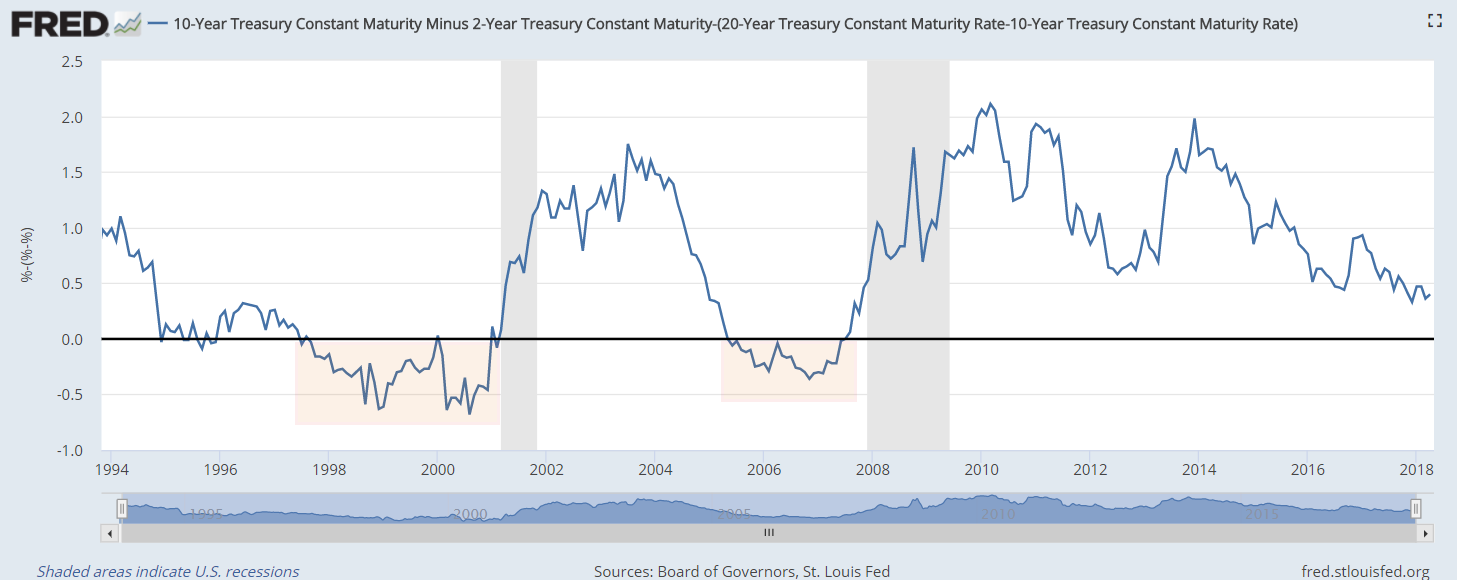
A benchmark is the difference between a 10-year Treasury bond and a 2-year bond. As this difference declines toward zero, economists call it a “flattening of the yield curve.” At zero, there is no reward for loaning the government money for a longer term. Knowing only that, a casual investor would sense that something is wrong, and they are right. Periods when this difference falls below zero usually occur about a year before a recession starts. In the graph below, I’ve shaded in pink those negative periods. In gray are the ensuing recessions.

10YRLess2Yr

Before that negative pink period comes another phenomenon. Above was the 10 year – 2 year difference in interest rates. Let’s call that the medium difference. There’s also the difference between two long term periods, the 20-year minus 10-year difference. I’ll call that the long difference. When we subtract the medium difference from the long, we get a difference in long term outlook. In a healthy economy, that difference should be positive, meaning that investors are being paid for taking risks over a longer period. When that difference turns negative, it shows that there are underlying distortions in the risks and rewards of loaning money. That distortion will show first before the flattening of the yield curve.

DiffRates1995-2018

As you can see, the difference today is positive, a welcome sign that a recession is not likely within the year.

//////////////////////////

Tidbits

The actuaries for Social Security and Medicare use an assumption that our average life expectancy will increase .77% per year (Reuters article)  If you are expected to live till 85 this year, then that expectation will grow to 85 years and eight months next year. That’s a nice birthday present!

U.S. lumber mills can supply only two-thirds of the lumber needed by homebuilders. The other third comes from Canada. Recent import tariffs now add about $6300 to the price of a new home (Albuquerque Journal).

Guessing the Future

April 23, 2017

Human beings have an ability to foretell the future, or at least some people think so.  A more accurate description is that we predict the likelihood of future events based on past patterns.  Index funds average the predictions of buyers and sellers in a particular market.

During the recovery most active fund managers have underperformed their benchmark indexes. Standard & Poors, the creator and publisher of many indexes, provides a quick summary in their SPIVA spotlight. In the past five years, 88% of active fund managers have underperformed the SP500.  In a random world, I would expect that 50% of active fund managers would beat the index, and 50% of managers would underperform the index because the index is an average of all those buy sell decisions.

The 1% higher fees charged by active fund managers contribute mightily to this underperformance. Using long term averages, we expect that a third of active fund managers would beat their benchmark index.  The current percentage is only 12%. It is likely that the law of averages will eventually exert its pull.

Index funds mechanically rebalance regularly. Let’s look at a real life example.  The pharmaceutical giant Johnson and Johnson is a member of both the SP500 and the smaller group of core stocks that make up the Dow Jones index.  This week the company  reported first quarter revenues that were below expectations, and sellers promptly knocked 3% off the stock price.  Because most SP500 index funds are market weighted, index funds that mimic the weighting of the stocks in the index would buy and sell stocks in the index to capture these changes.

Because index funds are averaging the decisions of all stock investors, they should underperform. After all, the index funds are buying those companies that everyone else is buying, and selling companies that everyone else is selling.  Index funds are buying high and selling low, creating a drag on performance that is overcome by the lower fees charged by these funds.

In an article last fall in the Kiplinger newsletter, Steven Goldberg makes the case for a mix of both index and active funds.  Research shows that active fund mangers do better when an index does poorly.  It’s worth a read.

The index fund giant Vanguard is featured in a NY times article. John Bogle founded Vanguard based on his thesis that a passive approach to investing and low fees would reward most investors over the long term.

///////////////////////

Correlation, not Causation

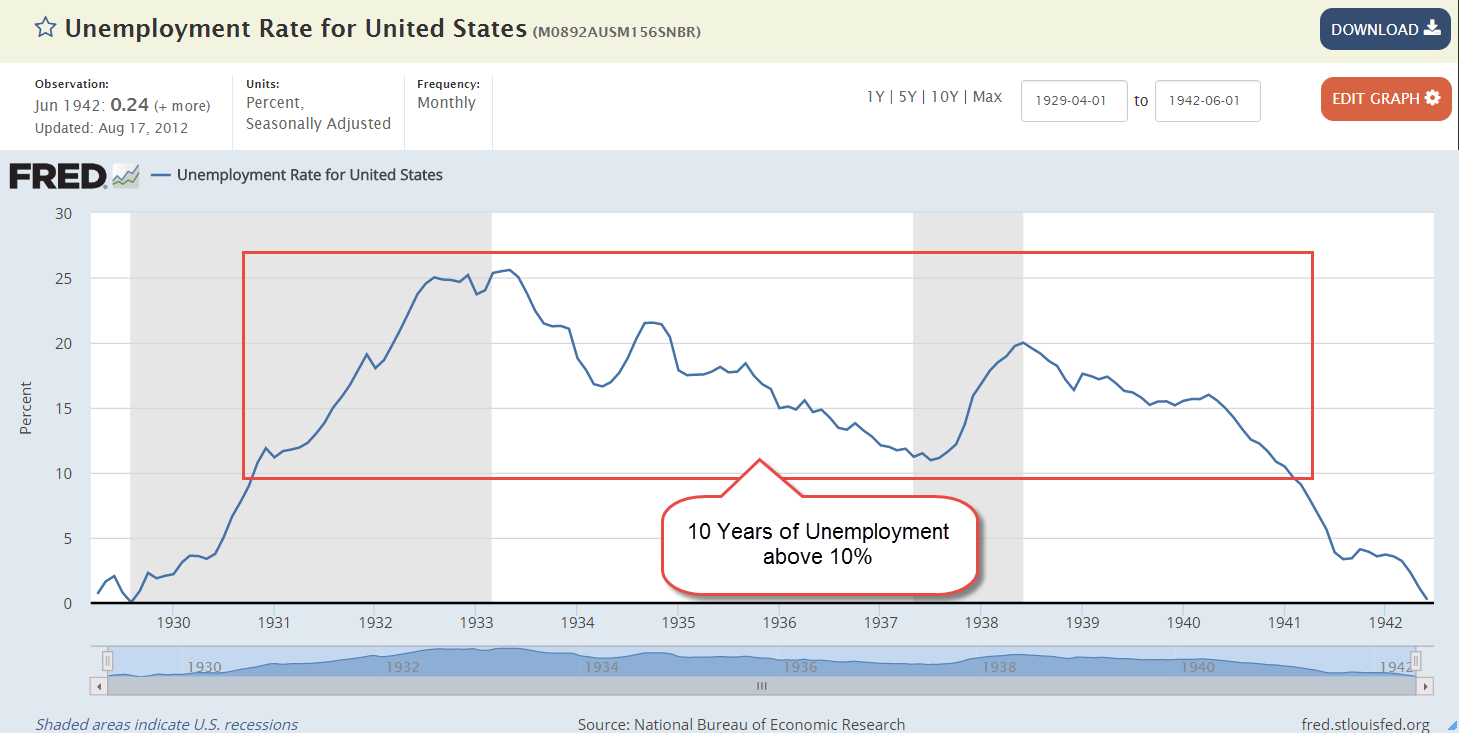
When the stock market crashed in 1929, the unemployment rate was less than 3%.  A booming economy during the 1920s lifted demand for labor, while severe immigration restrictions enacted in 1924 reduced the supply of workers.

Unemploy1929-1942

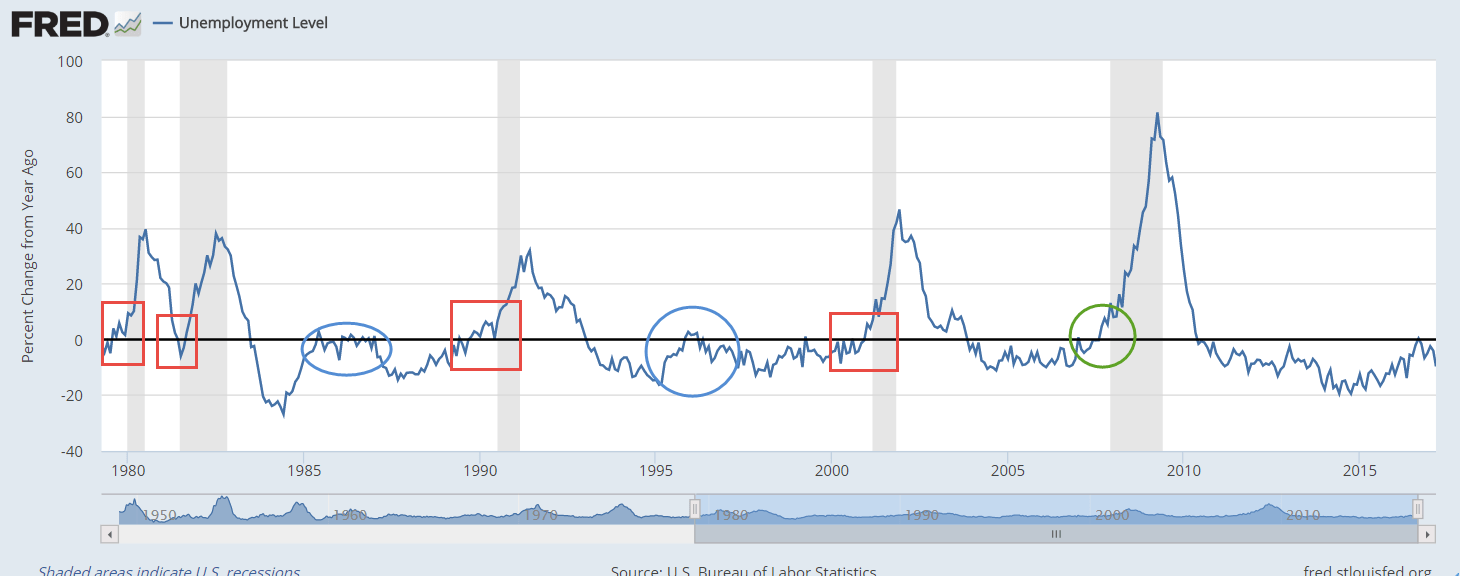
The unemployment rate was 6% when the market crashed in October 1987 and again in September 2008. There seems to be a weak connection between unemployment and severe market crashes.  However, there is a consistent correlation between the change in number of unemployed and the start of recessions.

UnemployChange

A yearly increase in the number of unemployed on a percentage basis indicates a fundamental weakness in the economy.  Sometimes, the change reverses as it did in early 1996, at the start of the dot com boom, or in the mid-eighties after a downturn in oil and housing exposed a banking scandal. These two periods are circled in blue in the graph above.

Often the economy continues to weaken, more people lose their jobs, GDP falters and the economy slides into depression.

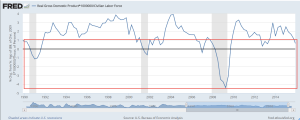
Because we cannot rely on just one indicator as a warning signal, we can chart the amount of production generated by each person in the labor force.  The civilian labor force includes both those who are working and those who are actively looking for work.  A growth rate below 1% indicates some weakness.  Using both the change in unemployment and the change in production helps filter out some of the noise.

While production growth may be faltering, the current unemployment level is not worrying.

///////////////////////

Pay Attention to the Pros

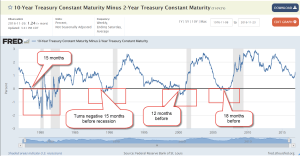
Institutional buyers and sellers of Treasury bonds will usually let the rest of us know when they are worried about a recession.  In a middling to healthy economy, Treasury buyers will demand a higher interest rate for a longer dated bond.  Subtracting the interest rate on a shorter term two year bond from a long term ten year bond should be positive.  In a “normal” environment, a 10 year bond might have an interest rate of 3% and a two year bond an interest rate of 1%.  The difference of 2% would be expected.  However, a negative result indicates that buyers want more interest from short term bonds because they are more concerned about short term risks.  As we can see in the chart below, a negative result precedes a recession by 12 to 18 months.  The current difference shows no indication of concern.

Guessing the future is not divination, nor is it perfect.  Retail investors may not have the time or expertise to estimate future risk, but we can study those who make it their business to manage risk.

Dance of Debt

April 9th, 2017

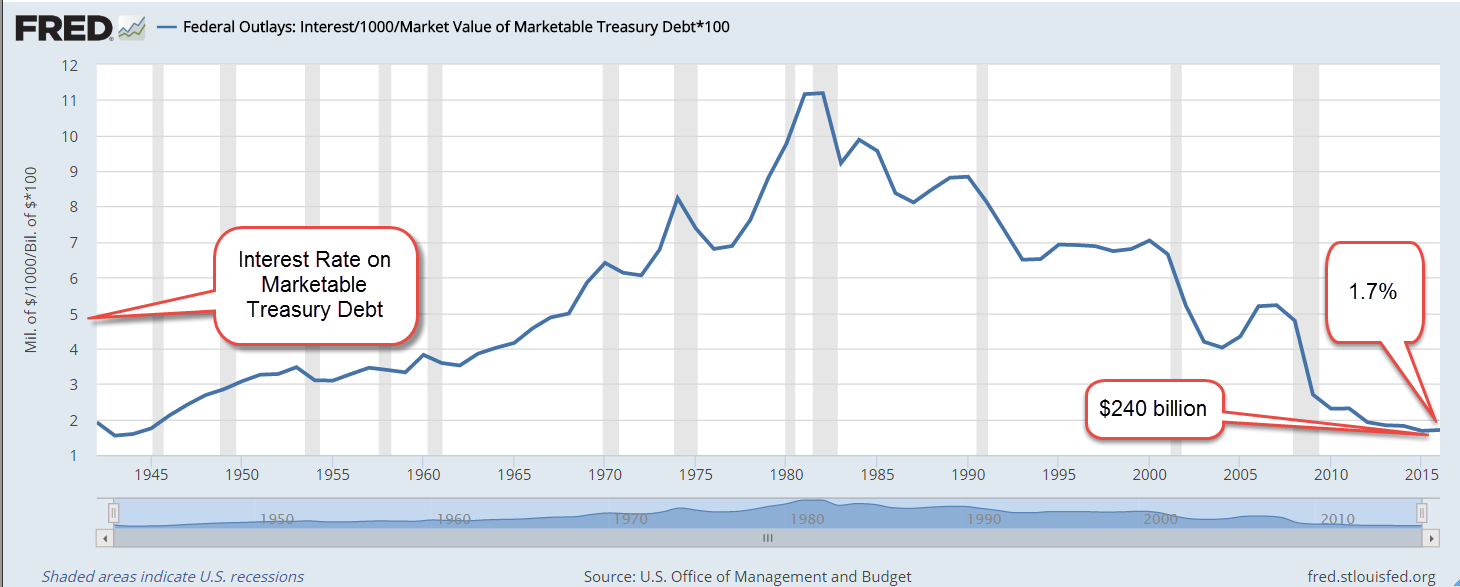
Last week I wrote about the dance of household, corporate and government debt. When the growth of one member of this trinity is flat, the other two increase. Since the financial crisis the federal debt has increased by $10 trillion. Let’s look at the annual interest rate that the Federal government has paid on its marketable debt of Treasuries. This doesn’t include what is called interagency debt where one part of the government borrows from another. Social Security funds is the major example.

In 2016, the Federal government paid $240 billion in interest, an average rate of 1.7% on $14 trillion in publicly held debt. Only during WW2 has the Federal government paid an effective interest rate that is as low as it today. World War 2 was an extraordinary circumstance that justified an enormous debt. Following the war, politicians increased taxes on households and businesses to reduce the debt. Here is a graph of the net interest rate paid by the Federal government since 1940.

InterestRate

In 2008, before the run up in debt, the interest rate on the debt was 4.8%. If we were to pay that rate in 2017, the interest would total $672 billion, more than the defense budget. Even at a measly 3%, the interest would be $420 billion.  That is $180 billion greater than the interest paid in 2016.  That money can’t be spent on households, or highways, or education or scientific research.

The early 1990s were filled with political arguments about the debt because the interest paid each year was crippling so many other programs. Presidential candidate Ross Perot made the debt his central platform and took 20% of the vote, more than any independent candidate since Teddy Roosevelt eighty years earlier. Debt matters. In 1994, Republicans took over Congress after 40 years of Democratic rule on the promise that Republicans would be more fiscally responsible. In the chart below, we can see the interest expense each year as a percent of federal expenses.

PctFedExp

Let’s turn again to corporate debt. As I showed last week, corporate debt has doubled in the past ten years.

CorpDebt2016

In December, the analytics company FactSet reported (PDF) that the net debt to earnings ratio of the SP500 (ex-financials) had set another all time high of 1.88. Debt is almost twice the amount of earnings before interest, taxes, debt and amortization (EBITDA). Some financial reporters (here, for example ) use the debt-to-earnings ratio for the entire SP500, including financial companies. Financial companies were highly leveraged with debt before the crisis. In the aftermath and bailout, deleveraging in the financial industry effectively hides the growth of debt by non-financial companies.

What does that tell us? Unable to grow profits at a rate that will satisfy stockholders, corporations have borrowed money to buy back shares. Profits are divided among fewer shares so that the earnings per share increases and the price to earnings (profit), or P/E ratio, looks lower. Corporations have traded stockholder equity for debt, one of the many incidental results of the Fed’s zero interest rate policy for the past eight years.

Encouraged by low interest rates, corporations have gorged on debt. In 2010, the pharmaceutical giant Johnson and Johnson was able to borrow money at a cheaper rate than the Federal government, a sign of the greater trust that investors had in Johnson and Johnson at that time.

Other financial leverage ratios are flashing caution signals, prompting a subdued comment in the latest Federal Reserve minutes ( PDF ) “some standard measures of valuations [are] above historical norms.” Doesn’t sound too concerning, does it?

Each period of optimistic valuation is marked by a belief in some idea. When the bedrock of that idea cracks, doubts grow then form a chasm which swallows trillions of dollars of marketable value.

The belief could be this: passively managed index funds inevitably outperform actively managed funds. What is the difference? Here’s  a one-page comparison table. In 1991, William Sharpe, creator of the Sharpe ratio used to evaluate stocks, made a simple, short case for the assertion that passive will outperform active.

During the post-crisis recovery, passive funds have clearly outperformed active funds. Investors continue to transfer money from active funds and ETFs into index funds and ETFs. What happens when a smaller pool of active managers make buy and sell decisions on stocks, and an ever larger pool of index funds simply copy those decisions? The decisions of those active managers are leveraged by the index funds. Will this be the bedrock belief that implodes? I have no idea.

Market tensions are a normal state of affairs. What is a market tension? A conflict in pricing and risk that makes investors hesitate as though the market had posed a riddle. Perhaps the easiest way to explain these tensions is to give a few examples.

1. Stocks are overvalued but bond prices are likely to go down as interest rates rise. The latest minutes from the Fed indicated that they will start winding down their portfolio of bonds. What this means is that when a Treasury bond matures, they will no longer buy another bond to replace the maturing bond. That lack of bond purchasing will dampen bond prices. Stocks, bonds or cash? Tension.

2. Are there other alternatives? Gold (GLD) is down 50% from its highs several years ago. Inflation in most of the developing world looks rather tame so there is unlikely to be an upsurge in demand for gold. However, a lot of political unrest in the Eurozone could drive investors into gold as a protection against a decline in the euro. Tension.

3. What about real estate? After a run up in 2014, prices in a broad basket (VNQ) of real estate companies has been flat for two years. A consolidation before another surge? However, there is a lot of debt which will put pressure on profits as interest rates go up. Tension.

In the aftermath of the financial crisis, we discovered that financial companies, banks, mortgage brokers and ordinary people resolved market tensions through fraud, a lack of caution, and magical thinking. Investors can only hope that there is enough oversight now, that the memories of the crisis are still fresh enough that plain old good sense will prevail.

During the present seven year recovery there have been four price corrections in the Sp500 (Yardeni PDF). A correction is a drop in price of 10 – 20%. The last one was in the beginning of 2016. Contrast this current bull market with the one in the 2000s, when there was only one correction. That one occurred almost immediately after the bear market ended in the fall of 2002. It was really just a part of the bear market. From early 2003 till the fall of 2007, a period of 4-1/2 years, there was no correction, no relief valve for market tensions.

Despite the four corrections and six mini-corrections (5 – 10%) during this recovery, the inflation adjusted price of the SP500 is 50% higher than the index in the beginning of 2007, near the height of the market.  Inflation adjusted sales per share have stayed rather stable and that can be a key metric in the late stages of a bull market. The current price to sales (P/S) ratio is almost as high as at the peak of the dot com boom in 2000 and that ratio may prove to be the better guide. In a December 2007 report, Hussman Funds sounded a warning based on P/S ratios.  Nine years later, this report will help a reader wanting to understand the valuation cycles of the past sixty years.

Election Volatility

November 13, 2016

Sometimes the hardest thing an investor can do is nothing.  That’s pretty much what a casual investor with a balanced portfolio should do in response to the election results.  With a portfolio of 57% stocks and 43% bonds and cash, my total portfolio has risen 1/2% this week, or much ado about nothing.  Let’s dig into this week’s election results and the market’s reaction.

Donald Trump, the President-elect, has long maintained that his campaign was a movement and was proved right this past Tuesday.  White voters from rural districts around the country rallied in strong numbers to Trump’s promise to straighten up Washington.

Voters generally want a change of direction after one party has occupied the White House for two terms and this election proved to be no different. In the modern era of politics, only H.W. Bush was able to gain a 3rd Presidential term for the Republican party in 1988 after two terms of Ronald Reagan.  Countering the emotion and momentum of the Trump movement on the right were the voters on the left who passionately turned out for Bernie Sanders in the Democratic primaries.  Voters and superdelegates chose the establisment candidate, Hillary Clinton.  Some say that the process and the rules favored Clinton over Sanders.  His supporters are convinced that Sanders could have beat Trump.  Movement against movement.

In the past decade, voters have expressed a preference for rallying cries, for mantras of momentum like “Si se puede!” (Obama), “Build the wall!” (Trump) and “Medicare for all!” (Sanders).  Candidates must learn to condense their message into a short slogan that can be easily waved.  McCain, Romney and Clinton never found a verbal cadence that would act as a catalyst for voters to enthusiastically join the parade.  Sarah Palin, McCain’s Vice-Presidential candidate in 2008, understood the need for slogans.

 Note to future Presidential candidates who would like to actually win:  criticize the candidate, not that candidate’s supporters.  Hillary Clinton made the same mistake that Romney made in the 2012 election – disparaging their opponent’s voters.

Election night.  As a Trump victory became increasingly probable, global markets began to sell risk (stocks) and buy safety (bonds).  In the early morning hours after the polls closed, the networks called the state of Wisconsin for Donald Trump and put him over the threshold of 270 votes in the Electoral College.  Several  minutes later, about 2:45 AM on Nov. 9th, we learned that Hillary Clinton  had called Donald Trump to concede and wish him luck.  Dow Futures were down about 4% at that point.  Japan’s stock market was down 5.5%.  The yield on the 10 year Treasury note was down 7.22%, meaning that the price was up about 8% as investors in world markets were seeking the safety of U.S. debt.  Emerging markets fell in anticipation of protectionist trade policies under a Trump administration.

About 3 A.M.  President-elect Trump began to give a sedate and rational acceptance speech that began with a gracious nod to Hillary Clinton’s fight.  He spoke of unity, healing and more importantly, infrastructure spending and tax cuts.  With control of the Congress and Presidency in Republican hands, there was real hope that Washington could end the years of stalemate and finally implement fiscal policy to rescue a economy that had been kept afloat by an exhausted monetary policy for six years.

The overseas markets began to turn around.  By the time U.S. markets opened more than six hours later, stocks and Treasuries had reversed.  Stocks were now off less than 1/2% and Treasury prices were down severely.  TLT, a popular ETF for long term Treasuries, opened about 2% lower, a price swing of 10%.  EEM, a composite of Emerging Market stocks, opened up almost 3% down and lost ground during the trading session.  By week’s end the SP500 had risen 3.8% for the week, and EEM had fallen by that same percentage.

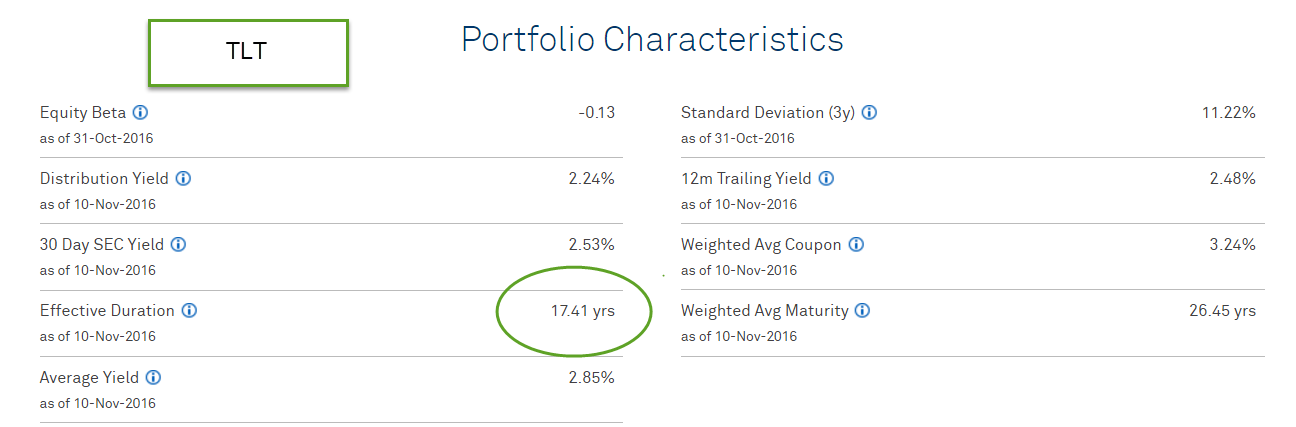
This week’s action in the bond market was a good example of the mechanics of bond pricing so let’s look at the price action and what it says about the future guesses of the direction and extent of interest rates.  First, bond prices move inversely to interest rates.   The extent that these prices move is measured by a bond’s duration.  Here is a link to the iShares page for the TLT ETF on long term Treasuries.  I have captured a section of the page with the duration highlighted.

If you have a bond fund, the mutual fund company will state the bond duration as well.  What does this tell you?  Leverage.  Duration tells you the approximate change in price for a 1% change in interest rates.  In this case, a 1% increase in interest rates will generate about a 17% decrease in price.  Because TLT is a composite of long term Treasuries, its price is more sensitive to changes in interest rates, or the consensus on interest rates six months to a year in the future.  The price of TLT fell 7.4% this week as traders repriced future interest rates.  With some grade school math, we can calculate what traders are guessing interest rates will be a half year to a year from now.

The Fed last raised rates at the end of 2015, putting them at approximately 1/4% – 1/2%.  In July, the price of this ETF was about $142.  It closed this week at $122, a decline of 14% from the summer high. Now we divide the 14% by the bond’s duration of 17.41% to get a ratio of .80.  This is the new guess of how much interest rates are likely to rise – approximately 3/4% – 1%.  By the fall of 2017, traders are betting that the benchmark Fed interest rate will be about 1.25% to 1.5%.

Let’s look at a more balanced composite bond ETF that financial advisors might recommend for casual investors.  Vanguard has a more conservative composite ETF whose ticker symbol is BND, with a duration of 5.8, about a third of the TLT ETF. (Spec Sheet here)  This week BND lost almost 2% and is down almost 4% from its summer high.  When we divide 4% by 5.8% (the duration in percentage terms) we get a guess of about a .7% raise in interest rates.  Because BND contains shorter term bonds, this guess is slightly below that of TLT.

Why are traders betting on more aggressive interest rate increases after Donald Trump was elected?  He has spoken about infrastructure spending and tax cuts, two fiscal stimulus programs that will likely spur inflation upward.  With a Republican party that has control of the Presidency and both houses of Congress, these measures are likely to be passed in some form.  Some sectors of the economy will likely benefit from more infrastructure spending so they rose this week.  Shares in technology giants like Apple and Google fell as traders switched money among sectors but are still up by healthy margins since February lows.

Let’s say that next March comes and the Trump White House and the House Budget Committee can not come to terms on either of these programs.  Investors would likely reprice interest rate expectations and lower them, causing the price of bond ETFs or mutual funds to rise.

/////////////////////////////////

Miscellaneous Election Notes

I’ll share a distinction that NPR’s David Folkenflik made this week.  Those on the left took Donald Trump literally, but not seriously.  Those who voted for him took him seriously, but not literally.

During Thursday’s trading the Mexican peso fell to 15.83 per dollar, the lowest since 1993 when Mexico reset their currency. Why the big drop?  Trump has repeatedly said that he would cancel the NAFTA agreement that binds Mexico, Canada and the U.S.  The NAFTA agreeement requires only a 6 month notification before termination.  There is some disagreement whether the White House would need Congressional approval to cancel NAFTA which might delay the action.  Some in the Republican party like free trade agreements and are likely to put up a fight.  Some analysts think that the devaluation of the peso could lead to a recession in Mexico, which was already under economic pressure due to falling oil prices.

131 out of 231 million registered voters cast their vote in this election, slightly below the voter total in the 2008 election. (538)  Trump and Clinton each took 26% of registered voters.

The Trump White House can reverse Obama’s executive action on the Keystone pipeline and re-initiate construction.  It will likely amend or repeal tentative proposals to mitigate climate change.

Why did pre-election polls get it so wrong?  According to Pew Research, more than a third of households would respond to a survey a few decades ago.  Now it is only 9%.  Statisticians must tweak this rather small sample to make it more representative of the population as a whole.  A particular demographic constituent in the sample – say white working class men – might be underrepresented in the survey.  Survey methodology then gives the opinion of relatively few sample respondents more weight than it actually has in the general voter population.

Some statisticians recommend using economic and demographic algorithms to gauge future election results based on actual past voting records.

Of the 700 counties that voted for Obama in 2012, a third of those voted for Trump in 2016.  Polls indicated that Hillary Clinton would capture the majority of the white college-educated vote for the first time in decades but she failed to do so.  More white voters voted for Obama than Hillary.

A third of Democrats in the House come from just three states:  California, New York and Massachusetts.  This concentration may answer to the concerns of those states but indicates that the party has become out of touch with the voters in many states.

Each time a Democratic candidate is elected President, unfounded rumors circulate that the new President will take away people’s guns.  People rush out to buy guns.  Trump’s surprise win caused the stock of gun maker Smith and Wesson to decline 22% in a couple of days.

On the other hand, many women feared that Trump and a Republican Congress would restrict birth control and stocked up in the days after the election. Here is a map of abortion regulations in the states before the 1972 Supreme Court’s decision in Roe v. Wade.  Abortion was more permitted in the southern states than the northeast states.

Here‘s a state-by-state breakdown of the vote from NPR.