The Missing Productivity Gains

May 1, 2022

by Stephen Stofka

On NBC News this week a reporter mentioned that a living wage was $35.80 an hour for someone with a child. M.I.T.’s Living Wage Calculator (2022) confirmed that approximate amount near where I live. That’s an annual income of $71,000, about $4,000 more than the median household income (MHI) today. In the past few decades incomes have been falling behind by just a little bit in inflation-adjusted income. In 1987, the MHI was $26,600, about $69,000 in today’s money (Series in footnotes). Today’s MHI is just a bit below off that figure. So what’s the problem?

Although incomes have kept up with inflation, they have not kept up with productivity gains. Most economists believe that a worker gets paid the value of her marginal product. If that is so and there have been productivity gains since 1987, then incomes should reflect some of those gains.

The BLS calculates a Total Factor Productivity that includes capital and labor. A 2018 study by the BLS calculated 2.9% annual output growth since the late 1980s. Estimating the sources of growth, they found that capital had contributed 40% more to productivity than labor but, even so, labor’s share of the gains should be at least 1% annually. If so, the MHI would be considerably higher today.

There are several reasons why American household income has not kept pace with productivity gains. They include:

A smaller percentage of workers belong to a union and so have less bargaining power. According to the BLS (2022), only 10.3% of all workers belong to a union. Among public sector workers the rate is far higher – 34%, but only 1 out of 7 employees are in the public sector.

Critics argue that greedy business owners are keeping all the productivity gains. Perhaps so, but that requires market power. Why have workers continued to work for less than a livable wage? Business owners complain that they have little pricing power. If workers and businesses have no pricing power, who has it? It may be buried in the garbage heap where capital goes to die in a competitive and fast changing marketplace. Before 2000, consumption of fixed capital accounted for 15% of GDP. Today, it has risen to 17%. In a $24 trillion economy, a 2% change is a lot. In a world where companies must innovate to survive, we notice only what survives. Growth comes at a cost.

Some say that the job mix has changed so that it is difficult to compare incomes, job skills and productivity with those of 35 years ago. There are now more lower paying service jobs, fewer high paying manufacturing jobs.

Making comparisons tough are the smaller household size today. With fewer people per household, incomes won’t be as high. The 1960s and 1970s saw explosive growth in household formation and this helped fuel the high inflation of the 1970s. Since then household formation has trended upward at a slow pace. The ratio of households to population today (.39) is only slightly higher than it was 40 years ago (.36). That slight difference does not account for the lost income in unpaid productivity gains.

 Some argue that illegal immigrants are taking American jobs. They are willing to work for lower wages, and are reducing the bargaining power of American workers. There are an estimated 12 million undocumented immigrants in this country, including children and people past working age. Many of those who do work do so in agriculture which is not counted in the payroll numbers. Some work in construction but those jobs are only 5% of the workforce. There wouldn’t be any noticeable effect on the incomes of 150 million workers.

So where are the missing productivity gains?

/////////////

Photo by Proxyclick Visitor Management System on Unsplash

BLS. (2018). Sources of growth in real output in the private business sector, 1987-2018. Productivity. Retrieved May 1, 2022, from https://www.bls.gov/productivity/articles-and-research/source-of-output-growth-private-business-productivity-1987-2018.pdf. Note: this is a short summary less than one page. Multi-factorial growth is the difference between calculable inputs and total output. I have divided it up according to the ratio of each factor’s input. Interested readers can find a list of articles on productivity at https://www.bls.gov/productivity/articles-and-research/total-factor-productivity-articles.htm

BLS. (2022, January 20). Union Members – 2021. Bureau of Labor Statistics. Retrieved April 30, 2022, from https://www.bls.gov/news.release/pdf/union2.pdf

FRED Construction Employment: USCONS – 7.6 million. Total employment – 151 million.

FRED Employee Cost Index – Total Compensation: ECIALLCIV, adjusted for inflation using PCEPI.

FRED Median Household Income: MEHOINUSA646N

FRED Total Factor Productivity at Constant Prices RTFPNAUSA632NRUG

M.I.T. (2022). Living Wage Calculator. M.I.T. Retrieved April 30, 2022, from https://livingwage.mit.edu/counties/08031

///////////////

Groundhog Day

April 24, 2022

by Stephen Stofka

As the press announces the latest inflation numbers, we hear that this is the highest inflation number in four decades. These two periods share few similarities. In 1982, the economy was in a deep recession, the worst since the Great Depression. A clerical position or warehouse job would draw forty in-person applicants. Inflation had been sporadic and persistent for a decade. Two oil supply shocks and a surge of young Boomers into the workforce led to high unemployment and high inflation, a phenomenon termed “stagflation.” Since that time, economists have struggled to understand the peculiarities of that era.

Human behavior produces what economists call simultaneous causality, a recursive loop where event A causes event B which feeds back into event A. Just the anticipation of a policy causes people to act differently before the policy is implemented. This week Fed Chairman Powell strongly hinted that the Fed would raise interest rates by ½% at their May 3-4 meeting (FOMC, 2022). Anticipating that the rate increase could be as high as ¾% and more rate hikes than the market had already priced in, the market sold off on Friday. When in doubt, run, the survival strategy of squirrels and their large cousins, groundhogs.

Uncertainty joins all decades. Policymakers and investors must make forecasts and decisions with less than complete information. The more unusual the circumstances the more likely the flaws. In 1977, Congress enshrined the Fed’s independence in law and gave it a twin mandate of full employment and stable prices (Fed, 2011). A year later, Congress passed the Full Employment and Balanced Growth Act. The text of this act demonstrates how several years of stagflation had confused the direction of causality. The Act reads:

 High unemployment may contribute to inflation by diminishing labor training and skills, underutilizing capital resources, reducing the rate of productivity advance, increasing unit labor costs, and reducing the general supply of goods and services.

(U.S. Congress, 1978)

High unemployment accompanies or is coincident with diminished labor skills, resource utilization and productivity. Unemployed people lowers demand and that contributes to lower prices, not inflation. In 1979, a year after this act was passed, the Iranian Revolution overthrew the Shah and strikes in the oil fields cut global oil production by 6-7% (Gross, 2022). U.S. refineries were slow to switch production to alternative sources. Typical of that time, the Congress and U.S. agencies overmanaged prices, supply and demand in key industries. This regulation contributed to long lines at gas stations and a 250% increase in gas prices.

Today, much of the supply line has been affected by the pandemic and the effects linger. China has again shut down some tech manufacturing regions. The prices of building materials have been erratic. The ratio of home prices to median household income has now exceeded the heights during the housing crisis (Frank, 2022). Millennials have endured the dot-com crash, 9/11, the housing crisis, and the pandemic. Now a housing affordability crisis. The Fed’s survey of household finance reports that the median amount of household savings is $5300 (Wolfson, 2022).

War in Ukraine, crazies in Congress and little accountability. Since the end of 2019, inflation-adjusted wages have not improved (FRED Wages). Low unemployment should have driven wages far higher. Profit margins shrank or turned negative during the pandemic. Supply constraints have presented businesses with an opportunity to raise prices and make up for profits lost during the pandemic. As prices climb, policymakers and economists engage in a round of finger pointing.

Now comes the bit about a recession. Casual readers may have heard of a yield inversion. Time has value. Risk has value. A debt that is due five years from now should return or yield more than a debt due one year from now. There is more that can go wrong in five years. When shorter term debt has a greater yield than longer term debt, that is called a yield inversion. The yield curve is a composite of interest rates over different periods. A common measure is the difference between the 10 year Treasury note and the 2 year Treasury. When that spread turns negative over a period of 3 months, investors show their lack of confidence in the near future. A recession has occurred within 18 months.

Why should this be? As I noted at the beginning, we are a feedback machine. Our anticipation of events contributes to the likelihood that they will occur. The weekly version of the graph above did turn negative a few months before the pandemic struck in the spring of 2020. However, the weekly chart may give false forecasts. The quarterly chart captures sustained investor sentiment.

At the right side of the chart, we see how negative the sentiment has turned. The Fed knows that rising interest rates will drive that sentiment further down. By law – that 1977 law I mentioned earlier – they can’t ignore the force of rising prices. Employment, their other mandate, is strong enough to withstand some rate hikes. What worries the Fed now is a different type of unemployment – idle capital. Worried investors and business owners are less likely to begin new projects. That lack of confidence becomes self-fulfilling, creating an economic environment of pessimism. To Millennials, it feels like Groundhog Day all over again.

////////////////

Photo by Pascal Mauerhofer on Unsplash

Fed. (2011). The Federal Reserve’s “Dual Mandate”: The Evolution of an Idea. Federal Reserve Bank of Richmond. Retrieved April 23, 2022, from https://www.richmondfed.org/publications/research/economic_brief/2011/eb_11-12

FOMC. (2022). Meetings Calendars, Statements and Minutes (2017-2022). Board of governors of the Federal Reserve System. Retrieved April 23, 2022, from https://www.federalreserve.gov/monetarypolicy/fomccalendars.htm

Frank, S. (2022). Home price to income ratio (US & UK). Longtermtrends. Retrieved April 23, 2022, from https://www.longtermtrends.net/home-price-median-annual-income-ratio/

FRED Real Wages, Series LES1252881600Q. Index level 362 in 2019:Q4. Index level 362 in 2021:Q4.

Gross, S. (2022, March 9). What Iran’s 1979 revolution meant for US and Global Oil Markets. Brookings. Retrieved April 23, 2022, from https://www.brookings.edu/blog/order-from-chaos/2019/03/05/what-irans-1979-revolution-meant-for-us-and-global-oil-markets/

U.S. Congress. (1978). Public law 95-254 95th Congress an act. Congress.gov. Retrieved April 23, 2022, from https://www.congress.gov/95/statute/STATUTE-92/STATUTE-92-Pg187.pdf

Wolfson, A. (2022, March 2). Here’s exactly how much money is in the average savings account in America. MarketWatch. Retrieved April 23, 2022, from https://www.marketwatch.com/picks/heres-exactly-how-much-money-is-in-the-average-savings-account-in-america-and-psst-you-might-feel-inadequate-in-comparison-01646168736

Fortress of Trust

April 17, 2022

by Stephen Stofka

Adherents of the Bitcoin digital technology tout it as both a payment system and a store of value, two of the three functions of a form of money. In September 2021 El Salvador adopted Bitcoin as an official currency as a measure to reduce dependence on the dollar. After six months, customers and vendors, even those devoted hawkers of wares on Bitcoin Beach, have been disappointed in the results (Brigida & Schwartz, 2022). Gadi Schwartz, a reporter for NBC News (Video, 2022) related that few vendors take bitcoin anymore because it was not reliable. He and his film crew found a restaurant that did accept Bitcoin. They paid with Bitcoin but the transaction did not go through and, after ten minutes, they paid cash. Later they learned that the Bitcoin account had been deducted on their end but not at the restaurant’s end.

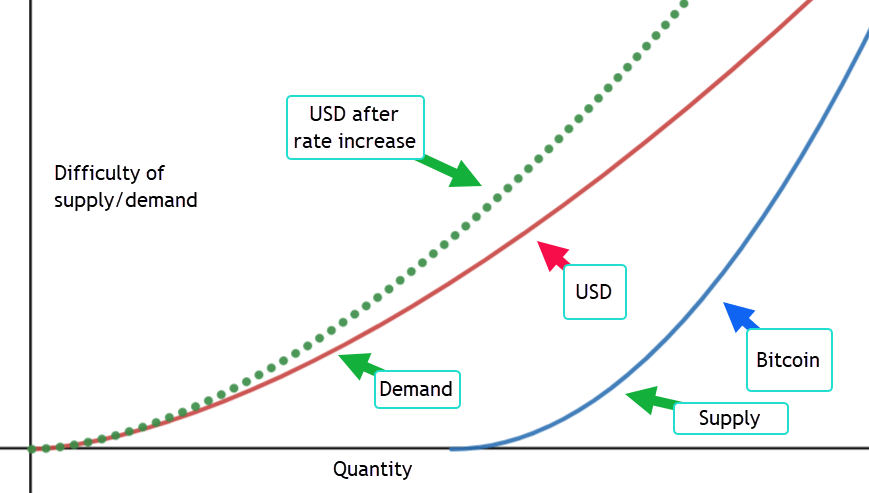
Bitcoin advocates point to recent inflation numbers as they make their case for a digital currency and against a fiat currency. Like gold, bitcoin does not grow enough to meet the growing needs of population and production technology. In the 18th century Adam Smith first noted the lack of gold available for the amount of economic activity in the American colonies. The use of gold as the dominant currency led to a number of crises and panics during America’s Gilded Age in the late 19th century.

Under a fiat currency regime, money can grow as needed. Price stability and prudent management of money and interest rates becomes the prime duty of a government and its central bank. To that end, the Fed sets a target of 2% annual inflation, which is the error term in calculating the change in prices and the comparison of utility we get from goods and services over time. We have all noticed the dramatic rise in prices at the grocery store and gas station but the 10 year average of annual inflation is right at the Fed’s target of 2% (FRED Series PCEPI). For years following the financial crisis in 2008, we became comfortable with disinflation, the slowing down of any price appreciation. Getting back to average inflation should not be so abrupt but the extraordinary slump in global production during the pandemic was abrupt.

Bitcoin boosters argue that a digital currency regime would curtail the government borrowing that fuels inflation, the borrowing that funds continual wars. That borrowing also funded the stimulus relief during the pandemic and kept millions safe in their homes and not hungry on the streets. The flexibility of fiat currencies can be good and bad. Currencies can be classified by time – the past and the future – and their flexibility in time. Gold and bitcoin are based on past effort and are proof of the work required to mine the currency, but both are inconvenient to use as such. The inhabitants on the island of Yap in the South Pacific mined limestone into round discs taller than a person. That proof-of-work, a highly immobile stone, became the island’s money. At the end of this post, check out the photo at the end of this Planet Money article (Goldstein & Kestenbaum, 2010).

From the earliest use of gold, people deposited their gold with a goldsmith who gave them a receipt for the gold. People then traded the receipts, not the gold (Cecchetti & Schoenholtz, 2021, 272). The gold was based on past effort but the receipts were based on the future – a promise by the goldsmith to redeem the receipt for gold. A fiat currency like the U.S. dollar is a receipt based on a promise as well. Few of us realize that the dollar in our pockets is a loan to the Federal Reserve as it appears on the Fed’s balance sheet. Want your loan paid back? Go to any bank, give them your dollar and they will give you a replacement dollar. The words on the back of a dollar bill may say In God We Trust but the dollar bill itself is a token of trust in the stability of the U.S. as a country.

As the NBC News crew learned in El Salvador, bitcoin may be proof-of-work in concept but it is not proof-of-trust in practice. The U.S. Fed stores the largest hoard of gold in the world. Like the large stones on the island of Yap, that accumulation of wealth is proof-of-work, proof-of-stability, and proof-of-trust. The proof-of-work is of the past. The proof-of-stability is the bridge from past to future. The proof-of-trust is a faith in the future.

/////////////

Photo by Donald Giannatti on Unsplash

Brigida, A.-C., & Schwartz, L. (2022, March 15). Six months in, El Salvador’s Bitcoin Gamble is crumbling. Rest of World. Retrieved April 16, 2022, from https://restofworld.org/2022/el-salvador-bitcoin/

Cecchetti, S. G., & Schoenholtz, K. L. (2021). Money, banking, and Financial Markets. McGraw-Hill.

Goldstein, J., & Kestenbaum, D. (2010, December 10). The island of Stone Money. NPR. Retrieved April 16, 2022, from https://www.npr.org/sections/money/2011/02/15/131934618/the-island-of-stone-money

NBC News. (2022, April 13). El Salvador adopted Bitcoin as a national currency. here’s how it’s going. NBCNews.com. Retrieved April 16, 2022, from https://www.nbcnews.com/nightly-news/video/el-salvador-adopted-bitcoin-as-a-national-currency-here-s-how-it-s-going-137673285897

Thirty Year Horizon

April 10, 2022

by Stephen Stofka

In the period leading up to the financial crisis a speculative fever engaged many of the actors in the housing market. This included homebuyers, agents, mortgage brokers, investment firms and risk managers convinced that housing prices could only rise. Homebuyers, struck by FOMO fever, jumped into the home lottery, gambling on a quick flip for a profitable gain with little investment. The frenzy of this market is marked by an opposite phenomenon. Small investors with a portfolio of ten or fewer houses are outbidding conventional buyers with all cash offers. Investment capital is at war with consumption capital.

The Atlanta branch of the Federal Reserve (2022) maintains a Home Ownership Affordability Monitor (HOAM) that ranks the affordability of a home at current prices and interest rates in cities and counties through the country. Readers can select the city, county they are interested in and they’ll see the affordability index. Hover over a county on the map and they’ll see the median home price, median household income and the share of income a house payment would be. The mortgage payment is based on the 3.6% interest rate of two months ago. After the recent rise in interest rates, you can add on at least $200 or more to the monthly payment.

A total housing cost of up to 30% of gross income is considered affordable according to the HOAM guidelines. A rule of thumb to calculate an affordable housing budget is to divide annual gross income by 40. For instance, $80,000 / 40 = $2000 per month. An index above 100 is affordable. The metro Denver area is in the 70s. With an index below 50, a typical household in the LA area would spend more than 50% of their gross income on housing. Some of the counties in the Dallas-Ft. Worth, Texas area and most of the counties in the Atlanta, Georgia area are affordable and that helps explain a growing population in some southern states.

Few will be surprised to learn that housing prices in many cities are unaffordable. Since the housing crisis, not enough housing has been built and low interest rates have increased the pool of qualified buyers. The higher demand puts upward pressure on prices. Older homeowners on a reduced income may resist selling because they cannot find a suitable replacement – a paradox of rising home prices.

In the chart below I’ve added on the Fed’s 2% inflation target to real GDP growth as a benchmark for the 30-year mortgage rate. Rates have been low the past decade but GDP growth has been low as well.

The red line is real economic growth after inflation + 2%. In the last quarter of 2021, economic growth was just 5% above the same quarter of 2019. That two year growth rate is moderate but not strong. The one year growth rate of 5.5% is due to what economists call base effects. Because of the pandemic the 2020 base number was weak, making moderate growth look stronger than it is.

The Fed is expecting growth to average 2.75% this year and decline to 2.3% in 2023 (FRED Series GDPC1CTM). Add in the Fed’s 2% inflation target as I done and the 30 year rate should find a balance in the range of 4.5-5.0%. However, that rate will probably overshoot before finding an equilibrium. The war in Ukraine will make it more difficult for that balance to happen. Homebuyers should not expect 30-year rates to fall below 4% in the near term.

/////////////////

Photo by Laib Khaled on Unsplash

Federal Reserve. (2022). Home Ownership Affordability Monitor. Federal Reserve Bank of Atlanta. Retrieved April 7, 2022, from https://www.atlantafed.org/center-for-housing-and-policy/data-and-tools/home-ownership-affordability-monitor Link updated 2/23/2025 → https://www.atlantafed.org/research/data-and-tools/home-ownership-affordability-monitor#Tab2

Home, Sweet Home

April 3, 2022

by Stephen Stofka

Interest rates belong to the world of money assets where changes can happen as fast as a keystroke. Prices are “sticky,” moving slower in the concrete world of real goods and services. This week the 30-year mortgage rate rose to 4.67% (MORTGAGE30US), but home prices are still high, reflecting the higher demand for homes at low interest rates. Denver was 11th in the country with an annual price increase of more than 20%, according to the Case Shiller index for January (DNXRSA see note). Six months ago, a 30-year rate was 2.87%, near a historic low. The difference in monthly payments on a 30-year $240K mortgage is $245.

When we buy a home, we leverage our down payment into a stable asset and become our own landlord. When the BLS computes the CPI inflation index, they include an item called Owner Equivalent Rent (OER) and it contributes 25% to the CPI index, the largest component of that index. Based on a survey of actual rental housing, OER represents the opportunity cost of renting our home to ourselves rather than to someone else at the going market price. While this might seem contorted, it reminds us that a home represents consumption capital, an investment whose benefits we consume during the time we own the asset. A home is the largest component of most household wealth.

The Federal Reserve charts changes various components of household wealth (Fed, 2022). Our homes represent a stable base of change, as the chart below shows.

The light green shaded area is the change in our home equity. You can visit the site and play with the time controls. Because the change is so stable, people’s expectations became anchored until the housing and financial crisis when the change in housing equity turned negative. People were shocked that such a thing could happen on a broad national scale. It is not unusual for home prices to turn down in a local area, usually in response to a substantial shift in the economic base of an area. Home prices in some Midwest cities experienced substantial losses as manufacturing went to other countries with lower labor costs. In the 1980s, the decline in oil prices made investments in oil shale on Colorado’s western slope unprofitable. Thousands lost their jobs and the prices of working class homes in Denver experienced a 10% decline (DNXRLTSA). Over several decades across the entire country, home prices are sure to rise but the probability of regional economic declines is equally sure.

The blue bars in the graph above represent the volatile changes in stock market equity. Compare that volatility to the stable changes in bond equity (orange). That’s why financial advisors recommend a growing portfolio allocation to bonds as we grow older. The small deviations in bond and real estate prices help anchor the large deviations in stock market wealth.

As mortgage rates rise, people can afford less home and the decrease in demand should relieve the upward momentum of rising home prices. There are those who play momentum in stock prices, buying and selling to take advantage of short term changes in sentiment. The graph above highlights the difference in deviations of stocks and homes. Playing the real estate market like it was the stock market got a lot of people in trouble during the 2000s. A home is an investment in stability, not a raffle ticket to riches.

////////////////////

Photo by Scott Webb on Unsplash

Home Price, Denver Note: Even affordable homes in Denver have experienced sharp prices increases, rising 19.6% in January (DNXRLTSA).

Fed. (2022, March 10). Board of governors of the Federal Reserve System. The Fed – Chart: Changes in Net Worth: Households and Nonprofit Organizations, 1952 – 2021. Retrieved April 2, 2022, from https://www.federalreserve.gov/releases/z1/dataviz/z1/changes_in_net_worth/chart/

Presidential Predictabilities

March 27, 2022

by Stephen Stofka

The 2024 presidential election is still far away but a 75 year political trend is surprisingly predictive of election results. Add in one economic indicator and the results are even more predictable. An incumbent president won re-election 8 out of 12 times, or 67%. Those who lost failed to jump the hurdle of unemployment. When there is not an incumbent president, voters have changed parties in 6 out of 7 elections. America spends billions of dollars on election campaigning but voters have busy lives full of many choices. As with many decisions, we follow a few simple guidelines. Here’s a guide to winning the next election.  

American voters like change but they usually play fair. When the annual (year-over-year) change in unemployment is falling (UNRATE note below), incumbent presidents are assured of a second term. I’ll refer to that change as ΔU. If that change is falling, then employment is improving and voters don’t kick someone out of office. Let’s look at some recent history to understand the trend and those few times when political issues overshadowed economic trends. At the end of this article is an earlier history for Boomers and political history buffs.

In 1992, the ΔU did not favor incumbent Republican President H.W. Bush in the long stuttering recovery after the 1990 recession. In the 18 months after the end of the first Gulf War ended in early 1991, his approval numbers sank from very high levels. A third party candidate Independent Ross Perot focused on economic issues and diverted a lot of moderate and conservative votes away from Bush, helping to put Democratic candidate Bill Clinton in the White House with only 43% of the popular vote. Unemployment numbers favored Clinton in his 1996 re-election bid and voters awarded him a second term.

By 2000, the great internet bull market was wheezing. Unemployment was rising and did not favor Democratic VP Al Gore as he sought to succeed Clinton. A few hundred votes in Florida separated Gore and his opponent, former Texas Governor George Bush. A partisan Supreme Court made a radical decision to overrule the Florida Supreme Court and award the election to Bush, switching party choice yet again. If the employment numbers had been more favorable to Gore, voters might have been inclined to keep him at the tiller.

Bush’s approval soared after the 9-11 attack but controversy erupted when he decided to attack Iraqi leader Saddam Hussein on the pretext that the country had weapons of mass destruction. When no weapons were found, his ratings sank. The economy had stumbled after the short recession of 2001 but tax cuts in 2003 helped employment numbers recover. Bush avoided the fate of his father and won re-election.

As the housing crisis grew in the spring of 2008, the unemployment numbers turned ugly. Again voters changed parties and elected the Democratic candidate Barack Obama. Despite Obama’s unpopularity over health care reform, the unemployment numbers helped Obama to a second term over challenger Mitt Romney. After two terms of a Democratic president and knowing voters like change, a gambler would put their money on a Republican candidate in the 2016 election. The employment numbers favored the Democratic candidate Hillary Clinton, who won the popular vote. A few thousand votes in key states turned the tide in Donald Trump’s favor. Again, we learned the lesson that employment numbers assure victory for an incumbent president but not the incumbent political party.

In 2020, the pandemic drove the change in unemployment to stratospheric levels, rising 9.3% from 2019 levels. Both parties responded with legislation to stem the shock and economic pain to American households. Despite those historically unfavorable unemployment numbers, Trump increased the Republican vote count but could not overcome a larger surge in Democratic votes. The unemployment numbers in the quarters before the pandemic favored Trump. Had the pandemic not struck, it is likely that he would have won re-election.

Memo to incumbent presidents: If unemployment is rising you won’t win re-election.

Given that history, an incumbent Party should enact fiscal policy that keeps or lowers unemployment in an election year. An opposition party should try to block any such legislation. After the 2008 election, the country was suffering the worst recession since the Great Depression and Senate Minority Leader Mitch McConnell said that his goal was to make newly elected Democratic candidate Barack Obama a one-term president. McConnell was vilified for his partisan remark during a time of crisis but he stated the political reality that elections are a zero sum game. At the time of the August 2011 budget crisis between Republicans and the White House, the ΔU was a solid ½% negative. Falling unemployment hurts the election chances of the opposition party. The realities of democratic elections are uglier than many voters can stomach but we are carried along on those currents.

If unemployment is rising toward the end of 2023, look for Democrats to enact fiscal spending that will put people to work. To improve their own chances, watch for Republican strategies that will block any such measures.

////////////

Photo by Gene Devine on Unsplash

UNRATE Note: Unemployment is the headline number, averaged over each quarter. The year-over-year change is taken in the 2nd quarter of an election year (April – June) before each political party conducts its convention to choose their candidate.

/////////////

For interested Boomers and history buffs:

Near the end of WW2, 4-term Democratic President Roosevelt died and his VP Harry Truman assumed the Presidency. In 1948, the unemployment numbers looked grim as the economy tried to absorb millions of soldiers returning from war. Pre-election polls had favored Truman’s opponent, Thomas Dewey, and one newspaper printed out a headline on election night that Dewey had won but that announcement was premature. Truman’s victory is the only time an incumbent has won re-election when unemployment numbers were unfavorable. When the final results were announced, Truman famously pointed to the newspaper’s false headline. Perhaps that is the first time when a politician called out “fake news.”

In the spring of 1952, incumbent Democrat President Truman’s ratings were falling. The ΔU was neutral but the trend was against Truman. When he lost the New Hampshire primary to another Democratic candidate, he retired to his home in Missouri. Republican Dwight Eisenhower won the election. In 1956, the unemployment numbers favored “Ike” and voters gave him another term. In 1960, the ΔU had turned against Ike’s aspiring successor, VP Richard Nixon. Voters switched parties, choosing JFK, a Democrat, in a close and contentious election.

After Kennedy’s assassination in 1963, the unemployment numbers were strongly in favor of President and former VP Lyndon Johnson, who rode the wave of favorable sentiment to the White House. In the spring of 1968, the ΔU still favored Johnson but voter sentiment was more focused on the Vietnam War and Johnson decided not to run for re-election just as Truman had chosen 16 years earlier. Richard Nixon’s political fortunes resurrected on his promise to end the war with dignity and voters changed parties.

In 1972, unemployment favored Nixon who regained the White House, only to leave a few years later to avoid impeachment and ejection from office. In 1976, unemployment numbers looked good for Gerald Ford, who had assumed the presidency. However, he could not overcome voter hostility after he pardoned Nixon for the crimes revealed during the Watergate hearings. Incumbency and favorable employment numbers are powerful persuaders but there are a few times when voters concentrate on political matters more than economic considerations.  

Jimmy Carter, a Democrat, took the White House but couldn’t keep it as both unemployment and inflation were rising in 1980. Republican winner Ronald Reagan had often asked “Are you better off today than you were four years ago?” In 1984, unemployment was still high but falling by 2.7% and Reagan won in a landslide. 1988 is the only election in which the voters did not change parties after two terms. Unemployment was falling and voters turned to VP H.W. Bush for his turn in the top job. Unemployment is a decisive factor in re-electing an incumbent but not enough to overcome the American inclination to political change every decade.

The history continues in the main part of the article.

The Change of the Change

March 20, 2022

by Stephen Stofka

Why do unexpected price changes bother us so much? Prices reflect two forces central to our lives – time and utility. Both are common measures yet each is uniquely experienced. The price of our utility – what we need and enjoy – and the price of our time is deeply personal. Price surprises upset a finely balanced mechanism inside each of us. We can adapt to a one-time price change. We struggle to make sense of repeated and erratic price changes.

A proverb in the tool business is that customers don’t want a ¼” drill bit – they want a ¼” hole. The price of goods we buy is the price of the experience we get when we consume a good. We don’t want an ice cream – we want the pleasure of eating ice cream. The cost of ice cream is the price of our time enjoying it.

Interest is the price of money’s time the way that wages are the price of our time. Einstein once quipped that interest was the most powerful force in the universe. We compliment ourselves when we enjoy an unexpected bonus return on our savings. We are outraged when the power of interest works against us. A credit card debt or student loan debt may grow even though we are making regular payments.

The price of money’s time and the price of our time are like two riders on a seesaw who seek an approximate level. For two decades the Federal Reserve has sat on the interest rate side of the seesaw to keep them close to the ground. In response, the prices of consumption assets (houses) and productive assets (stocks) have risen high. What about the price of consumption goods?

Inflation measures changes in the price of consumption goods the way that our car’s speedometer – the mileage indicator – measures our change in position on the road. We adapt to constant speed or inflation. What we notice then are the changes in speed or inflation – the acceleration. After a decade of low inflation, the pandemic was like approaching a highway junction and coming to a near stop before having to accelerate onto another highway. In mid-2021, the sudden acceleration of price changes seemed normal, a catching up after the economic lockdowns of 2020. The acceleration has continued for months now, as though the gas pedal got stuck. Using the FRED data tool at the Federal Reserve, I have charted the price acceleration – the change of inflation.

Today’s price acceleration is as high as that of the deep recession in 1973-74. Two shocks – one of them short term, one long term – produced a singular phenomenon economists called stagflation. The short term shocks were two oil crises in 1974 and 1979 that decreased world oil production (Gross, 2019). The long term shock was the large influx of the Boomer generation into the labor force, doubling the 1% average growth of the labor force. Forty years ago, the Boomers were in their late 20s and early 30s – at that age when we have increasing incomes and material needs. Lopsided demographics and supply shocks combined to produce erratic price changes.

To bring price acceleration under control in 1979 Fed Chair Paul Volker kept raising interest rates (FEDFUNDS) to keep them above the inflation rate. Interest rates acted as a cap on price changes. Once these two forces balanced, the change in inflation decreased but there was a cost. At that time, small businesses paid 20% interest for unsecured short term loans to cover payroll and accounts receivable. The change in interest rates was swift enough and large enough to drive the economy into recession. Until the 2008-9 financial crisis, the 1981-82 recession was the worst since the Great Depression of the 1930s.

This week, Fed Chair Jerome Powell announced a series of small and steady interest rate hikes with a target that is far below the interest rates of four decades ago when a 10% mortgage rate was a bargain. The demographics are different today. Because the labor force is barely growing structural price pressures should weaken. The large Boomer generation is aging and old people don’t buy as much stuff. The Fed can let the interest rate side of the seesaw rise up a bit and hope that inflation will lower in response. Instead of having to cap price changes as they did four decades ago, they can work to a negotiation between these two price forces.

////////////

Photo by Miles Loewen on Unsplash

Gross, S. (2019, March 5). What Iran’s 1979 revolution meant for US and Global Oil Markets. Brookings. Retrieved March 18, 2022, from https://www.brookings.edu/blog/order-from-chaos/2019/03/05/what-irans-1979-revolution-meant-for-us-and-global-oil-markets/

Price Connections

March 13, 2022

by Stephen Stofka

As I was waiting for the car to drink its fill at the gas station, I got to thinking about prices. Their role is to convey information about resource availability but prices are not a conversant sort. They grunt monosyllabic phrases, relaying only the information that something has changed. A person who paid not the slightest attention to the news would wonder what happened when they filled up their car.

When prices decrease, do we buy more of a good or service? Sometimes. We usually pay attention to prices when they increase. In response, we substitute a cheaper good if we can, smoothing out the price changes. Most of us don’t drive more when gas prices decrease. Annual miles driven per adult have fallen as the large Boomer generation has aged (FRED Series TRFVOLUSM227NFWA/CNP16OV). The oldest of the Boomers passed 55 in the mid-2000s when per capita miles peaked.

Prices may not change as quickly as global conditions. When there is a poor coffee harvest in Brazil, the price of coffee in the grocery store may take several months to respond. Not so with gasoline, a global commodity so vital to the global economic engine that gas prices respond quickly to geopolitical events.

Many countries subsidize or control the price of some goods but too much control and prices no longer relay information between producers and consumers. The U.S. government subsidizes the farmers who grow corn to make the ethanol blended into gasoline. It subsidizes dairy, peanut and cotton farmers. Countries with state owned industries may keep a lid on prices to gain and keep political power. This year Kazakhstan lifted price caps on liquified petroleum gas which most people use to fuel their vehicles. Thousands of citizens protested (Neuman, 2022). In 18th century France, people rioted over the price of bread. Gasoline is today’s bread.

The ancient Greek philosopher Protagoras said that man was the measure of all things. In past centuries, essential food commodities that kept people alive were a yardstick of value. Anyone who has to drive to work or drives for a living feels that way about the price of gasoline. Larger firms that depend on predictable prices use the futures market to smooth gas prices but an independent Uber driver bears the full impact of rising gas prices. Should the U.S. subsidize gas prices for those who depend on the fuel? Those policies, politically popular in countries like Venezuela and Kazakhstan, foster political corruption and weaken the economic system. Why? One group of taxpayers subsidizes another group of taxpayers. The price of gasoline is closely linked with the price of power.

Competitive pricing is a hallmark of capitalism but such pricing minimizes profits. Large companies prefer to set a price which maximizes their profits within a competitive environment where other large firms use the same strategy. The result is an entire aisle in a grocery store filled with breakfast cereals that are priced at 10 times their cost. With the milk subsidies, the cereal becomes more affordable. Developed countries have learned to tame the prices of essential items without keeping those prices in a cage. We want our prices to communicate essential resource allocation information but we want well-behaved prices.

In our modern global economy we have many more goods and services available to us. Multiple sources of food products help lower prices but we are subject to the geopolitical risks of a global economy. The Covid pandemic and the war in Ukraine has reminded us that risks accompany benefits. The Russian people are beginning to experience the isolation of being cut off from the international system of trade, money and assets. Like prices, it is better when we are connected to each other.

////////////

Photo by Clint Adair on Unsplash

Neuman, S. (2022, January 8). There’s chaos in Kazakhstan. here’s what you need to know. NPR. Retrieved March 12, 2022, from https://www.npr.org/2022/01/08/1071198056/theres-chaos-in-kazakhstan-heres-what-you-need-to-know

The Fruits of Labor

March 6, 2022

by Stephen Stofka

In trips to the grocery store and gas station, many of us develop an inflation calculator that we trust because it tracks price changes in the unique basket of goods that we buy. If the price of mushrooms doubles, we only care if we buy mushrooms. Economists have the difficult task of computing the price changes of a common set of goods. They spend an extraordinary amount of time and expense surveying people in cities throughout the U.S. to construct a representative sample of the goods we buy (BLS, 2021). The price weighting that economists use to measure inflation differs from our instinctive approach. We assign weighting by the frequency we do something. What catches our attention gets more weight in our consumption basket.

Our sense of inflation can be guided by the price of gasoline when we fill up each week, but it is only 4% of the CPI measure of inflation (BLS, 2022). Many of us underweight the cost of housing that we provide to ourselves. Wait, what? In January, economists at the Bureau of Labor Statistics computed a 4% increase in housing costs even for those who owned their home outright. They call this Owners’ Equivalent Rent (OER) and it makes up a whopping 25% of the calculation of inflation. In the BLS methodology, homeowners are both landlords and renters. Actual rental increases made up only 7% of the index but the BLS uses those rent increases to compute the market price of what a homeowner could rent out their home for each month. For a homeowner, that 4% increase in housing costs is actually a 4% saving. Even better, homeowners do not pay income taxes on that imputed income.

Like gasoline, we overweight the effect of grocery prices because we frequently shop. If we enjoy a sirloin steak once a week, we notice when it increases in price from less than $10 to $13 a pound (FRED series APU0400703613). In the years after the financial crisis many households ate more ground beef. Prices doubled in response to the increased demand (APU000070312). Ground beef is what economists call a Giffen good. Unlike normal goods, we buy more of a Giffen good when our income goes down.

Many of us measure inflation by comparing the prices we pay to the wages we receive. Workers have gained little in the past two decades, eking out an extra 8% in real earnings over that time. All of that gain has come in the past eight years. Workers should expect to share in the productivity increases of the past two decades.

An assumption of neoclassical economics is that workers’ wages reflect their marginal productivity. A BLS analysis (Sprague, 2014) of labor productivity showed an average gain of 2.2% in real output per hour from 2000-2013, yet workers’ real earnings declined slightly. In the past eight years, annual productivity gains have averaged about 1%, slightly below the annual 1.2% increase in real wages. Why have workers been able to command wages appropriate to their productivity in the past eight years but not in the 14 years prior? The problem began before the financial crisis when productivity rose 2.7% per year and real wage growth actually declined. The 2000s came after a period of reversal for the owners of capital. During the 1990s, much money was lost in the pursuit of profits promised by the developing internet. Owners and management recaptured those losses by keeping the productivity gains to themselves during the 2000s. Workers may not be able to regain those lost wages but at least they are securing the fruits of their labor.

/////////////

Photo by Timotheus Fröbel on Unsplash

BLS. (2021, December 9). Consumer price index frequently asked questions. U.S. Bureau of Labor Statistics. Retrieved March 5, 2022, from https://www.bls.gov/cpi/questions-and-answers.htm

BLS. (2022, February 10). Table 1. Consumer price index for all urban consumers (CPI-U): U. S. city average, by Expenditure Category – 2022 M01 results. U.S. Bureau of Labor Statistics. Retrieved March 5, 2022, from https://www.bls.gov/news.release/cpi.t01.htm

Sprague, S. (2014, May). Definition, concepts, and uses. U.S. Bureau of Labor Statistics. Retrieved March 5, 2022, from https://www.bls.gov/opub/btn/volume-3/what-can-labor-productivity-tell-us-about-the-us-economy.htm

A Real Test

February 27, 2022

by Stephen Stofka

A central archetype of the American character is an individual who stands up to a large institution. America declared independence in defiance of the British Empire. The text and spirit of the Constitution shows a healthy distrust of institutional power. In Mr. Smith Goes to Washington, Jimmy Stewart played an idealistic young man who wrestled with the power politics of the Washington elite. In 1971, Daniel Ellsberg challenged the White House and Defense Dept when he released the details of the Pentagon Papers to the New York Times. In his 2016 Presidential campaign, Donald Trump played the newcomer, ready to challenge the institutional power of Washington. This week thousands of Ukrainian civilians volunteered to take up arms against the Russian Army’s assault on their capital, Kyiv. This was a defiant defense of democracy that most Americans could champion.

Americans have long been conflicted in their attitudes to the institutions that form the web of civic life. Our faith in government has been sorely tested in the past two decades. The pretext for the war in Iraq was founded on faulty intelligence and political passion. The fall of Enron and the discrediting of a large accounting firm, Arthur Anderson, led many to question what the attention and motives of the many agencies that took up office space in Washington. The financial crisis confirmed our worst fears. Corruption, incompetence and political impotence had helped bring the global financial system to its knees. When the pandemic touched the shores of America in early 2020, there was not much belief left in the reservoir of American trust.  

In late 2018, the Pew Research Center interviewed 10,000 Americans about their trust in government (Rainie et al., 2021). Trust in government was at historic lows and ¾ of respondents thought it had become much worse in the past twenty years. A supermajority of Americans can’t distinguish truth from lies when politicians speak. At that time, only 42% of those interviewed thought that a lack of trust was a big problem. The pandemic has revealed just how big a problem it is. Parents have threatened school board officials. Thousands of airline passengers have threatened fellow passengers and airline employees. Americans have reacted violently not to an invading army but to mask mandates. Is this what we fight for?

A lack of trust in government may be very low but it is not new. More troubling is the growing lack of trust we have in other Americans, an unraveling of social cohesion that takes years to develop and decades to repair. Under the pretense of fostering connection with others, social media helps drive us apart with carefully written algorithms that promote conflict as a form of social engagement. We need an enemy other than our neighbors. As Ukrainians escape with their children to Poland, Slovakia, Hungary and Moldova – as they sleep in subway tunnels to escape bombardment by Russian troops – as they take up arms to protect their capital – let’s remember that the real test of freedom is not whether we have to wear a mask in a grocery store or on a plane.

//////////////////

Photo by Aaron Burden on Unsplash

Rainie, L., Keeter, S., & Perrin, A. (2021, July 27). Trust and Distrust in America. Pew Research Center – U.S. Politics & Policy. Retrieved February 27, 2022, from https://www.pewresearch.org/politics/2019/07/22/trust-and-distrust-in-america/