Good Hands Government

January 20, 2022

by Stephen Stofka

Socialist policymaking is founded on an aspirational principle of equal outcomes. Central to that approach is an expanded role for government as an insurance company, the insurer of last resort. Should government be the insurer of first resort? Some would prefer that but others are uncomfortable with the lack of privacy that entails. A characteristic of insurance is what economists call asymmetry of information. The insured knows more about their situation and risks than the insurer. Do we want to give government an incentive to pry into our private lives? Can government protection create a moral hazard? Will people be less careful or less industrious because they trust that government has their back? Student loan debt brings a pointed focus to some of these issues.

According to 39 state Attorney Generals, Navient was a predatory servicer of high-interest loans for students attending for-profit colleges (Settlement Administrator, 2022). In the mid-2010s, the Obama administration put its foot down with many  for-profits – if they could not meet minimum graduation rates, they would be cut off from federal funds. Many folded. Recently, 39 states  reached a settlement with Navient that gave relief to many thousands of student borrowers. Who was given no relief? Students who had been paying their loans on time.

In many areas of our lives, we disagree about who is responsible for the risks of unwelcome outcomes. A person who gets an education assumes a certain risk that higher lifetime earnings will be greater than the cost of an education. Such a risk cannot be quantified or insurance companies would sell policies to college students. However, the federal government provides some guarantee for federal student loans. Colleges, including for-profit schools, are usually accredited. That accreditation provides some assurance – but not insurance – to a student that a school’s curriculum has sufficient quality to earn the accreditation. However, conventional non-profit colleges are supervised by regional accrediting organizations that have higher standards than the accrediting bodies of for-profit colleges (The Best Schools, 2022). Without the regional accreditation, for-profit students often discover that they cannot transfer their credits to a 2-year or 4-year college. Employers may doubt the worth of their educational credentials.

Is this a case of buyer beware? How is a college education different than starting a small business? Students have a wealth of research available to them before they enroll in a for-profit college. Should taxpayers pick up the tab for students who may not have done adequate research before committing to a student loan?  Every year hundreds of thousands of small businesses go out of business for the same reason. They did not research the market. They didn’t have adequate management experience. Many people may be stuck with 2nd mortgages used to fund the business. Should taxpayers bail out small business owners? 

Financial and medical risks can be substantial and we may vehemently disagree about government’s responsibility for absorbing these risks. Government now insures us against loss of income due to injury (workmen’s compensation) or permanent inability to work (disability insurance), old age (Social Security), protects our pension funds (ERISA), insures our homes against flooding (Flood Insurance Program). It pays our medical bills if we are poor (Medicaid) and when we are old (Medicare).

Should government have a minimal or expanded role in our lives? If we want government to have our back, what is the limit? What are the boundaries between government and our lives? What is the extent of our personal responsibility? How much risk must we shoulder? There are many strong opinions on the subject.

////////////////

Photo by Lina Trochez on Unsplash

Settlement Administrator. (2022, January 13). 39 State Attorneys General Announce $1.85 Billion Settlement with Student Loan Servicer Navient. Home. Retrieved February 20, 2022, from https://navientagsettlement.com/Home/portalid/0

The Best Schools. (2022, January 6). Guide to for-profit colleges: What you need to know. TheBestSchools.org. Retrieved February 19, 2022, from https://thebestschools.org/resources/for-profit-colleges/

Unfolding Story

February 13, 2022

by Stephen Stofka

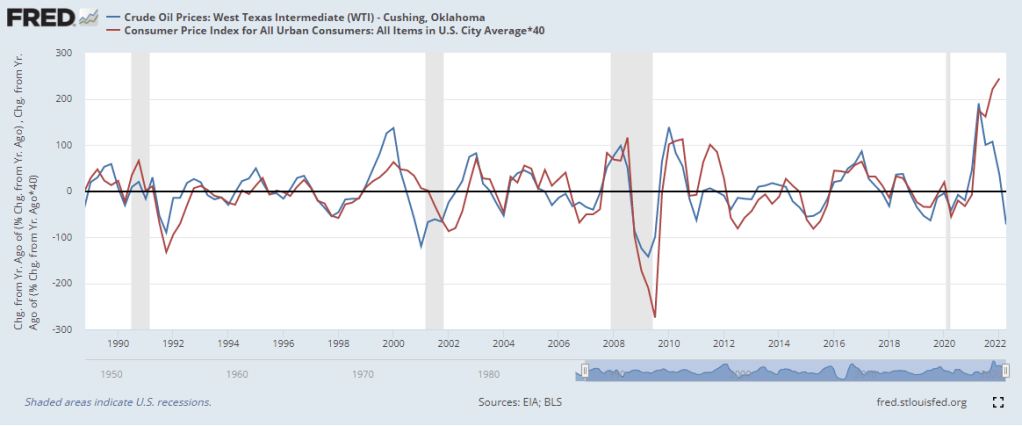
Trying to find the cause of inflation is like looking for a car in a big parking lot. Science is a process of ruling out causes. The latest release of the Employment Cost Index (ECIWAG) from the BLS rules out higher wages and salaries as a key driver of rising prices. During the financial crisis wages fell below trend and have stayed below the trendline for 12 years until this past year.

The average pay increase this past year has been 4.0%. Workers who have gained the most in this past year have been those with lower wages. Customer facing workers in leisure and hospitality workers are up 8% and retail workers have gained 6.3%. Other service jobs and whole sales are up over 5%. Industries with the lowest increases are in education 2.5%, state and local government (2.5%), utilities 3.0%, and financial activities 3.2%.

Two times a year the Philadelphia Federal Reserve (2022) surveys a number of economic forecasters and publishes the consensus outlook for inflation over the next decade. The current projection is 2.5%. Expectations for inflation among the public are on a shorter time frame. Once a month the University of Michigan publishes their survey of customer inflation expectations. December’s reading was 4.8%.

Housing costs could be a culprit for rising prices. The vacancy rate is very low at 5.6% and that has helped support a 5.7% increase in housing costs (CPIHOSSL). The growth rate has been swift in the past year, an aftereffect of the pandemic. For several years, the growth rate of housing costs had been about 2.7%, then fell to 2% during the pandemic. This erratic growth of the past months is unlikely to last.

The lack of new car inventory has led to sharp increases in used car prices, with smaller cars leading the pack. When the pandemic hit, auto manufacturers canceled their orders for semiconductors. As the tech factories in Asia resumed production, the auto manufacturers dedicated what chips they could get to larger SUVs and trucks with the highest profit margins. That has left a severe shortage of smaller cars. That has resulted in sharply higher prices for the used models.

The pandemic has been an experiment that would be unethical if done by anyone other than mother nature. For decades economists will try to understand the interlocking price and supply mechanisms. Economists still argue about the causes of the stagflation of the 1970s, almost fifty years ago. Human society and our interactions are at least as complex as the human mind. As economists sort through the dynamics of evolving relationships they can only hope to understand what is not true.

//////////////////

Photo by Evergreens and Dandelions on Unsplash

Federal Reserve. (2022). First quarter 2022 survey of professional forecasters. Federal Reserve Bank of Philadelphia. Retrieved February 13, 2022, from https://www.philadelphiafed.org/surveys-and-data/real-time-data-research/spf-q1-2022

A Voting Booth

February 6, 2022

By Stephen Stofka

How important are energy prices? British homeowners are paying almost 60% more than last January’s prices to heat their homes with natural gas (https://tradingeconomics.com/commodity/uk-natural-gas). They are upset at government officials and the party in power. In the U.S., the annual January increase to residential consumers was only 2.6% (https://www.eia.gov/dnav/ng/hist/n3010us3m.htm). The UK imports most of their natural gas while US consumers enjoy the benefits of US gas reserves. Americans drive far more than Brits so the weathervane of popular sentiment  in the US is the movement of gasoline prices. In general people don’t like rising prices – period – but when gasoline prices rise faster than paychecks, the public has the sense that something is broken and they want government to fix it. A gas pump can be a voting booth.

During the eight years of slow recovery following the financial crisis in 2008, paychecks struggled to keep up with the rise in gasoline prices. Income growth finally rose above gasoline price growth in the middle of 2016. As incoming Presidents do, Mr. Trump took credit for some of the gains and policies of his predecessor. Until the pandemic struck, paycheck growth stayed above the growth in gasoline prices. These annual growth rates erase most of the seasonality of gasoline prices, which fall in the winter and rise in the spring when the refineries must switch to a more expensive blend for the heat of summer.

That trend took a “wheelie” in the spring of 2020 when the entire country responded to the swell of pandemic deaths in New York City. Headed by a soapbox President with little organizational skill, the Trump administration struggled to cope with the daily demands of the pandemic. Mr. Trump himself cared little for the research his staff brought him. He has admitted that he is not a reader, trusting his instincts more than information. Had he shown more consistency during this singular pandemic, he might have retained enough college educated male voters to tip the 2020 election in his favor. As with many of us, Mr. Trump cannot come to grips with his own failings so he blames others. He has turned that nasty habit of self-deception into an art form of grand deception.

As the chart shows, the annual growth in gasoline prices was far above the growth in paychecks when Mr. Biden took office in the beginning of 2021. Both growth rates reached 10% in the 3rd quarter of last year, but people pay more attention to the sticker price on the pump as they fill up their cars. In the fourth quarter, paycheck growth edged up while gasoline prices growth edged down, a heartening trend if it continues.

Presidents have little effect on gasoline prices, a global commodity dependent on supply and demand around the world and subject to geopolitical tensions. However, the public holds Presidents responsible. If gasoline prices are high, reporters at White House press briefings ask what the administration is going to do about it. Occasionally, they release some of the government’s strategic gasoline reserves to show some action. That release has only a small effect on global prices but it shows the administration’s attention and good intentions. Until the country went off the gold standard during the Depression, each President had to answer for movements in the price of gold. Gasoline powers our daily lives. It is our daily gold.

Mr. Biden is mindful of the electoral beating that Mr. Obama took in the 2010 elections when the Tea Party led a Republican movement to forcefully take the majority gavel from the House Democrats. Most Presidents suffer election losses in the midterms but it was a devastating turnaround in a census year. Mr. Obama was more skilled at rhetoric than taking the tiller of a national political party. As a politician with decades of experience, Mr. Biden is already in campaign mode, moving funds to battleground states to get out the vote in November. He will be mindful of the public’s sensitivity in the final months leading up to the midterms.

Gasoline prices are higher in the summer months and people drive more so they notice high prices. The press is quick to point out Mr. Biden’s low approval ratings, currently in the low 40s. Mr. Biden’s low was Mr. Trump’s high. In a country evenly split between Democrats, Republicans and Independents, a President will struggle to gain and hold a majority favorable public opinion above 50%. According to Gallup (https://news.gallup.com/poll/116500/presidential-approval-ratings-george-bush.aspx) George Bush did not enjoy a majority opinion after 2005, his first year of his second-term. His ratings fell near 30%, lower than Mr. Trump’s lowest ratings. When did those lows come? During the summer months of 2008 when gasoline prices rose above $4 per gallon. Voters carried their sticker shock at the pump into the voting booth a few months later and gave Democrats a resounding majority.

If gasoline prices are moderate this summer, that will give a boost to Democratic chances at the polls but Mr. Biden should be savvy enough not to count on that. He must assume that prices will not be friendly to him or his party this summer. The Republican strategy is to use pocketbook issues to regain a majority in both the House and Senate. Their divisive stance on moral issues only antagonizes Independent voters in the suburbs so Republicans must focus on practical issues. Midterm elections suffer from low turnout. Voters shrug. The party that can energize their voters can command the political field for the next two years. Gasoline prices energize voters.

////////////////////

Photo by Dawn McDonald on Unsplash

The Leaving

January 30, 2022

by Stephen Stofka

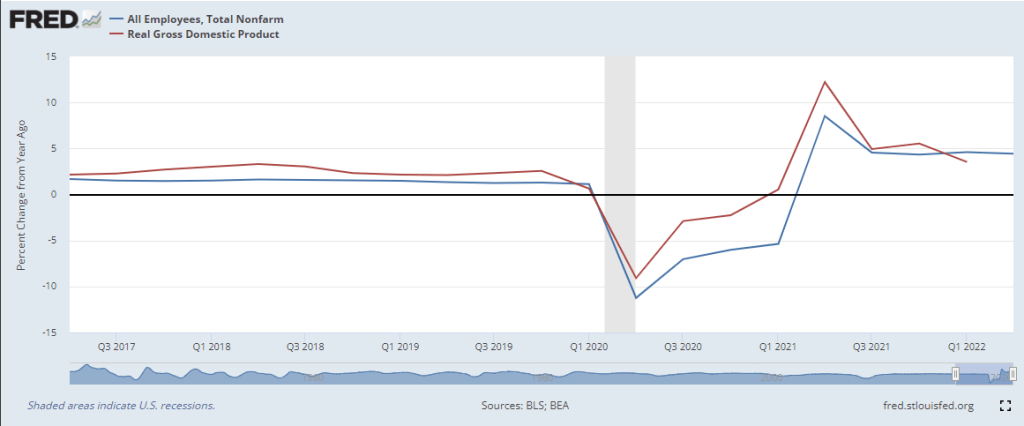
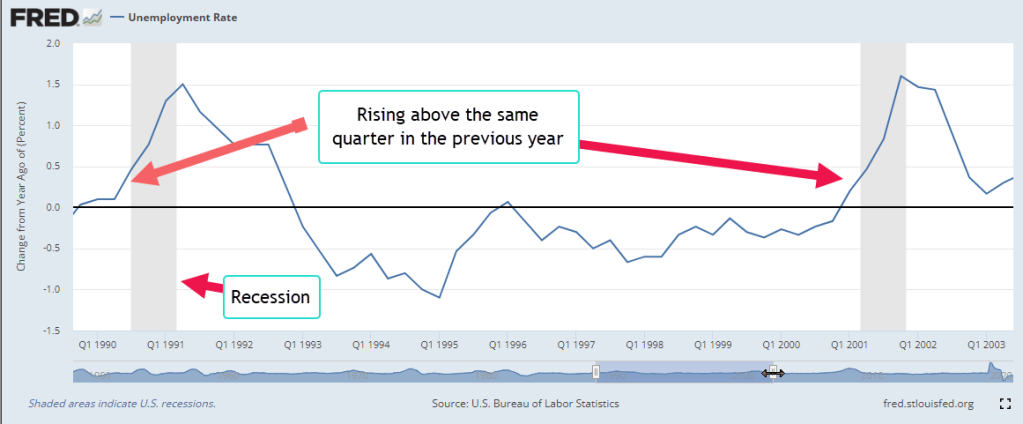
Every week I read about the Great Resignation. What is it? The number of people quitting their jobs is at a historic high. In the leisure and hospitality industry, the number of quits is up 20% from pre-pandemic levels. In retail jobs, quits are up 16%. People quit their jobs for a lot of reasons. In more normal times, a higher quit rate indicates a greater confidence in finding another job. As the quits rate goes up, the unemployment rate goes down. I’ve inverted the unemployment rate to show the historic trend between job quits and unemployment.

These are not normal times. Employees in public facing jobs are enduring abuse from patrons. We have lost a social cohesion, an agreement on the rules of civility. In response to physical threats to employees over mask wearing, Denver’s Children’s Museum closed for ten days. According to the FAA, the number of active investigations into unruly passengers climbed 7-fold in 2021. The number of quits in healthcare field, in the leisure and hospitality industry, education, and food services are all more than 1/3 higher than pre-pandemic levels. In professional services, quits have increased by 28%. In the retail sector, the growth is only 18%.

In the South and Midwest regions that the Labor Department surveys, the quits rate has climbed 30%. According to US Census data almost 40% of the country lives in the Southern region and is the fastest growing region of the country. The Midwest region has about half the population, has recently experienced a slight population decline, but is experiencing the same job churn. Are people moving from the Midwest to the South? In the Western and Northeastern regions, the quits rate has grown more modestly – at 20-22%.

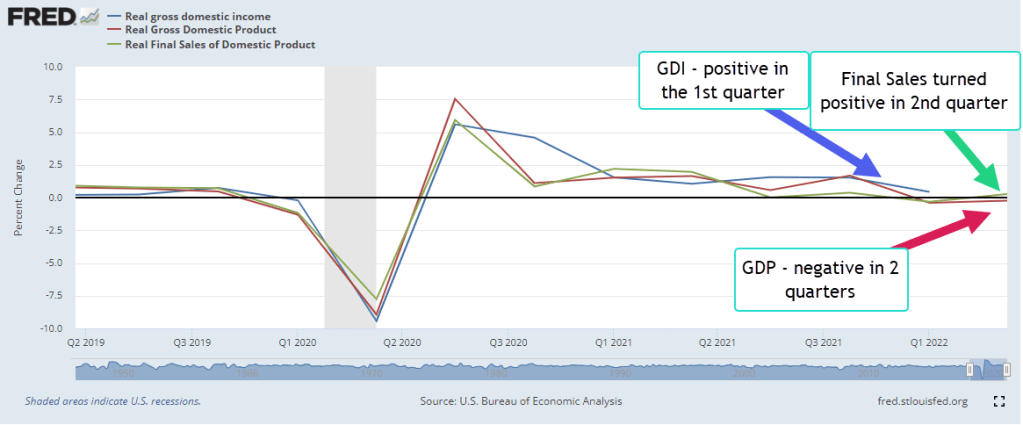
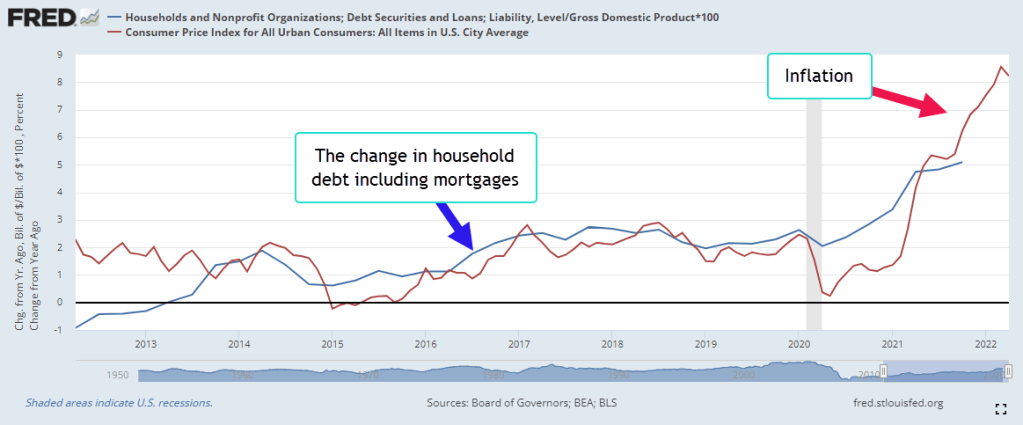
The first estimate of last quarter’s real GDP growth was an annualized 5.5% growth (GDPC1). That’s real growth after subtracting the effect of inflation. Household purchasing grew by a strong 7.1% after inflation (PCEC96). How much have households borrowed to fund that buying spree? 3rd quarter real debt rose by only 2.5%, easing slightly after the first two quarters of last year (CMDEBT/PCEPI). We won’t have 4th quarter debt levels until early March but real debt levels are still below the peak of 2007 when households had gorged on debt. Until the financial crisis in 2008, real household debt was growing 7-8% per year then went negative for six years after the crisis. Household debt did not rise above a 1% growth rate until the final year of the Obama presidency.

Households have a historically low debt burden as a percent of disposable income (TDSP). If a household’s monthly income after taxes is $1000, the average debt payment is less than $100, near a four decade low. There is a lot of guesswork in this series but the important thing is the declining trend in the data. People are not borrowing beyond their means as they did during the 2000s. Do lower debt levels mean that buying pressures will remain strong? Will another Covid variant further strain hospital staff and resources?

//////////////////////

Photo by Clem Onojeghuo on Unsplash

A Good Decade

January 23, 2022

by Stephen Stofka

As a year-end review I’ll compare risk and returns of the past ten years with the decade before. I submitted several standard portfolios to Portfolio Visualizer. These portfolio metrics are based on broad indexes with a yearly rebalancing. These are broad benchmarks and the performance metrics don’t include fees, taxes and transactions costs that would reduce an investor’s actual returns.

The CAGR is the compounded annual return. Worst Year measures the worry level that an investor might face. The first portfolio might be termed aggressive but would be typical for a person who is more than ten years from retirement. The 60/30/10 is a moderate portfolio allocation and the 50/40/10 is a balanced weighting, more appropriate for those who might need to draw funds from the portfolio.

2012-2021                                           2002-2011                            

Stocks/Bonds/CashCAGRWorst YearCAGRWorst Year
70/25/512.2%-3.6%4.6%-24.6%
60/30/1010.7%-3.0%4.7%-20.6%
50/40/109.4%-2.5%4.9%-16.3%

The last decade stands in stark contrast to its predecessor, which included the great financial crisis of 2008-2009. The 7.5% difference in annual returns between the two decades was worth $106K extra return on a $100K portfolio. The more aggressive 70/25/5 portfolio gained an additional 1.5% during the past “good” decade but had only a .1% lower return during the previous “bad” decade. During that bad decade, however, the aggressive portfolio lost 25% of its value in one year. A 20% drop in value is considered a bear market. For investors with no need to sell any of their portfolio, those were “paper” losses. Some investors needed to tap their portfolio for living expenses in retirement or to recover from job loss. During the recovery from the financial crisis, some older investors continued to work past retirement age to replenish their portfolio. Many of them left the labor force when the pandemic struck. The number of workers over 55 is still 1.2 million less than it was at the onset of the pandemic (FRED Series LNS12024230).

The government learned valuable lessons from its response to the financial crisis in 2008-9. Both the fiscal and monetary response had been too moderate and that prolonged the recovery over many years. When the pandemic struck in March 2020, Congress and the Federal Reserve enacted strong relief measures that protected many families and some businesses from the economic fallout of pandemic restrictions. Occasionally, Congress can come together on a bipartisan basis and accomplish something.

It is unlikely that the 2020s will have the same high returns as the last decade. A younger investor can take a more aggressive stance and rely on the law of averages. Time is on their side. An investor who may need funds from their portfolio in the coming years might check their allocation and rebalance to a more appropriate level of risk.

////////////////

Photo by Markus Winkler on Unsplash

Wealth-Income Ratio

January 16, 2022

by Stephen Stofka

Analyses of wealth and income inequality engage policymakers and economists and provoke lively discussion on social media. Thomas Piketty (2013) stirred up debate with the publication of Capital in the Twenty-First Century. Five years later came the publication of After Piketty (Boushey et al., 2019), a series of essays by prominent economists. I wanted to tackle a different aspect of this subject – why the ratio of wealth to income has become so erratic in the past two decades. The answers are too complex for a blog post and beyond my capability to understand. But let’s take a short journey down the rabbit hole.

In the past ten years both stocks and housing prices have more than doubled, moving in a synchronized dance. In the graph below I’ve plotted the two series on top of each other to show the similarity in trend.

The Federal Reserve charts a ratio of household wealth to disposable income, which is income less taxes plus transfer payments like Social Security. Although there are some similar components, the ratio is different than the capital-income ratio that Piketty uses. Housing represents the majority of wealth for many households. Many workers own part of the stock market through mutual funds, 401K plans at work or IRA retirement plans. The doubling of these two asset classes has led to a rise in household wealth and raised the wealth-income ratio to historically elevated levels.

In the graph above I have highlighted past decades where this percentage found a level and remained there. For almost 50 years following WW2 household wealth was about 5x disposable income. Beginning in the mid-90s, this percentage turned erratic, unable to find any stability until the violent recession following the fiscal crisis. In 2013, stock prices and housing began a steady climb that endured the pandemic shock and continues to this day. Will we establish a new level of wealth at 8x disposable income in the next few years? I doubt it. Such a growth curve is unsustainable.

As I search for the underlying causes, I look back to the mid-90s when the wealth-income ratio first turned erratic. The internet first began to grow into our commercial and personal lives. Heady expectations of rocketing business profits led many investors to make wild bets on companies who had little history, a lot of hype and little profit. Out of the carnage of mis-investment emerged an internet platform that has transformed our personal lives. Apple and Amazon are two success stories. In 1997 giant Microsoft made a $150 million investment in failing Apple Computer that kept Apple out of bankruptcy. This year Apple’s valuation passed the $3 trillion mark, about 13% of the entire GDP of the U.S. That same year Amazon went public. It’s business model? Selling books. For years it struggled to make a profit. Amazon’s market capitalization is now over $1.6 trillion. The so called FAANG stocks of big tech have surpassed the industrial and financial giants of the 20th century. Two researchers at Morningstar studied the decade long impact of the ten largest stocks and the impact they made on the overall return of the entire stock market (Solberg & Lauricella, 2021). Perhaps that concentration of market power is contributing to a more erratic wealth-income ratio.

Low interest rates and leverage have affected household wealth. In the mid-90s, bankers at JP Morgan developed the collateralized mortgage to spread risk. In ten years, misuse and overuse of that idea led to a historic meltdown in housing prices and caused a worldwide fiscal crisis. Since then the supply of new housing has not kept pace with demand. Fueling that demand is a large Millennial generation which is settling down. Persistently low mortgage rates have increased the pool of qualifying buyers. Low rates have raised the present value of the future housing services a homeowner receives from the house they buy. Not enough supply to meet demand has led to higher housing prices.

High inflation this year has grabbed headlines and stirred up comparisons to the stagflation of the 1970s. There are too many differences between now and then but that is a subject for another blog post. A rising federal debt has certainly contributed to a rising level of wealth but does not account for the erratic behavior of the ratio itself. In the mid-90s, the federal debt began falling and the wealth-income ratio rose dramatically.

I suspect that finding an equilibrium in this ratio will be a painful process. To reestablish a sustainable ratio, there are two possibilities. The first is a hard landing where asset valuations fall more than incomes fall. The second scenario is a soft landing in which incomes rise more than valuations rise. Let’s hope for the soft landing.

///////////////////

Photo by Ludde Lorentz on Unsplash

Boushey, H., Bradford, D. L. J., & Steinbaum, M. (2019). After Piketty: The agenda for economics and inequality. Harvard University Press.

Cautero, R. M. (2021, December 28). What is disposable income? The Balance. Retrieved January 15, 2022, from https://www.thebalance.com/what-is-disposable-income-4156858

Piketty, T. (2013). Capital in the Twenty-First Century. (A. Goldhammer, Trans.). The Belknap Press of Harvard University Press.

Solberg, L., & Lauricella, T. (2021, December 1). The FAANG Market is Fading. Morningstar, Inc. Retrieved January 15, 2022, from https://www.morningstar.com/articles/1070180/the-faang-market-is-fading

A Man With No Blame

January 9, 2022

by Stephen Stofka

A 63 year old man came into a hospital because of a heart problem and found out that his condition was aggravated by Covid. He had not gotten the vaccine because he was fed some incorrect information, he said to a reporter. He was not on a ventilator yet but regretted not getting the vaccine. He was not to blame. One of the many rioters on January 6th a year ago cried that his intentions were honest – a protest against what he had been told was a stolen election. As the riot turned violent, he was swept up in the motion of the crowd. He was not to blame. In the song I Shall Be Released Bob Dylan wrote about a man who also was not to blame. We want others to take responsibility for their actions but are reluctant to shoulder responsibility for our own actions.

In the middle of the 20th century, many psychotherapists took a mechanistic approach to explaining behavior, helping their patients understand that their actions were the result of environmental and genetic factors (Maddison, 1959). Therapists wanted to avoid moral labeling because it did not present a constructive way to help a patient manage their behavior. Scholars like Marshall McLuhan and Noam Chomsky argued that the mainstream media shaped public opinion to conform to corporate and institutional norms. When Noam Chomsky (1988) co-authored Manufacturing Consent there still was a mainstream media. Now we select the media that we want to listen to. We are the curators of our own information stream. Still we blame a conspiracy of misinformation for our own misfortune.

The formation of social media happened in America because it gave us an opportunity to form impromptu victim communities based on race, sexual orientations, political, economic and religious ideologies. We have become communities of umbrage, rallying in opposition to a stream of offenses. We form credential communities who challenge the right of others to call themselves victims.

We are drawn to conspiracy theories because there have been many of them throughout history. A small group of men – it is usually men – conspire in secret to pull the levers of power and affect the lives of many. Price fixing and asset bubbles are two examples. In the 19th century, Cornelius Vanderbilt busted up a cabal of New York politicians who kept railroad rates high and profited handsomely at the expense of merchants and consumers (Stiles, 2011). There was so much political corruption in America that taxpayers no longer trusted politicians with money. There was more transparency if the politicians contracted out the work to publicly held corporations, who had some accountability to their shareholders. By the dawn of the 20th century, corporations ruled America.

America has long been a country of victim communities. In the 18th century, colonists complained of British persecution while they persecuted black slaves, Native Americans and anyone thought to be a “loyalist.” In the Virginia colony, James Madison defended the Baptists who complained of religious persecution by the Anglican majority (Klarman, 2016, 566). Farmers complained of being exploited by “the rich and ambitious,” particularly northern bankers who seized upon every opportunity to repossess their land for failure to meet a payment deadline (Klarman, 2016, 385). In 1783, Pennsylvania farmers surrounded the statehouse demanding relief from their debts. In 1786-7, several thousand armed rebels occupied Massachusetts’ courthouses in an attempt to nullify tax liens and private debt contracts (Klarman, 2016, 88-90). This uprising, known as Shay’s Rebellion, showed a lack of respect for authority and the sanctity of contract that alarmed many leaders of colonial governments. The rebellion prompted the adoption of a stronger central government embodied in a new Constitution. The participants in the rebellion were dealt harsh sentences.

More than 200 years later, a former President, pampered since he was in diapers, claimed that he too was a victim. Like his predecessor, Richard Nixon, he claimed the role of Victim In Chief. He goaded his supporters to storm the Capitol building to deny the certification of an election which he had lost. One supporter carried a Confederate flag into the halls of Congress, a gesture of defiance and a repudiation of Lee’s surrender at Appomattox almost 150 years earlier. More than 700 of those who participated in the riot have been charged. Their leader, a man who has persistently avoided responsibility for any of his actions, faces no charges yet. He is the Victim, the Man Without Blame.

//////////////////////

Photo by Andrey Tikhonovskiy on Unsplash

Klarman, M. J. (2016). The Framers’ Coup: The Making of the United States Constitution. Oxford University Press.

Maddison, D. C. (1959, August 15). The doctrine of “diminished responsibility” in the Criminal Law. The Lancet. Retrieved January 8, 2022, from https://www.sciencedirect.com/science/article/pii/S0140673659922159

Stiles, T. J. (2011). The First Tycoon: The Epic Life of Cornelius Vanderbilt. Alfred A. Knopf.

The Old Normal

January 2, 2022

by Stephen Stofka

“We wish you a Merry Christmas and a Normal New Year” could be this year’s chorus. We left normal about 13 years ago when the global financial crisis erupted. Twenty schoolchildren were massacred at Sandy Hook Elementary in 2012. When Congress could not agree on any weapon restrictions, we knew we had veered onto the land of abnormal. In 2016, 60 million people voted for a candidate with no political experience. They had stopped believing in the normal and now embraced the abnormal. When the pandemic emerged in 2020, we stepped off the gangplank into the dark waters of the unnormal. That year a record number of people voted for a candidate who had spent most of his adult life in politics. They voted for normal.

On January 6th, 2021, the abnormals stormed the halls of Congress. They wore American flags and big bull horns and painted their bodies red and blue. They believed in a vast conspiracy. They had convinced themselves they were heroes. American cable and social media had created a funhouse of distorted reality and values. In that palace of crazy where everyone looked warped and bent, the warped and twisted looked like everyone else. Acting irrational became a strategy.

What is normal? In the past ten years, the SP500 has nearly quadrupled. Investors know the momentum can’t last but when will it end? Abnormal returns don’t return to normal. They pause then lurch in a different direction. The latest craze has been ESG funds, which grew by another $120B this year, according to Bloomberg. As the dot-com craze and the housing boom showed, investment flows can be fickle.

The flow of goods and services in the economy is more stable but the pandemic upset that dynamic balance. As we avoided close contact with others we diverted our purchasing power from services to goods. In April 2020, orders for durable goods fell 36% from the previous year’s level, comparable to the decline during the 2008-2009 recession (FRED, 2022). Production of gasoline fell 25%. National refineries did not return to their former level of production until April 2021(EIA, 2022). Durable goods boomed back in the spring of 2021. Federal relief supported many families but helped fuel inflation in a distorted economy. When and if the pandemic eases and people resume their habits, the economy may discover a more familiar equilibrium. That will help relieve price pressures.

What will relieve the erratic sentiments that drive investment flows? Casual investors who are young can afford to follow an investment theme. Older investors must protect their savings and avoid chasing the latest passion. A portfolio can protect us only if we protect it.

////////////////

Photo by Christophe Hautier on Unsplash

EIA. (2022). Weekly petroleum status report – U.S. energy information administration (EIA). Retrieved January 1, 2022, from https://www.eia.gov/petroleum/supply/weekly/. Table 3.

FRED (Federal Reserve). (2020, November 4). Manufacturers’ New Orders: Durable Goods (DGORDER). Retrieved January 1, 2022, from https://fred.stlouisfed.org/series/DGORDER#0

A New Vision

December 26, 2021

by Stephen Stofka

The launch of the James Webb telescope on Christmas morning promises a new glimpse into the early history of the universe. If the complex folding telescope performs as planned, it will capture the light from galaxies that first erupted into being after the birth of the universe. Events in our lives are less cosmic but help shape our outlook for many years. A 30-year old born in the early 1990s was old enough to fully grasp the horror of the attack on the World Trade Center. The financial crisis interrupted the life plans of this age cohort. As families lost their jobs and homes, many high school graduates felt they had to pursue further education to prepare for a tough job market. A decade later came the Covid pandemic. The Millennial generation has been seasoned by repeated shocks.

Adapting to this turbulence is especially difficult for immigrants, many of whom fled harrowing circumstances in the country of their birth. In 2020, the U.N. estimated 280 million immigrants, a 27% increase in the past decade. For fifty years, America has been the top destination of immigrants. 50 million people, about 15% of the U.S. population, is foreign-born (Armstrong & Richter, 2021).

Almost 20% of Germany’s 83 million people are immigrants. Other destination countries were Saudi Arabia, Russia and the U.K. Russia has the distinction of being both a destination and origin country for immigrants. Availability of work and proximity to overpopulated countries draws migrant workers to these destination countries. Saudi Arabia and the United Arab Emirates are top destinations for Indian and Pakistani migrant workers.

In 2020, migrant workers around the world sent back more than $500 billion in remittances to their home country (World Bank, 2021). That is about the size of Sweden’s GDP and it is a lucrative trade for the international banking community which charges more than 6% in fees.

Americans are a resilient bunch and have withstood a major economic shock every decade. Is that resilience wearing thin? Public health measures and medical advances have increased life expectancy at birth by ten years in the past sixty years. In 2014, life expectancy plateaued at almost 79 years (FRED, 2021). Preliminary 2020 data from the CDC indicates that the pandemic has reduced that expectancy by 1.5 years to 77.3 years (CDC, 2021). A recent study of growing obesity rates in middle aged adults estimated a 4 – 7 year reduction in lifespan (Hruby & Hu, 2015).

Higher suicide rates and gun violence are important contributors to a rising rate of premature death, defined by the CDC as deaths before age 75. In Los Angeles, the premature death rate has risen to the same level as twenty years ago. The trend is not isolated to heavily populated urban areas. By 2019, the premature death rate of sparsely populated Riley County, Kansas had risen to its 2001 peak. In 2021, its violent crime increased by almost 50%, an indication of the stress the pandemic has had on communities throughout the country (KHI, 2021)

The eldest of the Millennial generation touched 40 this year. They will gradually assume the reins of policymaking from earlier generations that took too much for granted. A life expectancy that is flat or declining indicates structural socioeconomic problems that will require clarity, focus and commitment to steer in another direction.

/////////////

Photo by SpaceX on Unsplash

Armstrong, M., & Richter, F. (2021, December 17). Infographic: Migration Destinations and origins. Statista Infographics. Retrieved December 25, 2021, from https://www.statista.com/chart/26424/top-destination-and-origin-countries-of-international-migrants/

CDC. (2021, July). Vital Statistics Rapid Release . Centers for Disease Control. Retrieved December 25, 2021, from https://www.cdc.gov/nchs/data/vsrr/vsrr015-508.pdf

FRED (Federal Reserve). (2020, November 4). Life Expectancy at Birth, Total for the United States. Retrieved December 25, 2021, from https://fred.stlouisfed.org/series/ SPDYNLE00INUSA. Los Angeles County Premature Deaths: CDC20N2U006037. Riley County, Kansas Premature Deaths: CDC20N2U020161.

Hruby, A., & Hu, F. B. (2015, July). The epidemiology of obesity: A big picture. PharmacoEconomics. Retrieved December 25, 2021, from https://www.ncbi.nlm.nih.gov/pmc/articles/PMC4859313/

KHI – Kansas Health Institute. (2021). Riley County. Kansas Health Institute. Retrieved December 25, 2021, from https://www.khi.org/assets/uploads/news/15162/riley_county_2021.pdf. World Bank. (2021, May 12). Defying predictions, remittance flows remain strong during covid-19 crisis. World Bank. Retrieved December 25, 2021, from https://www.worldbank.org/en/news/press-release/2021/05/12/defying-predictions-remittance-flows-remain-strong-during-covid-19-crisis

Believing In Answers

December 19, 2021

by Stephen Stofka

Over the next twenty-five years most of the Boomer generation, 1946-64, will pass into history, the last generation of the Age of Modernity that began four hundred years ago. Boomer children were taught by the Silent generation, 1928-45, that had endured the Depression of the inter-war period and World War 2. The Silents had emphasized a mechanical approach to learning, drilling Boomers in multiplication, diagramming sentences and the Pythagorean theorem. Boomers learned to salute the flag in recognition of the American values of democracy, freedom of speech, religion and markets. On the other side of the world were the Communists who were against these freedoms. The Boomers were taught that there were right and wrong answers, but the 1960s would challenge that Modernist mechanical view.

As the vanguard of the Boomer generation turned 65 in 2016, those of the Silent Generation voted for Donald Trump by a 19+ margin. He was the deal maker who offered a black and white version of a complicated world. Build a wall. Free markets. More oil, more coal. Make stuff again and Make America Great, a refrain from Ronald Reagan’s 1980 election. Mr. Trump appealed to people who had learned to fit answers to questions like folding a carton or assembling a piece of furniture from Ikea. In a striking difference of opinion, only 50% of Boomers voted for Trump’s black and white vision.

This was the last election in which the Silent and Boomer generations had the dominant voice, falling to 44% of voters in the 2020 elections (Igielnik et al, 2021). More recent generations, the GenXers and Millennials were more tolerant of differing perspectives. In 1965, Congress revamped the restrictive immigration rules of the previous four decades to allow more immigrants from around the world. Educators taught the process of finding answers as well as the answers. Children learned that there might be more than one solution to a problem.

Although they grew up in an analog world, the GenXers and Xenials were the first generation to come of age in the digital world of the late 1980s and early 1990s (Wolfe, 2020). As earlier generations learned French or Spanish, some Millennial children learned a programming language so they could converse with a computer. A growing pluralism characterized this widening world and marked a transition from the modern to what is now called the post-modern. Later scholars may call this post-war period the beginning of the Age of Pluralism, marked by conflicting authorities, answers and solutions. Many people raised in a monoculture of similar assumptions are uncomfortable with more open perspective. Like all transitions, there is a political struggle to control the discourse.

We have put aside few of our past controversies. Despite a growing condemnation of slavery since the 19th century, the 2020 US Conference of Catholic Bishops estimated that there are still 40 million slaves in the world (2020, 4). Americans are still bound by a Constitution written in an age when people espoused equal rights in principle but believed in a natural supremacy of some races. Our laws and judicial precedents are imprinted with the beliefs and contradictions of that founding generation.

Shortly after the ratification of the Constitution, Jean Baptiste Lamarck (Famous Scientists, n.d.) formalized the evolutionary theory of acquired traits. A giraffe had a long neck because successive generations had stretched skyward to reach tree leaves and had passed this characteristic onto their offspring. For the same reason, some groups of people had evolved more even temperaments and better reasoning skills. To the founding generation, it was eminently reasonable that only men who owned property and demonstrated responsibility could vote.

In the Wealth of Nations, Adam Smith (2009) wrote “by nature the philosopher is not in genius and disposition half so different from a street porter as a mastiff is from a greyhound.” This observation recognized the commonality of our species as human beings but distinguished people by breed or race. When Smith refers to segments of the British population as a “race of laborers” he does not distinguish race by color as we do today but by capability. Like different breeds of dogs, some races were better suited for certain tasks.

Each generation leaves a legacy of their aspirations, their beliefs and fallacies codified into the institutions that govern successive generations. In the next decade, most of the Silent Generation will have passed into history but their thirst for clear and simple answers will persist in our politics. The Boomers sit on the fence between the mechanical viewpoint of the modern and the fluid perspective of the post-modern. Although their influence will decline at the polls, they will continue to control a lot of the country’s wealth so politicians will court their favor.

////////////////

Photo by Nathan Dumlao on Unsplash

Igielnik, R., Keeter, S., & Hartig, H. (2021, September 30). Behind Biden’s 2020 victory. Pew Research Center – U.S. Politics & Policy. Retrieved December 18, 2021, from https://www.pewresearch.org/politics/2021/06/30/behind-bidens-2020-victory/

Famous Scientists. (n.d.). Jean Baptiste Lamarck. Famous Scientists. Retrieved December 18, 2021, from https://www.famousscientists.org/jean-baptiste-lamarck/

Smith, A. (2009). Wealth of Nations. New York: Classic House Books. (Book 1, Chapter 2).

USCCB. (2020). Anti-trafficking toolkit 2020 – USCCB. U.S. Conference of Catholic Bishops. Retrieved December 18, 2021, from https://www.usccb.org/about/anti-trafficking-program/upload/Anti-Trafficking-Toolkit-2020.pdf

Wolfe, H. (2020, July 22). Millennials, baby boomers, gen X and gen Z: The cutoff years for each generation. Considerable. Retrieved December 18, 2021, from https://www.considerable.com/life/people/generation-names/