Wild Ride

October 19, 2014

On Monday, Mabel met for lunch with several friends, both active and retired teachers, to celebrate a new inductee into the Million Mistake Club.  Mabel had once explained it to George, “It started a few decades ago when Mr. Densmore – he taught trigonometry at the school – commented one day in the break room that he had passed the two million mark.  He was probably in his late fifties, early sixties at that time. I had only a few years of teaching under my belt at that time and was still trying to get comfortable in the job.  Mr. Densmore – funny, I don’t think I ever called him by his first name and I can’t remember what it is right now – anyhow, he just seemed to flow so easily into the job.  It was like he wore the job as easily as he wore those old suit jackets he had.  Students that I had discipline problems with in my class behaved well in his class.  I was still trying to figure out the quiet command thing that can make or break a teacher.  He just seemed to make it all look so easy.  I asked him what the two million mark was.  He said it was the number of mistakes he had made in his lifetime.  It didn’t seem possible because it just seemed to me, being fairly new to the job, that he didn’t make any mistakes.  Well, except for his taste in clothes.  He would sometimes wear brown pants with a gray jacket which seemed to emphasize his age.  Mr. Densmore calculated that he made at least a hundred mistakes a day.  Joan – she taught sociology – said that no adult could survive if they made that many mistakes in a day.  Gary, the biology teacher, said that at the cellular level, our bodies probably made at least that many mistakes a day but we correct most of them before the mistakes turn into cancer or we get sick.”

Mabel had paused then, a catch in her throat. “Anyway, on my 28th birthday, several of the teachers, including Mr. Densmore, chipped in for a catered lunch.  Roast beef, some wonderful Italian pastries, potato salad, ice cream.” Mabel paused on her trip down memory lane.  “Security in the schools today.  Probably couldn’t have caterers come in without some planning weeks in advance.”  She went on with her story.  “Instead of wishing me a happy birthday, they inducted me into the million mistake club.  For the first time in my short career at the point, I felt like I was going to make it.  It changed how I taught.  I was no longer trying so hard to get everything just right.  I would discuss the wrong answers on tests with the students.  Why was it wrong?  No, Lee was not the general of the union army that won the battle at Gettysburg.  But what if Lee had been the general of the union army?  How did each army differ and so on.  The A students who were good at memorization stretched their imaginations, their analytical skills.  The C students started taking more interest in the class, participated more in discussion.  The stigma of wrong answers was less.  It became more about learning from our wrong answers.  I would occasionally take time to review episodes in the history of wrong answers, like phlogiston.”

“What’s that?” George asked.  “For a long time people speculated that it was the substance that caused things to burn,” Mabel responded.  “Wow,” George nodded.  “They didn’t know about oxygen yet.  You know, that’s the heart of risk assessment.  Learn from our mistakes.  The insurance business is just one long rocky path through mistakes in figuring out where the risk is, the degree of risk and how to reduce the risk.”

Monday was the Columbus Day holiday and there wasn’t much good economic news to stem the deepening pessimism in the market. Fears over the spread of Ebola just added to the darkening mood.  Mabel would be furious with him if they lost any more money so George sold the two remaining ETFs he hadn’t sold a week or so before.  If he had anticipated this pessimism, why hadn’t he bought an ETF that shorted the market?  The really good employment report in the beginning of October had made him less sure about his earlier forecast of lower prices.  Then he considered – again – buying the 20 Year Treasury ETF but everyone else had been doing that for the past ten days or so and the price was near $121 a share, up about 6% – 7% in the past few week.  Geez, George thought. The buying demand for safety has gotta slow down pretty soon.

Tuesday dawned brighter than Monday’s close but then came the release of a report  from the International Energy Agency forecasting that oil demand in 2014 would be 22% less than previously forecast.  Industrial production in the Eurozone was tepid.  George was surprised that the market finished near Monday’s close.  Maybe this was the end of the downturn in prices.  Like so many retail investors, George had probably sold at the bottom on the previous day.  Of little note to the world that day was the fact that George finally cleaned up the wasp nests above the door to the shed.  There were only two wasps buzzing around so George didn’t feel like a mass murderer.  Where did wasps go for the winter?

On Wednesday morning, George forgot to check the market or economic news before going out to clean up the rock garden.  With all of their money now in cash, George had turned his attention to his seasonal chores.  The climbing vine had shed most of it’s leaves.  The ash tree nearby had shed half of its leaves as well.  As George picked leaves out of the ground cover and other perennials in the garden, he wondered whether he should cut down the climbing vines.  He had planted them years ago to prevent the neighbor’s dog from jumping the fence during lightning storms in the summer.  The dog had died and the vines had spread.  Before lunch, Mabel came out onto the back deck. “George, honey.  The market is going crazy.”  “It’s OK,” George replied, assuring her, “we’re out of the market.”  “Oh,” the worry in her voice evaporated. “Well, just thought you’d want to know.”  Yeh, just wanted to let me know, George thought wryly. He wondered how many money managers had been fielding calls from clients who were worried about a meltdown like the fall of 2008. “Mrs. Jones, the SP500 is only down about 5 or 6 percent from its September peak,” they might tell their clients.  “But I heard that the Dow had dropped 200 points yesterday,” the client might say.  To older clients, anything more than 100 points was big. “Yes, but 200 points is just a bit more than 1%.  And remember, the Dow is only a part of the stock market.”  Yes, the firm is taking prudent care of your money, Mrs. Jones.   Put phone down.  Next phone call from another worried client.

Employment and retail sales are the top two economic reports that consistently set the tone of the market.  When the mood is pessimistic, it doesn’t take much negative news to send things into a tailspin. Wednesday’s retail sales report wasn’t bad but it wasn’t good.  Strong auto sales in August had led to expectations that total retail sales would decline in September.  The decline was just a teeny tiny more than expected, contributing to the wave of selling.  The core retail market without auto sales showed 3% year on year growth.
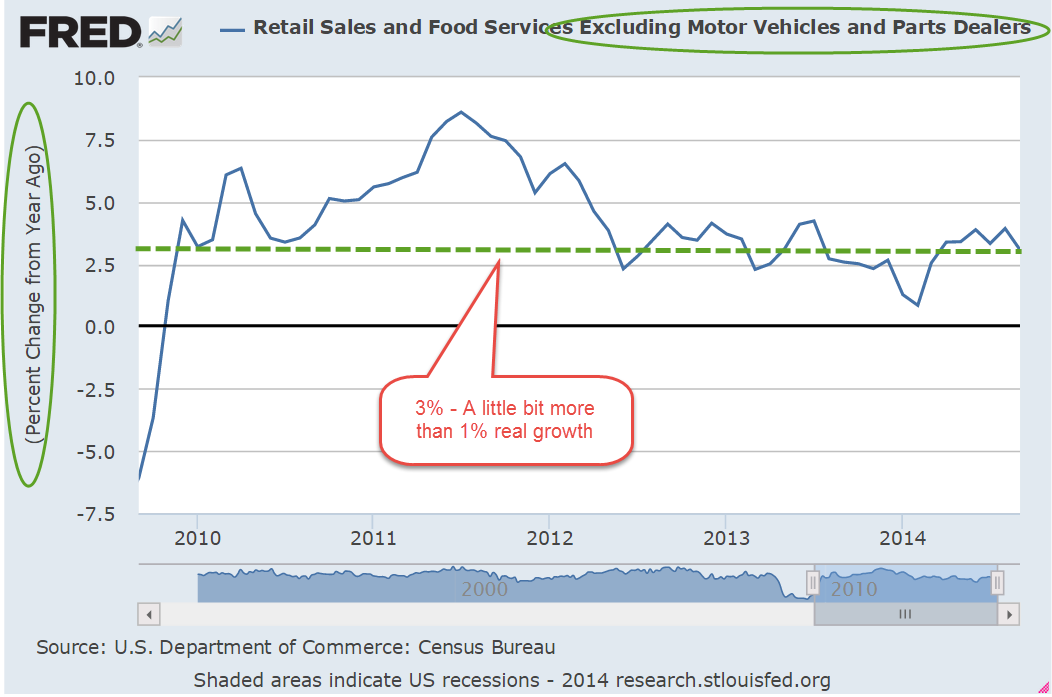
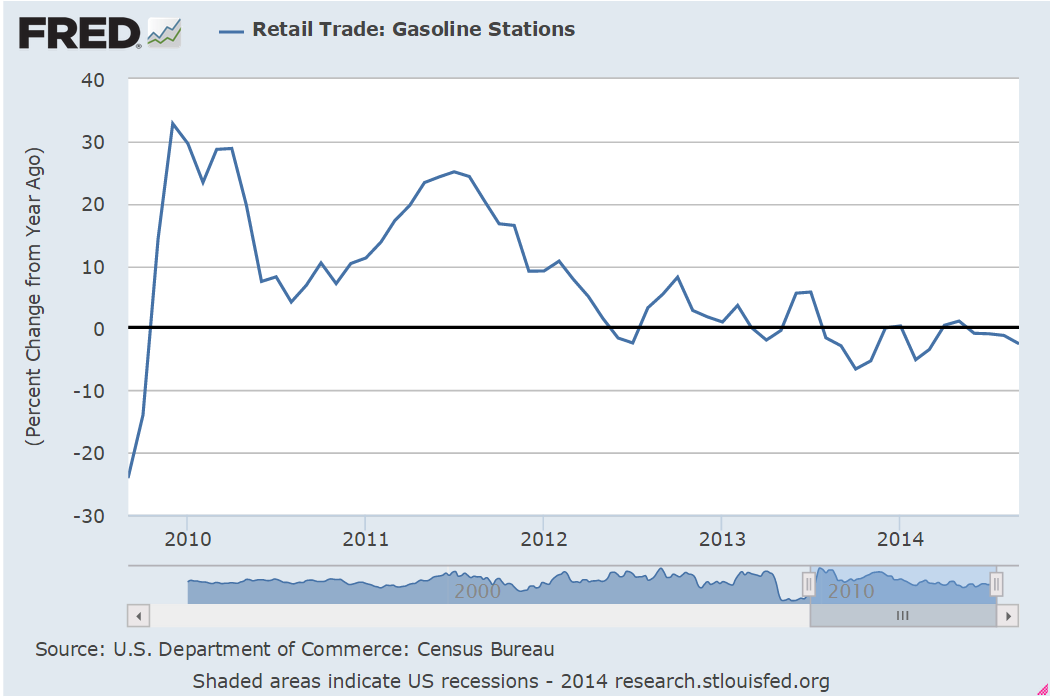
Part of the decline was because gas prices had been falling, producing less revenue.  What the market wanted to see was that the American consumer was taking that money saved on gas and spending it on back-to-school items, or a fall wardrobe.
The Census Bureau released manufacturing and trade sales data for August that showed a 4.5% year-over-year increase in sales but a 5.7% increase in inventories.  People were not buying as much as distributors were anticipating.  This only seemed to confirm fears that growth in consumer spending might be slowing down.  As though being routed by an opposing army, traders ran for the rear lines.  The SP500 dropped 4% by midday.  As George checked quotes on the SP500 ETF, SPY, he saw that it had climbed up from a bottom near 182.  He was tempted to put a buy order in, taking advantage of an afternoon rally.  Transportation stocks were bouncing up as well.  IYT, the iShares ETF, was bouncing off a midday bottom, indicating that money managers were buying in after the 14% decline from the mid-September highs.  Then George remembered that he had already tried his hand at these really short term trades.  From genius to dunce in a day, he had found that it was not good for him temperamentally.  Plus it took an hourly vigilance that he wasn’t willing to give.  One more report of Ebola in the U.S. could send this market into a dive within a few minutes. He closed the lid of his laptop.  By the end of the day, the Dow Jones had swung more than 600 points. After dropping about 4% during the day, the SP500 closed down only .7% from its previous day close.  Fresh troops in the rear had rallied at the end of the day.

Thursday’s release of October’s Housing Market Index from the National Assn. of Homebuilders showed a reversal of six months of rising sentiment.  More data from the Eurozone indicated that the entire region might be headed back into recession.  Sound the retreat alarm!  The market opened up about 1.5% lower.  Once again the troops in the rear pressed forward to the battle line as attention turned to several positive reports.

New claims for unemployment were near historic lows, prompting a discussion that had been missing for several years: when would unemployment get low enough to generate some wage growth?  George remembered Mabel’s Million Mistake Club earlier in the week.  Decades ago, unemployment levels below 5 or 5-1/2% were thought to be inflationary. This target level was called NAIRU, the Non-Accelerating Inflation Rate of Unemployment. At low levels of unemployment, workers could bargain for higher wages which pushed up the cost of products which pushed up prices which led workers to demand more wages, ad infinitum.  Like the “law” of gravity, this theory of unemployment and inflation had been regarded as solid by both investors and policy makers.  Theories are tested in the passage of time.  During the 1990s, unemployment dropped and did not spark inflation.  Economists scrambled to explain the phenomenon with global trade adjustments to their models. In the 2000s, unemployment fell below 5% and inflation remained tame by historic standards.  More adjustments to the models, more explanations of how the theory was still true. It is still a controversial topic.  (1998 article on NAIRU by Nouriel Roubini )

In addition to the positive employment news, Industrial Production grew in September, notching a 1% monthly gain, and rising back into the sustainable growth zone of 4 – 5%, year-over-year.

“Fix Bayonets, men!” came the call as the greenies beat back the morning onslaught from the reds. Greenies were days when the market closed higher than it opened, red the opposite.  George wondered if some set or prop designer for CNBC would come up with a Civil War soldier set for the talking heads to play with on camera when the market clash over valuation was particularly intense. As a kid, he’d been so disappointed that all the great battles like the Alamo had already been fought.  Santayana’s Mexican legions had rushed forward on the plains of Texas as the small band of brave Texans like Davey Crockett and Jim Bowie prepared for the onslaught.  The good ole days when life was exciting – and much shorter.

Friday was the last day of October option trading. The release of new Housing Starts for September, and strong earnings from G.E. and Morgan Stanley prompted a flood of buy orders at the opening bell on Friday.  The previous months housing starts had been volatile, rising up strongly in July, then falling a lot in August, and now up more than 6% in September.  On a year-over-year basis, September’s starts were up almost 18%.

George was not as awed by the housing data.  The declining peaks of year-over-year percent gains in new housing starts would probably continue.  Friday’s upswing continued shortly after the open when the latest consumer confidence numbers revealed a rising sentiment based on  improvements in employment and lower gas prices.  The price had crossed above both the open and closing prices for the past two days.  Could be a fake out but George hit the buy button. The earnings season would be in full swing next week.  

Zorro Moon

October 12, 2014

Last Sunday, George and Mabel flew back to Denver from Portland.  They took a bus shuttle from the terminal to long-term parking and discovered that neither of them could find the parking stub which indicated which section they had parked in.  Mabel dutifully looked through her purse.  “I know you kept the stub, George, but I’ll look anyway.”  Mabel remembered details like this so George knew she was probably right. “I should have put it in my wallet and it’s not there,” George replied.  They asked to be let out at the main exit booth.  The attendant told them to go inside the office where they met a nice man with a patient look.  His English was barely accented with the round vowels of Spanish.  “My name is George.  How can I help you?” the attendant announced.  “Hey, that’s my name too,” George replied, as though each of them belonged to a brotherhood.  “Well, we seem to have lost our ticket stub and we can’t remember where we parked our car,” George told him.  “What day did you come in?” the other George asked.  “Last Monday, about 7:30 in the morning.”  The attendant’s face adopted an odd stillness, his eyes looking far away. “That was a busy morning.  We were parking in GG and HH at the far end of the lot.”  Both George and Mabel were amazed at the man’s memory and said so.  The attendant smiled graciously.  He pulled a set of keys from a hook on a key board, picked up two of their bags and led them to an idle shuttle parked near the office.  At the far end of the lot, the attendant drove slowly down one row until they reached the edge of the lot, then drove down the next row.  Mabel was the first to see their car. “There it is!” she exclaimed.  George gave the attendant a $10 bill, thanking him for his help.  The attendant nodded graciously, then drove back toward the office.  “There’s someone with  a remarkable talent working at a parking lot,” Mabel remarked.  “I think our schools do a terrible job of helping students discover their own talents.   The structure of our society, our economy – it could uncover and use these talents better.”

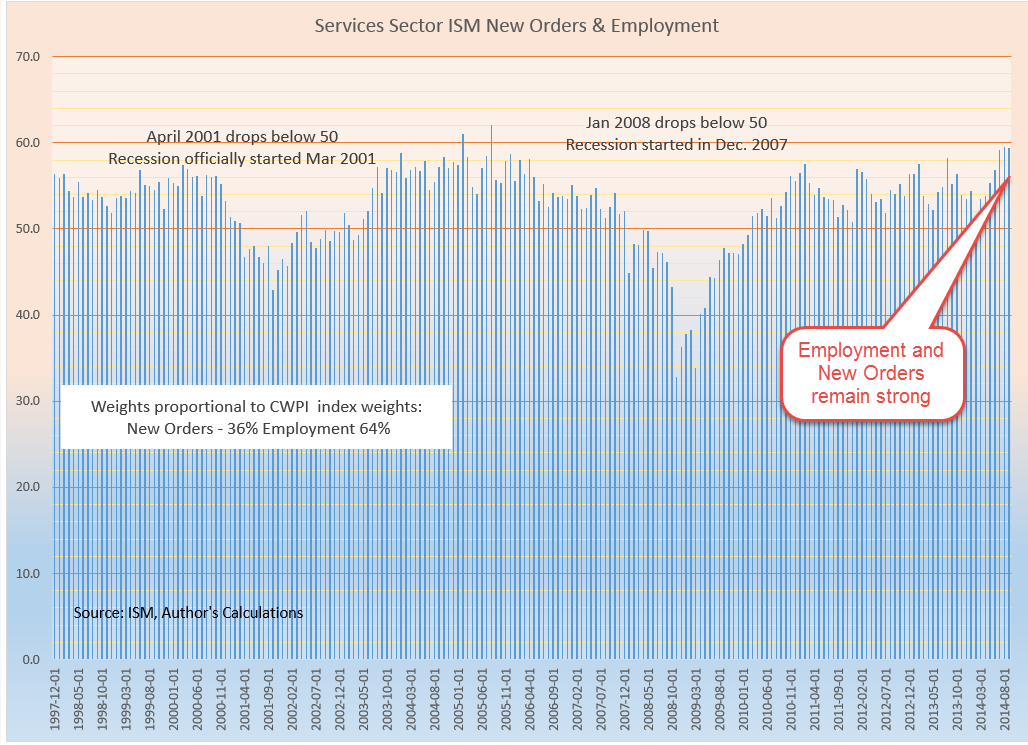
Sitting at his desk Sunday night, George mulled over the same thought that had distracted him on the flight from Portland.  Should he sell some or all of their stock holdings?  Two indicators said yes, another said maybe, one said this was temporary.  While on vacation, he had not compiled his makeshift index based on the monthly Purchasing Managers Index.  ISM, the publishers of the index, had released the services sector figures that past Friday.  He pulled up the latest report, then input the figures into his spreadsheet.  The index seemed to have peaked in September at a very robust reading near 70, rising up a few points from an already robust reading in August.

This composite of economic activity was a “stay out of trouble” indicator, giving buy and sell signals when the index rose above and below 50.  The last signal had been a buy signal in August 2009 when the SP500 was about half its current value.  Before that, the previous cue had been a sell signal in January 2008, a month after the official start of the recession.  Because employment and new orders were the largest components of the index, a chart of just these two components of the services sector reflected the larger composite.

So, the American economy was strong and Friday’s employment report had been a positive surprise. What seemed to be worrying investors was weakness over in Europe.  But Europe had been nearing recession for a few quarters now and that had not worried investors during the past year and a half.  Yes, no, yes, no decisions swirled around in George’s head.  Should he wait till the market opened Monday morning and see what the mood was?  Well, what if it was rather flat?  What would that tell him?  As Yogi Berra said, when you come to a fork in the road, take it.  So George did.  He put in an order to sell half of their stock holdings, essentially taking both forks of the road.

On Monday the market opened up above Friday’s close, indicating that a number of investors had put their buy orders in over the weekend after the positive employment report.  Active traders took the market back down below the level of Friday’s close.  In 1970s lingo, it was “negative vibes,” or negative sentiment in normal speak.

The Federal Reserve announced that they would begin publishing a labor market index that compiled 19 different labor market indicators to give an overall report card on employment.  The index was first proposed in a working paper published in May and the Fed was cautioning that the index was not “official.”

A chart of the various components of the index showed the correlations of each component with overall economic activity in the country.

The Fed provided a permanent link to a spreadsheet that they would update each month.  It was  a zero-based index.  Readings above zero meant overall conditions were improving; below zero, conditions were deteriorating.

The market opened up Tuesday with the news that Germany’s industrial output had dropped 4% in August.  A key leader and consistent performer, Germany was the Derek Jeter of the Eurozone.  As every baseball fan knows, if Derek was not producing, the whole team was in trouble.  The whole team in this analogy was the world.  The IMF revised their global growth rate for 2014 from 3.4% to 3.3%.  Quelle horreur!  Never mind that Tuesday’s JOLTS report showed the most job openings since 2001 when China was admitted to the World Trade Organization and started sucking jobs from the U.S.

Tuesday evening, George and Mabel watched the full moon, the Hunter’s moon, when it was about 30 degrees above the eastern horizon.  Clouds had obscured the moon when it was first rising and really big.  Wisps of clouds still drifted across the pale disk.  “It’s a Zorro moon,” George remarked.  “Zorro would go out on a night like this and undo the oppressive plans of the evil comandante.”  Mabel laughed.  “We’ll rename it the Zorro moon, then.  All those calendars we get each year will have to be changed.”  “Yeh, what’s with that?” George asked.  “No one ever sends a pamphlet of favorite quotes or prominent dates in history.  Just calendars.”

Mabel set her alarm to get up at 4:15 AM so she could watch the lunar eclipse.  She woke up about 7:30 that morning, disappointed that her sleeping self had turned off the alarm without even bothering to notify her lunar eclipse watching self.

On Wednesday afternoon, the Federal Reserve released the minutes of the September meeting of the Open Market Committee, the group within the Fed that that determined interest rate policy.  The sentiment of the Committee was rather dovish, and the stock market rallied up sharply in the last two hours of trading.  Still, the close was not as high as the opening price on Monday, two days earlier.  Volume was the highest it had been since August 1st and should have been confirmation that sentiment had reversed to the positive.  George was still cautious.

The market is essentially an argument over value.  The difference between each day’s high and low price indicates how much investors are arguing. The 5-day average of that difference was now double the 200 day average and rising.  George had learned that bigger arguments usually led to lower prices.  He had enjoyed a nice run up in 20-year Treasuries during the summer but then got out in mid-September.  Now two thirds of his investing stash was sitting on the sidelines in cash.  Treasuries had rallied, proving that it was difficult, if not impossible, to time the market.  Something George didn’t like was the relatively small movement in the price of Treasuries as the stock market rallied.

On Thursday, the market dropped quickly on news that German exports had dropped almost 6% in August. By the end of the day, the SP500 index had lost about 2%.  Bears saw an opportunity to hawk their books warning of the coming collapse of the global economy.  “Is the end near?  Next we go to Doug Munchie of Funchee Crunchie Capital.  Doug, tell our audience some companies that you think will do well as the coming global meltdown approaches.” Doug is looking sharp in a $300 white shirt and a $200 blue and red tie. “Good morning, Megan.  For our cautious clients, we recommend gold Lego blocks.  Our clients can construct many creative projects with their gold while they sit out the collapse.” “Thanks, Doug.  When we come back, we’ll talk to a priest who claims that holy water can cure Ebola.”

By the time he died, George thought, he will have heard at least 1 million hustles.  “Doctor, do you know the cause of Mr. Liscomb’s death?”  “Yes, he suffered from Bullshitis, the accumulation of a lifetime of blather.  A person’s brain becomes clogged and shuts down.”

The decline continued on Friday, bringing the SP500 back to the price levels of late May.  The closing price touched the 200-day average.  For long term investors, the next week might be a good  opportunity to move some idle cash into stocks. If the downturn became a serious decline, the 50 day average would cross below the 200-day average in a few weeks or so.  That crossing was called the Death Cross, a serious shift in sentiment.

Watching the news later that evening, Mabel asked, “We’re fine?”  “We’re fine,” George replied. Then he changed the subject to their recent visit to Oregon.  “I wish could be close to the ocean and yet not have all the dampness.”  “It’s called southern California,” Mabel quipped.

A Busy Week

October 5, 2014

On Monday George and Mabel flew to Portland, Oregon so Mabel could attend a teacher conference in Eugene on the development of strategies and practices for online learning.  “How’d you get invited?  You’re retired,” George had asked a few months earlier.  Mabel had spent many years both as a teacher and high school principal.

“The conference is focused on post-secondary education, but Lorraine thought I would be interested and wangled me a spot.” Her friend Lorraine was a department chair at a local community college. “I might be able to give her some perspective from the high school level as these kids make the transition to college courses.”

They had to get up early to make the morning flight.  Retired people should only get up this early when they are having a colonoscopy, George thought.  After the conference, they planned to spend a few days on the Oregon coast, which they were both looking forward to.  They sat in the Denver airline terminal awaiting the boarding call.  George couldn’t understand most of what they said.  Millions of dollars to build an airport and the contractors seemed to have bought the cheapest speakers through somebody’s Uncle Harry who knows a guy who’s got a connection with some exporter in Malaysia. Airline service had become little more than a subway in the sky.  In fact, the speakers sounded just as bad as the ones used in New York subway cars.  “Gate 23, now pre-boarding …” came out of the speakers as “Ateleeteehoweeornayhinienegetcrispbeergoremekeens.” Passengers, please get in the metal tube, sit down and be quiet.  The metal tube will go up in the air and deposit you at your destination.  Transportation for the masses.  The future has turned out slightly different than the one imagined at the New York World’s Fair in 1964.

In Portland they rented a car and drove down to Eugene.  Settling down in their hotel room, George was pleasantly surprised to find they had good wi-fi reception.  The market had been up but had closed below Friday’s close, indicating that there was still more negative sentiment to come.  Personal income in August had gained 4.3% above the level of August 2013.

That bit of good news was offset somewhat by a report from the National Assn. of Realtors that year-over-year pending home sales were down a little bit more than 2% in August.  This confirmed last week’s housing reports and made it unlikely that tomorrow’s Case-Shiller report on home sales would have any positive surprises.

Tuesday morning, George slept in while Mabel got up early to go to the nearby conference at the University of Oregon.    He missed the free breakfast at the hotel but the woman at the reception desk pointed him to a nearby coffee shop that served egg croissants and a good cup of coffee. The sun broke out on the short walk to the coffee shop, brightening George’s mood.  Despite the mid-morning hour, a number of people sat in the coffee shop working on their laptops.  West coast time was three hours behind New York so half of the day’s trading had occurred before many Oregonians had started work.

The Case-Shiller home index showed that home prices in 20 metropolitan areas had declined for the third month in a row.  Year over year gains were still positive at 6.7% but the pace of growth was slowing. Last Friday’s Consumer Confidence survey from the U. of Michigan had been positive and rising.  A separate Confidence survey by the Conference Board was positive but showed a declining sentiment on worries about employment and income.

In the afternoon, he drove near the campus to meet Mabel.  The campus was an artist’s rendition of what a college was supposed to look like.  Shade trees dotted the grounds between the grand buildings of gray stone.  Lawns and bushes were clipped but didn’t look overly manicured.  The concrete walkways that led from one building to another were well maintained but showed the typical wear of traffic and a wet climate.  The ghosts of mankind’s great minds and talents would feel comfortable on these grounds and in these halls.

Mabel introduced George to several colleagues attending the conference.  Most attendees were teachers and administrators in their forties and fifties.  For 300 years, teachers and students had gathered in  a classroom in what was called face-to-face education.  Students prepared for class at home at various times outside of the classroom but the daily routine of classes centered the educational activity of the students.  Online learning was a new phase in distance learning, attempting to blend the broader educational training of traditional colleges and universities with the asynchronous methods of the correspondence schools of the past century.

On Wednesday came further confirmation that the growth in housing sales and construction was slowing.  Year-over-year construction spending had increased 5% but the growth had declined for 9 months.  George thought this was a fairly normal cycle but the market reacted negatively, dropping more than 1% by the end of the day.

European Central Bank head Mario Draghi announced that they would continue to keep interest rates low to help spur the non-existent growth or decline in many European countries.  The private payroll processor ADP reported job gains of 215,000, slightly above expectations.  The Institute for Supply Management (ISM) showed a slight decline from the robust growth of the previous month but overall a very positive report.

Wednesday evening after the conference had concluded, George and Mabel had dinner at a restaurant with two women who had attended the conference.  The conversation was lively, the food a bit pricey for the quality but George enjoyed the evening.  For the past two days he had encountered many young people, reminding him of his college days decades before.

“I’ve decided I want to be 20 years old again, only not as dumb and inexperienced,” George quipped. He remembered sagely pronouncing that Fitzgerald’s novel, The Great Gatsby, was about social classes that no longer existed in America and was irrelevant. Somehow he had survived his own poor judgment.  He did want to jump high in the air once again, twisting toward the basket and snapping a 3-point shot at the basketball net.  The losses in physical vitality were offset by the gains in sagacity, George hoped.

On Thursday, George and Mabel woke up early (again! two times in one week!) to drive out from Eugene to the Oregon Coast.  At the Oregon Dunes they walked through coastal rain forest, then dunes, then a less dense strip of rain forest, then beach and ocean. “I get smaller the more I walk,” he told Mabel.  “What do you mean?” she asked.  “We walk through places like this, they’re like landscapes, I guess you could call it, shaped by this wind around us, the ocean out there,  and underneath our feet the earth is shifting about.  It’s like we’re teeny tiny bacteria walking on the ridges of paint left by some artist’s brush.”

Mabel smiled, “Well put.”  She paused.  “With the physical classroom, students and teachers can have field trips out to the Oregon dunes.  How do we take that and put it in an online environment?” she wondered.  George glanced at her.  “Someone has brought the conference to the beach, I think.” Later, they stopped off for a coffee in the old town of Florence before ending the day in Yachats where they stayed at the Overleaf Inn.

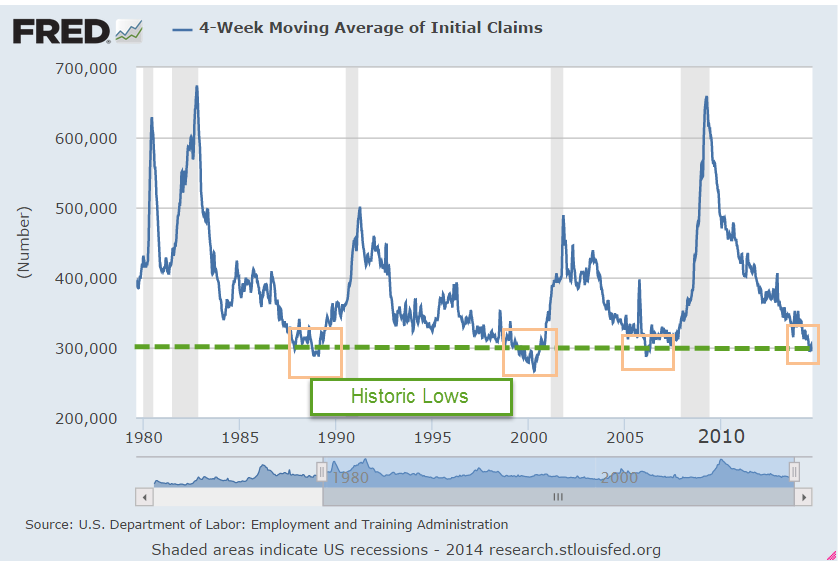
I could get used to this, George thought, checking the market news from his balcony while the last streaks of sunset and orange turned to purple and gray out over the ocean.  The BLS reported that the 4-week average of new unemployment claims had fallen below 295,000.

Levels lower than this had occurred rarely – in early 2006, 2000 and the winter of 1987-88. Yet there was no dancing in the streets.

Instead, investors focused on the 10% drop in factory orders for August.  Most of the decline was due to volatile aircraft orders, which had surged in July followed by an equal drop in August. The market remained flat.

On Friday, George and Mabel walked several miles on the 804 trail, a sometimes dirt, sometimes asphalt path that ran for many miles along the Oregon cliffs.  They ate at the Drift Inn that evening.  Good food.  “You think there’s much work for younger folks around here other than the tourist industry?” he asked Mabel.  “I doubt it,” she replied. “We’ve seen a lot of twenty-somethings working at hotel reception desks, waiters, waitresses, the coffee shop in Florence.  They can’t be making a lot of money.  Still it is lovely here”, she mused.  “Could be more sun, ya know?”  George nodded.  “We’re kinda spoiled in Colorado,” he said.

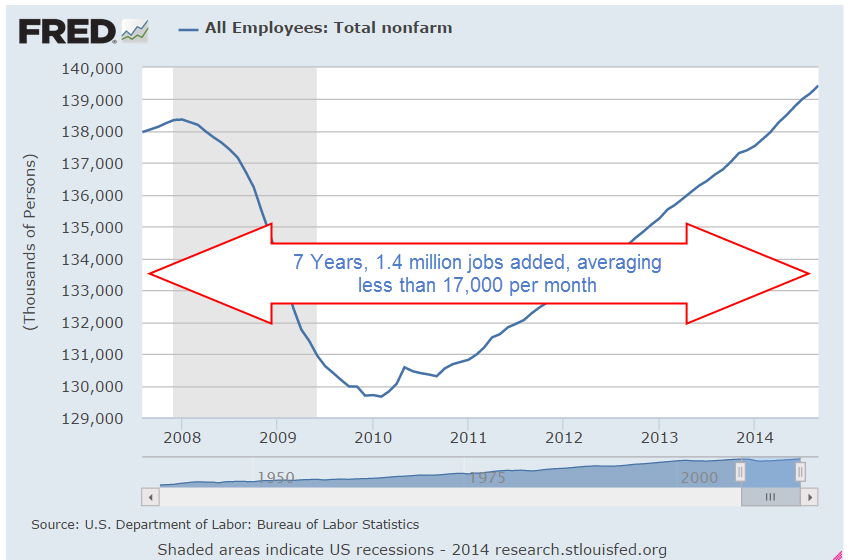
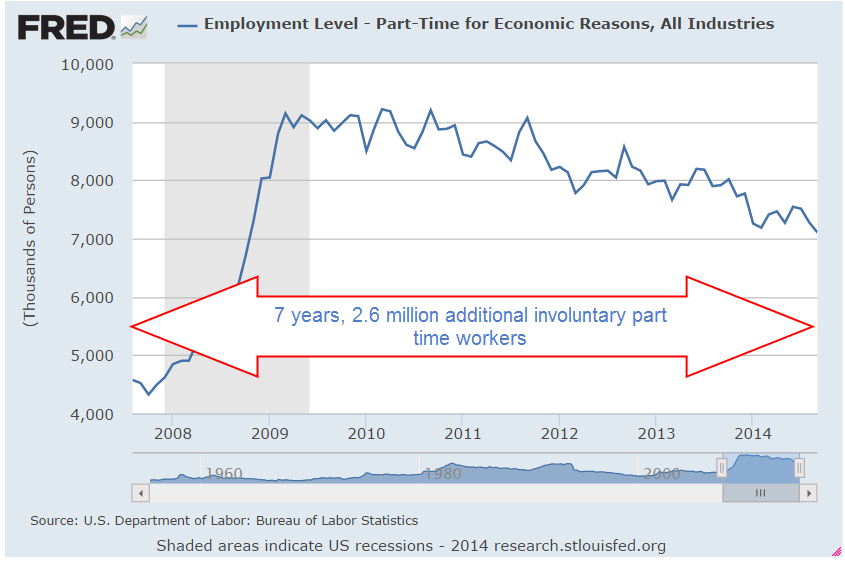
When they returned to their hotel room later that night, a stiff wind blew off the ocean, bringing with it a bit more chill than either of them had packed for on this trip.  George checked the monthly employment data released that morning by the BLS.  Job gains had surprised to the upside at almost 250K but the market had still closed below Wednesday’s opening price and was still below the 10-day average. He pulled up some FRED data to get a snapshot of the relative health of the labor force seven years after the start of the recession.   The results were rather chilling – or maybe it was the dampness of the Oregon coast that he was unaccustomed to.  In seven years the number of employed people had grown just 1% – not 1% annually but 1% total for the entire time.

2.6 million more people were working part time because they could not find full time work. The number of underemployed had grown almost twice the 1.4 million new jobs created in seven years.

The unemployment rate had dropped below 6% in September but even that bit of positive news did not look so good when George pulled up the historical snapshot of unemployment since the recession began.

The rate had risen more than 1% in those seven years.  Despite all the talk of recovery, the surge of stock prices from the lows of 2009 and the rise in home values, the labor market was still wounded.

“Why don’t you help me figure out where we’re going to stay tomorrow in Newport?”, Mabel asked.  “One of my friends suggested the Elizabeth St. Inn.”
“Fine with me.  I want to see the Aquarium if it’s open,” George replied.  “Hey, check out the moon.”  Then he put on his windbreaker, pulled a blanket off the bed and went to sit out on the balcony.  Through the shifting clouds, moonlight shone softly on the water below.  Mabel, taking a cue from her husband, tugged a blanket from the second bed, wrapped it around her and sat with him.

A Week In The Life

September 28, 2014

This past Monday George was out in the backyard when his wife Mabel came out on the back deck to announce that lunch was ready.  From the deciduous vines that grew on the backyard fence George was pulling leaves that had turned an autumn shade of red.

“George, what are you doing?”
“I thought I would pull these leaves off before they fall.  This way I won’t have to stoop so much a few weeks from now to pick them out of the rock garden.  The leaves are getting in the pond and clogging up the filter.”
“Well, come on, dear.  Lunch is ready.  I heard on the radio a little while ago that the market is down.  You know how I worry about that.”
“Oh, really?” George replied.  “It was down last Friday.  Did they give any reason?”
“Something about housing.  I’m sure you’ll find out all about it while you are eating.”

Mabel had set a nice lunch plate of panini bread, cheese and vegetables.  George was a tall man, a big boned man, prone to weight gain in retirement. Although George was fairly fit for his age, she worried about his health, particularly his heart, the male curse.  Mabel made sure that they both ate sensible, healthy meals.

Mabel took her lunch into the living room, leaving George alone in the kitchen.  He liked to check in on the stock market a few hours before the close to get a sense of the direction of the day’s action.  She would have chosen to keep all their savings in CDs and savings accounts but the interest rates were so low that living expenses would slowly erode their principle.

“We’ll put just 25% of our money in the market,” George had told her.  “I’ll watch it carefully and if anything like 2008 happens again, we can pull it out right away.  I’ll know what the signs are.”

George had studied a book on technical indicators which were supposed to help a person understand the direction of the market.  Despite her confidence in George’s ability and sensibility, Mabel still worried.  The stock market had always seemed to her like gambling.

At the kitchen table, George turned on the computer while he chewed his carrots and celery.  He had never been fond of vegetables but found that his likes and dislikes had mellowed with age.  He liked that Mabel cared.  The market helped distract him from the vegetables.  He paged through the daily calendar at Bloomberg, then checked out the headlines at Yahoo Finance. Existing home sales in August had fallen more than 5% from the previous August but that was a tough comparison because 2013 had been a pretty strong year.  Existing home sales were still above 5 million.

Before George had invested some of their savings in the stock market, he had bought several books on how to read financial statements but soon gave up when he realized that knowing the fundamentals of a company would not protect their savings in the case of another meltdown like the recent financial crisis.  Patient though she might be, Mabel would be extremely upset with him if he lost half of his investment in the market.

He then turned to the study of technical indicators which analyzed the behavior of other buyers and sellers in the stock market.  As an insurance adjuster, he had learned C programming back in the 1990s and found a charting program whose language was familiar to him.  As a former adjuster for the insurance of commercial buildings, he was used to making judgments based on a complex interplay of many factors.  He played with several indicators, found a few that seemed to be reliable, but got burned when the market melted down in the summer of 2011.  He got out quickly but not quickly enough for he had lost more than 10% of his investment in the market.  The market healed but at the time it seemed as though there might be a repeat of the 2008 crisis.  Had George and Mabel been younger, George could have just ridden out the storm.  Retirement had made him cautious and the 2011 downturn made George almost as leery of the market as Mabel.

Tuesday was a fine day in late September.  Mabel put her crochet down and made the two of them some soup, with fruit, crackers and cheese.  She took pride in the variety of food that she prepared.  When she walked out on the deck to call George in for lunch, a startled crow took to flight.  George was sitting on the edge of the deck where the crow had been.

“What are you doing, George?”
“I was teaching that little crow how to break open a peanut,” George replied. “I think they learn how to do stuff like that from their parents but I haven’t seen the flock in a few days and this guy was just wandering around the backyard looking for something to eat.  When I gave him a peanut, he didn’t seem to know what to do with it.  He’d pick it up in his beak, then drop it and stare at it.  He pecked at it a few times but that only made the peanut skitter away. “
George held up a branch.  “I carved a claw into the end of this branch and held down the peanut for him.”  George held up half a peanut shell.  “See, he got it figured out.  He flew off when the door opened but I’ll betcha he’ll be back.”
“Well, come on in then.  Lunch is ready.  The market is down again.  Something about housing again.”
“Hmmm,” George grunted and followed Mabel into the kitchen.  “Hmmm, that soup smells good.”
“A little beef vegetable that I doctored up a bit,” Mabel said with a smile.
George gave her a little hug. “I sure like your doctoring.”

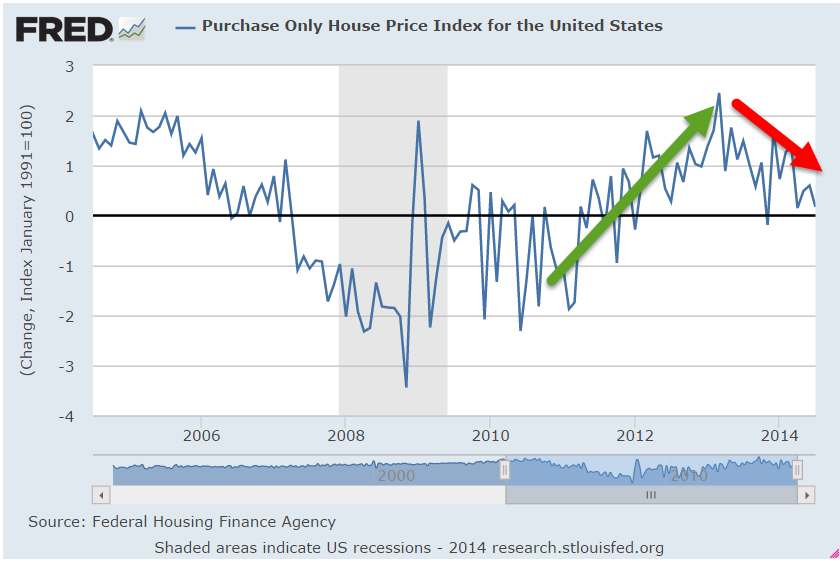
He sat down to eat, wondering what all the fuss in the market was.  Checking the Bloomberg Calendar, he saw that it was the House Price index from the Federal Housing Administration that had dampened spirits.  The monthly change was drifting down to zero, a sign of weakness.  Although housing prices were still rising, the rise was slowing down.

A disappointment, George thought, but not a catastrophe.  However, the market had been down for three days in a row.  He finished his lunch and went into the living room.  Mabel was reading a book.
“You know, Mabel, I think it’s just a short term thing.  The bankers from the developed countries met last week and they kinda put out a wake up call to the market.  I think there’s a bit more caution and common sense after that.”
“Well, as long as you’re watching it, dear.”
“You know, we did good this last year,” he reassured her.
“I just worry that it was too good.  We should have taken some of that out of the market and put it somewhere safe.”
 “Well, I’m keeping an eye on it,” he said.  “I checked CD rates last week and they are paying like 1% for a one year CD.  It just ain’t like it used to be. We just have to take some risk.”

They had a 3-year CD coming due in a month. He didn’t want to tell her that he was thinking about not rolling over the CD.  Maybe buy a bond fund.  She wouldn’t like that. For a time he had dabbled in some short to medium term trading but barely broke even.  He had lost sight of his original goal – to keep their savings safe while taking some risk with the money.  Fortunately, this insight had come to him toward the end of 2012.  The market had been mostly up since then, rewarding those who sat out the small downturns.

Late Wednesday morning, Mabel could hear George on the side of the house clearing brush or some such thing.  He said he was going to cut down an elm tree sapling that was growing near the house but when she went out to call him into lunch, he had cut everything but the elm sapling.

“I thought you were going to cut that down, dear.”
“Well, I was but the squirrels are using it to climb up to the old swamp cooler we have perched up there.  You remember the litter from early this spring?  Well, I think there’s another litter in there.  I haven’t seen any young ones but there’s a squirrel carrying twigs up that sapling to the cooler.  She’s even got a piece of one of my rags.  Must’ve fallen out of my pocket.”

Mabel looked up at the platform George had mounted to the side of the house years ago.  On top of the platform sat the old abandoned cooler.  George had meant to take it down and disassemble the platform but then the squirrels had used it as a nursery this winter and neither of them had been able to dismantle it while the little ones were scampering around in and out of the cooler.  Of course, George was supposed to take the cooler down during the summer but never got around to it.  Now she saw that he had tied a cord from the platform to the sapling to bend the sapling close to the platform, making it easier for the squirrel to get from the tree to the platform.

She shook her head and said “George Liscomb, I hope you don’t let that sapling get out of hand.  You know how elm trees are.  They grow faster than a puppy.”
“Well, the tree won’t grow much during the winter and I’ll cut it down in the spring.”
“Ok, well, come on it.  Lunch is ready.  I heard on the radio that the market is up a lot today.  Housing again.  Maybe you were right about it being short term.”
“Well, of course, I’m right,” he made a grand gesture.  “The squirrels will confirm that.”

His lunch plate held some broccoli spears and six, no more and no less, tater tots.  “I know you don’t particularly like broccoli so I thought a few tater tots might ease the pain,” Mabel said with a slightly sardonic smile.

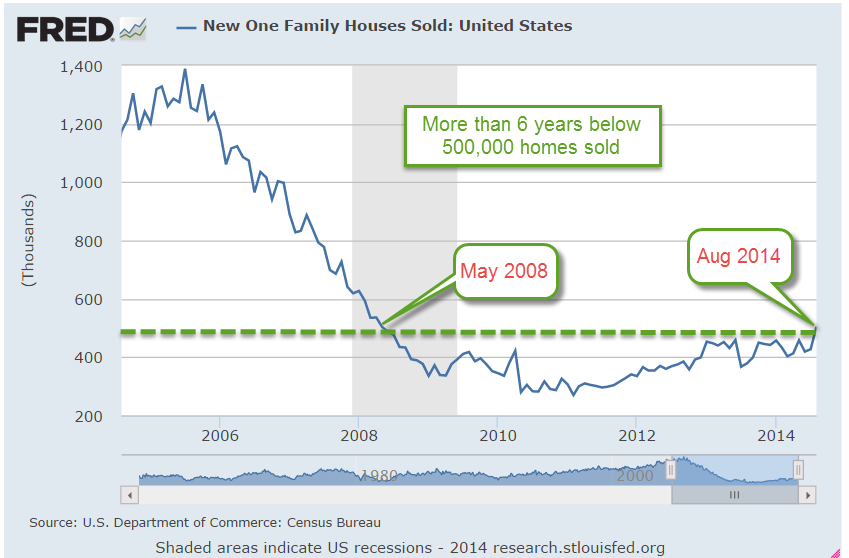
He laughed.  “I’m married to a kind prison guard.”  He sat down at the table, wondering what could have buoyed the market so much.  Housing yet again.  “Holy moly!” he called out to Mabel. He went into the living room to tell her the good news. “Finally, after more than six years, new homes are selling at a rate of more than half a million a year.  That’s what’s got the market dancing.”

On Thursday, she found George working on the stream that he had built in the rock garden.  A few feet from George a squirrel cautiously sipped water from the stream.  The squirrel saw her and scampered up the nearby fence.  “It’s remarkable how comfortable they are with you,” she told him.  “I try to move slowly when I’m working,” George replied. “They seem to be less anxious.”
“What are you doing today?” she asked.
“Got a leak somewhere.  I’ve lost about 15 gallons since last night.  Still haven’t found it.”
“Well, you’re not going to like what going on in the market.  It’s way down today and it’s not about housing.”

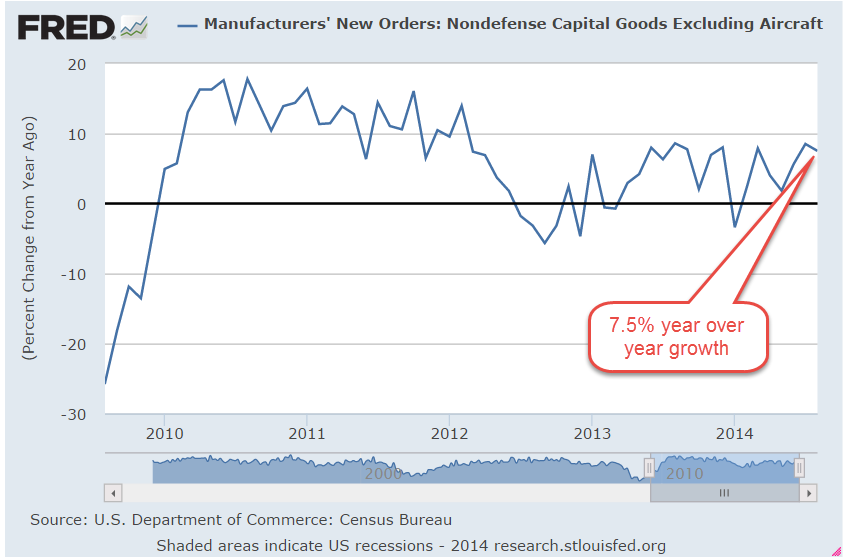
He followed her into the house and broke into a big grin when he saw what was for lunch. “Tuna fish!”  Mabel had dressed up her famous tuna fish salad with lettuce, tomatoes, some green onions and put it open faced on some toasted bread.  It was scrumptious.  Not so the market.  The SP500 was down about 1-1/2% on several news releases.  The whopper was that Durable Goods Orders were down 18% in August from the previous month.  But most of that drop was a decline in aircraft orders after a surge in those same orders in July.  Aircraft orders were notoriously volatile. Year-over-year gains in non-defense capital goods, the core reading, were up almost 8%.

The weekly report of new unemployment claims had risen slightly but was still below 300,000.  September’s advance reading of the services sector, the PMI Services Flash, was slightly less than the robust reading of August but still very strong.  So what was causing these overreactions to news releases?  The short term traders execute buy or sell orders within seconds of a news release.  Computer algorithms trade within nanoseconds of the release.  If new unemployment claims are up even by 1, the word “up” or “rise” or some variation will occur within the release.  Sell.  New home sales up?  Up is good for this report.  Buy.  Why would the short-termers be so active this week?  Because they are trading against each other.  The mid and long termers, the portfolio managers, will take the stage at the beginning of next week to adjust their positions at quarter end when funds report their allocations.

Late Friday morning, Mabel stood out on the back deck, her mouth open at the sight of George hunched down as he came out of the shed in the backyard.  Hundreds of wasps swarmed above him.  He knelt down and closed the doors to the shed and hurried to her on the deck.

“My God, George!  Are you all right?”
“Oh, yeah, no worries.  Anything on me?” he asked.
“No.”  There were just a few wasps visible outside the closed doors.  “What on earth?!”
“Well, they’ve really built themselves a city since I was in there last,” George explained.  He sat down on the deck.  The shed was where they kept old tax records and camping gear that they hadn’t used in quite a long time but hadn’t given away or sold – just in case they went camping again.  “I should have sprayed them earlier in the summer but it was such a small hive.  Those doors get sun most of the day so they like it in there.  They’re right above the doorway so they’re not bothering any of our stuff and I was able to stand up in the shed and they just left me alone.”
“I don’t care. What if I had gone out there to get something?!” she said angrily.
“Yeh, you’re right.  I’ll take care of them this weekend.  I was kinda waiting for the cold weather to do its job.”  He held up his hands a couple of feet apart from each other.  “That hive is like this, strung out along the studs that frame the doorway.”
“Why were you out there?” she asked.
“Well, I wanted to see if we still had the box that the TV came in a few years ago.”
“Didn’t you throw it out?” she asked.
“Well, I thought that in case we had trouble with the TV but then the box was behind a bunch of stuff and it was hard to get to and I guess I forgot,” he admitted.
“Well, come on it and eat your lunch.  The market is up again today, I heard them say.”

George settled down at the kitchen table.  A few salami slices, some macaroni salad, carrots, olives and crackers sat on the plate.  “Working man’s antipasto, hey?”
“There are some sardines in there, too” she said.
“I have the best wife and cook in the world.  Anthony Bourdain, move ovah!  Mah honey’s takin’ ovah!”
Mabel laughed.  “Now let me get back to my book.  Second to last chapter and I think the niece did it.  I haven’t trusted her since the first chapter.”

The 3rd estimate of 2nd quarter GDP had been revised up from 4.2% to 4.6%, helping to compensate for the weak first quarter.  Good stuff, thought George.  The U. of Michigan Consumer Sentiment Survey had risen in September to 84.6 from August’s 82.5.  Confident consumers buy stuff, a good sign.  Anything above 80 was welcome and more was better.  To round out the daily trifecta of news releases, corporate profits for the second quarter were revised upward.  The year over year gain without inventory and depreciation adjustments was 12.5%.  Not spectacular but solid.

Even with Friday’s triply good news, the market closed below what it opened at the previous day.  This was usually an indication that the short term downward trend in the market might have a little way to run.  Then he promised Mabel that he would get rid of the wasps this weekend, and yes, he would be careful.  Did she remember seeing the wasp spray that he bought earlier that summer?

Income and Poverty

September 21, 2014

A steadily rising market supports our theory that we are astute investors.  Fed Chairwoman Janet Yellen reassured investors that the Fed intends to keep interest rates near zero till at least the middle of 2015. The stock market closed out the week at a new high, edging out the high set two weeks ago.  In an economy fueled largely by consumer spending, median household income is down 8% since 2007.  The Japanese yen broke below $90 this week, a seven year low.  At this week’s meeting in Australia, the financial heads of the G-20 countries are seeing increasing economic strains around the globe but particularly in Europe and Asia. (Bloomberg)  Housing starts and building permits are getting erratic, jumping up one month only to fall precipitously the next.  Using either idle cash or borrowing at historically low interest rates, companies are buying back their own stock at a steady clip to juice per share profits for stockholders.

In a candid moment, many researchers will admit the difficulty of overcoming their own biases.  Investors are subject to the same myopia that afflicts politics and compromises research.  Our biases lead us to ignore or discount some facts.  The most damaging bias most of us have is thinking we have made the right decision.  The justifications for our investment decisions are sound and logical – until later events reveal the folly underlying those decisions.  In the late 1990s, some envisioned the internet marketplace much like a chessboard.  The companies who dominated the center of the board, regardless of the cost, reaped hefty stock evaluations.  It made sense – until it didn’t. Costs matter.  Profits matter.

Soros Fund Management, founded in 1969 by George Soros, has a long track record of generating consistently high returns.  The secret to Soros’ success as an investor is not that he is right most of the time because he isn’t.  Several years ago, his firm estimated that his success ratio was only 53%.  George Soros’ success comes from the fact that he knows he is wrong about half of the time, recognizes when he is wrong, abandons his position and minimizes his losses.  While most of us are not active traders like Soros, we can pay a bit more attention to the balance in our portfolios.  Quarter ending statements will arrive in our mailbox or email inbox in the next few weeks.  It would be a good time to assess portfolio allocations and targets.  A composite bond index (BND as a proxy) is down a few percent since April 2013 while the stock market has risen 33%.  Have we adjusted the balances in our portfolios or is that one of the things that has been on the to-do list for several months?

********************

Census Report

The Census Bureau just released their annual estimate of household income and poverty in the U.S.  Measurements of household income must be taken with a grain of salt, so to speak.  Say that a married couple with $70K in household income split up.  The total income remains the same but the number of households is now two and household income is $35K.

Given those caveats, there are some real bummer stats in the report as well as some surprises.  Real or inflation adjusted median household income was little changed in 2013 and is 8% lower than in 2007.  Median income of white households was $58K in 2013 but for black households, the annual figure was $34K.  The ratio of incomes between these two groups has changed little over the past five decades.  Since the mid 1980s, the income of white households has lost ground when compared to Asian households. Since the mid-90s, the ratio of Hispanic to white household income has risen.

One of the strengths of American society has been the income mobility that our economy generates. The Census Bureau groups incomes by quintiles, like steps on a ladder.  Each step is in 20% increments so that households are ranked in the bottom 20%, top 20% or in between. From 2009 – 2011, 30% of those who were on the lowest rung of the income ladder moved up the ladder.  During that same period, 32% of those at the top of the ladder moved down the ladder.

The poverty rate declined slightly but one in seven households, about 45 million people, is below the poverty threshold.  A continuing complaint about the methodology used in computing the poverty level is that non-cash benefits like subsidized housing, medical care, child care and food stamps are not included in the calculations.  In the early 60s, before the introduction of social welfare programs, almost one in five households were below the threshold.   Remember, the 60s were a boom decade. Various estimates of those who were chronically poor at that time ranged from 10% to 16% of households. In 1969,  several years after the introduction of the Great Society programs, the poverty rate was close to 14% (Source), about the same as it now.

Conservative commentators will make the case that, over the past fifty years, the U.S. has spent some $22 trillion (2013 dollars) on social welfare programs with little progress in alleviating poverty. During the three year period from 2009 – 2011, years of severe economic stress and political games of “chicken,” the Census Bureau reports that almost 32% of households had a spell of poverty lasting two months or more.

The Census Bureau also reports that only 3.5% of households were chronically poor, living under the poverty threshold during the entire three year period.  The low percentage of chronically poor is often ignored by those who are antipathetic to social welfare programs.  In the aftermath of this past recession, one of the most severe economic downturns of the past century, social welfare programs have provided a temporary helping hand up, a shelter against the economic storm, and cut the long term poverty rate to a quarter of what it was during the booming 60s.

Liberals will ignore this success, of course.  Instead they will point to the higher figure of temporary poverty to make the case for more welfare spending. More programs and more spending is the liberal brand.  Conservative pundits should point at the rather low 3.5% figure of the chronically poor and make the point that we don’t need more welfare spending.   But they won’t.  Opposed to income transfers as a matter of principle, conservatives don’t want to acknowledge the success of social welfare programs.

For those readers who don’t have the time to read the full report, a NY Times article provides a summary.

***************************

Lasting longer

When the Social Security system was enacted in the mid thirties, life expectancy for a 60 year old worker was 72.  (Bureau of Labor Statistics Monthly Labor Review, pg. 4)  Many of us don’t realize that the largest gains in life expectancy came in the first decades of 20th century with safer sanitation, drinking water and public health facilities. In 2006, the Census Bureau estimated life expectancy for a 60 year old at 82, an additional ten years of life – and retirement benefits and expenses. A 75 year old male today can expect to live to about 87.

In their 2014 survey of the costs of elderly care, Genworth Financial found that a home health aide in Colorado averages about $50K. A private room in a nursing home costs $92K per year.  At a 4% growth rate, that same private room could cost more than $130K in 2025, when the first cohort of baby boomers reaches 75.  How many seniors will be able to afford such an expense?  Many will push for ever more programs to subsidize the costs of living longer.  Seniors vote so politicians listen.  In Japan, the elderly segment of the population has grown from 5% of the population in the 1950s to 25% of the population. (Wikipedia)  This aging cohort commands an ever larger share of the nation’s resources, contributing to the stagnation in the Japanese economy for the past 20 years.

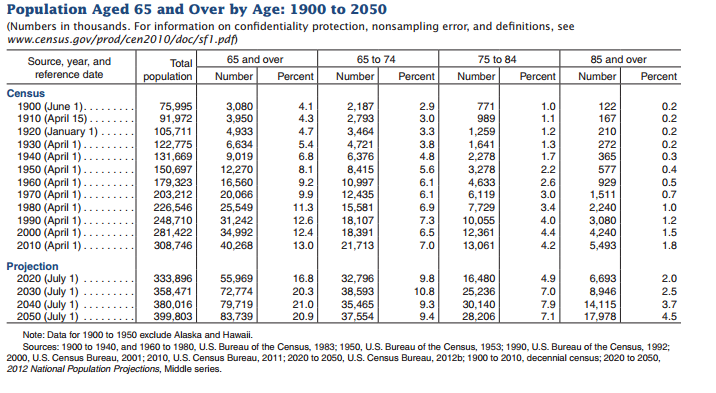
In the U.S. the growth of the elderly population has been less dramatic.  At 9% of the population in 1960, the elderly are expected to almost double to 17% of the population by 2020 (Census Bureau )

****************************
Takeaways

Pay attention to portfolio allocations.  Save money.  You’ll need it one of these days.

Central Banks

September 14, 2014

This week I’ll take a look at the latest JOLTS report from the BLS and an annual assessment of  global financial risks by the Bank of International Settlements.

********************

JOLTS

The BLS releases their Job Openings and Labor Turnover Survey (JOLTS) with a one month lag.  This past week’s release covered survey data for July.  The number of employees quitting their jobs is regarded as a sign of confidence in finding another job.  When it is rising, confidence is increasing.  The latest survey is optimistic.

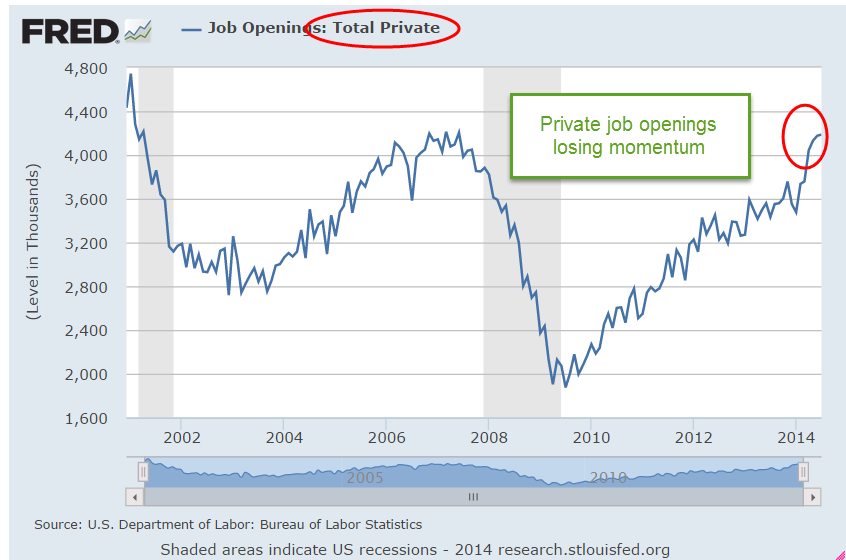
The number of job openings have accelerated since the January lows.  In June, they passed the peak reached in 2007.

However, since May, the growth of job openings in the private sector has stalled.

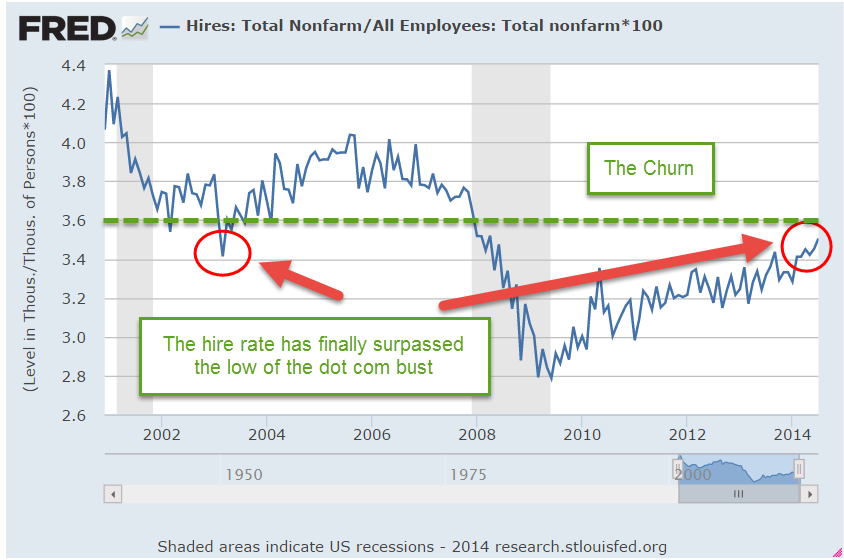
The number of new hires continues to increase but we should put this in perspective.  The hire rate, of percentage of new hires to the total number of employees, has only just surpassed the lows of the early 2000s after the dot com bust and the 2001 recession.  This “churn” rate is still low, even below the level at the start of the 2008 Recession.

********************

Consumer Credit

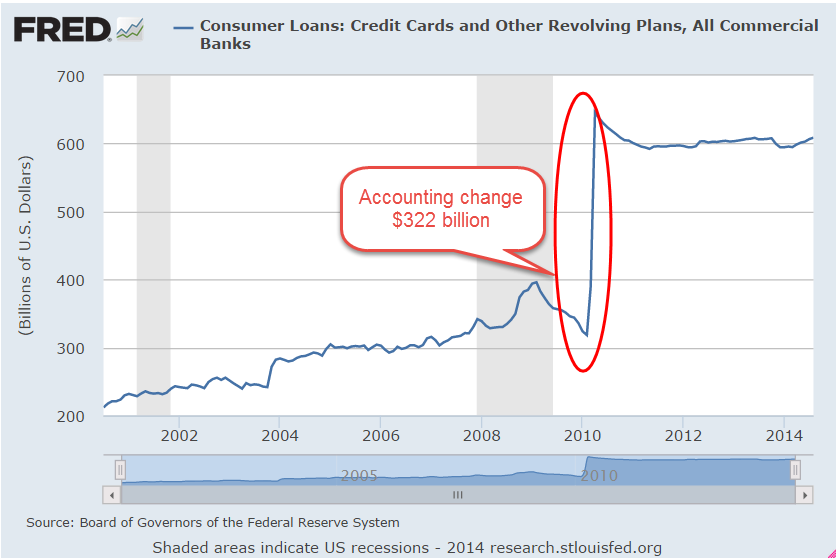
Auto sales and the loans to finance them have been strong but consumers have been slow to crank up the balances on their credit cards.  Although the latest consumer credit report indicates that consumers have loosened their wallets in the past few months, the overall picture is rather flat.

*********************

China 

China reported growth in factory output that was below all estimates at 6.9% and below target growth of 7.5%.  The Purchasing Managers Index, a barometer of industrial production,  shows that both China and Brazil are hovering at the neutral mark while the global index shows moderate growth.  Home prices in China have fallen for 4 months in a row.  As growth momentum slows, the clamor quickens for more easing by the central bank.

*********************

Bank of International Settlements Annual Report

The Bank of International Settlements (BIS) is the clearing house for central banks around the world, including the Federal Reserve and the European Central Bank. It is the central banker’s central bank that facilitates and monitors money and debt flows among the nations.  The BIS has cast a particularly watchful eye on Asian economies, who are about 15 years into their financial cycle.

Their annual June 2014 report sounds a word of caution, emphasizing that central bankers should focus more on the financial cycle than the business cycle as they construct and administer monetary policy:

To return to sustainable and balanced growth, policies need to go beyond their traditional focus on the business cycle and take a longer-term perspective – one in which the financial cycle takes centre stage. They need to address head-on the structural deficiencies and resource misallocations masked by strong financial booms and revealed only in the subsequent busts. The only source of lasting prosperity is a stronger supply side. It is essential to move away from debt as the main engine of growth.

In Chapter 4 the BIS notes the high levels of private sector debt relative to output, particularly in emerging economies. In a low interest environment, households and companies “feast” on debt, leaving them particularly vulnerable when interest rates rise to more normal levels.  International companies in emerging markets can tap the global securities market for funding and much of this private debt remains off the radar of the central bank in a country’s economy.

Financial booms in which surging asset prices and rapid credit growth reinforce each other tend to be driven by prolonged accommodative monetary and financial conditions, often in combination with financial innovation. Loose financing conditions, in turn, feed into the real economy, leading to excessive leverage in some sectors and overinvestment in the industries particularly in vogue, such as real estate. If a shock hits the economy, overextended households or firms often find themselves unable to service their debt. Sectoral misallocations built up during the boom further aggravate this vicious cycle.

While there is no consensus on the definition of a financial cycle, the peak of each cycle is marked by some degree of stress that encompasses a region of the world and can have a global effect.  Emphasizing the global component of financial cycles, the BIS is indirectly encouraging central bankers to communicate with each other.  Money flows largely ignore national borders.  It is not enough for a central banker to sit back, confident in the sage and prudent policies of their nation. Each banker should ask themselves: what are the neighbors doing that could impact my nation’s economy and financial soundness?

Financial cycles tend to last 15 – 20 years, two to three times the length of the business cycle.  It takes time to build up high levels of debt, to lower credit standards and become complacent about downside risks. There may be no clearly identifiable cause that precipitates a financial crisis.

Different regions have different cycles.  More advanced western economies have been on a downward recovery phase after the crisis of 2008 while emerging economies in the east are near the apex of their cycle.  Asian economies experienced their last peak at the start of the millenium.  They have had 15 years to inflate asset and property prices, to lower credit standards and accumulate debt, all hallmarks of a developing environment for a financial crisis.

The report notes that borrowers in China are especially vulnerable to rising interest rates but that many economies in the region would be pushed into crisis should interest rates rise just 2.5%, as they did a decade ago.

*************************

Takeaways

Employee confidence and hiring are strong but private sector hiring may be stalling.  The next crisis?  Look east, young man.

Labor and Purchasing Managers Index

September 7, 2014

Labor Report

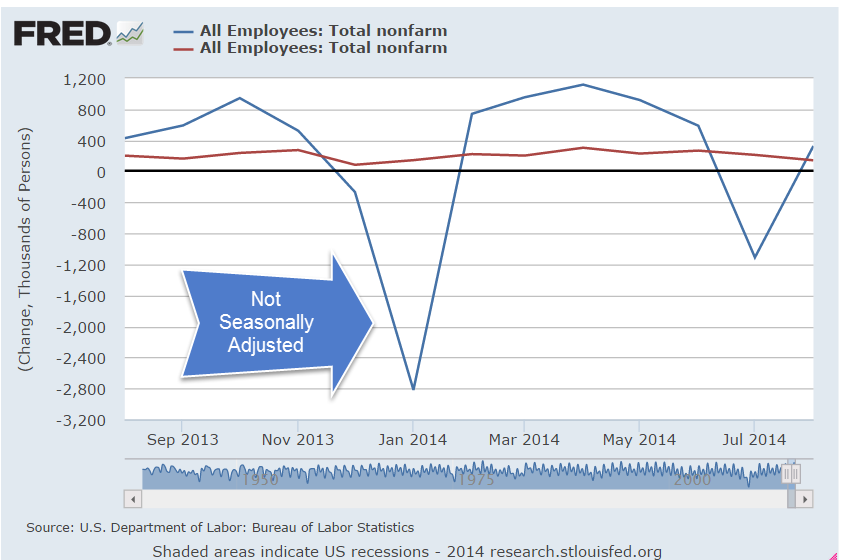
The Bureau of Labor Statistics (BLS) reported net job gains of 142K in August, much lower than the 200K+ expected.  The private payroll processor ADP reported 204K net private job gains earlier this week.  Some economists predicted that the number will be revised upwards in the next month.  Some point to the difficulties of the seasonal adjustment factor in August.  Below is the monthly net change in jobs with and without seasonal adjustments.

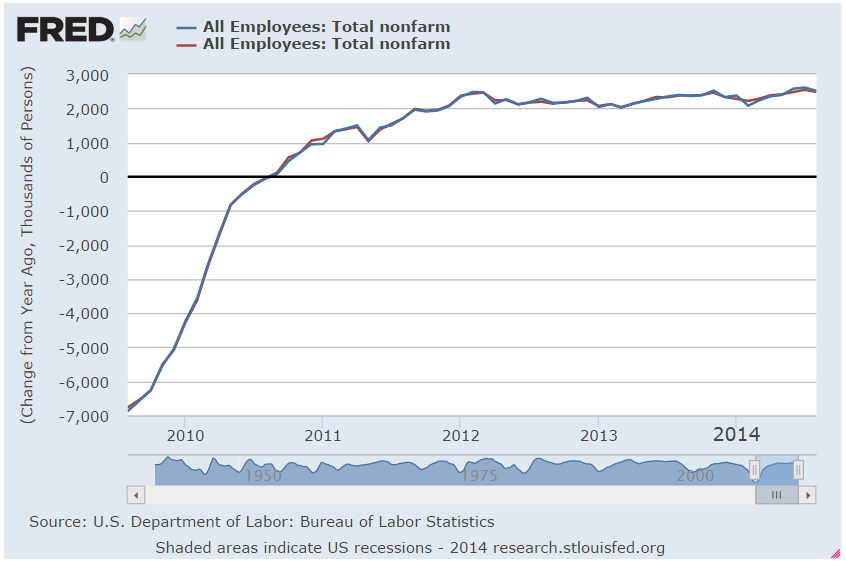
As usual, I average the private net job gains reported by BLS and the payroll processor ADP to come up with net job gains of 169K, add in the 8K job gains in the government sector to get a total of 177K. Another approach to take out the variability is to use the year-over-year change or percent change in employment.  As you can see in the chart below, the monthly seasonal adjustment (in red, overlayed on the blue non-seasonally adjusted figures) attempt to replicate this year over year change on a monthly basis.

As the year-over-year job gains topped the 2 million mark at the start of 2012, the “Golden Cross” – when the 50 day average of the SP500 crosses above the 200 day average – occurred shortly thereafter.  Zooming in on the past year, we can see that the difference between the two series is relatively slight.  In fact, the economy is nearing the levels of late 2005 to 2006 when the labor market was a bit overheated in some regions of the U.S.  The difference between now and then is that workers have relatively weak pricing power.  The average wage has increased just 2.1% in the past year.

A comparison of the monthly growth in jobs, as reported by the BLS, to the Employment index of the ISM Non-Manufacturing Survey shows that the ISM number charts a less erratic path through the variability of the employment data.  The index has been positive and rising since the hard winter dip.

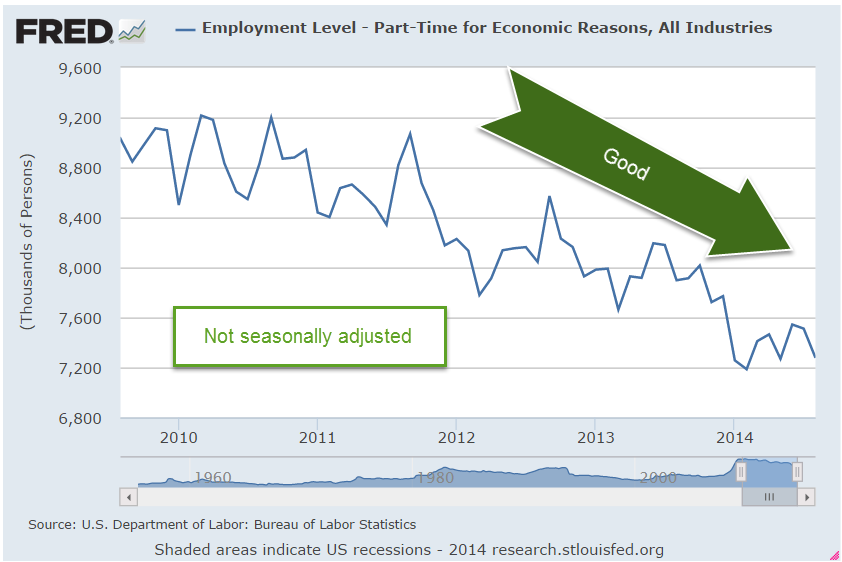
The unemployment rate ticked down slightly in August, but the more significant trend is the decreasing number of involuntary part timers, those who are working part time because they can’t find full time work.
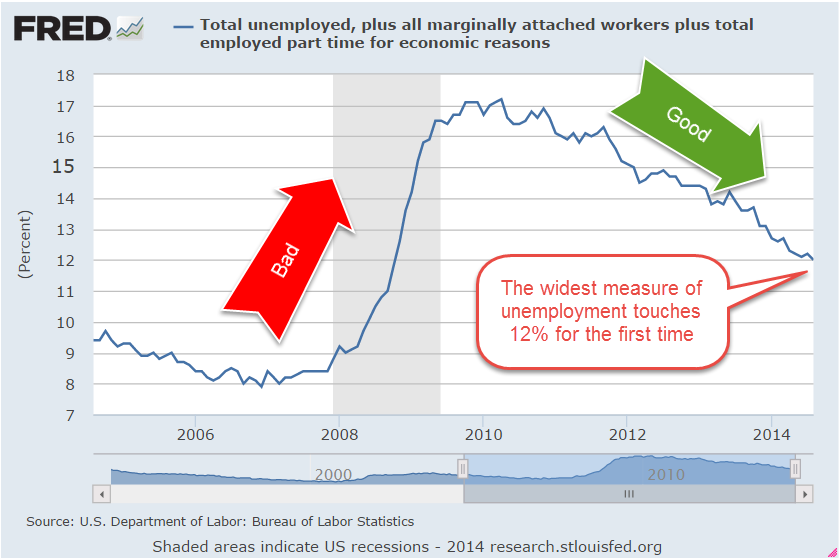
The widest measure of unemployment, which includes both these part time workers and those who have become discouraged and stopped looking for work, finally touched the 12% mark this month.
In short, this month’s employment report was good enough but not so good that it would shorten the period before the Federal Reserve begins to hike interest rates.

***********************

Constant Weighted Purchasing Index (CWPI)

Each month for the past year, I have been doing a little spreadsheet magic on the Purchasing Managers Index published by ISM to weight the employment and new orders components of this index more heavily.  This has proven to be a reliable and less erratic guide to the economic health of the country.

The manufacturing component of the ISM Purchasing Managers Index was particularly strong in August.  Because the CWPI weights new orders and employment heavily in its composition, the manufacturing component of the CWPI is at levels rarely seen in the past 34 years.  Levels greater than this have occurred only twice before – in November and December 1983 and December 2003.  Both of these previous periods marked the end of a multi-year malaise.

The services sector, which comprises most of the economic activity in the country, is strong and rising as well. New orders declined slightly but are still robust and employment is growing.  The composite of these two components is near robust levels.

This month the CWPI composite of manufacturing and service industries topped the previous high of 66.7 set in December 2003 and is now at an all time high in the 17 years that ISM has been publishing the non-manufacturing index. If the pattern of the past few years continues, this overall composite will probably decline in the next month or two.

Takeaways
Strong economic activity was muted somewhat by a lower than expected monthly labor report.

Economic Porridge

August 31, 2014

As summer comes to a close and the sun drifts south for the winter, the porridge is not too hot or too cold.

********************

Coincident Index

The index of Leading Indicators came out last week, showing increased strength in the economy.  Despite its name, this  index has been notoriously poor as a predictor of economic activity.  The Philadelphia branch of the Federal Reserve compiles an index of Coincident Activity in the 50 states, then combines that data into an index for the country.

This index is in the healthy zone and rising. When the year-over-year percent change in this index drops below 2.5%, the economy has historically been on the brink of recession.  The index turns up near the end of the recession, and until the index climbs back above the 2.5% level, an investor should be watchful for any subsequent declines in the index.

As with any historical series, we are looking at revised data.  When this index was published in mid-2011, the percent change in the index was -7% at the recession’s end in mid-2009.  Notice that the percent drop in the current chart is a bit less than 5%.  This may be due to revisions in the data or the methodology used to compile the index.

**************************

Disposable Income

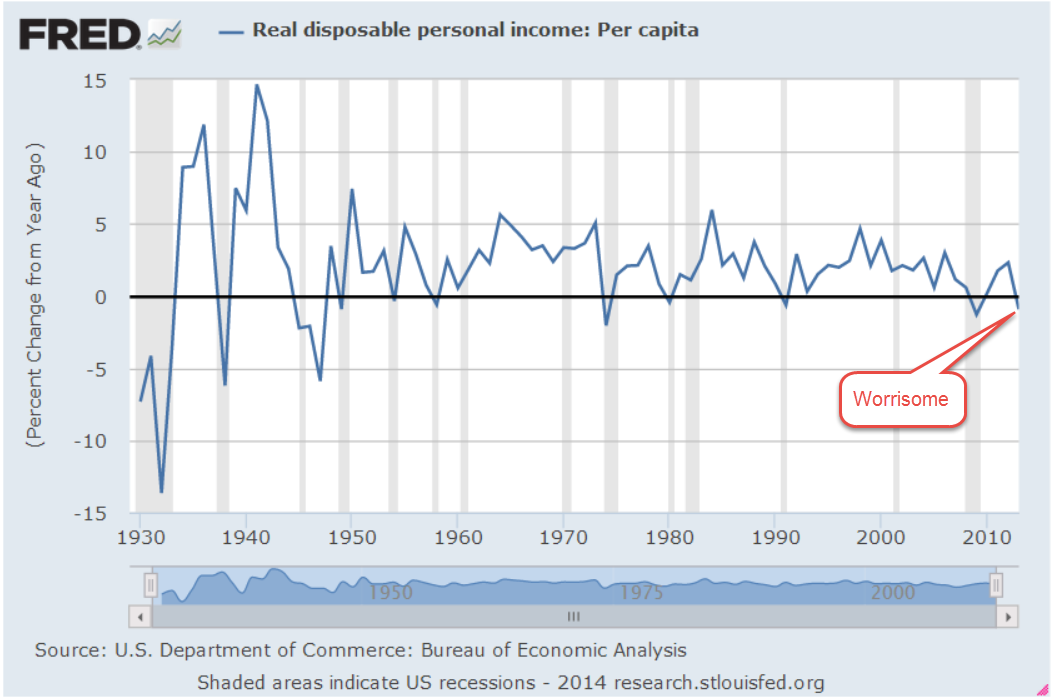
The Bureau of Economic Analysis (BEA) produces a number of annual series, which it updates through the year as more complete data from the previous year is received.  2013 per capita real disposable income, or what is left after taxes, was revised upward by .2% at the end of July but still shows a negative drop in income for 2013.  While all recessions are not accompanied by a negative change in disposable income, a negative change has coincided with ALL recessions since the series began at the start of the 1930s Depression.

Many positive economic indicators make it highly unlikely that we are either in or on the brink of recession.  Clearly something has changed.  Something that has routinely not been counted in disposable personal income is having some positive effect on the economy.  In 2004, the BEA published a paper comparing the methodology they use to count personal income and a measure of income, called money income, that the Census Bureau uses.  What both measures don’t count in their income measures are capital gains.

Unlike BEA’s measure of personal income, CPS money income excludes employer contributions to government employee retirement plans and to private health and pension funds, lumps-sum payments except those received as part of earnings, certain in-kind transfer payments—such as Medicare, Medicaid, and food stamps—and imputed income. Money income includes, but personal income excludes, personal contributions for social insurance, income from government employee retirement plans and from private pensions and annuities, and income from interpersonal transfers, such as child support. (Source)

Analysis (Excel file) of 2012 tax forms by the IRS shows $620 billion in capital gains that year, about 5% of the $12,384 billion in disposable personal income counted by the BEA.  An acknowledged flaw in the counting of disposable income is that the total reflects the taxes that individuals pay on the capital gains (deducted from income) but not the capital gains that generated that taxable income.  Although 2013 data is not yet available from the IRS, total personal income taxes collected rose 16%.  We can suppose that the 30% rise in the stock market generated substantial capital gains income.

*************************

Interest

Every year the Federal Government collects taxes and spends money.  Most years, the spending is more than the taxes collected – a deficit.  The public debt is the accumulation of those annual deficits.  It does not include money “borrowed” from the Social Security trust fund as well as other intra-governmental debt, which add another third to the public debt.  (Treasury FAQ)  This larger number is called the gross debt.  At the end of 2012, the public debt was more than GDP for the first time.

The Federal Reserve owns about 15% of the public debt.  But wait, you might say, isn’t the Federal Reserve just part of the government?  Well, yes it is.  Even the so-called public debt is not so public.  How did the Federal Reserve buy that  government debt?  By magic – digital magic.  There is a lot of deliberation, of course, but the actual buying of government debt is done with a few dozen keystrokes.  Back in ye olden days, a government with a spending problem would have to melt down some of its gold reserves, add in some cheaper metal to the mix and make new coins.  It is so much easier now for a government to go to war or to give out goodies to businesses and people.

Despite the high debt level, the percent of federal revenues to pay the interest on that debt is relatively low, slightly above the average percentage in the 1950s and 1960s but far below the nosebleed percentages of the 1980s and 1990s.

As the boomer generation continues to retire, the Federal Government is going to exchange intra-governmental debt, i.e. the money the government owes to the Social Security trust funds, for public debt.  As long as 1) the world continues to buy this debt,  and 2) interest rates stay low, the impact of the interest cost on the annual budget is reasonable.  However, the higher the debt level, the more we depend on these conditions being true.

************************

Watch the Percentages

As the SP500 touched and crossed the 2000 mark this week, some investors wondered whether the herd is about to go over the cliff.  The blue line in the chart below is the 10 month relative strength (RSI) of the SP500.  The red line is the 10 month RSI of a Vanguard fund that invests in long term corporate and government bonds.  Readings above 70 indicate a strong market for the security. A reading of 50 is neutral and 30 indicates a weak market for the security. The longer the RSI stays above 70, the greater the likelihood that the security is getting over-bought.

Long term bonds tend to move in the opposite direction of the stock market.  While they may both muddle along in the zone between 30 and 70, it is unusual for both of them to be particularly strong or weak at the same time.  We see a period in 1998 during the Asian financial crisis when they were both strong.  They were both weak in the fall of 2008 when the global financial crisis hit.  Long term bonds are again about to share the strong zone with the stock market.

Let’s zoom out even further to get a really long perspective.  Since November 2013, the SP500 index has been more than 30% above its 4 year average – a relatively rare occurrence.  It happened in 1954 – 1956 after the end of the Korean War, again in December of 1980, during the summer months of 1983, the beginning of 1986 to the October 1987 crash, and from the beginning of 1996 through September 2000.

In the summer of 2000, the fall from grace was rather severe and extended.  In most cases, including the crash of 1987, losses were minimal a year after the index dropped back below the 30% threshold.  When the market “gets ahead of itself” by this much, it indicates an optimism brought on by some distortion.  It does not mean that an investor should panic but it is likely that returns will be rather flat over the following year.

The index rarely gets 30% below its 4 year average and each time these have proven to be excellent buying opportunities.  The fall of 1974, the winter months of 2002 – 2003, and the big daddy of them all, March 2009, when the index fell almost 40% below its 4 year average.

************************

GDP

The Bureau of Economic Analysis (BEA) released the 2nd estimate of 2nd quarter GDP growth and surprised to the upside, revising the inital 4.0% annual growth rate to 4.2%.  As I noted a month ago, the first estimate of 2nd quarter growth included a 1.7% upward kick because of a build up of inventory, which seemed a bit high.  The BEA did revise inventory growth down to 1.4% but the decrease was more than offset primarily by increases in nonresidential investment. A version of GDP called Final Sales of Domestic Product does not include inventory changes.  As we can see in the graph below, the year-over-year percent gain is in the Goldilocks zone – not strong, but not weak.

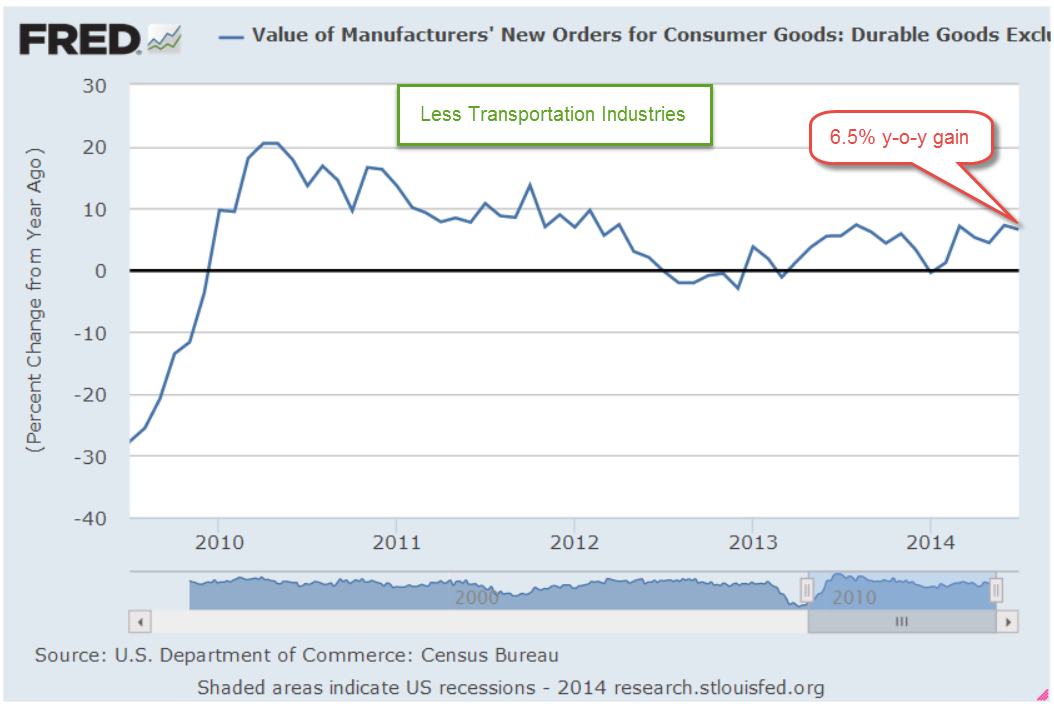
New orders for durable goods that exclude the more volatile transportation industries, airlines and automobiles, showed a healthy 6.5% y-o-y increase in July.  Like the Final Sales figures above, this is sustainable growth.

***********************

Takeaways

Economic indicators are positive but market prices may have already anticipated most of the positive, leaving investors with little to gain over the following twelve months.

Housing and Bond Trends

August 24, 2014

Housing

The week began with a bang as July’s Housing Market index notched its second consecutive reading of +50, growing a few points more than the 53 index of last month.  Readings above 50 indicate expansion in the market.  The index, compiled by the National Assn of Homebuilders, is a composite of sales, buyer traffic and prospective sales of both new and existing homes.  The index first sank below 50 in January and stayed in that contractionary zone for a few months before rising again in June and July.

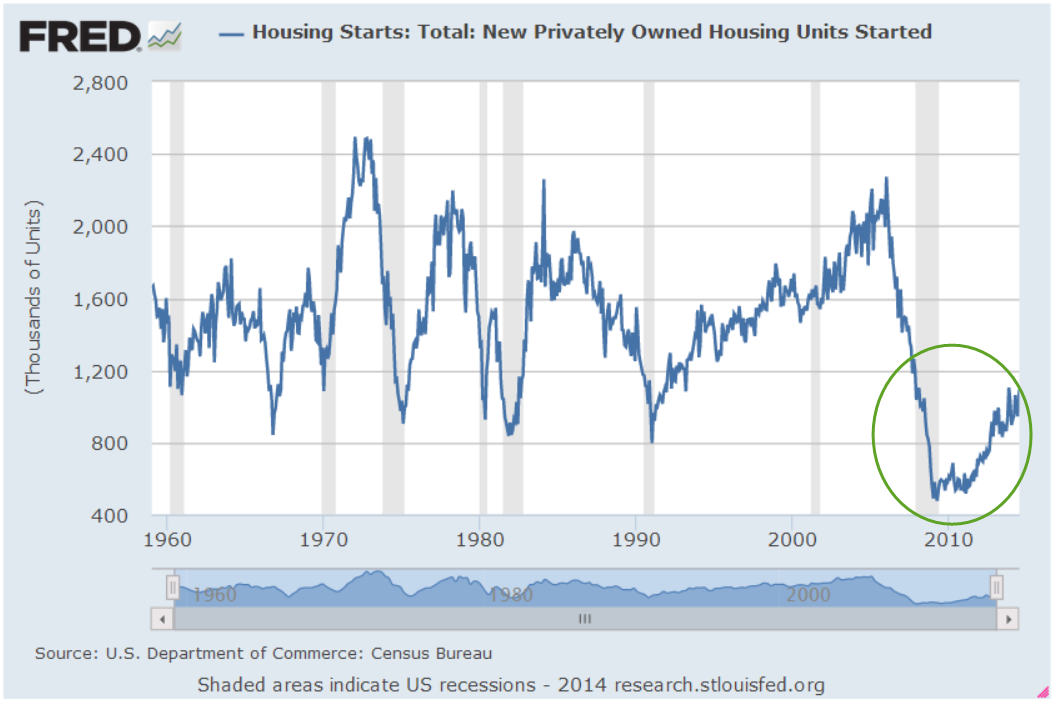
Housing Starts rose back above the 1 million mark but the big gains were in multi-family dwellings.  Secondly, this number needs to be put in a long term perspective. We simply are not forming new households at the same pace as we did for the past half century.

After monthly declines in May and June, new home sales popped up almost 16% in July.  Existing home sales rose in July but have now shown 9 consecutive months of year-over-year decreases.

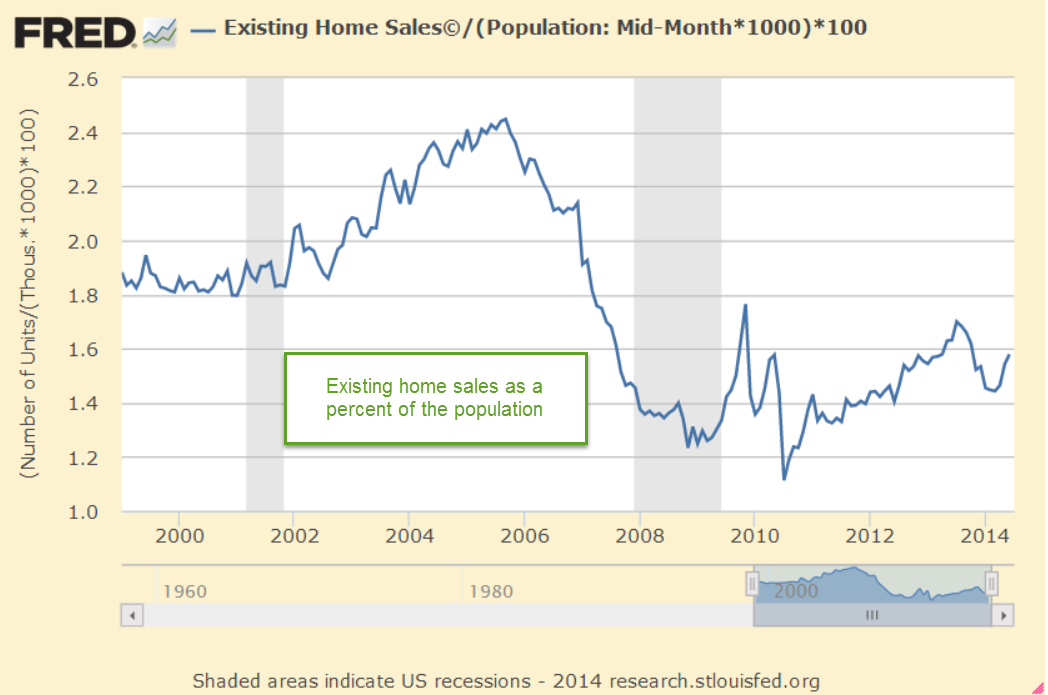
The number of existing home sales is at the same level as 1999-2000.  On a per capita basis, we are about 11-12% below the rather stable level of those years, before the housing bubble really erupted in the 2000s.

During the 1960s and 1970s, households grew annually by 2.1% (Census Bureau data).  That growth slowed to 1.4% in the 1980s and 1990s and has declined in the past decade to 1% per year.  During the 1960s and 1970s, the number of households with children headed by women exploded by over 3% per year, leading to a growing economic disparity among households.  During the 1980s, growth slowed but still hit 2.5%.  In the past two decades, this growth has stabilized at 1.2 to 1.3% per year, just a bit above the total rate of growth of all households.

The trend of slower growth in household formation shows no signs of changing in the near term.  We can expect that this will curtail any historically strong growth in the housing industry.  The price of an ETF of homebuilders, XHB, has plateaued since the spring of 2013.  The price has tripled from the dark days of 2009 but is unlikely to reach the formerly lofty heights of the mid-$40s anytime soon.

************************

Interest Rates

As the long days of summer wane and children return to school, central bankers gather in the majestic mountains of  Jackson Hole, Wyoming. Let’s crank up the wayback machine and return to those yester-years when fear and despondency continued to grip the hearts of many around the world.  In August 2010, the Chairman of the Federal Reserve, Ben Bernanke, announced that the Fed would continue to buy Treasuries and other bond instruments to maintain a balance sheet of about $2 trillion dollars, which was already far above normal levels. Bernanke hinted that the Fed would be ready to further expand the program should the economic recovery show signs of faltering. This speech would later be viewed as a pre-announcement of what would be dubbed QE2, or Quantitative Easing Part II, which the Fed announced in November 2010.  The promise of Fed support helped fuel a 30% rise in the market from August 2010 to the spring of 2011.

Like the announcement of a new pope, investors look toward the mountain and try to read the smoke signals rising up from this annual confab.  Financial gurus practiced at linear regressions and Bayesian probabilities struggle to  parse the words of Fed Chairwoman Janet Yellen. Did she use the word “likely” or “probably” in her speech? What coefficient of probability should we assign to the two words?  Did she use the present perfect progressive or the past perfect progressive verb tense?

Here’s the gist of Ms. Yellen’s speech – essentially the same gist that she has given in several testimonies before Congress:

monetary policy ultimately must be conducted in a pragmatic manner that relies not on any particular indicator or model, but instead reflects an ongoing assessment of a wide range of information in the context of our ever-evolving understanding of the economy.

Investors like simple forecasting tools – thresholds like the unemployment rate or the rate of inflation.  In 2012 and 2013, former chairman Ben Bernanke reminded investors that thresholds are benchmarks that may guide but do not rule the Fed’s decision making.  Ms. Yellen reiterated several points:

Estimates of slack necessitate difficult judgments about the magnitudes of the cyclical and structural influences affecting labor market variables, including labor force participation, the extent of part-time employment for economic reasons, and labor market flows, such as the pace of hires and quits….the aging of the workforce and other demographic trends, possible changes in the underlying degree of dynamism in the labor market, and the phenomenon of “polarization”–that is, the reduction in the relative number of middle-skill jobs.

 Each month I have encouraged readers to go beyond the employment report headlines, to look at these various  components of the labor market.  The Fed uses a complex model of 19 components:

This broadly based metric supports the conclusion that the labor market has improved significantly over the past year, but it also suggests that the decline in the unemployment rate over this period somewhat overstates the improvement in overall labor market conditions.

Long term bond prices are at all time highs, leading some to question the reward to risk ratio at these price levels.  Prices took a 10% – 12% hit in mid-2013 in anticipation of a rate hike in 2014, indicating that investors are that jumpy. Since the beginning of this year, prices have risen from those lows of late last year.  Will 2015 be the year when the Fed finally begins to raise interest rates? Investors have been asking that question for four years.

Since the spring of 2009, 5-1/2 years ago, an index of long term corporate and government bonds (VBLTX as a proxy) has risen 65%.  From the spring of 2000 to the spring of 2009, a period of nine years, this index gained the same percentage.  Perhaps too much too fast?  Only time will tell.

**************************

Takeaways

Housing growth will be constrained by the slower growth in household formation.  Further valuation increases in long term bonds seem unlikely.

Sales, Savings and Volatility

August 17, 2014

This week I’ll take a look at the latest retail sales figures, a less publicized volatility indicator, a comparison of BLS projections of the Labor Force Participation Rate, and the adding up of personal savings.

**********************

Retail Sales

Two economic reports which have a major influence on the market’s mood are the monthly employment and retail sales reports.  After a disappointing but healthy employment report this month, July’s retail sales numbers were disappointing, showing no growth for the second month in a row.  The year-over-year growth is 3.7%, which, after inflation, is about 1.5% real growth.  Excluding auto sales (blue line in the graph below), sales growth is 3.1, or about 1% real growth, the same as population growth.

As we can see in the graph below, the growth in auto sales has kicked in an additional 1/2% in growth during this recovery period. Total growth has been weakening for the past two years despite strong growth in auto sales, a sign of an underlying lack of consumer power.

Real disposable income rebounded in the first six months of this year after negative growth in the last half of 2013 but there does not seem to be a corresponding surge in sales.

*****************************

Labor Force Projections

While we are on the subject of telling the future…

All we need are 8 million more workers in the next two years to meet Labor Force projections made in 2007 by the Bureau of Labor Statistics (BLS).   8 million / 24 months = 300,000 a month net jobs gained. Hmmm…probably not.  In 2007, the BLS forecast slowing growth in the labor force in the decade 2006 – 2016.  Turned out it was a lot slower. Estimates then for 2016 projected a total of 164 million employed and unemployed.  In July 2014, the BLS put the current figure at 156 million employed.  The Great, or at least Big, Recession caused the BLS to revise their forecast a number of times.  The current estimate has a target date of 2022 to hit the magic 164 million.  In other words, we are 6 years behind schedule.

The Participation Rate is the ratio of the Civilian Labor Force to the Civilian Non-Institutional Population aged 16 and above.  The equation might be written:  (E + UI) / A = PR, where E = Employed, UI = Unemployed and Actively Looking for Work, and A = people older than 16 who are not in the military or in prison or in some institution that would prevent them from making a choice whether to work or not.  As people – the A divisor in the equation – live longer, the participation rate gets lower.  It ain’t rocket science, it’s math, as baseball legend Yogi Berra might have said.

The Participation Rate started rising in the 1970s as more women entered the work force, then peaked in the years 1997 – 2000.  Prior to the recession of 2001, the pattern of the participation rate was predictable, declining during an economic downturn, then rising again as the economy recovered.  The recovery after the recession of 2001 was different.  The rate continued to decline even as the economy strengthened.

In 2007, the BLS expected further declines in the rate from a historically high 67% in 2000 to 65.5% in 2016.  In 2012, the rate stood at 63.7%.  Current projections from the BLS estimate that the rate will drop to 61.6% by 2022.

Much of the decline in the participation rate was attributed to demographic causes in the 2007 BLS projections:

“Age, sex, race, and ethnicity are among the main factors responsible for the changes in the labor force participation rate.” (Pg. 38)

Comparing estimates by some smart and well trained people over a number of years should remind us that it is extremely difficult to predict the future.  We may mislead ourselves into thinking that we are better than average predictors.  Our jobs may seem fairly secure until they are not; a 5 year CD will get about 5 – 6% until it doesn’t; the stock market will sell for about 15x earnings until it doesn’t; bonds are safe until they’re not.

The richest people got rich and stay rich because they know how unpredictable the world really is.  They hire managers to shield them – hopefully – from that unpredictability.  They fund political campaigns to provide additional insurance against the willy-nilly of public policy.  They fight for government subsidies to provide a safety cushion, to offset portfolio losses and mitigate risk.  What do many of us who are not so rich do to insure ourselves against volatility?  Put our money in a safe place like a savings account or CD.  In real purchasing power, that costs us 1 – 2%, the difference between inflation and the paltry interest rate paid on those insured accounts.  In addition, we can pay a hidden “insurance” fee of 4% in foregone returns by being out of the stock and bond markets.  We stay safe – and not-rich.  Rich people manage to stay safe – and rich – by not doing what the not-rich people do to stay safe.  Yogi Berra couldn’t have said it better.

***************************

China

For you China watchers out there, Bloomberg economists have compiled a monetary index from several key factors of monetary policy.  After hovering near decade lows, China’s central bank has considerably loosened lending in the past two months.  The chart shows the huge influx of monetary stimulus that China provided in 2009 and 2010 as the developed world tried to climb up out of the pit of the world wide financial crisis.

The tug of war in China is the same as in many countries.  Politicians want growth.  Central banks worry about inflation.  The rise in this index indicates that the central bank is either 1) bowing to political pressure, or 2) feels that inflationary pressures are low enough that they can afford to loosen the monetary reins.  As is often the case with monetary policy, it is probably some combination of the two.

**************************
Personal Savings Rate

Over the past two decades, economists have noted the low level of savings by American workers.  While economists debate methodologies and implications, politicians crank up their spin machines. More conservative politicians cite the low savings rate as an indication of a lack of personal responsibilty.  As workers become ever more dependent on government programs, they do not feel the need to save.  Over on the left side of the political aisle, liberals cite the low savings rate as a sign of the growing divide between the middle class and the rich.  Many families can not afford to save for a house, or their retirement, or put aside money for their children’s education.  We need more programs to correct the economic inequalities, they say.

While there might be some truth in both viewpoints, the plain fact is that the Personal Savings Rate doesn’t measure savings as most of us understand the term.  A more accurate title for what the government calls a savings rate would be “Delayed Consumption Rate.”  The methodology used by the Dept. of Commerce counts whatever is not spent by consumers as savings.  “To consume now or consume later, that is the question.”

If a worker puts money into a 401K each month, the employer’s matching contribution is not counted.  If a consumer saves up for a down payment for a house, that is included in savings.  When she takes money out of savings to buy the house, that is a negative savings.  The house has no value in the “savings” calculation.  Many investors have a large part of their savings in mutual funds through personal accounts and 401K plans at work.  Capital gains in those funds are not counted as savings.  (Federal Reserve paper) In short, it is a poor metric of the aggregate behavior of consumers.  Some economists will point out that the savings rate indicates a level of demand that consumers have in reserve but because a significant portion of saved income is not counted, it fails to properly account for that either.

************************

Volatility – A section for mid-term traders

No one can accurately predict the future but we can examine the guesses that people make about the future.  In his 2004 book The Wisdom of Crowds (excerpt here) James Surowiecki relates a number of studies in which people are asked to guess answers to intractable problems, like how many jelly beans are in a jar.  As would be expected, respondents rarely get it right.  The surprising find was that the average of guesses was remarkably close to the correct answer.

Through the use of option contracts, millions of traders try to guess the market’s direction or insure themselves against a change in price trend.  A popular and often quoted gauge of the fear in the market is the VIX, a statistical measure of the implied volatility of option contracts that expire in the next thirty days.  When this fear index is below 20, it indicates that traders do not anticipate abrupt changes in stock prices.

Less mentioned is the 3 month fear index, VXV (comparison from CBOE). Because of its longer time horizon, it might more properly be called a worry index.  Many casual investors have neither the time, inclination or resources to digest and analyze the many economic and financial conditions that impact the market.  So what could be easier than taking a cue from traders preoccupied with the market?  Below is a historical chart of the 3 month volatility index.

Historically, when this gauge has crossed above the 20 mark for a couple of weeks, it indicates an elevated state of worry among traders.  The 48 month or 4 year average of the index is 19.76.  Currently, we are at a particularly tranquil level of 14.42.

When traders get really spooked, the 10 day average of this anxiety index will climb to nosebleed heights as it did during the financial crisis.  As the market calms down, the average will drift back into the 20s range, an opportunity for a mid-term trader to get cautiously back into the water, alert for any reversal of sentiment.

*********************

Takeaways

Retail sales have flat-lined this summer but y-o-y gains are respectable.  So-so income growth constrains many consumers.  The 3 month volatility index is a quick and dirty summary of the mid-term anxiety level of traders.  A comparison of BLS labor force projections shows the difficulty of making accurate predictions.  The personal savings rate under-counts savings.