The Homeowners’ Association

August 18, 2019

by Steve Stofka

Two quick asides before I get into this week’s topic. A cricket perched on the top of a 7′ fence. It drew up to the edge of the top rail, learned forward, raised its rear legs as though to jump, then settled back. It did this twice more before jumping 8′ out then down into a soft landing on some ground cover. How far can crickets see, how often do they injure a leg if they land incorrectly and do they get afraid?

The bulk of the personal savings in this country is held by the top 20% of incomes, and it is this income group that received the lion’s share of the 2017 tax cuts. It’s OK to bash the rich but that top 20% probably includes our doctor and dentist. Before you start drilling or cutting me, I want to make it perfectly clear that I was not criticizing you, Doc.

In 2016, the top quintile – the top 20% – earned 2/3rds of the interest and dividend income (Note #1). Due to falling interest rates over the past three decades, real interest and dividend income has not changed. Real capital has doubled and yes, much of it went to those at the top, but the income from that capital has not changed. That is a huge cost – a hidden tax that gets little press. The real value of the public debt of the Federal Government has quadrupled since 1990, but it pays only 20% more in real interest than it did in 1990 (Note #2). Here’s a graph of personal interest and dividend income adjusted to constant 2012 dollars. Thirty years of flat.

Ok, now on to a story. Economists build mathematical models of an economy. I wanted to construct a story that builds an economy that gradually grows in complexity and maybe it would help clarify the relationships of money, institutions and people.

Let’s imagine a group of people who move into an isolated mining town abandoned several years earlier. The houses and infrastructure need some repairs but are serviceable and the community will be self-sufficient for now. The homeowners form an association to coordinate common needs.

The association needs to hire lawn, maintenance and bookkeeping services, and security guards to police the area and keep the owners safe.  How does the association pay for the services?  They assess each homeowner a monthly fee based on the size of the home. How do the homeowners pay the monthly fee?  Each homeowner does some of the services needed. Some clean out the gutters, others fix the plumbing, some keep the books and some patrol the area at night. They work off the monthly fee.

How do they keep track of how much each homeowner has worked? The association keeps a ledger that records each owner’s fee and the amount worked off. The residents sometimes trade among themselves, but it is rare because barter requires a coincidence of wants, as economists call it. Mary, an owner, needs some wood for a project and Jack has some extra wood. They could trade but Mary doesn’t have anything that Jack wants. He tells Mary to go down to the association office and take some of her time worked off her ledger and credit it to Jack’s monthly fee. Mary does this and they are both happy (Note #3).

As other owners learn of this idea and start trading work credits, the association realizes it needs a new system. It prints little pieces of paper as a substitute for work credits and hands them out to owners who perform services for the association. These pieces of paper are called Money (Note #4).

The money represents the association’s accounts receivable, the fees owed and accruing to the association, and the pay that the association owes the owners for the work they have done. Then the association notices that there are some owners who are not doing as well as others. It assesses an extra fee each month from those with larger homes and gives that money to needy homeowners.  These are called transfers because the owners who receive the money do not trade any real goods or services to the association. In this case the association acts as a broker between two people. Let’s call these passive transfers. We can lump these transfers together with exchanges of goods and services.

Then some people from outside the area start stealing stuff from the homeowners. The association needs to hire more security guards, but homeowners don’t want to pay a special one-time assessment to pay for the extra guards.

Instead of printing more Money, the association prints pieces of paper called Debt. Homeowners who have saved some of their money can trade it in for Debt and the association will pay them interest. Homeowners like that idea because Money earns no interest and Debt does. The association uses the Money to pay for the extra security guards.

But there are not enough people who want to trade in their Money for Debt, so the association prints more Money to pay the extra security guards.

Let’s pause our story here to reflect on what the words inflation and deflation mean. Inflation is an increase in overall prices in an economy; deflation is a decrease (Note #5). Inflation occurs when the supply of money fuels a demand for goods and services that is greater than the supply of goods and services. Ok, back to our story.

So far so good. All the Money that the association has printed equals a trade or a passive transfer. Let’s say that the association needs more security guards and no one else wants to work as a security guard because they can make more Money doing jobs for other homeowners. The association makes a rule called a Draft. Homeowners of a certain age and sex who do not want to work as security guards will be locked up in the storage room of the community center.

Now there’s a problem. Because the association has taken some homeowners out of the customary work force, those people are not available for doing jobs for other homeowners, who must pay more to contract services. This is one of several paths that leads to inflation. To combat that, the association sets price controls and limits the goods that homeowners can purchase. After a while, the outsiders are driven off and the size of the security force returns to its former levels.

Now all the extra Money that the association printed to pay for the security force has to be destroyed. As homeowners pay their dues, the association retires some of the money and shrinks the Money supply. However, there is a time lag, and prices rise sharply (Note #6).

Over the ensuing decades, there are other emergencies – flooding after several days of rain, a sinkhole that formed under one of the roadways, and a sewer system that needed to be dug up and replaced. The association printed more Debt to cover some of the costs, but it had to print more Money to pay for the balance of repairs. Because the rise in the supply of Money was a trade for goods and services, inflation remained tame.

There didn’t seem to be any negatives to printing more Money, so the homeowners passed a resolution requiring that the association print and pay Money to homeowners who were down on their luck. These were active transfers – payments to homeowners without a trade in goods and services and without some offsetting payment by the other homeowners.

So far in our story we have several elements that correspond with the real world: currency, taxes, social insurance, the creation of money and debt and the need to pay for defense and catastrophic events. Let’s continue the story.

With the newly printed Money, those poorer homeowners could now buy more goods and services. The increased demand caused prices to rise and all the homeowners began to complain. Realizing their mistake, they voted on an austerity program of higher homeowner fees and lower active transfers to poorer homeowners.

Because homeowners had to pay higher fees, they didn’t have enough extra Money to hire other services. Some residents approached the association and offered to repair fences and other maintenance jobs, but the association said no; it was on an austerity program and cutting expenses. Some residents simply couldn’t pay their fees and the problem grew. The association now found that it received less Money than before the higher fees and Austerity program. It cut expenses even more, but this only aggravated the problem.

Finally, the association ended their Austerity program. They printed more Money and hired homeowners to make repairs. Several homeowners came up with a different idea. There is another housing development called the Forners a few miles away. They are poorer and produce some goods for a lower price. The homeowners can buy stuff from the Forners and save money. There are three advantages to this program:

  1. Things bought from the Forners are cheaper.
  2. Because the homeowners will not be using local resources, there will be less upward pressure on prices.
  3. The homeowners will pay the association for the goods bought from the Forners and the association will pay the Forners community with Debt, not Money. Since it is the creation of Money that led to higher prices, this arrangement will help keep inflation stable.

As the homeowners buy more and more stuff from the Forners, the money supply remains stable or decreases. After several years, homeowners are buying too much stuff from the Forners and there is less work available in the community. As homeowners cannot find work, they again fall behind in paying their monthly fees.

Several of those in the association realize that they don’t have enough Money to go around in the community. There is a lot to do, and the homeowners draw up a wish list: repairs to the roads and helping older homeowners with shopping or repairs around their home are suggested first. A person who is out of work offers to lead tours and explain the biology of trees for schoolchildren. The common lot near the clubhouse could use some flowers, another homeowner suggests. I could use a babysitter more often, one suggests, and everyone nods in agreement. I could teach a personal finance class, a homeowner offers. Another offers to read to homeowners with bad eyesight and be a walking companion to those who want to get more exercise.

Everyone who contributes to the welfare of the community gets paid with Money that is created by the association. What should we call the program? One person suggests “The Paid Volunteer Program,” and some people like that. Another suggests, “The Job Guarantee Program” and everyone likes that name so that’s what they called it (Note #7).

So far in this story we have two key elements of an organized society:

  1. Money – a paper currency created by the homeowner association.
  2. Debt – the amount the association owes to homeowners (domestic) and the Forners (international).

Next week I hope to continue this story with a transition to a digital currency, banks and loans.

//////////////////////

Notes:

  1. In 2016, the top 20% of incomes with more than $200K in income, earned more than 2/3rds of the total interest and dividends. IRS data, Table 1.4
  2. In 2018 dollars, the publicly held debt of the Federal government was $4 trillion in 1990, and $16 trillion now. In 2018 dollars, interest expense was $500B in 1990, and is $600B now.
  3. In David Graeber’s Debt: The First 5000 Years, there is no record of any early societies that had a barter system. They had a ledger or money system from the start.
  4. In the Wealth of Nations, Adam Smith – the “father” of economics – defined money as that which has no other value than to be exchanged for a good. This essential characteristic makes money unique and differentiates paper money from other mediums of exchange like gold and silver.
  5. An easy memory trick to distinguish inflation from deflation. INflation  = Increase in prices. DEflation = DEcrease.
  6. The account of the increased force of security guards – and its effect on prices and regulations – is the simple story of money and inflation during WW2 and the years immediately following. The process of rebalancing the money supply by the central bank is difficult. Monetary policy during the 1950s was a chief contributor to four recessions in less than 15 years following the war.
  7. A Job Guarantee program is a key aspect of Modern Monetary Theory.

The Skittish Market

August 11, 2019

by Steve Stofka

I had some whole hazelnuts left over and left them out for the squirrels. They smelled them, tried to bite them, gave up and buried them in the ground. No surprise there. Squirrels bury food. But that got me to wondering. Do hazelnuts soften after a few weeks in the ground? If so, then that might be an indication that squirrels have some primitive notion of future time. I buried a few hazelnuts in the garden and dug them up this week. Still as hard as they were when I put them in there.  Maybe two weeks is not long enough.

We bury money, not nuts. We put it in banks and other institutions called “financial intermediaries” and hope that our savings grow into a big money tree over time. Our bank, mutual or pension fund sends us statements every month or quarter and tells us how big our tree has grown. Financial advisors caution us not to go out and look at our money tree every day. Why? Because sometimes the wind comes and breaks a few branches.

This past Monday was a bit windy. In response to escalating trade tensions, the Chinese yuan weakened in the global money market, and the Chinese central bank did not intervene as the exchange rate dipped below a key number of 7 yuan to the dollar. President Trump accused the Chinese of manipulating their currency because they had taken a free market approach much like the U.S. does. That’s the upside down world we live in now. If the Chinese don’t manipulate their currency, they are guilty of manipulating their currency.

The popular Dow Jones index dropped 3%.  How much is that? A little perspective might help. The financial crisis began when investment firm Lehman Brothers went bankrupt on September 15th, 2008. The stock market dropped 4.4%. A dip below a key number in the money exchange rate between China and the US was all it took to drive the market down a remarkable 3%. In short, the market is extremely sensitive right now to information. Don’t look at your money tree. Some of the branches have been broken.

How do the banks and pension funds grow our money trees? They loan the money out to people and businesses who need it. Unlike nuts and seeds, money doesn’t grow when left in the ground. Growth during the past decade of recovery has been slow but unemployment is at 50-year lows so demand for consumer credit is high – credit card rates are the highest in 25 years – over 17% (Note #1).

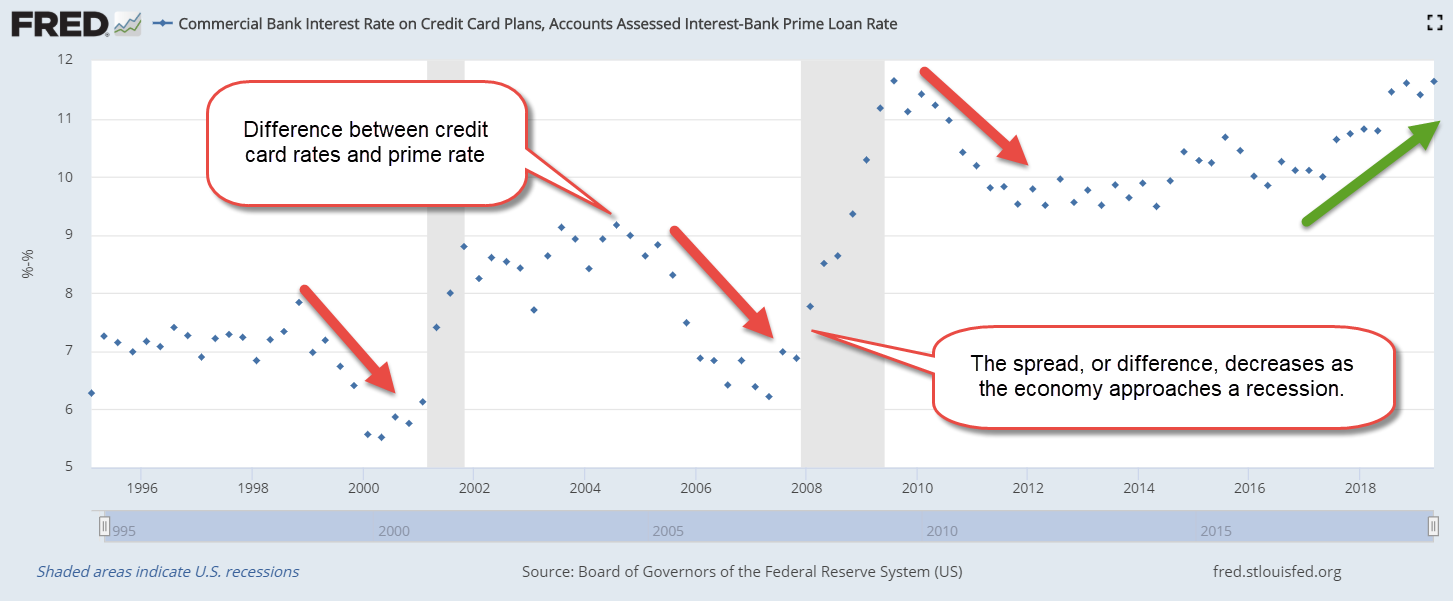
Here’s a graph showing credit card rates (the blue dots) and the prime rate (red line), the rate that banks charge their best business customers.

Here’s a chart of the spread or difference between the two rates. Notice that the spread decreases a few years before a recession actually occurs or banks get increasingly worried about a recession. Banks were already telegraphing their fears two years in advance of the 2008-09 recession.

As you can see, the current spread is increasing, not decreasing. Banks are not worried about getting paid because the economy is strong, and people are working. Credit card defaults are near all-time lows (Note #2). Interest rates are the price of money – the price of time. Banks are confident that they can raise their prices for people who want to borrow money.

Less than two weeks ago, the Fed cut interest rates for the first time in a decade. Chairman Powell cited concerns about global growth and warned that the market should not expect further cuts unless data justified such action. He called the ¼% rate cut a mid-course correction.

Conflicting signals – the “yes, buts” – drive market volatility higher. The economy is good. Yes, but the global economy is weakening.

Wage growth is slow. Yes, but unemployment and delinquencies are very low. Housing costs are through the roof and people won’t be able to keep up their payments. Yes, but annual increases in housing costs for the whole country are only 2-1/2 to 3%, the same as they were for most of the 90s and early 2000s (Note #3).

The yield curve recently inverted, meaning that short term rates are higher than long term rates. Yes, but workers in the retail industry are particularly vulnerable and their real weekly earnings are still rising (Note #4). The yes, buts.

As children we were told to go to sleep and we may have said, “yes, but I saw a spider on the ceiling, and I don’t want it to eat me while I’m sleeping.” It’s just a trick of the light, now go to sleep. “Yes, but I heard a mouse under the bed. What happens if it gets under the covers?” That’s just the wind outside, now go to sleep.

Not once did we worry before going to sleep, “Yes, but what about my piggy bank?” That’s what some of us do as adults. “Yes, but what if the financial crisis comes again and uproots my money tree and carries it up into the sky?” we ask. Close your eyes, now. Don’t listen to the market noise. It’s only the wind. Don’t look under your financial statement every minute for mice and bugs.

///////////////////////

Notes:

  1. Highest credit card rate in 25 years
  2. Credit card delinquency, FRED series DRCCLACBS
  3. Housing costs, FRED series CPIHOSNS
  4. After adjusting for inflation, median weekly earnings of full-time retail workers have risen 10% since the end of the recession. Annual earnings of $33,000 (in 2018 dollars) are far below the median $45,000 for all workers.

Interest Rate Ceiling

June 23, 2019

by Steve Stofka

After the Federal Reserve meeting this week, traders are betting on a cut in interest rates in July and the market hit all-time highs. Is a cut in interest rates warranted at this time? Such an action is usually taken in response to weak employment numbers, a decline in retail sales or sluggish GDP growth. Let’s review just how good the economy is.

Unemployment is at 50-year lows. The percent of people unemployed more than fifteen weeks is near the lows of the late 1990s. At almost 18 million vehicles, auto sales are near all-time highs. Real retail sales continue to grow more than 1% annually. In the first quarter of this year, real GDP growth was over 3%. Ongoing tariffs may cause real GDP to decline one percent but a growth rate above 2% is above average for this recovery after the financial crisis.

Corporate profits have been strong. In fact, that may account for the volatility of the past two decades. The chart below is after tax corporate profits (CP) as a percent of GDP. The multi-decade norm is in the range of 5-8% but the past twenty years have been above that trend except for the plunge in profits and GDP during the GFC.

Companies have paid part of those extra profits as dividends to shareholders who tend to be cautious pension funds or older, wealthier and more cautious individuals.  Some profits have been used to buy back shares and boost the return to existing shareholders.

Despite the above average profits, investors still have a strong thirst for lower yielding government debt. Why? The Federal Reserve has kept interest rates below a market equilibrium, which is currently about 3.8%, far above the current 2.4% federal funds rate (Note #1). As with any price ceiling, the below-market price creates a shortage. In this case, the shortage is in the capital investors want to supply to governments to meet the demand for capital. Consequently, investors have been searching for alternative substitutes or near-substitutes. That distortion is being reflected in stock market prices.

Despite a strong economy and corporate profits, the SP500 has gained less than 5% from its peak high in February 2018 after the passage of the 2017 tax cuts. Including dividends, the SP500 has gained just 5.7% in 16 months. If we turn the clock back a few weeks to the end of May, the total return of the SP500 during the past fifteen months was a big, flat zero. Those gains of the past sixteen months have come in the past three weeks on the hope and the hint of rate cuts.

An intermediate bond ETF like Vanguard’s BIV has returned 5.2% in the same period. On a scale of increasing risk 1-5, with 1 being a safe investment, BIV is rated a 2. The SP500 is rated a 4. Investors buying the broad stock market have not been rewarded for the additional risk they are taking.  How long will this situation persist? For as long as the Fed keeps a price ceiling on interest rates.

///////////////////

Notes: A popular model of equilibrium interest rates is the Taylor rule proposed in 1993 by John B. Taylor, a member of the Council of Economic Advisors under three presidents. The Atlanta Fed has a utility that calculates the current rate and allows the reader to change the parameters. Click on the graph icon, accept the default parameters and the utility graphs the equilibrium rate and the historical Fed funds rate.

Place Your Bets

January 6, 2019

by Steve Stofka

This will be my tenth year writing on the financial markets. As I’ve written in earlier posts, we’ve been sailing in choppy waters this past quarter. In 2018, a portfolio composed of 60% stocks, 30% bonds and 10% cash lost 3%. In 2008, that asset allocation had a negative return of 20% (Note #1). We can expect continued rough weather.

If China’s economy continues to slow, the trade war between the U.S. and China will stall because a slowing global economy will give neither nation enough leverage. Will the Fed stop raising interest rates in response? If there is further confirmation of an economic slowdown, could the Fed start lowering interest rates by mid-2019? Ladies and gentlemen, place your bets.

Thanks to good weather and a strong shopping season, December’s employment reports from both ADP and the BLS were far above expectations (Note #2). Wages grew by more than 3%. Will stronger wage gains cut into corporate profits? Will the Fed continue to raise rates in response to the strong employment numbers and wage gains? Ladies and gentlemen, place your bets.

The global economy has been slowing for some time. After a 37% gain in 2017, a basket of emerging market stocks lost 15% last year. Although China’s service sector is still growing, it’s manufacturing production edged into the contraction zone this past month (Note #3). Home and auto sales have slowed in the U.S. What is the prospect that the U.S. could enter a recession in the next year? Ladies and gentlemen, place your bets.

The partial government showdown continues. The IRS is not processing refunds or answering phones. If it lasts one more week, it will break the record set during the Clinton administration. Trump has said it could go on for a year and he does like to be the best in everything, the best of all time. Could the House Democrats vote for impeachment, then persuade 21 Republican Senators (Note #4) to vote for a conviction and a Mike Pence Presidency? Ladies and gentlemen, place your bets.

When the winds alternate directions, the weather vane gets erratic. This week, the stock market whipsawed down 3% one day and up 3% the next as traders digested the day’s news and changed their bets. Interest rates (the yield) on a 10-year Treasury bond have fallen by a half percent since November 9th. When yields fell by a similar amount in January 2015 and January 2016, stock prices corrected 8% or so before moving higher. Since early December, the stock market has corrected by a similar percentage. Will this time be different? Ladies and gentlemen, place your bets.

Staying 100% in cash as a long-term investment (more than five years) is not betting at all. From a stock market peak in 2007 till now, an all cash “strategy” earned less than 1% annually. A balanced portfolio like the one at the beginning of this article earned a bit less than 6% annually. Older investors may remember the 1990s, when a person could safely earn 6% on a CD. Wave goodbye to those days for now and place your bets.

///////////////////////////

Notes:

  1. Portfolio Visualizer results of a portfolio of 60% VTSMX, 30% VBMFX and 10% Cash
  2. Automatic Data Processing (ADP) showed 271,000 private job gains. The Bureau of Labor Standards (BLS) tallied over 300,000 job gains.
  3. China’s manufacturing output in slight contraction
  4. The Constitution requires two-thirds majority in Senate to convict an impeached President. Currently, there are 46 Democratic Senators and Independents who caucus with Democrats. They would need to convince 21 Republican Senators to vote for conviction to get a 67 Senator super-majority. 22 Republican Senators are up for re-election in 2020 and might be sensitive to public sentiment in their states.

Changing Dance Partners

October 14, 2018

by Steve Stofka

This week’s stock market activity helps us remember some simple rules of investing. Many of us confuse mass and weight. Mass is the resistance of an object to a change in speed or direction. Weight is the force of gravity on that object. Using this model, let’s compare the masses of stocks and bonds. On Wednesday, when stocks fell over 3%, the price of a broad bond composite barely moved.

Bonds act like a big cruise ship, more resistant to changes in wind and wave than a sailboat. The cruise ship’s progress is ponderous but predictable. Stocks behave like a sailboat which moves in a zig-zag fashion, changing directions to cope with wind and wave. Sometimes, the sailboat makes a lot of progress in calm waves with a favorable wind. November 2016 through January 2018 was one such period when stocks made steady progress.

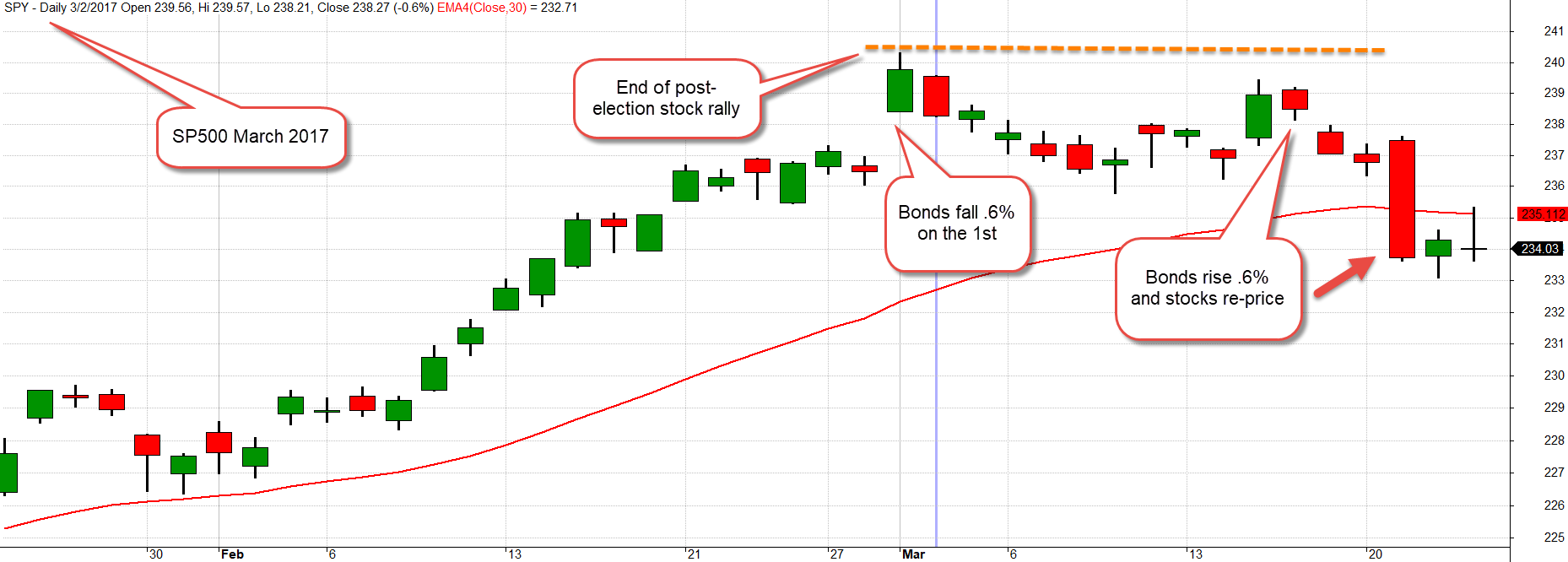
On the previous Wednesday, October 3rd, a “rout” – a half-percent drop – in the bond market indicated a global unease. A half-percent move in the stock market occurs weekly. The last half-percent drop in the bond market was on March 1st 2017, eighteen months ago. Let’s look at that incident to help us understand the pattern.

BondStockMoves201703

Post-election, the stock market rose for three months, then plateaued for two weeks following that bond rout. Bonds drifted slightly lower and then, on March 15, 2017, charged higher by .6%. Within a few days, stocks lost 2-1/2%. On May 17th, bonds again surged, and stocks fell 2%.

The gigantic size of the bond market dwarfs the stock market. An infrequent daily shift in the pricing of the bond market signals a long-term recalculation of future risks and profits in both the bond and stock markets. When large shifts in the bond market happen frequently, stock investors should pay attention. Between Thanksgiving 2007 and the end of that year, the bond market experienced ten days of greater than 1/2% price swings! It signaled confusion and was a warning to stock investors that rough times were coming.

The bond market’s YTD price loss of 4% marks the probable end of a multi-decade bull market in bonds. The bond market is so stable that a small loss of 4% can mark the largest loss in decades.

We are seeing a change in dance partners. As an example, the stocks of high growth companies rose 20% from February lows. That was almost twice the gains of the SP500 broader market. Many of these are small and medium size companies whose growth is hampered by the greater cost of borrowing money in an environment of rising interest rates. The owners of growth stocks wanted to take some profits this past week but could not find buyers at those high prices. In the past week, prices of those stocks fell 8%. Cushioning the fall of some stocks is the large stockpile of cash – $350 billion – that U.S. companies have stockpiled for buybacks of their own stock. Some of that money was put to work in Friday’s recovery.

The U.S. stock market has been the one of the few bright spots in a global marketplace that has turned down this year. This week begins the reporting for the 3rd quarter earnings season so we may see more price swings in the days to come.

The Hunt, Part 2

July 22, 2018

by Steve Stofka

Last week, I showed the inputs to the credit constrained economy as a percent of GDP. I’ll put that up again here.

CreditGrowthFedSpendPctGDP

This week I’ll add in the drains but first let me review one of the inputs, bank loans. Focus your attention on that period just after 9/11, the left gray recession bar,  and the end of 2006, just to the left of the red box outlining the Great Recession on the right.  For those five years after 9/11, the banks doubled their loans to state and local governments, a surge of $1.4 trillion. The banks increased their household and mortgage lending by $5.3 trillion, or 67%. Why did banks act so foolishly? Former Fed chairman Alan Greenspan couldn’t answer that. We have a partial clue.

For 4-1/2 years after 9/11 and the dot-com bust, there was no growth in credit to businesses, a phenomenon unseen before in the data history since WW2. The banks reached out to households, as well as state and local governments because they needed the $1 trillion in loan business missing on the corporate side (#1 below).

There are four drains in the economic engine – Federal taxes, payments on loans, bad debts and the change in bank capital. State and local government taxes are not a drain because those government entities can not create credit. The change in bank capital reflects the changes in the banks’ loan leverage and their confidence in the economy. During the 1990s and 2010s the sum of the inputs and the drains remained within a tight range of about 1/7th of GDP.

InputLessDrains

The results of bad policy during the 2000s are shown clearly in the graph. In addition to the surge in bank loans, the Federal government went on a spending spree after 9/11. There was too much input and not enough drain. The reduction in taxes in 2001 and 2003 exacerbated the problem. There was less being drained out. Asset prices absorb policy mistakes until they don’t – a life lesson for all investors.

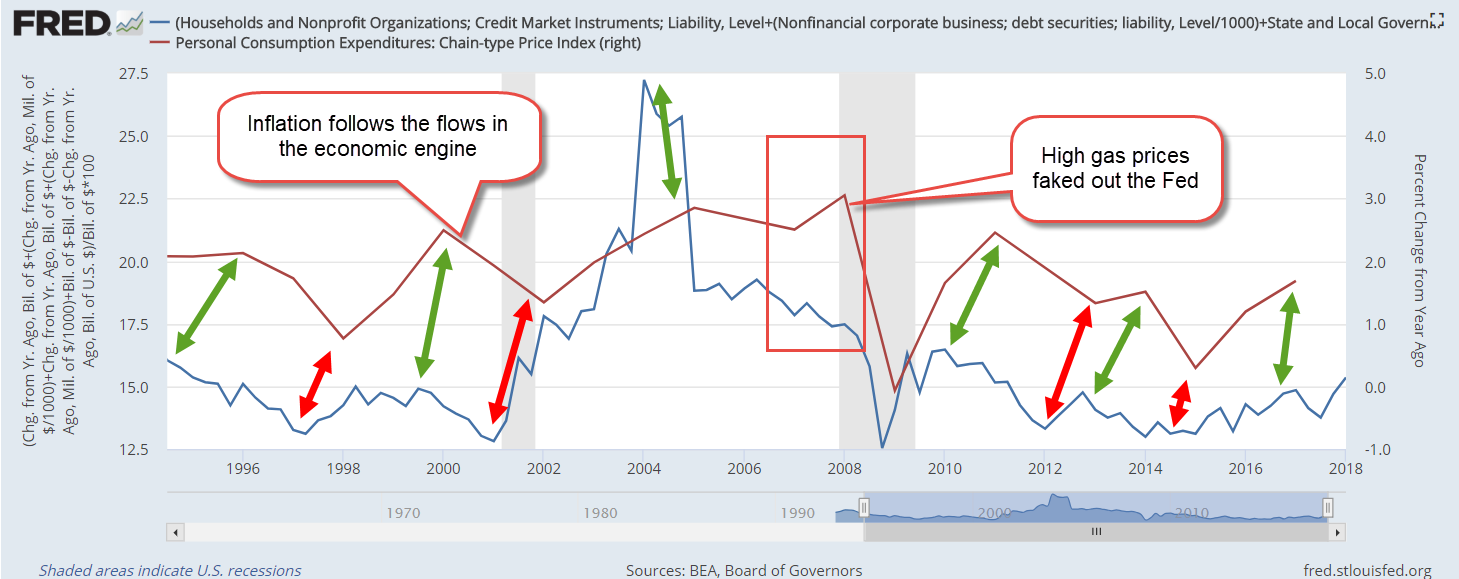
Let’s add in a second line to the graph – inflation. The rise and fall of inflation approximates the flows of this economic engine model with a lag time of several months. I’ve shown the peaks and troughs in each series.

InputLessDrainsVsPCE

Look at that critical period from 2006 through 2007. The Fed kept raising rates in response to rising inflation (the red line), driven primarily by increases in the price of oil.  The Fed Funds rate peaked out at 5-1/4% in the summer of 2006 and stayed at that level for a year. The Fed misread the longer term inflation trend and contributed to the onset of the recession in late 2007. The net flows in the engine model (blue line) indicated that the long term trend of inflation was down, not up.

Where will inflation go next? Using last week’s theme, follow the hounds! Who are the hounds? The banks. The inflow of credit from the banks is the primary driver of inflation. Why has inflation in the past decade been low? Because credit growth has been low. Where will inflation go next? A gentle increase – see the slight incline of the blue line at the right of the graph. Contributing to that increase were last year’s tax cuts. Less money is being drained out of the engine.

Too much flow into the economic engine or an improper setting of interest rates – these mistakes are absorbed by assets, which are the reservoirs of the engine. Stocks, bonds and homes are the most commonly held assets and most likely to be mispriced. During the early to mid 2000s, the mistakes in input were so drastic that the financial crisis seems inevitable when we look in the rear view mirror. During the past eight years, the inputs and drains have remained steady, but interest rates have been set at an inappropriate level. Again, we can anticipate that asset prices have been absorbing the mistakes in policy.


//////////////////////////

1. In the last quarter of 2001, loans to non-financial corporate business totaled $2.9 trillion and had averaged 6%+ growth for the past decade. Anticipating that same growth would have implied a credit balance of $3.9 trillion by the end of 2006. The actual balance was $3.1 trillion.

Hunt For Inflation

July 15, 2018

by Steve Stofka

Saddle up your horses, readers, because we are going on the Hunt for Inflation. I promise you’ll be home for afternoon tea. During this recovery, Inflation has been a wily fox, a real dodger. It has not behaved according to a model of fox behavior. Has Inflation evolved a consciousness?

Inflation often behaves quite predictably. The central bank lowers interest rates and pumps money into the economy. Too much money and credit chasing too few goods and Inflation begins running amuck. Tally-ho! Unleash the bloodhounds! The central bank raises interest rates which curbs the lending enthusiasm of its member banks through monetary policy. Inflation is caught, or tamed; the bloodhounds get bored and take a nap.

Not this time. Every time we think we see the tail of Inflation wagging, it turns out to be an illusion. Knowing that Inflation must be out there, the central bank has cautiously bumped up interest rates in the past two years. Every few months another bump, as though unleashing one more bloodhound ready to pounce as soon as Inflation shows itself.

Yes, Inflation has evolved a consciousness – the composite actions of the players in the Hunt. These players come in three varieties. One variety is the private sector – you and me and the business down the street. The second variety is the federal government and its authorized money agent, the Federal Reserve, the country’s central bank. Finally, there is a player who is a hybrid of the two – banks. They are private but have super powers conferred on them by the federal government. The private sector is the economic engine. The federal government and banks have inputs, drains and reservoirs that control the running of the economy.

The three money inputs into the constrained (see end) economy are 1) Federal spending, 2) Credit growth, and 3) net exports. In the graph below, the blue line includes 1, 2, and 3. The red line includes only 1. The graph shows the dramatic collapse of credit growth in this country. Federal spending accounted for all the new money flows into the economy.

CreditNXFedSpendvsFedSpend

Before the financial crisis, money flows into the economy were just over 30% of GDP. In less than a year, those inputs collapsed by almost 25%.

CreditGrowthFedSpendPctGDP

When inflation is lower than target, as it has been for the past decade, too much money flow is being drained out for the amount that is flowing in. In the case of too high or out of control inflation, as in the case of Venezuela, the opposite is true. Too much is being pumped in and not enough is being drained out. That’s the short story that gets you back to the lodge in time for a cup-pa or a pint. Next week – the inputs, drains and reservoirs of the economy.

////////////////////////////

  1. Constrained – the private economy, state and local governments who cannot create new credit.
  2. Net exports are the sum of imports (minus) and exports (plus).

Lots of Changes

March 25, 2018

by Steve Stofka

What a week it was. A glance at the headlines would lead someone to believe that it was all about tariffs and an impending trade war between the U.S. and China. On Thursday and Friday, the Dow Jones Industrial Average lost more than 1000 points, or almost 5%. Was that all about tariffs? Hardly.

As expected, the Federal Reserve raised interest rates ¼% on Wednesday.  This put the Fed rate at 1.5% – 1.75%. Half of the members of the interest setting committee (FOMC) indicated that it might be necessary to raise interest rates four times this year. The market has been pricing in three interest rate increases for 2018. Until Thursday, a fourth increase had not been fully priced in.

Further, the Fed is projecting an unemployment rate below 4% by late 2018 and early 2019. The current rate is 4.1%. Many industries are already struggling to find qualified workers. Rarely does the unemployment rate dip below 4%, and each time, inflation has risen and the stock market has fallen – sometimes substantially.

CPIUnemploy

The downturn following the Korean War was short and shallow, but the other two periods of low unemployment were followed by steep corrections in the market.

On Thursday night, the White House tweety bird announced another change in the roster. Out with the old National Security Adviser, General H. R. McMaster. In with the new adviser, John Bolton, an old school war hawk who avoided military service in Vietnam by joining the National Guard. Bolton’s first instinct is war and regime change as a solution to global disputes. In choosing Mike Pompeo as his new Secretary of State and John Bolton as his new National Security Advisor, Trump has assembled a war cabinet. The market has still not priced in the heightened chances of conflict with North Korea or Iran. Nor has it recognized a greater likelihood of armed conflict with China in the South China Sea. That might come in the next few weeks.

On Thursday, Trump enacted tariffs on imported steel and aluminum from China as promised. Stronger action against China’s trade policies are overdue, as it has long violated the spirit, if not the letter, of the WTO global agreements. Car manufacturers wanting to set up a plant in China must have a Chinese business partner with a 25% stake and – surprise – access to industrial trade secrets. The national government heavily subsidizes key industries so that they can support their own industries and workers. They avoid labor and environmental regulations, and when caught, pledge to do better. They issue a national change in regulation, but the change is only published and enforced in a few local areas.

The theft of intellectual property is a hallmark of most developing nations like China. In the 18th and 19th century, the U.S. was notorious for copying products made by companies in England and France. Article 1, Section 8 of the Constitution added some promise of patent and copyright protection, but the laws instituted protected only U.S. citizens. A half century later, Charles Dickens was “one of the chief victims of American literary piracy” (Source). A foreign inventor had to establish citizenship or residency in the U.S. for two years to gain any patent protection. In 1887, the U.S. joined a 19th century version of the WTO called the Paris Convention. As China does today, the U.S. skirted international agreements for at least a decade (Patent history).

Older Chinese citizens may have watched patrolling U.S. naval ships from the shores of the Yangtze River. The nation remembers the century of U.S. gunboat diplomacy (Wikipedia article). Despite American free market rhetoric, Chinese leaders understand that mercantilism still retains a strong political influence in the trading policies of many developed countries, including the U.S.

When NAFTA was signed in the early 1990s, subsidies of American corn farmers enabled them to sell cheap corn to Mexico. Unable to compete, many farmers in northern Mexico went out of business. As farming jobs decreased in Mexico, many laborers journeyed north to the U.S. to pick crops so that they could support their families. The U.S. is partially responsible for creating the very environment that led to so much illegal immigration from Mexico.

Around the world, developed countries cry foul when another country subsidizes goods that are exported at a lower cost into their countries. Since 1963, the U.S. has imposed a protectionist tariff of 25% on imported light duty trucks, the so called “chicken tax”. Protected for over fifty years by this tariff, domestic truck manufacturers like Ford and Chevy had made few substantial changes to their work vans in the past few decades. In 2015, Ford finally made a substantial change to its F-150 pickup. Notice those Mercedes tall work vans on the road? They are built in Germany, disassembled to avoid the tariff, shipped to the U.S. and reassembled by U.S. workers. Ford uses the same process with its Transit Connect van.

Boeing imports parts from all over the world to build its Dreamliners. Chinese companies use southeast Asia as a manufacturing supply, then assemble and ship thousands of products to the U.S. and around the world. In the truly global manufacturing economy, a trade war is a threat to the profits of many large businesses. They have tuned their operations to the contradictory rules of international trade.

Business leaders understand the political strut of free trade. Each business wants free trade when it wants to compete in someone else’s market. Each business lobbies for more regulations, tariffs and barriers to protect its competitive position within its own market. Yes, it’s all lies, so it’s important that the rules underlying this game not change too much. Trade wars change the rules and that’s bad for business.

Debt and Housing

March 18, 2018

by Steve Stofka

Republicans used to care about yearly budget deficits when Obama was President. Since Obama left office, the budget deficit is up 20%. As a percentage of GDP, 2017’s deficit was above the forty-year average of deficits (Treasury Dept press release).  At the end of the Obama term, the gross federal debt was 77% of GDP. In ten years, the Congressional Budget Office estimates that percentage will be over 90%. (Spreadsheet ) That estimate does not include the lower revenues from the tax cuts passed in December.

During the two Bush terms, Republican deficit hawks, genuinely concerned about budget deficits, were overruled by a majority of Republicans who paid only political lip service to common sense budgeting.

The Federal Government’s fiscal year runs from October to September. At the end of February, the fiscal year was five months old. According to the Treasury’s monthly budget statement, this fiscal year’s deficit has gone up 10%. Because of the tax cut passed in December, payroll tax collections are down. Because of higher interest rates, the government paid an extra $40 billion on the federal debt in the first five months of this fiscal year, which began October 2017. $40 billion is half of the food stamp program. Debt matters. The government is going into more debt to pay the interest on the existing debt.

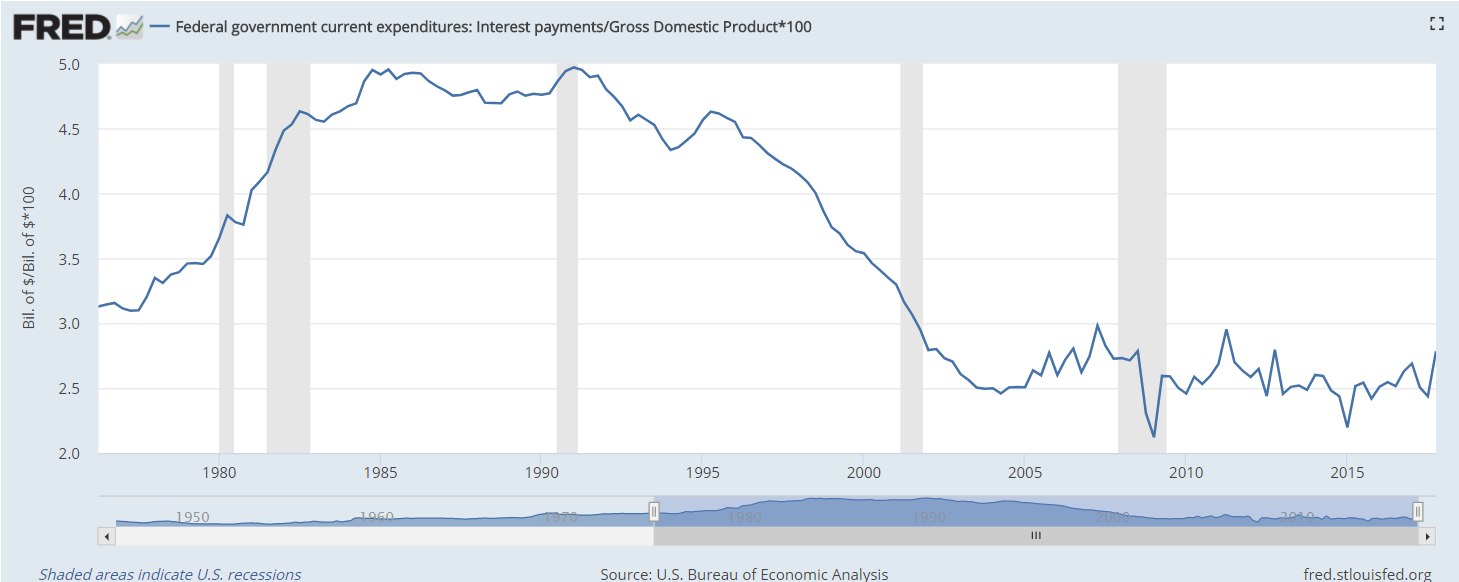
The government paid $550 billion in interest last year and is estimated to pay over $600 billion this year. That is just a $100 billion less than the defense budget. Because interest rates are historically low, the interest as a percent of GDP is low. We cannot expect that they will remain low.

InterestPctGDP

Interest rates were low in the 1950s. By 1970, they were over 7% and had climbed to 14% by 1980. Since the financial crisis ten years ago, central banks in China, Europe and the U.S. have been buying government debt. Central banks don’t demand higher interest. As their role diminishes, price-sensitive buyers like pension funds and households will demand higher interest rates (Bloomberg article). Recent Treasury debt auctions have been lightly subscribed, and the Fed is having to step in as a buyer to artificially make a market. Remember, the Fed is just another pants pocket of the Federal Government. In essence, the Federal Government is buying its own debt.   What can’t continue forever, won’t.

///////////////////

Housing

Have you gotten the impression that the housing market is going gangbusters? As a percent of GDP, housing investment is double what it was at the lows of the recession. The bad news is that current levels are near the historic lows of the post WW2 economy.

ResInvest

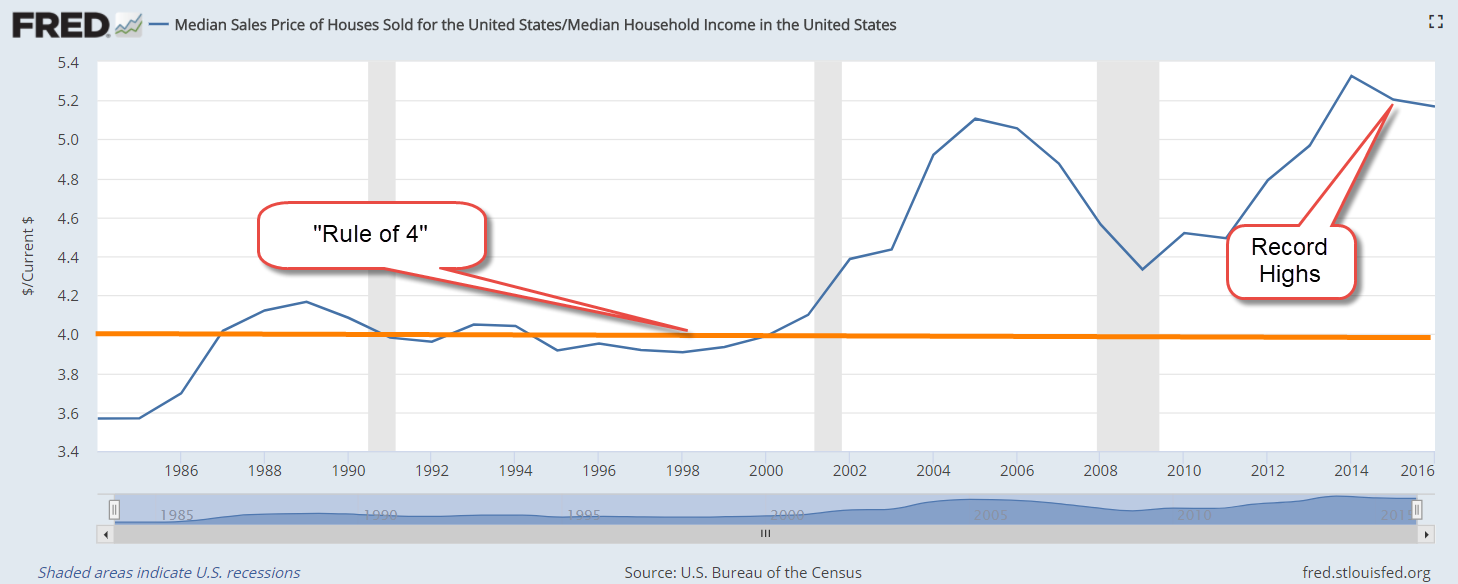
On the other hand, housing affordability has hit all time lows. A prudent rule of thumb is that a person or family should not spend more than 25% of their income on housing. A corollary of that rule is that a household should not buy a home that is more than 4 times their annual income. At 5.2, the current ratio is far above a prudent rule of thumb.

HousingIncomeRuleOf4

Government debt levels make the government, and us, vulnerable to any loss of confidence.  Low housing investment makes the economy less resilient.  High housing costs make it more difficult for families to save.  In a downturn, more families must turn to government for benefits.  Saddled with high debt levels and interest payments, government is less able and willing to extend benefits. The cycle turns vicious.


The Puff

February 25, 2018

by Steve Stofka

Each week I’m hunting scat, the data droppings that a society of human beings leaves behind. This week I’m looking for a ghost ship called the Phillips Curve, a relationship between employment an inflation that has had some influence on the Federal Reserve’s monetary policy. The ideas and policies of others, some long dead, have a daily impact on our lives. I’ll finish up with a disturbing chart that may be the result of that policy.

A word on the word “cause” before I continue. As school kids we learned a simplistic version of cause and effect. Gravity caused my ball to fall to the ground. As kids, we like simple. As adults, we long for simple. As we grow up, we learn that cause-effect is a very complex machine indeed. The complexity of cause-effect relationships in our lives are the chief source of our disagreements.

So, “cause” is nothing more than shorthand for “has an important influence on.” The dose-response mechanism is a key component of a causal model in biology. If A causes B, I should be able to give more of A, the dose, and get more of B, the response, or a more frequent response.

Let’s turn to the Phillips Curve, an idea that has influenced the Federal Reserve’s monetary policy since it was proposed sixty years ago by economist A.W. Phillips. Simply stated, the lower the unemployment rate, the higher the inflation rate. There is an inverse relationship between unemployment and inflation.

Inverse relationships are everywhere in our lives. Here’s one. The lower the air temperature, the more clothes I wear. I don’t say that air temperature is the only cause for how many clothes I wear. There is wind, humidity, sex, age and fitness, my activity level, social protocols, etc. While there is a complex mechanism at work, I can say that air temperature has an important effect on how many clothes I wear. If I measure the varying air temperatures throughout the year and weigh the amount of clothes that people have on, I will get a strong correlation. High temps, low clothes.

Now what if the temperature got colder and people still wore the same amount of clothes? I would need to come up with an explanation for this discrepancy. Perhaps there never was much of a relationship between air temperature and clothes? That seems unlikely. Perhaps clothes fabrics have been improved? I would need to look at all the other factors that I mentioned above. If I could find no difference, then I would have to conclude that air temperature had little to do with clothes wearing. Headlines would herald this new discovery. Important areas of our economy would be upended. Retail stores would stop stocking coats or bathing suits a few months in advance of the season. Businesses around the country who depend on warm weather clothing would go out of business.

Unlike air temperature and clothes, the relationship between inflation and employment is two-way. The change in one presumably has some influence on the other. During the 1970s, inflation and unemployment both rose. The hypothesis behind the Phillips curve posits that one should go up when the other goes down. Some economists threw the Phillips curve in the trashcan of ideas. Milton Friedman, an economist popular for his lectures and his work on monetary policy, proposed a concept we now call NAIRU. This is a “natural” level of unemployment. If unemployment goes below this level, then inflation rises.

Some economists complained that NAIRU was a statistical figment designed to fit the Phillips curve to existing data. Economic predictions based on the Phillips curve have been consistently wrong. Still, the Congress has mandated that the Federal Reserve maintain “maximum employment, stable prices, and moderate long-term interest rates” (Federal Reserve FAQs). Economists at the Fed must consider both employment and inflation when setting interest rates. The models may not accurately describe the relationship, but many will instinctively feel that the relationship, in some form or another, is valid.

For the past several years, the economy has been at or near maximum employment. In January 2018, the unemployment reading was 4.1%. Whenever that rate has been this low, the country has either been at war or within a year of being in recession. The puzzlement: only lately have there been signs of an awakening inflation.

Because inflation was below the Fed’s 2% benchmark while unemployment declined, the Fed kept its key interest rate near zero for seven years. For its 105 year history, the Fed has never kept interest rates this low for as long as it did. Low interest rates fuel asset bubbles. Such low rates cause people and institutions who depend on income to take inappropriate risks to earn more income. The financial industry develops and markets new products that hide risk and provide that extra measure of income. We can guess that these products are out in the marketplace, waiting to blow up the financial system if a set of circumstances occurs. What set of circumstances? We will only know that in the rear view mirror.

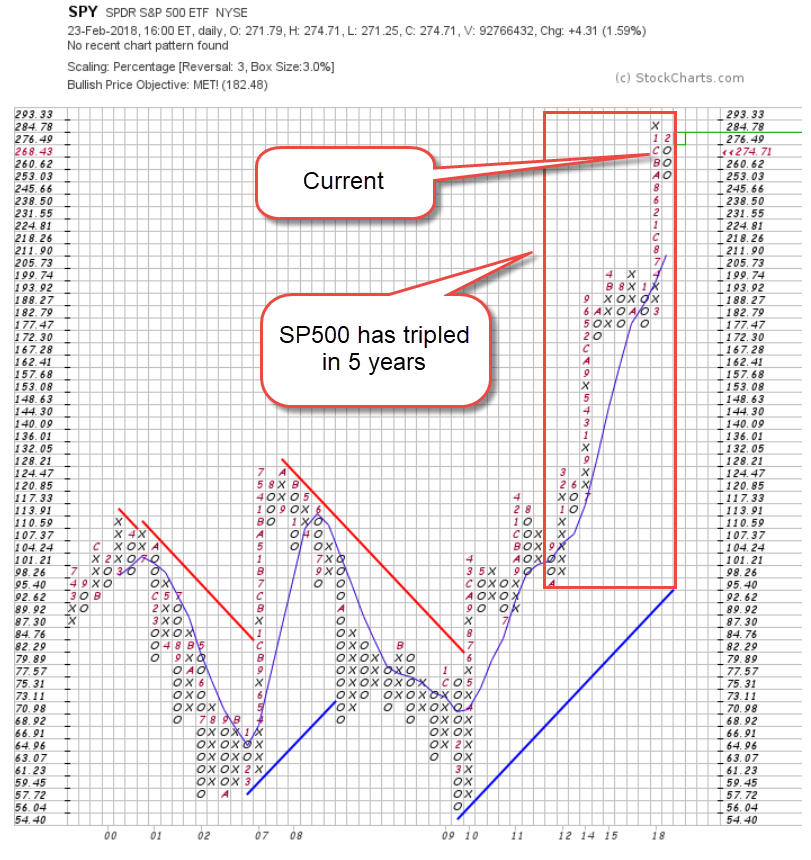
Here’s a chart that tracks price movement of the SP500 ETF SPY for the past twenty years. I’ve shown the tripling in price that has occurred during the past five years.  Notice the long stalk of rising prices. That growth has been nurtured by the Fed’s policy.  Well, maybe this time is different.  Maybe not.

SPYPF20180223