The Erosion of Inflation

August 13, 2016

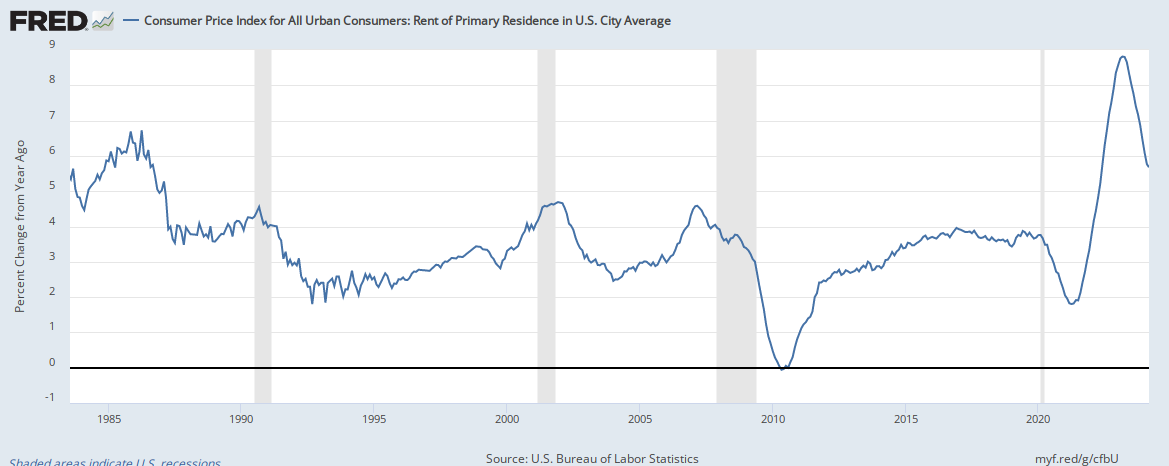
What is inflation?  Commonly regarded as the change in prices from one year to the next, we can also define it as the rate at which the value of money declines.  In classical monetary theory, inflation reflects government demand for private savings.  When savings can not meet the demand, immoderate governments create the money they need.  This influx of invented money leads to higher prices and inflation.

Higher inflation encourages borrowers, including governments, since they can pay back loans borrowed in Year 1 with money that is worth less in Year 2.  A person who borrows $100 for a year at 10% interest but with 10% inflation, pays back a total of $110.  But the $110 is only worth 90%, or $99, in purchasing power.  In effect, the lender has paid the borrower for loaning the borrower money.  In a case like this, no one wants to lend money at that interest rate. The lender must charge a higher interest rate, driving up the price of borrowed money in a self-reinforcing tailspin of inflation chasing interest rates chasing inflation.

Deflation, or negative inflation, discourages borrowing for the opposite reason; money borrowed in Year 1 is paid back with money that is worth more in Year 2.  That same $100 borrowed for a year at 10% interest and 10% de-flation is paid back with $110 that now has the purchasing power of $121.  In this example, the borrower effectively pays the lender 21% interest.

I marked up a graph of post-1850 inflation I found here to show several key points in the “hockey stick” of inflation.

The Federal Government borrowed and spent a great deal of money during the Civil War period 1860-65, driving up the rate of inflation.   With a  currency backed by gold and sometimes silver, it took several decades of intermittent deflationary periods to correct for the imbalance of the Civil War.

When the Federal Reserve was created in 1913, the value of a dollar was little changed since 1850.  The Bureau of Labor Statistics doesn’t compile data on inflation before 1913.  After a World War and a severe short recession, a dollar in 1920 was worth half of what it was in  1913 {BLS }

Several years of deflation after the stock market crash restored some of the value to the dollar until the Federal Government began borrowing large sums of money to fund Roosevelt’s New Deal.  Inflation accelerated under the heavy government borrowing for World War 2.

Even though Roosevelt had ended the ready convertibility of dollars to gold during the Depression, several countries wanted cooperation in setting an international monetary standard.  At the Bretton Woods Conference in 1944, a year before the end of World War 2, the price of gold was fixed at $35 per ounce, a dollar benchmark that effectively made the U.S. dollar the world’s reserve currency.
In 1971, the Nixon administration removed that fixed price and allowed the dollar to float in price against gold and other currencies.  Within two years, the rest of the developed world followed suit.  A glance at the chart shows that this is the bend in the hockey stick, the point where cumulative inflation marches relentlessly upwards.

As I noted at the start, some inflation encourages borrowing. The keyword is “some.”  High inflation introduces so much uncertainty into the economy that it becomes debilitating.  Workers can not negotiate wage increases fast enough to keep up with the speed of inflation,, so they reduce their real spending.  Lenders demand high interest rates when they lend money in order to compensate for the declining value of money.  The high rates discourage borrowing and crimp economic activity.

A reasonable and fairly predictable inflation rate allows debt burdened governments to pay back borrowed money with money that has less value. In half a lifetime, from the point in 1973 when most governments freed their currency from a gold standard, the U.S. dollar has lost 80% of its value.  For the first two decades of these past forty years, family income kept pace with that loss of value.  During the last two decades the value of a family’s labor has been transferred to governments whose elected officials devise programs to return some of that transferred value to the most disadvantaged families.

In real terms, personal incomes have more than tripled since 1973 {Graph} but most of those gains were in the twenty-five years ending in 2000 when real personal incomes grew by 135%, a 5% annual pace.  In the sixteen years since 2000, real incomes have risen only 35%, averaging slightly above 2% per year.  When the value of money declines, the only way to save value is to invest money in assets, and only those on the upper half of the income scale have been able to preserve the value of their money in assets.  The lower half on that income scale has struggled.

As the value of money has declined in the past forty years, money invested in assets have gained in value. The press goes goo-goo as the SP500 makes new highs but that is a nominal value.  The inflation adjusted value is barely above its value in 2000 (Table) but has tripled in real value since 1973.  Home prices have not done as well but have gained 50% since 1975 (Graph).  For many families, their house is the majority of their assets and the inflation adjusted Case Shiller home price index is still below the level of ten years ago.

Elections are a competition of ideas for solutions and this election is no different.  The chief theme has been the ever declining value of money and labor, the relentless struggle of those on the lower half of the income scale. Folks on the political left favor ever more government intervention and clamor for more social programs to reduce household expenses, including free college tuition,  childcare and medical care. On the income side, the left calls for a doubling of the minimum wage.  Higher taxes and more debt will pay for these solutions.

Folks on the right side of the political aisle are ruled by an ideology that opposes government solutions, believing that there always exist remedies from the private sector even if there are no proposals for a private solution.  However, even those on the right want more government spending, but of the military kind, where it can most benefit families and economies in rural communities.  Donald Trump is now calling for greater infrastructure spending but this is sure to anger the conservatives in his party.  Folks on the right claim that more spending will be paid for by lower taxes on upper income families and the magic of wishful thinking called optimistic economic assumptions and dynamic budget scoring

For more than four decades, the world has been engaged in an international game of currency manipulation to prevent the fair market pricing of each country’s currency. Nations newly industrializing disregarded or gave a knowing wink to international agreements on labor practices and environmental protections.  Now the populations of the developed countries are aging and their birth rates are falling, particularly those countries in western Europe.  Already high government debt levels are strained by a swell of retiring workers who want the pension benefits they have been promised.  Economic growth that is sluggish or non-existent can not meet the demands for services and benefits, prompting more government borrowing.

Promises in a Presidential campaign are like unicorns.  After the election, the candidate removes the horn and voters realize that what they got was a rather good looking but ordinary horse, not a magical unicorn.  Promises are nevertheless calling cards to a political vision, and the vision of both campaigns is a rally ’round the flag of the domestic economy and American families. Trump’s supporters are endorsing his call for tariffs on imported goods to punish those countries which subsidize their industries and make American products less competitive in price.  Hillary Clinton is now calling for penalties for company inversions, the practice of relocating the legal presence of a business overseas to lower a company’s tax liability.  To rally their troops each candidate promises to fight the international system that threatens the well being of many American families.  However, it is our own government that is part of that system, the war on the value of money, on the value of work.

Hillary’s America

August 7, 2016

Those of us who did not fall asleep in sixth grade civics class remember that the Democratic Party was the party of slavery in this country for almost two hundred years.  (To save some typing, I’ll use DP and RP for the Democratic and Republican parties.) Dinesh D’Souza, the maker of the political documentary “Hillary’s America: The Secret History of the Democratic Party” beats us over the head with that party association for about half the length of the film.

The film’s release was deliberately timed for July, coinciding with the conventions of both political parties.  The timing and the strong audience interest surely have the industry’s attention. In almost two weeks, the film had grossed over $5  million, admittedly weak compared to the usual movie offerings from Hollywood.  For a documentary, however, those are strong numbers.  I went to an early afternoon showing on a weekday, expecting a theater of mostly vacant seats.  Instead, I had difficulty finding a seat among a sea of gray haired retirees, the age demographic that votes in consistently high percentages each election.  The person manning the ticket booth later confirmed that the movie was the most popular daytime choice among the twelve movies it was showing.

The movie begins with the conviction and two year imprisonment of D’Souza, who contributed too much money to the campaign of a friend who was running for local office.  An innocent man persecuted by our legal system, we are told.  A sentence that was hardly commensurate with a technical violation of election law.  D’Souza had my sympathies until he attributed his plight to a vendetta by President Obama who evidently orchestrated this judicial persection of D’Souza in retribution for earlier documentaries that D’Souza had created.  What was next, I wondered?  The Illuminati?

Taking notes during the film, I did some fact checking afterwards.  Did D’Souza go to prison for two years?  Not according to this NY Times article.   By law, the judge could have given D’Souza two years but declined to do so.  The details of the trial are here. The reader will see that this was not an innocent mistake of  mistakenly writing one too many checks to a political campaign. The audience is led to believe that several scenes and conversations that occurred inside the jail were during D’Souza’s two year sentence.  They might have happened while he was in detention, not a pleasant experience, for sure, but not two years in prison.

D’Souza makes the claim that Obama rules over an urban plantation of blacks, other minorities and immigrants, following a template laid down by rural southern plantation owners and urban DP politicians.  Obama’s political background is rooted in the state of Illinois where Democratic mayors and a gang of political cronies have ruled Chicago through a system of voter impressment, physically forcing immigrants and blacks to the ballot box. D’Souza neglects to mention that the most corrupt mayor of Chicago was “Big Bill” Thompson, a Republican whose two terms during the Prohibition era set the template of power and corruption that marked successive administrations in the city. But this is not a Republican Party hatchet job, is it? More inconvenient facts, darn it.

D’Souza makes the case that FDR’s reign during the Depression era 1930s marks the beginning of the Democratic theft of America.  Whether it was a theft is a matter of opinion.  As Lincoln did, FDR used the crisis to help rewrite the relationship of the Federal government to the states and its citizens.

During some forty minutes, the movie documents the many horrors of slavery by Democratic landholders. The moral rot at the heart of the DP is evidenced by the election of a savage, ruthless man to the highest position in the land.  Andrew Jackson was a Democratic President who treated his slaves worse than farm animals and forced Indian tribes on a long death march from their ancestral lands.  The party of slavery and Jim Crow laws now tries to market itself as the champion of blacks and minorities.

As with other documentaries of political propoganda – yes, Michael Moore, I’m talking about you – there are careful omissions of fact and context as well as just plain old sloppy research.  Facts are sacrificed to the cause the film promotes.  D’Souza tells us that Abraham Lincoln started the Republican Party, a falsehood that is easily checked by anyone with a cell phone.  Why tell such balderdash? D’Souza wants to stress that the RP, which began as a friend to the blacks, is still a friend of the blacks and other minorities.

D’Souza notes that it was Republicans who took land from the defeated Democrats after the Civil War and gave it to the blacks who had worked those lands.  On the face of it, this is true.  Now for the rest of the story, as broadcaster Paul Harvey would say. In the Reconstruction period following the Civil War, Republican politicians took over state legislatures and did award white owned farms to the newly freed blacks.  Many blacks, illiterate and unschooled in the management of a farm, lost the newly awarded lands to tax forfeiture.  Republican legislators and their friends were at the courthouse when the lands were auctioned and became the new owners of the land for a paltry sum.  That unlovely coincidence of human greed surpasses all political affiliation.

Emphasizing the point that it is the Democrats who are the party of racism, D’Souza recounts Democratic President Woodrow Wilson’s sordid sentiments toward blacks, his endorsement of the KKK and the hosting of a White House screening of the D.W. Griffith film “Birth of a Nation.”  D’Souza includes several clips from the movie to cement the association between the Democratic Wilson and slavery.

D’Souza dramatizes a scene where Wilson repulses the efforts of Ida Wells, a black journalist and activist, who attempted to get the President’s help to stop lynchings in the Democratic South.  Left out is the fact that Wells had been unable to get cooperation in this cause from a Republican President, William McKinley (Source).  In 1918 and subsequent Congresses, there were repeated Republican efforts to pass anti-lynching legislation but they were blocked by Democratic Senators (See notes at end).

The RP is a friend of women as well as blacks, D’Souza tells us.  After all, a Republican Congress passed the women’s suffrage amendment.  What we are not told is that Republicans specifically excluded women from the draft language of the 14th Amendment.  As this historian notes, “History is messy.”  Inconvenient facts are tossed aside to present a consistent narrative with a simple, clear message.  Donkeys bad.  Elephants good.

Although Democratic President Lyndon Johnson signed the Civil Rights Act of 1964 into law, D’Souza reminds us that it was the Republicans who overcame a Senate filibuster of the Act by southern Democrats.  One more reminder in an election season that the RP has been a friend to blacks.  Republican efforts to make voting by blacks a bit more difficult is conveniently left out of the narrative.

D’Souza dismantles the notion of a party switch, the idea that southern racist Democrats switched parties and are now Republican.  To refute this theory popular in Democratic circles , D’Souza shows a graphic of the 1500 KKK leaders and Democratic politicians in the southern states in the 1960s.  After the passage of the Civil Rights Act, less than 1% switched parties.  The graphic is a visually powerful argument but there is little explanatory information with this graphic. What years are compared? Why include the KKK members?  How were the party affiliations of these members checked?  A comparison of election maps before and after the passage of the Civil Rights Act makes it clear that there was a party switch.

In the 1960 Presidential election, most of the southern states, including Johnson’s home state of Texas, voted Democratic. This election map shows the southern blue voting block.  The Civil Rights Act passed in July 1964, a few months before that year’s Presidential election.  Texas stayed with Johnson but five Southern states went Republican, as this election map shows. (You can also toggle the election year above the map.)

In the 1968 election, four of those five southern states voted for George Wallace, the former Democratic governor of Alabama who had refused to integrate public schools in the state. Running as an Independent and a champion of segregation and states’ rights, Wallace won about 10% of the electoral votes, a feat achieved by no third party candidate since. (Map)

Clearly now the southern states were in the hands of Republicans and segregationists. Or were they?  In the 1976 election, many southern states voted for Jimmy Carter, a fellow southerner and the Democratic governor of Georgia. (Map)

The appeal of political propoganda documentaries is that they simplify history by carefully filtering out the confusion of contradictory events and data.  We would all like to disregard the complexity of human behavior, the conflicting loyalties that confirm the chaotic in human affairs.  We want tidy circles, not ragged inkblot shapes.  What keeps historians busy in a lifetime of academic research and study can be easily brushed aside by the makers of message films.  Darn it, we’re still arguing over the causes of WWI  and that was a century ago!

Champions of slavery, tolerant of racist Jim Crow laws and lynchings in the southern states,  the DP has also supported eugenics laws.  D’Souza implies that this is part of a continuing effort to eradicate the black race.  No longer able to use black people as free slave labor, the DP seeks to rid the country of them through sterilization and abortion.

Margaret Sanger, the founder of what is now called Planned Parenthood, was also a champion of eugenics (see here),  as were many progressives.  In today’s political alignment, progressives are part of the DP, but they used to be part of the Republican Party when the eugenics movement first gained popular strength.  Led by President Theodore Roosevelt, the progressive movement was responsible for workplace and social reforms, and the creation of the first national parks.  Eugenics was an “enlightened” and scientific idea at the time, but horrifies us now. Hitler’s devotion to the concept impelled his commitment to the methodical destruction of the Jewish race, and the wholesale slaughter of Slavs and Communists who surrounded and threatened the noble German race.

Linking Sanger with another group devoted to the suppression and eventual eradicaton of the black race, D’Souza shows a picture of Sanger at a KKK rally as proof of her association with the racist group. The researchers at the debunking site Snopes showed that this was a doctored photo .  Sanger did speak before a NJ women’s chapter of the KKK as part of her effort to speak about birth control to as many groups as possible.  In her autobiography, Sanger wrote about the meeting and the strangeness of the experience so D’Souza uncovers no dark and hidden secrets.

Sanger wrote that she wanted Negro parents to have the ability to make the same family planning decisions that white parents did.  She envisioned a day when Negro parents had the same access to hospital services for their births that white parents did.  She wrote ” Some day … there will not be a single section of the country without adequate hospital facilities for all. But until that day is here, Negro mothers should be given all possible protection against needless sacrifice through childbearing.”  Doesn’t sound like someone who wants to eradicate the Negro race, does it?

D’Souza’s message is that abortion and sterilization are the twin weapons of the eugenics movement.  Although sterilization was discontinued after the 1970s, abortion remains a tool of the eugenics movement primarily aimed at black women and the gradual reduction of the black race in America.

As evidence of this, D’Souza notes that the majority of Planned Parenthood (PP) clinics are in black-majority neighborhoods.  Protecting Black Life, a pro-life advocacy group, has an interactive tool using 2010 census figures that verifies the correlation of clinics in black and Hispanic neighborhoods.  With a tendency to have lower incomes, these minority population may simply use PP’s services more frequently, prompting PP to position their clinics in these areas.  Secondly, lease rates are lower in these neighborhoods and are attractive to an organization with constant funding needs.  However, those are boring pedestrian explanations for the correlation of locations.  D’Souza’s more dramatic explanation is that the location of PP clinics is part of a DP master plan of genocide.  Republican presidential candidates Herman Cain (2012) and Ben Carson (2016) have made accusations similar to D’Souza’s (WP article)  Maybe D’Souza will write the next Jason Bourne film?

A conservative propoganda piece must include Saul Alinsky, the anti-Christ of liberal politics who wrote “Rules For Radicals.”  The 1971 book consisted of tactics that a community organizer might use to knit low income communities into a more powerful voice at the political bargaining table. Confrontation and conflict are themes common to many of the tactics.

Political propoganda consists of a series of “dog whistles” familiar to the target congregation.  Conservatives are quick to tar any Democratic politician with the epithet “Alinskyite” as in “Alinskyite ideas.”  The congregation barks with approval.

Obama was only ten years old when Alinsky died in 1972 but Obama was a community organizer who has quoted Alinsky.  The quotes are not direct but close enough that any true conservative can see that Obama is a commie radical like Alinsky.  In Chapter 2 of Rules for Radicals, Alinsky wrote about the world as it is and the world as it should be. When Obama uses the words “world”, “is” and “should” in the same sentence, he is quoting Alinsky and professing to be a Communist.  I totally get that.  Here is one example of this kind of dogmatic analysis.

In a 1963 speech, President Kennedy – yes, a Democrat – differentiated those who saw the world as it was and asked why, and those who dreamed of what the world could be and asked why not.  His brother, Robert Kennedy, used the phrase as well in several speeches.  In that same speech, JFK  attributed the original quote to Irish playwright George Bernard Shaw.  Using the logic of this conservative accusation, we can assume that anyone who has dreams about a better world is a disciple of Alinsky and yes, a radical Commie Utopian.

The movie’s title begins with Hillary’s America, so when is D’Souza going to show us Hillary’s secrets?  Why, just about now. Hillary Clinton actually wrote a student thesis on Alinsky.  As president of the student club, Hillary invited Alinsky to speak at Wellesley College. The audience does not have to be good at math to realize that Hillary Clinton = Communist.

As the student commencement speaker at her graduation from Wellesley in 1969, Hillary went off script to chide the guest speaker, Republican Senator Edward Brooks, an African American, about his remarks (Transcript of Hillary’s speech). D’Souza dramatizes it for his audience. White girl at Wellesley rebukes black senator, showing no respect for either his position or his race.  Senator sits quietly in chair on dais as Hillary says these disrespectful words.  Bad Hillary.

Here is a piece of Hillary’s remarks: “we feel that for too long our leaders have viewed politics as the art of the possible. And the challenge now is to practice politics as the art of making what appears to be impossible possible.”  Any conservative can see what she is saying.  We feed her words into the conservative de-confabulator and out pops the translation. She is talking about the world as it is and as it should or could be.  Alinskyite Communist thinking of a better world, for sure.

D’Souza left out the Senator’s remarks that prompted Hillary’s response. Senator Brooke adopted what was a mild authoritarian posture typical of the time.  Student protests against the Vietnam war, discrimination and entrenched power structures occurred almost weekly, it seemed.  He said: “Dissent and protest are essential ingredients in the democratic concoction. Without them an open society becomes a contradiction in terms, and representative government becomes as stagnant as despotism. Yet there is a narrow but distinct line between productive dissent and counter-productive disruption.” (Transcript of Brooke’s speech)

Brooke cautioned against protest for the sake of protest, sentiments that sound reasonable to most American ears today.  Other elements of the speech would be typical of today’s moderate Democrat or Republican, animals who may have been driven to extinction in the current era of polarized opinions.  Only a Republican very secure in his seat would dare to give such a speech today.  Brooke endorsed the growth of the many Federal government cabinets recently created to combat housing and job discrimination, poor education and poverty.  Yes, a Republican endorsing bigger government. He was practically a Socialist in the eyes of some conservatives today! What did bad Hillary find wrong with those sentiments?

Hillary’s response is rather tame for the period when there was open antagonism between the rulers and the ruled. D’Souza uses a snippet of a sentence taken out of context to portray Hillary as an uncivil person with little respect for authority.  That’s the message of this segment of the film.  Hillary bad.

These days ain’t those days.  There, I said that and you can quote me.

Rulers had rigid rules that gave most of society’s power to men, not women.  Hillary spoke for many who wanted a change.

The rulers said war was necessary and that the ruled were supposed to go fight the war to stop Communism.  The ruled were ordered to fight but were not allowed to vote. The ruled broke things in protest.

At the universities, rulers had clearly defined and time honored curricula choices that reflected the prejudices and preferences of past generations.  The ruled wanted a greater voice in curricula selection.

The rulers had a grading system that seemed arbitrary to the ruled.  What is the difference between a B+ and a B paper?  With few consistent rules to guide the grading process, wouldn’t a pass-fail grading system make more sense?  No, the rulers said.  Rulers make the rules and students follow them.  Is that clear?

Those were the good old days.  College students today are surprised when they hear of these old rules, most of which have been either abandoned or dramatically altered.  The ruled stormed the forts of power and the rulers compromised so that they could continue ruling in whatever capacity they could manage.  Some of the ruled became the rulers.

I do encourage the reader to read the speeches of both Hillary and Brooke.  Hillary’s speech is the shorter, for sure, but both speakers are rather moderate and deliberate, remarkable in an age of sometimes murderous (Kent State) and often bloody (Columbia U. and others in NYC, for example) protests.

Having established that Hillary is a socialist, anarchist Communist, D’Souza then shows the tragedy of her personal life.  For several decades she has been covering up for the sex addiction of her husband and former President Bill Clinton.  Democratic Party = slavery = sexual deviants = Communism = Godlessness = bad.

I was busy writing out D’Souza’s equations when I realized that I was going to miss an appointment.  I had to miss the final 15 minutes of the film but I suspect that D’Souza was going to finish with the tragedy at Benghazi and Hillary’s personal email server while she was Secretary of State. If you want to know how the film turned out, you can rent it on Vudu or spend a couple of hours at your local theater.  I have now seen a Michael Moore film and a Dinesh D’Souza film.  As Johnny Cash sang, I walk the line between either extreme.  I hope I can keep my balance.

//////////////////////////

Notes:

“We urge Congress to consider the most effective means to end Iynching in this country which continues to be a terrible blot on our American civilization.”  Republican presidential platform, 1920. In the House, Republicans held a 50 seat majority, 240 seats to 192 Democratic seats.  In the Senate, Republicans had won a 49 to 47 majority in the 1918 elections.  Repeated Republican efforts were blocked by Democratic Senators (more here)

The claim that Lincoln founded the Republican party is incorrect.  Here and here.

In Buck v. Bell (1927), the Supreme Court ruled that state sterilization laws were legal.  As further evidence of the DP’s efforts to eradicate the black race, D’Souza notes that it was Oliver Wendell Holmes, a Progressive, who wrote the court’s majority opinion.  D’Souza omits the fact that a Republican President, Theodore Roosevelt, appointed Holmes to the court and a Republican majority Senate approved the appointment.

Turning Toward

July 31, 2016

The Fourth Turning

A favorite historical device of the Western tradition is the timeline, running straight from the past to the future.  Cyclic models of history are less popular and circular models seem too formulaic, even primitive, for historical narrative.   Surely, Neil Howe and William Strauss, authors of the 1997 book “The Fourth Turning,” understood that their model might encounter a cool reception from the academic community.

Published a few years before the millennium and the Y2K scare, the book recounted the historical pattern of generations from 1500 through 2000, before taking on the ambitious task of predicting the pattern of events for the coming twenty years.  While researching a previous book “Generations,” the authors discovered a repeating pattern of responses to events.  They developed a model of four generational archetypes spanning the range of a human lifetime.  Every twenty years or so each generation passes into another phase of life, from childhood to adulthood, to middle age, then the elder years.  The authors called these passages “turnings.”

Every 80 years or so, every fourth generation, begins a period of crisis. The authors had projected this current fourth turning to last from approximately 2004 – 2026, understanding that these turnings are not fixed to a calendar. Although the authors trace the turnings back to 1500, previous crisis fourth turnings that we are familiar with are the American Revolution 1773-94, Civil War 1860-65, Depression and WW2 1929-46.

During a crisis period comes a pre-crisis strain that primes the scene for the main crisis.  Each crisis revolves around the social contract, the relationship between individuals and their government.  The resolution of the crisis occurs during the first turning in which a new version of the social contract is forged.  The leaders of these resolutions are the generation in middle age, approximately 42-62.  [So us Boomer parents better be nice to our kids 🙂 ]

In predicting the current crisis period, the authors pulled no punches.  Chapter Ten of the book is titled “A Fourth Turning Prophecy.” The time frames of these prophecies are approximate because they predict behavioral trends.   It has been almost twenty years since the book was published and it surprised me how well the authors understood the trends and ingredients of the crises that have occurred in the past decade.  Frankly, I hope that the authors are wrong about the coming decade when a generation of crisis intensifies and forces a resolution.

The authors predicted a financial crisis about 2005 and sketched a number of other plausible scenarios typical of a generation of crisis.  “The era will have left the financial world arbitraged and tentacled: Debtors won’t know who holds their notes, homeowners who owns their mortgages, and shareholders who runs their equities – and vice versa.” (p. 274 of the Broadway Books 1998 paperback edition)  Sound familiar?  Remember, this was written twelve years before the 2008 financial crisis.

The authors caution that these scenarios are archetypes, unlikely to happen in detail as written and yet the generalities are both scary and prescient. The hypothetical scenarios include terrorists blowing up an airplane, a government shutdown precipitated by a federal budget stalemate, the spread of a new communicable virus and an increasing aggression by Russia toward its former satellite countries. “All you know in advance is something about the molten ingredients of the climax,” the authors wrote.

Twenty years before the main crisis event, the nature of the crisis is difficult to see, the authors cautioned.  A series of crises weaken the social order and people’s expectations, creating tensions between groups in society.  We could use the analogy of tectonic plates to understand the economic and social frictions that build over time until the earthquake is finally triggered.  While a particular event is the catalyst for the main crisis, it is not the cause of the fracturing of the social contract.

The frictions can be promises made to one group that can not be kept.  Technological change may bring economic changes that favor one portion of a society and disadvantage others.  Political changes may pose constitutional challenges that are resolved with violence.  Long simmering military antagonisms may finally break out into war.  These are only a few frictions in a long list presented by the authors (p. 277).

The authors can be forgiven for a few incorrect predictions – that the government would hike taxes in response to a financial crisis or depression.  Perhaps they were misled by the economically conservative mood of the nation at the time when they wrote the book.  The authors did not anticipate that the Federal government would quadruple the Federal debt over fifteen years in response to 9-11 and the 2008 Financial Crisis.  They did not foresee that the Federal Reserve would add four trillion to its balance sheet to absorb the bad securitizations that contributed to the Financial Crisis.

Twenty years ago, the authors guesstimated the onset of the main crisis in the year 2020 followed by a six year period of resolution.  As I noted earlier, it is the middle aged generation that leads in the formation of solutions to these crises.  In this case, those leaders would be the children of the Boomers, the cohort labelled “Generation X” in sociological and popular literature.

Criticisms, controversy and praise for the generational model presented by the authors can be found at a Wikipedia article, which has been flagged for its lack of neutrality. Should a decade pass with no crisis, we could rest assured that the theory is totally bonkers pseudoscience.  There are a few problems, however, that could precipitate a crisis: 1) a federal debt approaching $20 trillion; 2) terrorist acts in the news each week; 3) many trillions of dollars in Social Security and  public pension promises that 80 million Boomers are beginning to redeem; 4) immigration, tax and other  policy disputes over who is entitled to what and who pays what.  These are some of the groaning sounds of tectonic frictions in our country.

Californians live with the possibility of a “big one,” a monster earthquake unleashed at the San Andreas fault that runs along the mountain spine of the state.  Each person silently hopes that the inevitable doesn’t happen in their lifetime.  Count me among that bunch.

It’s Never Happened Before

July 24, 2016

It’s often been said that everyone is entitled to their own opinion but not to their own facts.  Repeated experiments have shown that, through a process of cognitive filtering, we do form our own set of facts. First we filter what we recognize, then we assign different degrees of importance to what we do recognize.  The world is a big lump of Play-Doh that we pull parts from then shape it into a personal ball that we call reality.

Several decades ago when computer development and design was still fairly primitive, computer scientists envisioned the develpment of algorithms that allowed computers to act with the mental versatility of human beings. Many hoped that this new technology, called artifical intelligence, or simply AI, would be implanted in robots which would handle menial or dangerous tasks, making our lives both safer and less tedious.  Soon robots were deployed on factory floors and were highly effective at repetitive tasks.  The deployment of AI was but a few years distant, it seemed.

The AI project soon ran into difficulties when robots tried to navigate a room with only a few obstacles.  What was a routine task for a two year old toddler was extremely difficult for a robot.  Programmers struggled to write algorithms to distinguish and describe just the shadows of objects, and were especially frustrated that a puppy a few weeks out of the womb could do a better job at navigating a room than the most beautifully complex algorithm they could devise.

A decade or so later, Google and other tech firms are test driving cars with autonomous navigation.  How have AI algorithms progressed from negotiating the obstacles in a room to navigating a highway at 65 MPH?  Working with behavioral scientists and psychologists, programmers began to uncover a rather unflattering but powerful model of human learning, one that philosopher David Hume had posited almost three hundred years ago.

Hume was just a teenager when Isaac Newton, perhaps the greatest scientist that ever lived, died in 1726.  Newton formulated the fundamental laws of motion and gravitation.  Hume, on the other hand, put forth the radical notion that we can not know cause and effect, only the correlation of events. We can imagine that Newton rolled over in his grave a few times at this proposal. Hume contended the forces of motion that Newton had proposed were highly probable correlations only.

Scientists dismissed Hume’s skepticism.  For all practical purposes, the universe was bounded by the laws of classical mechanics that Newton had devised.  Scientists went on to develop a model of a clockwork universe created by God that obeyed a set of rules invented by God and thank you very much.  There was apparently little more to discover until two scientists, Albert Michelson and Edward Morley, went to measure the aether, a fundamental component of the clockwork universe.  They couldn’t measure it.  This “undiscovery” rocked the world of physics because it undermined the theories of planetary motion, of gravitation, and the behavior of light.  Undiscoveries are as important as discoveries.  A hundred years before the Michelson-Morley experiment, chemists were unable to find phlogiston, the supposed fundamental cause of combustion, and caused a radical revision of chemical theory.

Twenty years after the Michelson-Morley experiment, Albert Einstein presented his Special Theory of Relativity but even that theory could not fully explain gravity.  A decade later and a hundred years ago, Einstein theorized that our perception of falling was an illusion based on our perspective, a vantage point as we were falling along the surface, or field, of space time.  The system of relative motion that he introduced has radically altered the science of physics since.  Einstein had introduced the same skepticism to the physical sciences that Hume had introduced to philosophical inquiry.

During the past two hundred years mathematicians have developed a number of statistical tools to measure not only the correlation between events, but the correlation of our past predictions based on correlation. As processors became more powerful and memory storage more compact, programmers turned to those statistical tools to enrich their AI algorithms. A baby can not find its own hands at first.  Through trial and error the baby develops a sensory system called proprioception that is not confused by the conflicting data from the baby’s eyes.  When the baby moves both hands in opposite directions to the center of her vision, the hands have more of a chance of colliding together.  The sense of touch confirms the contact of the two hands.  There may be a slight sound. The brain learns the coincidence, the correlation of these phenomena and forms a learning model of cause and effect.

Shortly after the financial crisis in 2008, the former head of the Federal Reserve, Alan Greenspan, testified before Congress about his personal set of beliefs of cause and effect in finance. Because this set of circumstances had not happened before, Mr. Greenspan thought that it could not happen.  Didn’t he see the dangers of 30-1 leverage ratios by major banks in the U.S.?, Greenspan was asked.  Yes, he saw them but did not fully appeciate the degree of danger.  The rash stupidity of bank officers, the disregard for their own welfare, surprised and disturbed him most.  He could not understand that intelligent people could act with such utter disregard for their own self-interest.  Of course, the bankers didn’t have to look our for themselves.  They paid politicians in Washington to do that for them.

Greenspan is a very smart man, as are most of the economists and financial wizards who did not understand the dangers of the synthethic debt instruments that were being created and traded.  Why?  Because it had not happened before.  We are all subject to this fault in judgment.  We are so guided by past experience that it skews our judgment, our ability to assess both risk and opportunity.

 It has been seven years since the market low in March 2009, seven years since the official end of the recession that began in December 2007 and ended in June 2009.  The Shiller price earnings ratio of the SP500 index is very much higher than average.  Even the conventional P/E ratio, the TTM or Trailing Twelve Months ratio, is about 23; the historical average is less than 17. Here is an excellent recent review of P/E ratios.  Low oil prices have helped cripple earnings growth for the SP500 index as a whole but even when excluding energy stocks, both revenue and earnings growth has shrunk.  Yardeni Research has put together several graphs to illustrate the trend.

The Money Flow Index (MFI) is an oscillating measure of buying and selling pressures based on both volume and price.  This index usually ranges from 20 to 80 on a scale of 0 to 100.  This month, the 12 month reading of the SP500 fell below 40.  Such a low reading has been associated with a long period of a rather flat market as happened in 1994-1995.  More often, a low reading is associated with subsequent falls in equity prices, as in early 2000 and late 2007.  Toward the end of 2008, this index fell below 20, indicating extreme selling pressure.  We only have past correlations to guide us.

Bond prices are high.  Vanguard’s ETF of intermediate term bonds, those with maturities of five to ten years, are now yielding less than 2%.  As bond and stock valuations have climbed, have we adjusted our portfolio allocation to stay within our guidelines?  Oops, did we kind of forget to even look anymore?  Did we get lulled into a sense of security?

Saving money is a gamble on the fact that we will get older.  Most of us will experience some reduction in our physical abilities, and a corresponding decrease in the amount of income we earn from our labor.  Saving money therefore seems like a really safe bet.  Once the money is saved, though, another series of gambles begins and these bets are far less certain.  Where to put those savings so that we can get a reasonable balance of return and risk?

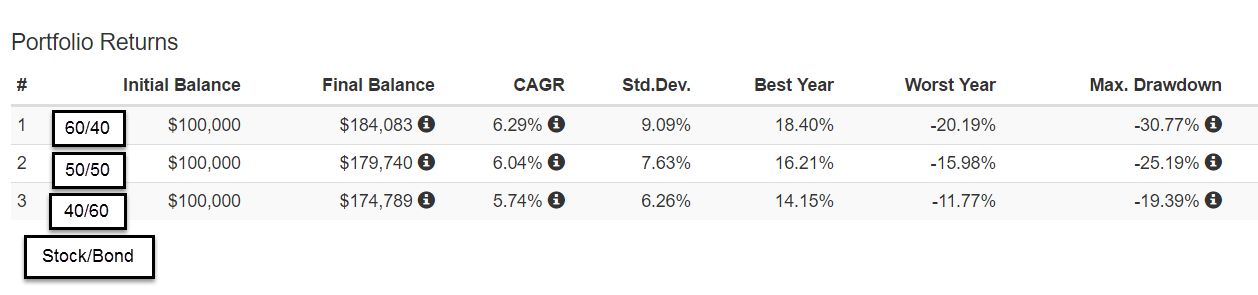
 For a short time both the stock and bond markets can experience a surge in selling as they did in 2008. When investors are scared, they run like deer into the safety of cash. After the initial reaction, one or the other of these asset groups will continue to feel selling pressure.  This is why most advisors recommend some balance of stocks and bonds. If the stock market were to drop 50%, or the bond market drop 20%, and stay down for five years, would we be able to meet our income needs?  Such a downturn might be welcome to a 35 year old who can buy equities at a lower price.  For seniors near or in retirement who might have planned to convert some of those higher valuations into income, such a downturn can be devastating.  If such a scenario would be a crisis for you, then it is time to assess your situation and perhaps make changes.

All Aboard!

July 17, 2016

I have changed the blogger template to make it easier to read on a mobile phone. On my Android phone, the dynamic template defaulted to classic view without all the widgets on the side and was easier to read. The graphs are easier to see in landscape mode, when the long part of the phone is horizontal to the ground. Perhaps some readers can give me some feedback if there are problems viewing on an Apple phone.  Now on to this week’s business!

As I noted last week, things can get a bit ugly when both stocks and Treasuries surge upward at the same time, as they have in the past few weeks following the sharp downward response to the Brexit vote in the U.K.  The buying of stocks signals that investors have more of an appetite for risk.  The buying of Treasuries and gold signal a desire for safety.  At the beginning of the week the world woke up to the news that the Japanese central bank was going to provide a lot of stimulus to goose economic growth.  This gave a boost to Asian stocks and the rally in equities was on.  By the end of the week, the Japanese stock market had risen 8% during the week and it’s currency, the yen, had fallen the most since 1999.

Economist Paul Krugman has called on Japanese policy makers to set higher inflation targets and provide even more stimulus to spur an economy now lethargic for two decades.  According to Krugman’s own textbook, the roles of an economist are 1) to describe the economic and market mechanisms; and 2) form predictions of how the economy and market would react if certain policy actions were adopted.

However, Krugman has a lot of visibility as an op-ed writer in the NY Times.  In this role, he often offers prescriptive solutions, and this week’s call is yet another prescription from Dr. Krugman.  Japan has been basing their policies on Krugman’s predictions for a decade with mixed or muted results. More stimulus seems to be the eternal cry from Krugman, a smart man who seems to have but one or two solutions for the majority of social and economic problems.

Most economists are rather circumspect, arguing among themselves the mechanisms and validation of varied predictions.  But there are a few stand outs who reach out to the general public, ready and willing to engage in the political debate.  The subfield of economics called macroeconomics forms a beautiful mud pit for the struggle of political policies, for politicians often cite macroeconomic rationale when championing a set of policies.  For thirty years, Nobel winner Milton Friedman espoused a more conservative and monetary model of the economy, emphasizing montetary, not fiscal, policy by the central bank as the chief intervention in the market economy.  Search YouTube and you will find many of his talks and lectures and they are both informative and entertaining.

Krugman is one of the more vocal macroeconomists who diagnose economic maladies, build a predictive model based on policy or monetary fixes, then diagnose their model when their predictions are in error.  The patient didn’t take enough of the medicine or there is some response lag or the full extent of the problem was not known or was disguised by something or other.  The descriptive aspect of macroeconomics doesn’t seem to help develop a predictive model.  Perhaps the study of economic phenomenon on a national and international scale is just too difficult to have much predictive ability. Let’s hope not.  For the past decade, so many really smart people have been wrong.

Once again this week, central bankers signalled that they were ready to adopt what are called accommodative policies to reassure markets.  If stock markets were an athlete with a knee injury, central bankers would be the good doctor who drains the knee then injects a bit of pain medication and cortisone into the joint before sending the athlete back onto the field.

////////////////////

Retail Sales

Wildlife scientists may study herds of grazing animals to gain insight into both the seasonal behaviors of the herd and its response to conditions that alter the animals’ environment.  These include drought, war, or the burning of forests for farmland.  Economists follow a different kind of herd – people.

Macroeconomists focus on the behavior of the entire herd; microeconomists analyze the behavior of individuals acting within the herd.   Two telltale signs of human behavior are paycheck stubs and sales receipts, which act in tandem like entangled particles in a quantum dance.  In this consumerist economy, retail sales are fueled by the earnings of 140 million workers; the monthly reports on each activity guide the analysis of economists.

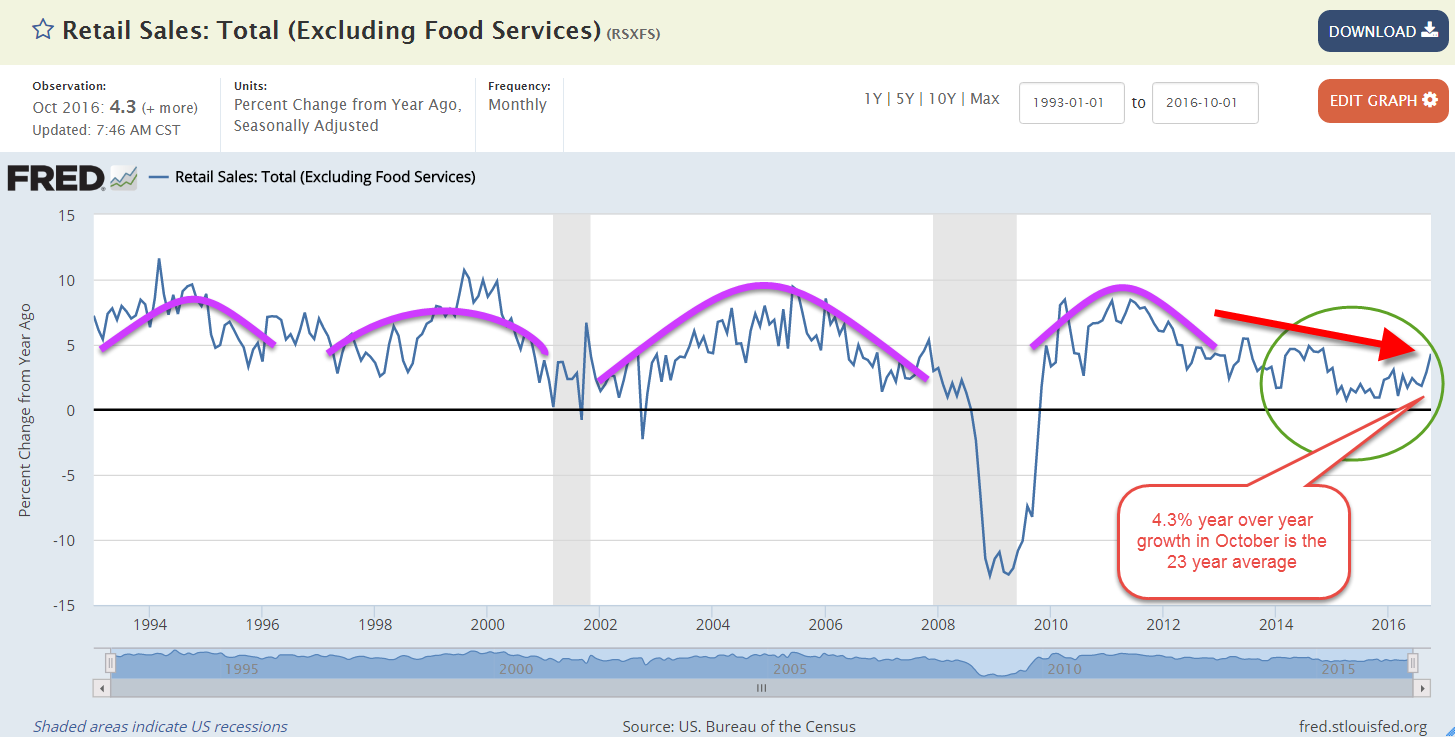
Each month a sample of paycheck stubs is gathered and reported by the Bureau of Labor Statistics.  The Census Bureau produces an estimate of retail sales based on a survey of almost 5000 companies.  (For those interested in the methodology.) Year-over-year growth in real, or inflation adjusted, sales fell below 1% in March this year and spurred some concern that consumption power was being eroded by slow income growth. Following the extraordinary labor report a week ago, the monthly retail sales report, released this past Friday, was stronger than the consensus.  Inflation adjusted sales rose 1.67% over last year, rising up a 1/2% from May’s year-over-year reading.  2% real growth would be ideal but anything over 1.5% is a sign of a growing economy. Why the 1.52% threshold?  1% of each year’s growth can be discounted as simply population growth.
 
On a sobering note, the year-over-year growth in retail sales is gradually declining as we can see in the graph below.

What negative signs should an ordinary investor watch for?  Where is the herd going?  Investors should get cautious when year-over-year growth in real retail sales consistently falls below 1.5%.  After December 2006, growth remained below this threshold and did not cross back above it till March 2010 – a period of 3-1/4 years that darkened the lives and hopes of many Americans.  During that period January 2007 through March 2010, the SP500 index fell from about 1440 to 1170, a decline of 19%.  We are part of the herd but with some observant caution we may be able to move some of our savings to the fringes of the herd movement and avoid getting trampled.

///////////////////////

MyRA

Earlier this year the U.S. Treasury introduced a Roth IRA tool called myRA for employees who work at a company that does not offer a retirement savings account.  This is a fully guaranteed account similar to a savings account that grows tax free.  The maximum one can save in this kind of account is $15,000 and part of the contribution amount is entitled to a tax credit.  This can be a good way to get started with retirement savings.  The Federal Reserve has an article on the subject here.

///////////////////

Amtrak Train Trance

On vacation in California recently, I rode Amtrak’s Pacific Surfliner several times on day trips from Los Angeles.  Unlike the east-west Amtrak routes, these north south routes along the coast are more frequent, running several times a day sometimes only two hours apart. Part of the route is along the beach, part along a highway, and part travels the urban backcountry – the backyards of businesses, farms and homes that most of us do not see from a car.  The experience was a sightseeing delight, a meditative trance of motion.

Most of Amtrak’s lines do not make money and rely on government subsidies.  Like so much of our transportation infrastructure in this country, railroad infrastructure needs upgrade and repair.  Opponents of government subsidies often don’t realize how much of what they personally use is subsidized.  Here is a link to a Business Insider article on Amtrak’s operations and the political debate over federal subsidies for Amtrak.  The debate crosses party lines because rural politicians of both parties tend to support subsidies for Amtrak when the rail service crosses through their geographic region.

Air travel, the most frequent mode of long distance transporation, is heavily subsidized by the federal government.  Here is a USA Today article on that subject and the $2 billion in subsidy for one airport alone, LaGuardia airport in New York City.  Likewise are the massive amount of indirect subsidies for automobile transporation, which rely on roads maintained by federal, state and local tax dollars.  These repairs are only partially paid for with dedicated gasoline tax dollars; state and local taxes must make up the difference.  Let us also include the multi-billion dollar bailouts of the industry that arise every few decades because of poor planning by industry executives in response to market demand or foreign competition.

Amtrak subsidies look miniscule in comparison. The railroad suffers from a chicken and egg problem of investment and revenue.  Which comes first?  Without more investment the railroad can only offer once a day service on east-west routes, which does not attract strong ridership.  Without a show of rider demand, there is little incentive to provide investment. The California Zephyr leaves a major city like Denver enroute to the west coast at 8 A.M. only once a day.

Boarding times in a particular region may be inconvenient.  Barstow, CA is a city of 23,000 north of Los Angeles that is serviced by the southern east-west Amtrak route called the Southwest Chief.  Like the Zephyr, this train starts in Chicago but heads southwest through Kansas, Colorado and New Mexico before heading west through northern Arizona to the west coast.  The Barstow railroad station, if it can be called that, consists of a bench and a slight overhang typical of urban bus stops.  There is no bathroom or other facilities.  The 4-1/2 hour trip to Union Station in Los Angeles arrives and departs once a day in Barstow at 3:40 AM, a unwelcoming time for a train jaunt into the big city.  The large city of San Bernadino, CA has a slightly more hospitable departure time of 5:30 AM.

In the early 19th century, before the refinement of petroleum deposits into gasoline, railroads were developed and built in Britain, then spread to Europe.  Early investment in rail transportation both for goods and people embedded the concept and the technology in European politics, its economies and cultures.

Many decades ago, this country chose to subsidize the movement of people by car, reserving the rails for the transportation of goods.  The land was big, and population centers west of the Mississippi were distant.  Steam locomotives run on wood,  a precious commodity west of the 100th meridian (central Nebraska), where there was not enough rainfall for trees to grow on the vast plains.  Oil deposits were plentiful in several regions within the country and gasoline is portable and a rich source of energy, packing a lot of BTUs per volume.

We love our cars, the hum of tires on blacktop as we run down the highway. But a train has another quality that is difficult to get in a car – a reduced sense of movement, a trance like floating through space while staring out the picture window of a rail car at a movie in motion.  If you have a few days and you are not in a rush, take a seat and let the landscape unroll before you.

Small Hope Amid Tragedy

July 10, 2016

The horrific news from Dallas on Thursday night and Friday morning understandably drowned out this month’s extraordinary employment report. No one anticipated job gains of 287,000 that were far above the consensus average estimate of 170,000.  Like last month, the BLS numbers are way off from those from the private payroll processor ADP, which reported gains of 172,000.

The strike at Verizon that started in May and ended in June involved 38,000 workers and skewed the BLS numbers down in May, then reversed back up again in June.  BLS methodology does not adjust for a strike involving so many workers, leading some to criticize such a widely followed methodology.  Because these estimates are prone to error, I think we get a more reliable picture by averaging the two estimates from the BLS and ADP.  As we can see in the graph below, economic growth during the past five years has been strong enough to stay ahead of the 150,000 monthly gains needed to keep up with population growth.

Those working part time because they couldn’t find full time work have dropped by 1.4 million in the past year – a positive sign. Although the supposed recovery is seven years old, it is only since the spring of 2014 that the ranks of involuntary part timers have consistently decreased.  Today’s level is almost 7 million less than it was two years ago but is still 2/3rds more than pre-Crisis levels.

This month’s 1/10th uptick in the participation rate was a welcome sign that more people are coming back into the workforce.  Although the unemployment rate ticked up two notches to 4.9% this was probably due to more people actively looking for work. An important component of the economy is the core work force aged 25 – 54, which continued to show annual growth in excess of 1%, a healthy sign.

////////////////////////////

CWPI (Constant Weighted Purchasing Index)

Earlier in the week, the monthly survey of Purchasing Managers (PMI) foreshadowed a positive employment report. A surge in new orders in the services sector and some healthy growth in employment helped lift up the non-manufacturing PMI to strong growth.  The Manufacturing index grew as well.  The CWPI composite of both surveys has a reading of almost 58, indicating strong growth.  The familiar peak and trough pattern that has continued during the recovery has changed to a steadier level.  New Export Orders in both manufacturing and services reversed direction this month.  The strong dollar makes American made products more expensive to buyers in other countries and presents a significant obstacle to companies who rely on exports.

Last month’s survey of purchasing managers in the services sector indicated some worrying weakness in employment.  This month’s reading suggests that a surge in new orders has reversed the decline in employment, a trend confirmed by the BLS report later released at the end of the week.

A few months ago I was concerned that the familiar trough that had developed in the spring might continue to weaken.  This month’s survey put those fears to rest.

//////////////////////////

Housing Bubble?

Soaring home prices in some cities has led to speculation that, ten years after the last peak in the housing market, we are again approaching unaffordable price levels.  Heavy migration into the Denver metro area has made it the third hottest housing market in the U.S., just behind San Francisco and Vallejo (northeast of SF) in California (Source). Despite bubble indications in these hot markets, the Case Shiller composite of the twenty largest metropolitan areas does not indicate that we are at excessive levels.

In the period 2000 through mid-2006 when housing prices peaked, annual growth was more than 10%.  Ten years have passed since then.  In the 16.5 years since the start of 2000, annual growth has averaged 4%.  While this is almost twice the 2% rate of inflation, it is approximately the same as the rate of growth during the past century.

//////////////////////////////

In the past two weeks following the Brexit vote in the U.K. the S&P500 has rebounded 6%, recovering all the ground lost and then some. It is near all time highs BUT so are Treasuries.  When both “risk on” (stocks) and “risk off” (Treasuries) both rise to new highs, it creates a tension that usually resolves in a rather ugly fashion as the market chooses one or the other.

Midpoints

July 3, 2016

A week after crash-go-boom in the stock market following Brexit, the British vote to leave the European Union, the market recovered most of the 5 – 6% lost in the two days following the vote.  The reaction was a bit too intense, inappropriate to an exogenous shock, the vote, whose consequences would take several years to develop. In last week’s blog I had suggested that the market drop was a good time to put some IRA money to work for 2016.  This was not some kind of magic insight.  Each year’s IRA contribution amount is a small percentage of our accumulated  retirement portfolio.

Buying on market dips can be an alternative strategy to regular dollar cost averaging since the market recovers within a few months after most dips, although the recovery is at a slower pace than the fall.  Fear can cause stampedes out of equities; confidence grows slowly.  As an example of an abrupt price decline, the SP500 index fell almost 7% in five days last August, then took more than two months to regain the price level before the fall.  The 12% price drop at the beginning of this year was more gradual, occurring over six weeks.  The recovery to regain that lost ground also took two months, from mid-February to mid-April. In the latter quarter of 2012, the market also took two months to erase a 7% price decline from mid-October to mid-November.

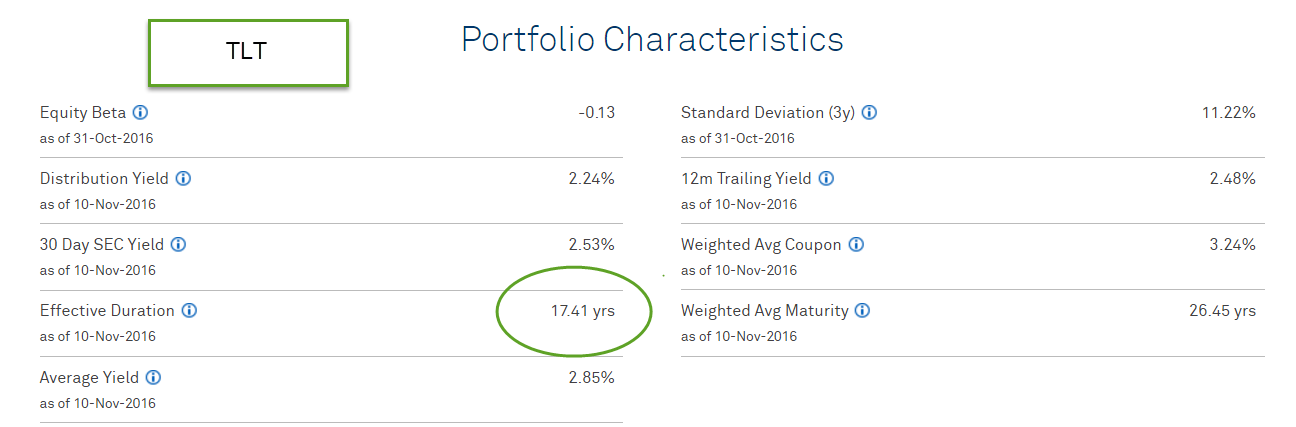
The price level of the SP500 is near the high mark set in May 2015, more than a year earlier.  Only in the past year has the inflation-adjusted price of the SP500 surpassed its summer 2000 level (Chart and table).  Nope, I’m not making that up. The stock market has just barely kept up with inflation for the past 15 years. The inability of the stock market to move higher indicates that buyers are not attracted to the market at current price levels.  The absurdly low interest yields on bonds makes this caution especially puzzling.  As stock prices recovered this past week, prices on long term Treasury bonds should have fallen as traders moved into more risky assets.  Instead, bond prices have risen.  As the price of long term Treasuries (ETF: TLT) broke through its January 2015 high  on Friday, the last day of June, traders began betting against treasuries (ETF: TBF).

Those who are concerned about the return OF their money, the safety searchers buying bonds, are competing against those seeking a return ON their money.  VIG is a Vanguard ETF that focuses on company stocks with dividend appreciation, and is favored by those seeking some safety while investing in stocks. TLT is an ETF of Treasury bonds for those seeking safety and, as expected, pays more in dividends than VIG.  Rarely do we see a broad stock ETF like VIG have a yield, or interest rate, that is close to what a long term Treasury bond ETF like TLT has.  At the end of this week, VIG had a dividend yield of 2.15%, just slightly below TLT.  Why are investors/traders bidding up the price of Treasury bonds?  Some 10 year government bonds in the Eurozone have recently crossed a dividing line and now have negative interest rates.  The low, but positive, interest rates of U.S. Treasury bonds look like big open flowers to the busy bees of institutional investors around the world.

In a large group of investors, buy and sell decisions tend to counterbalance each other.  Occasionally there are periods when such decisions reinforce each other and create a precarious imbalance that all too often rights itself in an abrupt fashion.  Bubbles and – what’s the opposite of a bubble? – are iconic examples of this kind of self-reinforcing behavior.

In another week we will mark the middle of the summer season.  The All-Star game on July 12th occurs near the halfway mark in the baseball season and advises parents in many states that there are still five to six weeks before the kids head back to school.  Our mid-40s is about the midpoint of our working years, a reminder that we need to start saving for retirement if we have not done so already.  It has been seven years since the market trough in March 2009.  Let’s hope that this is the midpoint of a 14 year bull market but I don’t think so.

Next week will be chock full of data before the start of earnings season for the second quarter. We will get the June employment report as well as the Purchasing Managers Index.  In this time of short, sharp reactions to news events, we can expect continued volatility.

/////////////////////////


Earnings


Pew Research just released a comparison of earnings by racial group and sex that is based on Census Bureau surveys, the same data that the BLS compiles into their monthly employment reports.  My initial criticism of the Pew Research comparison was that they used the earnings of full and part time workers.  Women tend to work more part time jobs so that would skew the earnings comparison, I thought. Thinking that a comparison of full time workers only would show different results, I pulled up the BLS report which groups the data by sex, only to find out that the differences between the earnings of men and women was about the same.  At the median, women earn 82% of men.


An even more depressing feature of the BLS report is that median weekly earnings have barely kept ahead of inflation during the past decade.  This wage stagnation provides a base of support for the criticisms voiced by former Presidential contender Bernie Sanders in a recent NY Times editorial.
Like a truck stuck in the mud, households are spinning their wheels without making much progress.  In the coming months, Donald Trump and Hillary Clinton will try to sell themselves as the tow truck that can pull average American families out of the mud. Well, it would be nice if they would conduct their campaigns in such a positive light.  The truth is that each candidate will try to convince voters that voting for the other candidate will get American families stuck deeper in the mud.  The conventions of both parties are later this month.  Expect the mud to start flying soon after they are over.  By election day in November, we will all be buried in mud.

Brexit

June 26, 2016

“Should I Stay Or Should I Go?” was a 1982 song by the Clash.  For months, Brits have debated the question of whether to stay in the European Union (EU) ahead of a referendum vote held just this past week and nicknamed “Brexit,” a mashup of British Exit.  Germany and Britain are the two strongest members of the EU and the loss of either from the union would weaken it’s political and economic ties. In the U.K., the campaigns turned vicious and sparked the murder of an MP (story) earlier this month.  In the British Parliamentary system, an MP is similar to a Congressperson in the U.S. House.

In recent polling the advocates of separation, or Leave, appeared to be gaining momentum so that the outcome of the referendum vote seemed deadlocked at 50-50.  A poll in the last days before Thursday’s vote reassured many that cooler heads would prevail and Britain would remain with the EU. Leaders from both the right and left belonged to this coalition, appropriately named “Remain.”

At about 3-4 AM London time, 11 PM New York City time on Thrusday night, a third of the vote had been counted and it was eerily close, with the Leave group having a teensy-weensy lead.  Then half of the vote was counted and the Leavers were up 1% over the Remainers.  As the vote tally continued, it became apparent that – surprise, surprise – the Remainers had won the vote.

Asian markets were active at that time and responded with a severe sell off of risky assets like stocks and rushed into the safe haven of bonds, cash and gold.  Stocks were down as much as 12% initially on some Asian exchanges.  Gold shot up 6%. Neither the U.S. or European markets were open but the Futures markets in the U.S. sank 6% and European futures plunged 9%.

While most Americans were sleeping European markets opened about 8- 9% down. Market makers in Italy could not establish an opening price for a number of Italian bank stocks, which had already been under pressure in recent weeks.  When they did, these stocks had lost a third of their value.  Everyone was selling, few were buying.

The referendum vote still needs to be codified into law before the Brits formally notify the EU that the country is leaving. After that negotiations begin over the trade and diplomatic terms of exit, a process that could take two years.  A rational person might wonder why the panicked selling?  The worry is that this vote may provoke similar votes in other EU countries, which might lead to the eventual dissolution of the EU.  When in doubt, get out.  Traders did.

Earlier this month the WSJ reported that legendary (and semi-retired) investor and billionaire George Soros had returned to his trading desk to make a series of bearish bets on global markets in anticipation of both political and economic turmoil.  Soros became a household name when he made a $1 billion on a bet against the British pound in 1992.  In several hours Thursday night/Friday morning, the British pound lost 10% of its value.  Was this also another killing for Soros?  Soros thinks the break-up of the EU is inevitable (Story)

What should the long term investor do?  January’s dip of 5% was a good time to make an IRA investment.  This may be an equally good opportunity.

Income Growth

June 19, 2016

A few weeks ago (here) I wrote about trends in income growth and the difficulties of measurement because the growth of employee benefits and insurances are not included.  As a follow up, I thought I would show you a chart of per capita income using a natural log scale, which shows a growth trend more clearly.  In the graph below, we can see three distinct periods of growth:

1) the late 1960s through the mid-1980s, a period of strong growth following WW2;
2) a more moderate period of growth from the mid-1980s to the mid-2000s; and
3) a much more muted cycle of growth after the financial crisis and recession of 2007-2009.

On the right hand scale is the natural log of the Employment Cost Index, an index of total employee costs calculated quarterly by the BLS.  This series is only sixteen years old but it does show the steep growth of these hidden costs.

Our government at all levels chooses to pay for social programs by sliding the costs under the rug.  Politicians could tax everyone for the dozens of social support programs but Americans do not like paying taxes.  As a rule, Europeans are more willing to make sacrifices for programs that benefit the group, although attitudes are changing as European populations become more diversified.  People in general are less willing to pay into the group kitty when a society is less homogenous.

In America, there are fewer protests when politicians add program costs to the total value of a paycheck where employees do not see most of the costs. Workmen’s compensation insurance is a good thing but would voters be willing to pay 5% of their pay for it?  Maybe not.  The law is written so that the employer pays it and the employee never knows the amount.

The cost for workmen’s comp may be 10-20% or more in service and construction trades but only 1% for an office worker.  Some people argue that such a disparity is appropriate; those who work in more dangerous jobs pay more into the insurance system.  Employers are incentivized to create a safe environment for their workers in order to reduce costs.

On the other hand, the health of workers is a public cost.  If all employees were taxed equally, the danger premium would be spread evenly across all employees.

//////////////////////////

Savings Glut

Interest rates are near zero.  One year CDs from major banks pay 1% or less.  Interest rates have been falling since the early 1980s when savings accounts were earning an astronomical 12% or so. Interest rates are a price of sorts, the price a bank is willing to pay for someone’s savings.  Lower interest rates = lower price = less demand for savings.  So, people will respond to that lowered demand by putting less money in savings accounts and CDs, right?  Wrong.

As interest rates decline, people actually increase the supply of savings they want to give to banks. Why?  It seems counterintuitive till we take into account that the population is aging, and older people tend to get more conservative with their savings.  Secondly, a larger pool of savings is needed to earn the same interest income.

So we would expect that “safe money” savings would increase somewhat in the past decade.  However, the difference in the amount of savings is dramatically higher.  In the 15 year period from 1980 to 1995,  Money Market, savings accounts, and CDs grew by 50% per person.  In the subsequent 15 year period from 1995 to 2010, safe savings grew by 150%, triple the increase of the previous fifteen year period.

By keeping interest rates low, the Federal Reserve is trying to force the public to take more chances with their money.  Like the mule who resists going down a steep path in soft dirt, the American public stubbornly refuses to go where the Fed wants.  It may take at least another ten years before Americans forget the financial crisis and are willing to take on more risk.  The slow growth of this seven year recovery will persist until Americans lose their aversion to risk.

Caution: Under Construction

June 12, 2016

As we travel the highways this summer we are likely to encounter many construction zones as crews repair wear and tear, and the damage that results from the temperature cycle of freeze and thaw. There are a few hitches on the economic road as well.

CWPI

I look to the Purchasing Manager’s (PM) Survey each month for some advance clues about the direction of the economy.  Like the employment report, this month’s survey contains some troubling signs.  I had my doubts about the low numbers in the employment report until I saw the results from this survey.  PMs in the services sectors reported a 3.3% contraction in employment growth so that it is now neutral, matching the lack of growth in manufacturing employment.

New orders in both manufacturing and services are still growing but slowed considerably in the services sectors.  The slowdown in both employment and new orders in the services sectors is apparent from the graph below.  While this composite is still growing (above 50), it has been below the five year average for four out of five months.

This recovery has been marked by, and hampered by, a familiar peak and trough pattern of growth. Last month I wrote:

 “A break in this pattern would indicate some concern about a recession in the following six months. What is a break in the pattern? An extended trough or a continued decline toward the contraction zone below 50.”

The CWPI, a custom blend of the various parts of the ISM surveys, shows a continued weakening that is more than just the periodic trough.  If there are further indications of weakness this summer, get concerned.

///////////////////////

LMCI

A few years ago the Federal Reserve introduced the Labor Market Conditions Index, or LMCI, a composite analysis of the labor market based on about twenty indicators published each month by several agencies. Because the report is released a week after the headline employment report, this composite does not receive much attention from policy makers, which is a bit of puzzle.  Janet Yellen, chair of the Fed, has indicated that she and others on the rate setting committee of the Fed, the FOMC, rely on this index when determining interest rate policy.

One business day after the release of this month’s unexpectedly weak employment report, the LMCI showed an almost 5% decrease and is the 5th consecutive monthly decrease in the index.

Although this composite is fairly new, many of the underlying indicators have long histories and enable the Fed to provide several decades of this index.  As a recession indicator, the monthly changes in this index tend to produce a number of false positives.  However, if we shift the graph upwards by adding 7 points to the changes, we see a familiar 0 line boundary.  When the monthly change in the index drops below 0 on this adjusted basis (actually -7), a recession has followed shortly.

We are not at the zero boundary yet, but we are getting close and the pattern looks ominously familiar.  Don’t play the Jaws music yet, though.