Money Ratios

A Denver investment advisor, Charles Farrell, has just written a book titled “Your Money Ratios” that should be part of a course for high school seniors. Mr. Farrell gives clear, simple guidelines for personal savings goals and debt ratios based on your income and age. The book lays out a game plan for making the transition from laborer to capitalist, from working for money in your twenties to having your money work for you to support you in retirement.

In simple language, Mr. Farrell explains many financial products that a person will encounter during their lifetime: stocks, bonds, various forms of insurance. He gives clear guidelines for mortgage and education debt as a ratio of your income and age. He compares the long term costs or savings of buying a house vs. renting.

His ratios are age-adjusted signposts, easy to understand and easy to use as a financial fitness check.

Social Security Wage Index

Every year we get a statement from the Social Security Administration (SSA) listing our wage history and an estimate of the monthly SS benefits we will receive when we retire. Our past earnings determine our future benefits. But how do they do that? Social Security Wage Indexing Factors. The SSA adjusts each person’s past wages for inflation, then takes the best 35 years as a benchmark for determining benefits.

If you have an extra half hour or so and want to look at your wage history in today’s dollars, go to the factor’s page at the SSA. Set the year to 2010. Copy the resulting table of years and index factors (two columns) into a spreadsheet. For each year, type in the reported earnings from your SSA statement into a third column. In a fourth column, set the formula to multiply each year’s actual earnings in the third column by the index factor in the second column. The result will be the inflation adjusted amount of your earnings for that year.

You may find a few surprises in the data. I did.

Concentrated Wealth & Taxes

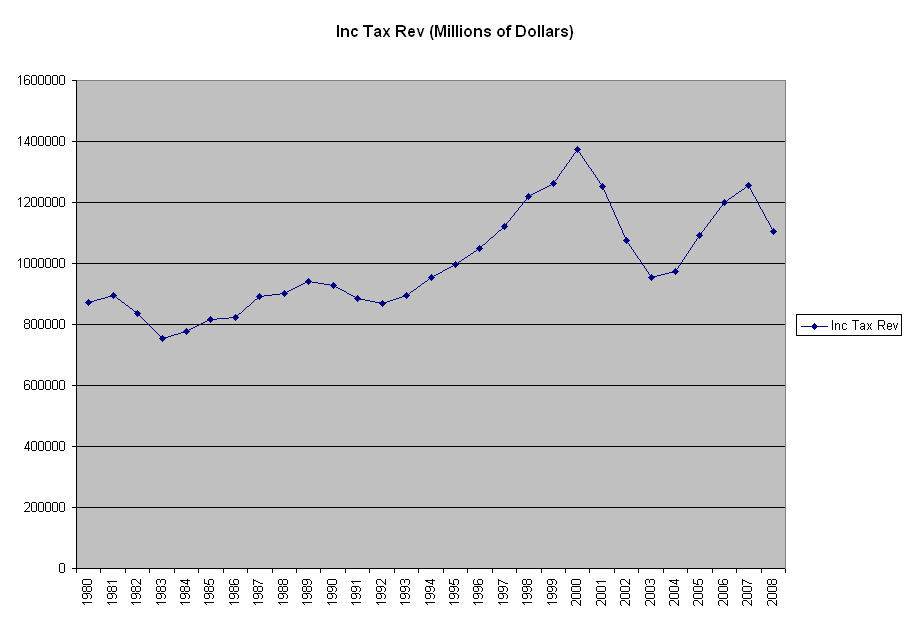
As the new year gets under way, it’s time to visit everyone’s second favorite topic after death: taxes. Conservative commentators and politicians have pointed to a disturbing trend in the past two decades: the increasingly smaller percentage of taxpayers paying an ever increasing share of income taxes in the U.S.

The Tax Foundation reviewed a mid-year IRS report on income and taxes. In 1980, the top 1% of income earners paid about 20% of total personal income taxes. In 2007, that same top 1% paid 40% of the tax bill. (Table 6) It is a concern when the tax burden is shared disproportionately by a small percentage of the population. A dangerous trend is that the bottom half of income earners pay almost nothing in income taxes. Why the danger? An ever increasing number of taxpayers who pay little in taxes will be more likely to vote for more government spending and more entitlements. Why not? It doesn’t cost them anything.

As valid as those concerns are, there is an equally alarming increase in the disparity of incomes. In 1980, the top 1% of earners in the U.S. reported 8.5% of the total income (AGI). In 2007, almost thirty years later, that top 1% reported almost 23% of total income. (Table 5) That three-fold increase in the proportion of income earned by the top 1% is overshadowed by another startling statistic in the IRS income tables: that the top 5% earned 60% of the total income in this country in 2007.

The increasing concentration of wealth in any country has been a harbinger of a downfall in a dominant economy. In “Wealth And Democracy” Kevin Phillips examined the history of the financial empires of Spain, Holland and England, which all lost their economic dominance as the wealth concentrated in the hands of the few. The U.S. is on the same path as those previous dominant economies. Will history repeat itself? Probably.

Health Horror Stories

In 2007, USA today reported several horror stories of individual health policy revocations. These stories highlight the root conflict of interest in private health insurance. In case you might wonder why other forms of insurance don’t have these problems, they do. Business liability insurance has its own horror stories. I know of several smaller contractors, newly in business, who simply could not get liability insurance from the more reputable insurance companies for their line of work in construction. The public hears little of these stories. They are told on job sites and in trade journals.

Cat Crushes Costs

At the beginning of this year, employees of the large equipment manufacturer Caterpillar were able to walk into Walgreen’s or Walmart pharmacies and get many generic drugs for free instead of paying a $15 co-payment. Many big companies like Caterpillar normally employ a prescription benefit manager (PBM) to handle and negotiate discount deals with drug manufacturers. The PBM then tacks on a percentage which it charges to its client. By negotiating directly with Walmart and Walgreen’s, Caterpillar will save 30 – 35% on many common drugs. It is a win-win-win for the employees, Caterpillar, and Walmart and Walgreen’s.

Returns After Inflation

“So how has your stock portfolio done the past ten years?”

” Well, not good but after the run-up this year, not bad. I think I’m about even.”

The Dow Jones index is about the same as it was 10 years ago, a fact that might mislead some investors into thinking that they have broken even during the past decade. They would be wrong. Adjusting for inflation, the Dow is down about 25% over the past ten years. Think that’s bad? Fly across the pond to Europe and look again at the U.S. market. In Euros, the Dow has lost 25% in nominal terms since 1999 without accounting for inflation. If we adjust for inflation … well, we better not. It’s too depressing.

Returns on any investment have to account for inflation, which averages about 3% over the past several decades.

Easy Money

A Future of Finance article in a December 2009 Financial Times quoted a partner at a leading London law firm: “There are huge piles of toxic debt on these [bank] balance sheets but much of it isn’t being recognized. Loans are being rolled over. There is a saying in banking circles now that ‘a rolling loan gathers no loss'” The same article also quoted Raymond Baer, chairman of Swiss private bank Julius Baer, who warned: “The world is creating the final big bubble. In five years’ time, we will pay the true price of this crisis.”

In a WSJ op-ed 10/16/09, Ann Lee, a former investment banker and hedge fund partner, writes that banks are hoping that by rolling over the loans at negotiated terms borrowers will eventually be able to make payments. She predicts that this cycle of rolling debt, reminiscent of what happened in Japan during the 1990s, could continue for a decade. With so much unrecognized bad debt, banks have little incentive to increase their lending. Instead, they borrow from the Federal Reserve at near zero interest rates and use the money to buy Treasury bonds, pocketing the difference in interest rates as profit. Since Treasury bonds are taxpayer IOUs, taxpayers are effectively subsidizing the profits of Wall Street banks. Ben Bernanke, head of the Federal Reserve and chief architect of this subsidy scheme, was recently reappointed by President Obama.

In late November, Standard & Poors released their analysis ranking of 45 leading banks in the world, using a new risk adjusted capital ratio (RAC), which will probably be adopted in 2010. This ratio gauges a bank’s leverage of assets to equity with greater attention paid to the risks of those assets than the current Tier 1 capital ratio does. According to this more rigorous metric, banks like Japan’s Mizuho and Sumitomo Mitsui, Citigroup, and Switzerland’s UBS have a particularly weak capital base. Just nine of the 45 banks rated by S&P had an adequate risk adjusted capital.

Big Government

In the past 50 years, which administrations have shown the most restraint in federal spending? The answer surprised me. As this Heritage Foundation chart shows, they were all Democrats: Johnson, Carter and Clinton. Who were the big spenders? Bush and Reagan top the charts, besting even Johnson. Despite rhetoric about small government, Republican administrations have shown that they are the party of Big Government.

The Heritage Foundation, a conservative think tank, has culled data from a number of sources and presents them in colorful charts that make the data easier to understand. Here is a summary of various charts on federal spending.

David Walker, the former head of the General Accounting Office (GAO) under the Clinton and Bush Administrations, now heads a nonpartisan group that put together a documentary movie, “I.O.U.S.A”, that was released in 2008. You can view a 30 minute shorter version of the movie at You Tube.

Capitalism Vote

In November, the BBC released a survey of almost 30,000 people around the world about their views of capitalism. Twenty years after the fall of the Berlin Wall and the much vaunted “victory” of capitalism, those responding to the survey had mixed reviews of free market capitalism. That might not surprise many in the U.S., but what does surprise is that only 25% of respondents in the U.S. thought that capitalism was working well.

Over half of those surveyed thought that regulation and reform could help solve capitalism’s problems. Two thirds of respondents wanted governments to take a greater role in redistributing wealth.

Disposable Personal Income

Disposable personal income is a benchmark that is used to assess aspects of our financial condition, like debt and wealth. What is it? It is gross income, including any transfer payments like Social Security that we receive, less taxes.

Discretionary income is what we have left of disposable income after paying our rent or mortgage, utilities, food and clothing – the essentials. Discretionary implies that we have some choice about whether to spend the money or not. What is discretionary to one person may seem like a necessity to another person. For those of us who are having some financial difficulties, it can be both fruitful and painful to reassess our guidelines for what is a necessity. A cell phone, once regarded as a luxury item, is now considered by many to be a utility like electricity. Is the monthly $100 voice/data plan we are on a necessity or could we get by with a $30 monthly voice plan instead? As I said, these reassessments can be painful.

Some regard a new car every three years a necessity while others view it as a luxury. In any assessment of our personal expenses, it is frightingly easy to lie to ourselves, to convince ourselves that something really is an absolute necessity and to line up several reasons why a particular item is a necessity.

Of the two income benchmarks, disposable personal income (DPI) is easier to measure and to gauge our debt. Household debt, which includes both consumer and residential mortgage debt, was about 80% of disposable personal income during the 1980s and 1990s. Household debt is now 122% of DPI, down from 129%. Americans are saving more but they have quite a ways to go to decrease their debt levels.

Credit Guard has a good guide to personal budgeting.