Capitalism and Politics

February 21, 2016

Capitalism

Growing income inequality, and extreme disparities of wealth in a capitalist economy prompted this 2013 speech by David Simon, the writer of the HBO series “The Wire.”  Mr. Simon attributes the plight of an economic underclass to thirty years of unrestrained capitalism.

Simon confuses capitalism with politics. When the politicians and agencies in Washington amass ever more power and draw corporate lobbying money to Washington, that’s politics, not capitalism.  When taxpayers bail out big banks for making stupid bets, that is politics, not capitalism.  When large companies like Archer Daniels Midland and Exxon receive generous subsidies from taxpayers, that is politics, not capitalism.

Cronyism contaminates whatever political or economic system it infects, be it capitalism, socialism, communism or fascism.  Cronyism and factions have infected every human society from the Assyrians of 4500 years ago to the present.  Knowing how destructive these twin human traits were, James Madison, chief constructor of the U.S. Constitution, crafted a system of checks and balances to provide a legal boxing ring for the various factions to punch it out.

Simon sees the economy as a Manichean battle between capital and labor, a model first proposed by Marx.  The battle is more accurately described as a triangle of capital, labor and political power.  Capital and labor are the two productive components of the economy, vying for legal favors from politicians. Capital and labor must push and shove for a more advantageous place in a courtier’s line before the political princes and princesses, kings and queens in the capitols of the world.

With much of the productive capacity of the world weakened or destroyed by World War 2, most of the world’s capital flowed to the U.S., which became the economic engine of the world.  With little global competition, workers in the U.S. had strong bargaining power, able to win pay packages of $200,000 (in 2015 dollars) to install parts on an assembly line.  Public labor unions flexed their legal bargaining and striking power to win pension packages that paid them almost full salary for the rest of their lives.

With few challenges from the rest of the world, management at U.S. companies became undisciplined, unfocused and uncompetitive.  The big three automobile manufacturers influenced politicians who passed tariffs which protected the vehicles produced by those manufacturers.  Tariffs on imported pickups and cargo vans still insulate domestic manufacturers from competion.  Like the automobile manufacturers, aerospace companies like Lockheed cracked under the weight of inept business planning and execution.  The demands of their labor force added to the strains.  Crippled by chronic cronyism, New York slid into bankruptcy and sought a bailout from the Federal government.

In the 1950s and 60s, I grew up in a union family, in a union neighborhood in New York City.  I accepted the nepotism and bribery in the union shops where I worked.  They were a fact of life along with housing segregation and sex discrimination.  The building trades were riddled with union cronyism and “tips” to building inspectors. Repeated strikes by city workers made daily life unpleasant.  Trash piled up in the streets, mass transit didn’t work and it could take an entire day at City Hall to renew a driver’s license.

In the 1960s and 70s, whole sections of New York, Chicago, Detroit and Philadelphia were unsafe to walk in, to live in or to work in. Folks like radio and TV host Tom Hartmann and Senator Bernie Sanders find it convenient to leave out some history when they talk about the 60s and early 70s as a benchmark of fairness for working people.

In the 1970s, the problems of the past two decades were brought to a head by the oil embargo, the recession of 1973-74, wage and price controls, the Watergate scandal, and rising inflation that would near 10% by decade’s end.  In 1971, Lockheed was bailed out by the U.S. government, a precedent that would be followed by others in the coming decades.

As European countries continued to rebuild their manufacturing and financial capacities, Japanese manufacturers took advantage of a new technology, transistors, to build smaller and less expensive electronic TVs and radios.  Their automobiles posed a weak but growing challenge to the dominance of U.S. manufacturers. In 1979, the three cronies of U.S. capitalism – organized labor, capital and politics – renewed their pact when Congress bailed out the automobile manufacturer Chrysler.

In the 1980s, the financial industry, the “bookies” of capitalism, began a decades long courtship of politicians in Washington, competing with organized labor and capital for political favors. The decade began with back to back recessions, 8 – 10% interest paid on savings accounts, 9 – 10% mortgages (a deal!),  and small business loans at 14% (secured), or 21% (unsecured) interest rates.  Small business owners worked extra hard  to compensate for the high interest rates paid on business loans.

Several Social Security tax increases were passed, taking an every bigger bite out of paychecks and profits.  A lot of us muttered about taxes.  There were 10 to 15 tax brackets, none of them indexed for inflation so that most of a raise or some occasional overtime went to Uncle Sam.    For decades, fat cats had been using tax dodges – legally – to escape taxes.

Sensing a growing discontent among voters at the unfairness of the tax system, politicians deliberated for several years before passing a tax reform bill in 1986.  Although tax rates were reduced for the wealthy, they lost many of their tax shelters.  Any change impacts both the incompetent and the dishonest, but especially exposes those who are both incompetent and dishonest.  The loss of tax shelters revealed a large network of scams in the financial and real estate industries that ignited the Savings and Loan Crisis of the late 1980s and early 1990s.

Declining union membership coupled with the growing political influence of the financial industry meant that unions could no longer afford to keep up with capital in the scuffle for treats from Washington.  Politicians protest that they too are victims of the “pay to play” system of American politics but efforts to enact a system of public financing of elections have been unsuccessful.  Why?  Because the system fattens the wallets of too many politicians.  If a few do lose their gerrymandered seats, they often find jobs lobbying the very politicians who replaced them.

The task of politicians and partisans of both major parties is to first craft the problem. Is the problem 1) greedy capitalists, 2) the immoral redistribution of income, 3) an overabundance of regulation that is stifling business growth, 4) income inequality, 5) too much power concentrated in the Federal Government, 6) too much money in politics, 7) too much taxes, 8) too little taxes, 9) ineffective or inadequate Federal regulation?  Pick one, or pick several. Make up your own.  The problem is that people can not agree on the problems, much less the solutions.

The essence of capitalism is that it has one metric – the return on capital which directs the flow of capital.To the champions of capitalism, this simplicity of feedback is the virtue of capitalism.  To the detractors of capitalism, this primitive mechanism is a bane.  Socialist and communist planners insist that an elite can direct a society’s capital for the greatest good.  They offer a top-down approach in contrast to the bottom-up solution design that a capitalist system offers.  Because capitalism does not present a unified solution for a society’s problems, some people reach for socialist and communist solutions presented by the few only to find that those solutions benefit mostly the few.
Portfolio Stability

February 14, 2016

Disturbed by the recent volatility in the stock market, some investors may be tempted to trade in some of their stock holdings for the price stability of a CD or savings account.  After a year of relatively little change, stock prices have oscillated wildly since China began to devalue the yuan at the beginning of the year.

Just this week, the price of JPMorgan Chase (JPM), one of the largest banks in the world, fell almost 5% one day then rose 7% the next.  Such abrupt price moves in a large multi-national company are driven less by fundamentals and more by fear.  As the price of oil fell below $30, hedge fund and investment managers began to doubt the safety of bank loans to energy companies, particularly those smaller companies whose fortunes have risen recently during the fracking boom.  Even if these types of loans were a miniscule portion of JPM’s total loan portfolio, investors remember that the financial crash began in 2007 with growing defaults of home loans that started a financial chain reaction of derivatives that blew up.  Sell, sell, sell, then buy, buy, buy.

Price stability is a term usually associated with measurements of inflation like the Consumer Price Index (CPI). A basket of typical goods is priced each month by the BLS and the changes in those prices are charted.  Each of us has a basket of investment goods that have varying degrees of price stability.  Stock prices vary a lot;  bond prices less so; house prices even less.  Cash type instruments like savings accounts and CDs have no nominal variation.

Each of us desires some degree of stability as we chug through the waters of our lives.  Like a ship we must make a tradeoff between speed and stability.  A stable ship must compromise between the depth and breadth of its keel, that part of the ship which is below water.  A deep keel provides stability but puts the ship at the risk of running aground in shallow water.  A broad keel is stable but increases the water’s drag, slowing the ship. (Cool stuff about ships)

It is no surprise that stocks provide the power to drive our investment ship.  Few investors realize that housing assets provide more power and stability than bonds.  We judge stability by the rate with which the price of an asset changes.  The slower the price change, the more stable the asset.  Over decades, residential housing has better returns and steadier pricing than bonds, although that might surprise readers who remember the housing bubble and its aftermath.

Many investors include the value of their home in their net worth but not necessarily in their investment portfolio and may underestimate the stability of their portfolio. Let’s imagine an investor with $750,000 in stocks, bonds, CDs, savings accounts and the cash value of a life insurance policy.  Let’s say that $375K is invested in stocks, $375K in bonds and cash equivalents.  That appears to be a middle of the road allocation of 50/50 stocks/bonds.  I will use bonds as a stand in for less volatile investments.

Let’s also assume that this investor has a house valued at $215K with no mortgage.  If we add in the $215K value of the house, we have a total portfolio of $965K and a conservative allocation closer to 40/60 stocks/bonds, not the 50/50 allocation using a more standard model.

We arrive at a conservative estimate of a house value based on the income or rental value that the house can generate, not the current market value of the house, which can be more volatile.  In previous posts, I have noted that houses have historically averaged 16x their annual net operating income, which is their gross annual rental income less their non-mortgage operating expenses. For real estate geeks, this multiplier is 1 divided by the cap rate.

Let’s use an example to see how this multiplier works.  Let’s say that the going rent for a modest sized house is $1600 per month and we guesstimate an average 30% operating expense, leaving a net monthly income of $1120.  Multiplying that amount by 12 months = $13,440 annual net operating income.  Multiply that by our 16x multiplier and we get a valuation of $215K.  Depending on location, this house might have a market value of $260K but we use  historic income multiples to calculate a conservative evaluation.

Our revised portfolio provides a more comprehensive perpective on our investment allocation and the stability of our “buckets.” During the past year, we may have seen a 5 – 10% increase in the value of our home, offsetting some of the apparent riskiness of a 10% or 20% move in the stock market.  Adjusting our portfolio assessment to allow for a home’s value might reveal that our stock allocation is actually a bit on the low side after the recent market decline and – quelle horreur! – we should be selling safer assets and buying stocks to maintain our target portfolio balance.  But OMG, what if stocks fall further?!  Then we might have to buy even more stocks to meet our target allocation percentages!  This is the essential strategy of buying low and selling high, yet it is so counterintuitive to our natural impulses.  We buy some assets when we are fearful of them.  We sell other assets when we think they are doing well.

****************

For anyone interested in housing as a business, the Wall St. Journal published a comprehensive guide, Wall St. Journal Complete Real Estate Investing Guidebook by David Crook in 2006. Recently, Moody’s noted that apartment building cap rates had declined to 5.5%, resulting in a multiplier of 18x that is above historical norms.

**********************

Income Distributions

February 7th, 2016

Updates on January’s employment report and CWPI are at the end of this post.  Get out your snowboards ’cause we’re going to carve the political half-pipe! (*v*)
(X-Game enthusiasts can click here)

////////////////////////////////

To Be Rich or Not To Be Rich

Every year the IRS takes a statistical snapshot of the almost 150,000,000 (150M) personal tax returns it receives.  There are some interesting tidbits contained in these tables that will put the lie to many a politician’s claim in this election season.  The IRS lists the number of returns for each of some twenty income brackets.  They also list the exemptions claimed for each of these income brackets and let’s turn to that for some interesting insights.

From Table 1.4 we learn that there were 290M exemptions claimed in the 147M tax returns filed in 2013, or almost two exemptions per return.  In 1995 (Table 1, same link as above) the number of exemptions claimed was 237M for 118M returns, exactly two exemptions per return. Exemptions are people that need to be fed, clothed, and housed.

Census Bureau surveys (CPS) over the past few decades show that households are shrinking.  Conservatives assert that median household income has stagnated simply because there are fewer people and workers in households today compared to the past.  If this were true, IRS data would show a greater decrease in exemptions over an 18 year period. We can’t say that one or the other data source is “true,” but that averaging data from the two sources probably gives a more accurate composite of income trends in the data.  Census data probably overcounts households while the IRS undercounts them.  Conservatives who advocate less government support will ignore IRS data that conflicts with their beliefs.

30% of the exemptions were claimed by tax returns with adjusted gross incomes (AGI) of less than $25,000, or less than half the median household income. (AGI is earned income and does not include much of the income received from government social programs.)  Only 2M exemptions, or 2/3 of 1%, were claimed by tax returns with an AGI of $1M or more.  Out of 315 million people in the U.S., there are only two million “fat cats” with incomes above $1,000,000.

Presidential contender Bernie Sanders tells his supporters that he is going to tax the rich to help pay for his programs.  IRS data shows just how few there are to tax to generate money for ambitious social programs. Mr. Sanders says he will get money from the big corporations.  Corporations with lots of well paid lawyers are not going to give up their money peacefully.

Instead, Mr. Sanders’ plans will rely on taxing individuals who can not erect the legal or accounting barricades employed by big corporations.  11% of exemptions were claimed by those making more than $200,000, a larger pool of potential tax money. Doctors, lawyers and other professionals will “Feel the Bern.”  It is not unusual for a middle class married couple in a high cost of living city like New York or Los Angeles to make $200K.  Mr. Sanders has his sights on you.  You are now reclassified as rich.

Here is a well-sourced analysis of the net cost to families.  Most will save money.  Unfortunately, Mr. Sanders made the political mistake of admitting that he would raise taxes, but…  No one paid attention to the “but.”  Should he win the Democratic nomination, Mr. Sanders will “feel the Bern” as Republicans use the phrase against him.  He might have used a phrase like “my plan will lower mandatory payments” to describe the combined effect of higher income taxes and no healthcare insurance payments.

The author calculates that the top 4% will spend a net $21K in extra taxes less savings on health care premiums.  The author probably overstates the effect on those at the top because he uses an average instead of a median, but we could conservatively estimate an additional $10K for those with AGIs in the $200K-$300K range.

****************

Earned Income Tax Credit

The Earned Income Tax Credit (EITC) is  a reverse income tax for low income workers, who get a check from the federal goverment.  For the 2014 tax year, over 27 million returns received about $67 billion from the government for an average of $2400 per receipient (IRS).  In inflation adjusted dollars, this is up 50% from the 2000 average of $1600.  The number of receipients has expanded 50% as well, growing from 18 million to 27 million.  Although Democrats often tout their support for the poor, it is Republican congresses that are largely responsible for expanding this support for low income families.  Republicans may talk tough but are more than willing to reach out a helping hand to those who are giving it their best effort.  There is a practical political consideration as well.  An analysis of IRS data by the Brookings Institute found that, in the past fourteen years, the poor have shifted from urban areas largely controlled by Democrats to the outlying suburbs of metropolitan areas, where Republicans have more support. In short, Republicans are taking care of their voter base.

****************

Constant Weighted Purchasing Index (CWPI)

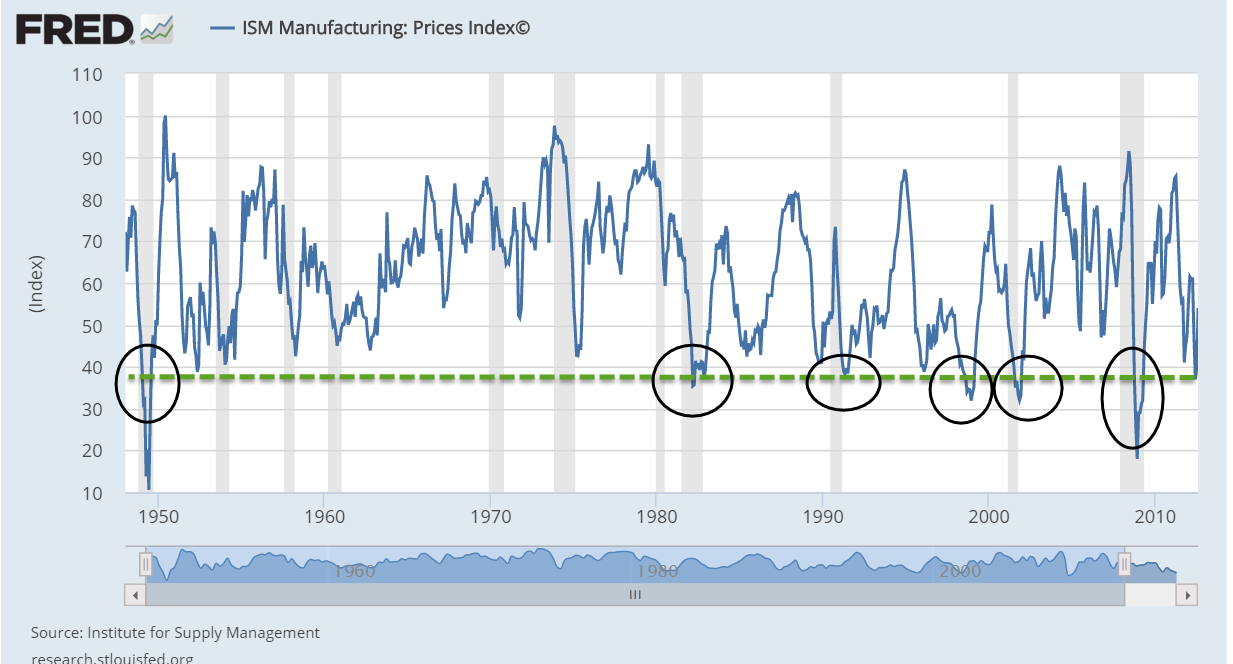
The manufacturing sector, about 15% of the economy, continues to contract slightly, according to the latest Purchasing Manager’s Survey from ISM.  The strong dollar and a slowdown in China have dragged exports down.   Extremely low oil prices have impacted the pricing component of the manufacturing survey, which has reached levels normally seen during a recession.


For some industries, like chemical products, the low oil prices have boosted their profit margins.  Most industries are reporting strong growth or at least staying busy.  Wood, food, beverage and tobacco manufacturers and producers report a sluggish start to the year, as reported to ISM.

The services sectors have weakened somewhat in the latest survey of Purchasing Managers, but are still growing, with a PMI index reading of 53.5.  Above 50 is growing; below 50 is contracting.  The weighted composite of the entire economy, the CWPI, is still growing strongly but the familiar up and down cycle of the recovery is changing.  Both exports and imports are contracting

The composite of employment and new orders in the non-manufacturing sectors has broken  below the 5 year trend.  It may turn back up again as it did in the winter of 2014, but it bears watching.

*************************

Employment

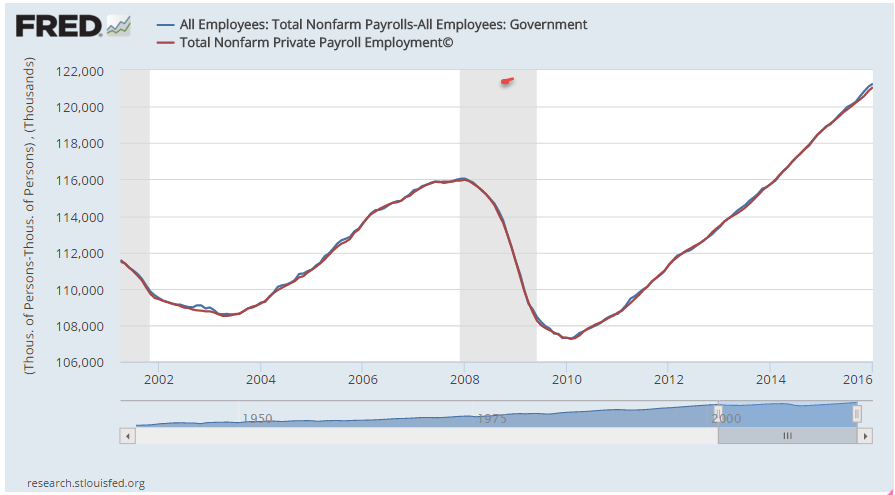
Each month theBureau of Labor Statistics  (BLS) surveys thousands of businesses and government agencies to compute the number of private and public jobs gained or lost during the month.  The payroll processing firm ADP also tallies a change in private jobs based on paychecks generated from thousands of its client businesses.  If we subtract government jobs from the BLS total, we should get a total number of jobs that is close to what ADP tallies.  As we see in the graph below, that is the case.

Economists, policy makers and the media look at the monthly change in that total number of jobs.  This change is miniscule compared to the 121 million private jobs in the U.S.  A historical chart of that monthly change shows that BLS survey numbers are more volatile than ADP.

I find an averaging method reduces the monthly volatility.  I take the change in jobs as reported by the BLS, subtract the  change in government employment, average that result with the ADP report of jobs gained or lost, then add back in the BLS estimate of the change in government employment.  This method produces a resulting monthly change that proves more accurate in time, after the data is subsequently revised by the BLS.  Based on that methodology, jobs gains were close to 175K in January, not the 151K reported by the BLS or the 205K reported by ADP.

There was a lot to like in January’s survey.  The unemployment rate fell below 5%.  Average hourly earnings increased by 1/2%.  Manufacturing jobs added 29,000 jobs, the most since the summer of 2013.  This helped offset the far below average job gains in professional and business services.  Year-over-year growth in the core work force aged 25-54 increased further above 1%.

The bad, or not so good, news: job gains in the retail trade sector accounted for 1/3 of total job gains and were more than twice the past year’s average of retail jobs gained.  Considering that job growth in retail was near zero in December, this may turn out to be a survey glootch.  Food services were another big gainer this past month.  Neither of these sectors pays particularly well.  The jump in manufacturing jobs probably contributed the most to lift the average hourly wage.

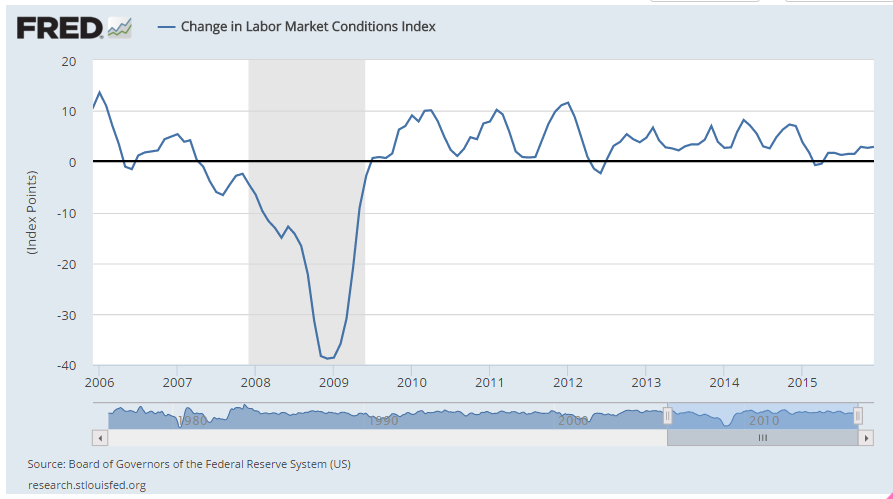
The Labor Market Conditions Index (LMCI) is a cluster of twenty or so employment indicators compiled by the Federal Reserve.  December’s change in the monthly index was almost 3%.  In the forty year history of this index, there has NEVER been a recession when this index was positive.

We are innately poor at judging risk.  We derive indicators and other statistical tools to help us balance that innate human weakness with the strength of mathematical logic.  Still, people do not make money by NOT talking about recession.  NOT talking does not pay commissions, does not generate the buying of put options, expensive annuities, and other financial products designed to make money on the natural gut fears of investors.  Next week I’ll look at the price stability of our portfolios.

Re-pricing the Market

January 31, 2016

In the closing moments of one of the “big ape” films, the very large gorilla Mighty Joe Young saves the girl, placing her on a boat as an island in the Pacific, broken by a volcano, falls back into the sea.  The bandaged hand of the big ape reaching out of the roiling waters is the last we see of the movie’s star.

On Friday morning, the Bank of Japan (BOJ) surprised the world by cutting it’s funds rate to a negative .1% from a positive .1%, vowing to fight the deflation and lack of growth that has plagued the Japanese economy for two decades.  As the island’s economy collapses under the weight of its aging population and lack of immigration, the bank thrust its arm above the Pacific waters to save – well, the entire Japanese population.  Could be the script of another big ape movie or a Godzilla sequel.

The first estimate of fourth quarter GDP was released Friday morning and the news was not good, which meant that the news was good, get it?!  GDP growth for the last quarter was positive, not negative, but less than 1%, so traders figured that the Fed will not raise interest rates again in March.

#3 in the combination was positive earnings surprises from Microsoft and Facebook, among others. Thursday was the busiest day of the earnings season.  #4 The price of oil continued to climb above the near rock-bottom benchmark of $30.  All of these factors were the impetus for a stock market surge of 2-1/2% on Friday and helped soften a really bad start to the year.  For the month, the index fell 5%.  During the month, revisions to earnings estimates for 2016 fell about the same amount – 4.7% (Fact Set).  In short, the stock market re-priced itself.

********************

Taxes

As the primary season approaches and millions of Americans receive their W-2 earnings record in the mail, Americans turn their attention to the cheery subjects of incomes and income taxes.  Here’s a Heritage Foundation chart of the effective payroll tax rates and income tax rates for the five quintiles of Americans based on income.

Those in the lowest quintile making less than $25K pay a combined rate of 2.1%.  Those in the next quintile making less than about $47K pay a combined rate of 6.6%.  Those in the next higher quintile making less than $80K pay 12.2%.  The top two quintiles pay 14.7% and 21% respectively.  It is easy to understand why many in the upper quintiles feel that they are already paying their fair share of taxes.

The fault in these calculations is that they neglect the employer’s portion of the payroll tax which is paid indirectly by the employee in the form of a lower wage.  Including that portion would add another 7.5% to 8% to the lower quintiles, a bit less to the top two quintiles.  Here’s a chart showing the total payroll tax burden since the Social Security Act was passed in the 1930s.

Should the rich pay more in taxes?  Yes, says Democratic Presidential contender Bernie Sanders.  Many Americans do not realize that we are in the top 10% of global incomes, the world’s fat cats.  Should Americans pay a global fairness tax of 10% or so?  This money would then be redistributed to poorer people around the world.  That is the world that Mr. Sanders is aiming toward.

**************************

Consumer Problem Survey

Over the past several thousand years people have developed numerous tools to predict the future.  Reading chicken bones, tea leaves and other forms of augery have given way to mathematical and statistical modeling.  The folks at Georgetown have developed a predictive tool to estimate consumer spending. Using a survey methodology researchers ask consumers what problems they have and which ones they are planning to solve in the coming months. These can be the payment of taxes, needing a new computer, iPad, or cell phone, the purchase of new home, etc.  Based on these responses, the researchers compile a Problem Driven Conumption Index (PDCI).  In the spring and early winter of 2014, the predictive index badly under-estimated retail sales.

However, the approach brings an essential understanding of the challenges American families face.  In a 2013 survey, respondents reported having many problems for which they see no solutions.  We learn that men and women have a few problems in common but confirm the axiom that each sex really does see the world differently.  The researchers are able to chart the shifting patterns of problems as we age.  This problems based approach is another statistical tool in the field of behavioral finance.

The Volatility Scare

January 24, 2016

Last week I wrote that I smelled capitulation.  When the Dow Jones (DJIA) dropped more than 500 points on Wednesday, I smelled burnt barbeque.  Historically, there is a weak correlation between the price of oil and the stock market.  In the past few weeks the 20 day correlation between the oil commodity ETF USO and the SP500 is .97, meaning that they are chained to each other in lockstep.  If that relationship continues throughout the month, investors can expect a continued bumpy ride.

Several factors helped indexes recover in the latter part of the week. After dropping near $26 a barrel, oil rebounded above $30 at the end of the week.  Mario Draghi, head of the European Central Bank (ECB), indicated that the bank was prepared for additional stimulus.  Sales of existing homes climbed in December, indicating a level of confidence among U.S. families.

Since the first of the year, investors have withdrawn $26 billion from equity mutual funds and ETFs (Lipper), offsetting the $10 billion inflow into equities in the last week of 2015.  Fund giants Fidelity and Vanguard report that their customers have been net buyers of equities despite the turbulence.

Volatility (VIX or ^VIX at Yahoo Finance) in the last half of the week dropped to the 8 year average of about 22.  We have enjoyed such low volatility in the past few years (mid-teens) that investors are especially sensitive to price swings.  For a long term perspective, here is a chart showing some multi-year averages of volatility.

A few weeks ago, I noticed an acronym for the 2008 Global Financial Crisis – GFC.  The memory wound is still fresh for many. Older investors with their working years largely behind them may feel even more vulnerable in times of higher market volatility.

*******************************

Fund Fees

Employees in 401K plans may not know how much money they are paying in fees each year.  One of the charges is what is called a 12b-1 fee, and you will need to breathe slowly into a paper bag while you read about this one.  Each fund has an investment advisor to administer the fund’s investments and the fund pays a fee for this service.  In addition, under some plans, the advisor charges the fund holders a separate marketing and distribution fee, the so called 12b-1 charge, to promote the fund through sales materials or broker incentives.  Wait, you might ask.  Shouldn’t marketing expenses be part of the advisor’s fee? Well, you would think so.

The Annual Report that accompanies your 401K statement might list one of the funds you are invested in as “Blah-Blah-Blah Growth Fund, Class R-1,” hoping you are going to sleep.  The R-1 class means the fund is charging you 1% for marketing and distribution fees. Here is a glossary of the classes of mutual funds and the percentages of 12b-1 fees.  In addition, funds have  varying sales or redemption fees which are denoted by a letter class for the fund, i.e. Class A, B, C.  The Securities and Exchange Commission (SEC) explains these here.

The  SEC has a FAQ sheet explaining the various fees.  These charges might seem small but they add up over a working lifetime.  The SEC provides an example  of the 20% difference in value between a fund that charges 1.5% fee each year and one that charges .5%.  FINRA, the industry group that certifies and regulates financial planners, has a mutual fund expense calculator that enables an investor to compare fund expenses by their ticker symbols.

I compared an American Funds Class A Balanced Fund ABALX that might be found in a 401K with a Vangard Admiral Balanced Index Fund VBIAX over a ten year period.  Taking the default assumptions of a 5% return on an initial investment of $10K, I had $1670 more in the Vanguard fund after the ten year period, or an additional 3 years of return.

Some 401K plans make it more difficult to compare performance or fees.  They may list a fund whose ticker symbol is not listed on any exchange but is a “wrapper” for a fund that is listed.  The only way to find out that information would be to look at the prospectus or other materials for the 401K fund or visit the web site of the 401K plan administrator.  How likely are many participants to do that?  That’s the point.

Ugly January

January 17, 2016

The ever-strengthening dollar and growing inventories of crude led to a plunge in the price of a barrel of West Texas Intermediate (WTI) which fell below $30.  I remember hearing some analyst on Bloomberg about a year ago saying that oil prices could go as low as the $20 range.  HaHaHaHa!  A popular basket of oil stocks, XLE, is about half of it’s July 2014 price, falling 25% in the past two months and almost 10% in the two weeks. Here’s a tidbit from the latest Fact Set earnings brief: “On September 30, the estimated earnings decline for the Energy sector for Q1 2016 was -17.7%. Today, it stands at -56.1%.”  Ouch!

Volume in energy stocks this week was more than double the three month average.  It smells like capitulation, that point when a lot of investors have left the theater.  Investors who do believe that the theater is on fire, as it was in 2008, should probably stay away.

What the heck is going on?  This Business Insider article from June 2015 (yes, six months ago) explains and forecasts the money outflows from China and emerging markets.  Pay particular attention to #4. This Bloomberg article from this week confirms the capital flight from China as investors anticipate a further devaluing of the yuan.

4th quarter earnings reports will begin in earnest in the following week.  If there are disappointments, that will magnify the already negative sentiment.

**********************

Death Cross

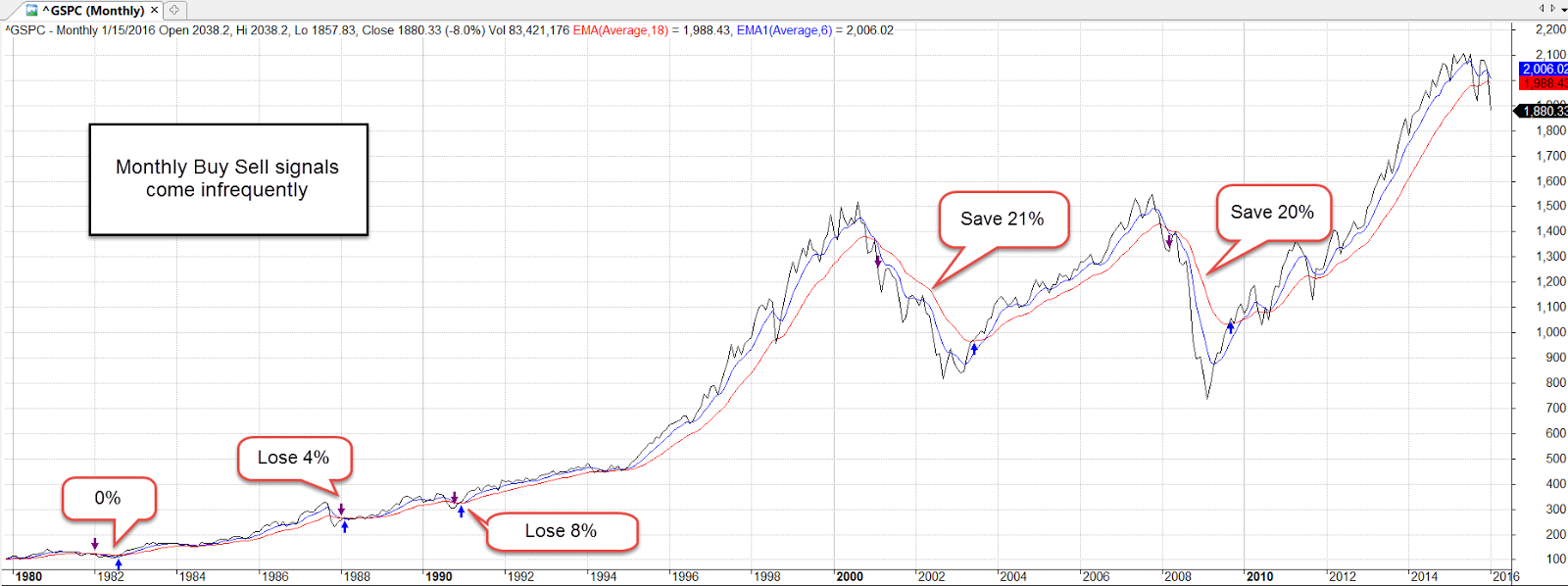
No, it’s not the title of a Fellini movie.  The merits of technical analysis can be more controversial than a Republican Presidential debate, but here goes.   The 50 day average of the SP500 crossed above the 200 day average, a Golden Cross, at Christmas, then crossed back below the longer average this week, a Death Cross.  A Golden Cross is a positive sign of investor sentiment.  The Death Cross is self-explanatory.  A crossing above, then below, happens infrequently – very infrequently.  The last two times were in 1960 and 1969 and the following months were negative.  After January 1960, the market stayed relatively flat for a year.  In June 1969, it marked the beginning of an 18 month downturn.  There was an almost Golden Cross followed by a Death Cross in May 2002.  A similar 18 month downturn followed.

Longer term investors might use a 6 month short term average and an 18 month longer average, selling when the 6 month crosses below the 18 month, buying back in when the one month (or 6 month average in the case of more volatile sector ETFs) crosses back above the longer average. Like any trading system, one takes the risk of losing a small amount sometimes but avoids losing big.

Trading signals are infrequent using monthly average prices.  Note that the sharp downturn of the 1998 Asian financial crisis did not trigger a sell signal.  The six month average of the SP500 as a broad composite of investor sentiment is above the 18 month average but several sectors have been sells for several months: Emerging markets (June and July 2015), Energy stocks (January 2015), and European stocks (August 2015).  Industrials (XLI) have taken a beating this month and will probably give a sell signal at the end of the month.

John Bogle, founder of Vanguard, recommends that long term investors look at their statement once a year and rebalance to meet their target allocation, one that is suitable for their age, needs and tolerance for risk.  In that case, don’t look at your January statement.  As I wrote a few weeks ago, it could look ugly.

********************

CPI

In 1998, the Boskin Commission estimated that the Consumer Price Index (CPI) over-estimates the rate of inflation by an average of 1.1%. In 2000, the NBER (the agency that determines recessions) revised their methodology and their estimate of the over-statement to .65%.  In 2006, Robert Gordon, a member of the original committee, re-examined subsequent CPI data and the methods used by the committee.  His analysis re-asserted that the over-statement was at least 1%.

Although this academic debate might seem arcane, the implications are enormous, particularly in an election year.  Presidential contender Bernie Sanders is gaining momentum on Hillary Clinton (HRC) by repeatedly asserting that the inflation-adjusted incomes of working families have declined since 1973.  Although Mr. Sanders makes no proposals to stimulate economic growth, he has many redistribution plans to achieve economic justice.  If inflation has been overstated for the past few decades, then Mr. Sanders’ argument is logically weak but emotionally strong.  More importantly, neither side of the political aisle can even agree on a common set of facts.  The other side is not evil, or stupid, or disingenuous. The disagreement over methodology is legitimate and ongoing.

Ominosity

January 10, 2016

Happy New Year!

Wait, get rid of the exclamation point.

Happy New Year.

After this week!  What are you kidding me?!  Get rid of the Happy.

New Year.

Ok, that’s better.  The New Year was not so happy when the market started its first day of trading last Monday.  For the tenth consecutive month, manufacturing activity in China contracted, which weighed down commodities (DBC down over 4%), energy stocks (XLE down 7%), emerging markets (EEM down more than 8%) and the broader market, which was down 6%.  Even stocks (Johnson and Johnson, Coca-Cola) regarded as relatively safe dividend paying equities suffered losses of more than 3 or 4%.  Investors and traders were re-pricing future profits and dividends.

December’s powerful employment report buoyed the mood for a short time on Friday morning but traders soon turned their attention again to China and the broader market fell about 1% by day’s end.

Given the decline in stocks, one would guess that the price of bonds, hard hit during the past few weeks, had showed some strong gains.  TLT, a popular ETF for long term Treasuries, gained more than 2% during the week but remains range bound since last August.  Treasuries are a safe haven for risk averse money, but the prospect of rising interest rates mutes the attractiveness of long term bonds.

Growth in the core work force aged 25 – 54 remains strong, up over 1% from last year.  The number of people not in the labor force dropped by 277,000 from last month, a welcome sign.  However, we need to put aside the politics and look at this in a long term perspective.  For the past twenty years, through good times and bad, the number of people dropping out of the workforce each year has grown.

This demographic trend is more powerful than who is President, or which party runs the Congress.  Depending on our political preferences, we can attribute this 20 year trend to Clinton, Bush, Obama, Democrats or Republicans. The job of the good folks running for President this year will be to convince voters that their policies and prescriptions can overcome this trend.  Our job, as voters, is to believe them.

The Bureau of Labor Statistics recently released a report of a ten year comparison of the reasons why people have left the work force.  Based on this BLS analysis, a Bloomberg writer who had not done their homework mistakenly reported that there has been a dramatic increase in the number of 20-24 year olds who had retired.

This “statistic” points out a flaw in BLS and Census Bureau data. BLS data is partially based on the Current Population Survey, or CPS.  Interviewers are not allowed to follow up and challenge the responder.  Both the BLS and the Census Bureau have been aware of the problem for at least a decade but I don’t think anyone has proposed a solution that doesn’t present its own challenges.

Looking at Chart 3 of the BLS report, the percentage of retired 20-24 year olds was .2% in 2004, .6% in 2014. The number of retired 16-19 year olds was .2% in 2004 and .2% in 2014. Do we really believe that there are almost 200,000 retired 16-19 year olds in this country? See page 16 for the BLS discussion of this problem.

Now, let’s put ourselves in a similar situation.  We are 22 and have recently graduated from college and are having trouble finding a job that actually uses our education.  Because of this, we are staying at our parent’s home.  We answer our parent’s landline phone (Census Bureau is not allowed to call cell phones).  Somebody from the Census Bureau starts asking us questions.  In response to the question why we are not working, we are presented with several choices, one of which is that we are retired (see pages 16 and 17)  Sarcastically we answer that yeh, we are retired.  The questioner can probably tell by our tone of voice that we are being sarcastic but is required to simply record our response.  How valid is that response?

Understand that problems of self-reporting and questionnaire design underlie all of the data from the monthly Household Survey, including the unemployment rate. This gives those with strong political views an opportunity to claim that government statistics are part of a conspiracy.  Claims of conspiracies can not be disproved, which is why they are so persistent throughout human history.

Each year some research firms predict a global recession. Ominosity is the state of sounding ominous and this year is no different. Adam Hayes, a CFA writing at Investopedia, gives some good reasons  that he believes such a widespread recession is possible. All of these risks are present to some degree.

What makes me less convinced of a global recession is the strength of the U.S. economy.  Just as China “saved” the world during the financial crisis, the U.S. may play the role of the cavalry in this coming year. Let’s look at some key data from the recent ISM Purchasing Manager’s index.  This is the new orders and employment components of the services sectors which comprise 85% of the U.S. economy.  Growth remains strong.

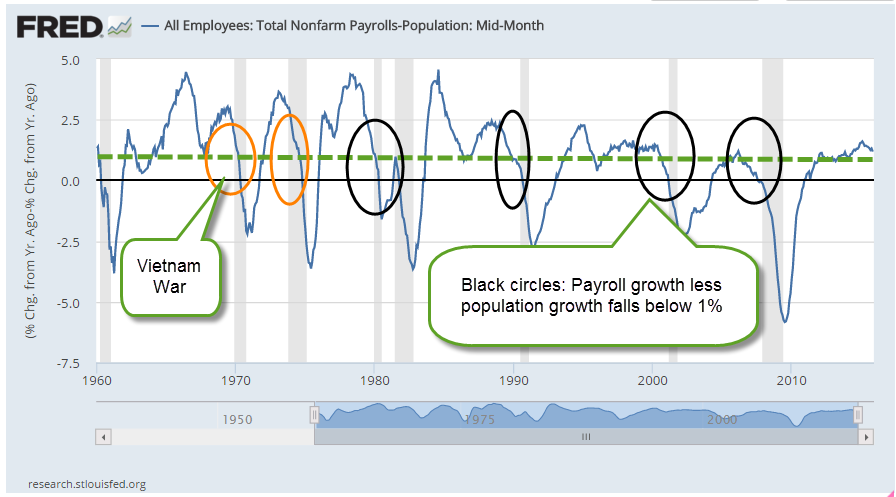
Recessions are preceded by a drop in new orders and by a decline in employment.  When payroll growth less population growth is above 1%, as it is today, a recession is unlikely.

Let’s climb into our time machines and go forward just 11 months.  It is now December 2016 and the IMF has enough data to make a post-facto determination that the entire world’s economy went into recession in March 2016.  We look at the SP500 index.  Holy shit!  We climb into our time machines, go back to January 2016 and sell all of our stocks.  Missed that cliff.

What about bonds? Should we sell all those?  Darn it, we forgot to check interest rates and bond prices when we were ahead in the future.  Back into the time machine.  Go forward again.  U.S. Fed halted rate increases in March 2016, then lowered them a 1/4 point.  The ECB had kept interest rates negative in the Eurozone and bond prices have stayed relatively flat.  OK, cool.  We get back in our time machines and go back to January 2016 and decide to hold onto our bond index funds.  The interest on those is better than what we would get on a savings account and we know that we won’t suffer any capital losses on our investment during the year.

We take all the cash we have from selling our stocks and put them entirely in bonds.  Wait, could we make a better return in gold, or real estate?  Back in the time machine and back to the future!  But now we notice that the SP500 index in December 2016 is different.  So is the intermediate bond index.  What’s going on?  The future has changed.  Could it be the Higgs boson causing an abnormality in space-time?  Maybe there’s something wrong with our time machine.  But where can we find a mechanic who can diagnose and repair a time machine?  Suddenly the thought occurs to us that a lot of other investors have gone into the future in their time machines, then have returned to the present and bought and sold.  That, in turn, has changed the future.

The time machine is called the human brain.  Each day traders around the world make decisions based on their analytical and imaginative journeys into the future.  The Efficient Markets Hypothesis (EMH) formulated by Eugene Fama and others postulates that all those journeys and decisions essentially distill all the information available on any particular day.  Therefore, it is impossible to beat a broader market index of those decisions.

Behavioral Finance rests on the judgment that human beings are driven by fear and greed which causes investors to make mistakes in their appraisals of the future.  An understanding of the patterns of these inclinations can help someone take advantage of opportunities when there is a higher likelihood of asset mispricing.

Each year we read of those prognosticators who got it right.  Their time machine is working, we think, and we go with their predictions for the coming year.  Sometimes they get it right a second year.  Sometimes they don’t.  Abby Cohen is a famous example but there are many whose time machines work well for a while.  If I could figure a way to fix time machines, I could make a fortune.

New Year Review

January 3, 2016

As we begin 2016, let’s take a look at some trends.  It is often repeated that the recovery has been rather muted.  As former Presidential contender Herman Cain once said, “Blame Yourself!”  You and I are the problem.  We are not charging enough stuff or we are making too much money. Debt payments as a percent of after tax income are at an all time low.

At its 2007 peak, households spent 13% of their after tax income to service their debt.  Currently, it is about 10%. In early 2012, this ratio crossed below the recession levels of the early 1990s.  By the end of 2012, this debt service payment ratio had fallen even below the levels of the early 1980s.  Almost six years after the official end of the Great Recession the American people are behaving as though we are still in a recession.  An aging population is understandably more cautious with debt.  In addition to that demographic shift, middle aged and younger consumers are cautious after the financial crisis. We gorged on debt in the 1990s and 2000s and paid the price with two prolonged downturns.  Having learned our lessons, our overactive caution is now probably dragging down the economy.

In this election year, we can anticipate hearing that the sluggish economy can be blamed on: A) the Democratic President, or B) the Republican Congress.  It is Big Government’s fault.  It is the fault of greedy Big Companies.  Someone is to blame.  Pin the tail on the donkey.  Blah, blah, blah till we are sick of it.

************************

Auto Sales

The latest figures on auto sales show that we are near record levels of more than 18 million cars and light trucks sold, surpassed only by the auto sales of February 2000, just before the dot com boom fizzled out.  On a per capita basis, however, car sales are barely above average.  The thirty year average is .054 of a vehicle sold per person.  The current sales level is .056 of a car per person.  Automobile dealers would have to sell an addiitonal 900,000 cars and light trucks per year to have a historically strong sales year.

************************

Construction Spending

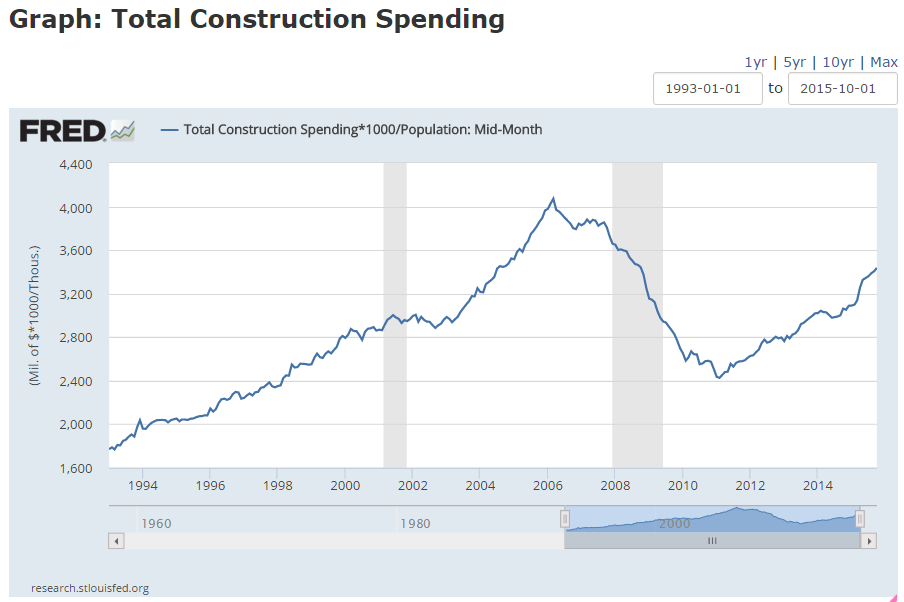
In some cities, housing prices and rents are rising, and vacancies are low.  We might assume that construction is booming throughout the country.  Six years into the recovery per capital construction spending is at 2004 levels and that does not account for inflation.  Levels like this are OK, not good, and certainly not booming.

*************************

Employment

The unemployment rate and average hourly wage may get most of the public’s attention but the Federal Reserve compiles an index of many indicators to judge the health of the labor market.  Positive changes in this index indicate an improving employment picture.  Negative changes may be temporary but can prompt the Fed to take what action it can to support the labor market.  Recent readings are mildly positive but certainly not strong.

*************************

Stock Market

Many of the companies in the SP500 generate half of their revenue overseas.  Because of the continuing strength of the dollar, the profits from those foreign sales are reduced when exchanged for dollars.  According to Fact Set, earnings for the SP500 are projected to be about $127 per share, the same level as mid-2014.  In the third quarter of 2015, the majority of companies reported revenue below estimates.  As 4th quarter revenue and earnings are released in the coming weeks, investors will be especially vigilant for any downturns in sales as well as revisions to sales estimates for the coming year.  It could get bloody.

The Other Book

December 27, 2015

Here’s hoping everyone had a good Christmas.

Investors use several different metrics to judge the value of a company.  Probably the most common is the Price to Earnings, or P/E, ratio.  This is the stock’s price divided by the earnings per share that the company has generated over the past twelve months.

Another common measure is the Price to Sales (P/S) ratio: the stock price divided by the Revenue per Share.  A third yardstick is the Price to Book (P/B) ratio, the stock price divided by the Book Value per Share.  What is book value?  Subract the debt of a company from its assets and what is left is the book value of the company.  If a company were to be liquidated, the shareholders get everything that belongs to the company after the creditors are paid off.  Book value does not include intangible assets like intellectual property and the power of a well-known brand, sometimes referred to as “blue sky.”

Some investors may argue that book value understates the true value of a company because it ignores these vague assets.  A value investor, on the other hand, might counter that the intangible value of a brand can dwindle rapidly in a highly competitive and rapidly changing environment.  As an example, remember Palm?  Don’t know who or what that is?  In the 1990s, there was a lot of blue sky baked into market valuations that dissipated quickly as investors regained their senses.

Even long time retail stalwarts like Sears have learned that brand is sand, eroding under the relentless pounding of shifting tastes, technologies and  competition.

Combining the P/S and P/B ratio – a mashup, so to speak – is the S/B ratio, the Sales to Book ratio, and is sometimes called the Buffet indicator, after Warren Buffet, a well known value investor.   While this ratio may not appear in the key valuation ratios for a company, it is derived easily by dividing the P/B ratio by the P/S ratio.

Let’s look at two examples in the same industry.  Apple has a P/S ratio of 2.59 and a P/B ratio of 5.08.  Using simple math we get an S/B ratio of 5.08 / 2.59 which we round off to 2.  Microsoft has a P/S ratio fo 4.91 and a P/B ratio of 5.76, giving us an S/B ratio of 5.76 / 4.91, or approximately 1.2.

The difference between those two ratios, 2.0 for Apple and 1.2 for Microsoft, tells us that the market values Apple’s blue sky a lot more than it does Microsoft.  Fifteen years ago, the situtation was reversed.  This was before the introduction of  the iPod, the iPhone and iPad.  Apple’s brand has become the dominant force in the consumer technology market.

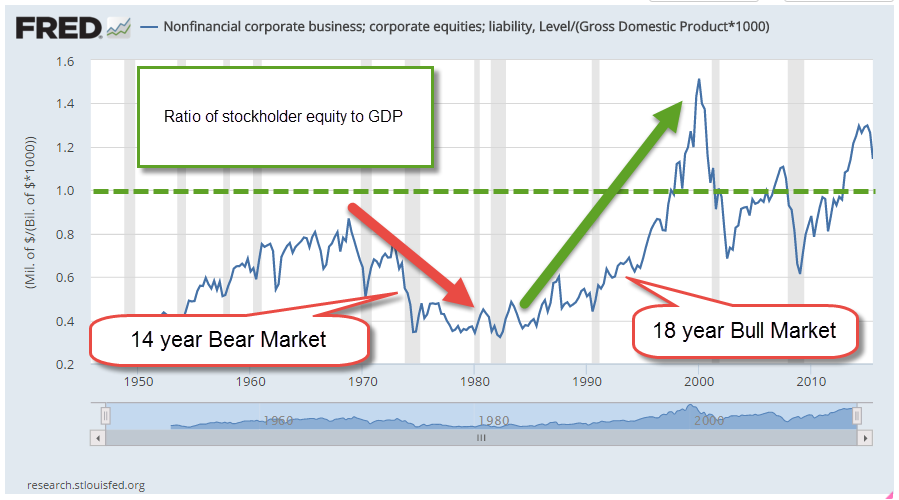
Using the book value of all companies we can construct a ratio that tells us the relative richness of asset valuations.  We will flip the S/B ratio used with individual companies and substitute GDP, the economic activity of a nation, for sales or revenue.

Here is a decades long chart of that indicator.  Higher interest rates and inflation in the late 1960s and 1970s helped lower this ratio.  By the early part of the 1980s stock valuations, using this method, were so beaten up that they had nowhere to go but up.  Lower interest rates and an  explosion of technological innovation in the past few decades have contributed to the rise in this indicator.  It wasn’t until about 1995 that the ratio was an even 1.0.

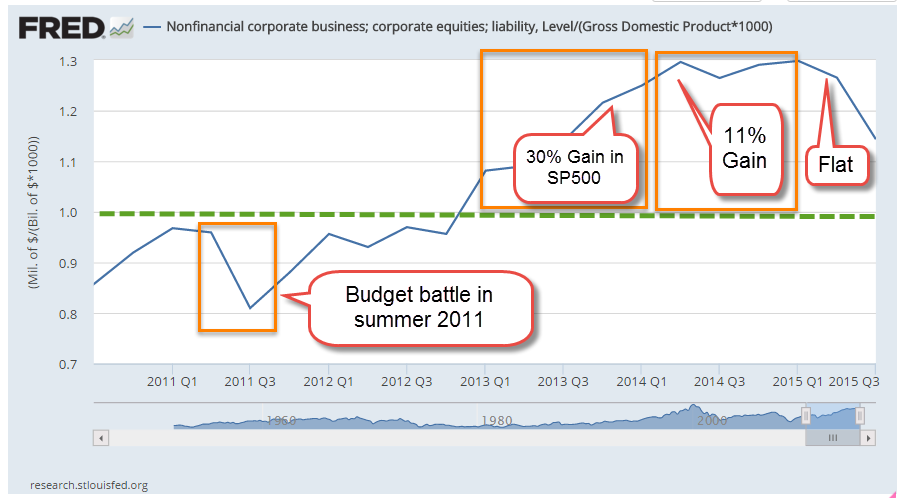
To the value investor, the ratio and the direction of changes in the ratio are equally important.  How much blue sky is baked into current market valuations? Is the ratio rising or falling?  Has the market overpriced the future value of the corporate blue sky?  If so, future price gains may be muted as investors correct their valuations.  Like 2011, the SP500 index will probably show little gain or loss this year.  Here’s a closer look at recent years.  The ratio is falling but still above 1.0.

*******************
 New Year’s Resolutions

Readers who are looking for one more resolution to add to their list can try this one: remembering stuff using spaced repetition with Anki Flashcards.  The desktop app is free and there are a number of shared decks of flashcards available for download.  In no time, you’ll be able to remember your wedding anniversary.  You’ll be able to retrieve French or Spanish phrases stored in some dark corner of your brain along with the lyrics to a 1980s Devo song.  Anything is possible.  Who was the actress who played Princess Leia?  Easy.  Who was the director of the movie Touch of Evil?  Oooh, repeat that one again.

Year End Approaches

December 19, 2015

For those of you who pay attention to crossing averages, the 50 day average of the SP500 index just crossed above the 200 day average.  This long term buy signal is often referred to as the Golden Cross.  The Death Cross, when the 50 crossed below the 200 day average in early August, is a sell signal.  Those who sold some of their holdings at that time missed the volatility of the past few months.  The index was at 2100 in early August.  It closed at approximately 2000 on Friday.  The index has lost about 4% in the past two days.

Past buy crosses were June 2009, October 2010, January and August 2012 and this past week.  Recent sell crosses were December 2007, July 2010, August 2011, July 2012, and August 2015.

In buy, sell order they were December 2007 (sell), June 2009 (buy), July 2010 (sell), October 2010 (buy), August 2011 (sell), January 2012 (buy), July 2012 (sell), August 2012 (buy), August 2015 (sell) and December 2015 (buy).  Note the three year period between buy and sell signals from August 2012 to August 2015.  The market gained 55% during that period.

As you can see from the list above, the market usually regains its footing after a few months – except when it doesn’t, as in 2008.  This buy sell rule avoided the protracted market downturns in 2000 and 2008 at the expense of acting on signals that are false positives, or what is known in statistics as Type I errors.

*****************************

Cost Basis

Mutual fund companies typically calculate an investor’s cost basis for their funds.  Some investors mistakenly think that cost basis reflects the performance of their investment.  It doesn’t. Let’s look at an example of a cost basis entry:

At first glance, an investor might think they have lost $186 since they first started investing in the fund.  Usually, that’s not the case.  In this case, the fund has earned more than $5000 in ten years.

Let’s look at some basics.  An investor in a mutual fund has the option of having dividends and capital gains reinvested in the same fund or transferred to another fund like a money market.  To begin our simple example, let’s choose to NOT reinvest.

Let’s say an investor put $1000 in a bond fund BONDX.  Each share sells for $100 so they have bought 10 shares.  Every quarter the fund pays a $1 dividend per share.  A day before the dividend is paid the fund’s share price is $101.  The fund then distributes the $1 dividend.  The market value of each share instantly falls by the amount of the dividend – $1 – so that after the dividend the market value of each share of BONDX is $100.  What is the investor’s cost basis?  $1000.  The market value is 10 shares x $100 = $1000.  Capital gain or loss? $0.  Does this mean the investor has made no money?  No, they have an extra 10 shares x $1 dividend per share = $10 in their money market account.

When opening up a fund the default option may be to reinvest capital gains and dividends.  This is where some investors get confused.  So, let’s change the reinvest option and choose YES. Now, as before, the fund distributes the $1 dividend and the share price of the fund falls to $100, just as before.  Now, however, the money is not transferred to the money market fund.  Instead it is used to buy more shares of BONDX.  The $10 that the investor receives buy a 1/10 share of BONDX.  Now the investor owns 10.1 shares of BONDX at a cost of $100 per share = $1010 cost basis.  The market price of the fund is $100 per share x 10.1 shares = $1010.  Captial gain or loss: $0.  Again, the capital gain or loss does not reflect the total performance, or profit and loss, of the investment.  The profit is $10.

So, the capital gain or loss should be used only to calculate the tax effect of selling a fund, not the performance of the fund.  The fund company will calculate the performance, or the rate of return (IRR) on an investor’s funds on a separate screen.  Choose that option instead of the cost basis screen.

******************************

The Investment Cycle

Investments tend to rise and fall in price over the course of a business cycle.  At the end of an expansionary cycle, commodity prices start falling.  Yardeni Research has some good graphs which illustrate the ongoing plunge in commodity prices.

As the economy begins its contraction phase, the prices of bonds start to fall.  As we enter recession or at least a contraction of growth, stocks fall.  In the recovery, comodities rise first, followed by bonds, then stocks.  Here is more information for readers who are interested in exploring the details and background of this cycle.

***************************
Diabetes

The American Diabetes Assn puts the direct costs of treating diabetes at $150 billion.  That is 25% of the $600 billion spent on Medicare in 2014.  Indirect costs add another $75 billion in costs.  Much of the increased expenditure is for treating late onset Type II diabetes.  Expenses are sure to grow as the population ages and people do not make the life style changes needed to delay or moderate the onset of the disease.

***************************
Credit Spreads

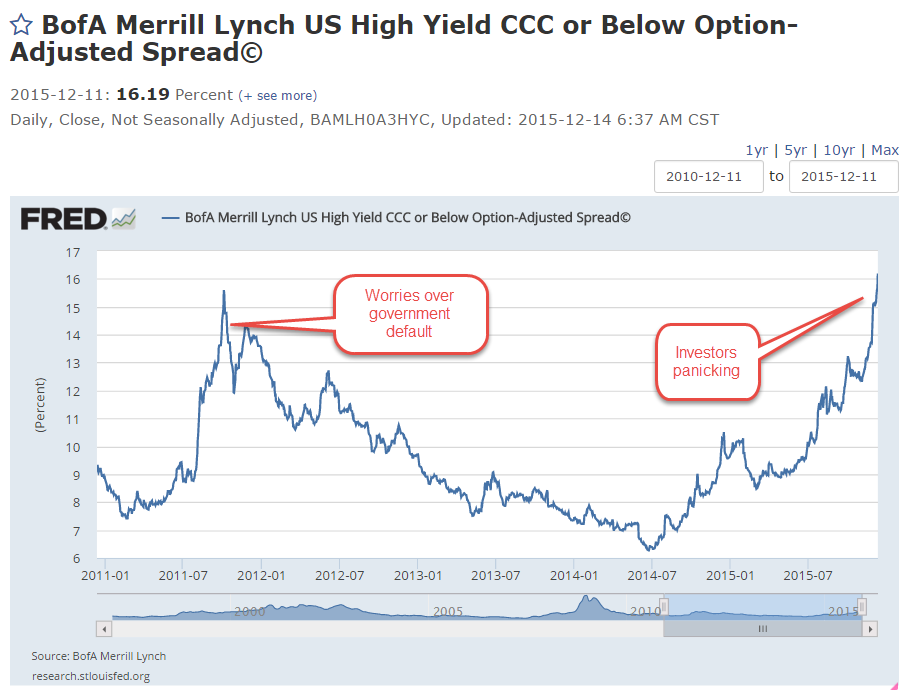
Several weeks ago, I noted the growing “spread” between Treasury bonds and high yield junk bonds.    The graph I showed was the benchmark of junk bonds, the Master II class. Let’s call them Bench Junks. The bottom of the barrel, so to speak, are those company bonds rated CCC and lower.  These are companies that are more likely to default as economic growth slows or contracts. Let’s call them Low Junks. While the Bench Junks’ spread shows investor concern, the Low Junks’ spread shows a stampede out of these riskier bonds.  A rising spread means that the prices for those bonds are falling, effectively giving buyers a higher interest rate. Investors want the higher yield to compensate them for the higher risk of owning the bonds.

Here is an article explaining the composition of some high yield bond ETFs for those readers who are interested. in learning more.

**************************

Income Taxes

Turbo Tax may be the most widely used individual income tax software but there are many providers of tax software.  Each state usually lists the software programs it has approved.  You can Google “approved income tax software” and insert your state name at the beginning of the search term. Here is a link to Colorado‘s list of approved software.  Here is the list for Texas, New York and California.

**************************
Lastly, have a wonderful Christmas!