Tax Tinkering

Negotiations over a resolution to the fiscal cliff  met an impasse in the past week.  Republicans, mainly from states with low state and local taxes, would prefer to cap tax deductions for higher income taxpayers than raise the top marginal tax rate.  Democrats are strongest in those states with high state and local taxes; the higher income taxpayers in those states would really feel the tax bite if deductions for these taxes were capped at the federal level.  Both parties have become proxies for upper income earners yet neither will admit it because it doesn’t play well in middle America.  Democrats profess that their sole concern is the middle class; Republicans cite their allegiance to small business owners as the reason for their resistance to higher tax rates.

On the spending side, Democrats have not put forward any specific modifications to entitlement programs like Social Security, Medicare, Medicaid that they would consider – only that they would consider them.   Mostly they talk about preserving these programs even though no one has suggested getting rid of them.  Most of us sit in the back of this bus with a sinking feeling in our guts;  we see posturing and positioning from the Congress and the President in the front seats but the bus is not moving.
 
Some voices are calling for comprehensive tax reform as a final solution; others rightly scoff at the idea that a lame duck Congress can enact even a small bit of tax reform.   The task of tax reform is monumental – almost Sisyphean.  I have been reading a book about the last comprehensive tax reform that took place in 1986, “Showdown at Gucci Gulch”, by Jeffrey Birnbaum and Alan Murray.  The authors tell a detailed and well informed narrative of the dastardly dueling and dealing that occurs in any democracy when competing interests collide and collude in crafting a compromise.

Venture investors want low capital gains rates.  Companies whose revenues and profit depend on investments in equipment and materials want to protect tax breaks for their costs.  Unions want fringe benefits for their members to remain tax free.  Oil and gas companies want to shield their oil depletion allowances that permit them to exclude some of the taxable income they earn each year.  Insurance companies lobby to retain the tax free status of the cash build up on the life insurance policies they sell.  Realtors and home builders want to preserve the mortgage interest deduction; the Tax Policy Center reports that over 50% of the total of this deduction goes to the top 1/10th of 1% of income earners.  Charitable organizations and places of worship lobby for the preservation of the charitable deduction.

70% of taxpayers do not itemize and the vast majority of taxpayers who do itemize claim about $10 – $15K.  The top 1% of taxpayers claim on average about $120K in deductions.

Voters want results; the say they want compromise and some resolution to the political standoff that has been the status quo in Washington for the past two years.  Given the issues, interests and costs involved, finding a middle ground will be difficult.  The 1986 Tax Reform law was almost two years in the making, and soon after it was passed, Congress began to tinker with it.
 
535 elves, the members of Congress, tinker away in the workshop of the Federal Government, making thousands of tax toys for the citizens and businesses of this country; everyone wants  a toy, not a lump of coal.  It is unlikely that Congress can put together  a comprehensive tax package before January 1st.

Charitable Giving

This is the time of year when many people reach out to their favorite charities.  Consider a charity that is helping with disaster relief after SuperStorm Sandy, provides meals for families and seniors, provides housing assistance for those in need, and so much more.  No, it is not the Red Cross, the Meals on Wheels program or Habitat for Humanity.  The charity is the U.S. government.  They are desperately in need of funds.  As they help clean up after Sandy, they have not even finished paying for damages from hurricane Katrina that battered Louisiana, Mississippi and Alabama in 2005.  Anyone can donate online at the U.S. Treasury.  As with other charities, you can use a credit card.

During and since the drafting of the U.S. Constitution over two hundred years ago, we have argued over the wording of the “general welfare” clause of the Constitution (Article 1, Section 8).  James Madison, a Federalist and chief drafter of the Constitution, said that the phrase was a limited power conferred on the federal government; that “general welfare” meant that welfare which applied to all the people.  You can read Federalist Paper No. 41 for his more lengthy explanation of this controversial phrase.

The anti-Federalists, always suspicious of the powers given to a large and powerful central government, replied that “general welfare” could mean anything.  What, they argued, was to prevent this newly formed Federal Government from becoming a charity?

Madison scoffed, arguing that the taxing power was restricted to only those taxes which were uniform throughout the country.  The taxing power is specified in the same sentence as the “general welfare” clause, separated only by a semicolon.  Therefore, it was preposterous that anyone could argue that “general welfare” could mean anything.

Alexander Hamilton, also a Federalist and an advocate of a strong Federal Government, argued that the “general welfare” clause was essentially a plenary power given to Congress, in line with its power to spend.  To the anti-Federalists, this violated the spirit of the Constitution which was designed to enumerate, or limit, the powers of central government.

In short, Madison says general welfare is limited by the taxing power that immediately follows.  Hamilton says it is not limited because Congress’ power to spend is not limited. 

United States vs. Butler in 1936 and Helvering vs. Davis in 1937 were two Supreme Court decisions that sided with Hamilton.  What the anti-Federalists had warned about was about to come true.  The U.S. Government was on its way to becoming – over the next 75 years – the largest charity in the world.

Some think that charity should be part of a government’s role; although some of those would argue that charity should not be the chief role of a government, as it is now.  Some argue that charity should not be in the hands of government.

Many of us will receive appeals from many charities during this season of giving.  The Treasury does not mail appeals for money despite the fact that it is performing the same helpful acts as other charities.  Charity Navigator, a charity watch dog organization, does not rate the U.S. Treasury for its management of the funds it receives.  But the Treasury really does need the money as it helps to feed, cloth and house millions of people each month.  

Cliff Diving

November 18th, 2012

This past week, President Obama gave a post-election news conference, answering a number of questions about the fiscal cliff due to take effect on January 1st if the lame duck Congress and the President can not come to an agreeement on some budget bandaging.  The stock market has had the jitters since the first week of October, falling 9% since then; about half of that decline came after the election.  At almost the same hour that it became apparent that the balance of power in Washington would remain the same came the unwelcome forecast of no growth for the Eurozone in 2013.  When in doubt, get out.

For the past two years, there have been few “Kumbaya” moments in the halls of Congress or the White House.  The market has had a good run this year; capital gains taxes could increase next year; many decided to take their profits and run.  A I wrote a month ago, the drop in new orders for durable goods was troublesome.  Three weeks ago, the newest durable goods report showed further declines yet consumer confidence was up, creating a tug of war and I waved the yellow flag, saying that the “prudent investor might exercise some caution.”

For the long term investor who makes annual investments in their IRA, this drop in the stock market is an opportunity to make some of that contribution for this year.  If the wrangling over revenue and spending cuts continues over the next few weeks, the market could drop another 10 – 15%. When budget negotiations collapsed in July – August 2011, the market declined almost to bear market territory – about 19%.  All too often, some of us wait till the last minute in April to make our annual IRA contribution. 

The “cliff” terminology was spoken by Fed Chairman Ben Bernanke at a hearing in February.  He probably wished he had chosen less colorful language but he was probably trying to wake up some of the senators at the hearing.  How bad is this cliff?

The total measured economic output of the U.S., its GDP, is estimated by the BEA (Bureau of Economic Analysis) at around $16 trillion – $15.85 trillion, to be exact, based on this year’s estimated growth of about 2.2% and next year’s average 2.75% estimate of growth.  What’s a trillion dollars?  About $9000 for every household in the country.

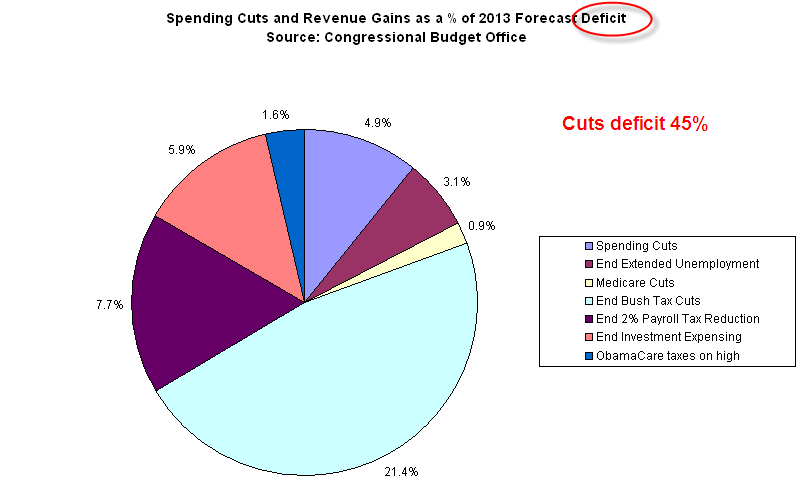
The non-partisan Congressional Budget Office (CBO) estimated some of the economic impacts if we did go over the cliff; in other words, if the spending cuts and revenue increases occurred next year.  Below is a chart of the percentages of GDP that each component of spending cuts and revenue were to occur.

The total of these is 3.2% of the economy.  Well, that’s not Armageddon, you might think and you would be right. As I mentioned earlier, forecast growth is only about 2.75% for next year so that means that GDP would contract slightly next year.  On the other hand, the cliff sure helps the deficit for next year, cutting it by almost half.  The deficit is projected at about $1.1 trillion before spending cuts and revenue increases.  In more manageable numbers, the country is going to go further into debt next year to the tune of almost $10,000 for every household.

Politicians in front of a microphone are prone to hyperbole.  So are news anchors.  Politicians try to sell their version of the story; news anchors try to keep our attention.  Small numbers like 3.2% of GDP might not get our attention so we could hear more dramatic numbers.  News anchors may say “Spending cuts of $100 billion” because $100 billion sounds important.  But without a total or a percentage, we have no context to evaluate the amount of money.  Is $100 billion a little or a lot?  $100 billion in spending cuts is .6% of the entire economy, or 2.6% of the budget for this coming year.  We may hear “Revenue increases of $400 billion,” which sounds gigantic.  It is 2.5% of the economy, or an additional 13.8% of the projected federal revenue.  Remember, even with the revenue increases, should they take effect, the country’s budget will still be “in the red” an estimated $600 billion dollars, or $5400 per household.

This country needs more revenue and it needs to cut expenses.  Each side of the aisle will fight to protect the “job creators” (interpretation: people with money) or the “working poor” (interpretation: people who are barely making it week to week) or the “middle class” (interpretation: the rest of us).  Tax the other guy, not me.  Cut the other guy’s deductions, not mine.  Cut subsidies, but not mine.  Cut expenses but not in my industry or area of the country. This is the same kind of behavior that 5 – 8 year old kids exhibited in an experiment featured on CBS’ 60 Minutes tonight.  Maybe, just maybe, we need to grow up.

Fiscal Cliff

Just pulled out of ElectionVille.  Next stop is FiscalCliffe.   Some of us ride in plush seats, some in coach, others stand in the aisles or ride on the roof, but we are all on the train. In the front car are the really plush seats where the President and Congress sit.   They occupy the front car because they are supposed to be looking out for what comes ahead but they spend most of their time arguing with each other. 

“We need to hook up some more cars so that those people riding on the roof can sit in safety,” the President says. 

“We won’t have enough coal for the engines to pull that many cars,” Republicans say.

“We need have those who are sitting in the plush seats pay more,” the President insists.

“They are already paying way more than their fair share,” Republicans counter.

“The passengers on the train have spoken.  They want the plush seats to pay more,” the President responds.

“They kept us in power in the House because the House controls the money.  They trust us to manage the money and we can not betray that trust.  If we make the plush seats pay more, then the plush seats won’t need as many porters and we will lose jobs,” the Republicans parry.

“I am not going to make the other passengers pay more when the plush seats can easily afford a little more,” the President maintains.

In September, I wrote about the coming “fiscal cliff”, a self-imposed austerity program of spending cuts and tax increases that is due to take effect Jan. 1, 2013, unless the President and Congress can agree to some fiscal balancing program.  After all the election talk and negative campaigns now comes the fiscal cliff chatter, which I am now adding to.

We are about $250 billion away from the debt limit of over $16 trillion dollars.  The Treasury will run out of money by the end of this year.  With some financial sleight-of-hand, the Treasury expects that they can make it till February of next year before the debt limit must be raised.  In July and August of 2011, President Obama and the Republican House could not come to an agreement to raise the debt limit and avoid default.  The fiscal cliff of upcoming spending cuts and tax increases became the devil’s bargain that were agreed to in the compromise that led to the raising of the debt limit to its current level.  The President did not want to come back to Congress for more money until after the election.  After the momentum of the 2010 elections, Republicans thought the election just past might give them control of the Senate and the Presidency.  The grand bargain was set to take effect after the 2012 election, each party thinking that the voters would make a clear choice in the elections.  Instead, the voters chose a divided government with the same power balance as before the election.  In short, voters said “Work it out.”

“Grandpa, what’s the pistol cliff?”

I snort a quick laugh and the inner comic in me speaks up.  “It’s a place where we are all going to shoot ourselves in the foot with pistols.”

“Will somebody shoot my foot?” 

I’ve really stuck my foot in it this time.  “No, your feet will be fine.”

“Will mommy be able to walk after her foot gets shot?”

“Your mom is not going to get her foot shot.  No one is going to get shot.  I was just making a joke.”

“I was on a cliff over the ocean this summer and there were big rocks at the bottom on the beach and the water was going ‘whooompf’ all over the rocks.”

“I’ll bet that was pretty,” I say.

“Cliffs won’t hurt us as long as we stay on the path and don’t climb over the rail.”

Amen, I think.

In the early nineties, the Democrats made a deficit cutting bargain with the first President Bush:  in exchange for tax increases, the Democrats would agree to spending cuts – after the recovery from the recession.  The tax increases were put into law and cost President Bush a second term.  The spending cuts that the Democrats promised never came.  In 1994, the Republicans took the House and forced the issue.  The symbol of the Republican Party is an elephant – and elephants don’t forget.  The President and Democratic Senate Majority Leader, Harry Reid, will be in budget negotiations with John Boehner, the Republican House Majority Leader, who was in the House in the early nineties.  Also present will be Mitch McConnell, the Senate Minority Leader, who was in the Senate at that time.  It is doubtful that either of these two Republicans have forgotten.    

Power To The People

A moment to acknowledge the personal caring and effort of ordinary people, the courage and doggedness of first responders during the superstorm “Sandy” and a heartfelt sympathy for those who lost loved ones during the storm.  Mile long lines of cars waiting for gas brought back vivid and unpleasant memories of the 1970s when many of us who lived in NYC would get up at 4 AM just to wait in line for a few hours to buy gas so we could get to work.  Resilience and persistence are bred into many New Yawkers (that includes you guys and gals in Jersey, too).  The clean up and repair will test every ounce of both during the next year.  Some losses, of course, are not the kind that can be repaired, only endured with the support of family and friends.

                                                                  _________________

The October employment figures released two days ago showed an increase of 171,000 jobs this past month, about 50,000 more than expected and a welcome relief to the Obama campaign.  Retail and restaurant jobs posted strong gains and health care jobs continued their strong growth. 

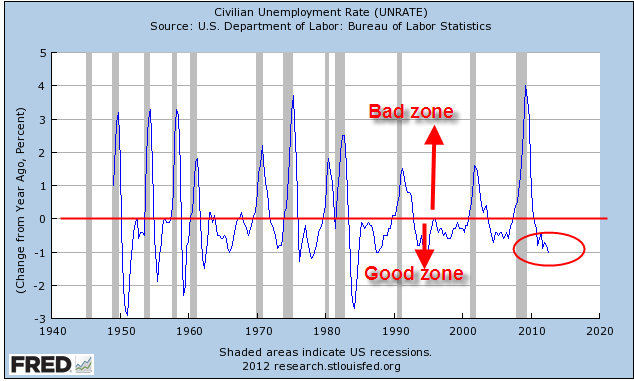
More people started looking for jobs, bringing the unemployment rate up a smidge to 7.9%. The year over year percent change in unemployment is relatively healthy, as shown on the 60 year chart below.

This past week came a series of positive reports.  Consumer spending rose .8% in September and home prices continue to improve, showing a .5% monthly gain in the Case Shiller index of 20 leading cities.  Both of these indicators have shown recent strength but the year-over-year gains for both consumer spending and home prices is a plodding 2%.

Consumer confidence has shown strong improvement the past four months and is expected to have about the same positive sentiment level as last month’s survey. As I noted last week, the consumer has lately shown more confidence than the business community.  The Chicago manufacturing index dropped last month and is now at a stall speed.  Tomorrow the national manufacturing report will be released.  The manufacturing sector is certainly responding to the weakness in Europe and slowing growth in China and southeast Asia.

While the employment gains were welcome, there are too many negatives that continue to show.  We are barely keeping ahead of population growth.  Below is a chart showing an index of employment and population growth.  We are still down about 7% from the peak in late 2007, which was more of a bubble level of employment.  We could reasonably target mid-2004 levels.

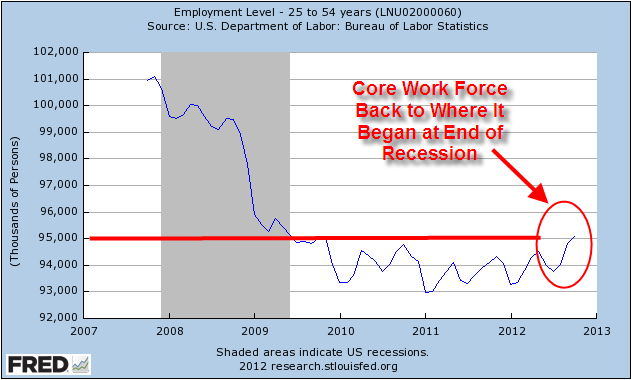
The core work force of those aged 25 – 54 is showing a little upward movement over the past two years but is still anemic.

Most of the job gains are going to older workers above 55. “Get out of the way, pops!” may become the mantra of younger generations. 

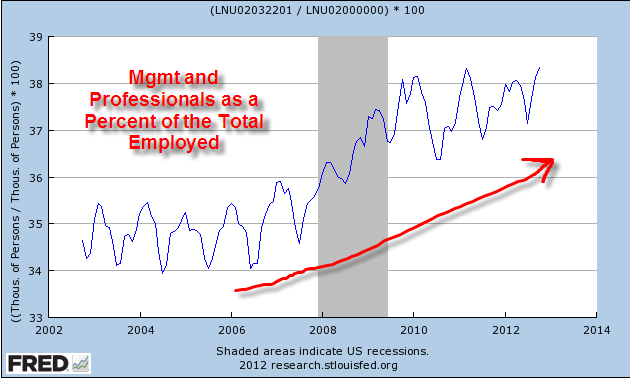
The loss in production jobs leads to a continual increase in the proportion of management and professional jobs.

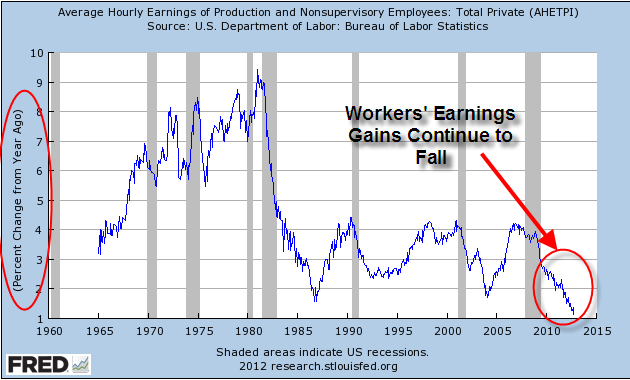
Hourly Earnings gains are flat out terrible, hitting an all time low.

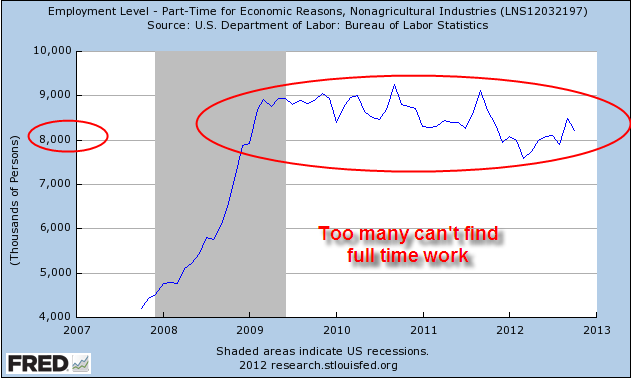
There are still too many people working part time because they can’t find a full time job.

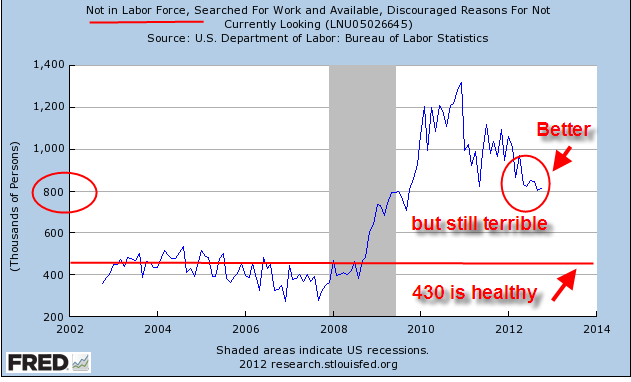
The number of discouraged workers is declining but is not healthy.

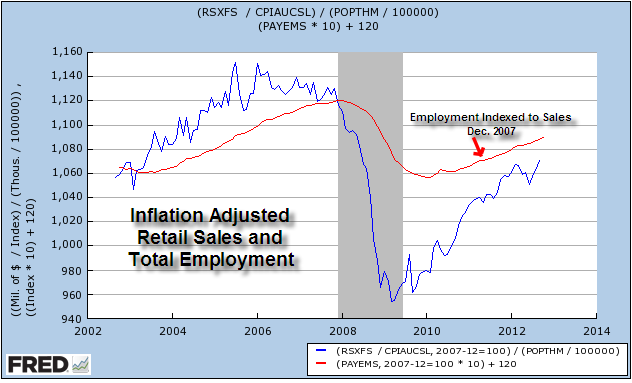
Retail sales, particularly auto sales, are an indication of rising consumer demand.

But after adjusting for population growth in the past decade, we have finally climbed back up to where we were 8 years ago.

To show the correlation between retail spending and employment, I’ve overlaid an index of one over the other.

As you can see, retail sales lead employment gains and losses.  I sincerely hope that retail sales will continue to improve and turn around the recent business pessimism.  My chief concern is the lack of competence and character in Congress on both sides of the aisle.  This coming election will do little to alleviate those concerns.

Capital and Consumer Spending

If I hit my thumb with a hammer, maybe it won’t hurt this time.  Not likely.  Last week I noted a warning sign in non-defense new orders for capital goods, excluding aircraft.  As I noted previously, aircraft orders are volatile; they may be up 30% one month and down 30% a few months later because orders for planes are placed in rather large blocks with the actual delivery of the aircraft occurring over many months.

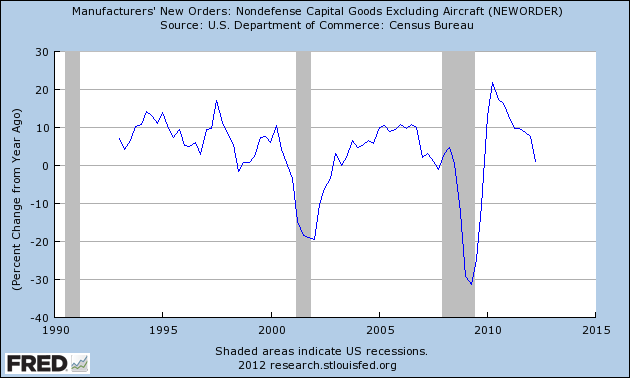
A few days ago the most recent durable goods report came out for September, showing a continued decline in the year-over-year gains for new orders.  Declines like this have preceded the past two recessions.

We like to think that this time may be different. Our imagination is capable of soaring the heights of creativity in art and science.  In the economics of our personal lives, it can lead to fanciful thinking.  Fanciful notions led many to buy houses with little money down at the height of the housing boom, thinking that somehow they would refinance when mortgage payments escalated after a certain period.  Magical thinking induced many to increase their credit balances far beyond their means to pay, thinking that they could pay down their credit balances by refinancing their homes.  No matter how much homes went up in value, housing prices would continue to rise.  Then they didn’t.

The chart below shows the housing inflation.  Recessions in the latter part of the past century had caused housing starts to decline to 400,000 before recovering.  In the 2001 recession, easy money and loose standards for mortgage securitization curbed the natural decline.  The bill eventually came due in 2008.

Single family homes create jobs; the market has shown life recently but is still very weak.

The Conference Board’s Consumer Confidence index rose 9 points to 70 in September and is about the same level as this past February, when confidence started sliding to a summer low point of 60.   The new consumer survey is due to be released next week and analysts are predicting another increase of 3 to 4 points. Consumers are feeling upbeat but the decline in new orders shows that businesses continue to be cautious as the prospect of rising taxes and budget cuts next year dampens any optimistic planning.  The slowdown in Europe and Asia contributes to the gloomy reading of Moody’s Business Confidence survey.  Rising consumer confidence before the critical Christmas shopping season may alleviate the pessimism of businesses if consumers actually open up their wallets and spend but retailers have not been building inventory ahead of the shopping season.

While these two forces tug at each other, a prudent investor might exercise some caution.

New Orders

No, this is not about the New Order, the conspiracist’s nemesis.  This is about New Orders of Capital Goods.  When companies forecast sales growth ahead, they place orders for capital equipment to meet the projected increase in demand.  One version of the monthly report on new orders excludes aircraft orders which are volatile; fulfilling the order – the delivery of the new aircraft – are structured over time.

Below is a chart of the year-over-year percentage in new orders excluding both aircraft and defense spending.  I have used quarterly averages to smooth and show the trend. (Click to enlarge in separate tab)

As you can see, there are warning signs of recession or very low economic activity as the quarterly change is close to zero. The most recent monthly change has, in fact, dropped below zero.

The value of new orders has a fairly strong correlation with the S&P500 stock index, adjusted to scale.

Some have suggested that business plans are on hold till after the election and the coming negotiations over budget sequestration, or the “fiscal cliff.”  If so, this may be a temporary drop. The stock index usually either anticipates or is concurrent with the drop in the dollar amount of new orders.  Further gains in the index may be minimal unless this new order indicator of business sentiment turns upward.

Obligations and Entitlements

“Social Security and Medicare are the two largest federal programs, accounting for 36 percent of federal expenditures in fiscal year 2011.”  (Trustee’s annual report)

So how did we get here?

When Social Security was enacted in 1935, President Roosevelt promoted it as an insurance program for the old, widowed and orphaned. The language of the law called the employee portion of the tax an “income tax”, and the employer portion an “excise tax,” not an insurance program. Regardless of the language, Social Security has acted both as an annuity for retired workers and an insurance program for disabled workers and survivors of workers.

Several challenges to the law were brought before the Supreme Court, which issued several decisions in 1937 that confirmed that various components of the Social Security tax were valid. By law, the Social Security reserve fund could invest only in the debt of the U.S., either through marketable Treasury bonds or through special bonds which could not be sold. (A history of the financing of Social Security)  Since 1960, the Social Security funds are “invested” in these special bonds, which are little more than promises that the federal government will pay Social Security benefits. 1960 is also the last year that the federal government ran a budget surplus except for the years 1999 and 2000; in two years out of 52, the federal government has been able to balance its books. In overwhelming numbers, voters send lawyers to Washington; most of them have little if any business experience or education.  We reap what we sow.

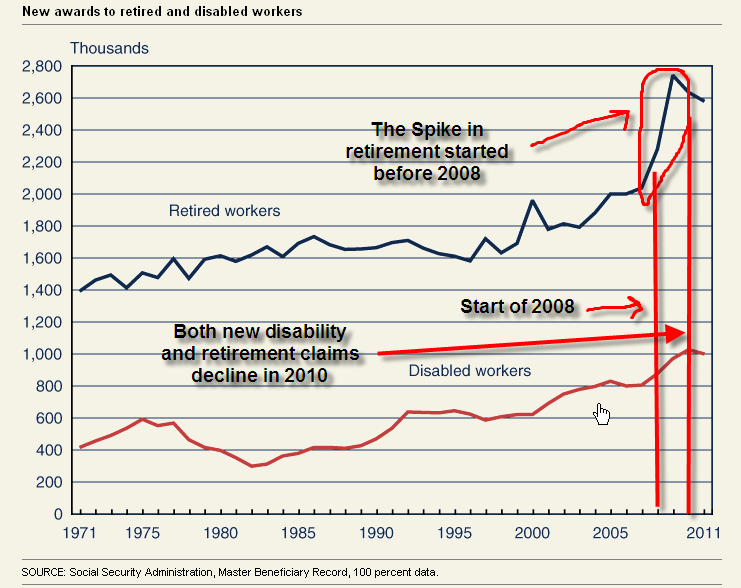
The Bureau of Labor Statistics (BLS) estimates the total number of workers at 135 million.  More than 55 million people are currently receiving some form of benefit under the Social Security program, a ratio of about 2.5 workers per beneficiary.  In 2011, 2.6 million applied for retirement benefits while one million applied for disability benefits.  In the past 40 years, the number of retirees receiving benefits has doubled, the number of disabled has more than doubled.  Both disabled and retiree claims have declined since 2010.  (Fast Facts

There is a demonstrated increase in disability applications when the unemployment rate rises.  As one guy with a bad back explained to me, “I’d rather be working scheduling service calls.  I worked in the heating and cooling business for almost 30 years.  After looking for a year, I gave up.  Who’s gonna hire a 60 year old guy with a bad back in this economy?”

(SSA Source)

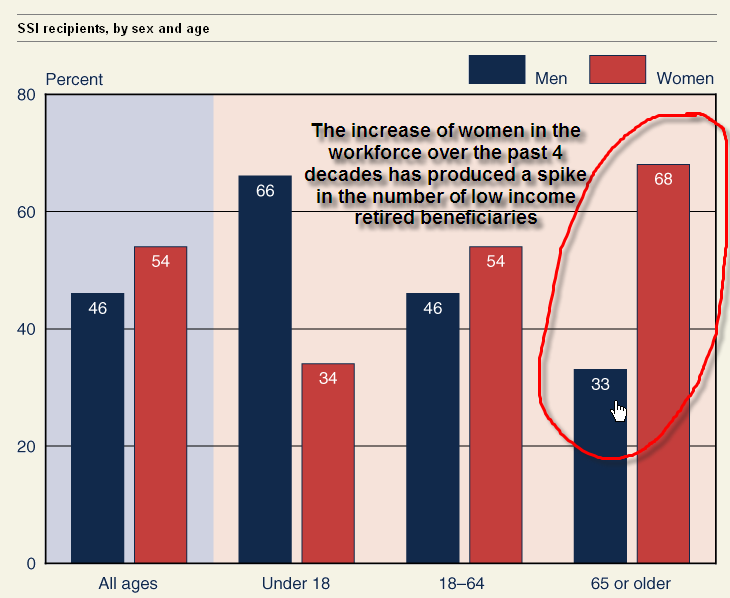
The number of retirees has doubled but the population has grown only 50%.  The growth of women in the workforce has contributed to the growth in retirees and in disability claims.

Most people receiving Social Security benefits of one type or another feel as though they entered a contract with the federal government.  In return for their Social Security taxes, retirees and the disabled are owed promised benefits from the federal government, just as one would expect from an insurance company. Likewise, veterans also feel that they entered a contract with the federal government when they risked their lives in defense of the country. In exchange for their service, the federal government made promises of benefits to veterans.  Too many Republican politicians are fond of lumping Social Security beneficiaries and veterans under the umbrella term of “entitlement” programs when the more proper term is one of obligation.  When someone buys a Treasury bond, they expect to be paid the value of the bond when it matures.  Is that person part of an “entitlement” program?  No.  The bond is a contractual obligation between the bondholder and the federal government.  Why should a bondholder be treated with any more or less respect than a person who has “lent” the government money throughout their working years through their Social Security taxes?  Neither Paul Ryan or Mitt Romney understand that, to many of us, an obligation is an obligation.  Period.

So I want to distinguish between obligation programs like Social Security, and entitlement programs.

What are more properly called entitlement programs are those programs for the unfortunate and the vulnerable, whose financial circumstances qualify them for some kind of income assistance program.  Many have paid little in income taxes over the years for any number of reasons.  Some are children, some don’t or can’t work, some work but make so little that they owe no taxes.  Some may have paid a good share of income taxes in the past but found themselves in a bad way in recent times.  There are a lot of programs: SNAP(food stamps), SSI (Supplementary Security Income), and TANF (traditionally called welfare), to name but a few.

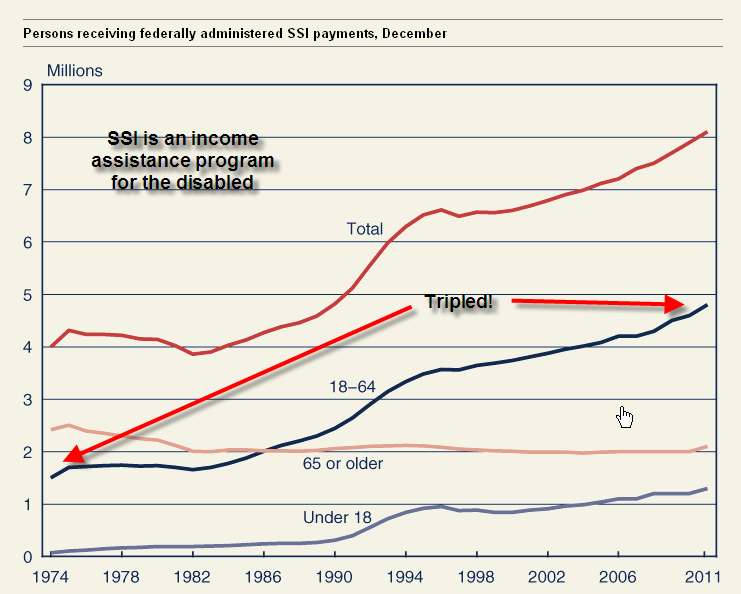
Let’s look at one program: SSI, an income assistance program for the blind, disabled and aged, whose beneficiaries comprise a mere 2.5% of the population.  The SSI program is paid out of general revenues, not Social Security taxes. In 2011, blind and disabled recipients made up 86% of the total of about 8 million. (Source)  The average monthly benefit is about $500. The cost of the program is about $50 billion, or 1.4% of total Federal expenditures. 2% of the cost of the SSI program includes vocational training and other back to work programs. When some politicians talk about reforms to “entitlement” programs, they know that some of these programs are small but they cite examples of abuse, of someone gaming the system, because they hope that you don’t know that the programs are small.  Vote them into office and what they really want to chop are the big obligation programs, Social Security and Medicare.

However, there are some legitimate concerns in these small programs; the number of SSI recipients has grown 33% in the past 17 years.

The number of disabled, aged 18 – 64, receiving income assistance under the SSI program has tripled in the past forty years, a growth rate six times that of the overall population. 

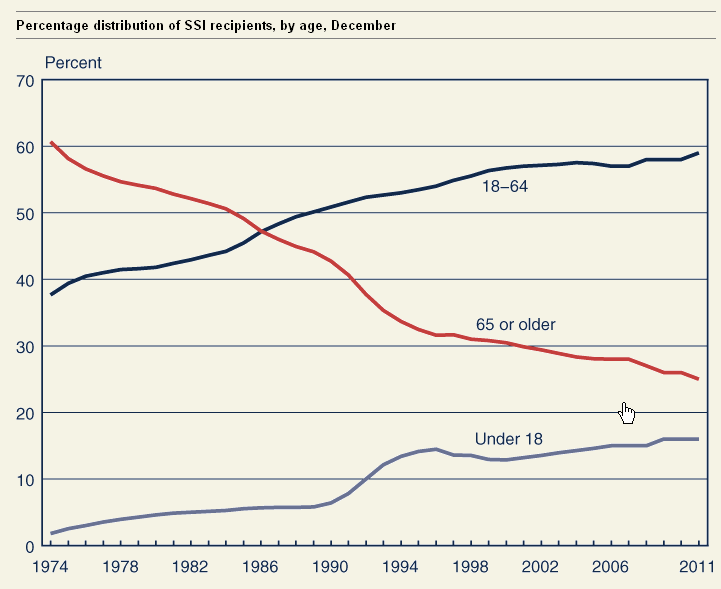
The SSI program also helps low income retirees, who have declined in real numbers by 15% in the past 16 years.

The percentage decline is explained partially by the explosive growth of the disabled who are younger than 65.  The number of women receiving SSI payments has also increased dramatically. 

Let’s look at another entitlement program that Mitt Romney and Paul Ryan have targeted in their stump speeches: SNAP or Food Stamps.  “45 million people on food stamps!” is the cry of either of these candidates to illustrate the runaway spending in entitlements and the poor economy.  What neither will tell you is that the program cost $78 billion in 2011 (CBO source).  That is 2.2% of Federal spending.  Whatever reforms these guys propose to this program will save a very small percentage of the budget.  In that same report, the CBO summarized the characteristics of those on the program: “three out of four SNAP households included a child, a person age 60 or older, or a disabled person. Most people who received SNAP benefits lived in households with very low income, about $8,800 per year on average in [2010].”  I can excuse Mitt Romney because he may not be aware of the numbers.  There is no excuse for Paul Ryan, who is the “budget-meister” and certainly knows that any savings to a program this small is chump change in a budget of $3600 billion. 

What both of them are counting on it that you don’t know that.  Their ultimate goal is to reform the big guy, Social Security, so that they can short change one type of federal obligation, Social Security recipients, to pay another obligation, the buyers of Treasury bonds.  Many of the large institutions that buy Treasury bonds are not suckers so Mr. Romney and Mr. Ryan turn to those with the least information – suckers who will vote for them.

Labor Report and Debate

A less than forceful President Obama appeared in Denver this past Wednesday at the first of three debates in the closing weeks before the November elections. (The Secret Service was rather more forceful, mandating a shut down of the main north-south highway through town during the debate.)  Republican contender Mitt Romney showed more preparation and assertiveness but unfortunately left some of the facts behind in his hotel room.  Neither candidate can look the truth in the face.  Mr. Obama’s repeated claim that his economic plan saves $4 trillion uses many discredited (even by his sympathizers) gimmicks to arrive at that figure and yet he continues to trot out the assertion.  Mr. Romney really wants us to believe that Congress is going to jeopardize their jobs by taking away popular tax deductions in order to pass his 20% rate cuts.  Congress will pass the rate cuts, which are good for re-election.  Take away the mortgage interest deduction?  We’re not betting on it, Mr. Romney.  The end result of his tax plan and his pledge to increase military spending would be a $2 trillion deficit, double the annual deficit we are currently running.

Mr. Obama continues to pledge his support for the middle class, many of whom continue to slide down from the middle middle class to the lower middle class on their way to upper lower class and downright poverty.  Mr. Obama spent much of the debate consulting his notes on supporting the middle class as though he were teaching a class on the subject.  Note to Mr. Obama: you are no longer in the classroom.  This is the real world.

There are any number of fact checks on claims by both Mr. Romney and Mr. Obama during the debate.  Here is a fairly short summary from several Associated Press writers.

Then Friday morning, the heavens parted and the voice of – no, not God – the Bureau of Labor Statistics issued forth in their monthly pronouncement on the state of the job market: “The unemployment rate decreased to 7.8 percent in September”.

Throughout the country millions of pundits, economists and average Joes and Bettys stopped in disbelief and reached for their ear trumpets.  Had they heard right, they wondered?  Tweet, tweet, tweet went the twittersphere.  Blah, blah, blah went the blogosphere.  Lies, lies, lies went the right wing cons over at Fox and dance, dance, dance went the lefties at MSNBC.  For the first time in his presidency, Mr. Obama has seen the unemployment rate drop below 8%.

Had a large number of people simply given up and left the work force, causing them not to be counted as unemployed?  This has been a characteristic of the decline in the unemployment rate earlier in the year.  But not this month. 

Was the number of jobs created particularly strong?  Not this month.  At 114,000, job growth was not strong or weak and probably not enough to keep up with population growth.  A third of that job growth was in the health care sector.  A nation that continues to show its greatest growth in taking care of an aging and poorer population is not building a foundation for sound long term economic growth.

Many of the unemployed simply did the best they could do – get a part time job.  The number of involuntary part timers increased by more than a half million this past month. From the BLS Employment Release:

“The number of persons employed part time for economic reasons (sometimes
referred to as involuntary part-time workers) rose from 8.0 million in August
to 8.6 million in September. These individuals were working part time because
their hours had been cut back or because they were unable to find a full-time
job.”

There are good and bad trends that cause the unemployment rate to fall.  The two most problematic of the bad trends are 1) unemployed people simply giving up, and 2) involuntary part timers.  We have now seen both of these trends this year.

The steep drop in discouraged workers contributed to the decline in the unemployment rate.

“Among the marginally attached, there were 802,000 discouraged workers in
September, a decline of 235,000 from a year earlier. (These data are not
seasonally adjusted.) Discouraged workers are persons not currently looking
for work because they believe no jobs are available for them.”

Below is a 10 year graph showing the level of discouraged workers. (Click to enlarge in separate tab)

Another contributing factor was the revision in the number of net jobs gained in the two previous months.

“The change in total nonfarm payroll employment for July was revised from
+141,000 to +181,000, and the change for August was revised from +96,000 to
+142,000.”  Last month, many were scratching their heads when the BLS released their August report showing a dramatically lower number of jobs gained than reported by the payroll processing company ADP. It seems that some companies may have been too busy hiring to fill out and turn in their August BLS survey form.

Discouraged workers comprise part of a larger total of 6.4 million people who want a job but have not actively looked for one in the past 4 weeks.  A year ago, in Sept. 2011, the figure was 5.9 million.

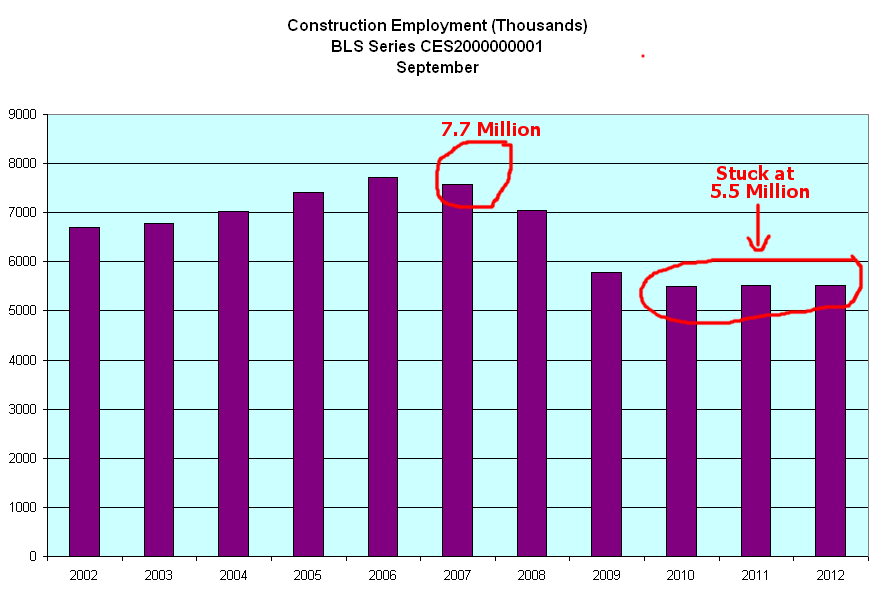
Homebuilder stocks have been on a tear this year but construction employment, at 5.5 million, has barely budged in the past 3 years.

The core work force, those aged 25 – 54, continue to show some improvement but still have not reached the post-recession level of late 2009.

In the larger work force, aged 25 and up, the number of employed has risen almost to pre-recession levels, indicating that there are more older people continuing to work when they can – at full or part time jobs. 

As the population ages, so too does the work force – a natural demographic change.  But older workers are not stepping aside for young workers just entering the work force.  Those who can work do so to compensate for the lackluster growth or decline of retirement funds and declining property values, the two chief sources of wealth that a person builds over a lifetime of work. Below is a graph of workers aged 55 and older.

The number of hours worked per week edged up slightly – a good sign.  But – “over the past 12 months, average hourly earnings have risen by 1.8 percent, ” the BLS report notes, indicating that family earnings are just not keeping up with inflation.

On the bright side, we are doing better than much of Europe which is probably already in recession.  Returning to the topic of debates, did we hear either candidate offer a recovery plan for … not this past recession but the one that will probably occur during the next Presidential term.  “What!!!???” you say, “we haven’t even gotten out of this past recession!”  The law of averages, like the law of gravity, is a pesky, problematic force of nature.  The 1960s and the 1990s are the only two decades in the past century where we did not witness a recession within an eight year period (Source), yet few Presidential candidates dare to discuss the eventuality of such a thing.  Even the Congressional Budget Office does not factor in recessions to their ten year budget projections unless the recession is ongoing.  As the Presidential contender, Mr. Romney must play the part of the man with a plan.  After four years, Mr. Obama probably understands that “hope and change” is little more than rousing rhetoric; that the President must steer the raft through dangerous currents without capsizing or losing any passengers, while the other political party rocks the raft enough to make his task even more difficult.  Should Mr. Romney win the Presidency, he will discover the same sobering truth.

We Are Young

There are many conflicting opinions and studies regarding the effect that the minimum wage (MW) has on employment, particularly the employment of teens who often work at jobs that pay MW.  Some studies show an increase in employment of teenage workers after the MW is increased.  Some show a decrease, some show no change.  A 2006 paper by two economists at the University of California reviewed early studies of MW prior to 1982 and those after 1990.  Methodologies, correlations and conclusions in one study are criticized in another study.  Reading just the first six pages of the 150 page paper will give you a sense of the arguments.

How many people does the MW affect?  Is it only those making the MW or does it also include those making just above MW?  What is the effect on the local economy as well as local employment?  Whatever you want to claim about MW, you can probably find a study in this area that will backup your claim.  What we can know for certain is that the MW has declined in real dollars over the past 50 years.  Using MW data  from the Dept of Labor and a CPI calculator from the Bureau of Labor Statistics, I have graphed the minimum wage in both current dollars and real inflation-adjusted dollars.

From 1963 to 2012, the MW has fallen 17%.  The unemployment rate for teens aged 16 – 19 stays stubbornly near 25%.

The unemployment rate for those aged 20 – 24 years has been steadily declining since late 2010 but has ticked up in the past few months.

Low wages and high unemployment breed a sense of futility in young people entering the work force.  During the late sixties and early seventies, the prospect of being drafted into the Vietnam War prompted many high school male graduates to go to college to gain a student deferment from the war.  Almost fifty years later, this generation of high school graduates – both men and women – feel the pressure of having to go to college to escape the bleak job prospects of this labor market.  As I wrote last week, older people are continuing to hold onto jobs, making it doubly difficult for young people entering the labor market supply chain.  Few young people can comprehend the multi-decade generational employment mechanism.  In our late teens and early twenties, we first step on the slow moving employment escalator, gaining experience, knowledge and judgment as we work for relatively low wages.  During our working years we build our skills and the amount of money our labor can command.  For too many young people waiting to step on this job escalator, the escalator is broken.  Each year more young people gather at the base of the escalator and wait.